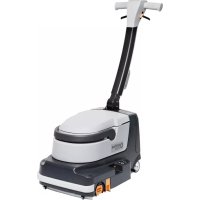
SR 1000S B - Scrubber NILFISK - Free user manual and instructions
Find the device manual for free SR 1000S B NILFISK in PDF.


| Product type | Scrubber dryer (vacuum sweeper) |
| Brand | Nilfisk |
| Model | SR 1000S B |
| Dimensions (L x W x H) | 1 255 x 795 x 1 155 mm |
| Weight without batteries | 143.89 kg |
| Washing width (with side brushes) | 1 000 mm |
| Washing width (without side brushes) | 600 mm |
| Waste container capacity | 40 liters |
| Maximum speed (forward / reverse) | 5.5 km/h / 4.4 km/h |
| Maximum climbable slope | 2 % |
| Minimum turning radius | 983 mm |
| Battery voltage | 24 V | Central brush and vacuum motor | 600 W |
| Side brush motor | 60 W |
| Traction motor | 400 W |
| Sound pressure level | 71.6 dB(A) |
| Filtration surface | 3 m² |
| Filter type | Paper (standard) or polyester (optional) |
| Compatible battery types | Lead-acid (WET) or Gel (GEL) |
| Battery capacity | 100 - 240 Ah C5 |
| Safety features | Emergency stop button, seat microswitch, hood safety switch |
| Shaker function | Yes, for filter cleaning |
| Scheduled maintenance | Every 10, 50, 100, 200, 400 hours (according to procedure) |
| Optional accessories | Gel batteries, electronic charger, manual vacuum, work lights, etc. |
| Spare parts | Available from Nilfisk-Advance (specify model and serial number) |
Frequently Asked Questions - SR 1000S B NILFISK
User questions about SR 1000S B NILFISK
0 question about this device. Answer the ones you know or ask your own.
Ask a new question about this device
Download the instructions for your Scrubber in PDF format for free! Find your manual SR 1000S B - NILFISK and take your electronic device back in hand. On this page are published all the documents necessary for the use of your device. SR 1000S B by NILFISK.
USER MANUAL SR 1000S B NILFISK
Authorized signatory: Franco Mazzini, General Mgr
Date:
Signature:
EINLEITUNG 2
ACCESSIONS / OPTIONS 7
UTILISATION 8
CONTROLE / PREPARATION DES BATTERIES SUR UNE MACHINE NEUVE 8
CONFIGURATION DU TYPE DE BATTERIES INSTALLLEES (WET ou GEL) 9
AVANT LA MISE EN MARCHE 9
MISE EN MARCHE ET ARRET DE LA MACHINE 9
MACHINE AU TRAVAIL 10
VIDANGE DU CONTENEUR DECHETS 10
APRES L'UTILISATION DE LA MACHINE 10
MOUVEMENT PAR POUSSEE / REMORQUAGE DE LA MACHINE 10
INACTIVITE PROLONGEE DE LA MACHINE 10
PREMIERE PERIODE D'UTILISATION 10
ENTRETIEN 11
PLAN RECAPITULATIF D'ENTRETIEN PROGRAMME 11
CONTROLE ET REGLAGE DE LA HAUTEUR DU BALAI CENTRAL 12
REEMPLACEMENT DU BALAI CENTRAL 12
CONTROLE ET REGLAGE DE LA HAUTEUR DES BALAIS LATERAUX 13
REEMPLACEMENT DES BALAIS LATERAUX 13
NETTOYAGE ET CONTROLE DE L'INTEGRITE DU FILTRPOUSSIERES A POCHES 13
CONTROLE DE LA HAUTEUR ET DU FONCTIONNEMENT DES VOLETS 14
CONTROLE DU FONCTIONNEMENT DE L'INTERRUPTEUR DE SECURITE
OUVERTURE DU COFFRE 14
CHARGEMENT DES BATTERIES 14
FONCTIONS DE SECURITE 16
BOUTON-POUSSOIR D'URGENCE 16
INTERRUPTEUR DE SECURITE OUVERTURE DU COFFRE 16
MICROINTERRUPTEUR DU SIEGE DE CONDUITE 16
DEPISTAGE DES PANNES 16
MISE EN DECHARGE 16
INTRODUCTION
BUT ET CONTENU DU MANUEL
CONSERVATION DU MANUEL
ACCESSIONS / OPTIONS
REEMPLACEMENT DU BALAI CENTRAL

REMARQUE
MANUAL PURPOSE AND CONTENTS 2
TARGET 2
HOW TO KEEP THIS MANUAL 2
CONFORMITY CERTIFICATE 2
IDENTIFICATION DATA 2
OTHER REFERENCE MANUALS 2
SPARE PARTS AND MAINTENANCE 2
CHANGES AND IMPROVEMENTS 2
SAFETY 3
SYMBOLS 3
GENERAL INSTRUCTIONS 3
UNPACKING/DELIVERY 4
MACHINE DESCRIPTION 5
ACCESSIONS/OPTIONS 7
USE 8
BATTERY CHECK/SETTING ON A NEW MACHINE 8
WET OR GEL BATTERY SETTING 9
BEFORE MACHINE START-UP 9
MACHINE START AND STOP 9
FIRST PERIOD OF USE 10
MAINTENANCE 11
SCHEDULED MAINTENANCE TABLE 11
MAIN BROOM HEIGHT CHECK AND ADJUSTMENT 12
MAIN BROOM REPLACEMENT 12
SIDE BROOM HEIGHT CHECK AND ADJUSTMENT 13
SIDE BROOM REPLACEMENT 13
CLOSED POCKET FILTER CLEANING AND INTEGRITY CHECK 13
HOOD SAFETY SWITCH 16
DRIVER'S SEAT MICROSWITCH 16
TROUBLESHOOTING 16
SCRAPPING 16
INTRODUCTION
MANUAL PURPOSE AND CONTENTS
The purpose of this Manual is to provide the operator with all necessary information to use the machine properly in a safe and autonomous way.
It contains information about technical data, operation, storage, maintenance, spare parts and safety.
Before carrying out any procedure on the machine, the operators and qualified technicians must read this Manual carefully. Contact Nilfisk-Advance in case of doubts regarding the interpretation of the instructions and for any further information.
TARGET
This Manual is intended for operators and technicians qualified to perform the machine maintenance.
The Operators must not carry out operations reserved for qualified Technicians. Nilfisk-Advance will not be answerable for damages coming from the non-observance of this prohibition.
HOW TO KEEP THIS MANUAL
The User Manual must be kept near the machine, inside an adequate case, away from liquids and other substances that can cause damage to it.
CONFORMITY CERTIFICATE
Figure A shows the documentation certifying the sweeper conformity with the law in force.

NOTE
Two copies of the original EC Declaration of Conformity are provided together with the machine documentation.
IDENTIFICATION DATA
The machine model and serial number are marked on the plate (1, Fig. U) applied on the frame and can be read by lifting the hood (10, Fig. C).
The machine model year is written in the EC statement and it is also indicated by the first two figures of the machine serial number.
This information is useful when ordering machine spare parts. Use the following table to write down the machine identification data for any further reference.
MACHINE model
MACHINE serial number
OTHER REFERENCE MANUALS
Electronic Battery Charger Manual (if equipped), to be considered an integral part of this Manual
Moreover, the following Manuals are available:
- Spare Parts List (supplied with the machine)
Service manual (that can be consulted at Nilfisk-Advance Service Centers)
SPARE PARTS AND MAINTENANCE
All necessary operating, maintenance and repair procedures must be carried out by qualified personnel or by
Nilfisk-Advance Service Centers listed at the end of this Manual. Only original spare parts and accessories must be used.
Contact Nilfisk-Advance for service or to order spare parts and accessories, specifying the machine model and serial number.
CHANGES AND IMPROVEMENTS
Nilfisk-Advance constantly improves its products and reserves the right to make changes and improvements at its discretion without being obliged to apply such benefits to the machines that were sold previously.
Any change and/or addition of accessory must be approved and performed by Nilfisk-Advance.
SAFETY
The following symbols indicate potentially dangerous situations. Always read this information carefully and take all necessary precautions to safeguard people and property. The machine Operator's cooperation is essential in order to prevent injury. No accident prevention program is effective without the total cooperation of the person responsible for the machine operation. Most of the accidents that may occur in a factory, while working or moving around, are caused by failure to comply with the simplest rules for exercising prudence. A careful and prudent operator is the best guarantee against accidents and is essential for successful completion of any prevention program.
SYMBOLS

DANGER!
It indicates a dangerous situation with risk of death for the operator.

WARNING!
It indicates a potential risk of injury for people.

CAUTION!
It indicates a caution or a remark related to important or useful functions. Pay attention to the paragraphs marked by this symbol.

NOTE
It indicates that it is necessary to consult the User Manual before performing any procedure.
GENERAL INSTRUCTIONS
Specific warnings and cautions to inform about potential damages to people and machine are shown below.

DANGER!
- Remove the key from the ignition switch and disconnect the batteries before performing any maintenance/repair procedure.
- This machine must be used by properly trained and authorised personnel only. Children or disabled people cannot use this machine.
- Keep sparks, flames and incandescent materials away from the batteries. During the normal operation explosive gases are released.
-
Do not wear jewels when working near electrical components.
-
Do not work under the lifted machine, if it is not securely fixed.
- Do not operate the machine near toxic, dangerous, flammable and/or explosive powders, liquids or vapours.
- Battery charging produces highly explosive hydrogen gas. Keep the hood open during battery charging and perform this procedure in well-ventilated areas and away from naked flames.

WARNING!
- Carefully read all the instructions before carrying out any maintenance/repair procedure.
Take all necessary precautions to prevent hair, jewels and loose clothes from being caught in the moving parts of the machine. - Do not smoke while charging the batteries.
Before connecting the battery charger to the electrical mains, make sure that frequency and voltage shown in the relevant Manual correspond to the mains voltage. - Do not charge the batteries if the battery charger cable or the plug are damaged. If the machine is not working as it should, has been damaged, left outdoors or dropped into water, return it to the Service Centre.
- Do not pull or carry the machine by the battery charger cable and never use the battery charger cable as a handle. Do not close a door on the battery charger cable, or pull the battery charger cable around sharp edges or corners. Do not run the machine on the battery charger cable.
- Keep the battery charger cable away from heated surfaces.
- To reduce the risk of fire, electric shock, or injury, do not leave the machine unattended when it is plugged in.
- To avoid electric shock, do not expose to rain. Store the machine indoors.
- Do not allow to be used as a toy. Close attention is necessary when used near children.
Use only as described in this Manual. Use only Nilfisk-Advance recommended accessories. - Do not leave the machine unattended with the key inserted in the ignition switch and the parking brake disengaged.
-
Do not use the machine on slopes with a gradient exceeding the value shown on the machine.
-
Do not wash the machine with direct or pressurised water jets, or with corrosive substances. Do not use compressed air to clean this type of machine.
- Do not use the machine in particularly dusty areas.
While using this machine, take care not to cause damage to other people, and children especially. - The storage temperature must be between 0^ and +40^ .
- The machine operating temperature must be between 0^ and +40^ .
The humidity must be between 30% and 95% .
Always protect the machine against the sun, rain and bad weather, both under operation and inactivity condition. - Do not use the machine as a means of transport.
- Do not allow the brooms to operate while the machine is stationary to avoid damaging the floor.
In case of fire, possibly use a powder fire extinguisher, not a water one. - Do not bump into shelves or foldings, especially where there is a risk of falling objects.
- Adjust the operation speed to suit the floor conditions.
- Do not tamper with the machine safety guards and follow the ordinary maintenance instructions scrupulously.
- Do not remove or modify the plates affixed to the machine.
In case of machine malfunctions, ensure that these are not due to lack of maintenance. Otherwise, request assistance from the authorised personnel or from an authorised Service Center.
In case of part replacement, order ORIGINAL spare parts from an authorised Dealer or Retailer. - To ensure the proper and safe operation of the machine, have the scheduled maintenance, detailed in the relevant chapter of this Manual, performed by the authorised personnel or an authorised Service Center.
- The machine must be disposed of properly, because of the presence of toxic-harmful materials (batteries, oils, etc.), which are subject to standards that require disposal in special centres (see the Scrapping chapter).
- If the machine is used according to the instructions, the vibrations do not cause dangerous situations. The machine vibration level is less than 2.5 ~m / s^2 (98/37/EEG-EN-1033/1995-EN 1032).
- When lead (WET) batteries are installed, do not tilt the machine for more than 30^ from the horizontal plane to prevent the highly corrosive acid from leaking out of the batteries. When the machine is to be tilted to perform maintenance procedures, remove the batteries.
UNPACKING/DELIVERY
Upon delivery carefully check that the machine and its packing have not been damaged during transportation. In case of visible damages, keep the packing and have it checked by the Carrier that delivered it. Call the Carrier immediately to fill in a damage claim.
Check that the machine is equipped as follows.
Technical documents:
- Sweeper User Manual
Electronic Battery Charger Manual (if equipped) - Sweeper Spare Parts List
MACHINE DESCRIPTION
This sweeper has been designed and built to clean (by sweeping and vacuuming) smooth and solid floors, in civil and industrial environments and to collect dust and light debris under safe operation conditions by a qualified operator.
CONVENTIONS
Forward, backward, front, rear, left or right are intended with reference to the operator's position, that is to say on the driver's seat with the hands on the handlebar (1, Fig. C).
DESCRIPTION
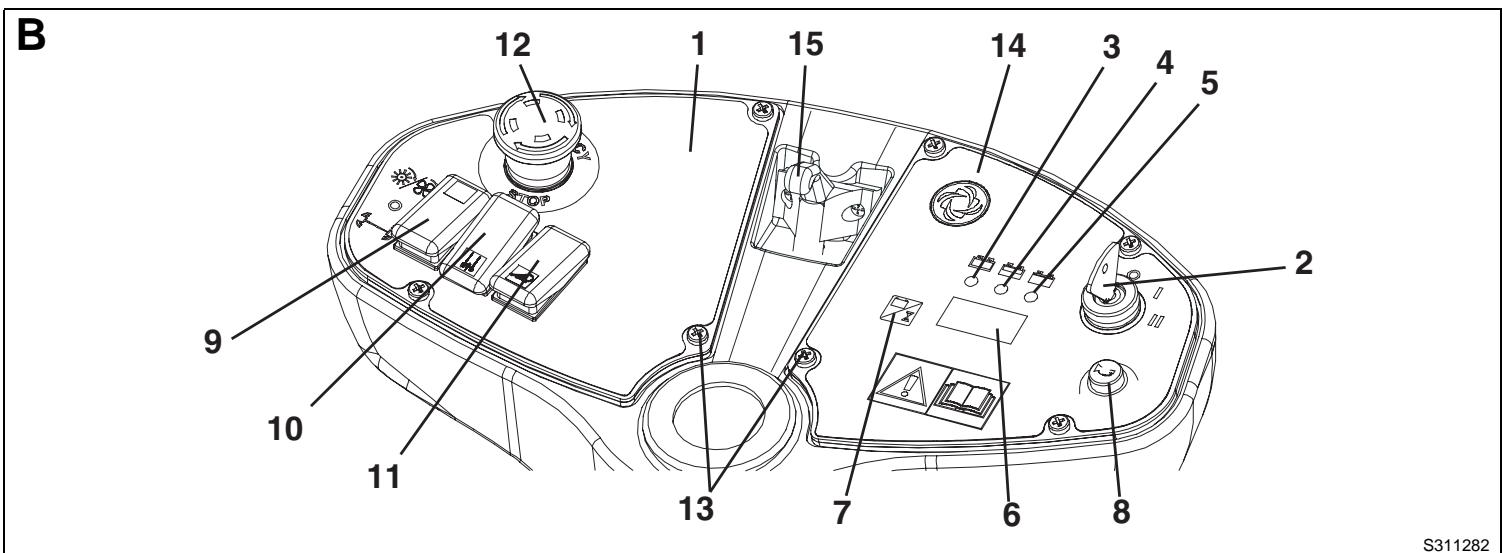
Control panel
(See Fig. B)
- Left control panel
- Ignition switch
- Discharged battery warning light (red)
- Semi-discharged battery warning light (yellow)
- Charged battery warning light (green)
- Display
- Display selection push-button: hour counter/hour and minute counter/battery voltage (V)
- Horn
-
Switch having the following functions:
-
in the central position: off
- pushed forward (fixed): it turns on the main broom and the vacuum fan
-
pushed backward (not fixed): it turns on the filter shaker
-
Manual vacuum system switch (optional)
-
Working light switch (optional)
- Emergency push-button
- Control panel mounting screws
- Right control panel
- Steering column inclination adjusting lever
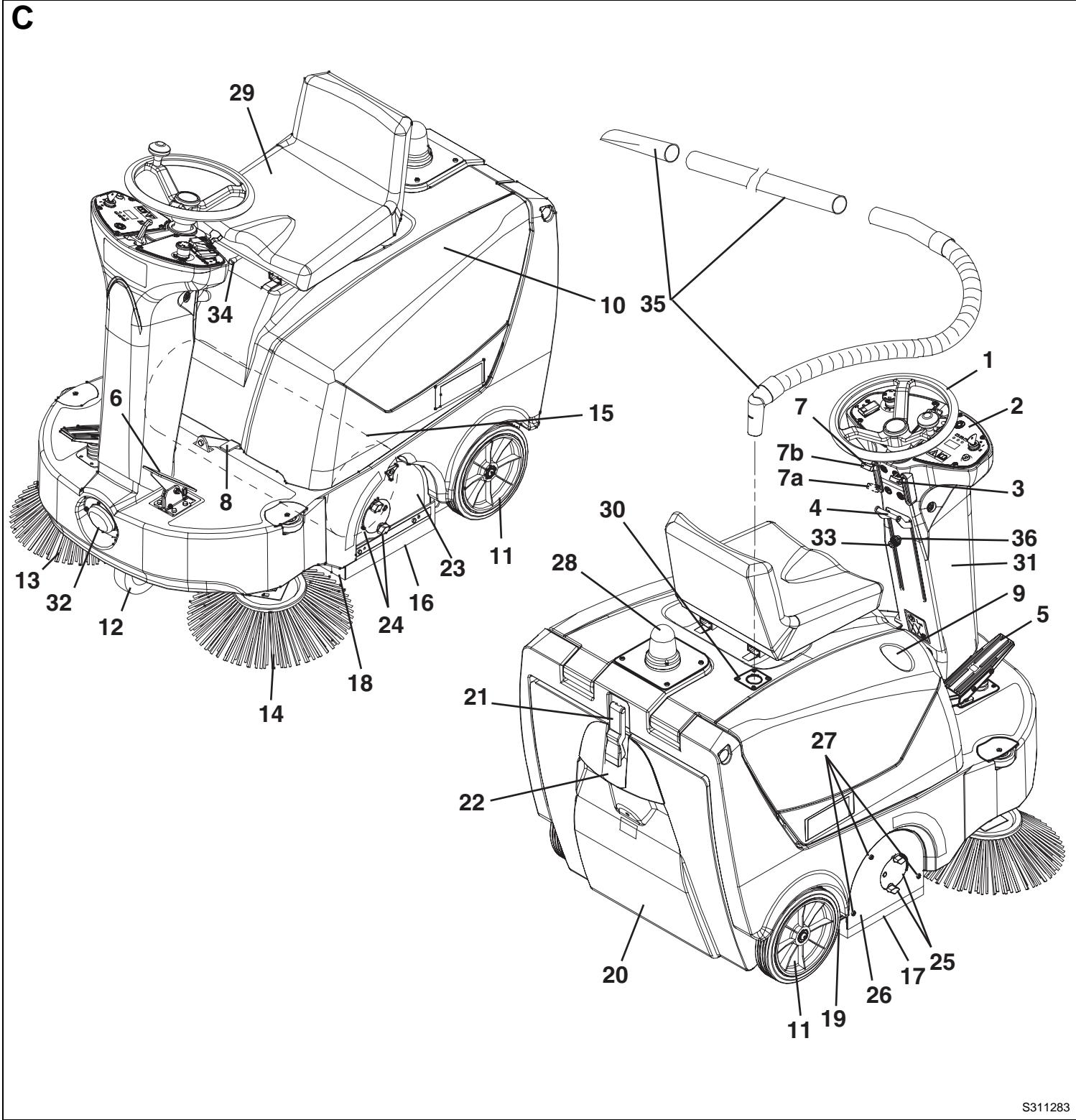
Outside view
(See Fig. C)
- Steering wheel
- Control panel
- Vacuum activation/deactivation lever
- Side broom lifting/lowering lever
- Forward/reverse gear pedal
- Service brake pedal
- Parking brake lever (it acts on the front wheel)
7a. Brake engaged
7b. Brake disengaged - Front skirt lifting pedal
- Can holder
- Hood
- Rear wheels on fixed axle
- Front driving and steering wheel
- Right side broom
- Left side broom
- Main broom
- Left side skirt
- Right side skirt
- Front skirt
- Rear skirt
- Hopper
- Hopper hook
- Hopper handle
- Main broom left door
- Main broom height left adjusting knob
- Main broom height right adjusting knob
- Main broom right door
- Main broom right door mounting screws
- Pivoting light (always on when the ignition switch is turned to "I" position) (optional)
- Driver's seat with safety microswitch
- Additional hole for manual vacuum system (optional)
- Adjustable steering column
- Working light (optional)
- Side broom height adjusting knob
- Seat longitudinal position adjusting lever
- Manual vacuum system (optional)
- Side broom height adjusting knob ring nut
Under-hood compartment (See Fig. U)
- Serial number plate/technical data/EC certification
- Hood (open)
- Hood support rod
- Batteries
- Battery caps (for WET batteries)
- Battery connector
- Electronic battery charger (optional)
- Battery charger connecting cable
- Lamellar fuse box (accessories)
- Drive system circuit breaker
- Main broom/vacuum fan motor circuit breaker
- Lead (WET) or gel (GEL) battery selector switch on the optional electronic battery charger
- Charged battery warning light (green)
- Main broom belt
- Main broom drive pulley
- Vacuum fan
- Main motor
- Manual vacuum system (optional)
- Switch for machine pushing
- Battery installation diagrams
TECHNICAL DATA
| General | Values |
| Machine length | 1,255 mm |
| Machine width (without side brooms) | 795 mm |
| Machine height | 1,155 mm |
| Working width (with/without side brooms) | 1,000/600 mm |
| Minimum height from the ground (skirts not included) | 40 mm |
| Minimum turning radius | 983 mm |
| Main broom size | Ø 265 mm x 600 mm |
| Side broom size | Ø 420 mm |
| Front driving and steering wheel | Ø 200 x 50 mm |
| Rear wheels | Ø 250 x 50 mm |
| Machine weight (without batteries) | 143.89 kg |
| Maximum forward/reverse speed | 5.5 km/h / 4.4 km/h |
| Gradeability | 2% |
| Hopper capacity | 40 litres |
| Main broom and vacuum fan motor | 600 W |
| Side broom motors | 60 W |
| Drive system motor | 400 W |
| Filter shaker motor | 12 W |
| Sound pressure level (A Lpa) | 71.6 dB (A) |
| Batteries | Values |
| Battery voltage | 24 V |
| Standard battery | Lead (WET), with acid electrolyte |
| Optional battery | Gel (GEL), hermetic |
| Battery capacity | 100 – 240 Ah C5 |
| Battery compartment maximum size | 357x375x385 mm |
| Dust vacuuming and filtering | Values |
| Paper dust filter 5-10 μm | 3 m² |
| Main broom compartment vacuum | 18.3 mm H₂O |
Wiring diagram (See Fig. V)
BAT: Batteries
BE1: Pivoting light
BZ1: Reverse gear buzzer
C1: Battery connector
CH1: Battery charger
EB1: Hour counter and battery voltage display
EB2: Drive system electronic board
ES0: Starting relay
ES1: Main broom switch
ES2: Filter shaker relay
ES3: Manual vacuum system switch
FA: Main broom/vacuum fan fuse
FL: Drive system electronic board fuse (3 A)
FT: Drive system fuse
F1: Main fuse (ignition switch circuit) (25 A)
F2: Filter shaker motor fuse (25 A)
F3: Manual vacuum system fuse (40 A) (optional)
F4: Horn and pivoting light fuse (10 A) (optional)
F5: Working light fuse (10 A) (optional)
F6: Side broom motor fuse (10 A)
HN1: Horn
K1: Ignition switch
L1: Working light (optional)
M1: Main broom motor
M2: Drive system motor
M3: Filter shaker motor
M4: Right side broom motor
M5: Left side broom motor
M6: Manual vacuum system motor (optional)
P1: Horn switch
R1: Drive speed potentiometer
SWC: Hood safety switch
SWS: Emergency push-button
SW1: Main broom, vacuum fan and filter shaker switch
SW2: Driver's seat safety microswitch
SW3: Forward/reverse gear microswitch
SW4: Side broom microswitch
SW5: Drive system switch
SW6: Manual vacuum system switch (optional)
SW7: Working light switch
Colour code
BK: Black
BU: Blue
BN: Brown
GN: Green
GY: Grey
OG: Orange
PK: Pink
RD: Red
VT: Violet
WH: White
YE: Yellow
Electrical fuses
The following fuses are located under the hood (10, Fig. C):
Circuit breakers, which can be reset by pressing the relevant key:
Drive system fuse (11, Fig. U)
-
Main broom/vacuum fan motor fuse (10, Fig. U)
-
Lamellar fuses, protected by a transparent plastic cover (9, Fig. U), which protect the following circuits:
-
Fuse F1 (25 A): Main fuse (ignition switch circuit)
-
Fuse F2 (25 A): Filter shaker motor
-
Fuse F3 (40 A): Manual vacuum system (optional)
-
Fuse F4 (10 A): Horn and pivoting light
-
Fuse F5 (10 A): Working light (optional)
-
Fuse F6 (10 A): Side broom motors
-
Fuse F7 (25 A): Spare
-
Fuse F8 (10 A): Spare
-
On the drive system electronic board there is the following fuse:
Drive system electronic board fuse (3 A)
ACCESSORIES/OPTIONS
In addition to the standard components, the machine can be equipped with the following accessories/options, according to the machine specific use:
GEL batteries
Electronic battery charger
- Main and side brooms with harder or softer bristles
- Antistatic polyester or polyester BIA C dust filter
- Manual vacuum system
Working light
Pivoting light
Skirts of various materials
For further information concerning the optional accessories, contact an authorised Retailer.
USE

WARNING!
On some points of the machine there are some adhesive plates indicating:
DANGER
-WARNING
- CAUTION
- NOTE
While reading this Manual, the operator must pay particular attention to these symbols.
Do not cover these plates for any reason and immediately replace them if they are damaged.
BATTERY CHECK/SETTING ON A NEW MACHINE
The machine requires two 12 V batteries or four 6 V batteries connected according to the diagrams (20, Fig. U).
The machine can be supplied in one of the following modes:
a. WET or GEL batteries already installed on the machine
- Open the machine hood (10, Fig. C) and engage the hood support rod (3, Fig. U), then check that the batteries are connected to the machine with the connector (6, Fig. U).
- Disengage the support rod and close the hood. Check that the hood is properly closed (the machine must be as shown in Fig. C).
- Insert the key into the ignition switch (2, Fig. B) and turn it to "II" position (without pressing the pedal (5, Fig. C)), then release it. If the green warning light (5, Fig. B) turns on, the batteries are ready to be used. If the yellow (4, Fig. B) or red (3, Fig. B) warning light turns on, it is necessary to charge the batteries (see the relevant procedure in the Maintenance chapter).
b. WET batteries installed on the machine but without electrolyte
- Open the machine hood (10, Fig. C) and engage the hood support rod (3, Fig. U).
- Remove all battery caps (5, Fig. U).

WARNING!
Pay attention when using sulphuric acid, as it is corrosive. If it comes in contact with skin or eyes, rinse thoroughly with water and consult a physician.
Batteries have to be filled in a well-ventilated area.
Wear protective gloves.
- Fill the battery cells (or elements) with sulphuric acid for batteries (density from 1.27 to 1.29kg at 25^ ) in accordance with the instructions shown in the Battery Manual. The correct quantity of sulphuric acid is shown in the Battery Manual.
- Let the batteries rest and fill in with sulphuric acid in accordance with the instructions shown in the Battery Manual.
- Charge the batteries (see the procedure in the Maintenance chapter).
c. Without batteries
- Buy appropriate batteries (See the Technical Data chapter and the diagrams (20, Fig. U)). For the battery choice and installation, apply to qualified battery Retailers.
- Install the batteries.
- Set the machine and the battery charger (if equipped) according to the type of batteries installed, according to the procedure shown in the following paragraph.
WET OR GEL BATTERY SETTING
According to the type of batteries (WET or GEL), set the electronic board of the machine and of the battery charger (if equipped), according to the following procedure:
- Turn the ignition switch (2, Fig. B) to "0" position.
- Open the hood (10, Fig. C) and engage the hood support rod (3, Fig. U).
Machine setting
The machine factory setting is for lead (WET) batteries. If this setting corresponds to the type of batteries installed on the machine, go to the next paragraph, otherwise perform the following procedures:
- Disconnect the battery connector (6, Fig. U).
- Remove the screws (13, Fig. B) and carefully remove the right control panel (14).
Install a jumper wire (1, Fig. T) on the GEL connectors (3) for gel batteries. - Carefully install the control panel (14, Fig. B) and the screws.
- Reconnect the battery connector (6, Fig. U).
Battery charger setting
- Turn the selector switch (12, Fig. U) to WET or GEL according to the type of batteries.
- Charge the batteries (see the procedure in the Maintenance chapter).
BEFORE MACHINE START-UP

CAUTION!
Make sure that there are no open doors/woods and that the machine is in normal operating conditions.
Make sure that the hopper (20, Fig. C) is properly closed.
If the machine has not been used after being transported, check that all the blocks used for the transportation have been removed.
MACHINE START AND STOP
Starting the machine
- Sit on the driver's seat (29, Fig. C) and, if it is necessary for an easier access to the machine, push the lever (15, Fig. B) and tilt the steering column (31, Fig. C) forward.
- Push the lever (15, Fig. B) forward and tilt the steering column (31, Fig. C) forward or backward, to reach a comfortable position. Then release the lever (15, Fig. B) and lock the steering column.
- Without pressing the drive pedal (5, Fig. C), turn the ignition switch (2, Fig. B) to "I" position, then release it; it will go back to "I" position. Check that the green warning light (5, Fig. B) (charged battery) turns on. If the yellow or red warning light (3 or 4, Fig. B) turns on, turn the ignition switch back to "0" position and charge the batteries (see the procedure in the Maintenance chapter).
-
Disengage the parking brake according to the following procedure:
-
Press the pedal (6, Fig. C) and turn the lever (7, Fig. C) from (7a) position to (7b) position.
-
Release the pedal (6).
-
Drive the machine to the working area, by keeping the hands on the steering wheel and pressing the pedal (5, Fig. C) on the front side to move forward and on the rear side to move backward. The drive speed can be adjusted from zero to maximum speed by increasing the pressure on the pedal (5, Fig. C).

NOTE
The seat (29, Fig. C) is equipped with a safety sensor, which allows the machine to be driven by pressing the pedal (5, Fig. C) only when the operator is on the driver's seat.
- Turn on the main broom and the vacuum fan by pressing the switch (9, Fig. B) forward.
- Turn on the vacuum system with the lever (3, Fig. C).
- Lower the side brooms (13 and 14, Fig. C) by lowering the lever (4).

NOTE
The side brooms (13 and 14, Fig. C) can be lowered and lifted even when the machine is moving. The side brooms do not rotate when they are lifted, but they rotate when they are lowered.
- Start sweeping by turning the steering wheel (1, Fig. C) and move the machine forward by pressing the pedal (5).
Stopping the machine
-
To stop the machine, release the pedal (5, Fig. C). To stop the machine more quickly, also press the service brake pedal (6, Fig. C). In case of emergency, press the emergency push-button (12, Fig. B) to immediately stop the machine. To deactivate the emergency push-button (12), turn it clockwise.
-
Lift the side brooms (13 and 14, Fig. C) by using the lever (4).
-
To turn off the main broom and the vacuum fan, turn the switch (9, Fig. B) to "0" (central) position.
-
To stop the machine, turn the ignition switch (2, Fig. B) to "0" position.
-
Engage the parking brake according to the following procedure:
-
Press the pedal (6, Fig. C) as necessary, then engage the brake by turning the lever (7, Fig. C) from (7b) position to (7a) position.
- Release the pedal (6).
MACHINE OPERATION
- Avoid stopping for a long time with the machine in the same position and the brooms rotating: this could create unwanted marks on the floor.
- To collect light and bulky debris, lift the front skirt by pressing the pedal (8, Fig. C); remember that while the front skirt is lifted, the machine vacuum power decreases.

WARNING!
When operating on wet grounds, it is essential to turn off the vacuum system with the lever (3, Fig. C) to prevent the dust filter from being damaged.
- For machine proper operation, the dust filter must be as clean as possible. To keep the dust filter clean while sweeping, turn off the vacuum system with the lever (3, Fig. C), then press the switch (9, Fig. B) for a while. During this procedure the main motor and the vacuum fan are automatically stopped.
After cleaning the filter, push the switch (9, Fig. B) forward to turn on the main broom and the vacuum system, then start sweeping again.
While working, repeat the procedure every 10 minutes on average (depending on the dustiness of the area to be cleaned).

NOTE
When the dust filter is clogged and/or the hopper is full, the machine cannot collect dust and debris anymore.
- The hopper (20, Fig. C) should be dumped after each working period and whenever it is full (see the procedure in the next paragraph).
HOPPER DUMPING
- Stop the machine by releasing the drive pedal.
- Turn the ignition switch (2, Fig. B) to "0" position.
- Disengage the hook (21, Fig. C) by pulling its lower end.
- Remove the hopper (20, Fig. C) by using the handle (22), and dump it into special containers.
- Reinsert the hopper and fasten it with the hook (21).
- The machine is ready to start working again.
AFTER MACHINE USE
After working, before leaving the machine:
- Lift the side brooms with the lever (4, Fig. C).
Turn on the filter shaker with the switch (9, Fig. B).
Dump the hopper (20, Fig. C) (see the previous paragraph). - Remove the key from the ignition switch (2, Fig. B).
-
Engage the parking brake according to the following procedure:
-
Press the pedal (6, Fig. C) as necessary, then engage the brake by turning the lever (7, Fig. C) from (7b) position to (7a) position.
- Release the pedal (6).
To easily push/tow the machine when it is off, proceed as follows:
- Open the hood (10, Fig. C).
- Turn the switch (19, Fig. U) to "0" and close the hood (10, Fig. C).
Push or tow the machine.
After pushing/towing the machine, turn the switch (19, Fig. U) to "I".
MACHINE LONG INACTIVITY
If the machine is not going to be used for more than 30 days, proceed as follows:
- Check that the machine storage area is dry and clean.
- Disconnect the battery connector (6, Fig. U).
Slightly lift the machine so that the skirts, the main broom and the wheels do not touch the ground. - If the optional battery charger (7, Fig. U) is installed, disconnect the positive terminal (+) directly from the battery (+) pole.
FIRST PERIOD OF USE
After the first period of use (first 8 hours) it is necessary to carry out the following procedures:
- Check the machine fastening and connecting parts for proper tightening.
- Check the visible parts for integrity and leakage.
MAINTENANCE
The lifespan of the machine and its maximum operating safety are ensured by correct and regular maintenance. The following table provides the scheduled maintenance. The intervals shown may vary according to particular working conditions, which are to be defined by the person in charge of the maintenance.

WARNING!
To carry out maintenance procedures, switch off the machine (remove the key from the ignition switch) and, if necessary, disconnect the batteries.
Moreover, carefully read the instructions in the Safety paragraph.
All scheduled or extraordinary maintenance procedures must be performed by qualified personnel, or by an authorised Service Center.
This Manual describes only the easiest and most common maintenance procedures.

NOTE
For other maintenance procedures contained in the Scheduled Maintenance Table, refer to the Service Manual that can be consulted at any Service Center.
SCHEDULED MAINTENANCE TABLE
| Procedure | On delivery | Every 10 hours | Every 50 hours | Every 100 hours | Every 200 hours | Every 400 hours |
| Battery fluid level check | ||||||
| Side and main broom height check and adjustment | ||||||
| Dust filter cleaning and integrity check | ||||||
| Skirt height and operation check | ||||||
| Filter shaker operation check | (*) | |||||
| Hood safety switch operation check | (*) | |||||
| Main broom drive belt visual inspection | (*) | |||||
| Nut and screw tightening check | (*) (1) | |||||
| Service and parking brake check and adjustment | (*) | |||||
| Main broom drive belt replacement | (*) | |||||
| Main motor and drive system motor carbon brush check and replacement | (*) |
(^*) : For the relevant procedure, see the Service Manual.
(1): And after the first 8 running-in hours.
MAIN BROOM HEIGHT CHECK AND ADJUSTMENT

NOTE
Brooms of various hardness are available. This procedure is applicable to all types of brooms.
-
Check that the main broom is at the correct height from the ground, according to the following procedure:
-
Drive the machine on a level ground.
- Keep the machine stationary and rotate the main broom for a few seconds.
- Stop and lift the main broom, then move the machine.
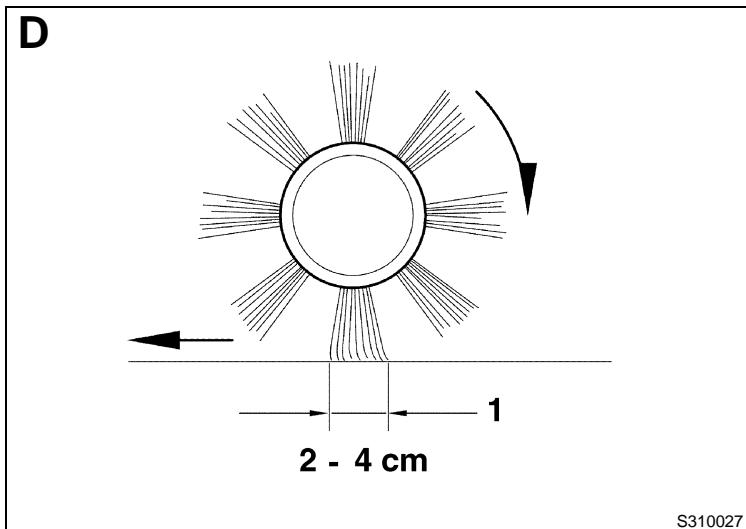
- Check that the main broom print (1, Fig. D), along its length, is 2 to 4 cm wide.
If the print (1) is not within specifications, it is necessary to adjust the broom height, according to the procedure shown in step 2.
- Drive the machine on a level ground and engage the parking brake (6 and 7, Fig. C).
- Turn the ignition switch (2, Fig. B) to "0" position.
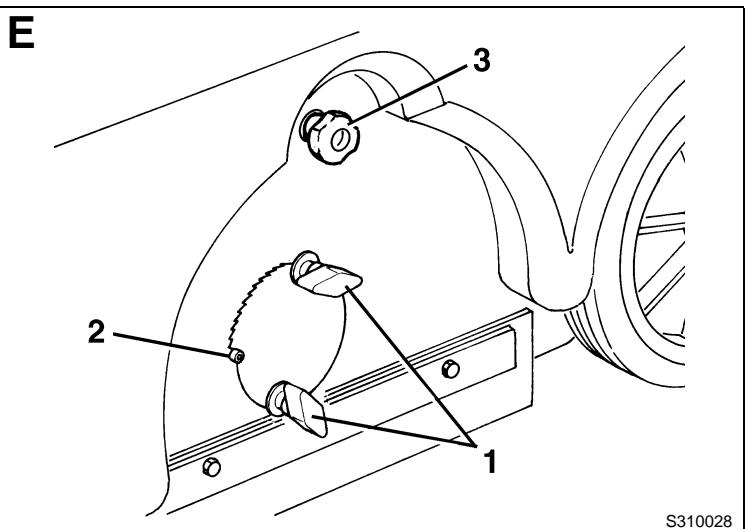
- Loosen the knobs (1, Fig. E) on both sides of the machine.
- Operating on the knobs (1, fig. E) move, on both sides of the machine, the broom height variation indicator (2) as necessary and then screw down the knobs (1).
The indicator (2) must be in the same position on both sides of the machine; the maximum difference allowed to obtain the print (1, Fig. D) described in step 1 (2 - 4 cm wide) is 2 notches.
- Perform step 1 again to check that the main broom is at the correct height from the ground.
- When the broom is too worn and can no longer be adjusted, replace it according to the instructions in the following paragraph.

CAUTION!
An excessive print (larger than 4cm ) of the main broom can lead to the machine malfunction and the overheating of the moving parts, thus reducing machine life.
Pay careful attention when performing the above-mentioned checks, and always use the machine according to the indicated conditions.
MAIN BROOM REPLACEMENT

NOTE
Brooms of various hardness are available. This procedure is applicable to all types of brooms.

CAUTION!
It is advisable to use protective gloves when replacing the side brooms because there can be sharp debris between the bristles.
- Drive the machine on a level ground and engage the parking brake (6 and 7, Fig. C).
- Turn the ignition switch (2, Fig. B) to "0" position.
- Loosen the knobs (1, Fig. E) on both sides of the machine.
- Move the broom height variation indicators (2, Fig. E) until the broom is at the maximum distance from the ground. Screw down the knobs (1).
- On the left side of the machine, loosen the knob (3, Fig. E).
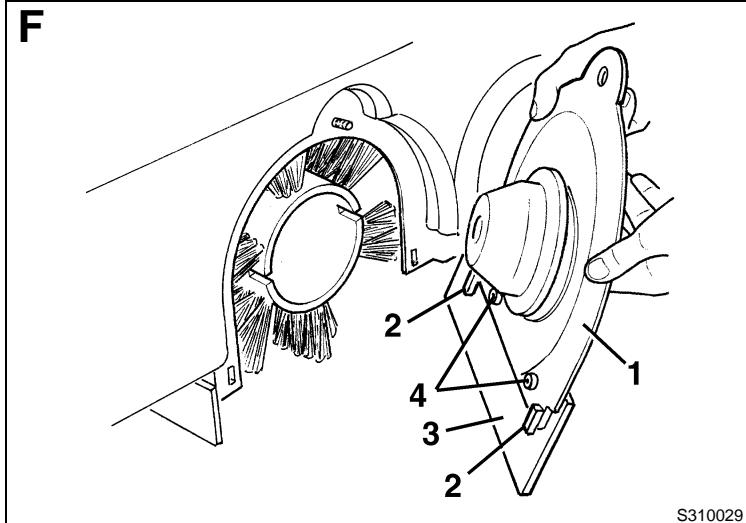
- Remove the broom door (1, Fig. F) by pulling it upwards to disengage the retainers (2).
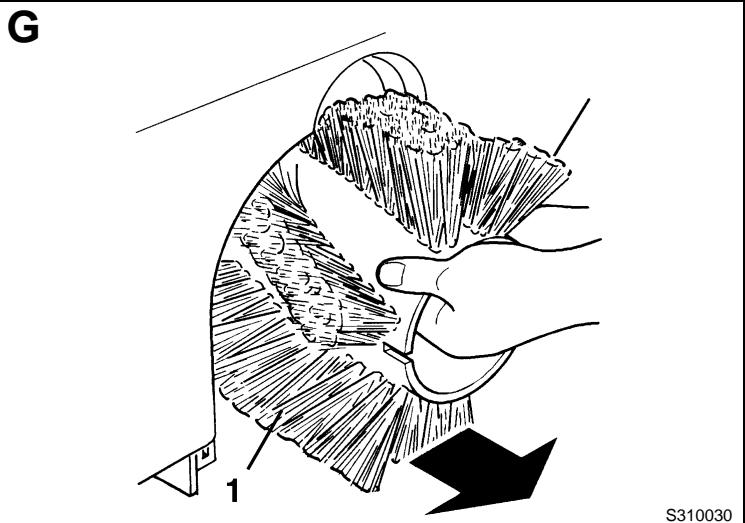
- Remove the broom (1, Fig. G).
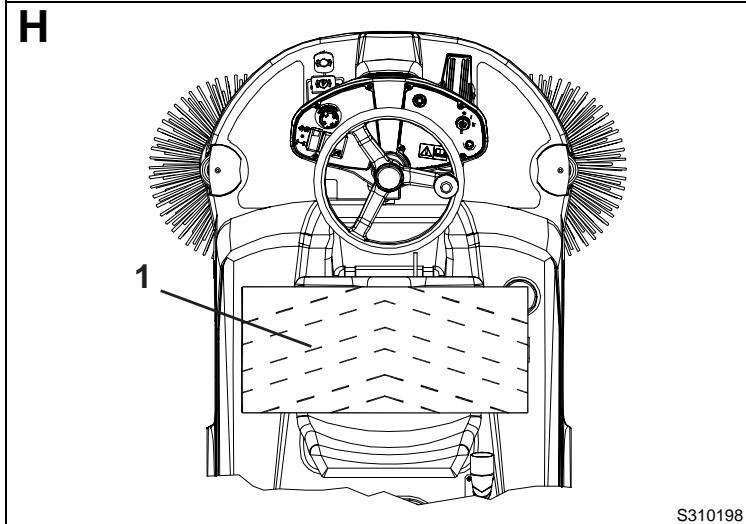
- The new broom must be installed with the bristles rows bent as shown in the figure H (top view).
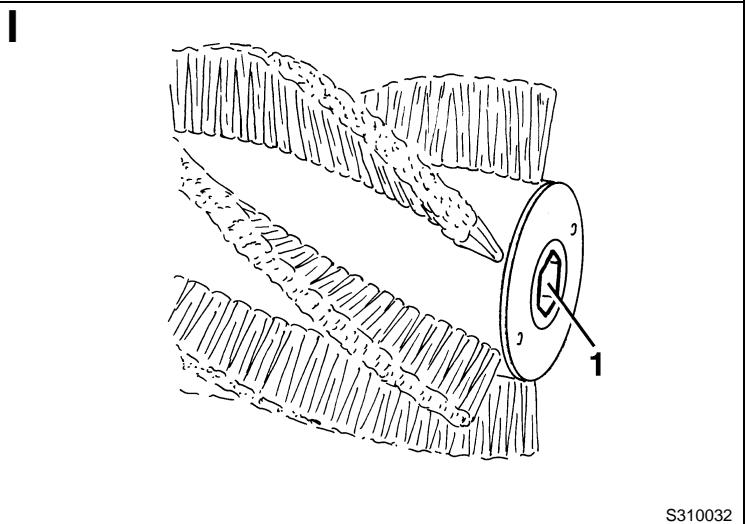
- Install the new broom on the machine and ensure that its mesh (1, Fig. 1) correctly fits into the relevant drive hub (4, Fig. R). Check that the drive hub is free from dirt or foreign materials (cords, rags, etc.) accidentally rolled up.
- Install the broom door (1, Fig. F) by engaging the retainers (2).
- Screw down the knob (3, Fig. E).
- Carry out the main broom height check and adjustment, as shown in the previous paragraph.
SIDE BROOM HEIGHT CHECK AND ADJUSTMENT

NOTE
Brooms of various hardness are available. This procedure is applicable to all types of brooms.
-
Check the side broom height from the ground, according to the following procedure:
-
Drive the machine on a level ground and lower the side brooms.
- Keep the machine stationary, lower the side brooms and rotate them for a few seconds;
- Stop and lift the side brooms, then move the machine and switch it off.
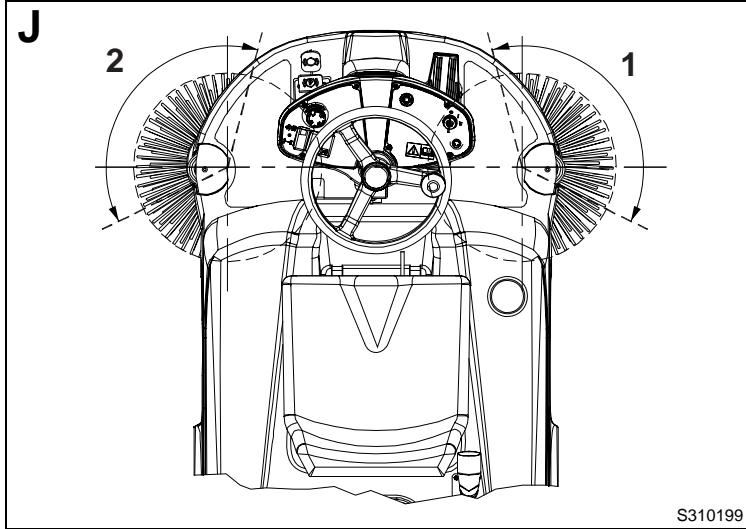
- Check if the size and orientation of the prints left by the side brooms are as shown in the figure (1 and 2, Fig. J).
If the print (1) is not within specifications, it is necessary to adjust the broom height, according to the procedure shown in step 2.
- Unlock the ring nut (36, Fig, C) by turning it counterclockwise, then turn the knob (33) as necessary, clockwise or counterclockwise, to adjust the broom height; then lock the knob (33) with the ring nut (36).
- Perform step 1 again to check the proper adjustment of the side broom height from the ground.
- When the brooms are too worn to be adjusted, replace them as shown in the next paragraph.
SIDE BROOM REPLACEMENT

NOTE
Brooms of various hardness are available. This procedure is applicable to all types of brooms.

CAUTION!
It is advisable to use protective gloves when replacing the side brooms because there can be sharp debris between the bristles.
- Drive the machine on a level ground and engage the parking brake (6 and 7, Fig. C).
- Turn the ignition switch (2, Fig. B) to "0" position.
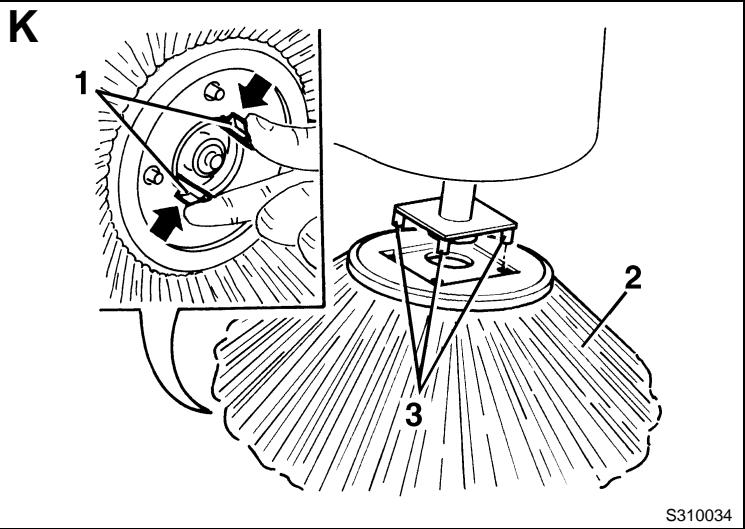
- Introduce the hand inside the side broom and press the tabs (1, Fig. K) inwards, then remove the broom (2) disengaging it from the four pins (3).
- Install the new broom on the machine engaging it on the pins (3) and on the tabs (1).
- Carry out the side broom height check and adjustment, as shown in the previous paragraph.
CLOSED POCKET FILTER CLEANING AND INTEGRITY CHECK

NOTE
Besides the standard paper filter, polyester filters are also available. The following procedure is applicable to each type of filter.
- Drive the machine on a level ground and engage the parking brake (6 and 7, Fig. C).
- Turn the ignition switch (2, Fig. B) to "0" position.
- Remove the hopper hook (21, Fig. C).
- Remove the hopper (20, Fig. C) by using the handle (22).
- Turn the handle (1, Fig. L) downwards ( 90^ approximately) and let the filter frame (2) rotate outwards.
- Remove the dust filter (3).
- In an appropriate outdoor area, clean the filter by shaking it on a level and clean surface, tapping the side (1, Fig. M) opposite to the wire gauze (2). Complete the cleaning by using compressed air (3) at maximum 6 bars, blowing only from the side protected by the wire gauze (2), at a minimum distance of 30~cm .
According to the filter type, observe the following cautions:
-
Paper filter (standard): Do not use water or detergents to clean it; the filter can be damaged.
Polyester filter (optional): To clean it, see the above-mentioned instructions. If necessary, for a better cleaning, it is allowed to wash the filter with water and non-lathering detergents. This provides better quality cleaning but reduces the life of the filter, which will have to be replaced more frequently. The use of inadequate detergents can damage the filter. -
Check the filter body for tears.
- If necessary, clean the filter compartment rubber seal (4, Fig. L) along its perimeter and check it for integrity. If necessary, replace it.
- Assemble in the reverse order of disassembly.

NOTE
Assemble the filter with the wire gauze (2, Fig. M) facing the vacuum fan (16, Fig. U).
- Drive the machine on a level ground that is suitable for checking the skirt height. Engage the parking brake (6 and 7, Fig. C).
- Turn the ignition switch (2, Fig. B) to "0" position.
Side skirt check
- Check the side skirts (16 and 17, Fig. C) for integrity. Replace the skirts when they have cuts (1, Fig. N) larger than 20 ~mm or cracks (2) larger than 10 ~mm (for skirt replacement, refer to the Service Manual).
- Check that the side skirt (16 and 17, Fig. C) height from the ground is within 0 - 3mm (Fig. O). If necessary, adjust the skirt height, according to the following procedure:
Left skirt:
- Open the hood (10, Fig. C) and engage the hood support rod (3, Fig. U).
- Loosen the knob (3, Fig. E) and remove the broom left door (1, Fig. F), pulling it upwards to disengage the retainers (2).
- Adjust the skirt (3, Fig. F) height by using the slots (4).
- Assemble in the reverse order of disassembly.
Right skirt:
- Remove the main broom, as shown in the relevant paragraph.
- Remove the belt (14, Fig. U) from the pulley (15); for a easier removal, turn the pulley (15) by operating on the vacuum fan (16) manually.
- Remove the screws (27, Fig. C) and the right door (26) together with the belt (14, Fig. U). Adjust the skirt (1, Fig. S) height by using the slots (2).
- Assemble in the reverse order of disassembly.
Front and rear skirt check
- Remove the main broom, as shown in the relevant paragraph.
- Check the front (1, Fig. R) and rear (2) skirts for integrity.
- Replace the skirts when they have cuts (1, Fig. N) larger than 20mm or cracks (2) larger than 10mm (for skirt replacement, refer to the Service Manual).
- Check that:
The front skirt (1, Fig. R) slightly touches the ground and that it is not detached from the ground (1, Fig. P).
- The rear skirt (2, Fig. R) height from ground is within 0 - 3 ~mm (1, Fig. O).
- If necessary, adjust the skirt height by using the slots (3, Fig. R).
-
Press the front skirt lifting pedal (8, Fig. C) and check that the front skirt (1, Fig. Q) rotates upward of about 90^ (as shown in figure); release the pedal and check that the skirt does not remain in an intermediate position but returns to its initial position. If necessary, for the front skirt control cable adjustment or replacement, refer to the Service Manual.
-
Assemble in the reverse order of disassembly.
HOOD SAFETY SWITCH OPERATION CHECK
With the vacuum fan turned on, slightly open the hood (10, Fig. C) and check that the fan immediately turns off. If opening the hood (10) does not cause the vacuum fan to turn off, contact an authorised Service Center or Retailer.
CHARGING THE BATTERIES

WARNING!
Battery charging produces highly explosive hydrogen gas. Charge the batteries in well-ventilated areas and away from naked flames. Do not smoke while charging the batteries. While charging the batteries always keep the hood open.

WARNING!
Pay careful attention when charging the batteries as there may be battery fluid leakages. The battery fluid is corrosive. If it comes in contact with skin or eyes, rinse thoroughly with water and consult a physician.
- Drive the machine on a level ground and engage the parking brake (6 and 7, Fig. C).
- Turn the ignition switch (2, Fig. B) to "0" position.
- Open the hood (10, Fig. C) and engage the hood support rod (3, Fig. U).
- (For WET batteries only) check the level of electrolyte inside the batteries. If necessary, top up through the caps (5, Fig. U).
Leave all the caps (5) open for battery charging. If necessary, clean the upper surface of the batteries.
- Charge the batteries according to one of the following methods, depending on the presence of the electronic battery charger (7, Fig. U) (optional).
Charging the batteries with an external battery charger
- Check that the battery charger is suitable by referring to the Battery Charger Manual.
The battery charger voltage rating is 24V

CAUTION!
Use a battery charger suitable for the type of batteries installed.
- Disconnect the battery connector (6, Fig. U) and connect it to the external battery charger.
- Connect the battery charger to the electrical mains.
- After charging, disconnect the battery charger from the electrical mains and from the battery connector (6, Fig. U).
- (For WET batteries only) check the level of electrolyte inside the batteries and close all the caps (5).
- Reconnect the battery connector (6, Fig. U) to the machine connector.
- Disengage the hood support rod (3, Fig. U) and close the hood (2); the machine is ready to be used.
Charging the batteries with the battery charger (optional)
- (For WET batteries only) check the level of electrolyte inside the batteries. If necessary, top up through the caps (5, Fig. U). Leave all the caps (5) open for battery charging. When the correct level is reached, clean, if necessary, the upper surface of the batteries.
- Connect the battery charger cable (8, Fig. U) to the electrical mains.

WARNING!
Check that the voltage and frequency shown on the machine serial number plate (1, Fig. U) correspond to the electrical mains values.
- When the green warning light (13, Fig. U) turns on, the batteries are charged.
- For further information about the battery charger operation (7, Fig. U), see the Battery Charger Manual.
- Disconnect the battery charger connector (8, Fig. U) from the electrical mains and place it in its special housing.
- (For WET batteries only) Close all the caps (5, Fig. U).
- Disengage the hood support rod (3, Fig. U) and close the hood (2); the machine is ready to be used.

NOTE
When the battery charger is connected to the electrical mains, all machine functions are automatically cut off.
SAFETY FUNCTIONS
The machine is equipped with the following safety functions.
EMERGENCY PUSH-BUTION
It is located in an easily accessible position (12, Fig. B). It has to be pressed in case of emergency, to stop all the machine functions.
To reset it, turn it clockwise.
HOOD SAFETY SWITCH
It activates when the machine hood is opened: It stops all functions.
If the machine keeps operating when the hood is open, contact an authorised Service Center or Retailer immediately.
DRIVER'S SEAT MICROSWITCH
It is located inside the driver's seat and it does not allow the machine drive system to operate if the operator is not seated on the driver's seat.
TROUBLESHOOTING
| Trouble | Remedy |
| The machine does not start when turning the ignition switch to "l" position. | Check the battery connector (6, Fig. U) for proper connection. |
| Check that the hood (10, Fig. C) is closed. | |
| Check the fuse F1 in the box (9, Fig. U) for integrity. | |
| Check that the optional battery charger (7, Fig. U) is disconnected from the electrical mains. | |
| The machine does not move by pressing the pedal (5, Fig. C). | Check that the parking brake (6 and 7, Fig. C) has been released. |
| Check that the switch (19, Fig. U) is in "l" position. | |
| Check that the drive pedal (5, Fig. C) is not pressed while starting the machine with the ignition switch (2, Fig. B), or while the operator is sitting on the driver's seat. The drive pedal (5, Fig. C) has to be pressed only after the operator has sit on the driver's seat and the machine has been started. | |
| The side brooms do not operate. | Check the fuse F6 in the box (9, Fig. U) for integrity. |
| The machine operates only when stationary, otherwise it switches off and the red warning light (3, Fig. B) flashes. | Charge the batteries. If the trouble persists, replace the batteries. |
| Battery autonomy is low. | Install batteries having higher capacity (minimum 100 Ah C5). |

NOTE
If the machine has been supplied with the optional battery charger, the machine cannot operate if the charger is not on board. In case of battery charger malfunction, contact an authorised Service Center.
For further information, refer to the Service Manual, available at any Nilfisk-Advance Service Center.
SCRAPPING
Have the machine scrapped by a qualified scraper. Before scrapping the machine, remove the following materials, which must be disposed of properly according to the law in force.
Batteries
Polyester dust filter
- Main and side brooms
- Electrical and electronic components (*)
- Plastic components and hoses
(*) Refer to the nearest Nilfisk-Advance Center especially when scrapping electrical and electronic components.
INLEIDING 2
DOEL EN INHOUD VAN DEZE HANDLEIDING 2
BETREFFENDE PERSONEN 2
OPBERGEN VAN DE HANDLEIDING 2
BEWIJS VAN CONFORMITEIT 2
IDENTIFICATIEGEGEVENS 2
ANDERE GEBRUIKERSHANDLEIDINGEN 2
VERVANGINGSONDERDELEN EN ONDERHOUD 2
MODIFICATIONS EN VERBETERINGEN 2
VEILIGHEID 3
GEBRUIKTE SYMBOLEN 3
ALGEMENE INSTRUCTIES 3
VERPAKKING VERWIJDEREN/AFLEVERING 4
BESCHRIJVING VAN DE MACHINE 5
BEDRIJFSCAPACITEIT 5
ALGEMENE OPMERKINGEN 5
BESCHRIJVING 5
ACCESSIONS / OPTIES 7
GEBRUK 8
CONTROLE / VOORBEREIDINGEN VOOR ACCU'S OP EEN NIEUWE MACHINE 8
INSTELLING VAN HET TYPE GEMONTEERDE ACCU (WET OF GEL) 9
VOOR HET STARTEN VAN DE MACHINE 9
DE MACHINE STARTEN EN STOPPEN 9
MACHINE IN BEDRIJF 10
DE AFVALCONTAINER LEGEN 10
NA GEBRUIK VAN DE MACHINE 10
DUW-/TREKBEWEGING VAN DE MACHINE 10
LANGE PERIODE VAN STILLSTAND 10
Zekering F7 (25 A): reserve
Zekering F8 (10 A): reserve
- GEVAARI!
- LET OPI!
WAARSCHUWING - OPMERKING
Registered office: Via F. Turati 16/18, 20121 Milano