USER MANUAL LL-1020V PROLINE
Instruction and maintenance booklet
Contents
Getting to know your washing machine 28
Preliminary warnings 28
Description of your washing machine 28
Using the selector controls 28
Programme selector control 28
Temperature selector control 28
Spin speed selector dial 29
Stop/start button 29
Additional function buttons 29
Loading the machine 29
Adding detergent and additives 30
Selecting the wash programme 31
Programme tables. 31
Programme guide 32/33
Cleaning your washing machine before use 34
Cleaning and special care 34
Starting your machine 34
End of programme 34
Practical advice for a better wash. 35
Sorting the clothes 35
Care label symbols 35
Treating stains 36
Practical advice on the wash load. 36
General hints on washing 36
General tips 37
Troubleshooting guide 37
Getting to know your washing machine
Before doing anything else you should get to know your washing machine perfectly. To help you recognise all the different devices and elements which your machine is equipped with, we have included some diagrams. These can be found at the back of the BOOKLET, inside the back cover.
Please study them carefully. They win help you to understand the text and to visually locate all the elements which make up your machine.
Preliminary warnings
Installation
It is essential that the installation of your WASHING MACHINE be carried out in accordance with current standards.
Specific installation instructions can be found in the INSTALLATION MANUAL.
Before starting your washing machine, it is absolutely essential to remove the INTERNAL FIXING SCREWS, used for transit. To do this, consult the installation manual.
Technical specifications table
Stuck to the back of your WASHING MACHINE, you will find a TECHNICAL SPECIFICATIONS TABLE, which gives the technical and identification information for your machine. THIS LABEL SHOULD BE CONSULTED BEFORE MAKING ANY ELECTRICAL CONNECTIONS.
In order to preserve the environment, your washing machine is equipped with a system which is capable of adapting to different conditions of use (amount of clothes and type of fabric), thereby ensuring an optimum level of water and power with the same wash and rinse results. This means that during the washing process, the amount of water you observe through the hatch may seem low.
Moreover, for the same reason, some models have a patented system by means of which the drum turns faster than normal for a short amount of time (2 seconds) only in the wash programmes for normal fabrics (cotton, linen, etc.). This occurs between six and eight times during the whole wash.
Description of your washing machine
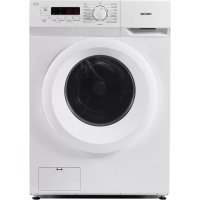
(Figure 1)
6.- Programme selector control knob.
7.- Wash temperature selector control knob.
8.- Additional function buttons.
9.- Detergent dispenser.
10.- «ON» light.
11.- Spin speed selector dial.
Using the selector controls

You can use this control to select the Wash Programme you require. Turn the control knob clockwise. Until the indicator coincides with the number of the programme required. NEVER TRY TO FORCE THE KNOB in the opposite direction.
Temperature selector control

Use this control to select the wash temperature you require. Turn it gently until the number corresponding to the temperature required coincides with the indicator.
ENGLISH
If you want to wash with cold water, turn the knob until the cold symbol × coincides with the indicator. 000

Spin speed selector dial
Whith this dial, you can choose the spin speed. To do this turn dial until the speed printed on the dial coincides with the printed sign on the machine.

Once you have selected programme you require, press this button to start your washing machine. The «ON» light will come on after a few seconds, during which time the door. Safety device is activated.
If the programme is completed without interruptions, you can open the loading door once the programme is over and you have waited for the door locking safety device to be deactivated (about 2 minutes). The «ON» light will go off indicate this.
When your washing machine is in operation, the wash cycle can be interrupted by pressing the stop/start button. The «ON» light will go off. Press the stop/start button again, to start your washing machine from the phase of the cycle where it left off. If you stop your machine to add or remove garments, make sure that the water level is not so high that it could overflow when the door is opened. Also make sure that the temperature inside the drum is not too high. Remember that even though the «ON» light goes off, you have to wait about two minutes until the door safety device is deactivated before you can open the door.
By pressing these buttons you can include a series of additional functions and features in the wash programme you have selected. These functions and features will enable you to adjust the wash to your particular needs and requirements.
Depending on the model, your washing machine will have some of the following funtions.

Press this button to eliminate the spin phase from any programme selected. This will help to avoid creasing when washing special fabrics.

Press this button to reduce spin speed. This function is specially recommended for washing clothes which are very worn or have a special finish.

Pres this button to interrupt the last rinse and hold the clothes immersed in water inside the drum to avoid creasing. Press the button again to complete the programme. Or select the drain-only programme to avoid the spin cycle.

Press this button to increase the final rinse. This increases water consumption.

Press this button to select a cold wash programme.

In the models which do not have the automatic variable capacity feature, press this button to save water by reducing consumption when washing small loads.
Loading the machine
Opening the door
In order to open the door, pull outwards on the handle (Figure 1-3)
Loading the drum
When loading clothes into the drum, you should bear the following points in mind:
- Make sure all the pockets are empty.
Stretch out and unfold each item.
ENGLISH
Put the items into the drum one by one, so that they do not get tangled up together.
Take into account the recommended load size for each programme.
- When washing towels, try not to wash them on their own. Mix them in with other clothes.
Once you have loaded the drum, close the door by pressing on it until it is properly closed. Make sure that no clothes get trapped between the door and the rubber seal.
Adding detergent and additives
Before starting the wash programme, add the detergent or additive to the detergent dispenser (Figure 3).
Depending on the model, the detergent dispenser in your washing machine has three or four compartments marked with the following symbols.

compartment:
For the PREWASH detergent.

compartment:
For the MAIN WASH detergent.

compartment:
For additives like starch, fabric conditioner, etc., if required.

compartment:
(Optional) For liquid whiteners: bleach, etc., if required.
Note: The level of liquid should never exceed the MAX LEVEL (Figure 3).
Optional dispenser
You can also use liquid detergent in your washing machine. To do this you need the optional dispenser which you can obtain
through the FAGOR SERVICE NETWORK. This optional dispenser should be placed in the COMPARTMENT of the detergent dispenser (Figure 3-A). Always use the amout recommended by the detergent manufacturer. However, the detergent should never go above the MAX level marked on the side of the dispenser.
Detergent
Only use detergents suitable for automatic washing machines good quality detergents which do not produce too much lather. When washing woolen garments, only use neutral detergents.
Detergent guide
Remember that the amount of detergent to be used always depends on:
The size of the load.
The type of clothes to be washed.
- How dirty the clothes are.
The hardness of the water.
Using more detergent than necessary will not improve the results of your wash. In addition to being a waste it will also have negative effects on the environment.
For wash programmes without a prewash, it is best to use detergents which can be put straight in the drum. In any case, we recommend that you follow the instructions of the manufacturer of the detergent used.
The following table will help you to determine the amount of detergent to be used, depending on the hardness of the water and the size of the load.
| LOAD SIZE IN KG. |
| 4,5/5 | 3,5 | 2 | 1 kg. |
| Water Hardness (French measures) | Amount of detergent in grammes |
| Soft: (Up to 12) | 90 | 80 | 65 | 55 |
| Medium: (12/25) | 125 | 115 | 90 | 75 |
| Hard (25/37) | 160 | 140 | 110 | 90 |
| Very hard (25/37) | 180 | 160 | 130 | 110 |
| Information about water hardness can be obtained from your local authority. If your water hardness is measured in german measures, divide the hardness values given above by 1.78. |
Selecting the wash programme
Your washing machine offers you a wide range of programmes which will enable you to wash all types of clothing.
It has 2 types of PROGRAMME:
1.- NORMAL WASH PROGRAMMES, for resistant fabrics.
2.- DELICATE WASH PROGRAMMES, for delicate fabrics.
The wash systems included in your washing machine are ideal for washing both cotton and synthetic garments, as well as woollen, silk or acrylic garments.
Basically, what varies between PROGRAMMES is the drum rotation speed, temperature, wash time and water level.
In general, the NORMAL, cycles are best for washing resistant fabrics like cotton, resistant synthetics, linen, etc., whilst the DELICATE cycles, with slower drum rota
tion speeds, lower temperature and higher water levels, are for synthetic fabrics, wool, silk, etc.
The models which have the wash temperature selector control have an automatic variable load control feature, which automatically adjusts the consumption of water and electricity to the a quantity of clothes to be washed.
Programme tables
There follows a number of detailed PROGRAMME TABLES. Please consult them, as they will provide you with information about the different wash programmes which your washing machine offers.
An abbreviated version of the table can be found on the front or top panel of the detergent dispenser, or on a card included in the documentation bag.
| Program setting | PROGRAMME DESCRIPTION | Range of recommend. temperatures | Wash product compartments | Clothes symbols | Degree of dirtiness whites / coloureds | Estimated duration |
| 1 | Prewash, followed by wash, rinsing, automatic absorption of additives if required and final spin. | 90-70°C | | | Very dirty. White. | 115-135 minutes |
| 60-50°C | | Very dirty. Resistant colours. | 125-135 minutes |
| 40-Cold | | Very dirty. Delicate colours. | 110-120 minutes |
| 2 | Wash, rinsing, automatic absorption of additives if required and final spin. | 90-70°C | | | Dirty. White. | 100-120 minutes |
| 60-50°C | | Dirty. Resistant colours. | 110-120 minutes |
| 40-Cold | | Slightly soiled. Delicate colours. | 95-100 minutes |
| 3 | Rinse with automatic absorption of additives if required and final spin. | | | | Resistant fabrics. | 40 minutes |
| 4 | Draining and long spin. | | | | Resistant fabrics. | 8 minutes |
Delicate wash programmes:
Delicate synthetic fabrics, mixed fabrics, etc.
Maximum recommended load: 2,5kg
| Program setting | PROGRAMME DESCRIPTION | Range of recommend. temperatures | Wash product compartments | Clothes symbols | Degree of dirtiness whites / coloureds | Estimated duration |
| 5 | Wash, rinsing, automatic absorption of additives if required and final spin. | 60-50°C | | | Dirty. White. | 55-60 minutes |
| 40-Cold | | Slightly soiled. Delicate colours. | 45-50 minutes |
| 6 | Short wash, rinsing, automatic absorption of additives if required and final spin. | 40-Cold | | | Slightly soiled. Delicate colours. | 40-45 minutes |
| 7 | Rinse with automatic absorption of additives if required and final spin. | | | | Delicate fabrics. | 10 minutes |
| 8 | Draining and gentle spin. | | | | Delicate fabrics. | 6 minutes |
Wool wash programme:
Wool Fabrics
Maximum recommended load: 1,0kg
| Program setting | PROGRAMME DESCRIPTION | Range of recommend. temperatures | Wash product compartments | Clothes symbols | Degree of dirtiness whites / coloureds | Estimated duration |
| 9 | Wash, rinsing, automatic absorption of additives if required and draining. | 40-Cold | | 30 40 | Slightly soiled. Delicate colours. | 40-50 minutes |
| 10 | Draining without spin. | | | | | 5 minutes |
| Program. setting | PROGRAMME DESCRIPTION | Range of recommend. temperatures | Wash product compartments | Clothes symbols | Degree of dirtiness whites / coloureds | Estimated duration |
| 1 | Prewash, followed by wash, rinsing, automatic absorption of additives if required and final spin. | 90-70°C | | | Very dirty. White. | 125 minutes |
| 60-50°C | | Very dirty. Resistant colours. |
| 40-Cold | | Very dirty. Delicate colours. |
| 2 | Wash, rinsing, automatic absorption of additives if required and final spin. | 90-70°C | | | Dirty. White. | 100 minutes |
| 3 | 60-50°C | | Dirty. Resistant colours. | 85 minutes |
| 4 | 40-Cold | | Slightly soiled. Delicate colours. | 70 minutes |
| 5 | Rinse with automatic absorption of additives if required and final spin. | | | | Resistant fabric garments. | 30 minutes |
| 6 | Draining and long spin. | | | | Resistant fabric garments. | 5 minutes |
Delicate wash programmes: Delicate synthetic fabrics, mixed fabrics,
Maximum recommended load: 2,5 kg.
| Program setting | PROGRAMME DESCRIPTION | Range of recommend. temperatures | Wash product compartments | Clothes symbols | Degree of dirtiness whites / coloureds | Estimated duration |
| 7 | Wash, rinsing, automatic absorption of additives if required and final spin. | 60-50°C | | | Dirty. White. | 70 minutes |
| 8 | 40-Cold | | Slightly soiled. Delicate colours. | 50 minutes |
| 10 | Short wash, rinsing, automatic absorption of additives if required and final spin. | 40-Cold | | | Slightly soiled. Delicate colours. | 40 minutes |
| 11 | Rinse with automatic absorption of additives if required and final spin. | | | | Delicate fabrics. | 10 minutes |
| 12 | Draining and gentle spin. | | | | Delicate fabrics. | 5 minutes |
Wool wash programme:
Wool Fabrics
Maximum recommended load: 1,0kg
| Program setting | PROGRAMME DESCRIPTION | Range of recommend. temperatures | Wash product compartments | Clothes symbols | Degree of dirtiness whites / coloureds | Estimated duration |
| 9 | Wash, rinsing, automatic absorption of additives if required and draining. | 40-Cold | | 30 40 | Slightly soiled. Delicate colours. | 45 minutes |
| 13 | Draining without spin. | | | | | 3 minutes |
Cleaning your washing machine before
It is advisable to clean the inside of your washing machine before using it for the first time, in order to get rid of any lubricants or water left over from testing. To do this you should:
Put a measure of detergent into the COMPARTMENT of the DETERGENT DISPENSER.
- Select WASH PROGRAMME «2» (90° without prewash) with the programme selector control knob.
- Start the washing machine.
Wait until the PROGRAMME finishes.
Cleaning and special care
(Fig. 6)
Clean the accessible filter whenever the drainage pump is blocked by foreign bodies.
a) Loosen the base by gently pulling on the sides and turning downwards. Then undo the fasteners.
If there is no side access, introduce a small screwdriver in the three slots on the upper part of the base, in order to lever it and loosen the hooks.
b) Use a plate or other container under the filter to collect the water that will be released when it is loosened.
c) Turn the filter a quarter- or halfway sideways towards the left. Water will start to come out.
d) When you are finished taking the water out of the washing machine, turn the filter around several times until you can take it out fully.
e) Remove any objects or fluff that may be in the filter.
f) Replace the filter and the base in their places.
Important: In order to avoid burns, this operation should not be carried out when the wash water temperature is over 30^ .
Starting your machine
When starting your washing machine, carefully follow all the steps explained below:
1.- Check that the washing machine is plugged in and that the power is turned on.
2.- Turn on the tap or open the stopcock.
3. - Put the clothes into the DRUM.
4.- Close the LOADING DOOR properly.
5.- Put the required amount of detergent into the DETERGENT DISPENSER.
6.- Select the PROGRAMME you require with the PROGRAMME SELECTOR control knob.
7.- Select the wash temperature with the TEMPERATURE SELECTOR control knob.
8.- Select the required spin speed with the SPIN SPEED SELECTOR DIAL.
9.- Select any special functions you require by pressing the corresponding buttons.
10.- Press the STOP/START button. The «ON» light will come on. The wash programme selected will now begin.
End of programme
When the programme selector control knob reaches the STOP POSITION, this means that the programme has finished.
DO NOT OPEN THE DOOR OF YOUR WASHING MACHINE UNTIL THE DOOR SAFETY DEVICE IS DEACTIVATED.
Press the STOP/STAR button.
Practical advice for a better wash
There follows some advice, which you should bear in mind when using your washing machine. Advice concerning the different types of clothes you can wash and the different types of detergent you can use.
Please read these pages carefully as they will help you to get the best results from your machine and to maintain it properly.
Sorting the clothes
Sort the different articles of clothing according to:
COLOUR.
DIRTINESS.
SENSITMY.
Colour
Before putting the clothes into the machine, sort the clothes according to the type of fabric and depth of colour.
— Wash whites separately from coloureds.
- If your coloureds are new, it is best to wash them separately the first few times.
Dirtineas
Sort the clothes according to dirtiness. Give special treatment to those which are very dirty or have got difficult stains.
Treat very dirty areas, like collars and cuffs, beforehand.
- Wash clothes that are only slightly dirty in short programmes. In this way, you will save energy as well as getting excellent results.
— Wash averagely dirty clothes in a normal wash programme.
— Wash very dirty clothes in a long programme with a prewash.
Sensitivity
Certain clothes, either because of their fabric or the way they are made, may be sensitive to action of your machine. When washing them it is best to use DELICATE PROGRAMMES.
- You can wash woollen garments in the SPECIAL WOOL PROGRAMME. Make sure, first of all, that your woollen garments are machine washable.
Care label symbols
These symbols are normally found on the care labels in the necks or side seams of your clothes. They indicate:
Maximum WASH temperature.
Type of wash they can withstand.
- Products with which they can or cannot be washed.
Treatments for their care.
- Correct ironing temperature and method.
Care label symbols

For washing at 30^

For washing at 40^

For washing at 60^ C. Coloureds.

For washing at 90^ C. Resistant fabrics.

Do not wash at home.

For bleaching.

For bleaching.

Do not bleach.

For dry cleaning.

Do not dry clean.

For drying.

Do not dry.
ENGLISH
For dry cleaning and special treatments.
For dry cleaning. Use only mineral sol- vents: benzine, white spirit, etc.
For dry cleaning. Perchlorethylenemay be used in addition to the previous solvents.
For dry cleaning. All normal solvents can be used.
Cool iron.
Warm iron.
Hor iron.
Do not iron at home.
Wool.
Treating stains
On many occasions, due to the type and characteristics of some stains, you may not be able to get the results you would like from the wash. There follows a guide to the special treatments you can apply to these stains before putting the clothes into your washing machine.
Water soluble stains
Treat these stains, even if they are stubborn, with concentrated detergent or washing soap.
Stains not soluble in water
Treat these stains with a special stain removal product.
Difficult stains
Felt-tip pen and biro: rub these stains with a cloth soaked in alcohol.
Candle wax: cover these stains with a piece of blotting-paper and iron at the correct temperature for the material. If necessary, repeat the operation.
Resin, grease and skin-care cream: treat these stains with a petrol-based stain remover and then wash.
Tar: rub these stains with butter and set to one side for a while, then wash.
Blood, milk and egg: soak in cold water and then wash with biological detergent at a
temperature of 50^ to 60^ , provided the fabric can take it.
Fruit, coffee and wine: these stains normally disappear after a number of washes.
If you come up against a stain which is not washable or particularly stubborn, ask for specialist advice. In any case, NEVER USE CHEMICAL PRODUCTS IN THIS WASHING MACHINE.
Practical advice on the wash load
- Whenever possible, it is best to wash with a full load, as this will reduce water and electricity consumption considerably.
If you have to wash very dirty clothes or very absorbent items (towels, bathroom linen, etc.), it is advisable to reduce the maximum load given.
- Whenever possible, we recommend that you wash items of different sizes in the same wash programmes, as this helps the wash action and benefits the distribution of clothes in the drum during spin drying. It also means that the machine operates more quietly.
General hints on washing
- When you wash garments which require different wash temperatures, always select the lowest temperature.
Generally speaking, whiteners should only be used to wash resistant white fabrics such as cotton, linen, etc.
— Wash garments made of synthetic, mixed and delicate fibres in delicate programmes to avoid creasing which will be difficult to iron out.
- It is best to finish delicate programmes with a short spin. This will increase the efficiency of the rinses and mean that the clothes are well wrung out.
General tips
Maintenance
Before cleaning or carrying out any maintenance operation on your washing machine, always unplug it from the mains supply.
Cleaning
After each wash, leave the loading door open for a while so that air can circulate inside your machine.
From time to time it is a good idea to rum a complete wash cycle, using a descending product. This will help prolong the life of your machine.
Cleaning the outside of your washing machine
Use warm soapy water or a gentle nonabrasive cleaning agent which is not a solvent to clean the outside of your washing machine. Then dry it well with a soft cloth.
Cleaning the detergent dispenser
Clean the detergent dispenser whenever you see a build up of washing powder deposits. To do this:
Take the DETERGENT DISPENSER right out, pulling outwards the handle.
Clean the DISPENSER COMPARTMENTS with warm water and a brush.
Clean the SUCTION SYPHONS as well.
Once you have done this, put the dispenser back in your washing machine.
Troubleshooting guide
If you have problem with your washing machine, you will probably be able to solve it by consulting the following guide.
If the guide does not offer a solution to the problem, unplug your washing machine and call your nearest AUTHORISED SERVICE CENTRE. Your washing machine contains no fuses or similar components which you can change. NEVER tamper with your washing machine.
Your washing machine does not start
Possible causes
There is no electricity supply.
- Your washing machine is not plugged in.
A mains fuse has blown.
- Your washing machine door is not properly shut.
The STOP/START button has not been pressed.
Your washing machine is not taking in water
Possible causes
The mains water supply has been cut off.
The water inlet tap is turned off.
The hose filter is blocked.
The pipe is blocked or bent.
Your washing machine does not empty or spin
Possible causes
The water outlet pipe is blocked or bent.
Your washing machine vibrates or makes a lot of noise.
Possible causes
The INTERNAL FIXING SCREWS have not been removed. (Consult the installation manual).
The washing machine has not been properly levelled.
Important
Some models (high spin speeds) have a spin safety system which stops the spin function from working if the clothes are not properly distributed in such a way that they could cause excessive vibrations. If your clothes should come out very wet, spin dry them again ensuring that they are evenly distributed in the drum.
Drogen in wasmachine.

Niet drogen in wasmachine.

Stomen en speciale behandeling

Ovladaci panel (obr. 2)
Ovladaci panel (obr. 2)
6.-ovladacie tlacitko volica programov
7.-ovladacie tlačitko volica teploty
8.-doplnkové funkcné tlacitka
9.-zasobnik na praciprostriedok
10.-prevádková kontrlka
11.-ovládacia kruhová stipnica rychlosti odsted'ovania