
RC-30 - Looper ROLAND - Free user manual and instructions
Find the device manual for free RC-30 ROLAND in PDF.


| Product Type | Dual Track Looper |
| Brand | ROLAND |
| Model | RC-30 |
| Dimensions | 173 (W) x 158 (D) x 57 (H) mm |
| Weight | 1.2 kg (including batteries) |
| Power Supply | 9 V DC: 6 AA alkaline batteries (LR6) or PSA series AC adaptor (optional) |
| Current Draw | 195 mA (max.) |
| Battery Life | Approx. 7.5 h (alkaline) |
| Number of Phrases | 99 maximum |
| Maximum Recording Time | Approx. 3 hours total |
| Number of Tracks | 2 |
| Recording Format | WAV (44.1 kHz, 16-bit linear, stereo) |
| Inputs | MIC IN (XLR, 48 V phantom power), INST IN L/MONO and R (6.35 mm phone jacks), AUX IN (stereo mini jack) |
| Outputs | OUTPUT L/MONO and R (6.35 mm phone jacks) |
| USB Interface | USB 2.0/1.1 (mass storage) |
| Built-in Effects | LOOP FX: BEND DOWN, STEP PHASER, SWEEP FILTER, TEMPO DELAY, Lo-Fi |
| Built-in Rhythms | 10 types (Hi-Hat, Rock, Pop, Funk, etc.) |
| Footswitches | 2 footswitches (left: record/overdub/play; right: stop/tap tempo) |
| Maintenance and Cleaning | Clean with a dry, soft cloth; avoid solvents; protect the unit from moisture and shocks |
| Safety | Do not turn off during recording or saving; use only the specified AC adaptor; observe battery polarity |
| Spare Parts and Repairability | PSA series AC adaptor, FS-5U/FS-6 footswitches; repair by a Roland authorized service center |
| General Information | Owner's manual available for download; registered trademark BOSS/Roland |
Frequently Asked Questions - RC-30 ROLAND
User questions about RC-30 ROLAND
0 question about this device. Answer the ones you know or ask your own.
Ask a new question about this device
Download the instructions for your Looper in PDF format for free! Find your manual RC-30 - ROLAND and take your electronic device back in hand. On this page are published all the documents necessary for the use of your device. RC-30 by ROLAND.
USER MANUAL RC-30 ROLAND
- This device contains demo phrases (90-99). Once you delete these, they cannot be recovered. Please back them up as described in "Backing up to your computer"(p. 15).
- This device will enter Sleep mode (power conservation mode) when ten hours have elapsed since the last operation, or since the last audio input while in Stop mode.
If you want to prevent the device from entering Sleep mode, hold down the left pedal while you turn on the power, and continue holding down it down for five seconds (p. 17).
Main Features
Welcome to the Loop Station!
The RC-30 is a pedal-type recorder that lets you record audio phrases from your guitar or vocal etc., and play them back by operating the pedal. You can create a wide variety of performances by layering sound while you record and carry out play back in real time.
- Up to 99 different loop phrases can be saved in phrase memory, for a total of approximately 3 hours (* total for all phrases).
- Multi-track recording allows a wide range of performance possibilities.
- You can input audio in stereo.
- In addition to guitar input, a MIC jack and AUX IN jack are also provided. You can connect a microphone and loop-record your voice, or record sound from your digital audio player.
- Recorded phrases can be copied via USB to your computer, or WAV files from your computer can be loaded into the RC-30 and played back as loops (p. 14).
- You can apply an effect that is synchronized with the tempo of a phrase while you play it back (p. 14).
Before using this unit, carefully read the sections entitled: "USING THE UNIT SAFELY" and "IMPORTANT NOTES" (supplied on a separate sheet). These sections provide important information concerning the proper operation of the unit.
Additionally, in order to feel assured that you have gained a good grasp of every feature provided by your new unit, this manual should be read in its entirety. The manual should be saved and kept on hand as a convenient reference.
Main Features 1
Installing Batteries. 3
Panel Descriptions 4
Turning On the Power 7
Basic Operation. 8
Selecting a Phrase Memory 8
Selecting the Current Track 8
Recording. 8
One-Shot Playback 9
Overdubbing 9
LoopPlayback 9
Stop 9
Saving a Phrase 10
Deleting a Phrase 10
Specifying How a Phrase Will Play/Stop (Stop Mode/One-Shot Playback) 10
Cancelling an Overrub (Undo/Redo/Track Clear) 11
Auto Recording/Count-In Recording Functions.. 11
About Rhythm 12
Sounding a Rhythm 12
Setting the Tempo. 12
Setting the Rhythm Type 12
Setting the Time Signature 13
- Recording, duplication, distribution, sale, lease, performance, or broadcast of copyrighted material (musical works, visual works, broadcasts, live performances, etc.) belonging to a third party in part or in whole without the permission of the copyright owner is forbidden by law.
- Do not use this product for purposes that could infringe on a copyright held by a third party. We assume no responsibility whatsoever with regard to any infringements of third-party copyrights arising through your use of this product.
- The copyright of content in this product (the sound waveform data, style data, accompaniment patterns, phrase data, audio loops and image data) is reserved by Roland Corporation.
- Purchasers of this product are permitted to utilize said content for the creating, performing, recording and distributing original musical works.
- Purchasers of this product are NOT permitted to extract said content in original or modified form, for the purpose of distributing recorded medium of said content or making them available on a computer network.
Using LOOP FX. 14
Turning LOOP FX On/Off. 14
Specifying the LOOP FX Type 14
Connecting to Your Computer via USB 14
Connecting to an External Footswitch. 16
When Connecting an FS-5U 16
When Connecting Two FS-5Us or an FS-6. 16
Other Settings 17
About Sleep Mode 17
Disabling Sleep Mode 17
Enabling Sleep Mode (default setting). 17
Changing the Switching Order of Recording Overdubbing Playback 17
Formatting the Internal Memory 17
Troubleshooting 18
Error Message List. 18
Other Display Indications 19
Specifications. 20
- BOSS and Loop Station are either registered trademarks or trademarks of Roland Corporation in the United States and/or other countries.
- All product names mentioned in this document are trademarks or registered trademarks of their respective owners.
- The screen shots in this document are used in compliance with the guidelines of the Microsoft Corporation.
- MMP (Moore Microprocessor Portfolio) refers to a patent portfolio concerned with microprocessor architecture, which was developed by Technology Properties Limited (TPL). Roland has licensed this technology from the TPL Group.
- The SD logo () and SDHC logo () are trademarks of SD-3C, LLC.
- This product contains eCROS integrated software platform of eSOL Co.,Ltd.
eCROS is a trademark of eSOL Co., Ltd. in Japan. - Featuring digital fonts by Yourname, Inc. Digital font: Copyright © Yourname, Inc.
Copyright © 2011 BOSS CORPORATION
All rights reserved. No part of this publication may be reproduced in any form without the written permission of BOSS CORPORATION.
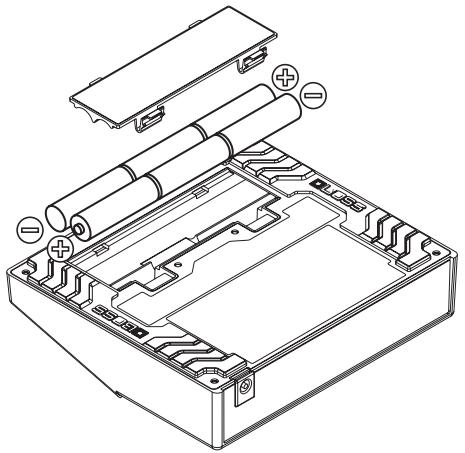
Insert the included batteries as shown in the diagram, being careful to observe the correct polarity.

- Incorrect handling of batteries, rechargeable batteries, or a battery charger can cause leakage, overheating, fire, or explosion. Before use, you must read and strictly observe all of the precautions that accompany the batteries, rechargeable batteries, or battery charger.
- Batteries are supplied with the unit. The life of these batteries may be limited, however, since their primary purpose was to enable testing.
- Be sure to observe the correct + (positive) and - (negative) orientation of the batteries.
- When turning the unit upside-down, get a bunch of newspapers or magazines, and place them under the four corners or at both ends to prevent damage to the buttons and controls. Also, you should try to orient the unit so no buttons or controls get damaged.
- When turning the unit upside-down, handle with care to avoid dropping it, or allowing it to fall or tip over.
- If the batteries run low, the display will indicate "bE" and the POWER indicator will become dim. When this occurs, install fresh batteries as soon as possible.
- The use of an AC adaptor is recommended as the unit's power consumption is relatively high. Should you prefer to use batteries, please use the alkaline type.
- Rechargeable Ni-MH batteries cannot be used.
- In some cases, all saved data might be lost if the batteries become depleted during recording or overdubbing (p. 7).
- When replacing the batteries, use six (AA, LR6) batteries.
- The contents of internal memory will not be lost when you replace the battery, but we recommend that you make regular backups (p. 15) for safety's sake.
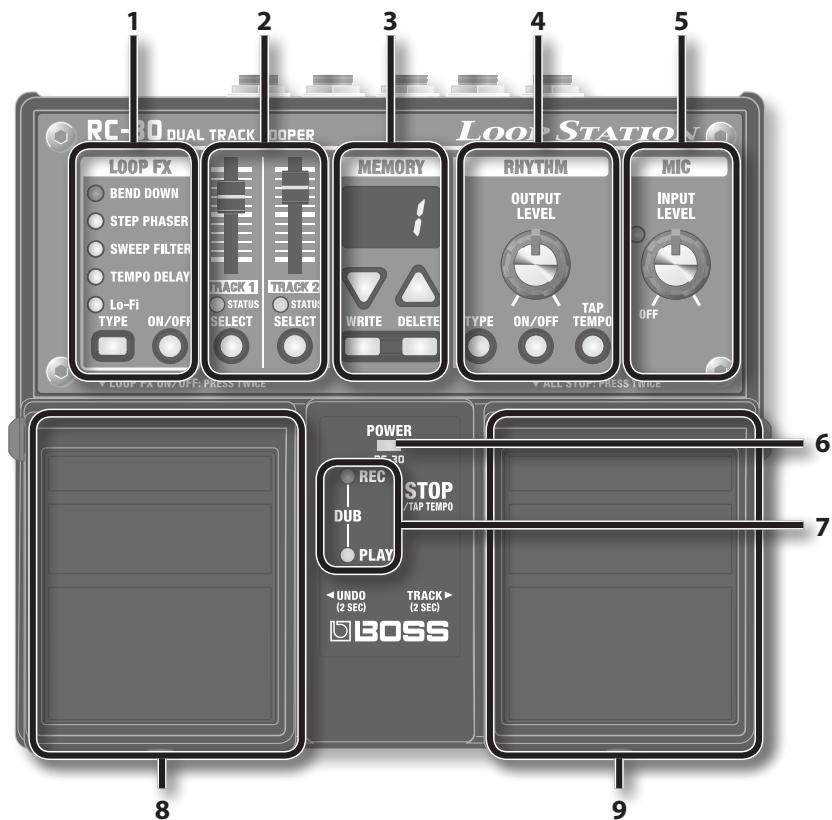
| Name | Explanation | Page | |
| 1 | LOOP FX | p. 14 | |
| [TYPE] button | Selects the LOOP FX type. | ||
| [ON/OFF] button | Turns LOOP FX on/off. | ||
| 2 | TRACK 1/2 | p. 8 | |
| [TRACK 1]/[TRACK 2] slider | Adjust the volume of the phrase playback for each track. | ||
| STATUS indicator | Light when tracks 1/2 are in recording or playback mode.While stopped, they will blink if the track contains data, and will be unlit if the track contains no data. | ||
| [SELECT] button | These buttons select a track. | ||
| 3 | MEMORY | p. 18 | |
| Display | This indicates the current phrase memory number, or various other information. | ||
| [▼](DOWN)/[▲](UP) buttons | These decrement or increment the number shown in the display. | p. 8 | |
| [WRITE] button | Press this to save the recorded phrase to internal memory. | p. 10 | |
| [DELETE] button | Deletes a phrase from internal memory. | p. 10 | |
| 4 | RHYTHM | p.12 | |
| [OUTPUT LEVEL] knob | This adjusts the volume level of the rhythm sound. | ||
| [TYPE] button | Specifies the rhythm type. | ||
| [ON/OFF] button | This button turns the rhythm sound on/off. | ||
| [TAP TEMPO] button | Press this button at the desired timing to set the tempo. | ||
| 5 | MIC | p.6 | |
| [INPUT LEVEL] knob | Adjusts the input level from the MIC IN jack. Turning the knob all the way to the left will turn off the microphone input. | ||
| PEAK indicator | Lights when the input level exceeds the allowable level. Adjust the [INPUT LEVEL] knob so that the PEAK indicator lights occasionally when you sing most loudly into the microphone. | ||
| 6 | POWER indicator | Lights when the power is on. | p.7 |
| 7 | REC, PLAY indicator | p.8 | |
| REC (red) indicator | Lights during recording. | ||
| PLAY (green) indicator | Lights during playback (while loading a phrase memory or performing an internal memory operation: blinks rapidly).During overdubbing, both the REC (red) indicator and the PLAY (green) indicator will light. | ||
| 8 | Left pedal | p.8 | |
| Switches the unit between recording/overdubbing/playback | If the phrase is empty: recording → overdubbing → playbackIf the phrase contains data: playback → overdubbing | ||
| Undo | During playback or overdubbing, hold down the left pedal for two or more seconds to undo (cancel the recording or the most recent overdubbing). | p.11 | |
| LOOP FX on/off | Press twice to turn LOOP FX on/off. | p.14 | |
| 9 | Right pedal | p.9 | |
| Stop | Stops the track currently being overdubbed or played. | ||
| Stop all | Press twice to stop both tracks simultaneously. | ||
| Tap tempo | While stopped, press the right pedal repeatedly to set the tempo to the timing at which you pressed it. | p.12 | |
| Switch tracks | To switch the selected track, hold down the right pedal for at least two seconds. | p.8 | |
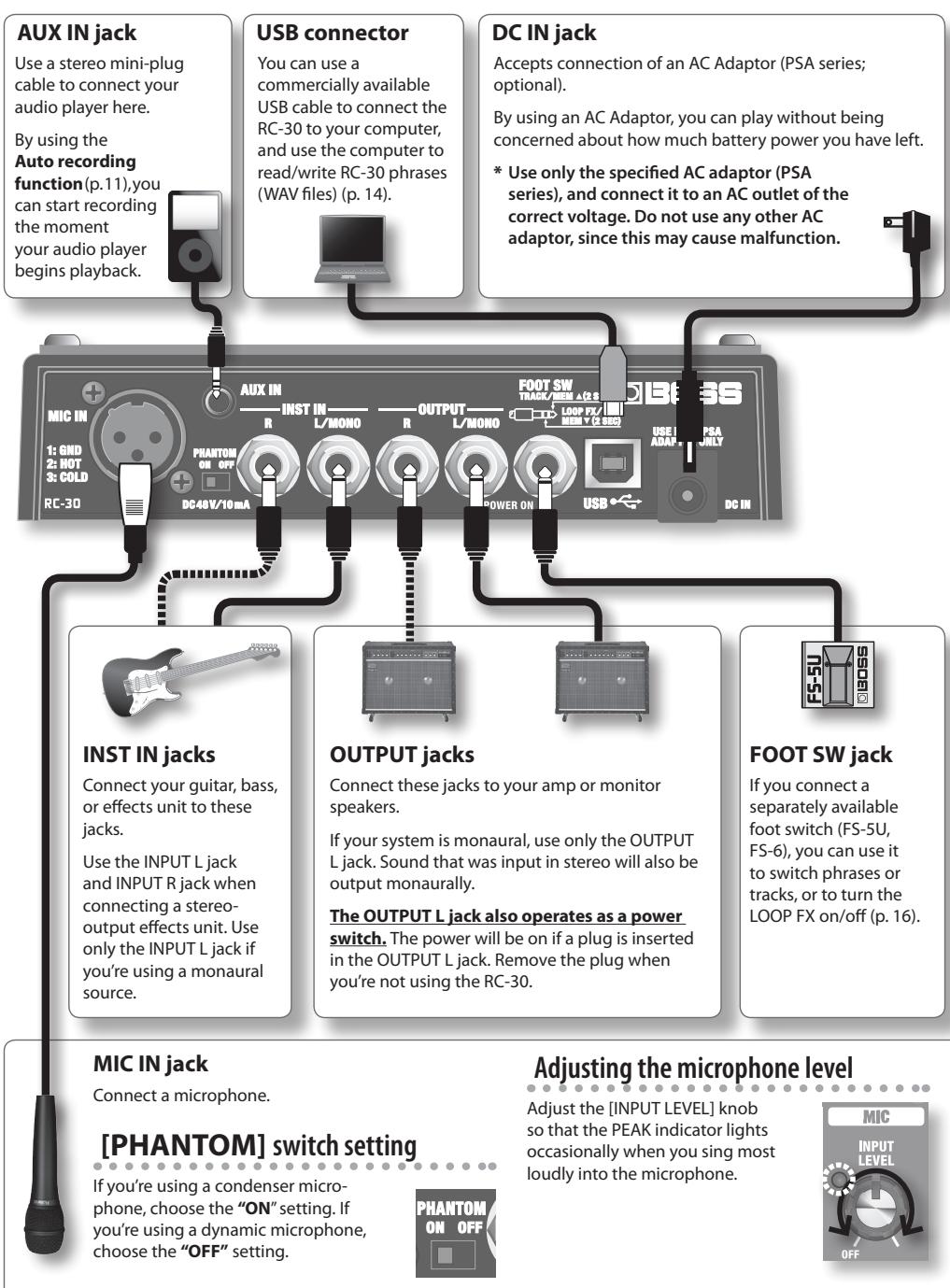
NOTE
- To prevent malfunction and/or damage to speakers or other devices, always turn down the volume, and turn off the power on all devices before making any connections.
- Before connecting or disconnecting any connection cables, be sure all the volume controls in your system are set to minimum.
- Use connection cables that do not contain a built-in resistor. If you use cables that contain a resistor, there might be insufficient volume from the device connected to the AUX IN jackets, or it might be inaudible.
- Do not connect headphones to the OUTPUT jack.
Doing so may damage the headphones.
Turning On the Power
Inserting a connecting plug into the OUTPUT L jack turns on the power to the unit.
Once the connections have been completed, turn on power to your various devices in the order specified. By turning on devices in the wrong order, you risk causing malfunction and/or damage to speakers and other devices.
| When powering up | Turn on the power to your guitar amp last. |
| When powering down | Turn off the power to your guitar amp first. |
- This unit is equipped with a protection circuit. A brief interval (a few seconds) after power up is required before the unit will operate normally.
Caution when turning off the power
While the RC-30 is in the following states, you must never turn off the power (i.e., disconnect the plug from the OUTPUT L jack).
Doing so may cause all the saved data to be lost.
- While the REC or PLAY indicator is lit (during phrase recording/playback/overdubbing)
- While the PLAY indicator is blinking rapidly (while phrase memory is being read, or an internal memory operation is occurring)
Caution when using a microphone
- Howling could be produced depending on the location of microphones relative to speakers. This can be remedied by:
- Changing the orientation of the microphone(s).
Relocating microphone(s) at a greater distance from speakers. - Lowering volume levels.
-
If the amp and microphone are close together, the sound played back from the amp may be picked up by the microphone. If you record or overdub in such a state, the amp playback picked up by the microphone will also be recorded. You should separate the amp and microphone so that the playback from the amp is not picked up by the microphone.
-
Always turn the phantom power off when connecting any device other than condenser microphones that require phantom power. You risk causing damage if you mistakenly supply phantom power to dynamic microphones, audio playback devices, or other devices that don't require such power. Be sure to check the specifications of any microphone you intend to use by referring to the manual that came with it. (This instrument's phantom power: 48 V DC, 10 mA Max)
-
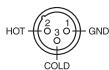
This instrument is equipped with balanced (XLR) type jacks. Wiring diagrams for these jacks are shown below. Make connections after first checking the wiring diagrams of other equipment you intend to connect.
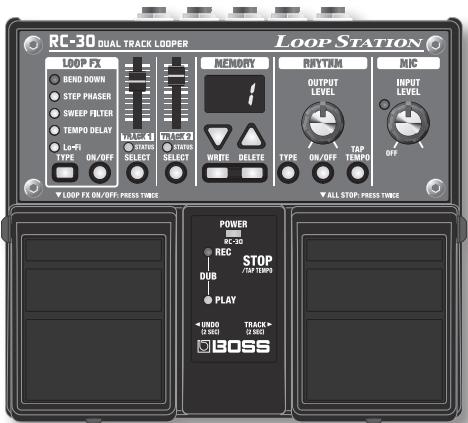
To perform recording, overdubbing, and playback, press the left pedal as shown in the diagram.
Selecting a Phrase Memory
Use the [ ] / [ ] buttons to select a phrase memory (1-99).
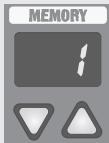
| Display | Explanation |
| Only number displayed | Empty phrasePress the left pedal to start recording |
| Dot in lower right | Phrase containing dataPress the left pedal to start loop playback |
| Number alternately displayed with “DL,” “La,” or “do” | One-shot phraseWhen you press the left pedal, the track for which one-shot has been specified will play only once (it will not loop) |
- When shipped from the factory, phrases 90–99 contain demo phrases.
Recording
- Record your guitar or bass performance, or the sound from an audio player connected to the AUX IN jack.

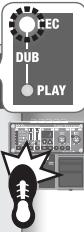
- Auto recording (p. 11) lets you start recording the moment you begin performing.
- You can also record along with rhythm sounds (p. 12).
Selecting the Current Track
There are two tracks for phrases, and the track that is currently selected is called the "current track." Recording and overdubbing can be performed only on the current track. If you switch the current track during recording or overdubbing, the track that was being recorded will switch to playback.
You can switch the current track as follows.
Press the [SELECT] button for TRACK 1 or TRACK 2
The [SELECT] button you pressed will light, and that button's track will become the current track.
Hold down the right pedal for two seconds or longer
The current track will switch when you hold down the right pedal for two seconds or longer.
Starting the two tracks simultaneously
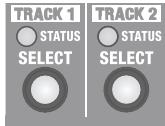
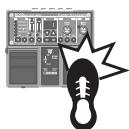
When you press the left pedal for a phrase that contains data, only the current track will start playback. If data exists in both track 1 and track 2, simultaneously pressing the track 1 and track 2 [SELECT] buttons while stopped (or using the right pedal to switch tracks several times) will cause the two buttons to light. If you start playback from this state, the two tracks will start simultaneously. After starting, track 1 will be the current track.
Over dubbing

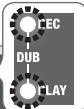
Layer your performances while the phrase plays as a loop.
Pressing the left pedal switches the unit to playback.
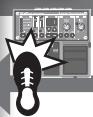
- You can Undo and Redo (p. 11).
LoopPlayback

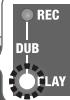
Play back phrases as loops.
Pressing the left pedal switches the unit to overdubbing.
To use the Memory Shift function, press the [ ] / [] buttons while a phrase is playing; the phrase memory number will blink, allowing you to select the next phrase (p. 16).
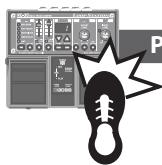
Press the right pedal
Stop


Regardless of the timing, pressing the right pedal will stop the current track.
- If you want the two tracks to stop simultaneously, press the right pedal twice in succession.
One-ShotPlayback
The track for which one-shot has been specified will play only once.
Refer to "Specifying How a Phrase Will Play/Stop
(Stop Mode/One-Shot Playback)" (p. 10).
| Display | Track 1 | Track 2 |
| aL | One shot | Loop |
| LQ | Loop | One shot |
| aa | One shot | One shot |
NOTE
- While phrase memory is being read, the PLAY (green) indicator will blink rapidly. Never turn off the power while the PLAY indicator is blinking rapidly.
- The minimum recording time for a loop phrase is approximately 1.5 seconds. If you press the pedal within approximately 1.5 seconds after you start recording, recording will continue until the phrase is at least approximately 1.5 seconds long.
- The maximum recording time for a loop phrase is approximately 3 hours (total for all phrases). When the maximum recording time is exceeded, the display will show "FL" to indicate that internal memory is full, and recording or overdubbing may end before you intended. If this occurs, delete unneeded phrases (p. 10) and then try the operation again.
- If you use the Memory Shift function before saving a phrase, that phrase will be erased. For details on how to save a phrase, refer to p. 10.
Saving a Phrase
If you select a different phrase memory or turn off the power after recording or overdubbing, the phrase you recorded will be lost. If you want to keep the phrase, you must save it.
1. Press the [WRITE] button.
The display will indicate "B" (wr).
2. Use the [ ] / [] buttons to specify the save-destination phrase memory.
You can skip this step if you want to save to the currently selected phrase.
You can't select a phrase memory in which a phrase has already been saved.
The maximum recording time is a total of approximately 3 hours for all phrases (including the phrase that has not been saved). If the phrase cannot be saved because there is insufficient free memory, the display will indicate "FL" alternately with the phrase memory number. In this case, delete unneeded phrases (p. 10) and then try the operation again.
3. Press the [WRITE] button once again; the phrase will be saved.
If you decide to cancel the save operation, press any button other than [WRITE], [▼], or [▲], or press a pedal.
While the phrase is being saved, the number in the display and the PLAY indicator will blink rapidly.
NOTE
- Never turn off the power while the PLAY indicator is blinking rapidly. This may cause all saved data to be lost.
- Please be aware that the contents of memory can be irretrievably lost as a result of a malfunction or improper operation of the unit. You should back up important data as described in "Backing up to your computer" (p. 15).
- All due care is taken during repairs to avoid the loss of data. However, in certain cases, such as when there is damage to the memory, it may not be possible to restore the data.
- Unfortunately, it may be impossible to restore the contents of data that was stored in the unit's memory once it has been lost. Roland Corporation assumes no liability concerning such loss of data.
Deleting a Phrase
- This device contains demo phrases (90-99). Once you delete these, they cannot be recovered. Please back them up as described in "Backing up to your computer" (p. 15).
1. Use the [] / [] buttons to select the phrase memory that you want to delete.
2. Press the [DELETE] button.
The display will indicate "dL."
- At this point, you can't change the phrase memory number that will be deleted.
3. Press the [DELETE] button once again; the phrase will be deleted.
If you decide to cancel the delete operation, press any button other than [DELETE] or press a pedal.
While the phrase is being deleted, the number in the display and the PLAY indicator will blink rapidly.
- Never turn off the power while the PLAY indicator is blinking rapidly. This may cause all saved data to be lost.
Specifying How a Phrase Will Play/Stop (Stop Mode/One-Shot Playback)
You can specify how a phrase will play and stop.
1. For two seconds or longer, hold down the [SELECT] button of the track whose setting you want to change.
The display will indicate the currently selected stop mode setting.
2. Use the [] / [] buttons to select the desired stop mode.
| Display | Play | Stop | Explanation |
| LP | Loop play | Stop immedi- diately | This is regular loop playback (default setting). |
| a5 | One-shot playback | Stop immedi- diately | One-shot playback will play the phrase once from the beginning to the end, and then stop automatically.* Overdubbing is disabled when one-shot playback is in effect. If the left pedal is pressed during playback of the phrase, the phrase starts playing from the beginning again (retrigger playback). |
| Fo | Loop play | Fade- out and then stop | The stop effect will be applied when you press the right pedal.• The PLAY indicator will blink until the phrase stops.• You can stop immediately by pressing the right pedal once again before the phrase has stopped.* You can't overdub before the phrase has stopped. |
| LE | Loop play | Play to the end of the phrase and then stop |
3. Press the [SELECT] button to return to normal operation.
The stop mode setting is remembered when you save the phrase (p. 10).
Cancelling an Overhub (Undo/Redo/Track Clear)
You can Undo/Redo by holding down the left pedal for two seconds or longer. You can clear the track by holding down the right pedal and pressing the left pedal.
| Operation | Display | Explanation |
| Undo | Un | Hold down the left pedal for at least two seconds during playback or overdubbing; the recording or the most recent overdubbing will be cancelled. |
| Redo | RE | If you want to restore the cancelled sound, hold down the left pedal for at least two seconds once again. * You can't Redo after Undoing a recorded phrase. |
| Operation | Display | Explanation |
| Track clear | CL | If you hold down the right pedal and press the left pedal, the phrase of the current track will be cleared. (Clear is temporary; phrases saved in phrase memory will not be deleted.) |
| NOTE | ||
| * If you're clearing while stopped, the phrase will play if you press the left pedal first. |
During Undo/Redo, the PLAY and REC indicators will blink rapidly. During Clear, the PLAY indicator will blink rapidly.
Auto Recording/Count-In Recording Functions
"Auto recording" starts recording the moment you begin playing your guitar or play back your audio player. "Count-in" sounds the rhythm for one measure before recording starts.
1. Hold down the [TAP TEMPO] button for at least two seconds.
The display will indicate "no."
2. Use the [] / [] buttons to select the desired recording mode, and then press the left pedal to start recording.
| Display | Mode | Explanation |
| na | Normal recording | Recording will begin the instant you press the left pedal. |
| RU | Auto recording | The REC indicator will blink rapidly, and the RC-30 will enter recording-standby mode. When you begin playing, the REC indicator will light and recording will start. |
| Et | Count-in recording | The [RHYTHM ON/OFF] button will blink. When you press the left pedal, the REC indicator will blink rapidly, and the rhythm will sound for one measure. (You can stop by pressing the right pedal during this time.) When the one measure of playback has ended, recording will start. (The rhythm will continue sounding even after recording has begun.) For more about the rhythm settings, refer to “About Rhythm” (p. 12). |
The recording mode will be reset to Normal recording when you turn off the power.
Sounding a Rhythm
1. Press the [RHYTHM ON/OFF] button to switch the rhythm sound between playing and stopped.
- Use the [RHYTHM OUTPUT LEVEL] knob to adjust the volume of the rhythm.
- The [TAP TEMPO] button will blink in time with the rhythm (red on the first beat, green on subsequent beats).
- When you save a phrase (p. 10), the rhythm type and time signature selected at that time will also be saved.
Setting the Tempo
When recording, you can set the tempo before you start recording. When playing back a saved phrase, you can change the playback tempo without changing the pitch of the phrase.
1. Use the [] / [] buttons to select the phrase memory whose tempo you want to set.
2. Press the [TAP TEMPO] button several times at the desired tempo.
The tempo will be set to the interval at which you press the button.
Alternatively, you can set the tempo by pressing the right pedal repeatedly while stopped.
- If the RC-30 is stopped, the rhythm ([RHYTHM ON/OFF] button) will turn on after you set the tempo.
- You can only change the tempo of phrases that have been saved in phrase memory. If you want to change the tempo of a phrase immediately after recording or over dubbing, you must first save it to phrase memory (p. 10).
- There are limitations on the proportion of the possible tempo change.
- You can't specify a tempo that would cause the phrase to loop in a shorter time than the minimum recording time (approximately 1.5 seconds).
The tempo setting is stored when you save the phrase (p. 10).
Setting the Rhythm Type
1. Press the [RHYTHM TYPE] button.
The display will indicate "r" - "r"; the RC-30 is now in rhythm type selection mode.
2. Use the [ ] / [ ] buttons to select the desired rhythm type (r - r - 9)
3. Press the [RHYTHM TYPE] button to return to normal operation.
| Rhythm Type List | |
| r0 | Hi-Hat |
| r1 | Kick & Hi-Hat |
| r2 | Rock 1 |
| r3 | Rock 2 |
| r4 | Pop |
| r5 | Funk |
| r6 | Shuffle |
| r7 | R & B |
| r8 | Latin |
| r9 | Percussion |
Setting the Time Signature
You can set the time signature before you start recording.
- You can't change the time signature after recording.
1. Hold down the [RHYTHM TYPE] button for at least two seconds.
The display will indicate "b4" or "b3"; the RC-30 is now in time signature selection mode.
2. Use the [] / [] buttons to select the desired time signature.
| Display | Explanation |
| b4 | 4/4 beat (default) |
| b3 | 3/4 beat |
3. Press the [RHYTHM TYPE] button to return to normal operation.
Recording with the rhythm sound
If you record while the rhythm sound is on, recording will start from the beginning of the measure the instant you press the pedal to initiate recording.
By using the "Count-in recording" function (p. 11), you can start recording after the rhythm sound has played back for one measure.
Regardless of the timing at which you press the pedal to end recording, the length of the phrase will automatically be adjusted to units of one measure.
Recording without the rhythm sound
If you record while the rhythm sound is off, the tempo of the phrase will be automatically specified after recording has ended.
The automatic tempo setting is calculated by assuming that you have recorded "1, 2, 4, 8, 16, ... measures in the specified time signature (p. 13)."
You can apply an effect to the phrase playback. The effect will be applied in synchronization with the tempo of the phrase.
- You can't apply an effect to the sound being recorded (i.e., you can't record the processed signal).
Turning LOOP FX On/Off
1. Press the [LOOP FX ON/OFF] button to turn LOOP FX on/off.
While stopped or playing, you can turn LOOP FX on/off by pressing the left pedal twice in succession.
Specifying the LOOP FX Type
- Press the [LOOP FX TYPE] button to select the desired LOOP FX type.
| LOOP FX Type | Explanation |
| BEND DOWN | This effect abruptly lowers the pitch. |
| STEP PHASER | This is a phaser that changes in steps. |
| SWEEP FILTER | This is a filter whose frequency changes in synchronization with the tempo. |
| TEMPO DELAY | This produces a tempo-synchronized delay effect. |
| Lo-Fi | This effect intentionally degrades the sound to create a distinctive character. |
Connecting to Your Computer via USB
You can connect the RC-30 to your computer via a commercially available USB cable, and back up RC-30 phrases (WAV files) to your computer or load WAV files from your computer to the RC-30.
Playable WAV file formats
| Data Format | WAV |
| Bit Rate | 16-bit linear, stereo |
| Sampling Frequency | 44.1 kHz |
Maximum WAV file size is 1.7 GB (total of all files), maximum time is approximately 3 hours (total of all phrases), and minimum time is approximately 1.5 seconds.
-
Turn on the RC-30's power (insert a plug into the OUTPUT L jack).
-
The RC-30 will not operate on USB bus power. We recommend that you use an AC adaptor (sold separately) to ensure that the power does not turn off while connected via USB.
-
Use a commercially available USB cable to connect the RC-30's USB connector to your computer's USB connector (a connector that supports USB 2.0 Hi-Speed).
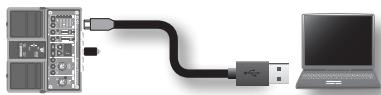
- You can't make USB connections if the RC-30 is not stopped, or if there is a phrase that has not been saved.
3. Back up the phrases as described below.
Windows users
Within My Computer (or Computer), open "BOSS_RC-30" (or Removable Disk).
Mac OS users
On the desktop, open the "BOSS_RC-30" icon.
Backing up to your computer
Copy the entire "ROLAND" folder from the BOSS_RC-30 drive to your computer.
Recovering backed-up data from your computer to the RC-30
- Performing this operation will erase all phrases that are currently saved in the RC-30. Be sure to make a backup before you proceed. In the BOSS_RC-30 drive, delete the "ROLAND" folder, and then copy the backed-up "ROLAND" folder from your computer to the BOSS_RC-30 drive.
Writing individual WAV files from your computer to the RC-30's phrase memory
You can copy WAV files from your computer to the "001_1","001_2"-"099_1","099_2" folders within the "ROLAND"-WAVE" folder in the BOSS_RC-30 drive (In the folder name "XX_Y", the XX is the phrase memory number and the Y is the track number).
NOTE
- Do not delete the folders inside the BOSS_RC-30 drive unless you are performing a recovery operation.
- You can use the following characters in file names.
A-Z ( uppercase letters), 0-9 (numbers), _
(underscore) - Do not place more than one WAV file in any folder. If a folder already contains a WAV file, do not overwrite it. Write your WAV files into empty folders.
4. When you've finished copying WAV files, disconnect the USB drive as follows.
When you have disconnected the USB drive, the display will indicate "dE" and the [RHYTHM ON/OFF] button will blink.
Windows 7 users
In the lower right of your screen, click the [ ] icon → [ ] icon, and then click "Remove BOSS_RC-30 (or Removable Disk)."
Windows Vista/Windows XP users
In the lower right of your screen, click the [ ] icon ([ ] in XP) and then click "Safely Remove BOSS_RC-30 (or Removable Disk)."
Mac OS users
On the desktop, right-click (or [Control] + click) the USB drive icon, and then click "Remove BOSS_RC-30".
5. Press the [RHYTHM ON/OFF] button to return to normal operation.
The "dE" indication will disappear from the display, and the RC-30 will return to normal operation.
6. Disconnect the USB cable from your computer.
NOTE
- Never perform the following actions until you have completed steps 4-5. Doing so might make your computer freeze, or might result in the loss of all of the RC-30's data.
- Disconnect the USB cable.
- Allow your computer to enter suspend (standby) or hibernate mode, restart it, or shut it down.
- Turn off the RC-30's power.
- Unfortunately, it may be impossible to restore the contents of data that was stored in the unit's memory once it has been lost. Roland Corporation assumes no liability concerning such loss of data.
Connecting to an External Footswitch
Connect your foot switch to the FOOT SW jack as shown in the illustration, and set its POLARITY switch.
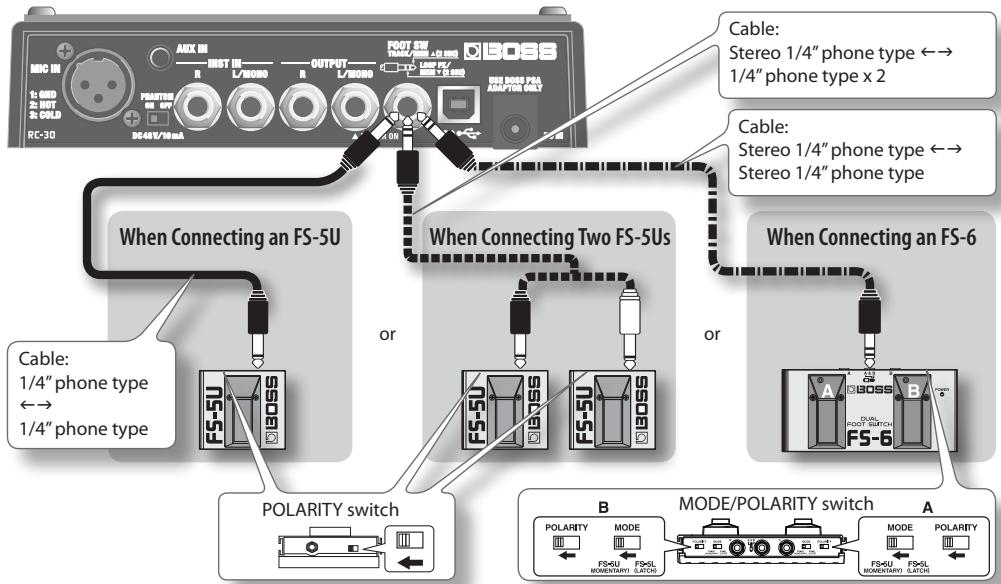
When Connecting an FS-5U
- The FS-5L cannot be used.
| Operation | Explanation |
| Switch the current track | Pressing the foot switch will switch the current track. |
| Memory shift (up) | Holding down the foot switch for two seconds or longer switches you to the next-numbered phrase memory. If you press the foot switch during playback, the newly selected phrase memory number will blink in the display, and the phrase memory will be changed when the currently playing phrase has ended. |
- If the current phrase has not been saved, that phrase will be lost when you perform the memory shift. For details on how to save a phrase, refer to p. 10.
- If you perform the memory shift operation near the end of the phrase, there may be cases in which the shift-destination phrase memory will not be selected.
- You can also perform memory shift operations by pressing the [] / [] buttons.
When Connecting Two FS-5Us or an FS-6
When you operate an FS-5U connected to the white plug (stereo L side) or pedal B of an FS-6
The operation will be the same as when a single FS-5U is connected.
When you operate an FS-5U connected to the red plug (stereo R side) or pedal A of an FS-6
| Operation | Explanation |
| LOOP FX on/off | Pressing the foot switch will turn LOOP FX on/off. |
| Memory shift (down) | When you hold down the foot switch for at least two seconds, the previous-numbered phrase memory will be selected. |
| Switching the LOOP FX TYPE | To switch the LOOP FX TYPE, hold down the B pedal of the FS-6 (FS-5U of stereo L side) while you press (within 2 seconds) the A pedal of the FS-6 (FS-5U of stereo R side). |
About Sleep Mode
When ten hours have elapsed since the last operation or audio input, the RC-30 will enter sleep mode (power conservation mode; only the bypass sound will be output). From sleep mode, you can press the pedal to return to normal mode.
- Battery power continues to be consumed even in sleep mode. To prevent battery consumption, turn off the power by removing the plug from the OUTPUT L jack.
- The RC-30 will not enter sleep mode if there is a phrase that has not been saved.
Disabling Sleep Mode
- While holding down the left pedal, turn on the power (insert a plug into the OUTPUT L jack).
- Continue holding down the left pedal for five seconds.
The display will blink"--"and the POWER indicator will blink.
3. Release the left pedal; the RC-30 will resume normal operation.
Enabling Sleep Mode (default setting)
- While holding down the left pedal, turn on the power (insert a plug into the OUTPUT L jack).
- Within two seconds, press the left pedal twice.
The display will blink "5L" and the POWER indicator will blink.
After two seconds, the RC-30 will resume normal operation; sleep mode will be enabled.
Changing the Switching Order of Recording Over dubbing Playback
When you press the left pedal, the RC-30 will switch its operation in the order of recording overdubbing playback (default setting) (p. 8). However, you can change this so that the order is recording playback overdubbing (RC-20XL compatible).
- While holding down the [TAP TEMPO] button, turn on the power (insert a plug into the OUTPUT L jack).
- Use the [ ] / [] buttons to select the desired mode.
| Display | Explanation |
| r d | Operation will switch in the order of Recording → Overdubbing → Playback (default setting). |
| r P | Operation will switch in the order of Recording → Playback → Overdubbing (RC-20XL compatible). |
- Press the [TAP TEMPO] button to return to normal operation.
Formatting the Internal Memory
-
When you format the RC-30's internal memory, all phrase memories that were saved will be erased, and cannot be recovered. Do not format the internal memory unless the display indicates "Er" and the RC-30 has stopped operating correctly.
-
While holding down the [WRITE] button and the [RHYTHM ON/OFF] button, turn on the power (insert a plug into the OUTPUT L jack).
The display will indicate "FII."
- Press the [RHYTHM ON/OFF] button once again.
The display will blink "F1."
- Press the [WRITE] button; formatting of the internal memory will begin.
The indication "FNI" in the display and the PLAY indicator will blink rapidly. When formatting is completed, the RC-30 will return to normal operation.
- Never turn off the power while the PLAY indicator is blinking rapidly.
Troubleshooting
| Problem | Action |
| Recording does not end immediately when you press the right pedal | If rhythm is on, or if you recorded a phrase that is shorter than the minimum recording time (approximately 1.5 seconds), the length of the phrase is adjusted automatically; this may mean that recording does not end immediately when you press the right pedal. |
| Recording started immediately even though Auto recording mode is selected | If due to distortion or other causes there is a significant amount of noise, that noise may be enough to trigger the beginning of recording. Reduce the noise, for example by lowering the distortion level. |
| Cannot change the playback tempo | You cannot change the playback tempo in the following situations. • If the phrase has not been saved. • While phrases are being switched (PLAY indicator blinking rapidly). • When you attempt to set the tempo for a phrase that is looped over an interval shorter than the minimum recording time (approximately 1.5 seconds). |
Error Message List
| Display | Meaning | Action | Page |
| bk | The battery has run low. | Replace the battery. | p. 3 |
| FL | Memory is full. | Delete unneeded phrases. | p. 10 |
| LF | This WAV file is unreadable. | Check the format of the WAV file. | p. 14 |
| EF | Further overdubbing is not possible. | Re save the phrase. | p. 10 |
| Er | Internal memory must be formatted. | Format the RC-30's internal memory. | p. 17 |
| dπ | The RC-30 has malfunctioned. | Contact your dealer. | |
Other Display Indications
| Display | Explanation | Page |
| I-99 | Phrase memory number | p. 8 |
| (.dot) | Phrase memory containing data | |
| aL | One-shot phrase on track 1 only | p. 9 |
| Lo | One-shot phrase on track 2 only | |
| oo | One-shot phrases on tracks 1 and 2 | |
| LP | Loop playback | p. 10 |
| o5 | One-shot playback | |
| Fo | Fade-out and then stop | |
| LE | Play to the end of the phrase and then stop | |
| Un | Undo | p. 11 |
| rE | Redo | |
| cL | Tack clear | |
| yr | Save phrase | p. 10 |
| dL | Delete phrase | p. 10 |
| Display | Explanation | Page |
| no | Normal recording | p. 11 |
| RU | Auto recording | |
| Et | Count-in recording | |
| r0-r9 | Rhythm type | p. 12 |
| b3-b4 | Time signature | p. 13 |
| Cn | USB connected | p. 14 |
| dC | USB disconnected | |
| SL | Sleep mode enabled | p. 17 |
| -- | Sleep mode disabled | |
| rd | Switch in the order of record/ overdub/play | p. 17 |
| rP | Switch in the order of record/play/ overdub | |
| FN | Format internal memory | p. 17 |
BOSS RC-30 DUAL TRACK LOOPER: Loop Station
| Nominal Input Level | MIC IN: -40 dBu (variable) INST IN: -20 dBu AUX IN: -10 dBu |
| Input Impedance | MIC IN: 4 k ohms INST IN: 1 M ohm AUX IN: 22 k ohms |
| Nominal Output Level | -20 dBu |
| Output Impedance | 1 k ohm |
| Recommended Load Impedance | 10 k ohms or larger |
| Recording/Playback | Maximum recording time: Approx. 3 hours Maximum number of stored phrases: 99 phrases Number of tracks: 2 Data format: WAV (44.1 kHz, 16-bit linear, stereo) |
| USB Interface | USB 2.0/1.1 mass storage device class |
| Connectors | MIC IN jack (XLR type/balanced/ phantom power: 48 V DC, 10 mA max) INST IN jacks (L/MONO, R) (1/4" phone type) AUX IN jack (Stereo miniature phone type) OUTPUT jacks (L/MONO, R) (1/4" phone type) BOOT SW jack (1/4"TRS phone type) USB connector DC IN jack (DC 9V) |
| Power Supply | DC 9V: Alkaline battery (AA, LR6) or Carbon-zinc battery (AA, R6) x 6, AC Adaptor (PSA-series: sold separately) * Rechargeable Ni-MH batteries cannot be used. |
| Current Draw | Maximum 195 mA (DC 9V) Alkaline battery (AA, LR6) : Approx. 7.5 hours Carbon-zinc battery (AA, R6) : Approx. 1.5 hours * These figures will vary depending on the actual conditions of use. |
| Dimensions | 173 (W) x 158 (D) x 57 (H) mm 6-13/16 (W) x 6-1/4 (D) x 2-1/4 (H) inches |
| Weight | 1.2 kg/2 lbs 11 oz (including batteries) |
| Accessories | Owner's Manual, Leaflet ("USING THE UNIT SAFELY," "IMPORTANT NOTES," and "Informa- tion"), Alkaline battery (AA, LR6) x 6 * The battery that was supplied with the unit is for temporary use, intended primarily for testing the unit's operation. We suggest replacing this with an alkaline dry cell. |
| Options (sold separately) | AC Adaptor (PSA series) Foot Switch: FS-5U, FS-6 |
- 0 dBu = 0.775 Vrms
- In the interest of product improvement, the specifications and/or appearance of this unit are subject to change without prior notice.
Bedienungsanleitung
Copyright © 2011 BOSS CORPORATION
Copyright © 2011 BOSS CORPORATION
Copyright © 2011 BOSS CORPORATION
Copyright © 2011 BOSS CORPORATION
Copyright © 2011 BOSS CORPORATION
Copyright © 2011 BOSS CORPORATION
DECLARATION OF CONFORMITY Compliance Information Statement
Model Name: RC-30
Type of Equipment: Effector
Responsible Party: Roland Corporation U.S.
Address: 5100 S. Eastern Avenue, Los Angeles, CA 90040-2938
Telephone: (323) 890-3700