
UA-1X - Audio Interface ROLAND - Free user manual and instructions
Find the device manual for free UA-1X ROLAND in PDF.


| Product type | USB audio interface |
| Brand | Roland |
| Model | UA-1X |
| Approximate dimensions | 120 x 80 x 30 mm |
| Approximate weight | 200 g |
| Power supply | USB bus power (5 V, 500 mA max) |
| Audio resolution | 16 bits / 44.1 kHz or 48 kHz |
| Analog inputs | 1 line input (3.5 mm stereo jack) |
| Analog outputs | 1 line output (3.5 mm stereo jack), 1 headphone output (3.5 mm stereo jack) |
| Digital output | Not specified (no mention) |
| Connector | USB type B |
| Supported operating systems | Windows 98/Me/2000/XP, Mac OS 9 and OS X (up to 10.2) |
| Main functions | USB audio converter, audio playback and recording, software volume control |
| ASIO compatibility | No (standard Mac OS driver not ASIO compatible) |
| Maintenance and cleaning | Disconnect before cleaning. Use a dry cloth. Avoid any liquid. |
| Safety | Do not expose to moisture. Do not open the device. Disconnect during thunderstorms. |
| Spare parts and repairability | No spare parts available. Entrust all repairs to a Roland authorized technician. |
| General information | Manual available in multiple languages (FR, DE, EN, ES, IT, JA). Free download in PDF format. |
Frequently Asked Questions - UA-1X ROLAND
User questions about UA-1X ROLAND
0 question about this device. Answer the ones you know or ask your own.
Ask a new question about this device
Download the instructions for your Audio Interface in PDF format for free! Find your manual UA-1X - ROLAND and take your electronic device back in hand. On this page are published all the documents necessary for the use of your device. UA-1X by ROLAND.
USER MANUAL UA-1X ROLAND
AUDIO Capture UA-1X USB AUDIO INTERFACE
Owner's Manual Bedienungsanleitung Mode d'emploi Manuale d'uso Manual del usuario
Before using this unit, carefully read the sections entitled: "USING THE UNIT SAFELY" (p. 2–3) and "IMPORTANT NOTES" (p. 4). These sections provide important information concerning the proper operation of the unit. Additionally, in order to feel assured that you have gained a good grasp of every feature provided by your new unit, Getting Started should be read in its entirety. The manual should be saved and kept on hand as a convenient reference.
USING THE UNIT SAFELY
INSTRUCTIONS FOR THE PREVENTION OF FIRE, ELECTRIC SHOCK, OR INJURY TO PERSONS
About ⚠️ WARNING and ⚠️ CAUTION Notices
| WARNING | Used for instructions intended to alert the user to the risk of death or severe injury should the unit be used improperly. |
| CAUTION | Used for instructions intended to alert the user to the risk of injury or material damage should the unit be used improperly.* Material damage refers to damage or other adverse effects caused with respect to the home and all its furnishings, as well to domestic animals or pets. |
About the Symbols
| The △ symbol alerts the user to important instructions or warnings. The specific meaning of the symbol is determined by the design contained within the triangle. In the case of the symbol at left, it is used for general cautions, warnings, or alerts to danger. | |
| The Ⓧ symbol alerts the user to items that must never be carried out (are forbidden). The specific thing that must not be done is indicated by the design contained within the circle. In the case of the symbol at left, it means that the unit must never be disassembled. | |
| The ● symbol alerts the user to things that must be carried out. The specific thing that must be done is indicated by the design contained within the circle. In the case of the symbol at left, it means that the power-cord plug must be unplugged from the outlet. |
ALWAYS OBSERVE THE FOLLOWING
WARNING
- Before using this unit, make sure to read the instructions below, and the Owner's Manual.

- Do not open or perform any internal modifications on the unit.

- Do not attempt to repair the unit, or replace parts within it (except when this manual provides specific instructions directing you to do so). Refer all servicing to your retailer, the nearest EDIROL/Roland Service Center, or an authorized EDIROL/Roland distributor, as listed on the “Information” page.

- Never use or store the unit in places that are:
- Subject to temperature extremes (e.g., direct sunlight in an enclosed vehicle, near a heating duct, on top of heat-generating equipment); or are
- Damp (e.g., baths, washrooms, on wet floors); or are
- Humid; or are
- Exposed to rain; or are
- Dusty; or are
- Subject to high levels of vibration.
WARNING
- Make sure you always have the unit placed so it is level and sure to remain stable. Never place it on stands that could wobble, or on inclined surfaces.

- This unit, either alone or in combination with an amplifier and headphones or speakers, may be capable of producing sound levels that could cause permanent hearing loss. Do not operate for a long period of time at a high volume level, or at a level that is uncomfortable. If you experience any hearing loss or ringing in the ears, you should immediately stop using the unit, and consult an audiologist.

- Do not allow any objects (e.g., flammable material, coins, pins); or liquids of any kind (water, soft drinks, etc.) to penetrate the unit.


WARNING
- Immediately turn the power off, and request servicing by your retailer, the nearest Roland Service Center, or an authorized Roland distributor, as listed on the "Information" page when:
• If smoke or unusual odor occurs
- Objects have fallen into, or liquid has been spilled onto the unit; or
- The unit has been exposed to rain (or otherwise has become wet); or
- The unit does not appear to operate normally or exhibits a marked change in performance.

- In households with small children, an adult should provide supervision until the child is capable of following all the rules essential for the safe operation of the unit.
- Protect the unit from strong impact. (Do not drop it!)


CAUTION
- Try to prevent cords and cables from becoming entangled. Also, all cords and cables should be placed so they are out of the reach of children.

- Never climb on top of, nor place heavy objects on the unit.

- Disconnect all cords coming from external devices before moving the unit.

* Microsoft and Windows are registered trademarks of Microsoft Corporation.
* Screen shots in this documents are reprinted with permission from Microsoft Corporation.
* Windows® is known officially as: "Microsoft® Windows® operating system."
* Apple and Macintosh are registered trademark of Apple Computer, Inc.
* MacOS is a trademark of Apple Computer, Inc.
* All product names mentioned in this document are trademarks or registered trademarks of their respective owners.
In addition to the items listed under “USING THE UNIT SAFELY” on page 2–3, please read and observe the following:
Power Supply
- Before connecting this unit to other devices, turn off the power to all units. This will help prevent malfunctions and/or damage to speakers or other devices.
Placement
- Using the unit near power amplifiers (or other equipment containing large power transformers) may induce hum. To alleviate the problem, change the orientation of this unit; or move it farther away from the source of interference.
- This device may interfere with radio and television reception. Do not use this device in the vicinity of such receivers.
- Noise may be produced if wireless communications devices, such as cell phones, are operated in the vicinity of this unit. Such noise could occur when receiving or initiating a call, or while conversing. Should you experience such problems, you should relocate such wireless devices so they are at a greater distance from this unit, or switch them off.
- Do not expose the unit to direct sunlight, place it near devices that radiate heat, leave it inside an enclosed vehicle, or otherwise subject it to temperature extremes. Excessive heat can deform or discolor the unit.
- When moved from one location to another where the temperature and/or humidity is very different, water droplets (condensation) may form inside the unit. Damage or malfunction may result if you attempt to use the unit in this condition. Therefore, before using the unit, you must allow it to stand for several hours, until the condensation has completely evaporated.
Maintenance
- For everyday cleaning wipe the unit with a soft, dry cloth or one that has been slightly dampened with water. To remove stubborn dirt, use a cloth impregnated with a mild, non-abrasive detergent. Afterwards, be sure to wipe the unit thoroughly with a soft, dry cloth.
- Never use benzine, thinners, alcohol or solvents of any kind, to avoid the possibility of discoloration and/or deformation.
Copyright
- Unauthorized recording, distribution, sale, lending, public performance, broadcasting, or the like, in whole or in part, of a work (musical composition, video, broadcast, public performance, or the like) whose copyright is held by a third party is prohibited by law.
- When exchanging audio signals through a digital connection with an external instrument, this unit can perform recording without being subject to the restrictions of the Serial Copy Management System (SCMS). This is because the unit is intended solely for musical production, and is designed not to be subject to restrictions as long as it is used to record works (such as your own compositions) that do not infringe on the copyrights of others. (SCMS is a feature that prohibits second-generation and later copying through a digital connection. It is built into MD recorders and other consumer digital-audio equipment as a copyright-protection feature.)
- Do not use this unit for purposes that could infringe on a copyright held by a third party. We assume no responsibility whatsoever with regard to any infringements of third-party copyrights arising through your use of this unit.
Additional Precautions
- Unfortunately, it may be impossible to restore the contents of data that was stored on a storage device (e.g., hard disk) once it has been lost. Roland Corporation assumes no liability concerning such loss of data.
- Use a reasonable amount of care when using the unit's buttons, sliders, or other controls; and when using its jacks and connectors. Rough handling can lead to malfunctions.
- When connecting / disconnecting all cables, grasp the connector itself—never pull on the cable. This way you will avoid causing shorts, or damage to the cable's internal elements.
- To avoid disturbing your neighbors, try to keep the unit's volume at reasonable levels. You may prefer to use headphones, so you do not need to be concerned about those around you (especially when it is late at night).
- When you need to transport the unit, package it in the box (including padding) that it came in, if possible. Otherwise, you will need to use equivalent packaging materials.
- Use a cable from Roland to make the connection. If using some other make of connection cable, please note the following precautions.
- Some connection cables contain resistors. Do not use cables that incorporate resistors for connecting to this unit. The use of such cables can cause the sound level to be extremely low, or impossible to hear. For information on cable specifications, contact the manufacturer of the cable.
- Unauthorized duplication, reproduction, hiring, and lending prohibited.
- Before you open the included CD-ROM, you must read the "license agreement". Opening the CD-ROM will be taken to mean your acceptance of the license agreement.
- Although Roland has tested numerous configurations, and has determined that on average, a computer system similar to that described above will permit normal operation of the UA-1X, Roland cannot guarantee that a given computer can be used satisfactorily with the UA-1X based solely on the fact that it meets the above requirements. This is because there are too many other variables that may influence the processing environment, including differences in motherboard design and the particular combination of other devices involved.
Contents
Features of the UA-1X 6
Check the Contents of the Package 7
Panel Descriptions 8
Using the UA-1X 9
UA-1X Signal Flow Diagram....9
Listening to Sound from Your Computer 10
Digitally Recording to MD 11
Recording from the AUX Input 12
English
Connections and Driver Installation (Windows).... 13
Connections and Driver Installation (Macintosh).... 23
Deutsch
Problems related to the USB driver.... 111
Problems when using the UA-1X 113
Deleting the USB Audio Device Driver (Windows) 119
Specifications 120
Features of the UA-1X
The UA-1X is a USB audio interface that can be connected to your computer via a single USB cable, providing high-quality digital audio output.
Unbeatable Audio Quality
Digital output connectors are provided, and sampling frequencies of 32/44.1/48 kHz are supported for both digital output, allowing signals to be transferred to or from CD, MD, or DAT with no loss in audio quality. Analog input/output is provided by RCA phono jacks, allowing high-quality recording and playback.
\* Sampling frequency
When audio is recorded digitally, the level of the sound is measured at fixed intervals, and those levels are converted into digital signals. The “sampling frequency” is what determines this interval. Normally, a CD or MD uses a sampling frequency of 44.1 kHz.
Simple Connection to Your Computer Via USB Cable
The UA-1X can be connected to your computer via a USB cable. It is bus-powered, meaning that the power is supplied from your computer.
Since an AC adaptor is not necessary, the UA-1X is an ideal choice for use with a notebook computer.
What is USB?
USB stands for Universal Serial Bus. It is a new interface used to connect various peripheral devices to a computer.
USB allows more than one peripheral device to be connected via a single USB cable, and also allows data to be transmitted more rapidly than conventional serial ports. Peripherals can also be connected or disconnected with the power turned on, and the computer will automatically recognize the peripheral that has been plugged in. (Some peripherals may require settings or other operations to be performed.)
Check the Contents of the Package
The UA-1X includes the following items. When you open the package, first make sure that all items are included. If any are missing, contact the dealer where you purchased the UA-1X.
● UA-1X
- Owner's Manual
This is the document you are reading. Keep it at hand for reference when needed.
You will Need to Provide These Items Yourself
External amp, speakers, headphones, and mic are not included
External amp, speakers, or headphones necessary for listening to the sound output via the UA-1X are not included. Nor is a mic included for inputting sound to the UA-1X. You will need to provide these items yourself.
* As soon as you connect the UA-1X to your computer, sound will no longer be output from the speakers of your computer. You will need to provide an external monitor system or headphones.
Digital input/output cables for connecting the MD or DAT recorder are not included
Although you can use an MD or DAT digital recorder to perform digital recording, the cables for connecting the recorder to the UA-1X are not included. You will need to provide these separately.
Panel Descriptions
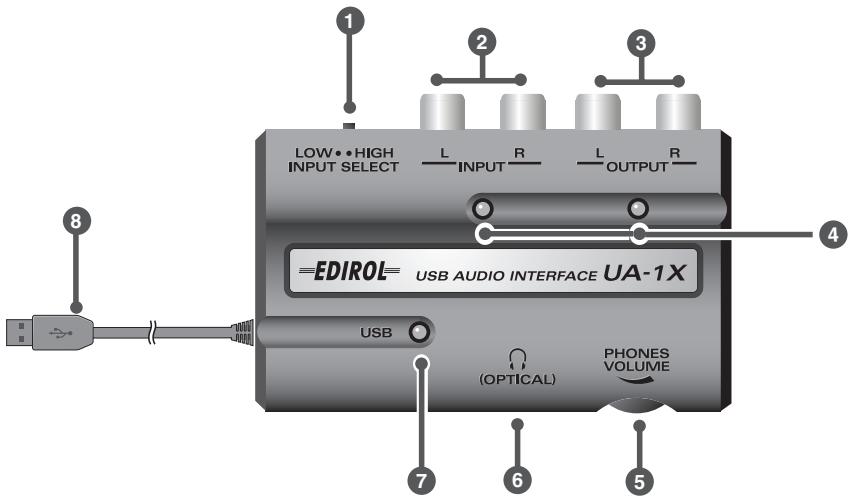
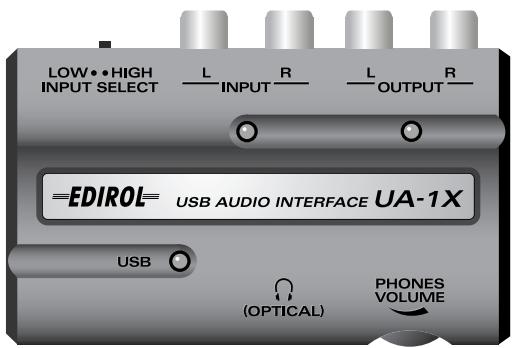
1 Input select switch
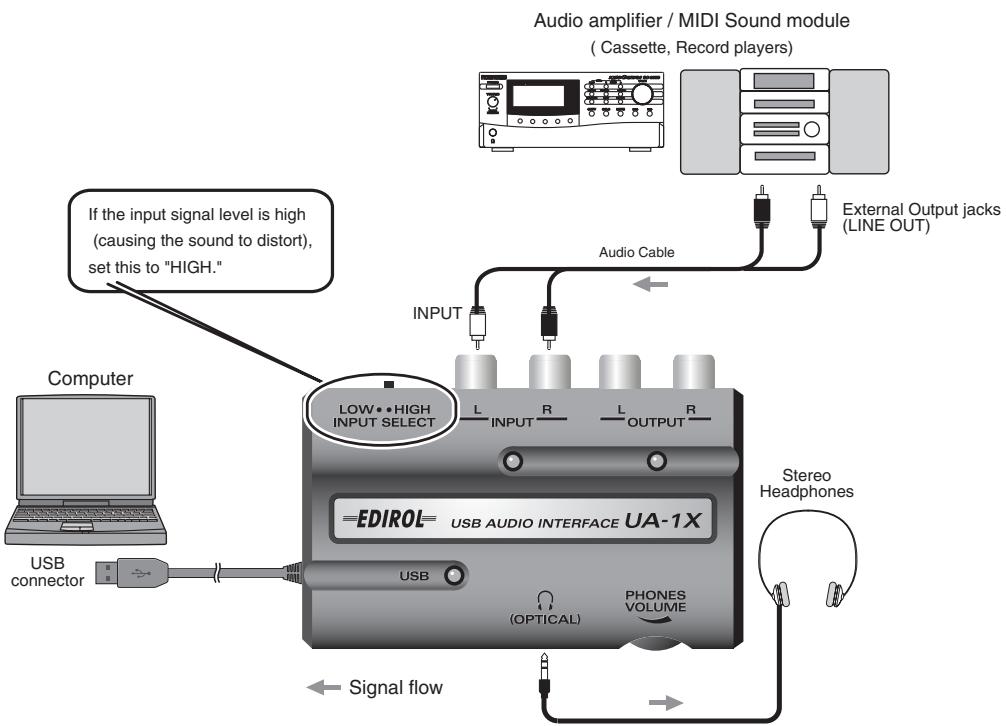
Set this switch appropriately for the device that you connect to the input jacks. Normally, you will leave this at the LOW setting. If the sound is distorted because the signal level is high, set this to HIGH.
2 Line input jacks
Make connections here when you want to input audio signals from an audio device or MIDI sound generator.
3 Line output jacks
Connect these to your audio equipment (AUX IN, LINE IN), such as an AV amp or stereo system.
4 Output level indicator, Input level indicator
The INPUT indicator will light when audio is received through the line input jacks. The OUTPUT indicator will light when audio is output from the line output jacks.
5 Headphones volume
This adjusts the volume that is output from the Headphone jack ⑥.
You cannot adjust the volume of the signal that is output from the digital output jack.
6 Headphone jack
A set of headphones can be connected here. Even if headphones are connected, sound will still be output from the Line output jacks ③.
6 Digital output connector (optical)
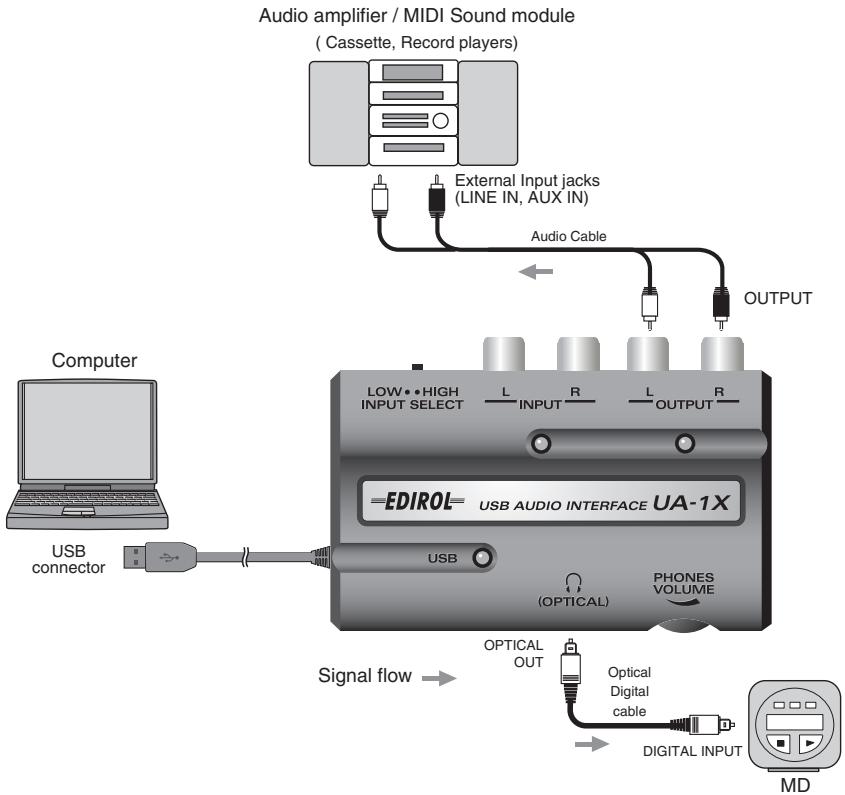
If you want to digitally output the audio signal to a Dolby Digital decoding amp or to a digital recorder such as an MD, use an optical cable to make connections.
* The same jack serves as both the headphone jack and digital output jack.
Optical
These are digital I/O jacks for connecting optical cables. Digital I/O jacks for connecting coaxial cables are labeled Coaxial.
7 USB indicator
This will light when the UA-1X is connected and recognized to the computer.
8 USB cable
Connect this cable to the USB connector of your computer.
Using the UA-1X
This chapter explains the various ways the UA-1X can be connected, and introduces some of its applications.
* To prevent malfunction and/or damage to speakers or other devices, always turn down the volume, and turn off the power of all devices before disconnecting the USB cable.
UA-1X Signal Flow Diagram
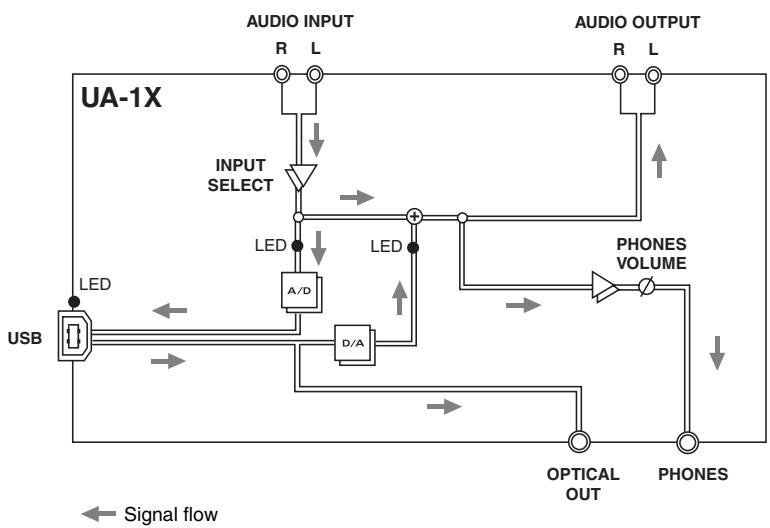
flowchart
graph TD
    A["USB"] -->|LED| B["INPUT SELECT"]
    B --> C["LED"]
    C --> D["A/D"]
    D --> E["D/A"]
    E --> F["PHONES VOLUME"]
    F --> G["OPTICAL OUT"]
    G --> H["PHONES"]
    H --> I["OUTPUT"]
    I --> J["Output"]
    style A fill:#f9f,stroke:#333
    style H fill:#f9f,stroke:#333
    style I fill:#f9f,stroke:#333
* The same jack serves as both the headphone jack and digital output jack.

As soon as you connect the UA-1X to your computer, sound will no longer be output from the speakers of your computer.
- Connect an external monitor system or headphones to the UA-1X.
- If you want sound to be output from the speakers of your computer, disconnect the UA-1X from your computer.
Listening to Sound from Your Computer
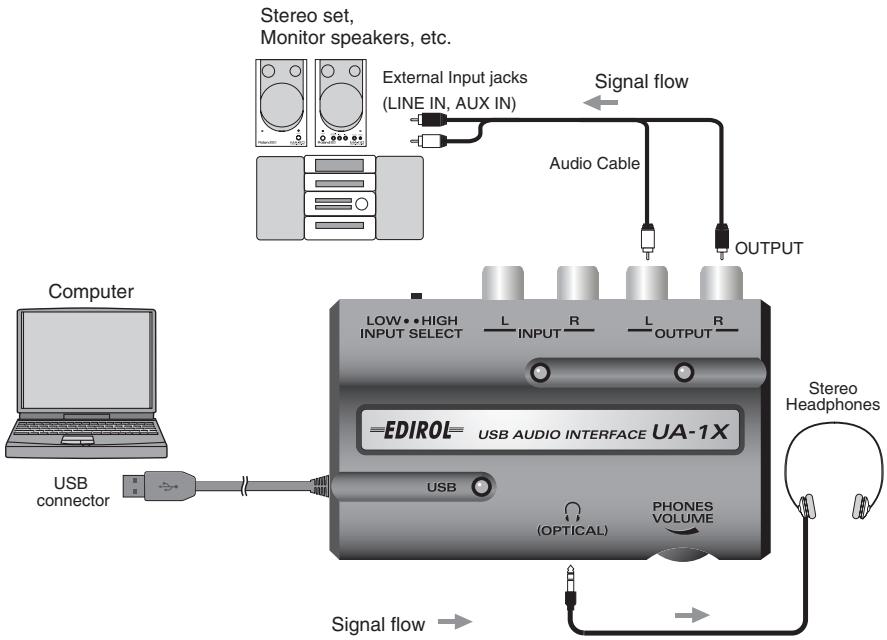
As shown in the diagram, you can connect headphones or monitor speakers, and monitor the playback sound from your application or the sound from the instrument or audio device to which the UA-1X is connected.
flowchart
graph TD
    A["Computer"] --> B["USB connector"]
    B --> C["EDIROL USB AUDIO INTERFACE UA-1X"]
    C --> D["Output"]
    D --> E["Audio Cable"]
    E --> F["External Input jacks (LINE IN, AUX IN)"]
    F --> G["Signal flow"]
    G --> H["Stereo Headphones"]
    C --> I["Signal flow"]
    I --> J["USB"]
    style A fill:#f9f,stroke:#333
    style B fill:#ccf,stroke:#333
    style C fill:#cfc,stroke:#333
    style D fill:#fcc,stroke:#333
    style E fill:#cff,stroke:#333
    style F fill:#ffc,stroke:#333
    style G fill:#fcf,stroke:#333
    style H fill:#cff,stroke:#333
Set the desired sampling frequency for recording in the application being used for recording, then proceed with recording. Available sampling frequencies vary depending on the operating system used.
| OS\Frequency | 32 kHz | 44.1kHz | 48 kHz |
| Mac OS 9/X | × | × | ○ |
| Windows 98 SE/Windows Me/Windows 2000/XP | ○ | ○ | ○ |
Digitally Recording to MD
flowchart
graph TD
    A["Computer"] --> B["USB connector"]
    B --> C["EDIROL USB AUDIO INTERFACE UA-1X"]
    C --> D["Output"]
    C --> E["PhONES VOLUME"]
    E --> F["Optical Digital cable"]
    E --> G["Optical OUT"]
    C --> H["LOW•HIGH INPUT SELECT L INPUT R L OUTPUT"]
    C --> I["External Input jacks (LINE IN, AUX IN)"]
    J["Audio amplifier / MIDI Sound module (Cassette, Record players)"] --> K["External Input jacks (LINE IN, AUX IN)"]
    K --> L["Audio Cable"]
    L --> M["Output"]
    N["MD"] --> O["Digital INPUT"]
Recording from the AUX Input
flowchart
graph TD
    A["Computer"] -->|Signal flow| B["USB connector"]
    B --> C["USB"]
    C --> D["EDIROL USB AUDIO INTERFACE UA-1X"]
    D --> E["Output"]
    E --> F["External Output jacks (LINE OUT)"]
    F --> G["Audio Cable"]
    G --> H["Audio amplifier / MIDI Sound module (Cassette, Record players)"]
    I["USB Audio Interface UA-1X"] --> J["OUTPUT"]
    K["Input Select"] --> L["LOW HIGH INPUT"]
    M["Input Select"] --> N["L INPUT"]
    O["Input Select"] --> P["R OUTPUT"]
    Q["Input Select"] --> R["L OUTPUT"]
    S["Input Select"] --> T["R OUTPUT"]
    U["Input Select"] --> V["L OUTPUT"]
    W["Input Select"] --> X["L OUTPUT"]
    Y["Input Select"] --> Z["L OUTPUT"]
    AA["Input Select"] --> AB["L OUTPUT"]
    AC["Input Select"] --> AD["L OUTPUT"]
    AE["Input Select"] --> AF["L OUTPUT"]
    AG["Input Select"] --> AH["L OUTPUT"]
    AI["Input Select"] --> AJ["L OUTPUT"]
    AK["Input Select"] --> AL["L OUTPUT"]
    AM["Input Select"] --> AN["L OUTPUT"]
    AO["Input Select"] --> AP["L OUTPUT"]
    AQ["Input Select"] --> AR["L OUTPUT"]
    AS["Input Select"] --> AT["L OUTPUT"]
    AU["Input Select"] --> AV["L OUTPUT"]
    AW["Input Select"] --> AX["L OUTPUT"]
    AY["Computer"] --> AZ["USB audio interface UA-1X"]
    style A fill:#f9f,stroke:#333
    style B fill:#ccf,stroke:#333
    style C fill:#cfc,stroke:#333
    style D fill:#fcc,stroke:#333
    style E fill:#cff,stroke:#333
    style F fill:#ffc,stroke:#333
    style G fill:#fcc,stroke:#333
    style H fill:#ffc,stroke:#333
    style I fill:#fcc,stroke:#333
    style J fill:#fcc,stroke:#333
    style K fill:#fcc,stroke:#333
    style L fill:#fcc,stroke:#333
    style M fill:#fcc,stroke:#333
    style N fill:#fcc,stroke:#333
    style O fill:#fcc,stroke:#333
    style P fill:#fcc,stroke:#333
    style Q fill:#fcc,stroke:#333
    style R fill:#fcc,stroke:#333
    style S fill:#fcc,stroke:#333
    style T fill:#fcc,stroke:#333
    style U fill:#fcc,stroke:#333
    style V fill:#fcc,stroke:#333
    style W fill:#fcc,stroke:#333
    style X fill:#fcc,stroke:#333
If the input signal level is high (causing the sound to distort), set INPUT SELECT to "HIGH".

If you are using a record player, use a player that has a built-in phono equalizer. If your record player does not have a phono equalizer, output the sound through a speaker system that has a phono equalizer.
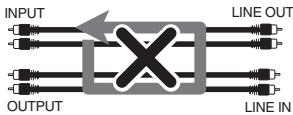
Be Careful of Looped Connections
UA-1X
Loop Connection
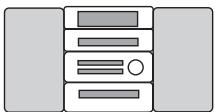
Stereo set
(Cassette, record player)
natural_image
Pure diagram of server racks without any text, numbers, or symbolsIf you connect the UA-1X as shown in the above diagram with another device that passes the input audio back to the output (e.g., a MD/DAT in recording mode), the sound will loop between the UA-1X and the other device, causing oscillation and producing an unexpected high volume. Be aware that such connections can cause malfunctions or damage your speakers.
Connections and Driver Installation (Windows)
* If you are a Macintosh user, refer to Connections and Driver Installation (Macintosh) (p. 23).
Before installing the driver
* The UA-1X cannot be used with Windows 95 or Windows NT.
* Exit all other applications of the Windows before you install the UA-1X driver.
* If you intend to connect the UA-1X and other USB devices to your computer and use them simultaneously, disconnect all USB devices other than the UA-1X from the USB connector before you install the driver. If a USB device other than the USB is left connected to your computer when you install the driver, the driver may not be installed correctly.
In order to use the UA-1X, you must first install the USB Composite Device driver, the USB Human Interface driver, and the USB Audio Device driver consecutively. These drivers are included with Windows. If you are using Windows 98, this driver is provided in the Microsoft Windows CD-ROM, so you will need to have the Microsoft Windows CD-ROM ready.
(This is not necessary for Windows Me, 2000, or XP.)
What is a driver?
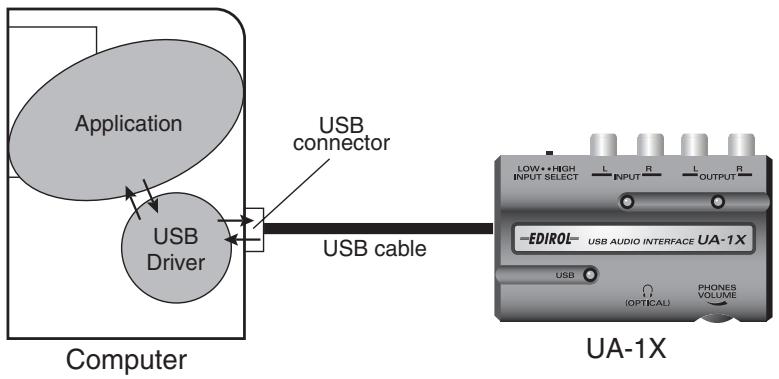
A driver is software that allows an application program running on your computer to transfer data to and from the UA-1X when it is connected to your computer via a USB cable.
The driver passes data from the application to the UA-1X, and passes data from the UA-1X to the application.
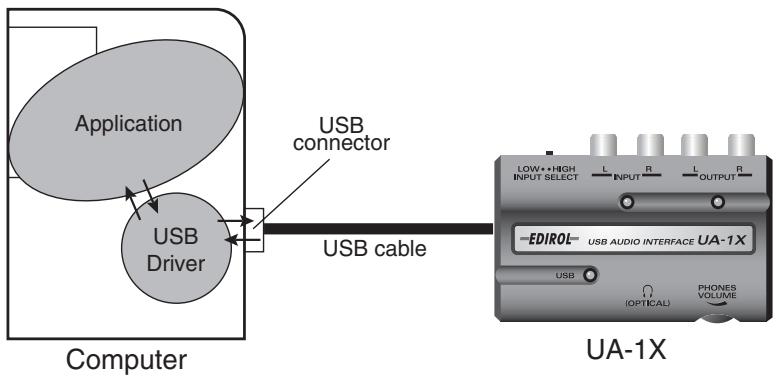
flowchart
graph LR
    A["Application"] --> B["USB Driver"]
    B --> C["USB connector"]
    C --> D["USB cable"]
    D --> E["UA-1X"]
    style A fill:#f9f,stroke:#333
    style B fill:#ccf,stroke:#333
    style C fill:#cfc,stroke:#333
    style D fill:#fcc,stroke:#333
    style E fill:#cff,stroke:#333
Making Connections and Installing the Driver
The installation procedure will differ depending on your system. Please proceed to one of the following sections, depending on the system you use.
- Windows XP/2000 users......p. 14
- Windows Me users......p. 15
- Windows 98 users......p. 16
To prevent malfunction and/or damage to speakers or other devices, always turn down the volume, and turn off the power on all devices before disconnecting the USB cable. It is not necessary to turn off the power of your computer. Use a USB cable to connect the UA-1X to your computer before turning on the power of your audio equipment.
■ Windows XP/2000 Users
1
With the UA-1X disconnected from your computer, turn on your computer and start up Windows.
Disconnect all USB cables except for a USB keyboard and USB mouse (if used).
2
Use a USB cable to connect the UA-1X to your computer.
The UA-1X will be detected automatically, and the driver will be installed.
3
After installing the driver, restart Windows.
Next, you need to make the driver settings.
→ Settings and Checking (p. 19)

If you are using Windows XP, the installation has been completed when the message near the taskbar saying that "Found New Hardware" has disappeared.

This unit is equipped with a protection circuit. A brief interval (a few seconds) after connecting a USB connector is required before the unit will operate normally.
■ Windows Me Users
1
With the UA-1X disconnected from your computer, turn on your computer and start up Windows.
Disconnect all USB cables except for a USB keyboard and USB mouse (if used).
2
Use a USB cable to connect the UA-1X to your computer.
3
Windows will detect the UA-1X, and the “Add New Hardware Wizard” dialog box will appear.
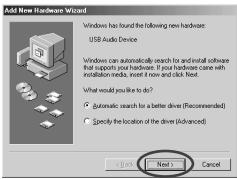
Make sure that Automatic search for a better driver (Recommended) is selected, and click [Next].
4
The search for the driver starts.
5
When the correct driver is found, driver installation starts.
6
When a dialog box informing you that driver installation has finished appears, click [Finish], and restart Windows.
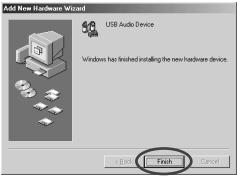
Next, you need to make the driver settings.
→ Settings and Checking (p. 19)

This unit is equipped with a protection circuit. A brief interval (a few seconds) after connecting a USB connector is required before the unit will operate normally.

Some time may be required until this dialog box appears.

Depending on your computing setup, there may be a short wait after the driver is installed until the device is recognized.
Windows 98 Users
Installation must be performed in the order of the USB Composite Device driver, USB Human Interface Device driver, and then the USB Audio Device driver. Use the following procedure to perform the installation.
1
With the UA-1X disconnected from your computer, turn on your computer and start up Windows.
Disconnect all USB cables except for a USB keyboard and USB mouse (if used).
2
Insert the Microsoft Windows CD-ROM into your CD-ROM drive, and use a USB cable to connect the UA-1X to your computer.
Since some computers are sold with the contents of the Microsoft Windows CD-ROM already in the hard disk, a Microsoft Windows CD-ROM may not have been included. If this is the case, you will be able to install the driver without the Microsoft Windows CD-ROM
3
A USB Composite Device will be detected automatically, and the “Add New Hardware Wizard” dialog box will appear.
Click [Next].
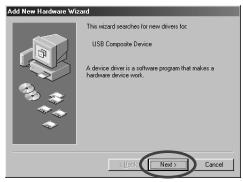
4
When the display asks “What do you want Windows to do?”, select “Search for the best driver for your device. (Recommended)” and click [Next].
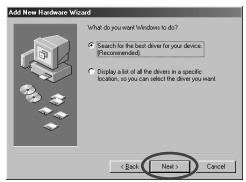

This unit is equipped with a protection circuit. A brief interval (a few seconds) after connecting a USB connector is required before the unit will operate normally.

If this dialog box does not appear, refer to Problems related to the USB driver (p. 111)
5
Check CD-ROM drive, and click [Next].
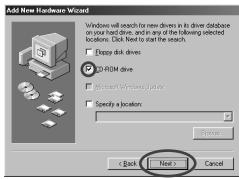
6
Click [Next].
* Depending on your system, the Location of driver may differ from the above illustration, but this is not a problem.
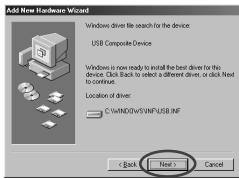
7
Copying of the file (Driver) will begin.
If the Windows CD-ROM is not inserted in the CD-ROM drive, a "Insert Disc" dialog box may appear. If this occurs, insert the Microsoft Windows CD-ROM into the CD-ROM drive, and click [OK].
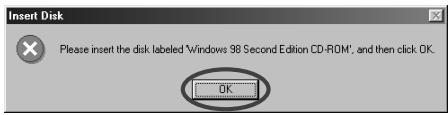
8
When installation of the USB Composite Device driver is finished, the following dialog box will appear. Click [Finish].
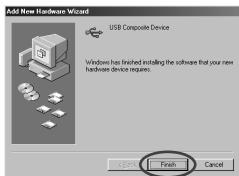
9
Next, the USB Human Interface Device will be detected automatically, and the "Add New Hardware Wizard" dialog box will appear. Click [Next], and proceed with the installation in the same way as in steps 4–7 (pp. 16–17).
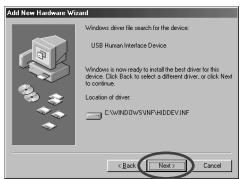

In step 6, the screen will indicate “Windows driver file search for the device: USB Audio Device.”
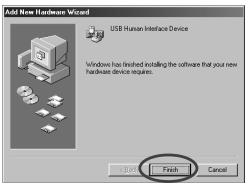
10
When installation of the USB Human Interface Device driver is finished, the following dialog box will appear. Click [Finish].
11
Next, the USB Audio Device will be detected automatically, and the “Add New Hardware Wizard” dialog box will appear.
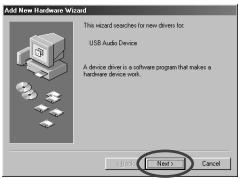
Click [Next], and proceed with the installation in the same way as in steps 4–7 (pp. 16–17).
12
When installation of the USB Audio Device driver is complete, a dialog box like the one shown here will appear. Click [Finish].
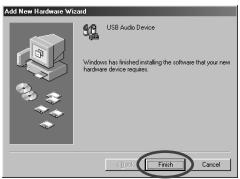
This completes installation of the USB Composite Device driver, the USB Human Interface Device driver, and the USB Audio Device driver. Restart Windows.
Next, you need to make the driver settings.
→ Settings and Checking (p. 19)

In step 6, the screen will indicate “Windows driver file search for the device: USB Audio Device.”

Depending on your system, the cursor may stay in the hourglass shape for several minutes after you click [OK], but you should simply keep waiting.
Settings and Checking
■ Specifying the Audio Input/Output Device
1
Click the Windows Start button, and select Settings - Control Panel. (In Windows XP, click the Start button and then click Control Panel.)
2
Access “Sound and Multimedia Properties” (for Windows 98, “Multimedia Properties”).
If using Windows XP/2000/Me:
In Control Panel, double-click the Sounds and Multimedia icon to open the “Sounds and Multimedia Properties” dialog box.
* If the Sound and Multimedia Properties icon is not shown Windows XP:
In the Control Panel, click Sounds, Speech, and Audio Devices. Next, click Sounds and Audio Devices to access the "Sound and Audio Devices Properties" dialog box. Windows Me:
In the left frame, click View all Control Panel options.
Windows 98 users:
In Control Panel, double-click the Multimedia icon to open the Multimedia Properties dialog box.
3
Click the Audio tab.
4
As the Preferred device for Sound playback and Preferred device for Sound recording, select USB Audio CODEC or USB Audio Device.
Click ▼, and from the list that appears, click USB Audio CODEC or USB Audio Device to select it.
5
Click [OK] to complete the settings.

If you are using Windows XP, set the Default device for Sound playback and Default device for Sound recording to USB Audio CODEC.

If you are using Windows 98, set the Preferred device for Playback and Preferred device for Recording to USB Audio CODEC.

Depending on your system, USB Audio Device will be shown a number added, ex. "USB Audio Device (1)."
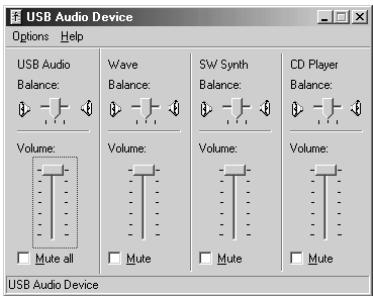
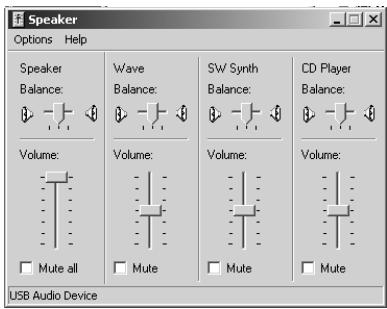
Volume Control Settings
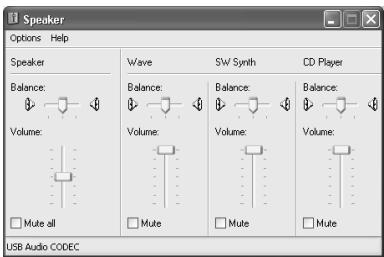
The output volume of the UA-1X can be controlled by the Windows Volume Control.
1
Click the Windows Start button, and select Programs (In Windows XP, All Programs) – Accessories – Entertainment – Volume Control to start it up.
Windows XP users
Windows Me users
Windows 2000 users/Windows 98 users
MEMO
If Volume Control is not installed on your computer, use Add/ Remove Applications in the Control Panel to install it. For details on installation, refer to the Windows owner's manual or Help.
MEMO
If you are using Windows 2000 and “CD Player” does not appear, check the Digital CD Playback item “Enable digital CD audio for this CD-ROM device.”
→ When using your computer's CD-ROM drive to play an audio CD, or when playing background music for games with the UA-1X (p. 22)
2
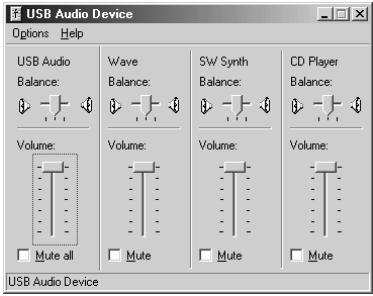
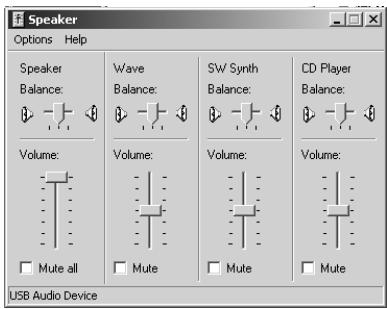
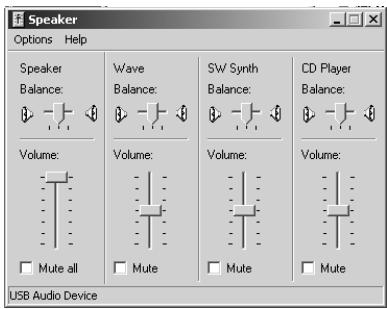
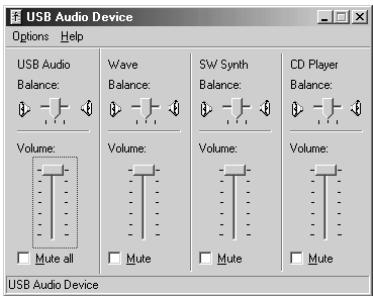
You can raise or lower the slider to adjust the volume of the UA-1X. The following items can be set.
| USB Audio (Speaker) | Adjust the volume of the analog outputs (line output and headphone output). The digital output will not change (*1). |
| CD Player | Adjust the “CD Music” volume for the CD-ROM drive of your computer (*2). |
| Wave | Adjust the volume that is output from the audio output device “USB Audio Device.” The digital output and analog output will change. |
| SW Synth | Adjust the volume of the software synthesizer built into Windows. |
* 1 Depending on your Windows version, this may be displayed as an “analog connector.”
* 2 If the playback of the CD does not change when you adjust this volume, change the WAVE volume.
MEMO
By turning up the volume control you can output the sound from your computer through the UA-1X at the best audio quality.
NOTE
If Mute is checked, or if the slider is in the lowest position, no sound will be output from the UA-1X.
NOTE
If the UA-1X is connected, Windows will not output sound from your computer's speakers. Since the sound from your computer will be output from the UA-1X's headphone jack or line output jacks rather than from your computer's speakers, you will need to connect headphones or monitor speakers to the UA-1X. Alternatively, you can connect the UA-1X's line output jacks to the LINE input jacks of your computer.
When using your computer's CD-ROM drive to play an audio CD, or when playing background music for games with the UA-1X
Windows XP/2000 users:
-
Open the System Properties dialog box.
Select Start | Settings | Control Panel, and in the Control Panel, double-click the System icon.
For Windows XP, select Start | Control Panel, and in the Control Panel, double-click the System icon.
Alternatively, click Control Panel | Performance and Maintenance. Next, click the System icon. -
Open the Device Manager.
Click the Hardware tab, and click the Device Manager button. -
Open the CD-ROM drive's Properties.
In CD-ROM drive, double-click the CD-ROM drive that you are using. With Windows XP, you should next click the Properties tab.
In Digital CD Playback, check the “Enable digital CD audio for this CD-ROM device” item.
Windows Me users:
- Open the System Properties dialog box.
Select Start | Settings | Control Panel, and in the Control Panel, double-click the System icon. - Click the Device Manager tab.
- Open the CD-ROM drive's Properties.
Double-click the CD-ROM icon, and then double-click the CD-ROM drive that you are using. - Click the Properties tab, and in Digital CD Playback, check the “Enable digital CD audio for this CD-ROM device” item.
Windows 98 users:
- Open the Multimedia Properties dialog box.
Select Start | Settings | Control Panel, and in Control Panel, double-click the Multimedia icon. - Click the CD Music tab, and check the “Enable digital CD audio for this CD-ROM device” item.
Connections and Driver Installation (Macintosh)
* If you are a Windows user, refer to Connections and Driver Installation (Windows) (p. 13).
When you start up your computer with the UA-1X connected, the computer may become unstable. If this occurs, start up your computer before connecting the UA-1X, and connect the UA-1X after start-up.
Before Installing the Driver
In order to use the UA-1X, you must first install a driver. UA-1X uses a driver included with Mac OS. You do not need to use the CD-ROM that is included with the UA-1X.
What is a Driver?
A driver is software that allows an application program running on your computer to transfer data to and from the UA-1X when it is connected to your computer via a USB cable.
The driver passes data from the application to the UA-1X, and passes data from the UA-1X to the application.
flowchart
graph LR
    A["Application"] --> B["USB Driver"]
    B --> C["USB connector"]
    C --> D["UA-1X"]
    D --> E["USB cable"]
    style A fill:#f9f,stroke:#333
    style B fill:#ccf,stroke:#333
    style C fill:#cfc,stroke:#333
    style D fill:#fcc,stroke:#333
The installation procedure will differ depending on your system. Please proceed to one of the following sections, depending on the system you use.
• Mac OS 9 users....p. 24
• Mac OS X users ......p. 28
Connections and Driver Installation (OS 9)
To prevent malfunction and/or damage to speakers or other devices, always turn down the volume, and turn off the power on all devices before disconnecting the USB cable. It is not necessary to turn off the power of your computer. Use a USB cable to connect the UA-1X to your computer before turning on the power of your audio equipment.
1
With the UA-1X disconnected, start up the Macintosh.
Disconnect all USB cables except for a USB keyboard and USB mouse (if used).
2
Exit all currently running software (applications).
If you are using virus checking or similar software, be sure to exit it as well.
3
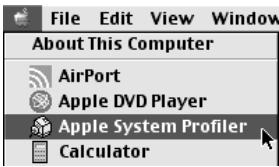
After starting up Mac OS, select Apple
System Profiler from the Apple menu.
The "Apple System
Profiler" dialog box will appear.
4
Click the Devices and Volumes tab.
5
Choose Update all information from the Commands menu.
6
Use a USB cable to connect the UA-1X to your computer.
MEMO
This unit is equipped with a protection circuit. A brief interval (a few seconds) after connecting a USB connector is required before the unit will operate normally.
7
Wait for approximately five seconds.
UA-1X uses a driver included with Mac OS.
While you are waiting, the screen display will not change, but the UA-1X is being detected. Do not touch the mouse or keyboard.
8
In order to check that detection has been completed, once again go to Apple System Profiler, and select
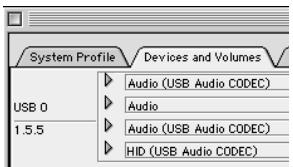
Update all information from the Commands menu.
In the USB area, three audio devices will be displayed.
If these are displayed correctly, driver installation has succeeded. In the File menu, click Quit to close “Apple System Profiler.”
If they are not displayed correctly, disconnect the UA-1X, wait for about ten seconds, and then repeat the procedure from step 2.
■ Settings and Checking
Adjusting the Sound Input/Output
1
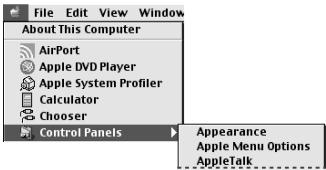
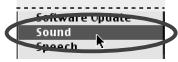
From the Apple menu, select Control Panels - Sound to open the Sound dialog.
2
Click the Speakers tab or Speaker Settings.
3
Turn down the volume on the UA-1X, and on your audio equipment, then click [Start Test].
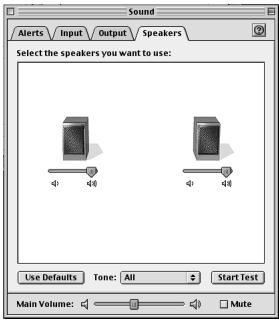

The contents of the display will differ depending on your operating system and data.
4
Use the [Main Volume] bar to adjust the volume. When you are finished, click [Stop Test].
Test sounds are output from left to right, along with what appears on the screen.
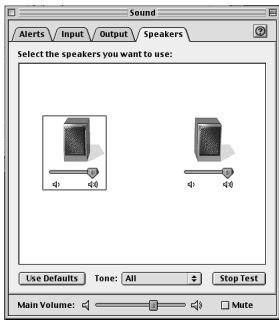

Depend on the your OS version, there is no Main Volume bar. In that case, use the Volume bar in the Output to adjust the volume.
5
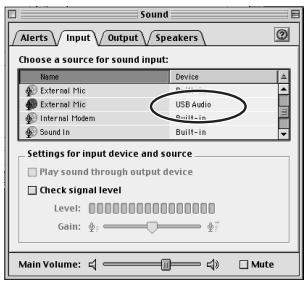
In the Sound dialog box, click the Input tab.
In Choose a source for sound input, select USB audio.
* Do not check "Play sound through output device."
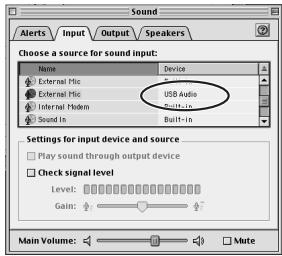

If USB audio is not displayed, close the “Sound” dialog box, and disconnect the UA-1X’s USB cable from the Macintosh. Perform the driver installation once again.(p. 24)
6
When you are finished making settings, close the "Sound" dialog box.
Select Quit from the File menu.
Known issues: UA-1X
- While the audio application is recording or playing, do not connect/disconnect the USB cable. Doing so may cause the application to freeze.
- You may hear sound hopping and/or noise when you record and play back at the same time due to high load on the CPU. However, the noise should not be in the recording itself. Such noise should only be found in the playback signal.
- The standard driver that comes with Mac OS is not ASIO compatible.
Connections and Driver Installation (OS X)
* The UA-1X and Mac OS 10.2 are used for this explanation.
■ Make Connections and System Sound Input/Output Settings
1
Use a USB cable to connect the UA-1X to your Macintosh.
2
Open the System Preference dialog box and click Sound.
3
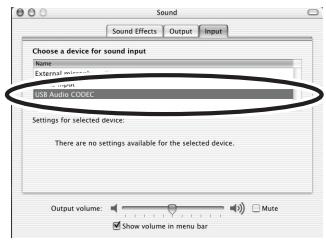
In the Sound Effects tab, click Play alerts and sound effects through and choose USB Audio CODEC as the playback device for sound effects.
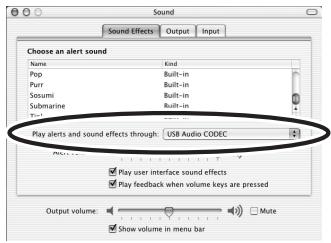
4
Click the Output tab, and choose USB Audio CODEC as the device that will output sound.
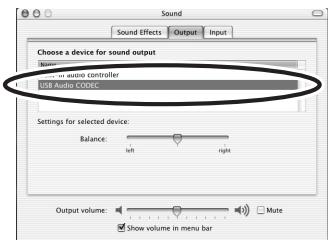
MEMO
You cannot use the UA-1X in the Mac OS X Classic environment.
MEMO
If no sound is output from the speaker (internal speaker) of the Macintosh, choose Built-in audio controller in the Output tab.
5
If the Input tab is displayed, choose USB Audio CODEC as the device for inputting sounds.
Known issues: UA-1X
Caution
Please check the following before you use your software.
- Use a USB cable to connect the UA-1X to your computer before you start up your software.
- Do not disconnect the UA-1X's USB cable while your software is running.
- Exit your software before you disconnect the UA-1X's USB cable.
- Turn off the Sleep settings of your Macintosh.
- The UA-1X will not operate in the Mac OS X Classic environment. You can not use it if the Classic environment is running.
■ Audio Software Settings
Use a USB cable to connect the UA-1X to your computer before you start up your software.
If your software allows you to make audio input/output settings, choose USB Audio CODEC.
* For details, refer to the owner's manual of the software you are using.
Known issues: UA-1X
- While the audio application is recording or playing, do not connect/disconnect the USB cable. Doing so may cause the application to freeze.
- You may hear sound hopping and/or noise when you record and play back at the same time due to high load on the CPU. However, the noise should not be in the recording itself. Such noise should only be found in the playback signal.
- The standard driver that comes with Mac OS is not ASIO compatible.
MEMO
4

6
7
9
10
MEMO
Windows Me-Anwender
Windows 2000-Anwender/Windows 98-Anwender
MEMO
4
2


Play alerts and sound effects
through (Warntöne


4

6
7
9
10
MEMO
Windows Me

Windows 2000/Windows 98
MEMO
4
2


Dans l'onglet Sound Effects, cliquez sur Play alerts and sound effects through et
sélectionnez USB
Audio CODEC comme
4
MEMO
4

6
Fare clic su [Avanti].
7

10
11
Utenti Windows Me
MEMO
4
Fare clic sulla scheda Devices and Volumes.
5
2
Fare clic sulla scheda Speakers o Speaker Settings.
3


4

4
4

6
7
9
10
MEMO
MEMO
Update all information del menú Commands.
3


* No active “Play sound through output device.”

4

If an unexpected problem occurs while using the UA-1X, please read this chapter first. It provides numerous hints that will help you solve problems.
The problems covered in the troubleshooting section are organized according to the operating system on which the problem might be encountered.
The problems covered in the troubleshooting section are organized according to the operating system on which the problem might be encountered. Use the icon shown at the left of the title to find the information you need.

Problems common to both Windows and Macintosh

Problems that occur only on Windows

Problems that occur only on Macintosh
Troubleshooting
If you are using computer for the first time, or do not understand the explanation of a procedure, refer to the owner's manuals for your computer or for OS.
If the UA-1X does not operate as you expect, check the following points.
Problems related to the USB driver

“Add New Hardware Wizard” does not start up automatically

"Add New Hardware Wizard" terminates before completion
- When the USB cable is connected or disconnected, approximately 15 seconds (or more) may be required for the UA-1X to be recognized.
• Is the USB cable connected correctly?
Make sure that the UA-1X and computer are connected correctly by the USB cable.
- Can USB be used on your computer?
Refer to the owner's manual for your computer, and make sure that it is able to use USB.
- Does your computer or USB hub have sufficient power supply capacity?
The UA-1X cannot be connected if insufficient power is supplied to it. Check whether one of the following cases apply.
If you are using the UA-1X with a notebook computer that is running on its battery, operation may be unreliable with some models of computer. If this is the case, connect the AC adaptor to your notebook computer.
The power conservation mode of your computer may limit the power that is supplied to USB. Check the settings of your computer.
In some cases, the UA-1X cannot be used with a bus-powered hub (a hub that does not contain a power supply). Please use a self-powered hub (a hub that contains a power supply).
- Does your computer meet the USB specifications?
If you are using a computer that does not meet the USB specifications (such as a homemade computer), operation may be unstable. In such cases, you may be able to solve the problem by connecting a USB hub that contains a power supply.
- Is “Unknown Device” displayed for “Other devices” or “Universal Serial Bus controllers”?
Use the following procedure to delete “Unknown Device” from “Other devices” (Universal serial bus controller), and re-start your computer.
- In the Windows Control Panel, double-click System to open the System Properties dialog box. The System Properties dialog box will appear.
- Click the Device Manager tab.
- Double-click Other devices (Universal Serial Bus controllers) to see the list of devices.
- From the list, select the unknown device and click Delete.
* In order to check whether or not the “Unknown Device” is the UA-1X, disconnect the USB cable of the UA-1X, and verify that “Unknown Device” has disappeared. Then connect the UA-1X once again, and delete “Unknown Device.”
- In the Confirm Device Removal dialog box, click [OK].
- Verify that "Other device" or "Unknown device" is not displayed in the list, and click [Close] to close the dialog box.

The “Add New Hardware Wizard” dialog box appears even though you installed the drivers
If your computer or USB hub has two or more USB connectors, connecting the UA-1X to a USB connector to which the UA-1X has never before been connected may cause the Add New Hardware Wizard dialog box will appear even though the drivers have already been installed.
Install the drivers once again as described in Connections and Driver Installation (Windows) (p. 13). This is not a malfunction.

The UA-1X Driver Is Not Installed Correctly.
Use the procedure described in Deleting the USB Audio Device Driver (Windows) (p. 119) to delete the USB Audio Device driver installed in your computer, and install the UA-1X drivers once again as described in Connections and Driver Installation (Windows) (p. 13). Check whether there is an item named “Unknown Device” in “Other devices” or in “Universal Serial Bus controllers.” If you find “Unknown Device”, delete it.

A dialog box saying “Unknown Device found” appears, and I can’t install the driver
- Depending on your computer, not all of the Windows files required to support audio over USB may have been installed when the computer was shipped.
Please check with the manufacturer of your computer.
Problems when using the UA-1X

OS becomes unstable
- Starting up a computer when the UA-1X is already connected may cause the computer to become unstable.
If this occurs, start up the computer with the UA-1X disconnected, and then connect the UA-1X. On a computer that uses a USB keyboard, starting up the computer with the UA-1X already connected may cause operation to become unstable. In this case, start up the computer with the UA-1X disconnected, and then connect the UA-1X.
No sound

- Are you attempting to use the CD player of your computer to play an audio CD?
If you wish to play an audio CD on the CD-ROM drive of your computer, refer to When using your computer's CD-ROM drive to play an audio CD, or when playing background music for games with the UA-1X (p. 22). - Are you running multiple applications?
If multiple applications are running simultaneously, an error message may appear. If this occurs, click [OK], and close the other applications.
Even if an application window is closed, it is still running if it remains in the taskbar, so be sure to quit any unneeded applications shown in the taskbar.


- Have you specified the audio data output destination for your operating system?
You must specify the UA-1X as the audio data output destination for your computer. For details on this setting, refer to Specifying the Audio Input/Output Device (p. 19) or Adjusting the Sound Input/Output (p. 25).

• Have the drivers been installed correctly?
In order to playback audio data using the UA-1X, the USB Audio Device driver must be installed. For details on installation and settings, refer to Connections and driver installation (Windows p. 13, Macintosh p. 23).

- If you are using Macintosh OS X, some system sound input/output settings may cause there to be no sound from the Macintosh speakers.
Select "Internal speakers" in the Output tab. (→ Make Connections and System Sound Input/Output Settings (p. 28))

• Could you have turned down the UA-1X's Headphones volume control?
Check this if you are using headphones.

- As soon as you connect the UA-1X to your computer, sound will no longer be output from the speakers of your computer.
Connect external monitors or headphones to the UA-1X.
If you want sound to be output from your computer speakers, disconnect the UA-1X from your computer.

Sound is distorted
• Could the Input select switch be set to LOW?
The sound may be distorted if the INPUT SELECT switch is set to LOW and you input an audio signal higher than -10 dBu from the line input jacks. Set the INPUT SELECT switch to HIGH.
- Could you have updated your software while the UA-1X was connected to your computer?
Disconnect the UA-1X from your computer before you update your software.

The volume level of the instrument connected to LINE IN is too low.
• Could you be using a connection cable that contains a resistor?
Use a connection cable that does not contain a resistor.
Noise is heard when playing back audio

- Noise is sometimes heard in the line input.
If a USB-compatible MIDI sound module and the UA-1X are connected via USB to the same computer, and the outputs of the MIDI sound module are connected to the line input jacks of the UA-1X, noise from your computer may be heard via the MIDI sound module from the UA-1X, depending on the computer you are using. If this occurs, you can either connect the MIDI sound module and the UA-3D in parallel using a self-powered hub, or connect the MIDI sound module via its serial or MIDI interface.

- This problem may be solved by properly grounding the chassis of your computer, or the ground prong of the plug on the AC power cord that was supplied with your computer. Also, make sure that there are no devices nearby that emit a strong magnetic field, such as a television or a microwave oven.

- Are a large number of audio devices connected?
If a large number of audio devices are connected, noise may occur. Do not connect audio devices that you are not using.

- If the sound is interrupted during audio playback, you may hear a soft "pop" noise.
Also refer to the following section, "Sound is interrupted during audio playback."
Sound is interrupted during audio playback

- Noise may be heard if you record and play back simultaneously.
If you record and play back simultaneously, the playback may be interrupted depending on the performance of the system, and this may be heard as noise. However since priority is given to recording, the recorded data will not be lost.

- Graphic accelerators may cause noise to be heard during audio playback. Use the following procedure to set graphic acceleration to "None."
* Some computers may not have all of the following settings.
-
In the Windows Control Panel, double-click Display to open the Display Properties dialog box, and click the Settings tab.
-
Click Advanced to open properties, and click the Performance tab.
-
In the Graphics section, set the Hardware acceleration slider to None, and then click [OK].
-
In the Display Properties dialog box, click [OK] to close the dialog box.
-
Then restart your computer.


- Are many applications running on your computer?
If you use numerous applications during playback, or start up another application, the playback may be interrupted depending on your computer system. Exit all unneeded applications, and try again. If this does not resolve the problem, try restarting your computer.
- Try making the following changes to the disk drive settings.
Some computers may not have the following settings.
- In the Windows Control Panel, double-click System.
- Click the Device Manager tab.
- Double-click Disk Drives to see the list of devices.
- From the list, select GENERIC IDE DISK TYPE**, and click Properties to access the GENERIC IDE DISK TYPE** Properties dialog box.
* In the ** field of GENERIC IDE DISK TYPE**, there will be a number that differs depending on your computing environment.
- Click the Settings tab, place a check mark in the check box for the DMA option, and click [OK] to close the dialog box.
* Depending on your system, a dialog box for DMA settings may appear. Verify the contents of the dialog box, and click [OK] or [Cancel].
-
In System Properties dialog box, click [OK] to close the dialog box.
-
Restart your computer so that the above settings will take effect.

- On some computers, the Power Management settings in the Control Panel may cause audio playback to stop.
The Power Management Properties that are displayed when you double-click Power Management will differ depending on your computer system. One example is given below, but you should consult the owner's manual for your computer as well. Some computers may not have the following settings.
- Click the Windows Start button, and select Settings - Control Panel to open the Control Panel.
- In Control Panel, double-click System to open the System Properties dialog.
- Double-click System devices to see the list of devices.
- Double-click System Devices to display the list of devices.
- From the list, select Advanced Power Management Support. Then click Properties to open the Advanced Power Management Support Properties dialog box.
- Click the Settings tab, and in Troubleshooting, place a check in the check box for Don't Poll Power Supply Status. Then click [OK].
- In the System Properties dialog box, click [OK].
- Restart Windows.

• Try increasing the memory
You can increase the processing power of your computer by adding more memory. For details on how to install more memory, refer to the operation manual for your computer.

- Does your computer meet the USB specifications?
The audio may be interrupted if you are using a computer that does not electrically meet the USB specifications. In such cases, you may be able to solve the problem by connecting a USB hub that contains a power supply.
A blank (silent) file is created when you record

- Try setting the bit rate to "16bit."
If you are using Windows98 Second Edition, and your recording software is set to a bit rate of 8 bits, a blank file may be created, so that you may not be able to record effectively. If this occurs, you will be able to record correctly by setting the bit rate to "16 bit."

Noise is present in the recorded sound
Depending on the virtual memory setting or network-related settings, noise may occur.
Please make the following settings before use.
- In Chooser of the Apple menu, set AppleTalk to "Inactive."
(This setting is not changed as a result of turning off AppleTalk, as requested by OMS when sequencer software is started up. You must change the setting yourself using the “Chooser.”)
- In the “Memory” Control Panel, set Virtual Memory to “Off.”
- Depending on the way in which you connect to the Internet, use the UA-1X with the following settings.
If you connect to the Internet via a LAN cable
Use while the LAN cable is connected.
If you connect to the Internet via the internal modem port, or are not connected to the Internet
In the “TCP/IP” Control Panel, set “Connect via” to “PPP.”
After you have made the settings, restart your Macintosh.
* Do not use software that accesses the network (such as a Web browser) at the same time that you are using sequencer software or audio editing software.
- In the SimpleSound application that is included with MacOS, noise will be heard in the sound if it is played back immediately after being digitally recorded. Save the sound first, then try playing it back.
- Update the Mac OS.
The Mac OS can be downloaded from the Apple web site.
Checking the USB audio driver
- Connect the UA-1X to the computer.
- Click the Apple menu, and select Apple System Profiler.
- Click the Devices and Volumes tab control.
- In the USB section, the screen will indicate "Audio (USB Audio Device)." Click the arrow at the left of this text.
- The number displayed to the right of "Driver version" is the version of the USB audio driver.

Game background music does not sound
- Is the Background Music for the Game on an Audio CD? If the game uses an audio CD for background music, refer to When using your computer's CD-ROM drive to play an audio CD, or when playing background music for games with the UA-1X (p. 22).

The volume changed when you resumed from Suspend or Hibernation status
- When Windows 2000 resumes from Suspend or Hibernation, the output volume setting is changed due to a problem of Windows. Start up the Mixer application as described in Volume Control Settings (p. 20), and adjust the USB Audio (Speaker) slider.
Deleting the USB Audio Device Driver (Windows)
- If re-installing the USB Audio Device driver
- If installation of the USB Audio Device driver was terminated before completion
Use the following procedure to delete the driver that is already installed. Depending on your computer, some of the folder names may be different.
- Use a USB cable to connect the UA-1X to your computer.
- Delete the USB Audio Device driver. Click the Windows Start button, and select Settings - Control Panel. (In Windows XP, click the Start button and then click Control Panel.)
- In Control Panel, double-click System to open the "System Properties" dialog. (In Windows XP, Performance and Maintenance | System.)
- Click the Device Manager tab. (In Windows XP, Hardware tab | Device Manager.)
- Double-click Sound, video and game controllers to see a list of the devices.
- From the list, select USB Audio Device, and click Remove (In Windows XP, Disable). In the Confirm Device Removal dialog box, click [OK]. If USB Audio Device is not displayed, proceed to step 8.
* If a dialog box suggesting that you restart Windows appears at this point, follow the suggestion and restart your computer.
-
Make sure that USB Audio Device is not in the Sound, video and game controllers list, and click [Close] to close the System Properties dialog.
-
Follow the steps 1.-4. again, and double-click Universal Serial Bus controllers to display the list of devices.
If ① is displayed for the USB-compatible device icon: Select the [USB Composite Device] icon, and click [Remove]. In the Confirm Device Removal dialog box, click [OK]. As in the step 7., close System Properties.
If there is no USB-compatible device icon, or if ⚠️ is not displayed: Simply close System Properties.
If you are using Windows Me and ⚙ is displayed: Simply close System Properties.
- Disconnect the USB cable from your computer, and restart Windows.
Specifications
UA-1X: USB Audio Interface
●Number of Audio Record/Playback Channels
Record: 1 pair of stereo
Playback: 1 pair of stereo
●Signal Processing
PC interface: 16 bits
●Sampling Frequency
Digital output: 32/44.1/48 kHz
●Nominal Input Level
Line input jacks: -10 dBu (LOW)/+4 dBu (HIGH)
●Nominal Output Level
Line output jacks: -10 dBu
●Interface
USB
Digital output
Optical type (confirms to S/P DIF consumer format)
Connectors
Line Input jacks (L, R): RCA phono type
Line Output jacks (L, R): RCA phono type
Headphones jack (Stereo miniature phone type)
Digital Output connector (Optical type)
* The same jack serves as both the headphones jack and digital output connector.
●Power Supply
Supplied from the computer
●Current Draw
100 mA
●Dimensions
* In the interest of product improvement, the specifications and/or appearance of this unit are subject to change without prior notice.
MEMO
MEMO
-For the USA
FEDERAL COMMUNICATIONS COMMISSION RADIO FREQUENCY INTERFERENCE STATEMENT
This equipment has been tested and found to comply with the limits for a Class B digital device, pursuant to Part 15 of the FCC Rules. These limits are designed to provide reasonable protection against harmful interference in a residential installation. This equipment generates, uses, and can radiate radio frequency energy and, if not installed and used in accordance with the instructions, may cause harmful interference to radio communications. However, there is no guarantee that interference will not occur in a particular installation. If this equipment does cause harmful interference to radio or television reception, which can be determined by turning the equipment off and on, the user is encouraged to try to correct the interference by one or more of the following measures:
– Reorient or relocate the receiving antenna.
– Increase the separation between the equipment and receiver.
- Connect the equipment into an outlet on a circuit different from that to which the receiver is connected.
– Consult the dealer or an experienced radio/TV technician for help.
This device complies with Part 15 of the FCC Rules. Operation is subject to the following two conditions:
(1) This device may not cause harmful interference, and
(2) This device must accept any interference received, including interference that may cause undesired operation.
Tested To Comply With FCC Standards
FOR HOME OR OFFICE USE
Unauthorized changes or modification to this system can void the users authority to operate this equipment. This equipment requires shielded interface cables in order to meet FCC class B Limit.
For Canada
NOTICE
This Class B digital apparatus meets all requirements of the Canadian Interference-Causing Equipment Regulations.
AVIS
DECLARATION OF CONFORMITY Compliance Information Statement
Model Name : UA-1X
Type of Equipment : USB Audio Interface
Responsible Party: Edirol Corporation North America
Address: 425 Sequoia Drive, Suite 114, Bellingham, WA 98226
Telephone : (360) 594-4276
Information
When you need repair service, call your nearest EDIROL/Roland Service Center or authorized EDIROL/Roland distributor in your country as shown below.
EDIROL
EUROPE
EDIROL (Europe) Ltd.
Studio 3.4 114 Power Road
London W4 5PY
U.K.
TEL: +44 (0)20 8747 5949
FAX:+44 (0)20 8747 5948
http://www.edirol.com/europe
Deutschland
TEL: 0700 33 47 65 20
France
TEL: 0810 000 371
Italia
TEL: 02 93778329
U. S. A. / CANADA
EDIROL Corporation North
America
425 Sequoia Drive, Suite 114
Bellingham, WA 98226
U.S. Å.
TEL: (360) 594-4276
FAX: (360) 594-4271
http://www.edirol.com/
Roland
AFRICA
EGYPT
Al Fanny Trading Office
9, EBN Hagar A1 Askalany Street,
ARD E1 Golf, Heliopolis,
Cairo 11341, EGYPT
TEL: 20-2-417-1828
REUNION
That Other Music Shop
(PTY) Ltd.
11 Melle St., Braamfontein,
Johannesbourg, SOUTH AFRICA
P.O.Box 32918, Braamfontein 2017
Johannesbourg, SOUTH AFRICA
TEL: (011) 403 4105
Paul Bothner (PTY) Ltd.
17 Werdemuller Centre,
Main Road, Claremont 7708
SOUTH AFRICA
P.O.BOX 23032, Claremont 7735,
SOUTH AFRICA
TEL: (021) 674 4030
ASIA
CHINA
Roland Shanghai Electronics
Co., Ltd.
5F. No.1500 Pingliang Road
Shanghai 200090, CHINA
TEL: (021) 5580-0800
Roland Shanghai Electronics
Co., Ltd.
(BEIJING OFFICE)
10F. No.18 Anhuaxili
Chaoyang District, Beijing 100011
CHINA
TEL: (010) 6426-5050
Roland Shanghai Electronics
Co., Ltd.
(GUANGZHOU OFFICE)
2/F., No.30 Si You Nan Er Jie Yi
Xiang, Wu Yang Xin Cheng,
Guangzhou 510600, CHINA
Tel: (020) 8736-0428
HONG KONG
Parsons Music Ltd.
8th Floor, Railway Plaza, 39
Chatham Road South, T.S.T,
Kowloon, HONG KONG
TEL: 2333 1863
INDIA
Rivera Digitec (India) Pvt. Ltd.
409, Nirman Kendra Mahalaxmi
Flats Compound Off. Dr. Edwin
Moses Road, Mumbai-400011,
INDIA
TEL: (022) 2493 9051
INDONESIA
PT Citra IntiRama
J1. Cideng Timur No. 15J-150
Jakarta Pusat
INDONESIA
TEL: (021) 6324170
KOREA
Cosmos Corporation
1461-9, Seocho-Dong,
Seocho Ku, Seoul, KÖREA
TEL: (02) 3486-8855
MALAYSIA
G.A. Yupangco & Co. Inc.
339 Gil J. Puyat Avenue
Makati, Metro Manila 1200,
PHILIPPINES
TEL: (02) 899 9801
SINGAPORE
CRISTOFORI MUSIC PTE
LTD
Blk 3014, Bedok Industrial Park E,
02-2148, SINGAPORE 489980
TEL: 6243-9555
TAIWAN
ROLAND TAIWAN
ENTERPRISE CO., LTD.
Room 5, 9fl. No. 112 Chung Shan
N.Road Sec.2, Taipei, TAIWAN,
R.O.C.
TEL: (02) 2561 3339
THAILAND
Theera Music Co., Ltd.
330 Verng NakornKasem, Soi 2,
Bangkok 10100, THAILAND
TEL: (02) 2248821
VIETNAM
Saigon Music
Suite DP-8
40 Ba Huyen Thanh Quan Street
Hochiminh City, VIETNAM
Tel: (08) 930-1969
AUSTRALIA/ NEW ZEALAND
AUSTRALIA
Roland Corporation
Australia Pty., Ltd.
38 Campbell Avenue
Dee Why West. NSW 2099
AUSTRALIA
TEL: (02) 9982 8266
NEW ZEALAND
Roland Corporation Ltd.
32 Shaddock Street, Mount Eden,
Auckland, NEW ZEALAND
TEL: (09) 3098 715
CENTRAL/LATIN AMERICA
ARGENTINA
Instrumentos Musicales S.A.
Av.Santa Fe 2055
(1123) Buenos Aires
ARGENTINA
TEL: (011) 4508-2700
BRAZIL
Roland Brasil Ltda
Rua San Jose, 780 Sala B
Parque Industrial San Jose
Cotia - Sao Paulo - SP, BRAZIL
TEL: (011) 4615 5666
CHILE
Comercial Fancy II S.A.
Rut.: 96.919.420-1
Nataniel Cox #739, 4th Floor
Santiago - Centro, CHILE
TEL: (02) 688-9540
MEXICO
Casa Veerkamp, s.a. de c.v.
Av. Toluca No. 323, Col. Olivar
155, New National Road
Patras 26442, GREECE
TEL: 2610 435400
HUNGARY
Roland East Europe Ltd.
Warehouse Area 'DEPO' Pf.83
H-2046 Torokbalint, HUNGARY
TEL: (23) 511011
IRELAND
Roland Ireland
G2 Calmount Park, Calmount
Avenue, Dublin 12
Republic of IRELAND
TEL: (01) 4294444
ITALY
Roland Italy S. p. A.
Danvik Center 28, 2 tr
S-131 30 Nacka SWEDEN
TEL: (0)8 702 00 20
SWITZERLAND
Roland (Switzerland) AG
Atlantic Close, Swansea
Enterprise Park, SWANSEA
SA7 9FJ,
UNITED KINGDOM