
Ecoline - Saw KINZO - Free user manual and instructions
Find the device manual for free Ecoline KINZO in PDF.


| Product type | Heat gun |
| Brand | Kinzo |
| Model | Ecoline |
| Supply voltage | 230 V / 50 Hz |
| Power consumption | 1600 W |
| Temperature - Setting I | 375 °C |
| Temperature - Setting II | 495 °C |
| Airflow - Setting I | 400 l/min |
| Airflow - Setting II | 550 l/min |
| Number of settings | 2 (I and II) |
| Included accessories | Glass nozzle for protection, spoon-shaped reflector nozzle, conical welding nozzle, fish-tail nozzle, scraper |
| Main applications | Paint stripping, plastic welding, pipe bending, defrosting, drying, varnish removal |
| Professional use | No (domestic use) |
| Safety instructions | Do not use on lead paint, do not block the vents, let cool before storing, wear protective equipment |
| Maintenance and cleaning | Clean the ventilation grilles with a soft cloth, do not use solvents |
| Warranty | 24 months |
| Weight | Approximately 0.8 kg (estimated) |
Frequently Asked Questions - Ecoline KINZO
User questions about Ecoline KINZO
0 question about this device. Answer the ones you know or ask your own.
Ask a new question about this device
Download the instructions for your Saw in PDF format for free! Find your manual Ecoline - KINZO and take your electronic device back in hand. On this page are published all the documents necessary for the use of your device. Ecoline by KINZO.
USER MANUAL Ecoline KINZO
airfl ow. 400/550 L/M
KINZO® High quality reliable tools.
KINZO®

HEATGUN1600W
1 APPLICATION
Your heat gun has been designed for stripping paint, soldering pipes, shrinking PVC, welding and bending plastics as well as general drying and thawing purposes. It is not designed for professional use.

For your own safety, read this manual and the general safety instructions carefully before using the appliance. Your power tool should only be given to other users together with these instructions.
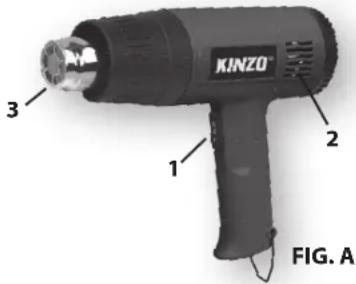
2 DESCRIPTION (FIG. A)
- Switch ON/OFF
- Air vents
- Nozzle
3 PACKAGE CONTENT LIST
- Remove all packaging materials.
- Remove remaining packaging and packing inserts (if included).
- Check that the package contents are complete.
- Check the appliance, the power cord, the power plug and all accessories for transportation damage.
- Keep the packaging materials as far as possible until the end of the warranty period. Then take it to your local waste disposal system.

WARNING Packaging materials are not toys! Children must not play with plastic bags! There is a danger of suffocation!
1 Heat gun
1 Accessory
1 Manual
If any parts are missing or damaged, please contact your dealer.
4 GENERAL SAFETY WARNINGS
Read all safety warnings and instructions. Failure to heed warnings and follow instructions may result in electric shock, fi re and/or serious injury. Keep safety warnings and instructions for future reference. The term "power tool" in the safety warnings refers to your mainsoperated (corded) power tool or battery-operated (cordless) power tool.
4.1 Workingarea
- Keep working area clean and well lit. Untidy and dark areas can lead to accidents.
- Do not operate power tools in potentially explosive surroundings, for example, in the presence of infl ammable liquids, gases or dust. Power tools create sparks which may ignite the dust or fumes.
- Keep children and bystanders at a distance when operating a power tool. Distractions can cause you to lose control of it.
KINZO ® 2

4.2 Electrical safety


Always check that the power supply corresponds to the voltage on the rating plate.
- Power tool plugs must match the outlet. Never modify the plug in any way. Do not use any adapter plugs with earthed (grounded) power tools. Unmodified plugs and matching outlets will reduce risk of electric shock.
- Avoid body contact with earthed or grounded surfaces such as pipes, radiators, ranges and refrigerators. There is an increased risk of electric shock if your body is earthed or grounded.
- Do not expose power tools to rain or wet conditions. Water entering a power tool will increase the risk of electric shock.
- Do not abuse the cord. Never use the cord for carrying, pulling or unplugging the power tool. Keep cord away from heat, oil, sharp edges or moving parts. Damaged or entangled cords increase the risk of electric shock.
- When operating a power tool outdoors, use an extension cord suitable for outdoor use. Use of a cord suitable for outdoor use reduces the risk of electric shock.
- If operating a power tool in a damp location is unavoidable, use a residual current device (RCD) protected supply. Use of an RCD reduces the risk of electric shock.
4.3 Personal safety
- Stay alert, watch what you are doing and use common sense when operating a power tool. Do not use a power tool when you are tired or under the influence of drugs, alcohol or medication. A moment of inattention when operating a power tool may result in serious personal injury.
- Use safety equipment. Always wear eye protection. Using safety equipment such as a dust mask, non-skid safety shoes, a hard hat, or hearing protection whenever it is needed will reduce the risk of personal injury.
- Avoid accidental starts. Ensure the switch is in the off position before inserting the plug. Carrying power tools with your finger on the switch or plugging in power tools when the switch is in the on position makes accidents more likely.
- Remove any adjusting keys or spanners before turning on the power tool. A spanner or key left attached to a rotating part of the power tool may result in personal injury.
- Do not reach out too far. Keep your feet firmly on the ground at all times. This will enable you retain control over the power tool in unexpected situations.
- Dress properly. Do not wear loose clothing or jewellery. Keep your hair, clothing and gloves away from the power tool. Loose clothes, jewellery or long hair can become entangled in the moving parts.
4.4 Power tool use and care
- Do not expect the power tool to do more than it can. Use the correct power tool for what you want to do. A power tool will achieve better results and be safer if used in the context for which it was designed.
- Do not use the power tool if the switch cannot turn it on and off. A power tool with a broken switch is dangerous and must be repaired.
- Disconnect the plug from the power source before making adjustments, changing accessories, or storing power tools. Such preventive safety measures reduce the risk of starting the power tool accidentally.
- Store power tools, when not in use, out of the reach of children and do not allow people who are not familiar with the power tool or these instructions to operate it. Power tools are potentially dangerous in the hands of untrained users.
- Maintenance. Check for misalignment or jammed moving parts, breakages or any other feature that might affect the operation of the power tool. If it is damaged, the power tool must be repaired. Many accidents are caused by using poorly maintained power tools.
- Keep cutting tools sharp and clean. Properly maintained cutting tools with sharp cutting edges are less likely to jam and are easier to control.
- Use the power tool, accessories and cutting tools, etc., in accordance with these instructions and in the manner intended for the particular type of power tool, taking into account the working conditions and the work which needs to be done. Using a power tool in ways for which it was not intended can lead to potentially hazardous situations.
4.5 Service
Your power tool should be serviced by a qualified specialist using only standard spare parts. This will ensure that it meets the required safety standards.
KIN20®

5 ADDITIONAL SAFETY INSTRUCTIONS
- Do not place your hand over the air vents or block the vents in any way.
- The nozzle and accessories of this tool become extremely hot during use. Let these parts cool down before touching.
• Always switch the tool off before putting it down. - Do not leave the tool unattended while it is switched on.
• A fire may arise if the appliance is not used with care - Heat may be conducted to combustible materials hat are out of sight.
- Do not use in a damp atmosphere, where flammable gases may be present or near combustible materials.
- Allow the tool to cool fully before storing.
- Ensure adequate ventilation as toxic fumes may be produced.
- Do not use as a hairdryer.
- Do not obstruct either the air intake or nozzle outlet, as this may cause excessive heat build up resulting in damage to the tool.
- Do not direct the hot air blast at other people.
- Do not touch the metal nozzle as it becomes very hot during use and remains hot for up to 30 minutes after use.
- Do not place the nozzle against anything while using or immediately after use.
- Do not poke anything down the nozzle as it could give you an electric shock. Do not look down the nozzle while the unit is working because of the high temperatures being produced.
- Do not allow paint to adhere to the nozzle or scraper as it could ignite after some time.
6 REMOVING PAINT
- Do not use this tool to remove paint containing lead. The peelings, residue and vapors of paint may contain lead, which is poisonous. Any pre-1960 building may have been painted in the past with paint containing lead and covered with additional layers of paint. Once deposited on surfaces, hand to mouth contact can result in the ingestion of lead. Exposure even to low levels of lead can cause irreversible damage to the brain and nervous system. Young and unborn children are particularly vulnerable.
- When removing paint, ensure that the work area is enclosed. Preferably wear a dust mask.
- Do not burn the paint. Use the scraper provided and keep the nozzle at leaf 25 mm away from the painted surface. When working in a vertical direction, work downwards to prevent paint from falling into the tool and burning.
- Dispose of all paint debris safely and ensure that the work area is thoroughly cleaned after completing the work.
7 ASSEMBLY AND ADJUSTMENT

Prior to assembly and adjustment always unplug the tool
The air temperature can be adjusted to suit a wide range of applications. The table below suggests settings for different applications.
| Setting Applications | |
| I - Drying paint and varnish.- Removing stickers.- Waxing en de-waxing.- Drying wet timber prior to filling.- Shrinking PVC wrapping and insulation tubes.- Thawing frozen pipes. | |
| II - Welding plastics.- Bending plastic pipes end sheets.- Loosening rusted or tightly fastened nuts and bolts. | |
| II - Removing paint and lacquer.- Soldering plumbing joints. |
KINZO° 4

- When you don't know which adjustment you have to use, please start with the low adjustment en slowly raise the temperature until you have reached the wanted result.

7.1 Mounting the correct accessory
This tool is supplied with a set of accessories for different applications
| Icon Description Propose | ||
 | Glass protection nozzle Protecting windows when stripping frames | |
 | Spoon reflector nozzle Soldering pipes. | |
 | Cone nozzle Welding, shrink sleeving (heat concentrated over small area) | |
 | Fish tail surface nozzle Drying, thawing (heat spread over wider area) | |
 | Scraper Stripping paint and varnish | |
• Make sure that the tool is switches off and the nozzle has cooled down.
- Set the desired accessory onto the nozzle.
8 OPERATION


Always observe the safety instructions and applicable regulations.
- Use only one hand to hold the tool Do not place your other hand over the air vents
Prior to operation: - Mount the correct accessory for the application.
- Set the desired air temperature.
8.1 Switching on and off
- To switch the tool on, set the on/off switch to position I. Some smoke may be emitted after switching on; this does not indicate a problem.
• To switch the tool off, set the on/off switch to position O. Let the tool cool down before moving or storing it.
8.2 Stripping paint
- Mount an appropriate accessory.
- Set a high air temperature.
- Switch the tool on.
- Direct the hot air onto the paint to be removed.
- When the paint softens, scrape the paint away using a hand scraper.

Do not strip metal window frames, as the heat may be conducted onto the glass and crack it. When stripping other window frames, use the glass protection nozzle.
- Use the scraper when you are stripping the window frames..
- Do not keep the tool directed on one spot too long to prevent igniting the surface.
- Avoid collecting paint on the scraper accessory, as it may ignite. If necessary, carefully remove paint debris from the scraper accessory using a knife.
8.3 Stationary use
This tool can also be used in stationary mode.

KINZO®

- Place the tool onto the workbench.
- Secure the cable to prevent pulling the tool off the workbench.
- Carefully switch the tool on.

Make sure that the nozzle always points away from you and any bystanders.

Make sure not to drop anything into the nozzle.
8.4 Cooling down
The nozzle and accessory become very hot during use. Let them cool down before attempting to move or store the tool.
- To reduce the cooling time, switch the tool on at the lowest air temperature setting and let in run for a few minutes.
- Switch the tool off and let it cool down for at least 30 minutes.
9 MAINTENANCE AND CLEANING

Attention !Before performing any work on the equipment, pull the power plug.
9.1 Cleaning
- Keep the ventilation slots of the machine clean to prevent overheating of the engine.
• Regularly clean the machine housing with a soft cloth, preferably after each use. - Keep the ventilation slots free from dust and dirt.
- If the dirt does not come off use a soft cloth moistened with soapy water.

Never use solvents such as petrol, alcohol, ammonia water, etc. These solvents may damage the plastic parts.
9.2 Lubrication
Your power tool requires no additional lubrication
10 TECHNICAL DATA
| Voltage 230V / 50Hz | |
| Power supply 1600W | |
| Air temperature/flow I 375°C / 400 l/minII 495°C / 550 l/min | |
11 SERVICE DEPARTMENT
- Damaged switches must be replaced by our after-sales service department.
- If the connecting cable (or mains plug) is damaged, it must be replaced by a special connecting cable which is available from our service department. Replacement of the connecting cable should only be carried out by our service department (see last page) or by a qualified specialist (qualified electrician).
12 STORAGE
• Thoroughly clean the whole machine and its accessories.
- Store it out of the reach of children, in a stable and secure position, in a cool and dry place, avoid too high and too low temperatures.
- Protect it from exposure to direct sunlight. Keep it in the dark, if possible.
- Don't keep it in plastic bags to avoid humidity build-up.
KINZO® 6

13 WARRANTY

- This product is warranted as provided by law for a 24-month period effective from the date of purchase by the first user.
- This warranty covers all material or production flaws. It does not include defective parts subject to normal wear & tear such as bearings, brushes, cables, and plugs, or accessories such as drills, drill bits, saw blades, etc.; damage or defects resulting from maltreatment, accidents or alterations; nor the cost of transportation.
• We reserve the right to reject a claim whenever the purchase cannot be verified or when it is clear that the product has not been properly maintained. (Clean ventilation slots, carbon brushes serviced regularly, etc.). - Your purchase receipt must be kept as proof of date of purchase.
- Your appliance must be returned un-dismantled to your dealer in an acceptably clean state, (in its original blow moulded case if applicable to the unit), accompanied by your proof of purchase.
14 ENVIRONMENT
Should your appliance need replacement after extended use, do not discard it with the household rubbish but dispose of it in an environmentally safe way. Waste produced by electrical machine items should not be handled like normal household rubbish. Please recycle where recycle facilities exist. Check with your Local Authority or retailer for recycling advice.
KINZO®

2 OMSCHRIJVING (AFB. A)
3 INHOUD VAN DE VERPAKKING
4 ALGEMENE VEILIGHEIDSWAARSCHUWINGEN
PISTOLETTHERMIQUE1600W
1 APPLICATION
3 CONTENU DE L'EMBALLAGE
3 OBSAH BALENÍ
3 ZOZNAM OBSAHU BALENIA
- KINZO®
- HEATGUN1600W
- APPLICATION
- DESCRIPTION (FIG. A)
- PACKAGE CONTENT LIST
- GENERAL SAFETY WARNINGS
- Workingarea
- Electrical safety
- Always check that the power supply corresponds to the voltage on the rating plate.
- Personal safety
- Power tool use and care
- Service
- KIN20®
- ADDITIONAL SAFETY INSTRUCTIONS
- REMOVING PAINT
- ASSEMBLY AND ADJUSTMENT
- Prior to assembly and adjustment always unplug the tool
- Mounting the correct accessory
- OPERATION
- Always observe the safety instructions and applicable regulations.
- Switching on and off
- Stripping paint
- Do not strip metal window frames, as the heat may be conducted onto the glass and crack it. When stripping other window frames, use the glass protection nozzle.
- Stationary use
- Cooling down
- MAINTENANCE AND CLEANING
- Cleaning
- Lubrication
- SERVICE DEPARTMENT
- STORAGE
- WARRANTY
- ENVIRONMENT
- OMSCHRIJVING (AFB. A)
- INHOUD VAN DE VERPAKKING
- ALGEMENE VEILIGHEIDSWAARSCHUWINGEN
- PISTOLETTHERMIQUE1600W
- CONTENU DE L'EMBALLAGE
- OBSAH BALENÍ
- ZOZNAM OBSAHU BALENIA
Brand : KINZO
Model : Ecoline
Category : Saw