
TSW 1200 - Subwoofer BLAUPUNKT - Free user manual and instructions
Find the device manual for free TSW 1200 BLAUPUNKT in PDF.

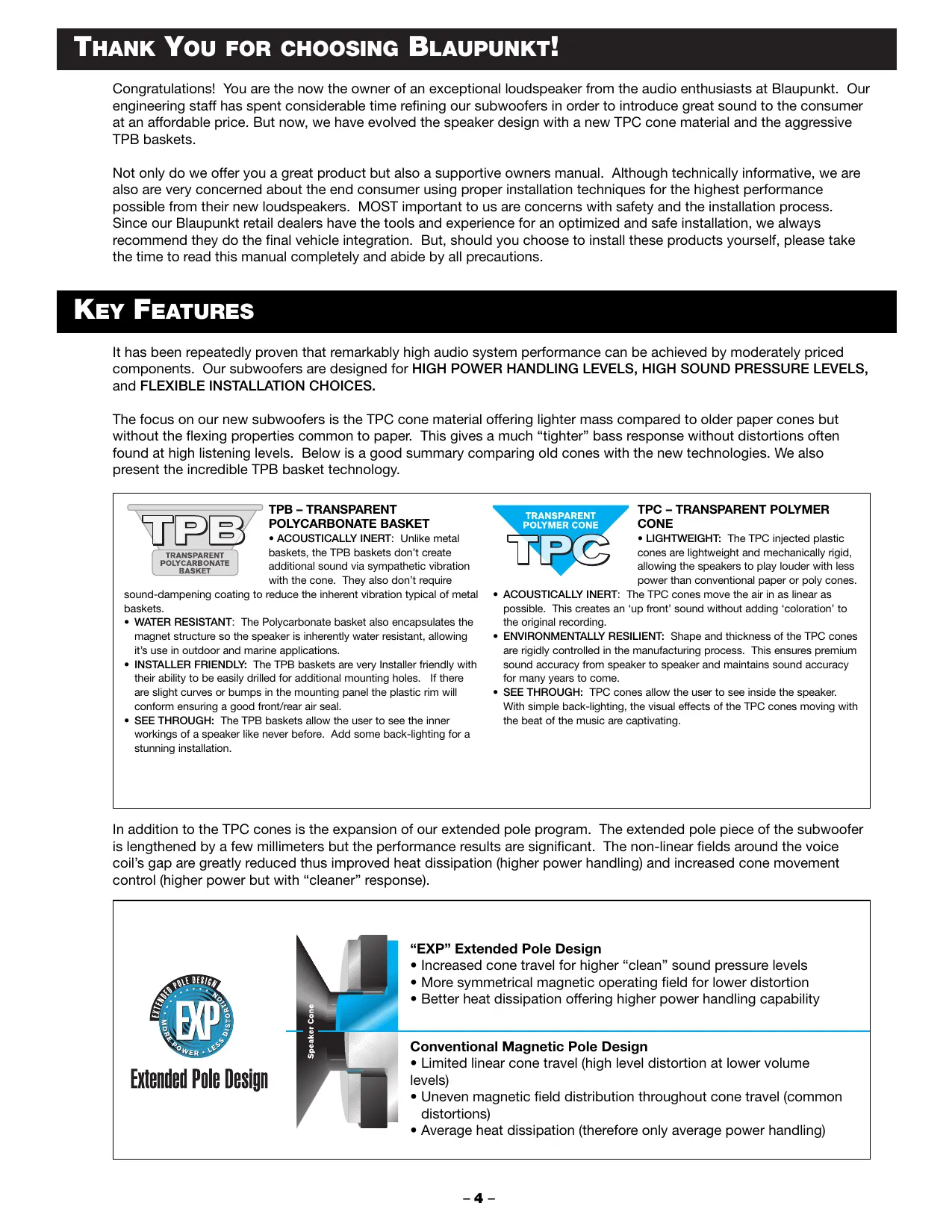


| Product type | Subwoofer |
| Brand | Blaupunkt |
| Model | TSW 1200 |
| Speaker diameter | 30.5 cm (12 inches) |
| Maximum power | 1200 W |
| RMS power (estimated) | 400 W |
| Impedance | 4 ohms |
| Sensitivity (estimated) | 90 dB (1W/1m) |
| Frequency response (estimated) | 25 – 100 Hz |
| Cone technology | TPC (Transparent Polycarbonate) |
| Basket technology | TPB (Transparent Polycarbonate Basket) |
| Magnetic pole | Extended for better heat dissipation |
| Recommended enclosure types | Sealed, Bass-reflex, Bandpass |
| Power supply | Passive (requires external amplifier) |
| Maintenance | Clean with a soft, dry cloth; avoid moisture |
| Installation safety | Disconnect the battery; wear safety goggles |
| Spare parts | Available through Blaupunkt after-sales service |
| General information | 84-page user manual available for download |
Frequently Asked Questions - TSW 1200 BLAUPUNKT
User questions about TSW 1200 BLAUPUNKT
0 question about this device. Answer the ones you know or ask your own.
Ask a new question about this device
Download the instructions for your Subwoofer in PDF format for free! Find your manual TSW 1200 - BLAUPUNKT and take your electronic device back in hand. On this page are published all the documents necessary for the use of your device. TSW 1200 by BLAUPUNKT.
USER MANUAL TSW 1200 BLAUPUNKT
Safety concerns and installation warnings 5
Installation tools & guidelines 6
System design guidelines 7
Subwoofer enclosure types 8
Active & passive electrical configurations 9
Basic mathematics for enclosure construction 10
Sample boxes 11
Final subwoofer enclosure construction 12
Additional reference information 12
Technical specifications 76-79
Blaupunkt technical support 80
Limited warranty information 80-81
Table of Contents
Congratulations! You are now the owner of an exceptional loudspeaker from the audio enthusiasts at Blaupunkt. Our engineering staff has spent considerable time refining our subwoofers in order to introduce great sound to the consumer at an affordable price. But now, we have evolved the speaker design with a new TPC cone material and the aggressive TPB baskets.
Not only do we offer you a great product but also a supportive owner's manual. Although technically informative, we are also very concerned about the end consumer using proper installation techniques for the highest performance possible from their new loudspeakers. MOST important to us are concerns with safety and the installation process. Since our Blaupunkt retail dealers have the tools and experience for an optimized and safe installation, we always recommend they do the final vehicle integration. But, should you choose to install these products yourself, please take the time to read this manual completely and abide by all precautions.
KEY FEATURES
It has been repeatedly proven that remarkably high audio system performance can be achieved by moderately priced components. Our subwoofers are designed for HIGH POWER HANDLING LEVELS, HIGH SOUND PRESSURE LEVELS, and FLEXIBLE INSTALLATION CHOICES.
The focus on our new subwoofers is the TPC cone material offering lighter mass compared to older paper cones but without the flexing properties common to paper. This gives a much "tighter" bass response without distortions often found at high listening levels. Below is a good summary comparing old cones with the new technologies. We also present the incredible TPB basket technology.

TPB - TRANSPARENT POLYCARBONATE BASKET
- ACOUSTICALLY INERT: Unlike metal baskets, the TPB baskets don't create additional sound via sympathetic vibration with the cone. They also don't require
sound-dampening coating to reduce the inherent vibration typical of metal baskets.
- WATER RESISTANT: The Polycarbonate basket also encapsulates the magnet structure so the speaker is inherently water resistant, allowing its use in outdoor and marine applications.
- INSTALLER FRIENDLY: The TPB baskets are very installer friendly with their ability to be easily drilled for additional mounting holes. If there are slight curves or bumps in the mounting panel the plastic rim will conform ensuring a good front/rear air seal.
- SEE THROUGH: The TPB baskets allow the user to see the inner workings of a speaker like never before. Add some back-lighting for a stunning installation.
TRANSPARENT POLYMER CONE

TPC - TRANSPARENT POLYMER CONE
- LIGHTWEIGHT: The TPC injected plastic cones are lightweight and mechanically rigid, allowing the speakers to play louder with less power than conventional paper or poly cones.
- ACOUSTICALLY INERT: The TPC cones move the air in as linear as possible. This creates an 'up front' sound without adding 'coloration' to the original recording.
- ENVIRONMENTALLY RESILIENT: Shape and thickness of the TPC cones are rigidly controlled in the manufacturing process. This ensures premium sound accuracy from speaker to speaker and maintains sound accuracy for many years to come.
- SEE THROUGH: TPC cones allow the user to see inside the speaker. With simple back-lighting, the visual effects of the TPC cones moving with the beat of the music are captivating.
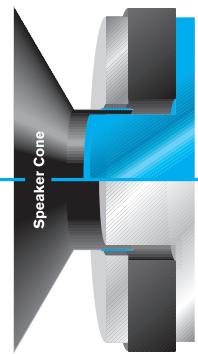
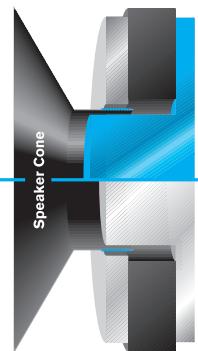
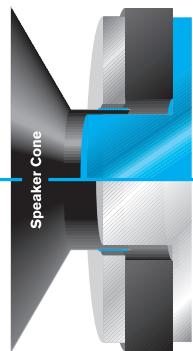
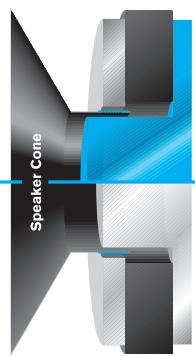
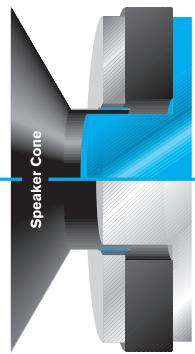
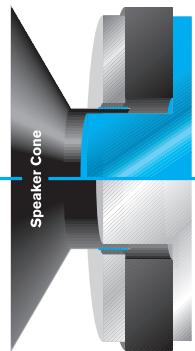
In addition to the TPC cones is the expansion of our extended pole program. The extended pole piece of the subwoofer is lengthened by a few millimeters but the performance results are significant. The non-linear fields around the voice coil's gap are greatly reduced thus improved heat dissipation (higher power handling) and increased cone movement control (higher power but with "cleaner" response).
Extended Pole Design
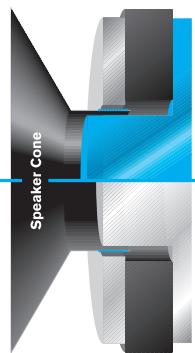
"EXP" Extended Pole Design
- Increased cone travel for higher "clean" sound pressure levels
- More symmetrical magnetic operating field for lower distortion
- Better heat dissipation offering higher power handling capability
Conventional Magnetic Pole Design
- Limited linear cone travel (high level distortion at lower volume levels)
- Uneven magnetic field distribution throughout cone travel (common distortions)
- Average heat dissipation (therefore only average power handling)
We always recommend you have your Blaupunkt speakers professionally installed but the installation process is often so easy that the average consumer can achieve success with little trouble. Regardless of the person installing, you should be sure to review the following points before proceeding with the installation:
- READ THE MANUAL! Understanding the product and installation limitations before lifting a screwdriver. WEAR SAFETY GLASSES AT ALL TIMES - Flying debris are always dangerous. PROTECT THE VEHICLE - Always disconnect the negative battery cable before starting any kind of installation work. This prevents a possible high current electrical short (potential fires).
- HEAT - Keep all speakers away from nearby hot components such as amplifiers or vehicle components that heat up over time such as hoses, high current wires, and braking system components. GIVE YOURSELF LOTS OF TIME - Rushing to complete an installation nearly always ends up with problems. DO NOT LISTEN AT HIGH SOUND LEVELS FOR A PROLONGED TIME - If connected to high power amplifiers, these speakers have the potential to cause permanent hearing loss after listening at maximum volume levels for several hours.

INSTALLATION WARNINGS!
Before disassembling your beautiful new car, you need some basic installation knowledge and skill with common hand and power tools. Following these basic installation tips and warnings will prevent possible damage to the vehicle and also prevent possible fires.
■ AGAIN...READ THE MANUAL! There is a lot of helpful information in this manual that will save time and prevent problems later. - COVER THE VEHICLE WORK AREAS - Use fender covers or blankets to protect the work areas from scratches or dings. ■ DISCONNECT THE (-) LEAD ON THE BATTERY - No sparks or fires please! ■ "REVIEW" THE INSTALLATION - Before using any tools or moving vehicle components, take five minutes to review the installation intentions (e.g., verify that an enclosure will fit in an area of a car before tearing out all the interior). ■ "REVIEW" THE VEHICLE - Before drilling any holes or cutting into any surfaces, make sure there are no fuel or hydraulic lines behind the surfaces. Also make sure there are no wires routed directly behind or near the desired mounting area (remember...screws can often extend 1-2 inches behind the mounting surface). ■ ENSURE PROPER FIT - Before cutting or drilling, make sure the speaker will physically fit in its desired location. Check for clearance around rear deck torsion bars or other structural elements. ■ EVERY CAR IS ASSEMBLED DIFFERENT - Every auto manufacturer uses different assembly techniques. Take care in removing/modifying all trim panels and mounting surfaces since they often use unique screws or snap fasteners that are difficult to replace if they are lost or broken. ■ BE CAREFUL WITH CABLE ROUTING - When routing audio cables, make sure RCA and speaker wires are routed away from high current power lines for audio amplifiers and vehicle systems lines when possible. This will help prevent noises from creeping into the audio system, plus prevent potential damage to the vehicle wiring itself. ■ BE CAREFUL WITH ALL CONNECTIONS - When making connections, make sure each connection is clean and properly secured. Observe all polarity markings carefully to ensure proper end performance. CAUTION - FUEL TANKS AND FUEL LINES ARE NOW LOCATED DIRECTLY BENEATH THE REAR DECK IN MANY CARS - CHECK FOR ADEQUATE CLEARANCE BEFORE EVEN CONSIDERING SUCH A MOUNTING LOCATION!

For most installations, simple hand tools are adequate if replacing the factory speakers. If the factory locations, or other convenient mounting locations are not used, you will need power tools for drilling and cutting plastics and metal. A good starting list is summarized below:
Tape measure and ruler ■ Marking pen and starting punch ■ Phillips and flat blade screwdrivers (small and medium sizes) Nylon wire bundle ties ■ Pliers: standard vice-grip and needle nose styles Light-duty trim pry-bar for removing door trim Cutting shears or nibbling tool for cutting thin and medium gauge metal - Wire cutters, wire strippers, electrical tape, crimping pliers and appropriate crimp-on terminals ■ Power drill with appropriate sized drill bits (1/8", 3/16", and 1/4" to start) Electric jig-saw (sabre saw)

INSTALLATION GUIDELINES
We strongly recommend that you have your Blaupunkt speakers professionally installed. If you choose to do your own installation please note the following important information:
Before cutting any trim or metal make sure your final installation will clear all moving parts, factory cables, wires, and hoses. ■ Be sure to leave enough slack in the wiring to prevent the need to pull or stretch wires if service is needed later. Tie down all loose wires with nylon wire ties to prevent them from getting caught in moving parts or shorted out due to abrasions from moving over time. ■ Never mount speakers in a vehicle's wheel wells or areas where they may be subjected to moisture or road spray. Proper speaker polarity must be observed. The polarity positive side is marked by a (+) symbol or a red colored dot. At low frequencies woofers out of phase will acoustically cancel one another thus resulting in little bass output. Although components used in Blaupunkt speakers exceed most production quality standards, speaker frames can still be twisted by improper installation on uneven surfaces. This can occur when surfaces are heavily padded or carpeted and the screws are unevenly tightened or over tightened. The results will be a damaged voice coil assembly due to knocking it off center. ■ When installing more than one speaker per amplifier channel be sure that the combined impedance values will not damage the amplifier should they be too low (i.e., a common minimum impedance value of 2 ohms is common). ■ Speaker wire size should be sufficient to carry the full power of the amplifier (16 gauge or larger is sufficient in about 90% of all audio systems assuming <100 watt amplifiers and wire runs under 20 feet) ■ Speaker wires should be electrically and physically isolated from the vehicle and routed away from any factory wiring that carries high currents or noises (e.g., ABS brake systems and engine computer signals)
FINAL SYSTEM TEST & TROUBLESHOOTING
Once the system is installed, turn on the total audio system main power switch and SLOWLY turn the volume up using a music selection with a full range of frequencies. If you experience any of the following problems take corrective action immediately to prevent damage to the speaker, amplifier, and vehicle.
| NO SOUND AT ALL -or-VERY LOW SOUND LEVELS | Verify the amplifiers are on and gain controls at mid-position Verify RCA level signals exist with small test amplifier Verify power, ground, and RCA cabling to all channels is correct Verify adequate voltage to the amps (12-14 volts in most vehicles) Install another outboard speaker at the amp to see if sound comes out Replace the amplifier |
| POWER AMP CYCLES ON/OFF -or-HIGH DISTORTION LEVELS | Verify adequate voltage to the amps (12-14 volts in most vehicles) Check that speaker load impedances are 2 ohms or greater per channel Check for a pinched wire or wire shorted to vehicle ground somewhere Lower input gain to amp - you may be over-driving the input stage The amp must have adequate ventilation - it may be getting too hot |
SYSTEM PLANNING
The largest possible impact on any audio system (home or car) is the tonal quality of the loudspeakers, their respective placement, and their overall efficiency (loudness). A 4x20 watt amplifier and four dual-cone speakers is never going to make an impressive performance. The first major improvement comes with the addition of a strong low frequency performance which gives the emotional sensation of "strength" to the audio system. Often many newer cars have acceptable coaxial speakers in acceptable mounting locations. By adding a subwoofer speaker and amplifier, the system, although only moderate performance, becomes surprisingly pleasant for most listeners. To move to the next step up in performance you must install some good component speakers for the mids and highs ("satellite" speakers) then add a separate subwoofer speaker for the lows.
Speaker configurations are a common problem in autosound installations. We want to achieve a sound field in front of us (like a live concert) as compared to sound partly from the front and partly behind us. This dictates good midrange and tweeter speakers in front, usually mounted in the doors for good left/right balance, with high-pass crossovers set greater than 80-100 Hz. The best stereo image will occur when the front speakers are spaced as far forward as possible attempting to achieve nearly equal distance from the speakers to the listening position. For deep bass a subwoofer is required but is nearly always located behind us in a rear trunk or rear hatch area. If the subwoofer crossover is too high in frequency male voices can be heard "gurgling" out of the subwoofer speaker and therefore pulls the sound-stage to the rear of the car, which is very unnatural and therefore undesirable.
MULTI-CHANNEL SYSTEMS
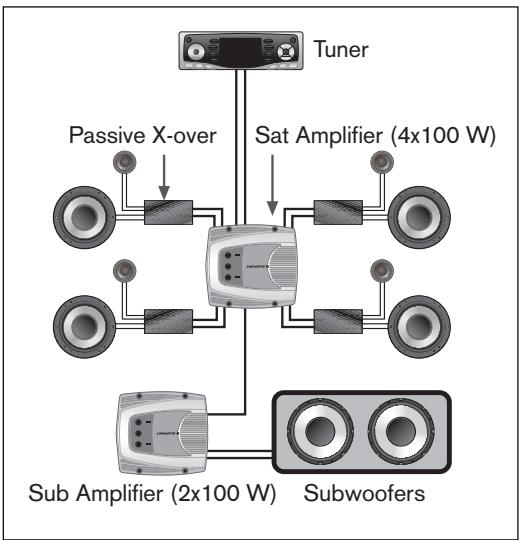
Moving up to amplifiers around 4x50 watts on the satellite channels with component speakers is a common and acoustically rewarding step. The improvements in acoustical left/right balance and stereo imaging are quickly obvious. By adding a
dedicated subwoofer amplifier the perceived "strength" of the system is often dramatic.
In order to achieve such a multi-channel system, a dividing network must be installed that keeps the low frequencies out of the midrange speakers. Such a "crossover" network directs the higher and lower frequencies to their respective drivers. Such a crossover can be "passive" (simple coils and capacitors) that limit the operating frequencies seen by their respective speakers. A crossover can also be "active" where an electronic box must be installed in front of a dedicated amplifier and process the signal via small signal RCA cables before its amplification. In general, active crossovers are most common for the low/mid transition area because they best filter the low frequencies and are physically small compared to the passive equivalent. Passive crossovers are most often used where they provide adequate filtering in the mid/high frequency transition with satellite midranges and their tweeters. Passive crossovers at these higher frequencies require only small coils and capacitors so they are easy to install and perform well.
AMPLIFIER POWER
Amplifier choice and power is important but less so compared to speaker choice and placement. Matching the RMS (continuous) power capability to that of the speaker is important, but it should be noted that "under-powering" a system can often damage more tweeters than providing slightly more power than stated by the speakers. If the speakers are rated to 50 watts RMS, you can often run 60-80 watt RMS amplifiers without concern IF the amps are not driven into clipping (deep distortion). IMPEDANCE is the electrical resistance to AC current flow and is typically 4 ohms for most car speakers. Impedance loads should not fall below the manufacturer's recommended minimum impedance or the amp will heat up and sometimes shut down (2 ohms/channel is common).
SOUND QUALITY VS. LOUDNESS
All well-designed sound systems can provide good sound quality and still play loud. Above about 120 dB (decibels) the sound isn't perceived as getting much louder due to the non-linearities of the human ear. A four-loudspeaker system with a per-speaker efficiency rating of 90 dB (1 watt/1 meter) will often achieve about 110-115 dB if driven by 100 watts per speaker channel. (Although often debated, this is more than enough sound pressure level for most humans to enjoy and can easily cause hearing loss if listened to at such levels for hours at a time.)
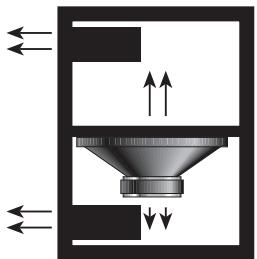
In the car audio world there are 5 types of subwoofer enclosures commonly used: Infinite Baffle, Sealed Box, Vented Box, Single-Vented Band-Pass, and Dual-Vented Band-Pass. No single design is superior because each has its own compromises in performance, power handling, and design/construction complexity. You need to make the choice based upon personal listening habits and requirements.
Having "Multi-Box" design characteristics, your Blaupunkt subwoofer performs remarkably well in ALL installations, but is optimized for Sealed, Vented, and Single-Vented Band-Pass configurations due to its moderate Qts values. Below is a summary of these 5 popular enclosures. More importantly their respective advantages and disadvantages are noted so an intelligent choice can be made regarding the best box for you.
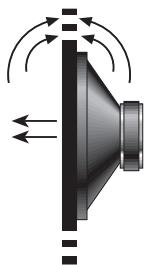
INFINITE BAFFLE (a.k.a. "Free-air") is simply a woofer installed in the back shelf of the car that uses the trunk as the enclosure. Advantages: simple installation and adequate performance; Disadvantages: only moderate sound pressure levels and poor power handling.
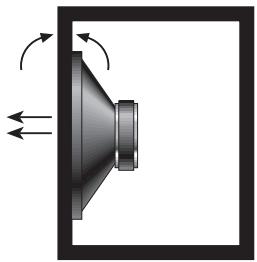
SEALED BOX (a.k.a. "Closed Box") offers one of the best compromises in performance and power handling. Advantages: simple box construction, high power handling, excellent transient response, and smooth low frequency roll-off. Disadvantages: moderate to large box sizes, moderate efficiency, moderate sound pressure levels.
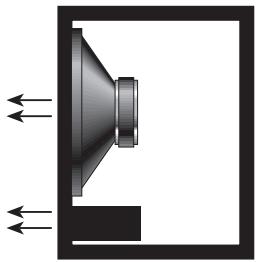
VENTED BOX (a.k.a. "Ported Box" and "Bass Reflex") is simply a sealed box but with a specifically tuned tube inserted. It extends the low frequency response compared to a sealed box. Advantages: low cut-off frequency, low distortion in its operating passband, excellent efficiency, good transient response, moderate power handling (in its pass-band), and small box sizes. Disadvantages: complex design and limited power handling if driven hard at very low frequencies (below port tuning frequency).
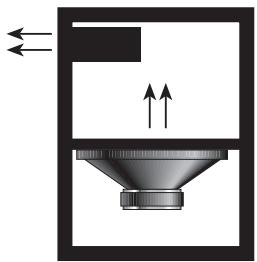
SINGLE-VENTED BAND-PASS (a.k.a. "4th Order Band-Pass") is one of the best designs for the car. It is basically a "compromise" between a sealed and vented box in performance and reliability. Advantages: small box volumes, extended low frequency performance, and can be used with VERY high power amplifiers. Disadvantages: slight drops in efficiency compared to a vented box and increased box design and construction complexity.
DUAL-VENTED BAND-PASS (a.k.a. "6th Order Band-Pass") is unfortunately often used in the car as an acoustical "fog-horn" - lots of high-SPL but marginal tonal quality if the enclosure isn't precisely constructed. Advantages: tremendous SPL's from VERY small boxes. Disadvantages: VERY complex construction and susceptibility to cone over-excursions for frequencies outside its operating region if a high quality electrical filter is not used.
ACTIVE AND PASSIVE ELECTRICAL CONFIGURATIONS
At some point, the subwoofer speaker must be electrically connected to an audio amplifier, be it a dedicated bass-only amp or the amplifier built inside the radio. Clearly, the highest performance level will be from the outboard dedicated amp due to its typically higher power (e.g., 100 watt amp vs. 20 watts from the radio). To avoid disappointing performance we recommend power amps with rms power levels exceeding 50 watts if possible. This is NOT a minimum value; it is simply a nice power point where you begin to really FEEL the substantial improvements in sound offered by a good subwoofer/amplifier system.
Now that we have concluded that an outboard dedicated subwoofer amplifier is needed for optimum performance we must somehow process the signal in order to limit the audio signals to only low frequencies. This must be done via a "crossover" which can be "active" or "passive". As stated earlier in this manual, the active system is preferred due to its small size and better frequency contouring. But it must be placed in front of the amplifier and process the signals via the RCA cables. This is rarely a problem in most installations.
The passive design is more of a "brute force" process requiring large inductors and capacitors but it is often a "cheap and dirty" way to get bass response into the car quickly and without noise problems sometimes associated with active crossovers. Its bigger advantage is when you wish to operate in a combination stereo high-pass/bridged subwoofer mode common with 2 channel amps. Such configurations are shown in the manuals of most amplifiers. Below is a simple summary showing how to connect such a passive installation.
AREA AND VOLUME CALCULATIONS
Although many enclosures can now be purchased in prefabricated form, building your own enclosure is often fun, acoustically rewarding, or even a necessity to properly fit many vehicles. In order to build such a box there MUST be a basic understanding of mathematic principals or you will wind up wasting incredible amounts of time and money by making mistakes in the box design and assembly.
The areas of surfaces or openings are calculated in square inches (in2). Such calculations depend upon height and width values or diameters for circles
AREAS circle or a hole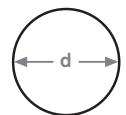
rectangular wall or area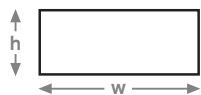
triangle wall or area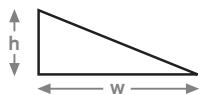
AREA CALCULATIONS
| Circle or hole | Area = 0.79 x d x d |
| Rectangular wall or area | Area = h x w |
| Triangle wall or area | Area = 0.5 x h x w |
The volumes of assemble shapes are measured in cubic inches (in3). Such calculations depend upon height, width, and depth calculations for rectangular shapes and a diameter and height for a tube shape.
VOLUMES tube shape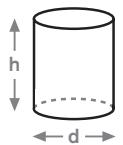
rectangular shape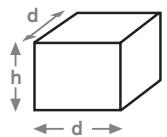
triangular/wedge shape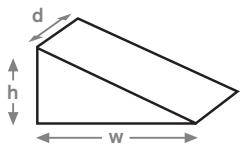
cone shape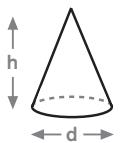
VOLUME CALCULATIONS
| Cylinder (port tube) | Volume = 0.79 x d x d x h |
| Rectangular box | Volume = h x w x d |
| Triangular box | Volume = 0.5 x h x w x d |
| Cone shape | Volume = 0.26 x d x d x h |
AREA AND VOLUME CONVERSIONS
Technical data for speakers are often given in English and Metric unit values (e.g., inches and meters). Also, when calculating dimensions we must often flip between size formats (e.g., cubic inches and cubic feet). To easily convert back and forth between two formats you can use the conversion table below.
VOLUME AND AREA CONVERSIONS
| TO CONVERT YOUR NUMBER FROM: | MULTIPLY YOUR NUMBER BY: | TO GET A NEW VALUE IN |
| Inches | 0.0254 | Meters |
| Meters | 39.37 | Inches |
| Square inches | 0.007 | Square feet |
| Square feet | 144 | Square inches |
| Cubic inches | 0.00058 | Cubic feet |
| Cubic feet | 1728 | Cubic inches |
| Liters | 0.035 | Cubic feet |
| Cubic feet | 28.3 | Liters |
This page is offered ONLY as a "starting point" for box construction. Although our woofers work well in a wide range of box volumes, many people try to build boxes too large assuming they will get better bass response with such monstrous sized boxes. This is NOT acoustically correct and you need to pay attention to the recommended volumes and predicted performance data when making your box decision. On the other hand, the more common mistake is to jam a big woofer in an extremely small box and have virtually no low frequency response due to the "choking" effect of an undersized box.
To help understand how large a "cubic foot" really is we have provided the drawings and tables below with some common relationships for height, width, and depth. These are not "magical" sizes or relationships in any way, just popular sizes that will fit in most vehicles and perform well.
All dimensions are stated for exterior sizes and are calculated with compensations for box wall thickness using 3/4'' wood. Also, each volume is adjusted for air volume displacements for a woofer (average 0.15 cu ft for 10/12'' woofer) and a mid size port ( 3'' dia. x 7'' long). Please be aware of the small impact that box size fluctuations has on the end sound quality: loudspeaker enclosure interior size deviations of +/- 5% from ideal are rarely heard. In addition, interior objects such as port volume displacements and cross braces can usually be forgotten about in all but the smallest of boxes.
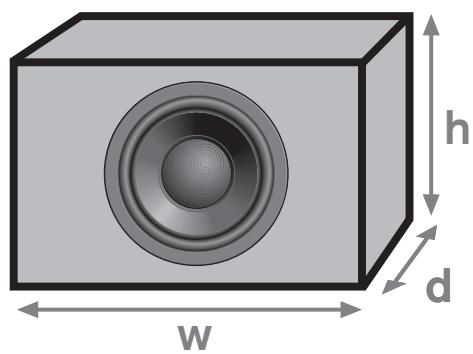
| SIMPLE RECTANGULAR BOX (outside dimensions in inches) | |||
| Nominal Interior Volume (cu. ft.) | height (h) | width (w) | depth (d) |
| 0.5 | 14 | 15 | 8 |
| 1.0 | 14 | 16 | 12 |
| 1.5 | 16 | 20 | 12 |
| 2.0 | 16 | 26 | 12 |
| 3.0 | 18 | 33 | 12 |
| 4.0 | 18 | 36 | 14 |
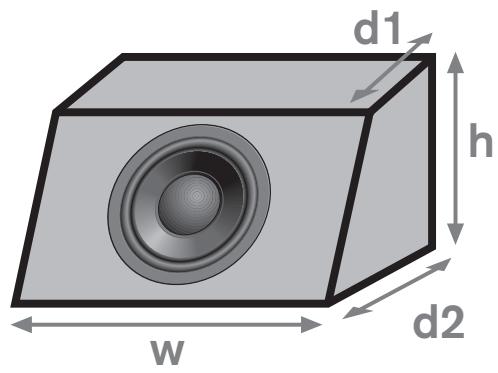
| SIMPLE “WEDGE” BOX (outside dimensions in inches) | ||||
| Nominal Interior Volume (cu. ft.) | height (h) | width (w) | depth (d1) | depth (d2) |
| 0.5 | 14 | 15 | 6.5 | 9.5 |
| 1.0 | 14 | 16 | 10.5 | 13.5 |
| 1.5 | 16 | 20 | 10.5 | 13.5 |
| 2.0 | 16 | 26 | 10.5 | 13.5 |
| 3.0 | 18 | 33 | 10.5 | 13.5 |
| 4.0 | 18 | 36 | 12.5 | 15.5 |
FINAL SUBWOOFER ENCLOSURE CONSTRUCTION
Before final design, wood cutting, and assembly of the enclosure some basic box construction issues need to be understood. These items are acoustically related, some are construction tips, and some are simply to ensure a long lasting product for the listener.
Infinite baffles are simply a piece of wood holding up the woofer to the back deck of a car. If you choose this installation (which is generally a poor performer) you must take great care in sealing/making all holes that vent into the back seat for proper bass response. - Wedge shaped boxes are simply a triangular box added to a rectangular box. Mathematically add up the volumes of these two boxes and you have the total of a wedge shaped box. ■ When making the calculations, be sure to adjust interior box volumes for port volumes and woofer displacement volumes. ■ All calculations should be made in advance of cutting wood out. If the final box is off by +/- 5% of optimum values don't worry about it; you will rarely be able to hear the difference! This is very important since prefabricated boxes often work well even if off a little bit. Also, if you do forget to compensate for woofer and port tube volume displacement, it is rarely acoustically noticed by most people. - Very low frequencies simply do not care about the shape of the box. Such wavelengths allow for nearly any reasonable shape or length but really odd shapes should be avoided so they can be easily cut and glued. ■ Particle board, MDF, or high grade birch plywood are good materials to build boxes with thicknesses of 5/8"-1" (14-25mm). Solid wood panels should actually be avoided for splitting and warping over time in the car environment. All seams in the box should be glued, screwed, then caulked to prevent panel separation and air leaks over time. Cross bracing of panels is important for large boxes to prevent the panels themselves from radiating sound. ■ Acoustical damping material (e.g., fiberglass batting material 2-4" thick) should cover about 50% of the interior walls. This helps reduce high frequency resonances and increase the box volume as seen by the woofer by about 10-15%. - Spraying the interior walls of the box with a damping material such as tar based automotive undercoating is one of the best things to help dampen wall resonances. The final box should allow for servicing the woofer at a later time should it be damaged for any reason. ■ 5-way binding posts mounted on the box for electrical connections are highly recommended. It is then easy to remove the box from the vehicle for service or theft protection. ■ Where possible, use the largest diameter port tubes to prevent wind noise. PVC plumbing pipe is inexpensive and is common in 3, 4, and 5" diameters. PVC "elbow" connectors allow you to make turns inside the box with the average diameter being along the centerline of the tube. Try to always use active (electronic) crossovers. Today, most power amps have them built in. The mounting distance from the side of the woofer and the port should be less than 12" or so if possible. Regarding simple vented boxes, you CANNOT achieve lower frequency response by simply lowering the port tuning frequency from its recommended value. This severely over-damps the box and results in a very "muddy" sound for the box.
Before gluing and screwing everything together, lightly "tack nail" the sides together and make sure the box fits in the vehicle. Also, look carefully to see if the woofer magnet has enough depth of clearance from the back wall. There are many other things to think about when designing and building subwoofer boxes but they are too numerous to mention here. But, for those interested, please refer to some of the related reading for more information on speakers and audio in general.
ADDITIONAL REFERENCE INFORMATION
The following is a list of materials and sources of recommended reading for the person interested in loudspeakers, acoustics, and audio in general. Subjective comments are noted for each.
DESIGNING, BUILDING, AND TESTING YOUR OWN SPEAKER SYSTEM, David Weems, Copyright 1984, TAB Books #1964, Blue Ridge Summit, PA 17294. (This is an excellent introductory book on designing speakers for the home but is quite applicable to the car since many concepts are carried over.) ■ LOUDSPEAKER DESIGN COOKBOOK, Vance Dickason, copyright 1991-2002, distributed by Old Colony Sound Lab, Peterborough, NH, 03458. (A significant technical step up from Weems addressing complex woofer box and crossover designs. A tremendous reference book useful for all.) ISBN: 1-882580-33-8 ■ BLAUBOX WOOFER BOX DESIGN COMPUTER PROGRAM, Thomas Breithaupt, Blaupunkt div. Robert Bosch Corporation, 2800 S. 25th Avenue, Broadview, IL 60155. (This is a simple to use IBM PC computer program used to predict the frequency response of a subwoofer in 10 different enclosures including sealed, vented, and bandpass configurations. Basic passive crossover designs are covered as well. It is provided free of charge as a download from the Blaupunkt Internet site at: http://www.blaupunkt.com.) ■ TESTING LOUDSPEAKERS, Joseph D'Appolito, copyright 1998, distributed by Old Colony Sound Lab, Peterborough, NH, 03458, (Outstanding technical reference on measuring loudspeakers-NOT for the feint of heart!) ISBN: 1-882580-17-6
THANK YOU FOR CHOOSING BLAUPUNKT!
Extended Pole Design
Extended Pole Design
TRANSPARENT POLYMER CONE = TPC (transparent polymer cone)
Extended Pole Design
Extended Pole Design
CALCULATION OF AREA AND VOLUME
Extended Pole Design
Wall or rectangular area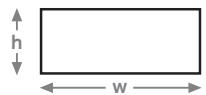
Wall or triangular area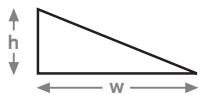
CALCULATION OF AREAS
| Círculo u orificio | A = 0,79 x d x d |
| Pared o área rectangular | A = h x l |
| Pared o區域 triangular | A = 0,5 x h x l |
Extended Pole Design
ACTIVE AND PASSIVE ELECTRICAL CONFIGURATIONS
Extended Pole Design
FINAL SYSTEM TEST AND TROUBLESHOOTING
6 dB/octave filter Radio Passive filter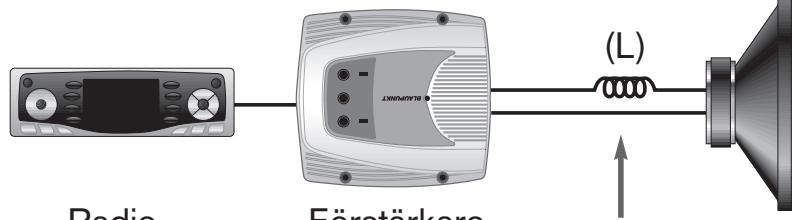
12 dB/octave filter Radio
Amplifier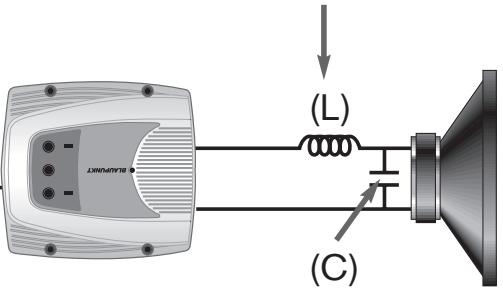
| Filterfrekv. (Hz) | Induktorvärde (L) (mH) |
| 80 | 8.0 |
| 100 | 6.4 |
| 150 | 4.2 |
| 200 | 3.2 |
Extended Pole Design
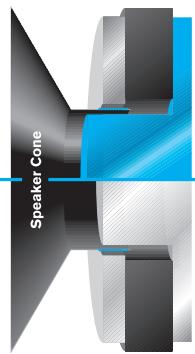
"EXP" Extended Pole Design
- Increased cone travel for higher "clean" sound pressure levels
- More symmetrical magnetic operating field for lower distortion
- Better heat dissipation offering higher power handling capability
Conventional Magnetic Pole Design
- Limited linear cone travel (high level distortion at lower volume levels)
- Uneven magnetic field distribution throughout cone travel (common distortions)
- Average heat dissipation (therefore only average power handling)
| POWER HANDLING | 200 Watts rms 600 Watts peak |
| SENSITIVITY | 92 dB (2.83V/1m) 89 dB (1W/1m) |
| FREQ. RESPONSE | 20 - 200Hz |
| NOMINAL IMPEDANCE | 4 ohms |
| MAGNET WEIGHT | 40 oz. (1.1 kg) |
| MOUNTING CUTOUT DIMENSIONS | 9.13" (232mm) |
| MOUNTING深度 | 4.86" (124mm) |
| AIR VOLUME DISPLACEMENT | 0.08 cu.ft. (3.3L) |
| VOICE COIL DIAMETER | 2.0" (50.8mm) |
| THIELE-SMALL PARAMETERS | |
| Resonance frequency | 26 Hz |
| Total Q factor (Qts) | 0.26 |
| Electrical Q factor (Qes) | 0.27 |
| Mechanical Q factor (Qms) | 8.61 |
| Volume equivalent compliance (Vas) | 2.95 cu.ft. (83.5L) |
| Linear excursion (Xmax) | 5.6mm (1 direction) |
| DC resistance (Re) | 3.71 (ohms) |
| Force factor (BL) | 12.5 (Tm) |
| Effective cone area (Sd) | 333 (sq.cm.) |
| Compliance (Cms) | 536 (uM/N) |
| Moving mass (Mms) | 69.4 g |
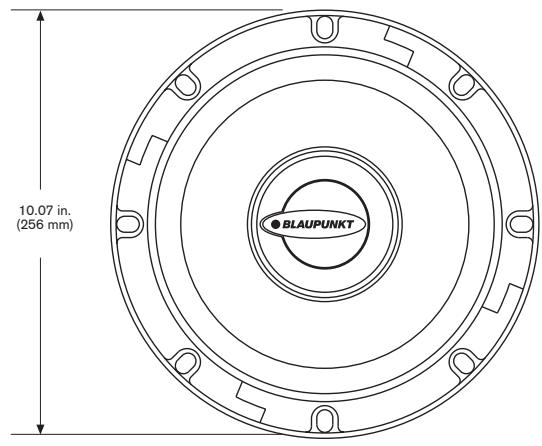
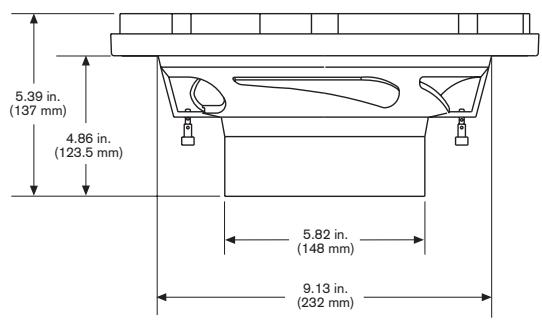
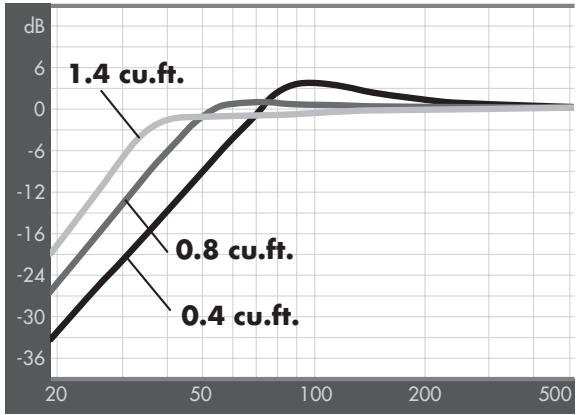
COMMON BOX DESIGNS
| SEATED | CU. FT. | COMMENTS |
| Small box | 0.4 (11.3L) | Limited deep bass but O.K. for many listeners |
| Pounder | 0.8 (22.7L) | Good low-end response with impressive power handling - JAM ON IT! |
| Most accurate | 1.4 (39.6L) | More accurate sound but slightly lowered power capability than smaller boxes |
| VENTED | ||
| Small box | 0.4 (11.3L) | A little "boomy" response at low frequencies but still very usable |
| Pounder | 0.8 (22.7L) | Good low-end balance with excellent power handling (HP @ 40Hz recommended) |
| Most accurate | 1.4 (39.6L) | Pleasant deep bass with great tonal quality (HP @30Hz recommended) |
| BANDPASS | ||
| Small box | 0.6 (17.0L) | Narrow bass response due to small box but plays loud |
| Pounder | 1.0 (28.3L) | Great pounding capability if subsonic limited (electrical HP @ 30Hz) |
| Most accurate | 1.4 (39.6L) | Impressive wide bandwidth, good tonal quality, and good power handling |
SEALED BOX
| Vf (Volume Total) cu.ft. (L) | f3 (freq. @ -3dB) Hz | SPL (dB ref 1W) |
| 0.4 (11.3L) | 79 | 89 |
| 0.6 (17.0L) | 79 | 89 |
| 0.8 (22.7L) | 82 | 89 |
| 1.0 (28.3L) | 85 | 89 |
| 1.4 (39.6L) | 87 | 89 |
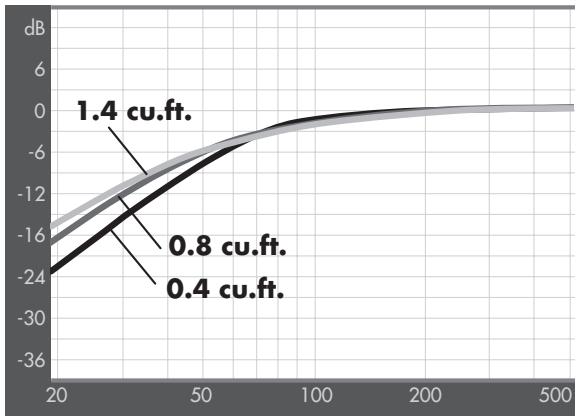
VENTED BOX
| Vf(Volume Total)cu.ft. (L) | f3(freq. @ -3dB)Hz | fb(Port tuning freq.)Hz | Port Lengthw/2" dia portin. (cm) | Port Lengthw/3" dia portin. (cm) | SPL(dB ref 1W) |
| 0.4 (11.3L) | 65 | 65 | 3.4" (8.6cm) | 9.2" (23.4cm) | 89 |
| 0.6 (17.0L) | 54 | 55 | 3.1" (7.8cm) | 8.3" (21.1cm) | 89 |
| 0.8 (22.7L) | 47 | 45 | 3.7" (9.4cm) | 9.7" (24.6cm) | 89 |
| 1.0 (28.3L) | 42 | 40 | 3.7" (9.4cm) | 9.9" (25.1cm) | 89 |
| 1.4 (39.6L) | 37 | 35 | 3.3" (8.4cm) | 9.0" (22.9cm) | 89 |
| POWER HANDLING | 200 Watts rms 600 Watts peak |
| SENSITIVITY | 93 dB (2.83V/1m) 90 dB (1W/1m) |
| FREQ. RESPONSE | 20 - 200Hz |
| NOMINAL IMPEDANCE | 4 ohms |
| MAGNET WEIGHT | 40 oz. (1.1 kg) |
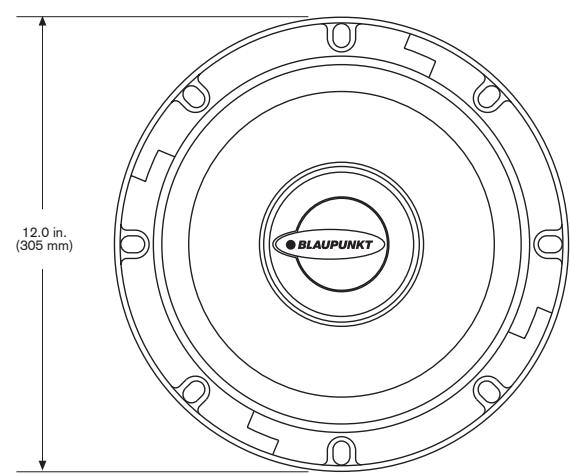
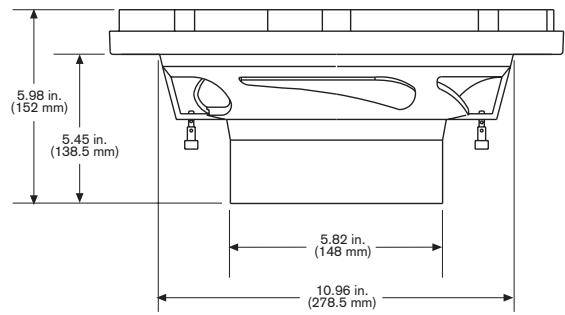
| MOUNTING CUTOUT DIMENSIONS | 10.96" (278.5mm) |
| MOUNTING深度 | 5.45" (138.5mm) |
| AIR VOLUME DISPLACEMENT | 0.12 cu.ft. (2.2L) |
| VOICE COIL DIAMETER | 2.0" (50.8mm) |
| THIELE-SMALL PARAMETERS | |
| Resonance frequency | 25 Hz |
| Total Q factor (Qts) | 0.35 |
| Electrical Q factor (Qes) | 0.38 |
| Mechanical Q factor (Qms) | 4.06 |
| Volume equivalent compliance (Vas) | 4.18 cu.ft. (146.7L) |
| Linear excursion (Xmax) | 5.6mm (1 direction) |
| DC resistance (Re) | 3.69 (ohms) |
| Force factor (BL) | 12.5 (Tm) |
| Effective cone area (Sd) | 510 (sq.cm.) |
| Compliance (Cms) | 400 (uM/N) |
| Moving mass (Mms) | 104.5 g |
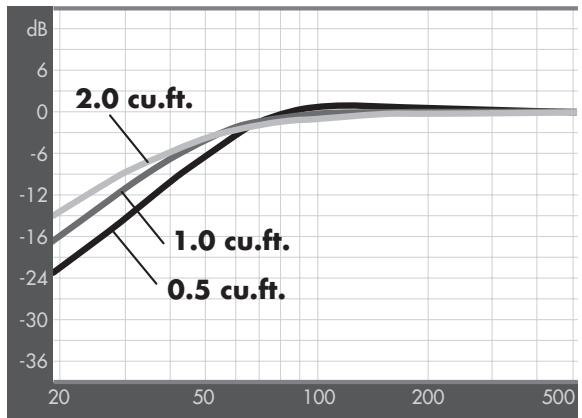
COMMON BOX DESIGNS
| SEATED | CU. FT. | COMMENTS |
| Small box | 0.5 (14.1L) | Limited deep bass but O.K. for many listeners |
| Pounder | 1.0 (28.3L) | Good low-end response with impressive power handling - JAM ON IT! |
| Most accurate | 2.0 (56.6L) | More accurate sound but slightly lowered power capability than smaller boxes |
| VENTED | ||
| Small box | 0.5 (14.1L | A little "boom" response at low frequencies but still very usable |
| Pounder | 1.0 (28.3L) | Good low-end balance with excellent power handling (HP @ 40Hz recommended) |
| Most accurate | 2.0 (56.6L) | Pleasant deep bass with great tonal quality (HP @30Hz recommended) |
| BANDPASS | ||
| Small box | 1.0 (28.3L) | Narrow bass response due to small box but plays loud |
| Pounder | 1.5 (42.5L) | Great pounding capability if subsonic limited (electrical HP @ 30Hz) |
| Most accurate | 2.5 (70.7L) | Impressive wide bandwidth, good tonal quality, and good power handling |
| SEATED BOX | ||
| Vt (Volume Total) cu.ft. (L) | f3 (freq. @ -3dB) Hz | SPL (dB ref 1W) |
| 0.5 (14.1L) | 62 | 90 |
| 0.75 (21.2L) | 57 | 90 |
| 1.0 (28.3L) | 56 | 90 |
| 1.5 (42.5L) | 56 | 90 |
| 2.0 (56.6L) | 56 | 90 |
| VENTED BOX | |||||
| Vt (Volume Total) cu.ft. (L) | f3 (freq. @ -3dB) Hz | fb (Port tuning freq.) Hz | Port Length w/2" dia port in. (cm) | Port Length w/3" dia port in. (cm) | SPL (dB ref 1W) |
| 0.5 (14.1L) | 60 | 55 | 4.0 (10.2cm) | 10.6 (26.9cm) | 90 |
| 0.75 (21.2L) | 50 | 45 | 4.0 (10.2cm) | 10.6 (26.9cm) | 90 |
| 1.0 (28.3L) | 44 | 40 | 3.7 (9.4cm) | 9.9 (25.1cm) | 90 |
| 1.5 (42.5L) | 37 | 33 | 3.6 (9.1cm) | 9.6 (24.2cm) | 90 |
| 2.0 (56.6L) | 33 | 30 | 3.0 (7.62cm) | 8.5 (21.5) | 90 |
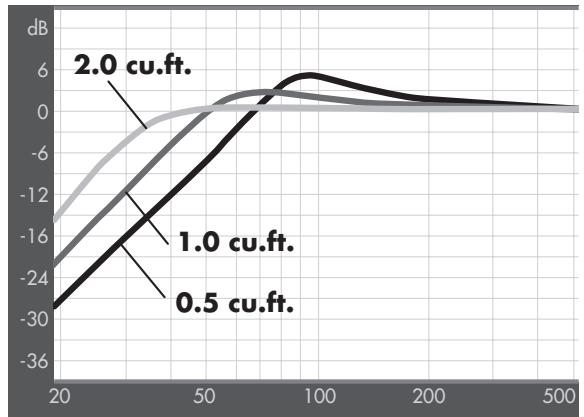
| SINGLE-VENTED BAND-PASS BOX | ||||||||
| Vt (Volume Total) cu.ft. (L) | f3-low Hz | f3-hi Hz | VF (Vented front box volume) cu.ft. (L) | VR (Sealed rear box volume) cu.ft. (L) | fb (Port tuning freq.) Hz | Port Length w/3" dia port in. (cm) | Port Length w/4" dia port in. (cm) | SPL (dB ref 1W) |
| 1.0 (28.3L) | 42 | 133 | 0.45 (12.7L) | 0.55 (15.6L) | 77 | 3.7" (9.4cm) | 7.8" (19.8cm) | 91 |
| 1.25 (35.4L) | 40 | 119 | 0.625 (17.7L) | 0.625 (17.7L) | 68 | 4.1" (10.4cm) | 8.7" (22.2cm) | 91 |
| 1.5 (42.5L) | 38 | 109 | 0.75 (21.2L) | 0.75 (21.2L) | 64 | 3.9" (9.9cm) | 8.3" (21.1cm) | 90 |
| 2.0 (56.6L) | 34 | 89 | 1.0 (28.3L) | 1.0 (28.3L) | 56 | 3.8" (9.7cm) | 8.1" (20.6cm) | 89 |
| 2.5 (70.7L) | 31 | 80 | 1.4 (39.6L) | 1.1 (31.1L) | 50 | 4.5" (11.4cm) | 9.3" (23.6cm) | 89 |
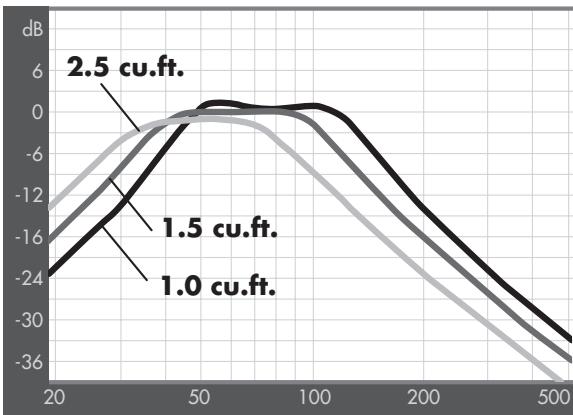
LIMITED WARRANTY INFORMATION (UNITED STATES ONLY)
Robert Bosch Corporation warrants new Blaupunkt car audio products it distributes in the United States through authorized Blaupunkt dealers, or which are imported as original vehicle equipment by the automobile manufacturer, to be free from defects in material and workmanship, in accordance with the following:
For twelve (12) months after delivery to you, the original consumer purchaser, we will repair or at our option replace at no charge to you any car audio product which, under normal conditions of use and service, proves to be defective in materials or workmanship. However, this warranty does not cover expenses incurred in the removal or reinstallation of any car audio product, whether or not proven defective, and does not cover products not purchased from an authorized Blaupunkt dealer. This warranty is limited to the original consumer purchaser and is not transferable. Repaired and replacement car audio products shall assume the identity of the original for purpose of this warranty and this warranty shall not be extended with respect to such products.
To obtain performance of this warranty, contact the nearest Blaupunkt authorized repair facility or our nearest office. A dated purchase receipt or other proof that the product is within the warranty period will be required in order to honor your claim. Carefully pack the unit and ship prepaid to the servicing location. For further information, write to the Robert Bosch Corporation, 2800 South 25th Avenue, Broadview, Illinois, 60153, attention Blaupunkt Customer Service Department or call 1-800-266-2528.
Specifically excluded from this warranty are failures caused by misuse, neglect, abuse, improper operation or installation, dropping or damaging, unauthorized service or parts, or failure to follow maintenance instructions or perform normal maintenance activities. Normal maintenance activities for car audio products include but are not limited to cleaning and other minor maintenance activities and adjustments that are outlined in the owner's manual or that are normally required for continued proper operation. Also excluded from this warranty is the correction of improper installation and the elimination of any external electromagnetic interference. This warranty sets forth your exclusive remedies with respect to the products covered by it. We shall not be liable for any incidental, consequential, special or punitive damages arising from the sale or use of any Blaupunkt car audio products, whether such claim is in contract or tort. No attempt to alter, modify, or amend this warranty shall be effective unless authorized in writing by an officer of Robert Bosch Corporation.
THIS WARRANTY IS IN LIEU OF ALL OTHER WARRANTIES OR REPRESENTATIONS, EXPRESS OR IMPLIED, INCLUDING ANY WARRANTY IMPLIED BY LAW, WHETHER FOR MERCHANTABILITY OR FITNESS FOR A PARTICULAR PURPOSE OR OTHERWISE AND SHALL BE EFFECTIVE ONLY FOR THE PERIOD THAT THIS EXPRESS WARRANTY IS EFFECTIVE.
In the event any provision, or any part or portion of this warranty shall be held invalid, void or otherwise unenforceable, such holding shall not affect the remaining part or portions of that provision or any other provision hereof.
NOTICE TO CALIFORNIA OWNERS: If your Blaupunkt car audio product needs warranty repair service and there is no authorized service center reasonably close to you, you can return the defective unit to the dealer from whom you purchased it, or you can return it to any dealer who sells Blaupunkt car audio products. The dealer may, at the dealer's option, replace, repair or refund the purchase price for any Blaupunkt car audio products which prove defective under conditions of normal use. If the dealer fails to repair, replace, or partially refund your money, you may take your Blaupunkt car audio product to any repair shop and they can repair your unit at our expense unless the repair cost exceeds the depreciated value of the unit, but you must contact Blaupunkt to receive authorization to do this before your car audio product is repaired.
ROBERT BOSCH CORPORATION
BLAUPUNKT CUSTOMER SERVICE
2800 SOUTH 25TH AVENUE
BROADVIEW, IL 60155
TEL: 1-800-266-2528
BLAUPUNKT TECHNICAL SUPPORT
We will make all reasonable efforts to help you, the end purchaser or Installation Technician, to competently install these components. Before calling us please carefully review this owners manual for the answers to your questions. The attached Blaupunkt technical data should assist in designing good subwoofer enclosures and answer most technical questions.
Numerous computer programs exist for designing subwoofer enclosures but we particularly recommend our "BlauBox" IBM PC offered free of charge. This program easily and quickly assists in comparing the predicted acoustical frequency response of two independent subwoofer enclosures. Such a program helps design a box to built from scratch but also confirms the performance of an existing pre-fabricated box should one already exist. This program is free to the consumer and retailer and is easily downloaded from our Internet site at the address given below - it is NOT mailed or shipped free of charge.
BLAUPUNKT LOUDSPEAKER TECHNICAL SUPPORT
2800 SOUTH 25TH AVENUE, BROADVIEW, IL 60155, TEL: 1-800-266-2528
Internet site: http://www.BlaupunktUSA.com

We provide a manufacturer guarantee for our products bought within the European Union. You can view the guarantee conditions at www.blaupunkt.de or ask for them directly at: Blaupunkt GmbH, Hotline CM/PSS 6, Robert Bosch Str. 200, D-31139 Hildesheim, Germany

Robert Bosch Corporation
Sales Group - Mobile
Communications Division
2800 S. 25th Avenue
Broadview, IL 60155, U.S.A.
Blaupunkt World Headquarters
Blaupunkt GmbH
Postfach 77 77 77
D-31132 Hildesheim
Germany
www.BlaupunktUSA.com
www.Blaupunkt.com




- TABLE OF CONTENTS
- KEY FEATURES
- TPB - TRANSPARENT POLYCARBONATE BASKET
- TRANSPARENT POLYMER CONE
- TPC - TRANSPARENT POLYMER CONE
- EXP" EXTENDED POLE DESIGN
- CONVENTIONAL MAGNETIC POLE DESIGN
- INSTALLATION WARNINGS
- INSTALLATION GUIDELINES
- FINAL SYSTEM TEST & TROUBLESHOOTING
- SYSTEM PLANNING
- MULTI-CHANNEL SYSTEMS
- AMPLIFIER POWER
- SOUND QUALITY VS. LOUDNESS
- ACTIVE AND PASSIVE ELECTRICAL CONFIGURATIONS
- AREA AND VOLUME CALCULATIONS
- AREA AND VOLUME CONVERSIONS
- FINAL SUBWOOFER ENCLOSURE CONSTRUCTION
- ADDITIONAL REFERENCE INFORMATION
- THANK YOU FOR CHOOSING BLAUPUNKT
- EXTENDED POLE DESIGN
- TRANSPARENT POLYMER CONE = TPC (TRANSPARENT POLYMER CONE)
- CALCULATION OF AREA AND VOLUME
- FINAL SYSTEM TEST AND TROUBLESHOOTING
- LIMITED WARRANTY INFORMATION (UNITED STATES ONLY)
- BLAUPUNKT TECHNICAL SUPPORT
Brand : BLAUPUNKT
Model : TSW 1200
Category : Subwoofer