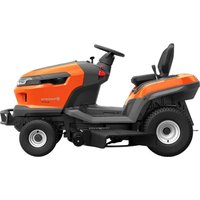
TS 218T - Lawn mower HUSQVARNA - Free user manual and instructions
Find the device manual for free TS 218T HUSQVARNA in PDF.


| Product type | Lawn tractor (ride-on lawn mower) |
| Brand | Husqvarna |
| Model | TS 218T |
| Engine power | 14.4 kW (19.3 hp) |
| Displacement | 708 cm³ |
| Fuel type | Unleaded gasoline, octane rating min. 91 RON (87 AKI), max. 10% ethanol |
| Fuel tank capacity | 13 L |
| Electrical system | 12 V, negative ground, 24 Ah battery |
| Transmission | Hydrostatic Tuff Torq K46EN |
| Cutting width | 108 cm (42.5 in) |
| Cutting height | 25 to 105 mm, 10 positions |
| Weight (with cutting deck, empty tank) | 234 kg |
| Dimensions (L x W x H) | 2029 x 1375 x 1124 mm (with low chute) |
| Maximum speed forward / reverse | 10 km/h / 6 km/h |
| Tires front / rear | 15x6-6 / 20x10-8 |
| Maximum slope | 10° (17.6%) |
| Starting type | Electric (12 V) |
| Safety | Operator presence control (OPC), reverse operating system (ROS), parking brake |
| Maintenance | Engine oil change every 50 h, replaceable air filter and spark plug, replaceable cutting belt |
| Blade reference | 531 14 83-03 (length 554 mm) |
Frequently Asked Questions - TS 218T HUSQVARNA
User questions about TS 218T HUSQVARNA
0 question about this device. Answer the ones you know or ask your own.
Ask a new question about this device
Download the instructions for your Lawn mower in PDF format for free! Find your manual TS 218T - HUSQVARNA and take your electronic device back in hand. On this page are published all the documents necessary for the use of your device. TS 218T by HUSQVARNA.
USER MANUAL TS 218T HUSQVARNA
| Introduction | 2 |
| Safety | 6 |
| Assembly | 12 |
| Operation | 14 |
| Maintenance | 19 |
| Troubleshooting | 31 |
| Transportation, storage and disposal | 34 |
| Technical data | 36 |
| Service | 38 |
Introduction
Pre-delivery inspection and product numbers
Note: A pre-delivery inspection has been done of this product. Make sure that you receive a signed copy of the pre-delivery inspection document from your dealer.
| Husqvarna servicing dealer contact information: | |
| This operator's manual belongs to product with product number / serial number: | |
| / | |
| Engine: | |
| Transmission: | |
Product description
This is a lawn tractor with the cutting deck installed between the front and rear axles. It has a 4-stroke engine that uses gasoline.
Intended use
This product is only used to cut grass in private gardens and on private garden slopes with not more than 10^ slope. It is not to be used in public parks, sports grounds, in farming or in forestry. Attach an optional accessory to use the product for other tasks. Only use the product with accessories that are approved by the manufacturer. Speak to an Husqvarna servicing dealer for more information.
To use the product differently is incorrect use. It will void your warranty and reject the responsibility for damage to the user of third parties on the part of the manufacturer.
Refer to local directives for the operation of lawn mowers.
Insure your product
Make sure that you have insurance coverage for your new product. Speak to your insurance company if you are not sure. We recommend a fully comprehensive insurance that includes third party, fire, damage, theft and liability.
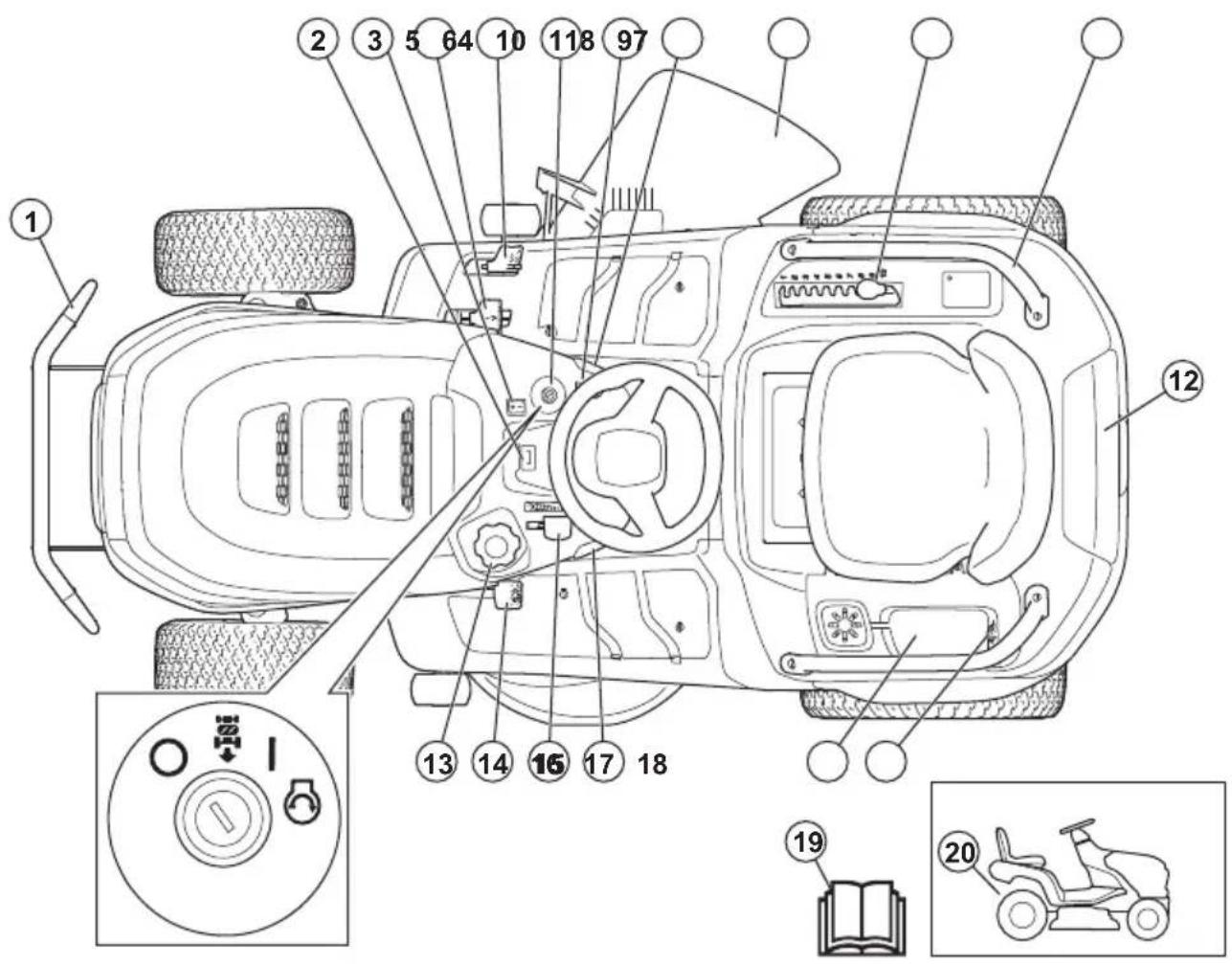
- Front bumper (accessory for TS 216Tm)
- Hour meter
- Light switch
- Forward pedal
- Rearward pedal
- Ignition lock
- PTO button
- Parking brake lock
- Deflector
- Cutting height lever
- Handles (accessory for TS 216Tm, TS 218T)
- Toolbox
- Fuel tank cap
- Parking brake pedal
- Throttle/Choke control: TS 216Tm, Throttle control: TS 218T, TS 220TD
- Cruise control (TS 220TD only)
- Storage compartment and battery cover
- Power outlet, 12 V
- Operator's manual
- Lever to engage or disengage the drive
Husqvarna Connect
The operators manual and more information about the product is available at Husqvarna Connect App. Husqvarna Connect is a free App for your mobile device. Refer to To start to use Husqvarna Connect on page 14.
Operator Presence Control (OPC)
The OPC engages when the operator lifts from the seat. The engine stops if the parking brake is not applied. The blades stop if the blades are engaged. Refer to Operation conditions on page 9.
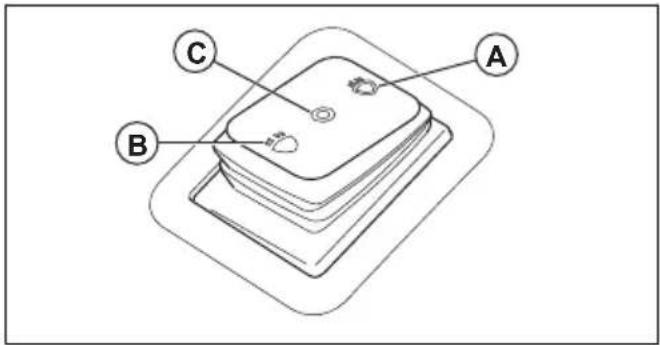
Headlight
The product has work light and high beam. Push the light switch to position (A) for high beam or position (B)
for work light. Push the light switch to position (C) to make the headlight go off.
Symbols on the product

WARNING: This product can be dangerous and cause serious injury or death to the operator or others. Be careful and use the product correctly.

Read the operator's manual carefully and make sure that you understand the instructions before you use this product.
Fast
Slow
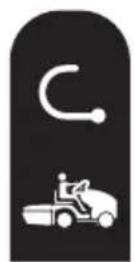
Engage the drive system.
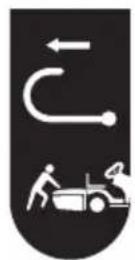
Disengage the drive system.

Engine off

Engine on
Engine start
Choke (TS 216Tm).


Parking brake pedal

Cutting height
Reverse operation system (ROS)
Reverse
Forward
Cruise control (TS 220TD)
High beam
Work light

Headlight off
Fuel

Max. ethanol 10%
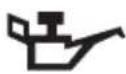
Engine oil

Use hearing protection.
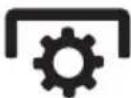
The blades are disengaged.

The blades are engaged.
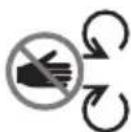
Keep body parts away from rotating parts.
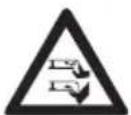
Keep body parts away from rotating blades.
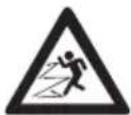
Look out for ejecting objects and ricochets.
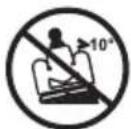
Do not cut grass across a slope. Do not cut grass on ground that slopes more than 10^ .
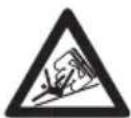
Tip-over hazard
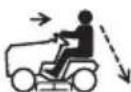
Look behind you before and while you move the product in reverse.
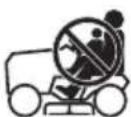
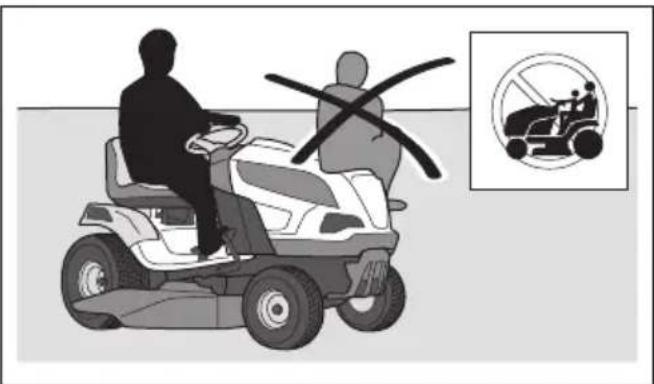
Never carry passengers on the product or equipment.
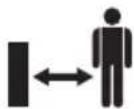
Keep bystanders away.

No step
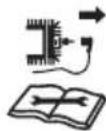
Disconnect the spark plug cap before you do maintenance on the product.
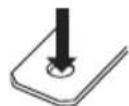
Max. permitted vertical load on the towbar is specified in Technical data on page 36 and on the label.
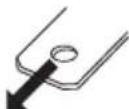
Max. permitted horizontal load on the towbar is specified in Technical data on page 36 and on the label.
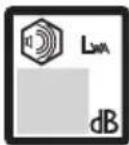
Noise emission to the environment label as per EU and UK directives and regulations, and New South Wales legislation "Protection of the Environment Operations (Noise Control) Regulation 2017". The guaranteed sound power level of the product is specified in Technical data on page 36 and on the label.

Scannable code

Apply and release the parking brake.
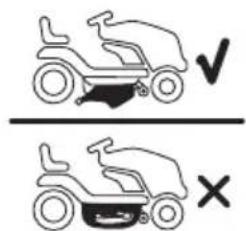
Make sure that the protective cover is attached before you operate the product. Do not operate the product without the protective covers.
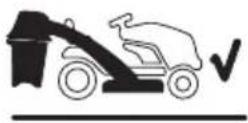
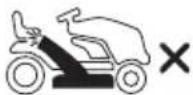
Make sure that the collector is attached when you use the side collection system. Do not operate the product without the collector when you use the side collection system.
Note: Other symbols/decals on the product refer to market specific legal requirements.
Label on the product
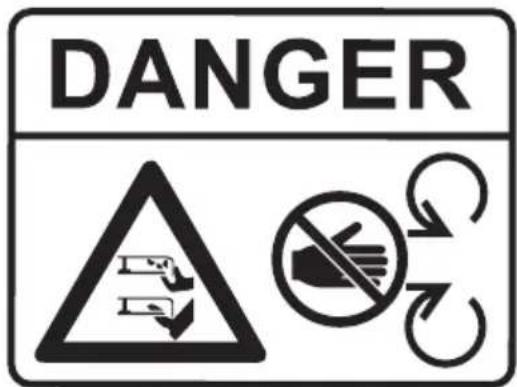
DANGER – Keep hands and feet away.
Hour meter
The hour meter shows how many hours the engine has been in operation. Refer to Product overview on page 3 for the position of the hour meter.
Product damage
We are not responsible for damages to our product if:
• the product is incorrectly repaired.
• the product is repaired with parts that are not from the manufacturer or not approved by the manufacturer.
• the product has an accessory that is not from the manufacturer or not approved by the manufacturer.
• the product is not repaired at an approved service center or by an approved authority.
Safety
Safety definitions
Warnings, cautions and notes are used to point out specially important parts of the manual.

WARNING: Used if there is a risk of injury or death for the operator or bystanders if the instructions in the manual are not obeyed.

CAUTION: Used if there is a risk of damage to the product, other materials or the adjacent area if the instructions in the manual are not obeyed.
Note: Used to give more information that is necessary in a given situation.
General safety instructions

WARNING: This product can cut off hands and feet and throw objects. Serious injury or death may occur if you do not obey the safety instructions.

WARNING: Do not continue to use a product with damaged cutting equipment. Damaged cutting equipment can throw objects and cause serious injury or death. Replace damaged blades immediately.

WARNING: This product produces an electromagnetic field during operation. This field may under some circumstances interfere with active or passive medical implants. To reduce the risk of serious or fatal injury we recommend persons with medical implants to consult their physician and the medical implant manufacturer before operating this product.

WARNING: Read the warning instructions that follow before you use the product.
- Only let operators who are responsible, has the correct training, knows the instructions, and are physically capable, to operate the product.
- Do not operate in reverse unless fully necessary. Always look down and behind you before and while
you move in reverse. Look out for large and small obstacles
• Always be careful and use your common sense. Avoid all situations which you consider to be beyond your capability. If you feel uncertainty about the operating procedures after you read the operator's manual, consult an expert before you continue.
- Read, understand and obey the operator's manual and the instructions on the product carefully before you start the product.
- Learn how to use the product and its controls safely and learn how to stop the product quickly.
- Learn to recognize the safety decals.
- Keep the product clean to make sure that you can clearly read signs and stickers.
- Clean fuel or oil spillage on the product before you operate the product and before you put the product in storage.
- Keep in mind that the operator will be held responsible for accidents that involve other persons or their property.
- Do not put hands or feet near parts that rotate.
- Do not put hands or feet below the product.
- Keep away from the discharge opening at all times.
- Make sure that discharged material does not hit other persons or animals.
- Make sure that discharged material does not hit walls or other hard surfaces. Discharged materials can ricochet.
• Always stop the blades when you operate the product on gravel surfaces.
- Do not operate the cutting deck if the grass catcher, discharge chute, or other safety devices are missing or defective.
• Always disengage the blades when you do not mow.
• Make sure that grass or other unwanted materials cannot touch hot exhaust or hot parts of the engine.
- Do not use the cutting deck to mow leaves or other unwanted materials that can cause buildup.
- Do not transport passengers. The product must only be used by one person.
natural_image
Illustration of a person on a steering wheel with a crosshair, accompanied by a prohibition sign (no text or symbols on the diagram itself)- Do not let the product stay unsupervised with the engine on. Always stop the blades, apply the parking brake, stop the engine and remove the ignition key before you let the product stay unsupervised.
- Only use the product in daylight or in other well-lit conditions. Keep the product at a safe distance from holes or other irregularities in the ground. Look out for other possible risks.
- Do not use the product in bad weather, for example in fog, in rain, moist or in wet locations, strong winds, intense cold, risk of lightning, etc.
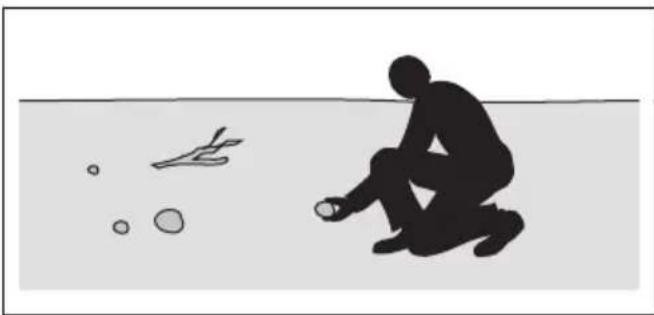
• Find and mark stones and other fixed objects to prevent collision. - Clear the area of objects such as stones, toys, wires, etc. that may become caught in the blades and be thrown out.
natural_image
Silhouette of a person crouching in water with bubbles and a small object nearby (no text or symbols)- Do not let children or other persons not approved for operation of the product to use or do servicing on it. Local laws may regulate the age of the user.
• Make sure that nobody else is in the vicinity of the product when you start the engine, engage the drive or start to move the product. Stop the product if anyone else enters the working area. - Keep an eye on the traffic when you mow near a road or move across a road.
- Do not use the product if you are fatigued, while under the influence of alcohol or drugs, medicine or anything that can have a negative effect on your vision, alertness, coordination or judgement.
- Be careful when you put the product on a trailer or a truck and when you remove the product from a trailer or truck.
• Always park the product on a level surface with the engine stopped. - Stop the engine and make sure that all parts have stopped before you clean or do maintenance on the product.
- Stop the engine and make sure that all parts have stopped before you remove the grass catcher or remove blockage in the discharge chute.
- Let the product become cool before you put it in storage.
Safety instructions regarding children

WARNING: Read the warning instructions that follow before you use the product.
- Serious accidents can occur if you are not on your guard for children in the vicinity of the product. Children can be attracted to the product and to
mowing. It is very possible that children do not stay where you last saw them.
- Keep children away from the area to be mowed. Make sure that an adult other than the operator is responsible for the children.
- Keep an eye out and stop the product if children enter the work area. Be very careful near corners, bushes, trees or other objects that prevents a clear view.
- Before and while you move the product in reverse, look behind you and look down to make sure there are no small children in the vicinity of the product.
- Do not let children ride along. They can fall off and get seriously injured or prevent safe maneuvering of the product.
- Do not let children operate the product.
- Never let children ride along, not even with blades shut off. They can fall off and get seriously injured or prevent safe maneuvering of the product. Children who have been given rides in the past may suddenly appear in the work operation area for another ride and be run over or backed over by the product.
Safety instructions for operation

WARNING: Do not touch the engine or exhaust system during or directly after operation. The engine and the exhaust system become very hot during operation. Risk of burn injuries, fire and damage to property or adjacent areas. When you operate the product, keep away from bushes and other objects.

WARNING: Read the warning instructions that follow before you use the product.
- Do not cut the grass when you move the product in reverse, unless it is fully necessary. Always look down and behind you before and while you move in reverse. Look out for large and small obstacles.
- Decrease the speed before you turn around a corner.
- Stop the blades when you move across areas that you do not cut.

CAUTION: Read the caution instructions that follow before you use the product.
- Before you operate the product, clear the cold air intake of the engine from grass and dirt. If the cold air intake is blocked, there is a risk of engine damage.
-
Move around stones and other larger objects carefully and make sure that the blades do not hit the objects.
-
Do not operate the product across objects. Stop and examine the product and cutting deck if you operate the product across or into an object. If it is necessary, make repairs before you restart.
- Only use the cruise control for forward travel on smooth, straight surfaces. (TS 220TD)
Personal protective equipment

WARNING: Read the warning instructions that follow before you use the product.
- Use approved personal protective equipment when you use the product. Personal protective equipment cannot fully prevent injury but it decreases the degree of injury if an accident does occur. Let your dealer help you select the right equipment.
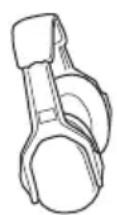
- Use approved hearing protection. Long-term exposure to noise can result in permanent hearing impairment.
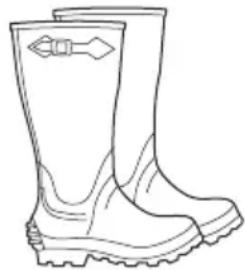
- Use heavy-duty slip-resistant boots or shoes. Steel toes are recommended. Do not use open shoes or go with bare feet.
natural_image
Line drawing of a pair of boots with visible tread pattern and buckles (no text or symbols)- Use protective gloves when necessary, for example when you attach, examine or clean the cutting equipment.
- Do not wear loose-fitting clothing, jewelry or other items that can get caught in moving parts.
- Keep first aid equipment and fire extinguisher near.
Safety devices on the product

WARNING: Read the warning instructions that follow before you use the product.
- Do not use a product with safety devices that are damaged or do not operate correctly. Do a check of the safety devices regularly. If the safety devices are damaged, speak to your Husqvarna servicing dealer.
- Do not make modifications on safety devices. Do not use the product if protective plates, protective covers, safety switches or other protective devices are not attached or are damaged.
To do a check of the ignition lock
- Start and stop the engine to do a check of the ignition lock. Refer to To start the engine (TS 218T, TS 220TD) on page 15 or To start the engine (TS 216Tm) on page 15 and To stop the product on page 18.
- Make sure that the engine starts when you turn the ignition key to the start position.

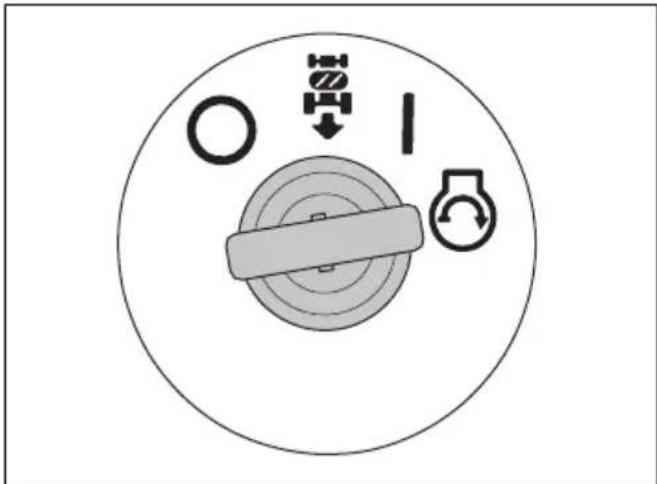
- Make sure that the engine stops immediately when you turn the ignition key to the stop position (O).
To do a check of the reverse operation system (ROS)
If the reverse operation system (ROS) does not operate correctly, speak to an Husqvarna servicing dealer.
- Start the product. Refer to To start the engine (TS 218T, TS 220TD) on page 15 or To start the engine (TS 216Tm) on page 15.
- Engage the cutting deck. Refer to To engage and disengage the cutting deck on page 17.
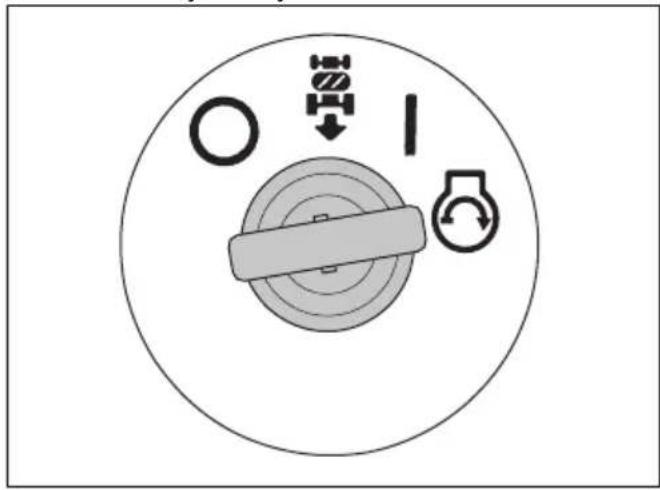
- With the ignition key in the on position (A), push down on the rearward pedal. The engine must stop when you push down on the rearward pedal.
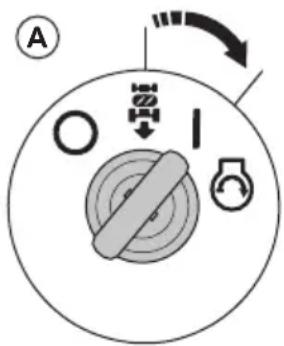
- Start the product and engage the cutting deck again.
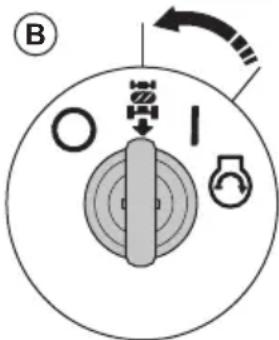
- Turn the ignition switch to the ROS on position (B).
- With the ignition key in the ROS on position, push down on the rearward pedal. The engine must not stop when you push down on the rearward pedal.
Operation conditions
These conditions are necessary to start the engine:
• The parking brake is applied.
• The drive of the blades is disengaged.
- The forward pedal and the rearward pedal are in their neutral position.
The engine must stop in these situations:
- The parking brake is not applied and the operator lifts from the seat.
- The cutting deck is engaged and the operator lifts from the seat.
- The cutting deck is engaged and the rearward pedal is pushed down but the ROS is disengaged.
The drive of the blades must stop in these situations:
• The operator lifts from the seat.
- The PTO button is pushed in.
Try to start the engine without one of the conditions. Change the conditions and try again. Do this check daily.
To do a check of the forward pedal and rearward pedal
- Start the product. Refer to To start the engine (TS 218T, TS 220TD) on page 15 or To start the engine (TS 216Tm) on page 15.
- Make sure that the forward pedal and rearward pedal are not blocked and can be operated freely.
- Slowly push the forward pedal to move forward.
- Release the forward pedal to brake. Make sure that the brake engages when the forward pedal is released.
Note: The product has an automatic brake that engages when you release the pedals.
- Do the same procedure for the rearward pedal.
- Make sure that the product does not move when the pedals are in their neutral position.
Parking brake

WARNING: If the parking brake does not work, the product can start to move and cause injury or damage. Make sure that the parking brake is regularly examined and adjusted.
Refer to To do a check of the parking brake on page 22.
Muffler
The muffler keeps the noise levels to a minimum and sends the exhaust fumes away from the operator.
Do not use the product if the muffler is missing or damaged. A damaged muffler increases the noise level and the risk of fire.

WARNING: The muffler becomes very hot during and after use and when the engine operates at idle speed. Be careful near flammable materials and/or fumes to prevent fire.
To do a check of the muffler
- Examine the muffler regularly to make sure that it is attached correctly and not damaged.
Protective covers
Missing or damaged protective covers increase the risk of injury on moving parts and hot surfaces. Do a check of the protective covers before you operate the product. Make sure that the protective covers are correctly attached and do not have cracks or other damages. Replace damaged covers.
To cut grass on slopes

WARNING: Read the warning instructions that follow before you use the product.
• To cut grass on slopes increases the risk that you can not control the product and that it overturns. This can cause injury or death. It is necessary to cut the grass carefully on all slopes. If you cannot reverse up a slope or if you do not feel safe, do not cut it.
- Remove stones, branches and other obstacles.
- Cut up and down the slope, not from side to side.
- Do not operate the product on ground that slopes more than 10^ .
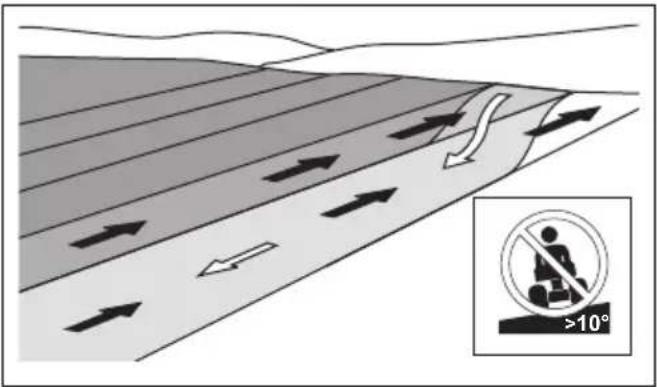
- Do not start or stop on a slope.
- Move smoothly and slowly on slopes.
- Do not make sudden changes in speed or direction.
- Do not turn more than necessary. Turn slowly and gradually when you move down a slope. Move at low speed. Turn the wheel carefully.
- Look out for and do not move across furrows, holes and bumps. There is a higher risk that the product overturns on ground that is not flat. Long grass can hide obstacles.
- Do not cut grass near edges, ditches or banks. The product can suddenly overturn if a wheel moves
across the edge of a steep slope or a ditch, or if an edge gives way. If the product falls into water, there is a risk of drowning.
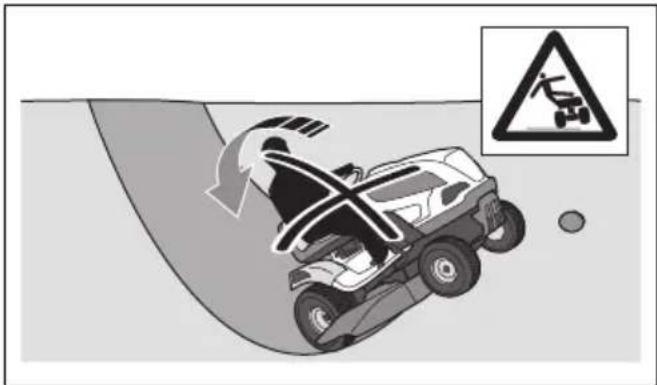
- Keep the product in gear when you go down a slope. Do not coast downhill.
- Do not operate the product under any condition where traction, steering, or stability is challenged. Tires can lose their grip even if the wheels are stopped.
- Do not cut wet grass. It is slippery, and tires can lose their grip so that the product skids.
- Do not put your foot on the ground to try to make the product more stable.
- Move very carefully if an accessory or other object is attached that can make the product less stable.
- Follow the manufacturer's recommendations for wheel weights or counterweights.
Tow safety
- Only use tow equipment approved by Husqvarna.
- Use the tow bar to attach the equipment.
- Do not tow equipment that is heavier than the maximum permitted tow equipment weight. Refer to Technical data on page 36.
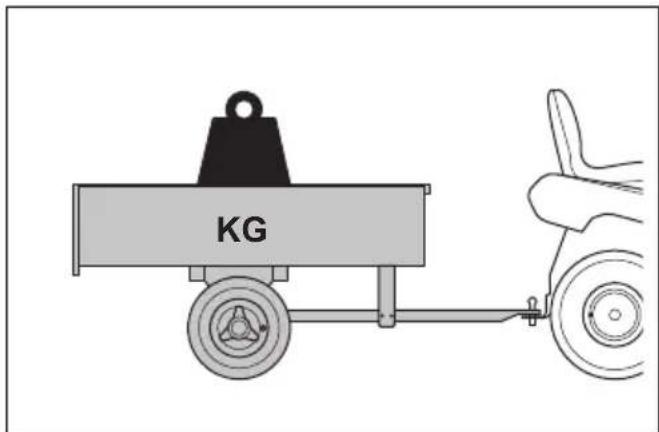
• Make sure that no other persons are near the product when you tow equipment.
- Be careful when you tow equipment on slopes or rough ground.
- Operate the product at low speed when you tow equipment.
Fuel safety

WARNING: Be careful with fuel. It is very flammable, and can cause injury and damage to property.

WARNING: Read the warning instructions that follow before you use the product.
- Extinguish all cigarettes, cigars, pipes and other sources of ignition.
- Do not fill the fuel tank indoors or in closed spaces.
- Gasoline and gasoline fumes are poisonous and very flammable. Be careful with gasoline to prevent injury or fire.
- Do not remove the fuel tank cap or fill the fuel tank when the engine is on or if it is hot.
- Let the engine become cool before you refuel.
- Do not smoke when you fill fuel.
- Do not put hot objects near the fuel or the engine.
- Do not fill fuel near sparks or naked flames.
- If there are leaks in the fuel system, do not start the engine until the leaks are repaired.
- Do not fill above recommended fuel level. The heat from the engine and the sun makes the fuel expand and the fuel overflows if the tank is filled too much.
- Do not fill too much. If you spill fuel on the product, clean up the spill and wait until it is dry before you start the engine. If you spill on your clothing, change it.
- Store fuel in approved containers only.
- Store the product and fuel in such a way that there is no risk that fuel leaks or fumes can cause damage.
- Drain off the fuel in an approved container outdoors and away from naked flames.
Transport safety
- Use an approved transport vehicle for transportation of the product.
- The product is heavy and can cause crush injuries. Be careful when you load it onto or off a vehicle or trailer.
- A markets national or local regulations can set limit to the transportation of the product.
- The operator of the transport vehicle is responsible to attach the product safely during transport. Refer to To safely attach the product for transportation on page 34.
Battery safety

WARNING: A damaged battery can cause an explosion and cause injury. If the battery has a deformation or is damaged, speak to an Husqvarna servicing dealer.

WARNING: Read the warning instructions that follow before you use the product.
- Use protective glasses when you are near batteries.
- Do not wear watches, jewelry or other metal objects near the battery.
- Keep the battery out of reach for children.
- Charge the battery in a space with good airflow.
- Keep flammable materials at a minimum clearance of 1 m when you charge the battery.
- Discard replaced batteries. Refer to Disposal on page 35.
- Explosive gases can come from the battery. Do not smoke near the battery. Keep the battery away from open flames and sparks.
Safety instructions for maintenance

WARNING: The product is heavy and can cause injury or damage to property or the adjacent area. Do not do maintenance on the engine or the cutting deck without these conditions:
- The engine is off.
- The product is parked on a level surface.
• The parking brake is applied.
• The ignition key is removed.
• The cutting deck is disengaged. - The ignition cables are removed from the plugs.
- The negative battery cable is removed.

WARNING: The exhaust fumes from the engine contain carbon monoxide, an odourless, poisonous and very dangerous gas. Do not run the product in closed spaces or spaces with not sufficient air flow.

WARNING: Read the warning instructions that follow before you use the product.
- For best performance and safety, do maintenance on the product regularly as given in the maintenance schedule. Refer to Maintenance schedule on page 19.
- Electrical shocks can cause injuries. Do not touch the cables when the engine is on. Do not do a function test on the ignition system with your fingers.
- Do not start the engine if the protective covers are removed. There is a high risk of injury caused by moving or hot parts.
-
Let the product become cool before you do maintenance near the engine.
-
The blades are sharp and can cause cuts. Wind protection around the blades or use protective gloves when you do work on the blades.
- Do not park the product near the edge of a ditch or slope to get access to the cutting deck.

CAUTION: Read the caution instructions that follow before you use the product.
- Do not turn over the engine if the spark plug or ignition cable is removed.
• Make sure that all nuts and bolts are tightened correctly and that the equipment is in good condition. - Do not change the adjustment of governors. If the engine speed is too high, the product components can become damaged. Refer to Technical data on page 36 for highest permitted engine speed.
• The product is approved only with the equipment supplied or recommended by the manufacturer.
Assembly
Introduction

WARNING: Read and understand the safety chapter before you assemble the product.
Assembly overview
natural_image
Illustration of four mechanical fasteners (no text or symbols)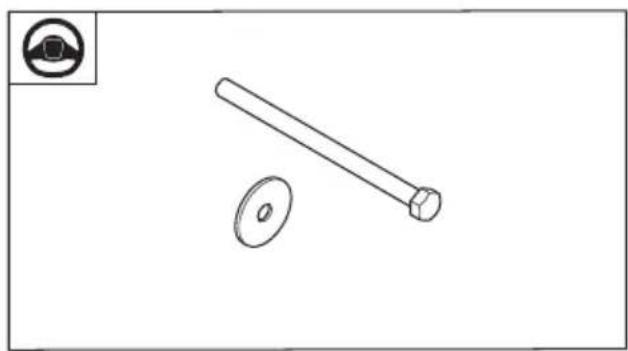
natural_image
Technical line drawing of a mechanical component including a cylindrical rod and a flanged circular part (no text or symbols)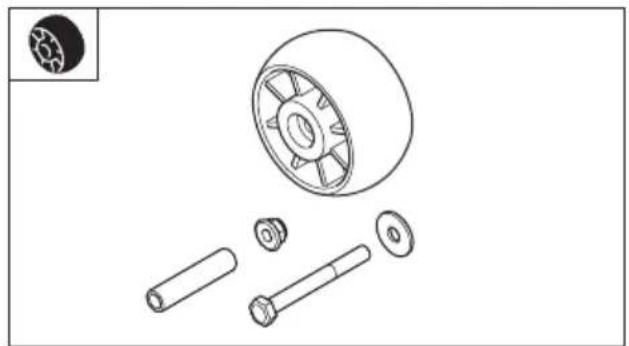
natural_image
Technical line drawing of a mechanical component with exploded view, including a wheel, bolt, and nut assembly (no text or labels)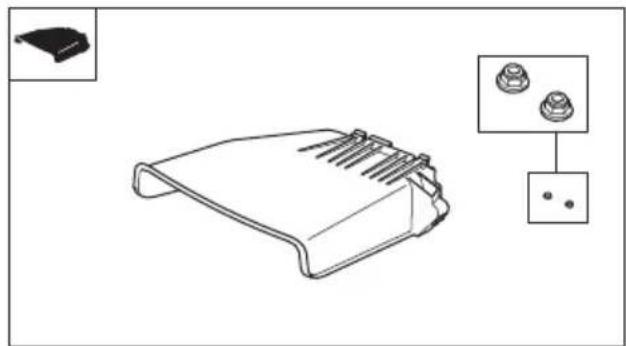
natural_image
Technical line drawing of a mechanical component with mounting holes and a separate inset showing a small component (no text or symbols)To install the side discharge chute
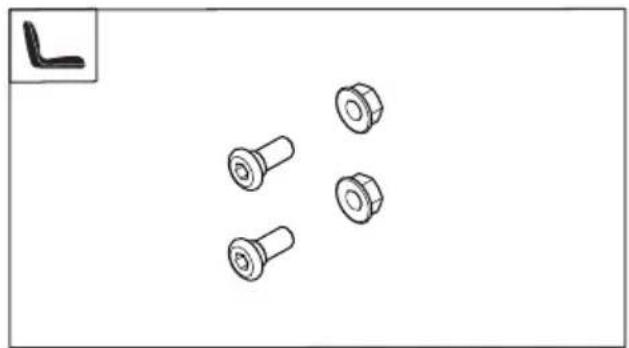
Refer to Assembly overview on page 12 for the correct fasteners for this task.
- Pull and hold the latch (A) to the side and put the bracket of the side discharge chute (B) on the 2 bolts (C).
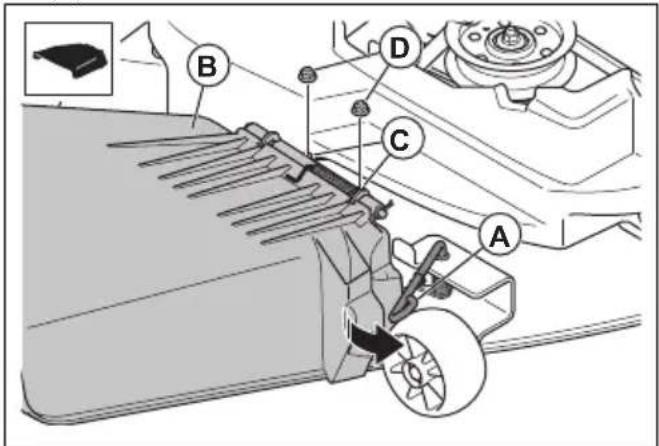
- Release the latch.
- Install the 2 nuts (D).
To connect the battery

WARNING: Risk of electric shock. Make sure that the ignition switch is in the off position and that the ignition key is removed.
The location of the battery is above the left rear wheel.
- Fold the seat forward.
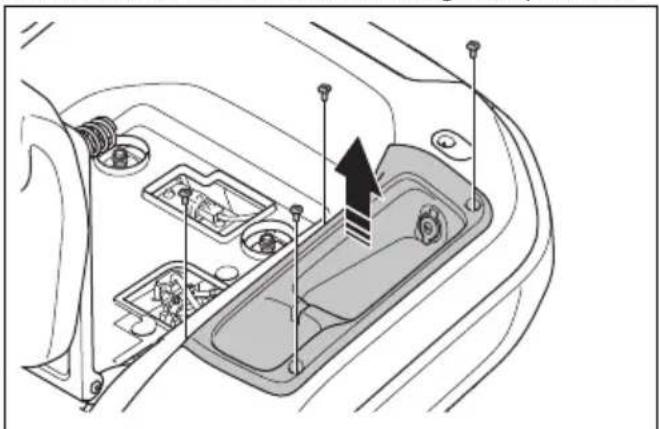
- Remove the 4 screws and the storage compartment.
natural_image
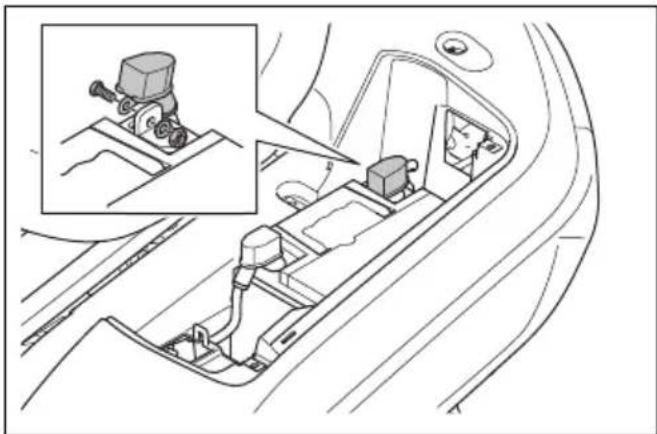
Diagram of a car intake tray with directional arrows indicating movement or flow (no text or symbols present)- Make sure that the red battery cable is installed to the positive (+) terminal on the battery.
-
Remove the screw and the nut on the negative (-) terminal on the battery.
-
Attach the black battery cable to the negative (-) terminal on the battery and install the nut and the screw.
natural_image
Line drawing of a car interior showing steering wheel, dashboard, and seatbelt mechanism (no text or symbols)- Attach the terminal cover.
- Install the storage compartment and the 4 screws.
To remove and install the handles (TS 220TD)
Note: Handles are an accessory for the TS 216Tm, TS 218T model.
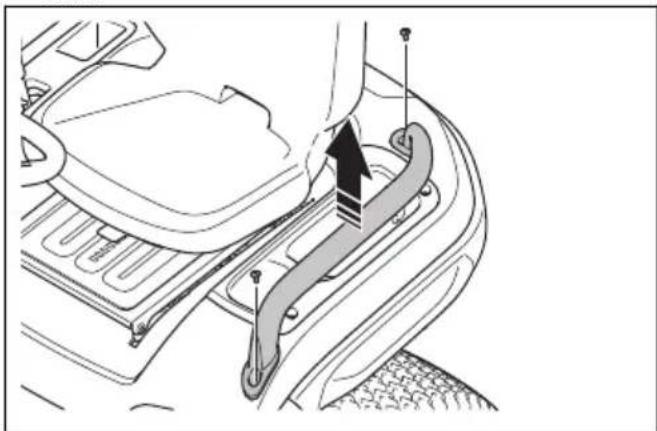
- Remove the 2 screws and the handle on the left side.
natural_image
Diagram of a car gear shift mechanism showing the lever and keyway (no text or labels)- Remove the 2 screws and the handle on the right side.
- Install the handles in the opposite sequence.
To install the anti-scalp wheels
Refer to Assembly overview on page 12 for the correct fasteners for this task.
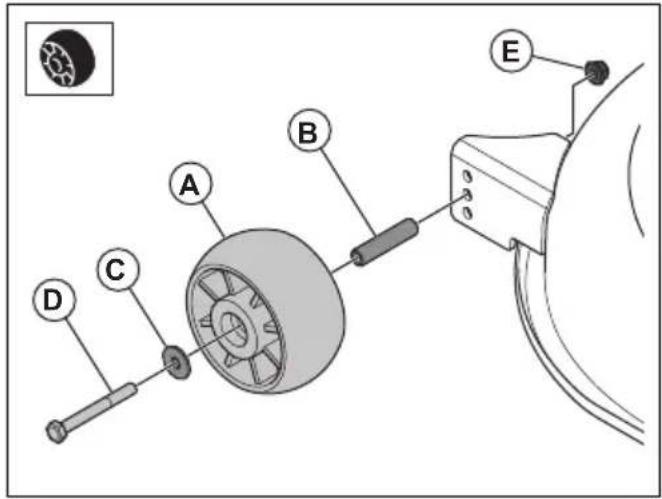
• Install the anti-scalp wheel (A), the bushing (B), the washer (C), the bolt (D), and the nut (E) in 1 of the 3 holes.
Operation
Introduction

WARNING: Read and understand the safety chapter before you use the product.
To start to use Husqvarna Connect
- Download the Husqvarna Connect app on your mobile device.
- Register in the Husqvarna Connect app.
- Do the instruction steps in the Husqvarna Connect app to connect and register the product.
To fill fuel

WARNING: Gasoline is very flammable. Be careful and refuel outdoors, refer to Fuel safety on page 11.

WARNING: Do not use the fuel tank as a support area.

CAUTION: Incorrect type of fuel can result in engine damage.
The engine runs on gasoline with a minimum octane rating of 91 RON (87 AKI), not mixed with oil. We recommend biodegradable alkylate gasoline. Do not use gasoline that contains more than 10% ethanol.
- Do a check of the fuel level before each use and refuel if it is necessary.
- Do not fully fill the fuel tank. Keep a space of a minimum 2.5 cm.
To adjust the seat

WARNING: Do not adjust the seat during operation of the product.
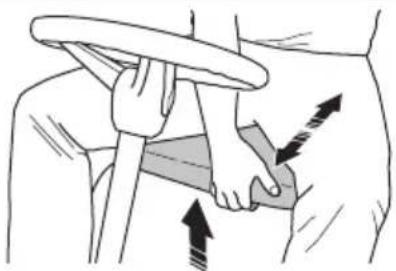
- To adjust the seat forward and rearward, put your feet on the footrest plates.
- Push the lever below the front edge of the seat up and move the seat to the correct position.
natural_image
Illustration of a person performing a knee joint exercise with directional arrows indicating movement (no text or symbols)To do before you start the product

WARNING: Before you operate the product, carefully read and understand the safety instructions and the operation instructions.
- Do a check of the engine oil level. Refer to To do a check of the engine oil level on page 24.
-
Fill the fuel tank with fuel. Refer to To fill fuel on page 14.
-
Make sure that the fuel shut-off valve is open. The fuel shut-off valve is open when the tab is in the direction of the fuel hose.

natural_image
Line drawing of a car's front dashboard and steering wheel, showing structural components and a close-up of the steering wheel (no text or symbols present)- Make sure that the drive system is engaged. Refer to To engage and disengage the drive system on page 16.
- Put the cutting deck in the highest position. Refer to To set the cutting height on page 17.
To start the engine (TS 218T, TS 220TD)
- Make sure that the cutting deck is disengaged. Refer to To engage and disengage the cutting deck on page 17.
- Sit in the seat in work position.
- Apply the parking brake. Refer to To apply and release the parking brake on page 16
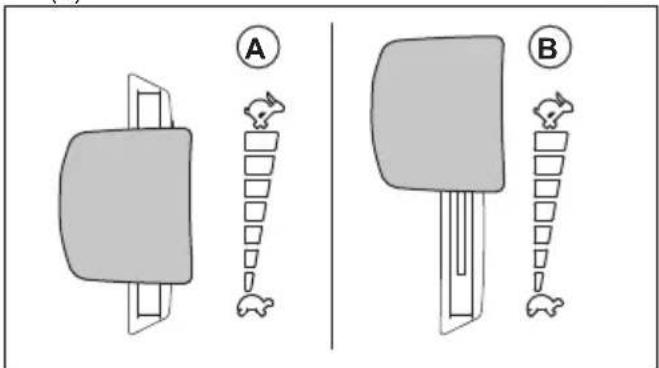
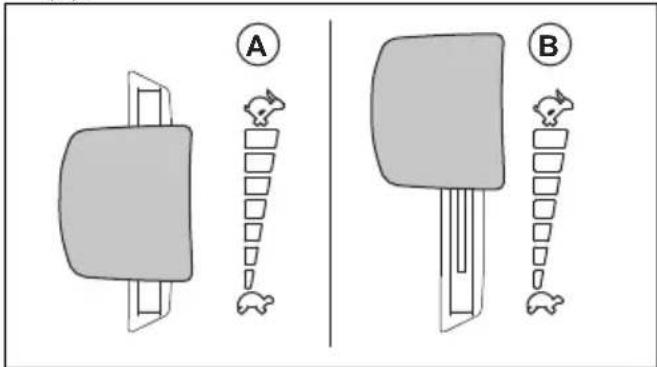
- Push the throttle control to the half throttle position (A).
- Turn the ignition key to the start position. When the engine starts, immediately release the ignition key. The ignition key goes back to the ON (I) position automatically when you release it.

CAUTION: Do not operate the starter for more than 5 seconds at a time. If the engine does not start, wait 15 seconds before you try again.
- Let the engine operate at half throttle for 3–5 minutes before you apply heavy load.
- Push the throttle control to the full throttle position (B).

CAUTION: To engage the cutting deck when the engine is at full speed causes strain on the drive belts. Engage the cutting deck before you put the throttle control in the full throttle position.
To start the engine (TS 216Tm)
- Make sure that the cutting deck is disengaged. Refer to To engage and disengage the cutting deck on page 17.
- Sit in the seat in work position.
-
Apply the parking brake. Refer to To apply and release the parking brake on page 16.
-
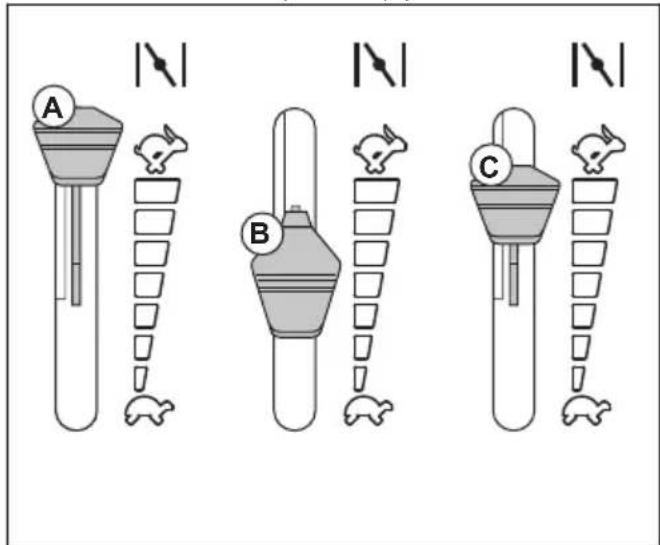
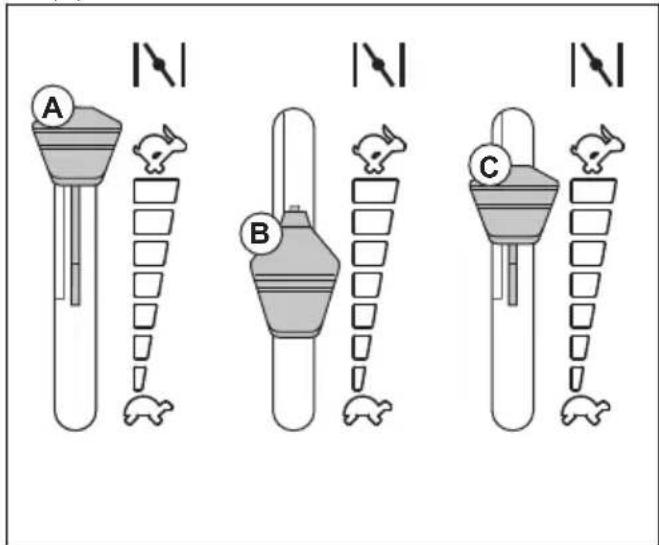
If the engine is cold, push and hold the throttle control to the choke position (A).
- Turn the ignition key to the start position. When the engine starts, immediately release the ignition key. The ignition key goes back to the ON (I) position automatically when you release it.

CAUTION: Do not operate the starter for more than 5 seconds at a time. If the engine does not start, wait 15 seconds before you try again.
-
Release the throttle control from the choke position and move the throttle control to half throttle position (B).
-
Push the throttle control to the full throttle position (C).

CAUTION: To engage the cutting deck when the engine is at full speed causes strain on the drive belts. Engage the cutting deck before you put the throttle control in the full throttle position.
To engage and disengage the drive system
To move the product with the engine off, the drive system must be disengaged.

CAUTION: Make sure that you fully pull out or push in the lever. Do not use middle positions.
The lever to engage or disengage the drive system is found behind the right rear wheel.

- Push the lever in fully to engage the drive system. - Pull the lever out fully to disengage the drive system.
To apply and release the parking brake
• To apply the parking brake, do the steps that follow.
a) Push down the parking brake pedal (A) fully and pull up the parking brake lock (B).
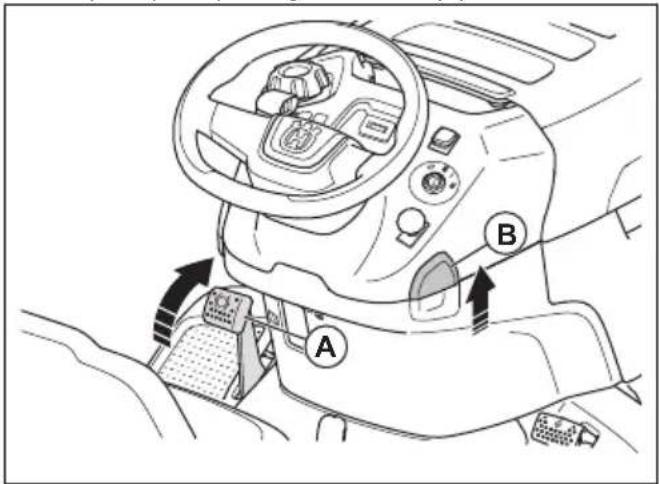
b) Release the parking brake pedal.
• To release the parking brake, push down on the parking brake pedal and release it.
To engage and disengage the cutting deck

WARNING: Do not operate the cutting deck without a deflector installed to the grass discharge.
- Pull out the PTO button to engage the cutting deck.
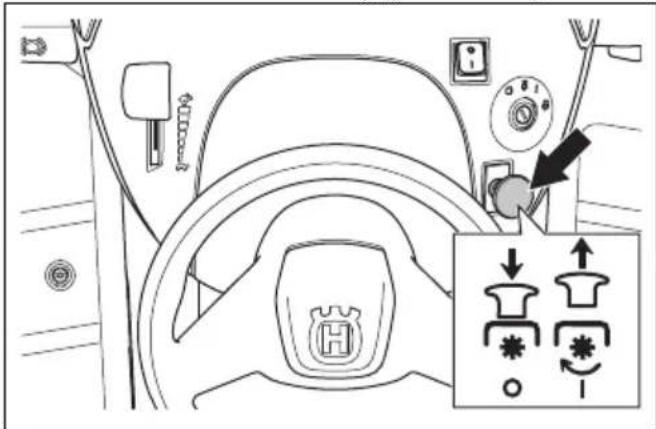
- Push in the PTO button to disengage the cutting deck.
To set the cutting height
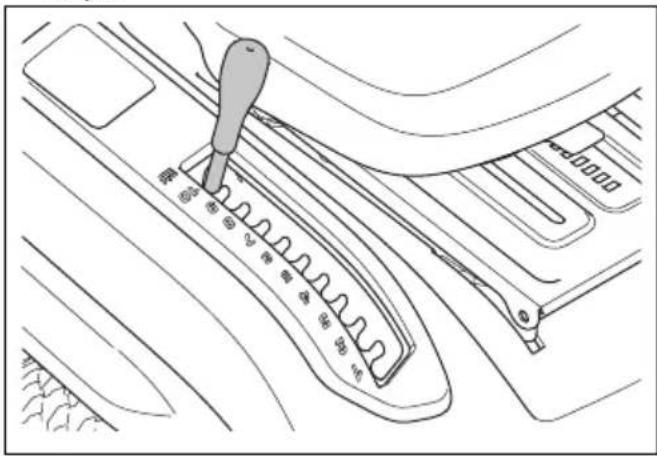
- Pull the cutting height lever in the direction of the seat and put it in 1 of the notches to set the cutting height.
natural_image
Line drawing of a car gear shift lever mechanism (no text or symbols)To operate the product
- Start the engine. Refer to To start the engine (TS 218T, TS 220TD) on page 15 or To start the engine (TS 216Tm) on page 15.
- Release the parking brake. Refer to To apply and release the parking brake on page 16.
- Carefully push the forward pedal (A) or the rearward pedal (B). The speed increases the more the pedal is pushed down.
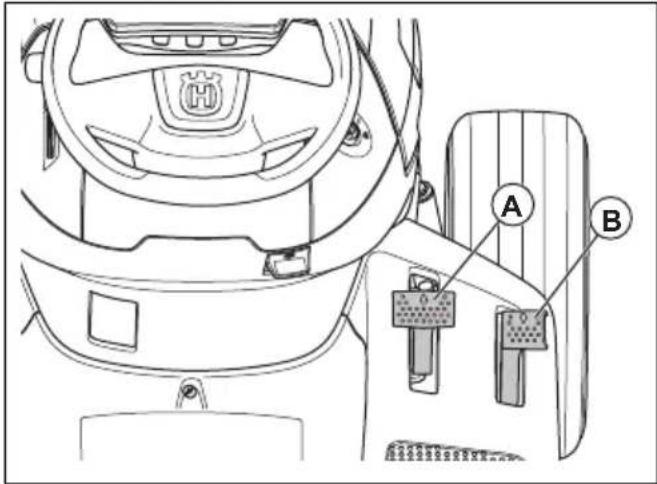
Note: The forward pedal and the rearward pedal go back to their neutral position when they are released.
- Release the pedals to brake.
- Select the correct cutting height. Refer to To set the cutting height on page 17.
- Engage the cutting deck. Refer to To engage and disengage the cutting deck on page 17.
To use the cruise control (TS 220TD)
Only use the cruise control for forward travel on smooth, straight surfaces.
- Push the forward drive pedal (A) down. Keep the forward drive pedal in a position that gives the correct speed for the terrain.
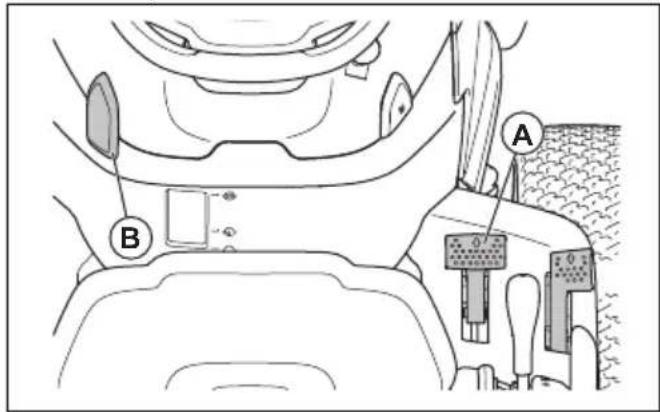
- Pull the cruise control lock (B) up and hold it while you release the forward drive pedal.
- Release the cruise control lock to engage the cruise control.
- Push the forward drive pedal to disengage the cruise control.
To use the reverse operation system (ROS)
Note: If you try to go rearward with the product when the cutting deck is engaged, the engine stops immediately. Engage the ROS to go rearward with the product when the cutting deck is engaged.

WARNING: Before and while you operate the product rearward, look down and behind the product for the safety of others.
- Turn the ignition key counterclockwise to the ROS position to engage the ROS.
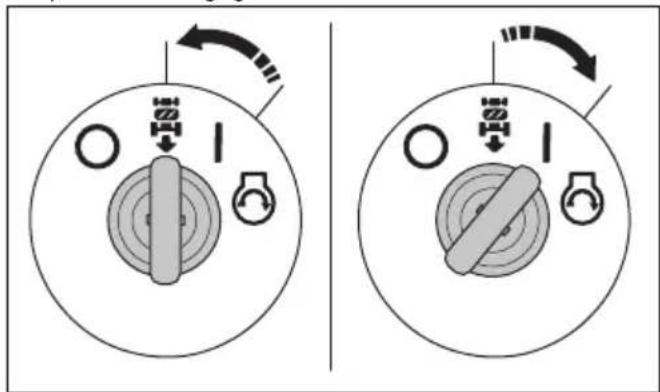
- Slowly push down the rearward pedal to start movement.
- Turn the ignition key clockwise to the engine ON (I) position to disengage the ROS.
To stop the product
- Disengage the cutting deck. Refer to To engage and disengage the cutting deck on page 17.
- Turn the ignition key to the OFF (O) position.
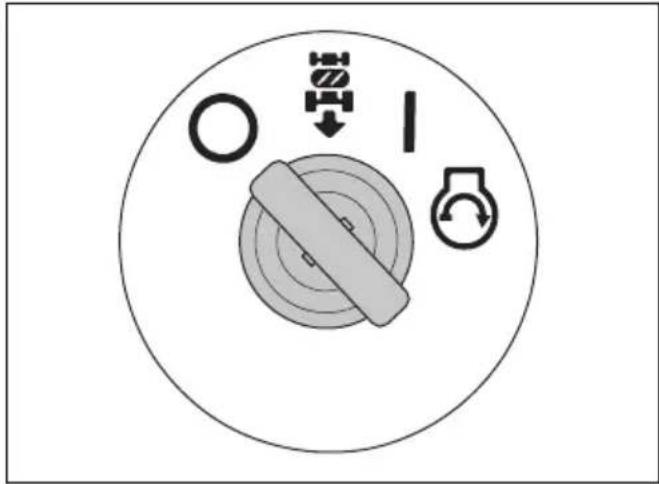
- When the product is stationary and the engine is off, apply the parking brake. Refer to To apply and release the parking brake on page 16
To get a good cutting result
- For best performance, do maintenance on the product regularly as given in the maintenance schedule. Refer to Maintenance schedule on page 19.
- Do not cut a wet lawn. Wet grass can give a bad cutting result.
- Do not use tire chains when you operate the product with a cutting deck.
- Make sure that the cutting deck is level. Refer to To adjust the parallelism of the cutting deck on page 28.
- If the grass is high, start with a high cutting height and decrease it gradually.
- Move the product forward at low speed if the grass is high and thick.
- Use full throttle when you cut the grass.
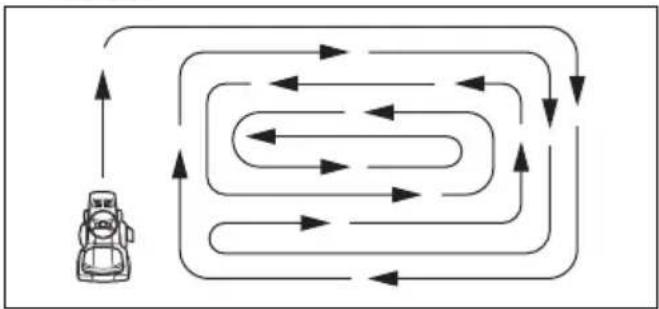
- Cut the grass in an irregular pattern.
- Use the left side of the cutting deck when you cut near trees, bushes or paths. The blade cuts approximately 15 mm in from the side of the cutting deck.
- When you cut large areas, move the product to the right during 1 or 2 turns around the work area. This procedure will keep the grass discharge away from shrubs, fences and driveways. After approximately 2 turns around the work area, cut in the opposite direction.
• To get the best cutting result, cut the grass frequently.
WARNING: Before you do any maintenance work you must read and understand the safety chapter.
Maintenance schedule
| Maintenance schedule Before each use/ | weekly | Every 50 h or an-nually | |
| General Clean the battery and the terminals. X | |||
| Do a check of the battery level. Charge the battery if it is necessary. | |||
| Examine all belts and pulleys for wear and damage. Replace worn or damaged parts. | |||
| Clean the engine and the transmission. X X | |||
| Examine all wires for damage. X | |||
| Lubricate the product. Refer to the lubrication over-view. | |||
| Make sure that all fasteners are tightened correctly. X | |||
| Make sure that the tire pressure is correct in all tires. | X | ||
| Engine Examine the | fuel hose for wear and damage. Re- place the fuel hose if it is necessary. | X | |
| Replace the fuel filter. X | |||
| Clean the air filter. X | |||
| Replace the air filter. X | |||
| Examine the muffler and the heat deflector. X X | |||
| Do a check of the engine oil level. Fill with engine oil if it is necessary. | X | ||
| Replace the engine oil. X | |||
| Replace the engine oil filter. X | |||
| Replace the spark plug. X | |||
| Do a check of the engine speed. Adjust the engine speed if it is necessary. | X | ||
| Transmission, con- trols and drive sys- tem | Examine the transmission cooling fan. X X | ||
| Remove the wheels and lubricate the axles. X | |||
| Make sure that the product does not move when the pedals are in the neutral position. | X | ||
| Do a check of the forward and rearward drive at different speeds. | X | ||
| Do a check of the switch for the blade engagement control. | X | ||
| Do a check of the switch for the cutting height lever. X | |||
| Do a check of the switches for the forward pedal and rearward pedal. | X | ||
| Do a check of the parking brake. X | |||
| Do a check of the operator presence control (OPC). X | |||
| Cutting equipment C | lean the cutting deck, below the belt covers and below the cutting deck. | X | |
| Do a check of the parallelism of the cutting deck. Adjust the cutting deck if it is necessary. | X | ||
| Examine the cutting deck belt for wear and dam- age. | X | ||
| Examine the blades for wear and damage. Sharpen or replace the blades if it is necessary. | X | ||
| Do a check of the blade brakes (if equipped). | X | ||
| Grass catcher (TC models only) | Examine the grass catcher and the switches for the grass catcher. | X | |
Lubrication schedule
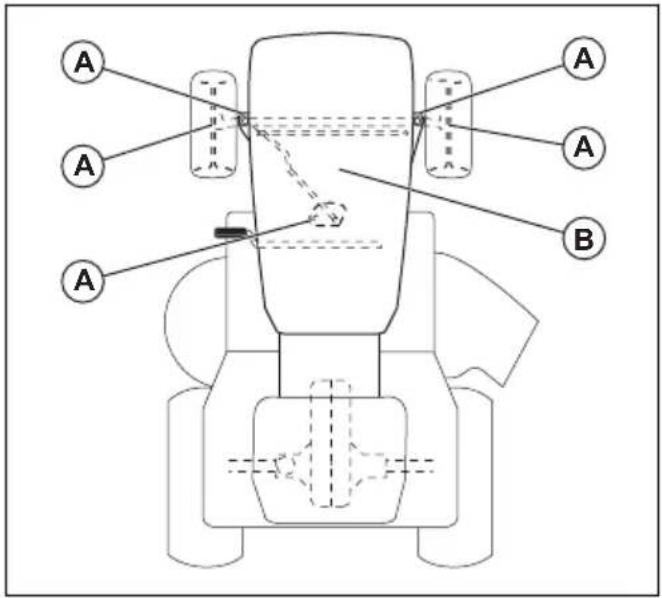
A. General lubrication. Lubricate the spindle grease connection and the gear teeth of the sector gear and the steering column.
B. Engine lubrication. Refer to To do a check of the engine oil level on page 24.
To clean the product

CAUTION: Do not use a high-pressure washer or a steam cleaner. Water can go into bearings and electrical connections and cause corrosion which causes damage to the product.
Clean the product immediately after use.
- Do not clean hot surfaces such as the engine, muffler and exhaust system. Wait until the surfaces are cool, then remove the grass or dirt.
- Before you clean with water, clean with a brush. Remove grass cuttings and dirt on and around the transmission, the transmission air intake, and the engine.
- Clean the top of cutting deck, below the belt covers and below the cutting deck. To clean the cutting deck, refer to To clean the cutting deck on page 21.
- Use running water from a hose to clean the product. Do not use high pressure.
- Do not point the water at electrical components or bearings. Detergent usually increases the damage.
- When the product is clean, start the cutting deck for a short period to blow off remaining water.
To clean the engine and the muffler
Keep the engine and muffler free from grass cuttings and dirt. Grass cuttings soaked in fuel or oil on the engine can increase the fire risk and the risk that the engine becomes too hot. Let the engine cool before it is cleaned. Clean with water and a brush.
Grass cuttings around the muffler dry quickly and are a fire risk. Use a brush or remove the grass cuttings with water when the muffler is cold.
To clean the cutting deck

WARNING: Do not use the product with a broken or missing deck washout port. There is a risk of thrown objects. Replace a broken or missing deck washout port immediately.
- Park the product in a clear area on your lawn that is near a water source with a garden hose.

CAUTION: Do not point the discharge chute of the product in the direction of buildings or vehicles.
-
Make sure that the cutting deck is disengaged. Refer to To engage and disengage the cutting deck on page 17.
-
Stop the engine. Refer to To stop the product on page 18.
-
Apply the parking brake. Refer to To apply and release the parking brake on page 16.
-
Connect a garden hose (A) to the deck washout port (B) and start the water supply.
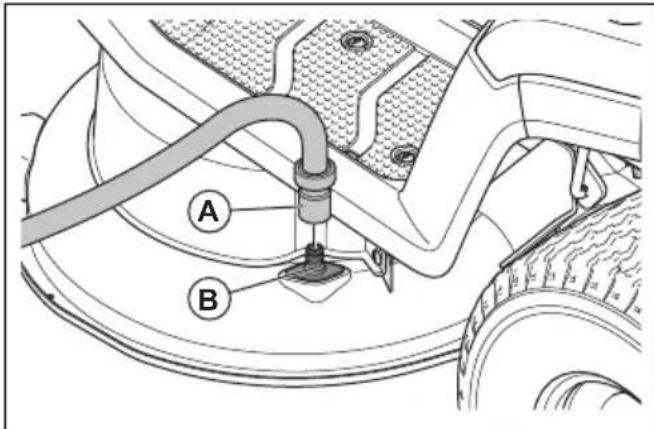
- Sit in the seat and start the engine. Refer to To start the engine (TS 218T, TS 220TD) on page 15 or To start the engine (TS 216Tm) on page 15.

CAUTION: Examine the area again to make sure that the area is clear before you start the engine.
-
Engage the cutting deck and let it operate at full throttle until the cutting deck is clean. Refer to To engage and disengage the cutting deck on page 17.
-
Disengage the cutting deck and stop the engine Refer to To engage and disengage the cutting deck on page 17 and To stop the product on page 18.
-
Stop the water supply and disconnect the garden hose from the deck washout port.
-
Move the product to a dry area.
-
Sit in the seat and start the engine. Refer to To start the engine (TS 216Tm) on page 15 or To start the engine (TS 216Tm) on page 15.
- Engage the cutting deck and let it operate until the cutting deck is dry.
To clean the air intake of the engine

WARNING: Stop the engine. The air intake has rotating parts which can cause injury to your fingers.
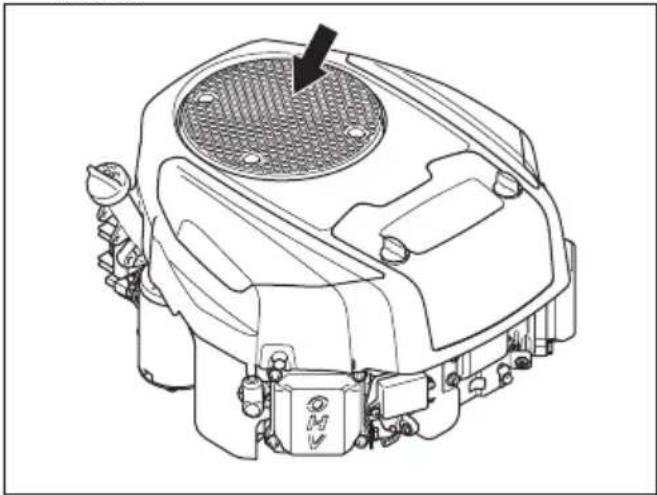
Note: The illustration shows one type of engine. The engine in your product can be different, but the procedure is the same.
- Open the engine cover.
- Make sure that the air intake on the engine is not blocked.
natural_image
Technical line drawing of a mechanical component with a circular top and internal structure, no visible text or symbols- Remove grass and dirt with a brush.
To remove and install the engine cover
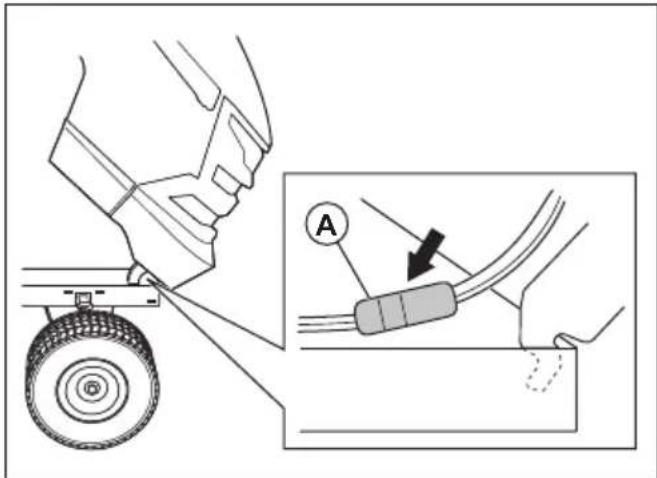
- Open the engine cover.
- Disconnect the headlight wire connector (A).
-
Tilt the engine cover forward and lift it to remove it from the product.
-
Install the engine cover in the opposite sequence.
To do a check of the parking brake
- Park the product on a hard surface that slopes.
Note: Do not park the product on a grass slope when you do a check of the parking brake.
- Apply the parking brake. Refer to To apply and release the parking brake on page 16.
- If the product starts to move, let an Husqvarna servicing dealer adjust the parking brake.
- Push the parking brake pedal again to release the parking brake.
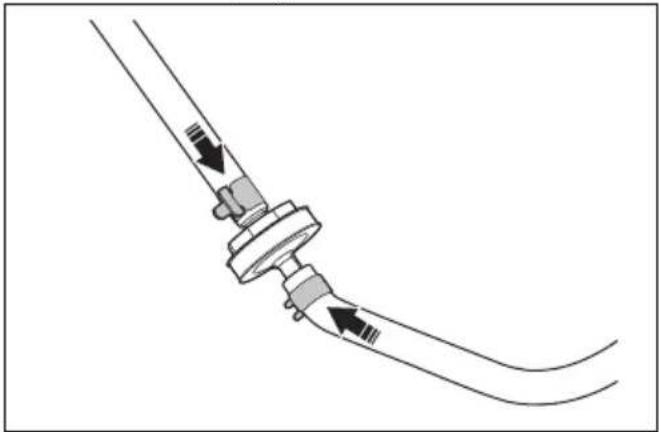
To replace the fuel filter
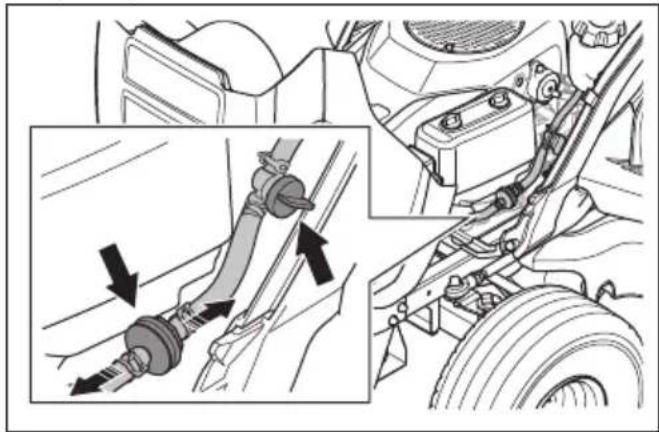
Note: The illustration shows one type of fuel filter. The fuel filter on your product can be different, but the procedure is the same.
- Open the engine cover to get access to the fuel filter.
- Close the fuel shut-off valve.
- Compress the fuel tank hose to prevent leakage.
- Move the hose clips away from the fuel filter with a pair of flat pliers.
- Pull the fuel filter from the hose ends. A small quantity of fuel can leak.
natural_image
Mechanical assembly diagram showing a shaft and gear assembly with directional arrows (no text or labels)-
Push the new fuel filter into the hose ends. Apply liquid detergent to the ends of the fuel filter to make the connection easier.
-
Push the hose clips against the fuel filter.
natural_image
Pure mechanical diagram showing a lever and connecting rod (no text or symbols)To clean and replace the air filter
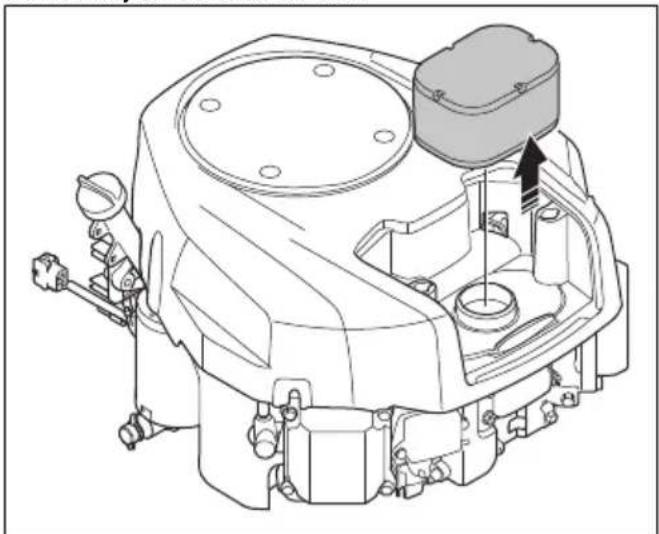
Note: The illustration shows one type of air filter. The air filter on your product can be different, but the procedure is the same.
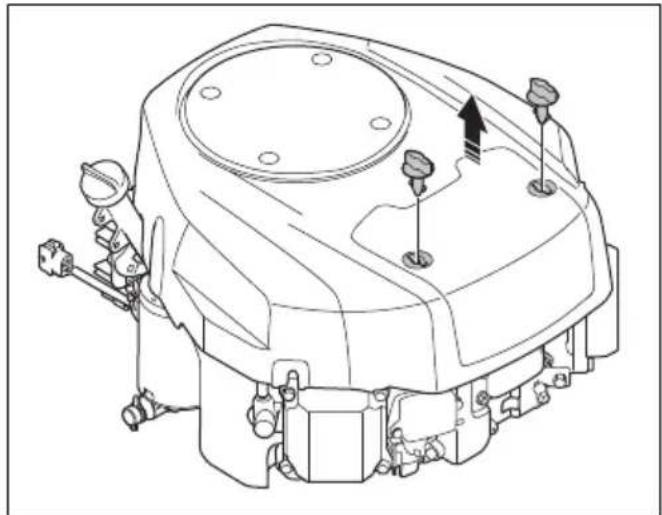
-
Turn the 2 knobs 14 turn counterclockwise.
-
Remove the air filter cover.
natural_image
Technical line drawing of a mechanical component with no visible text or symbols- Carefully remove the air filter.
natural_image
Technical line drawing of a mechanical assembly with no visible text or symbols- To clean a foam air filter, do the steps that follow.
a) Remove the foam air filter from the air filter cartridge.
b) Clean the foam air filter with a weak detergent.
c) Let the foam air filter become dry.
d) Install the foam air filter around the air filter cartridge.
- To clean a paper air filter, do the steps that follow.
a) Hit the paper air filter against a hard surface.
b) Blow with compressed air from the inner side of the paper air filter.

CAUTION: If the paper air filter does not become clean, the paper air filter must be replaced.
- Install the air filter in the opposite sequence.
To examine and replace a spark plug
- Open the engine cover.
- Remove the spark plug cap and clean around the spark plug.
- Remove the spark plug with a spark plug wrench.
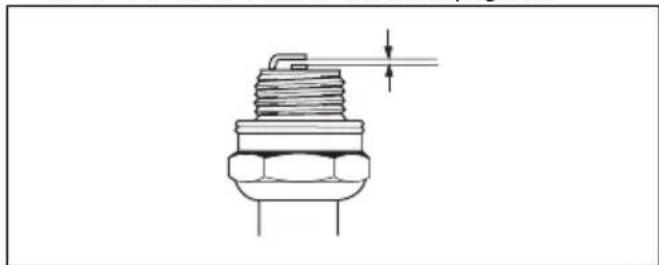
- Examine the spark plug. Replace it if the electrodes are burned or if the insulation has cracks or damages. If the spark plug is not damaged, clean it with a steel brush.
- Measure the electrode gap and make sure that it is correct. Refer to Technical data on page 36.
natural_image
Technical line drawing of a spark plug with threaded shaft and mounting base (no text or symbols)- Bend the side electrode to adjust the electrode gap.
- Put the spark plug back in and turn it by hand until it touches the spark plug seat.
- Tighten the spark plug with the spark plug wrench until the washer is compressed.
- Tighten a used spark plug 18 of a turn more, and a new spark plug 14 turn more.

CAUTION: Spark plugs that are not tightened correctly can cause damage to the engine.
- Attach the spark plug cap.

CAUTION: Do not try to start the engine if the spark plug or ignition cable is removed.
To do a check of the engine oil level
Note: The illustration shows one type of engine.
The engine in your product can be different, but the procedure is the same.
- Park the product on level ground and stop the engine.
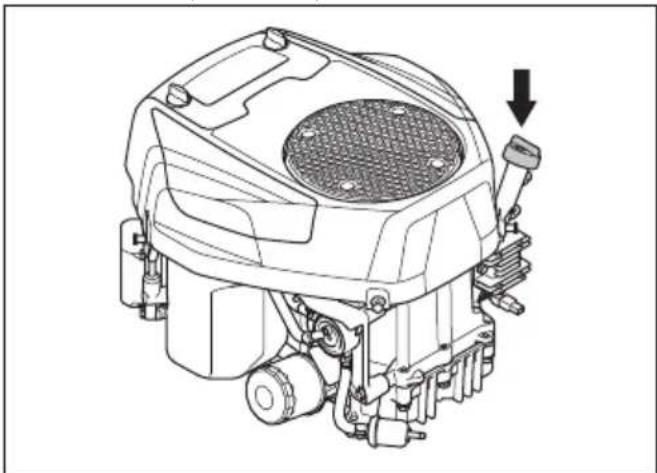
- Open the engine cover.
- Loosen the dipstick and pull it out.
natural_image
Technical line drawing of a mechanical engine component with no visible text or symbols- Clean the oil from the dipstick.
- Put the dipstick back in and tighten it.
- Loosen and pull the dipstick out and read the oil level.
- The oil level must be between the marks on the dipstick. If the level is near the ADD mark, fill oil to the FULL mark.
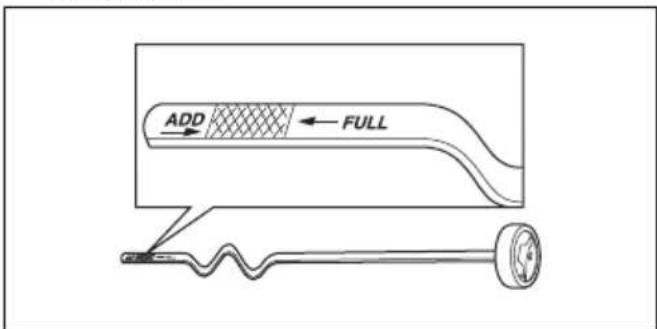
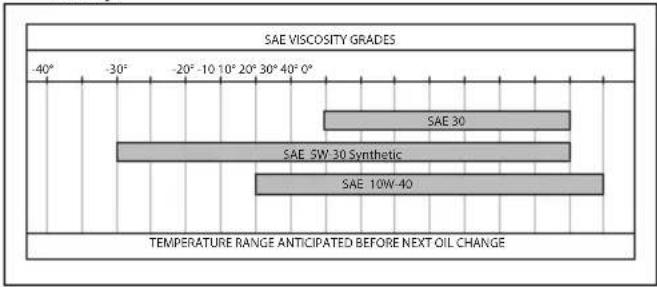
- Fill the oil through the hole for the dipstick. Fill the oil slowly.
bar
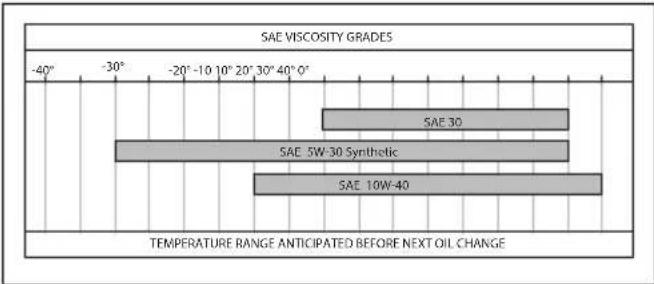
SAE VISCOSITY GRADES | Category | SAE Viscosity Grade (°) | |---|---| | SAE 30 | -20 | | SAE 5W-30 Synthetic | -20 | | SAE 10W-40 | -20 |Note: Refer to Technical data on page 36 for the types of engine oil that we recommend.
-
Tighten the dipstick.
-
Start the engine and let it operate at idle speed for approximately 30 seconds.
- Stop the engine.
- Wait 30 seconds and do a check of the oil level again.
To replace the engine oil
If the engine is cold, start the engine and let it operate for 1–2 minutes before you drain the engine oil. This makes the engine oil warm and faster to drain.

WARNING: Do not operate the engine for more than 1–2 minutes before you drain the engine oil. The engine oil becomes very hot and can cause burn injuries. Let the engine become cool before you drain the engine oil.

WARNING: If you spill engine oil on your body, clean with soap and water.
- Remove the oil drain hose (A) from the holder (B) and put the oil drain hose through the gap (C).
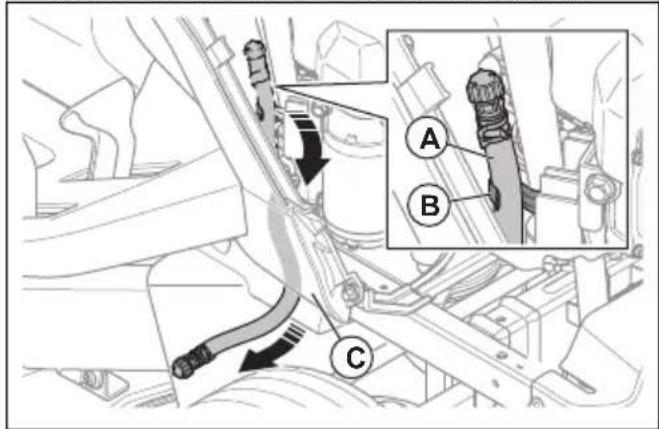
- Put a container below the oil drain plug.
- Remove the dipstick.
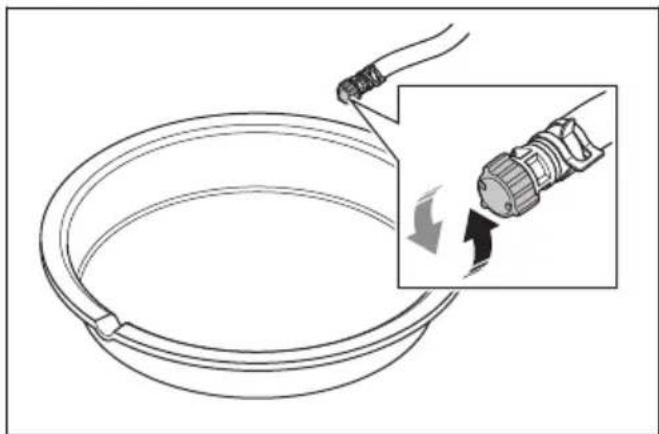
- Remove the end cap on the oil drain valve on the oil drain hose and let the engine oil drain into the container.
natural_image
Diagram showing a cable being inserted into a plastic tube, with an inset illustrating the process (no text or symbols present)- When all oil is drained, install the end cap on the oil drain valve.
- If the engine has an oil filter, replace the oil filter. Refer to To replace the oil filter on page 25.
- Fill the oil through the hole for the dipstick. Fill the oil slowly.
bar
SAE VISCOSITY GRADES | Category | SAE Viscosity Grade | |---|---| | SAE 30 | -20°-10° | | SAE 5W-30 Synthetic | -20°-10° | | SAE 10W-40 | -20°-10° | | SAE 10W-40 (TEMPERATURE RANGE ANTICIPATED BEFORE NEXT OIL CHANGE) | -20°-10° |Note: Refer to Technical data on page 36 for the types of engine oil that we recommend.
- Install the dipstick.
- Discard the used engine oil.
To replace the oil filter

WARNING: Use protective gloves. If you spill engine oil on your body, clean with soap and water.
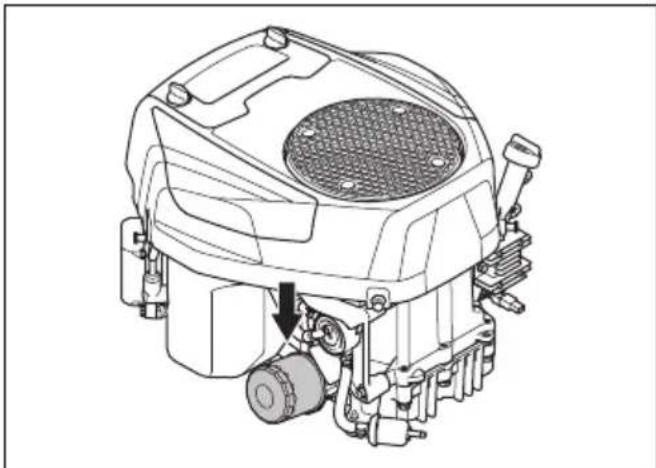
Note: The illustration shows one type of oil filter.
The oil filter can be different in your product, but the procedure is the same.
- Drain the engine oil. Refer to To replace the engine oil on page 24.
- Turn the oil filter counterclockwise to remove it.
natural_image
Technical line drawing of a mechanical engine component with no visible text or symbols- Lightly lubricate the rubber seal on the new oil filter with new engine oil.
- Turn the oil filter clockwise by hand until the rubber seal is in position, then tighten a half turn more.
-
Fill the engine with new engine oil. Refer to To replace the engine oil on page 24.
-
Start the engine and let it operate at idle speed for 3 minutes.
- Stop the engine and make sure that there is no oil leakage from the oil filter.
- Fill with engine oil to make up for the oil held in the new oil filter.
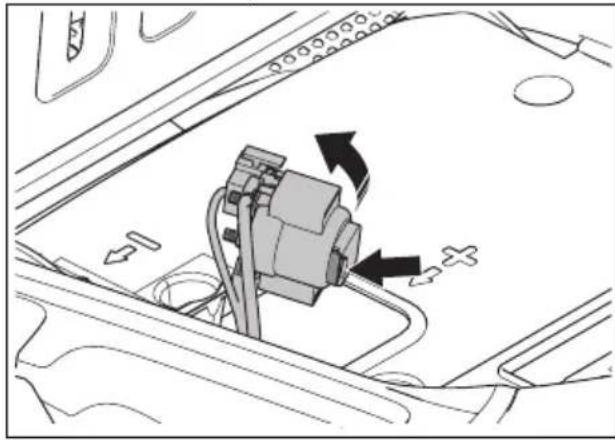
To replace the main fuse
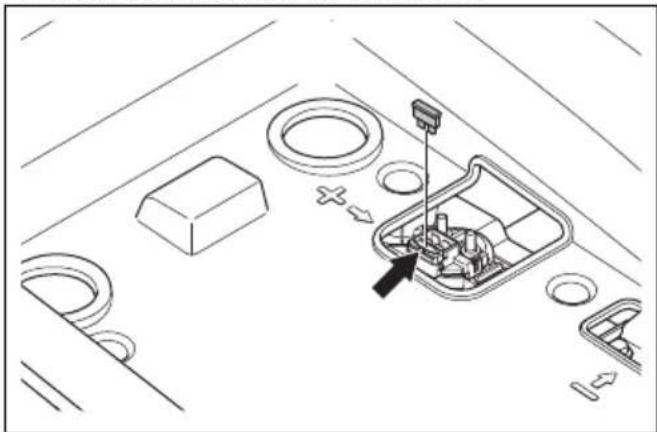
The main fuse is found in the fuse holder on the start relay below the seat.
- Fold the seat forward.
- Remove the connector from the fuse holder.
- Pull the main fuse from the fuse holder.
natural_image
Technical line drawing of a mechanical assembly with no visible text or symbols- Replace the broken fuse with a new fuse of the same type. Refer to Technical data on page 36.
Note: 1 spare fuse is supplied with the product.
The holder for the spare fuse is found on the bottom side of the connector, below the seat.
natural_image
Diagram of a car engine compartment with internal components and directional arrows indicating motion (no text or symbols)If the main fuse breaks again a short period after you replace it, there is a short circuit. Repair the short circuit before you operate the product again.
To charge the battery
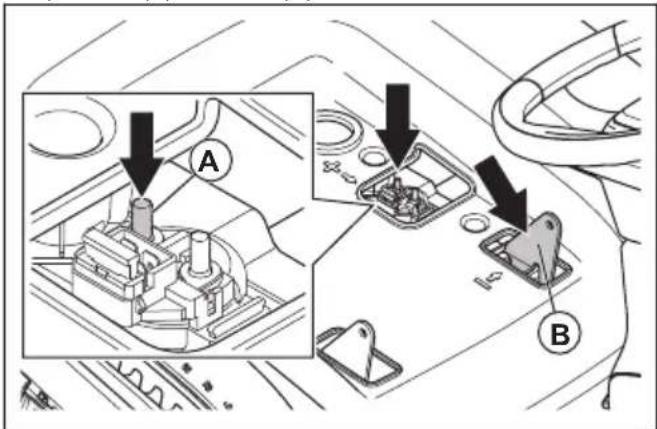
Charge the battery if it is too weak to start the engine.
- Connect the positive (+) charging cable to the positive (+) terminal (A) on the starter solenoid.
-
Connect the negative (-) charging cable to the negative (-) connection point (B).
-
Use a standard battery charger.

CAUTION: Do not use a boost charger or start booster. That will cause damage to the electrical system of the product.
- Always disconnect the charger before starting the engine.
To do an emergency start of the engine
If the battery is too weak to start the engine, you can use jumper cables to do an emergency start. This product has a 12 V system with negative ground. The product that is used for the emergency start must also have a 12 V system with negative ground.
To connect the jumper cables

WARNING: Risk of explosion because of explosive gas that comes from the battery. Do not connect the negative terminal of the charged battery to or near the negative terminal of the weak battery.

CAUTION: Do not use the battery of your product to start other vehicles.
- Connect one end of the red battery cable to the POSITIVE (+) terminal (A) on the start relay below the seat.
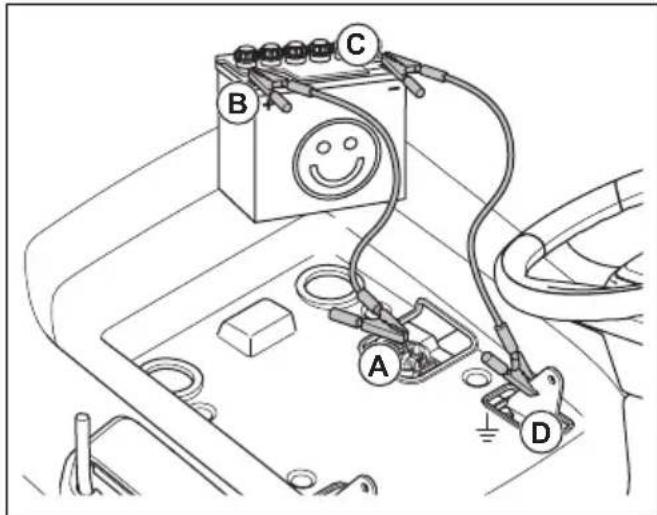
- Connect the other end of the red battery cable to the POSITIVE (+) battery terminal (B) on the charged battery.

WARNING: Do not let the ends of the red battery cable touch the chassis. This will cause a short circuit.
-
Connect one end of the black battery cable to the NEGATIVE (-) battery terminal (C) on the charged battery.
-
Connect the other end of the black battery cable to a CHASSIS GROUND (D), away from the fuel tank and the battery.
To remove the jumper cables
Note: Remove the jumper cables in the opposite sequence to how you connect them.
- Remove the BLACK cable from the chassis.
- Remove the BLACK cable from the fully charged battery.
- Remove the RED cable from the 2 batteries.
To replace the battery

WARNING: Risk of electrical shock and burn injuries. Do not use metal wristbands or other metal accessories. Metal items that touch the battery terminals can cause burn injuries, electrical shock, and short circuit of the battery.
-
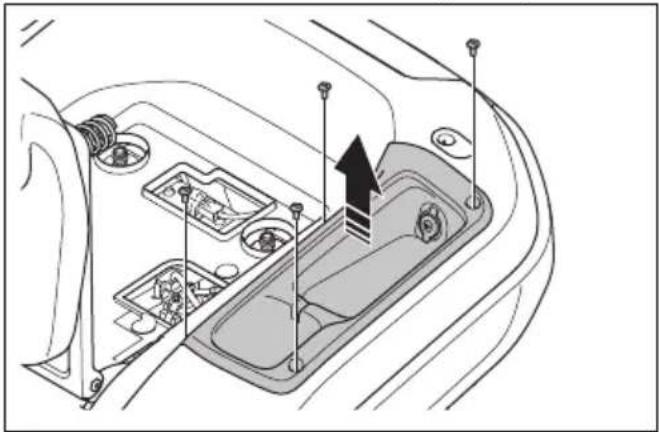
Fold the seat forward.
-
Remove the 4 screws and the storage compartment.
natural_image
Diagram of a car intake tray with screwdrivers and directional arrows indicating movement (no text or symbols)-
Remove the terminal cover on the black battery cable.
-
Remove the screw, the washer, the nut, and the black battery cable from the negative (-) terminal on the battery.
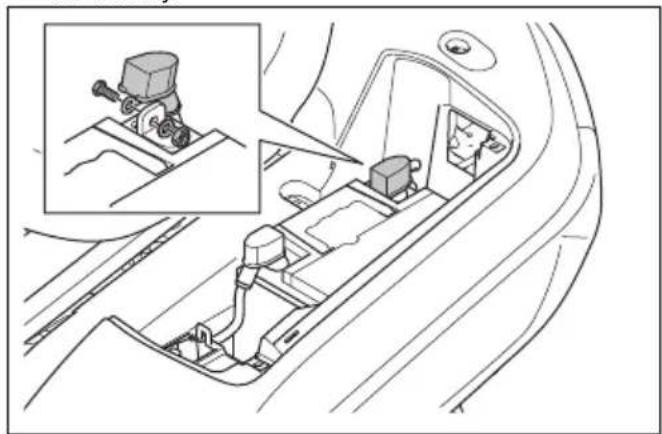
natural_image
Diagram of a car interior showing steering wheel, dashboard, and seatbelt mechanism (no text or labels)-
Remove the terminal cover on the red battery cable.
-
Remove the screw, the nut, and the red battery cable from the positive (+) terminal on the battery.
-
Carefully remove the battery from the product.
-
Put a new battery in position.
-
Attach the red battery cable to the positive (+) terminal on the battery and install the nut and the screw.
-
Install the terminal cover on the red battery cable.
-
Attach the black battery cable to the negative (-) terminal on the battery and install the nut, the screw and the terminal cover.
-
Install the battery cover and the attach the strap.
-
Install the storage compartment and the 4 screws.
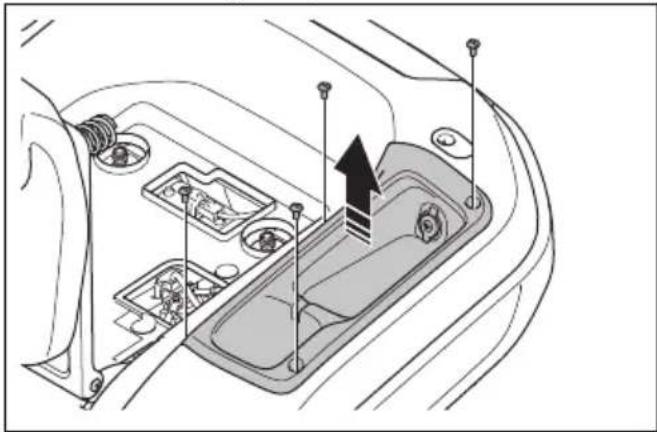
natural_image
Diagram of a car interior showing dashboard and steering wheel assembly with an upward arrow indicating motion (no text or symbols)Tire pressure
Make sure that the tire pressure is correct in all 4 tires. Refer to Technical data on page 36.
Cutting deck
To remove and install the cutting deck
- Disengage the cutting deck and stop the engine.
- Put the cutting deck in the lowest position.
- Remove the 3 screws and the left belt cover.
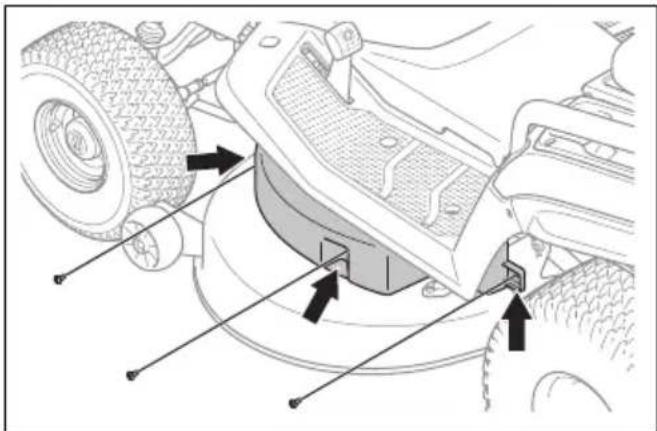
natural_image
Technical diagram of a vehicle's internal components with arrows indicating assembly or alignment (no text or symbols present)- Remove the 3 screws and the right belt cover.
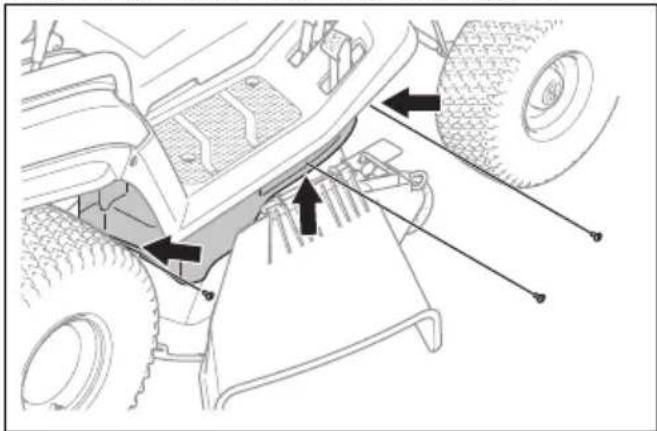
natural_image
Technical diagram of a vehicle's front wheel assembly showing mounting brackets and tire alignment (no text or labels)- Remove the spring (A) from the spring holder (B) to decrease the tension of the cutting deck belt.
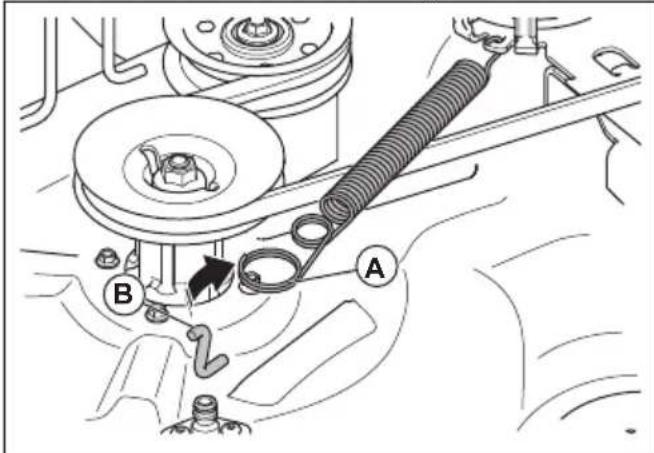
-
Remove the cutting deck belt from the engine pulley.
-
Do the steps that follow to disconnect the front link.
a) Remove the clip (C) and the washer (D).
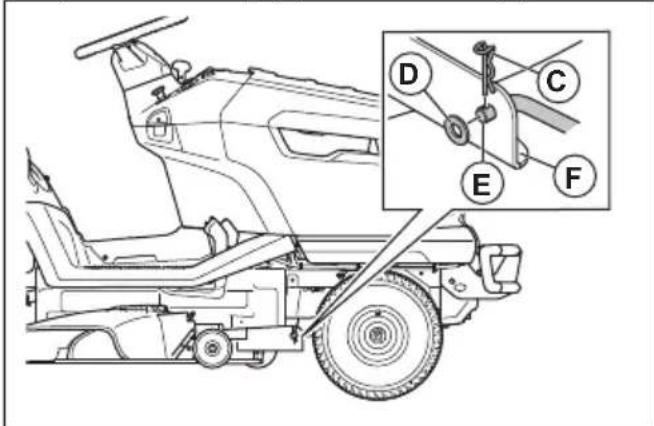
b) Disconnect the front link (E) from the bracket (F) on the cutting deck.
c) Put the front link in the front link holder.
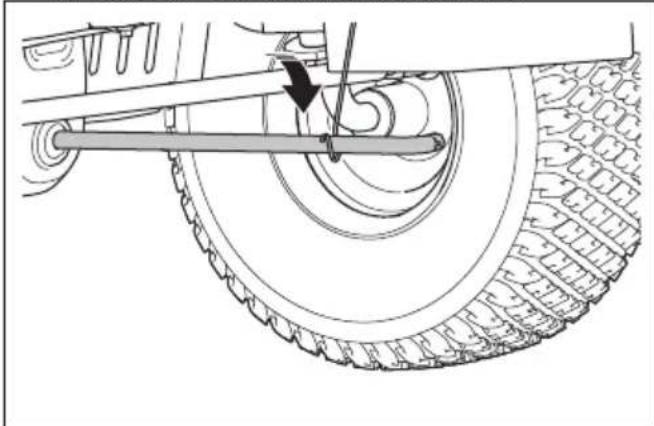
natural_image
Technical line drawing of a vehicle wheel assembly with a mechanical lever and tire (no text or symbols)- Do the steps that follow to disconnect the 2 rear links. There is one rear link on the left side and one rear link on the right side of the product.

WARNING: The cutting deck is heavy. Use a crowbar or equivalent below the cutting deck to hold the weight of the cutting deck when you disconnect the 2 rear links.
a) Remove the clip (G) and the washer (H) from the front end of the left rear link.
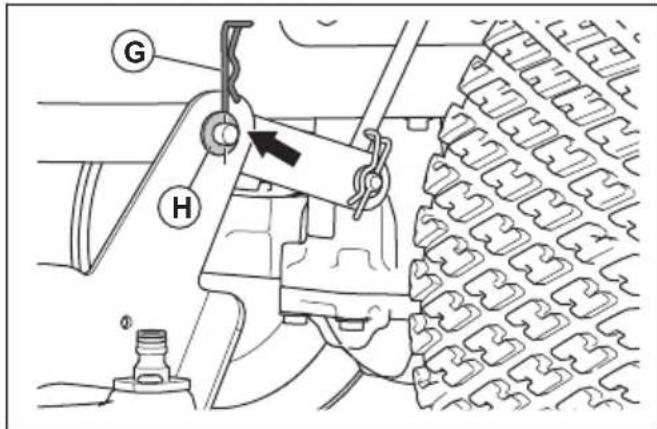
b) Disconnect the cutting deck from the left rear link.
c) Pull and hold the cutting height lever in the lowest position with one hand. Remove the clip and the washer from the front of the right rear link.

WARNING: Do not release the cutting height lever. The mechanism for the cutting height adjustment is spring-loaded. The force from the spring can cause crush injury if you do not pull and hold the cutting height lever.
d) Disconnect the cutting deck from the right rear link.
e) Carefully release the cutting height lever.

WARNING: The mechanism for the cutting height adjustment is spring-loaded. The force from the spring can cause crush injury. Keep body parts away.
-
Move the cutting height lever to the highest position.
-
Remove the cutting deck from the product.
-
Install the cutting deck in the opposite sequence.

CAUTION: Make sure that the drive belt is installed correctly and does not get compressed when you install the cutting deck.
To adjust the parallelism of the cutting deck
To do a side-to-side adjustment of the cutting deck
If the cutting height is different between the right and left side, the cutting height can be adjusted.
-
Make sure that the tire pressure is correct in all 4 tires. Refer to Tire pressure on page 27.
-
Park the product on a level surface.
-
Put the cutting deck in the highest position.
-
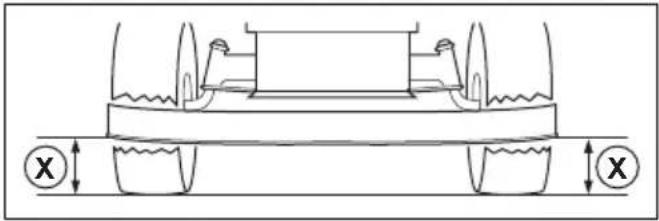
Measure the distance (X) from the bottom edge of the cutting deck to the ground on the left and right side. The distance must be the same on the 2 sides.
natural_image
Technical line drawing of a mechanical assembly with two circular components and dimension arrows (no text or symbols)
WARNING: The blades on the cutting deck are sharp and can cause injury. Use protective gloves.
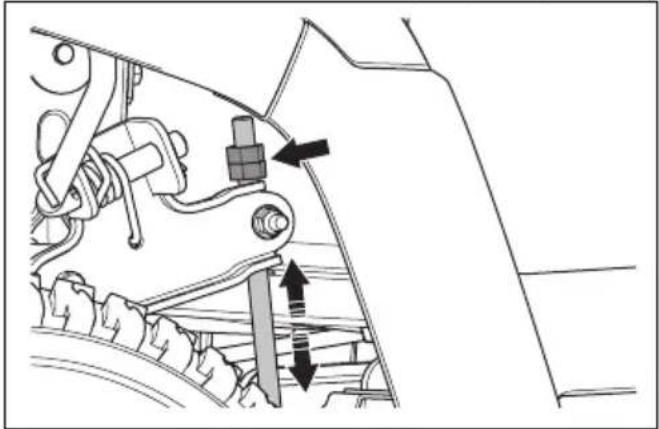
- Loosen the locknuts on the cutting height stays.
natural_image
Technical diagram of a mechanical assembly with arrows indicating motion or force directions (no text or symbols present)Note: The cutting height stays are behind the cutting deck, in front of the rear wheels.
- Adjust the nuts on the cutting height stays until the cutting deck has the same cutting height on the left and right side.
a) Turn the nuts counterclockwise to lower the cutting deck.
b) Turn the nuts clockwise to lift the cutting deck.
-
Measure the distance again. Adjust until the 2 sides are equal.
-
Tighten the locknuts when the side-to-side adjustment is complete.
-
Cut some grass and examine the results. Adjust if it is necessary.
To do a front-to-rear adjustment of the cutting deck
The cutting deck must be level side to side before you do front to rear adjustment. Refer to To do a side-to-side adjustment of the cutting deck on page 28.
-
Make sure that the tire pressure is correct in all 4 tires. Refer to Tire pressure on page 27.
-
Park the product on a level surface.
-
Put the cutting deck in the highest position.
-
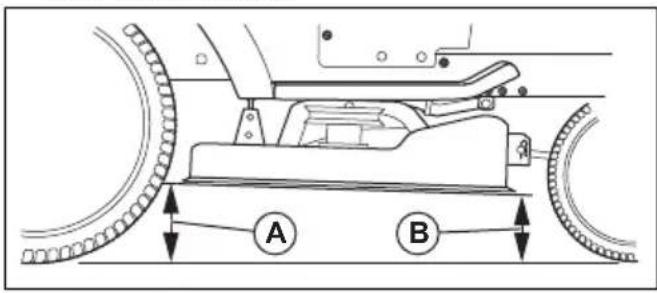
Measure the distance from the bottom edge of the cutting deck to the ground at the rear (A) and at the front (B). The distance at the front must be 5–10 mm lower than at the rear.

WARNING: The blades on the cutting deck are sharp and can cause injury. Use protective gloves.
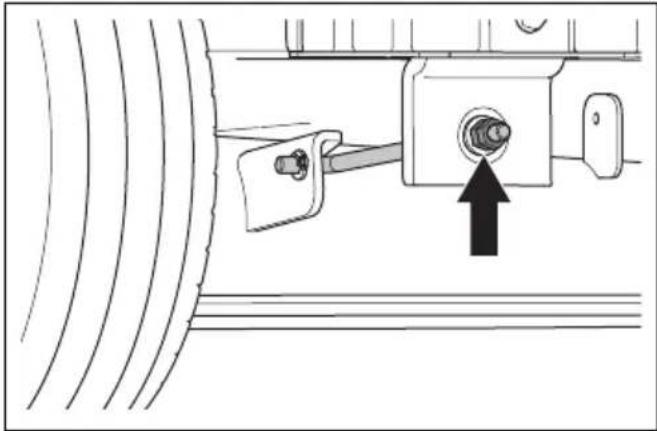
- If it is necessary to make a front adjustment, loosen the locknut and turn the nut on the front link.
natural_image
Diagram of a mechanical device with a central component and an arrow indicating direction (no text or symbols present)Note: The front link is in the front of the product, behind the muffler.
a) Turn the nut counterclockwise to lower the front of the cutting deck.
b) Turn the nut clockwise to lift the cutting deck.
c) Tighten the locknut when the front adjustment is complete.
To examine the blades

CAUTION: Damaged or incorrectly balanced blades can cause damage to the product. Replace damaged blades. Let an Husqvarna servicing dealer help you sharpen and balance blunt blades.
-
Remove the cutting deck. Refer to To remove and install the cutting deck on page 27.
-
Look at the blades to see if they are damaged and if it is necessary to sharpen them.
To replace the blades
-
Remove the cutting deck. Refer to To remove and install the cutting deck on page 27.
-
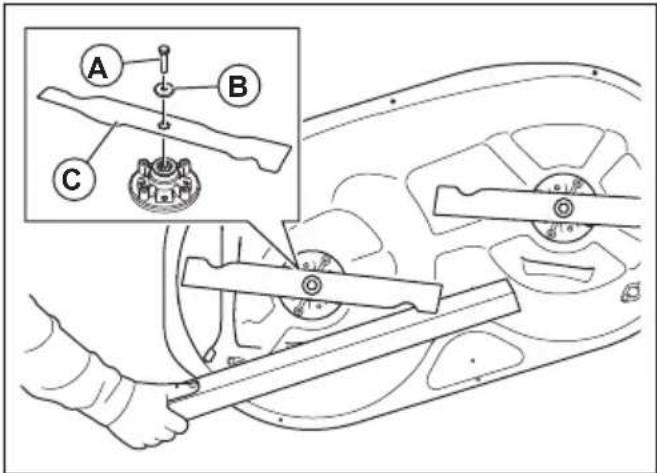
Lock the blade with a wooden block.
-
Remove the bolt (A), the washer (B), and the blade (C).
-
Install the new blades with the bent ends in the direction of the cutting deck.

WARNING: Incorrect blade type can cause objects to eject from the cutting deck and cause serious injury. Use only the blades given in Technical data on page 36.
-
Tighten the bolts to 58.5–69.5 Nm.
-
Install the cutting deck. Refer to To remove and install the cutting deck on page 27.
To replace the cutting deck belt
-
Remove the cutting deck. Refer to To remove and install the cutting deck on page 27.
-
Remove the dirt and grass around the bearing housings, blade pulleys and from the top surface of the cutting deck.
-
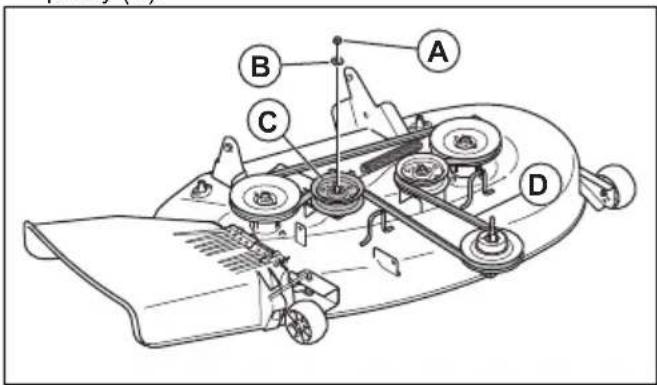
Remove the nut (A), the washer (B) and the idler pulley (C).
-
Remove the cutting deck belt (D) from the blade pulleys on the cutting deck.
-
Install a new drive belt in the opposite sequence.
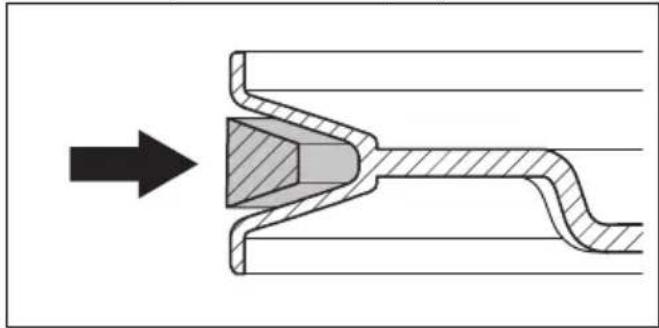
a) Make sure that the cutting deck belt is in the correct position in all belt pulleys.
natural_image
Cross-sectional diagram of a mechanical or fluidic component with an arrow indicating direction (no text or symbols present)
CAUTION: Make sure that the cutting deck belt is correctly installed and not twisted. Refer to the belt routing decal on the cutting deck.
To adjust the anti-scalp wheels
The anti-scalp wheels keep the cutting deck in the correct position on the ground and prevent lawn scalping in most terrain conditions. The anti-scalp wheels are adjusted correctly when they are slightly off the ground when the cutting deck is at the necessary cutting height.
- Park the product on a level surface.
- Set the power switch to the off (O) position and remove the power switch key.
- Put the cutting deck in the necessary cutting height. Refer to To set the cutting height on page 17.
- Remove the nut (A), the bolt (B), the washer (C), the anti-scalp wheel (D), and the bushing (E).
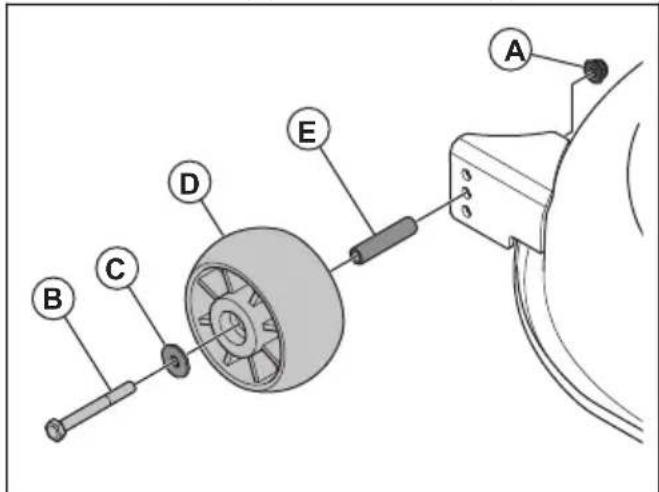
- Install the anti-scalp wheel, the bushing, the bolt, the washer, and the nut in 1 of the 3 holes.
- Adjust all anti-scalp wheels in the same procedure.
Troubleshooting
Troubleshooting schedule
If you cannot find a solution to your problems in this operator's manual, speak to your Husqvarna servicing dealer.
| Problem Cause Action | ||
| The starter motor does not crank the engine. | The parking brake is not applied. Apply the parking brake. Refer to To apply and release the parking brake on page 16. | |
| The cutting deck is engaged. Disengage the cutting deck. Refer to To engage and disengage the cutting deck on page 17. | ||
| The main fuse is blown. Replace the main fuse. Refer to To replace the main fuse on page 25. | ||
| The ignition lock is broken. Speak to your Husqvarna servicing dealer. | ||
| The connection between the cable and the battery is bad. | Make sure that the battery is connected correctly. Refer to To connect the battery on page 13. | |
| The battery is too weak. Charge the battery. Refer to To charge the battery on page 25. | ||
| The starter motor is damaged. Speak to your Husqvarna servicing dealer. | ||
| The engine does not start when the starter motor cranks the engine. | There is no fuel in the fuel tank. Fill the fuel tank with fuel. Refer to To fill fuel on page 14. | |
| The spark plug is damaged. Examine the spark plugs. Replace the spark plugs if it is necessary. Refer to To examine and replace a spark plug on page 23. | ||
| The ignition cable is damaged. Speak to your Husqvarna servicing dealer. | ||
| There is dirt in the carburetor or fuel line. | Speak to your Husqvarna servicing dealer. | |
| The fuel filter is clogged. Replace the fuel filter. Refer to To replace the fuel filter on page 22. | ||
| Problem Cause Action | |||
| The engine does not run smoothly. The spark plug is damaged. Examine the spark plugs. Replace the spark plugs if it is necessary.Refer to To examine and replace a spark plug on page 23. | |||
| The fuel tank vent is blocked. Speak to your Husqvarna servicing dealer. | |||
| The fuel filter is clogged. Replace the fuel filter. Refer to To replace the fuel filter on page 22. | |||
| The engine has no power. The air filter is clogged. Clean or replace the air filter. Refer to To clean and replace the air filter on page 23. | |||
| The engine stops when you try to operate the product rearward. | The reverse operation system (ROS) is not engaged. | Engage the reverse operation system (ROS). Refer to To use the reverse operation system (ROS) on page 18. | |
| The transmission does not have sufficient power. | The transmission air intake or the cooling fins are blocked. | Speak to your Husqvarna servicing dealer. | |
| The fan on the transmission is damaged. | Speak to your Husqvarna servicing dealer. | ||
| There is no oil in the transmission or the oil level is too low. | Speak to your Husqvarna servicing dealer. | ||
| The drive system is disengaged. Engage the drive system. Refer to To engage and disengage the drive system on page 16. | |||
| The battery does not charge. The battery is damaged. Replace the battery. Refer to To replace the battery on page 26. | |||
| There is vibration in the product. The blades are loose. Tighten the blades. Refer to replace the blades on page 29. | |||
| The cutting result is unsatisfactory. The blades are blunt. Examine the blades for wear and damage. Refer to To examine the blades on page 29. | |||
Transportation, storage and disposal
Transportation
- Use full width ramps when you load the product onto or off a vehicle or trailer.
- The product is heavy and can cause crush injuries. Be careful when you load it onto or off a vehicle or trailer.
- Do not lift the product. The anchor points are not approved lifting points and must only be used to attach the product to a trailer.
- Use an approved trailer for transportation of the product.
• Make sure that you have knowledge of local road traffic regulations before transportation of the product in a trailer or on roads.
• To make it easier to load the product onto a trailer, put the cutting deck in the highest position.
To safely attach the product for transportation

WARNING: Before you attach the product, you must read and understand the safety chapter. Refer to Safety on page 6.

WARNING: The parking brake is not sufficient to lock the product during transportation. Attach the product tightly to the load area.
Equipment: 2 approved straps and 4 chocks.
- Park the product in the center of the load area.
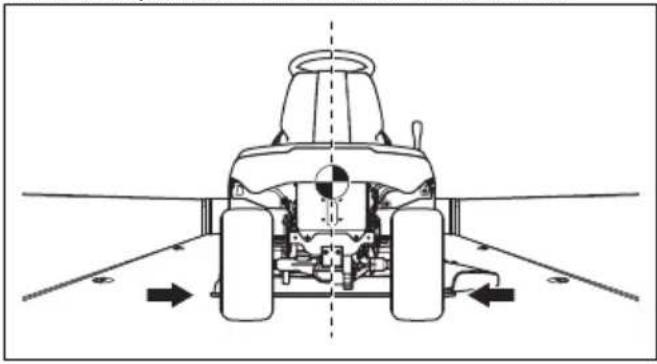
natural_image
Top-down technical line drawing of a tractor's front wheel and side wheels (no text or symbols)
CAUTION: For transportation in transport vehicles with a cover, let the product become cool before you put it below the cover.
- Make sure that the center of gravity of the product is above the wheel axle of the transport vehicle. If a trailer is used for transportation, make sure that the vertical force on the tow bar is correct.
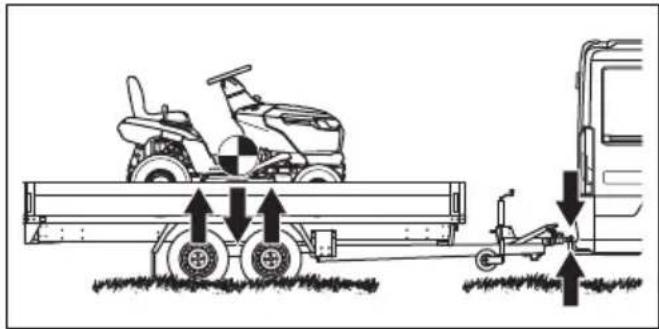
natural_image
Diagram of a tractor on a flatbed trailer with a scooter nearby, showing directional arrows indicating movement or force (no text or symbols present)- Apply the parking brake.
- Remove all loose objects.
- Attach the first strap to the tow bar.
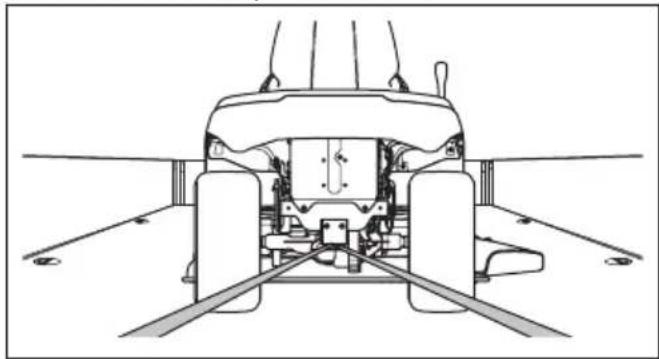
natural_image
Technical line drawing of a vehicle's front suspension system with tracks and structural components (no text or labels)- Tighten the strap rearward to attach the product to the load area.
- Put the second strap around the front axle.
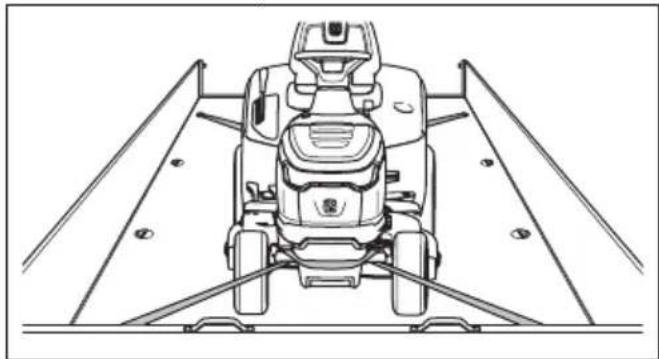
natural_image
Top-down line drawing of a tractor on tracks, showing front and rear views (no text or symbols)- Attach the strap to the load area.
-
Tighten the strap in the direction of the front of the load area to attach the product to the load area.
-
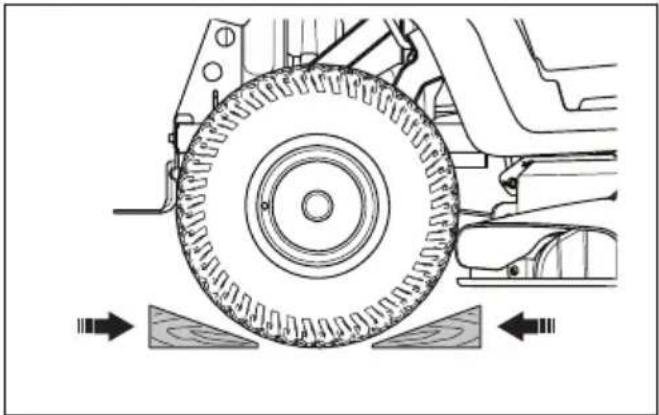
Put the chocks in front of and behind the rear wheels.
natural_image
Technical line drawing of a vehicle tire assembly with mounting brackets and directional arrows indicating motion (no text or symbols)Storage
Prepare the product for storage at the end of the season, and before more than 30 days of storage. If you keep fuel in the fuel tank for 30 days or more, tacky particles can cause blockage in the carburetor. This has a negative effect on the engine function.
To prevent tacky particles during storage, add a stabilizer. If alkylate gasoline is used, stabilizer is not necessary. If you use standard gasoline, do not change to alkylate gasoline. This can cause sensitive rubber parts to become hard. Add stabilizer to the fuel in the tank or in the container used for storage. Always use the mixing ratios given by the manufacturer. Run the engine for a minimum of 10 minutes after you add the stabilizer until it flows into the carburetor.

WARNING: Do not keep the product with fuel in the tank in an indoor location or in locations with bad airflow. Risk of fire if fuel fumes come near open flames, sparks, or pilot lights in for example boilers, hot water tanks and clothes dryers.

WARNING: Remove grass, leaves and other flammable materials from the product to decrease the risk of fire. Let the product become cool before you put it in storage.
- Clean the product, refer to To clean the product on page 21. Repair paint damages to prevent corrosion.
- Examine the product for worn or damaged parts and tighten loose screws and nuts.
- Remove the battery. Clean it, charge it, and keep it cool during storage.
- Change the engine oil, and discard the waste oil.
- Empty the fuel tank. Start the engine and let it operate until there is no remaining fuel in the carburetor.

CAUTION: Do not empty the fuel tank and carburetor if a stabilizer has been added.
- Close the fuel shut-off valve.
- Remove the spark plugs and put approximately a tablespoon of engine oil into each cylinder. Manually turn the engine shaft to apply the oil and put the plugs back on.
- Lubricate all grease nipples, joints and axles.
- Keep the product in a clean and dry area and put a cover on it for more protection.
- A cover for protection of your product during storage or transportation is available at your dealer.
Disposal
• Chemicals can be dangerous and must not be discarded on the ground. Always discard used chemicals at a service center or an applicable disposal location.
- When the product is worn out, send it to the dealer or to an applicable recycling location.
- Oil, oil filters, fuel and the battery can have negative effects on the environment. Obey the local recycling requirements and applicable regulations.
- Do not discard the battery as domestic waste.
- Send the battery to a Husqvarna servicing dealer or discard it at a disposal location for used batteries.
Technical data
Technical data
| TS 216Tm TS 218T TS 220TD | ||
| Dimensions | ||
| Width, excl. cutting deck, mm 933 971 971 | ||
| Width, incl. cutting deck with chute up, mm 1154 1154 1154 | ||
| Width, incl. cutting deck with chute down, mm 1375 1375 | 1375 | |
| Height, mm 1124 1124 1124 | ||
| Length, mm 1921 2029 2029 | ||
| Weight, incl. cutting deck, with empty tank, kg 226 234 236 | ||
| Wheel base, mm 1250 1250 1250 | ||
| Track width, front, mm 756 756 756 | ||
| Track width, rear, mm 717 717 717 | ||
| Tire pressure, front, kPa/bar/PSI 150/1.5/21.8 150/1.5/21.8 | 150/1.5/21.8 | |
| Tire pressure, rear, kPa/bar/PSI 100/1.0/14.5 100/1.0/14.5 | 100/1.0/14.5 | |
| Front tires 15×6-6 15×6-6 15×6-6 | ||
| Rear tires | 18×8.5-8 | 20×10-8 |
| Max. gradient, degrees ° | 10 | 10 |
| Max. tow equipment weight, at 10° gradient, kg | 110 110 110 | |
| Max. permitted vertical load on the towbar, N/kg | 520/52 | 520/52 |
| Max. permitted horizontal load on the towbar, N/kg | 600/60 | 600/60 |
| Engine | ||
| Brand / model | Husqvarna / HV 635E | Husqvarna / HV 708AE |
| Nominal engine output, kW ^1 | 12.5 | 14.4 |
| Displacement, cm ^3 | 635 708 764 | |
| Max. engine speed, rpm | 3100 ± 50 | 3100 ± 100 |
| Max. speed forward, km/h | 9 | 10 |
| Max. speed rearward, km/h | 5 | 6 |
| Fuel, lead-free, maximum ethanol/minimum octance grade | E10/92 | E10/92 |
| Fuel tank volume, liters | 13 | 13 |
| TS 216Tm TS 218 | T TS 220TD | ||
| Oil ^2 | Husqvarna SAE 30, Husqvarna SAE 5W-30 Synthetic, Husqvarna SAE 10W-40 | Husqvarna SAE 30, Husqvarna SAE 5W-30 Synthetic, Husqvarna SAE 10W-40 | Husqvarna SAE 30, Husqvarna SAE 5W-30 Synthetic, Husqvarna SAE 10W-40 |
| Oil volume incl. oil filter, liters 1.7 2.4 2.4 | |||
| Oil volume excl. oil filter, liters 1.6 2.3 2.3 | |||
| Start motor Electric start, 12 | V | Electric start, 12 V | Electric start, 12 V |
| Transmission | |||
| Brand / model Tuff Torq / | K46EN | Tuff Torq / K46EN | Tuff Torq / K46EP |
| Oil volume, liters 2.2 2.2 2.2 | |||
| Electrical system | |||
| Type 12V, negative | grounded | 12V, negative grounded | 12V, negative grounded |
| Battery 12V, 24Ah 12V, 24Ah 12V, 24Ah | |||
| Main fuse, A 20 20 20 | |||
| Spark plug HQT-7/HQT-12 HQT-7/HQT-12 HQT-7/HQT-12 | |||
| Electrode gap, mm/inch 0.6–0.8/0.024– | 0.032 | 0.6–0.8/0.024–0.032 | 0.6–0.8/0.024–0.032 |
| Lamp type 12V, 10.19W 12V, 10.19W 12V, 10.19W | |||
| Cutting deck | |||
| Cutting width, mm | 1080 | 1080 | 1080 |
| Cutting height, 10 positions, mm | 25–105 | 25–105 | 25–105 |
| Blades | |||
| Blade length, mm | 554 | 554 | 554 |
| Article number | 531 14 83-03 | 531 14 83-03 | 531 14 83-03 |
| Article number, mulch kit (accessory) ^3 | 546 51 52-01 | 546 51 52-01 | 546 51 52-01 |
| Article number, mulch blade (accessory) ^4 | 531 14 82-99 | 531 14 82-99 | 531 14 82-99 |
| Article number, side collection kit (accessory) ^5 | 547 28 93-01 | 547 28 93-01 | 547 28 93-01 |
| Article number, collect blades (accessory) ^6 | 531 14 83-01 531 | 14 83-01 531 14 83 | -01 |

WARNING: Use only the cutting decks that are specified in this manual. Cutting decks that are not approved for this product can cause objects to eject at high speed and cause serious injury.
| Control points | |
| Parallelism cutting deck with cutting height in position 1 5- | 10 mm / 0.197–0.394 in. |
| Control of cutting height in position 1 25 ± 2 mm / 0.98 ± 0 | .079 in. |
Service
Do a yearly check at an authorized service center to make sure that the product functions safely and at its best during high season. The best time to do a servicing or overhaul of the product is low season.
When you send an order for the spare parts, give information about the purchase year, model, type, and serial number.
Always use original spare parts.
Sommaire
Attention : projections et ricochets.
natural_image
Illustration of a person riding an electric scooter with a crosshair, accompanied by a no-smoking symbol (no text or labels present)natural_image
Silhouette of a person crouching in water with bubbles and a small object nearby (no text or symbols)natural_image
Line drawing of a pair of boots with visible tread pattern and buckles (no text or symbols)natural_image
Technical line drawing of four mechanical fasteners or bolts (no text or symbols)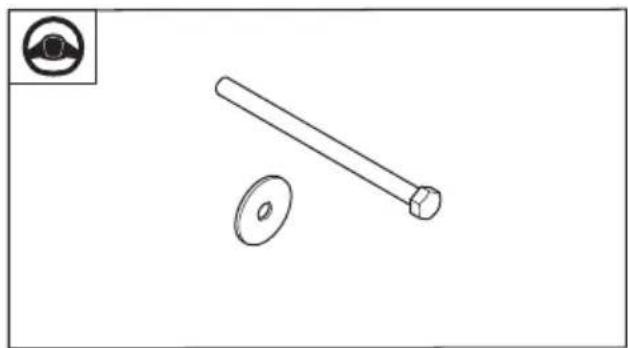
natural_image
Technical line drawing of a mechanical component including a cylindrical rod and a flanged washer (no text or symbols)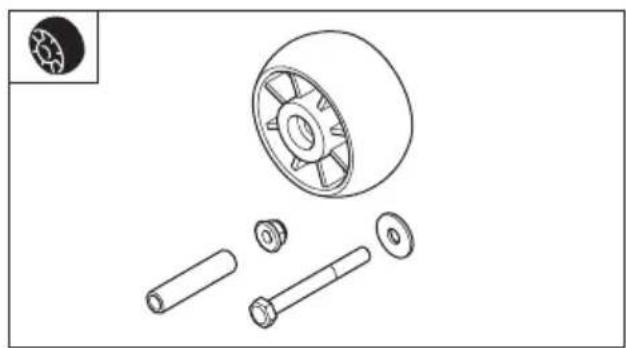
natural_image
Exploded view diagram of a mechanical component including a wheel, bolt, and nut (no text or labels)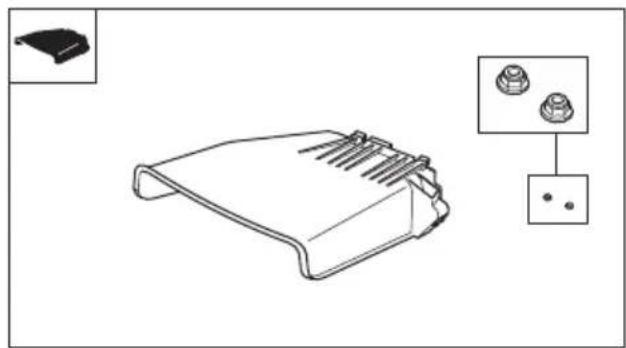
natural_image
Technical line drawing of a mechanical component with mounting holes and a separate inset showing a small component (no text or symbols)natural_image
Diagram of a car intake tray with directional arrows indicating movement or force (no text or symbols present)natural_image
Line drawing of a car interior showing seatbelt and dashboard components, with an inset view of a mechanical device (no text or symbols)natural_image
Diagram of a car gear shift mechanism with an arrow indicating direction (no text or symbols present)Utilisation
Introduction

natural_image
Illustration of a person performing a grip or grip motion with directional arrows indicating movement (no text or symbols)natural_image
Line drawing of a car's front dashboard and steering wheel, showing structural components and a close-up inset of the steering wheel (no text or symbols)

natural_image
Line drawing of a car gear shift lever mechanism (no text or symbols)natural_image
Technical line drawing of a mechanical component with a circular top and internal components (no text or symbols)natural_image
Mechanical assembly diagram showing a belt switch mechanism with mounting brackets and a close-up inset of the component (no text or labels)natural_image
Pure mechanical diagram showing a pipe joint with arrows indicating direction of motion (no text or symbols)natural_image
Technical line drawing of a mechanical component with mounting holes and a directional arrow (no text or symbols)natural_image
Technical line drawing of a mechanical assembly with no visible text or symbolsnatural_image
Technical line drawing of a spark plug with threaded body and bolted base (no text or symbols)natural_image
Technical line drawing of a mechanical engine component with no visible text or symbolsnatural_image
Diagram showing a cable being inserted into a plastic housing, with an inset illustrating the process (no text or symbols present)natural_image
Technical line drawing of a mechanical engine component with no visible text or symbolsnatural_image
Technical line drawing of a mechanical assembly with components like gears, rings, and a central component (no text or symbols)natural_image
Diagram of a car engine compartment showing internal components and airflow direction (no text or labels)natural_image
Diagram of a car interior showing dashboard and steering wheel assembly with an upward arrow indicating motion (no text or symbols)natural_image
Technical line drawing of a car interior showing dashboard and steering wheel (no text or symbols)natural_image
Diagram of a car interior showing dashboard and intake tray with no visible text or symbolsPression des pneus
natural_image
Technical diagram of a vehicle's internal components with arrows indicating assembly or alignment (no text or symbols present)natural_image
Technical diagram of a vehicle's front wheel assembly showing mounting brackets and tire alignment (no text or labels)natural_image
Technical line drawing of a vehicle's wheel and suspension system (no text or symbols)natural_image
Technical line drawing of a mechanical assembly with two circular indicators labeled 'X' indicating measurement points (no text or symbols present)
natural_image
Technical diagram of a mechanical assembly with arrows indicating motion or force directions (no text or symbols present)
natural_image
Diagram of a mechanical component with a black arrow pointing to a circular feature, no text or symbols presentnatural_image
Cross-sectional diagram of a mechanical or fluidic component with an arrow indicating direction (no text or symbols present)
natural_image
Top-down technical line drawing of a tractor with visible wheel, wheels, and directional arrows indicating motion (no text or symbols)
natural_image
Diagram of a tractor on a flatbed trailer with a truck in the background, showing mechanical components and directional arrows (no text or symbols)natural_image
Technical line drawing of a vehicle front view showing tracks and structural components (no text or symbols)natural_image
Top-down line drawing of a tractor with wheels and structural brackets (no text or symbols)natural_image
Technical diagram of a vehicle wheel assembly with mounting brackets and directional arrows indicating motion (no text or symbols)Remisage
natural_image
Illustration of a person steering a motor with a crosshair, accompanied by a no-forcentage sign (no text or symbols on the diagram itself)natural_image
Silhouette of a person crouching near water with bubbles, and another figure in mid-air (no text or symbols)natural_image
Line drawing of a pair of boots with visible branding and sole details (no text or symbols)natural_image
Cartoon illustration of a car on a curved ramp with an arrow indicating motion, and a warning sign showing a person falling (no text or symbols present)natural_image
Technical line drawing of four mechanical fasteners or bolts (no text or symbols)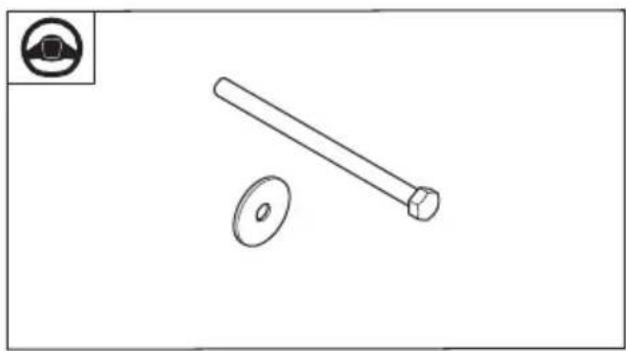
natural_image
Technical line drawing of a mechanical component with a cylindrical rod and a flanged circular part, accompanied by a small inset view (no text or symbols)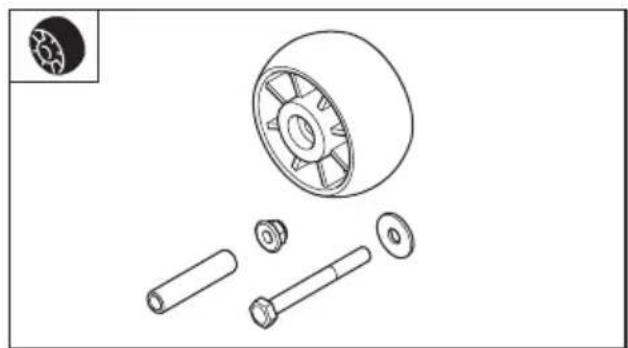
natural_image
Exploded view diagram of a mechanical component showing wheel, shafts, and bolts (no text or labels)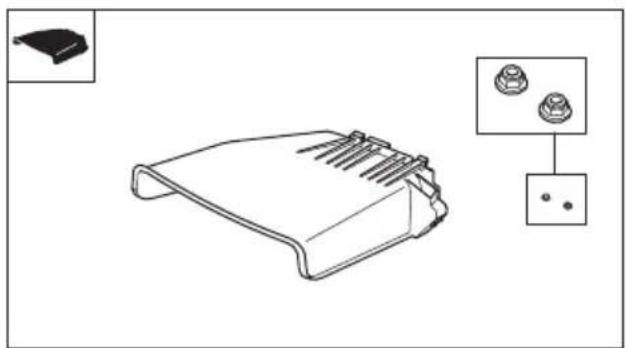
natural_image
Technical line drawing of a mechanical component with inset view (no text or symbols)サイド排出シュートの取り付け方法
natural_image
Diagram of a car interior showing dashboard and intake tray with directional arrows (no text or symbols)natural_image
Interior view of a car showing the dashboard, seatbelt, and dashboard lift (no text or symbols visible)natural_image
Diagram of a car's seatbelt mechanism with hand placement and arrow indicating motion (no text or symbols)Operation (操作)
はじめに

natural_image
Illustration of a person's lower back with hands holding a steering wheel and a shaded grip, showing motion arrows (no text or symbols)本製品始動前の作業

natural_image
Line drawing of a car's front bumper and dashboard, showing structural components and a close-up of the dashboard handle (no text or symbols present)


b) 駐車ブレーキペダルを放します。
natural_image
Line drawing of a car gear shift lever mechanism (no text or symbols)本製品の操作
natural_image
Technical line drawing of a mechanical component with a circular top and internal components (no text or symbols)- ブラシで芝や汚れを落とします。
エンジンカバーの取り外しおよび取り付け
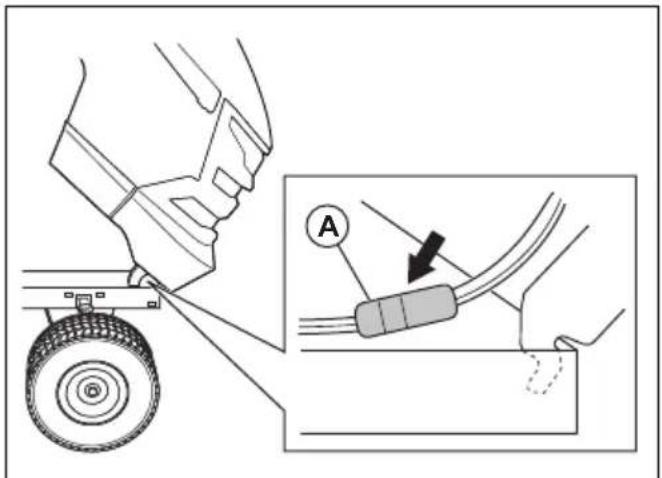
natural_image
Mechanical assembly diagram showing a shaft and gear assembly with directional arrows (no text or labels)natural_image
Pure mechanical diagram showing a pipe joint with arrows indicating direction (no text or symbols)エアフィルターの清掃と交換
natural_image
Technical line drawing of a mechanical component with mounting holes and internal structure (no text or symbols)- エアフィルターを慎重に取り外します。
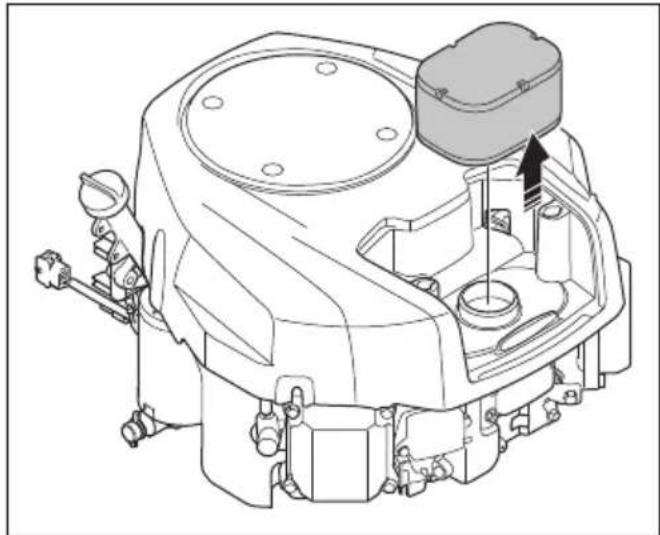
natural_image
Technical line drawing of a mechanical assembly with no visible text or symbolsnatural_image
Technical line drawing of a spark plug with threaded shaft and mounting base (no text or symbols)natural_image
Technical line drawing of a mechanical engine component with no visible text or symbolsnatural_image
Diagram showing a cable being inserted into a ring, with an inset illustrating the process (no text or symbols present)natural_image
Technical line drawing of a mechanical engine component with no visible text or symbolsnatural_image
Technical line drawing of a mechanical assembly with components like rings, gears, and a central component (no text or symbols)natural_image
Diagram of a car engine compartment with directional arrows indicating motion or movement (no text or symbols present)natural_image
Diagram of a car intake tray with sensors and a directional arrow indicating movement (no text or symbols)natural_image
Line drawing of a car interior showing steering wheel, dashboard, and seatbelt mechanism (no text or symbols)natural_image
Diagram of a car gear shift lever system with no text or symbolsタイヤ圧
natural_image
Mechanical assembly diagram showing components like wheels, brackets, and mounting points (no text or labels)natural_image
Technical diagram of a vehicle's front wheel assembly showing tire, wheels, and mounting bracket (no text or labels)natural_image
Technical line drawing of a vehicle wheel assembly with a gear and shaft (no text or symbols)
natural_image
Mechanical assembly diagram showing a lever mechanism with two directional arrows indicating movement or force (no text or labels present)
natural_image
Diagram of a car door lock mechanism with an arrow indicating clockwise motion (no text or symbols present)natural_image
Cross-sectional diagram of a mechanical or fluidic component with an arrow indicating direction (no text or symbols present)
natural_image
Top-down technical line drawing of a tractor's front wheel and rear wheels, showing structural components without any text or symbols.
natural_image
Diagram of a tractor on a flatbed trailer connected to a truck, showing mechanical components and directional arrows (no text or symbols)natural_image
Technical line drawing of a vehicle's front suspension system with tracks and structural components (no text or symbols)natural_image
Line drawing of a tractor on tracks with no text or symbolsnatural_image
Technical diagram of a vehicle wheel assembly with mounting brackets and directional arrows indicating motion (no text or symbols)保管
natural_image
Illustration of a person riding an electric scooter with a crosshair, accompanied by a no-rocker vehicle (no text or symbols present)natural_image
Silhouette of a person crouching near water with bubbles and a small object, no text or symbols presentnatural_image
Line drawings of two different boots, one showing front and side views (no text or symbols)natural_image
Technical line drawing of four mechanical fasteners or bolts (no text or symbols)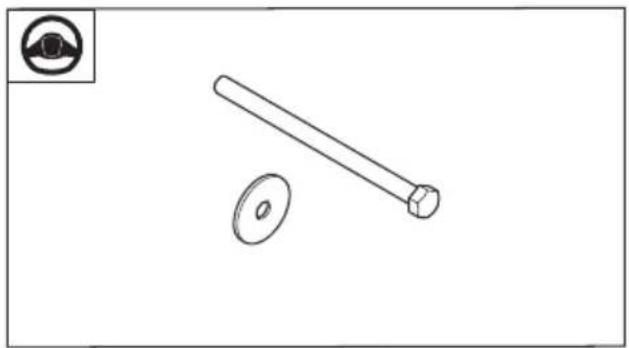
natural_image
Technical line drawing of a mechanical component including a cylindrical rod and a flanged washer (no text or symbols)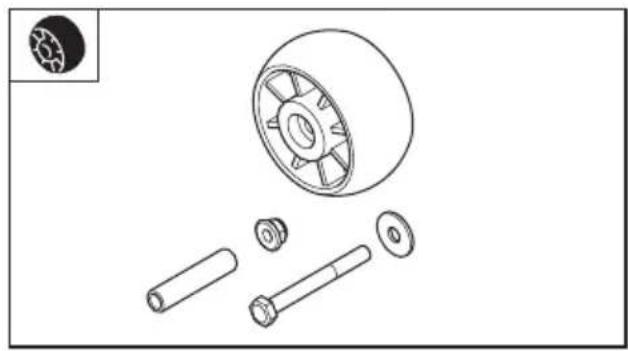
natural_image
Exploded view diagram of a mechanical component showing wheel, shafts, and bolts (no text or labels)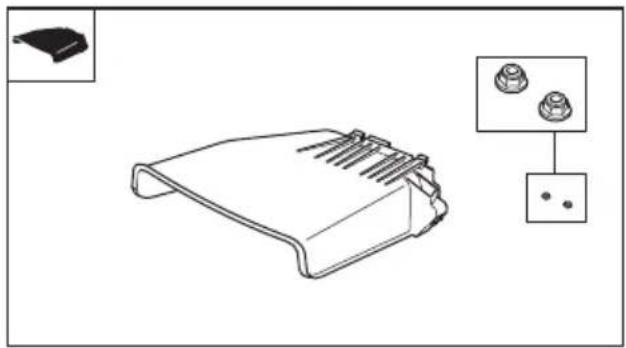
natural_image
Technical line drawing of a mechanical component with inset view (no text or symbols)측면 배출구 설치 방법
natural_image
Diagram of a car gear shift lever system with no text or symbolsnatural_image
Line drawing of a car interior showing steering wheel, dashboard, and seatbelt mechanism (no text or symbols)natural_image
Diagram of a car's seatbelt mechanism with arrows indicating direction (no text or symbols)작동
서문

natural_image
Illustration of a person performing a physical maneuver with directional arrows indicating movement (no text or symbols)제품을 시작하기 전에 수행할 작업

natural_image
Line drawing of a car interior showing dashboard and steering wheel (no text or symbols)


natural_image
Line drawing of a car gear shift lever mechanism (no text or symbols)제품 작동 방법
natural_image
Technical line drawing of a mechanical component with no visible text or symbolsnatural_image
Mechanical assembly diagram showing a belt drive mechanism with inset detail (no text or labels)natural_image
Pure mechanical diagram showing a pipe joint with arrows indicating direction of motion (no text or symbols)공기 여과기 청소 및 교체 방법
natural_image
Technical line drawing of a mechanical component with mounting holes and a directional arrow (no text or symbols)natural_image
Technical line drawing of a mechanical assembly with no visible text or symbolsnatural_image
Technical line drawing of a spark plug with threaded end and shaft (no text or symbols)natural_image
Technical line drawing of a mechanical engine component with no visible text or symbolsbar
SAE VISCOSITY GRADES | Oil Type | SAE Viscosity Grade | |---|---| | SAE 30 | -20°-10 | | SAE 5W-30 Synthetic | -20°-10 | | SAE 10W-40 | -20°-10 | | SAE 30 (Temperature Range Anticipated Before Next Oil Change) | -30° to -40° |natural_image
Diagram showing a cable being inserted into a plastic tube, with an inset illustrating the process (no text or symbols present)natural_image
Technical line drawing of a mechanical engine component with no visible text or symbolsnatural_image
Technical line drawing of a mechanical assembly with components like gears, rings, and a central component (no text or symbols)natural_image
Diagram of a car engine compartment with internal components and directional arrows indicating motion (no text or symbols)natural_image
Diagram of a car gear shift lever mechanism showing key components and motion direction (no text or labels)natural_image
Interior view of a car showing the dashboard, seatbelt, and engine compartment with an inset image of a vehicle (no text or symbols present)natural_image
Diagram of a car gear shift lever mechanism showing key components and motion direction (no text or labels)타이어 압력
natural_image
Technical diagram of a vehicle's internal components with arrows indicating assembly or alignment (no text or symbols present)natural_image
Technical diagram of a vehicle's front wheel assembly showing mounting brackets and tire alignment (no text or labels)natural_image
Technical line drawing of a vehicle wheel assembly with a mechanical lever and tire (no text or symbols)
natural_image
Mechanical assembly diagram showing a lever mechanism with two directional arrows indicating movement or force (no text or labels present)
natural_image
Diagram of a car door lock mechanism with an arrow indicating clockwise motion (no text or symbols present)natural_image
Cross-sectional diagram of a mechanical or fluidic component with an arrow indicating direction (no text or symbols present)
natural_image
Top-down technical line drawing of a tractor's front wheel and rear wheels (no text or symbols)
natural_image
Diagram of a tractor on a flatbed trailer with arrows indicating movement or force direction (no text or symbols)natural_image
Technical line drawing of a vehicle front view showing tracks and structural components (no text or symbols)natural_image
Technical line drawing of a tractor with front and rear views (no text or symbols)natural_image
Technical diagram of a vehicle wheel assembly with mounting brackets and directional arrows indicating motion (no text or symbols)보관
natural_image
Illustration of a motorcyclist with two riders, one steering wheel and the other on, alongside a no-smoking symbol (no text or labels)natural_image
Silhouette of a person crouching in water with bubbles and a small object nearby (no text or symbols)natural_image
Line drawings of two different boots, one viewed from the side and one standing upright (no text or symbols)natural_image
Technical line drawing of four mechanical fasteners or bolts (no text or symbols)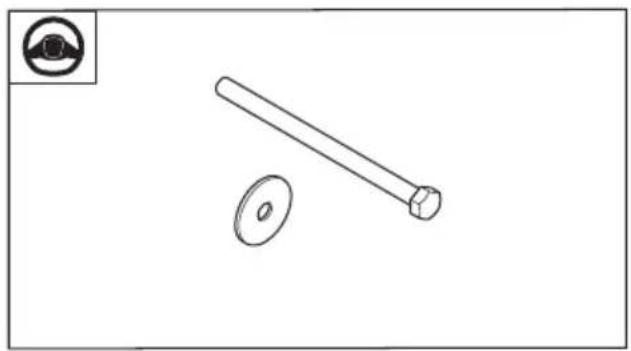
natural_image
Technical line drawing of a mechanical assembly with a bolt and washer (no text or symbols)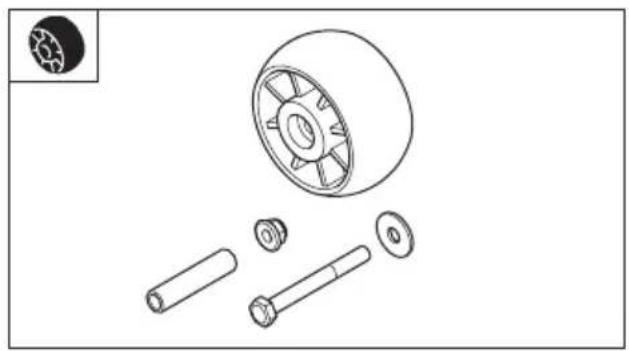
natural_image
Exploded view diagram of a mechanical component showing wheel, shafts, and bolts (no text or labels)
natural_image
Technical line drawing of a mechanical component with mounting holes and a separate inset showing a small component (no text or symbols)Instalar a calha de descarga lateral
- Solte o trinco.
- Instale as 2 porcas (D).
Ligar a bateria

natural_image
Diagram of a car intake tray with directional arrows indicating movement or force (no text or symbols)natural_image
Line drawing of a car interior showing steering wheel and dashboard (no text or symbols)natural_image
Diagram of a car gear shift mechanism showing the lever and keyway (no text or labels)Instalar as rodas antidesrelve
Funcionamento
Introdução

natural_image
Illustration of a person performing a knee press exercise with directional arrows indicating movement (no text or symbols)natural_image
Line drawing of a car's front dashboard and side gear assembly (no text or symbols)
natural_image
Simple line drawing of a rounded rectangular shape with vertical lines on both sides (no text or symbols)A
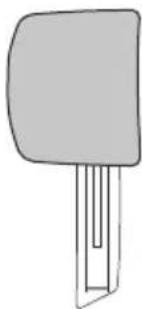
natural_image
Simple line drawing of a stylized object resembling a key or connector (no text or symbols)B

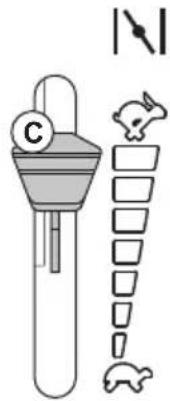
natural_image
Illustration of a medical or laboratory device with a labeled component and a separate diagram showing a rabbit, mouse, and scale (no text or symbols present)
- Empurre totalmente a alavanca para ativar o sistema de acionamento.
- Puxe totalmente a alavanca para desativar o sistema de acionamento.
b) Liberte o pedal do travão de estacionamento. - Para soltar o travão de estacionamento, carregue no pedal do travão de estacionamento e solte-o.
Utilizar o produto
natural_image
Technical line drawing of a mechanical component with a circular top and internal structure, no visible text or symbolsnatural_image
Mechanical assembly diagram showing a belt switch mechanism with inset detail (no text or labels)natural_image
Pure mechanical diagram showing a pipe joint with arrows indicating direction of motion (no text or symbols)natural_image
Technical line drawing of a mechanical component with no visible text or symbolsnatural_image
Technical line drawing of a mechanical assembly with no visible text or symbolsnatural_image
Technical line drawing of a mechanical component with threaded end and shaft (no text or symbols)natural_image
Technical line drawing of a mechanical engine component with no visible text or symbolsbar
SAE VISCOSITY GRADES | Category | SAE Viscosity Grade | |---|---| | SAE 30 | -20°-10 | | SAE 5W-30 Synthetic | -20°-10 | | SAE 10W-40 | -20°-10 | | Temperature Range Anticipated Before Next Oil Change | -40° to 0° |natural_image
Diagram showing a cable being inserted into a plastic ring, with an inset illustrating the process (no text or symbols present)natural_image
Technical line drawing of a mechanical engine component with no visible text or symbolsnatural_image
Technical line drawing of a mechanical assembly with no visible text or symbolsnatural_image
Diagram of an automotive engine component with directional arrows indicating motion or flow (no text or symbols)natural_image
Diagram of a car interior showing dashboard and intake manifold with no visible text or symbolsnatural_image
Line drawing of a car interior showing dashboard, steering wheel, and dashboard lift (no text or symbols)natural_image
Diagram of a car interior showing dashboard and intake tray with no visible text or symbolsPressão dos pneus
natural_image
Technical diagram of a vehicle's brake system showing wheel, suspension, and mounting components (no text or labels)natural_image
Technical diagram of a vehicle's front wheel assembly showing mounting brackets and tire alignment (no text or labels)natural_image
Technical line drawing of a vehicle's wheel and suspension system (no text or symbols)natural_image
Technical line drawing of a mechanical assembly with two circular components and dimension arrows (no text or symbols)
natural_image
Technical diagram of a mechanical assembly with arrows indicating directional components (no text or symbols)
natural_image
Diagram of a vehicle suspension system with a valve and directional arrow (no text or labels)natural_image
Cross-sectional diagram of a mechanical or fluidic component with an arrow indicating direction (no text or symbols present)
Ajustar as rodas antidesrelve
natural_image
Top-down technical line drawing of a tractor's front wheel and rear wheels, showing structural components and motion arrows (no text or symbols)
natural_image
Diagram of a tractor pulling a flatbed truck with arrows indicating movement or force direction (no text or symbols)natural_image
Top-down line drawing of a vehicle's front view showing tracks and structural components (no text or symbols)natural_image
Technical line drawing of a tractor with front wheel and side-mounted tractors (no text or symbols)natural_image
Technical diagram of a vehicle wheel assembly with mounting brackets and directional arrows indicating motion (no text or symbols)Armazenamento
natural_image
Illustration of a person riding an electric scooter with a crosshair, accompanied by a no-roofed vehicle (no text or symbols present)natural_image
Silhouette of a person crouching in water with bubbles and a small object nearby (no text or symbols)natural_image
Line drawings of two different boots, one showing front and side views (no text or symbols)natural_image
Technical line drawing of four mechanical fasteners (no text or symbols)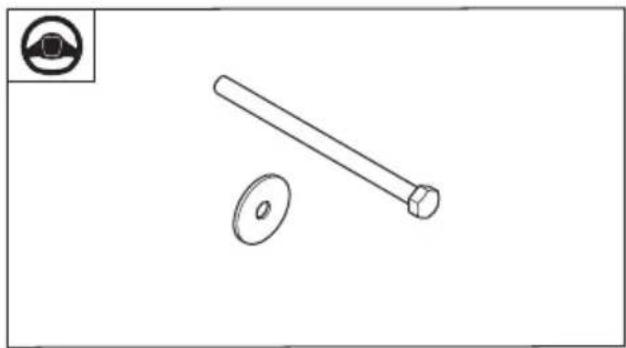
natural_image
Technical line drawing of a mechanical assembly with a cylindrical rod and washer, plus a small inset showing a circular component (no text or symbols)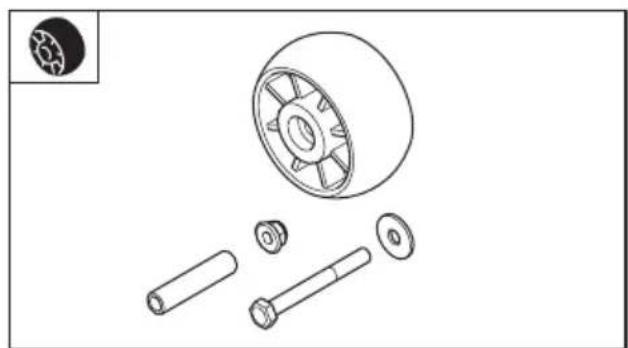
natural_image
Exploded view diagram of a mechanical component showing wheel, bolts, and shafts (no text or labels)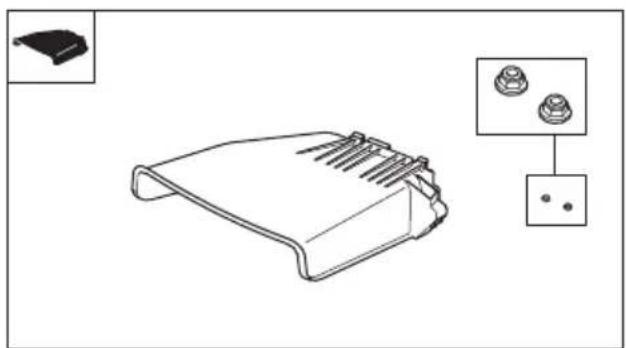
natural_image
Technical line drawing of a mechanical component with inset view (no text or symbols)natural_image
Diagram of a car interior showing dashboard and intake tray with directional arrows (no text or symbols)natural_image
Line drawing of a car interior showing steering wheel, dashboard, and seatbelt mechanism (no text or symbols)natural_image
Diagram of a car gear shift mechanism showing the lever and keyway (no text or labels)Эксплуатация
Введение

natural_image
Illustration of a person's seat with hand positions and directional arrows indicating movement (no text or symbols)natural_image
Line drawing of a car's front dashboard and steering wheel, with an inset showing a close-up of the wheel (no text or symbols)
natural_image
Technical line drawing of a mechanical component with a circular top and internal structure, no visible text or symbols.natural_image
Mechanical assembly diagram showing a shaft and gear assembly with directional arrows (no text or labels)natural_image
Pure mechanical diagram showing a pipe joint with arrows indicating direction of motion (no text or symbols)natural_image
Technical line drawing of a mechanical component with mounting holes and a directional arrow (no text or symbols)natural_image
Technical line drawing of a mechanical assembly with no visible text or symbolsnatural_image
Technical line drawing of a mechanical component with threaded end and shaft (no text or symbols)natural_image
Technical line drawing of a mechanical engine component with no visible text or symbolsnatural_image
Line drawing of a coiled cable with a connector, showing a magnified inset illustrating the process (no text or symbols)bar
SAE VISCOSITY GRADES | Category | SAE Viscosity Grade | |---|---| | SAE 30 | -20°-10° | | SAE 5W-30 Synthetic | -20°-10° | | SAE 10W-40 | -20°-10° | | Temperature Range Anticipated Before Next Oil Change | -40° to 0° |natural_image
Technical line drawing of a mechanical engine component with no visible text or symbolsnatural_image
Technical line drawing of a mechanical assembly with no visible text or symbolsnatural_image
Diagram of a car engine compartment showing internal components and directional arrows (no text or labels)natural_image
Diagram of a car gear shift lever mechanism showing key components and motion direction (no text or labels)natural_image
Interior view of a car showing the dashboard, seatbelt, and engine compartment with an inset image of a vehicle (no text or symbols present)natural_image
Diagram of a car intake tray with directional arrows indicating movement or force (no text or symbols)Давление в шинах
natural_image
Technical diagram of a vehicle's wheel assembly with mounting brackets and tire alignment (no text or labels)natural_image
Technical diagram of a vehicle's front wheel assembly showing mounting brackets and tire alignment (no text or labels)natural_image
Technical line drawing of a vehicle's wheel and suspension system (no text or symbols)natural_image
Technical line drawing of a mechanical assembly with two circular components and wavy internal features (no text or symbols)
natural_image
Technical diagram of a mechanical assembly with arrows indicating directional components (no text or labels)
natural_image
Diagram of a mechanical device with a central component and an arrow pointing to it, no text or symbols present.natural_image
Cross-sectional diagram of a mechanical or fluidic component with an arrow indicating direction (no text or symbols present)
natural_image
Top-down technical line drawing of a tractor's front wheel and rear wheels (no text or symbols)
ВНИМАНИЕ: При
natural_image
Diagram of a tractor on a flatbed trailer with arrows indicating movement or force direction (no text or symbols)natural_image
Top-down line drawing of a vehicle's front view showing tracks and structural components (no text or symbols)natural_image
Technical line drawing of a mechanical vehicle with front and rear views (no text or symbols)natural_image
Technical diagram of a vehicle wheel assembly with mounting brackets and directional arrows indicating motion (no text or symbols)Хранение
natural_image
Illustration of two people on a mobility scooter with a crossed hand, accompanied by a no-smoking sign (no text or symbols on the diagram itself)natural_image
Silhouette of a person crouching near water with bubbles and a small object, no text or symbols presentnatural_image
Line drawings of two different boots, one showing front and side views (no text or symbols)natural_image
Technical line drawing of four mechanical fasteners or bolts (no text or symbols)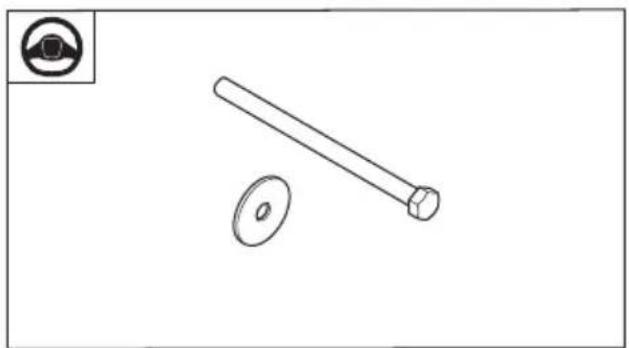
natural_image
Technical line drawing of a mechanical assembly with a shaft and washer, accompanied by a small inset circular detail (no text or symbols)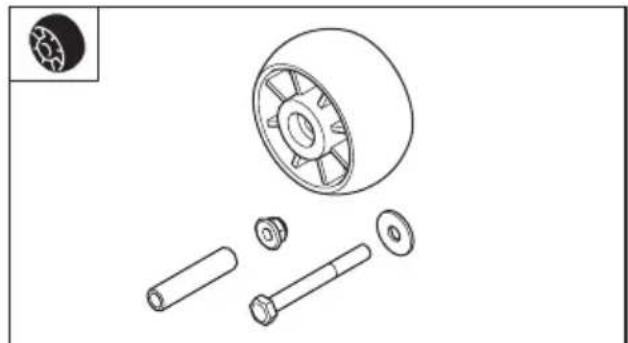
natural_image
Technical line drawing of a mechanical component with exploded view, including a wheel, bolt, and nut assembly (no text or labels)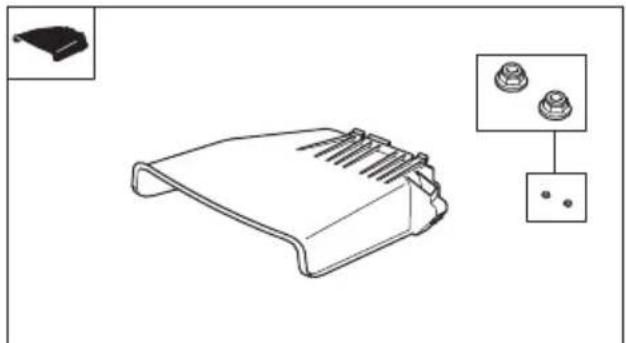
natural_image
Technical line drawing of a mechanical component with inset view (no text or symbols)安装侧排草槽
-
松开锁条。
-
安装 2 颗螺母 (D)。
连接电池

natural_image
Diagram of a car gear shift lever mechanism showing key components and motion direction (no text or labels)natural_image
Diagram of a car interior showing dashboard, steering wheel, and passenger seat (no text or labels)natural_image
Diagram of a car gear shift mechanism showing the blade and guide mechanism (no text or labels)操作
引言

natural_image
Illustration of a person's seat with arrows indicating movement or pressure points (no text or symbols)启动本产品前需要采取的措施

natural_image
Line drawing of a car interior showing the dashboard and steering wheel, with an inset showing a hand holding a bucket (no text or symbols present)

b) 松开驻车制动踏板。
- 推入 PTO 按钮可分离刀盘。
设置修剪高度
操作本产品
natural_image
Technical line drawing of a mechanical component with a circular top and internal structure, no visible text or symbols- 用刷子清除草和污垢。
拆卸和安装引擎盖
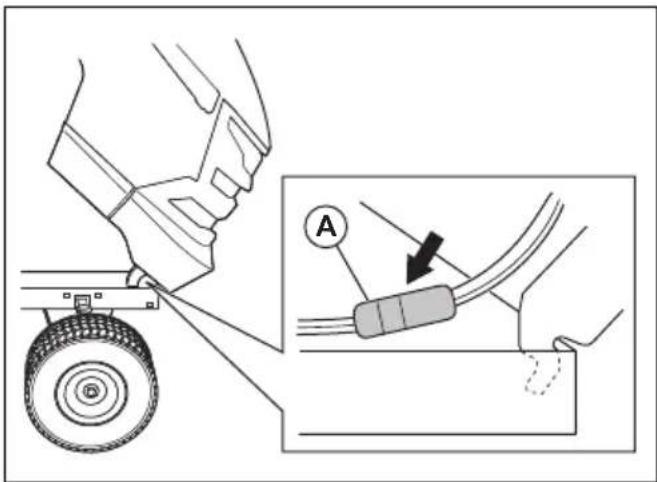
natural_image
Mechanical assembly diagram showing a shaft and gear assembly with directional arrows (no text or labels)natural_image
Pure mechanical diagram showing a pipe joint with arrows indicating direction of motion (no text or symbols)清洁和更换空气滤清器
natural_image
Technical line drawing of a mechanical component with no visible text or symbols- 小心地拆 下空气滤清器。
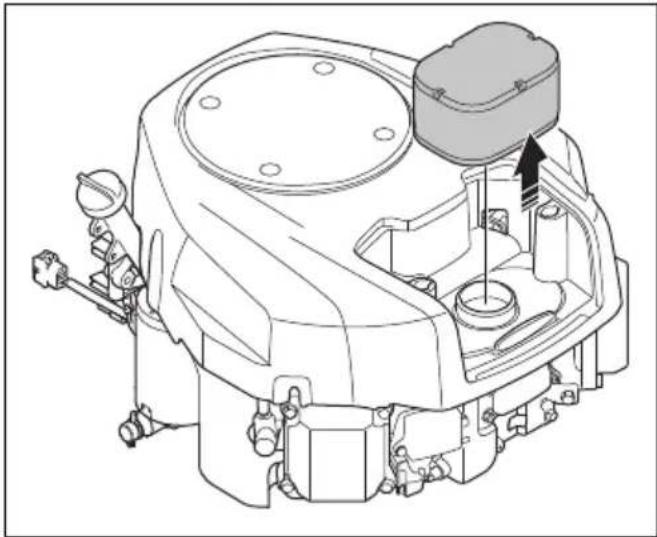
natural_image
Technical line drawing of a mechanical assembly with no visible text or symbols- 要清洁海绵空气滤清器,请执行以下步骤。
natural_image
Technical line drawing of a spark plug with threaded end and shaft (no text or symbols)natural_image
Technical line drawing of a mechanical engine component with no visible text or symbolsnatural_image
Diagram showing a cable being inserted into a plastic housing, with an inset illustrating the process (no text or symbols present)bar
SAE VISCOSITY GRADES | Category | SAE Viscosity Grade | |---|---| | SAE 30 | -20°-10° | | SAE 5W-30 Synthetic | -20°-10° | | SAE 10W-40 | -20°-10° | | Temperature Range Anticipated Before Next Oil Change | -40° to 0° |natural_image
Technical line drawing of a mechanical engine component with no visible text or symbolsnatural_image
Technical line drawing of a mechanical assembly with no visible text or symbolsnatural_image
Diagram of a car interior showing a mechanical component with directional arrows indicating motion (no text or symbols)natural_image
Diagram of a car gear shift lever system with no text or symbolsnatural_image
Interior view of a car showing dashboard, steering wheel, and passenger seat (no text or symbols)natural_image
Diagram of a car intake tray with screw holes and an upward arrow indicating motion (no text or symbols)胎压
natural_image
Technical diagram of a vehicle's wheel assembly with mounting brackets and tire alignment (no text or labels)- 拧下 3 颗螺丝,拆下右皮带护罩。
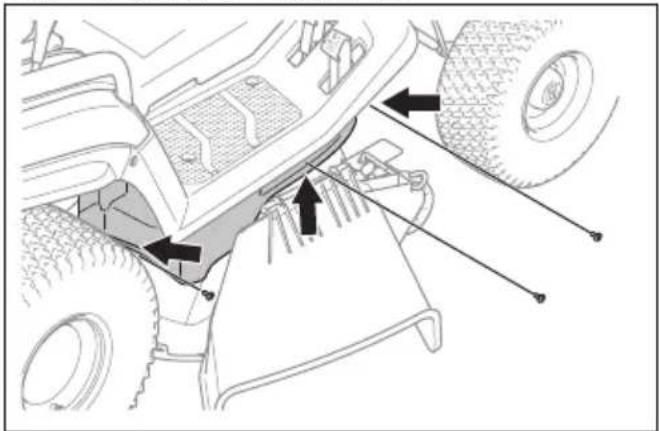
natural_image
Technical diagram of a vehicle's front wheel assembly showing mounting brackets and tire alignment (no text or labels)natural_image
Technical line drawing of a vehicle wheel assembly with a belt and tire, showing no text or symbolsnatural_image
Technical line drawing of a mechanical assembly with two wheels and a central shaft, showing dimension X (no text or symbols)
natural_image
Technical diagram of a mechanical assembly with arrows indicating movement or force (no text or symbols present)natural_image
Pure mechanical component diagram without any text, numbers, or symbols

natural_image
Diagram of a car door lock mechanism with an arrow indicating clockwise motion (no text or symbols present)注意:前连杆位于产品前部,消音器后面。
natural_image
Cross-sectional diagram of a mechanical or fluidic component with an arrow indicating direction (no text or symbols present)
natural_image
Top-down technical line drawing of a tractor's front wheel and rear wheels (no text or symbols)
natural_image
Diagram of a tractor on a flatbed trailer connected to a truck, with arrows indicating movement or force direction (no text or symbols present)natural_image
Technical line drawing of a vehicle front view showing tracks and structural components (no text or symbols)natural_image
Technical line drawing of a mechanical assembly with mounting brackets and wheels (no text or symbols)natural_image
Technical diagram of a vehicle wheel assembly with mounting brackets and directional arrows indicating motion (no text or symbols)存放
Original instructions