
Basic 300-50 - Compressor METABO - Free user manual and instructions
Find the device manual for free Basic 300-50 METABO in PDF.


| Product type | Lubricated piston compressor |
| Brand | Metabo |
| Model | Basic 300-50 |
| Maximum pressure | 8 bar |
| Tank capacity | 50 L |
| Supply voltage | 230 V ~ 50 Hz |
| Rated input power (P1) | 1500 W |
| Effective delivery (Leff) | 150 L/min |
| Guaranteed sound power level (LWA(G)) | 97 dB(A) |
| Lubrication | Oil |
| Oil quantity | Approx. 0.3 L |
| Dimensions (L x W x H) | 600 x 350 x 600 mm |
| Weight | 28 kg |
| Number of air outlets | 1 quick coupler |
| Operating mode | Continuous duty (S1) |
| Recommended fuse | 16 A |
| Operating temperature range | +5 °C to +40 °C |
| Storage temperature range | -20 °C to +40 °C |
| Standard equipment | Pressure gauges, pressure regulator, safety valve, air filter, condensate drain |
| Included accessories | Wheels, rubber feet, transport handle |
Frequently Asked Questions - Basic 300-50 METABO
User questions about Basic 300-50 METABO
0 question about this device. Answer the ones you know or ask your own.
Ask a new question about this device
Download the instructions for your Compressor in PDF format for free! Find your manual Basic 300-50 - METABO and take your electronic device back in hand. On this page are published all the documents necessary for the use of your device. Basic 300-50 by METABO.
USER MANUAL Basic 300-50 METABO
Original Instructions
Contents
1.Declaration of Conformity
2. Specified Use
3.General Safety Instructions
4.Special Safety Instructions
5.Overview
6. Commissioning
7. Operation
8.Care And Maintenance
9.Repairs
10.Environmental Protection
11.Troubleshooting
12. Technical Specifications
1. Declaration of Conformity
We, being solely responsible: Hereby declare that these compressors, identified by type and serial number 1 , meet all relevant requirements of directives 2 and standards 3 . Measured LWA(M) / guaranteed LWA(G) sound power level 4 , technical documentation for *5 - see page 4.
For UK only:
UK We as manufacturer and authorized person to compile the technical file, see 5) on page 4, hereby declare under sole responsibility that these compressors, identified by type and serial number 1) on page 4, fulfill all relevant provisions of following UK Regulations S.I. 2016/1091, S.I. 2008/1597, S.I. 2012/3032, S.I. 2001/1701 and Designated Standards 3), Measured LWA(M) / Guaranteed LWA(G) sound power level 4) - see page 4.
2. Specified Use
This tool is used for the generation of compressed air for professional tools powered by compressed air.
The use in the medical and food sector as well as refilling of oxygen tanks is not permitted.
Explosive, flammable or harmful gases must not be aspirated. Operation in potentially explosive rooms is not permitted.
Any other use does not comply with the intended purpose. Unspecified use, modification of the pump or use of parts that have not been tested and approved by the manufacturer can cause unforeseeable damage!
Children, adolescents and untrained persons must not use the machine and the connected compressed air tools.
Operate the device only unter supervision.

Only for use in indoor rooms.
3. General Safety Instructions
WARNING - Reading the operating instructions will reduce the risk of injury. General Safety Instructions
WARNING - Read all safety warnings and instructions. Failure to follow all safety warnings and instructions may result in electric shock, fire and/or serious injury.
Save all safety warnings and information for future reference! Pass on your power tool only together with these documents. You and all other users must be able to inform yourselves at any time.
3.1 Work area safety
a) Keep work area clean and well lit. Cluttered or dark areas invite accidents.
b) Do not operate the device in explosive atmospheres, such as in the presence of flammable liquids, gases or dust. Tools create sparks which may ignite the dust or fumes.
c) Keep children and other persons away while operating the device.
3.2 Electrical safety
a) Tool plugs must match the outlet. Never modify the plug in any way. Unmodified plugs and matching outlets will reduce risk of electric shock.
b) Avoid body contact with earthed or grounded surfaces, such as pipes, radiators, ranges and refrigerators. There is an increased risk of electric shock if your body is earthed or grounded.
c) Do not expose power tools to rain or wet conditions. Water entering a power tool will increase the risk of electric shock.
d) Do not abuse the cord. Never use the cord for carrying, hanging or unplugging the tool. Keep cord away from heat, oil, sharp edges or moving parts. Damaged or entangled cords increase the risk of electric shock.
e) When operating a power tool outdoors, use an extension cord suitable for outdoor use.
Use of a cord suitable for outdoor use reduces the risk of electric shock.
3.3 Personal safety
a) Stay alert, watch what you are doing and use common sense when operating a tool. Do not use a tool while you are tired or under the influence of drugs, alcohol or medication. A moment of inattention while operating power tools may result in serious personal injury.
b) Use personal protective equipment. Always wear eye protection. Protective equipment such as a dust mask, non-skid safety shoes, hard hat or hearing protection, depending on the type and application of the tool, will reduce personal injuries.
c) Prevent unintentional starting. Ensure the switch is in the off-position before connecting to power source and/or battery pack, picking up or carrying the tool. Carrying power tools with your finger on the switch or energising power tools that have the switch on invites accidents.
d) Remove any adjusting key or wrench before turning the power tool on. A wrench or a key left attached to a rotating part of the power tool may result in personal injury.
e) Do not overreach. Keep proper footing and balance at all times. This enables better control of the tool in unexpected situations.
f) Wear appropriate clothing. Do not wear loose clothing or jewellery. Keep your hair, clothing and gloves away from moving parts. Loose clothes, jewellery or long hair can be caught in moving parts.
h) Do not let familiarity gained from frequent use of tools allow you to become complacent and ignore tool safety principles. A careless action can cause severe injury within a fraction of a second.
3.4 Tool use and care
a) Do not force the power tool. Use the correct tool for your application. The correct tool will do the job better and safer at the rate for which it was designed.
b) Do not use the tool if the switch does not turn it on and off. Electrical devices that can no longer be switched on or off are dangerous and must be repaired immediately.
c) Disconnect the plug from the power source and/or the battery pack from the tool before making any adjustments, changing accessories, or storing tools. Such preventive safety measures reduce the risk of starting the power tool accidentally.
d) Store idle tools out of the reach of children. Do not allow persons unfamiliar with the device or these instructions to operate the device. Devices are dangerous when used by inexperienced personnel.
e) Maintain power tools and accessories with care. Check that the moving parts are functioning properly and do not jam, that there is no breakage of parts or any other condition that may affect the device's operation. If damaged, have the device
repaired before using. Many accidents are caused by poorly maintained power tools.
g) Use the power tool, accessories, tool bits etc. in accordance with these instructions. Take into account the working conditions and the work to be performed. Use of the power tool for operations different from those intended could result in a hazardous situation.
h) Keep handles and grasping surfaces dry, clean and free from oil and grease. Slippery handles and grasping surfaces do not allow safe handling and control of the tool in unexpected situations.
3.5 Service
a) Have your device serviced by a qualified repair person using only genuine replacement parts. This will ensure that the device functions safely.
3.6 Additional Safety Instructions
- These operating instructions are intended for people with basic technical knowledge in handling machines such as the one described here. If you have had no experience with machines of this kind, you should initially work under the supervision of people with previous experience.
- The manufacturer bears no liability for damage caused by non-compliance with these operating instructions.
Information in these operating instructions is designated as shown below:

Danger!
Risk of personal injury or environmental damage.

Risk of electric shock!
Risk of personal injury from electric shock.

Caution!
Risk of material damage.
4. Special Safety Instructions
The following residual risks basically exist for compressed air tools and cannot be remedied completely even with safety installations:
4.1 Danger of injury due to escaping compressed air and parts, which are carried along by compressed air!
- Never direct compressed air on people or animals.
- Ensure that all compressed air tools and accessories used are designed for the working pressure or can be connected via a pressure reducer.
- When loosening the quick coupling pay attention that the compressed air contained in the compressed air hose escapes suddenly. Therefore get a firm grip of the end of the compressed air hose to be loosened.
- Ensure that all screwed connections are always tightened properly.
- Do not attempt to repair the pump yourself! Only professionals may carry out repairs on compressors, compressed containers and compressed air tools.
4.2 Danger from compressed air containing oil! (Basic 200-24, Basic 250-50, Basic 300-50, Basic 400-50 V)
- Use compressed air containing oil exclusively for compressed air tools, which are designed for compressed air containing oil.
- Use a compressed air hose for compressed air containing oil not for compressed air tools, which are not designed to be used with compressed air containing oil.
- Do not fill any car tyres etc. with compressed air containing oil.
ENGLISHen
Oil particles can be removed from the compressed air by means of appropriate filters. This permits the use of an oil-lubricated compressor even for compressed air tools requiring oil-free compressed air.
4.3 Risk of burns at the surfaces of the parts bearing compressed air!
- Let the tool cool down prior to the servicing work.
4.4 Risk of personal injury and crushing by moving parts!
-
Do not operate the tool without installed guards.
-
Keep in mind that the tool starts up automatically when the minimum pressure is reached! - Ensure the tool is disconnected from power before servicing.
- Ensure that when switching on (e.g. after servicing) no tools or loose parts are left on or in the tool.
4.5 Hazard generated by insufficient personal protection gear!
Wear hearing protection.
Wear protective goggles.
Wear a breathing mask for applications generating dust or when harmful gases, mist or vapours are generated.
Wear suitable work clothes.
- Wear non-slip footwear.
4.6 Hazard generated by tool defects!
- Keep tool and accessories in good repair. Observe the maintenance instructions.
- Prior to each use check the tool for any eventual damage: Before continuing to use the tool, safety devices, protective devices or lightly damaged parts must be carefully inspected for correct and proper operation. A damaged device must only be reused after it has been correctly repaired.
- Check to see that all moving parts work properly and do not jam. All parts must be correctly installed and fulfil all conditions necessary to ensure perfect operation of the unit.
- Damaged protection devices or parts must be repaired or replaced by a qualified specialist.
4.7 Additional Safety Instructions
- Please also observe the special safety instructions in the respective chapters.
- Observe any particular health and safety or accident prevention regulations governing the use of compressors and compressed air tools.
- Observe the legal provisions for the operation of systems requiring monitoring.
- Keep in mind that escaping condensate and other consumables contaminate the surrounding area and may trigger damage to the environment during operation and storage of the tool.
- Consider environmental conditions:
4.8 Symbols on the machine

Read the operating instructions.

Warning of personal injury by touching hot parts.
Wear eye goggles

Wear ear protectors.

Warning of automatic startup.

Danger - electrical voltage.
Guaranteed sound power level.
4.9 Safety devices
Safety valve
The safety valve (9) activates if the permitted maximum pressure is exceeded.
5. Overview
See page 2. The illustrations serve as examples for all devices.
1 ON/OFF Switch
2 manometer control pressure
3 manometer boiler pressure
4 pressure regulator
5 connection for compressed air (quick coupling), regulated compressed air
6 Area for storing tire inflator accessories and impact driver socket spanners.
7 compressor
8 air filter / air filter housing
9 safety valve
0 pressure vessel
1 condensate outlet
2 Clamping screws for the transportation handle (left and right)
3 Transportation handle
4 Hook for storing the pressure hoses *
5 Hook for storing pneumatic tools
6 Cable winder
7 Clip for securing the cable
8 Motor protection switch
9 oil sealing plug
20 oil discharge plug *
21 oil inspection glass
depends on model / equipment
Note: accessories shown are not included in the scope of delivery.
6. Commissioning
6.1 Assembly
- Mount the tyres as shown (see fig. A, page 3).
- Mount the rubber feet as shown (see fig. B, page 3).
6.2 Basic 400-50 V: Mounting the air filter housing
This can be mounted on both sides of the device. See fig. C, page 3.
- Screw the air filter housing (a) onto the device as shown using the enclosed screw (b).
- Insert an air filter in the air filter housing.
- Close the cover.
6.3 Check condensate outlet
Ensure that the condensate outlet (11) is closed.
6.4 Filling with oil
(Basic 200-24, Basic 250-50, Basic 300-50, Basic 400-50 V)
see fig. F, page 3.
IMPORTANT! After unpacking / before initial commissioning: unscrew the screwed in, short TRANSPORT sealing plug (c), dispose of it, and replace it with the enclosed, long oil sealing plug (19).
Oil quality and quantity (approx. details) see chapter 12. Technical data.
- Unscrew the oil sealing plug (19).
- Fill oil up to the centre of the oil inspection glass (21) or the marking.
- Screw the oil plug (19) back in.
6.5 Installation
The positioning site of the device has to meet the following requirements:
Dry, protected from frost
- Stable, horizontal and even surface

Danger!
Wrong positioning might cause serious accidents.
-
Secure the device against rolling away, tilting and slipping.
-
Safety installations and operating elements have to be easily accessible at any time.
(Basic 200-24, Basic 250-50, Basic 300-50, Basic 400-50 V) Do not lay the device on its side. Oil might leak out!
6.6 Transport
(Basic 200-24, Basic 250-50, Basic 300-50, Basic 400-50 V) Do not lay the device on its side. Oil might leak out!
(Basic 250-50, Basic 300-50, Basic 400-50 V) Unscrew the left and right (12) clamping screws, pull the transportation handle (13) to the front position, and tighten the clamping screws (12) once again.
Transport the device at the transport handle (13). Do not pull the device using the hose or mains cable.
7. Operation
7.1 Power-supply connection

Danger! High voltage.
Operate the device in dry surroundings only.
Operate the device only at a power source meeting the following requirements: Wall sockets installed according to regulations, earthed and tested; fuse protection according to the technical data.
Position power supply cable so it does not interfere with the work and is not damaged.
Check every time if the device is switched off, prior to plugging the mains plug into the socket outlet.
Protect power supply cable from heat, aggressive liquids and sharp edges.
Use only extension cables with sufficient core cross-section (see chapter 12. Technical Data).
Use extension cables for outdoor areas. When working outdoors, only use the correspondingly marked extension cable approved for this purpose.
Do not switch off the compressor by pulling the mains plug, but use the ON/OFF switch.
Always install an RCD with a maximum trip current of 30mA upstream.
7.2 Generate compressed air
- Switch on the device using the ON/OFF switch (1) and wait, until the maximum boiler pressure has been reached (compressor switches off). The boiler pressure is shown at the boiler pressure manometer (3).
Set the control pressure at the pressure reducer (4). The current control pressure is shown at the control pressure manometer (2).

Attention!
The set control pressure must not exceed the maximum operating pressure of the connected compressed air tools!
- Connect the compressed air hose at the compressed air inlet (5).
- Connect the compressed air tool. Now you can work with the compressed air tool.
- Switch off the tool if you don't want to continue working immediately. Afterwards pull the mains plug.
- Drain the condensed water of the pressure vessel at the condensate outlet (11) on a daily basis.
8. Care And Maintenance

Danger!
Prior to all servicing:
Switch machine off. Disconnect the mains plug. Wait until the device has stopped. Ensure that there is no more pressure on the device and all used compressed air tools and accessories.
Leave the device and all used compressed air tools and accessories to cool down.
After to all servicing:
Put back into operation and check all safety installations. Ensure that there are no tools or similar at or in the device.
Repair and maintenance work other than described in this section should only be carried out by qualified specialists.
8.1 Important information
Maintenance and test have to be planned and carried out in accordance with the legal provisions in line with the setup and mode of operation of the device.
Regulatory authorities may ask to view respective documentation.
8.2 Regular maintenance
Prior to every start
- Check compressed air hoses for damage and replace, if necessary.
- Check that all screw fittings are seated securely, and tighten if necessary.
- Check connection cables for damage, and, if necessary, have it replaced by a qualified electrician.
Daily
- Drain the condensed water of the pressure vessel at the condensate outlet (11). Note: the formation of small plugs of ice is normal.
Every 50 hours of operation
- Check function of the safety valve (9): The tank must be pressurised (preferably at least 80% of the maximum pressure). Turn the knurled screw of the safety valve (9) by hand in anti-clockwise direction until you can clearly hear compressed air escaping. Close the safety valve (9) again, tighten the knurled screw by hand in clockwise direction until the stop. If no compressed air escapes even when the safety valve is completely open, switch off the compressor and do not continue to operate for safety reasons! Have the safety valve (9) replaced, see chapter 9. Repairs.
Clean air filter (8) (see fig. D, page 3).
(Basic 200-24, Basic 250-50, Basic 300-50, Basic 400-50 V) Check the oil level in the compactor through the oil inspection glass (21) add oil if necessary. (See chapter 6.)
Every 250 hours of operation
- Clean air filter (8) or replace (see fig. D, page 3).
Every 500 hours of operation
-(Basic 200-24, Basic 250-50, Basic 300-50, Basic 400-50 V) Drain all oil using the oil discharge plug (20) and replace. (See chapter 6.)
Every 1000 hours of operation
- Have an inspection carried out in an authorised service centre. This significantly increases the service life of the compressor.
8.3 Storage of device
- Switch off the device and pull mains plug.
- Depressurise the pressure vessel and all connected compressed air tools.
- Drain the condensed water of the pressure vessel at the condensate outlet (11).
- Store the device in such a way that unauthorised persons cannot start it.
- (Basic 200-24, Basic 250-50, Basic 300-50, Basic 400-50 V) Do not lay the device on its side. Oil might leak out!

Attention!
Do not store the tool outdoors or in damp conditions without protection.
Danger of frost

Attention!
Frost (< 5^) destroys the pump and accessories as both always contain water! If there is a danger of frost disassemble pump and accessories and store in frost-free conditions.
9. Repairs

Danger!
Repair of tools must be carried out by qualified electricians only!
If you have Metabo devices that require repairs, please contact your Metabo service centre. See www.metabo.com for addresses.
You can download a list of spare parts from www.metabo.com.
10. Environmental Protection

Danger!
The condensed water from the pressure vessel contains oil residue and/or contaminations hazardous to the environment. Dispose of the condensed water in an environmentally-friendly manner using respective collection sites!

Danger!
(Basic 200-24, Basic 250-50, Basic 300-50, Basic 400-50 V) Dispose of used oil from the compressor in an environmentally-friendly manner at an appropriate collection site!
Observe national regulations on environmentally compatible disposal and on the recycling of disused machines, packaging and accessories.
Packaging materials must be disposed of according to their labelling in accordance with municipal guidelines. Further information can be found at www.metabo.com in the "Service" section.

Only for EU countries: Never dispose of devices in your household waste! In accordance with European Guideline 2012/
19/EU on used electronic and electric equipment and its implementation in national legal systems, used devices must be collected separately and returned for environmentally compatible recycling.
11. Troubleshooting

Danger!
Prior to all servicing:
Switch machine off. Disconnect the mains plug Wait until the device has stopped. Ensure that there is no more pressure on the device and all used compressed air tools and accessories. Leave the device and all used compressed air tools and accessories to cool down.
Any works other than the ones described in this chapter, must be carried out only by a qualified electrician or the service branch in your country.
After to all servicing:
Put back into operation and check all safety installations. Ensure that there are no tools or similar at or in the device.
Compressor does not run:
- No mains voltage.
- Check cables, plug, outlet and mains fuse.
- Mains voltage too low.
- Use only extension cables with sufficient core cross-section (see chapter 12. Technical Data). For cold device: Avoid extension cable. For cold device: Depressurise the pressure vessel.
- Compressor was switched off by pulling the mains plug while it was running.
- First, switch off the compressor using the ON/OFF switch (1), then switch on again.
- Motor overheated, e.g. due to insufficient cooling (cooling ribs covered).
- Check the (18) motor protection switch: see fig. E, page 3.
- If the pin of the motor protection switch is clearly visible, the motor protection has been triggered. In this case: 1.) Switch off the compressor using the ON/OFF switch (1). 2.)
Wait 10 seconds. 3.) Reset the motor
protection switch (18) by pressing it. 4.) Switch on the compressor again using the ON/OFF switch (1).
- If the pin of the motor protection switch is pressed in: 1.) Switch off the compressor using the ON/OFF switch (1). 2.) Wait 20 minutes. 3.) Switch on the compressor again using the ON/OFF switch (1).
Compressor runs without building up sufficient pressure.
- Condensate outlet leaking.
- Ensure that the condensate outlet (11) is closed.
- Check valve leaking.
- Have check valve serviced in authorised service centre.
Compressed air tool does not get enough pressure.
Pressure controller not open enough.
- Open pressure controller (4) further.
- Hose connection between compressor and compressed air tool leaking.
- Check hose connection; if required replace damaged parts.
12. Technical Data
Explanatory notes on the specifications on page 3. Changes due to technological progress reserved.
A=suction capacity
F =filling capacity
L_ eff =Effective output volume at 80% max. pressure
p = max. pressure
V = vessel size
a = number of air outlets
z = number of cylinders
n0 =max.speed
P1 =rated input power
B=short time duty
U = connection voltage
I=rated power
F_ =min. fuse protection
IP =protection class
G =maximum overall length and core cross-section of extension cables
A=dimensions(lxwxh)
Tmax=max. storage / operating temperature
Tmin =min. storage / operating temperature
Oil =oil quantity and quality for oil change
depends on model)
m =weight
= The service life of some components e.g. seal in check valve is significantly reduced, if the compressor is operated at high temperatures (max. storage / operating temperature and higher)
* = At temperature below the min. storage / operating temperature, there is danger of frost for the condensate in the pressure vessel.
The technical specifications quoted are subject to tolerances (in compliance with the relevant valid standards).
A Emission values
These values make it possible to assess the emissions from the device and to compare different devices. The actual load may be higher or lower depending on the operating conditions, the condition of the device or the accessories. Please allow for breaks and periods when the load is lower for assessment purposes. Arrange protective measures for the user e.g. organisational measures based on the adjusted estimates.
Typical A-effective perceived sound levels:
LDA =sound-pressure level
LWA =acoustic power level
LWA(G) = guaranteed acoustic power level as per EN ISO 3744 2010; EN ISO 2151:2008
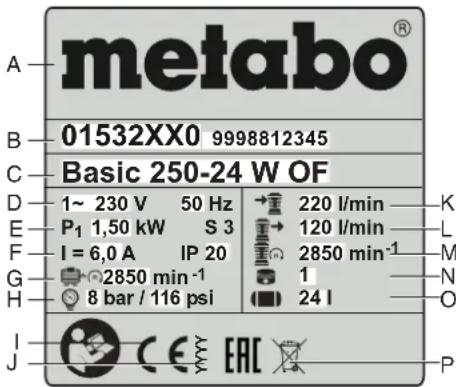
Information on the nameplate:

A Manufacturer
B Item, version, serial number
C Machine designation
D Connection voltage / frequency
E Rated input power
F Rated power / protection type
G Max. speed
H Max. pressure
ICE mark - This machine conforms to the EC directives as per Declaration of Conformity
J Year of manufacture
K Suction capacity
L Filling capacity
M Compressor speed
N Number of cylinders
Boiler size
P Disposal symbol (see chapter 10.)
Notice originale
Sommaire
WAARSCHUWING - Lees de
Varning for livsfarlig elspanning!
Garanterad ljudeffektniva.
Opate npootatetukyauaia

ΦopATE wtoaonTIDEC.

PpoeiDOnoiOn ano ev6xOeVn autouat Ekkivnon.
PpOeIsooino ano EπiKivduynn λεκτρικ ταση.
Eyyunévnαθμnnxntknc anódoans.
4.9 Diataeic aoaepiaes
Baβiδa αφαλεις
H baIbIa aorbaeiaac (9) evpyoTeiitai, otavivetai unepbaon mC entpentouevns meyioTNCieic.
5. Eπιοκόπησ
BAEIe 35a2. Oi ekovc ioxouv Uoiuivuikia via oec Tc uokuec.
1 Dlakonns ON/OFF
Leff =Eeoynnoo0nta npaoxnc 8% mey. n
p=Mεγ.πiεση
V=Meye8o8doxieou
Oil = NooctnKa Ka noiotnλaiou KaTa
Tn aalayn laiou (avaloya mto ouvtel
m=Bapoc
^* = H diapkeia zwo n opouevwv exapntmuatw .x. nTeayavonoi nTc BaIiOa aventiotpofnc
eAattweTAtOnuavtika, otav o ouuTieOTC
Leitoupye ae uynLec eepokpaiec (muy.
Thepokpaia anohtkeuoc kai leitoupyiac
kaowkui nploTepc).
Tuttikcs nxntikcs otahees A:
LpA =2tαθμηnxntiknc nieons
LWA =∑τaθμn nxtikns xuos
LWA(G) =yyunmev nστaθun nxntnck ioxuoc ouμφων aε tyn odηγia EN ISO 3744 2010;EN ISO 2151:2008
K_pA , K_WA = A a i n a
Φopáte wtoaoníδεc!
Micue BCTaHOBHeHH NOBHHo BiNObiDaTH HabeEHMMHxKHe BmOrAM.
Cyxe,3axuheBIMopo03y
-MiHa,Topn3OHTaJIbHaipibHaOCHOBA

He6e3nega!
Yepe3 HnnpaBnIbHe BCTaHOBLeHnH MoKJIbBi Heuachi BnnaKn 3 TReKKMm TpaBMamN.
-3akpinnt npnlaD BiD BiKOhyBaHHa, nepeKnuHaHr Ta KOB3aHH.
-Do 3aNo6HHNx npHCTPOIB Ta eJEMeHTIb KepyBaHnO NobHHe 6Ty nocTlHn HaJeKHN doCTyn.
-Basic 200-24,Basic 250-50,Basic 300-50, Basic 400-50V)3a6oPnoHReTbcra KnaCTn npnad ha6K. MoKe BVtKnATn OINBa!
6.6 TpaHcnpTyBaHHA
(Basic 200-24, Basic 250-50, Basic 300-50, Basic 400-50 V) 3a6bopohReTbCra KlaCTn npHaI na 6iK. MoKe BVtIKaTIOnIINA!
(Basic 250-50, Basic 300-50, Basic 400-50 V)
Bɪdʒpɪtɪnɪ 3aɪtɪcʌhɪrɪrɪnɪ (12) 3ɪlɪbaɪ cɪnpəbɑː, nɔcŋyɪnɪ pyɪkɪy dɪŋ Tpaɪhɒpɪtybɑːnɪ (13) y nepeŋdɪne nɔlɒkɛhɪnɪ, 3hOby 3aɪrɪhʊntɪ 3aɪtɪckHɪrɪnɪ (12)
TpaHcnpTyBaTH npnlaed Heo6xidHO 3a pyHy nIra TpaHcnpTyBaHHA (13).3abOpOHeo TnHyTN npnlaed 3a WnaHr abo KaabeB JXHBLeHHA.
7. Eknnyatauaia
7.1Пднluоehнdo eelktpomepeki

He6e3neHa!EeKtpnHa Hanpyra.
BukopncToByTe npnlaad IInwe y cyxomy cepedobu.
IeKcNlyataui npnAdu BHKOpHCTOByHe IJIue DKepeNo CTpyM,UO 3aIOBOJIbHRe TAHIM BmOrAM: BCTAOHObEHi BiIOBIOHDo IO pnpINcIB POzETNI 3a3EMHeI Ta nepebiEHI;3an06HHNBIIOBIAeTexHCHM XapAKTePncTHAM.
POKnadaTKeKabeIbXINBHeHHrTaK,Uo6BInHE 3aBaKaB nppoBoTi I He Ml8yTn NIOkOxHenn B XOJI EKnIyatauJI.
IopəaTy nepeBipriTe, uN BmKHeHO npnlaD, nepEd NiKDIOHcHbM MepEkeBOrO wTeKepa Do pOsetNI.
3axuataMepeKaeBnKa6bBidHarpibHHa arpecBnpxpiinTa roctpux Kpaib.
BnHOpNCTOByIte NLIe NObOByBaIbHNi KaBeJIb 3 DOCTaTHIM NOpEpyHmIpePfIcM (DIN. pO3J12. TExHHYXI XapaKTepNCTHNI).
He BIMNKaIte KOMPpeCop, TReHnyu MEpeXeBn WTeKeP, BIKOPNCTOByTE BIMNKaY.
3aBxHnPiKlnuOaIe npncTpi 3axnCHoro BiDkIyueHHN (13B) 3 MaKcHMaJIbHMM CTpyMOM BNTOKY 30 MA.
7.2 CTBOPEHRA CTUHCHEO NOBITPA
- YBIMHKHITb npnlaD BmHKaem (1) i 3aueKaHTe, NOKI Byde DOcRHYTO MAKCHMaJbHOrTO TCHy B KOTJI (Homnpcecop BMKKHeTBcR). TCHy KOTJI BiDOpbaKaETbCR Ha MaHometpi TCHy B KOTJI (3).
HaiaaHTyTe TnCK perynIOBaHH Ha perynIToPi TnCKY (4).TnOtuHn TnCK perynIOBaHH BIDobpaHaetbca Ha MaHOMeTpI TnCKy perynIOBaHH (2).

ybara!
HanaaltoBaHH Tnck peRyIbOaHH He NOBHe HnepeBnUBAHTM KACmHaBnPo6oBuNTHnK npeHAnHO TnHEBMaTtHOrHO IcHpyMeHTa!
2.Пибдайе пHEBMATNCHHшлангdo 3'EDAHHHДЯпIDBeDEHнCTNCHeHOro nobITpr(5).
3.Ппсднaite ПнБMaTnHm iHCTpyMent. TenermpMOKHa npaQOBaTn 3 nHEBaMaTHnHIM IHCTpyMeHToM.
4.BMnKHtB npNlaJ,KnIO He 36npaTeceb 3 Nm npaOBoT daJI. IOTm TAKOH BIDcDnHTe MepeXeBn WTeKeP.
5. UoHNO 3nBaIte KOHdEHCAT 3 pecnBepa uepe3 OTbip BiDBeEHN KOHDeHCaty (11).
8. Texhiye 06cnyrobyBaHHa I DOrna

He6e3neHa!
Pepe 6ydb-aknmu po6oTAmu 3 npHnaDom: BmKHHbIh hCTpyMeHT. BtAryHb MepeKeBm Wteep 30e3Kn. 3aeeKaTe NOBHO 3ynHKn npNAdy. PepeKHaTEc, yO npNAdTa y
BCIX BIKOPNCTOByaHIN NHEBMATMHIN
iHCTPymeHTax Ta npnlaDi BiCyTHI TNCK.
JaTe npnlaDu Ta BCIM BIKOPNCTOByaHIM
NHEBMATMHIN iHCTPymeTAm Ta npnaDIO
OXOLOHYTN.
NicBcx po6it 3 npnlaqom:
3HOByaHTbByBaTHi npeBepHTn Bci 3axnChi npCTpoI. PpeKoHaTeC, uO Ha npUlaDi a6o BV hOmy HEme iHCTpymEtTIB a6o nOdiOnHX npEdMetTIB.
OncaHbIbOMyPO3JIiPO60Tn3TEXIHNOHO 06cIyROyBAHHI pEmoHTyO3BOJREtbcra BIKOHByaTNIIbKnAqBImr.
8.1 BaJIbIbIaIHΦOpMaIaI
TexobcyrobyaHnra nepeBipkn NoTpi6ho nlaHybATn Ta BHKoHybTN BiNObIDHO 3aHOJdABHx HOpM 3aJIeXHO BiMicu BCTaHOBHeHHra cnOco6y eKcnNyatau npnilady.
OprHnHarJMyMOHybBMaraTnHaDaHHBIDNOBIDHXDOKyMENTIB.
8.2 PerylneTexnue 06cnyrobyBaHH
Ipeep KOHHM NOaTHOM po60Tu
- IpekoHaTncs, uo nheMaTuHnI uHaHn He nookdKeH, y pa3i notpe6n 3amInHTN.
- IpebeipnHaJIiHicb 3aTaryBaHHp3b6oBnx 3'EDHaHb, y pasi nOtpe6n 3aTaryHytn.
- Ipekeohatnc, 10 Ka6eJIb IIikHIOueHHn DO eKHTPOMepEchi He NtIKoDKHeHn, y pa3i NOTpeBn 3aMIHN, DOpYuBwN 3aMHy npOphiCINHOeHTpNIk.
UoDehHo
-3IINBaIte KOHDeHCat HanipHOI EMHOCTI 3I 3INBy IAN KOHNHeHCATy (3).PnIMiTHa: yTBOpEHN HEBeJIKNK X KPNJKAHX NpO6OK E HOPMaIbHmRABIIeM.
Hoxhi 50 roaHH po6oTH
- IpeBiptnp oboTy 3anobixHoro Klanana (9): KOTeI NOBHeH bTy NID TnKOM (6aKaHO OoHaMeHwe 80% BiM CaMcMaIbHO). NobepHyT bpyHy rBnHT 3 HaKataHOO roLOBKO 3anobixHoro Klanana (9) npotn DOnHHNkoBO CIptiHN, noH He 6yde CyTHo, Rk BxNOdtb CTnCHeHE nobITpr. 3HOBy 3akpnTH 3anobixHn Klanah (9): 3akpyTnT rBnHT 3 HAKATAHOO RoLOBKO BO BpyHy 3a DOnHHNkoBO CTPIKHO DO ynOpy. RaIO CTnCHe HOBtPr He BNXoDHT, HabITb KOIN 3anobixHn Klanah NoBHCTHO BlKpnTH, BmKHytN KomPecop i 3 MIPkyBaHb 6e3neHn He BnKOpNCTOBYBaTN npnIad! 3amHnT 3anobixHn Klanah (9) (nB. po3di n 9. «PeMOHT»).
-NTNIOBITPRAHNIΦIbTp(8)(INB.MaI.D,CTOp.3).
-(Basic 200-24, Basic 250-50, Basic 300-50, Basic 400-50 V) NpebeipitpiieHb OINB u KOHNecatopi 3a donomoroo KOHTPOlbHO r cNla (21), y pa3i notpe6n doJInTH OINBy. (INB. po3d16.)
Honnhi 250 roaHH po6oTH
-CHNTnA60MIHTN NOBITPRAHNIΦIbTp (8) (INB.MaI.D,CTOp.3).
Hochhi 500 roaHn po6oTH
-(Basic 200-24, Basic 250-50, Basic 300-50, Basic 400-50 V) OINy NOBHCTIO 3IITn 3a DOnOMOro npO6Kn IJN 3INy OINBn (20)i 3AmHNTn. (INB.po3Dn 6.)
Yepe3 1000 royn po6oTH
- Dopyatn BHKOHAnr OrJy faxiBzM y CneJIaI3OBAHOM CypeICHOMy cHTPI. TaKIM YHOM 3aHuNO iDvNUsyEeTcR TepMin npuaTHoCTI KOMnpecOpa.
8.3 36epirahn npilay
- BmKHyTN npnla i Bi'd'edHaTH MepeKeBn WTeKeP.
2.CnHyTN TnCK y pecuBepi Ta BCix npueHaHnx nHEBMaTHNHX IHCTpyMeHTax. -
3nTn KOHdeHcat i3 pecHBepa uepe3 OTbip IyBIDBeEHN KOHDeHCaty (11).
4.ПиЗБергИпрИдуТpe6a3a6e3neuHTN HEMOJIINBICTbI NOYOBIMHHeHHCTOPOHHIOM OOC6AMn. -
(Basic 200-24, Basic 250-50, Basic 300-50, Basic 400-50 V) 3a6oPONrEbCSKnactn npnaad ha6k. Moke BnTtKaTn OlnBa!

ybaral
He 36epiratn npnaa y BONORx abo cnpnx npmiueHHx 6e3 BiNobiDHorO 3axHcTy.
Pn He63neu 3aMe3aHH

ybaral
3a Hn3bKx Tempepatyp (< 5^) pyHyHbCbHacocipnpnlaD,OCJIbKBHOBNIOCTiHO MicTb B0dyI PpH He6e3neCi zAmeP3aHHHeo6XIDHO pO3ibpaTHacocipnpnaD i36epirATB 3axuHcHOMyBd Hn3bKHX Tempepatypmicj
9. PemOHr

He6e3neka!
PemOHn pInlaBIO3BOJIeTbCBA INKHOyBaTN TINbKn npoocHm eNEKTpknam!
ДлpeMoHTу пиJaIbMetabo3eptaTecB 萏HOBHeNepeCTaBnHTBOMetabo.AdpeCn DHB.Na caNITWww.metabo.com.
CnNCKH3aNAChNXyACTINMHMOKH3aBaHTaKHTNa caNTi www.metabo.com.
10.3axnctdoBknla

He6e3neka!
KoHHeHCaT 3 pecnBepa MicrTb 3aIIMkN OINBn Ta/a6o shiDnBi Dn DOBkiJIra 3abpydHeHHy. Ytni3yTe KOHeHCaT B EKOIOrIH N 6e3NeHn CnOci6Yepe3 BiNDobHi NyHKTI 3bnpaHH BIXOJB!

He6e3neKa!
(Basic 200-24, Basic 250-50, Basic 300-50, Basic 400-50 V) YTHIISYBATN CTAPY OINBY 3 KOHDeHCaTopa EKONOIgHNo 6e3NeuHM cnoocobom Upe3 BInNOBHI NHyKNTH 3bnpAHH BIXxDi!
DToPmMyTeCnHaioHbHnx npaBn63neHoi yTnIlaaui i nepeo6Kn BnKOpNCTanHX IHcTpymTeiB, naKyBaIbHnx MaTepiArib i npnaiaJ.
NaybaIbHI MaTepiAIn yTnIi3yIObBc BiINoBIOHO Do IXHbOTo MapKByAHHa 3rJIOHO KOMyHbHIMn npaBnIaMn. IdoaTKOby IHopMaio HO MxHa 3NaHnHa caTl www.metabo.com y po3diN «Cepic»

Tilbki nIg KpaH EC:3a6oPoneHOyTNl3yBaTH PnIaIpa3OM 3
no6yTOBmN BiXoMaM! BiNoBiDnO do
eBponeHbOi DInpeKTHnB 2012/19/EU npo
36epirAHn, 36paHnra Ta nepeop6ky BiXoDIB
eEkeTpHnOro i eHKeTPOHOrO oBaJHaHNrTa
BiIOBIDHnx HAioHaIbHnx HOpM BiNpaCbOBaHi
npinAdn iNlaIraOToB po3dIbHi yTnI3auii 3
MeTOx i NdaIbWo eKOIoYHO Be3neHoi
nepeop6kn.
11.ПобLEMи I HecnpaBHOcTi

He6e3neka!
Ipeed 6ydb-ramn po6oTaMn 3 npnaDom:
BmKHTb IHCTpMeH. BnTgHtB MepeXeBm
WTeKep 3pOeTKn. 3aekai Te NOBHOI 3yNHNk
PnpAady. IpekoHaTeC, 0o y npAadi Ta y
BCIX BnKOpHcTOByBAHN HnEBMaTHHH
IHCTpyMeHax Ta npAadii BiCyTHII TnCK.
DaaiTe npAady Ta BCIM BnKOpHcTOByBAHN
PiHEBMaTHHM IHCTpyMeHtam Ta npAadIO
OXOLOHTN.
PoaIbui pOoBTH,KIM OINcAHHY u BOMy po3di,MOKHA BHKOHByaTH IuIe EJIeKTpIKaM a60 faoXIBzrm cepBicHNx fiiin y Baaii KpaIIH.
Picra Bcx po6it 3 npnlaqom:
3HOByaKTHyBaTn i nepeBipTu Bci 3axncHi npntpoI. NepeKoHaNTecr, 00 Ha npniladi 60B
YKPAIHcHauk
Hbomy Hemaie IHcTpMeHTIB a6o noi6hIX npedmetIB.
Homnpecop He npaioe:
-
Hanpyra mepexi BiCyTHA.
-
IpepeBipTe Ka6eIb, WTeKepe, po3eTKy i 3aNo6iHKnK.
-
Hanpyra Mepeksi 3aHaTo Hn3bKa.
-BHKOPNCTOByIte NOOBOHyBaIbHNI KAbel 3 NOCTaTHIM NOpeHcHIM NepeIcIOM (INB. PO3dIN 12. TexuHniXapaHTepnCTKn).Y pasi XoNOHO rnpnaJy: yHnKaIte BHKOPNCTAHRA NOOBOHyBaIbHNX Ka6eJIb. Y pasi XoNOHO rnpnaJy: cKNHbTe TnCK y peCInBePI.
HOMPecop BMMKHYTO BiDNIUHOHHM MEpeXeBOrO wTeKepa, NiD Yac po60TN.
-CnoaTky BmHKHITb KOMnPecOp BmHKaem (1),NOTIM 3HOBy yBIMHKHITb.
AIBRyHnepeRpiBcHnAPnHnlaJuepe3 Heoctathe OxonOKeHHa (peba oxoOnKeHHa nepeKpntI).
-ПepeBipuTn 3aNo6iXHHN BmMnKaU DnryHa (18): nB. mA. E, cTOp. 3.
-ⅢHHTHO BnHO,ue O3Haue,IO CnpaOOB MexAHm 3axNCTyBnHyA. Y TaKOMy paa1:1.) BmKnHTy KOMnPecOp BmNKaem (1).2.) 3aYeKaTH 10 ceHyd.3.) NObepHyTn 3ano6iHHn BmNKau DnRyHa (18) y BxHne NoJIOKeHHHa, HaTNCbUHN Ha HbOrO.4.) 3HOBy BBIMKHyTN KOMnPecOp BmNKaem (1).
-RAKUo WTHnF 3anobixHoro BmHKaHa aBnryHa BtncHyTN:1.) BMKHHTN KOMnPecOp BmHKaYeM (1).2.) 3aeyKaTn 20 XbIMHN.3.) 3HOBy BBIMKHTN KOMnPecOp BmHKaHem (1).
Homnpecop npaepo6e3 yTbopeHH NOCTaTHbOTo TCHy.
CnCTema BiDBeHeHHa KOHcHcaTy HEREpMeTHHa.
-PepeKoHaTecr, 0O OTBip BIDBeHHe H KOHNcATy (11) 3aKpHTn.
3BOpOTHn Klaanah HerepMeTHNHI.
- DopyuTb peMOHT 3BOPOTHO KlaNaHa phaxiZum CneuaJIIOBAHOrO cepBICHO ueHTpy.
IHEBMATuHHIN HCtpyMeHT He OTPMmEc DOCTaTHbO THcHy.
- PerylTop TnCKy HeoocTaTHbO NoBepHyTNI. -BiIbSe npOBepHyTn perylTop TnCKy (4).
UJHROBe 3'EnaHHMIX KOMPecOPOM Ta HEBMaTHuHM IHCTpyMeHTOM He uJIbHe.
- Ipebeipntu 7aHrobe 3'edHaHHy; y pazi notpe6n 3amHNTn NOWKoJKeHi Detani.
12. TexhiHixapAnTepeNCTnH
PoncheHHa DaHnx, HabeDeHHx Ha cTOp.3.
3aJnuaeMo 3a co6oIO npaBO HaTexHi 3MiH.
A=npOdykTNBHiCTbBCMOKtyBaHH
F=npoDyKTHBHCtB HAnOBHHeHHA
[ \text{L}_{\text{eff}} = \frac{\text{E} \phi \text{e} \kappa \text{T} \mu \text{B} \text{H} \text{N} \text{I} \text{O} \text{I} \text{e} \text{M} \text{I} \text{O} \text{a} \text{u} \text{i}}{80 \%} ]
p=MAHC.TNCH
V =p03MIP KOTna
a=KilbKiCtB BiDBeDeHb NOBiTpA
Z=KilbKiCTbCnHπiHπiB
n0 =MaKc. YaCTota 0eepTaHHA
P1 =HOMHaIbHa cnoXnBaHa nOtyxHicTb
B=HOMIHahbHHpeKmpo60TN
U=Hanpyra ndKIOueHH
I=HOMiHaJIbHnCTpyM
Fmin =M1H.3axnCT
IP=Klnac 3axnCTy
G=MaKCHMajbHa 3aaraJbHa DoBxHnHa Ta nopepeHHnpeepi3 npoDBkyBaIbHNkabJIb
A=po3mipn(D×L×B)
Tmax =MaKc.Tempepatyra36epirahn/ ekcnpyaatau
Tmin =Mm.TemnepaTypa36epiraHHA/ ekcnjyaatauii
Oil = KijbKicTb Ta kicTb OINBn npn 3amhi OINBn (3aJIeHNO BID MOeJI)
m=Macac
^* = TepmiN npndaTHOCTI OKPemix KOMNOHENTIB, HapnKnaIy uinbHeHHa Y 3BOPOTHomy Knanahi
3HaHNO noripuyEbC8, RKIO KOMnpecop
eKCNyATyBaTH pR N BOCOKHX Tempeatypax
(MaKC, TemepaTypa 36epirAH / eKCNyatauCiJi Bnue).
**Pn TEmnpaTpyx HmHcE MiH.TemnpaTpyn 3ebpirAHnHrNcNpTaayi BnHkae He6eNeke 3aMeep3AHH KOHDeHcATy B pceBepi.
Ha Bka3aHI TexHiXapaKTepnCTnKi
noiupoIObCdoNyckn,nepeDbaeHicHHHMCTaHdapTaMn.
3HaueHHHaemiciIyMy
L3HaueHNOBIOHOHOBATNI
NopIBHOATm EMICIO WMyI pIHINpIAiB.
3AJeHO H BID yMOB EKCNYATAUJI,CTAHy PnIaJy
abo POBOHX IHCTPymeTIB FAKTNUHE
HabaHTaKeHHMOXe 6yTH BIMc a60 HNNQe.
OuIKHN 3pa3OBORo PBHcEMII BRPOABYHe
nepePNB N BO6OTI TaFa3H pOBOTi 3IHNHeHM (WMOUM) HabaHTaKeHHM. BIm3HaTe nepeIiK
OpraH3auiHx 3axOJD UoDO 3axHCTy
KOpHcyBa7a 3ypxAyBaHHM TIN YI INHX
3HaueHb EMICl WMy.
PIBeHb 3ByKOBOrO TnCKy 3a TnIOM A:
LDA =piBeHb 3ByKOBOrTO TnCKy
LWA =piBHeB 3ByKOBoi nOtYHHoCTi
LAWA(G) = rapaHTOBAHNI pIBeHb 3BYHOBOI
NOTYJHNOCT3IINHO3ENISO37442010; EN102415201
EN ISO 2151:2008
KDA,KW=KoeΦiüiEHTnoxHKn
IpaioBataB 3ac06ax 3axncty opraHIB cnlyx!
Dahi ha texhihni Ta6nuyi:
A Bnpo6HnK
B Homep apTkyla, Bepci, cepiHnHomep
C HaMeHyBaHH npHnady
DIIJIIOUeHHN ENEKTPOKINBJIENHNAHpyra/ YACTOTA
E HomiHaIbHa CNOKnBaHa NOTyKHHcTb
F HomHaJIbHn CTpyM / BnD 3axHcTsy
G MaHc. KInbKiCTb 06epTIB
H MaKc.TnCK
CE-MapKyBaHHN-uei npHJaD BnHOyE BmOri AnpeKTHB EC BiIDNOBIDHO do 3aBn IPO BIDNOIBIDCTb
J PiK BnroTOBNEHRA
K PpOdyKTnBHiCTb BCMOKTyBaHHA
L PpOdyKTHBHCb HANOBHeHHr
M Yactota o6epTaHHKoHdeHcTopa
N KInbKiCTb cuninHdpB
06'em pecnBepa
P CmBON yTnlaui (Hb. po3di 10.)

BnO6HnK:MeTa6oBepeKeΓm6X, MeTa6o-Ale1,72622 HOpTInReH, HimeuHa
YyOBHOBAKeHn npedCTABHN:
TOB "Meta6o YkpaHa",ByI
3opraHa,6yD.22
c.CBtOnetpiBcbKe,KnBcbKa 06n
08141, YkpaHa


Metabowerke GmbH
Metabo-Allee 1
72622 Nuertingen
Germany
www.metabo.com
metabo

- Original Instructions
- Contents
- Declaration of Conformity
- For UK only:
- Specified Use
- General Safety Instructions
- Work area safety
- Electrical safety
- Personal safety
- Tool use and care
- Service
- Additional Safety Instructions
- Special Safety Instructions
- Danger of injury due to escaping compressed air and parts, which are carried along by compressed air!
- Danger from compressed air containing oil! (Basic 200-24, Basic 250-50, Basic 300-50, Basic 400-50 V)
- ENGLISHen
- Risk of burns at the surfaces of the parts bearing compressed air!
- Risk of personal injury and crushing by moving parts!
- Hazard generated by insufficient personal protection gear!
- Hazard generated by tool defects!
- Additional Safety Instructions
- Symbols on the machine
- Safety devices
- Safety valve
- Overview
- Commissioning
- Assembly
- Basic 400-50 V: Mounting the air filter housing
- Check condensate outlet
- Filling with oil
- (Basic 200-24, Basic 250-50, Basic 300-50, Basic 400-50 V)
- Installation
- Danger!
- Transport
- Operation
- Power-supply connection
- Danger! High voltage.
- Generate compressed air
- Attention!
- Care And Maintenance
- Prior to all servicing:
- After to all servicing:
- Important information
- Regular maintenance
- Prior to every start
- Daily
- Every 50 hours of operation
- Every 250 hours of operation
- Every 500 hours of operation
- Every 1000 hours of operation
- Storage of device
- Danger of frost
- Repairs
- Environmental Protection
- Troubleshooting
- Compressor does not run:
- Compressor runs without building up sufficient pressure.
- Compressed air tool does not get enough pressure.
- Technical Data
- A Emission values
- Notice originale
- Sommaire
- Diataeic aoaepiaes
- Baβiδa αφαλεις
- Eπιοκόπησ
- He6e3nega!
- TpaHcnpTyBaHHA
- Eknnyatauaia
- 7.1Пднluоehнdo eelktpomepeki
- He6e3neHa!EeKtpnHa Hanpyra.
- CTBOPEHRA CTUHCHEO NOBITPA
- ybara!
- Texhiye 06cnyrobyBaHHa I DOrna
- He6e3neHa!
- NicBcx po6it 3 npnlaqom:
- BaJIbIbIaIHΦOpMaIaI
- PerylneTexnue 06cnyrobyBaHH
- Ipeep KOHHM NOaTHOM po60Tu
- UoDehHo
- Hoxhi 50 roaHH po6oTH
- Honnhi 250 roaHH po6oTH
- Hochhi 500 roaHn po6oTH
- Yepe3 1000 royn po6oTH
- 36epirahn npilay
- ybaral
- Pn He63neu 3aMe3aHH
- PemOHr
- He6e3neka!
- 10.3axnctdoBknla
- Tilbki nIg KpaH EC:3a6oPoneHOyTNl3yBaTH PnIaIpa3OM 3
- 11.ПобLEMи I HecnpaBHOcTi
- Ipeed 6ydb-ramn po6oTaMn 3 npnaDom:
- Picra Bcx po6it 3 npnlaqom:
- YKPAIHcHauk
- Homnpecop He npaioe:
- Homnpecop npaepo6e3 yTbopeHH NOCTaTHbOTo TCHy.
- IHEBMATuHHIN HCtpyMeHT He OTPMmEc DOCTaTHbO THcHy.
- TexhiHixapAnTepeNCTnH
- 3HaueHHHaemiciIyMy
- Dahi ha texhihni Ta6nuyi:
Brand : METABO
Model : Basic 300-50
Category : Compressor