
RBC-25 - Hydraulic press Vevor - Free user manual and instructions
Find the device manual for free RBC-25 Vevor in PDF.
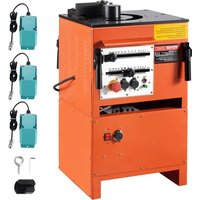


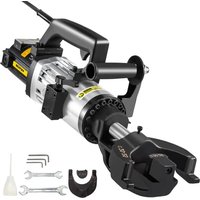
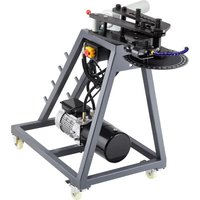
| Product Type | Hydraulic press for bending and cutting rebar |
| Brand | Vevor |
| Model | RBC-25 |
| Power Supply | 220-240 V, 50 Hz |
| Power | 1700 W |
| Net Weight | 131.3 kg |
| Gross Weight | 154.7 kg |
| Max Bending Capacity | 25 mm (rebar) |
| Max Bending Angle | 180° (bars 18-25 mm), 90° (bars 8-16 mm) |
| Bending Speed | ≤ 4 s / 3.5 s |
| Main Functions | Bending and cutting rebar, angle 1 and angle 2 adjustment, foot pedal, emergency stop |
| Maintenance and Cleaning | Weekly lubrication with lithium grease; monthly carbon brush check; annual hydraulic oil change; clean after each use |
| Safety | Emergency stop button, protective lock, mandatory grounding, use of gloves and safety glasses |
| Spare Parts and Repairability | Carbon brushes, cutting blocks, free wheels, seals, bearings; complete list in manual; technical support available at www.vevor.com/support |
| General Information | Use on flat and stable ground; operating temperature -10 to 45 °C; humidity < 90% RH; altitude < 1000 m |
Frequently Asked Questions - RBC-25 Vevor
User questions about RBC-25 Vevor
0 question about this device. Answer the ones you know or ask your own.
Ask a new question about this device
Download the instructions for your Hydraulic press in PDF format for free! Find your manual RBC-25 - Vevor and take your electronic device back in hand. On this page are published all the documents necessary for the use of your device. RBC-25 by Vevor.
USER MANUAL RBC-25 Vevor
Technical Support and E-Warranty Certificate www.vevor.com/support
BENCHTOP HYDRAULIC
REBAR BENDER
MODEL: RBC-25/RB-25
We continue to be committed to providing you with tools at competitive prices. "Save Half", "Half Price", or any other similar expressions used by us only represent the savings you might benefit from buying certain tools with us compared to top brands and do not necessarily mean to cover all categories of tools offered. We kindly remind you to verify carefully when placing an order with us to ensure you are actually saving half in comparison with the top major brands.
VEVOR®
TOUGH TOOLS, HALF PRICE
Benchtop Hydraulic Rebar Bender
MODEL: RBC-25/RB-25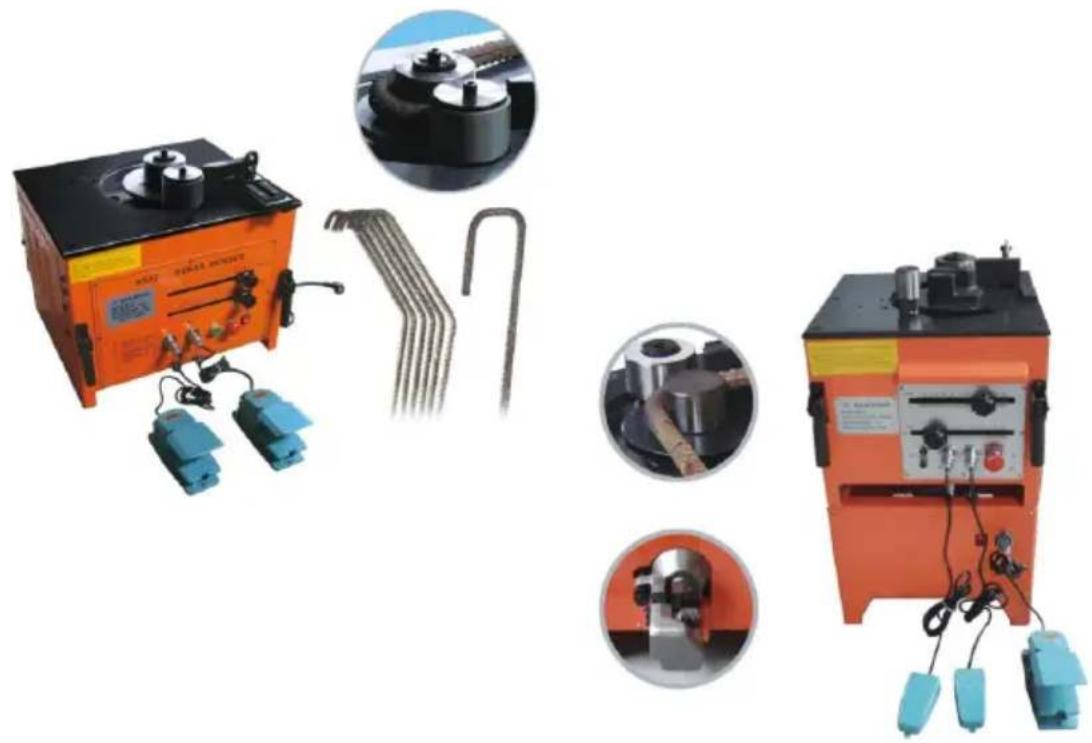
NEED HELP? CONTACT US!
Have product questions? Need technical support? Please feel free to contact us:
Technical Support and E-Warranty Certificate www.vevor.com/support
This is the original instruction. Please read all manual instructions carefully before operating. VEVOR reserves a clear interpretation of the user manual. The appearance of the product shall be subject to the product you received. Please forgive us that we won't inform you in advance if there are any technology or software updates on our product.

WARNING
Do not attempt to operate until you have read thoroughly and understood completely all instructions, rules, etc. contained in this manual. Failure to comply can result in accidents involving fire, electric shock, or serious personal injury. Keep the owner's manual and review it frequently for continued safe operation.
1. KNOW YOUR MACHINE.
For your own safety, read the owner's manual carefully. Learn its application and limitations as well as specific potential hazards pertinent to this machine.
2. KEEP WORK AREA CLEAN.
Disorderly areas and work tables will cause accidents.
3. DO NOT USE IN DANGEROUS ENVIRONMENTS.
Do not use power tools in damp or wet locations, or expose them to rain. Keep work area well illuminated.
4. KEEP NON-PROFESSIONAL PEOPLE AWAY.
All visitors should be kept at a safe distance from the work area.
5. USE THE SUITABLE TOOLS, DO NOT FORCE THE MACHINE.
It will do the job better and be safer at the rate for which it was designed.
6. WEAR PROPER APPAREL.
Avoid loose clothing, gloves, neckties, rings, bracelets, or jewelry, which could be caught in moving parts. Non-slip footwear is recommended. Wear protective hair covering to contain long hair.
7. THE MACHINE SETTING
Bender should be on flat and steady ground before starting.
Any shaking may cause imprecise work. To avoid safety accidents, please make sure the machine is not shaking before working.
Keep the machine clean and safe. After operation, clean and remove scrap iron from the main gear and body.
9. USE RECOMMENDED ACCESSORIES.
Before servicing, replacing fittings, or assembling and disassembling the motor, the machine's power source must be disconnected from the power supply (note: operations should be carried out by specialists).
10. POWER SUPPLY
①. Connect the power source to a single-phase 110V or 220V supply (see the parameter on the machine) for use.
②. When connecting to the power source, RB-25 and RBC-25 must use a 5.5 sq (mm) power line. The power line must be able to reach 30~40m to ensure normal operation.
※ Reference----in case of using an extension cord
This product is designed for situations where the distance from the power source is far, requiring an extension cord. According to the thickness of the cord and the difference in current capacity, the above provisions must be followed. If the extension cord is too long or too thin, it will cause loss of electric current and voltage, leading to rapid heating of the wiring insulation, reducing its insulating ability, and finally resulting in electric leakage or fire. Additionally, it weakens the motor output force, and the internal electrical circuit is prone to failure. Starting from the power line connection point, the extension cord must comply with the above provisions. This does not mean that operation without proper power supply is acceptable. In long-distance operation, please refer to the table to use the appropriate power cord.
line according to distance.
| (wire) max.longth | RB-25 / RBC-25 |
| Diameter of wire / wire size | |
| 15m | 2.0sq X 3C |
| 25m | 3.5sq X 3C |
| 40m | 5.5sq X 3C |
1.1.2 Additional safety rules
①. When the machine is running, do not clean or remove scraps. ②. Do not remove or modify warning signs, nor replace or cause confusion of marks. ③. Carefully read the manual before operating the machine. ④. Place the machine on the ground correctly to avoid hazard shock. ⑤. Do not leave the machine until it is off. ⑥. Before replacing the module, the machine should stop completely. ⑦. Before starting, confirm and determine the correct bending angle. ⑧. Do not put any tools on the platform before starting work to avoid accidents. ⑨. Use appropriate tools to adjust the machine.
1.2. Warning signs:
This machine has warning symbols attached to it as shown below to ensure proper and safe operation.
These symbols are used on the machine to indicate points or instances of specific danger to operating personnel.
Do not remove safety symbols from the machine.
This manual uses two safety levels: Danger and Attention.

Danger—Indicates a hazardous situation which, if not avoided, will result in death or serious injury.
Attention—Indicates a hazardous situation which, if not avoided, could result in minor or moderate injury. Attention also alerts the user to potential property damage. It helps the user understand the consequences of ignoring warnings and recognize and avoid hazards.
damage of common or venial harm. Attention can help the user to know the result of ignoring the warning and recognize the danger and avoid it.
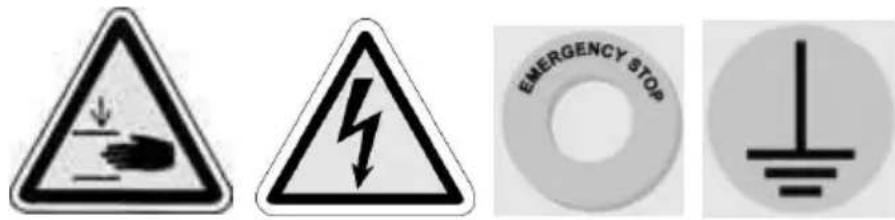
Danger

Do not put your hand or head inside the guard fence; doing so may cause injury.
Do not touch the buttons with wet hands; doing so may cause electric shock. All work including installation, testing, inspection, and maintenance must be performed by qualified technicians.
Do not touch the button with wet hands, as this may cause electric shock. All work, including installation, testing, inspection, and maintenance, must be performed by a professional technician.
Attention

Use appropriate lifting and moving equipment when transporting the equipment to avoid damage and accidents.
Please use the proper rise and fall tools to transit the equipment to avoid damage and accidents.
Follow the operation manual to install the equipment.
Do not subject the machine to violent impacts or hits during transport. Do not lift or hang the motor during transport, as this may damage it. Do not test the machine if any electrical components are missing or damaged.
Do not subject the machine to violent impacts or hits during transport. Do not lift or hang the motor during transport, as this may damage it. Do not test the machine if any electrical component is missing or damaged.

Danger
Do not connect the main power supply to the fan-out of the creepage protection.
button.
Please cut off the power supply and confirm by checking when setting the line or inspecting.
Set the line after installation; otherwise, it may lead to an accident.
Do not press or clamp the cable, and do not damage or bend it arbitrarily. Otherwise, it may cause electric shock.
Attempt Running

Attention
Check the whole machine and confirm that a sudden start-up cannot damage the equipment.
Adjust the three-phase relationships between the control tank and each motor to confirm that the turning direction of each motor is correct.
Operation

Attention
Do not touch the running parts of the slitting folder with your hands during early testing to avoid injury.
Do not make any modifications to the equipment unless you have technical assistance from BS. Otherwise, BS will not bear any responsibility for the consequences.
Other Attention Items

Attention
A complete inspection and test run are required before using the machine after it has been left unused for a long time.
It is not allowed to operate or maintain the machine when the operator is not clear-headed due to alcohol or fatigue.
Please use spare parts from BS for maintenance. BS will not guarantee to keep the machine in good repair if the customer damages the machine by using spare parts from other companies.
PARAMETER LIST
| Model | RBC-25 | RB-25 |
| Voltage | AC220-240V 50Hz | AC220-240V 50Hz |
| Wattage (W) | 1700 | 1700 |
| G.W.(kg) | 131.3 | 93.3 |
| N.W.(kg) | 154.7 | 110 |
| Cutting speed | ≤4s /3.5s | ≤4s/3.5s |
| Max Rebar | 25mm | 25mm |
| Min Rebar | 4mm | 4mm |
| angle of bend | 18-25 # steel bar bending angle 180 degrees (round die)8-16 # steel bar bending angle 90 degrees (corner mold)The bending angle of the # reinforcement is <90 degrees | 18-25 # steel bar bending angle 180 degrees (round die)8-16 # steel bar bending angle 90 degrees (corner mold)The bending angle of the 8 # reinforcement is <9 degrees |
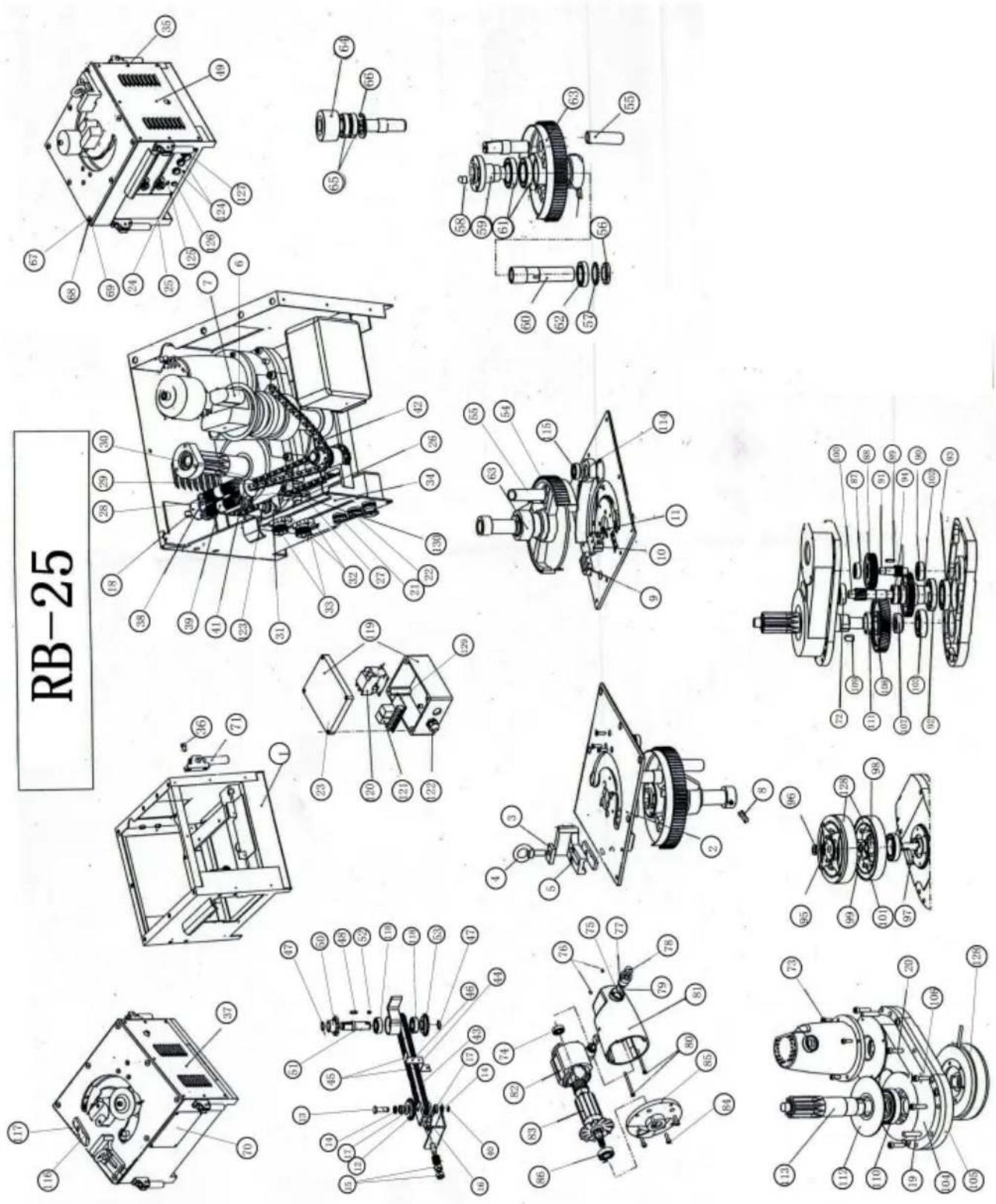
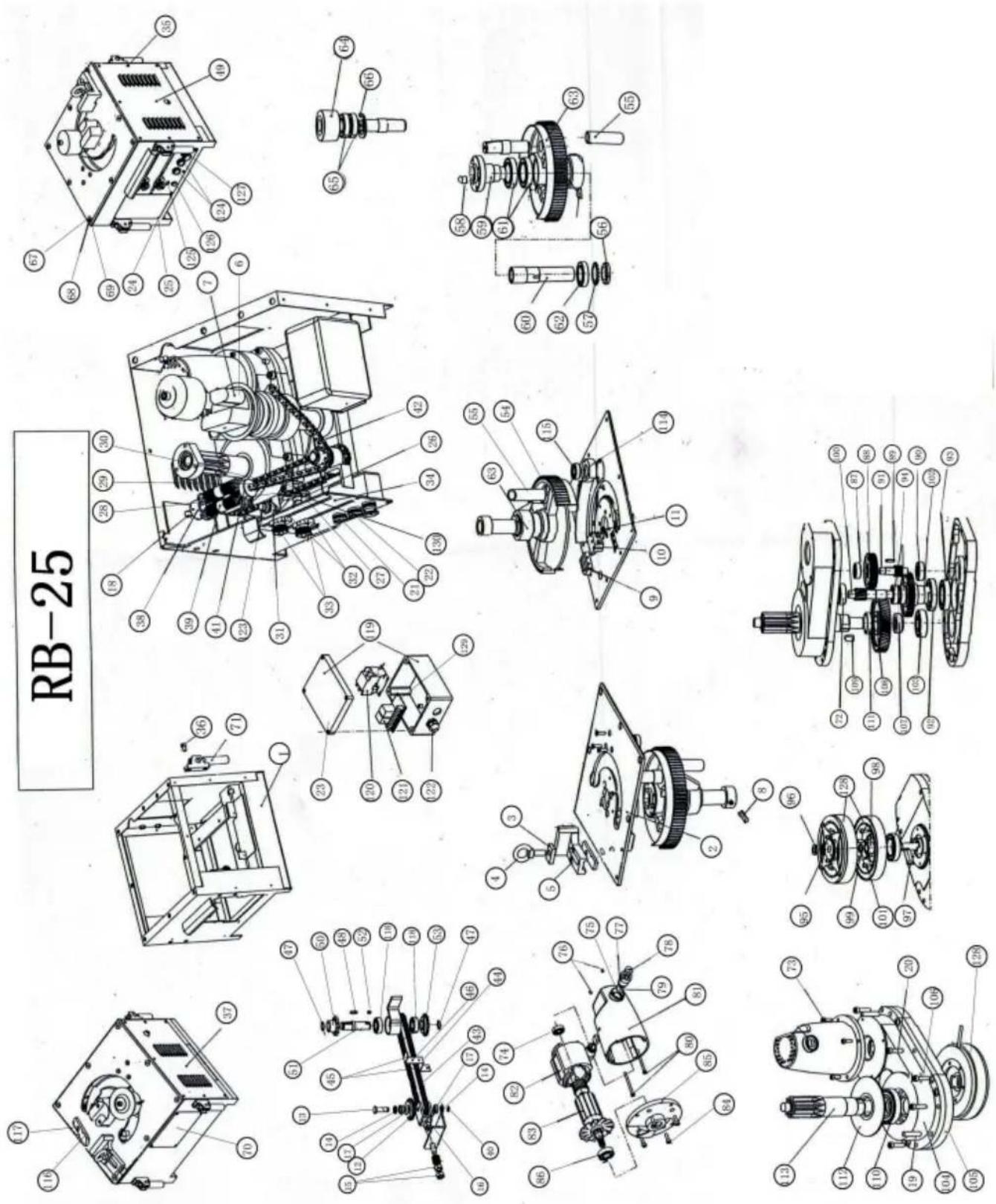
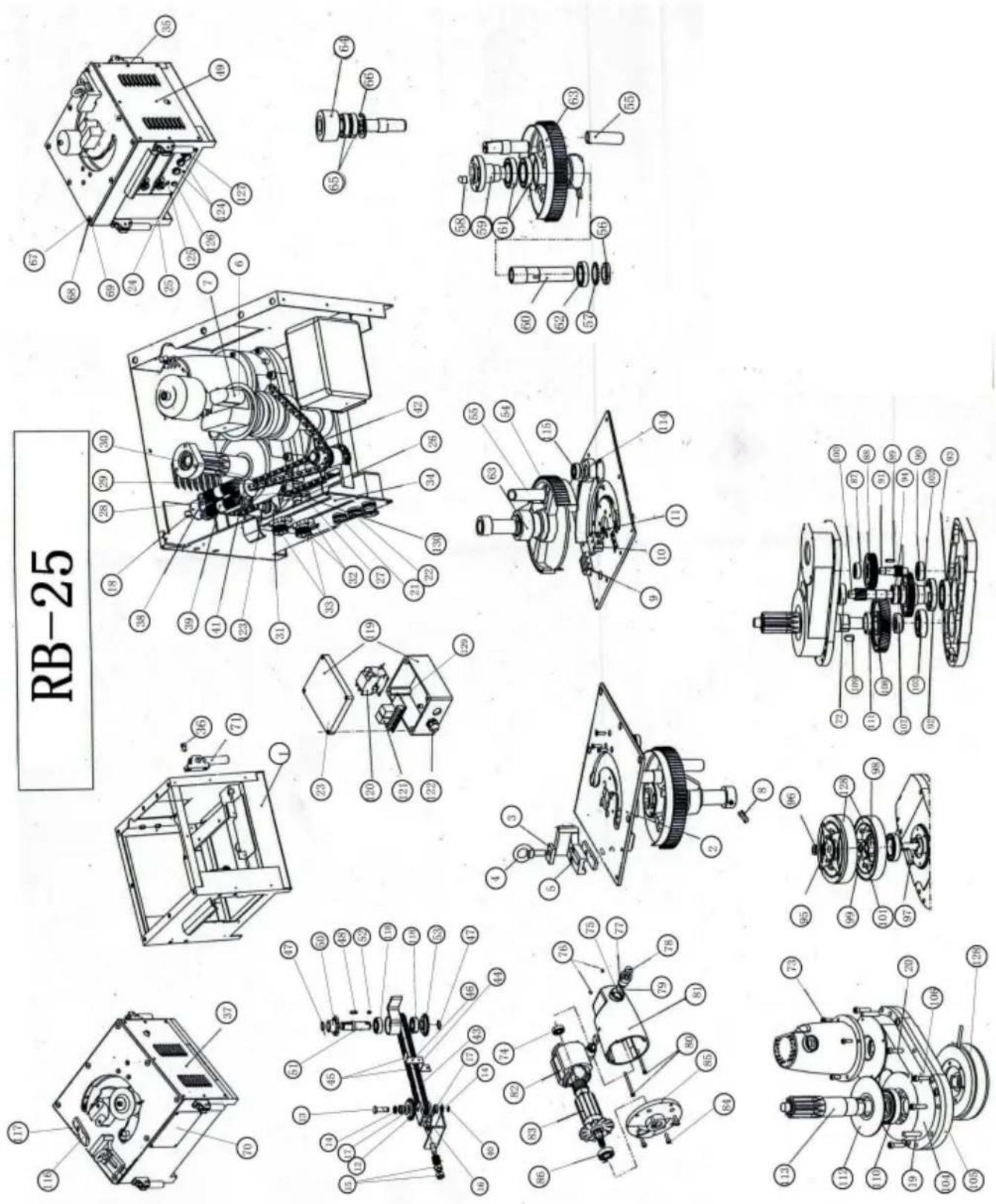
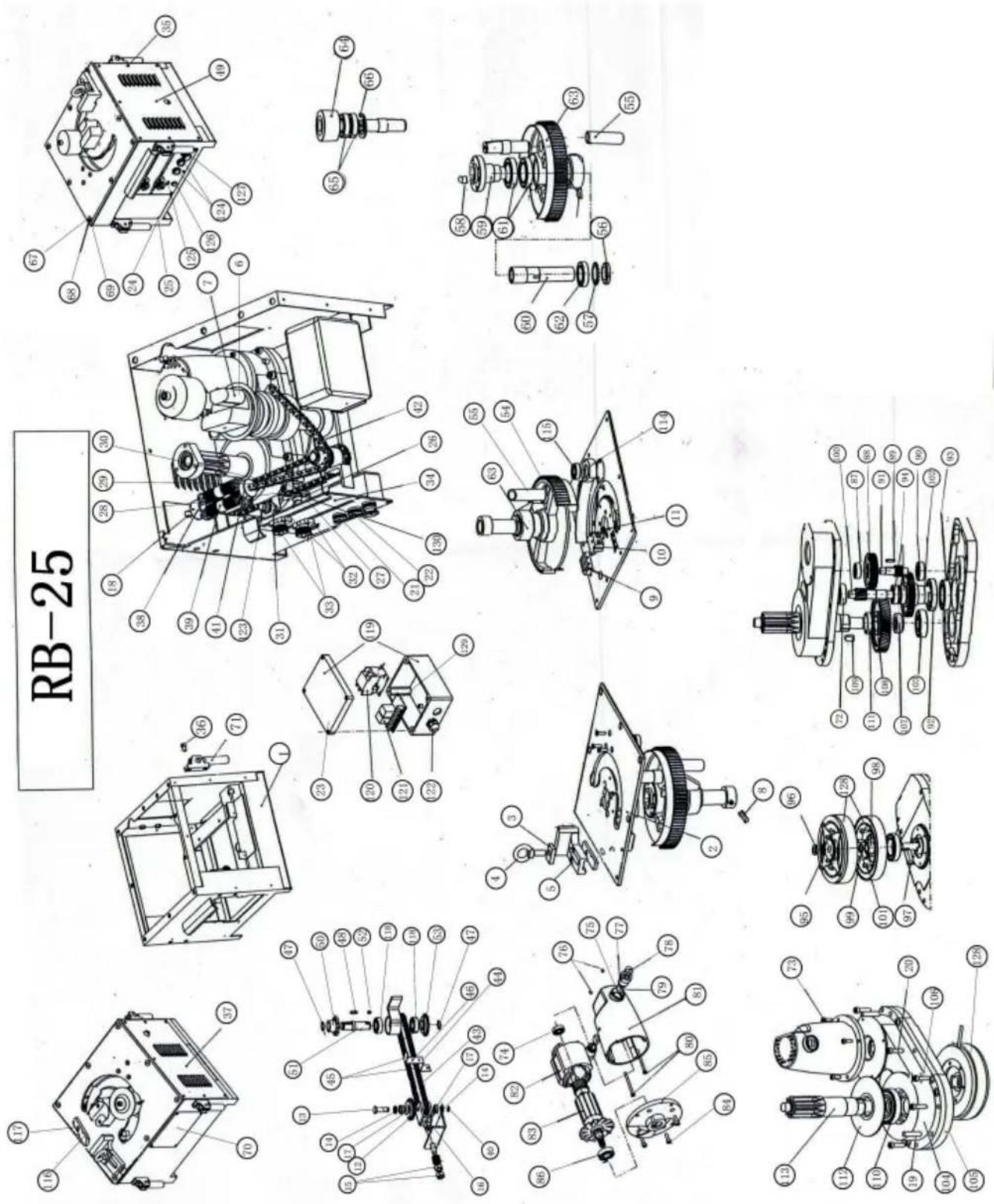
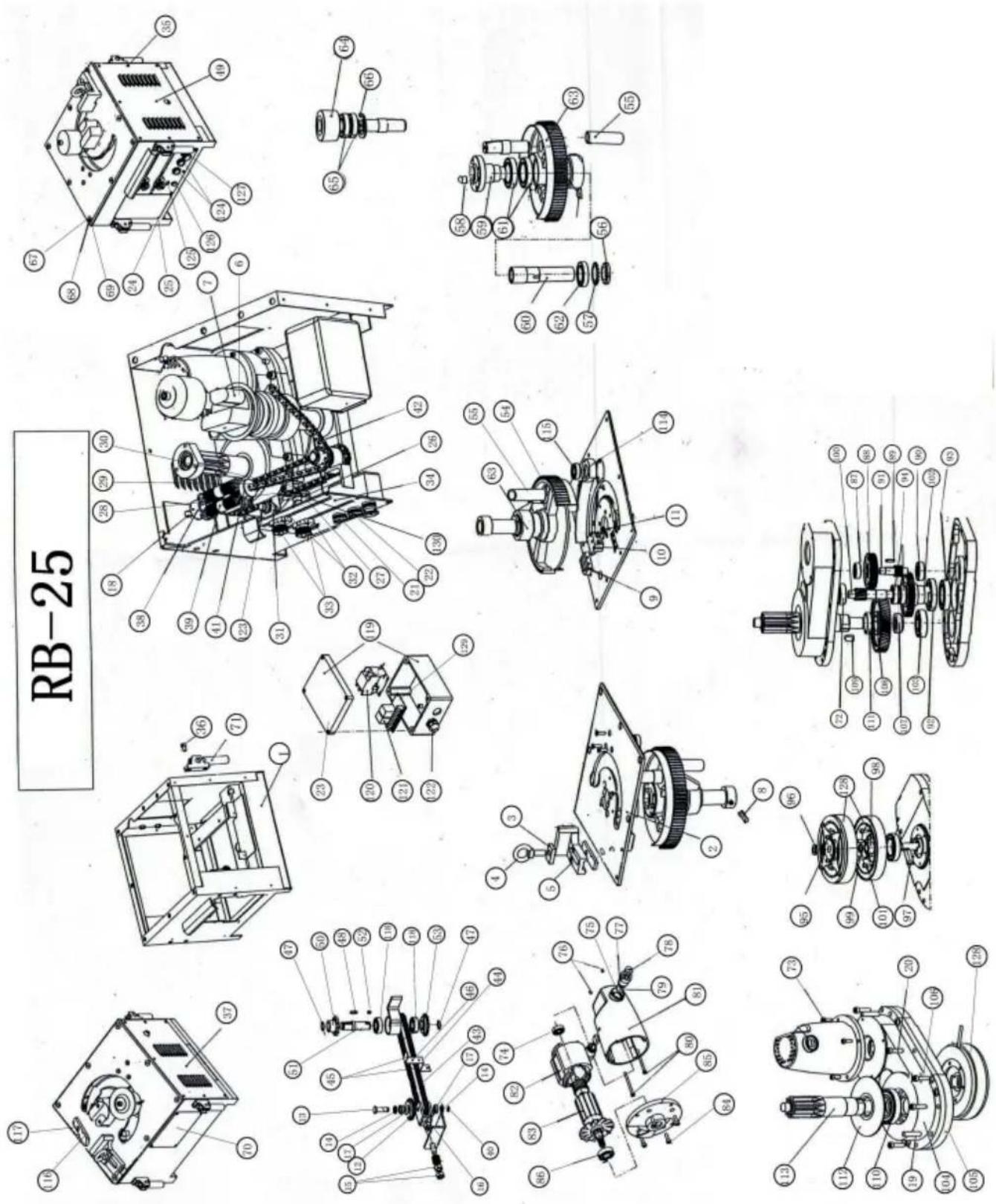
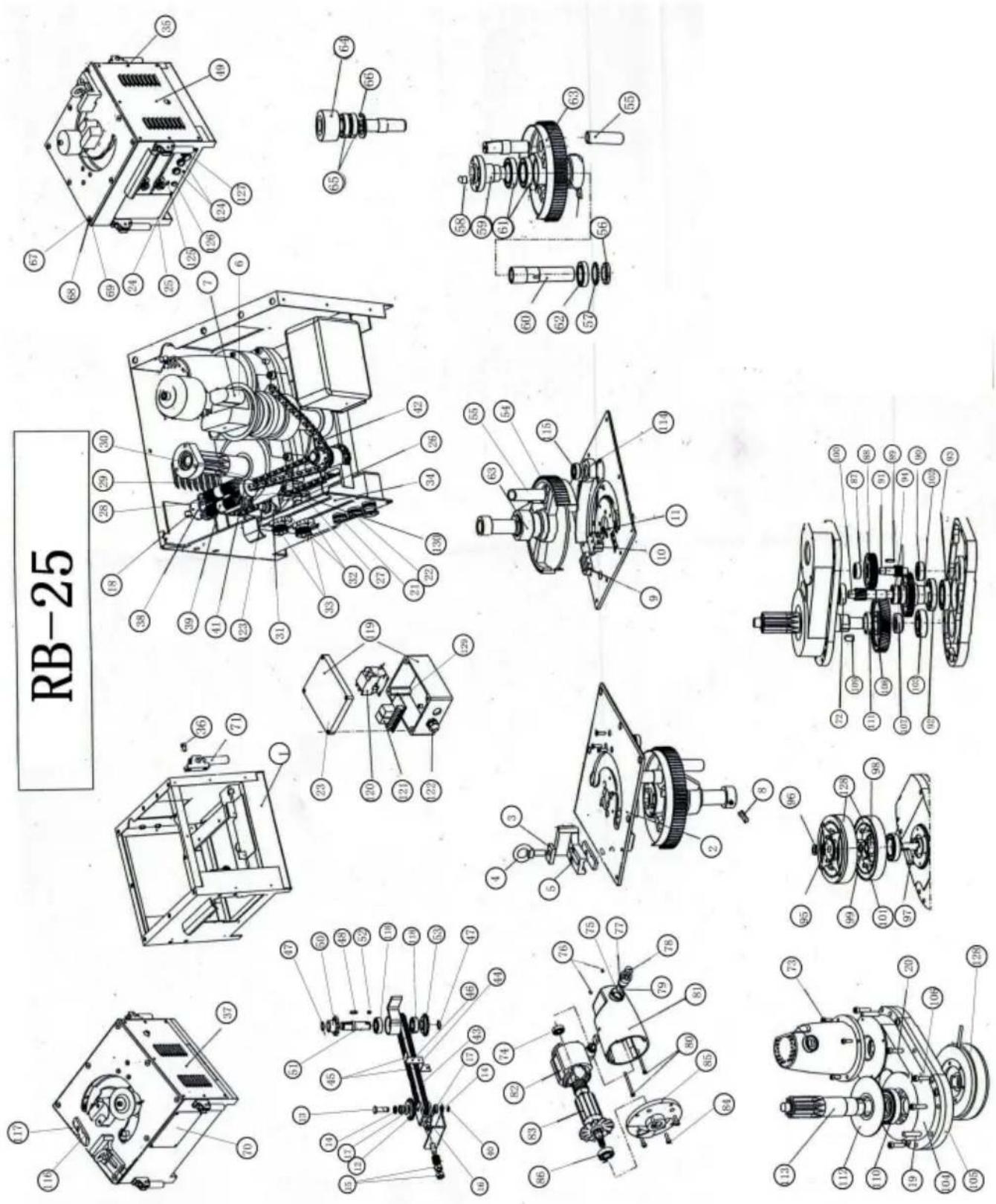
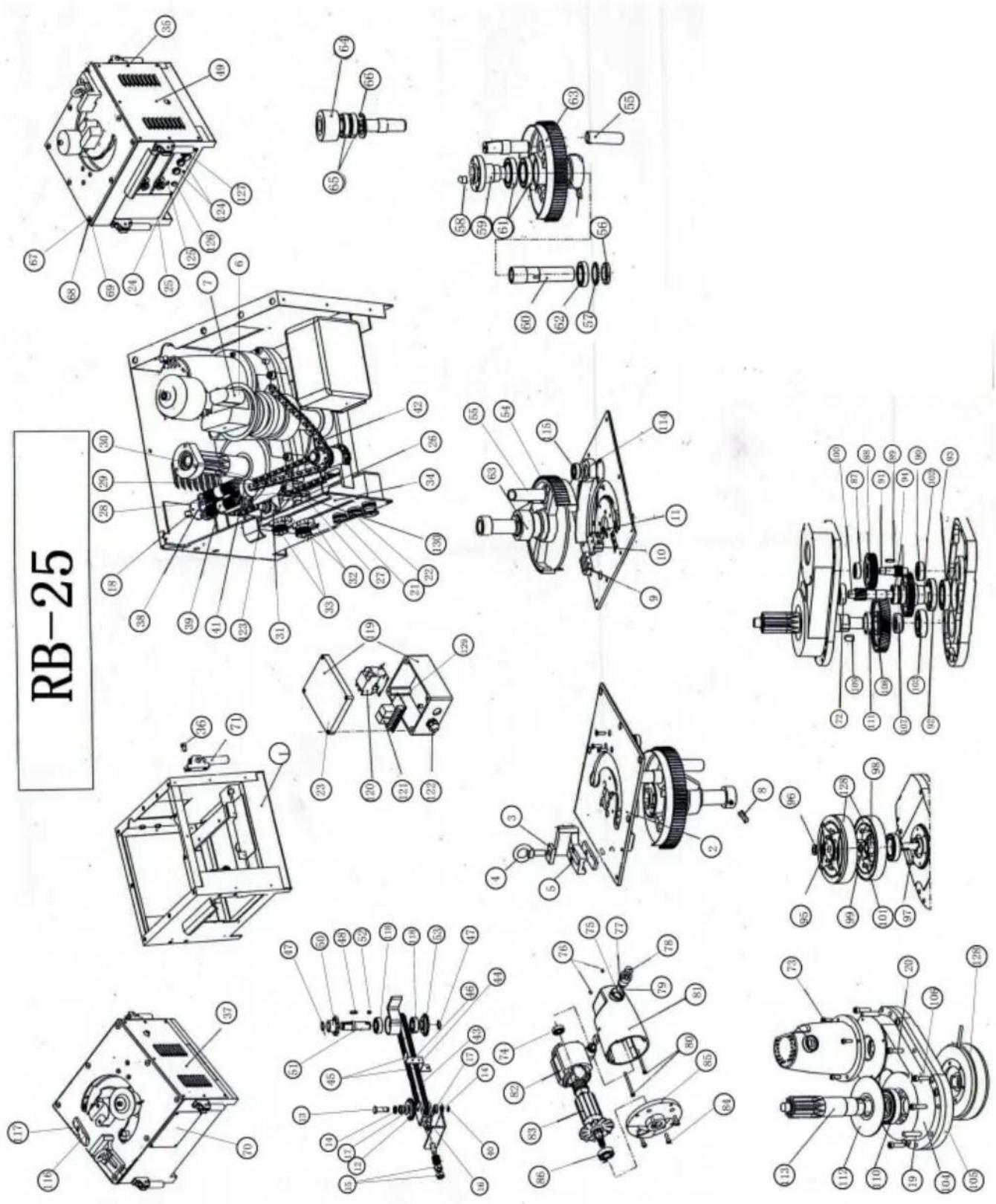
Rebar bender Parts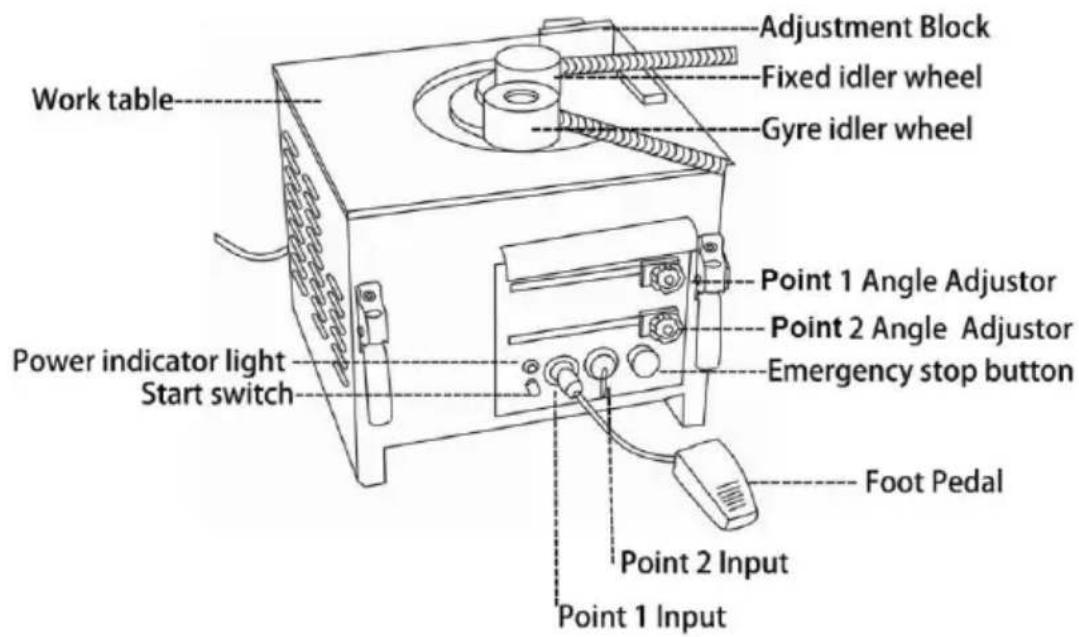
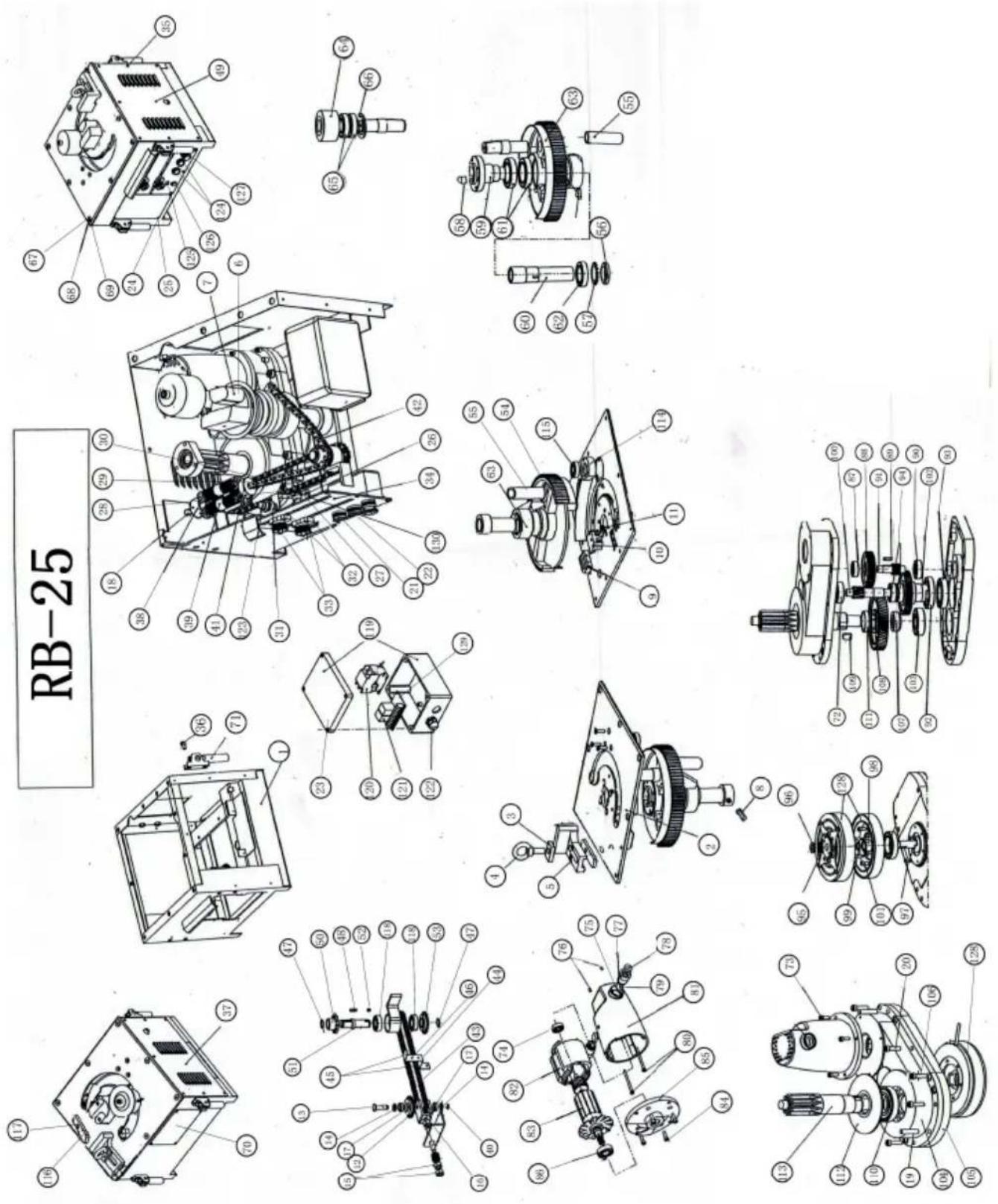
| NO. | PARTS NAME | NO. | PARTS NAME | NO. | PARTS NAME |
| 1 | Foot stand sets | 44 | stop film | 87 | 6202 bearing 15×35×11 |
| 2 | work table sets | 45 | chain connector | 88 | gear |
| 3 | fixed gasket | 46 | cup head rivetΦ3.5×4 | 89 | round head flat key |
| 4 | hexagonal screw M16×55 | 47 | shaft circlip Φ20 | 90 | 6302bearing15×42×13 |
| 5 | adjust block | 48 | round head flat key | 91 | gear shaft |
| 6 | model | 49 | right shutter | 92 | 61910 bearing 50×72×12 |
| 7 | locating shaft | 50 | chain wheel | 93 | 10008bearing40×68×9 |
| 8 | hexagon socket set screws | 51 | chain wheel shaft | 94 | 6004bearing20×42×12 |
| 9 | buffer block | 52 | round head flat key | 95 | stop washer 16 |
| 10 | stop block | 53 | chain wheel | 96 | round nut M16×1.5 |
| 11 | hexagon socket set screws | 54 | inner hexagon screw | 97 | round head flat key |
| 12 | chain wheel | 55 | leakage terminal welding sets | 98 | Needle bearing |
| 13 | pin roll | 56 | round nut M45×1.5 | 99 | bearing gasket |
| 14 | gasket 12 | 57 | stop washer Φ45 | 100 | gear shaft |
| 15 | nut M12 | 58 | round head flat key12×17 | 101 | inner hexagon screw |
| 16 | chain wheel foc stand | 59 | locating sleeve | 102 | connecting gear |
| 17 | 61901bearing12×24×6 | 60 | connect sleeve | 103 | 6305 bearing 25×62×17 |
| 18 | hexagon headed bolt | 61 | 6011 bearing 55×90×18 | 104 | gear case(up case) |
| 19 | round pin 10×3 | 62 | 6009 bearing 45×75×16 | 105 | gear case(down case) |
| 20 | inner hexagon screwM8×35 | 63 | big gear component | 106 | inner hexagon screw |
| 21 | cord arma | 64 | roll wheel | 107 | washer |
| 22 | cord arma | 65 | 6207 bearing 35×72×17 | 108 | gear |
| 23 | electrical housing | 66 | hole collar Φ72 | 109 | round head flat key |
| 24 | gasket | 67 | chamfer head screw M10×25 | 110 | 6208bearing40×80×18 |
| 25 | pan head screw M4×7 | 68 | spring washerΦ10 | 111 | washer |
| 26 | Down sensor holder | 69 | nut M10 | 112 | housing |
| 27 | nut M4 | 70 | air door plate | 113 | gear shaft |
| 28 | chamfer head screw | 71 | handle rivet sets | 114 | washer |
| 29 | nut bolt | 72 | 6303 bearing 17×47×14 | 115 | 6204bearing20×47×14 |
| 30 | nut M5 | 73 | inner hexagon screw | 116 | gasket |
| 31 | up sensor holder | 74 | 6200bearing 10×30×9 | 117 | inner hexagon screw |
| 32 | cord holder | 75 | carbon holder's washer | 118 | 6004 bearing |
| 33 | hand wheel | 76 | hexagon socket set screws | 119 | electric box |
| 34 | panel | 77 | carbon holder sets | 120 | contactor |
| 35 | pan head screv | 78 | carbon holder cap | 121 | relay |
| 36 | inner hexagon screw | 79 | carbon brush sets | 122 | water joint |
| 37 | left shutter | 80 | inner hexagon screw | 123 | sensor |
| 38 | tension spring holder | 81 | Motor housing | 124 | navitage plug |
| 39 | tension spring | 82 | stator components | 125 | indicator lamp |
| 40 | splitpinΦ3.2×16 | 83 | rotor components | 126 | jogging switch |
| 41 | tension spring holder | 84 | inner hexagon screw | 127 | emergency switch |
| 42 | chain 08B-1-35 | 85 | motor end housing | 128 | magnetic clutch |
| 43 | chain 06B-1-T6 | 86 | 6203 bearing 17×40×12 | ||
2. Means of operation
2.1 Using methods
① When the power line is connected to the 110V/220V power source, the power indicator light shines, meaning the machine is ready for operation and normal work can proceed. ② The spacing of the fixed idler wheel, the movable idler wheel, and the steel bar block needs to be adjusted accordingly based on the specification of the steel bar. ③ Connecting the foot switch to point 1 or point 2 will make work more convenient.
Point 1: Connect to work. The angle is set by point 1. Press the START button or the point 1 foot pedal switch to control operation.
Point 1: Connect to work. The angle is set by point 1. Press the START button or the point 1 foot pedal switch to control operation.
Point 2: Connect to work. The angle is set by point 2, and operation is controlled via the foot switch. In this case, the angle set by the point 1 handle must be set to the same level angle as point 2 or greater than point 1. Also, after setting the angle handle, ensure the handle nut is tightened, as it may become loose during machine operation.
④ Adjust the angle you need by moving left or right. When the adjustment is set accurately, ensure that the angle setting handle is fixed. ⑤ The operator must stand outside the direction of the rebar bender's operation. ⑥ When pressing the start switch or the foot switch, the machine will bend the right angle you have set. ⑦ If you find any abnormality during operation, you must press the emergency stop to shut down the machine's operation. ⑧ Remember, when bending, the angle of point 1 must be larger than point 2, otherwise the machine cannot operate normally. (This applies to RB-25 and RBC-25; RB-32 and RBC-32 have no such issue.) ⑨ When using the foot switch to control the machine's operation, if it becomes uncontrollable, press the hand switch near the power light to test whether the motor rotates, to determine if the foot switch is faulty.
Note: ① When the emergency switch is pressed to run the machine, the idler wheel will return to its position.
② Under the working condition of point 2 bending, the point 1 handle must be kept at the same level angle as point 2, or set to an angle 5 degrees smaller than point 1, and then fix the angle handle. This is to prevent electrical or machine misoperation.
※Matching of different wheels (RB-25 / RBC-25):
| Rebar specification | Fixed idler wheel | Gyre idler wheel | Contemporary bending capacity |
| ∅22- ∅25 | ∅78 | ∅94 | 1 pcs |
| ∅16- ∅20 | ∅78 | ∅94 | 1-2 pcs |
| ∅10- ∅13 | ∅78 | ∅94 | 4-5 pcs |
| ∅6- ∅13 | module | ∅94 | 3-6 pcs |
| Special situation | Possible customize | Possible customize |
2.2 Attention items
① Must use according to the contemporary bending capacity; exceeding this capacity can easily cause product breakdown. ② When performing steel bar bending work, pay special attention to avoid safety incidents such as finger injuries. ③ Depending on the hardness of the reinforced material, special attention should be paid to avoid fragments that may lead to safety incidents such as wounds. ④ Do not operate until you confirm that no person or object is within the reinforced bending radius. ⑤ The product is electric functional machinery. If exposed to rain or water, it may cause leakage; it must be covered with a waterproof membrane during use. ⑥ Ensure the stationary ring bolt is fixed when transporting or moving the machine. ⑦ When operating under point 2, fix the angle of point 2 to be the same as or no more than 5 degrees from point 1, to ensure that under conditions of external shock, the machine itself will not move left and right to stop the machine. ⑧ Make sure the stationary ring bolt is fixed when transporting or moving the bender. Chains must be inserted into the safety pin to prevent the bender from shaking or waving during transport. When moving the bender by fixing the handle, the 4 bolts must not be loose, then move the bender together by 4 handles. ⑨ Prohibit the use of idler wheel items.
If you operate according to the method marked with (X) below, the troughing of the hoop will burst easily. Record the proper operation sincerely!
3. Environment:
Please use it under these kinds of environmental conditions.
| Environment | Environment temperature | -10°C~45°C(does not ice up |
| Environment humidity | Below 90%RH (does not congeal dew) | |
| Storage temperature | -20°C~+65°C | |
| Environment | In room (non-corrosiveness gas, flammable gas, oil mi and so on) | |
| Altitude above sea level | Below elevation 1000m |
4. Operation
4.1 Operation position
After installing the equipment, the operator can operate the equipment standing about 0.5m in front of the operation panel.
Notice
Do not use your hand to touch any running parts when the equipment is running to avoid accidents.
After adjusting the quantity, remember to lock the nut.
If there is any abnormality during running, stop working.
When the container is big, the diameter of the filling mouth should not be small to protect the filling mouth from damage when the filling pressure is too high.
4.2 Emergency Stop
This machine is equipped with an emergency stop button. Pressing it will stop the machine completely. Use it in case of an emergency.
4.3 Power
110V or 220V single-phase power supply only. The power line must comply with the safety regulations.
4.4 Control panel
1. Indicator light: When the power supply is connected, the light should be on. 2. Manual switch: If the foot switch cannot control the machine, replace foot switch 1 with the manual switch near the power light. 3. Foot switch 1: Press foot switch 1 to perform the operation set by the "1 point" angle adjuster. 4. Foot switch 2: Press foot switch 2 to perform the operation set by the "2 point" angle adjuster. 5. Emergency stop switch: During operation, if any problem occurs, release the button to stop all actions. 6. Angle 1: Adjust the bending angle using the "1 point" adjuster (corresponding to foot switch 1). 7. Angle 2: Adjust the bending angle using the "2 point" adjuster (corresponding to foot switch 2). 8. Before bending, note that the angle setting of "1 point" must be greater than that of "2 point", otherwise the machine will not work. This applies to RB-2 and RBC-25; RB-32 and RBC-32 have no such issue.
4.5 Operating process
1. Connect the power cord to a 110V/220V outlet and check that the indicator light turns on. This means the bender is ready to work. 2. Choose the correct size of fixed idler wheel and idler wheel according to the rebar diameter. 3. Connect the foot switches to the 1-point and 2-point holes securely. 4. The 1-point angle setting adjuster is for setting the angle for the foot switch connected to the 1-point hole. For example, to bend 180 degrees with foot switch 1, set the angle to 180 degrees using the 1-point adjuster, then press foot switch 1 to bend the rebar 180 degrees. 5. The 2-point angle setting adjuster is for setting the angle for the foot switch connected to the 2-point hole. For example, to bend 90 degrees with foot switch 2, set the angle to 90 degrees using the 2-point adjuster, then press foot switch 2 to bend the rebar 90 degrees.
6. Note that the angle setting of "1 point" must be greater than that of "2 point", otherwise the machine will not work. See the two pictures below. 7. Adjust the angle adjuster by moving it left or right as needed. 8. The operator should stand on the outside of the rebar's bending direction. 9. The rebar will be bent to the set angle when the start switch or foot switch is pressed.
Attention: For precise work, set point 1 when the bending angle is large (90°), and set point 2 when the bending angle is small (135°).
Note:
① It is mandatory to follow the processing capacity while using the product, as the product can easily lead to failure. ② When gripping, bending, or reinforcing material, pay special attention to safety incidents such as bumping fingers. ③ According to the different hardness of the reinforced material, special attention should be paid to the fracture which may lead to safety incidents such as wounding. ④ Please do not operate until you confirm no person or object is in the reinforced bending radius. ⑤ The product is electrical functioning machinery. If it is exposed to rain or water leading to leakage, it must be covered with a waterproof membrane after use.
4.6 Movement
- Move the bender after making sure the handle fixing bolt is tight.
- Make sure the stationary ring bolt is fixed when in transit or moving the bender.
- Chains must be inserted into the safety pin to prevent the bender from shaking or waving during transit.
- When moving the bender by fixing handle, the 4 bolts must not be loose or damaged. Move the bender together by the 4 handles.
5. Maintenance
5.1 Check and Change
① Change the carbon brush --- The power must be cut off. If the machine stops operating during the process, please confirm the wearing and test the intensity of the carbon brush. The carbon brush that electric machinery uses belongs to consumables. If the carbon brush is used beyond the restraining line of the wearing and tearing, the electric machinery will subside, even stop running. Then turn off the machine and resume it. If the machine shuts down automatically after transient running, it proves necessary to change the carbon brush. Please do not use the machine at the change of the carbon brush as the continuing use accelerates wear and tearing of the commutator which leads to the damage of the coil.
② Means of changing:
Open the upper brush cap with a screwdriver so that the carbon brush can be taken out of the machine.
Please use the attaching brush while purchasing the machine to clear the internal centre axle and fixed gyro wheel before changing and using.
5.2. Lubrication:
5.2.1. Cycle:
The lubrication should be done by the personnel regularly and also can be maintained during the time that it is not used.
Please lubricate every week.
5.2.2. Oil
It uses common lithium grease; do not use different lubricants at the same time. If you choose one, stick to it, as mixing can affect its lifespan.
5.2.3. Cleaning the oil port
Before applying lubricating grease, clean the oil port and remember to wipe off any remaining grease.
5.3 Check and maintenance
Check the bolts and nuts at every position; if they become loose, tighten them. In humid seasons or after rainy days, ensure proper ventilation to dry the machine. In case of heavy power shock when turning the gyro wheel to the location, tighten it after adjusting the unclamp, and set it to a very slow speed.
into the very slow state.
Panel indicator lamp on means the machine is turned on and ready. Check the power and cable if the indicator lamp on the PC rear board does not light up when plugged in.
Indicator lamp shows on the panel; if the machine cannot start, press the START switch --- Please confirm the condition of the carbon brush (whether it is worn out).
For other items, please consult your local branch or the after-sales service center at the headquarters.
6. Electrical safety
6.1. Safety rules for the electrical system
- Only personnel who are properly trained and have adequate knowledge and skill should undertake all electrical troubleshooting and repair.
- Do not alter or bypass protective interlocks.
- Before starting, read and observe all warning labels.
- When troubleshooting, make sure the power source has been cut and the main switch has been locked.
- Take extra precautions in damp areas to protect yourself from accidental grounding.
- Before applying power to any equipment, it must be established, without a doubt, that all persons are clear.
- Do not open the electrical control panel unless it is necessary for the electrical equipment.
- Do not alter the electrical circuits unless authorized to do so by the manufacturer.
- When replacing electrical components, make sure they conform to the manufacturer's specifications, including proper color-coding.
- Do not wear metal glasses, metallic necklaces or chains while work on any electrical equipment.
Also do not wear any ring, watch or bracelet while operating electrical equipment.
Additional instructions for rebar cutter (Rebar cutter and bender Model)
General Safety Precautions
Usage
Use rebar cutters on concrete re-forcing bars only.
Restrict use to designated materials
There is always a chance that the cut end may shoot out, especially than 30cm in length. Exceeding designated material specifications great increases this risk and will also damage the tool. Do not attempt to rebars. Harder, thicker or thinner than those specified.
Use eye protection
Wear safety goggles, safety glassed with side shields or a face shield when using cutter.
Provide safety barriers
Erect safety screens to protect co-workers from possible flying ends. If safety screen under the rebar when working in high places.
Exercise proper control
Hold cutter firmly and maintain proper footing and balance. Do not over-reach when working in high places; secure cutter to scaffolding safety rope. Check that power cord is not fouled and keep cord away from sharp edges and heat. Check that all adjusting wrenches have been removed before using cutter.
Guard against electric shock
To avoid possible electric shock, do not handle cutter with wet hands or use cutter in the rain or damp places. Be aware of all power lines,
circuits and other hazards that may be contacted, especially those below the surface or otherwise hidden from view.
Unplug tool
Disconnect cutter from outlet when not in use and before cleaning, adjusting, or servicing. Do not disconnect plug from outlet by pulling the cord. Always check that the switch lock is OFF before plugging in.
Beware of environment
Do not use cutter in the presence of flammable materials (e.g., paint, thinner, petroleum products, adhesives).
Do not use cutter in a possibly lighted and clear of obstructions. Operator should at all times have an unobstructed view of the cutter, rebar, and surrounding area.
Wear proper apparel
Do not wear loose clothes, dangling objects, or jewelry. Restrain long hair. The use of a safety helmet and rubber soled boots is recommended. If safety gloves are worn, be especially careful that gloves do not get caught in moving parts.
Keep visitors away
Keep all visitors at a safe distance from the work area for their own protection and to prevent distraction of the operator.
Maintain cutter with care
Inspect cutter before each application. Faulty or loose cutter blocks can result in personal injury. Keep handle dry, clean, and free from oil and grease. Keep housing and piston free of dirt and iron filings. Check if screws or bolts are loose or missing. Follow instructions for maintenance. Inspect switch, cord, plug, and any extension cable at regular intervals.
Store carefully
When not in use, store the cutter and accessories in a dry place where they cannot be accessed by unauthorized persons.
Operating Instructions
Caution: Indicates a hazard that could result in minor personal injury or product damage.
Care: Indicates a hazard that will result in product damage.
Pre-use checks
- Check oil level.
- Check the condition of the cutter blocks and the tightness of the cutter block bolts. Caution: Using loose or cracked cutter blocks may result in injury to operators as well as damage to the unit.
- Check that the power source is appropriate for the cutter. Care: If the voltage is too high, the motor will burn out. If the voltage is too low, insufficient power will be generated. Never use DC current.
- Check that the power supply is properly earthed.
- Caution: Failure to earth the power supply may result in electric shock to the operator.
- Check that the cord is undamaged and that the plug is not loose.
Caution: Cut or abraded covering could result in a short circuit and electric shock to the operator.
Warm-up
In cold weather, warm up the unit for 30-60 seconds so that the hydraulic fluid reaches the proper viscosity. Pull the trigger switch to extend the piston and release it when it has reached its full stroke. Repeat 15-20 times.
Stopper adjustment
The adjustable stopper function is to maintain the rebar in the correct position during cutting and must be properly set for each size of rebar before
making a cut.
Screw in stopper to provide sufficient clearance for rebar.
Insert rebar fully into U-shaped support. Make sure that rebar is resting against the base of the stopper.
Keeping rebar at right angles (90°) to front cutter block, screw out stopper until it is just touching the rebar. Once set, the stopper needs no further adjustment while cutting rebar of the same diameter, but must be re-adjusted for a different size rebar.
Caution: Failure to correctly set the stopper will result in excessive wear on cutter block and may cause cut end to fly out.
Cutting
- Insert rebar between stopper and front cutter block, making sure that it is properly seated in U-shaped support.
- Pull trigger switch and keep depressed while piston advances and cut is made. (If switch is released at an intermediate point, piston will stop.)
- When cut is completed, release switch. Piston retracts automatically.
(Note that switch can't be re-activated until piston has fully retracted.)
Points of attention
- Be especially careful when cutting off short lengths (30cm or less) cut end tends to fly out.
Caution: Flying ends are a hazard to all personnel in the vicinity. Use safety screens.
- Do not cover air vents.
Caution: If vents are covered, the motor will overheat and may burn out.
- If hydraulic oil exceeds 70°C (158°F), power will drop. Allow it to cool before resuming operation. (Be particularly careful in summer, when the aluminum pump case heats up quicker.)
- If a drop in power is observed and the motor is unusually hot, check the brush.
- If the piston should ever fail to retract completely, push the rear cutter block backwards to manually retract the piston.
Caution: Use a rebar or flat metal bar for this purpose. Never push the block with any part of the hand, even if gloved.
Once the piston has been retracted, pull the trigger switch long enough to advance the piston. Unplug the unit. Check the piston and housing for accumulated dust or iron filings that may be jamming the piston. After cleaning, if the piston still does not automatically retract when fully extended, the piston itself may be damaged. Return the unit to an authorized agent for repair.
Maintenance
Cutter blocks
Before using, always check that the two bolts on each cutter block are properly tightened. Using a loose block will result in damage to the block housing. Also check the condition of the cutter blocks. If either cutting edge is worn or chipped, remove the retaining bolts and rotate both blocks so that two edges come into use. Replace and tighten the bolts (each block has four cutting edges).
When all four cutting edges have been used, or if either block is cracked or otherwise damaged, replace both blocks.
Caution: A loose or cracked block may result in injury to the operator.
Cleaning
Clean the cutter after use.
Caution: Wear gloves to protect hands from metal splinters. Do not use an air gun; blasting with air can cause metal filings and/or dust to get into the eyes and respiratory system.
- Disconnect unit.
- Wipe or brush away all dirt and metal filings. Pay particular attention to the lower half of the piston, where dirt is more easily accumulated.
Oil-level check
As the cutters are hydraulically operated, the oil level must be checked at frequent intervals, preferably every day. Failure to maintain the oil at the proper level results in a drop in pressure and loss of cutting power.
Caution: Hydraulic oil is highly flammable. Keep away from sparks or naked flame. Do not smoke.
Caution: Hydraulic oil may cause inflammation of the eyes and skin. If ingested, it will cause diarrhoea and vomiting.
In case of eye contact, rinse in clean water for at least 15 minutes and consult a physician. In case of skin contact, wash thoroughly with soap and water.
In case of ingestion, consult a physician immediately. Do not deliberately induce vomiting.
- Oil should be warm but not hot. Warm up unit if cold.
- Adjust stopper and make three or four cuts, noting exactly at what point the rebar is actually breaking.
- Pinch a short piece of rebar, stopping just before it breaks off. Unplug from power source.
- With partially severed rebar in place, turn unit over so that oil-plug is uppermost. (If unit is hot, allow to cool down.)
- Remove oil-plug and seal-washer (packing)
Caution: Never remove oil-plug when unit is hot or oil will spurt out.
- Check that oil is level with bottom of plug hole. (i.e. That pump is full to the brim). If oil level is too low, top up with 20-weight hydraulic oil with anti-foam and anti-abrasion properties. (ISO viscosity grade VG46. E.g. Shell oil Tellus 46, Mobil oil DTE-25 or Esso Uni Power SQ46.)
- After topping up, extract air from the system. Gently tilt the cutter lengthwise and return it to a level position. Top up again and tilt in the opposite direction. Repeat this process until all air has been extracted.
Caution: The cutter cannot function properly if the oil contains air bubbles.
- Replace the seal washer (packing) and plug. Connect the cutter to power and completely sever the rebar.
Oil change
- The hydraulic oil should be changed at least once a year, or sooner if it appears dirty.
- Unplug the unit from the power source. Remove the oil plug and packing. Turn over and drain oil into a suitable receptacle. When oil ceases to drain, tilt the unit to the rear so that oil trapped in the piston housing can run out. When the housing is empty, tilt the unit in the opposite direction to empty the residue from the pump case.
- With the drain hole uppermost, slowly fill the unit with fresh oil. Replace and lightly tighten the plug. Connect the unit to the power source and advance the piston three times. Unplug the unit and remove the oil plug. Top up the oil level and replace the plug.
- Finally, follow the procedure for oil level check.
Note: Dispose of hydraulic oil in accordance with local regulations. Do not pour it into the sea, river, lake, or drains.
Bolt tightness
Once a week or after every 500 cuts, check the tightness of all bolts, especially those securing the housing to the cylinder. Loose bolts will result in a loss of power.
Carbon brushes
Inspect the two carbon brushes at least once every two months (normal brush life is 200 hours).
Care: Worn brushes will result in power loss, cause the motor to run and irreparably damage the armature's commutator.
1. Disconnect unit. 2. Unscrew both brush caps and pull out carbon brushes. 3. Replace brushes if less than 6 cm in length.
Manufacturer: Shanghaimuxinmuyeyouxiangongsi
Address: Shuangchenglu 803nong11hao1602A-1609shi, baoshanqu, shanghai 200000 CN.
Imported to AUS: SIHAO PTY LTD. 1 ROKEVA STREETEASTWOOD NSW 2122 Australia
Imported to USA: Sanven Technology Ltd. Suite 250, 9166 Anaheim Place, Rancho Cucamonga, CA 91730
| UK | REP |
YH CONSULTING LIMITED. C/O YH Consultin Limited Office 147, Centurion House, London Road, Staines-upon-Thames, Surrey, TW18 4A>
| EC | REP |
Technical Support and E-Warranty Certificate
www.vevor.com/support
VEVOR®
TOUGH TOOLS, HALF PRICE
NEED HELP? CONTACT US!
Avoid damage

Danger
Transport and installation

Attention
YH CONSULTING LIMITED. C/O YH Consulting Limited Office 147, Centurion House, London Road, Staines-upon-Thames, Surrey, TW18 4AX
| REPRÉSENTANT CE |
E-CrossStu GmbH
Mainzer Landstr.69,
1. KNOW YOUR MACHINE.
YH CONSULTING LIMITED. C/O YH Consulting Limited Office 147, Centurion House, London Road, Staines-upon-Thames, Surrey, TW18 4AX
www.vevor.com/support
VEVOR®
TOUGH TOOLS, HALF PRICE
NEED HELP? CONTACT US!
Avoid damage

Danger
Shell oil tellus 46, mobil oil DTE-25 or Esso uni power SQ46.)
Imported in AUS: SIHAO PTY LTD. 1 ROKEVA STREETEASTWOOD NSW 2122
Australia
YH CONSULTING LIMITED. C/O YH Consulting Limited
Office 147, Centurion House, London Road, Staines-upon-Thames, Surrey, TW18 4AX
| REP.CE |
E-CrossStu GmbH
Mainzer Landstr.69,
electronics www.vevor.com/support
VEVOR®
TOUGH TOOLS, HALF PRICE
avoid damage

Danger
YH CONSULTING LIMITED. C/O YH Consulting Limited Office 147, Centurion House, London Road, Staines-upon-Thames, Surrey, TW18 4AX
E-CrossStu GmbH
Mainzer Landstr.69,
NEED HELP? CONTACT US!
Avoid damage

Danger
RESPONSIBILITY. C/O YH Consulting Limited Office
147, Centurion House, London Road, Staines-upon-Thames, Surrey, TW18 4
E-CrossStu GmbH
Mainzer Landstr.69,
60329 Frankfurt am Main.
VEVOR®
TOUGH TOOLS, HALF PRICE
www.vevor.com/support
VEVOR®
TOUGH TOOLS, HALF PRICE
Technical support and e-warranty certificate www.vevor.com/support
BENCHTOP HYDRAULIC
REBAR BENDER
MODEL: RBC-25/RB-25
NEED HELP? CONTACT US!
Avoid damage

Danger
YH CONSULTING LIMITED. C/O YH Consulting Limited Office 147, Centurion House, London Road, Staines-upon-Thames, Surrey, TW18 4AX
warranty certificate www.vevor.com/support
VEVOR®
TOUGH TOOLS, HALF PRICE
NEED HELP? CONTACT US!
Avoid damage

Danger
YH CONSULTING LIMITED. C/O YH Consulting Limited Office 147, Centurion House, London Road, Staines-upon-Thames, Surrey, TW18 4AX
| EC | REP |
www.vevor.com/support
- BENCHTOP HYDRAULIC
- REBAR BENDER
- VEVOR®
- BENCHTOP HYDRAULIC REBAR BENDER
- NEED HELP? CONTACT US
- WARNING
- KNOW YOUR MACHINE
- KEEP WORK AREA CLEAN
- DO NOT USE IN DANGEROUS ENVIRONMENTS
- KEEP NON-PROFESSIONAL PEOPLE AWAY
- USE THE SUITABLE TOOLS, DO NOT FORCE THE MACHINE
- WEAR PROPER APPAREL
- THE MACHINE SETTING
- USE RECOMMENDED ACCESSORIES
- POWER SUPPLY
- ※ REFERENCE----IN CASE OF USING AN EXTENSION CORD
- ADDITIONAL SAFETY RULES
- WARNING SIGNS
- DANGER
- DO NOT PUT YOUR HAND OR HEAD INSIDE THE GUARD FENCE; DOING SO MAY CAUSE INJURY
- ATTENTION
- USE APPROPRIATE LIFTING AND MOVING EQUIPMENT WHEN TRANSPORTING THE EQUIPMENT TO AVOID DAMAGE AND ACCIDENTS
- ATTEMPT RUNNING
- OPERATION
- OTHER ATTENTION ITEMS
- MEANS OF OPERATION
- USING METHODS
- ATTENTION ITEMS
- ENVIRONMENT
- OPERATION POSITION
- EMERGENCY STOP
- POWER
- CONTROL PANEL
- OPERATING PROCESS
- NOTE
- MOVEMENT
- MAINTENANCE
- CHECK AND CHANGE
- LUBRICATION
- CYCLE
- OIL
- CLEANING THE OIL PORT
- CHECK AND MAINTENANCE
- ELECTRICAL SAFETY
- SAFETY RULES FOR THE ELECTRICAL SYSTEM
- ADDITIONAL INSTRUCTIONS FOR REBAR CUTTER (REBAR CUTTER AND BENDER MODEL)
- GENERAL SAFETY PRECAUTIONS
- USAGE
- RESTRICT USE TO DESIGNATED MATERIALS
- USE EYE PROTECTION
- PROVIDE SAFETY BARRIERS
- EXERCISE PROPER CONTROL
- GUARD AGAINST ELECTRIC SHOCK
- UNPLUG TOOL
- BEWARE OF ENVIRONMENT
- KEEP VISITORS AWAY
- MAINTAIN CUTTER WITH CARE
- STORE CAREFULLY
- OPERATING INSTRUCTIONS
- PRE-USE CHECKS
- WARM-UP
- STOPPER ADJUSTMENT
- CUTTING
- POINTS OF ATTENTION
- CUTTER BLOCKS
- CLEANING
- OIL-LEVEL CHECK
- OIL CHANGE
- BOLT TIGHTNESS
- CARBON BRUSHES
- TOUGH TOOLS, HALF PRICE
- AVOID DAMAGE
- MODEL: RBC-25/RB
Brand : Vevor
Model : RBC-25
Category : Hydraulic press