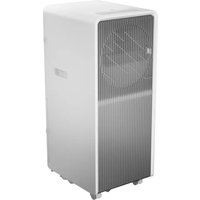
USER MANUAL BP409C BEKO
Local air conditioner
User Manual

BP407C
BP409C
BP412C
EN-IT-SR-UA-SQ-BS-PL-FR
CONTENTS
ENGLISH 3-43
ITALIANO 44-86
SRPSKI 87-127
УКРАЇНСЬКОЮ 128-173
SHQIP 174-215
BOSANSKI 216-256
POLSKI 257-301
FRANÇAIS 302-348
Please read this user manual first!
Dear Customer,
Thank you for choosing a Beko product. We hope you get the best results from your product, which has been manufactured with high quality and state-of-the-art technology. Therefore, please read this entire user manual and all other accompanying documents carefully before using the product, and keep it for future reference. If you pass the product on to someone else, give them the user manual as well. Follow all warnings and information in the user manual.
Meanings of the symbols
The following symbols are used in various sections of this manual:
| Important information or useful hints about usage. |
| Warning for hazardous situations with regard to life and property. |
| Warning to actions that must never perform. |
| Warning for electric shock. |
| This symbol shows that information is available such as the operating manual or installation manual. |
| Do not cover it. |
| This symbol shows that the operation manual should be read carefully. |
| This symbol shows that a service personnel should be handling this equipment with reference to the installation manual. |
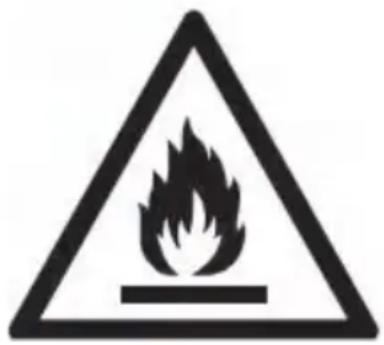
| (For R32/ R290 gas type) This symbol shows that this appliance used a flammable refrigerant. If the refrigerant is leaked and exposed to an external ignition source, there is a risk of fire. |
CONTENTS
1 Safety awareness 5 2 Name of parts 28 3 Accessories 29 4 Appearance and function of control panel 31 5 Appearance and function of remote control 32 6 Operation introduction 33 7 Installation explanations 36 8 Maintenance explanations 39 9 Troubleshooting 40 10 European disposal guidelines 41 11 F-gas instruction 42 12 Specifications 43
1 Safety awareness
VERY IMPORTANT!
Please do not install or use your portable air conditioner before you have carefully read this manual. Please keep this instruction manual for any product warranty and for future reference.

Warning:
Do not use means to accelerate the defrosting process or to clean, other than those recommended by the manufacturer. The appliance shall be stored in a room without continuously operating ignition sources (for example: open flames, an operating gas appliance, or an operating electric heater). Do not pierce or burn. Be aware that refrigerants may not contain an odor.
The appliance shall be installed, operated, and stored in a room with a floor area larger than Xm2.
1 Safety awareness
| MODEL X ( m2 ) | |
| 7000Btu/h 4 | |
| 9000Btu/h | 12 |
| 12000Btu/h | 15 |
Servicing shall be performed only as recommended by the manufacturer.
The appliance shall be stored in a well-ventilated area where the room size corresponds to the room area as specified for operation.
All working procedures that affect safety means shall only be carried out by competent persons.
Warning (for R290)
Specific information regarding appliances with R290 refrigerant gas.
- Thoroughly read all of the warnings.
- When defrosting and cleaning the appliance, do not use any tools other than
those recommended by the manufacturing company.
- The appliance must be placed in an area without any continuously sources of ignition (for example: open flames, gas or electrical appliances in operation).
- Do not puncture any part of the refrigerant circuit.
- This appliance contains Y g (see rating label back of unit) of R290 refrigerant gas.
- R290 is a refrigerant gas that complies with the European directives on the environment. Do not puncture any part of the refrigerant circuit.
- If the appliance is installed, operated or stored in an unventilated area, the room must be designed to prevent to
1 Safety awareness
the accumulation of refrigerant leaks resulting in a risk of fire or explosion due to ignition of the refrigerant caused by electric heaters, stoves, or other sources of ignition.
- The appliance must be stored in such a way as to prevent mechanical failure.
- Individuals who operate or work on the refrigerant circuit must have the appropriate certification issued by an accredited organization that ensures competence in handling refrigerants according to a specific evaluation recognized by associations in the industry.
- Repairs must be performed based on the recommendation from the manufacturing company. Maintenance and repairs that require the assistance of other qualified personnel must be performed under the supervision of an
individual specified in the use of flammable refrigerants.
- Ducts connected to an appliance shall not contain a potential ignition source.
General Safety Instruction
- The appliance is for indoor use only.
- Do not use the unit on a socket under repairs or not installed properly.
- Do not use the unit, follow these precautions:
A. Near to source of fire. B. An area where oil is likely to splash. C. An area exposed to direct sunlight. D. An area where water is likely to splash. E. Near a bath, a laundry, a shower or a swimming pool.
1 Safety awareness
- Never insert your fingers, rods into the air outlet. Take special care to warn children of these dangers.
- Keep the unit upward while transport and storage, for the compressor locates properly.
- Before cleaning the air-conditioner, always turn off or disconnect the power supply.
- When moving the air-conditioner, always turn off and disconnect the power supply, and move it slowly.
- To avoid the possibility of fire disaster, the air-conditioner shall not be covered.
- All the air-conditioner sockets must comply with the local electric safety requirements. If necessary, please check it for the requirements.
- Children should be supervised to ensure that they do not play with the appliance.
- If the supply cord is damaged, it must be replaced by the manufacturer, its service agent or similarly qualified persons in order to avoid a hazard.
- This appliance can be used by children aged from 8 years and above and persons with reduced physical, sensory or mental capabilities or lack of experience and knowledge if they have been given supervision or instruction concerning use of the appliance in a safe way and understand the hazards involved. Children shall not play with the appliance. Cleaning and user maintenance shall not be made by children without supervision.
- The appliance shall be installed in accordance with national wiring regulations.
1 Safety awareness
- Details of type and rating of fuses: T, 250V AC, 2A or 3.15A.
- Recycling.
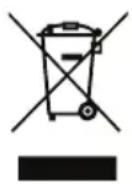
Compliance with the WEEE Directive and Disposing of the Waste Product:
This product complies with EU WEEE Directive (2012/19/EU). This product bears a classification symbol for waste electrical and electronic equipment (WEEE).
This symbol indicates that this product shall not be disposed with other household wastes at the end of its service life. Used device must be returned to official collection point for recycling of electrical and electronic devices. To find these collection systems please contact to your local authorities or retailer where the product was purchased. Each household performs important role in recovering and recycling of old appliance. Appropriate disposal of used appliance helps prevent potential negative consequences for the environment and human health.
- Contact authorized service technician for repair or maintenance of this unit.
- Do not pull, deform. or modify the power supply cord, or immerse it in water. Pulling or misuse of the power supply cord can result in damage to the unit and cause electrical shock.
- Compliance with national gas regulations shall be observed.
- Keep ventilation openings clear of obstruction.
- Any person who is involved with working on or breaking into a refrigerant circuit should hold a current valid
1 Safety awareness
certificate from an industry-accredited assessment authority, which authorizes their competence to handle refrigerants safely in accordance with an industry recognized assessment specification.
- Servicing shall only be performed as recommended by the equipment manufacturer. Maintenance and repair requiring the
assistance of other skilled personnel shall be carried out under the supervision of the person competent in the use of flammable refrigerants.
- Do not operate or stop the unit by inserting or pulling out the power plug, it may cause electric shock or fire due to heat generation.
- Unplug the unit if strange sounds, smell, or smoke comes from it.

1 Safety awareness

Notes:
- If any parts damage, please contact the dealer or a designated repair shop. – In case of any damage, please turn off the air switch, disconnect the power supply, and contact the dealer or a designated repair shop. – In any case, the power cord shall be firmly grounded. - To avoid the possibility of danger, if power cord is damaged, please turn off the air switch and disconnect the power supply. It must be replaced from the dealer or a designated repair shop.
INSTRUCTIONS FOR REPAIRING APPLIANCES CONTAINING R290
1 GENERAL INSTRUCTIONS
1.1 Checks to the area
Prior to beginning work on systems containing flammable refrigerants, safety checks are necessary to ensure that the risk of ignition is minimized. For repair to the refrigerating system, the following precautions shall be
complied with prior to conducting work on the system.
1.2 Work procedure
Work shall be undertaken under a controlled procedure so as to minimize the risk of a flammable gas or vapor being present while the work is being performed.
1.3 General work area
All maintenance staff and others working in the local area shall be instructed on the nature of work being carried out. Work in confined
1 Safety awareness
spaces shall be avoided. The area around the workspace shall be sectioned off. Ensure that the conditions within the area have been made safe by control of flammable material.
1.4 Checking for presence of refrigerant
The area shall be checked with an appropriate refrigerant detector prior to and during work, to ensure the technician is aware of potentially flammable atmospheres. Ensure that the leak detection equipment being used is suitable for use with flammable refrigerants, i.e. non-sparking, adequately sealed or intrinsically safe.
1.5 Presence of fire extinguisher
If any hot work is to be conducted on the refrigeration equipment or any associated parts, appropriate fire extinguishing
equipment shall be available to hand. Have a dry powder or CO2 fire extinguisher adjacent to the charging area.
1.6 No ignition sources
No person carrying out work in relation to a refrigeration system which involves exposing any pipe work that contains or has contained flammable refrigerant shall use any sources of ignition in such a manner that it may lead to the risk of fire or explosion. All possible ignition sources, including cigarette smoking, should be kept sufficiently far away from the site of installation, repairing, removing and disposal, during which flammable refrigerant can possibly be released to the surrounding space.
Prior to work taking place, the area around the
1 Safety awareness
equipment is to be surveyed to make sure that there are no flammable hazards or ignition risks. "No Smoking" signs shall be displayed.
1.7 Ventilated area
Ensure that the area is in the open or that it is adequately ventilated before breaking into the system or conducting any hot work. A degree of ventilation shall continue during the period that the work is carried out. The ventilation should safely disperse any released refrigerant and preferably expel it externally into the atmosphere.
1.8 Checks to the refrigeration equipment
Where electrical components are being changed, they shall be fit for the purpose and to the correct specification. At all times the manufacturer's maintenance and service
guidelines shall be followed. If in doubt consult the manufacturer's technical department for assistance. The following checks shall be applied to installations using flammable refrigerants: the charge size is in accordance with the room size within which the refrigerant containing parts are installed; the ventilation machinery and outlets are operating adequately and are not obstructed; if an indirect refrigerating circuit is being used, the secondary circuit shall be checked for the presence of refrigerant; marking to the equipment continues to be visible and legible. Markings and signs that are illegible shall be corrected; refrigeration pipe or components are installed in a position where they are unlikely to be exposed
1 Safety awareness
to any substance which may corrode refrigerant containing components, unless the components are constructed of materials which are inherently resistant to being corroded or are suitably protected against being so corroded.
1.9 Checks to electrical devices
Repair and maintenance to electrical components shall include initial safety checks and component inspection procedures. If a fault exists that could compromise safety, then no electrical supply shall be connected to the circuit until it is satisfactorily dealt with. If the fault cannot be corrected immediately but it is necessary to continue operation, an adequate temporary solution shall be used. This shall be reported to the owner of the
equipment so all parties are advised.
Initial safety checks shall include: that capacitors are discharged: this shall be done in a safe manner to avoid possibility of sparking; that there are no live electrical components and wiring exposed while charging, recovering or purging the system; that there is continuity of earth bonding.
1 Safety awareness
2 REPAIRS TO SEALED COMPONENTS
2.1 During repairs to sealed components, all electrical supplies shall be disconnected from the equipment being worked upon prior to any removal of sealed covers, etc. If it is absolutely necessary to have an electrical supply to equipment during servicing, then a permanently operating form of leak detection shall be located at the most critical point to warn of a potentially hazardous situation. Servicing shall be performed only as recommended by the manufacturer.
The appliance shall be stored in a well-ventilated area where the room size corresponds to the room area as specified for operation.
2.2 Particular attention shall be paid to the following to ensure that by working on electrical
components, the casing is not altered in such a way that the level of protection is affected. This shall include damage to cables, excessive number of connections, terminals not made to original specification, damage to seals, incorrect fitting of glands, etc. Ensure that apparatus is mounted securely. Ensure that seals or sealing materials have not degraded such that they no longer serve the purpose of preventing the ingress of flammable atmospheres.
Replacement parts shall be in accordance with the manufacturer's specifications.
Note:

The use of silicon sealant may inhibit the effectiveness of some types of leak detection equipment. Intrinsically safe components do not have to be isolated prior to working on them.
The use of silicon sealant may inhibit the effectiveness of some types of leak detection equipment. Intrinsically safe components do not have to be isolated prior to working on them.
Do not apply any permanent inductive or capacitance loads to the circuit without ensuring that this will not exceed the permissible voltage and current permitted for the equipment in use.
Do not apply any permanent inductive or capacitance loads to the circuit without ensuring that this will not exceed the permissible voltage and current permitted for the equipment in use.
Intrinsically safe components are the only types that can be worked on while live in the presence of a flammable atmosphere. The test apparatus shall be at the correct rating.
Replace components only with parts specified by the manufacturer. Other parts may result in the ignition of refrigerant in the atmosphere from a leak.
4 CABLING
Check that cabling will not be subject to wear, corrosion, excessive pressure, vibration, sharp edges or any other adverse environmental effects. The check shall also take into account the effects of aging or continual vibration from sources such as compressors or fans.
5 DETECTION OF FLAMMABLE REFRIGERANTS
Under no circumstances shall potential sources of ignition be used in the searching for or detection of refrigerant leaks. A halide torch (or any other detector using a naked flame) shall not be used.
1 Safety awareness
6 LEAK DETECTION METHODS
The following leak detection methods are deemed acceptable for systems containing flammable refrigerants.
Electronic leak detectors shall be used to detect flammable refrigerants, but the sensitivity may not be adequate, or may need re-calibration. (Detection equipment shall be calibrated in a refrigerant-free area.)
Ensure that the detector is not a potential source of ignition and is suitable for the refrigerant used.
Leak detection equipment shall be set at a percentage of the LFL of the refrigerant and shall be calibrated to the refrigerant employed and the appropriate percentage of gas (25 % maximum) is confirmed. Leak detection fluids are suitable for use with most refrigerants but the use of detergents containing chlorine shall be avoided as the chlorine may react with
the refrigerant and corrode the copper pipe-work. If a leak is suspected, all naked flames shall be removed/extinguished. If a leakage of refrigerant is found which requires brazing, all of the refrigerant shall be recovered from the system, or isolated (by means of shut off valves) in a part of the system remote from the leak. Oxygen free nitrogen (OFN) shall then be purged through the system both before and during the brazing process.
7 REMOVAL AND EVACUATION
When breaking into the refrigerant circuit to make repairs - or for any other purpose - conventional ventilation procedures shall be used. However, it is important that best practice is followed since flammability is a consideration. The following procedure shall be adhered to: remove refrigerant; purge the circuit with inert gas; evacuate; purge again with inert gas; open
1 Safety awareness
the circuit by cutting or brazing. The refrigerant charge shall be recovered into the correct recovery cylinders. The system shall be “flushed” with OFN to render the unit safe. This process may need to be repeated several times. Compressed air or oxygen shall not be used for this task. Flushing shall be achieved by breaking the vacuum in the system with OFN and continuing to fill until the working pressure is achieved, then venting to atmosphere, and finally pulling down to a vacuum. This process shall be repeated until no refrigerant is within the system. When the final OFN charge is used, the system shall be vented down to atmospheric pressure to enable work to take place. This operation is absolutely vital if brazing operations on the pipework are to take place. Ensure that the outlet for the vacuum pump is not close to any ignition sources and there is according to IEC 60079-15:2010. Information about the correct working procedures:
a) Commissioning
- Ensure that the floor area is sufficient for the refrigerant charge or that the ventilation duct is assembled in a correct manner.
- Connect the pipes and carry out a leak test before charging with refrigerant.
- Check safety equipment before putting into service.
b) Maintenance
- Portable equipment shall be repaired outside or in a workshop specially equipped for servicing units with flammable refrigerants.
- Ensure sufficient ventilation at the repair place.
- Be aware that malfunction of the equipment may be caused
1 Safety awareness
by refrigerant loss and a refrigerant leak is possible.
- Discharge capacitors in a way that won't cause any spark. The standard procedure to short circuit the capacitor terminals usually create sparks.
- Reassemble sealed enclosures accurately. If seals are worn, replace them.
- Check safety equipment before putting into service.
c) Repair
- Portable equipment shall be repaired outside or in a workshop specially equipped for servicing units with flammable refrigerants.
- Ensure sufficient ventilation at the repair place.
- Be aware that malfunction of the equipment may be caused by refrigerant loss and a refrigerant leak is possible.
- Discharge capacitors in a way that won't cause any spark.
- When brazing is required, the following procedures shall be carried out in the right order:
- Remove the refrigerant. If the recovery is not required by national regulations, drain the refrigerant to the outside.
Take care that the drained refrigerant will not cause any danger. In doubt, one person should guard the outlet. Take special care that drained refrigerant will not float back into the building.
- Evacuate the refrigerant circuit. – Purge the refrigerant circuit with nitrogen for 5 min. Evacuate again. - Remove parts to be replaced by cutting, not by flame. – Purge the braze point with nitrogen during the brazing procedure.
1 Safety awareness
- Carry out a leak test before charging with refrigerant.
- Reassemble sealed enclosures accurately. If seals are worn, replace them.
- Check safety equipment before putting into service.
d) Decommissioning
- If the safety is affected when the equipment is put out of service, the refrigerant charge shall be removed before decommissioning.
- Ensure sufficient ventilation at the equipment location.
- Be aware that malfunction of the equipment may be caused by refrigerant loss and a refrigerant leak is possible.
- Discharge capacitors in a way that won't cause any spark.
Remove the refrigerant. If the recovery is not required by national regulations, drain ventilation available.
8 CHARGING PROCEDURES
In addition to conventional charging procedures, the following requirements shall be followed.
- Ensure that contamination of different refrigerants does not occur when using charging equipment. Hoses or lines shall be as short as possible to minimize the amount of refrigerant contained in them. Cylinders shall be kept upright.
- Ensure that the refrigeration system is earthed prior to charging the system with refrigerant. Label the system when charging is complete (if not already). Extreme care shall be taken not to overfill the refrigeration system.
Prior to recharging the system, it shall be pressure tested with OFN. The system shall be leak
1 Safety awareness
tested on completion of charging but prior to commissioning.
A follow up leak test shall be carried out prior to leaving the site.
9 DECOMMISSIONING
Before carrying out this procedure, it is essential that the technician is completely familiar with the equipment and all its detail. It is recommended good practice that all refrigerants are recovered safely. Prior to the task being carried out, an oil and refrigerant sample shall be taken in case analysis is required prior to re-use of reclaimed refrigerant. It is essential that electrical power is available before the task is commenced.
a) Become familiar with the equipment and its operation. b) Isolate the system electrically. c) Before attempting the procedure, ensure that: mechanical handling equipment is available, if required, for
handling refrigerant cylinders; all personal protective equipment is available and being used correctly; the recovery process is supervised at all times by a competent person; recovery equipment and cylinders conform to the appropriate standards.
d) Pump down the refrigerant system, if possible. e) If a vacuum is not possible, make a manifold so that refrigerant can be removed from various parts of the system. f) Make sure that the cylinder is situated on the scales before recovery takes place. g) Start the recovery machine and operate in accordance with the manufacturer's instructions. h) Do not overfill cylinders (no more than 80% volume liquid charge). i) Do not exceed the maximum working pressure of the cylinder, even temporarily.
j) When the cylinders have been filled correctly and the process completed, make sure that the cylinders and the equipment are removed from site promptly and all isolation valves on the equipment are closed off. k) Recovered refrigerant shall not be charged into another refrigeration system unless it has been cleaned and checked.
10 LABELLING
Equipment shall be labeled stating that it has been decommissioned and emptied of refrigerant. The label shall be dated and signed.
Ensure that there are labels on the equipment stating that the equipment contains flammable refrigerant.
11 RECOVERY
When removing refrigerant from a system, either for servicing or decommissioning, it is recommended good practice that all refrigerants are removed
safely. When transferring refrigerant into cylinders, ensure that only appropriate refrigerant recovery cylinders are employed. Ensure that the correct number of cylinders for holding the total system charge are available. All cylinders to be used are designated for the recovered refrigerant and labeled for that refrigerant (i.e., special cylinders for the recovery of refrigerant). Cylinders shall be complete with pressure relief valve and associated shut-off valves in good working order. Empty recovery cylinders are evacuated and, if possible, cooled before recovery occurs.
The recovery equipment shall be in good working order with a set of instructions concerning the equipment that is at hand and shall be suitable for the recovery of flammable refrigerants. In addition, a set of calibrated weighing scales shall be
available and in good working order. Hoses shall be complete with leak-free disconnect couplings and in good condition. Before using the recovery machine, check that it is in satisfactory working order, has been properly maintained and that any associated electrical components are sealed to prevent ignition in the event of a refrigerant release. Consult the manufacturer if in doubt.
The recovered refrigerant shall be returned to the refrigerant supplier in the correct recovery cylinder, and the relevant Waste Transfer Note arranged. Do not mix refrigerants in recovery units and especially not in cylinders. If compressors or compressor oils are to be removed, ensure that they have been evacuated to an acceptable level to make certain that flammable refrigerant does not remain within the lubricant. The evacuation process shall be carried out prior to returning the compressor to the suppliers. Only electric heating to the compressor body shall be employed to accelerate this process. When oil is drained from a system, it shall be carried out safely.
Competence of service personnel General
Special training additional to usual refrigerating equipment repair procedures is required when equipment with flammable refrigerants is affected.
In many countries, this training is carried out by national training organizations that are accredited to teach the relevant national competency standards that may be set in legislation.
The achieved competence should be documented by a certificate.
1 Safety awareness
Training
The training should include the substance of the following: Information about the explosion potential of flammable refrigerants to show that flammables may be dangerous when handled without care. Information about potential ignition sources, especially those that are not obvious, such as lighters, light switches, vacuum cleaners, electric heaters. Information about the different safety concepts:
Unventilated - (see Clause GG.2) Safety of the appliance does not depend on ventilation of the housing. Switching off the appliance or opening of the housing has no significant effect on the safety. Nevertheless, it is possible that leaking refrigerant may accumulate inside the enclosure and flammable atmosphere will be released when the enclosure is opened. Ventilated enclosure - (see Clause GG.4) Safety of the appliance depends on ventilation of the housing. Switching off the appliance or opening of the enclosure has a significant effect on the safety. Care should be taken to ensure a sufficient ventilation before.
Ventilated room - (see Clause GG.5) Safety of the appliance depends on the ventilation of the room. Switching off the appliance or opening of the housing has no significant effect on the safety. The ventilation of the room shall not be switched off during repair procedures. Information about the concept of sealed components and sealed enclosures the refrigerant to the outside. Take care that the drained refrigerant will not cause any danger. In doubt, one person should guard the outlet.
1 Safety awareness
Take special care that drained refrigerant will not float back into the building.
•Evacuate the refrigerant circuit. - Purge the refrigerant circuit with nitrogen for 5 min. - Evacuate again. - Fill with nitrogen up to atmospheric pressure. - Put a label on the equipment that the refrigerant is removed. e) Disposal
- Ensure sufficient ventilation at the working place.
- Remove the refrigerant. If recovery is not required by national regulations, drain the refrigerant to the outside. Take care that the drained refrigerant will not cause any danger. In doubt, one person should guard the outlet. Take special care that drained refrigerant will not float back into the building.
- Evacuate the refrigerant circuit.
- Purge the refrigerant circuit with nitrogen for 5 min.
- Evacuate again.
- Cut out the compressor and drain the oil.
- Transportation, marking and storage for units that employ flammable refrigerants
Transport of equipment containing flammable refrigerants
- Attention is drawn to the fact that additional transportation regulations may exist with respect to equipment containing flammable gas. The maximum number of pieces of equipment or the configuration of the equipment, permitted to be transported together will be determined by the applicable transport regulations.
- Marking of equipment using signs
• Signs for similar appliances used in a work area generally
1 Safety awareness
are addressed by local regulations and give the minimum requirements for the provision of safety and/or health signs for a work location.
- All required signs are to be maintained and employers should ensure that employees receive suitable and sufficient instruction and training on the meaning of appropriate safety signs and the actions that need to be taken in connection with these signs.
- The effectiveness of signs should not be diminished by too many signs being placed together. Any pictograms used should be as simple as possible and contain only essential details.
- Disposal of equipment using flammable refrigerants: see national regulations.
- Storage of equipment/appliances
- The storage of equipment should be in accordance with the manufacturer's instructions. Storage of packed (unsold) equipment
- Storage package protection should be constructed such that mechanical damage to the equipment inside the package will not cause a leak of the refrigerant charge.
- The maximum number of pieces of equipment permitted to be stored together will be determined by local regulations.
1 Safety awareness

Packaging materials of the product are manufactured from recyclable materials in accordance with our National Environment Regulations. Do not dispose of the packaging materials together with the domestic or other wastes. Take them to the packaging material collection points designated by the local authorities.
Compliance with RoHS Directive
The product you have purchased complies with EU RoHS Directive (2011/65/EU). It does not contain harmful and prohibited materials specified in the Directive.
2 Name of parts
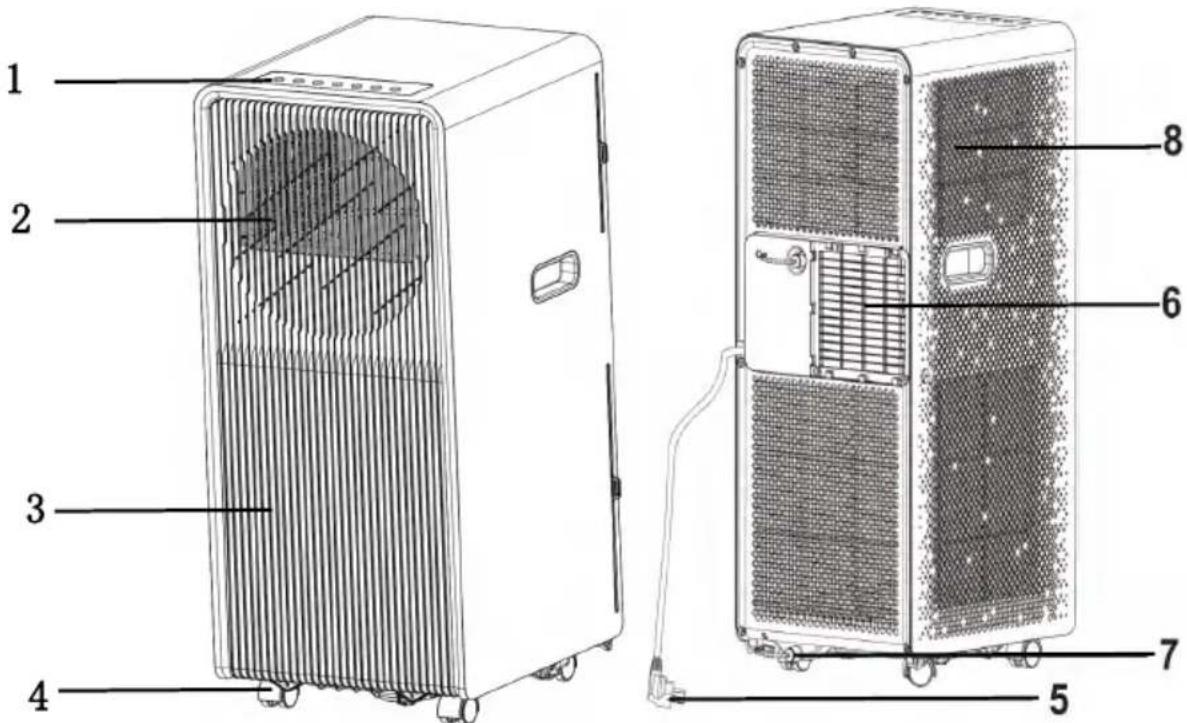
Fig. 1
| 1 | Control panel | 5 | Power cord |
| 2 | Louver | 6 | Air outlet |
| 3 7 | Frontpanel | | Drainage outlet |
| 4 | Castor | 8 | Air inlet |
3 Accessories
| Part Description Quantity | | |
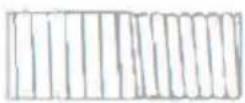 | Exhaust hose 1 | |
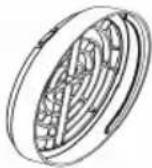 | Window Connector 1 | |
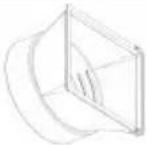 | Housing adaptor 1 | |
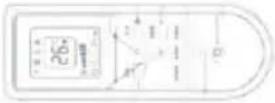 | Remote Controller LCD 1 | |
 | Window Kit 1 | |
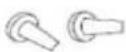 | Dowell 2 | |
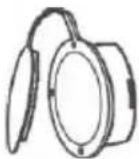 | Air outlet 1 | |
 | Water pipe 1 | |
| [yXTA] | Batteries 2 | |
 | Window installation cloth | 1 (optional) |
3 Accessories
| Part Description Quantity | | |
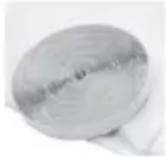 | Roll ribbon 1 (optional) |
After unpacking, please check whether the above-mentioned accessories are present and understand their purposes as described in the installation introduction in this manual.
4 Appearance and function of control panel
Cooling only model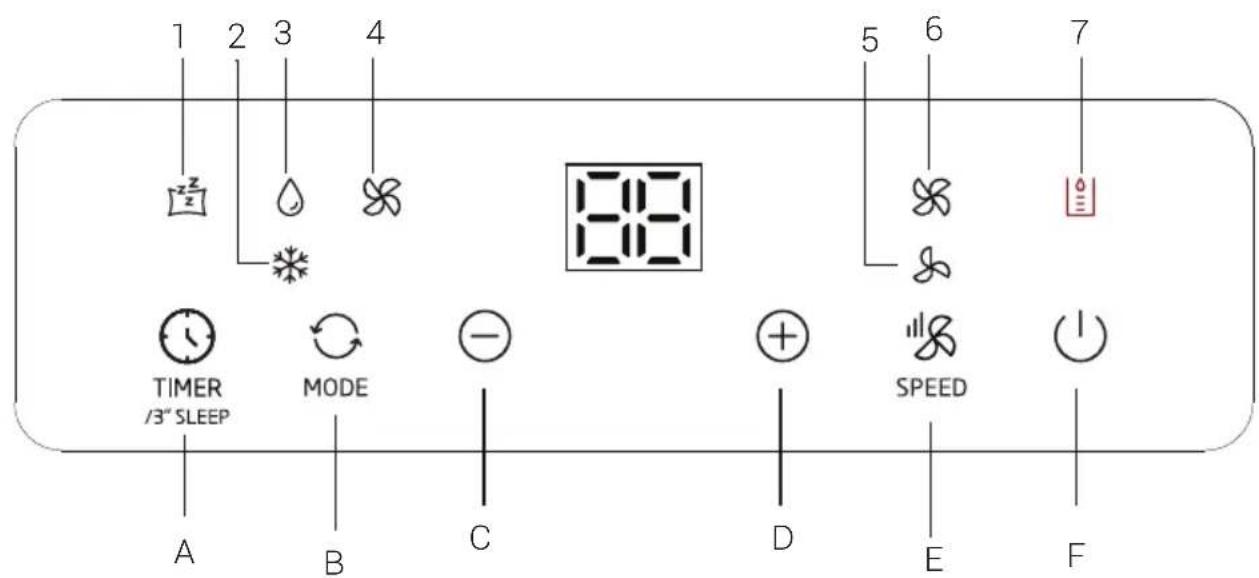
| A Timer on/off /Sleep 1 Sleep | | |
| B Operation MODE 2 Cooling | | |
| C Temperature down 3 Dehumidifying | | |
| D Temperature up 4 Fan | | |
| E Fan speed 5 Low fan speed | | |
| F Power on/off 6 High fan speed | | |
| | 7 Water full |
5 Appearance and function of remote control
Remote Control with LCD display for cooling only (for some models)
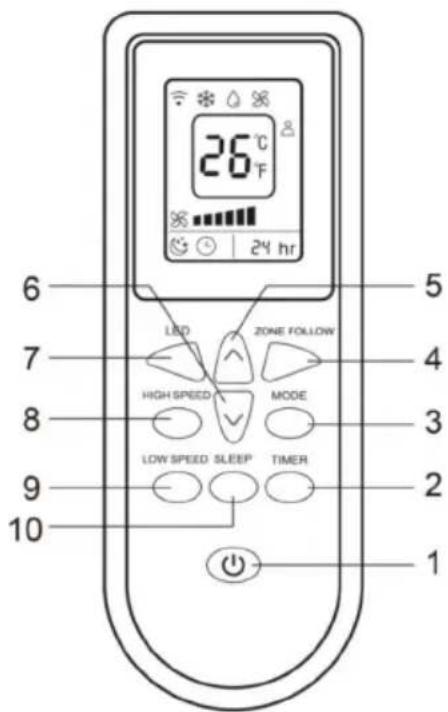
| 1 Power on/off |
| 2 Timer on/off |
| 3 Operation MODE |
| 4 Zone Follow |
| 5 Temperature up |
| 6 Temperature down |
| 7 LED display |
| 8 | High speed |
| 9 | Low speed |
| 10 | Sleep mode |
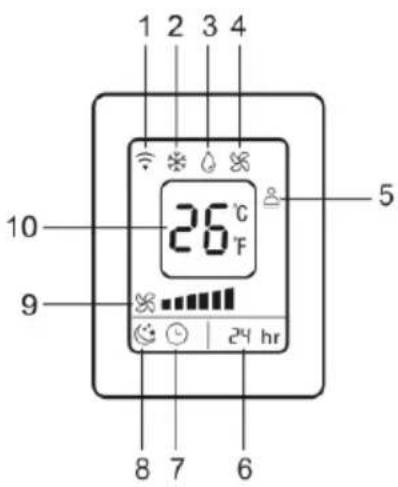
| 1 Receiver signal |
| 2 Cooling |
| 3 Dehumidifying |
| 4 Fan |
| 5 Zone Follow |
| 6 Timing |
| 7 Timer on/off |
| 8 Sleep mode |
| 9 Fan speed |
| 10 Temperature display |

Notes:
- Do not drop the remote controller.
- Do not place the remote controller in a location exposed to direct sunlight.
6 Operation introduction
Before starting operations in this section:
1) Find a place where there is power supply nearby.
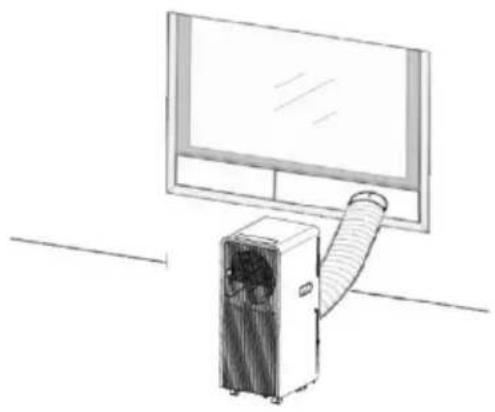
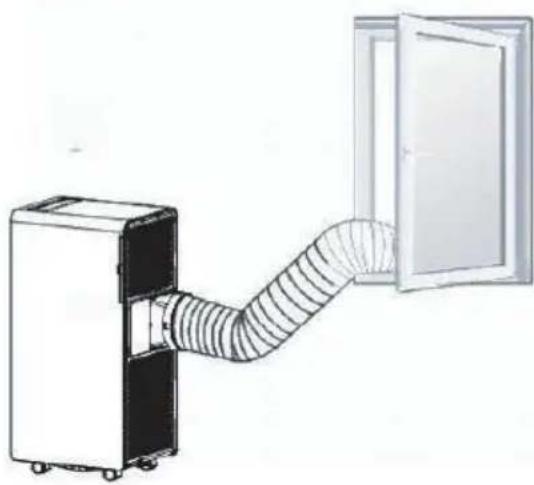
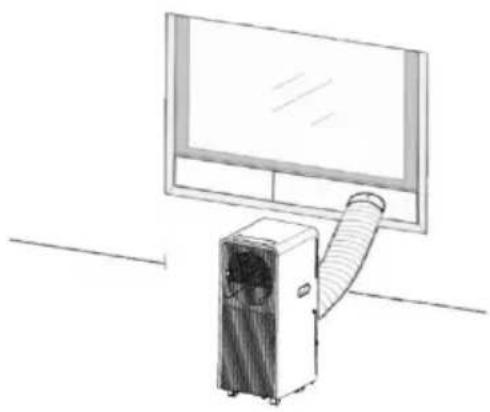
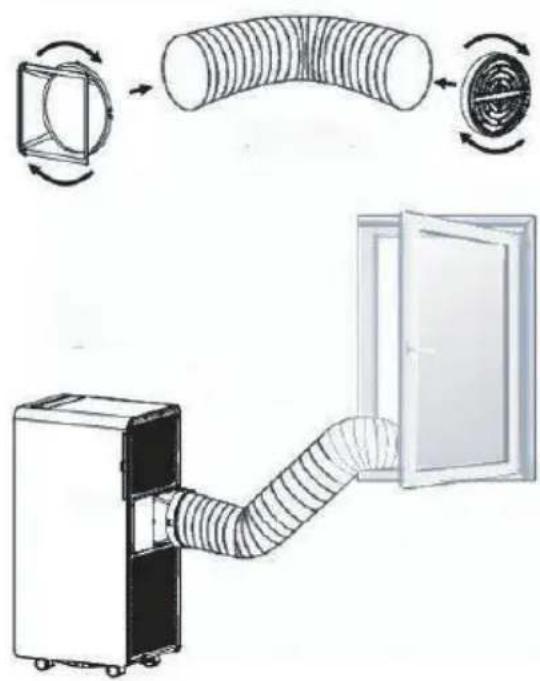
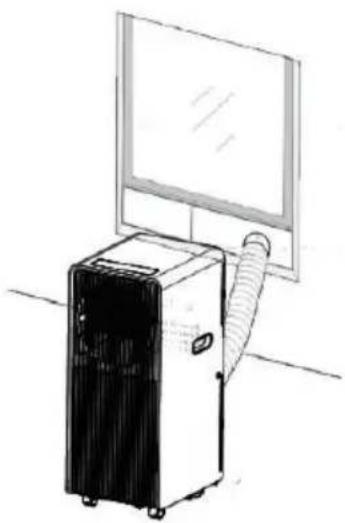
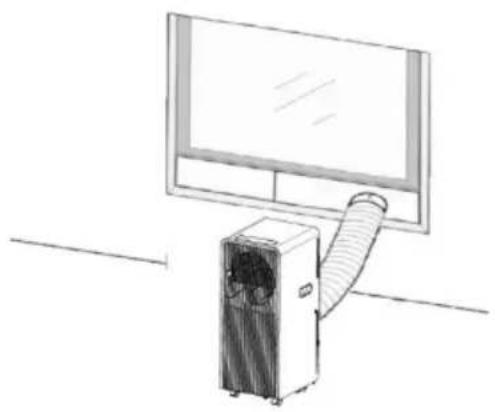
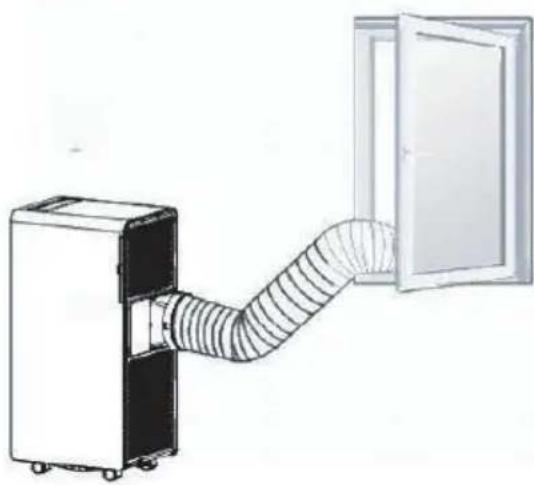
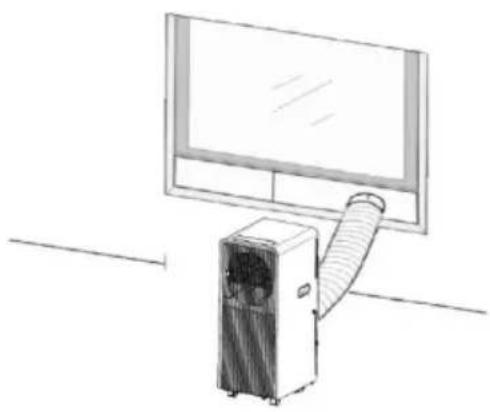
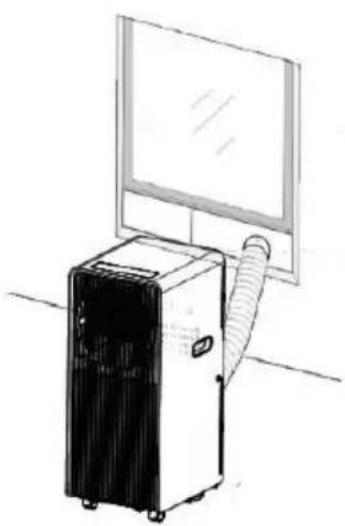
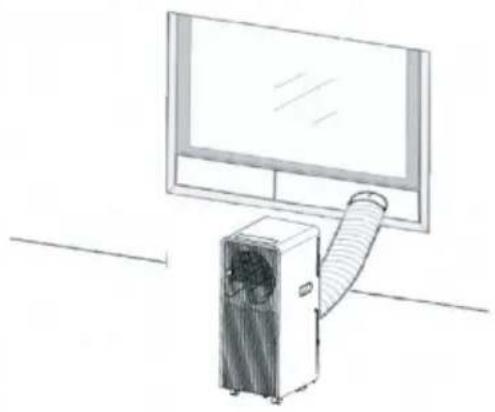
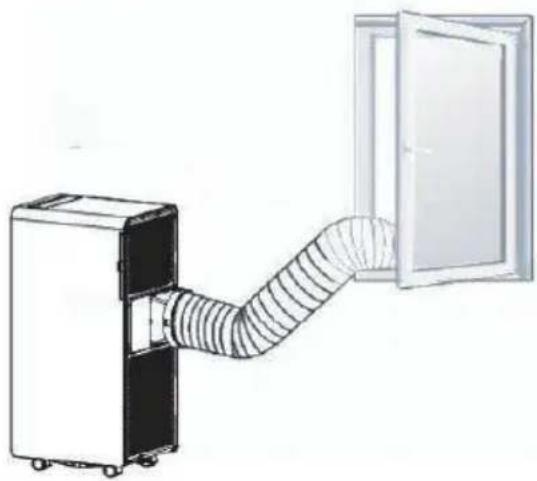
2) As shown in Fig.2 and Fig.2a, install the exhaust hose, and adjust the window position well.
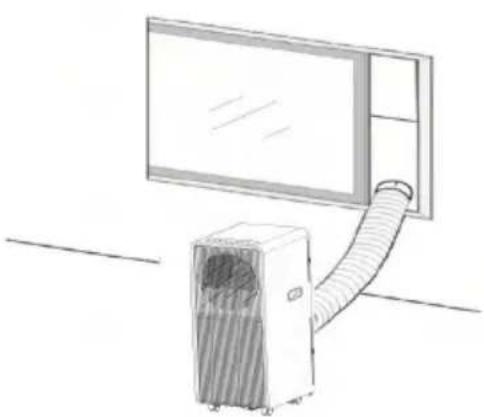
Fig. 2
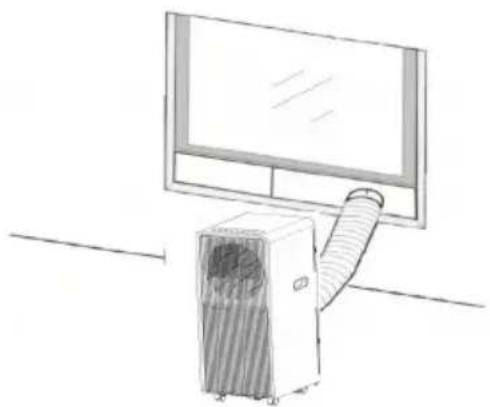
Fig. 2a
3) As shown in Fig. 6, connect drain hose well (only for using heating model);
4) Insert the power cord into a grounded AC220~240V/50Hz socket;
5) Press the POWER button to turn on the air-conditioner.
- Before using
 | Note:Operation temperature range: |
| Maximum cooling Minimum cooling |
| DB/WB(°C) | 35/24 18/12 | |
| Maximum heating Minimum heating- |
| DB/WB(°C) | 27/- 7/- | |
Check whether the exhaust hose has been mounted properly.
Cautions for cooling and dehumidifying operations:
- When using cooling and dehumidifying functions, keep an interval of at least 3 minutes between each POWER.
- Power supply meets the requirements. The socket is for AC use.
- Do not share one socket with other appliances.
- Power supply is AC220-240V, 50Hz
- Cooling operation
- Press the "Mode" button until the "Cool" icon appears.
- Press the "or" button to select a desired room temperature. (16°C-31°C)
6 Operation introduction
- Press the "Fan Speed" button to select wind speed.
- Dehumidifying operation
Press the "Mode" button until the "Dehumidify" icon appears.
- Automatically set the selected temperature to current room temperature minus 2°C.
- Automatically set the fan motor to LOW wind speed.
- Fan operation
- Press the "Mode" button until the "Fan" icon appears.
- Press the "Fan Speed" button to select wind speed.
- Timer operation
Timer ON setting
- When the air-conditioner is OFF, press the 'Timer' button and select a desired ON time through the temperature and Timer setting buttons.
- Preset "ON Time" hours will keep shown at 88 display part all the time once ON Timer is set. ON time can be regulated at any time in 0-24 hours.
- To deactivate the timer function press "Timer" button 2 times continuously until the preset Timer display turns off.
Timer OFF setting
- When the air-conditioner is ON, press 'Timer' button and select a desired OFF time through the temperature and time setting buttons.
- "Preset OFF Time" will be shown on "88" display for one minute. OFF time can be regulated at any time in 0-24 hours.
- Preset "OFF Time" hours will be shown at "88" display part for 1 minute, and then the setting temperature will keep shown in the "88" display.
Repress 'Timer' button, the remaining "OFF Time" hours will be displayed on the "88" display.
- To deactivate the timer function, press the "Timer" button twice in succession until the preset timer display turns off.
- SLEEP mode
- While in cooling mode, press the SLEEP key for 3 seconds to set the temperature. It increases by 1 °C after an hour and by at most 2 °C after 2 hours.
- While in heating mode, press the SLEEP key for 3 seconds to set the temperature. It decreases by 1 °C after an hour and by at most 2 °C after 2 hours.
- Press the SLEEP key for 3 seconds again to cancel the setting.
- Zone follow function
- You can switch the Zone follow function on or off using the remote controller.
- When this function is on, the unit will control the room temperature using the temperature sensor inside the remote controller (the room temperature sensor inside the machine will not be used).
- This function will turn off if the unit does not receive a signal from the remote controller within 30 minutes. It will then switch to the normal room temperature sensor inside the unit to control the temperature.
- Water Drainage
Water Full Alarm Function
- The inner water tray in the air-conditioner has one water level safety switch that controls the water level. When the water level reaches an anticipated height, the water full indicator lights up. When the water is full, remove the rubber blockage from the drainage hole at the bottom of the unit and drain all water outside.
6 Operation introduction
Continuous Drainage
- If you plan to leave this unit unused for a long time, remove the rubber blockage from the drainage hole at the bottom of the unit and drain all water outside.
- You can use continuous drainage with a drainage hose connected to the bottom drain hole when the unit is operating in HEAT mode.
- Continuous drainage is not necessary when the unit is operating in COOL or DEHUMIDIFY mode. The unit can evaporate condensate water automatically via the splash motor. Ensure the drainage holes are properly sealed.
- If the water splash motor is damaged, continuous drainage can be used. Connect the drain hose to the bottom drain hole (Fig.6), and the unit will still operate effectively.
- If the splash motor is damaged, intermittent drainage can also be used. In this case, when the water full indicator lights up, connect a drain hose to the bottom drainage hole, and all water in the water tank will be drained outside. The unit will still operate effectively.
7 Installation Explanations
- Installation Explanations:
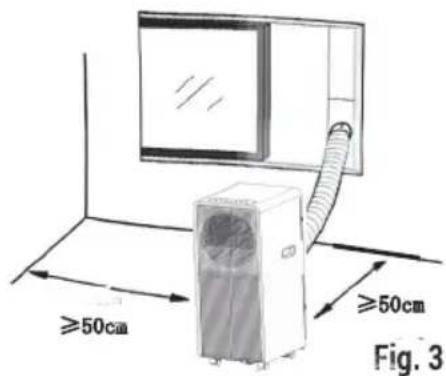
- A portable air conditioner should be installed on a flat, clear surface. Do not block the air outlet, and maintain a clearance of at least 50 cm around the unit (see Fig.3).
- Do not install in damp locations, such as a laundry room.
- Socket wiring must comply with local electrical safety regulations.
Introduction to Exhaust Hose Installation
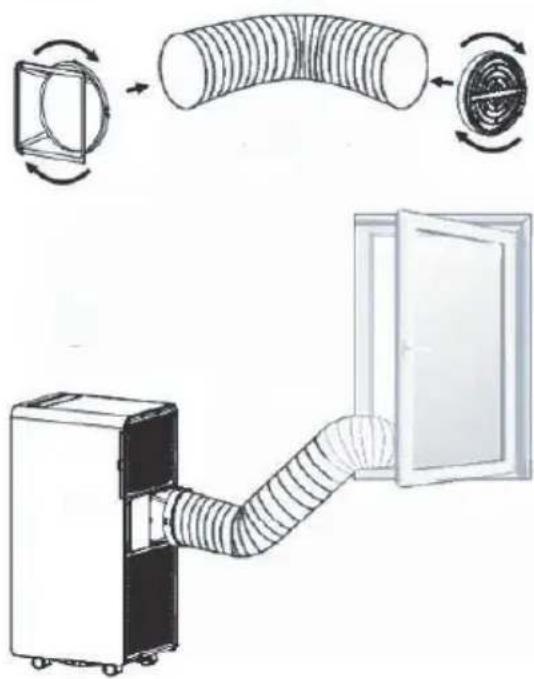
A) Temporary Installation
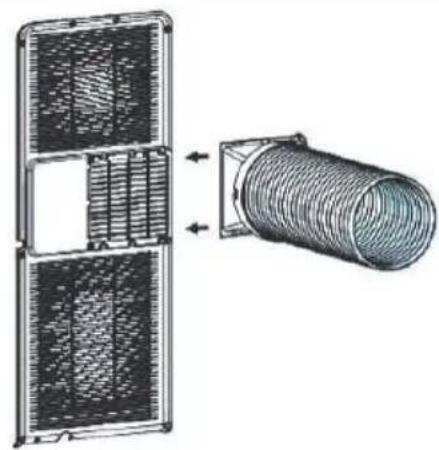
- Twist the housing adaptor and the window connector onto the ends of the exhaust hose.
- Insert the fixing clip of the housing adaptor into the openings at the back of the air conditioner.
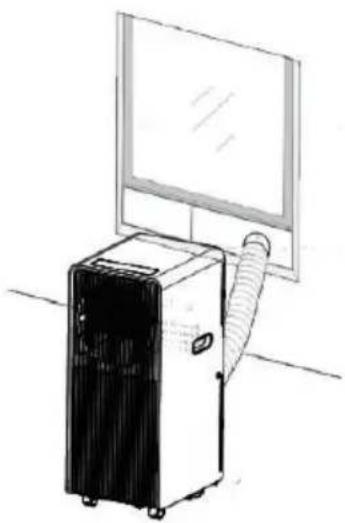
- Put the other end of the exhaust hose to the near windowsill (see Fig.4)
7 Installation explanations
B) Window Kit Installation
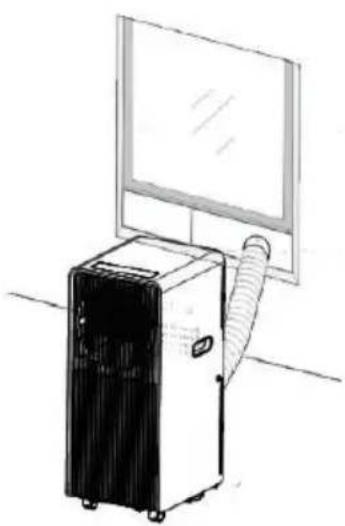
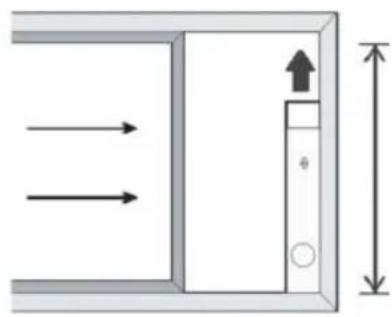
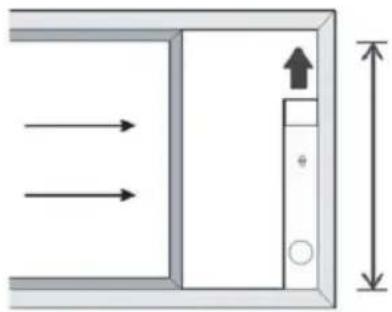
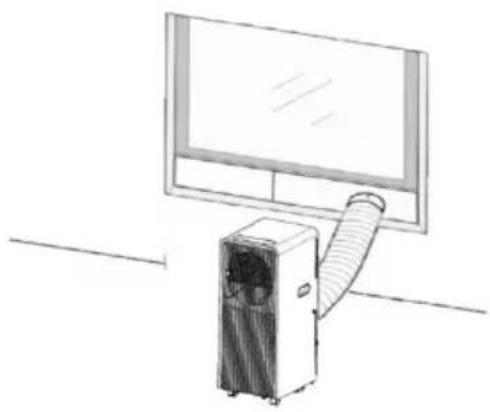
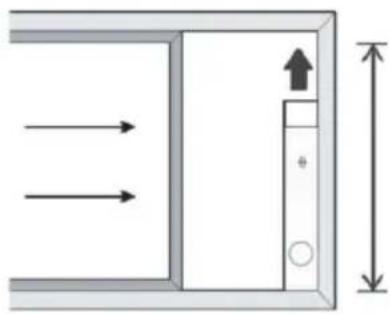
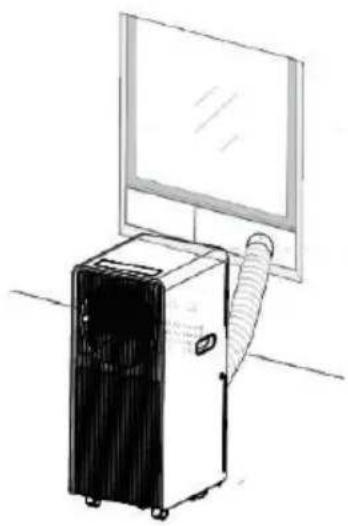
The installation manner of window slider kit is mostly in "horizontal" or "vertical". As shown Fig.5 and Fig.5a, check the min. and max. size of the window before the installation.
- Install the window kit on the window (Fig.5, Fig.5a);
- Adjust the length of the window slider kit according to the window width or height, and fix it with the dowel;
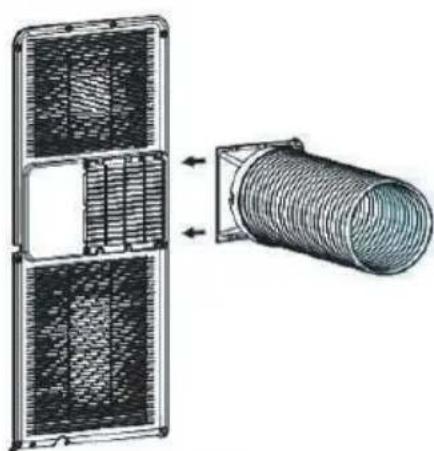
- Insert the window connector of the hose to the hole of the window kit (Fig.5b).
①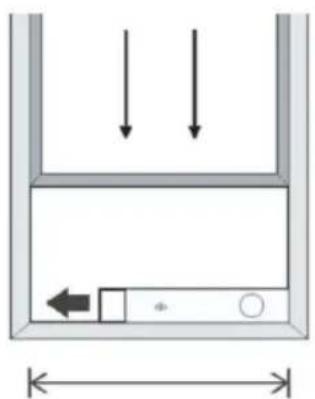
Window width
min:67.5cm
max:123cm
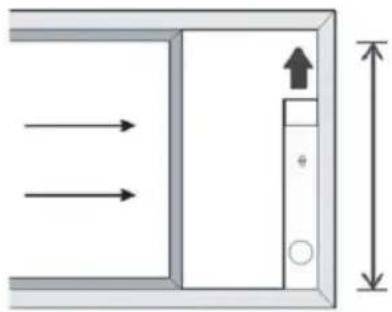
Window height min:67.5cm max:123cm
②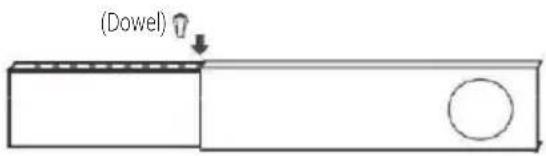
③
Fig. 5b
7 Installation explanations
Water Full Alarm Function
The inner water tray in the air-conditioner has one water level safety switch, which controls the water level. When the water level reaches an anticipated height, the water full indicator lamp lights up. (If the water splash motor is damaged, when the water is full, please remove the rubber blockage at the bottom of the unit, and all water will drain outside.)
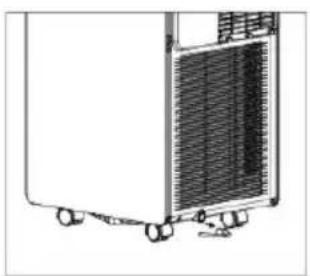
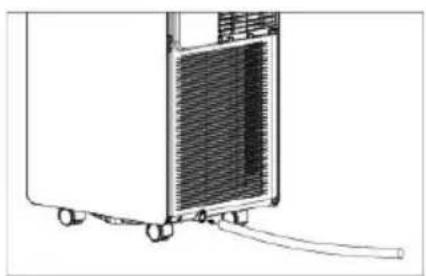
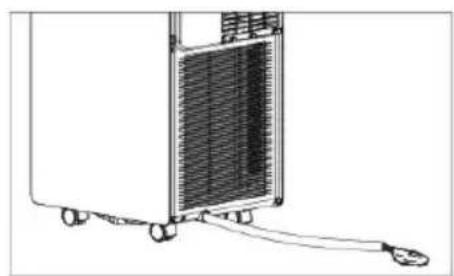
Fig. 6
8 Maintenance explanations
Declaration:
1) Before cleaning, be sure to disconnect the unit from any electric supply outlet; 2) Do not use gasoline or other chemicals to clean the unit;
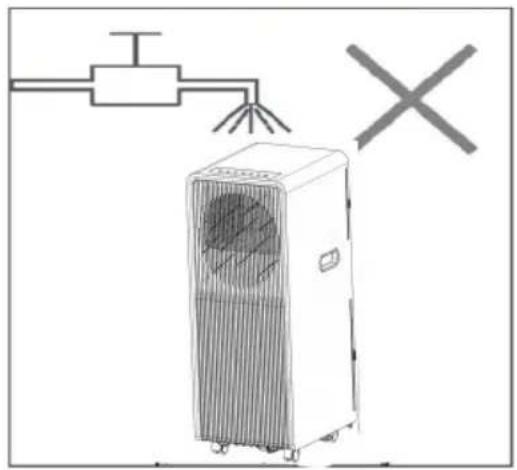
3) Do not wash the unit directly; 4) If the conditioner is damaged, please contact the dealer or repair shop.
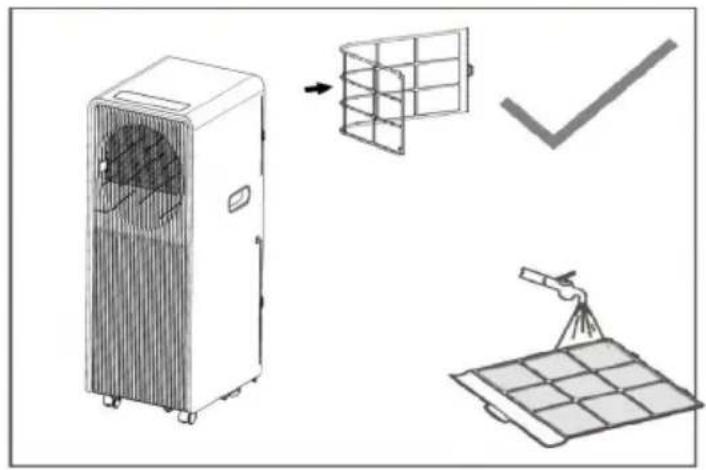
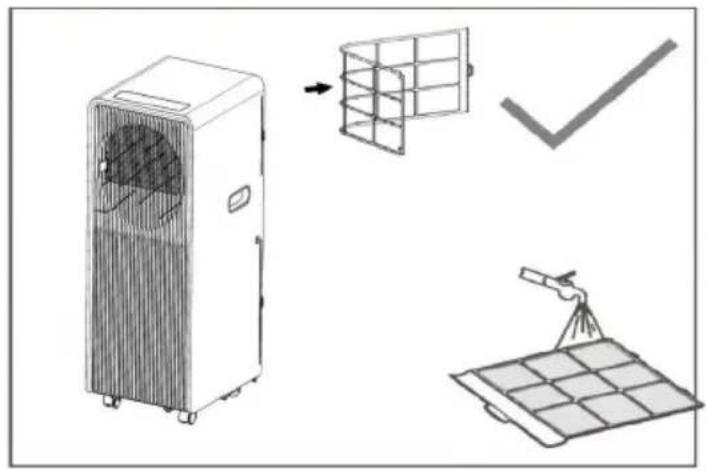
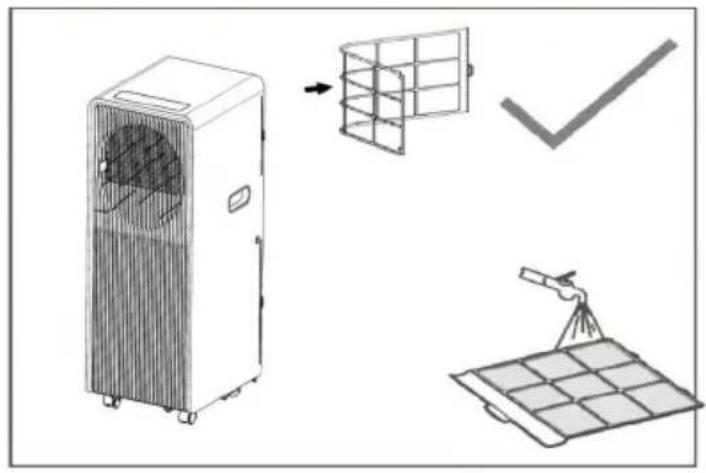
1. Air Filter
- If the air filter becomes clogged with dust/dirt, the air filter should be cleaned once every two weeks.
- Dismounting
Open the air inlet grille and take off the air filter.
- Cleaning
Clean the air filter with neutral detergent in lukewarm (40°C) water and dry it up in the shade.
- Mounting
Put the air filter into the inlet grille, replace the components as they were.
- Clean the Air-conditioner Surface
First clean the surface with a neutral detergent and wet cloth, and then wipe it with a dry cloth.
9 Troubleshooting
| Troubles Possible | Causes Suggested Remedies | |
| 1. Unit does not start when pressing on/off button | Water full indicator lamp blinks, and water tray is full. | Dump the water out of the water tray. |
| Room temperature is higher than the setting temperature. (Electric heating mode) | Reset the temperature |
| Room temperature is lower than the setting temperature. (Cooling mode) | Reset the temperature |
| 2. Not cool enough The doors or windows are not closed. | Make sure all the windows and doors are closed. |
| There are heat sources inside the room. |
| Exhaust air hose is not connected or blocked. |
| Temperature setting is too high. Reset the temperature |
| Air inlet is blocked. Clean the air inlet. |
| 3. Noisy The ground is not level or not flat enough | Place the unit on a flat, level ground if possible |
| The sound comes from the flowing of the refrigerant inside the air conditioner |
| 4. EO Code Room temperature sensor failed Replace room temperature sensor (the unit can also work without replacement.) |
| 5. E1 Code Condenser temperature sensor failed | Replace condenser temperature sensor |
| 6. E2 Code Water tray full | Take off rubber stopper and empty | the water. |
| 7. E3 Code Evaporator temperature sensor failed | Replace evaporator temperature sensor |

Note:
The real products may look different.
10 European disposal guidelines
This appliance contains refrigerant and other potentially hazardous materials. When disposing of this appliance, the law requires special collection and treatment. Do not dispose of this product as household waste or unsorted municipal waste.
When disposing of this appliance, you have the following options:
- Dispose of the appliance at a designated municipal electronic waste collection facility.
- When buying a new appliance, the retailer will take back the old appliance free of charge.
- The manufacturer will take back the old appliance free of charge.
- Sell the appliance to certified scrap metal dealers.

Special notice: Disposing of this appliance in the forest or other natural surroundings endangers your health and is bad for the environment. Hazardous substances may leak into the ground water and enter the food chain.
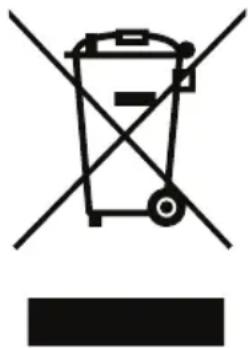
This symbol indicates that this product shall not be disposed with other household wastes at the end of its service life. Used device must be returned to official collection point for recycling of electrical and electronic devices. To find these collection systems please contact your local authorities or retailer where the product was purchased. Each household performs important role in recovering and recycling of old appliance. Appropriate disposal of used appliance helps prevent potential negative consequences for the environment and human health.
11 F-gas instruction
This product contains fluorinated greenhouse gases.
The fluorinated greenhouse gases are contained in hermetically sealed equipment.
Installation, servicing, maintenance, repair, leak checking, or decommissioning of equipment and product recycling should be carried out by natural persons holding relevant certificates.
If the system has a leak detection system installed, leak checks should be performed at least every 12 months; ensure the system operates properly.
If the product must undergo leak checks, the inspection cycle should be specified, and records of leak checks should be established and saved.

Note: For hermetically sealed equipment, local air conditioners, window air conditioners, and dehumidifiers, if the CO2 equivalent of fluorinated greenhouse gases is less than 10 tonnes, leak checks should not be performed.
12 Specifications
| Model Name BP407C BP409C | BP412C | | |
| Refrigerant R290 R290 R290 | | | |
| Total refrigerant amount(g) 80 | 140 185 | | |
| Climate class T1 T1 T1 | | | |
| Coolimg capacity(Btu/h) 6824 | 8871 11942 | | |
| Cooling capacity(kW) 2.0 2.6 | 3.5 | | |
| Energy efficiency cooling(W/W)-EER | 2.6 | 2.6 | 2.6 |
| Energy level-cooling | A | A | A |
| Cooling power input(KW) | 0.769 | 1.000 | 1.346 |
| Voltage/Frequency(V/Hz) | 220~240V/50Hz | 220~240V/50Hz | 220~240V/50Hz |
| Noise power level(dBA)-(sound power) | 65/63 | 65/63 | 65/63 |
| Noise power level(dBA)-(sound pressure) | 52/50 | 52/50 | 53/51 |
| Air flow volume( m3 /h) | 300 300 320 | | |
| Moisture removal(L/h) | 0.8 1.0 1.2 | | |
| Working temperature range at cooling(°C) | 18°C-35°C | 18°C-35°C | 18°C-35°C |
| Unit Net weight(KG) | 20.0 | 22.0 | 23.5 |
| Unit Net Dimension(mm)-(WxHxD) | 285*698*335 | 285*698*335 | 285*698*335 |
Note: 1. Specifications are standard values calculated based on rated operating conditions. They will vary under different working conditions. 2. Rated cooling values are calculated under 35/24 (In.) 35/24 (Out.) conditions.

Note:
Fig.1
Fig.2 Fig. 2a
![graph LR A["Initial circular structure"] --> B["Cylindrical component"] B --> C["Rotating circular structure with rotational arrow"]](/content/2026/04/726102/images/6d195bdf3b5480b463da10702f7d7857beaa566cf7cee8906abf3f4caf48b812.jpg)
Minimum window width: 67.5 cm, maximum: 123 cm
③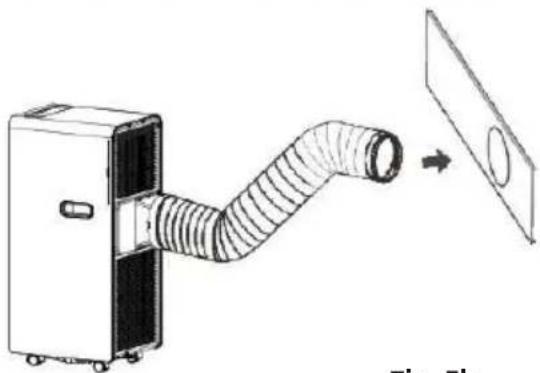
Fig. 5b
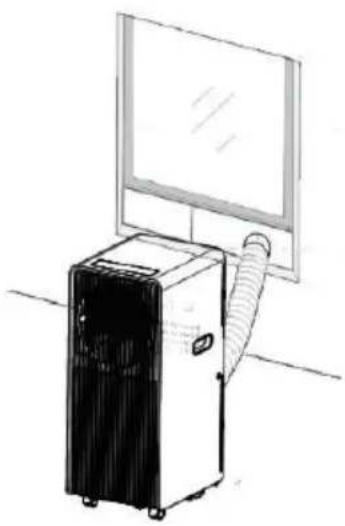
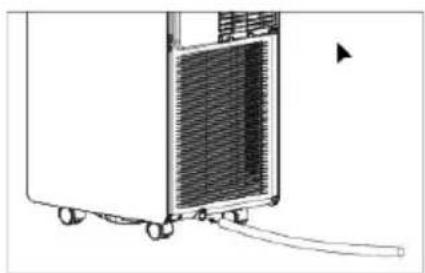
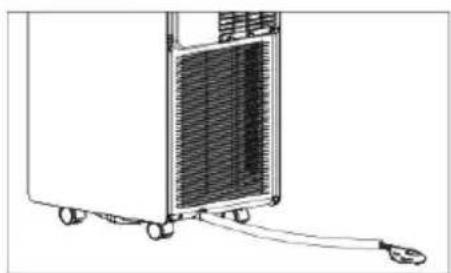
Fig.6
8 Maintenance
Warning:
- Air filter
(for gas type R32/R290)
This symbol indicates that this appliance uses a flammable refrigerant. If the refrigerant leaks and comes into contact with an external ignition source, a fire may occur.
CONTENTS

Figure 2 Figure 2a
5) Press the Power button to turn on the air conditioner.
Window width
min: 67.5 cm
max: 123 cm
Window height min: 67.5 cm max: 123 cm
②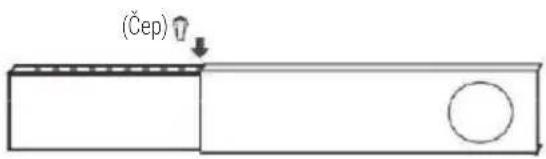
③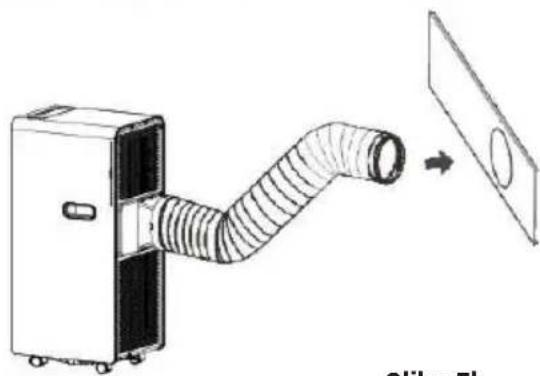
Figure 5b
1. Air filter
- If the air filter becomes clogged with dust/dirt, it should be cleaned once every two weeks.
- Removal
Open the air inlet grille and remove the air filter.
- Cleaning
Clean the air filter with a neutral detergent in lukewarm water (40 °C) and dry it in the shade.
- Installation
This symbol indicates that this product must not be disposed of with other household waste at the end of its service life. At the end of its service life, the appliance must be disposed of at an official collection center for recycling electrical and electronic devices. To find these collection centers, contact local authorities or the dealer from whom you purchased the product. Every household plays an important role in the recovery and recycling of old appliances. Proper disposal of the appliance at the end of its service life helps prevent potential negative consequences for the environment and health.
11 F-gas instructions
1 Safety instructions

Notes.
Fig. 2 Fig. 2a
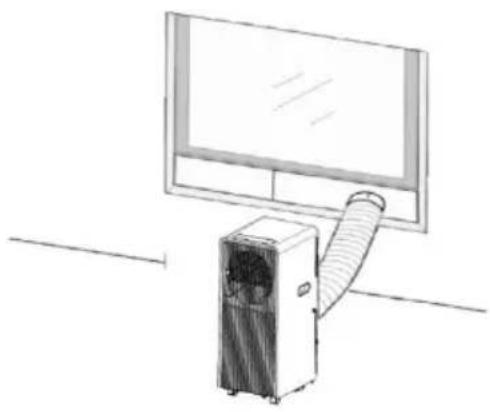
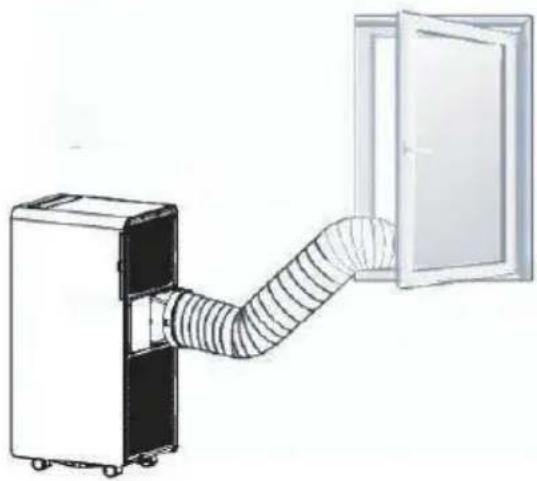
Fig. 5b
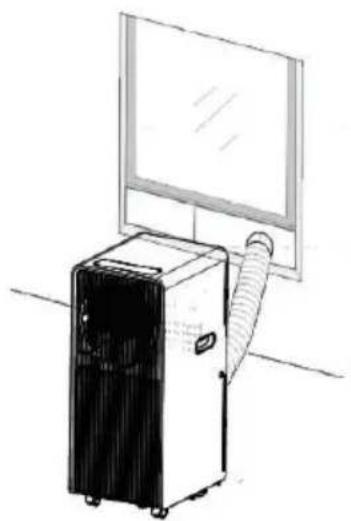

Fig. 2 Fig. 2a
7 Installation explanations
B) Installation of the window box
Fig. 5b
7 Installation explanations
Water Full alarm function
- Air filter
(For gas types R32/R290)

1 GENERAL INSTRUCTIONS
Figure 2 Figure 2a
5) Press the POWER button to turn on the air conditioner.
3) As shown in Fig. 6, connect the drain hose (only for models with heating);
4) Insert the power cord into a grounded AC220~240V/50Hz outlet;
- Before use
| [NW5A] | Napomena: Raspon radne temperature: |
| Maksimalno hlađenje Minimalno hlađenje |
| DB/WB(°C) | 35/24 18/12 | |
|
| Maksimalno zagrijavanje Minimalno zagrijavanje- |
| DB/WB(°C) | | 27/- 7/- | |
Window width min:67.5cm max:123cm
Window height min:67.5cm max:123cm
②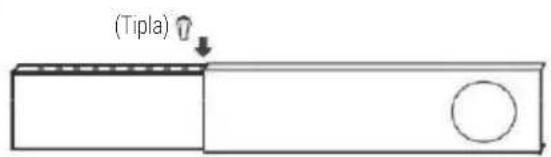
③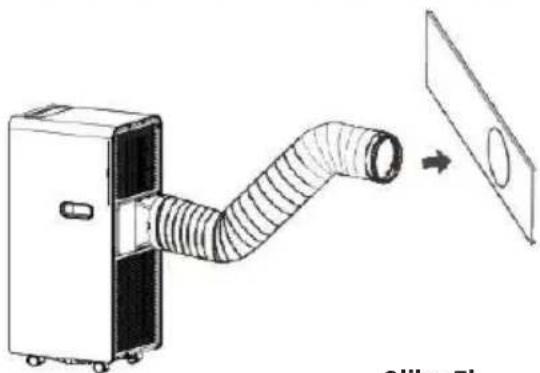
Figure 5b
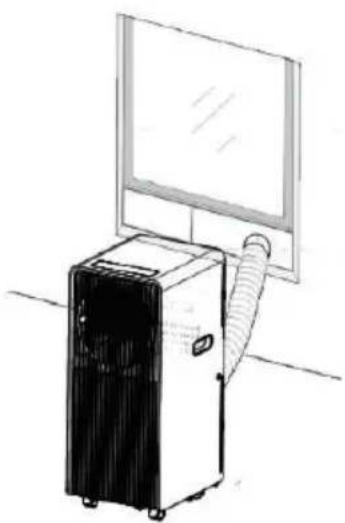
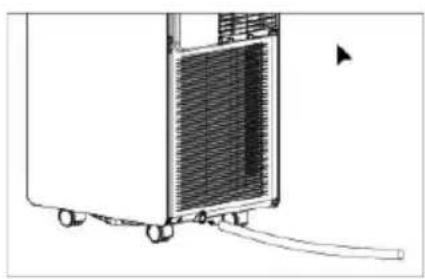
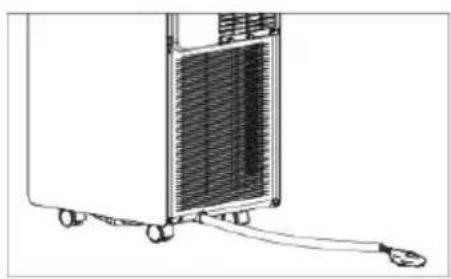
Figure 6
1. Air filter
- If the air filter becomes dirty with dust/dirt, it should be cleaned every two weeks.
- Removal
Open the air intake grille and remove the air filter.
- Cleaning
Clean the air filter with a neutral detergent in lukewarm water (40°C) and dry it in the shade.
- Installation
Put the air filter back into the air intake grille and reassemble the components as they were.
2. Cleaning the surface of the air conditioner
First clean the surface with a neutral detergent and a damp cloth, then wipe it with a dry cloth.
9 Troubleshooting
| Smetnje Mogući | uzroci Predloženi načini otklanjanja | |
| 1. Jedinica se na uključuje nakon što pritisnete dugme on/off (uklj/isklj) | Lampica indikatora punog rezervoara vode treperi, a rezervoar za vodu je pun. | Ispraznite vodu iz rezervoara za vodu. |
| Temperatura prostorije je viša od podešene temperature. (Electric heating mode) (električni način grijanja) | Ponovo postavite temperaturu. |
| Temperatura prostorije je niža od podešene temperature. (Cooling mode) (način rada hlađenja) | Ponovo postavite temperaturu. |
| 2. Nije dovoljno hladno Vrata ili prozori nisu zatvoreni. Provjerite | jesu li svi prozori i vrata zatvoreni. |
| Postoje izvori topline unutar prostorije. | Uklonite izvore topline, ako je moguće |
| Izduvno crijevo za zrak nije spojeno ili je začepljeno. | Spojite ili očistite izduvno crijevo za zrak. |
| Podešena temperatura je previsoka. | Ponovo postavite temperaturu. |
| Ulaz zraka je blokiran. Očistite ulaz zraka. |
| 3. Buka Pod nije ravan ili dovoljno stabilan. Postavite jedinicu na | ravan, stabilan pod, ako je moguće. |
| Zvuk dolazi od protoka rashladnog medija unutar klima uređaja. | To je normalno. |
| 4. Kod EO Neispravan senzor temperature prostorije | Zamijenite senzor temperature prostorije (jedinica može raditi i bez zamjene). |
| 5. Kod E1 Senzor temperature kondenzatora nije uspio | Zamijenite senzor temperature kondenzatora |
| 6. Kod E2 Rezervoar za vodu pun Skinite gumeni čep i ispraznite | vodu. |
| 7. Kod E3 Senzor temperature isparivača nije uspio | Zamijenite senzor temperature isparivača |

Note:
This symbol indicates that this product must not be disposed of with other household waste at the end of its service life. The used appliance must be taken to an official collection point for recycling of electrical and electronic devices. To find these collection systems, contact your local authorities or the dealer where the product was purchased. Every household plays an important role in the recovery and recycling of old appliances. Proper disposal of used appliances helps prevent potential negative consequences for the environment and human health.
11 Instructions for F-gas
This product contains fluorinated greenhouse gases.
Fluorinated greenhouse gases are contained in hermetically sealed equipment.
Installation, servicing, maintenance, repairs, leak checks, or decommissioning of equipment and product recycling should be carried out by individuals holding appropriate certifications.
If the system has a leak detection system installed, leak checks should be performed at least every 12 months; ensure the system is functioning properly.
If leak checks must be performed on the product, the inspection cycle should be specified, and records of leak checks should be established and maintained.

Note: For hermetically sealed equipment, local air conditioner, window air conditioner, and dehumidifier, if the CO₂ equivalent of fluorinated greenhouse gases is less than 10 tons, leak checks are not required.
12 Specifications
| Naziv modela BP407C BP409C BP412C | | | |
| Rashladno sredstvo R290 R290 R290 | | | |
| Ukupna količina rashladnog medija (g) | 80 140 185 | | |
| Klimatska klasa T1 T1 T1 | | | |
| Kapacitet hlađenja (Btu/h) 6824 8871 11942 | | | |
| Kapacitet hlađenja (kW) 2,0 2,6 3,5 | | | |
| Energetska efikasnost hlađenja (W/W) - EER | 2,6 2,6 2,6 | | |
| Energetski nivo - hlađenje A A A | | | |
| Cooling power input(kWh) | 0,769 | 1,000 | 1,346 |
| Napon/frekvencija (V/Hz) | 220~240 V / 50 Hz | 220~240 V / 50 Hz | 220~240 V / 50 Hz |
| Nivo jačine buke (dBA) - (jačina zvuka) | 65/63 | 65/63 | 65/63 |
| Nivo jačine buke (dBA) - (zvučni pritisak) | 52/50 | 52/50 | 53/51 |
| Zapremina protoka zraka ( m3/h ) | 300 300 320 | | |
| Odstranjivanje vlage (L/h) | 0,8 1,0 1,2 | | |
| Opseg radne temperature pri hlađenju (°C) | 18 °C - 35 °C | 18 °C - 35 °C | 18 °C - 35 °C |
| Neto težina jedinice (KG) | 20,0 | 22,0 | 23,5 |
| Neto dimenzija jedinice (mm) - (Š x V x D) | 285*335*698 | 285*335*698 | 285*335*698 |
Note:
- Specifications are standard values calculated based on nominal operating conditions. They will vary under different operating conditions.
- Nominal cooling values are calculated under 35/24 (indoor) 35/24 (outdoor) conditions.

![graph LR A["Initial circular structure"] --> B["Toroidal coil with rotational arrow"] B --> C["Rotated coil with spiral arrow"]](/content/2026/04/726102/images/0bcd4b8b3007a7217d3656040ab68bd1795dff2bcae0a5ad12ae3b7858e2c740.jpg)
1. Air filter