
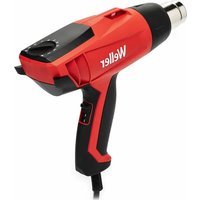
WLHG1212A - Heat gun Weller - Free user manual and instructions
Find the device manual for free WLHG1212A Weller in PDF.


| Product Type | Hot Air Gun |
| Brand | Weller |
| Model | WLHG1212A |
| Power Consumption | 1200 W |
| Mains Voltage | 120 V~, 50/60 Hz |
| Temperature Setting I | 350 °C / 660 °F |
| Temperature Setting II | 550 °C / 1020 °F |
| Air Flow Setting I | 250 l/min (8.8 cfm) |
| Air Flow Setting II | 400 l/min (14.1 cfm) |
| Heat-up Time | 3 min |
| Dimensions (L x W x H) | 230 × 250 × 80 mm (ø 45 mm) |
| Weight | 700 g (1.5 lb) |
| Protection Class | II (double insulation) |
| Main Applications | Copper soldering, tinning, plastic welding, defrosting, metal heating, paint stripping, heat shrink tubing |
| Safety | Use with residual current circuit breaker ≤30 mA recommended; protection against burns (hot nozzle) |
| Maintenance and Cleaning | Clean with a damp cloth; do not use solvents; permanent lubrication unnecessary |
| Warranty | 2 years |
| Repairability | Repair by qualified Weller personnel; use only genuine parts |
Frequently Asked Questions - WLHG1212A Weller
User questions about WLHG1212A Weller
0 question about this device. Answer the ones you know or ask your own.
Ask a new question about this device
Download the instructions for your Heat gun in PDF format for free! Find your manual WLHG1212A - Weller and take your electronic device back in hand. On this page are published all the documents necessary for the use of your device. WLHG1212A by Weller.
USER MANUAL WLHG1212A Weller
EN Original instructions
| Heat Gun Advanced WLHG1412A | |
| Power consumption (W) | 1400 |
| Mains supply | (V~) (Hz) |
| Heat-up time | (min) |
| Temperature (°C /°F) | |
| 1 - 9 | |
| Air flow (I / min, cfm) | |
| I | |
| II | |
| Dimensions L x W x H | mm inch |
| Weight | (g / lbs) |
Wear appropriate protective clothing to protect yourself against burns. Protect your eyes by wearing eye protection. Never work on voltage-carrying parts.
Avoid unintentional operation. Disconnect the soldering tool from the power supply while not in use.
The power cable must only be plugged into the power socket or adapter approved for this purpose. Check that the power supply voltage is compatible with the connected load of the tool.
Before use check machine, cable, and plug for any damages or material fatigue.
Please contact our Customer Service: technical-service@ weller-tools.com
If the power tool's supply cord is damaged, it must be replaced with a specially prepared supply cord.
WARNING
Fire and explosion hazard! Risk of burns!
- Take care if using the device in the vicinity of combustible materials. Do not direct the device towards the same place for long periods.
- Do not use the device in rooms with a potentially explosive atmosphere.
- Do not use the device in rooms in which easily flammable material or gases may be present.
- Do not leave the appliance unsupervised when it is switched on.
- Do not use the device outside if it is raining.
- Never cover or close the hot air nozzle.
- Do not point the hot air flow at people.
- Do not use the device as a hair dryer.
- Allow the device to cool down for a while after use before packing it away.
SAFETYINSTRUCTIONS
Hidden areas such as behind walls, ceilings, floors, covers, and other panels may contain flammable materials that could be ignited by the hot air blower when working in these areas. The ignition of these materials may not be immediately obvious and could cause property damage and injury. When working in these areas, keep the hot air blower constantly moving back and forth. Lingering or pausing in one spot could ignite the panel or the material behind it.
Persons removing paint should follow these rules:
CAUTION
Lead-based paint should only be removed by a professional and not with a hot air blower.
WARNING
Health hazard!
When removing paint or varnish, paint and varnish residues can get into your eyes and cause injury.
- Wear appropriate eye protection.
- If paint or varnish residues get into your eyes, flush them out and seek medical attention immediately.
Once deposited on surfaces, lead can be ingested through hand-to-mouth contact. Even low levels of lead exposure can cause irreversible damage to the brain and nervous system; young children and unborn babies are particularly vulnerable.
Take the workpiece outside. If this is not possible, keep the work area well ventilated. Open the windows and place an exhaust fan in front of them. Ensure the fan moves air from inside to outside.
Be cautious when handling the heat gun. Keep the heat gun moving, as excessive heat can generate vapors that may be inhaled by the operator.
SPECIFIED CONDITIONS OF USE
The device is suitable for soldering copper pipes, tinning body parts, welding and fusing plastics, thawing water pipes, and heating metal parts.
The manufacturer shall not be liable for damage resulting from misuse of the product or unauthorized alterations.
BEHAVIOR IN EMERGENCY
Initiate appropriate first aid measures according to the injury and request qualified medical assistance as soon as possible. Protect the injured person from further harm and keep them calm. When requesting help, provide the following details:
- Location of the accident,
- Type of accident,
- Number of injured,
- Nature of injuries
MAINS CONNECTION

CAUTION
Operation is only permitted with a residual current device (RCD max. 30mA).
The rated voltage specified on the device must match the mains voltage. EN 61000-3-11;
$$ Z \max = 0. 2 1 5 \Omega + j 0. 1 3 4 \Omega . $$
Connect only to single-phase AC system voltage as indicated on the rating plate. It is also possible to connect to sockets without an earthing contact as the design conforms to safety class II. Only plug-in when machine is switched off.

WARNING
Health hazard!
To reduce the risk of injury, user must read and understand this operator's manual before operating this tool. Save this Manual for future reference.

WARNING
The Operation of any power tool can result in foreign objects being thrown into your eyes, which can result in severe eye damage. Before beginning tool operation always wear safety goggles or safety glasses with side shields and a full face shield when needed. We recommend Wide Vision Safety Mask for use over eyeglasses or standard safety glasses with side shields. Always wear eye protection which is marked to comply with ANSI Z87.1.
GENERAL SAFETY RULES

WARNING
The Operation of any power tool can result in foreign objects being thrown into your eyes, which can result in severe eye damage. Before beginning tool operation always wear safety goggles or safety glasses with side shields and a full face
shield when needed. We recommend Wide Vision Safety Mask for use over eyeglasses or standard safety glasses with side shields. Always wear eye protection which is marked to comply with ANSI Z87.1.

WARNING
Some dust created by power sanding, sawing, grinding, drilling, and other construction activities contains chemicals known to cause cancer, birth defects or other reproductive harm. Some examples of these chemicals are:
- Lead from lead-based paints, or solder that contains lead.
- Crystalline silica from bricks and cement and other masonry products, and
- Arsenic and chromium from chemically treated lumber.
Your risk from these exposures varies, depending on how often you do this type of work. To reduce your exposure to these chemicals: work in a well ventilated area, and work with approved safety equipment, such as those dust masks that are specially designed to filter out microscopic particles.

WARNING
Read these instructions and the accompanying safety information carefully before starting up the device and starting work with the device. Failure to follow all instructions listed below may result in electric shock, fire and/or serious personal injury.
WORK AREA SAFETY
- Keep your work area clean and well lit. Cluttered benches and dark areas invite accidents.
- Do not operate power tools in explosive atmospheres, such as in the presence of flammable liquids, gases, or dust. Power tools create sparks which may ignite the dust or fumes.
- Keep bystanders, children, and visitors away while operating a power tool. Distractions can cause you to lose control.
ELECTRICAL SAFETY
- Power tool plugs must match the outlet. Never modify the plug in anyway. Do not use any adapter plugs in any earthed (grounded) power tools. Double insulated tools are equipped with a polarized plug (one blade is wider than the other). This plug will fit in a polarized outlet only one way. If the plug does not fit fully in the outlet, reverse the plug. If it still does not fit, contact a qualified electrician to install a polarized outlet. Do not change the plug in any way. Double insulation eliminates the need for the three wire grounded power cord and grounded power supply system.
- Do not expose power tools to rain or wet conditions. Water entering a power tool will increase the risk of electric shock.
- Avoid body contact with earthed or grounded surfaces such as pipes, radiators, ranges and refrigerators. There is an increased risk of electric shock if your body is grounded.
- Do not abuse the cord. Never use the cord for carrying, pulling
or unplugging the power tool. Keep cord away from heat, oil, sharp edges or moving parts. Damage cords increase the risk of electric shock.
- When operating a power tool outside, use an extension cord suitable for outdoor use. These cords are rated for outdoor use and reduce the risk of electric shock.
- Do not use AC only rated tools with a DC power supply. While the tool may appear to work, the electrical components of the AC rated tool are likely to fail and rate a hazard to the operator.
PERSONAL SAFETY
- Stay alert, watch what you are doing and use common sense when operating a power tool. Do not use a power tool while you are tired or under the influence of drugs, alcohol or medication. A moment of inattention while operating power tools may result in serious personal injury.
- Use safety equipment. Always wear eye protection. Safety equipment such as dust mask, non-skid safety shoes, hard hat, or hearing protection for appropriate conditions will reduce personal injuries.
- Dress properly. Do not wear loose clothing or jewelry. Keep your hair, clothing and gloves away from moving parts. Loose clothes, jewelry or long hair can be caught in moving parts. Air vents may cover moving parts and should be avoided.
- Avoid accidental starting. Ensure the switch is in the off position before plugging in. Carrying power tool with your finger on the switch or plugging in power tools that have the switch on invites accidents.
- Remove any adjusting keys or wrenches before turning the power tool on. A wrench or key that is left attached to a rotating part of the tool may result in personal injury.
- Do not overreach. Keep proper footing and balance at all times. Loss of balance can cause an injury in an unexpected situation.
- If devices are provided for connection of dust extraction and collection facilities, ensure these are connected and properly used. Use of these devices can reduced user related hazards.
- Do not use a ladder or unstable support. Stable footing on a solid surface enables better control of the tool in unexpected situations.
- Keep tool handles dry, clean and free from oil and grease. Slippery handles cannot safely control the tool.
TOOL USE/CARE SAFETY
- Secure the work piece. Use clamp or other practical way to hold the work piece to a stable platform. Holding the work piece by hand or against your body is unstable and may lead to loss of control.
- Use the correct power tool for the job. Do not force the tool or attachment to do a job for which it is not designed. The tool will perform the job better and safer at the feed rate for which it is designed. Forcing the tool could possibly damage the tool and may result in personal injury.
- Do not use tool if switch does not turn it on or off. Any tool that cannot be controlled with the switch is dangerous and must be repaired or replaced by an authorized service center.
- Turn power tool off, and disconnect the plug from the power source and/or battery pack from the power tool before making any adjustments, changing the accessories, or storing the tools. Such preventive safety measures reduce the risk of an accidental startup which may cause personal injury.
- Store idle tool out of reach of children and other inexperienced persons. It is dangerous in the hand of untrained users.
- Maintain power tools with care. Check for proper alignment and binding of moving parts, component breaks, and any other conditions that may affect the tool's operation. A guard or any other part that is damaged must be properly repaired or replaced by an authorized service center to avoid risk of personal injury.
- Use recommended accessories. Using accessories and attachments not recommended by the manufacturer or intended for use on this type tool may cause damage to the tool or result in personal injury to the user. Consult the operator's manual for recommended accessories.
- Keep cutting tools sharp and clean. Properly maintained cutting tools with sharp cutting edges are less likely to bind and are easier to control.
- Feed the work piece in the correct direction and speed. Feed the work piece into a blade, cutter, or abrasive surface against the direction of the cutting tool's direction of rotation only. Incorrectly feeding the work piece in the same direction may cause the work piece to be thrown out at high speed.
- Never leave the tool running unattended, turn the power off. Do not leave the tool until it comes to a complete stop.
- Never start the power tool when any rotating component is in contact with the work piece.
WARNING
USE OF THIS TOOL CAN GENERATE AND DISBURSE DUST OR OTHER AIRBORNE PARTICLES, INCLUDING WOOD DUST, CRYSTALLINE SILICA DUST AND ASBESTOS.
Direct particles away from face and body. Always operate tool in a well ventilated area and provide for proper dust removal. Use dust collection system wherever possible. Exposure to the dust may cause serious and permanent respiratory or other injury, including silicosis (a serious lung disease), cancer, and death. Avoid breathing the dust, and avoid prolonged contact with the dust. Allowing dust to get into your mouth or eyes, or lay on your skin may promote absorption of harmful material. Always use properly fitting NIOSH/OSHA approved respiratory protection appropriate for dust exposure, and wash exposed areas with soap and water.
SPECIFIC SAFETY RULES FOR HEAT GUNS
WARNING
DO NOT LET COMFORT OR FAMILIARITY WITH PRODUCT (GAINED FROM REPEATED USE) REPLACE STRICT ADHERENCE TO PRODUCT SAFETY RULES.
If you use this tool unsafely or incorrectly, you can suffer serious personal injury!
- Do not direct the heat gun airflow at clothing, hair or other body parts. Do not use as a hair dryer. Heat guns can generate temperatures of 932^ or more of flameless heat. Contact with the nozzle or air stream may cause serious burns.
- Inspect and know your work area. Check your work area for hidden spaces before applying heat (behind walls, ceilings, floors, soffits and other panels) that may contain flammable materials which may ignite when using the heat gun. It may not be readily apparent if these materials ignite and could result in serious personal injury and property damage. Avoid excessive heating which may ignite the work area or material behind it by continuous movement of the heat gun over the work area.
- Keep a fire extinguisher near the work area. Heat guns are capable of igniting flammable materials in or around the work area.
- Do not use near flammable liquids or in explosive atmospheres containing fumes, gases, or dust. Flameless heat from the heat gun may ignite the dust or fumes. All materials or debris which may be ignited should be removed from the work area.
- Shield materials around the heated work area to prevent property damage or fire.
- Always hold the heat gun by its handle. Do not touch the nozzle or accessory tips, allow them to contact flammable material, or store the heat gun until the nozzle has cooled to room temperature. The metal nozzle may require 20
minutes or more to cool adequately before it can be touched. Contacting the heated nozzle or accessory tips can cause personal injury. While cooling, the heat gun should be placed in a clear area away from combustible materials while cooling to prevent flammable materials from igniting.
- When not hand held, place the heat gun on a stable, level surface using noncombustible support pads or support stand so the nozzle is directed upwards, away from the supporting surface. The cord should be positioned so that it won't contact the hot nozzle or cause the heat gun to fall over.
- Do not leave the heat gun unattended while running or while cooling down.
- Do not cut off airflow from the heat gun by placing nozzle too close to the work piece. Do not obstruct airflow through the intake vents. Restricting heat gun air flow may cause overheating.
- Store indoors in a dry, high location out of reach by children and untrained persons. Do not expose the stored heat gun to moisture. Heat guns are dangerous in the hands of untrained persons.
- Do not use the heat gun in rain, moisture or submerge in water. Exposing the heat gun element to water or other liquids may cause an electrical shock hazard.
- Do not direct heat gun airflow onto glass. The glass may crack resulting in property damage or personal injury. Use the deflector nozzle when working near glass to protect and prevent cracking the glass.
PAINT STRIPPING SAFETY INSTRUCTIONS
WARNING
Use extreme care when stripping paint. Feelings, residue and vapors of paint may contain lead, which is poisonous. Any pre 1977 paint may contain lead and paint applied to homes prior to 1950 is likely to contain lead. Once deposited on surfaces, hand to mouth contact can result in the ingestion of lead. Exposure to even low levels of lead can cause irreversible brain and nervous system damage; young and unborn children are particularly vulnerable. Before beginning any paint removal process you should determine whether the paint you are removing contains lead. This can be done by your local health department or by a professional who uses a paint analyzer to check the lead content of the paint to be removed. LEAD-BASED PAINT SHOULD ONLY BE REMOVED BY A PROFESSIONAL AND MUST NOT BE REMOVED USING A HEAT GUN.
- Move the work piece outdoors. If this is not possible, open windows and place an exhaust fan in a window. Be sure the fan is moving air from inside to outside. Proper ventilation reduces the risk of inhaling fumes or dust created by using the heat gun.
- Remove or cover any household items in the area such as
carpets, rugs, furniture, clothing, cooking utensils and air ducts.
- Place drop cloths in the work area to catch any paint chips or peelings. Wear protective clothing such as extra work shirts, overalls and hats.
- Wear a dust respirator mask or a dual filter (dust and fume) respirator mask, which has been approved by the Occupational Safety and Health Administration (OSHA), the National Institute of Safety and Health (NIOSH), or the United States Bureau of Mines. These masks and replaceable filters are readily available at major hardware stores. Be sure the mask fits. Beards and facial hair may keep masks from sealing properly. Change filters often. DISPOSABLE PAPER MASKS ARE NOT ADEQUATE.
- Work one room at a time. Furnishings should be removed or placed in the center of the room and covered. Work areas should be sealed off from the rest of the dwelling by sealing doorways with drop cloths.
- Keep the work environment clean. Keep food and drinks away from the work area. Wash hands, arms, face and rinse mouth before eating and drinking. Do not smoke, or chew gum or tobacco in the work area. Paint scrapings and dust created from removing paint may contain chemicals that are hazardous.
- Children, pregnant or potentially pregnant women and nursing mothers should not be present in the work area until the work is done and all cleanup is complete.
- Use caution when operating the heat gun. Keep the heat gun moving to prevent creating excessively high temperatures. Excessive heat can cause paint and other materials to burn and cause fumes, which may be inhaled by the operator.
- Clean up all removed paint and dust by wet mopping the floors. Use a wet cloth to clean all walls, sills and any other surface where paint scrapings or dust have accumulated. DO NOT SWEEP, DRY DUST OR VACUUM. Use a high phosphate detergent, trisodium phosphate (TSP), or a trisodium phosphate substitute to clean and mop the work area.
- Properly dispose of paint scrapings. Following each work session put the paint chips, scrapings, and debris in a double plastic bag. Close it with tape or twist ties and dispose of properly.
- Remove protective clothing and work shoes in the work area to avoid transferring dust to other parts of the building. Wash work clothes separately. Wipe shoes off with a wet rag that is then washed with the work clothes. Wash hair and body thoroughly with soap and water.
CAUTION!
Always check that the power supply is on the voltage on the rating name plate.
WARNING
Always be sure that the tool is switched off and unplugged before adjusting, adding accessories, or checking a function on the tool. Your heat gun is a high quality, general purpose heat gun. Its high power and air flow ratings enable you to perform more heating jobs faster and more efficiently whenever fast, consistent and portable heat is needed.
WARNING
Use personal protective equipment. Always wear eye protection. Wear protective goggles
WARNING
Be aware that material behind or in between exposed surfaces may ignite.
WARNING
To reduce the risk of burns and/or fire, keep the tool moving at all times over the material you are heating.
This product is a dual temperature control heat gun and uses a 3 position rocker type switch. Moved to the center position, marked ^ , the heat gun is turned OFF. Depress the lower switch portion completely, marked ^ , for the Low temperature range. Depress the upper switch portion completely, marked ^ , for the High temperature range.
- Plug the heat gun into a properly rated outlet.
- If using an accessory nozzle tip, install the desired accessory nozzle tip by sliding it on to the nose of the heat gun.
- Depress completely the upper or lower portion of the rocker switch to obtain the desired heat range. It is suggested that you start in the lower heat range when beginning an operation and then move to the higher temperature range if needed.
To turn the heat gun off after use, move the switch to the center position, O^ - Allow the heat gun nozzle to cool by resting the gun on the rear air intake housing and the handle, with the gun's nozzle pointing upward.
-
The correct amount of heat used for each application depends on the selected heat range, material being worked on, and the distance of the nozzle from the work surface and length of time that heat is applied to the work surface. We recommend that you experiment with a piece of scrap material before performing an operation. Carefully approach the work until you determine the proper combination of heat range, distance from the work surface and duration of heat application.
-
Always maintain heat gun movement over the work surface using a gentle back and forth movement while applying heat unless you find that a concentrated application of heat best delivers the desired results for a particular operation.
APPLICATIONS
Reduce the risk of heat damage and personal injury, shield combustible materials and areas adjacent to the work piece. Protect yourself from hot paint scrapings and dust.
SHRINKING TUBING
Shrink tubing is most often used in place of electrical tape to hold joined wires in position and provide insulation. When exposed to adequate heat, the tubing shrinks to the size and shape of the wire it covers. Slide the tubing over the wire to be insulated; hold the wire with one hand away from the hot air stream and hold the heat gun in the other hand. Move the tubing from side to side through the heated air flow until the tubing has shrunk. If the wire must be held with both hands, position the heat gun with the nozzle pointed upward by resting the heat gun on the handle and the rear gun housing. Then pass the tubing covered wire from side to side through the hot air flow until the wire shrinks to the desired size. Remove the wire from the air flow and move the rocker switch to the "OFF" position.
STRIPPING PAINT
- Fit the wide "deflector" accessory tip on to the heat gun nozzle. This tip will spread the heat over a wider surface area, speeding paint removal. The "deflector" tip will also help protect window glass from cracking due to thermal shock when removing paint near the glass.
- Turn the heat gun on, starting in the "Low" heat setting and hold it about 1 inch from the painted surface being stripped. The best combination of distance, heat range and speed of stripping will be determined by experience.
- Work small areas, moving the gun slowly over the surface. When the paint begins to blister and bubble, move the gun steadily across the surface while scraping off the loosened paint behind the heat gun. Use a scraper that best matches the work surface shape and width of the paint loosened by the heat gun's path. Preheating the scraper as you are heating the painted surface will increase the speed of paint stripping.
- Do not burn or heat the paint for too long since this will make the paint more difficult to remove. For working in confined areas, away from glass, remove the wide deflector tip.
- When the job is completed, move the rocker switch to "OFF" and properly position the heat gun to cool, away from combustible material.
MAINTENANCE / CLEANING
- Avoid using solvents when cleaning plastic parts. Most plastics are susceptible to damage from various types of commercial solvents and maybe damaged by their use. Use clean cloths to remove dirt, dust, oil, grease, etc.
WARNING
Do not at any time let brake fluids, gasoline, petroleum based products, penetrating oils, etc., come in contact with plastic parts. Chemicals can damage, weaken or destroy plastic which may result in serious personal injury.
Electric tools used on fiberglass material, wallboard, spackling compounds, or plaster are subject to accelerated wear and possible premature failure because the fiberglass chips and grindings are highly abrasive to bearings, brushes, commutators, etc. Consequently, we do not recommend using this tool for extended work on these types of materials. However if, you do work with any of these materials, it is extremely important to clean the tool using compressed air.
LUBRICATION
This tool is permanently lubricated at the factory and requires no additional lubrication.
SERVICE
- Have your power tool serviced by a qualified repair person using only identical replacement parts. This will ensure that the safety of the power tool is maintained.
- Service your power tool periodically. When cleaning a tool, be careful not to disassemble any portion of the tool since internal wires maybe misplaced or pinched.
WARRANTY
Weller supplies this device with a warranty valid for two (2) years from the date of purchase. The warranty relates to material and manufacturing defects and covers both replacement parts and labour.
We shall only be liable for claims arising from a warranty furnished by us if the quality or durability warranty has been furnished by us in writing and using the term "Warranty".
The warranty shall be void if damage is due to improper use and if the device has been tampered with by unauthorized persons.
SYMBOLS

Warning!

Danger High voltage.

Warning! Risk of burns

Fire and explosion hazard

Read the operating instructions!

Wear protective mask

Wear gloves!

Wear protective goggles

Ensure adequate ventilation.
Before performing work of any kind on the unit, always disconnect the power plug from the socket.

Safety class II
Disposal
Check with your local authority or retailer for recycling advwice and collection point. According to local regulations retailers may have an obligation to take back waste electrical and electronic equipment free of charge. Your contribution to re-use and recycling of waste electrical and electronic equipment helps to reduce the demand of raw materials. Waste electrical and electronic equipment contain valuable, recyclable materials, which can adversely impact the environment and the human health, if not disposed of in an environmentally compatible manner. Delete personal data from waste equipment, if any. Dispose of replaced device parts or old devices according to your country's regulations.
DATOS TECNICOS


1.5 mm/1.4 lbs
| Heat Gun WLHG | 1212A |
| Consumo de potencia (W) 1200 | |
| Tensión de red (V~) | 120 |
| (Hz) | 50/60 |
| Tiempo de calentimiento (min) 3 | |
| Temperatura (°C /°F) | |
| I | 350 / 660 |
| II | 550 / 1020 |
| Air flow (I / min, cfm) | |
| I | 250 / 8.8 |
| II | 400 / 14.1 |
| Dimensiones L x An x Al mm | 230 × 250 × 80 |
| inch | (ø 45) |
| 9.0 × 9.8 × 3.1 | |
| (ø 1.8) | |
| Peso aproximadamente (g / lbs) 700 / 1 | 5 |
| Heat Gun Advanced | WLHG 1412A | |
| Consumo de potencia (W) 1400 | ||
| Tensión de red | (V~) (Hz) | 120 50/60 |
| Tiempo de calentimiento | (min) | 3 |
| Temperatura (°C /°F) | 80 – 600 180 – 1120 | |
| Air flow (l / min, cfm) 1 - 9 | 250 / 8.8 450 / 15.9 | |
| Dimensiones L x An x Al | mm inch | 230 × 250 × 80 (ø 45) 9.0 × 9.8 × 3.1 (ø 1.8) |
| Peso aproximadamente | (g / lbs) | 700 / 1,5 |
Present Guarantee Policy
Thank you for purchasing an Apex tool group product. This item has been
manufactured with the highest quality materials and under strict production control.
This policy guarantees against manufacturing defects of the indicated product with its components, labor and services necessary for its correct operation and at no additional cost to the customer, for a period of 7 years after the date of purchase.
Procedure to make the guarantee effective.
This policy will be effective by presenting the product and this document duly sealed in the establishment where it was acquired to Apex Tool Group with address shown above.
At this address you can get parts, consumable components and accessories.
Within the warranty period the company will repair, change the product or refund the amount paid, if the product actually presents defects contemplated in the conditions of this warranty.
This policy will NOT be effective in the following cases:
A) When the product has been used under conditions other than normal.
B) When the product has not been operated in accordance with the accompanying instructions for use.
C) When the product has been altered or repaired by persons not authorized by the respective responsible national manufacturer, importer or marketer.
Name:
Address:
Tel:
Purchase Date Address:
Model and Brand:
Authorized Dealer:
Authorized Distributor Stamp


USA
Apex Tool Group, LLC.
Weller Professional Tools
Division
1000 Lufkin Road
Apex, NC 27539w
Tel: +866-498-0484
Fax: +1 (800) 546-7312
CANADA
Apex Tools - Canada
5925 McLaughlin Rd.
Mississauga, Ontario L5R 1B8
Fax. +1 (905) 387-2640
MEXICO
Apex Tool Group Mexico S. de R.L. de C.V.
© 2024, Apex Tool Group, LLC.
Weller is a registered Trademark and registered Design of Apex Tool Group, LLC.
Weller
- WARNING
- Fire and explosion hazard! Risk of burns!
- SAFETYINSTRUCTIONS
- CAUTION
- SPECIFIED CONDITIONS OF USE
- BEHAVIOR IN EMERGENCY
- MAINS CONNECTION
- Health hazard!
- GENERAL SAFETY RULES
- WORK AREA SAFETY
- ELECTRICAL SAFETY
- PERSONAL SAFETY
- TOOL USE/CARE SAFETY
- USE OF THIS TOOL CAN GENERATE AND DISBURSE DUST OR OTHER AIRBORNE PARTICLES, INCLUDING WOOD DUST, CRYSTALLINE SILICA DUST AND ASBESTOS.
- SPECIFIC SAFETY RULES FOR HEAT GUNS
- DO NOT LET COMFORT OR FAMILIARITY WITH PRODUCT (GAINED FROM REPEATED USE) REPLACE STRICT ADHERENCE TO PRODUCT SAFETY RULES.
- If you use this tool unsafely or incorrectly, you can suffer serious personal injury!
- PAINT STRIPPING SAFETY INSTRUCTIONS
- CAUTION!
- APPLICATIONS
- SHRINKING TUBING
- STRIPPING PAINT
- MAINTENANCE / CLEANING
- LUBRICATION
- SERVICE
- WARRANTY
- SYMBOLS
- Disposal
- DATOS TECNICOS
- Procedure to make the guarantee effective.
- At this address you can get parts, consumable components and accessories.
- This policy will NOT be effective in the following cases:
- USA
- CANADA
- MEXICO
Brand : Weller
Model : WLHG1212A
Category : Heat gun