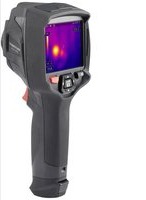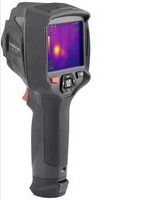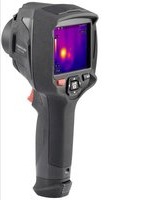
WB-310 - Thermal camera VOLTCRAFT - Free user manual and instructions
Find the device manual for free WB-310 VOLTCRAFT in PDF.


User questions about WB-310 VOLTCRAFT
0 question about this device. Answer the ones you know or ask your own.
Ask a new question about this device
Download the instructions for your Thermal camera in PDF format for free! Find your manual WB-310 - VOLTCRAFT and take your electronic device back in hand. On this page are published all the documents necessary for the use of your device. WB-310 by VOLTCRAFT.
USER MANUAL WB-310 VOLTCRAFT
GB Operating Instructions
Thermal Imaging Camera
Item no: 2890403 (WB-310)
F Mode d'emploi
Caméra thermique
N° de commande 2890403 (WB-310)
text_image
Technical diagram of a handheld device with numbered parts for identification and assembly reference.text_image
CME=0.95 09:57 S:19.1 27.0 + Below alarm 18.3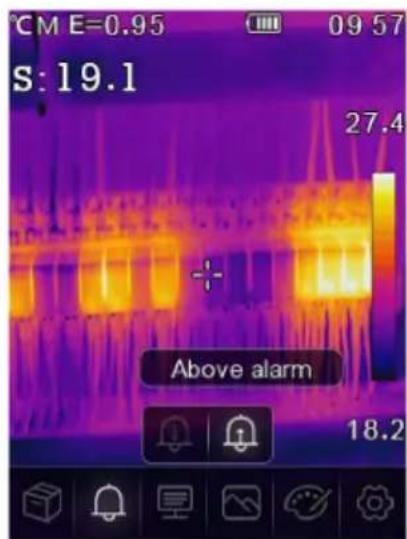
text_image
S:19.1 27.4 Above alarm 18.212.2 Parametern
text_image
°CM E=0.95 09 57 S: 18.9 27.3 Parameters 18.21 Introduction.... 36
2 Operating Instructions for download.... 36
3 Intended use 36
4 Delivery contents 36
5 Description of symbols.... 37
6 Safety instructions 37
6.1 General 37
6.2 Handling 37
6.3 Operating environment.... 37
6.4 Operation.... 37
6.5 Power adapter and cable 38
6.6 Li-ion battery.... 38
6.7 Measurement accuracy on low-emissivity surfaces 39
6.8 LED light.... 39
6.9 Laser class 2 39
7 Overview 40
7.1 Product 40
7.2 Control panel buttons 41
7.3 Display.... 42
8 Getting started 42
8.1 Charge the rechargeable battery.... 42
8.1.1 Camera charging input 42
8.1.2 Computer USB port 42
8.2 MicroSD card.... 42
8.2.1 Insert / remove the microSD card 43
8.2.2 Formatting the microSD card 43
9 Emissivity and accuracy 43
9.1 Emissivity setting.... 43
9.2 Accuracy.... 43
10 Menu navigation 43
11 Operation.... 44
11.1 Power ON / OFF 44
11.2 Hold readings 44
11.3 Capture photos / videos 44
11.3.1 Photos 44
11.3.2 Video 44
11.3.3 Playback photos / video 44
11.4 LED light 44
11.5 Laser pointer 45
11.6 Image transform 45
11.6.1 Histogram mode (HG) 45
11.6.2 Automatic mode (AUTO) 46
11.6.3 Manual / lock mode (MANUAL) 46
12 Main menu.... 47
12.1 Alarms 47
12.2 Parameters.... 48
12.2.1 Ambient temperature.... 48
12.2.2 Reflection temperature.... 49
12.2.3 Atmospheric humidity 49
12.2.4 Infrared compensation 50
12.2.5 Distance 50
12.2.6 Emissivity 51
12.3 Image modes.... 51
12.4 Palette 52
12.4.1 Standard palette 52
13 Device settings 53
14 Measure settings 54
15 Reset 54
15.1 Erase all files.... 54
15.2 Default settings.... 55
16 PC software 55
16.1 Before installation.... 55
16.2 Install the PC software 56
16.3 Connect to PC (file management) 56
16.4 Connect to PC (Live view).... 56
17 Mobile app 56
18 Update the firmware 57
18.1 Check firmware version.... 57
18.2 Download and install new firmware.... 57
19 Troubleshooting.... 57
20 Cleaning and care.... 58
20.1 Housing 58
20.2 Infrared lens 58
21 Declaration of Conformity (DOC).... 58
22 Disposal.... 59
22.1 Product 59
22.2 (Rechargeable) batteries.... 59
23 Technical data 60
23.1 Product power input 60
23.2 Rechargeable battery pack 60
23.3 Infrared (IR) imaging performance 60
23.4 Optics 60
23.5 Measurement 60
23.6 Image processing enhancement.... 60
23.7 Visible light camera 61
23.8 Display.... 61
23.9 Storage and media 61
23.10 Laser pointer 61
23.11 LED light.... 61
23.12 Measurement units 61
23.13 Language setting.... 61
23.14 Data communication interface.... 61
23.15 Wi-Fi 62
23.16 Mobile application.... 62
23.17 Computer software 62
23.18 Environment 62
23.19 Physical specifications 62
23.20 Emissivity table.... 62
1 Introduction
Thank you for purchasing this product.
If there are any technical questions, please contact:
www.conrad.com/contact
2 Operating Instructions for download
Use the link www.conrad.com/downloads (alternatively scan the QR code) to download the complete operating instructions (or new/current versions if available). Follow the instructions on the web page.
3 Intended use
The product is a thermal imaging camera with laser pointer and LED light. Some uses include e.g., finding hot spots, energy leaks, structural defects, pipe blockages, and HVAC faults.
The product is intended for indoor use only. Do not use it outdoors.
Contact with moisture must be avoided under all circumstances.
If you use the product for purposes other than those described, the product may be damaged.
Improper use can result in short circuits, fires, electric shocks or other hazards.
The product complies with the statutory national and European requirements.
For safety and approval purposes, you must not rebuild and/or modify the product.
Read the operating instructions carefully and store them in a safe place. Make this product available to third parties only together with the operating instructions.
All company names and product names are trademarks of their respective owners. All rights reserved.
4 Delivery contents
Thermal imager
Li-ion rechargeable battery
■ MicroSD card (32 GB, U1 V10)
■ MicroSD to SD card adapter
USB-A to USB-C® cable
Windows® software CD-ROM
Carry bag
- Operating instructions
5 Description of symbols
The following symbols are on the product/appliance or are used in the text:

The symbol warns of hazards that can lead to personal injury.

The symbol warns of dangerous voltage that can lead to personal injury by electric shock.

Laser aperture. Do not stare into beam or view with optical instruments!
6 Safety instructions

Read the operating instructions carefully and especially observe the safety information. If you do not follow the safety instructions and information on proper handling, we assume no liability for any resulting personal injury or damage to property. Such cases will invalidate the warranty/guarantee.
6.1 General
The product is not a toy. Keep it out of the reach of children and pets.
Do not leave packaging material lying around carelessly. This may become dangerous playing material for children.
If you have questions which remain unanswered by this information product, contact our technical support service or other technical personnel.
- Maintenance, modifications and repairs must only be completed by a technician or an authorised repair centre.
6.2 Handling
- Handle the product carefully. Jolts, impacts or a fall even from a low height can damage the product.
6.3 Operating environment
- Do not place the product under any mechanical stress.
- Protect the appliance from extreme temperatures, strong jolts, flammable gases, steam and solvents.
- Protect the product from high humidity and moisture.
■ Protect the product from direct sunlight.
6.4 Operation
- Consult an expert when in doubt about the operation, safety or connection of the product.
If it is no longer possible to operate the product safely, take it out of operation and protect it from any accidental use. DO NOT attempt to repair the product yourself. Safe operation can no longer be guaranteed if the product:
– is visibly damaged,
– is no longer working properly,
– has been stored for extended periods in poor ambient conditions or
– has been subjected to any serious transport-related stresses.
6.5 Power adapter and cable

Do not modify or repair mains supply components including mains plugs, mains cables, and power supplies. Do not use damaged components. Risk of death by electric shock!
- Connect the appliance to a wall socket that can be accessed easily.
As power supply, only use the supplied mains adaptor.
Only connect the power adaptor to a normal mains socket connected to the public supply. Before plugging in the power adaptor, check whether the voltage stated on the power adaptor complies with the voltage of your electricity supplier.
■ Never connect or disconnect power adaptors if your hands are wet. -
Never unplug the power adaptor from the mains socket by pulling on the cable; always use the grips on the plug.
For safety reasons, disconnect the power adaptor from the mains socket during storms.
Do not touch the power adapter if there are any signs of damage, as this may cause a fatal electric shock! Take the following steps: -
Switch off the mains voltage to the socket containing the power adapter (switch off the corresponding circuit breaker or remove the safety fuse, and then switch off the corresponding RCD protective switch).
– Unplug the power adapter from the mains socket. - Use a new power adapter of the same design. Do not use the damaged adapter again.
- Ensure that cables are not pinched, kinked or damaged by sharp edges.
■ Always lay cables so that nobody can trip over or become entangled in them. This poses a risk of injury.
6.6 Li-ion battery
- Never damage the rechargeable battery. Damaging the casing of the rechargeable battery might cause an explosion or a fire!
- Never short-circuit the contacts of the rechargeable battery. Do not throw the battery or the product into fire. There is a danger of fire and explosion!
Charge the rechargeable battery regularly, even if you do are not using the product. Due to the rechargeable battery technology being used, you do not need to discharge the rechargeable battery first.
■ Never charge the rechargeable battery of the product unattended.
When charging, place the product on a surface that is not heat-sensitive. It is normal that a certain amount of heat is generated during charging.
Risk of overheating, damage, and/or decreased performance. Charge the rechargeable battery within the temperature range: 0 to +50 °C.

WARNING
Risk to personal safety (e.g. burns), fire, or other hazards!
Measuring surfaces with an emissivity ( ) less than 0.60 can lower the accuracy of temperature readings. If precise temperature measurements are critical, consider alternative methods to verify the readings.
6.8 LED light
- Do not look directly into the LED light!
- Do not look into the beam directly or with optical instruments!
6.9 Laser class 2
When operating the laser equipment, always make sure that the laser beam is directed so that no one is in the projection area and that unintentionally reflected beams (e.g., from reflective objects) cannot be directed into areas where people are present.
■ Never look into the laser beam or point it at people or animals. Laser radiation can seriously damage your eyes.
Never open the device. Configuration or maintenance tasks must only be completed by a trained specialist who is familiar with the potential hazards. Improper maintenance work may result in dangerous laser radiation.
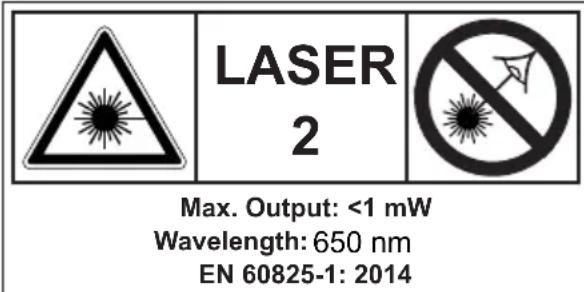
The product is equipped with a class 2 laser. Laser signs in different languages are included in the packaging. If the sign on the laser is not in your local language, attach the appropriate sign to the laser.
text_image
LASER 2 Max. Output: <1 mW Wavelength: 650 nm EN 60825-1: 20147 Overview
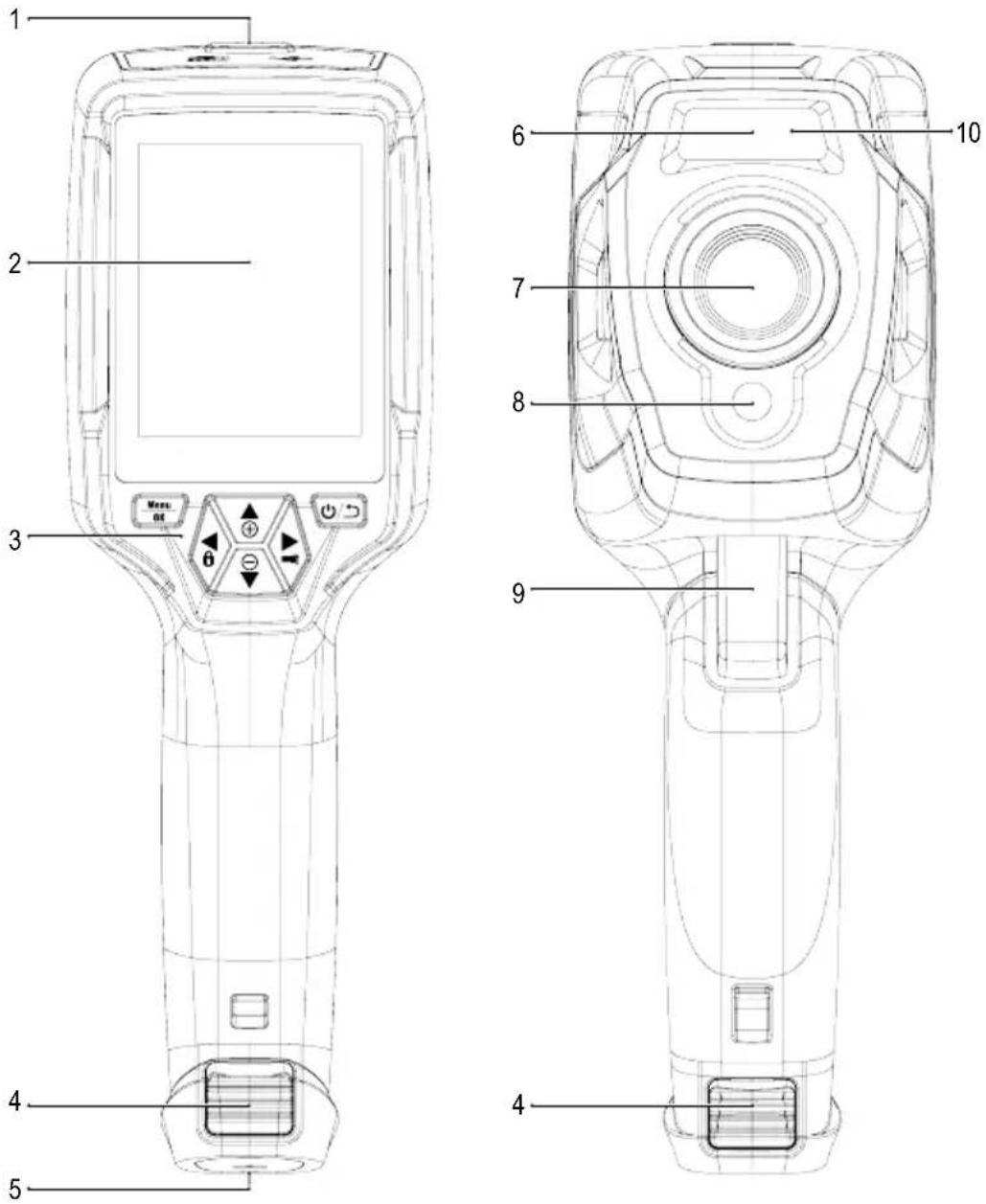
7.1 Product
text_image
Technical diagram of a handheld device with numbered parts for identification and assembly reference.1 Cover:
USB-C® port: data / charging
MicroSD card slot
3 Control panel 4 Release tabs: rechargeable battery
5 Tripod mount 6 LED light / Laser pointer
7 Infrared camera lens 8 Digital (visible light) camera
9 Trigger:
Freeze image, capture photo, record video
2 Display
10 LED light
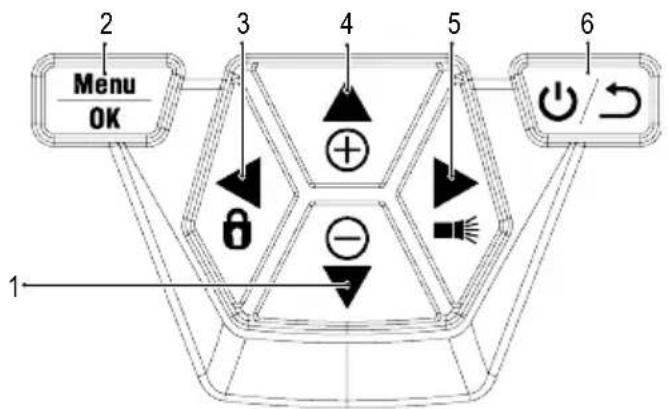
7.2 Control panel buttons
text_image
2 Menu OK 3 4 5 6 1 + - ← → ← ← ← ← ←| # Icon Description | ||
| 1 |  | Press to navigate down.Press and hold during measurement to zoom out. |
| 2 |  | Press to enter the menu.Press and hold to enter the settings menu.Press to confirm a menu selection. |
| 3 |  | Press to navigate left.Short press to switch between: MANUAL (and AUTO (A) / HG (H) modes.Press and hold during measurement to perform a manual IR calibration. |
| 4 |  | Press to navigate up.Press and hold during measurement to zoom in. |
| 5 |  | Press to navigate right.Press and hold to switch the LED light ON/OFF. |
| 6 |  | Press and hold to switch the power ON / OFF.Press to return to previous menu. |
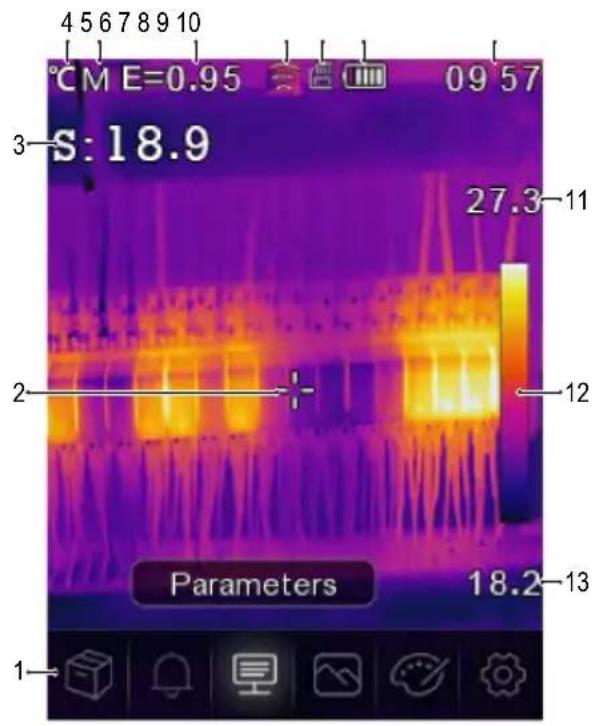
7.3 Display
text_image
45678910 °C E=0.95 09 57 3 S: 18.9 27.3-11 12 Parameters 18.2-13 11 Main menu
2 Centre point cross
3 Centre point temperature
4 Temperature unit
5 Distance unit
6 Emissivity
7 Wi-Fi status
8 MicroSD card
9 Battery level
10 Time
11 Max. temperature of current scene
12 Colour bar
13 Min. temperature of current scene
8 Getting started
8.1 Charge the rechargeable battery
8.1.1 Camera charging input
Preconditions:
√ Rechargeable battery is inserted into the product.
- Connect the supplied USB cable to a USB power supply and the TypeC USB/Charge input on the product.
→ The battery icon on the display will show the charging status.
8.1.2 Computer USB port
The USB port must be capable of delivering 5 V/DC for charging to occur.
The rechargeable battery will charge if you connect the TypeC USB/Charge port to a USB port on your computer.
8.2 MicroSD card
Internal storage space will be used to save photos, video and data if no microSD card is inserted.
For further details, see section: Storage and media.
8.2.1 Insert / remove the microSD card
Important:
Make sure the microSD card is oriented correctly before inserting it. Do not use excessive force to push it in.
- Insert the microSD card into slot, it will "click" into place.
→ The microSD card icon will appear.
- Remove using the tip of your finger to press down until it "clicks", then release to eject.
8.2.2 Formatting the microSD card
Important:
- The microSD must be formatted before it can be used to save photos, video and data.
– Always back up important files before formatting the microSD card.
Format the card using the product.
- Insert the microSD card into the card slot.
- Navigate to: Menu → Setting → Reset → Format Memory → Yes.
Format the card using a PC computer
The microSD should be formatted using the FAT 16 or 32 filing systems.
- Refer to your computer software operating instructions for information about how to do this.
9 Emissivity and accuracy
9.1 Emissivity setting
To increase the accuracy of readings, set an emissivity value that matches the material being measured. The emissivity can be set two ways:
■ Manual setting: Emissivity [▶ 51].
■ Preset values: Measure settings [▶ 54].
A list of common materials and emissivity values can be found here: Emissivity table [▶ 62].
9.2 Accuracy
Configure the parameters to improve accuracy of readings. See section: Parameters [▶ 48].
10 Menu navigation
| Button Function | |
| Menu | Press to enter the menu and submenus. |
| OK | Press to confirm a selection. |
| ▲/▼ press to navigate up / down. | |
| ◄/◄ Press to navigate left / right. | |
| → | Press to return to previous menu. |
11 Operation
11.1 Power ON / OFF
- Press and hold the button to switch the power ON.
→ Wait a few moments for the product to self calibrate and display a thermal image.
- Press and hold the button to switch the power OFF.
11.2 Hold readings
- Press the trigger to hold the reading.
→ The reading will be held.
- Press the ⏻ button to release the hold.
11.3 Capture photos / videos
11.3.1 Photos
-
Short press the trigger to capture the measured scene.
-
Press OK save the image.
11.3.2 Video
- Press and hold the trigger to start recording.
→ The icon will show to indicate recording is in progress.
- Short press the trigger to stop recording.
11.3.3 Playback photos / video
Playback will first recall photos / video from an inserted microSD card. Remove the microSD card to playback from internal storage.
-
Press the Menu to enter the menu.
-
Press ↗ to navigate to the gallery .

- Press OK access further options e.g., play video, view file info., delete viewed file.
Tip:
View saved photos / video on a PC. See section: Connect to PC (file management) [▶ 56].
11.4 LED light
Press and hold the button to switch the light ON/OFF.
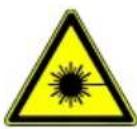
! WARNING
Laser aperture
Do not stare into the beam or view with optical instruments. See section: Laser class 2 [▶ 39].
The product is equipped with a laser pointer.
■ Switch the laser ON/OFF here: Menu → Setting → Device setting → Laser.
11.6 Image transform
Select a mode (Histogram, Automatic, or Manual) to optimize temperature visualization based on the complexity of the scene, consistency of temperature ranges, or specific user-defined parameters.
Tips:
- Press ◀ to toggle between modes: AUTO, HG, or MANUAL.
- If "AUTO", "HG" mode does not appear, activate it here: Menu → Setting → Measure setting → Image Transform → HG / AUTO.
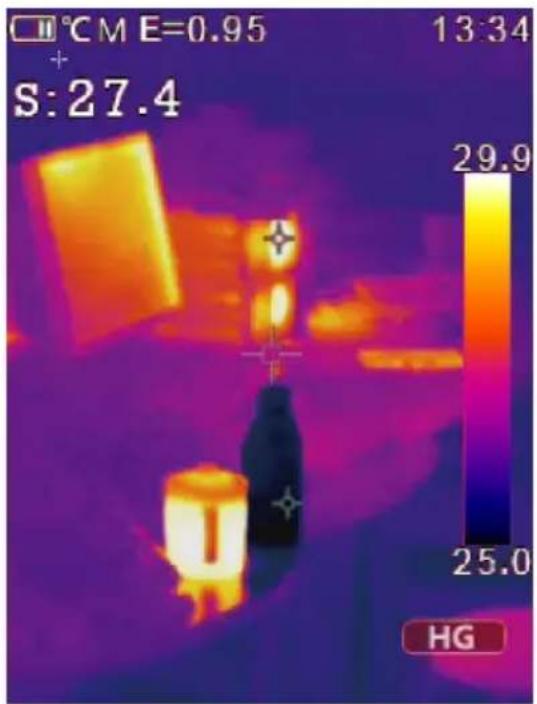
11.6.1 Histogram mode (HG)
text_image
°C M E=0.95 13:34 S:27.4 29.9 25.0 HGThe thermal image is enhanced using a histogram algorithm. The color-temperature relationship is not linear, which may improve detail and contrast.
This mode is suited for complex scenes where subtler temperature gradients need to be highlighted.
- Short press the button to toggle between "HG" and "MANUAL" mode.
- "H" and "HG" will appear to indicate automatic mode is active.
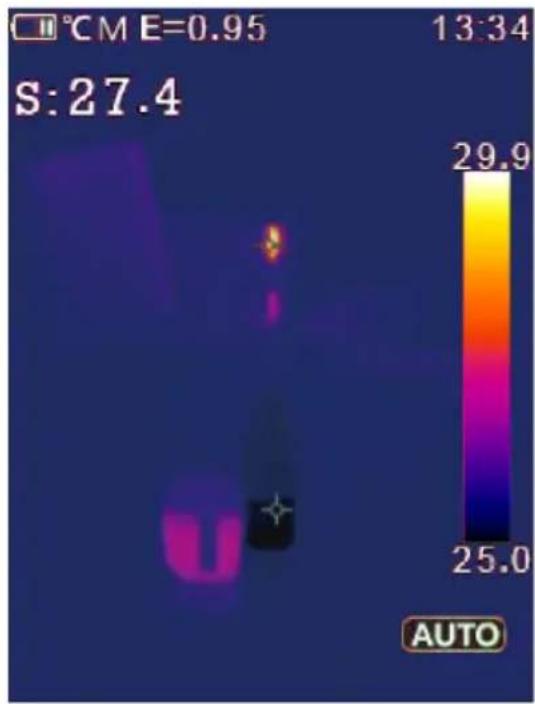
11.6.2 Automatic mode (AUTO)
text_image
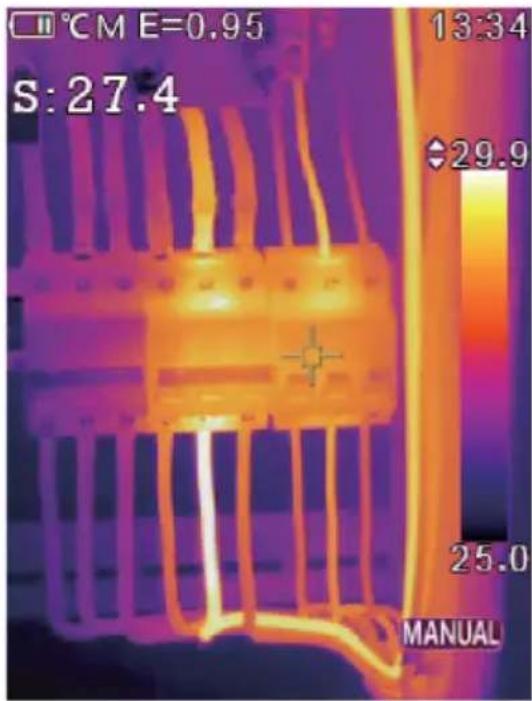
°CM E=0.95 13:34 S:27.4 29.9 25.0 AUTO11.6.3 Manual / lock mode (MANUAL)
text_image
°CM E=0.95 S:27.4 13:34 29.9 25.0 MANUALAdjusts the thermal image automatically based on the detected minimum and maximum temperatures.
The color-temperature relationship for this setting is linear and suited for consistent, routine monitoring where temperature ranges are known and stable.
- Short press the button to toggle between "AUTO" and "MANUAL" mode.
- "A" and "AUTO" will appear to indicate automatic mode is active.
The temperature level is determined by user-set upper and lower temperature limits.
It is suited for situations where a specific temperature band is targeted for observation.
- Short press the button to activate / deactivate this mode.
The icon and "MANUAL" will appear to indicate manual mode is active.
- Touch the upper or lower temperature values to manually adjust them.
12 Main menu
| Icon Setting Section links | ||
 | Gallery | Enter the gallery to view saved photos and video.See section: Capture photos / videos [▶ 44]. |
 | Alarm | Set high / low temperature alarm values.See section: Alarms [▶ 47]. |
 | Parameters | Set parameters for increased accuracy.See section: Parameters [▶ 48]. |
 | Image mode | Select how images are overlaid on the display.See section: Image modes [▶ 51]. |
 | Palette | Select how thermal images are color rendered.See section: Palette [▶ 52]. |
 | Setting | Access various system settings.See section: Device settings [▶ 53]. |
12.1 Alarms
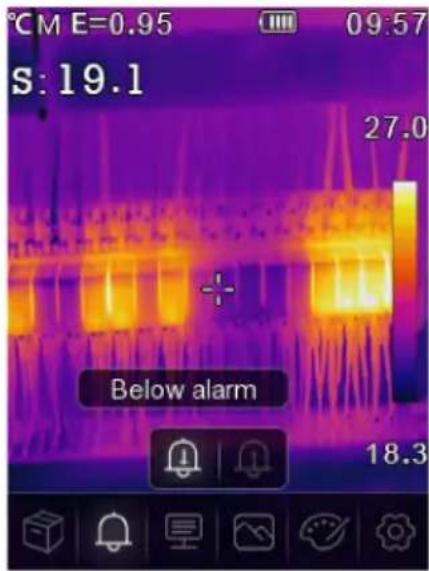
- Select an alarm type: Menu → Setting → Measure setting → Alarm mode.
| Alarm type Description | |
| OFF Disable alarm sound. | |
| Above alarm If the object temperature is above than set value, the sound alarm will activate. | |
| Below alarm If the object temperature is less than set value, the sound alarm will activate. | |
| Zone alarm If the object temperature between high and low values, the sound alarm will activate. | |
- Set the temperature values:
text_image
°C M E=0.95 09:57 S:19.1 27.0 + Below alarm 18.3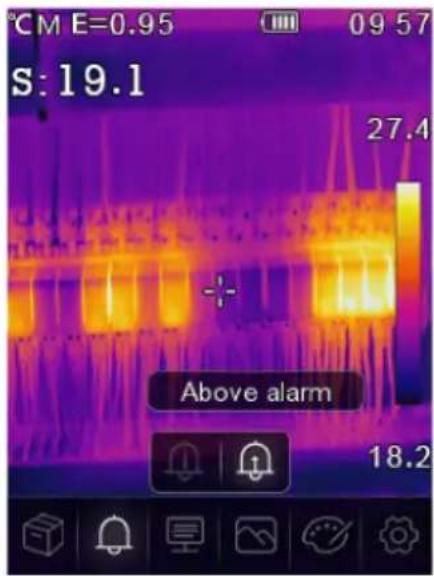
text_image
CME=0.95 09 57 S:19.1 27.4 Above alarm 18.212.2 Parameters
text_image
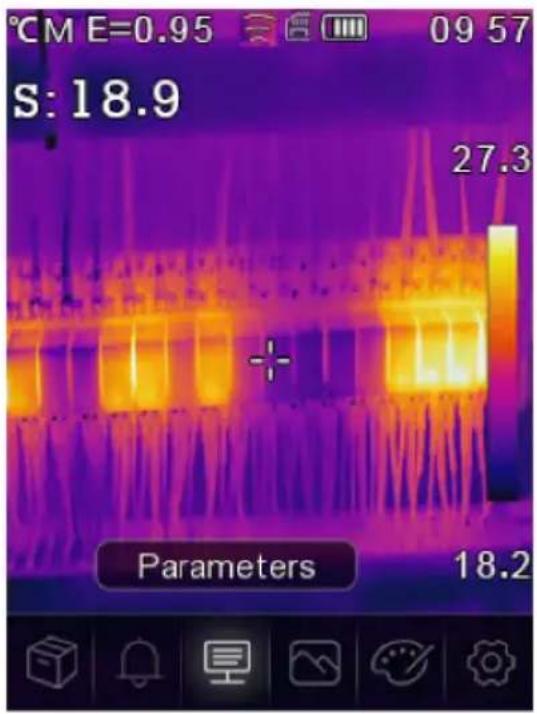
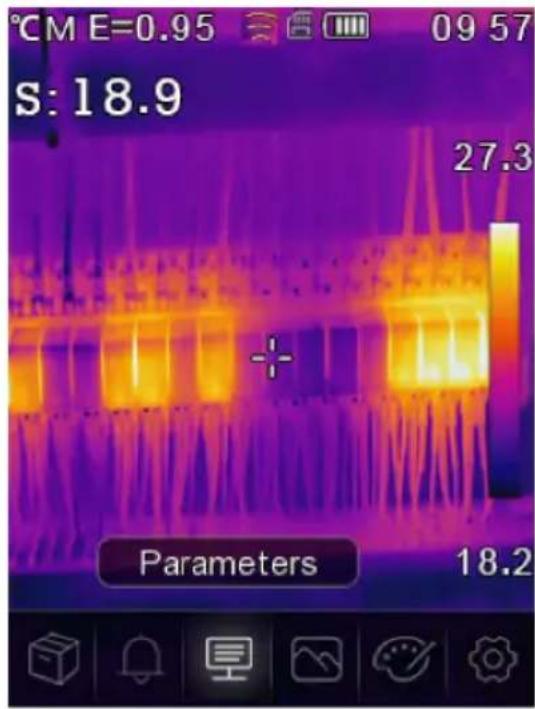
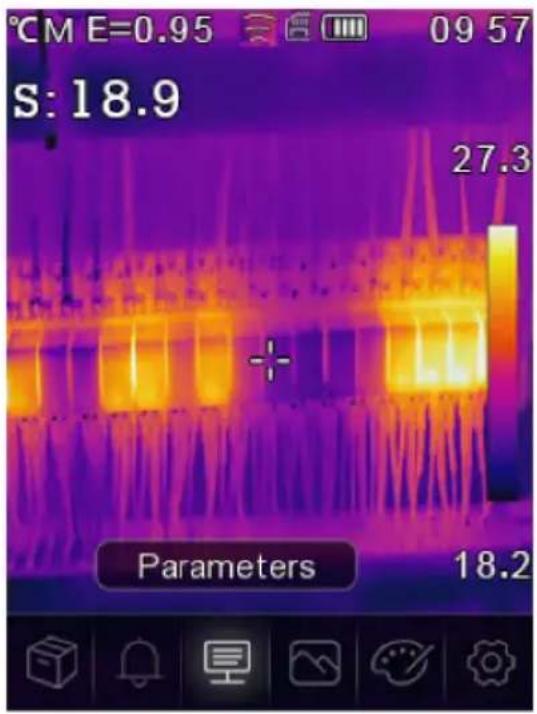
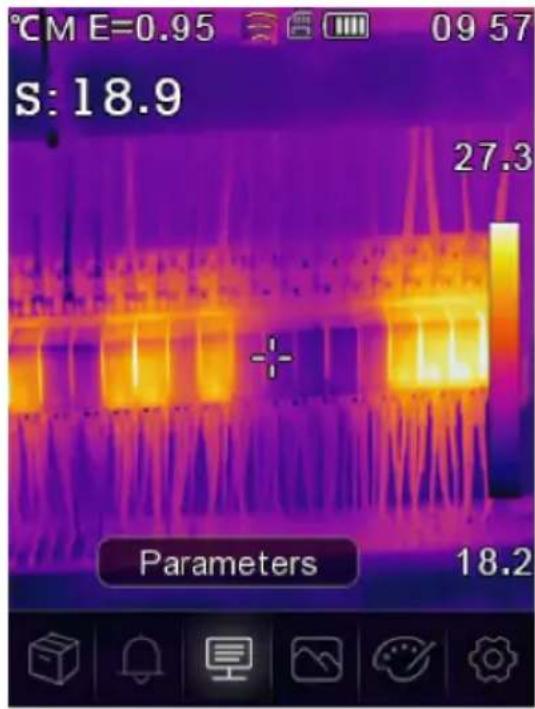
°CM E=0.95 09 57 S: 18.9 27.3 Parameters 18.2- Set parameters to enhance the accuracy of temperature measurements.
■ Each parameter addresses a variable that can affect the precision of the thermal readings.
12.2.1 Ambient temperature
text_image
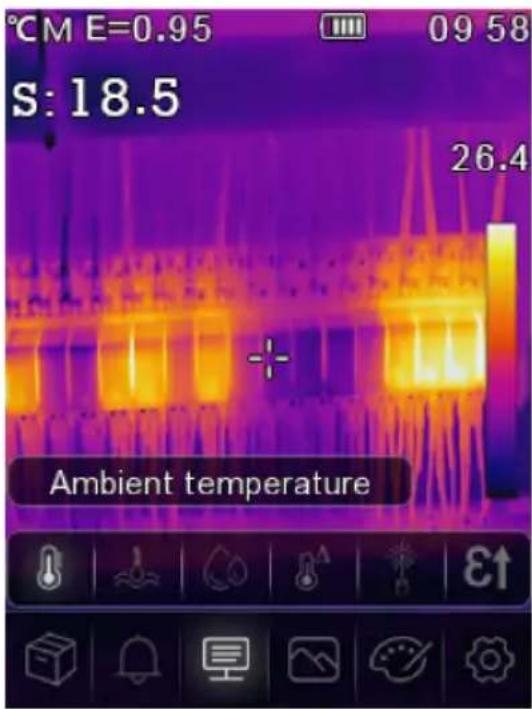
°CM E=0.95 09 58 S:18.5 26.4 Ambient temperature■ Deviations from the default temperature setting can affect the accuracy of readings.
- Adjust the settings to match the ambient temperature.
12.2.2 Reflection temperature
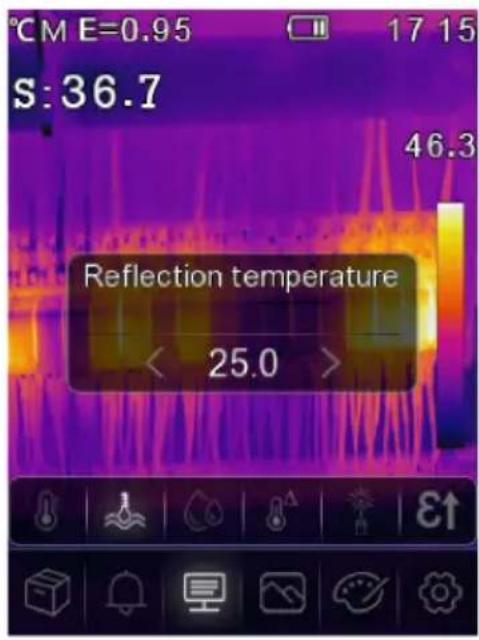
Objects reflect infrared energy coming from surrounding objects. Reflected energy is added to the energy of the object itself, potentially causing measurement errors. Results are more likely to be affected with objects that have low emissivity.
In most applications (especially objects with high emissivity), the reflected temperature will reach an equilibrium with the ambient temperature. This has a minimal effect on temperature measurements.
In environments with higher temperature sources close to the object being measured, it is necessary to compensate for reflected energy by setting a temperature value for the environmental heat source.
text_image
°CM E=0.95 17 15 S:36.7 46.3 Reflection temperature < 25.0 >- Set the emissivity to 1.00. See section: Emissivity setting [▶ 43].
- Point the lens 180^ away from object to be measured.
- Take a measurement and then press the trigger to hold (freeze) the image.
- Determine the average value of the image.
→ Average value: take multiple readings and divide by number of readings taken.
- Input the value via the onscreen settings.
→ This setting will be factored in to create a temperature reading adjustment to account for reflected energy.
12.2.3 Atmospheric humidity
text_image
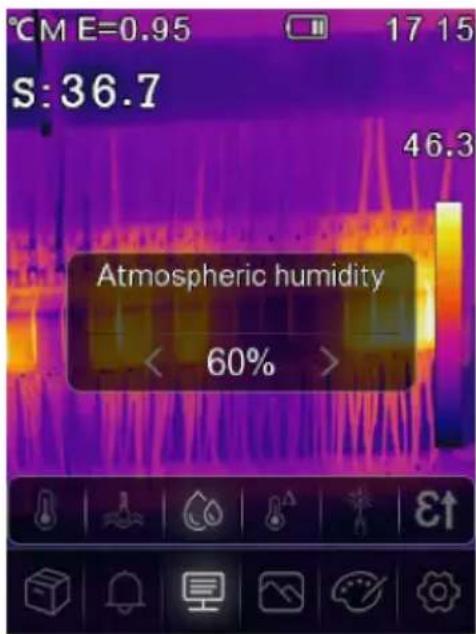
°CM E=0.95 17 15 S:36.7 46.3 Atmospheric humidity < 60% >Water droplets in the air can absorb infrared rays, and affect the accuracy of readings.
- Adjust the settings to match the humidity levels.
12.2.4 Infrared compensation
text_image
°CM E=0.95 17 15 S:36.7 46.3 Infrared compensation < 0.0 >12.2.5 Distance
text_image
°CM E=0.95 17 15 S:36.7 46.3 Distance 2 >■ Various factors can affect measurement accuracy (e.g., accuracy drift over time).
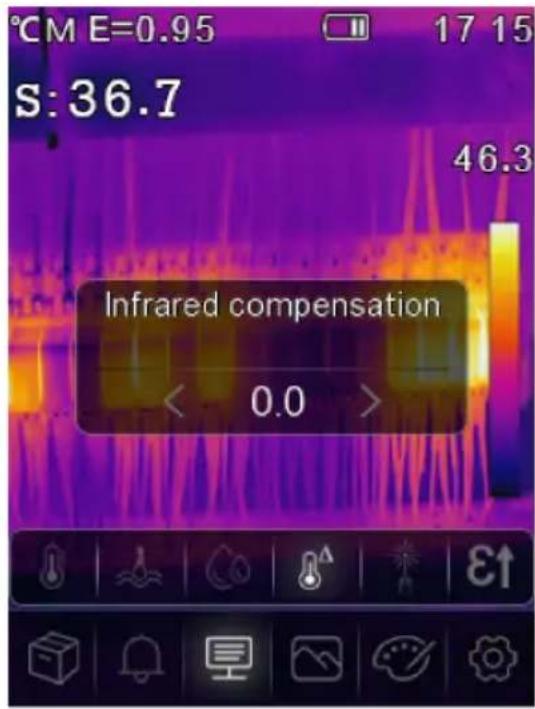
In automatic mode, set a compensatory value if there is a known discrepancy between the measured temperature and the actual object temperature.
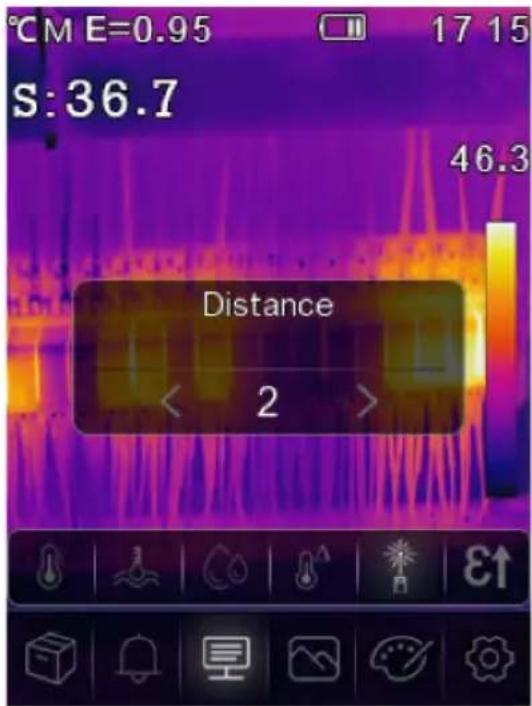
Infrared energy reduces as the distance from the measured object increases.
- Adjust for this by entering the distance to the measured object.
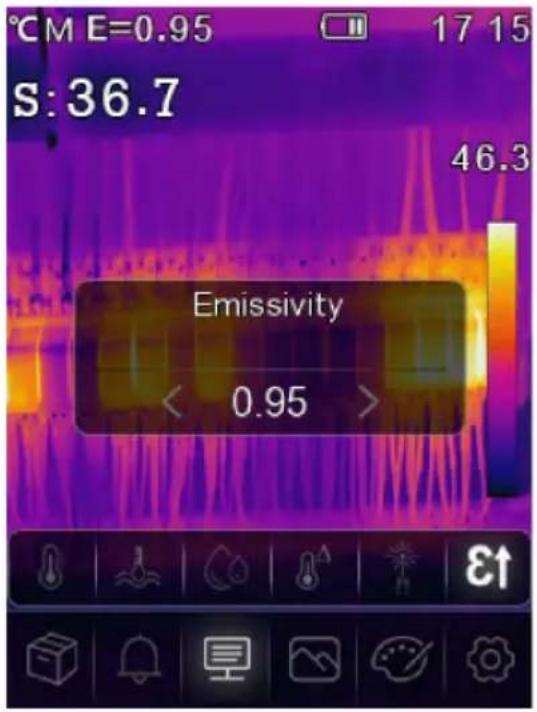
12.2.6 Emissivity
text_image
°CM E=0.95 17 15 S:36.7 46.3 Emissivity < 0.95 > ε↑■ Emissivity settings can be adjusted manually, and in smaller increments.
For further information on emissivity see: Emissivity and accuracy [▶ 43].
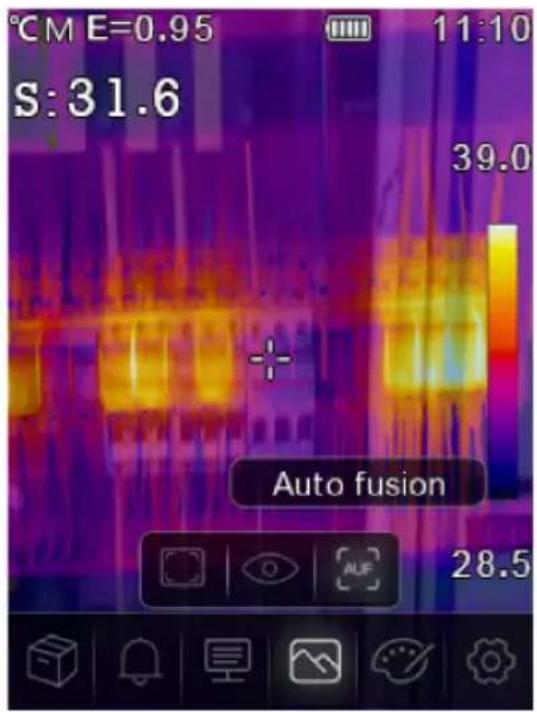
12.3 Image modes
text_image
°CME=0.95 11:10 S:31.6 39.0 + Auto fusion 28.5
Image modes

An infrared image is displayed.

Visual image only.

■ Center area temperature is compared with the full screen area.
The ratio of infrared to visible image is calculated automatically.
12.4 Palette
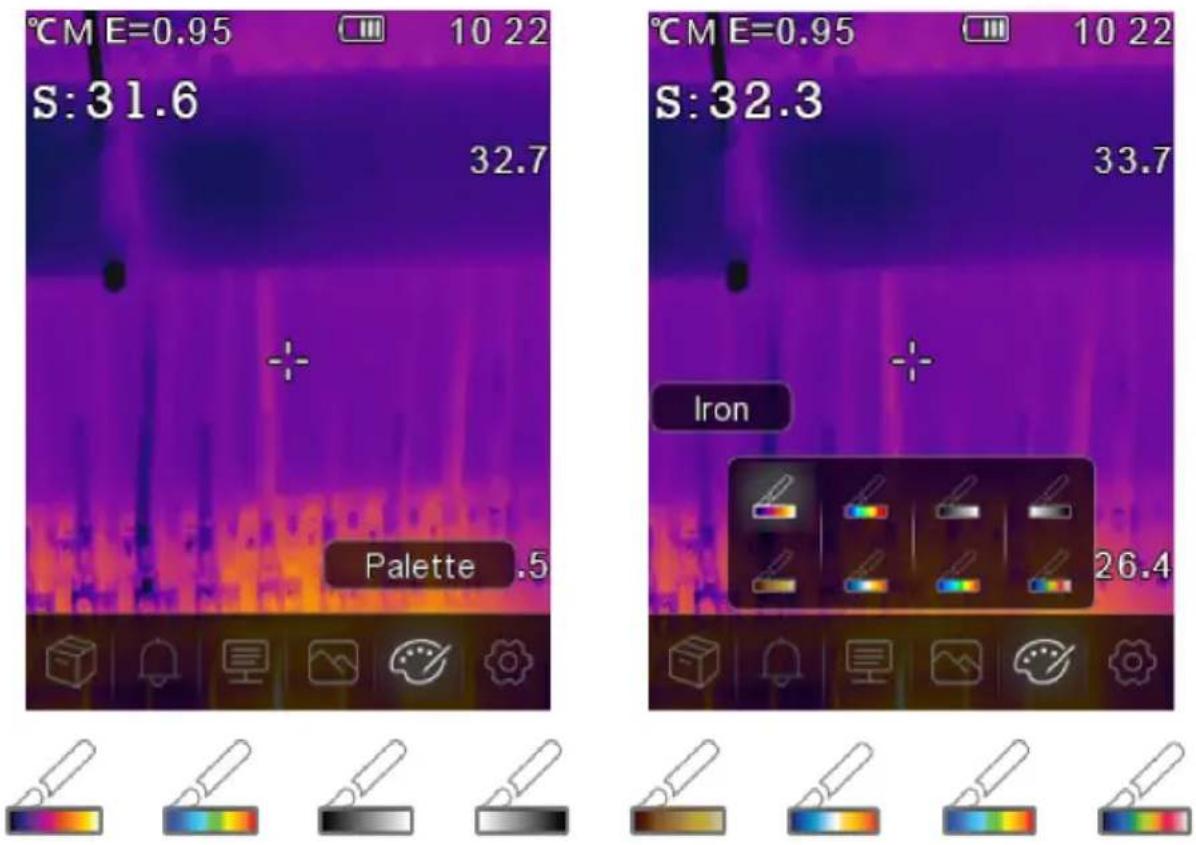
A variety of palettes are available for specific applications.
Pallets change the false-color presentation of infrared images displayed or captured.
12.4.1 Standard palette
The standard palettes offer an equal, linear presentation of colours that allow for best presentation of detail.

Palette
text_image
°CM E=0.95 10 22 S:31.6 32.7 Palette .5 °CM E=0.95 10 22 S:32.3 33.7 Iron 26.4Iron Rainbow White hot Black hot Brown hot Blue red Hot cold Feather
13 Device settings
To access device settings: Menu → Setting → Device setting.
| Setting Description | |
| USB Mode Select between two different connection modes:■ USB Driver:- When connected to a computer, the product will show up as a removable disk- After launching the PC software it will enter file management mode.■ PC Software:- After launching the PC software it will enter live view mode.See section: Connect to PC (file management) [▶ 56]. | |
| Flashlight | ■ Switch flashlight ON/OFF |
| Laser | ■ Switch laser pointer ON/OFF |
| Brightness | ■ Adjust the display brightness. |
| WIFI | ■ WIFI: Switch Wi-Fi ON/OFF.■ SSID: Change the SSID.■ Password: Change the Wi-Fi password. |
| Time/Date | ■ Set the time and date. |
| Date/Format | ■ Set a date format. |
| Language | ■ Change system language. |
| Auto Power Off | ■ Disable auto power off.■ Set the auto power off time. |
| About | ■ View device information (e.g., model, serial number, firmware version, storage capacity). |
14 Measure settings
To access measure settings: Menu → Setting → Measure setting.
| Setting Description | |
| Max temp | Switch maximum temperature measurement ON/OFF. |
| Min temp | Switch minimum temperature measurement ON/OFF. |
| Distance Unit | m (meters), ft (feet)Conversion: 1 (ft) = 0.3048 (m); 1 (m) = 3.2808399 (ft). |
| Temp. Unit | °C (Celcius), °F (Fahrenheit) and K (Kelvin).Conversion: °F = 1.8 x °C + 32, K = 273.15 + °C. |
| Temp. Range | If there is an overlap between the two ranges, select: -20 to +150 °C for greater accuracy. |
| Emissivity | Choose from a selection of presets. See section:Emissivity table [▶ 62]. |
| Alarm mode Choose an alarm setting:OFFAbove temperatureBelow temperatureZone alarmTo configure alarm temperature values, see section: Alarms. | |
| Auto Calibration | Select a calibration time interval.TIP:Press and hold the button during IR measurement to perform a manual IR calibration."IR calibrating..." will appear on the display during calibration. |
| Image transform | Select between "AUTO" and "HG" modes.See section: Image transform. |
| Image align | Adjust the IR overlay (x, y axis) so it lines up with the visual image. |
15 Reset
15.1 Erase all files
Important:
This function erases the memory. Always back up important files before clearing the memory.
- If a microSD card is inserted, this function will clear all files on the microSD card.
- If no microSD card is inserted, this function will clear the internal memory.
To clear the memory: Menu → Setting → Reset → Format Memory → Yes.
15.2 Default settings
To return to factory defaults: Menu → Setting → Reset → Default settings → Yes.
| Item Parameter Value | ||
| Wi-Fi SSID Device model number | ||
| Password 12345678 | ||
| Measurement parameters Emissivity 0.95 | ||
| Reflective temperature 25 | ||
| Temp. range -20 to +150 °C | ||
| Temp. unit °C | ||
| Image Mode Thermal | ||
| Palette Iron | ||
| Adjustment Auto | ||
| System setting Language English | ||
| USB mode USB driver | ||
| Parameters Ambient temperature | 25.0 | |
| Reflection temperature | 25.0 | |
| Atmospheric humidity | 60% | |
| Infrared compensation | 0.0 | |
| Distance (meters) | 2 | |
16 PC software
16.1 Before installation
1. Check .NET framework requirement
The software requires .NET Framework 4.6. This version is included with Windows® 10 by default.
If you are using Windows 8.1 or Windows 7 (with Service Pack 1), you may need to install or update to .NET Framework 4.6.
2. Install .NET framework software (if required)
Important:
Always download the framework from official Microsoft sources to maintain the security and integrity of your system.
If you do not have .NET Framework 4.6, you can download and install it from the official Microsoft website. Search for: "Microsoft .NET Framework 4.6".
■ After downloading, open the .NET Framework 4.6 installer and follow the instructions to complete the installation process.
16.2 Install the PC software
- Insert the CD-ROM into an available drive on your computer.
- Follow the on screen instructions to complete the installation process.
16.3 Connect to PC (file management)
Use this mode to manage the files, and images on your device using:
Windows file management.
■ Included PC software file management.
Preconditions:
√ The PC software is installed on your PC.
- Load the PC software.
- Enable "USB Driver" mode: Menu → Setting → Device Setting → USB Mode → USB Driver.
- Press repeatedly to exit the menu and return to the main screen.
- Connect one end of the USB cable to the TypeC USB port on the product, and the other end to an available USB port on your PC computer.
→ You can now manage your files on your PC.
16.4 Connect to PC (Live view)
Use this mode to configure settings, control functions, view live readings and more.
Preconditions:
√ The PC software is installed on your PC.
1. Load the PC software.
2. Enable "USB Driver" mode: Menu → Setting → Device Setting → USB Mode → PC Software.
3. Press repeatedly to exit the menu and return to the main screen.
4. Connect one end of the USB cable to the TypeC USB port on the product, and the other end to an available USB port on your PC computer.
5. A new menu option "Camera" will appear on the software interface. Select it to enter live view.
→ You can now use your PC computer to configure settings, control functions, and view live readings.
17 Mobile app
- Compatible Android™ and iOS apps are available from their respective app stores.
■ Search for: Voltcraft Thermal Imaging.
Some features include: live view, image to phone transfer, and various camera settings control.
To connect to the app:
Preconditions:
√ The application is installed on your mobile device.
- On the thermal camera navigate to: Menu → Setting → Device Setting → WIFI → WIFI (ON).
→ The Wi-Fi status will show on the display.
-
Press repeatedly to exit the menu and return to the main screen.
-
On the mobile device connect to the thermal camera Wi-Fi "SSID" and enter the "Password" [default:12345678].
→ You are now connected to the thermal camera via Wi-Fi.
- Launch the mobile app.
18 Update the firmware
18.1 Check firmware version
To check the firmware: Menu → Setting → Device Setting → About → Software.
18.2 Download and install new firmware
Any firmware updates will be available for download here: www.conrad.com/downloads.
- Download the files to your computer.
- Connect the product to your PC computer in file management mode. See section: Connect to PC (file management) [▶ 56].
- The product will appear as a drive letter on your computer.
- Drag and drop the firmware file to the drive letter.
→ Wait a few moments for the file to finish copying.
-
Disconnect the cable and follow the onscreen prompts to complete the firmware upgrade.
-
Restart the product.
-
Check the firmware version to verify the update.
19 Troubleshooting
| Problem Possible cause Suggested solution | ||
| Power will not switch ON Rechargeable battery flat, or faulty power supply. | Charge the rechargeable battery and/or check the power supply. | |
| Power switches OFF during use | No power Charge the rechargeable battery. | |
| Thermal image not shown Lens cover still attached Remove the lens cover. | ||
| Temperature readings not accurate | Incorrect emissivity values set Check the emissivity values are correct for the material being measured.See: Emissivity table [▶ 62]. | |
| Poor image contrast Incorrect colour palette selection or poor lighting conditions. | Choose a different color palette that enhances contrast or modify the lighting conditions if possible. | |
| Image artifacts | Dirty lens. | Clean the lens. See: Infrared lens [▶ 58]. |
20 Cleaning and care
20.1 Housing
Important:
- Do not use aggressive cleaning agents, rubbing alcohol or other chemical solutions. They damage the housing and can cause the product to malfunction.
-
Do not immerse the product in water.
– Risk of dirt / debris contaminating lens. Always use the included lens cap to cover the lens before cleaning the housing. -
Clean the product with a dry, fibre-free cloth.
20.2 Infrared lens
Important:
- The lens has an anti-reflective coating that can get damaged if not cleaned correctly.
- Do not use abrasive materials and/or chemicals to rub/clean the lens.
- Do not use the following abrasive materials as they may damage the anti-reflective coating (e.g., micro fiber cloths, kitchen towels, toilet paper, towels, shirt cuffs etc.
To reduce calibration errors and maximize accuracy, the lens should be free from dirt and debris.
- Inspect the lens for dirt, dust, fingerprints etc.
- Use a non-contact cleaning method first (e.g., manual pump air blower).
- If further cleaning is required, use a fine tipped optical sensor cleaning swab.
→ Do not apply lens cleaning solution as this may damage / stain the lens. - Carefully wipe once across the lens (do not apply pressure).
→ To avoid scratches, wipe across the lens once and then discard the swab. - Repeat steps 2-4 as needed.
21 Declaration of Conformity (DOC)
Conrad Electronic SE, Klaus-Conrad-Straße 1, D-92240 Hirschau hereby declares that this product conforms to the 2014/53/EU directive.
- Click on the following link to read the full text of the EU declaration of conformity: www.conrad.com/downloads
Enter the product item number in the search box. You can then download the EU declaration of conformity in the available languages.
22 Disposal
22.1 Product

This symbol must appear on any electrical and electronic equipment placed on the EU market. This symbol indicates that this device should not be disposed of as unsorted municipal waste at the end of its service life.
Owners of WEEE (Waste from Electrical and Electronic Equipment) shall dispose of it separately from unsorted municipal waste. Spent batteries and accumulators, which are not enclosed by the WEEE, as well as lamps that can be removed from the WEEE in a non-destructive manner, must be removed by end users from the WEEE in a non-destructive manner before it is handed over to a collection point.
Distributors of electrical and electronic equipment are legally obliged to provide free take-back of waste. Conrad provides the following return options free of charge (more details on our website):
in our Conrad offices
■ at the Conrad collection points
at the collection points of public waste management authorities or the collection points set up by manufacturers or distributors within the meaning of the ElektroG
End users are responsible for deleting personal data from the WEEE to be disposed of.
It should be noted that different obligations about the return or recycling of WEEE may apply in countries outside of Germany.
22.2 (Rechargeable) batteries
Remove batteries/rechargeable batteries, if any, and dispose of them separately from the product. According to the Battery Directive, end users are legally obliged to return all spent batteries/rechargeable batteries; they must not be disposed of in the normal household waste.

Batteries/rechargeable batteries containing hazardous substances are labelled with this symbol to indicate that disposal in household waste is forbidden. The abbreviations for heavy metals in batteries are: Cd = Cadmium, Hg = Mercury, Pb = Lead (name on (rechargeable) batteries, e.g. below the trash icon on the left).
Used (rechargeable) batteries can be returned to collection points in your municipality, our stores or wherever (rechargeable) batteries are sold. You thus fulfil your statutory obligations and contribute to environmental protection.
Batteries/rechargeable batteries that are disposed of should be protected against short circuit and their exposed terminals should be covered completely with insulating tape before disposal. Even empty batteries/rechargeable batteries can contain residual energy that may cause them to swell, burst, catch fire or explode in the event of a short circuit.
23 Technical data
23.1 Product power input
Input 5 V/DC 2.4 A
*USB-C® input can be used to charge rechargeable battery or use product tethered to power supply without rechargeable battery inserted.
23.2 Rechargeable battery pack
Rechargeable battery 3.7 V 2600 mAh 9.62 Wh Li-ion
Battery life.... max. 4 hrs
23.3 Infrared (IR) imaging performance
Objective (H x V) 42° x 32°
Resolution.... 160 x 120 pixels
Frequency.... 25 Hz
Thermal sensitivity / NETD.... <0.05°C @ 30 °C (50 mK)
IFOV (spatial resolution)...... 4.62 mrad
23.4 Optics
Optical lens..... f=2.6 mm, F1.1
Type...... Infrared
Focal distance .... min. 0.5 mm
23.5 Measurement
Temperature measuring range ...... -20 to +150 °C (-4 to +302 °F)
$$ + 1 0 0 \text { to } + 5 5 0 ^ {\circ} \mathrm{C} (2 1 2 \text { to } 1 0 2 2 ^ {\circ} \mathrm{F}) $$
Temperature accuracy* .... ±2 °C (±2 °F) or ±2 % of reading
Resolution.... 0.1 °C
Emissivity.... 0.01 to 1.00 (adjustable)
*Tested between +10 to +35 °C, object temperature >0 °C.
23.6 Image processing enhancement
Alarms ...... High / low temperature in all areas
Alarm modes: above / below / zone
Measurement corrections.... Emissivity, reflected temperature, ambient temperature, atmospheric
humidity, infrared compensation, distance
Measurements.... Center spot
Image enhancement / correction...... Histogram mode
Colour palettes.... Iron, Rainbow, White hot, Black hot, Brown hot, Blue-red, Hot-cold,
Feather
Image fusion.... Thermal image, camera, auto fusion
23.7 Visible light camera
Sensor resolution.... 2 MP
Digital zoom.... 1 - 32x
23.8 Display
Size....7.11 cm (2.8") LCD
Resolution.... 320 x 240 pixels
Touch screen...... no
23.9 Storage and media
Internal storage.... 3.5 GB eMMC
MicroSD.... Max. 32 GB
MicroSD file format.... FAT 16 or 32
Image storage format .... Standard JPEG, HIR files (includes data)
Image storage mode...... Simultaneous image storage (IR and visual)
Image storage capacity .... approx. 6000 images
Video format 320 x 240 pixels @ 30 fps, *.mp4
Video storage capacity .... approx. 60 minutes
23.10 Laser pointer
Class.....II
Wavelength.... 630 - 670 nm
Output power.... max 0.4 mW
Colour.... Red
23.11 LED light
Brightness.... 26 lm
Colour temperature.... 5000 K
23.12 Measurement units
Temperature.....°C (Centigrade) °F (Fahrenheit), K (Kelvin)
Distance..... m, ft
23.13 Language setting
Languages..... English (default), German
23.14 Data communication interface
USB Type-C® Live video output, data transfer
Wi-Fi Data transfer, live video output, remote operation via mobile app
23.15 Wi-Fi
Standard..... IEEE 802.11 b/g/n, 2.4 GHz
Frequency range 2.412 - 2.462 GHz
Transmission power 16.5 dBm
Transmission distance.... max. 20 m
Password (default)...... 12345678
SSID (default)..... Device model number
23.16 Mobile application
Application name..... Voltcraft Thermal Imaging
Supported OS...... Android 6 (or above), iOS 13.0 (or above), iPad OS 13.0 (or above)
USB port support OTG .... Required
23.17 Computer software
Supported OS...... Windows® 7 (or above)
23.18 Environment
Operating conditions....-15 to + 50 °C, 10 - 90 % RH (non-condensing)
Storage conditions....-40 to + 70 °C, 10 - 90 % RH (non-condensing)
23.19 Physical specifications
Dimensions (W x H x D) 75.5 x 101 x 235 mm
Weight 420 g
23.20 Emissivity table
| Material Emissivity Material Emissivity | |||
| Water 0.96 Tape 0.96 | |||
| Stainless steel 0.14 Brass plate 0.06 | |||
| Aluminium plate 0.09 Human skin 0.98 | |||
| Asphalt 0.96 PVC plastic 0.93 | |||
| Concrete 0.97 Polycarbonate 0.80 | |||
| Cast iron 0.81 Oxidized copper | 0.73 | ||
| Rubber 0.95 | Rust | 0.80 | |
| Wood 0.85 Paint 0.90 | |||
| Brick 0.75 | Soil | 0.93 | |
F Sommaire
France (email): technique@conrad-france.fr
text_image
Technical diagram of a handheld device with numbered parts for identification and assembly reference.text_image
°CM E=0.95 09:57 S:19.1 27.0 + Below alarm 18.3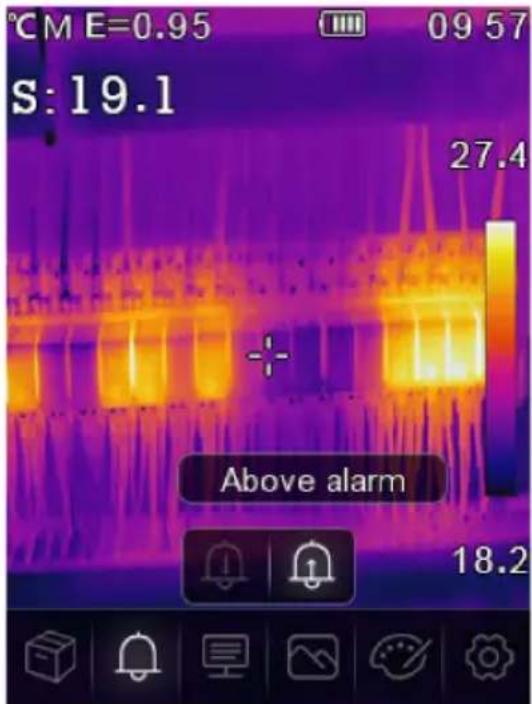
text_image
°C ME=0.95 09 57 S:19.1 27.4 Above alarm 18.212.2 Paramètres
text_image
°CM E=0.95 09 57 S: 18.9 27.3 Parameters 18.223.16 Application mobile
Nom de l'application ..... Voltcraft Thermal Imaging
20.1 Behuizing.... 121
20.2 Infraroodlens 121
text_image
Technical diagram of a handheld device with numbered parts for identification and assembly reference.text_image
°C M E=0.95 09:57 S:19.1 27.0 Below alarm 18.3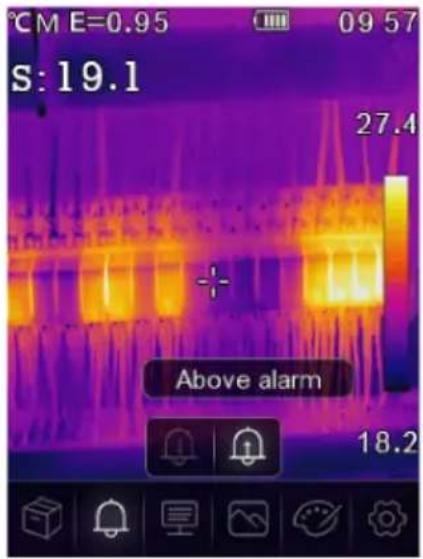
text_image
CME=0.95 09 57 S:19.1 27.4 + Above alarm 18.212.2 Parameters
text_image
°CM E=0.95 09 57 S: 18.9 27.3 Parameters 18.2This is a publication by Conrad Electronic SE, Klaus-Conrad-Str. 1, D-92240 Hirschau (www.conrad.com).
All rights including translation reserved. Reproduction by any method (e.g. photocopying, microfilming or the capture in electronic data processing systems) requires prior written approval from the editor. Reprinting, also in part, is prohibited. This publication reflects the technical status at the time of printing.
Copyright by Conrad Electronic SE *2890403 (WB-310)_V2_0824_dh_mh_en 18014399824713739-2 l3/O2 en