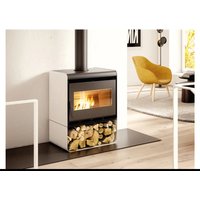
Asia - Frying Pan Palazzetti - Free user manual and instructions
Find the device manual for free Asia Palazzetti in PDF.


| Product type | Wood stove |
| Brand | Palazzetti |
| Model | Asia |
| Category | Stove |
| Fuel | Wood logs (moisture ≤25%, ideal length 33 cm) |
| Use | Domestic heating (not for cooking) |
| Ignition | Manual with natural firelighter |
| Primary air register | Adjustable, combustion control |
| Glass cleaning | Integrated via air flow (adjustable lever) |
| Bypass damper | Present, adjustable to facilitate smoke evacuation |
| Safety distances (version 70) | X1=800 mm, X2=300 mm, Y1=400 mm, Y2=400 mm, Z=1000 mm |
| Safety distances (version 80) | X1=1000 mm, X2=50 mm, Y1=100 mm, Y2=0 mm, Z=1000 mm |
| Floor protection | Fireproof base required if flammable floor (wood, carpet, etc.) |
| Flue connection | First vertical section ≥1.5 m, max 3 direction changes, horizontal sections max 2-3 m with 3-5% slope |
| Daily maintenance | Cleaning the grate and emptying the ash drawer |
| Weekly maintenance | Glass cleaning |
| Annual maintenance | By approved service: sweeping, checking seals, bypass damper |
| Spare parts | Original Palazzetti recommended (cold handle, ceramic glass, seals) |
| Safety | Do not touch hot surfaces without gloves, do not use with door open, do not burn waste |
| First ignition | By installer, reduced loads (1 kg/h) for 4 h, then progressive over 3 days |
| Provided documentation | User and installation manual, product booklet, barcode label |
Frequently Asked Questions - Asia Palazzetti
User questions about Asia Palazzetti
0 question about this device. Answer the ones you know or ask your own.
Ask a new question about this device
Download the instructions for your Frying Pan in PDF format for free! Find your manual Asia - Palazzetti and take your electronic device back in hand. On this page are published all the documents necessary for the use of your device. Asia by Palazzetti.
USER MANUAL Asia Palazzetti
This manual is an integral part of the product.
Read the instructions carefully before installing, servicing or operating the product.
Translation of the original instructions
FR
NOTICE D'INSTALLATION ET D'ENTRETIEN
We'd like to thank you for having purchased one of our products and congratulate you on your choice.
To make sure you get the most out of your product, please carefully follow the instructions provided in this manual.
FR
Cher client,
1.1 Symbols 27
1.2 Intended use 27
1.3 Purpose and content of the manual 27
1.4 Preservation of the manual 27
1.5 Update of this manual 27
1.6 Overview 28
1.7 Compliance 28
1.8 Responsibility of the manufacturer 29
1.9 Technical assistance and maintenance 29
1.10 Spare parts 29
1.11 Serial plate 29
1.12 Delivery of the appliance 30
2 SAFETY WARNING 30
2.1Warnings for the installer 30
3 FUEL CHARACTERISTICS 33
3.1 Fuel characteristics 33
4 BECOMING FAMILIAR WITH THE PRODUCT 34
4.1 Serial plate 34
5 HANDLING AND TRANSPORTATION 35
5.1 Transportation 36
5.2 Checking the support surface 36
6 PREPARING THE PLACE OF INSTALLATION 36
6.1 General considerations 36
6.2 Safety Precautions 36
6.3 Place of installation 37
6.4Combustion air 38
6.5 Flue gas fitting 39
6.6 Roof exhaust with traditional fireplace 39
7 COMMISSIONING 41
7.1 First ignition 41
7.2Combustion 41
7.3 Adjusting the bypass valve 41
8 OPERATION 42
8.1 Power on 42
9 CLEANING AND MAINTENANCE 43
9.1 Routine maintenance cleaning schedule 43
9.2 Ordinary cleaning 43
9.3 Routine maintenance 45
10 DEMOLITION AND DISPOSAL 46
1 GENERAL INTRODUCTION
Palazzetti heating appliances are manufactured and tested in accordance with the safety requirements set forth in the reference European directives.
Even partial printing, translation and reproduction of this manual are bound by the authorisation from Palazzetti. Technical information, graphical representations and specifications in this manual may not be disclosed to third parties.
Do not operate if not all the information provided in the manual has been thoroughly understood; if in doubt always request the advice or intervention of Palazzetti specialised personnel.
Palazzetti reserves the right to change specifications and technical and/or functional characteristics of the product at any time without prior notice.
1.1 Symbols
In this manual the points of major importance are highlighted by the following symbols:

INDICATION: Indications concerning the correct use of the appliance and the responsibilities of those in charge.

ATTENTION: The point in which a note of particular importance is expressed.

HAZARD: Expresses an important note of behaviour for the prevention of injuries or damage to property.
1.2 Intended use

The indoor domestic heating appliance described in this manual is suitable for burning logs.

The appliance must only work with the fire box door closed.
The intended use indicated is valid only for appliances in full structural, mechanical and engineering efficiency.
1.3 Purpose and content of the manual
The purpose of this manual is to provide the fundamental and basic regulations for correct installation of the appliance.
Strict observance of that which is described herein guarantees a higher level of appliance safety and productivity.
1.4 Preservation of the manual
Preservation and consultation
The manual must be kept carefully and must always be available for consultation, both by the user and by the assembly and maintenance staff.
The installation manual is an integral part of the appliance.
Deterioration or loss
If needed, request an additional copy from Palazzetti.
Sale of the appliance
In the event of transferring the appliance the user is obliged to deliver even this manual to the new owner.
1.5 Update of this manual
This manual reflects the latest developments at the time the appliance was placed on the market.
The products already on the market with the relevant technical documentation, will not be considered by Palazzetti as deficient or inadequate due to possible modifications, adjustments or application of new technologies on newly marketed products.
1.6 Overview
The instructions in this manual apply as general rules; it is still necessary to comply with all the rules laid down by the local, national and European legislation in force in the country where the appliance is installed.
Information
In the event that you need to contact the Manufacturer of the appliance, refer to the serial number and the identification data indicated on the identification plate.
In case of problems, contact the dealer or a qualified technician authorised by the manufacturer; in case of repair, request the use of original spare parts.
Periodically check and clean the flue gas duct (connected to the chimney flue).
The appliance is not suitable for cooking.
Store this instruction manual, which is an integral part of the appliance, for its entire service life. If the appliance is sold or transferred to another user, always make sure it is accompanied by the product booklet.
In case of loss, contact the manufacturer or authorised retailer to receive another copy.
Maintenance
Maintenance operations must be carried out by qualified personnel authorised to work on the appliance to which this manual refers.
Responsibility for the works of installation
Responsibility for the works carried out for the installation of the appliance cannot be considered to be taken on by Palazzetti; it is and remains the responsibility of the installer, who is responsible for carrying out the checks relating to the flue, the air intake and how right the proposed installation solutions are.
1.7 Compliance
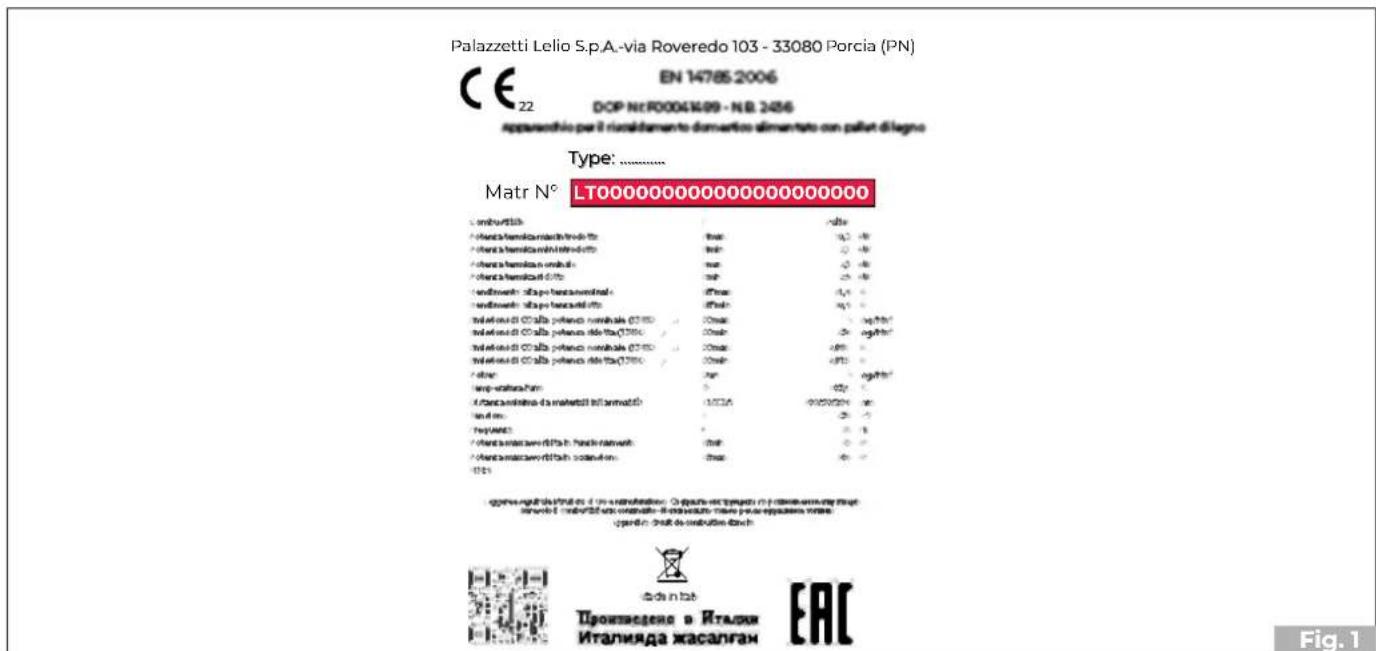
The appliances described in this manual comply with the legal provisions of the EU directives that can be consulted at the following web address: https://prdocs.palazzetti.it
The search key to be used is the serial number as shown below in the illustrative image (Fig. 1).
1.8 Responsibility of the manufacturer

With the delivery of this manual, Palazzetti declines all responsibility, both civil and criminal, direct or indirect, due to:
- installation that does not comply with standards in force in the country and with safety directives;
partial or total non-compliance with the instructions contained in this manual; - installation by unqualified and/or untrained personnel;
- use not in compliance with the safety directives;
- modifications and/or repairs carried out on the appliance that are not authorised by the manufacturer;
- lack of maintenance;
- exceptional events.
1.9 Technical assistance and maintenance
Palazzetti has a dense network of service centres with specialised, trained and skilled technicians.
The headquarters and our sales network is at your disposal to direct you to the nearest authorised service centre.
1.10 Spare parts
Use only original spare parts.
Do not wait until the components are worn by use before proceeding to their replacement.
Replace a worn component before its breaking favours the prevention of accidents arising from accidents caused by the sudden breakage of components which may cause serious damages to persons and objects.
1.11 Serial plate
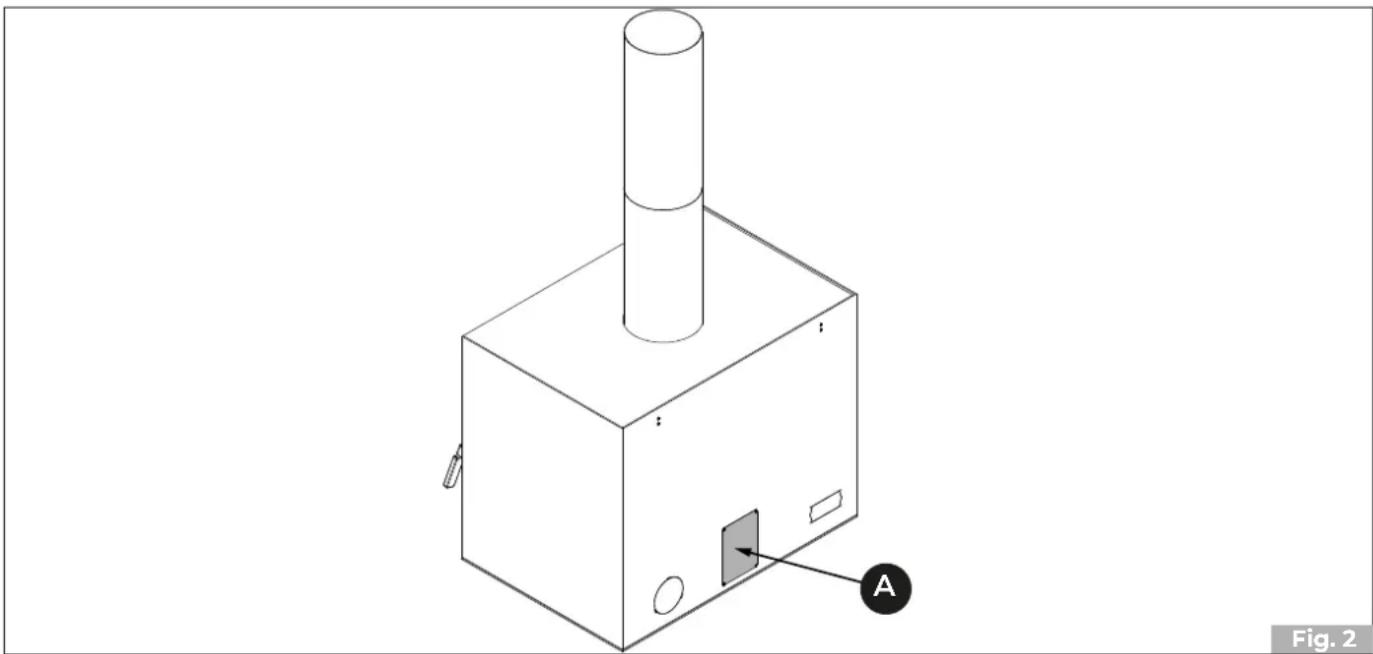
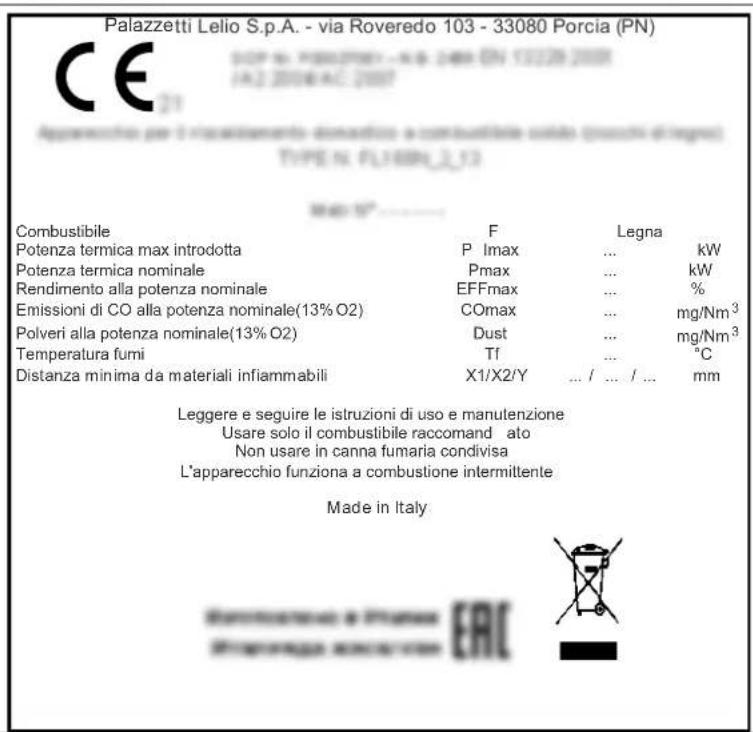
The serial identification plate (A) is positioned on the rear (Fig. 2) and shows all the characteristic data relating to the appliance, including details of the Manufacturer, the Serial number and brand C
The Serial number must always be indicated for any type of request regarding the appliance.
1.12 Delivery of the appliance
The appliance is delivered perfectly packaged and fixed to a wooden platform which allows handling it using fork lift trucks and/or other means.

The following material accompanies the appliance:
- installation and maintenance manual;
Product booklet - bar code label
- cold handle.

Where supplied, the flue section can be replaced with another having the same diameter and equal or greater length.
2 SAFETY WARNING
2.1Warnings for the installer
Observe the prescriptions contained in this manual.

The instructions for assembly and disassembly of the appliance are reserved for specialist technicians only.
Installation, use and maintenance of the product must be in accordance with the manufacturer's instructions and in compliance with the regulations. Failure to comply with the instructions and any incorrect operations may give rise to hazardous situations, damage to property, animals, health problems or malfunctioning.
Installation, functional testing and maintenance should only be carried out by authorised, qualified personnel.
The cladding must be made in such a way that the user cannot gain access to hazardous parts.
Installation and maintenance of the product must be carried out exclusively by qualified personnel with familiarity of the product itself. Use only original spare parts recommended by the manufacturer.
Responsibility for the works carried out in the space of the appliance location is, and remains, the responsibility of the user; the latter is also responsible for carrying out checks regarding the proposed installation solutions.
The installer must comply with all local, national and European safety regulations.
The appliance must be installed on floors with adequate load bearing capacity.

Check that the chimney flue and air inlet set-ups conform to the type of installation.
Before assembly or disassembly of the appliance, the installer must observe the safety precautions required by law and the following instructions in particular:
- do not operate in adverse conditions;
-
they must operate in perfect psychophysical conditions and must check that the personal protective equipment is intact and functioning perfectly;
-
they must wear gloves and safety shoes;
- they must use tools with electrical insulation;
- they must make sure that the area used during assembly/dismantling is free from obstacles.
The product must only be installed in rooms that are not subject to fire hazards and must be equipped with all the necessary facilities including air supplies and flue gas exhausts.
Evaluate the static conditions of the surface bearing the weight of the product and provide suitable insulation if it is composed of flammable materials (e.g. wood, carpet, plastic).
Warnings for technical maintenance personnel
Maintenance operations must be carried out only by authorised and qualified personnel.
Observe the prescriptions contained in this manual.
Always use personal protective equipment and other means of protection.
Before starting any maintenance work ensure that the appliance, if it has been used, has cooled down.
Even if only one of the safety devices is not working, the appliance is to be considered not working.
Warnings for the user
The appliance may only be put into operation when installation is complete and cladding is in place.
To use the product in the correct manner and prevent accidents from occurring, follow the instructions in this manual.
The appliance has particularly hot external surfaces (door, handle, glass, flue gas outlet pipes, etc.). Contact with these parts must therefore be avoided unless wearing suitable protective clothing or equipment, such as heat resistant gloves or in the presence of "cold handle" operating systems.
For this reason, maximum caution is recommended during operation and in particular:

Do not touch and do not get close to the glass of the firebox door, it may cause burns, do not stare at the flame for a long time.

Do not hang laundry directly over the appliance for drying: fire hazard.

- do not touch the flue gas outlet;
- do not perform any type of cleaning;
- do not remove the ashes;
- do not open the ash drawer (where provided).
The appliance cannot be used by children under the age of 8 and by people with reduced physical, sensory or mental abilities, or without experience or the necessary knowledge, unless they are under supervision or after they have received instructions relating to the safe use of the appliance and to understanding the inherent dangers. Children should not play with the appliance. Cleaning for which the user is responsible must not be carried out by unsupervised children.
Before performing any type of operation, the user or whoever is operating the product must have read and fully understood the contents of this installation and use manual. Errors or bad settings may cause hazardous conditions and/or irregular operation.
Non-specialised user must be protected from the access to any party that may expose them to dangers. They must, therefore, not be permitted to work on internal parts that pose a hazard.
Respect the instructions and warnings highlighted on the sign plates displayed on the appliance.
The sign plates are accident prevention devices, therefore they must always be perfectly legible. If these are damaged and unreadable, it is mandatory to replace them, requesting the original spare parts from the Manufacturer.
Follow the routine and extraordinary maintenance schedule carefully.
Do not use the appliance without having first carried out daily cleaning.
Do not use the appliance in case of abnormal operation, suspicion of breakage or unusual noises.
In the event of a fault or malfunction, switch off the appliance and immediately seek the assistance of a specialist technician.
Do not throw water on the appliance during operation or to extinguish a fire.
Do not use the appliance as an anchor support of any kind.
It is prohibited to use the product as a ladder or support structure.
Do not clean the appliance until the structure and the ashes are completely cooled down.
In case of flue gas leaks in the room or deflagration detrimental to the device, turn it off, ventilate the room and immediately contact your installer/service technician.
In the event of a blaze in the flue, attempt to extinguish the blaze in the fireplace by closing all the primary air required for combustion and subsequently stifling the flame, closing the combustion air through the combustion air register. Then call the competent authorities.
In case of malfunction of the appliance due to a poor flue draught, clean the flue in accordance with the procedure described in section "9.3.2 Maintenance of the smoke system"
Do not touch the painted parts during operation to avoid damage to the paintwork.
All responsibility for improper use of the product is fully borne by the user, who relieves the manufacturer of any civil and criminal liability.

It is prohibited to operate the appliance with the door open.
It is prohibited to use the appliance if the door glass or gaskets are damaged.
Any type of unauthorised handling or replacement with non-original spare parts shall place the safety of the operator at risk and relieve the manufacturer of any civil and criminal liability.
Before each ignition be sure to have correctly cleaned the ash drawer.
Do not wash the product with water.
Do not sit/stand in front of the product in operation for long periods.
Incorrect use of the product or incorrect maintenance works may create a serious risk of explosion in the combustion chamber.
Only use the fuel recommended by the manufacturer. The product must never be used as an incinerator.
It is prohibited to use benzene, lamp fuel, kerosene, liquid firelighter for wood, ethyl alcohol or similar liquids to light or rekindle a flame in this appliance. Keep these liquids at a due distance from the appliance during operation.
Some tips to avoid corrosion phenomena:
- carry out routine cleaning operations to avoid the build-up of ash deposits;
- Power the appliance only with fuel having the characteristics listed under "Fuel characteristics";
- Do not use solvents, acids, aggressive detergents or products to directly clean the glass or other components of the product;
- avoid leaving the product in unfavourable ambient conditions (humidity, airborne salinity, storms, etc.);
- if the appliance is not used for a long time (e.g. summer period), introduce desiccant bags into the combustion chamber to absorb moisture from the air, being sure to remove them when the product is switched on again.
3 FUEL CHARACTERISTICS
3.1 Fuel characteristics
The appliance should preferably be fuelled with well seasoned beech/birch wood. Each type of wood has different characteristics that also affect the combustion efficiency.

The use of conifers (pine-fir) is discouraged: they contain high quantities of resinous substances that quickly clog the flue.

Waste, bark, wood treated with paints, panels, coal, plastic materials, paper and cardboard cannot be burned, under penalty of forfeiture of the appliance warranty.

The continuous and prolonged use of wood particularly rich in aromatic oils (e.g. eucalyptus, myrtle, etc.) causes sudden deterioration of the internal components of the product.
The nominal yield declared in kW of the stove, is obtained by burning a correct quantity of wood, being careful not to overload the combustion chamber.
The wood must have a recommended humidity no higher than 25% , an ideal length of approximately 33 cm and must be placed in a horizontal position, making sure not to completely obstruct the slots in the fire box grate and the front and rear holes of the combustion air distributor.
The reference standard for the fuel is UNI/ISO 17225-1 "wood logs of forest origin".

It is prohibited to use the appliance as an incinerator to burn rubbish.
4 BECOMING FAMILIAR WITH THE PRODUCT
4.1 Serial plate
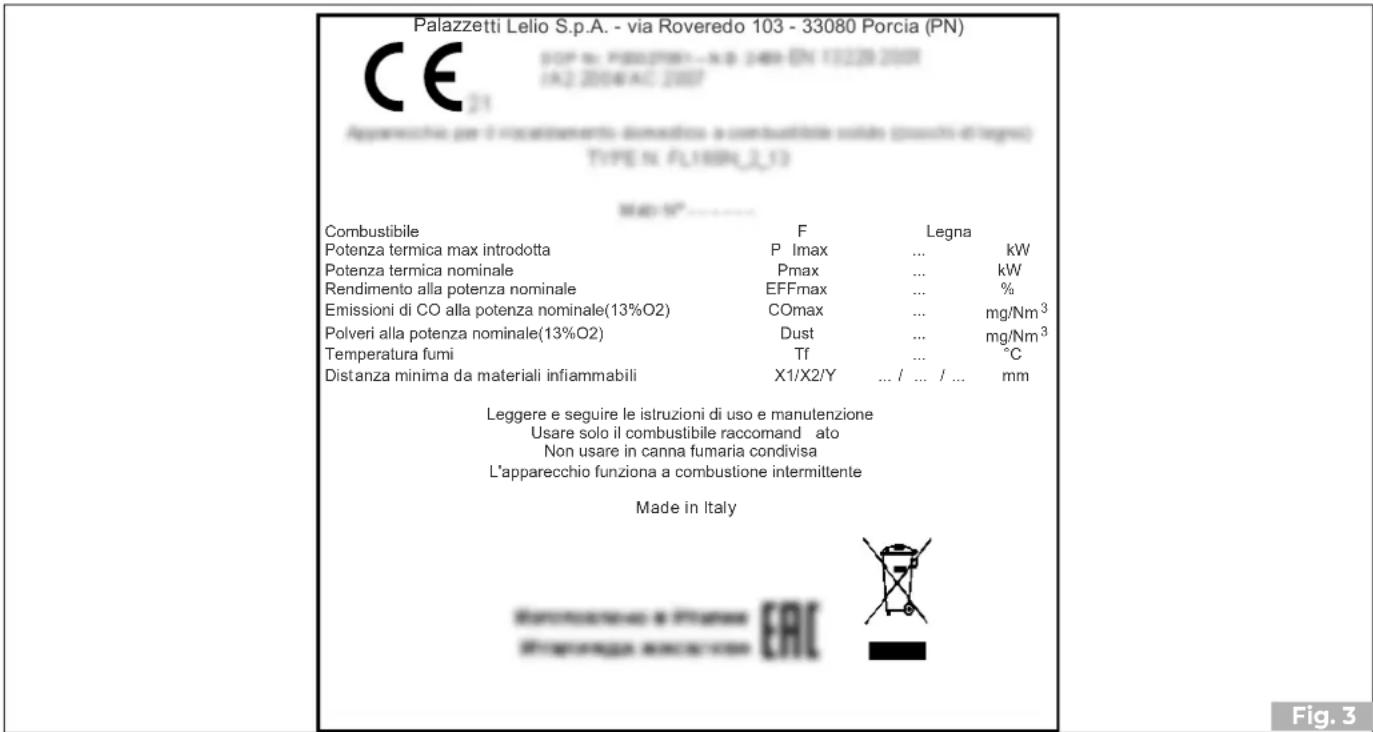
| F | Fuel |
| Plmax | Max. thermal power input |
| Pmax | Rated ambient thermal power |
| EFFmax | Efficiency at rated power |
| COmax (13% O2) | CO emissions at rated power (13% O2) |
| Dust | Dust |
| Tf | Flue gas temperature |
| x1/x2/y | Minimum distance from flammable materials |
5 HANDLING AND TRANSPORTATION
The appliance is delivered complete with all the required parts: metal structure and internal combustion chamber lining installed. These parts are contained in a packaging suitable for long distance transportation. It is advisable to unpack the appliance only when it has arrived at the installation site.

The product must be handled and unpacked using suitable means.
Make sure that children do not play with the packaging components (e.g. films and polystyrene):

Danger of suffocation!
During moving, lifting, and unpacking of the appliance the following is absolutely necessary:
- always keep it upright;
- never tip it over into a horizontal position;
- Removal of the transport pallet
Disposal can be entrusted to a third party, provided only companies authorised for the recovery and elimination of the materials in question are used.
Always follow the regulations in force in the country in which the appliance is being used for disposal of materials and possibly for the disposal report.
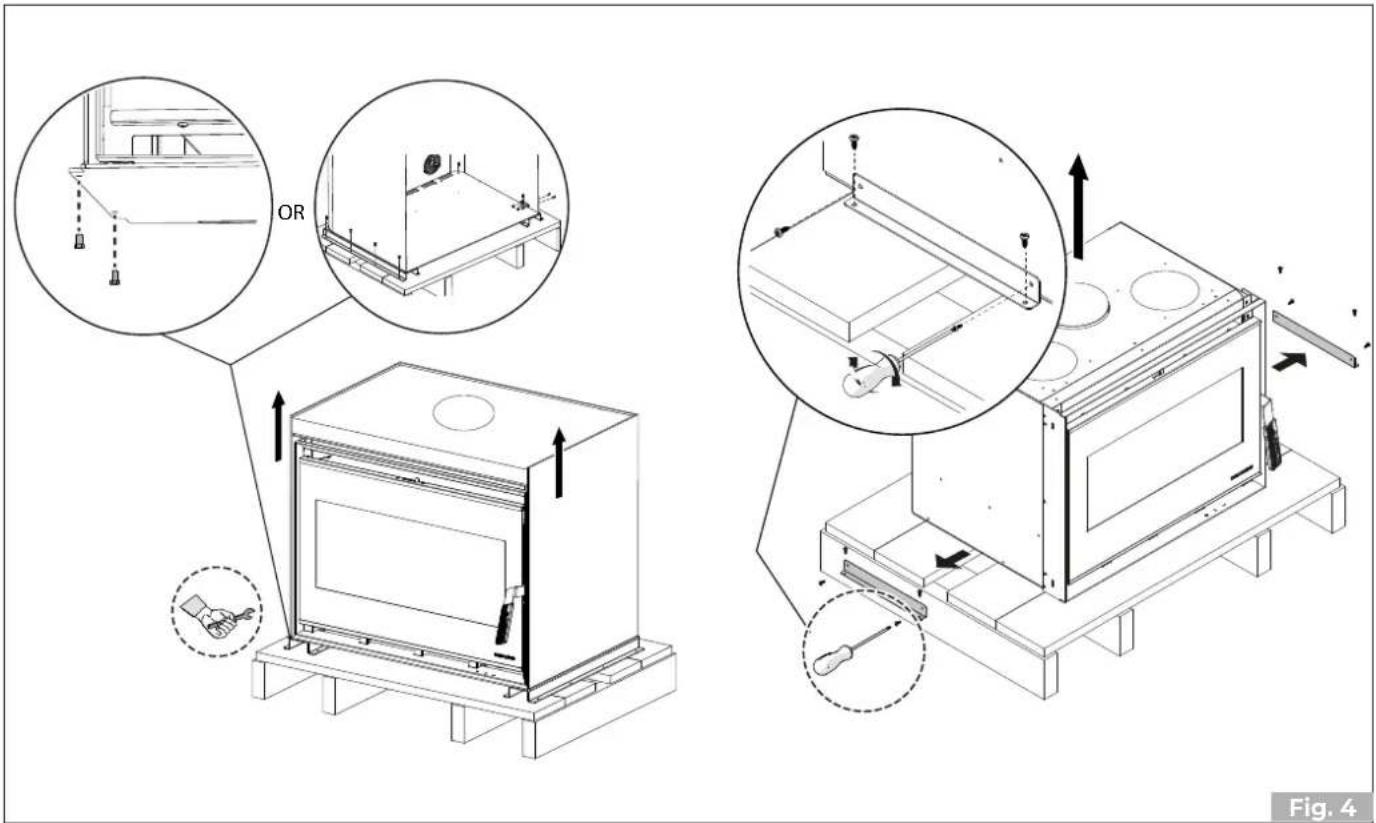
To remove the appliance from the transport pallet:
- Unscrew the fixing screws.
- Remove the fixing brackets.
- Lift the appliance.
- Remove the transport pallet.
5.1 Transportation

Make sure that the lifting carriage has a payload higher than the weight of the appliance to be lifted. The full responsibility of the lifting of loads lies with the person handling the lifting equipment.

Ensure wood or timber floors are properly protected in order to prevent the weight of the appliance from damaging them during movement.
During lifting, avoid jerking or abrupt movements.
Pay attention to overbalancing.
5.2 Checking the support surface
Check the load capacity of the floor slab.
If a floor is not suitable to support the weight of the appliance, install appropriate steel plates (A - Fig. 5) or a concrete base (A - Fig. 5) equipped with 10 × 10 × 6 arc-welded mesh (B - Fig. 5) to distribute the weight.

For the dimensions of the plates and the concrete base, use a qualified technician.
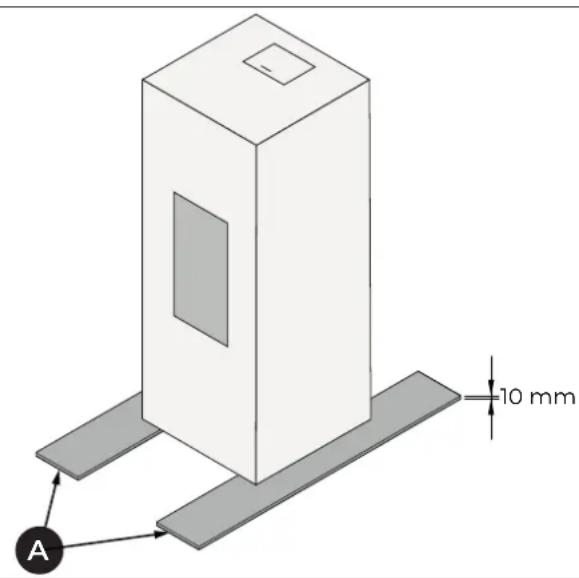
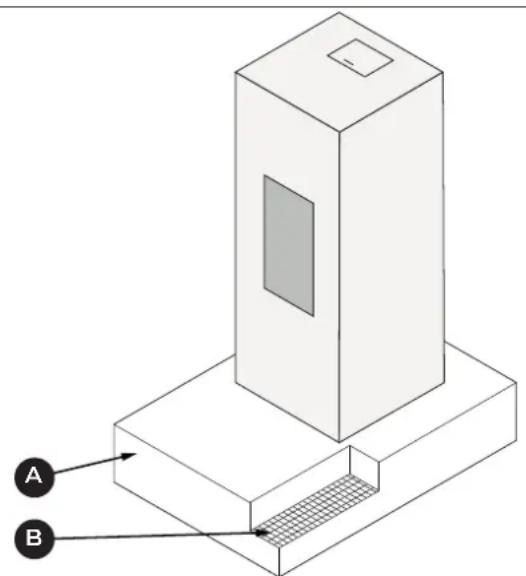
Fig. 5
6 PREPARED THE PLACE OF INSTALLATION
6.1 General considerations
The following paragraphs contain some guidelines to be followed to obtain the maximum efficiency of the product purchased and to ensure safe operation. The following indications are however subject to compliance with any possible national, regional and municipal laws and regulations in force in the country where the appliance is installed.
In Italy, installation must be performed by qualified personnel in compliance with the EN 10683 standard.
6.2 Safety Precautions
The operations for assembly and disassembly of the appliance are reserved for specialist technicians only. It is recommended to be sure of their qualifications and their actual capacity.

For Italy, these technicians must be in possession of the letter "C" qualification issued by the chamber of commerce based on the Ministerial Decree. 37/08.
6.3 Place of installation
For the minimum clearances when positioning the appliance with respect to flammable materials and objects, refer to the instructions in (Fig. 6)
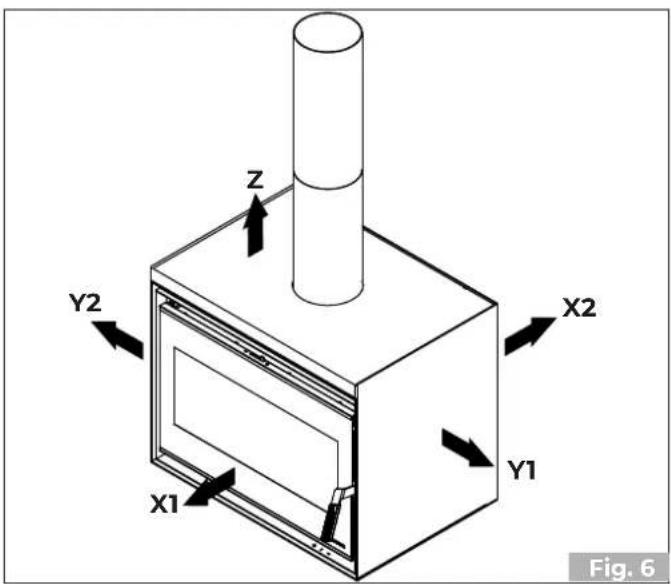
VERSION 70
| SAFETY CLEARANCE (mm) FROM FLAMMABLE MATERIALS | X1 X2 Y1 Y2 Z | ||||
| 800 | 300 | 400 | 400 | 1000 | |
VERSION 80
| SAFETY CLEARANCE (mm) FROM FLAMMABLE MATERIALS | X1 X2 | Y1 Y2 | Z | ||
| 1000 | 50 | 100 | 0 1000 | 1000 |
Floors made of flammable material such as wood, parquet, linoleum, laminate or floors covered with carpets must be protected by a fireproof base under the appliance that also protects the front during cleaning from any falling combustion residue.
The manufacturer declines all responsibility for any variations in the characteristics of the material constituting the floor under the protection.

Set up an accessible technical space for any maintenance work.
Remember to respect the minimum distance from flammable materials (X), shown on the identification plate of the pipes used to make the chimney (Fig. 7).
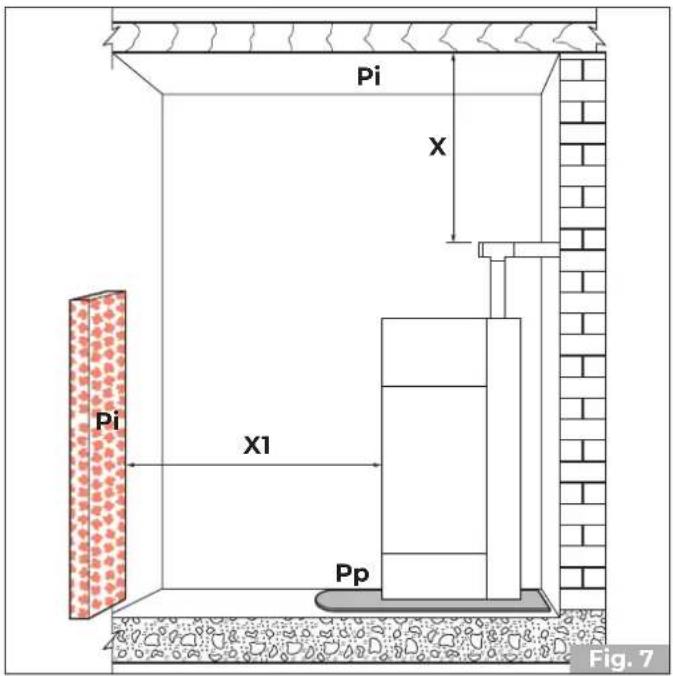
Pi = Flammable wall
Pp = Floor protection
6.4 Combustion air
The appliance, during its operation, requires combustion air.
The inflow of combustion air can be obtained in the following ways:
- it can come directly from outside with direct connection to the combustion chamber (Fig. 8).
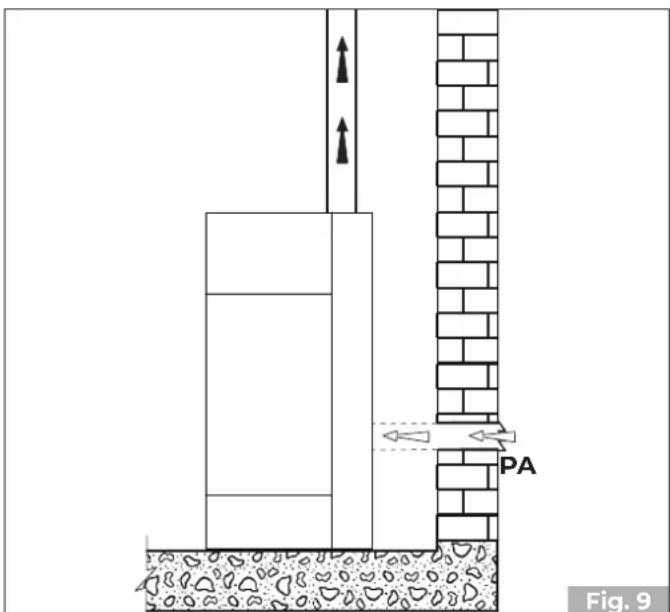
- it can come from the installation room or from suitable adjacent rooms (Fig. 9)
Intake of combustion air from outside
In this case, a possible alternative may be:
- connect the combustion air inlet of the appliance to the air intake using a special pipe (Fig. 8).
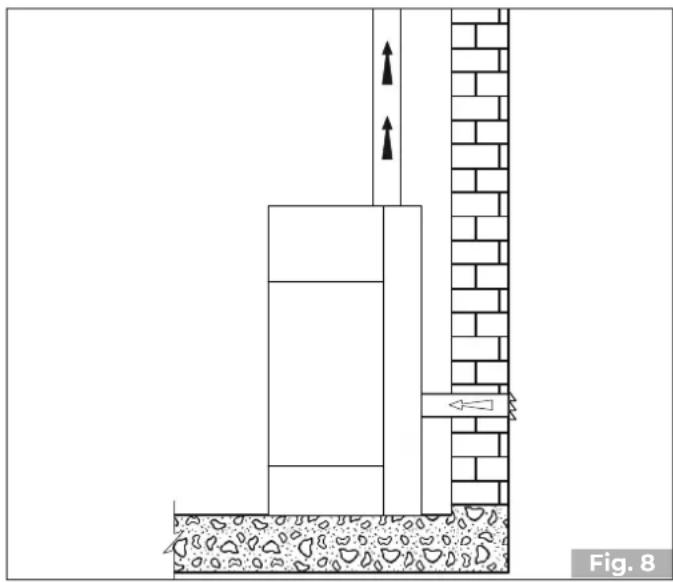
Intake of combustion air from the room
Create the air intake on the wall (Fig. 9 - PA = Air Intake), and leave the appliance to withdraw the room air, making sure to connect the section of corrugated pipe on the air inlet pipe, if supplied, fixing it with the strap and folding it slightly downwards to prevent any resonance effects.
If the rear wall of the appliance is an external wall, make a hole for the intake of combustion air at a height of about 20 - 30cm from the ground, observing the dimensions on the technical data sheet in section "Caratteristiche tecniche".
A non-closable permanent aeration grid must be placed externally; in areas that are particularly windy and exposed to weathering, provide rain and wind protection.
Make sure the air intake is positioned so that it is not accidentally obstructed.
If it is impossible to create an external air intake in the wall behind the appliance (non-perimeter wall), a hole must be made in an external wall of the room where the appliance is positioned.
If it is not possible to create the external air intake in the room, an external hole can be created in an adjacent room provided it communicates permanen
It is forbidden to take combustion air from garages, warehouses of combustible material or places with activities at risk of fire.

If there are other heating or extraction appliances in the installation room, combustion malfunctions may occur due to a lack of combustion air.
The combustion air intakes must therefore be sized correctly, in order to ensure the necessary supply of air for the correct operation of all devices.
6.5 Flue gas fitting
The appliance works with the combustion chamber at negative pressure. It is therefore essential to make sure that the flue gas evacuation is airtight (this is the responsibility of the installer).
The appliance must be connected to its own flue gas duct, not shared, and which is suitable for ensuring adequate dispersion of the combustion products into the atmosphere, in accordance with the regulations in force in the country of installation.

The components making up the flue gas ducting system must be declared suitable for the specific operating conditions and provided with CE marking.

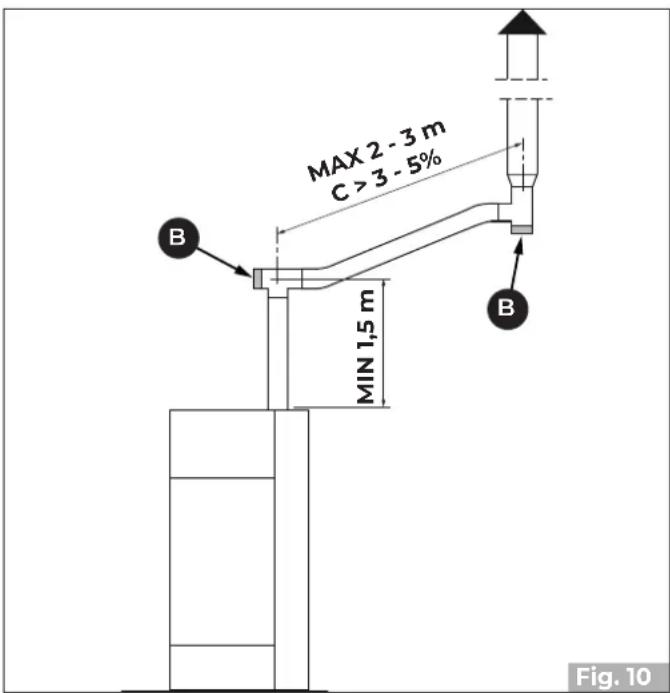
It is mandatory to create a first vertical section measuring at least 1.5 meters to guarantee correct expulsion of the flue gases.
It is advisable to make a maximum of 3 direction changes, in addition to that resulting from the rear connection of the appliance to the chimney, using 45 - 90^ bends or Tee fittings.
Always use a Tee fitting with inspection cap at each horizontal and vertical change of the flue gas route (Fig. 10).
The horizontal sections must have a maximum length of 2-3 m with an upward slope of 3 - 5% (Fig.10).
Anchor the pipes with suitable collars to the wall.
The flue gas fitting MUST NOT BE connected:
- to a chimney used by other generators (boilers, stoves, fireplaces, etc. ...);
- to air extraction systems (hoods, vents etc. ...) even if "ducted".
It is forbidden to install shut-off and draught valves.
6.6 Roof exhaust with traditional fireplace
The chimney for the evacuation of flue gases must be made by qualified personnel in compliance with standards UNI 10683- EN 1856-1-2- EN 1857-EN 1443- EN 13384-1-3- EN 12391-1 both in terms of the dimensions and the materials used in its construction.
The flue gases can be evacuated through a traditional chimney ("Fig. 11" - "Fig. 12") provided the good condition and proper maintenance of the chimney has been verified. In the case of an old chimney, it is advisable to renew it using ducting.
The flue gas exhaust must be on the roof.
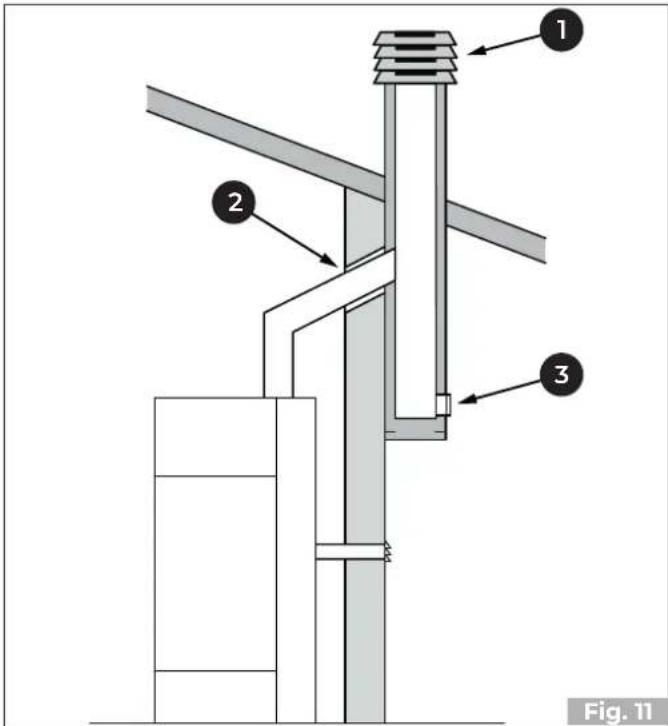
Fig.11
1) Wind-proof cowl
2) Seal
3) Inspect

If the chimney has a larger section, it must be "ducted" with a suitably insulated steel pipe (with diameter suitable for the route)
Make sure that the connection to the brickwork chimney is properly sealed.

In case of pipes that pass through wooden roofs or walls, it is recommended to use special certified ducting kits commonly available on the market.
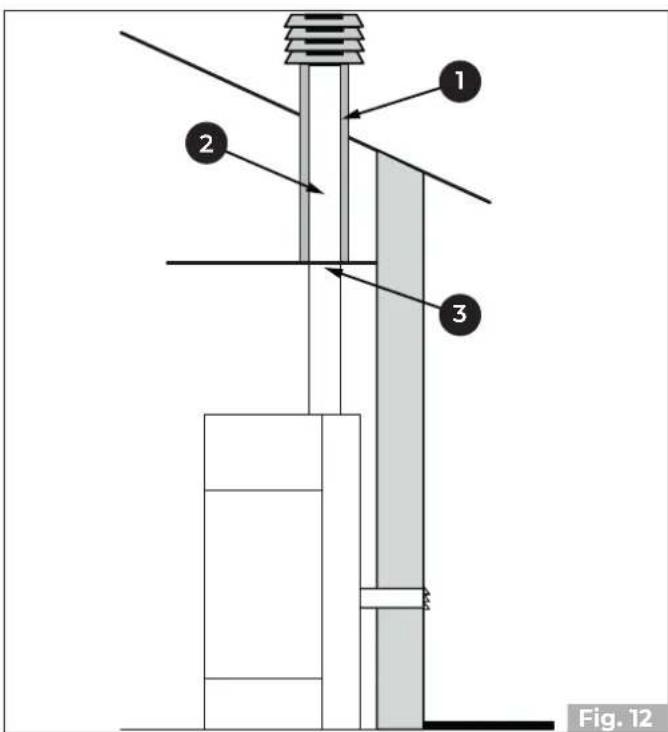
Fig.12
1) Non-combustible material
2) Steel piping
3) Closing panel
7 COMMISSIONING
7.1 First ignition

The first ignition must be carried out by the installer.

Before commissioning, remove the stickers and packaging inside the fire box and the external stickers applied to the glass.
The first ignition is a fundamental operation, used to test the product at full operation, and to gradually evaporate the water used in the construction mixtures, which will make it resistant and long-lasting.

First lighting must be carried out with reduced loads (approximately 1kg / h ), keeping the appliance on for at least 4 hours at low speeds. Proceed with these feed rates for at least three days before using the appliance at its full capacity. This will allow for the evaporation of any moisture accumulated in the refractory elements when not used.

During the first ignition of the product, unpleasant odours or fumes may be generated due to the evaporation or drying of certain materials used, and water may seep from the grout. This phenomenon will gradually disappear.
For this reason during the first lighting it is recommended to maintain the premises well airy.
7.2 Combustion
The wood-fired appliance has been designed for intermittent combustion. This means the product will need to be periodically loaded within a time period that guarantees the complete burning of the previous load until nothing is left but burning embers.
7.3 Adjusting the bypass valve
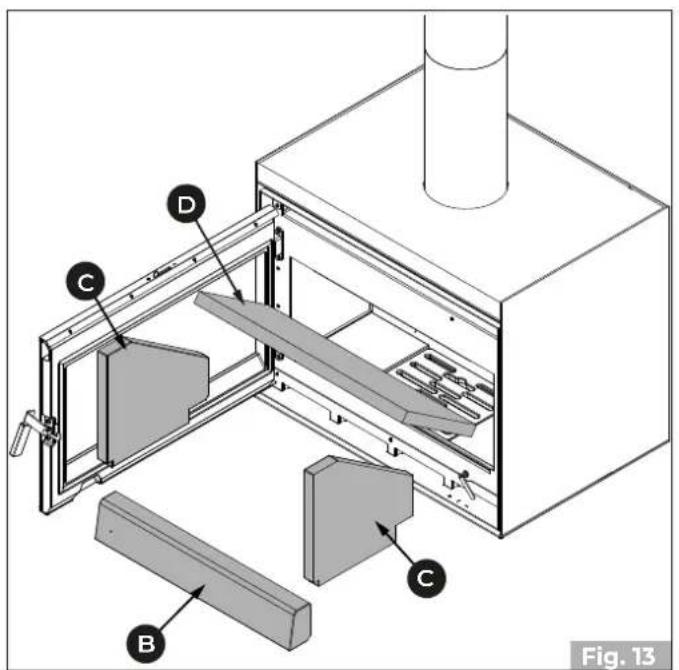
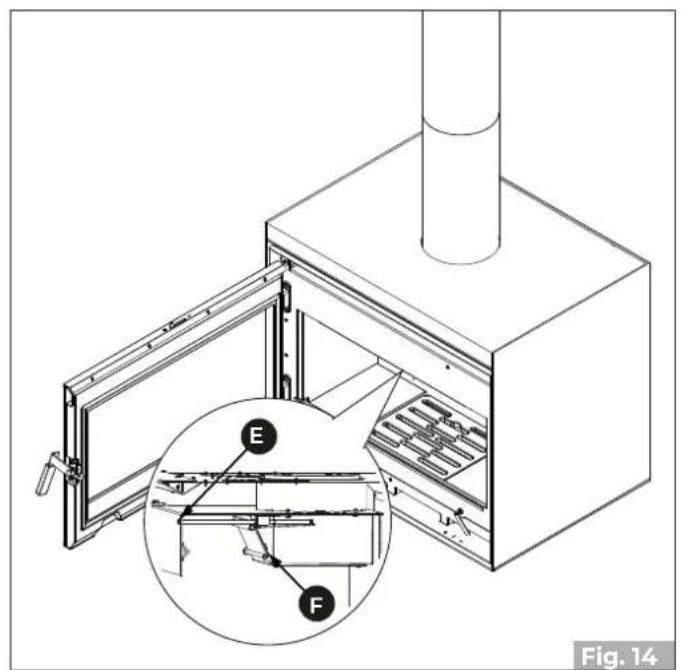
The appliance is supplied with the bypass valve (F) already regulated against the box ("Fig. 14"). If the adjustment is not adequate, recalibrate the valve in order to obtain good combustion.
Proceed as follows:
- Remove in sequence the back wall (B), the side walls (C) and the upper baffle (D) ("Fig. 13").
- Loosen the screw (E) in order to place the bypass valve (F) against the box ("Fig. 14").
8 OPERATION

When handling hot parts (e.g. door) use the supplied glove.
8.1 Power on
- Open the door using the cold handle, inserting it into the appropriate slot and turning it upwards.
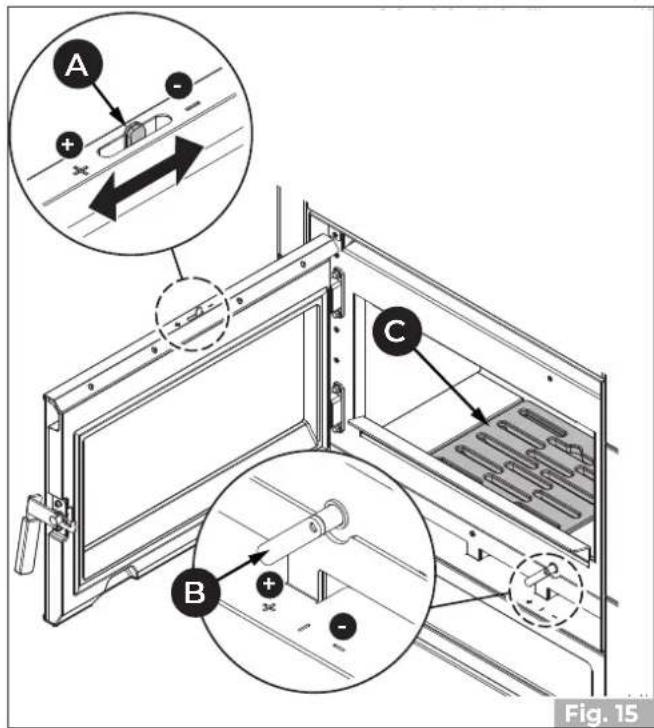
- Open the primary air (A) and glass cleaning (B) regulator to the maximum (+) (Fig. 15).
- Carefully place the pieces of wood in fire box grate (C) (Fig. 15).
- Place a natural fire-igniter on the pile of wood.
- Add small pieces of wood on top of the stack in a crossed over-type pattern.
Light the fire-igniter from above. - Close the fire door and make sure it is firmly closed.
- Keep the combustion air (B) and glass cleaning (A) regulator open (+) to ensure a high and bright flame.
- Reduce the opening of the air intake and of glass cleaning (-) only when a good amount of embers has formed.
8.2 Adding fuel
During operation, to add fuel, it is necessary to follow this procedure:
-
Open the fire door slowly in order to avoid smoke escaping into the room (depending on the draught in the flue).
-
Refill the fire box with fuel and then close the fire door.
Do not overheat the product by inserting an excess quantity of fuel.
Introduce fuel when the embers have formed and the flame has lowered.
The appliance is equipped with a bypass valve, which, when opened, facilitates the escape of smoke into the flue, minimising puffs of smoke into the environment.
8.3 Operation
Combustion control
Combustion is adjusted using the air regulator (A) (Fig. 15). Turning it toward the symbols (+) or (-) a higher or lower flow of combustion air will be obtained and consequently a faster or slower combustion will result.
Glass cleaning
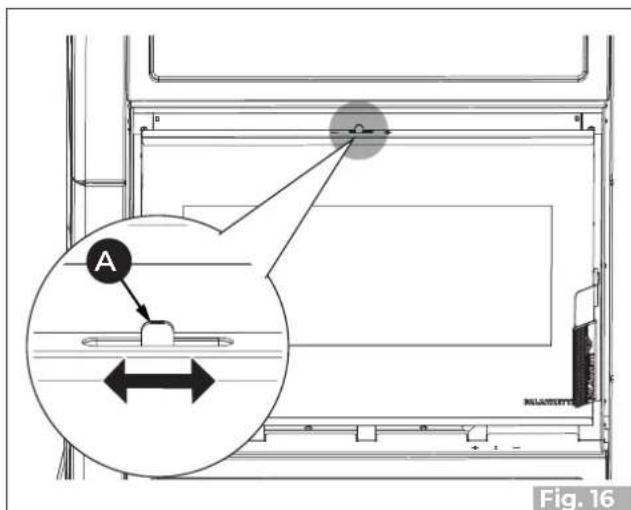
During operation, it is possible to facilitate the cleaning of the ceramic glass by means of the adjustment lever (A) (Fig. 16) without having to open the door.
If the lever is opened completely (+) a flow of air hits the ceramic glass surface, cleaning it. Use a glove to perform this operation.
9 CLEANING AND MAINTENANCE
Cleaning can be carried out by the user.
Maintenance operations must be performed by an authorised technical assistance centre.
Before carrying out any cleaning and/or maintenance operations, take the following precautions:
- Make sure that all parts of the appliance are cold.
- Make sure that the ashes are completely extinguished.
- Use personal protective equipment provided for by Directive 89/391/EEC.
- Ensure that the main power switch is switched off (if present).
- Make sure that the power supply cannot be accidentally reactivated. Disconnect the plug from the wall socket (if present).
- Always use appropriate equipment for maintenance.
- Once maintenance or repair operations have been completed, before putting the appliance back into service, reinstall all the safety guards and reactivate all the safety devices.
9.1 Routine maintenance cleaning schedule
9.1.1 Routine cleaning (User)
| EVERY TIME THE APPLIANCE IS TURNED ON | EVERY WEEKLY MONTH | |
| Grate ("Fig. 17") X | ||
| Ash drawer / compartment ("Fig. 17") X | ||
| Glass ("Fig. 19") X |
9.1.2 Ordinary maintenance (certified technical service centre)
| 1 YEAR (*) | |
| Gaskets (door, refractory cements, etc...) | X |
| Flue manifold | X |
| Flue system (refer to section “9.3.2 Maintenance of the smoke system” | X |
| Appliance (refer to section “9.3.3 Appliance maintenance” | X |
(*) At least once a year or every 4000kg of fuel burned.
9.2 Ordinary cleaning
9.2.1 Cleaning the fire box
Daily, or before each ignition, it is necessary to make sure that there are no combustion residues on the fire box grate, as they may obstruct the free passage of combustion air.
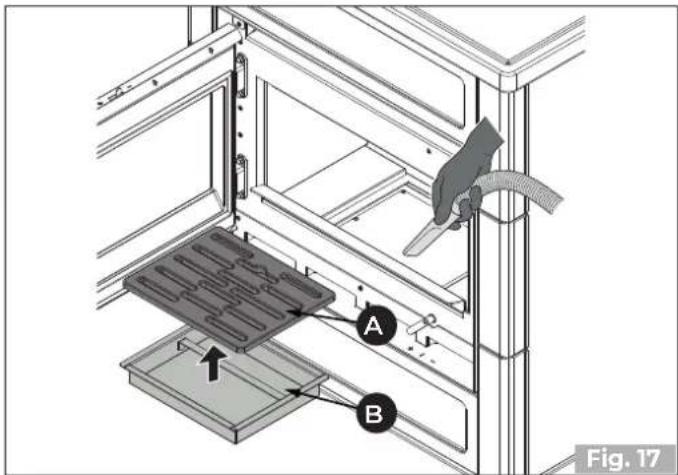
1) Carefully clean the grate (A) (Fig. 17). Remove it and clean the fire box using a hand brush (not supplied) brushing the combustion residues into the ash drawer.

Place the grate carefully on a suitable support surface.

The images in the following sections are purely indicative.

Remove the ash from the combustion chamber as the salts present cause corrosion of the metal. In addition, the ash could block the passage of air, varying the development of the flame which, if it approaches the glass, would increase corrosion.
2) Extract the ash drawer (B) from the base and vacuum out any ash deposited in the compartments below (Fig. 17).

The ash drawer below the fire box must be emptied out every day to stop it from filling up with ash, thus causing the cast iron grate of the fire box to overheat and preventing the flow of air to the fire box.
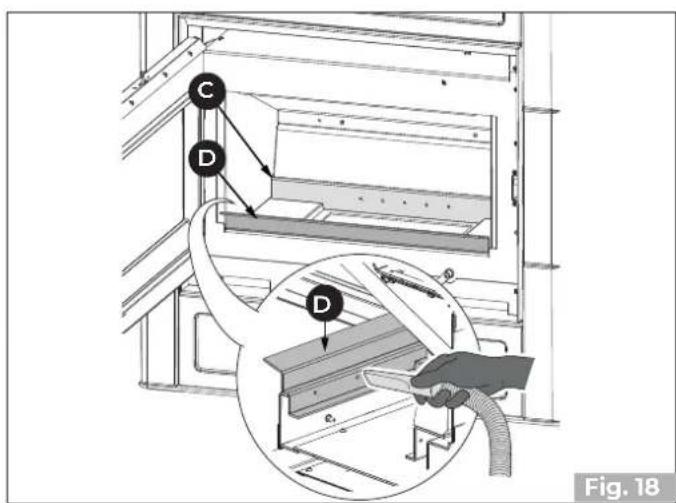
3) Vacuum the rear (C) and front holes (D - if any) of the combustion air distributor in order to prevent ash from accumulating (Fig. 18).

The refractory bricks undergo expansion deformations during the operation of the appliance, due to the high temperatures reached. For this reason the slots open between one piece and another of the refractory bricks should be considered normal. During combustion these slots are filled from the ashes which absorb the expansions of the refractory bricks.
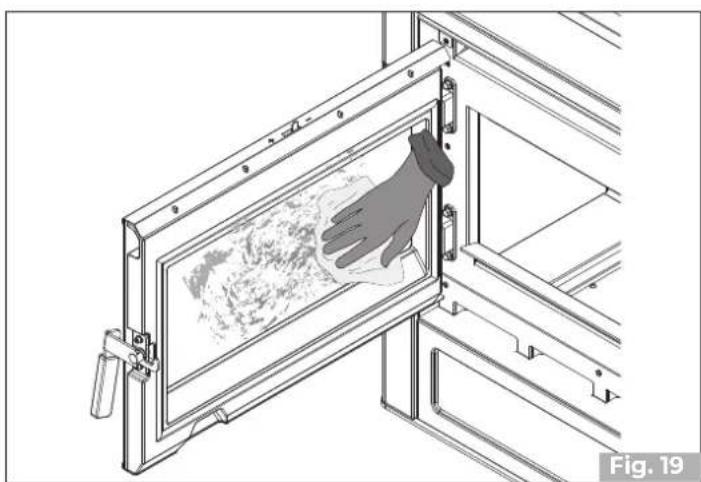
9.2.2 Cleaning the glass
It is carried out with a damp cloth or with dampened paper that is wiped over the ash.
Rub until the glass is clean.
Do not clean the glass while the appliance is operating and do not use abrasive sponges.

Do not use solvents, acids or detergents, liquid detergents or aggressive products.
9.3 Routine maintenance
9.3.1 Maintenance of flue manifold
Open the door, Lift the deflector (D) and remove the post-combustion plate (A) (Fig. 13). Remove, in this order, the back wall (B), the side walls (C) and the upper deflector (D) ("Fig. 14") (section "Adjusting the bypass valve").
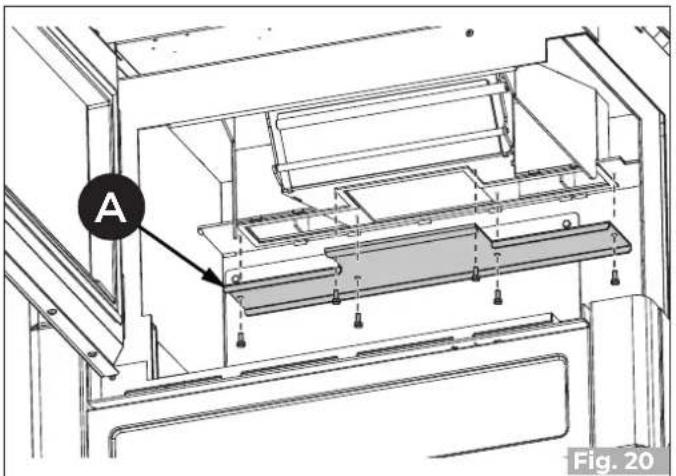
Remove the flue manifold cap (A) ("Fig. 20").
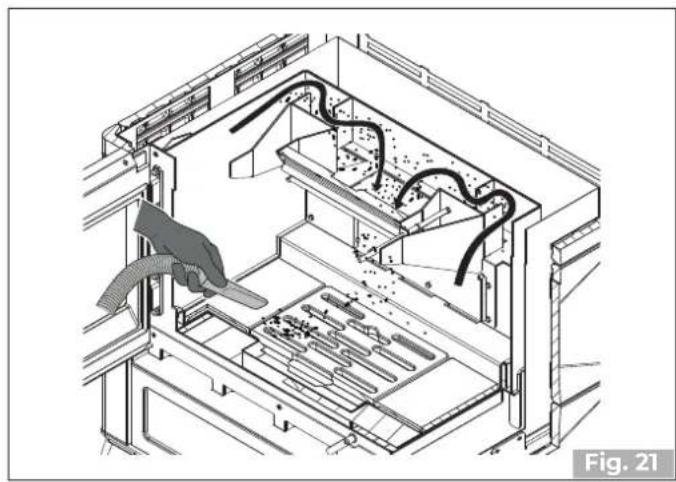
Use a flexible brush to clean the pipes in the combustion chamber ("Fig. 21").
Remove any residues that fall in the flue manifold using an ash vacuum.
9.3.2 Maintenance of the smoke system
To be carried out at least once a year, or every 4000kg of fuel burned (as specified in the product standard), by contacting specialist personnel
If there are horizontal sections, it is necessary to check and remove any deposits of ash and soot before they obstruct the passage of fumes.
The incrustations inside the flue affect the optimum forced draught. When they reach a thickness of 5-6 mm, with high temperatures and sparks, they can ignite with easily imaginable consequences both for the flue and for the house.
9.3.3 Appliance maintenance
To be carried out at least once a year, or every time the appliance indicates the need for maintenance.
During the maintenance operation, the technician must:
- clean the flue gas transit area thoroughly and completely;
- check the adjustment of the bypass valve;
- check the condition and tightness of all the seals;
- check the condition of all internal components and make sure they are clean;
make sure the flue gas outlet connection is sealed and clean; - check the correct operation of the appliance.
10 DEMOLITION AND DISPOSAL

The demolition and disposal of the appliance is the sole responsibility of the owner, who must comply with the current regulations in the country where the appliance is in use for the disposal of materials and, if required, for a declaration of disposal, with regard to safety, respect and protection of the environment.
Disposal can be entrusted to a third party, provided only companies authorised for the recovery and elimination of the materials in question are used.

All dismantling for demolition must be carried out with the appliance stationary and with the power supply cut, where present.

Leaving the appliance in accessible areas is a serious danger to people and animals.
The differentiated disposal of the product makes it possible to avoid potentially negative consequences on the environment and health, and also allows recycling of the materials making up the product in order to achieve significant energy and resource savings.
Any liability for damage to people and animals always falls on the owner. Upon demolition, the EC marking, this manual and other documents relating to this appliance must be destroyed.
10.1 Disposal of electrical components
- Remove all the electrical equipment.
- Separate the accumulators on the electronics boards.
- Scrap the structure of the appliance with the assistance of authorised companies.
INFORMATION FOR THE PROPER DISPOSAL OF THE BATTERIES WITHIN THE MEANING OF THE EU DIRECTIVE 2006/66/EC
Please replace the battery when its electric charge is exhausted: at the end of its useful life this battery must not be disposed of together with unsorted waste. It must be delivered at appropriate selective collection centres for municipal waste or to resellers who provide this service. Disposing of a battery separately allows you to avoid possible adverse effects on the environment and on human health resulting from improper disposal and allows to recover and recycle the materials of which it is composed, with substantial savings on energy and resources. In order to emphasize on the obligation to dispose of separately the batteries, on the battery itself there is the crossed-out wheeled bin symbol. Abusive disposal of the product by the user involves the application of administrative sanctions provided by law.
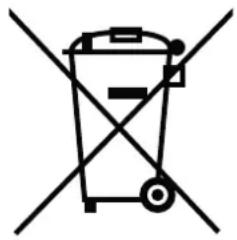

A crossed-out wheelie bin symbol on the equipment label indicates that the product must not be disposed of as unsorted waste, but should be sent to separate collection facilities for recovery and recycling.
Pursuant to art.13 of Italian Legislative Decree no. 151 of 25 July 2005 implementing Directive 2002/96/EC of 23 February 2003 on Waste Electrical and Electronic Equipment relating to the measures and procedures designed to prevent the production of waste electrical and electronic equipment, called WEEE, promoting the reuse, recycling and other forms of recovery so as to reduce the quantity to be disposed of and improving the intervention of the parties involved in the life cycle of such products.
Table des matieres
1 INTRODUCTION 49
5 MANUTENTION ET TRANSPORT 57
5.1 Transport 58
5.2 Verification du plan d'appui 58
6 PREPARATION DU LIEU D'INSTALLATION 58
5 MANUTENTION ET TRANSPORT
4 DAS PRODUKT KENNEN
4.1 Typenschild
4 DAS PRODUKT KENNEN
4.1 Typenschild
6.3 Installationsort
4 CONOCER EL PRODUCTO
4.1 Placa de la matricula
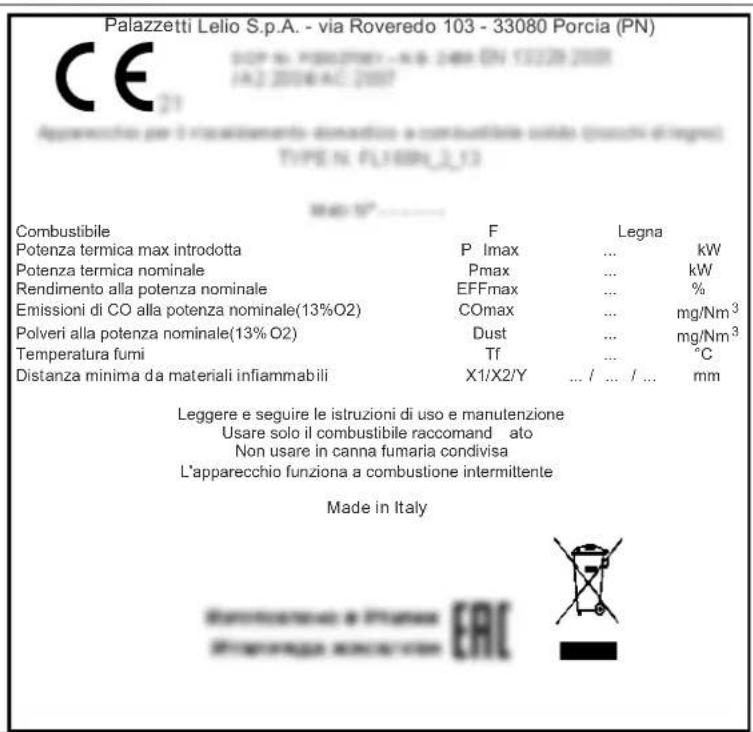
Fig.3
Palazzetti reserves the right to change its products at any time and without notice in order to improve them without compromising their essential characteristics.
- NOTICE D'INSTALLATION ET D'ENTRETIEN
- FR
- SAFETY WARNING 30
- FUEL CHARACTERISTICS 33
- BECOMING FAMILIAR WITH THE PRODUCT 34
- HANDLING AND TRANSPORTATION 35
- PREPARING THE PLACE OF INSTALLATION 36
- COMMISSIONING 41
- OPERATION 42
- CLEANING AND MAINTENANCE 43
- DEMOLITION AND DISPOSAL 46
- GENERAL INTRODUCTION
- Symbols
- Intended use
- Purpose and content of the manual
- Preservation of the manual
- Preservation and consultation
- Deterioration or loss
- Sale of the appliance
- Update of this manual
- Overview
- Information
- Maintenance
- Responsibility for the works of installation
- Compliance
- Responsibility of the manufacturer
- Technical assistance and maintenance
- Spare parts
- Serial plate
- Delivery of the appliance
- SAFETY WARNING
- 2.1Warnings for the installer
- Warnings for technical maintenance personnel
- Warnings for the user
- It is prohibited to operate the appliance with the door open.
- FUEL CHARACTERISTICS
- Fuel characteristics
- BECOMING FAMILIAR WITH THE PRODUCT
- Serial plate
- HANDLING AND TRANSPORTATION
- - Removal of the transport pallet
- Transportation
- Checking the support surface
- PREPARED THE PLACE OF INSTALLATION
- General considerations
- Safety Precautions
- Place of installation
- Combustion air
- Intake of combustion air from outside
- Intake of combustion air from the room
- Flue gas fitting
- Roof exhaust with traditional fireplace
- COMMISSIONING
- First ignition
- Combustion
- Adjusting the bypass valve
- OPERATION
- Power on
- Adding fuel
- Operation
- Combustion control
- Glass cleaning
- CLEANING AND MAINTENANCE
- Routine maintenance cleaning schedule
- Ordinary cleaning
- Cleaning the fire box
- Cleaning the glass
- Routine maintenance
- Maintenance of flue manifold
- Maintenance of the smoke system
- Appliance maintenance
- DEMOLITION AND DISPOSAL
- Disposal of electrical components
- Table des matieres
- INTRODUCTION 49
- MANUTENTION ET TRANSPORT 57
- PREPARATION DU LIEU D'INSTALLATION 58
- MANUTENTION ET TRANSPORT
- DAS PRODUKT KENNEN
- Typenschild
- Installationsort
- CONOCER EL PRODUCTO
- Placa de la matricula
Brand : Palazzetti
Model : Asia
Category : Frying Pan