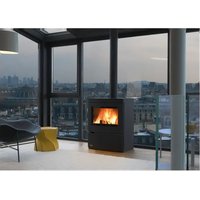
Nicole - Frying Pan Palazzetti - Free user manual and instructions
Find the device manual for free Nicole Palazzetti in PDF.


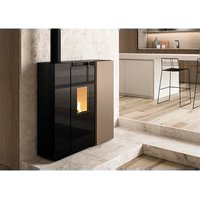
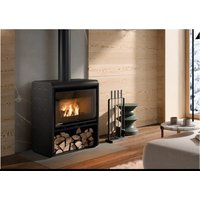
| Product type | Wood stove |
| Brand | Palazzetti |
| Model | Nicole |
| Fuel | Wood logs (beech, birch) or wood briquettes (25 or 33 cm) |
| Nominal power | 10 kW (estimate) |
| Efficiency | 78% (estimate) |
| Dimensions (H x W x D) | 110 x 55 x 55 cm (approximate) |
| Weight | 120 kg (approximate) |
| Firebox material | Steel with ceramic glass window |
| Glass type | Ceramic glass, resistant to high temperatures but fragile |
| Ignition | Manual with ecological firelighter |
| Air adjustment | Primary air control lever (left position: max, right position: min) |
| Ash drawer capacity | Large capacity (estimate 5-7 litres) |
| Safety distance | 80 cm from flammable materials (glass sides) |
| Flue connection diameter | 150 mm (typical) |
| Required draft | 12 Pa (door closed) |
| Standards complied with | EN 13240, EcoDesign Directive 2009/125/EC, EU Regulation 2015/1185 |
| Warranty | Legal warranty (directive 1999/44/EC) subject to compliance with instructions |
| Routine maintenance | Glass cleaning (ash), emptying ash pan, chimney sweeping (every 40 kg of wood or once a year) |
| Spare parts | Use exclusively original Palazzetti parts |
| Air supply | External air intake mandatory (insect screen) |
| Usage | Residential heating, closed fireplace, do not use with door open |
Frequently Asked Questions - Nicole Palazzetti
User questions about Nicole Palazzetti
0 question about this device. Answer the ones you know or ask your own.
Ask a new question about this device
Download the instructions for your Frying Pan in PDF format for free! Find your manual Nicole - Palazzetti and take your electronic device back in hand. On this page are published all the documents necessary for the use of your device. Nicole by Palazzetti.
USER MANUAL Nicole Palazzetti
7.3 ACCENSIONE DEL FUOCO:
natural_image
Technical line drawing of a laboratory oven with labeled components (A, B, C), showing internal structure and ductwork (no text or symbols beyond labels)-7.2-
-8.2-
3 HANDLING AND TRANSPORT
4 FUEL CHARACTERISTICS
5 PREPARING THE PLACE OF INSTALLATION
5.1 SAFETY PRECAUTIONS
6 INSTALLATION
6.1 PREMISE
6.2 HEIGHT ADJUSTMENT
6.3 SMOKE EXHAUST SYSTEM
6.4 CONNECTION TO FLUE PIPE
6.5 AIR INTAKE CONNECTION
7 COMMISSIONING AND USING THE STOVE
7.1 DESCRIPTION OF THE PRODUCT
7.2 LIGHTING THE FIREPLACE FOR THE FIRST TIME
7.3 FIRE LIGHTING:
7.4 KEEPING THE FIRE
7.5 CONTROLLINGCOMBUSTION
7.6 DOOR OPENING
8 MAINTENANCE AND CLEANING
8.1 SAFETY PRECAUTIONS
8.2 CLEANING THE GLASS
8.3 CLEANING THE FIRE BOX AND ASH BOX
8.4 CLEANING THE FLUE PIPE
9 DECOMMISSIONING AND DISPOSAL
1 GENERAL
Do not start using the stove until you have read and understood the contents of this manual. If you have any doubts at any time do not hesitate to call the PALAZZETTI specialized personnel who are there to help you.
Palazzetti reserves the right to modify the technical and/or functional specifications and features at any time without prior notice.
1.1 SYMBOLS
The important points in this manual are highlighted with the following symbols:
INDICATION: Indications concerning the correct use of the stove and the responsibilities of those using.
ATTENTION: A particularly important note is written here.
DANGER: Here you are warned of the possibility of bodily harm or material damages.
1.2 INTENDEDUSE
The Palazzetti device is a stove fuelled with wood logs for eater residential heating with firebox closed by ceramic glass.
The stove operates at its best when the firebox door is shut.
The intended use described above and configurations of the appliance described herein are the only ones allowed by the manufacturer: never use the stove in a way not described in the instructions provided.
The intended use described only applies to appliances that are structurally sound and installed correctly. The Palazzetti stove must only be installed and used inside the home.
1.3 PURPOSE AND CONTENTS OF THE MANUAL
Purpose
The purpose of the manual is to allow the user to take the necessary precautions and to have all the human and material means required for its correct, safe and lasting use.
Contents
This manual contains all the information necessary for installation, use and maintenance of the stove.
By complying scrupulously with the contents of this manual you will ensure a high degree of safety and productivity of the stove.
1.4 KEEPING THE MANUAL
keeping and consulting the manual
The manual must be kept in a safe, dry place and be available at all times for consultation by the user and by those who see to its installation and maintenance.
The instructions for use and maintenance manual is an integral part of the stove.
Deterioration or loss
If needed, ask Palazzetti for another copy of the manual.
Selling the stove
If the stove is sold the user must give the manual to the
new owner as well.
1.5 MANUAL UPDATE
This manual reflects the state-of-the-art at the time the product was put on the market.
The products already on the market, together with their technical documentation, will not be considered by PALAZZETTI as wanting or inadequate simply because changes or adjustments have been made or new technologies have been applied to the next generation of products.
1.6 GENERAL INFORMATION
Information
If needing to provide information to the stove manufacturer, always refer to the product serial number marked underneath the barcode on the labels provided with this manual.
Liabilities
Upon delivery of this manual Palazzetti declines all liabilities, both civil and penal, for any accidents that may derive from the total or partial failure to comply with the specifications contained in it.
Palazzetti also declines all liabilities resulting from an improper use of the unit, incorrect use by the user or resulting from unauthorised alterations and/or repairs, or the use of spare parts that are either not genuine or not specific for this particular model.
Maintenance
Maintenance must be carried out by personnel qualified to work on the stove model to which this manual refers.
Responsibility for installation
It is not PALAZZETTI's responsibility to carry out the works needed to install the stove. Such works are entirely up to the installer who is requested to check the flue and air intake and to check if the installation solutions proposed are feasible.
All regulations required by local, national and European laws in force in the country where the appliance is installed must be observed.
Use
Use of the stove is subject to compliance with all the safety standards established by the relevant laws in force in the place of installation besides the prescriptions contained in this manual.
The appliance is not intended for use by people (including children) with limited physical, sensorial or mental abilities, or without sufficient experience or knowledge, unless they are supervised or instructed on the use of the appliance by a person responsible for their safety.
1.7 MAINACCIDENTPREVENTION REGULATIONS TO COMPLY WITH
2009/125/EC: Eco-Design Requirements for Energy-Related Products Directive
REGULATION (EU) N. 305/2011 (CPR)
REGULATION (EU) 2015/1185 (ECODESIGN)
The following harmonised standards and/or regulations have been applied:
CPR:
- EN 13240:2006
1.8 LEGAL GUARANTEE
The user may only make use of the legal guarantee, as under the EEC directive 1999/44/CE, if he has scrupulously complied with the regulations indicated in this manual, and more specifically:
- To work always within the stove's range of use;
- Maintenance must be constant and accurate;
- Only allow people who are capable and who have been suitably trained to use the stove.
Failure to comply with the regulations contained in this manual will invalidate the guarantee immediately.
1.9 MANUFACTURER'S LIABILITY
!The manufacturer declines all civil and penal liabilities, direct or indirect, due to:
- An installation that fails to comply with the laws in force in the country and with the safety rules and regulations;
- Failure to comply with the instructions given in the manual;
• An installation by unqualified and untrained personnel; - Use that fails to conform to the safety directives;
- Alterations and repairs on the appliance not authorised by the manufacturer;
- Use of spare parts that are either not genuine or specific for this particular model of stove
- Lack of maintenance;
- Exceptional events.
1.10 USER CHARACTERISTICS
The person who uses the stove must be an adult and responsible, with all the necessary technical know-how to carry out routine maintenance of the mechanical and electrical components of the stove.

not let children near the stove to play with it when it is working.
1.11 TECHNICAL ASSISTANCE
PALAZZETTI is able to solve any technical problem concerning the use and maintenance of the appliance's whole life cycle.
The main office will help you find the nearest authorised assistance centre.
1.12 SPARE PARTS
Use genuine spare parts only.
Do not wait until the components are worn from use before changing them.
Changing a worn component before it breaks makes it easier to prevent accidents that could otherwise lead to serious injury to people or damage to things.

ry out the routine maintenance checks as explained in the "MAINTENANCE AND CLEANING" chapter.
1.13 ID PLATE
The serial number plate is placed on the rear of the stove and bears all product technical specifications including the Manufacturer's data, the Serial Number and the brand €.
The serial number must always be specified for any type of request concerning the stove.
1.14 DELIVERY OF THE STOVE
The stove is delivered perfectly packed in cardboard and fixed to a wooden pallet so it can be handled by forklifts and/or other means.

will find the following items inside the stove:
- Use, installation and maintenance manual;
- Product booklet;
- Bar code label;
- Protection glove;
- Combustion air adapter.
2 SAFETY WARNING
2.1 WARNINGS FOR THE INSTALLER
Observe the prescriptions contained in this manual.

The instructions for assembly and disassembly of the appliance are reserved for specialist technicians only.
The installation, use and maintenance of the product must be in accordance with the manufacturer's instructions and in compliance with the regulations. Failure to comply with the instructions and any incorrect operations may give rise to hazardous situations, damage to property, animals, health problems or malfunctioning.
The installation and maintenance of the product must be carried out exclusively by qualified personnel with suitable knowledge of the product itself. Use only original spare parts recommended by the manufacturer.
Responsibility for the works carried out in the location of the appliance is, and remains, with the user; the latter is also responsible for carrying out the checks relating to the proposed installation solutions.
The installer must comply with all local, national and European safety regulations.
The appliance must be installed on floors with adequate load bearing capacity.

Check that the chimney flue and air inlet set-ups conform to the type of installation.
Before starting the assembly or disassembly phases of the appliance, the installer must observe the safety precautions required by law and the following indications in particular:
- do not operate in adverse conditions;
- they must operate in perfect psychophysical conditions and must check that the personal protective equipment is intact and functioning perfectly;
• they must wear gloves and safety shoes;
• they must use tools with electrical insulation; - they must make sure that the area used during assembly/dismantling is free from obstacles.
The product must only be installed in rooms that are not at risk of fire and equipped with all the necessary services including air and electrical supplies and flue gas exhausts.
Evaluate the static conditions of the surface bearing the weight of the product and provide suitable insulation if it is composed of flammable materials (e.g. wood, carpet, plastic).
2.2 WARNINGS FOR TECHNICAL MAINTENANCE PERSONNEL
Maintenance operations must be carried out only by authorised and qualified personnel.
Observe the prescriptions contained in this manual.
Always use personal protective equipment and other means of protection.
Before starting any maintenance work ensure that the appliance, if it has been used, has cooled down.
Even if only one of the safety devices is not working, the appliance is to be considered not working.
2.3 WARNINGS FOR USERS
To ensure correct use of the product a it is important to always follow the instructions provided in this manual.
The outer surface of the appliance presents several particularly hot parts (door, handle, glass, flue gas pipes, etc.). Contact with these parts must therefore be avoided unless wearing suitable protective clothing or equipment, such as heat resistant gloves or in the presence of “cold handle” operating systems.
For this reason, maximum caution is recommended during operation and in particular:
Do not touch and do not get close to the glass of the fire box door, it could cause burns, do not look at the flame for a long time.
Do not hang laundry directly over the appliance for drying: fire hazard.
• do not touch the smoke outlet;
• do not perform any type of cleaning;
• do not remove the ashes;
The appliance cannot be used by children under the age of 8 and by people with reduced physical, sensory or mental abilities, or without experience or the necessary knowledge, unless they are under supervision or after they have received instructions relating to the safe use of the appliance and to understanding the inherent dangers. Children must not play with the appliance. Cleaning for which the user is responsible must not be carried out by unsupervised children.
Before performing any type of operation, the user or whoever is operating the product must have read and fully understood the contents of this installation and use manual. Errors or bad settings may cause hazardous conditions and/or irregular operation.
Unskilled users must be protected from access to any part that could expose them to danger. Therefore, they must not be allowed to intervene on internal parts at risk (electrical or mechanical), even if the disconnection of the
power supply is required.
Respect the instructions and warnings highlighted on the sign plates displayed on the appliance.
The sign plates are accident prevention devices, therefore they must always be perfectly legible. If these are damaged and unreadable, it is mandatory to replace them, requesting the original spare parts from the Manufacturer.
Follow the routine and extraordinary maintenance schedule carefully.
Do not use the appliance without having first carried out daily cleaning.
Do not use the appliance if operation is abnormal, you suspect a breakage or if there are unusual noises.
In case of failure or malfunction, turn the appliance off and immediately contact your specialised technician.
Do not throw water on the appliance in operation or to extinguish the fire.
Do not lean on open doors, this could compromise the stability of the appliance.
Do not use the appliance as an anchor support of any kind.
It is prohibited to use the product as a ladder or support structure.
Do not clean the appliance until the structure and ashes have completely cooled.
Only touch the door when the appliance is cold.
In case of flue gas leaks in the room or explosions detrimental to the device, turn it off, ventilate the room and immediately contact your installer/service technician.
In case of fire in the chimney flue, turn the appliance off, disconnect it from the power supply and do not open the door. Then call the competent authorities.
In case of failure of the ignition system, do not ignite the appliance with flammable materials.
In electrically powered devices, if unburned gas/fumes accumulate inside the fire box, do
not disconnect the electrical power supply and move as far away from the appliance as possible.
In case of malfunction of the appliance due to a poor flue draught, clean the flue in accordance with the procedure described in section "CLEANING THE FLUE PIPE" on page 27.
Do not touch the painted parts during operation to avoid damage to the paintwork.
All responsibility for improper use of the product is fully borne by the user, who relieves the manufacturer of any civil and criminal liability.
It is prohibited to operate the appliance with the door open.
It is prohibited to use the appliance if the door glass or gaskets are damaged.
Any type of unauthorised handling or replacement with non-original spare parts shall place the safety of the operator at risk and relieve the manufacturer of any civil and criminal liability.
Do not sit/stand in front of the product in operation for long periods.
Only use the fuel recommended by the manufacturer. The product must never be used as an incinerator.
It is prohibited to use benzene, lamp fuel, kerosene, liquid firelighter for wood, ethyl alcohol or similar liquids to light or rekindle a flame in this appliance. Keep these liquids at a due distance from the appliance during operation.
PALAZZETTI
- Some tips to avoid corrosion phenomena:
- carry out routine cleaning operations to avoid the build-up of ash deposits;
- feed the appliance only with fuel having the characteristics described in the section “Fuel characteristics” on page 23;
- Do not use solvents, acids, aggressive detergents or products to directly clean the glass or other components of the product;
- avoid leaving the product in unfavourable ambient conditions (humidity, airborne salinity, storms, etc.);
- if the appliance is not used for long periods (e.g. during the summer), disconnect the combustion air inlet pipe and place dessicant bags in the combustion chamber to absorb the humidity in the air, making sure to remove them when the product is re-ignited.
3 HANDLING AND TRANSPORT
It is advisable to wait until the stove arrives at the place where it will be installed before unpacking it.
The stove is supplied with all its parts.
Pay attention to the stove's tendency to oscillate.
Avoid sudden movements and sharp tugs when lifting the stove.
Make sure the lifting capacity of the lift truck is more than the weight of the stove. The person manoeuvring the lifting means is held completely responsible for lifting loads.

not let children play with the packaging materials (film, polystyrene). Suffocation hazard!
4 FUEL CHARACTERISTICS
The appliance is to be fed preferably with mature beech or birch wood or with lignite briquettes 25 or 33 cm.
Humidity must not exceed 25%.
The recommended amount of wood is indicated in the technical data table.
Each type of wood has different characteristics that also influence combustion yield.
It is forbidden to burn: pieces of bark, wood treated with varnish, pressed wood panels, coal, plastic materials; in this case, the guarantee on the appliance is no more valid.
Despite the User being responsible for verifying the characteristics of the wood use, we must also specify that:
- Use of pinewood (pine, fir) is not recommended as it contains high quantities of resin substances that quickly clog the flue.
- IMPORTANT: burning wood types rich of aromatic oils (e.g. eucalyptus, myrth, etc.) will cause the rapid corrosion of the internal parts of the appliance.

Note that any damage to the product or its components due to elements outside of such product is not covered by the warranty and therefore no claims of this type can be made to the manufacturer.
The declared nominal yield of the chimney is obtained by burning the right quantity of wood, making sure not to overload the combustion chamber. The ideal length of the wood is provided by the length of the log holder.

Overloading the stove can cause damage or deformation of the product.
The reference standard for the fuel used are UNI/ISO 17225-1 - UNI/ISO 17225-5 "Forest, plantation and other virgin wood".
5 PREPARING THE PLACE OF INSTALLATION
5.1 SAFETY PRECAUTIONS
The user is responsible for the work carried out in the area where the stove is installed; the user is likewise responsible for checking the various installation solutions proposed.

user must comply with all the local, national and European rules and regulations.
If the floor does not have a sufficient load-bearing capacity, it is advisable to use a load-distributing plate of an appropriate size.

appliance must be installed on a floor with an adequate carrying capacity
The stove assembly and disassembly operations must be carried out by skilled technicians only.
The qualifications and effective expertise of such skilled technicians should be verified.
Before starting the assembly or dismantling phases of the machine, the installer must comply with the safety precautions as established by law, and in particular as regards:
A) he must not work in adverse conditions;
B) he must be in perfect psychophysical condition to work and ensure that the individual and personal accident prevention devices are sound and in perfect working order;
C) he must wear accident prevention gloves;
D) he must wear safety shoes;
E) he must make sure that the area he is working in for assembling/dismantling the stove is free from obstacles.
6 INSTALLATION
6.1 PREMISE
- Incorrect installation may compromise safety of the unit.
- If there are flammable structures or materials at the rear of or adjacent to the stove, ensure the minimum safety clearance shown in the product booklet.
- All combustible materials must be placed at least 80 cm away from the area where heat radiates from the glass door.
6.2 HEIGHT ADJUSTMENT
To adjust the final height of the stove, just turn the adjustment screws locted on the base.
6.3 SMOKE EXHAUST SYSTEM
The stove must be connected to a smoke exhaust system so as to ensure combustion products are suitably discharged into the atmosphere, in accordance with standards EN 1856-1-2 EN 1857, EN 1443 EN 13384-1-3, EN 12391-1 and UNI 10683, both as regards sizing and the construction materials used.
- The CHIMNEY must be sized as described on the datasheet (average draught 12 Pa with door closed).
- The components making up the combustion product exhaust system must be declared as being suitable for the specific operating conditions and C marked.
- The flue must have a constant cross-section along its entire height.
- A collection chamber should be featured at the bottom of the flue to collect any solid residues and condensate. IMPROVISED flues made using unsuitable materials are illegal and affect correct operation of the stove.
- A PERFECT DRAUGHT is above all the result of a flue that is clear of obstructions such as chokes, horizontal sections or corners; any axial displacements should be at a maximum angle of 45^ compared to the vertical axis, (better still if it is only 30^ ).
- The CHIMNEY TOP shall be the WINDPROOF type with an inside cross section equivalent to that of the flue and with a smoke outlet passage section at least DOUBLE the internal one of the flue.
- To avoid draught problems, each stove should have its own flue.
- If the stove is installed with a flue that has already been used it should be cleaned thoroughly to avoid malfunctions and the danger of unburned parts deposited on the inside from catching fire.
- Pay particular attention to the passage of the flue system through wooden walls or ceilings; in such cases you should use particular certified elements.
6.4 CONNECTION TO FLUE PIPE
Dimensioning the flue must be executed in accordance with EN 13384-1.
- The SMOKE connection between the stove and flue should have the same cross section as the stove's smoke outlet. The smoke fitting must be sealed and the use of flexible metallic pipes is prohibited.
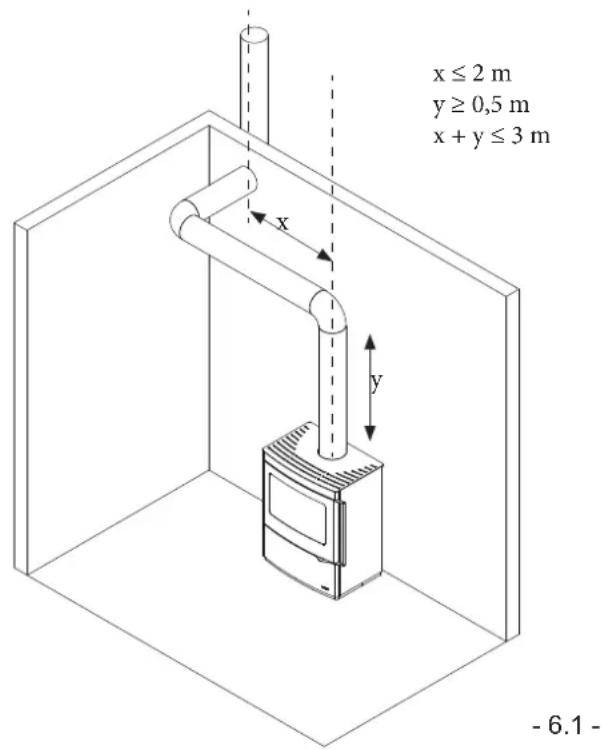
- In order to connect the stove to the chimney you may perform maximum 3 changes of direction that should not exceed 90^ , the fume duct should not exceed 2 metres in length and 3 metres in total (-6.1 -).
- if the outlet is placed on the ceiling, make sure that the first vertical section has at least 50 cm before changing the direction.
- Follow the indications in the technical data sheet regarding the chimney draught value.
6.5 AIR INTAKE CONNECTION
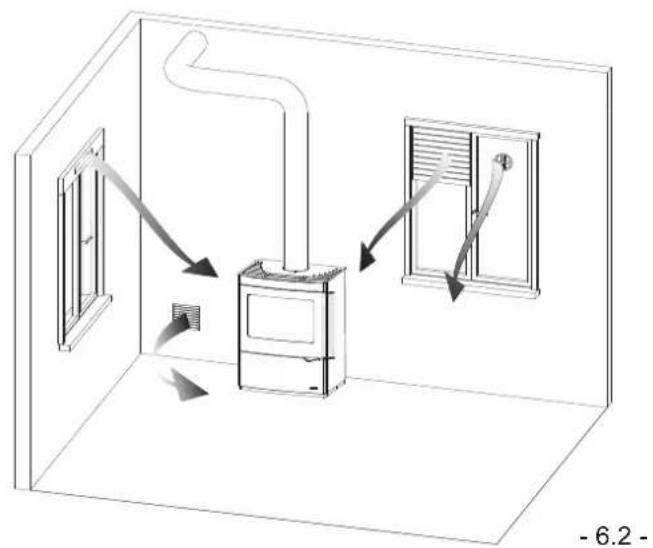
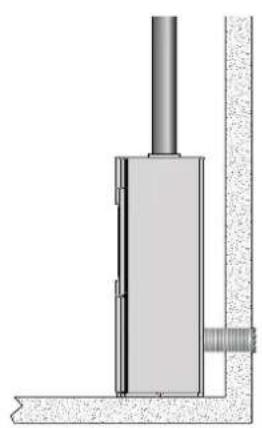
It is necessary to provide an external air intake to ensure the flow of combustion air to the stove (-6.2-).
The dimensions of the hole must comply with the values set forth in the table of technical data shown in the "Product booklet".
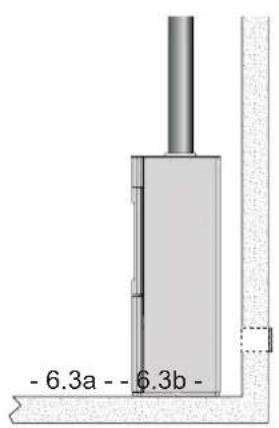
According to local standards in force, air intake could be taken directly from the room (- 6.3a -) or connected to the stove (- 6.3b -).
To get the air directly from the outside, you must install the connection for the combustion air, on the back of the stove, after cutting the pretrimmed on the rear of the stove.
- Is forbidden the intake of air for combustion from garages, rooms where flammable materials are stored or where there is danger of fire.
- The combustion air intake should be protected by an anti-insect grille and placed where it can not be accidentally obstructed, and made in such a way that the useful cross-section allows the right amount of oxygen to reach the stove.
In the room where the stove is located, if there are one or more extraction fans (exhaust hoods and the like), there may be problems with combustion due to lack of combustion air.
flowchart
graph TD
    A["Vent Vent"] --> B["Refrigerator"]
    B --> C["Window"]
    style A fill:#f9f,stroke:#333
    style C fill:#bbf,stroke:#333
natural_image
Technical diagram of a mechanical assembly with a cylindrical component and threaded end (no text or symbols)7 COMMISSIONING AND USING THE STOVE
7.1 DESCRIPTION OF THE PRODUCT

before proceeding, check for any "specific features of the model" described for the stove model in question in the enclosed "Product booklet".
7.2 LIGHTING THE FIREPLACE FOR THE FIRST TIME

The first time you light your fireplace the flames should burn at a moderate rate for approximately an hour to allow complete settling of any masonry fillings on the smoke fitting and drying of the protective materials of the metallic parts.
7.3 FIRE LIGHTING:
- Clean the fireplace from any ash residues;
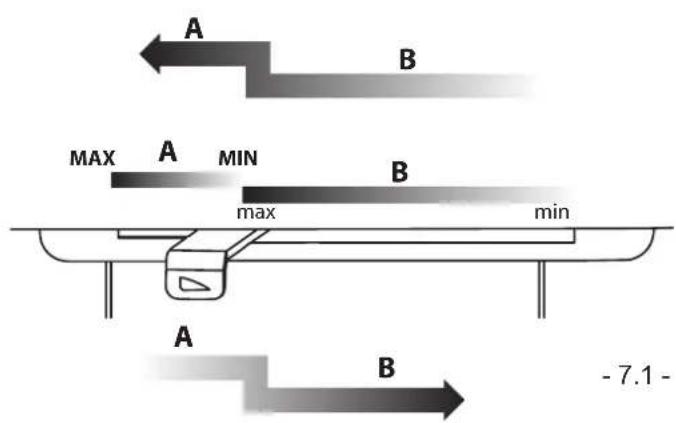
- completely open the primary air adjustment; set the lever to the start position; To do this you must move the lever to the left, lift and place it on the extreme left (fig.7.1 A);
- open the fire door pulling it towards yourself. Attention: an automatic system tends to keep the door closed;
- carefully place the wood pieces inside the combustion chamber;
- place a natural fire starter on the stack;
- add some crossed fine wood sticks;
• light the fire starter from the top and close the fire door - keep the air vent opened to ensure a high bright flame
- slightly close the air vent only when proper grill base is ensured; to do this you must move the lever to the right to climb over the start position (Figure 7.1 B).

er use alcohol, benzene, kerosene or other liquid fuels to light up the fire. Keep them away from fire. Never use fire starting cubes derived from petroleum or of chemical nature: they may seriously deteriorate the fireplace walls.
Only use ecological fire starting cubes.
7.4 KEEPING THE FIRE
Once the fire started and formed a proper grill base, load the fireplace with regular amount of wood.

In the appliance is working, possible inflammable materials must be placed at a distance of at least 80 cm from the radiation surface (glass sides of the hearth).

not touch the painted parts during first lightings to avoid damaging the paint finish and burn.
7.5 CONTROLLINGCOMBUSTION
Combustion air is adjusted by acting on the lever in the middle of the lower front panel (fig.7.1 B); moving it to the left increases the amount of primary air let in, and moving it to the right decreases the amount of air let in.
Once the fire is burning it is advisable to adjust the air based on heating needs or how long you want the load of wood to last (fig.7.1 B).

is recommended not to leave the stove with the lever to the start position for more than 10-15 minutes. This can cause damage to the stove.

stove is not suitable for continuous flame operation.
During stove operation you can favour the glass cleaning using the air adjustment lever (fig.7.1 B).

adjusting it to left you allow the entry of a greater air flow that surrounds the glass keeping it cleaner by preventing the deposits of soot and ash.
Do not exceed the maximum recommended load of wood.
7.6 DOOR OPENING
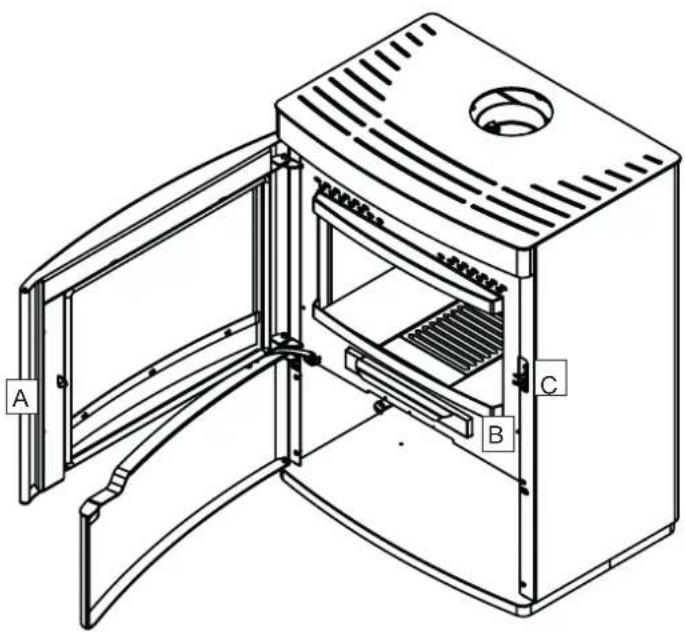
You can open the door by holding and pulling the lever inwards (-7.2 A).

ing stove operation, the door most be completely closed.
If the door is not completely closed during operation, a violent combustion might take place, consuming more wood.

When the fire is lit up the door reaches high temperatures therefore you should use the supplied glove to open it.
When feeding the fireplace with wood, the door must be opened in two steps:
1) first slowly and partially (3-4 cm), to allow the smoke diverter valve to open and the flue pipe to suction the smoke from the firebox
2) then completely, avoiding any smoke leaks into the atmosphere.
To close the door simply release from its maximum aperture position. An automatic system will call and lock the door in the closed position.
The user can choose to manually close the door bringing
to the closed position and pressing until the locking system has not taken hold.

learning! If the locking hook (-7.2 C) accidentally falls into place, you must manually pull it, carefully, using a tool.
-7.2-
8 MAINTENANCE AND CLEANING
8.1 SAFETY PRECAUTIONS
Before carrying out any maintenance and cleaning work, take the following precautions:
A) Ensure that all parts of the stove are completely cold.
B) Ensure that the ashes are completely out.
C) Use individual safety gear as set forth by directive 89/391/EEC.
D) Always use appropriate tools for maintenance.
8.2 CLEANING THE GLASS
- Clean the glass with a cloth or a damp roll of newspaper wiped in the ashes and then rubbed on the dirty parts until they are completely clean.
- Only carry out cleaning when the appliance is off and has cooled down.
• Do not lean on the door - Pyroceram resists high temperatures very well, but it is fragile, so DO NOT STRIKE IT.
- Do not use abrasive products for cleaning.
8.3 CLEANING THE FIRE BOX AND ASH BOX
The internal ash box (-7.2 B) is spacious and easy to extract.

re carrying out this operation, make sure that the stove has cooled completely and make sure there are no burning embers in the ash box.
Warning: the ash may contain hot coals even after several hours.
8.4 CLEANING THE FLUE PIPE
The cleaning of the flue pipe, for excellent draught, must be carried out before the period the stove will be used and any time you notice a build-up of soot and tar, which are highly flammable.
Incrustations, once they reach a thickness of 5-6 mm, in the presence of high temperatures and sparks may catch fire.

In normal operating conditions, the chimney must be cleaned after every 4 tonnes of wood burnt, or at least once a year, unless otherwise required by regulations.
-8.1-
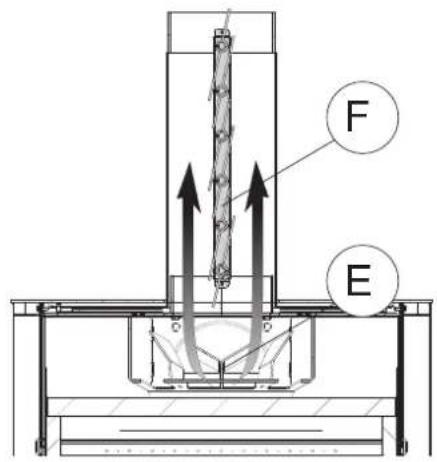
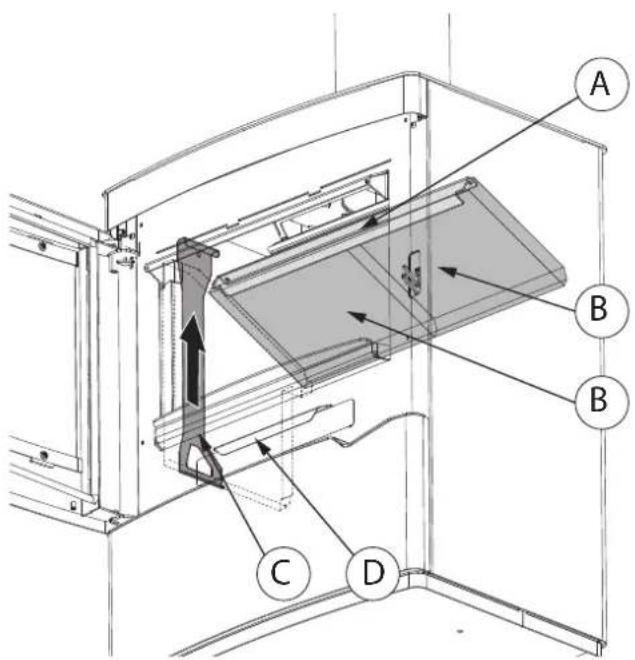
Before starting cleaning, it is necessary to position the valves in the fully open position (fig.8.1), if the stove has a Twister Flue (F), and to remove the refractories inside the combustion chamber, according to the sequence (fig.8.2):
- remove the upper bracket (A) which supports the lids;
- remove the 2 lids (B);
- pull the support upwards (C);
- remove the lateral refractory (D);
- also remove the refractory from the opposite side.
For more thorough cleaning it is possible to vacuum up any residues in the fume fan (fig. 8.1 F), accessing it from the valve (fig. 8.1 E).
After cleaning, replace the refractories in their place following the procedure in reverse.
-8.2-
9 DECOMMISSIONING AND DISPOSAL
Decommissioning and disposal of the stove are the exclusive responsibility of the owner, who must act in accordance with the laws in force in the country where the stove is installed with regards to safety and environmental protection.
The stove may also be dismantled and disposed of by companies authorised to recover and dispose of the materials in question.
INSTRUCTION: always observe the standards in force in the country where the stove is decommissioned as regards disposal of the materials and the waste disposal report where required.
IMPORTANT: All dismantling operations for decommissioning the stove must be performed when the stove is off and disconnected from the power supply.
- remove all electrical equipment;
- separate the batteries fitted on the electronic boards;
• have the structure of the stove scrapped by an authorised company;
IMPORTANT: Dumping the stove in accessible areas represents a serious hazard to people and animals.
Liability for any harm caused to people or animals always lies with the owner.
When decommissioning the stove the ce mark, this manual and other documents relating to this stove must be destroyed.
INDEX
1 PREMESSA
1.1 SYMBOLES UTILISÉS DANS LE MANUEL
1.2 UTILISATION PRÉVUE
1.3 BUT ET CONTENU DU MANUEL
1.4 CONSERVATION DU MANUEL
1.5 MISE À JOUR DU MANUEL
1.6 INFORMATIONS GÉNÉRALES
1.7 PRINCIPALES NORMES DE SÉCURITÉ RESPECTÉES ET À RESPECTER
1.8 GARANTIE LÉGALE
1.9 LIMITES DE RESPONSABILITÉ DU FABRICANT
1.10 CARACTÉRISTIQUES DE L'UTILISATEUR
1.11 ASSISTANCE TECHNIQUE
1.12 PIÈCESDÉTACHÉES
1.13 PLAQUED'IDENTIFICATION
1.14 LIVRAISON DE LA POÊLE
2 AVERTISSEMENTS POUR LA SÉCURITÉ
2.1 AVERTISSEMENTS POUR L'INSTALLATEUR
2.2 AVERTISSEMENTS POUR LES TECHNICIENS PRÉPOSÉS À LA MAINTENANCE
2.3 AVERTISSEMENTS POUR L'UTILISATEUR
3 DÉPLACEMENT ET TRANSPORT
4 CARACTÉRISTIQUES DU COMBUSTIBLE
5 PRÉPARATION DU LIEU D'INSTALLATION
5.1 PRÉCAUTIONS POUR LA SÉCURITÉ
6 INSTALLATION
6.1 PRÉMISSE
natural_image
Technical line drawing of a laboratory oven with labeled components (A, B, C), showing internal structure and ductwork (no text or symbols beyond labels)-7.2-
8 ENTRETIEN ET NETTOYAGE
8.1 RECOMMANDATIONS DE SÉCURITÉ
-8.1-
-8.2-
9 DESOSSEMENT ET MISE AU REBUT
natural_image
Technical diagram of a mechanical assembly with a cylindrical component and threaded end (no text or symbols)natural_image
Technical line drawing of a laboratory oven with labeled components (A, B, C), showing internal structure and ductwork (no text or symbols beyond labels)-7.2-
-8.1-
-8.2-
REGLAMENTO (UE) 2015/1185 (ECODESIGN)
natural_image
Technical line drawing of a laboratory oven with labeled components (A, B, C), showing internal structure and ductwork (no text or symbols beyond labels)-7.2-
8 MANTENIMIENTO Y LIMPIEZA
-8.2-
Palazzetti reserves the right to change its products at any time and without notice in order to improve them without compromising their essential characteristics.
- ACCENSIONE DEL FUOCO:
- HANDLING AND TRANSPORT
- FUEL CHARACTERISTICS
- PREPARING THE PLACE OF INSTALLATION
- INSTALLATION
- COMMISSIONING AND USING THE STOVE
- MAINTENANCE AND CLEANING
- DECOMMISSIONING AND DISPOSAL
- GENERAL
- SYMBOLS
- INTENDEDUSE
- PURPOSE AND CONTENTS OF THE MANUAL
- Purpose
- Contents
- KEEPING THE MANUAL
- keeping and consulting the manual
- Deterioration or loss
- Selling the stove
- MANUAL UPDATE
- GENERAL INFORMATION
- Information
- Liabilities
- Maintenance
- Responsibility for installation
- All regulations required by local, national and European laws in force in the country where the appliance is installed must be observed.
- Use
- MAINACCIDENTPREVENTION REGULATIONS TO COMPLY WITH
- LEGAL GUARANTEE
- MANUFACTURER'S LIABILITY
- USER CHARACTERISTICS
- TECHNICAL ASSISTANCE
- SPARE PARTS
- ID PLATE
- DELIVERY OF THE STOVE
- SAFETY WARNING
- WARNINGS FOR THE INSTALLER
- WARNINGS FOR TECHNICAL MAINTENANCE PERSONNEL
- WARNINGS FOR USERS
- It is prohibited to operate the appliance with the door open.
- PALAZZETTI
- SAFETY PRECAUTIONS
- PREMISE
- HEIGHT ADJUSTMENT
- SMOKE EXHAUST SYSTEM
- CONNECTION TO FLUE PIPE
- AIR INTAKE CONNECTION
- DESCRIPTION OF THE PRODUCT
- LIGHTING THE FIREPLACE FOR THE FIRST TIME
- FIRE LIGHTING:
- KEEPING THE FIRE
- CONTROLLINGCOMBUSTION
- DOOR OPENING
- SAFETY PRECAUTIONS
- CLEANING THE GLASS
- CLEANING THE FIRE BOX AND ASH BOX
- CLEANING THE FLUE PIPE
- INDEX
- PREMESSA
- ENTRETIEN ET NETTOYAGE
- RECOMMANDATIONS DE SÉCURITÉ
- DESOSSEMENT ET MISE AU REBUT
- MANTENIMIENTO Y LIMPIEZA
Brand : Palazzetti
Model : Nicole
Category : Frying Pan