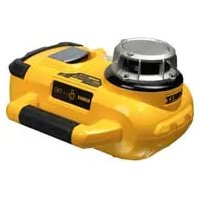
DW078 - Laser pointer DEWALT - Free user manual and instructions
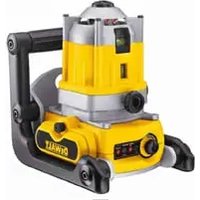
Find the device manual for free DW078 DEWALT in PDF.


| Brand | DEWALT |
| Model | DW078 |
| Product type | Self-leveling rotary laser |
| Voltage (battery) | 9.6 / 12 / 14.4 / 18 V |
| Battery type | NiCd, NiMH or Li-Ion |
| Laser class | 3R |
| Protection rating | IP54 |
| Accuracy | ±0.1 mm/m |
| Self-leveling range | ±5° |
| Operating temperature | -5°C to +50°C |
| Thread size | 5/8"-11 |
| Weight (without battery) | 2.0 kg |
| Power supply | DEWALT rechargeable battery |
| Charger included | DE9116 (230 V, 50 Hz) |
| Package contents | Rotary laser, remote control, detector, detector mount, case, charger, battery, manual |
| Main functions | Horizontal self-leveling, manual tilt mode (X/Y axes), wireless remote control, digital laser detector |
| Maintenance and cleaning | Clean with a soft dry cloth; do not use solvents; clean the lens with a damp cotton swab |
| Safety | Class 3R laser, do not look directly into the beam, do not disassemble, use only DEWALT accessories |
| Warranty | 1 year full + 30 days satisfaction + 1 year free maintenance |
Frequently Asked Questions - DW078 DEWALT
User questions about DW078 DEWALT
0 question about this device. Answer the ones you know or ask your own.
Ask a new question about this device
Download the instructions for your Laser pointer in PDF format for free! Find your manual DW078 - DEWALT and take your electronic device back in hand. On this page are published all the documents necessary for the use of your device. DW078 by DEWALT.
USER MANUAL DW078 DEWALT
English (original instructions)
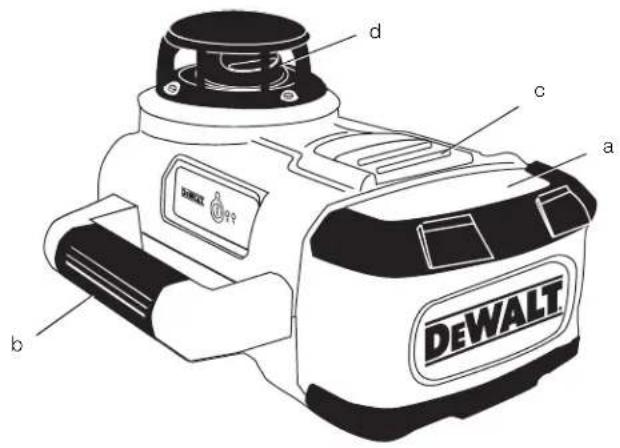
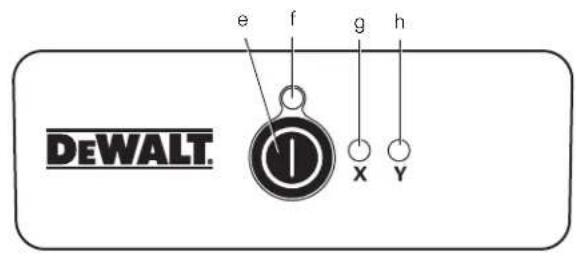
Figure 2
natural_image
Technical line drawing of a mechanical device with a side view showing internal components (no text or symbols)Figure 3
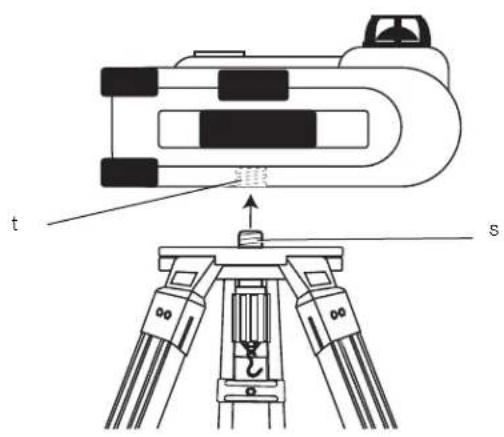
Figure 4
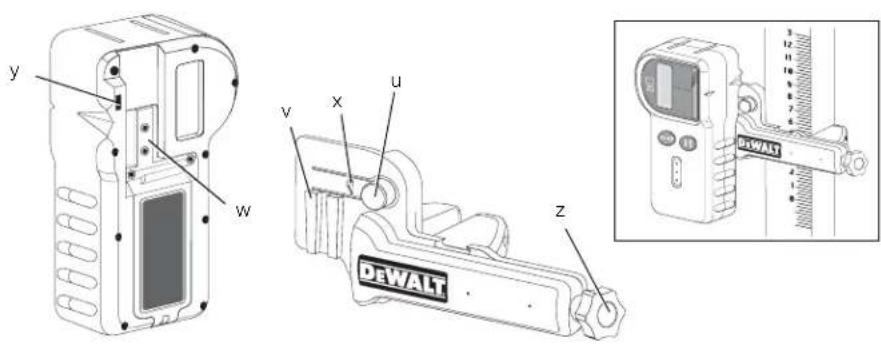
Figure 5

Figure 6
ROTERENDE LASER DW078
Tillykke!
DIGITAL LASERDETEKTOR (FIG. 4)
You have chosen a DEWALT laser. Years of experience, thorough product development and innovation make DEWALT one of the most reliable partners for professional power tool users.
Technical Data
| DW078 | ||
| Voltage V 9.6, 12, 14.4, 18 | ||
| Type 1 | ||
| Rotary speed min | 1 | 600 |
| Laser class 3R | ||
| Protection class IP54 | ||
| Accuracy mm/m | ± | |
| Self-leveling range ° ±5 | ||
| Operating temperature °C | -5 to +50 | |
| Receptacle thread | 5/8"-11 | |
| Weight (without battery pack) kg 2.0 | ||
| Battery pack | DE9503 | |
| Battery type | NiMH | |
| Voltage V | 18 | |
| Weight kg | 1.1 | |
| Charger | DE9116 | |
| Mains voltage V_ac | 230 | |
| Battery type | NiCd/NiMH | |
| Approx. charging time min | 60(2.0 Ah battery packs) | |
| Weight kg | 0.4 | |
| Fuses | ||
| Europe 230 V tools | 10 Amperes, mains | |
| U.K. & Ireland 230 V tools | 3 Amperes, in plugs | |
Definitions: Safety Guidelines
The definitions below describe the level of severity for each signal word. Please read the manual and pay attention to these symbols.

DANGER: Indicates an imminently hazardous situation which, if not avoided, will result in death or serious injury.

WARNING: Indicates a potentially hazardous situation which, if not avoided, could result in death or serious injury.

CAUTION: Indicates a potentially hazardous situation which, if not avoided, may result in minor or moderate injury.
CAUTION: Used without the safety alert symbol indicates a potentially hazardous situation which, if not avoided, may result in property damage.

Denotes risk of electric shock.
Denotes risk of fire.
Safety Instructions for Lasers

WARNING! Read and understand all instructions. Failure to follow all instructions listed below may result in electric shock, fire and/or serious personal injury.
SAVE THESE INSTRUCTIONS
- Do not operate the laser in explosive atmospheres, such as in the presence of flammable liquids, gases or dust. Power tools create sparks which may ignite the dust or fumes.
- Use the laser only with the specifically designated batteries. Use of any other batteries may create a risk of fire.
- Store idle laser out of reach of children and other untrained persons. Lasers are dangerous in the hands of untrained users.
- Use only accessories that are recommended by the manufacturer for your model. Accessories that may be suitable for one laser may create a risk of injury when used on another laser.
- Tool service MUST be performed only by qualified repair personnel. Repairs, service or maintenance performed by unqualified personnel may result in injury. For the location of your nearest authorised DEWALT repair agent, refer to the list of authorised DEWALT repair agents on back of this manual or visit www.2helpU.com on the Internet.
- Do not use optical tools such as a telescope or transit to view the laser beam. Serious eye injury could result.
- Do not place the laser in a position which may cause anyone to intentionally or unintentionally stare into the laser beam. Serious eye injury could result.
- Do not position the laser near a reflective surface which may reflect the laser beam toward anyone's eyes. Serious eye injury could result.
- Turn the laser off when it is not in use. Leaving the laser on increases the risk of staring into the laser beam.
- Do not operate the laser around children or allow children to operate the laser. Serious eye injury may result.
- Do not remove or deface warning labels. If labels are removed, user or others may inadvertently expose themselves to radiation.
- Position the laser securely on a level surface. Damage to the laser or serious injury could result if the laser falls.
- Dress properly. Do not wear loose clothing or jewellery. Contain long hair. Keep your hair, clothing and gloves away from moving parts. Loose clothing, jewellery or long hair can be caught in moving parts. Air vents often cover moving parts and should also be avoided.
WARNING: Use of controls or adjustments or performance of procedures other than those specified herein may result in hazardous radiation exposure.
NG! DO NOT DISASSEMBLE THE ROTARY LASER. There are no user serviceable parts inside. Disassembling the rotary laser will void all warranties on the product. Do not modify the product in any way. Modifying the tool may result in hazardous laser radiation exposure. - This laser complies with class 3R according to DIN EN 60825-1:2007 (max 5 mW, 600–680 nm). Do not replace a laser diode with a different type. If damaged, have the laser repaired by an authorised repair agent.
- Only qualified and trained persons are allowed to install, adjust and operate the laser equipment. Areas in which class 3R lasers are used have to be posted with an appropriate laser warning sign.
- Do not use the laser for any purpose other than projecting laser lines.
- Before first use, check that the safety warnings on the label have been formulated in your language. Do not use the tool if it does not carry the warnings in your language!
- As the beam of a class 3R laser provides high visibility over longer distances, the potential risk of damage to the eye remains unchanged within the radius of application.


Additional Safety Instructions for Lasers
- Always set up the tool at a position where the laser beam cannot cross any person at eye level. Be extra alert for the presence of stairs and specular surfaces.
Residual Risks
- The following risks are inherent to the use of these machines:
- Injuries caused by staring into laser beam.
Markings on Tool
The following pictographs are shown on the tool:

Read instruction manual before use.

Laser warning.

Class 3R laser.

Protection class: IP54.
DATE CODE POSITION
Date Code, which also includes the year of manufacture, is printed on the bottom of the laser near the mounting threads.
Example:
2010 XX XX
Year of Manufacture
Important Safety Instructions for All Battery Chargers
SAVE THESE INSTRUCTIONS: This manual contains important safety and operating instructions for battery chargers.
- Before using charger, read all instructions and cautionary markings on charger, battery pack, and product using battery pack.

DANGER: Electrocution hazard. 230 volts are present at charging terminals. Do not probe with conductive objects. Electric shock or electrocution may result.

WARNING: Shock hazard. Do not allow any liquid to get inside charger. Electric shock may result.
ENGLISH
CAUTION: Burn hazard. To reduce
the risk of injury, charge only DEWALT rechargeable batteries. Other types of batteries may burst causing personal injury and damage.
CAUTION: Under certain conditions, with the charger plugged in to the power supply, the exposed charging contacts inside the charger can be shorted by foreign material. Foreign materials of a conductive nature such as, but not limited to, steel wool, aluminum foil, or any buildup of metallic particles should be kept away from charger cavities. Always unplug the charger from the power supply when there is no battery pack in the cavity. Unplug charger before attempting to clean.
- DO NOT attempt to charge the battery pack with any chargers other than the ones in this manual. The charger and battery pack are specifically designed to work together.
- These chargers are not intended for any uses other than charging DEWALT rechargeable batteries. Any other uses may result in risk of fire, electric shock or electrocution.
- Do not expose charger to rain or snow.
- Pull by plug rather than cord when disconnecting charger. This will reduce risk of damage to electric plug and cord.
- Make sure that cord is located so that it will not be stepped on, tripped over, or otherwise subjected to damage or stress.
- Do not use an extension cord unless it is absolutely necessary. Use of improper extension cord could result in risk of fire, electric shock, or electrocution.
- Do not place any object on top of charger or place the charger on a soft surface that might block the ventilation slots and result in excessive internal heat. Place the charger in a position away from any heat source. The charger is ventilated through slots in the top and the bottom of the housing.
- Do not operate charger with damaged cord or plug — have them replaced immediately.
- Do not operate charger if it has received a sharp blow, been dropped, or otherwise damaged in any way. Take it to an authorised service centre.
- Do not disassemble charger; take it to an authorised service centre when service or
repair is required. Incorrect reassembly may result in a risk of electric shock, electrocution or fire.
- Disconnect the charger from the outlet before attempting any cleaning. This will reduce the risk of electric shock. Removing the battery pack will not reduce this risk.
- NEVER attempt to connect 2 chargers together.
- The charger is designed to operate on standard 230V household electrical power. Do not attempt to use it on any other voltage. This does not apply to the vehicular charger.
SAVE THESE INSTRUCTIONS
Charger
The DE9116 charger accepts 7.2–18 V NiCd and NiMH batteries.
The DE9135 charger accepts 7.2–18 V NiCd, NiMH or Li-Ion batteries.
These chargers require no adjustment and are designed to be as easy as possible to operate.
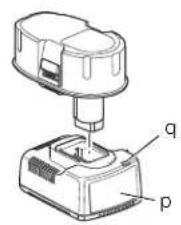
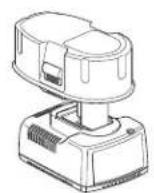
Charging Procedure (fi g. 2)
DANGER: Electrocution hazard. 230 volts present at charging terminals. Do not probe with conductive objects. Danger of electric shock or electrocution.
- Plug the charger (p) into an appropriate outlet before inserting battery pack.
- Insert the battery pack (n) into the charger. The red (charging) light will blink continuously indicating that the charging process has started.
- The completion of charge will be indicated by the red light remaining ON continuously. The pack is fully charged and may be used at this time or left in the charger.
NOTE: To ensure maximum performance and life of NiCd, NiMH and Li-Ion batteries, charge the battery for a minimum of 10 hours before first use.
Charging Process
Refer the table below for the state of charge of the battery pack.
| State of charge | ||||
| charging | - | - | - | - |
| fully charged | ||||
| hot/cold pack delay | - | - | - | |
| replace battery pack | ●●●●●●●●● | |||
| problem | ●● | ●● | ●● | |
Automatic Refresh
The automatic refresh mode will equalise or balance the individual cells in the battery pack at its peak capacity. Battery packs should be refreshed weekly or whenever the pack no longer delivers the same amount of work.
To refresh your battery pack, place the battery in the charger as usual. Leave the battery pack for at least 10 hours in the charger.
Hot/Cold Pack Delay
When the charger detects a battery that is too hot or too cold, it automatically starts a Hot/Cold Pack Delay, suspending charging until the battery has reached an appropriate temperature. The charger then automatically switches to the pack charging mode. This feature ensures maximum battery life.
LI-ION BATTERY PACKS ONLY
Li-Ion batteries are designed with an Electronic Protection System that will protect the battery against overloading, overheating or deep discharge.
The tool will automatically turn off if the Electronic Protection System engages. If this occurs, place the Li-Ion battery on the charger until it is fully charged.
Important Safety Instructions for All Battery Packs
When ordering replacement battery packs, be sure to include catalog number and voltage.
The battery pack is not fully charged out of the carton. Before using the battery pack and charger, read the safety instructions below. Then follow charging procedures outlined.
READ ALL INSTRUCTIONS
- Do not charge or use battery in explosive atmospheres, such as in the presence of flammable liquids, gases or dust. Inserting or removing the battery from the charger may ignite the dust or fumes.
- Charge the battery packs only in DEWALT chargers.
• DO NOT splash or immerse in water or other liquids. - Do not store or use the tool and battery pack in locations where the temperature may reach or exceed 40^ C ( 105^ F) (such as outside sheds or metal buildings in summer).

DANGER: Never attempt to open the battery pack for any reason. If battery pack case is cracked or damaged, do not insert into charger. Do not crush, drop or damage battery pack.
Do not use a battery pack or charger that has received a sharp blow, been dropped, run over or damaged in any way (i.e., pierced with a nail, hit with a hammer, stepped on). Electric shock or electrocution may result. Damaged battery packs should be returned to service centre for recycling.

N: When not in use, place tool on its side on a stable surface where it will not cause a tripping or falling hazard. Some tools with large battery packs will stand upright on the battery pack but may be easily knocked over.
SPECIFIC SAFETY INSTRUCTIONS FOR NICKEL CADMIUM (NiCd) OR NICKEL METAL HYDRIDE (NiMH)
- Do not incinerate the battery pack even if it is severely damaged or is completely worn out. The battery pack can explode in a fire.
- A small leakage of liquid from the battery pack cells may occur under extreme usage or temperature conditions. This does not indicate a failure.
However, if the outer seal is broken:
a. and the battery liquid gets on your skin, immediately wash with soap and water for several minutes.
b. and the battery liquid gets into your eyes, flush them with clean water for a minimum of 10 minutes and seek immediate medical attention. (Medical note: The liquid is 25–35% solution of potassium hydroxide.)
SPECIFIC SAFETY INSTRUCTIONS FOR LITHIUM ION (Li-Ion)
- Do not incinerate the battery pack even if it is severely damaged or is completely worn out. The battery pack can explode in a fire. Toxic fumes and materials are created when lithium ion battery packs are burned.
- If battery contents come into contact with the skin, immediately wash area with mild soap and water. If battery liquid gets into the eye, rinse water over the open eye for 15 minutes or until irritation ceases. If medical attention is needed, the battery electrolyte is composed of a mixture of liquid organic carbonates and lithium salts.
- Contents of opened battery cells may cause respiratory irritation. Provide fresh air. If symptoms persist, seek medical attention.

WARNING: Burn hazard. Battery liquid may be flammable if exposed to spark or flame.
ENGLISH
Battery Cap (fi g. 2)
A protective battery cap is supplied to cover the contacts of a detached battery pack. Without the protective cap in place, loose metal objects could short circuit the contacts, causing a fire hazard and damaging the battery pack.
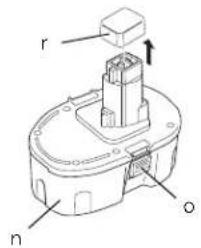
- Take off the protective battery cap (r) before placing the battery pack in the charger or tool.
- Place the protective cap (r) over the contacts immediately after removing the battery pack from the charger or tool.

WARNING: Make sure the protective battery cap is in place before storing or carrying a detached battery pack.
Battery Pack (fi g. 2)
BATTERY TYPE
The DW078 operates on DEWALT 12, 14.4 and 18 V NiMH and DEWALT 9.6, 12, 14.4 and 18 V NiCd battery packs. The DW078 also operates on DEWALT 14.4 and 18 V Lithium Ion battery packs.
Storage Recommendations
- The best storage place is one that is cool and dry away from direct sunlight and excess heat or cold.
NOTE: Li-lon battery packs should be fully charged when stored.
- Long storage will not harm the battery pack or charger. Under proper conditions, they can be stored for 5 years or more.
Labels on Charger and Battery Pack
In addition to the pictographs used in this manual, the labels on the charger and the battery pack show the following pictographs:

Read instruction manual before use.


Battery charging.

Battery charged.

Battery defective.

Hot/cold pack delay.

Do not probe with conductive objects.

Do not charge damaged battery packs.

Use only with DEWALT battery packs; others may burst, causing personal injury and damage.

Do not expose to water.

Have defective cords replaced immediately.

Charge only between 4 °C and 40 °C.

Discard the battery pack with due care for the environment.

Do not incinerate the battery pack NiMH, NiCd+ and Li-Ion.


NiMH Charges NiMH and NiCd NiCd battery packs.

Li-Ion Charges Li-Ion battery packs.

See technical data for charging time.
Package Contents
The package contains:
1 Rotary laser
1 Remote control
1 Detector
1 Detector clamp
1 Kitbox
1 Charger (DW078KH)
1 Battery pack (DW078KH)
1 Instruction manual
NOTE: Battery packs and chargers are not included with N-models.
- Check for damage to the tool, parts or accessories which may have occurred during transport.
• Take the time to thoroughly read and understand this manual prior to operation.
Description (fi g. 1, 2)
WARNING: Never modify the power tool or any part of it. Damage or personal injury could result.
INTENDED USE
The DW078 rotary laser has been designed to project laser lines to aid in professional applications. The tool can be used both inside and outside for horizontal (level) alignment. The applications include wall layout, foundation leveling and deck building.
DO NOT use under wet conditions or in presence of flammable liquids or gases.
This laser is a professional tool. DO NOT let children come into contact with the unit. Supervision is required when inexperienced operators use this laser.
LASER (FIG. 1)
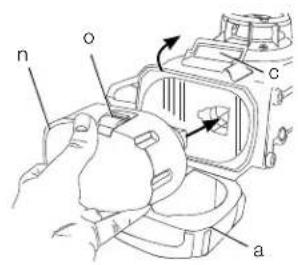
a. Hatch door
b. Carrying handle
c. Latch
d. Rotary laser head
e. Power button
f. Power LED indicator
g. X-axis LED indicator
h. Y-axis LED indicator
REMOTE CONTROL (FIG. 1)
i. Power button
j. Manual mode button
k. Directional arrows: up/down
- Directional arrows: left/right
m. Power LED indicator
CHARGER (FIG. 2)
n. Battery pack
o. Release buttons
p. Charger
q. Charging indicator (red)
r. Battery cap
Electrical Safety
The electric motor has been designed for one voltage only. Always check that the battery pack voltage corresponds to the voltage on the rating plate. Also make sure that the voltage of your charger corresponds to that of your mains.

Your DEWALT charger is double insulated in accordance with EN 60335; therefore no earth wire is required.

WARNING: 115 V units have to be operated via a fail-safe isolating transformer with an earth screen between the primary and secondary winding.
If the supply cord is damaged, it must be replaced by a specially prepared cord available through the DEWALT service organisation.
Mains Plug Replacement (U.K. & Ireland Only)
If a new mains plug needs to be fitted:
• Safely dispose of the old plug.
- Connect the brown lead to the live terminal in the plug.
- Connect the blue lead to the neutral terminal.

WARNING: No connection is to be made to the earth terminal.
Follow the fitting instructions supplied with good quality plugs. Recommended fuse: 3 A.
Using an Extension Cable
An extension cord should not be used unless absolutely necessary. Use an approved extension cable suitable for the power input of your charger (see technical data). The minimum conductor size is 1 mm; the maximum length is 30 m.
When using a cable reel, always unwind the cable completely.
Unpacking
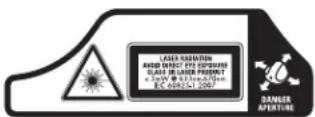
FITTING THE WARNING LABEL
The safety warnings on the label shown on the laser must be formulated in the language of the user.
For that purpose, a separate sheet of self-adhesive labels has been supplied with the tool.

VG: Check that the safety warnings on the label have been formulated in your language.
The warnings should read as follows:
LASER RADIATION AVOID DIRECT EYE EXPOSURE CLASS 3R LASER PRODUCT
- If the warnings are in a foreign language, proceed as follows:
- Remove the required label from the sheet.
- Carefully place the label over the existing label.
- Press the label in place.
ENGLISH
ASSEMBLY

WARNING: Prior to assembly and adjustment, always remove the battery pack. Always switch off the tool before inserting or removing the battery pack.

WARNING: Use only DEWALT battery packs and chargers.
Inserting and Removing the Battery Pack from the Tool (fi g. 2)
TO INSTALL THE BATTERY PACK
- Release latch (c) to open the hatch door (a). Insert the battery pack (n).
CAUTION: The laser will operate even if battery door is not fully latched. To secure the battery, always ensure battery door is closed and latched.
- Slide the battery pack in firmly.
- Close the hatch door and fasten latch.
TO REMOVE THE BATTERY PACK
- Release latch to open the hatch door.
- Remove the battery pack.
- Insert battery pack into the charger to recharge it. (Refer to Charging Procedure.)
Setting Up the Laser (fi g. 3)
The laser facilitates various set-ups, making it useful for several applications.
TRIPOD SET-UP (FIG. 3)
- Position the tripod securely and set it to the desired height.
- Make sure that the top of the tripod is roughly level. The laser will self-level only if the top of the tripod is within ±5^ of level. If the laser is set up too far out of level, it will beep when it reaches the limit of its leveling range. No damage will be done to the laser, but it will not operate in an “out of level” condition.
- Secure the laser to the tripod by screwing the threaded knob (s) on the tripod into the female thread (t) on the bottom of the laser.
NOTE: Be sure that the tripod you are working with has a 5/8"-11 threaded screw to ensure secure mounting.
- Turn the laser on.
OPERATION

WARNING: Always observe the safety instructions and applicable regulations.
- To extend battery life per charge, turn the laser off when it is not in use.
- To ensure the accuracy of your work, check the laser calibration often. Refer to Field Calibration Check under Laser Maintenance.
- Before attempting to use the laser, make sure the tool is positioned on a relatively smooth, secure surface.
- Always mark the centre of the laser line or dot. If you mark different parts of the beam at different times you will introduce error into your measurements.
- To increase working distance and accuracy, set up the laser in the middle of your working area.
- When attaching to a tripod or wall, mount the laser securely.
- To increase beam visibility, wear Laser Enhancement Glass es and/or use a Laser Target Card to help find the beam.
- Extreme temperature changes can cause movement or shifting of building structures, metal tripods, equipment, etc., which can affect accuracy. Check your accuracy often while working.
- If the laser is dropped or suffers a sharp blow, have the calibration system checked by a qualified service centre before using the laser.
Laser Control Panel (fi g. 1)
The laser is controlled by the power button (e). Three LED indicator lights are on the control panel: power (f), X-axis leveling (g), Y-axis leveling (h).
TURNING THE LASER ON (FIG. 1)
- Insert the fully charged battery pack. Be sure that the battery door is securely latched.
- Gently press the power button (e) to power the laser on. The power LED light (f) will illuminate. If the laser is out of level, the X-axis (g) and/or Y-axis (h) leveling lights will flash until the laser is level.
NOTE: The head will begin or resume rotation once the laser is level.
TURNING THE LASER OFF
Gently press the power button to turn the laser off. The power LED indicator light will no longer be illuminated.
ENGLISH
Laser Control Panel Buttons (fi g. 1)
POWER BUTTON ①
To completely power the laser unit off, the power button on the control panel of the laser unit must be pressed. The laser unit will also automatically power off if it is left in Sleep Mode for 8 hours.
NOTE: Press the remote control power button to put the laser unit into Sleep Mode. In Sleep Mode all laser unit functions shut off except for a periodic blink from the power LED on the control panel of the laser unit. Press the remote control power button again to "wake up" the laser unit.
Wireless Remote Control (fi g. 1)
The remote control allows one person to operate and setup the laser from a distance. The remote control features a power button (i), manual mode button (j), four arrows (k, l) and an LED transmit indicator (m).
REMOTE CONTROL: POWER BUTTON
Press the remote control power button (i) to put the laser unit into Sleep Mode. In Sleep Mode all laser unit functions shut off except for a periodic blink from the power LED (f) on the control panel of the laser unit. Press the remote control power button again to "wake up" the laser unit.
NOTE: To completely power the laser unit off, the power button on the control panel of the laser unit must be pressed. The laser unit will also automatically power off if it is left in Sleep Mode for 8 hours.
REMOTE CONTROL: MANUAL MODE BUTTON M
To activate Manual Mode, press and hold the remote control manual mode button (j) for 3 seconds. Manual Mode must be activated to use manual sloping. (Refer to Using Manual Slope Mode for a complete description of this function.)
To re-engage full self-leveling, press and hold the manual mode button again for 3 seconds.
Using Manual Slope Mode:
The DW078 Manual Slope Mode allows the self-leveling function to be disabled in one axis (direction) so that the laser can be sloped in that axis. The other axis will continue to self-level, ensuring that the laser beam is only sloping in the expected direction.
Entering and exiting Manual Slope Mode:
• To activate Manual Slope Mode, press and hold the remote control manual mode button (j) for 3 seconds.
- To re-engage full self-leveling, press and hold the manual mode button again for 3 seconds.
Setting the Slope Direction:
- When Manual Slope Mode is activated, the unit automatically engages Manual Y Mode. This allows the operator to slope the laser in the direction of the Y-axis, as indicated by the "gunsights" on the rollcage.
In certain situations, it may be desirable to slope the laser in the X-axis. The direction of Manual Slope Mode can be changed back and forth between the Y- and X-axes as follows:
- Immediately (within 5 seconds) after entering Manual Slope Mode, press and hold the remote control right arrow button to activate Manual X Mode.
- The unit can be changed back to Manual Y Mode by immediately pressing and holding the remote control left arrow button.
- To change the direction of Manual Slope Mode at a later time, re-engage full self-leveling, then activate Manual Slope Mode again and go through the axis selection procedure outlined above.
The X and Y LED indicator lights on the laser unit control panel (g, h) will indicate the manual slope direction that is selected. The manually controlled axis is identified by a turned-off LED, and the self-leveling axis is identified by a lighted LED.
Setting the Amount of Slope:
Once Manual Slope Mode is activated, the amount of slope can be manually adjusted using any of the following methods:
- Use the remote control up and down arrow buttons (k) to tilt the laser rotor head up and down.
OR
- The entire laser unit can be tipped up and down by setting it on a sloped surface. Make sure the laser unit is positioned so the direction of manual sloping is lined up in the same direction as the sloped surface.
ENGLISH
REMOTE CONTROL: ARROW BUTTONS

The arrow buttons (k, l) are used for different functions depending on the operating mode of the laser unit.
In Self-Leveling Horizontal Mode:
In this mode, the arrow buttons have no function.
In Manual Horizontal Mode:
The arrow buttons (k) are used to tilt the laser head up or down in the X or Y directions as marked on the protective roll cage of the laser unit.
In Manual Vertical Mode:
The up and down arrows (k) tilt the laser beam clockwise and counterclockwise.
The left and right arrows (l) move the laser beam left and right.
NOTE: The DW078 does not have a self-leveling vertical mode.
Height of Instrument Alert
The DW078 has a built-in alarm feature that alerts the operator if the unit is disturbed after the unit has self-leveled. The laser unit will stop rotating, the control panel LED indicator lights will flash and the beeper will sound.
TO RESET THE LASER UNIT FOR CONTINUED USE
- Tum the unit off and back on again using the power button on the laser unit control panel. OR
- Put the unit in sleep mode and then wake it back up using the power button on the remote control.
NOTE: Always recheck the laser setup after the Height of Instrument Alert has triggered.
Laser Accessories
DIGITAL LASER DETECTOR (FIG. 4)
The detector helps in locating the position of a laser beam in bright light conditions or over long distances. It produces both visual and audio signals as the rotating laser beam crosses the detector.
The detector can be used both indoor and outdoor whenever it is difficult to locate the laser beam.
The detector is not for use with non-rotating lasers but is compatible with most rotary red-beam or infrared (invisible) beam lasers on the market.
The DEWALT Digital Laser Detector can be used with or without the detector clamp. When used
with the clamp, the detector can be positioned on a grade rod, leveling pole, stud or post.
Accuracy
When the laser is operated using the detector, the accuracy level of the detector needs to be added to that of the laser.
- Constant accuracy (detector in narrow setting) ± 1.0 mm
- Nominal accuracy (detector in wide setting) ± 3.0 mm
For most accurate results, start the operation using the wide setting and finish in the narrow setting.
Mounting Detector on a Grade Rod (fig. 4)
- To secure your detector to a grade rod, first attach the detector to the clamp by pushing in on the clamp latch (u). Slide the tracks (v) on the clamp around the rail (w) on the detector until the latch (x) on the clamp pops into the latch hole (y) on the detector.
- Open the jaws of the clamp by turning the clamp knob (z) counterclockwise.
- Position the detector at the height needed and turn the clamp knob clockwise to secure the clamp on the rod.
- To make adjustments in height, slightly loosen the clamp, reposition and retighten.
Optional Accessories

WARNING: Since accessories, other than those offered by DEWALT, have not been tested with this product, use of such accessories with this laser could be hazardous. To reduce the risk of injury, only DEWALT-recommended accessories should be used with this product.
These are:
- Laser enhancement glasses
• DE0730 Target card
• DE0790 DEWALT Wall mount
• DE0734 DEWALT Grade rod
• DE0735 DEWALT Tripod
• DE0736 DEWALT Tripod
• DE0737 DEWALT Grade rod
• DE0738 DEWALT Gradient bracket
• DE9135 DEWALT LI charger
- DEWALT Battery packs:
| Voltage | NiCd | NiMH | LEV |
| 9.6 | DE9061 | - | 1 |
| 12 | DE9071/DE9075 | DE9501 | - |
| 14.4 | DE9091/DE9092 | DE9502 | DE9140 |
| 18 | DE9095/DE9096 | DE0503 | DE9180 |
Consult your dealer for further information on the appropriate accessories.
MAINTENANCE
Your DEWALT laser unit has been designed to operate over a long period of time with a minimum of maintenance. Continuous satisfactory operation depends upon proper laser care and regular cleaning.
- To maintain the accuracy of your work, check the calibration of the laser often. Refer to Field Calibration Check.
- Calibration checks and other maintenance repairs can be performed by DEWALT service centres.
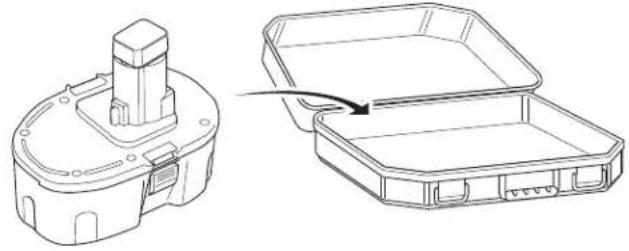
- When the laser is not in use, store it in the kit box provided.
- Do not store your laser in the kit box if the laser is wet. Dry exterior parts with a soft, dry cloth and allow the laser to air dry.
- Do not store your laser at temperatures below -18°C (0°F) or above 41°C (105°F).
- The charger is not serviceable. There are no serviceable parts inside the charger.
Field Calibration Check (fi g. 5, 6)

WARNING: Always have the laser head calibrated by a qualified repair agent.
Field calibration checks should be done frequently.
NOTE: As part of the DEWALT guarantee, the owner is entitled to one FREE calibration service within the first year. Simply complete the enclosed voucher and return along with the laser and proof of purchase to an authorised DEWALT agent. A certificate will be awarded at no additional charge.
Field calibration checks do not calibrate the laser. These checks indicate whether or not the laser is providing a correct level line and do not correct errors in the leveling capability of the laser.
These checks cannot take the place of professional calibration performed by a DeWALT service centre.
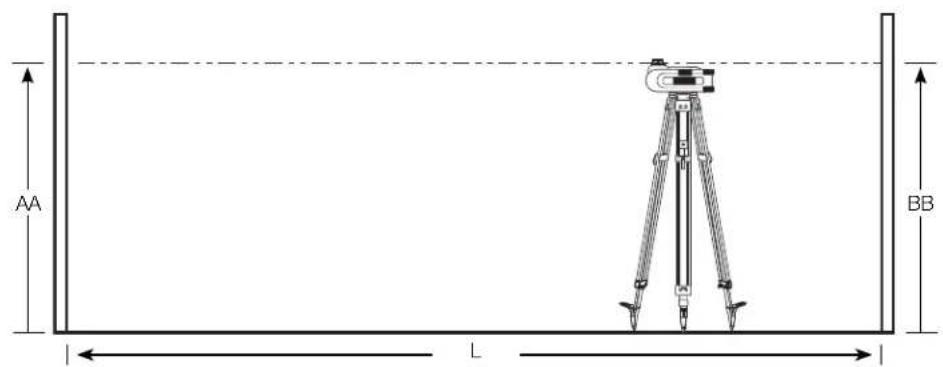
LEVEL CALIBRATION CHECK (X-AXIS)
- Set up a tripod between two walls that are at least 15 m (50 feet) apart. The exact location of the tripod is not critical.
- Mount the laser unit on the tripod so that the X-axis points directly toward one of the walls.
- Turn the laser unit on and allow it to self-level.
- Mark and measure points A and B on the walls as shown in Figure 5.
- Turn the entire laser unit 180° so the X-axis points directly toward the opposite wall.
- Allow the laser unit to self-level, and mark and measure points AA and BB on the walls as shown in Figure 6.
- Calculate the total error using the equation:
- Compare total error to the allowable limits shown in the following table.
$$ \text { Total Error } = (A A - A) - (B B - B) $$
| Distance between walls | Allowable Error |
| L = 15 m (50 ft.) | 3 mm (0.125") |
| L = 25 m (80 ft.) | 5 mm (0.2") |
| L = 50 m (160 ft.) | 10 mm (0.4") |
LEVEL CALIBRATION CHECK (Y-AXIS)
Repeat the procedure above, but with the laser unit positioned so the Y-axis is pointed directly toward the walls.

Cleaning

WARNING:
- Unplug the charger before cleaning. Dirt and grease may be removed from the exterior of the charger using a cloth or soft non-metallic brush. Do not use water or any cleaning solutions.
- Remove the battery pack before cleaning your laser unit.
- Never use solvents or other harsh chemicals for cleaning the non-metallic parts of the laser. Use a cloth dampened only with water and mild soap.
- Never let any liquid get inside the unit; never immerse any part of the unit into a liquid.
ENGLISH
- Never use compressed air to clean the laser.
- Keep the ventilation slots clear and regularly clean the housing with a soft cloth.
- The flexible rubber shield can be cleaned with a wet lint-free cloth such as a cotton cloth. USE WATER ONLY — DO NOT use cleansers or solvents. Allow the unit to air dry before storing.
- Under some conditions, the glass lens inside the rotary head may collect some dirt or debris. This will affect beam quality and operating range. The lens should be cleaned with a cotton swab moistened with water.

Rechargeable Battery Pack
This long life battery pack must be recharged when it fails to produce sufficient power on jobs which were easily done before. At the end of its technical life, discard it with due care for our environment:
- Run the battery pack down completely, then remove it from the tool.
- Li-Ion, NiCd and NiMH cells are recyclable. Take them to your dealer or a local recycling station. The collected battery packs will be recycled or disposed of properly.
Protecting the Environment

Separate collection. This product must not be disposed of with normal household waste.
Should you find one day that your DEWALT product needs replacement, or if it is of no further use to you, do not dispose of it with household waste. Make this product available for separate collection.

Separate collection of used products and packaging allows materials to be recycled and used again. Re-use of recycled materials helps prevent environmental pollution and reduces the demand for raw materials.
Local regulations may provide for separate collection of electrical products from the household, at municipal waste sites or by the retailer when you purchase a new product.
DEWALT provides a facility for the collection and recycling of DEWALT products once they have reached the end of their working life. To take advantage of this service please return your product to any authorised repair agent who will collect them on our behalf.
You can check the location of your nearest authorised repair agent by contacting your local DEWALT office at the address indicated in this manual. Alternatively, a list of authorised DEWALT repair agents and full details of our after-sales service and contacts are available on the Internet at:
www.2helpU.com.
GUARANTEE
DEWALT is confident of the quality of its products and offers an outstanding guarantee for professional users of the product. This guarantee statement is in addition to and in no way prejudices your contractual rights as a professional user or your statutory rights as a private non-professional user. The guarantee is valid within the territories of the Member States of the European Union and the European Free Trade Area.
• 30 DAY NO RISK SATISFACTION GUARANTEE •
If you are not completely satisfied with the performance of your DEWALT tool, simply return it within 30 days, complete with all original components, as purchased, to the point of purchase, for a full refund or exchange. The product must have been subject to fair wear and tear and proof of purchase must be produced.
• ONE YEAR FREE SERVICE CONTRACT •
If you need maintenance or service for your DEWALT tool, in the 12 months following purchase, you are entitled to one service free of charge. It will be undertaken free of charge at an authorised DEWALT repair agent. Proof of purchase must be produced. Includes labour. Excludes accessories and spare parts unless failed under warranty.
• ONE YEAR FULL WARRANTY •
If your DEWALT product becomes defective due to faulty materials or workmanship within 12 months from the date of purchase, DEWALT guarantees to replace all defective parts free of charge or – at our discretion – replace the unit free of charge provided that:
• The product has not been misused;
- The product has been subject to fair wear and tear;
• Repairs have not been attempted by unauthorised persons;
• Proof of purchase is produced;
- The product is returned complete with all original components.
If you wish to make a claim, contact your seller or check the location of your nearest authorised DEWALT repair agent in the DEWALT catalogue or contact your DEWALT office at the address indicated in this manual. A list of authorised DEWALT repair agents and full details of our after-sales service is available on the Internet at: www.2helpU.com.
LASER ROTATIF DW078
Félicitations !
Suspension de charge.

Batterie rechargeable
LASERPRODUKT I KLASSE 3R
SLÅ PÅ LASEREN (FIG. 1)
DIGITAL LASERDETEKTOR (FIG. 4)
KLASS 3R LASERPRODUKT