Medicus X - Blood pressure monitor BOSO - Free user manual and instructions
Find the device manual for free Medicus X BOSO in PDF.


User questions about Medicus X BOSO
0 question about this device. Answer the ones you know or ask your own.
Ask a new question about this device
Download the instructions for your Blood pressure monitor in PDF format for free! Find your manual Medicus X - BOSO and take your electronic device back in hand. On this page are published all the documents necessary for the use of your device. Medicus X by BOSO.
USER MANUAL Medicus X BOSO
natural_image
Diagram of a battery pack being inserted into a device, showing charge distribution and battery arrangement (no text or symbols)natural_image
Diagram of a car's seatbelt with a cable and connector, showing a small inset detail (no text or symbols)Bild 2
text_image
M 888 888 ♥ 888Bild 5

Blutdruckmessung

Contents of package 44
Symbols on the blood pressure monitor 45
Symbols on the power supply unit 48
Quick guide 49
Introduction......50
Purpose 51
Blood pressure values....52
Systolic and diastolic blood pressure value....52
WHO blood pressure cut-off values....52
Starting up....54
Inserting batteries....54
Battery status....55
General instructions for self-measurement....56
Preparing to measure your blood pressure....58

Table of contents

Note on cuff sizes....58
Attaching the cuff 59
Measuring your blood pressure 62
Interrupting a measurement 63
Measurement display....64
Completing the blood pressure record card / Retrieving the average value and WHO classification....66
Displaying individual stored values....68
Mains operation 69
Error messages....70
Cleaning and Disinfection....72
Warranty Conditions....73
Customer service / Disposal....74
Technical data....75
Calibration checks - Testing instructions (for trained specialist staff only)....78
Product features
text_image
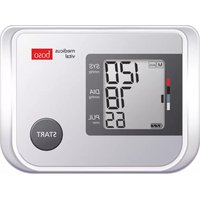
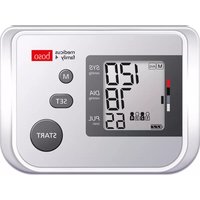
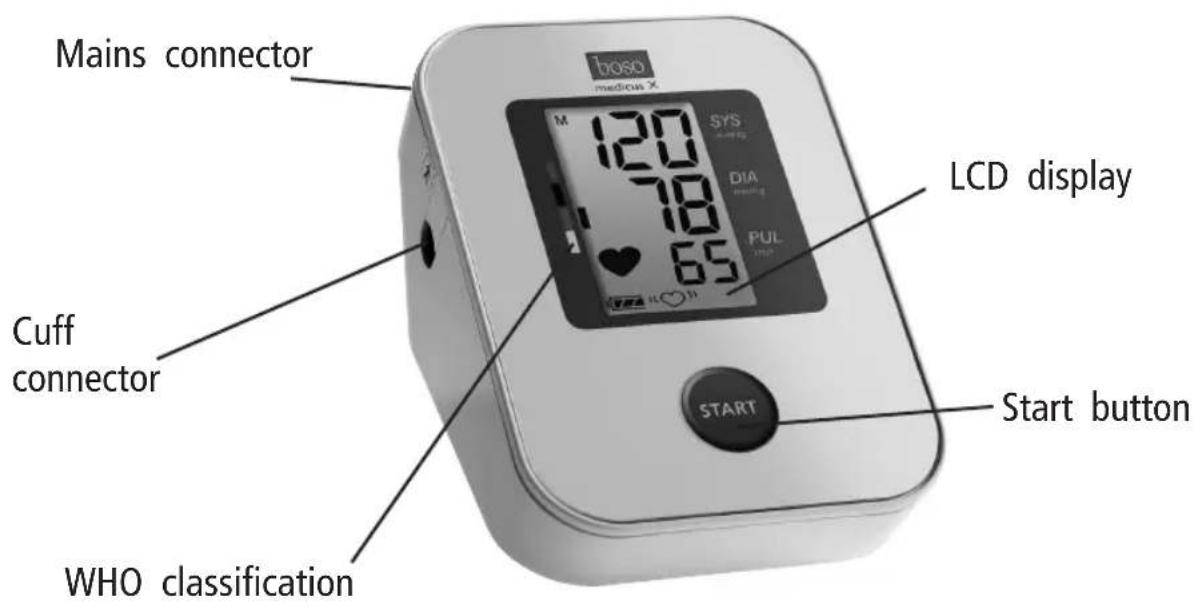
Mains connector boso MEDICUS X M 120 SYS DIA PUL LCD display Cuff connector START WHO classification Start button
Contents of package
1 boso-medicus X blood pressure monitor

4 LR 6 (AA) batteries

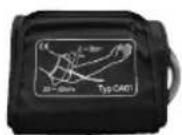
1 CA 01 standard cuff
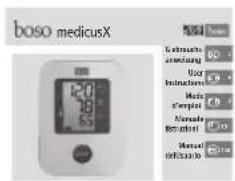
1 User instructions
text_image
boso medicusX 120 18 30 Control Extrusive anreduction Use Instructions Media S'empli C Niveau Bor undel Manual deficuation1 Blood pressure record card

Symbols on the blood pressure monitor
Symbol Function/meaning
| START | START/STOP button |
| Direct current | |
| SN | Serial number |
 | Year of manufacture |
 | Type BF: The device, cuff and tubing have been designed to protect the patient against electric shock. |
 | Reading in progress. Flashes as soon as a heartbeat was detected. |
Symbols on the blood pressure monitor

Symbol Function/meaning
| ((♡)) | Cardiac rhythm disorder or movement during reading. |
| M | Stored value |
| Battery fully charged. | |
| Battery partly discharged. | |
| Replace battery as soon as possible. | |
| Flashing! No further reading possible.Replace battery. | |
| Protect against liquids |
Symbols on the blood pressure monitor
Symbol Function/meaning
| SYS | Systolic blood pressure in mmHg |
| DIA | Diastolic blood pressure in mmHg |
| PUL | Pulse per minute |
| CE0124 | Device complies with the European Medical Devices Directive. |
| Device must not be discarded with household waste. | |
| Manufacturer | |
| Read instructions for use | |
| Polarity of power supply port |

Symbols on the power supply unit

Symbol Function/meaning
 | Only for use in enclosed spaces. |
 | Protection class II device |
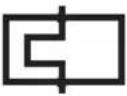 | Thermal fuse |
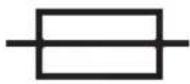 | Fuse |
 | Device complies with the European Medical Devices Directive |
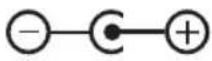 | Polarity of the mains adapter plug |
Quick guide
→Insert batteries, ensure correct positioning (P. 54)
→Connect cuff to monitor (P. 58)
→Attach cuff (P. 59)
→Start (and stop) a measurement by pressing the start button (P. 62)
Measured systolic, diastolic and pulse values are displayed after the measurement is completed (P. 64)
→Retrieving values from memory (P. 66): Press the START-button for about 3 seconds with the monitor switched off. The first value displayed is the average
value of all stored measurements together with the WHO classification. The total number of stored measurements is displayed at the same time, e.g. "A30". The individual measurement values are then displayed in sequence.
This quick guide does not replace the detailed information on the use and safety of the blood pressure monitor featured in the user instructions.

Please be sure therefore to read the user instructions!

Introduction

Dear Customer,
We are delighted that you have decided to purchase a boso blood pressure monitor. The boso brand is synonymous with optimal quality and precision and is also number 1 among professionals: 96% of all German general practitioners, physicians and internists work in practice with blood pressure instruments from boso (API survey conducted by GfK 01/2016). The experience gained from decades of use by professionals has also been incorporated into all the patient monitors for home measurement. This instrument has also passed our strict quality control procedures and is your reliable partner for monitoring your blood pressure values.
time, as correct blood pressure readings can only be obtained if the instrument is operated correctly.
In these user instructions, „→“ means an action by the user.
To get help concerning usage or maintenance please contact your dealer or the manufacturer (contact details can be found on the back cover of this manual).
An unexpected operating condition or an incidence which has worsened the health condition or could have worsened the health condition should be reported to the manufacturer immediately.
⚠️Please read these user instructions before using the instrument for the first
If the instrument is to be sold, ensure that these user instructions are enclosed.
Introduction
Purpose
The boso-medicus X blood pressure moni-Non-invasive recording of systolic and tor is suitable for patients with an upper diastolic blood pressure and pulse rate in arm circumference of between 22 and 48 adults. Not suitable for use on newborn cm. babies and infants. The device is suitable
The use of accessories not referred to in these instructions for use can undermine safety.
Wireless communication devices, such as home networking devices, mobile phones, cordless phones and their base stations, walkie-talkies can affect this blood pressure monitor. Therefore, a minimum distance of 11 feet should be kept from such devices.
The instrument can be used with any arm circumference as shown on the corresponding cuff.

Blood pressure values
To determine the blood pressure, two ues need to be measured:
vaDiastolic (lower) blood pressure: Thisispresent whentheheart muscleexpands and fills with blood again.
●Systolic (upper) blood pressure:
This is produced when the heart muscle blood pressure measurement values are contracts and blood is forced into the expressed in mmHg (mm of mercury). blood vessels.

| The World Health Organization (WHO) has defined the following cut-off values for assessing blood pressure: | ||
| systolic diastolic | ||
| High blood pressure (hypertension) over | 140 mmHg over 90 mmHg | |
| Borderline normal blood pressure 130 to | 139 mmHg 85 to 89 mmHg | |
| Normal blood pressure 120 to 129 mmHg | 80 to 84 mmHg | |
| Optimum blood pressure up to 119 mmHg | up to 79 mmHg | |
Blood pressure values
Whether medical treatment is necessary than at the doctor's. The German depends not only on the blood pressure, Hypertension League has therefore defi-but also on the patient's risk profile. ned lower cut-off values for home measu-Please contact your GP if one of the val-reements:ues (systole, diastole) consistently exceeds the cut-off point for high blood pressure.
Home measurement: 135/85 mmHg
Self-measurement of blood pressure often Measurement in the produces somewhat lower values at homedoctor's surgery: 140/90 mmHg

Starting up
The device must be installed and put into ⚠️Never mix old and new batteries or operation in accordance with the instructions in this manual.

natural_image
Diagram of a battery pack with an open circuit board and battery cells, showing internal components and connections (no text or symbols)→Use only high quality leak-proof batteries of the correct specifications (see "Technical data" P. 75).
⚠️If the batteries are not inserted correctly, the monitor will not work and this may cause the batteries to heat up and leak, damaging the monitor.
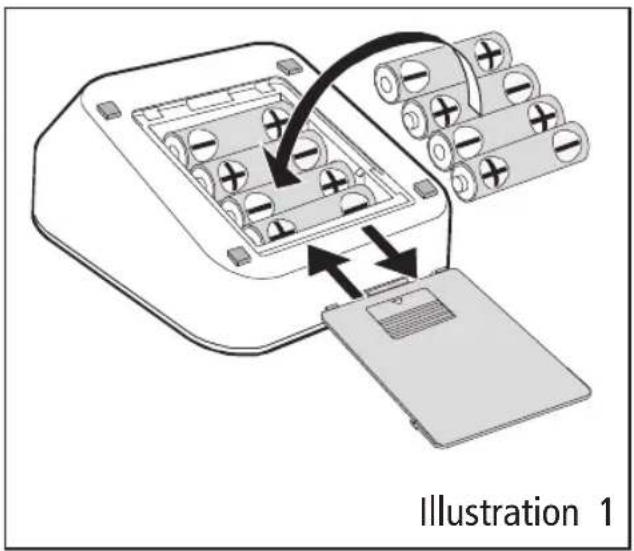
→Inserting the batteries
The battery compartment is located on the underside of the monitor. Insert batteries in the battery compartment as shown in illustration 1.
→Remove the batteries if the monitor is not to be used for any length of time.
⚠️Batteries that are short-circuited can become hot and cause burning.
Starting up
The monitor has a battery status display (see P. 46)

Battery fully charged.

Battery partially charged.

Replace battery soon.
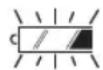
Flashing! No further measurements possible. Replace battery.
⚠️Care for the environment
Do not dispose of used batteries and charger units in domestic waste.
You can take these to collection sites for used batteries or special waste.
Contact your local authority for information.

General instructions for self-measurement

-
Fluctuations in blood pressure are quite normal. Even when measurements are repeated, there can be marked differences. Single or irregular measurements do not provide reliable information about the actual blood pressure. A reliable evaluation is only possible if regular measurements are taken under comparable conditions and themeasurement values entered in the blood pres-6. sure record card.
-
⚠️Self-testing does not mean self-treatment. Do not on any account change the dose of medicine prescribed by your doctor of your own accord.
-
Always measure your blood pressure
- Irregular heartbeats can affect the accuracy of the monitor or result in incorrect pressure values (where not required measurements (see page 71). otherwise (see page 60)).
Incorrect measurements can also occur in patients with a weak pulse (possibly in patients wearing a pacemaker, for example). The blood pressure monitor itself has no effect on the pacemaker.
The device has not been validated for use on pregnant women.
Always take the measurement in a calm and relaxed state.
You are recommended to check your blood pressure twice a day—in the morning on getting up and in the evening once you have relaxed after work.
Always measure your blood pressure from the arm with the higher blood pressure values (where not required otherwise (see page 60)).
General instructions for self-measurement
To do this, measure the blood pressure first in both arms and thereafter always from the arm with the higher blood pressure.

Preparing to measure your blood pressure
Note on cuff sizes:
⚠ The monitor may only be used with the following cuff types. These should be chosen according to the upper arm circumference printed on them.
| Type | Arm Order numbercircumference | |
| CA01 | 22 – 32 cm | 143-4-764* |
| CA02 | 32 – 48 cm | 143-4-757 |
* included in the standard.
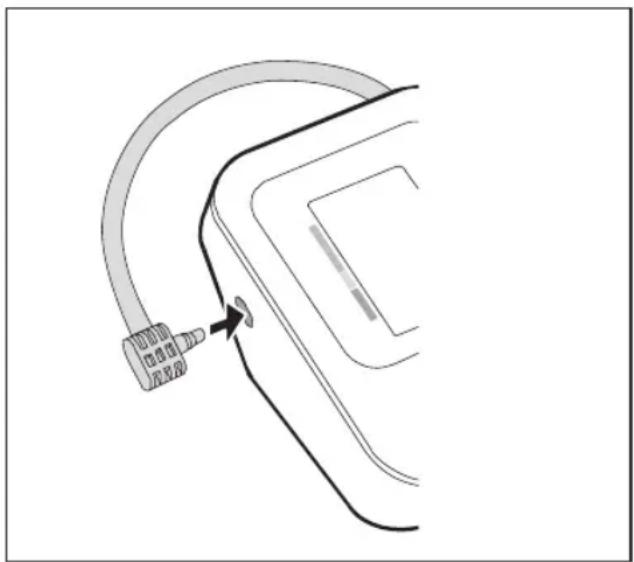
Attach the cuff to the monitor by pressing the plug (click) into the socket on the left side of the unit. (See illustration 2).
natural_image
Diagram of a medical or surgical device with a curved tube and connector, showing no text or symbolsIllustration 2
Preparing to measure your blood pressure
Observe the following instructions Attaching the cuff
when measuring your blood pressure:

Avoid smoking or drinking coffee for one hour before measuring your blood pressure.
The measurement should be taken from the bare upper arm.
⚠ In the case of tightly fitting outer clothing, ensure that the blood supply to

Sit comfortably for the blood pressure measurement. Support your back and arms. Do not cross your legs. Place your feet flat on the floor.
the arm is not cut off when the sleeve is rolled up (if necessary remove the article clothing before taking the measurement).
Relax for 5 minutes before taking a measurement.
Do not move during the measurement.
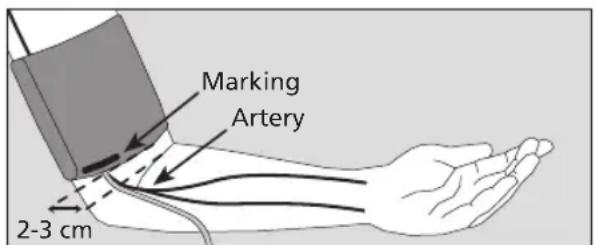
→Open out the cuff into the shape of a ring and slide it over the upper arm until the bottom edge of the cuff is about 2-3 cm above the elbow. The cuff must be positioned so that the marking is over the artery (see illustration 3).

text_image
Marking Artery 2-3 cmIllustration 3
⚠️Do not attach the cuff over wounds this can cause further injuries.
⚠ Ensure that the cuff is not attached to an arm where arteries or veins are undergoing or have undergone medical treatment (e.g. shunt).
⚠ For women who have had a breast amputated, do not attach the cuff to the arm on the amputated side of the body.
⚠️During the measurement, medical apparatus that are being used on the same arm at the same time, may malfunction.
⚠️The cuff must not be too tight. There should be enough space to fit roughly two fingers between arm and cuff.
as! The metal ring should never lie over the artery (see illustration 3) as this may produce a false reading.
→Grasp the end of the cuff that feeds though the metal ring and wrap it around the outside of your arm. Attach the Velcro fastener by applying gentle pressure.
Preparing to measure your blood pressure
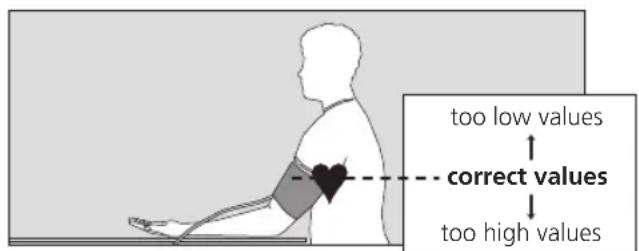
→Place your arm with the cuff attached on the table, holding it relaxed and slightly bent so that the cuff is level with your heart.
text_image
too low values ↑ correct values ↓ too high valuesIllustration 4

Do not talk during the measurement.
⚠️Check that the air tube is not kinked during the measurement. This could cause congestion of the blood flow and subsequent injury.
⚠ The blood pressure measurement should not prevent the flow of blood for an unnecessary length of time (> 2 minutes). If the monitor fails to function correctly, remove the cuff from the arm.
Excessive frequent measurements can cause injury by restricting blood flow.
EN
⚠ The device may not be used by unsupervised children.
⚠️Do not use the device near infants. This can lead to accidents or damage.
⚠️Do not start the device without putting on the cuff.
There are small parts that may cause a choking hazard if swallowed by mistake by infants.
Measuring your blood pressure
⚠️If the ambient temperature changes significantly, leave the device about an hour to adapt to the new ambient temperature before using it.
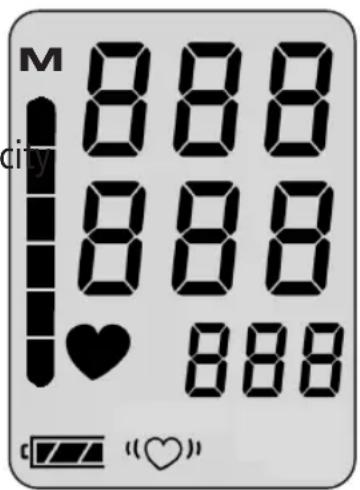
⚠️Now hold the arm absolutely still and do not talk. All the items on the LCD display appear briefly to indicate that the monitor is now ready for use (see illustration 5).

The performance of the device can be affected by excessive temperature, humidity or altitude.
Your monitor has a memory with a capacity of 30 measurements.
→Start the measurement with the start button

text_image
M 888 city 888 ♥ 888 c/7 ((♥)Illustration 5
Measuring your blood pressure
The pump starts to inflate the cuff.
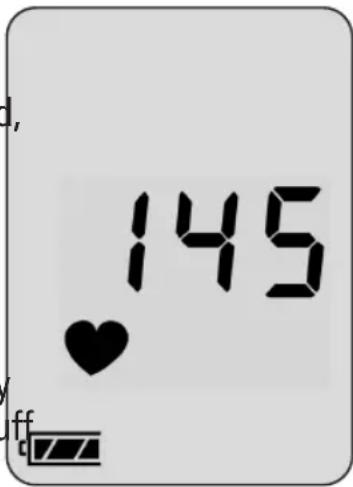
During the measurement phase the descending cuff pressure and the flashing
The monitor has an intelligent automatic inflation system for gentle inflation to th
♥ symbol are displayed (see illustra-
correct cuff pressure.
The increasing cuff pressure is displayed.
When the required pressure is reached, the pump switches off and the air is released slowly from the cuff.
text_image
145⚠ Interrupting a measurement:
A measurement can be interrupted at any stage by pressing the start button; the cuff deflates automatically.
Illustration 6

Measurement display

After the end of the measurement, the built valve opens automatically and the cuff deflates rapidly.
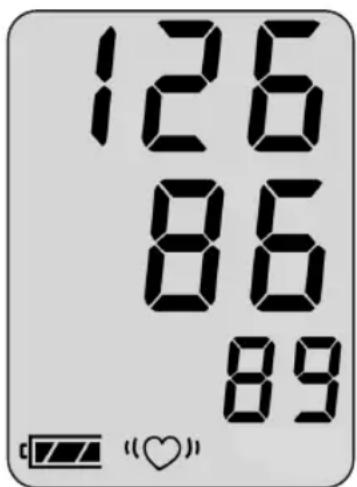
The measured blood pressure values (systole, diastole, pulse) are displayed (s yllustration 7).
text_image
126 86 89Illustration 7
Systole mmHg
Diastole mmHg
Pulse/min.
inThe measurement is stored automatically. If the memory store is full (30 measurements), the oldest measurement is deleted and the current one stored.
Invalid measurements with an "Err" message (see page 70) are not stored.
If the symbol appears after the measurement, it is recommended that the measurement is repeated, holding the arm completely still. If the symbol appears again even with the arm held still, this may be an indication of an irregular heartbeat. Please discuss this with your doctor at your next visit.
Measurement display
Blood pressure is a dynamic parameter and can be affected by the patient's position, e.g. sitting, standing, lying, moving, before or during the measurement, physical condition (stress, disease, etc.).

Allow at least two minutes between measurements.
→If no further measurement is required, remove the cuff from the arm.
→If the measurement result is obviously wrong, repeat the measurement.
The unit switches itself off automatically after about 1 min. To repeat a measurement, press the start button again briefly.

Completing the blood pressure record card Retrieving the average value and WHO classification
→Enter each individual value in your record card.
→ Enter the average value in the field specifically reserved for this in your record card.
→Retrieve your average value after 30 blood pressure measurements by pres- If there is no measurement in the memory, sing the START-button for about 3 "0" is displayed for systole, diastole and seconds with the monitor switched offpulse.
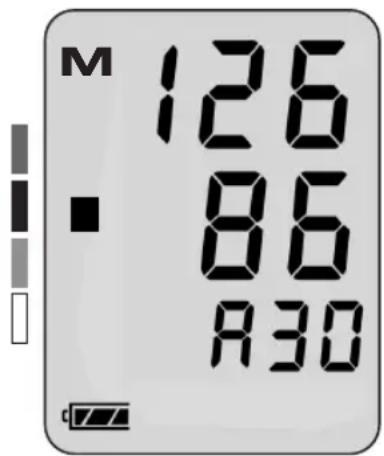
The average value of all stored values (for systole and diastole) appears. The number of measurements stored is shown in the "PUL" display (see illustration 8).

Completing the blood pressure record card Retrieving the average value and WHO classification
A dark rectangle appears on the left of the screen(seeillustration8), indicating the level of the average blood pressure value. Use the accompanying evaluation scale (see illustration 9) to identify the range within which your blood pressure falls under the WHO classification (see page 52).
The WHO display appears only with the average value display.
text_image
M 126 ■ 86 A30Illustration 8
Average value Systole mmHg
Average value Diastole mmHg
Number of measurements

WHO classification
high blood pressure (hypertension)
borderline normal blood pressure
normal blood pressure
□ optimum blood pressure
Illustration 9
Displaying individual stored values
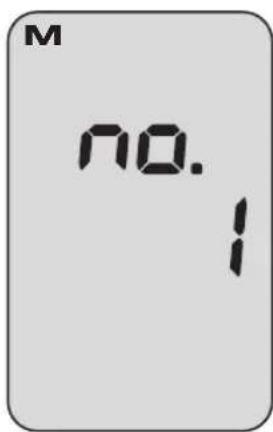
After indication of the average values automatically After the last value has been all measured values are displayed in chronological shown the device switches off order (starting with the most recent value). Before automatically. the values are shown, the number of the measurement is displayed (see illustration 10).

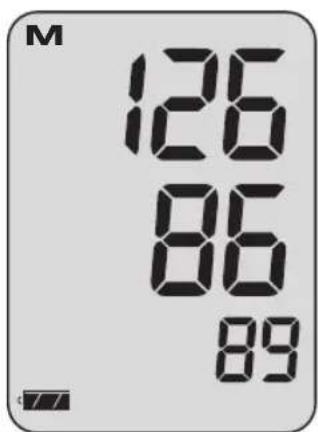
The corresponding measurement value appears after 3 seconds (see illustration 11).
text_image
M no. 1Illustration 10
text_image
M 126 86 89Illustration 11
Systole mmHg
Diastole mmHg
Pulses/min.
.Erase the memory
Press and hold the START button for about 5 seconds with the monitor switched off. The display shows "LL"no Release the START button. Then press the START button again. The display shows "CL-YES". Wait until the unit automatically shuts off.
Mains operation
The mains connection socket is located at⚠️Do not touch the batteries, the power supply unit socket and the patient at the rear of the monitor.
Where required, use only the boso powersame time.
supply unit (order number 410-7-150).
This power supply unit produces a rectified. Remove the power supply unit plug output of the correct polarity. Other com-from the blood pressure monitor when it is mercially available power supply units cannot in use.
cause damage to the electronic compo-
nents, which will invalidate the warranty.
There is also a risk of fire with these other power supply units.
Error messages
If any problems occur during the measurement, the display will show an error message instead of a blood pressure reading.
Meaning of error messages:

| Cause of Err message: Troubleshooting: | ||
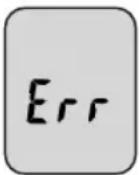 | Excessive variation in cuff pressure during measurement | Hold arm still. |
| No valid pulse readings Check position of cuff (see page 59) and repeat measurement. | ||
| Systole – diastole difference Check position of cuff (see page 59) too small: and repeat measurement. | ||
| Systole – diastole≤10 mmHg | ||
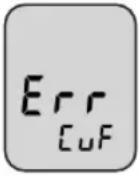 | Incorrectly inflated Cuff possibly | too loose, attach cuff more firmly (see page 59) |
| Cause of Err message: Troubleshooting: | ||
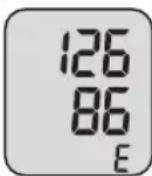 | The pulse value could not be determined correctly. Check position of cuff and repeat measurement. | |
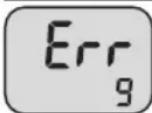 | Internal Error | Remove the batteries and briefly press START but ton. Put the batteries back into the monitor. If the error persists, return the instrument for repairs to the manufacturer. |
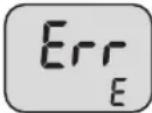 | ||
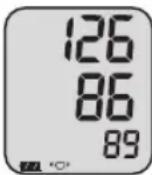 | “♡” Display: Troubleshooting: | |
| Repeat measurement recommended, holding the arm absolutely still.If the “symbol appears again, even with the arm held still, this may be an indication of an irregular heartbeat.Please discuss this with your doctor at your next visit. | ||
Cleaning and Disinfection
Cleaning Monitor:
Use a soft, dry cloth to clean your monit
Cleaning Cuff:
Small stains on the cuff can be removed carefully with a proprietary washing-up liquid.
Disinfection Cuff:
for disinfectant wipes (at least 5 minutes exposure time) of the device and the cuff, we recommend the disinfectant antifect li- quid (Schülke & Mayr). To disinfect the cuff, we recommend spray disinfection. In particular, if the device is used on multi-ple users is to pay attention to regular cleaning and disinfections of the cuff.

Warranty Conditions
We give 3 years warranty from the date No claims for damages against us are sub-purchase. The purchase date has to be substantiated by the warranty.
ven by the invoice. Within the warranty pe-
riod defects are eliminated free of charge. In the case of justified warranty claims the After repairs the warranty period is not ex device has to be sent along with the origi-tended on the whole unit, but only to the al invoice to:
replaced components.
BOSCH + SOHN GMBH U. CO. KG,
Excluded from the warranty are parts subBahnhofstr. 64, ject to normal wear and tear (e.g. cuff), 72417 Jungingen, transport damages and any damage cau- GERMANY. sed by improper handling (e.g. non-compli-www.boso.de ance with the instructions for use). Dama- ges due to disassembly by unauthorized persons are also excluded from warranty.

Customer service
Disposal

Customer service:
Warranty and repair work must be undertaken by trained and authorised personnel
Do not modify this equipment without authorization of the manufacturer.
Send the monitor, carefully packaged and with sufficient postage, to your authorised dealer or directly to:
Do not dispose of monitors and batteries in the domestic waste.
At the end of its lifespan, the monitor must be taken to a collection site for obsolete
electronic items.
Please note that batteries and rechargeable batteries must be disposed of separately (local authority collection site).
Expected operational lifetime of the equipment: 5 years (using the unit 6 times a day). Expected operational lifetime of the cuff: 2 years (using the unit 6 times a day).
Technical data
Measurement principle: oscillometric
Measurement range: Systolic: 60 to 279 mmHg Diastolic: 40 to 200 mmHg Pulse: 40 to 180 per minute
Cuff pressure: 0 to 299 mmHg
Memory store: 30 measurements
Display: LCD
Operating conditions: environmental temperature +10°C to +40°C Relative humidity 15 to 85% Air pressure 800 hPa to 1060 hPa
Transport/ environmental temperature -20°C to +60°C Storage conditions: Relative humidity 10 to 95% Air pressure 700 hPa to 1060 hPa

Technical data
Power supply: DC 6 V (4 x 1.5 V Mignon IEC LR 6 alkaline manganese batteries)
Alternative special option: DC 6 V power supply unit, Order No. 410-7-150

Typical battery life: 700 measurement cycles
(depending on inflation pressure and frequency of use).
Battery check: symbol display in LCD window
Weight: 240 g without batteries
Dimensions (WxHxD): 96 mm x 68 mm x 130 mm
Classification: Medical device with internal energy source (in battery operation) / class II (in power supply unit operation), continuous operation mode
Applied part: Type BF ( )

Technical data
Protection against solid IP20
objects: IP classification is the degree of protection provided by enclosures in accordance with IEC 60529. This device is protected against solid foreign objects of 12mm diameter and greater such as fingers. This device is not protected against water.
Clinical test: Accuracy complies with the requirements of ISO 81060 Part 2
Maximum deviation of cuff ± 3 mmHg or 2% of the reading pressure measurement: (whichever is the higher)
Maximum deviation of ± 5% pulse rate display:
Applicable standard: IEC 80601-2-30 : "Particular requirements for basic safety and essential performance of automated non-invasive sphygmomanometers"

Calibration checks - Testing instructions
(for trained specialist staff only)
Calibration checks – every 2 years at the B) latest – must be performed by the following institutions or persons:
- Manufacturer
– Trade measurements authorities - Persons who fulfil the requirements of the legislation governing the operation of medical devices.
A) Function testing
Function testing of the monitor can only be carried out on a person or with a suitable simulator.
Testing of pressure circuit integrity and deviation of pressure display Note:
a) When the pressure in measurement mode increases above 299 mmHg, the quick release valve is triggered and the pressure circuit opens. When the pressure in test mode increases above 320 mmHg, the measured value display flashes.
b) For the calibration checks a special test plug must be used. The test plug is th available for a fee from the manufacturer.

Calibration checks - Testing instructions
(for trained specialist staff only)
A pump ball must also be introduced into the pressure circuit.
Testing
1.) Remove batteries.
2.) Hold start button pressed down and insert batteries.
3.) Release start button.
The monitor is now ready for testing;
the current pressure is displayed in the
SYS and DIA fields.
4.) Perform test for deviation of pressure display and pressure circuit integrity (observe setting time for cuff – at least 30 seconds) in the usual manner.
5.) Switch off monitor by pressing the START button again.
⚠ The device must not undergo service or maintenance while it is in use.

Table des matières
Introduction......89
Destination 90
natural_image
Diagram of a battery pack with two batteries and an open circuit board, showing internal components and connections (no text or symbols)natural_image
Diagram of a medical device with a curved tube and connector, showing a small circular component inserted into the ear (no text or symbols)Figure 2

natural_image
Diagram of a battery pack being inserted into a device, showing internal components and battery arrangement (no text or symbols)natural_image
Diagram of a car door handle with a cable and connector, showing no text or symbolsFig. 2

text_image
M 888 I 888 ♥ 888 C ( ) ( )Fig. 5
natural_image
Diagram of a battery pack inserting into a slot, showing charge distribution and battery arrangement (no text or symbols)natural_image
Diagram of a connector or cable assembly with a connector pin, showing no text or symbolsFigura 2

text_image
M 888 i 888 i 888 0 c/77 ((♥)Figura 5


natural_image
Blank white image with no visible content, text, or symbolsCE 0124