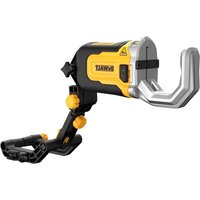
DWAPVCIR - Saw DEWALT - Free user manual and instructions
Find the device manual for free DWAPVCIR DEWALT in PDF.


User questions about DWAPVCIR DEWALT
0 question about this device. Answer the ones you know or ask your own.
Ask a new question about this device
Download the instructions for your Saw in PDF format for free! Find your manual DWAPVCIR - DEWALT and take your electronic device back in hand. On this page are published all the documents necessary for the use of your device. DWAPVCIR by DEWALT.
USER MANUAL DWAPVCIR DEWALT
English (original instructions) 17
natural_image
Technical illustration of a mechanical linkage component with labeled parts (1 and 2), showing no text or symbols beyond labels.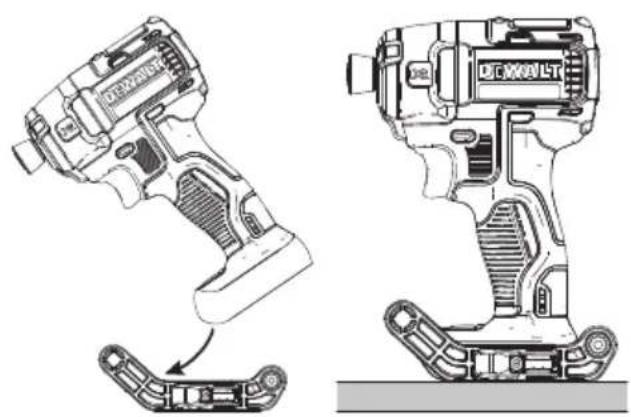
natural_image
Technical line drawing of a mechanical device with exploded view and side view (no text or symbols)Fig. D Fig. E
natural_image
Technical illustration of a STAVNUT robotic arm with directional arrows indicating movement or force (no text or symbols present)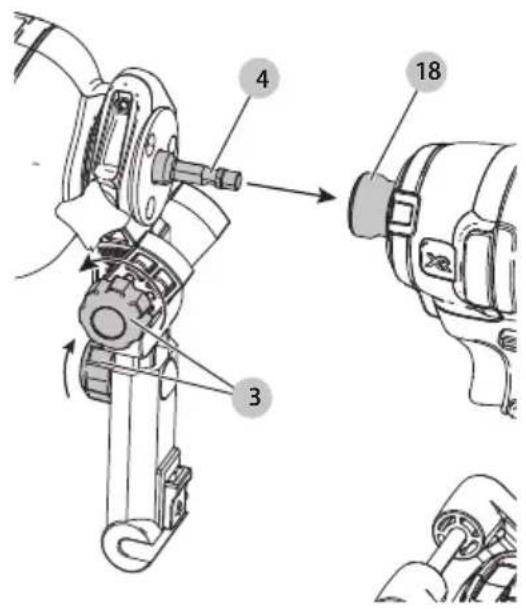
text_image
Technical diagram of a mechanical assembly with numbered components and directional arrows indicating motion or assembly.Fig. F
text_image
5 6 8 7 9 DEWAIFig. G
natural_image
Technical line drawing of a robotic arm with articulated joints and control panel (no text or symbols)Fig. H Fig. I
text_image
H Fig. I 10 14 15 11 12 13 DiWAVE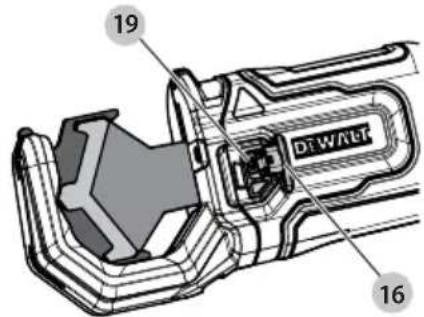
text_image
19 DiWNET 16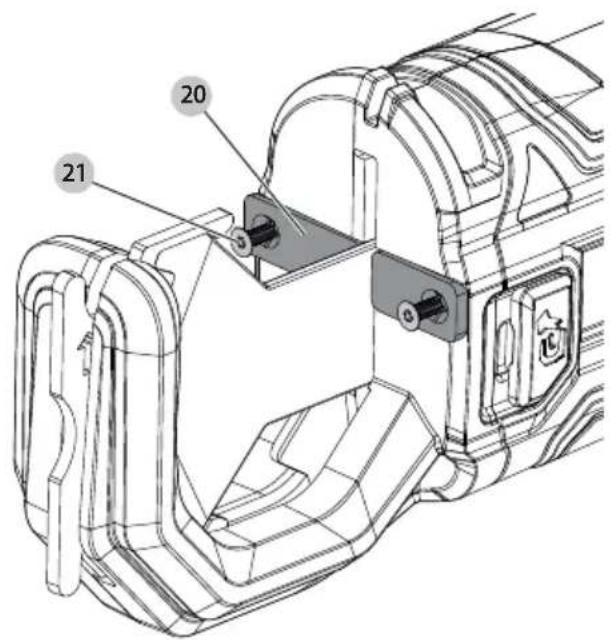
text_image
Technical diagram of a mechanical assembly with numbered components labeled 20 and 21Fig. J Fig. K
natural_image
Line drawing of a hand operating a DEXEULT electric drill press device (no text or symbols visible)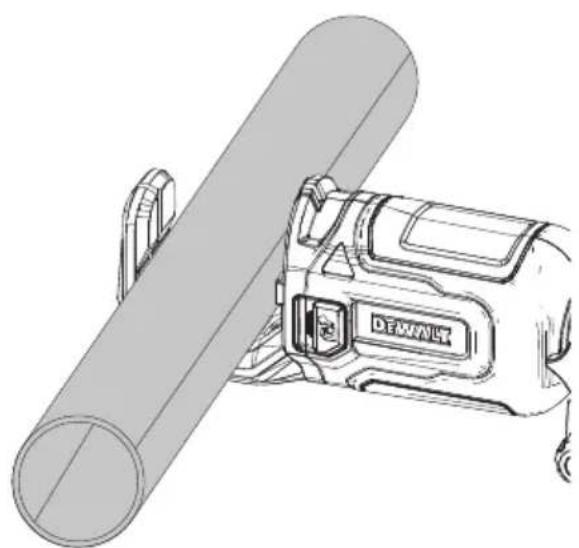
natural_image
Technical line drawing of a handheld device with a cylindrical pipe attached to its side (no text or symbols)Impact Connect® PVC/PEX-SAKS DT20560
Tillykke!
text_image
QR code image containing encoded data, no visible human-readable texttext_image
Mr. Georg Molecular LaboratoryMarkus Rompel
Vice-President Engineering, PTE-Europe
text_image
QR code image containing encoded data, no visible human-readable textImpact Connect® PVC/PEX Cutter DT20560
Congratulations!
You have chosen a DEWALT tool. Years of experience, thorough product development and innovation make DEWALT one of the most reliable partners for professional power tool users.
Technical Data
WARNING: Cold pipes could result in flying debris of PVC.
DT20560 is intended to be connected to Impact Drivers only."
DT20560
| Max pipe diameter mm | 60.3 |
| Materials To Be Cut | PVC, uPVC, cPVC and PEXType A, B, and C |
The pipe cutter DT20560 is optimized for DEWALT Impact Drivers and compatible with select other branded pro-grade Impact Drivers.
Mass not exceeding 2kg
Torque between 135Nm and 280Nm
Speed between 2500/min and 4000/min

WARNING: To reduce the risk of injury, read the instruction manual.
Definitions: Safety Guidelines
The definitions below describe the level of severity for each signal word. Please read the manual and pay attention to these symbols.
DANGER: Indicates an imminently hazardous situation which, if not avoided, will result in death or serious injury.
WARNING: Indicates a potentially hazardous situation which, if not avoided, could result in death or serious injury.
CAUTION: Indicates a potentially hazardous situation under, if not avoided, may result in minor or moderate injury.
NOTICE: Indicates a practice not related to personal injury which, if not avoided, may result in property damage.
Diabetes risk of electric shock.
Diabetes risk of fire.
The vibration and/or noise emission level can be expected equally or lower than the value as given in the information sheet of the used impact driver. These values have been measured in accordance with a standardised test given in EN62841 and may be used to compare one tool with another. It may be used for a preliminary assessment of exposure.
WARNING: The declared vibration and/or noise emission leads represents the main applications of the tool. However,
if the tool is used for different applications, with different accessories or is poorly maintained, the vibration and/or noise emission may differ. This may significantly increase the exposure level over the total working period.
An estimation of the level of exposure to vibration and/or noise should also take into account the times when the tool is switched off or when it is running but not actually doing the job. This may significantly reduce the exposure level over the total working period.
Identify additional safety measures to protect the operator from the effects of vibration and/or noise such as: maintain the tool and the accessories, keep the hands warm (relevant for vibration), organisation of work patterns.
EC-Declaration of Conformity
Machinery Directive

PVC/PEX CUTTER
DT20560
DEWALT declares that these products described under Technical Data are in compliance with:
2006/42/EC, EN 62841-1:2015 + AC:2015 + A11:2022.
For more information, please contact DEWALT at the following address or refer to the back of the manual.
The undersigned is responsible for compilation of the technical file and makes this declaration on behalf of DEWALT.
Markus Rompel
Vice-President Engineering, PTE-Europe
65510, Idstein, Germany
2023.02.01
DECLARATION OF CONFORMITY
THE SUPPLY OF MACHINERY (SAFETY) REGULATIONS 2008

PVc/PEX cutter DT20560
DEWALT declares that these products described under "technical data" are in compliance with:
EN 62841-1:2015 + AC:2015 + A11:2022
These products conform to the following UK Regulations
The Supply of Machinery (Safety) Regulations, 2008, S.I. 2008/1597 (as amended).
For more information, please contact DEWALT at the following address or refer to the back of the manual.
The undersigned is responsible for compilation of the technical file and makes this declaration on behalf of DEWALT.
text_image
E KeeKarl Evans
Vice President Professional Power Tools EANZ GTS
270 Bath Road, Slough
Berkshire, SL1 4DX
England
2023.02.01
GENERAL POWER TOOL SAFETY WARNINGS
WARNING: Read all safety warnings, instructions, illustrations and specifications provided with this power tool. Failure to follow all instructions listed below may result in electric shock, fire and/or serious injury.
SAVE ALL WARNINGS AND INSTRUCTIONS FOR FUTURE REFERENCE
The term "power tool" in the warnings refers to your mains-operated (corded) power tool or battery-operated (cordless) power tool.
Work Area Safety
a) Keep work area clean and well lit. Cluttered or dark areas invite accidents.
b) Do not operate power tools in explosive atmospheres, such as in the presence of flammable liquids, gases or dust. Power tools create sparks which may ignite the dust or fumes.
c) Keep children and bystanders away while operating a power tool. Distractions can cause you to lose control.
Electrical Safety
a) Power tool plugs must match the outlet. Never modify the plug in any way. Do not use any adapter plugs with earthed (grounded) power tools.
Unmodified plugs and matching outlets will reduce risk of electric shock.
b) Avoid body contact with earthed or grounded surfaces, such as pipes, radiators, ranges and refrigerators. There is an increased risk of electric shock if your body is earthed or grounded.
c) Do not expose power tools to rain or wet conditions. Water entering a power tool will increase the risk of electric shock.
d) Do not abuse the cord. Never use the cord for carrying, pulling or unplugging the power tool. Keep cord away from heat, oil, sharp edges or moving parts. Damaged or entangled cords increase the risk of electric shock.
e) When operating a power tool outdoors, use an extension cord suitable for outdoor use. Use of a cord suitable for outdoor use reduces the risk of electric shock.
f) If operating a power tool in a damp location is unavoidable, use a residual current device (RCD) protected supply. Use of an RCD reduces the risk of electric shock.
Personal Safety
a) Stay alert, watch what you are doing and use common sense when operating a power tool. Do not use a power tool while you are tired or under the influence of drugs, alcohol or medication. A moment of inattention while operating power tools may result in serious personal injury.
b) Use personal protective equipment. Always wear eye protection. Protective equipment such as a dust mask, non-skid safety shoes, hard hat or hearing protection used for appropriate conditions will reduce personal injuries.
c) Prevent unintentional starting. Ensure the switch is in the off position before connecting to power source and/or battery pack, picking up or carrying the tool. Carrying power tools with your finger on the switch or energising power tools that have the switch on invites accidents.
d) Remove any adjusting key or wrench before turning the power tool on. A wrench or a key left attached to a rotating part of the power tool may result in personal injury.
e) Do not overreach. Keep proper footing and balance at all times. This enables better control of the power tool in unexpected situations.
f) Dress properly. Do not wear loose clothing or jewellery. Keep your hair and clothing away from moving parts. Loose clothes, jewellery or long hair can be caught in moving parts.
g) If devices are provided for the connection of dust extraction and collection facilities, ensure these are connected and properly used. Use of dust collection can reduce dust-related hazards.
h) Do not let familiarity gained from frequent use of tools allow you to become complacent and ignore tool safety principles. A careless action can cause severe injury within a fraction of a second.
Power Tool Use and Care
a) Do not force the power tool. Use the correct power tool for your application. The correct power tool will do the job better and safer at the rate for which it was designed.
b) Do not use the power tool if the switch does not turn it on and off. Any power tool that cannot be controlled with the switch is dangerous and must be repaired.
c) Disconnect the plug from the power source and/or remove the battery pack, if detachable, from the power tool before making any adjustments, changing accessories, or storing power tools. Such preventive safety measures reduce the risk of starting the power tool accidentally.
d) Store idle power tools out of the reach of children and do not allow persons unfamiliar with the power tool or these instructions to operate the power tool. Power tools are dangerous in the hands of untrained users.
e) Maintain power tools and accessories. Check for misalignment or binding of moving parts, breakage of parts and any other condition that may affect the power tool's operation. If damaged, have the power tool repaired before use. Many accidents are caused by poorly maintained power tools.
f) Keep cutting tools sharp and clean. Properly maintained cutting tools with sharp cutting edges are less likely to bind and are easier to control.
g) Use the power tool, accessories and tool bits, etc. in accordance with these instructions, taking into account the working conditions and the work to be performed. Use of the power tool for operations different from those intended could result in a hazardous situation.
h) Keep handles and grasping surfaces dry, clean and free from oil and grease. Slippery handles and grasping surfaces do not allow for safe handling and control of the tool in unexpected situations.
Battery Tool Use and Care
a) Recharge only with the charger specified by the manufacturer. A charger that is suitable for one type of battery pack may create a risk of fire when used with another battery pack.
b) Use power tools only with specifically designated battery packs. Use of any other battery packs may create a risk of injury and fire.
c) When battery pack is not in use, keep it away from other metal objects, like paper clips, coins, keys, nails, screws or other small metal objects, that can make a connection from one terminal to another. Shorting the battery terminals together may cause burns or a fire.
d) Under abusive conditions, liquid may be ejected from the battery; avoid contact. If contact accidentally occurs, flush with water. If liquid contacts eyes, additionally seek medical help. Liquid ejected from the battery may cause irritation or burns.
e) Do not use a battery pack or tool that is damaged or modified. Damaged or modified batteries may exhibit unpredictable behaviour resulting in fire, explosion or risk of injury.
f) Do not expose a battery pack or tool to fire or excessive temperature. Exposure to fire or temperature above 130 °C may cause explosion.
g) Follow all charging instructions and do not charge the battery pack or tool outside the temperature range specified in the instructions. Charging improperly or at temperatures outside the specified range may damage the battery and increase the risk of fire.
Service
a) Have your power tool serviced by a qualified repair person using only identical replacement parts. This will ensure that the safety of the power tool is maintained.
b) Never service damaged battery packs. Service of battery packs should only be performed by the manufacturer or authorised service providers.
Additional Safety Rules for PVC/PEX Cutter Attachment
WARNING: Read and understand these instructions for the attached power tool. Before use, ensure the attachment is properly attached to the tool.
WARNING: Use the PVC cutter attachment only with DEWALT or DEWALT-approved accessories. Other uses of modifying the attachment for other applications may damage the attachment, damage the accessories and/or can result in a faulty installation. Faulty installations can result in failures, injury to installers and damage to property.
WARNING: When using this DEWALT cutting attachment for cutting PVC/PEX for fittings, the preparation of the cut should follow recommendations from the fitting manufacturer for proper installation procedures. Proper preparation and installation is the responsibility of the installing contractor.
a. Keep all body parts away from the attachments during operation and any time the power is ON. A moment of inattention while operating power tools may result in serious personal injury. Fingers or hands can be crushed, fractured or amputated if they become caught in the attachments.
b. Inspect tool and attachments before use for any loose or missing parts. Never attempt to repair or use a damaged PVC/PEX cutter, brace or other attachment. Replace with a new cutter or brace.
c. This tool produces large forces that can break attachments or parts and cause injury. Always be attentive and take proper safety precautions, including wearing eye protection.
d. Before operating, inspect job site for hazards including chemicals or waste that could remain in pipes.
e. Before operating, read and understand all safety and operating instructions including the fitting manufacturer's installation instructions and the instructions for any other equipment used with this tool. Failure to follow all instructions and warnings may result in property damage and/or serious personal injury.
f. Keep the cutting area of the attachment free from hands and other objects while the tool is in use. Fingers could be crushed or cut.
g. For best results, always clamp or anchor the material to be cut.
h. Cutting operations may cause material pieces to fly. Flying particles can cause permanent eye damage. ALWAYS wear eye protection.
i. Always wear gloves when operating tool and handling materials. The ends of the materials can be sharp and cause serious personal injury.
j. To reduce the risk of explosion, electric shock and property damage, never cut gas lines, electrical lines, or full water lines. Shut off water and drain lines before making a cut.
Storage Recommendations
The best storage place is one that is cool and dry, away from direct sunlight and excess heat or cold.
Package Contents
The package contains:
1PVC/PEXcutter
1 Instructionmanual
- Check for damage to the tool, parts or accessories which may have occurred during transport.
• Take the time to thoroughly read and understand this manual prior to operation.
Markings on Tool
The following pictograms are shown on the tool:

Read instruction manual before use.

Wear ear protection.

Wear eye protection

Laceration hazard
Date Code Position (Fig. A)
The production date code 11 consists of a 4-digit year followed by a 2-digit week and is extended by a 2-digit factory code.
Description (Fig. A)
WARNING: Never modify the power tool or any part of it. Damage or personal injury could result.
1 Back knob
2 Brace bracket
3 Arm knobs
4 Attachment shank
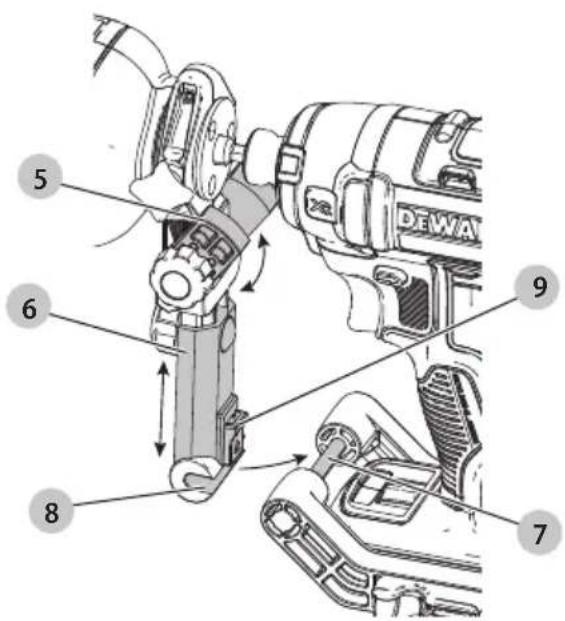
5 Arm joint
6 Arm slider
7 Bar
8 Bar channel
9 Slide lock
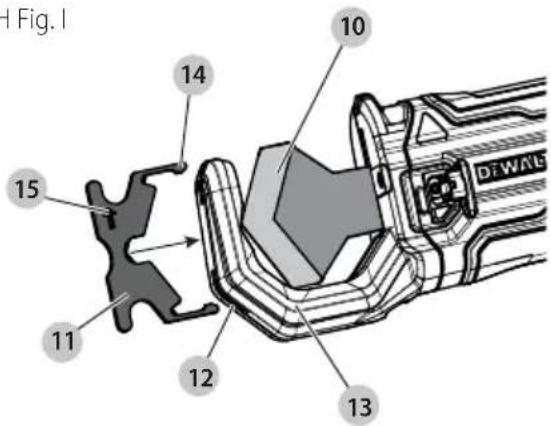
10 Blade
11 Blade cover/alignment guide
12 Front slot
13 Hook
14 Tabs
15 Arrow
16 Plug
17 Date code
Intended Use
This PVC/PEX cutter is designed for professional cutting of the following PVC and PEX materials.
- Max pipe diameter: 2.4" (60.3 mm)
- Materials to be cut: PVC, uPVC, cPVC and PEX Types A, B, and C
DO NOT use under wet conditions or in the presence of flammable liquids or gases.
This impact wrench is a professional power tool.
DO NOT let children come into contact with the tool.
Supervision is required when inexperienced operators use this tool.
This product is not intended for pruning activities or cutting any cables.
. Young children and the infirm. This appliance is not intended for use by young children or infirm persons without supervision.
- This product is not intended for use by persons (including children) suffering from diminished physical, sensory or mental abilities; lack of experience, knowledge or skills unless they are supervised by a person responsible for their safety. Children should never be left alone with this product.
ASSEMBLY AND ADJUSTMENTS
WARNING: To reduce the risk of serious personal injury, turn unit off and remove the battery pack before making any adjustments or removing/installing attachments or accessories. An accidental start-up can cause injury. WARNING: Never modify this device or any part of it. Damage or personal injury could result.
Attach the Universal Brace Bracket (Fig. B - D)
- Remove battery from Impact Driver. Do not reinstall battery until AFTER the Brace Bracket is installed.
- Loosen the back knob 1 until the Brace Bracket 2 can open wide enough to slip the Impact Driver through (as shown in Fig. B).
- Slide the Impact Driver into the Brace Bracket from the top (as shown in Fig. C).
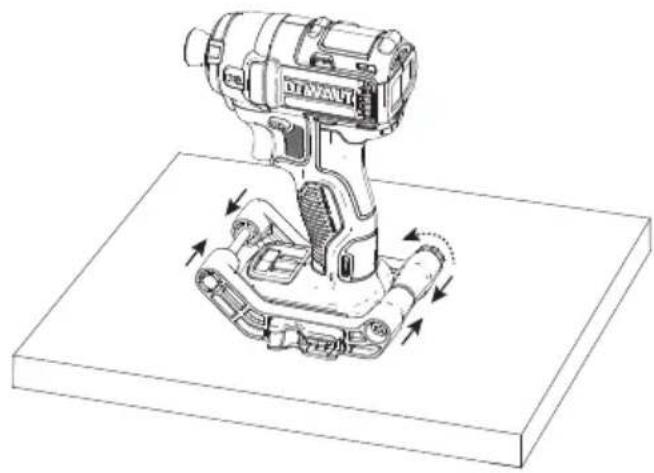
- Place the Impact Driver and Brace Bracket on a FLAT surface.
- Compress the front end together until the Brace Bracket is snug around the Impact Driver foot, then tighten the back knob. Both sides should remain parallel during tightening (as shown in Fig. D).
Attach the Brace Arm and Impact Connect Attachment (Fig. E - G)
- The blade should be fully advanced with the blade cover installed as the initial step.
-
Loosen both yellow arm knobs 3 one turn and insert the attachment shank 4 into the impact driver chuck 18 (as shown in Fig. E).
-
Rotate the arm joint 5 and the arm slider 6 until the bar 7 clicks into the bar channel 8. There will be an audible clicking as you rotate. The yellow slide lock 9 should secure the bar in place (as shown in Fig. F).
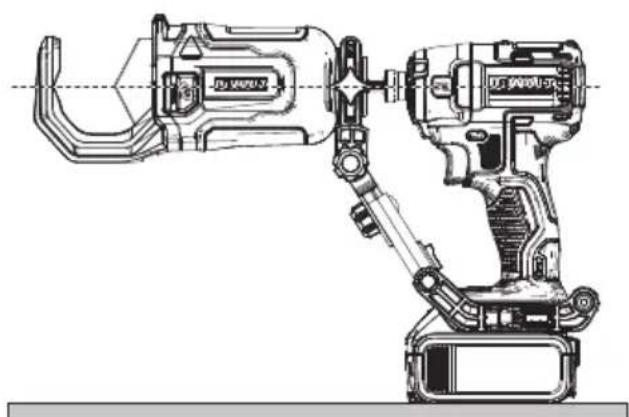
- Ensure the shank is parallel to the ground and finger tighten all knobs (as shown in Fig. G).
- Reinstall battery aFTER installation and prior to use.
Scan QR code for installation video.

text_image
QR code image containing encoded data, no visible human-readable textReplacing Blade (Fig. H)
- The blade should be fully advanced with the blade cover installed as the initial step.
- Advance blade 10 all the way forward by holding the trigger on the impact driver.
- Remove battery from impact driver.
- Push blade cover/alignment guide 11 through the front slot 12 of the hook 13 and over the blade until the tabs 14 are secured onto the blade.
NOTE: The arrow 15 should point to the open end of the hook.
- Once the blade cover/alignment guide is set, pull back the plug 16 to expose the set screw 19.
- Use 2.5mm hex wrench to loosen set screw until the covered blade can be pulled forward through the front slot of the hook.
- Carefully remove the blade cover/alignment guide and install onto new blade.
- Insert new covered blade through the front slot and into the PVC Cutter Attachment body.
- Tighten set screw. Ensure the blade does not move.
- Reinsert the plug.
- Reset the guide plate as described in the RESETTING GUIDE PLATE section..
Resetting Guide Plate (Fig. I)
Reset the guide plate 20 every time the blade is replaced or whenever the blade becomes loose.
- Advance blade 10 all the way forward by holding the trigger on the impact driver.
- Remove battery from impact driver.
- Push blade cover/alignment guide 11 through the front slot 12 of the hook 13 and over the blade until the tabs 14 are secured onto the blade.
NOTE: The arrow 15 should point to the open end of the hook.
- Loosen plate screws 21 using a T10 screwdriver.
NOTE: The screws should remain attached but the guide plates should be able to slide slightly. - Press the guide plates in so the front end lightly contacts the blade and retighten the screws firmly.
- Remove the blade cover/alignment guide prior to use.
OPERATION
Instructions for Use
WARNING: Always observe the safety instructions and applicable regulations.
WARNING: To reduce the risk of serious personal injury, turn tool off and disconnect battery pack before making any adjustments or removing/installing attachments or accessories. An accidental start-up can cause injury.
Introduction
The DWAPVCIR PVC/PEX Cutter uses a compatible impact driver to actuate a power screw which mechanically cuts plastic tubing members.
- Forward setting: Squeezing the trigger with the impact driver set to forward (clockwise) advances the cutting blade. Fully releasing the trigger switch stops the advancement of the blade.
- Reverse setting: Squeezing the trigger with the impact driver set to reverse (counterclockwise) retracts the blade into the housing.
WARNING: CUT OR AMPUTATION HAZARD. Never have any part of your body near the blade or moving parts during the cutting cycle or when the battery is installed in the tool. Serious personal injury may occur.
WARNING: Proper material preparation and installation is the responsibility of the installing contractor.
WARNING: To reduce the risk of injury, always fully retract the trade for transport or storage.
WARNING: Do not cut short pieces of material that requires hands to be within 6" from the blade. Blade is sharp.
CAUTION: Do not cut off pieces of tubing less than 1x a diameter of tubing for optimal cut.
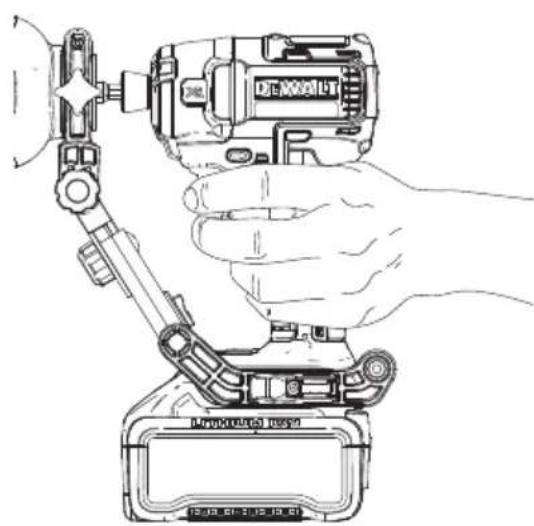
Proper Hand Position (Fig. J)
WARNING: To reduce the risk of serious personal injury, ALWAYS use proper hand position as shown.
WARNING: To reduce the risk of serious personal injury, ALWAYS hold securely in anticipation of a sudden reaction.
Proper hand position requires one hand on the main handle of the impact driver.
Cutting PVC/PEX (Fig.K)
- Mark the cutting point on the pipe.
- Secure pipe to prevent it from moving while cutting.
- Insert the pipe into the "V" notch for optimal cutting.
- Align the blade with mark.
- Depress the trigger of the impact driver.
- After the tubing is fully cut, release the trigger.
- Retract blade fully into housing for subsequent cut, storage, or transportation.
MAINTENANCE
Your power tool has been designed to operate over a long period of time with a minimum of maintenance. Continuous satisfactory operation depends upon proper tool care and regular cleaning.
WARNING: To reduce the risk of serious personal injury, turn tool off and disconnect battery pack before making any adjustments or removing/installing attachments or accessories. An accidental start-up can cause injury.
The charger and battery pack are not serviceable.

Cleaning
WARNING: Never use solvents or other harsh chemicals for cleaning the non-metallic parts of the tool. These chemicals may weaken the materials used in these parts. Use a cloth dampened only with water and mild soap. Never let any liquid get inside the tool; never immerse any part of the tool into a liquid.
Optional Accessories
WARNING: Since accessories, other than those offered by DEWALT, have not been tested with this product, use of such accessories with this tool could be hazardous. To reduce the risk of injury, only DEWALT-recommended accessories should be used with this product.
Consult your dealer for further information on the appropriate accessories.
Protecting the Environment
Separate collection. Products and batteries marked with this symbol must not be disposed of with normal household waste. Products and batteries contain materials that can be recovered or recycled, reducing the demand for raw materials. Please recycle electrical products and batteries according to local provisions. Further information is available at www.2helpU.com.
Rechargeable Battery Pack
This long-life battery pack must be recharged when it fails to produce sufficient power on jobs that were easily done before. At the end of its technical life, discard it with due care for our environment:
- Run the battery pack down completely, then remove it from the tool.
- Li-lon cells are recyclable. Take them to your dealer or a local recycling station. The collected battery packs will be recycled or disposed of properly.
Impact Connect® CORTADORA DE PVC/PEX
DT20560
¡Enhorabuena!
text_image
QR code image containing encoded data, no visible human-readable text65510, Idstein, Germany
2023.02.01
CONSIGNES DE SÉCURITÉ GÉNÉRALES PROPRES AUX OUTILS ÉLECTRIQUES
text_image
QR code image containing encoded data, no visible human-readable textRemplacer la lame (Fig. H)
Bloc-batterie rechargeable
Vice Presidente Engineering, PTE-Europe
text_image
QR code image containing encoded data, no visible human-readable textVice-President Engineering, PTE-Europe
65510, Idstein, Germany
2023.02.01
ALGEMENE VEILIGHEIDSWAARSCHUWINGEN VOOR ELEKTRISCH GEREEDSCHAP
WAARSCHUWING: Lees alle
BEWAAR ALLE WAARSCHUWINGEN EN INSTRUCTIES ALS TOEKOMSTIG REFERENTIEMATERIAAL
text_image
QR code image containing encoded data, no visible human-readable textVice-President Engineering, PTE-Europe
text_image
QR code image containing encoded data, no visible human-readable textSkifte blad (figur H)
text_image
QR code image containing encoded data, no visible human-readable texttext_image
QR code image containing encoded data, no visible human-readable textVice-President Engineering, PTE-Europe