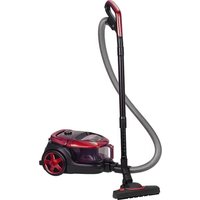
MOD-61 - Vacuum Cleaner MPM - Free user manual and instructions
Find the device manual for free MOD-61 MPM in PDF.


| Product type | Bagless vacuum cleaner with cyclone |
| Model | MPM MOD-61 |
| Usage | Home, indoor, dry surfaces |
| Power supply | Mains, 5 m power cord |
| Suction power | Variable via regulator (MIN to MAX) |
| Operating radius | 7 m (cord + hose) |
| Filtration system | HEPA 13 filter, sponge filter, motor carbon filter, exhaust carbon filter, steel filter |
| Dust container capacity | Not specified (MAX mark visible) |
| Suction type | Bagless, cyclone |
| Included accessories | Floor/carpet brush, parquet brush, small turbo brush, extendable crevice nozzle, upholstery brush, accessory holder |
| Hose and tube | Suction hose with handle, metal telescopic tube |
| Parking handles | Two: one horizontal at the back, one vertical under the device |
| Cord rewinder | Automatic with folding handle (button) |
| Filter maintenance | Monthly cleaning: brush HEPA, others washable with warm water and thorough drying |
| Safety | Automatic shut-off in case of overheating, do not use without filters, child protection (do not leave unattended) |
| Electrical characteristics | See rating plate on the bottom of the device |
| Housing material | Plastic |
| Weight | Approximately 5 kg (estimate) |
| Dimensions (L × W × H) | Approximately 30 × 30 × 50 cm (estimate) |
Frequently Asked Questions - MOD-61 MPM
User questions about MOD-61 MPM
0 question about this device. Answer the ones you know or ask your own.
Ask a new question about this device
Download the instructions for your Vacuum Cleaner in PDF format for free! Find your manual MOD-61 - MPM and take your electronic device back in hand. On this page are published all the documents necessary for the use of your device. MOD-61 by MPM.
USER MANUAL MOD-61 MPM
EN We wish you satisfaction from using the product and invite you to check a wide range of other MPM appliances
natural_image
Red and black vacuum cleaner with coiled hose (no visible text or symbols)cz NAVOD K OBSLUZE 3
BEZPEČNOSTNÍ POKYNY PŘI POUŽÍVÁNÍ
- Read the instructions carefully before use.
-Always unplug when the appliance is not in use or before cleaning it.
-Check that the power parameters on the appliance's rating plate correspond to the parameters of your power supply network.
- Do not hang the cable on sharp edges or allow it to come into contact with hot surfaces.
-Never pull on the cable to disconnect the appliance from the power source.
- Never leave the vacuum cleaner switched on unattended.
- Take special care when children are near the appliance.
-Do not let the vacuum cleaner ride on the mains cable, as this can damage the cable's insulation cover.
-Do not attempt to use the vacuum cleaner if you suspect any technical fault.
- Never use an appliance, including one with a damaged cord or plug, in which case have it repaired at an authorised service centre.
- Use of accessories not recommended by the manufacturer may cause damage to the appliance, personal injury or fire.
- Take extra care when operating the vacuum cleaner on stairs.
-Do not immerse the appliance, cord or plug in water or other liquids; the power cord and plug must always be dry.
-Do not use the vacuum cleaner to pick up flammable and corrosive liquids, solvents, matches, ashes, cigarette butts, oils, sharp objects, etc. This can damage the appliance or even cause fire! Do not vacuum near flammable liquids or substances either!
- Keep the vacuum cleaner away from all heat sources (radiators, cookers, etc.) due to its plastic housing.
- Do not block the vacuum cleaner inlet and outlet openings!
- The appliance is intended for domestic use only.
-This equipment may be used by children of at least 8 years of age and by persons of diminished physical, mental capacity and lack of experience and knowledge of the equipment if supervision or instruction is provided regarding the safe use of the equipment so that the hazards involved are understood. Unsupervised children should not perform cleaning and maintenance of the equipment.
-The appliance is not a toy and should not be used as such by children.
-Keep the device and its cord out of reach of children under 8 years of age.
- Do not vacuum people or pets, and take particular care not to bring the nozzle close to your eyes or ears.
-Switch off the appliance and disconnect its power supply before the replacement.
-Do not vacuum without the bag and the filters, or if they are damaged.
-Check the suction hose, pipes and nozzles – remove debris inside.
-Use the vacuum cleaner only indoors and only for vacuuming dry surfaces. Dry wet cleaned carpets before vacuuming.
-For the safety of children, please do not leave freely accessible parts of the packaging (plastic bags, cardboard boxes, polystyrene, etc.).
-WARNING! Do not allow children to play with the film. Danger of suffocation!
DESCRIPTION OF THE APPLIANCE
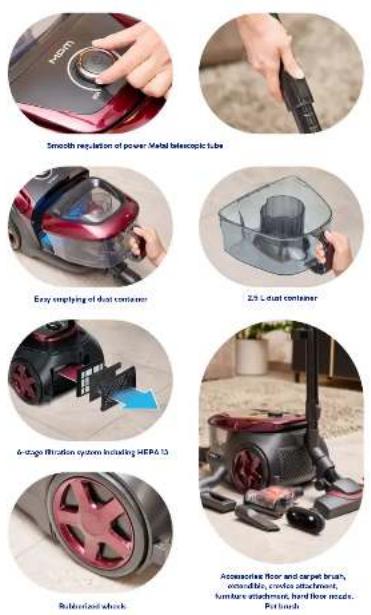
Unlike a conventional vacuum cleaner, a bagless vacuum cleaner has a specially designed chamber in which the contaminated air moves in a circular motion at very high speed, thus causing centrifugal force to eject all the dirt into the dust container. Cleaning the container is an extremely simple operation, which means that using a vacuum cleaner saves time and also reduces operational costs.
- Vacuum Cleaner housing
- Carrying handle/cable retraction button
- On/off switch with suction power regulator
- Dust container with handle
- Dust container lid
- Dust container lock release button
- Steel filter
- Anti-dust foam filter
- Hepa filter with handle
- Motor carbon filter
- Filtr Hepa 13
-
Outlet carbon filter
-
Hepa filter protective grille
- Power cable
- Suction hose connection hole
- Telescopic metal tube
- Suction hose with handle
- Parking handle
- Floor and carpet brush
- Parquet brush
- Small turbo brush
- Crevice attachment
- Furniture attachment
- Handle for accessories
- Vacuum Cleaner wheels
ELECTROSTATICS
Vacuuming certain surfaces in low humidity conditions may cause the unit to become slightly electrified. This is a natural phenomenon, which does not damage the appliance and is not a defect.
In order to minimise this phenomenon, it is recommended to:
- discharge the appliance by frequently touching metal objects in the room with the tube,
- increase air humidity in the room,
- use generally available anti-electrostatic agents.
ASSEMBLY OF THE APPLIANCE
- Unpack the appliance and remove all fillers, stickers and bags.
- Check whether the dust container with the cover and all filters are properly assembled on the vacuum cleaner. The detailed description of the assembly and disassembly can be found in chapters: "EMPTYING THE DUST CONTAINER" and "CLEANING AND REPLACEMENT OF FILTERS".
- Press the latch located at the end of the suction hose (17), then insert the hose into the hole (15) and release the latch. In order to disassemble these elements press the latch and remove the hose (17) from the hole (15).
- Connect the other side of the suction hose with the handle (17) to the telescopic tube (16). Put one of the attachments (19), (20), (21), (22) or (23) on the end of the tube. The length of the telescopic tube can be adjusted by pressing the button on the tube and extending/retracting the tube according to the user's needs.
USING THE APPLIANCE
- Before switching on the vacuum cleaner, unfold the power cord (14) to the appropriate length and insert the plug into the mains socket. The green sign on the power cord means the optimal length. Do not extend the cord beyond the red marking! When unwinding the cord, do not press the vacuum cleaner handle (2), which acts as a cord retractor button in the folded position.
- Press the switch (3) to switch the vacuum cleaner on.
CAUTION! It is recommended to set the power regulator knob (3) to MIN before switching the vacuum cleaner on!
- During the operation of the appliance, select the optimal suction power with the suction power regulator knob (3). Follow the rule that we use the lowest power for delicate surfaces (MIN), gradually increasing it for carpets and floors with heavy soiling (MAX).
- Keep the dust container level under regular control (4). The container must not be filled over the horizontal line MAX located on the container. The overfilling of the container will result in the weakening of the suction power and the fast soiling of the filters.
CAUTION! If you conclude that the suction power of the vacuum cleaner is weaker, clean the dust container and/or unblock the suction hose.
-
To optimally position the appliance after use, use the parking handles (18) in the horizontal position located on the back of the vacuum cleaner next to the protective grille of the Hepa filter. Place the catch located on the back of the floor-carpet head (19) with the connected suction hose and telescopic tube. The second catch for parking, which facilitates the storage of the vacuum cleaner in the vertical position is located underneath the appliance.
-
To retract the power cord, press the folded handle of the vacuum cleaner (2) with one hand and hold the cord with the other hand to prevent sudden shuffling that could damage the cord.
DESCRIPTION OF ACCESSORIES
FLOOR AND CARPET BRUSH
It is designed for the cleaning of large and flat surfaces. It is equipped with wheels which facilitate movement in hard-to-reach areas and a flexible joint which connects it to the suction hose, allowing it to be guided at different angles. When the button on the top of the attachment is pressed (switching it to the brush mode), a row of stiff bristles will appear on the underside of the attachment, allowing hard floors to be cleaned.
PARQUET BRUSH
It is designed for vacuuming scratch-prone surfaces such as wooden floors, parquet floors and floor panels.
SMALL TURBO BRUSH
It is designed for effective cleaning of surfaces such as sofas, armchairs, as well as car up - holstery or carpets.
CREVICE ATTACHMENT
It is used for cleaning hard-to-reach areas such as corners of rooms, next to and under furniture and in folds and crevices. It is also perfect for cleaning computer keyboards, drawers, radiators or window frames.
FURNITURE BRUSH
It is designed for collecting dust and removing dirt from flat surfaces, furniture, upholstery and mattresses. Owing to its smaller size, it proves its value in vacuuming hard-to-reach areas, where the floor-carpet brush does not fit. By attaching a bristle brush to the attachment, we get a tool that facilitates the vacuuming of, for example, blinds, furniture, soft surfaces such as seat upholstery, chair upholstery, creases in soft furniture such as pouffes, sofas, couches or particularly delicate objects such as lampshades.
HANDLE FOR ACCESSORIES
It is used to store the accessories, i.e. the furniture brush with cap and the crevice attach - ment. The handle must be assembled at any place on the telescopic tube.
EMPTYING THE DUST CONTAINER
To empty the dust container (4), disconnect the appliance from the power supply, detach the suction hose (17), then press the container lock release button (6) and lift the container upwards using the handle. Then, remove the cover (5) from the dust container. Place the container over the rubbish bin and empty it. When emptying the dust container, make sure that the steel filter is clean (7). The filter is disassembled by sliding it out of the chamber after turning it a slight angle to the left. The filter is assembled in reverse order.
After emptying and cleaning the dust container (4), put the cover on (5). Refit the dust container (4) back into place.
CLEANING AND REPLACEMENT OF AIR FILTERS
Normal operation of the vacuum cleaner requires periodic replacement or cleaning of the filters covering the motor on the dust container mounting side and the filters at the air outlet. Unplug the vacuum cleaner from the power supply and disconnect the suction tube before cleaning.
- Disassemble the dust container from the vacuum cleaner (4). Then slide out the motor carbon filter (10) and remove the anti-dust sponge filter (8) and the Hepa filter (9). The motor carbon filter (10) is located on the wall opposite the dust container handle (4), while the anti-dust sponge filter (8) and Hepa filter (9) are located under the dust container (4).
- Remove the protective grille (13) from the vacuum cleaner, then remove the outlet carbon filter (12) and the Hepa 13 filter (11).
- Clean the HEPA filters (9) and (11) of accumulated dust with a fine brush or blow under a gentle stream of air. Do not wash the HEPA filters in water or any other liquid
- First clean the sponge filter, the dust filter (8), the charcoal filters (10), (12) and the steel filter (7) mechanically from heavy dirt and then wash them in lukewarm water and dry thoroughly. The filters must be completely dry before they are reassembled.
- Clean the filters wvery month or more frequently (depending on the frequency of use). If any of the inserts is too dirty or damaged, replace it with a new one.
- When assembling the filters (8), (9), make sure that the anti-dust sponge filter (8) is located in the HEPA filter housing (9), on the side without the grille, while the HEPA filter housing (9) is oriented with the protruding pin upwards so that it presses on the safety lock lever to prevent improper assembly. The HEPA filter housing (9) is press-fitted into the chamber under the dust container (4) without latches.
- Fit the HEPA filter 13 (11) and the outlet carbon filter (12) to the back of the vacuum cleaner taking care to lock the latch correctly, then fit the protective grille (13).
CAUTION! The installed filter element must be completely dry. The assembly of the wet filter poses the risk of electric shock.
CLEANING AND MAINTENANCE
- Clean the vacuum cleaner housing and dust container occasionally with a damp cloth. This will help keep the appliance looking good.
- Sharp objects and all kinds of strong cleaning agents (e.g. solvents) must not be used for this purpose, as this will permanently damage the vacuum cleaner housing.
- In the case of air filters, act in accordance with the above-mentioned hints.
IN CASE OF FAILURE
| Type of failure: Possible causes: Tips: | |
| the dust container cannot be fitted in its place | incorrectly fitted motor filters install the motor filters correctly |
| overheating of the vacuum cleaner housing | Slight heating of the housing is normal; if it gets very hot, switch off the vacuum cleaner immediately and wait for it to cool down. |
| low suction power heavily soiled | filters clean or replace the filters |
| Dust container full Empty the dust container | |
| clogged hose or telescopic tube remove any objects that block the hose or telescopic tube |
TECHNICAL DATA
Technical specifications are given on the product nameplate.
Lenght of the mains cable: 5 m
Range of the vacuum cleaner: 7 m

CAUTION! MPM agd S.A. reserves the right to technical changes.
This manual has been machine translated.
In case of any doubts, please read its English version.
Proper disposal of the product (waste electrical and electronic equipment)
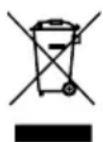
Marking on the product indicates that after the service-life of the product expires, it should not be disposed with other type of municipal waste. Used equipment may have a negative impact on the environment and health of people due to potentially containing hazardous substances, mixtures and components. Mixing electric waste with other types of waste or disassembling those in an unprofessional manner may cause a release of substances that are hazardous to the environment and health.
Used equipment should be handed-over to a point for collection of electric waste. In order to obtain detailed information regarding the electric waste collection points, the user should contact the municipal point of electric waste collection or used equipment processing department.
BESCHRIJVING VAN HET APPARAAT
INSTALLATIE VAN HET APPARAAT
ACCESSOIRE BESCHRIJVING:
VLOER- EN TAPIJTBORSTEL
- BEZPEČNOSTNÍ POKYNY PŘI POUŽÍVÁNÍ
- DESCRIPTION OF THE APPLIANCE
- ELECTROSTATICS
- ASSEMBLY OF THE APPLIANCE
- USING THE APPLIANCE
- CAUTION! It is recommended to set the power regulator knob (3) to MIN before switching the vacuum cleaner on!
- CAUTION! If you conclude that the suction power of the vacuum cleaner is weaker, clean the dust container and/or unblock the suction hose.
- DESCRIPTION OF ACCESSORIES
- FLOOR AND CARPET BRUSH
- PARQUET BRUSH
- SMALL TURBO BRUSH
- CREVICE ATTACHMENT
- FURNITURE BRUSH
- HANDLE FOR ACCESSORIES
- EMPTYING THE DUST CONTAINER
- CLEANING AND REPLACEMENT OF AIR FILTERS
- CLEANING AND MAINTENANCE
- TECHNICAL DATA
- CAUTION! MPM agd S.A. reserves the right to technical changes.
- Proper disposal of the product (waste electrical and electronic equipment)
- BESCHRIJVING VAN HET APPARAAT
- INSTALLATIE VAN HET APPARAAT
- ACCESSOIRE BESCHRIJVING:
- VLOER- EN TAPIJTBORSTEL
Brand : MPM
Model : MOD-61
Category : Vacuum Cleaner