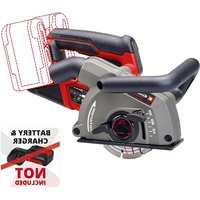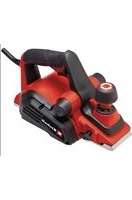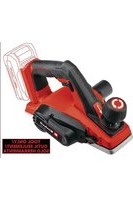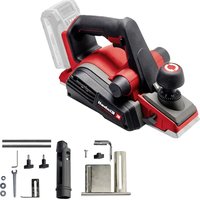
TP-PL 18/3 Li BL - Plane EINHELL - Free user manual and instructions
Find the device manual for free TP-PL 18/3 Li BL EINHELL in PDF.


| Product type | Cordless planer (planer) |
| Brand | Einhell |
| Model | TP-PL 18/3 Li BL |
| Power supply | 18 V DC Li-Ion battery (not included) |
| No-load speed | 12,000 rpm |
| Adjustable depth of cut | 0 - 3 mm (in 0.1 mm increments) |
| Rabbeting depth | 0 - 25 mm |
| Planing width | 82 mm |
| Weight | 3.0 kg |
| Sound pressure level LpA | 84 dB(A) (uncertainty K=3 dB) |
| Sound power level LWA | 92 dB(A) (uncertainty K=3 dB) |
| Vibration emission value | 5.22 m/s² (uncertainty K=1.5 m/s²) |
| Main functions | Planing, rabbeting, chamfering (45°) |
| Parallel guide | Included, for parallel planing |
| Dust extractor adapter | Can be mounted on left or right |
| Battery capacity indicator | 3 LEDs (charging, ok, low, temperature) |
| Blades | 2 reversible carbide blades (non-sharpable) |
| Start lock | Yes (safety) |
| Belt replacement | By qualified personnel |
| Recommended storage | Dark, dry, frost-free place, 5-30 °C, battery charged to ≥40% |
| Intended use | Wood only, no asbestos |
Frequently Asked Questions - TP-PL 18/3 Li BL EINHELL
User questions about TP-PL 18/3 Li BL EINHELL
0 question about this device. Answer the ones you know or ask your own.
Ask a new question about this device
Download the instructions for your Plane in PDF format for free! Find your manual TP-PL 18/3 Li BL - EINHELL and take your electronic device back in hand. On this page are published all the documents necessary for the use of your device. TP-PL 18/3 Li BL by EINHELL.
USER MANUAL TP-PL 18/3 Li BL EINHELL
GB Original operating instructions Cordless planer
natural_image
Black manual power tool with labeled parts (a and 6), no visible text or symbols beyond labels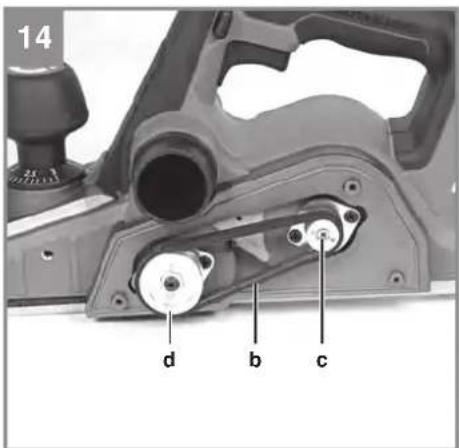
D
Gefahr!
When using the equipment, a few safety precautions must be observed to avoid injuries and damage. Please read the complete operating instructions and safety regulations with due care. Keep this manual in a safe place, so that the information is available at all times. If you give the equipment to any other person, hand over these operating instructions and safety regulations as well. We cannot accept any liability for damage or accidents which arise due to a failure to follow these instructions and the safety instructions.
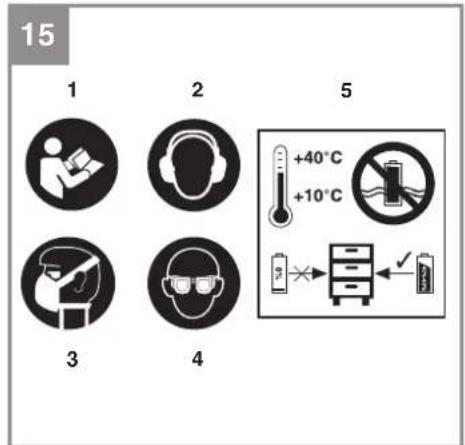
Explanation of the symbols used (see Fig. 15)
- Danger! - Read the operating instructions to reduce the risk of injury.
- Caution! Wear ear-muffs. The impact of noise can cause damage to hearing.
- Caution! Wear a breathing mask. Dust which is injurious to health can be generated when working on wood and other materials. Never use the device to work on any materials containing asbestos!
- Caution! Wear safety goggles. Sparks generated during working or splinters, chips and dust emitted by the device can cause loss of sight.
- Store the batteries only in dry rooms with an ambient temperature of +10°C to +40°C. Place only fully charged batteries in storage (charged at least 40%).
1. Safety regulations
The corresponding safety information can be found in the enclosed booklet.
Warning!
Read all the safety information, instructions, illustrations and technical data provided on or with this power tool. Failure to adhere to the following instructions may result in electric shock, fi re and/or serious injury.
Keep all the safety information and instructions in a safe place for future use.
2. Layout and items supplied
2.1 Layout (Fig. 1/2)
- Setting knob for the chip depth
- Dust extraction adapter
- Safety lock-off
-
On/Off switch
-
Rear base plate
- Belt cover
- Parking soleplate
- Front base plate
- Thumb screw for step depth scale
- Step depth scale
- Parallel stop
- Wrench
2.2 Items supplied
Please check that the article is complete as specified in the scope of delivery. If parts are missing, please contact our service center or the sales outlet where you made your purchase at the latest within 5 working days after purchasing the product and upon presentation of a valid bill of purchase. Also, refer to the warranty table in the service information at the end of the operating instructions.
- Open the packaging and take out the equipment with care.
- Remove the packaging material and any packaging and/or transportation braces (if available).
- Check to see if all items are supplied.
- Inspect the equipment and accessories for transport damage.
- If possible, please keep the packaging until the end of the guarantee period.
Danger!
The equipment and packaging material are not toys. Do not let children play with plastic bags, foils or small parts. There is a danger of swallowing or suffocating!
- Cordlessplane
- Parallel stop
Wrench - Step depth scale
• Original operating instructions - Safetyinstructions
3. Proper use
The cordless plane is designed for planing, rebating and chamfering pieces of wood.
The equipment is to be used only for its prescribed purpose. Any other use is deemed to be a case of misuse. The user / operator and not the manufacturer will be liable for any damage or injuries of any kind caused as a result of this.
GB
4. Technical data
Motor power supply: 18 V d.c.
Idling speed 12,000 rpm
Chip depth: 0-3 mm
Rebate depth 0-25 mm
Plane width: 82 mm
Weight: 3,0 kg
Danger!
Sound and vibration
Sound and vibration values were measured in accordance with EN 62841.
L_pA sound pressure level 84 dB(A)
K_pA uncertainty 3 dB
L_WA sound power level 92 dB(A)
K_WA uncertainty 3 dB
Wear ear-muff s.
The impact of noise can cause damage to hearing.
Total vibration values (vector sum of three directions) determined in accordance with EN 62841.
Vibration emission value a_h = 5.22 m/s^2
K uncertainty = 1.5 m/s ^4
The stated vibration emission levels and stated noise emission values were measured in accordance with a set of standardized criteria and can be used to compare one power tool with another.
The stated vibration emission levels and stated noise emission values can also be used to make an initial assessment of exposure.
Warning:
The vibration and noise emission levels may vary from the level specified during actual use, depending on the way in which the power tool is used, especially the type of workpiece it is used for.
Keep the noise emissions and vibrations to a minimum.
-
Only use appliances which are in perfect working order.
• Service and clean the appliance regularly.
• Adapt your working style to suit the appliance.
• Do not overload the appliance. -
Have the appliance serviced whenever necessary.
• Switch the appliance off when it is not in use.
Caution!
Residual risks
Even if you use this electric power tool in accordance with instructions, certain residual risks cannot be rules out. The following hazards may arise in connection with the equipment's construction and layout:
- Lung damage if no suitable protective dust mask is used.
- Damage to hearing if no suitable ear protection is used.
- Health damage caused by hand-arm vibrations if the equipment is used over a prolonged period or is not properly guided and maintained.
5. Before starting the equipment
Warning!
Always remove the battery pack before making adjustments to the equipment.
5.1 Adjusting the chip depth (Fig. 3/Item 1)
You can adjust the chip depth in steps of 0.1 mm from 0 to 3 mm by turning the setting knob for the chip depth (1).
Turn the setting knob for the chip depth (1) in a clockwise direction to set a greater chip depth. Greater chip depth
Turn the setting knob for the chip depth (1) in a counter-clockwise direction to set a lower chip depth. Lower chip depth
After fi nishing work, set the chip depth so that the knives are lowered and thus protected from damage. Turn the setting knob for the chip depth to position "0" for this purpose.
5.2 Chip extraction (Fig. 3/Item 2)
For optimum chip extraction you can connect the equipment to a vacuum cleaner (not supplied).
To do so, insert the vacuum cleaner tube into the chip extraction adapter (2).
GB
The chip extraction adapter (2) can be fitted to the equipment on the left or right.
Fit the dust extraction adapter (2) on the side you prefer until you hear it latch in place.
To remove the dust extraction adapter (2), press on the side marked with the arrow and push it sideways out of the equipment.
Note!
The vacuum cleaner you use for the vacuum extraction must be suitable for the material you are cutting.
5.3 Parallel stop (Fig. 4)
Use the parallel stop (11) when you want to plane parallel to the edge of the workpiece.
Fitting the parallel stop
- Fasten the mount (d) of the parallel stop to the left side of the tool using the supplied thumb screw (a).
- Now connect the mount (d) to the slide of the parallel stop (11).
- The guide rail must always be aligned in downward direction.
- Fix the distance required between the parallel stop and the edge of the workpiece.
- Fasten the parts with the carriage bolt (b) and the wing nut (c).
5.4 Charging the LI battery pack (Fig. 5-6)
- Remove the battery pack (a) from the handle, pressing the pushlock buttons (c) downwards to do so.
- Check that your mains voltage is the same as that marked on the rating plate of the battery charger. Insert the power plug of the charger (b) into the mains socket outlet. The green LED will then begin to flash.
- Push the battery pack onto the battery charger.
In section 10 "Charger indicator" you will find a table with an explanation of the LED indicator on the charger.
If the battery pack fails to become charged, please check
• whether there is voltage at the socket-outlet
- whether there is proper contact at the charging contacts on the charger.
If the battery still fails to become charged, please return
• thecharger
• the battery pack
to our Customer Service Department.
To ensure that items are properly packaged and delivered when you send them to us, please contact our customer service or the point of sale at which the equipment was purchased.
When shipping or disposing of batteries and cordless tools, always ensure that they are packed individually in plastic bags to prevent short circuits and fi res.
To ensure that the battery pack provides long service, you should take care to recharge it promptly. You must recharge the battery pack when you notice that the performance of the device drops. Never allow the battery pack to become fully discharged. This will cause it to develop a defect.
5.5 Battery capacity indicator
(Fig. 5 - Item e)
Press the battery capacity indicator switch (d). The battery capacity indicator (e) shows the charge status of the battery using 3 LEDs.
All 3 LEDs are lit:
The battery is fully charged.
2 or 1 LED(s) are lit:
The battery has an adequate remaining charge.
1 LED fl ashes:
The battery is empty, recharge the battery.
All LEDs blink:
The battery temperature is too low. Remove the battery from the equipment, keep it at room temperature for one day. If the fault reoccurs, this means that the rechargeable battery has undergone exhaustive discharge and is defective. Remove the battery from the equipment. Never use or charge a defective battery.
6. Operation
6.1 ON/OFF switch (Fig. 7)
- The plane comes with a safety switch which is designed to prevent accidents.
GB
- To switch on the tool, press the side safety lock-off (3) and press the button switch.
- Release the button switch (4) to switch off the plane. The button switch (4) jumps back into its starting position.
6.2 Practical tips
Warning! Only ever bring the plane towards the workpiece while switched on.
6.2.1 Planing surfaces
Now adjust the desired chip depth. Equip the front base plate and place the plane onto the piece of wood you wish to plane. Then switch on the plane. Push the plane over the surface with both hands and make sure that the both the front and the rear base plate lie fl at on the workpiece. Used a low chip depth for fi nishing surfaces and complete several passes over the surface.
6.2.2 Chamfering edges (Fig. 8-9)
- There are three V-shaped grooves (a) in the front base plate that enable you to plane edges at an angle of 45^ for a smooth finish.
- Switch on the tool and wait until it reaches full speed. Place the V-shaped groove (a) on the edge of the workpiece at an angle of 45^ .
- Now move the plane along the edge of the workpiece.
• To achieve a good quality result you should keep the feed speed and angle constant.
6.2.3 Planing steps (Fig. 4/10)
- The planing of steps is possible with the help of the parallel stop (11).
- Mount the parallel stop (11) on the left side of the tool (see section 5.3).
- To mount the depth stop, fasten the step depth scale (10) to the front right side of the plane housing with the locking lever (9) (see Fig. 10).
- Release the locking lever (9) and position the step depth scale (10) so that the required step depth is displayed. Pull the locking lever (9) tight again.
Width of step:
You can set the width of the step with the parallel stop (11).
Depth of step:
We recommend you to set a cutting depth of 3 mm and to keep planing the workpiece until the required depth of step is reached.
7. Cleaning, maintenance and ordering of spare parts
Danger!
Always pull out the mains power plug before starting any cleaning work.
7.1 Cleaning
- Keep all safety devices, air vents and the motor housing free of dirt and dust as far as possible. Wipe the equipment with a clean cloth or blow it with compressed air at low pressure.
• We recommend that you clean the device immediately each time you have finished using it. - Clean the equipment regularly with a moist cloth and some soft soap. Do not use cleaning agents or solvents; these could attack the plastic parts of the equipment. Ensure that no water can seep into the device. The ingress of water into an electric tool increases the risk of an electric shock.
7.2 Changing the planing knives (Fig. 11)
Danger! Always pull the plug out of the power socket before doing any work on the equipment.
The hand-held electric plane comes with two carbide metal reversible knives. Reversible knives have two cutting edges and can be reversed. The guide slot on the reversible knives ensures the same height setting after a change. Replace a worn, blunt or damaged knife.
Carbide metal reversible knives cannot be re-sharpened.
Undo the three hexagonal screws (a) using the wrench (12) supplied and push the carbide metal reversible knife out of the planing shaft using a piece of wood. (see Fig. 11).
Clean the knife seat before fi tting. Install the kni- ves in reverse order. Check that the planing knife conforms with both ends of the planing shaft. Always replace both knives to ensure a uniform chip depth.
Danger! Before using the hand-held electric plane make sure the knives are installed securely and in the right place.
GB
Check the correct setting (Fig. 12)
(8) Front base plate (moving plane shoe)
(5) Rear base plate (fi xed plane shoe)
1. Correct adjustment
Result: Smooth planed surfaces
2. Notches in the surface
Problem: The cutting edge on the planing knife (or both planing knives) is not parallel to the height of the rear base plate.
3. Furrows at the start of the planed surface
Problem: The cutting edge on the planing knife (or both planing knives) is below the height of the rear base plate.
4. Furrows at the end of the planed surface
Problem: The cutting edge on the planing knife (or both planing knives) is above the height of the rear base plate.
7.3 Replacing the drive belt (Fig. 13-14)
- The belt should be replaced by a trained expert.
- The drive belt (b) must be replaced if it is worn.
- Undo the screws (a) and remove belt cover at the sides (6).
- Remove the worn belt drive (b) and clean the two belt pulleys (c/d).
- Place the new drive belt on the small belt pulley (c) and pull the belt onto the large belt pulley (d) whilst turning the planing shaft.
- Ensure that the longitudinal grooves on the drive belt are in the guide grooves on the drive wheels.
- Fit the belt cover (6) and secure it with the screws (a).
7.4 Maintenance
There are no parts inside the equipment which require additional maintenance.
7.5 Ordering replacement parts:
Please quote the following data when ordering replacement parts:
• Type of machine
• Article number of the machine
• Identification number of the machine
• Replacement part number of the part required
For our latest prices and information please go to www.Einhell-Service.com
8. Disposal and recycling
The equipment is supplied in packaging to prevent it from being damaged in transit. The raw materials in this packaging can be reused or recycled. The equipment and its accessories are made of various types of material, such as metal and plastic. Never place defective equipment in your household refuse. The equipment should be taken to a suitable collection center for proper disposal. If you do not know the whereabouts of such a collection point, you should ask in your local council offices.
9. Storage
Store the equipment and accessories in a dark and dry place at above freezing temperature. The ideal storage temperature is between 5 and 30 °C. Store the electric tool in its original packaging.
GB
10. Charger indicator
| Indicator status Explanations and actions | ||
| Red LED Green LED | ||
| Off | Flashing | Ready for useThe charger is connected to the mains and is ready for use; there is no battery pack in the charger |
| On Off Charging | The charger is charging the battery pack in quick charge mode. The charging times are shown directly on the charger.Important! The actual charging times may vary slightly from the stated charging times depending on the existing battery charge. | |
| Off | On | The battery is charged and ready for use. (READY TO GO)The unit then changes over to gentle charging mode until the battery is fully charged.To do this, leave the rechargeable battery on the charger for approx. 15 minutes longer.Action:Take the battery pack out of the charger. Disconnect the charger from the mains supply. |
| Flashing Off | Adapted charging | The charger is in gentle charging mode.For safety reasons the charging is performed less quickly and takes more time. The reasons can be:- The rechargeable battery has not been used for a very long time.- The battery temperature is outside the ideal range.Action:Wait for the charging to be completed; you can still continue to charge the battery pack. |
| Flashing Flashing Fault | Charging is no longer possible. The battery pack is defective.Action:Never charge a defective battery pack.Take the battery pack out of the charger. | |
| On On Temperature fault | The battery pack is too hot (e.g. due to direct sunshine) or too cold (below 0^ ).Action:Remove the battery pack and keep it at room temperature (approx. 20^ ) for one day . | |
GB

For EU countries only
Never place any electric power tools in your household refuse.
To comply with European Directive 2012/19/EC concerning old electric and electronic equipment and its implementation in national laws, old electric power tools have to be separated from other waste and disposed of in an environment-friendly fashion, e.g. by taking to a recycling depot.
Recycling alternative to the return request:
As an alternative to returning the equipment to the manufacturer, the owner of the electrical equipment must make sure that the equipment is properly disposed of if he no longer wants to keep the equipment. The old equipment can be returned to a suitable collection point that will dispose of the equipment in accordance with the national recycling and waste disposal regulations. This does not apply to any accessories or aids without electrical components supplied with the old equipment.
Please note that batteries and lamps (e.g. light bulbs) must be removed from the tool before it is disposed of.
The reprinting or reproduction by any other means, in whole or in part, of documentation and papers accompanying products is permitted only with the express consent of the Einhell Germany AG.
Subject to technical changes
GB
Service information
We have competent service partners in all countries named on the guarantee certificate whose contact details can also be found on the guarantee certificate. These partners will help you with all service requests such as repairs, spare and wearing part orders or the purchase of consumables.
Please note that the following parts of this product are subject to normal or natural wear and that the following parts are therefore also required for use as consumables.
| Category Example | |
| Wear parts* Carbon brushes, drive belt | |
| Consumables* Planing knife | |
| Missing parts |
* Not necessarily included in the scope of delivery!
In the effect of defects or faults, please register the problem on the internet at www.Einhell-Service.com. Please ensure that you provide a precise description of the problem and answer the following questions in all cases:
• Did the equipment work at all or was it defective from the beginning?
• Did you notice anything (symptom or defect) prior to the failure?
• What malfunction does the equipment have in your opinion (main symptom)?
Describe this malfunction.
GB
Warranty certifi cate
Dear Customer,
All of our products undergo strict quality checks to ensure that they reach you in perfect condition. In the unlikely event that this equipment develops a fault, please contact our service department at the address shown on this guarantee card. You can also contact us by telephone using the service number shown. Please note the following terms under which guarantee claims can be made:
-
These guarantee terms apply solely to consumers, i.e. natural persons, who do not want to use this product in connection with either their commercial or other self-employed activities. These guarantee terms regulate additional guarantee services which the undermentioned manufacturer promises to buyers of its new products in addition to their statutory rights of guarantee. Your statutory rights of guarantee are not affected by this guarantee. Our guarantee is free of charge to you.
-
The guarantee services cover only defects due to material or manufacturing faults on the new product which you have bought in the European Union from the undermentioned manufacturer and are limited to either the rectification of said defects or the replacement of the product, whichever we prefer. Please note that only equipment under the brand name "Professional" has been designed for use in commercial, trade or professional applications. For all other products the guarantee is invalidated if the equipment is used within the guarantee period in commercial, trade or industrial applications or for other equivalent activities.
-
Our guarantee does not cover:
-
Damage to the equipment caused by failure to comply with the installation/assembly instructions or by unprofessional installation; damage caused by failure to comply with the operating instructions (e.g. connection to the wrong mains voltage or current type); damage caused by failure to comply with the maintenance and safety regulations; damage caused by exposing the equipment to abnormal environmental conditions; damage resulting from poor care and maintenance.
- Damage to the equipment caused by misuse or incorrect applications (e.g. overloading the equipment or using non-approved attachments or accessories); damage caused by foreign bodies (e.g. sand, stones, dust, ....) getting inside the equipment. Damage in transit; damage caused by force or external influences (e.g. by dropping the equipment).
-
Damage to the equipment or parts of the equipment which is owed to use-related, normal or otherwise natural wear. For example, batteries and battery packs are manufactured with a cycle limit for design-related reasons. Wear is negatively influenced in particular by load demands and charging speeds as well as exposure to heat, cold, vibration and impact.
-
The guarantee is valid for a period of 2 years starting from the purchase date of the equipment. Guarantee claims must be submitted before the end of the guarantee period and within two weeks of the defect being noticed. No guarantee claims will be accepted after the end of the guarantee period. The original guarantee period remains applicable to the equipment even if repairs are carried out or parts are replaced. In such cases, the work performed or parts fitted will not result in an extension of the guarantee period, and no new guarantee will become active for the work performed or for any replacement parts fitted. This also applies if on-site service is used.
-
To assert your guarantee claim, register the defective equipment at: www.Einhell-Service.com. You will need to provide proof of purchase of the new item of equipment. Equipment returned without such proof or without a rating plate are excluded from the guarantee services because of the lack of traceability. If the defect is covered by our guarantee, then either the item in question will be repaired immediately and returned to you or we will send you a new replacement.
-
If you have taken the equipment with you to a different EU country than where you bought it, we will arrange for a local service partner to provide the guarantee services. If you take the equipment outside the EU, the guarantee will not apply.
Of course, we are also happy to offer a chargeable repair service for any defects which are not covered or no longer covered by the scope of this guarantee. To take advantage of this service, please send the equipment to our service address. We draw attention to the restrictions of this guarantee concerning wear parts, consumables and missing parts as presented in the service information included in this operating manual.
Warrantor/ Service:
Einhell UK Ltd, Unit 10, 1st Floor, Champion's Business Park, Arrowe Brook Road, Upton, Wirral, CH49 0UQ
F
Danger!
Spanning motor: 18 V DC
Stationair toerental: 12000 min ^-1
Verspaandiepte: 0-3 mm
Afschuindiepte: 0-25 mm
Acumulator = 10-20°C
X 2006/42/EC
Annex IV
Notified Body:
Reg. No.:
□2000/14/EC_2005/88/EC
□ Annex V
Annex VI
Noise: measured L_WA = dB(A) ; guaranteed L_WA = dB(A)
P = kW; L/∅ = cm
Notified Body:
□2012/46/EU_(EU)2016/1628
Emission No.
Standard references: EN 62841-1; EN 62841-2-14; EN 55014-1; EN 55014-2
Subject to change without notice
Archive-File/Record: NAPR026691
Documents registrar: Christoph Egginger
Wiesenweg 22, D-94405 Landau/Isar
* GB Cordless planar. P. Batotouse sans N. (P. Politto a betiera - D'KN Akni-helv. S. Betardriven nyel - CZ Akumulatorný hoblík - SK Akumulatorný hoblík - NI, Acou schief - E Cosillo malábrico - P'IN Akniityla - SLO Akumulatorski skočej - H Akni-gyala - RO Mežná de imozet ou acumulator - GR Plátov jumaplosc - P Plaína som fa - HR/HH Akumulatorska biyajalce - RS Akumulatorska rendislatka. PL Strug akumulatorny - NR 30 klog planura - RUS Akumulatorný prábanok - EE Akuhčebel LV Akumulatora eweve LT Akumulatorná obizavma mažina - BG Ankumulatorne pezir - UKP Akumulatorníp rúbanok - NK Eléchričen strup

Declaration of conformity
We, Einhell UK Ltd
Champions Business Park, First Floor Unit 10, Arrowe Brook Rd, Upton, Wirral CH49 0AB, United Kingdom
declare the conformity to UK standards and legislation was assessed for:
Cordless Planer TP-PL 18/3 Li BL (Einhell)
UK legislation
□ Simple Pressure Vessels (Safety) Regulation
□ Electrical Equipment (Safety) Regulation
□ Radio Equipment Regulation
□ Personal Protective Equipment Regulation
☐ The Ecodesign for Energy-Related Products and Energy Information Regulation
X The Restriction of the Use of Certain Hazardous Substances in Electrical and Electronic Equipment Regulation
□ Noise Emission in the Environment by Equipment for use Outdoors Regulation
X Electromagnetic Compatibility Regulation
□ Measuring Instruments Regulation
☐ Pressure Equipment (Safety) Regulation
Annex V
Annex VI
Noise:measuredL ww = dB (A); guaranteed L ww = dB (A)
P = kW; L/∅ = cm
UK Approved Body:
X Supply of Machinery (Safety) Regulation
Annex IV
UK Approved Body:
UKTE Certifi cate No.:
Standards: BS EN 62841-1; BS EN 62841-2-14; BS EN 55014-1; BS EN 55014-2
Wirral, 2023.07.03
Tom Chambers, Managing Director Einhell UK Ltd.
Archive-File/Record: NAPR026691
Article Number: 43.454.05 I.-No.: 21013
Subject to change without notice Wiesenweg 22, 94405 Landau/Isar, Germany
Documents registrar: Christoph Egginger
EH 10/2023 (01)