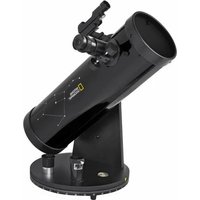
90-65000 - Telescope National Geographic - Free user manual and instructions
Find the device manual for free 90-65000 National Geographic in PDF.


| Product type | Telescope |
| Brand | National Geographic |
| Model | 90-65000 |
| Focal length | 500 mm |
| Mount | Altazimuth |
| Included eyepieces | 6 mm and 20 mm |
| Barlow lens | 2x |
| Finder | LED |
| Moon filter | Included |
| Magnifications | 25x, 50x (with Barlow), 83x, 167x (with Barlow) |
| Included software | Yes |
| Objective lens material | Optical glass |
| Power supply | None (manual) |
| Dimensions (approx.) | Tube length: approx. 500 mm |
| Weight (approx.) | 2-3 kg |
| Usage | Terrestrial and astronomical observation |
| Safety | Never look directly at the sun; risk of blindness |
| Maintenance | Clean lenses with a microfiber cloth; use a blower for the mirror |
| Warranty | 2 years, extendable to 5 years under conditions |
| Included accessories | 2 eyepieces, 2x Barlow lens, LED finder, moon filter, software |
Frequently Asked Questions - 90-65000 National Geographic
User questions about 90-65000 National Geographic
0 question about this device. Answer the ones you know or ask your own.
Ask a new question about this device
Download the instructions for your Telescope in PDF format for free! Find your manual 90-65000 - National Geographic and take your electronic device back in hand. On this page are published all the documents necessary for the use of your device. 90-65000 by National Geographic.
USER MANUAL 90-65000 National Geographic
Durchmesser: 3.476 km
Risk of bodily injury!
Never use this device to look directly at the sun or in the direct proximity of the sun. This will result in a risk of blindness.
- Children should only use the device under adult supervision. Keep packaging material, like plastic bags and rubber bands, out of the reach of children, as they pose a choking hazard.
- Never subject the device, especially the optics, to direct sunlight. The concentration of light can cause fires or burns.
- Do not disassemble the device. In the event of a defect, please contact your dealer. The dealer will contact the Service Centre and can send the device in to be repaired, if necessary.
- Do not expose the device to high temperatures.

Privacy protection!
This device is intended only for private use. Please heed the privacy of other people. Do not use it to look into apartments, for example.
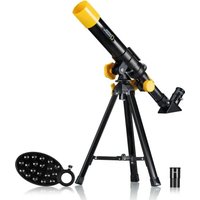
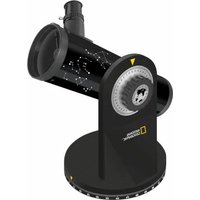
Your telescope consists of these parts:
- Focus wheel
- Telescope (Telescope tube)
- Compass
- Alt-azimuth mount
- Azimuth scale
- Scale with 90^ steps
- Height adjustment wheel
- LED Viewfinder
Additional equipment:
- Two Eyepieces (6 mm, 20 mm)
10.Barlow lens 2X - Moon filter
- Software
Please look for a suitable location to set up your telescope before you begin. Use a stable surface like a table or countertop.
Pointing your telescope
Azimuthal mounting means that you can move your telescope up and down, left and right.
With the height adjustment wheel (7) and the turnable azimuth mount, you can point the telescope at any object you want. Use the wheel (7) to tilt the telescope up and down. By using the azimuth mount like a turntable you can pan the telescope to the left and to the right.
Fine adjustment is done with the aid of the LED Viewfinder (8). Look through the viewfinder and try to align it with the North Star in the centre of the crosshairs (No. 1).
Which eyepiece is right?
It is important that you always choose an eyepiece with the highest focal width for the beginning of your observation. Afterwards, you can gradually move to eyepieces with smaller focal widths. The focal width is indicated in
millimeters, and it is written on each eyepiece. In general, the larger the focal width of an eyepiece, the smaller the magnifi cation.
There is a simple formula for calculating the magnifi cation:
Focal width of the telescope tube / Focal width of the eyepiece
= Magnificatior
The magnifi cation is also depends on the focal width of the telescope tube. The telescope has a focal length of 500mm
From this formula, we see that if you use an eyepiece with a focal width of 20mm , you will get the following magnification:
500mm / 20mm = 25× magnification
The table below shows some common magnifi cations.
| Telescope tube focal width | Focal width of eyepiece Mag | nifi cation Magnifi cation with 2X Barlow lens | |
| 500 mm 20 mm 25X 50X | |||
| 500 mm 6 mm 83X 167X | |||

NOTES on cleaning
-
Clean the eyepieces and lenses only with a soft, lint-free cloth, like a microfi bre cloth. Do not apply excess pressure to the cloth to avoid scratching the lenses.
-
To remove more stubborn dirt, moisten the cleaning cloth with an eyeglass-cleaning solution, and wipe the lenses gently.
-
Protect the device from dust and moisture. After use, particularly in high humidity, let the device acclimate for a short period of time, so that the residual moisture can dissipate before storing. Remove the dust cover and store it in the included bag during use.
-
To remove dust on the mirrors, use a fine brush or air blower (from your local camera shop or optician). Don't touch any mirror surface with your fingers - they may damage the coating.

DISPOSAL
-
Dispos of the packaging materials properly, according to their type, such as paper or cardboard. Contact your local waste- disposal service or environmental authority for information on the proper disposal.
-
Please take the current legal regulations into account when disposing of your device. You can get more information on the proper disposal from your local waste-disposal service or environmental authority.
Telescope ABC:
What do the following terms mean?
Barlow Lens:
The Barlow lens was named after its inventor, Peter Barlow, a British mathematician and physicist who lived from 1776-1862. The lens can be used to increase the focal width of a telescope. Depending on the type of lens, it is possible to double or even to triple the focal width. As a result, the magnifi cation can also be increased. Also, see Eyepiece.
Focal width:
Everything that magnifi es an object via an optic (lens) has a certain focal width. The focal width is the length of the path the light travels from the surface of the lens to its focal point. The focal point is also referred to as the focus. In focus, the image is clear. In the case of a telescope, the focal widths of the telescope tube and the eyepieces are combined.
Lens:
The lens bends the light which falls on it in such a way that the light creates a clear image at the focal point, after it has traveled a certain distance (focal width).
Eyepiece:
An eyepiece is a viewing system comprised of one or more lenses. The eyepiece magnifi es the clear image generated at the focal point of a lens.
There is a simple formula for calculating magnifi cation:
Focal width of the telescope tube / Focal width of the eyepiece
= Magnificatior
In a telescope, the magnification depends on both the focal width of the telescope tube and the focal width of the eyepiece.
Magnification:
The magnifi cation corresponds to the difference between observation with the naked eye and observation through a magnifi cation apparatus (e.g. a telescope). Observation with the naked eye is considered single, or 1x magnifi cation. Accordingly, if a telescope has a magnifi cation of 30X , then an object viewed through the telescope will appear 30 times larger than it would with the naked eye. Also see Eyepiece.
Useful accessories can be found at www.bresser.de
Possible objects for observation:
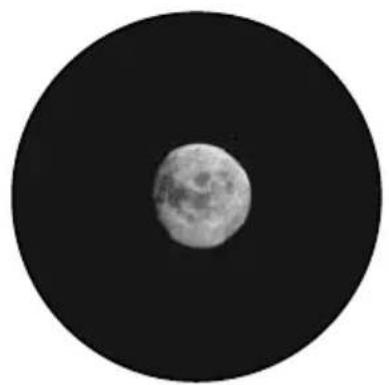
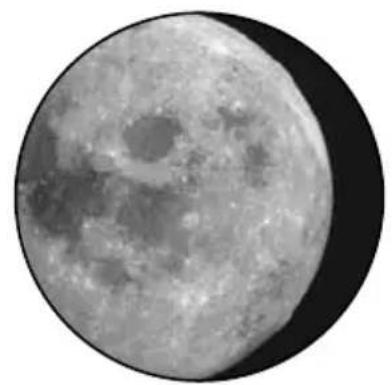
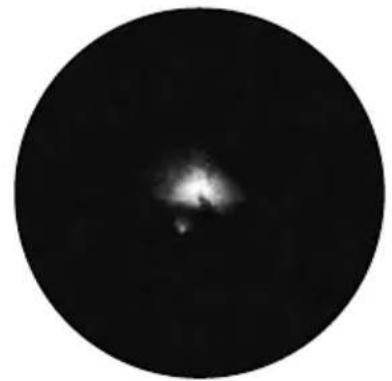
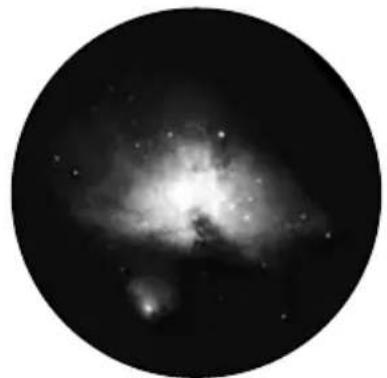
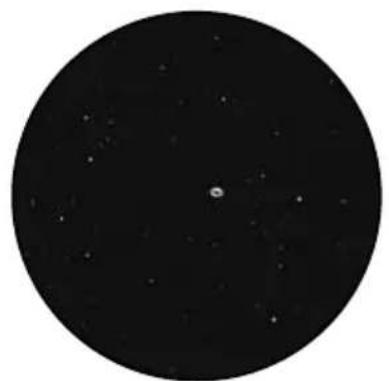
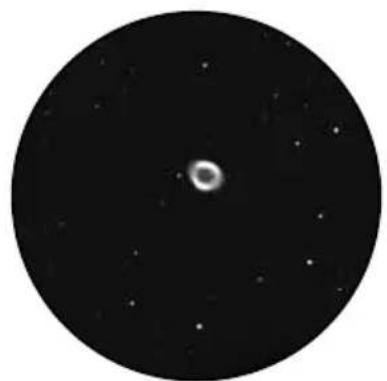
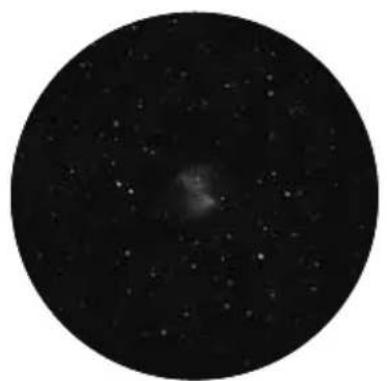
We have compiled and explained a number of very interesting celestial bodies and star clusters for you. On the accompanying images at the end of the instruction manual, you can see how objects will appear in good viewing conditions through your telescope using the eyepieces that came with it.
The Moon
The moon is the Earth's only natural satellite.
Diameter: 3,476 km
Distance: approx. 384,400 km from Earth
The moon has been known to humans since prehistoric times. It is the second brightest object in the sky (after the sun). Because the moon circles the Earth once per month, the angle between the Earth, the moon and the sun is constantly changing; one sees this change in the phases of the moon. The time between two consecutive new moon phases is about 29.5 days (709 hours).
Orion Nebula (M 42)
M 42 in the Orion constellation
Distance: 1,344 light years from Earth
With a distance of about 1,344 light years from the Earth, the Orion Nebula (Messier 42, abbreviation: M 42) is the brightest diffuse nebula in the sky it is visible with the naked eye and a rewarding object for telescopes in all sizes, from the smallest fi eld glass to the largest earthbound observatories and the Hubble Space Telescope.
When talking about Orion, we're actually referring to the main part of a much larger cloud of hydrogen gas and dust, which spreads out over the half of the Orion constellation. The expanse of this enormous cloud stretches several hundred light years.
Ring Nebula in Lyra constellation (M 57)
M 57 in the Lyra constellation
Distance: 2,412 light years from Earth
The famous Ring Nebula (M 57) in the constellation of Lyra is often viewed as the prototype of a planetary nebula; it is one of the magnificent features of the Northern Hemisphere's summer sky. Recent studies have shown that it is probably comprised of a ring (torus) of brightly shining material that surrounds the central star (only visible with larger telescopes), and not of a gas structure in the form of a sphere or an ellipse.
If you were to look at the Ring Nebula from the side, it would look like the Dumbbell Nebula (M27). With this object, we're looking directly at the pole of the nebula.
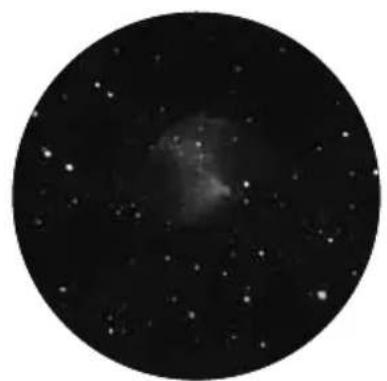
Dumbbell Nebula in the Vulpecula (Fox) constellation (M 27)
M 27 in the Fox constellation
Distance: 1,360 light years from Earth
The Dumbbell Nebula (M 27) in the Fox constellation was the first planetary nebula ever discovered. On 12 July 1764, Charles Messier discovered this new and fascinating class of objects. We see this object almost directly from its equatorial plane. If you could see the Dumbbell Nebula from one of its poles, it would probably reveal that it's in the shape of a ring, and we would see something very similar to what we know from the Ring Nebula (M 57). In reasonably good weather, we can see this object well even at small magnifi cations.
Warranty and warranty term extension
The warranty term is two years from the date of purchase. Please keep your proof of purchase.
Register at www.bresser.de/warranty and fill out a brief questionnaire to get your warranty term extended to five years. Registration must be completed within three months of purchase (date of receipt) to validate the warranty. If you register thereafter, the warranty term will not be extended. If you have problems with your device, please contact our customer service first. Do not send any products without consulting us first by telephone. Many problems with your device can be solved over the phone. If the problem cannot be resolved by phone, we will take care of transporting your device to be repaired. If the problem occurred after the warranty ended or it is not covered by our warranty terms, you will receive an estimate of repair costs, free of charge.
Service Hotline: +49 (0) 2872-80 74-210
Important for any returns:
Please make sure to return the device carefully packed in the original packaging in order to prevent damage during transport. Also, please enclose your receipt for the device (or a copy) and a description of the defect. This warranty does not imply any restriction of your statutory rights.
Your dealer: Art. No.:
Description of problem:
Name: Telephone:
Street: Date of purchase:
City/Postcode: Signature:

BESCHERMING van privacy!
Advertencias de character general

Kak BbI6paTb OkyJap?
PekomeHnyeTcHaunHbTaHa6nOJeHn,ncNoB3yOkynpC HAn6oBbMmΦokychbIMpacCTOHHem.BnocneDCTBn Bbl MoKeTe NoCTepeHNOpeHTN K OkyIpaM C MeHbUHMnΦokychbIMpacCTOHHaMn.Φokychoe pacCTOHHne
OKyIpa(B MInnImMeTpax) yka3aHo Ha Kopnyce camoro OKyIpa. Ka npabHno, cem 60JIbe oKocHoe pacCToHne, TEM MeHbIe yBcIeHne. Blyncnlt bYBeIeHne moXHO c nOMOsbIO cJeDyUoJ e fOpMylbl:
ΦokychoepacctoHnneTeleckona/ΦokychoepacctoHnneOKyIpa =YBeIyuIeHne
Kak BnDHO n3 fOpMynbl, yBENuHHe N TaKHe 3aBnCT H OT fOKyCHOrO paccTcHnRA TeNeckOna. Y daHHo MOneHNfokycHoe pacctToHnE coCTaBnAeT 500 MM. BocnoJIb3OBaBUnCb fOpMynl, MoKHo IocHTaTb, KaKoe Jx yBeNtuHHe dAcT 3OT TeneckON c OKyIapOM 20 MM:
500MM/20MM=25X
B Ta6nue yka3aHbI yBeInuHeHH DaHHOro TeleckOna CO CtHaDapTHbIMN OKyIpaMn:
Ecn mOtpetb Ha TymaHooctb KoIbQc60ky, OHa 6yDet nooxka Ha TymaHHocTb TaHTeIb (M27). Tem He Mehee, H6JIIOda M57, Mb CMOTpHM HeNOCpeDCTBeHHo Ha ee ocb.
TymaHHoCTbFaHTeJIbBCo3Be3dHJInChuKn (M27)
M27Bco3Be3dINJinChuKIn
PacCToHne ot 3emn:1360 cBeToBbIxIeT
TymaHocb TaHTeB (M27) B co3Be3dnn JncuKn 6bIa nepBOI pnaHeTapHO TymaHocbIO, OTKpbIToI IApJem Meccbe 12 H0JI 1764 rOJa. Ha6IIOaI 3OT o6BeKT, Mbl cMOrIM Ha Hero B 3KBaTOpHaJIbHO nIOCKoCTn. Ecln 6bl y Hac 6bla BO3MOXHOCTb Ha6IIOaTb 3Ty TymaHOCbC ODHO n3 NOnIOcoB, OHA npedctana 6bl B BVne KOJIbaI noxOdnla 6bl HA TymaHHocb KoIbuO (M57). B xopoUHX ycNoBnx Ha6NIOdeHn HaHTn TymaHHocb TaHTeB MoKHO daKe Ha MaIbIX yBeInuHeHNx.
RapaHTnI npoJleHne rapaHTnHoro cPoka
IrapaHTnHbI cPOK COCTabJIeT Dba rOda Co dHr NOKyNk. CoXpaHrTe KACCOBbl ueK KaK NOdTBeRJDeHne NOKyNk. IJa npoJHHe rapaHTn Eue Ha 3 roDa 3apeHrCTpnpYteCb Ha Be6-caTe n 3aONHtE anKeTy: www.bresser.de/ warranty. PernctpauHIO Heo6xOdHMo npoTn B TeueHne Tpex MecraeB Co dHr NOKyNk (DnH, yKa3aHHOrO Ha ueKe). EcIn BB3apeHrCTpnpYteCb No3Ke, rapaHTnHbI cPOK He 6yDet npoJHHe.
Ipn O6hApUKeHH HEnCnPaBHOCTN 3dEHNr OBpaNTeCb Chayana B Hauy cepBnchHy CnyK6y; He cneJyET OTnpaBnTb Ham n3dEJIe 6e3 PpeBapHTeHbON KOHCytBaunno TetefoHy. ObuHO MbIOMxem opraHn3oBaTb DOCTaBky n3dEJIr OT Bac N o6pAHO, a MHOrne npOBeMeMbIO MoXHO peWHTb NO tetefoHy. EcHn HEnCnPaBHOCTb Bo3HKnJa NoCNE OKOHuaHr rapaHTnHOrO Cpoka nn He NOKpbIbaETcR yCNOBnMn rapaHTnn, MbI 6ecPiataHO OueHM CTOnMOCTb pEMoHTa.
CepBnchna cnjka oHnaiH: +49 (0) 2872 - 80 74-210
Pn BO3BpATE H3eJIHa:
y6eHntecb, yTO n3dennne npabnIbHO n TuaTeIbHO ynaKOBaHO B opnHaJIbHyO yNAKOBY - 3TO ppeDToBpaTNT IOBpeXdEHHN I3dEINBA Bpem TaHCnOpTnpOBKn. PpHIOKe Yek (nn ero KOnHo) n KpaTKoe OncanHe HEnCpABHOCTN. DaHHa rapaHTn He OrpaHnUBaet Baun 3aKOHbIe npaba.
Baw dIeR: ApTnKyNNo:
Onncnne HncnpaBnoctn:
Имя: TelenФон:
yina: Data noKyni:
Hndekc/Topo: POnnnscb:
f = 20 ~mm f = 6 ~mm
The Moon
Orion Nebula (M 42)
Ring Nebula in Lyra constellation (M 57)
Dumbbell Nebula in the Vulpecula (Fox) constellation (M 27)
KOMPAKT-TELESKOP COMPACT TELESCOPE 114/500


National Geographic's net proceeds support vital exploration, conservation, research, and education programs.
Visit our website: www.nationalgeographic.com
© 2012 National Geographic Society
NATIONAL GEOGRAPHIC and Yellow Border Design are trademarks of the National Geographic Society. All rights reserved.

BRESSER
Bresser GmbH

- Risk of bodily injury!
- Privacy protection!
- Your telescope consists of these parts:
- Additional equipment:
- Pointing your telescope
- Which eyepiece is right?
- NOTES on cleaning
- DISPOSAL
- Telescope ABC:
- Barlow Lens:
- Focal width:
- Lens:
- Eyepiece:
- There is a simple formula for calculating magnifi cation:
- Magnification:
- Possible objects for observation:
- The Moon
- Orion Nebula (M 42)
- Ring Nebula in Lyra constellation (M 57)
- Dumbbell Nebula in the Vulpecula (Fox) constellation (M 27)
- Warranty and warranty term extension
- Important for any returns:
- BESCHERMING van privacy!
- Advertencias de character general
- Kak BbI6paTb OkyJap?
- TymaHHoCTbFaHTeJIbBCo3Be3dHJInChuKn (M27)
- RapaHTnI npoJleHne rapaHTnHoro cPoka
- Pn BO3BpATE H3eJIHa:
- KOMPAKT-TELESKOP COMPACT TELESCOPE 114/500
- BRESSER
Brand : National Geographic
Model : 90-65000
Category : Telescope