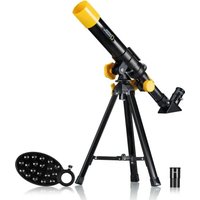
40/400 - Telescope National Geographic - Free user manual and instructions
Find the device manual for free 40/400 National Geographic in PDF.


| Product type | Refractor telescope |
| Brand | National Geographic |
| Model | 40/400 |
| Objective lens diameter | 40 mm |
| Focal length | 400 mm |
| Magnification | 20x (20 mm eyepiece) and 32x (12.5 mm eyepiece) |
| Included eyepieces | 12.5 mm and 20 mm |
| Zenith mirror | Included |
| Tripod | Included |
| Smartphone adapter | Included |
| Compass | Included |
| Usage | Astronomical and terrestrial observation (via zenith mirror) |
| Safety | Never look at the sun – risk of blindness. Keep out of reach of children. |
| Cleaning | Soft, lint-free cloth (microfiber); for stubborn stains, slightly dampen with glasses cleaning solution. |
| Protective cap | Do not expose to high temperatures; protect from dust and humidity. |
| Warranty | 2 years (extendable by registering at www.bresser.de/warranty_terms) |
| Compliance | CE – declaration available at www.bresser.de/download/9140400/CE/9140400_CE.pdf |
| Manufacturer | Bresser GmbH |
| Repairability | Contact the specialized dealer in case of defects |
| Disposal | Recycle according to local regulations – deposit in store or recycling center |
Frequently Asked Questions - 40/400 National Geographic
User questions about 40/400 National Geographic
0 question about this device. Answer the ones you know or ask your own.
Ask a new question about this device
Download the instructions for your Telescope in PDF format for free! Find your manual 40/400 - National Geographic and take your electronic device back in hand. On this page are published all the documents necessary for the use of your device. 40/400 by National Geographic.
USER MANUAL 40/400 National Geographic
natural_image
Black-and-white photo of a telescope on a tripod, no visible text or symbolsEN Operating instructions
FR Mode d'emploi
NL Handleiding
natural_image
Prohibition symbol showing sun above eye and no text or numbers(DE) WARNUNG:
Never use this device to look directly at the sun or in the direct proximity of the sun. Doing so may result in a risk of blindness.
(FR) AVERTISSEMENT!
MANUAL DOWNLOAD:

natural_image
Simple shield icon with a checkmark inside, no text or symbols presentSERVICE AND WARRANTY:

www.bresser.de/warranty_terms

TELESCOPE GUIDE:

natural_image
Simple line drawing of a speech bubble with three dots inside, enclosed in a square frame (no text or symbols)TELESCOPE FAQ:

www.bresser.de/faq
natural_image
Simple line drawing of a person using a telescope (no text or symbols)EXPERIMENTS:

EN Operating instructions....8

- Risk of blindness — Never use this device to look directly at the sun or in the direct proximity of the sun. Doing so may result in a risk of blindness.
- Choking hazard – Children should only use the device under adult supervision. Keep packaging material, like plastic bags and rubber bands, out of the reach of children, as these materials pose a choking hazard.
- Risk of fire — Do not place the device, particularly the lenses, in direct sunlight. The concentration of light could cause a fire.
- Do not disassemble the device. In the event of a defect, please contact your dealer. The dealer will contact the Service Centre and can send the device in to be repaired, if necessary.
- Do not expose the device to high temperatures.
- The device is intended only for private use. Please heed the privacy of other people. Do not use this device to look into apartments, for example.
Parts overview
- Focus wheel
- Zenith mirror (diagonal)
- Eyepieces (12.5 mm, 20 mm)
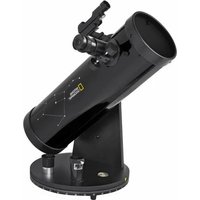
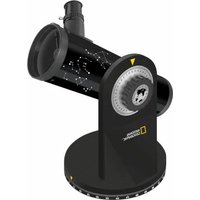
- Telescope (Telescope tube)
- Tube opening
-
Objective lens
-
Locating screw for the vertical fine adjustment (for moving upward and downward)
- Locating screw for the vertical axis (for turning to the right and left)
- Tripod legs
- Compass
- Smartphone holder
Assembly
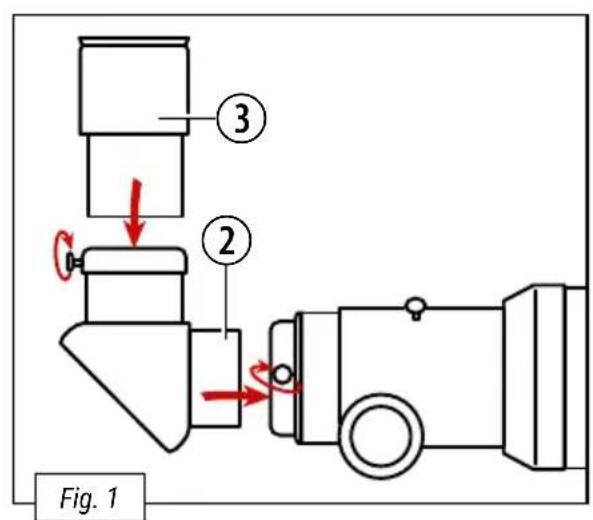
You should take some time to decide where you would like to set up your telescope. Choose a stable surface like a table. Snap the telescope tube into the U-shaped clamp on the top of the tripod head. You can now place the zenith mirror (2) into the eyepiece holder and secure it with the small screw on the connector (Fig. 1). Next, set the eyepiece (3) into the opening of the zenith mirror (2) (Fig. 1). Here too, there is a screw with which you can screw the eyepiece onto the zenith mirror.
Note: First, put the eyepiece with the largest focal length (e.g. 20 mm) onto the zenith mirror. While you'll get the lowest amount of magnification, it will be easier for you to view things.
Using your telescope
To move the scope up, down and side to side, grip the telescope and steadily move the tube until your target comes into view in the eyepiece. It is important to remember that the rotation of the Earth means objects will move out of your eyepiece fairly quickly. Once you have found and focused on your desired target, you will have to track the object as it journeys across the night sky. For a closer look at an object, you can insert the 12.5mm eyepiece. The magnification will increase from 20x to 32x.
Which eyepiece is right?
It is important that you always choose an eyepiece with the highest focal width at the beginning of your observation. Afterward, you can gradually move to eyepieces with smaller focal widths. The focal width is indicated in millimetres and is written on each eyepiece. In general, the following is true: the larger the focal width of an eyepiece, the smaller the magnification. There is a simple formula for calculating the magnification:
Focal width of the telescope tube : Focal width of the eyepiece = Magnification
The magnification also depends on the focal width of the telescope tube. This telescope contains a tube with a focal width of 400 mm.
Examples:
400 mm / 20 mm = 20X magnification
400 mm / 12.5 mm = 32X magnification
Focus wheel
Look through the telescope eyepiece (3) and hone in on a far away object that you can see well (for instance, a church tower). Focus in on the object with the focus knob (1) in the way shown in Fig. 3.
Smartphone holder
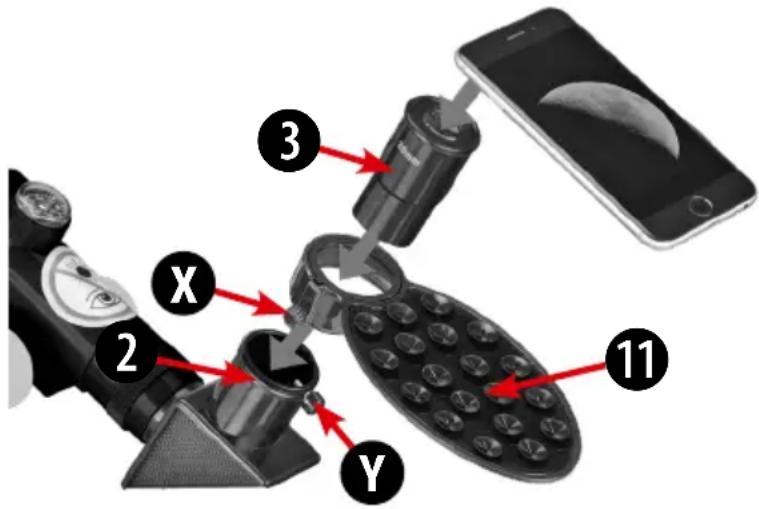
Insert the eyepiece (3) into the smartphone holder (11) and tighten the screw (X) to the bracket firmly. Then set the smartphone holder with the eyepiece into the eyepiece connection (2) and tighten the clamping screws (Y) by hand firmly. Now start your smartphone camera app and press your smartphone on the plate. Make sure that it is properly secured. The camera should rest just above the eyepiece. Place the smartphone exactly over the eyepiece, so that the image is exactly centered on your display. It may be necessary to use the zoom function to fill out the whole screen of your smartphone. The suction cups must be dry, clean and free from all kinds of dust and dirt. We assume no responsibility for dropped and broken smartphones due to incorrect handling.
Technical data:
- Design: achromatic
- Focal length: 400 mm
• Objective diameter: 40 mm
Notes on cleaning
- Clean the eyepieces and lenses only with a soft, lint-free cloth, like a microfibre cloth. To avoid scratching the lenses, use only gentle pressure with the cleaning cloth.
- To remove more stubborn dirt, moisten the cleaning cloth with an eyeglass-cleaning solution, and wipe the lenses gently.
- Protect the device from dust and moisture. After use, particularly in high humidity, let the device acclimatise for a short period of time, so that the residual moisture can dissipate before storing.
Possible observation targets
The following section details several interesting and easy-to-find celestial objects you may want to observe through your telescope.
The Moon
The moon is Earth's only natural satellite.
Diameter: 3,476 km / Distance: 384,400 km from Earth (average)
The moon has been known to humans since prehistoric times. It is the second brightest object in the sky, after the sun. Because the moon circles the Earth once per month, the angle between the Earth, the moon and the sun is constantly changing; one sees this change in the phases of the moon. The time between two consecutive new moon phases is about 29.5 days (709 hours).
Constellation Orion: The Orion Nebula (M 42)
Distance: 1,344 light years from Earth
Though it is more than 1,344 light years from Earth, the Orion Nebula (M 42) is the brightest diffuse nebula in the sky. It is visible even with the naked eye and a worthwhile object for telescopes of all types and sizes. The nebula consists of a gigantic cloud of hydrogen gas with a diameter of hundreds of light years.
Constellation Lyra: The Ring Nebula (M 57)
Distance: 2,412 light years from Earth
The famous Ring Nebula (M57) in the Lyra constellation is often viewed as the prototype of a planetary nebula. It is one of the magnificent features of the Northern Hemisphere's summer sky. Recent studies have shown that it is probably comprised of a ring (torus) of brightly shining material that surrounds the central star (only visible with larger telescopes), and not a gas structure in the form of a sphere or an ellipse. If you were to look at the Ring Nebula from the side, it would look like the Dumbbell Nebula (M 27). When viewed from Earth, we are looking directly at the pole of the nebula.
Constellation Vulpecula (Little Fox): The Dumbbell Nebula (M 27)
Distance: 1,360 light years from Earth
The Dumbbell Nebula (M 27) was the first planetary nebula ever discovered. On 12 July 1764, Charles Messier discovered this new and fascinating class of objects. We see this object almost directly from its equatorial plane. If we could see the Dumbbell Nebula from one of its poles, we would probably see the shape of a ring, something very similar to what we know as the Ring Nebula (M 57). In reasonably good weather, we can see this object well, even with low magnification.
Telescope ABC's
What do the following terms mean?
Eyepiece (3):
An eyepiece is a system made for your eye and comprised of one or more lenses. In an eyepiece, the clear image that is generated in the focal point of a lens is captured and magnified still more.
There is a simple formula for calculating the magnification:
Focal length of the telescope tube / Focal length of the eyepiece = Magnification
In a telescope, the magnification depends on both the focal length of the telescope tube and the focal length of the eyepiece. From this formula, we see that if you use an eyepiece with a focal length of 20 ~mm and a telescope tube with a focal length of 400 ~mm , you will get the following magnification:
400 mm / 20 mm = 20 times magnification
Focal length:
Everything that magnifies an object via an optic (lens) has a certain focal length. The focal length is the length of the path the light travels from the surface of the lens to its focal point. The focal point is also referred to as the focus. In focus, the image is clear. In the case of a telescope, the focal length of the telescope tube and the eyepieces are combined.
Lens:
The lens turns the light that falls on it around in such a way so that the light gives a clear image in the focal point after it has traveled a certain distance (focal length).
Magnification:
The magnification corresponds to the difference between observation with the naked eye and observation through a magnifying device like a telescope. If a telescope configuration has a magnification of 30x, then an object viewed through the telescope will appear 30 times larger than it would with the naked eye. See also 'Eyepiece'.
Zenith mirror (diagonal) (2):
A mirror that deflects the ray of light 90 degrees. With a horizontal telescope tube, this device deflects the light upwards so that you can comfortably observe by looking downwards into the eyepiece. The image in a diagonal mirror appears upright, but rotated around its vertical axis (mirror image).
DISPOSAL

Dispose of the packaging materials properly, according to their type, such as paper or cardboard. Contact your local waste-disposal service or environmental authority for information on the proper disposal.
Please take the current legal regulations into account when disposing of your device. You can get more information on the proper disposal from your local waste-disposal service or environmental authority.
EC Declaration of Conformity

Bresser GmbH has issued a "Declaration of Conformity" in accordance with applicable guidelines and corresponding standards. The full text of the EU declaration of conformity is available at the following internet address: www.bresser.de/download/9140400/CE/9140400_CE.pdf
UKCA Declaration of Conformity

Bresser GmbH has issued a „Declaration of Conformity“ in accordance with applicable guidelines and corresponding standards. The full text of the UKCA declaration of conformity is available at the following internet address:
www.bresser.de/download/9140400/UKCA/9140400_UKCA.pdf
Bresser UK Ltd. • Suite 3G, Eden House, Enterprise Way • Edenbridge, Kent TN8 6HF • Great Britain
Warranty
The regular warranty period is 2 years and begins on the day of purchase. To benefit from an extended voluntary warranty period as stated on the gift box, registration on our website is required.
You can consult the full warranty terms as well as information on extending the warranty period and details of our services at www.bresser.de/warranty_terms.

Every purchase helps support the global nonprofit National Geographic Society in its work to protect and illuminate our world through exploration, research, and education.
TO LEARN MORE, VISIT NATGEO.COM/INFO
© National Geographic Partners LLC. All rights reserved.
NATIONAL GEOGRAPHIC KIDS and Yellow Border Design are trademarks of National Geographic Society, used under license.
Visit our website: kids.nationalgeographic.com

BRESSER®
Bresser GmbH
Gutenbergstr. 2
46414 Rhede
Germany
www.bresser.de
info@bresser.de
Bresser UK Ltd.
Suite 3G, Eden House,
Enterprise Way • Edenbridge,
Kent TN8 6HF, Great Britain

- (DE) WARNUNG:
- (FR) AVERTISSEMENT!
- MANUAL DOWNLOAD:
- SERVICE AND WARRANTY:
- TELESCOPE GUIDE:
- TELESCOPE FAQ:
- EXPERIMENTS:
- Parts overview
- Assembly
- Using your telescope
- Which eyepiece is right?
- Examples:
- Focus wheel
- Smartphone holder
- Technical data:
- Notes on cleaning
- Possible observation targets
- The Moon
- Constellation Orion: The Orion Nebula (M 42)
- Constellation Lyra: The Ring Nebula (M 57)
- Constellation Vulpecula (Little Fox): The Dumbbell Nebula (M 27)
- Telescope ABC's
- Eyepiece (3):
- Focal length:
- Lens:
- Magnification:
- Zenith mirror (diagonal) (2):
- DISPOSAL
- EC Declaration of Conformity
- UKCA Declaration of Conformity
- Warranty
- BRESSER®
Brand : National Geographic
Model : 40/400
Category : Telescope