
80-40114 - Telescope National Geographic - Free user manual and instructions
Find the device manual for free 80-40114 National Geographic in PDF.


Pick your language and provide your email: we'll send you a specifically translated version.
| Product Type | Refractor Telescope |
| Brand | National Geographic |
| Model | 80-40114 |
| Aperture | 80 mm |
| Focal Length | 400 mm |
| Focal Ratio | f/5 |
| Mount Type | Altazimuth |
| Tripod | Adjustable aluminum tripod |
| Eyepieces Included | 20 mm and 10 mm |
| Magnification | 20x (with 20 mm eyepiece) and 40x (with 10 mm eyepiece) |
| Finderscope | Red dot finder |
| Dimensions | Optical tube length: 70 cm; Tripod height: 120 cm |
| Weight | 3.5 kg |
| Power Source | None (manual operation) |
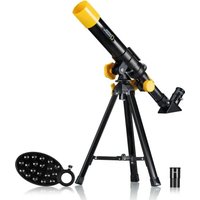
| Included Accessories | Moon filter, smartphone adapter |
| Cleaning | Use lens cleaning cloth; avoid solvents |
| Safety Warning | Never point at the sun without a proper solar filter |
| Spare Parts Availability | Eyepieces, tripod parts available from National Geographic |
| Recommended Use | Lunar, planetary, and terrestrial observation |
Frequently Asked Questions - 80-40114 National Geographic
How do I assemble the telescope for the first time?
Start by attaching the tripod legs and spreading them out. Mount the optical tube onto the altazimuth mount, then attach the finderscope and eyepiece. Refer to the manual for detailed steps.
What can I see with this telescope?
With an 80 mm aperture, you can observe the moon's craters, Jupiter's bands and moons, Saturn's rings, and bright deep-sky objects like the Orion Nebula. For best results, use a dark sky location.
Why can't I see anything through the eyepiece?
First, ensure the lens cap is removed. Then, try focusing by slowly turning the focus knob. If still unclear, check that the finderscope is aligned and that you are pointing at a bright object like the moon.
How do I align the finderscope?
During daytime, point the telescope at a distant object (e.g., a tree). Look through the main eyepiece and center the object, then adjust the finderscope's screws until the crosshairs are on the same object.
Can I use this telescope for astrophotography?
Yes, basic astrophotography is possible with the included smartphone adapter. Attach your phone to the eyepiece and use a camera app to capture the moon or planets. For deeper sky, a motorized mount is recommended.
How do I clean the lenses?
Use a soft brush or compressed air to remove dust. Then, gently wipe with a microfiber cloth. For stubborn spots, use a lens cleaning solution applied to the cloth, not directly on the lens.
Is it safe to observe the sun with this telescope?
Never point the telescope at the sun without a certified solar filter. Doing so can cause permanent eye damage. Only use a filter designed for the objective lens, not the eyepiece.
What maintenance does the telescope require?
Store the telescope in a dry place, cover it when not in use, and periodically check screws for tightness. Lubricate the mount sparingly if movement becomes stiff.
Can I replace damaged parts?
Yes, replacement eyepieces, tripod legs, and finderscopes are available from National Geographic or authorized retailers. Contact customer support for specific parts.
Why does the image appear upside down?
This is normal for astronomical telescopes. For terrestrial viewing, you can use an optional erecting prism (not included) to correct the orientation.
User questions about 80-40114 National Geographic
0 question about this device. Answer the ones you know or ask your own.
Ask a new question about this device
No questions yet. Be the first to ask one.
Download the instructions for your Telescope in PDF format for free! Find your manual 80-40114 - National Geographic and take your electronic device back in hand. On this page are published all the documents necessary for the use of your device. 80-40114 by National Geographic.
USER MANUAL 80-40114 National Geographic
Manual assistant
Powered by Anthropic
Waiting for your message
Product information
Brand : National Geographic
Model : 80-40114
Category : Telescope