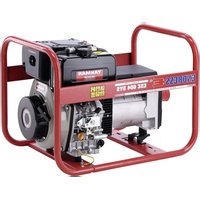
ESE 604 DYS DI - Generator Endress - Free user manual and instructions
Find the device manual for free ESE 604 DYS DI Endress in PDF.


User questions about ESE 604 DYS DI Endress
0 question about this device. Answer the ones you know or ask your own.
Ask a new question about this device
Download the instructions for your Generator in PDF format for free! Find your manual ESE 604 DYS DI - Endress and take your electronic device back in hand. On this page are published all the documents necessary for the use of your device. ESE 604 DYS DI by Endress.
USER MANUAL ESE 604 DYS DI Endress
text_image
Analog voltmeter dial with pointer indicating voltage measurement3
text_image
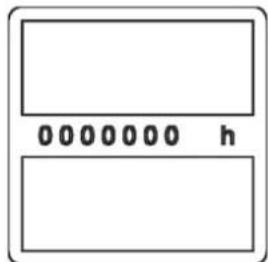
0000000 h4
5
natural_image
Pure electrical circuit lines without any symbols67891011
natural_image
Pure electrical circuit lines without any symbols
natural_image
Simple line drawing of a room layout with furniture and fixtures (no text or symbols)




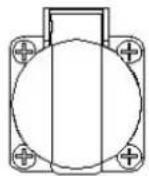
12131415161718

1920212223
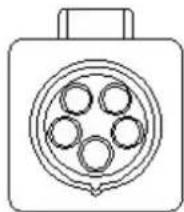
natural_image
Simple line drawing of a rectangular device with a circular component on top (no text or symbols)24
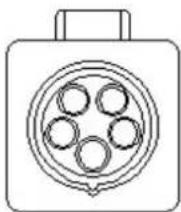
natural_image
Simple line drawing of a rectangular device with a circular component on top (no text or symbols)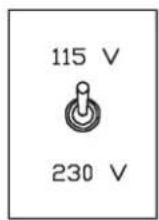

text_image
Prohibition sign with crossed-out flame and smoke symbol, indicating no smoking or fire
text_image
PASSED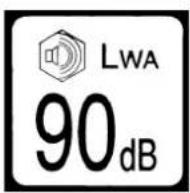
natural_image
Warning symbol of a lightning bolt inside a triangle (no text or numbers)
text_image
PE
natural_image
Simple electrical symbol for a diode (no text or labels)| Model S8007HEPI | ||
| Code PO65Z7HB009 | ||
| Manufacturing Year 2003 Serial # PWR0002760 | ||
| COP Power (kW) 5.6 Power Factor 0.8 | ||
| Rated Frequency (Hz) 50 Rated Voltage (V) 490 | ||
| Rated current (A) 10.1 Weight (Kg) 95 | ||
25262728
| ATTENÇÃO 1PRIMA DI METTERE IN MOTOREMREPUZ DI OLIO IL MOTORE.VEDEO SUL LIBERTTO ISTRUZIONE. | ACHTUNG 1DEN MOTOR MIT ÖL FÜLLER,BEVOR MAN IHH ANLASSTIHE BEDEINNINGSANLEITUNG. | ATENCIÓN 1ANTES DE PONER EN MARCA,LLXMAR EL MOTOR CON ELCATEC. CONSULTAR EL LIBRITO DE ISTRUCCIONE. |
| ATTENTION 1BEFORE STARTING FILL THEMOTOR WITH OIL. SEE THEINSTRUCTION MANUAL. | ATTENTION 1AVANT DE METTRE EN MARCHEREMPLIR D'HUILE LE MOTEUR.VOIR LIVRET D'INSTRUCTIONS. | LET OP 1VOIR HET STARTEN EREST OFMOTOR ME ÖL VÜLLER, DE DE GEBRUKSAANWUZING. |
| ATTENÇÃO 1ANTES DE LIGAR ENCHER DEOLIO O MOTOR, CONSULTAR O LIVET DE INSTRUCTIONS. | PAS PA 1FBR START PÄYLFIDESMOTOURN OLIIE, SE INSTRUKTIONSROGEN. | IPPODOXH:IPIN NA MIBEI ZEKINNESHO KINHTHPAÇ NA YTEMENDEI ME AALKOTAETE TO EXKEPIÃO OAHTEIX. |
| VARNING 1FYL MOTORIM MED OLA FÖRESTART. SE INSTRUMENTSROB. | HUOM 1ENHEN KÄNYNGSTÄSTÄ ON HUOLLEHOTTINA MOTOURN ÖLYNKÄTYTÖSTÄ SA KÄYKÄTTÖDHAJET. |
29

30

31

32
33
34
• LABELLA COMPONENTI
• BLEAU COMPOSANTS
• TABLE OF COMPONENTS
• LABELLE BAUTEILE
• :ABLA DE COMPONENTES
• TABELA COMPONENTES
• TABEL COMPONENTEN
• OVERSIGT OVER KOMPONENTERNE
• KOMPONENTTABELLE
• TABELL ÖVER KOMPONENTER
• ΠΙΝΑΚΑΣ ΣΤΟΙΧΕΙΩΝ
• KOMPONENTTITAULUKKO
• СПЕЦИФИКАЦИЯ
КОМПОНЕНТОВ
SFIFROBDE
| 1 | Amperometro | Ampèremètre | Ammeter | Amperemeter | Amperímetro | Amperímetro | Ampèremeter | Amperemeter | Ampere-måler | Ampere-mätare | Амперóμετρο | Virtamittari | Амперметр |
| 2 | Voltmetro | Voltmètre | Voltmeter | Voltmeter | Voltímetro | Voltímetro | Voltmeter | Voltmeter | VoltmåLER | Voltmätare | Волтóμετρο | Volttimittari | Вольтметр |
| 3 | Frequenziometro | Fréquencemètre | Frequency meter | Frequenzmesser | Frecuencímetro | Frequencímetro | Frequentiemeter | Frekvensmåler | Frekvense-måler | Frekvens-mätare | Метрптнг Συχνοτητας | Taajuusmittari | Частотомер |
| 4 | Contaore | Compteur horaire | Hour meter | Betriebsstundenzähler | Contador | Contador de horas | Urenteller | Timetæller | Teller | Räkneverk | Ωρομετρητής | Tuntilaskuri | Счетчик часов |
| 5 | Bobina a lancio di corrente | Bobine à lancement de courant | Current discharge coil | Startstromspule | Bobina de disparo | Bobina a Impulso de corrente | Stroomstartspoel | Strømviking | Strømforsyningsspole- | Strömförsörj-ningsspole | Πηνίο παροχής ρεύματος | Virran syöttökela | Катушка с передачей тока |
| 6-7 | Interruttore Magnetotermico | Déclencheur thermique | Thermal cut-out switch | Magnetothermischer Schalter | Interruptor Magnetotérmico | Disjuntor | Magnetothermis che schakelaar | Automatisk udkobling | Magnetisk termisk bryter | Magnetisk termisk strömbrytare | Μανγητοθερμικός διακόττης | Ylivirtasuojakytkin | Тормомапнитный выключатель |
| 8-9 | Relé Differenziale | Relais Différentiel | Differential relay | Differentialrelais | Relé Diferencial | Relê diferencial | Differentieelrelais | Differentialrelae | Differensial-relé | Differential-relä | Διαφορικό ρελέ | Välitysrele | Дифференциальное реле |
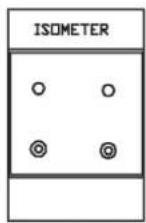
| 10 | Controllore d'isolamento | Contrôleur d'Isolation | Insulation controller | Isolatorskontrollvorrichtung | Controlador de aislamiento | Controlador de isolamento | Isometer | Isoleringskontrol anordning | Isolerings-kontroll | Isolerings-kontroll | Ελεγκτής μόνωσης | Eristyksen tarkistin | Изоляционный контроллер |
| 11 | Interruttore a chiave | Interrupteur à clé | Key switch | Schlüsselschalter | Interruptor con llave | Interruptor de chave | Sleutelschakelaar | Kontakt med nøgle | Nykkel-strømbrytare | Nyckel-strömbrytare | Διακόττης κλειδί | Katkaisuavain | Ключевой переключатель |
| 12 | Disgiuntore Termico | Disjoncteur Thermique | Thermal circuit breaker | Thermo-Aufrenner | Disyuntor Térmico | Disjuntor térmico | Thermische beveiliging | Termisk adskiller | Termisk frakopler | Termisk fränkopplare | Θερμικός διακόττης ασφαλείας | Lämpörajoitin | Термовыключатель |
| 13 | Fusibile di protezione Carica Batteria | Fusible de sécurité Chargeur de Batteries | Battery charger protection fuse | Sicherung Batterieladegerät | Fusible de protección Carga Bateria | Fusivel protecção carregador bateria | Zekering bescherming acculader | Sikring Batterilader | Sikeinf for batterilader | Skyddssäk-ring för batteri-laddning | Ασφάλεια προστασίας φορτωτή μπαταρίας | Varmistussulake Akun lataus | Плавий предохранитель зарядного уст-ва батареи |
| 14 | Dispositivo Carica Batteria | Dispositif Chargeur de Batteries | Battery charger device | Vorrichtung Batterieladegerät | Dispositivo Carga Bateria | Dispositivo carregador de bateria | Acculader | Batterilade-anordning | Batterilader | Batteriladd-ningsenhet | Συσκευή φορτωτή μπαταρίας | Akun latauslaite | Зарядное уст-во ахкумуляторной батареи |
| 15 | Commutatore di Tensione Y/Δ | Commutateur de tension Y/Δ | Vovlitage controller Y/Δ | Spannungsumschalter Y/Δ | Commutador de Tensión Y/Δ | Comutador de tensão Y/Δ | Spanningsschak elaar Y/Δ | Spændingsomstiller Y/Δ | Spennings-kopler Y/Δ | Spännings-omkopplare Y/Δ | Μεταλλακτήρας τάσης Y/Δ | Jännitemuuntaja Y/Δ | Переключатель напряжения Y/Δ |
| 16 | Pulsante ON/OFF | Bouton ON/OFF | ON/OFF button | Taste ON/OFF | Pulsador ON/OFF | Botão ON/OFF | Knop ON/OFF | ON/OFF knap | TILL/FRAU tast | AV/PÄ-knapp | Κουμπί ON/OFF | Painike ON/OFF | Кнопка ВКЛ.ЫЫКЛ. |
| 17 | Spia presenza Tensione | Témoin présence Tension | Voltage indicator light | Kontrollampe Spannung ein | Luz de aviso Tensión dada | Indicador luminoso presença de tensão | Controlelampje spanning aanwezig | Signallampe spænding til stede | Strømspen-ningsindi-kator | Strömspän-ningsindi-kator | Λυχνια ενδειξης τάσης | Jännitteen merkkivalo | Световой сигнал наличия напряжения |
| 18 | Presa Schuko | Prise Schuko | Schuko socket | Schuko-Dose | Toma Schuko | Tomada Schuko | Contactstop Schuko | Schuko-stik | Schuko-uttak | Schuko-uttag | Υποδοχή σουκου | Pistoke Schuko | Розетка "Шуко" |
| 19 | Presa 2P+T | Prise 2P+T | 2P+T socket | Steckdose 2P+T | Toma 2P+T | Tomada 2P+T | Contactstop 2P+T | Stik 2P+J | Uttak 2P + Jordeledning | Uttag 2P + Jord | Υποδοχή 2P+T | Pistoke 2N+M | Розетка 2P+T |
| 20 | Presa 3P+T | Prise 3P+T | 3P+T socket | Steckdose 3P+T | Toma 3P+T | Tomada 3P+T | Contactstop 3P+T | Stik 3P+J | Uttak 3P + Jordeledning | Uttag 3P + Jord | Υποδοχή 3P+T | Pistoke 3N+M | Розетка 3P+T |
| 21 | Presa 3P+N+T | Prise 3P+N+T | 3P+N+T socket | Steckdose 3P+N+T | Toma 3P+N+T | Tomada 3P+N+T | Contactstop 3P+T | Stik 3P+N+J | Uttak 3P+N+J ordeledningeing | Uttag 3P+N+Jord | Υποδοχή 3P+N+T | Pistoke 3N+N+M | Розетка 3P+N+T |
| 22 | Dual Voltage | Dual Voltage | Dual Voltage | Dual Voltage | Dual Voltage | Dual Voltage | Dual Voltage | Dual Voltage | Dual Voltage | Dual Voltage | Dual Voltage | Dual Voltage | Двойное напряжение |
LISTA TARGHETTE:
23 NO SMOKING OR OPEN FLAMES: During refuelling and maintenance operations smoking and the use of open flames is forbidden, as it may cause damages and injuries.
24 PASSED: Indicates that the machine has passed all end of production line tests
25 NOISE LEVEL: Indicates the guaranteed noise level (as prescribed by Directive 2000/14/CE).
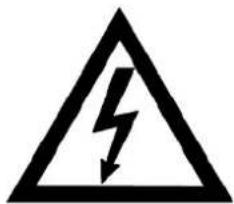
26 WARNING! danger of electrocution Do not carry out maintenance in areas near electrical cables without first turning the machine off, it may lead to death.
27 GROUNDING CONTACT: The PE clamp for the equipotential connection of the masses and/or grounding (by special ground plate) of the unit is located near this symbol.
28 NUMBER PLATE: Indicates the market name, number, and year of manufacture and main specifications of the machine.
29 WARNING! MACHINE WITHOUT OIL: Indicates that the factory-delivered machine is without oil and that the tank should be filled before use according to the instructions in the engine manual.
30 WARNING! HOT PARTS: Indicates that parts nearby may be very hot.
31 USE PETROL ONLY: Use only unleaded petrol for fuel. Other types of fuel will cause irreparable damage to the engine.
32 USE DIESEL FUEL ONLY: Use only diesel fuel. Other types of fuel may cause irreparable damage to the engine.
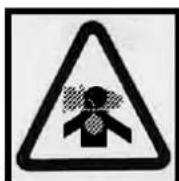
33 WARNING: Exhaust gas is poisonous. Do not operate in an unventilated room.
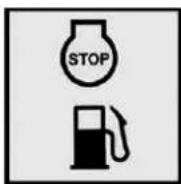
34 WARNING: Stop the engine before refueling.
D LISTE SCHILDER:
33 WARNING: Exhaust gas is poisonous. Do not operate in an unventilated room.
34 WARNING: Stop the engine before refueling.
E LISTA DE PLACAS:
EST PRESCRIT N'EST ADMISE.
INSTRUCTIONS DE SÉCURITÉ (4.1):
Thank you for purchasing one of our generators. We would like to draw your attention to a few points concerning this manual:
- This manual gives useful indications for the correct use and maintenance of the generator set to which it refers: it is therefore indispensable to pay the fullest attention to all those paragraphs that illustrate the simplest and safest way of using the generator.
- This manual is to be considered as an integral part of the generator and must be included at the moment of purchase.
- This publication may not be reproduced, either totally or in part, without written authorization from the makers.
- All information shown hereafter is based on the data available at the moment of printing; the makers reserve the right to make modifications to their products at any time, without warning and without incurring sanctions. You are therefore advised to check frequently for any updates.
KEEP FOR FUTURE REFERENCE
USE OF THE GENERATOR
THIS GENERATING PLANT IS DESIGNED TO SUPPLY
THREE PHASE AND/OR SINGLE PHASE ELECTRICAL POWER.
NO OTHER APPLIANCES OTHER THAN THOSE INDICATED
SHOULD BE USED.
SAFETY INSTRUCTIONS (4.1):
ATTENTION: if the following instructions are not fully observed, injury to persons, animals and/or things could result, and the Manufacturer does not accept responsibility for improper use.
- Do not run the generator in closed work areas: the engine produces carbon monoxide and other harmful gases detrimental to the health of persons who work with it; make sure that the generator is well ventilated.
- Direct combustion exhaust gas outside the machine room or a reasonable distance away from the workplace and personnel. Use piping or other extraction methods.
- The generator must only be run on a horizontal surface to guarantee optimum oil and fuel flow to the engine; if it is not possible to run it on a horizontal surface, the user must provide the necessary means to anchor and align the engine to ensure the machine's stability.
- If the generator is to be used during rain or snow, make sure that it is well and firmly sheltered.
- Always keep children away from the generator when in use; remember that, even after being shut off, the engine will remain at a high temperature for about 1 hour. In the areas where the exhaust is located, the flexible tube and the engine are subject to high temperatures and could possibly cause severe burns if touched.
- Maintenance and servicing of the equipment must not take place while the generator is operating; always switch off the engine.
- Refuelling and topping up with oil must be done when the engine is not running; remember that the engine remains hot for about 1 hour after it is turned off.
- It is vital to be aware of the functions and controls of the generator: do not allow any unauthorized persons to use the machine.
- Improper use of the machine should be avoided: such as, using the engine to heat the surrounding atmosphere etc.
- Do not allow any unauthorized persons to use the machine; to ensure the generator cannot operate, block the system (remove the starter key, close and lock the door of the switchboard).
- The machine does not need to be in a specially lighted area. However provide adequate lighting to comply with applicable working norms.
- Do not remove the protection devices and do not use the machine without adequate protection (sides and casing) or the use may be at risk.
- Should it be necessary to remove the protection devices (for maintenance and servicing), this operation should be done with the generator switched off and only by specialized persons.
- Do not use the machine in an explosive atmosphere.
- In the case of an emergency do not use water to extinguish a fire, use only the correct type of equipment (a powder loaded fire extinguisher, etc.).
- Whenever it is necessary to work in close proximity to the machine, sound muffler should be used (head muffs, ear plugs, etc.).
ATTENTION: Avoid any direct bodily contact with fuel, motor oil or battery acid. In case of contact with the skin wash with water and soap and rinse thoroughly; do not use organic solvents. In case of contact with the eyes, wash with water and soap and rinse thoroughly. In case of inhalation and swallowing, consult a medical practitioner.
PRELIMINARY CHECKS (5.1):
- Make sure these operations are carried out with the generator placed on a horizontal and stable surface.
- Oil is the most important element influencing the efficiency and long life of the engine. In the use and maintenance manual are shown details of the type of oil to use and the correct oil level for this generator.
ATTENTION: Running the engine with insufficient oil could cause serious damage.
- Check the fuel level: use clean fuel free of water.
ATTENTION: Fuel is highly infl ammable and explosive under certain conditions.
Refuel in a well ventilated area with the engine switched off. During refueling do not smoke and do not approach the equipment with an open flame.
Do not overfill the tank (do not fill up to the cap), because vibration from the running engine could cause fuel spillage. Pay attention not to spill fuel while filling the tank. Ensure that the cap is correctly screwed down after filling. If fuel has been spilt, ensure that the area is completely dry before switching on the engine. Avoid any bodily contact with the fuel and do not inhale the vapour. It is important to
keep the fuel in a place inaccessible to children. The fuel fumes are highly infl ammable.
- Check the air filter: make sure that it is in good conditions and free from dust and dirt. To reach the filter consult the engine user's and maintenance manual.
ATTENTION: do not use the generator without the air fi iter: the life of the engine and the generator will be reduced!
- Activate the battery: fill the compartments to their maximum level with a 30 / 40% sulphuric acid solution and wait at least two hours before using.
ATTENTION: do not touch the acid and do not smoke or use naked lights; battery fumes are highly inflammable. Keep the acid out of reach of children.
STARTING THE GENERATOR (6.1):
Before starting the engine it is necessary to:
- Ensure that no appliance is plugged into the generator.
- For the petrol engine version use the choke for cold starts.
- For generators with electrical starters turn the key to the "START" position and release it as the machine starts.
- To start the recoil operated generators, pull the cord handle until resistance is felt, then pull energetically.
ATTENTION: Do not let the recoil handle rewind quickly. Guide it to prevent damage to the automatic winder.
- When the engine is running, switch off the choke.
- At this point the unit is ready for use.
NOTE: If the generator is used at high altitudes or temperatures, the air-fuel mix ratio may be too rich; this will cause higher consumption and lower performance. Check the effective power of the generator by means of the following correction factors:
TEMPERATURE: Power drops an average of 2% every 5 degrees centigrade above a temperature of 20 degrees centigrade.
ALTITUDE: Power drops an average of 1% every 100 meters a.s.l. Above an altitude of 2000 m, contact the service centre of the engine's manufacturing company to reset the combustion mixture if necessary.
USING THE GENERATOR (7.1):
NOTE: The generator, built to current standards, has been designed to satisfy a very wide range of applications.
It should be remembered when using the machine, that every application is subject to exact electrical, accident prevention and sanitary standards; for this reason the generator should be considered as an integral part of the complete installation, and should be designed, tested and approved by qualified technicians and/or companies.
- In order to avoid electrical accidents, all connections to the distribution panel must be carried out by qualified technicians. Incorrect connections can harm people and damage the generator.
- Protection against indirect contacts: all the generators, when functioning normally, use the principal of electrical separation; however, they can be supplied with various protection options (differentiator, isometer) by the manufacturer on specific request, or they can be protected in the same way during installation by the user.
It is important therefore, to follow the instructions as below:
1) Standard generators: protected by electrical separators. This equipment has a thermic protection device and/or a magnetothermic device to protect against a surge of current, overloading and short-circuiting.
In these cases the Generator should under no circumstances be earthed using the terminal “PE” or with any other part of the generator.
2) Generator with optional switchboard (or with other devices installed by the user): must be protected using a circuit breaker' which automatically cuts off the power supply. It has heat overload protection devices and/or magnetothermic combinations with differential circuit breakers or trip switches. In this case the generator must be connected to an earth leakage unit using the terminal "PE", and using as conductor a yellow - green cable of suitable size.
IMPORTANT: In the event of the user installing differential circuit breakers, it is important for its correct functioning that:
A) On single-phase generators the neutral point that corresponds to the joint of the two main coils is also earthed.
B) On three-phase generators the neutral point that corresponds to the wye-centre in the case of a wye connection is also earthed. In the case of a delta connection it is not possible to install a differential switch.
- The generator is preset for grounding the masses; a special screw, marked with the symbol PE, allows all the metal parts of the generator set to be connected to a ground plate.
- Do not connect to the generator any appliances with unknown electrical specifications or with specifications different from those of the generator (i.e. different voltages and/or frequencies).
- The electrical circuit of the generator is protected by a switch, which is either thermomagnetic, thermomagnetic-differential of thermic; overloading and/or a short circuit will cut the flow of current immediately. To reset, disconnect all appliances, check the cause of the short-circuit and/or overload and switch on.
- If using the generator as battery charger, place the battery at a distance of 1m from the unit, making sure that the filling plugs are removed from the cells. Take care to observe the battery polarities, incorrect connection of positive and negative poles could cause the battery to explode.
ATTENTION: During charging, the battery gives off infl ammable vapour. Therefore observe the maximum caution during charging and keep children far away.
- With a star-delta switch the following options are available:
THREE PHASE 400 V (full design load)
SINGLE PHASE 230 V (1/3 of design load)
THREE PHASE 230V (full design load)
SINGLE PHASE 230 V (2/3 of design load)
When set on "O" all power points are disconnected.
- Before setting the switch to any of the above, ensure that no appliances are connected to the generator. Be sure to set the switch to the correct current as shown on the tag, in order to avoid damages to the appliances.
- When the generator is in use, do not place any objects on the frame or directly on the engine: any foreign bodies may impair performance.
- Do not hinder the normal vibrations that the generator makes when in use. The silent-blocks are of an adequate size to work properly.
STOPPING THE GENERATOR (8.1):
Switch off or disconnect all the accessories powered by the generator: then stop the engine after letting it idle for 2-3 minutes to cool down; to stop the generator turn off the switch.
With electrically started generators, turn the key to the "OFF" position.
ATTENTION: the engine will remain hot even after being switched off: make sure the generator is well ventilated even after engine shut down.
MAINTENANCE (9.1):
As regards this important paragraph please carefully consult the use and maintenance manual published by the makers of the engine: if you spend some time now you will save money later!
ATTENTION: WHEN REQUESTING SPARE PARTS CHECK YOUR REQUIREMENTS AGAINST THE SCHEDULE IN THIS MANUAL.
- Normal battery, alternator and frame maintenance operations are reduced to a minimum: keep the battery terminals well greased and top up with distilled water when the plates are uncovered.
- No special maintenance operations are required for the commutator system – brush holder – brushes – as they are designed to guarantee reliable and prolonged service.
- When requesting spare parts, as shown in the attached current Manual, it is essential that they are quoted in sequential order, supplying the code number of the piece required, the registered number of the generator, its commercial name and the date of construction (see Appendix of the list of spare parts attached to the current Manual).
NOTE: In order to observe the Directive 2000/14/CE, it is recommended that periodical checks (at least every 6 months) be carried out on the components that may be subject to wear and tear during normal running conditions, and that may as a consequence cause an increase in machine noise. The following is a list of components that should be checked:
Exhaust pipe
If a problem arises in one or more of these components, the nearest authorized service centre should be contacted.
Silent-Blocks
Air fi Iter
Mounting of mechanical parts
Engine and alternator fans
Good working order of the machine
Sound absorbing and sound insulating materials (where present)
NOTE: When disposing of used oil or residual fuel, respect the environment. We suggest collecting waste product in drums for delivery at a later date to a nearby Service Station. Do not deposit oil and residual fuel into the earth or into unsuitable receptacles.
NOTE: Bad operation of the generator due to faults in the engine (oscillation, low number of revs, etc.) is of exclusive competence of the departments of the engine makers' customer service, both during and after the warranty period. Tampering or intervention carried out by personnel unauthorized by the makers will invalidate the conditions of guarantee.
Malfunction of the generator due to faults in the electrical circuits and in the frame is of exclusive competence of the makers' customer service department. Repairs carried out by unauthorized personnel, substitution of components with unoriginal spare parts and tampering with the generator will invalidate the conditions of warranty.
The makers do not accept any liability arising out of faults or accidents due to neglect, incapacity or installation by not qualified technicians.
CLEANING (10.1):
Turn off the machine and wait until the hot parts have cooled down before proceeding.
It is recommended that the machine not be cleaned with jets of water or inflammable products. Use special products or a damp cloth if necessary; in the latter case pay attention to the electrical components.
Before turning the machine back on make sure that it is completely dry.
TRANSPORTATION (11.1):
- It is a good rule during transportation to firmly fix the generator so that it cannot turn over; remove all fuel and make that acid or fumes do not leak from the battery (if present).
Check the overall weight of the machine to be transported by road.
Under no circumstances should the generator be started while inside a truck.
STORAGE (12.1):
If you do not intend to use the generator for more than thirty days, it is advisable to completely drain the fuel tank.
For petrol engines it is important to drain also the carburetor float chamber: petrol left in contact with components for a long period will cause them to deteriorate due to the rubbery deposits typical to this fuel.
ATTENTION: Petrol is extremely inflammable and explosive under certain conditions. Avoid smoking and sparks in the vicinity.
- Substitute the engine with oil if it is finished: when the engine is not in use, it could damage the thermal group and the connecting rods.
- Clean the generator accurately, disconnect the battery cables (if present) and cover well to protect from dust and damp.
TROUBLE SHOOTING:
NO VOLTAGE IN A.C. SOCKET (13.1):
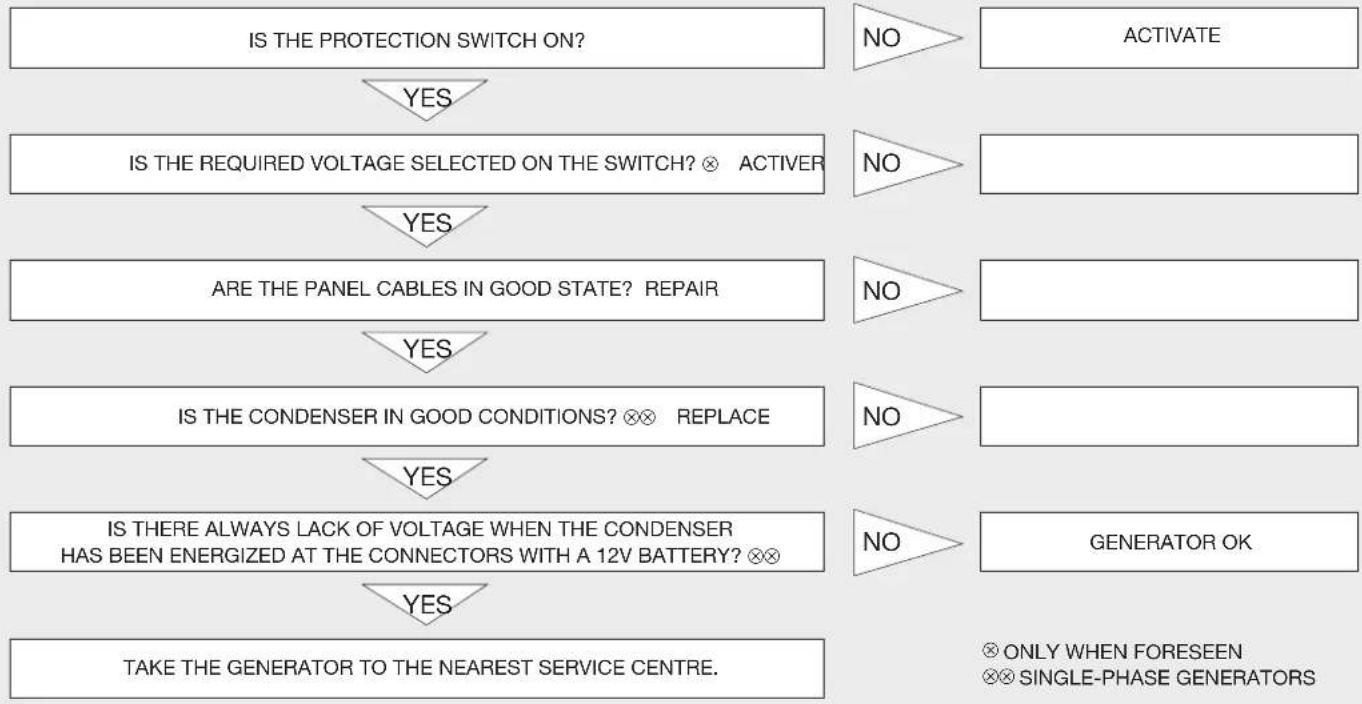
flowchart
graph TD
    A["IS THE PROTECTION SWITCH ON?"] -->|YES| B["IS THE REQUIRED VOLTAGE SELECTED ON THE SWITCH? Ⓧ ACTIVER"]
    B -->|YES| C["ARE THE PANEL CABLES IN GOOD STATE? REPAIR"]
    C -->|YES| D["IS THE CONDENSER IN GOOD CONDITIONS? Ⓧ REPLACE"]
    D -->|YES| E["IS THERE ALWAYS LACK OF VOLTAGE WHEN THE CONDENSER HAS BEEN ENERGIZED AT THE CONNECTORS WITH A 12V BATTERY? Ⓧ"]
    E -->|YES| F["TAKE THE GENERATOR TO THE NEAREST SERVICE CENTRE."]
    F -->|NO| G["ACTIVATE"]
    F -->|NO| H["GENERATOR OK"]
    H --> I["ONLY WHEN FORESEEN\nSINGLE-PHASE GENERATORS"]
NO VOLTAGE IN CHARGER SOCKET (14.1):
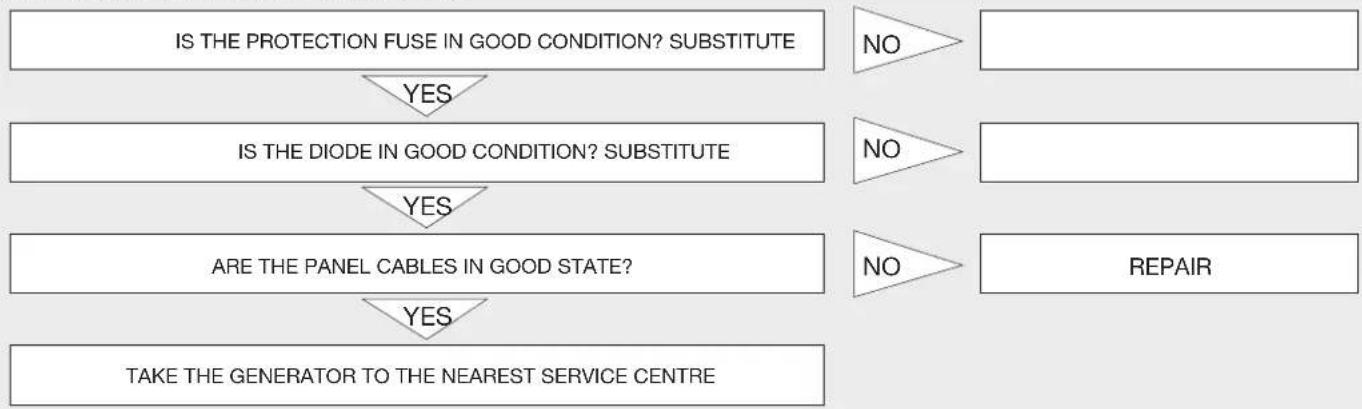
flowchart
graph TD
    A["IS THE PROTECTION FUSE IN GOOD CONDITION? SUBSTITUTE"] -->|YES| B["IS THE DIODE IN GOOD CONDITION? SUBSTITUTE"]
    B -->|YES| C["ARE THE PANEL CABLES IN GOOD STATE?"]
    C -->|YES| D["TAKE THE GENERATOR TO THE NEAREST SERVICE CENTRE"]
    A -->|NO| E["REPAIR"]
    B -->|NO| E
    C -->|NO| E
THE ENGINE DOES NOT START (15.1):
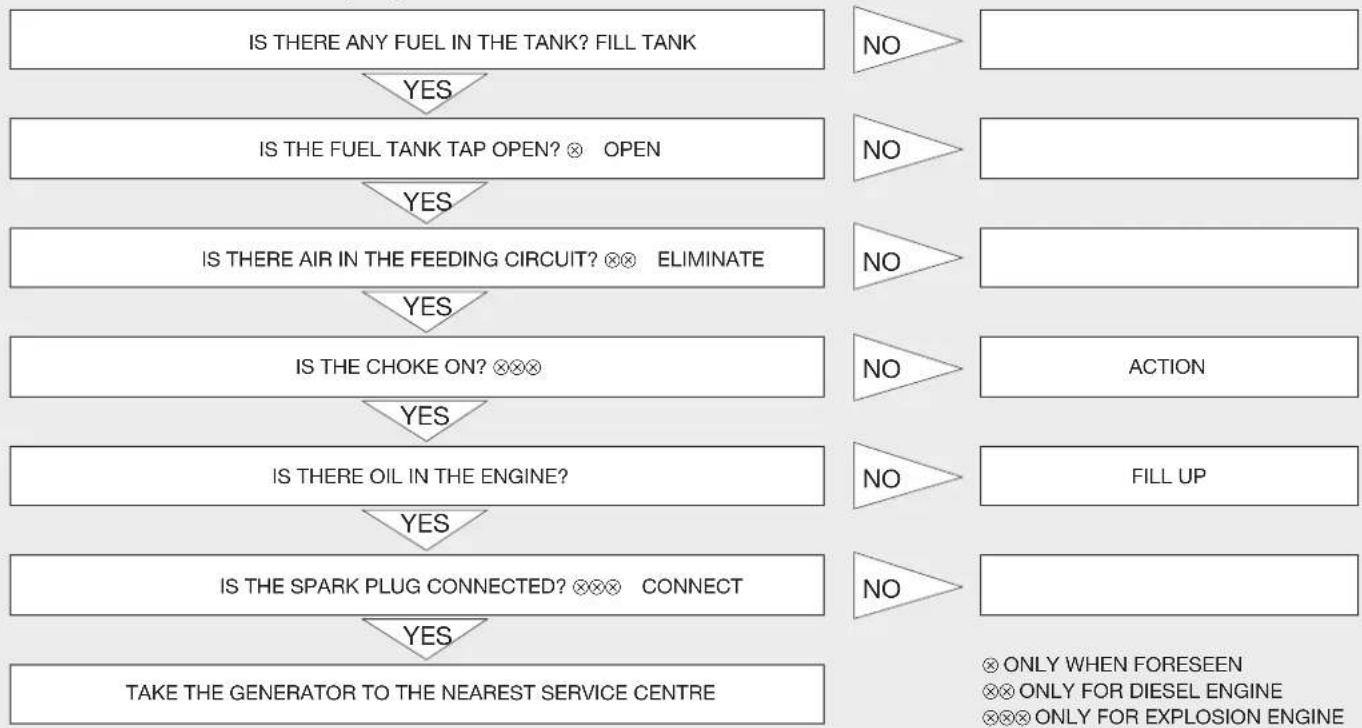
flowchart
graph TD
    A["IS THERE ANY FUEL IN THE TANK? FILL TANK"] -->|YES| B["IS THE FUEL TANK TAP OPEN? Ⓧ OPEN"]
    B -->|YES| C["IS THERE AIR IN THE FEEDING CIRCUIT? Ⓧ ELIMINATE"]
    C -->|YES| D["IS THE CHOKE ON? ⓍXX"]
    D -->|YES| E["IS THERE OIL IN THE ENGINE?"]
    E -->|YES| F["IS THE SPARK PLUG CONNECTED? ⓍXX CONNECT"]
    F -->|YES| G["TAKE THE GENERATOR TO THE NEAREST SERVICE CENTRE"]
    H["NO"] --> I["ACTION"]
    J["NO"] --> K["FILL UP"]
    L["NO"] --> M["ONLY WHEN FORESEEN"]
    N["NO"] --> O["ONLY FOR DIESEL ENGINE"]
    P["NO"] --> Q["ONLY FOR EXPLOSION ENGINE"]
D INHALT(1.1)
DAS NOTSTROMAGGREGAT DARF NUR ALS
DREIPHASEN- UND/ODER EINPHASEN- STROMERZEUGER BENUTZT WERDEN.
Transport ......sd. 31
Opmagasinering ......sd. 31
Fejlfinding ....sd. 32