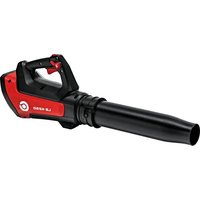
LB 4250 - Blower SOLO - Free user manual and instructions
Find the device manual for free LB 4250 SOLO in PDF.


| Product type | Cordless blower |
| Brand | SOLO |
| Model | LB 4250 |
| Power source | Lithium-ion battery (not included) |
| Compatible battery reference | 127390 |
| Compatible charger reference | C150 Li (127391) |
| Carrying system | Harness with battery BTA 42 (not included, ref. 127442) |
| Blower nozzle | Included |
| Intended use | Domestic, collection of leaves, grass and light debris |
| Functions | Progressive on/off, Turbo mode, continuous operation |
| Sound power level (measured/guaranteed) | 98 dB(A) / 101 dB(A) |
| Safety | Locking lever, protective grille, locking switch |
| Maintenance | Clean after use, check contacts, do not expose to water |
| Warranty | According to national legislation, original parts required |
| After-sales service | AL-KO Geräte GmbH, AL-KO maintenance service |
Frequently Asked Questions - LB 4250 SOLO
User questions about LB 4250 SOLO
0 question about this device. Answer the ones you know or ask your own.
Ask a new question about this device
Download the instructions for your Blower in PDF format for free! Find your manual LB 4250 - SOLO and take your electronic device back in hand. On this page are published all the documents necessary for the use of your device. LB 4250 by SOLO.
USER MANUAL LB 4250 SOLO
natural_image
Technical line drawing of a mechanical device with cylindrical shaft and handle (no text or symbols)





Inhaltsverzeichnis
Deutsch 8
English....22
Nederlands 36
Français....50
Español 65
Italiano....79
Slovenščina 92
Hrvatski....105
Polski 118
Česky 133
Slovenská 146
Magyarul....159
Dansk 173
Svensk....186
Norsk 199
Suomi 212
Lietuvių 225
Latviešu 238
Русский 251
Україна....266
© 2018
AL-KO KOBER GROUP Kötz, Germany
This documentation or excerpts therefrom may not be reproduced or disclosed to third parties without the express permission of the AL-KO KOBER GROUP.
01
02
flowchart
graph TD
    A["Device Icon"] --> B["Stage 1"]
    A --> C["Stage 2"]
    A --> D["Stage 3"]
04
natural_image
Line drawings of two different types of safety harnesses, one showing a seatbelt and the other a person holding a device (no text or symbols present)The image is too blurry to recognize any text content.

LpA = 89,3 dB(A), K = 3,0 dB(A) EN 50636-2-100

Ahw = 0,995 m/s ^2 (K = 1,5 m/s ^2 ) EN 50636-2-100
max. 180 km/h

Nr. Bauteil
1 Blasrohr
2 Grundgerät
3 Betriebsanleitung

HINWEIS
Dr. Wolfgang Hergeth Managing Director
TRANSLATION OF THE ORIGINAL INSTRUCTIONS FOR USE
Contents
1 About these operating instructions ..... 22
1.1 Symbols on the title page.... 22
1.2 Legends and signal words ...... 23
2 Product description 23
2.1 Designated use 23
2.2 Possible foreseeable misuse .... 23
2.3 Residual dangers 23
2.4 Safety and protective devices ..... 23
2.5 Symbols on the appliance 23
2.6 Scope of supply.... 24
2.7 Product overview (01) 24
3 Safety instructions 24
3.1 Safety instructions for rechargeable battery-operated leaf-blowers ..... 25
3.1.1 Safety in the workplace 26
3.1.2 Safety of persons, animals and property 26
3.1.3 Appliance safety 27
3.2 Vibration load 28
3.3 Noise pollution.... 29
3.4 Safety notes for rechargeable battery and charger 29
4 Installation.... 29
4.1 Mounting the blowing tube (11)...... 29
5 Start-up 30
5.1 Charging the rechargeable battery..... 30
6 Operation 30
6.1 Connecting the rechargeable battery belt system (02) to (05) 30
6.2 Inserting the rechargeable battery (06).... 30
6.3 Establishing the voltage supply (07, 08) 30
6.4 Operating the leaf blower (09, 10)..... 30
7 Working behaviour and working technique 31
8 Maintenance and care 31
9 Help in case of malfunction.... 31
10 Transport.... 32
11 Storage.... 32
11.1 Storing the rechargeable battery and charging unit 32
12 Disposal.... 33
13 After-Sales / Service.... 34
14 Guarantee 34
15 Translation of the original EU/EC declaration of conformity.... 35
1 ABOUT THESE OPERATING INSTRUCTIONS
The German version is the original operating instructions. All additional language versions are translations of the original operating instructions.
■ Always safeguard these operating instructions so that they can be consulted if you need any information about the appliance.
■ Only pass on the appliance to other persons together with these operating instructions.
■ Comply with the safety and warning information in these operating instructions.
1.1 Symbols on the title page
Symbol Meaning

It is essential to read through these operating instructions carefully before start-up. This is essential for safe working and trouble-free handling.

Operating instructions
Handle Li-Ion rechargeable batteries with care! In particular, observe the notes on transport, storage and disposal in these operating instructions!
1.2 Legends and signal words

DANGER!
Denotes an imminently dangerous situation which will result in fatal or serious injury if not avoided.

WARNING!
Denotes a potentially dangerous situation which can result in fatal or serious injury if not avoided.

CAUTION!
Denotes a potentially dangerous situation which can result in minor or moderate injury if not avoided.
IMPORTANT!
Denotes a situation which can result in material damage if not avoided.

NOTE
Special instructions for ease of understanding and handling.
2 PRODUCT DESCRIPTION
These operating instructions describe a hand-operated, rechargeable battery-powered leaf blower.
2.1 Designated use
This rechargeable battery-powered leaf blower is designed for private use. It can be used for:
■ Blowing away and collecting leaves, grass, dirt and refuse.
Before starting work, assemble the accessories that are enclosed.
Any other use, as well as unauthorised conversions or add-ons, are regarded as being contrary to the intended use and will result in invalidation of the warranty as well as loss of conformity (CE mark); the manufacturer will thus decline any responsibility for damage and/or injury suffered by the user or third parties.
2.2 Possible foreseeable misuse
The tool is designed neither for commercial use in public parks and sports facilities, nor for use in farming and forestry.
2.3 Residual dangers
Even during correct use of the appliance, there is always a certain residual risk that cannot be ex-
cluded. Depending on the use, the following potential risks can be derived from the type and construction of the appliance:
■ Throwing out of cuttings, soil and small stones
■ Inhalation of cuttings particles if no breathing protection is worn.
■ Damage to the hearing if no hearing protection is worn.
2.4 Safety and protective devices

WARNING!
Risk of injury
Defective and disabled safety and protective devices can lead to serious injury.
■ Have any defective safety and protective devices repaired.
■ Never disable safety and protective devices.
2.5 Symbols on the appliance
Symbol Meaning
 | Pay special attention when handling this product! |
 | Read the operating instructions before starting operation. |
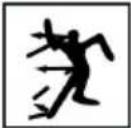 | Danger due to objects being thrown out! |
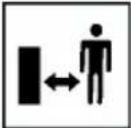 | Keep other people out of the danger area. |
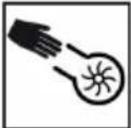 | Do not reach into the fan! |
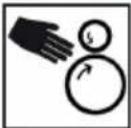 | Danger due to rotating parts. |
Symbol Meaning

Read the operating instructions before performing maintenance work.

Wear protective glasses and ear defenders!

Protect the appliance from rain and moisture!
2.6 Scope of supply
The items listed here are part of the scope of supply. Check that all items are included:
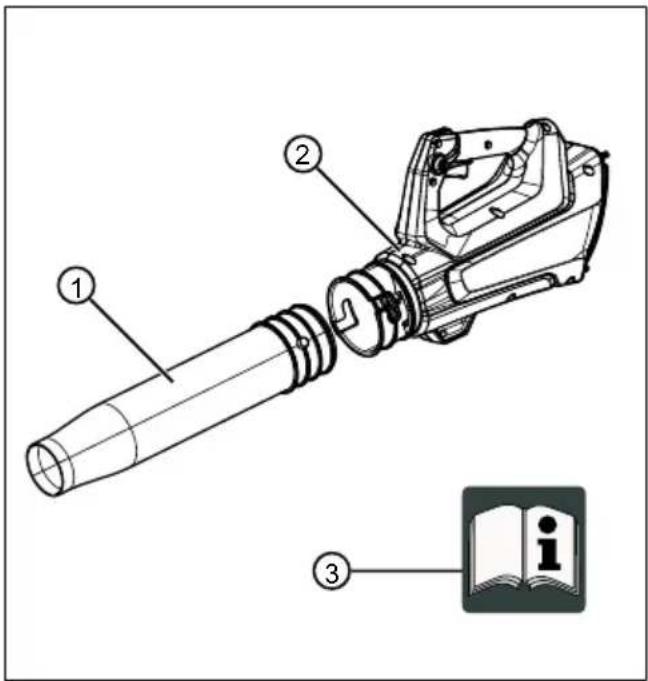
No. Component
1 Blowing tube
2 Base unit
3 Operating instructions

NOTE
Rechargeable battery, charger and belt are not included in the scope of supply and must therefore be purchased separately.
Available under the following part numbers are:
Lithium-ion rechargeable batteries – Item no. 127390
- Charging unit – C150 Li – Item no. 127391
■ Rechargeable battery belt system BTA 42 – Item no. 127442
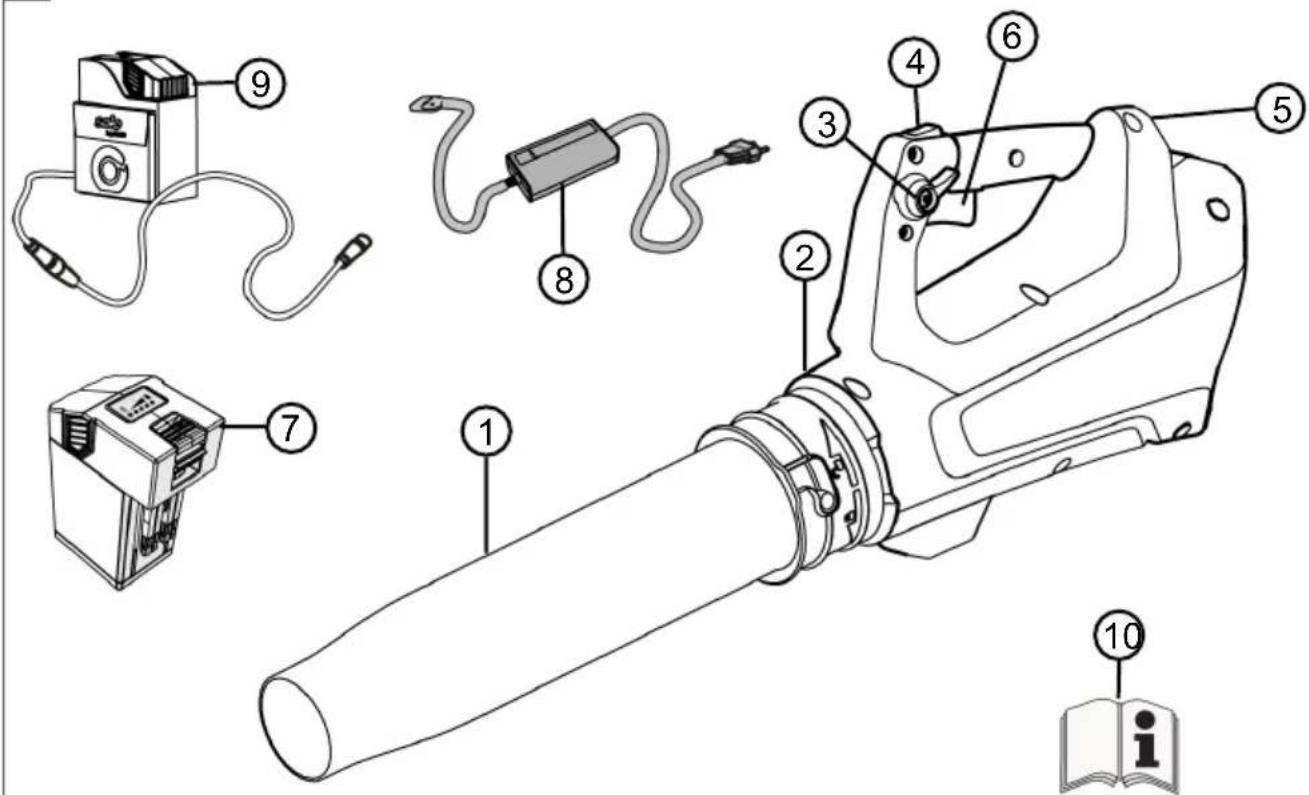
2.7 Product overview (01)
The product overview provides an overview of the appliance.
No. Component
| 1 Blowing tube |
| 2 Rechargeable battery leaf blower |
| 3 Steplessly-adjustable locking lever for On/Off switch |
| 4 Turbo button |
| 5 Grip bar with connection socket for connecting cable |
| 6 Stepless On/Off switch |
| 7 Rechargeable battery* |
| 8 Charger with mains plug* |
| 9 Rechargeable battery belt system with connecting cable* |
| 10 Operating instructions |
* Not included in the scope of delivery
3 SAFETY INSTRUCTIONS

DANGER!
Danger of fatal injury and danger of extremely severe injury!
Lack of knowledge of the safety instructions and operating instructions can lead to extremely serious and even fatal injury.
- Observe all safety instructions and instructions for use in these operating instructions as well the operating instructions which are referred to before you start using the appliance.
- Keep all supplied documents in a safe place for future reference.
3.1 Safety instructions for rechargeable battery-operated leaf-blowers
Operator
■ Carefully read the safety instructions. Familiarise yourself with the operating and adjustment elements and the intended use of the appliance.
This appliance must not be used by children, persons with impaired physical, sensory or mental abilities or insufficient experience and knowledge or persons who are not familiar with the instructions. Local regulations may set an age limit for the user.
■ People with very strong and complex restrictions may have needs that exceed the instructions described here.
■ Do not operate the appliance if you are under the influence of alcohol, drugs or medication.
■ The user is responsible for accidents involving other people and their property.
Preparation
■ Before operation, always check that protective devices and covers are undamaged, present or correctly fitted. Damaged protective devices
and covers must be replaced, missing protective devices and covers must be correctly fitted.
■ Never put the appliance into operation while people, especially children or pets, are in the immediate vicinity.
■ Before working, remove any dangerous objects from the working area, e.g. branches, glass or metal pieces, stones.
operation
■ Always wear safety glasses and sturdy shoes when working with the appliance.
- Do not work with the appliance in bad weather conditions, especially when thunderstorms are approaching.
■ Only use the appliance in daylight or good artificial light.
■ Never use the appliance if protective devices and covers are damaged or not present.
■ Always disconnect the appliance from the power supply, i.e. remove rechargeable batteries or non-rechargeable batteries:
■ before leaving the appli-
ance unattended
■ before removing blockages in the appliance
■ before checking, cleaning or working on the appliance
■ whenever the appliance starts to vibrate in an unusual way
■ Always make sure that the ventilation openings on the appliance are free of foreign objects.
■ After contact with dangerous objects and foreign bodies, check the appliance for damage. Have the appliance repaired if it has been damaged.
Maintenance and storage
■ Before carrying out maintenance or cleaning work, disconnect the appliance from the power supply i.e. activate switch-on lock, remove rechargeable batteries or non-rechargeable batteries.
■ Always wear protective gloves during maintenance, care and cleaning work.
■ Only use the spare parts and accessories recommended by the manufacturer.
■ Regularly check and maintain the appliance. The appliance may only be repaired by an AL-KO service centre.
- Keep the appliance out of the reach of children when not in use.
3.1.1 Safety in the workplace
■ Work only in daylight or under very bright artificial light.
■ Before work, remove any hazardous products and objects from the working area, e.g. explosive and inflammable products, hot ashes, combustion residues, smouldering cigarettes, branches, pieces of glass, sharp objects, pieces of metal, stones.
■ Operate the appliance only on solid and level ground and not on sharp inclines.
■ Pay attention to stability.
■ When working, move cautiously and slowly. Do not run. Watch out for obstacles.
■ When working on a slope:
■ Never work on a smooth and slippery slope.
■ Always ensure that you are standing securely.
■ Always blow the leaves near to the ground.
■ Never work up a slope.
3.1.2 Safety of persons, animals and property
■ Only use the appliance for the purposes for which it is intended. Any non-intended use can lead to injury and property damage.
■ You are responsible for accidents and endangering other persons or your property.
■ Only switch on the appliance when there are no persons and/or animals in the working area.
- Maintain a safe distance to persons or animals, or switch off the appliance if persons or animals approach.
■ Never aim the blowing tube at persons or animals.
■ Never blow refuse in the direction of persons or pets.
■ During operation, keep your eyes and ears away from the intake opening.
- Do not reach into the vacuum and vent grilles when the motor is running. Injuries can occur due to rotating appliance parts.
■ Always switch off the appliance when it is not needed, e.g. when changing the work area, during maintenance and care work.
- Immediately switch off the appliance if there is an accident in order to avoid further injuries and/or property damage.
■ Never operate the appliance with worn or defective parts. Worn or defective appliance
parts can cause serious injuries.
- Keep the appliance out of the reach of children.
■ Switch off the appliance before crossing gravel paths.
■ Do not lay the appliance down on gravel whilst switched on.
3.1.3 Appliance safety
■ Only use the appliance under the following conditions:
■ The appliance is not dirty, especially not with petrol and oil.
■ The appliance show no signs of damage, especially the protective grille.
■ All controls function properly.
All accessory parts intended for the respective operating mode are fitted on the appliance.
- Do not force the power tool. It is intended for light work in the private sector. Overload can lead to damage to the appliance.
■ Never block the vacuum and ventilation grille during operation in order to avoid any overheating of the engine.
■ Immediately switch off the appliance if the engine begins to
vibrate abnormally or strongly. There is an appliance fault in this case.
■ Never operate the appliance with worn or defective parts. Always replace defective parts with original spare parts from the manufacturer. If the appliance is operated with worn or defective parts, guarantee claims against the manufacturer are excluded.
3.2 Vibration load
■ Danger due to vibration
The actual magnitude of the vibration emissions during the use of the appliance may deviate from that stated by the manufacturer. Observe the following influencing factors before or during use:
Is the appliance being used as intended?
Is the material being cut or processed in the proper manner?
Is the appliance in a proper condition of use?
Are the handle grips and any optional vibration grips mounted, and are they firmly attached to the appliance?
■ Only operate the tool at the motor speed required for the
respective work. Avoid using the maximum speed in order to reduce noise and vibrations.
The noise and vibrations of the tool may increase due to improper use and maintenance. This leads to health damage. In this case, immediately switch off the tool and have it repaired by an authorised service workshop.
■ The degree of stress due to vibration depends on the work to be performed or on the use of the tool. Estimate the stress and plan appropriate work breaks. This considerably reduces stress due to vibration over the entire working time.
■ Extensive use of the tool exposes the operator to vibrations, which can lead to circulatory issues ("white fingers"). To avoid this risk, wear gloves and keep your hands warm. If any symptoms of "white fingers" occur, immediately consult a physician. These symptoms include: Numbness, loss of feeling, tingling, itching, pain, reduced muscular strength, changes in the colour or condition of the skin. Normally these conditions affect the fingers, hands or
pulse. The risk increases at low temperatures.
■ Take long breaks during your working day so you can recover from the noise and the vibrations. Plan your work in such a way that the use of appliances that generate strong vibrations is spread over several days.
If you notice an unpleasant sensation or discolouration of the skin on your hands when using the tool, stop work immediately. Take sufficient work breaks. Without sufficient breaks, a hand/arm vibration syndrome can occur.
- Minimise your risk of being exposed to vibrations. Maintain the tool according to the instructions in the operating instructions.
If the tool is used frequently, contact your dealer to purchase anti-vibration accessories (e.g. handles).
- Avoid working with the tool at temperatures below 10 °C. Define how the vibration load can be limited in a work plan.
3.3 Noise pollution
■ A certain level of noise exposure from this appliance is inevitable. Carry out noisy work
at approved and specified time periods.
- Observe rest periods as necessary and restrict the duration of the work to a minimum.
■ For your personal protection and protection of persons in the vicinity, appropriate hearing protection must be worn.
■ National and/or regional regulations may restrict the use of this device at certain times of the day.
3.4 Safety notes for rechargeable battery and charger
Heed the safety instructions for the rechargeable battery and for the charging unit in the separate operating instructions.
4 INSTALLATION

WARNING!
Danger if assembly is not carried out completely!
Operation of an incompletely assembled appliance can result in serious injury.
■ Only operate the appliance when it is fully assembled.
- Do not insert the battery into the appliance until it is fully assembled.
- Check that all safety and protective devices are in place and functioning correctly before switching on.
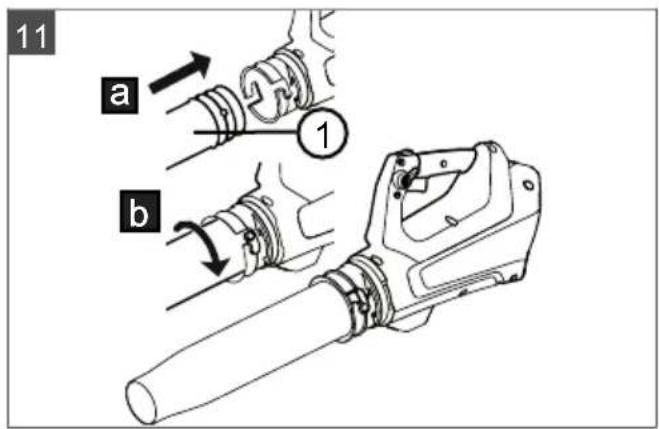
4.1 Mounting the blowing tube (11)
- Push the blowing tube (11/1) into the machine up to the stop (11/a).
-
Lock the blowing tube (11/1) by rotating it (11/b).
-
Check the fastened blowing tube to ensure it is seated firmly.
5 START-UP
5.1 Charging the rechargeable battery

NOTE
For detailed information, heed the separate operating instructions for the rechargeable battery and for the charging unit.

NOTE
When charging, the rechargeable battery is protected from overcharging due to automatic detection of the charge status and thus can remain connected to the charging unit for some time, but not permanently.

NOTE
Fully charge the rechargeable battery before using it for the first time. The rechargeable battery can be charged in any charge status. Interrupting charging does not damage the rechargeable battery.
6 OPERATION

WARNING!
Risk of injury due to detaching appli- ance parts
Appliance parts detaching during operation can lead to serious injury.
■ Before switching on the appliance, check that all appliance parts are firmly attached.
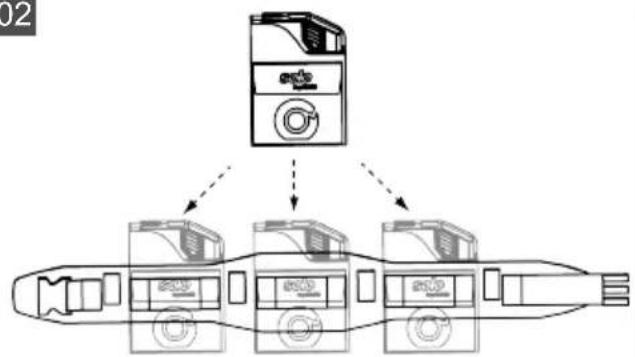
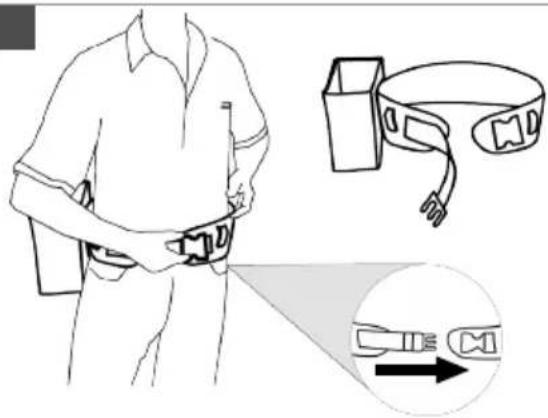
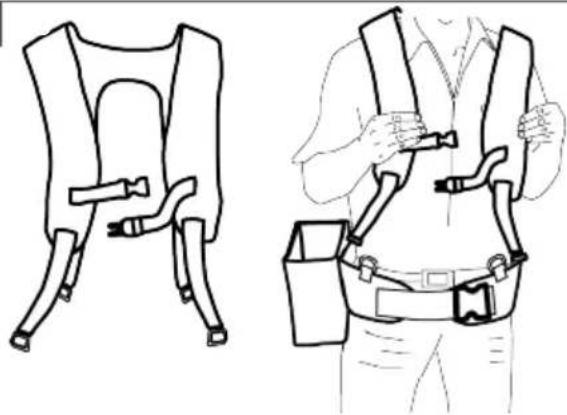
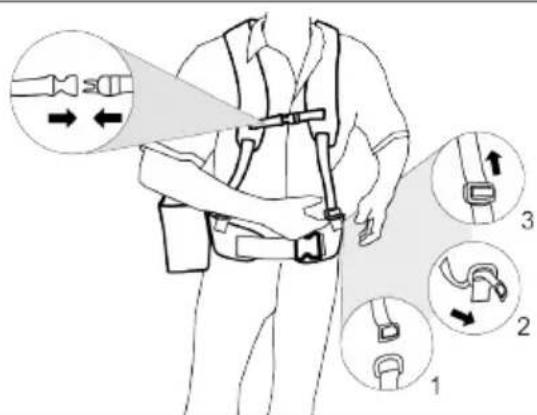
6.1 Connecting the rechargeable battery belt system (02) to (05)
Connect the rechargeable battery belt system according to the illustration (02) to (05).
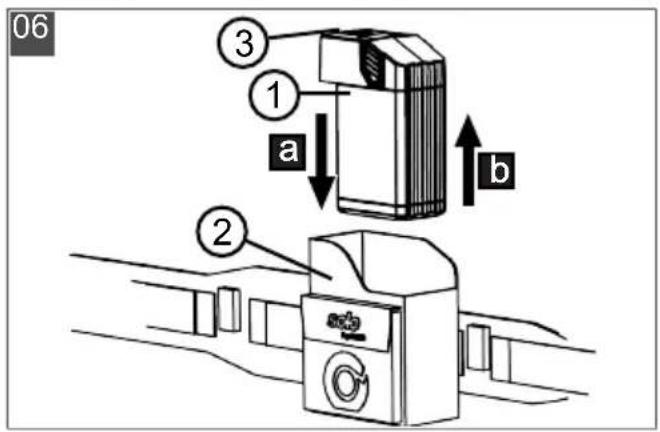
6.2 Inserting the rechargeable battery (06)
Inserting the battery
- Push in (06/a) the rechargeable battery (06/1) into the rechargeable battery belt system (06/2) until it locks.
Pull out the rechargeable battery
- Press and hold the unlock button (06/3) on the rechargeable battery (06/1).
- Pull out (06/b) rechargeable battery (06/1).
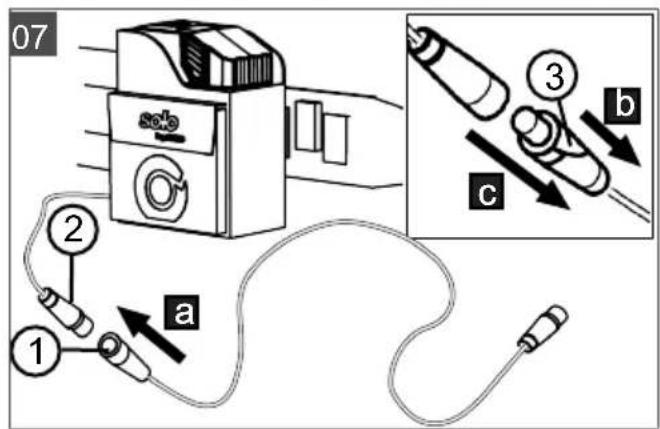
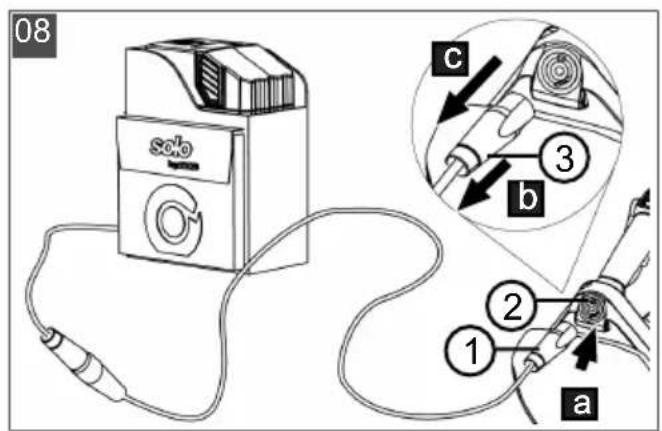
6.3 Establishing the voltage supply (07, 08)
Mounting the connecting cable
- Align the first connector of the connecting cable (07/1) to the guiding pin and guide slot of the rechargeable battery belt system connector (07/2), join, and turn slightly clockwise until the locking and unlocking switch (07/3) audibly engages.
- Align the second connector of the connecting cable (08/1) to the guiding pin and guide slot of the connection socket, push (08/a) into the connection socket of the machine (08/2), and turn slightly clockwise until the locking and unlocking switch (08/3) audibly engages.
Dismounting the connecting cable
- Pull locking and unlocking switch (07/3) backwards (07/b), turn the connector slightly to the left and pull out (07/c).
- Pull the locking and unlocking switch (08/3) backwards (08/b), turn the connector slightly to the left and pull it out (08/c) of the connection socket of the machine (08/2).
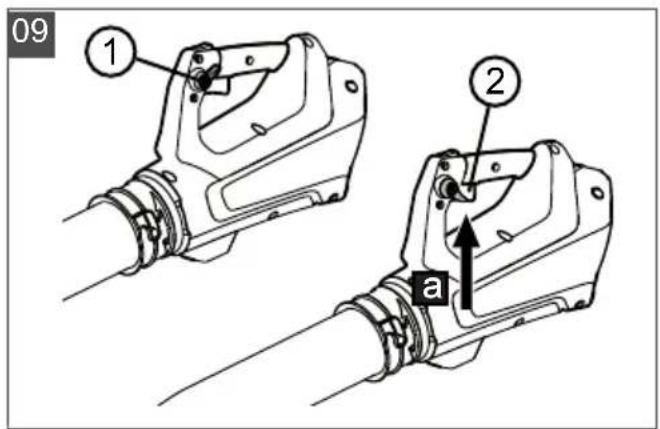
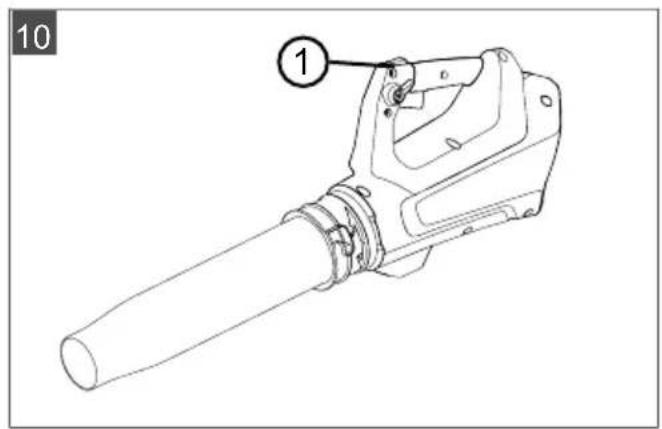
6.4 Operating the leaf blower (09, 10)

CAUTION!
Risk of injury and damage to property
Persons or animals can be injured and soiled by the air jet and blown away material.
It is essential to make sure that the air jet and blown away material does not negatively affect persons or animals or damage objects.
Note the wind direction.

NOTE
Never work against the wind to ensure that you and persons behind you are not soiled.
- Stand securely.
Switching on the leaf blower
-
Press the On/Off switch (09/2). The leaf blower runs.
-
With the leaf blower operating, turn the locking lever (09/1) upward for continuous operation.
Turbo mode
- With the machine operating, press the Turbo button (10/1). The leaf blower is operating in the Turbo mode.
Switching off the leaf blower
- Turn the locking lever (09/1) downwards.
- Release the On/Off switch (09/2). The leaf blower is switched off.
7 WORKING BEHAVIOUR AND WORKING TECHNIQUE
■ Angle the machine forwards slightly, and walk forwards slowly.
■ Sweep the machine to the right and left in order to blow away the leaves.
■ Do not overload the appliance during work.
■ After use, remove the rechargeable battery and check the appliance for damage.
8 MAINTENANCE AND CARE
- Do not get the machine wet or expose it to moisture. Do not spray with water.
■ Remove the rechargeable battery and check the appliance for damage each time after use.
■ Regularly check the machine is in good working order.
- Check the appliance's electrical contacts for corrosion, clean with a fine wire brush if necessary and then spray with a contact spray.
9 HELP IN CASE OF MALFUNCTION

CAUTION!
Risk of injury
Sharp-edged and moving appliance parts can lead to injury.
■ Always wear protective gloves during maintenance, care and cleaning work.

NOTE
If you encounter any malfunctions that are not listed in this table or that you cannot rectify yourself, please contact our customer service.
| Malfunction Cause Remedy | ||
| Appliance does not blow. Attachment blocked. Clean the attachment. | ||
| Motor does not run. Rechargeable battery is flat. Charge the rechargeable battery. | ||
| Rechargeable battery missing or rechargeable battery not seated correctly. | Insert the rechargeable battery correctly. | |
| Rechargeable battery is too cold or too hot. | Warm up the rechargeable battery slightly or allow it to cool down. | |
| Motor keeps cutting out. Air speed regulator is defective. | Contact an AL-KO service centre. | |
| Motor cuts out. Motor protection switch has tripped. | Wait until the motor protection switch switches the machine back on. | |
| Rechargeable battery operating time is significantly shorter. | Rechargeable battery discharged because it has not been used for some time. | Charge the rechargeable battery. |
| The service life of the rechargeable battery has expired. | Replace the rechargeable battery. Only use genuine accessories from the manufacturer. | |
| Rechargeable battery cannot be charged. | Rechargeable battery contacts are dirty. | Contact an AL-KO service centre. |
| Rechargeable battery or charging unit is defective. | Order spare parts. Contact an AL-KO service centre. | |
| Rechargeable battery is too hot. | Allow the battery to cool down. | |
10 TRANSPORT
Before transporting, carry out the following measures:
- Switch off the tool.
- Remove the rechargeable battery from the appliance.
- Pack the battery properly.

NOTE
The nominal energy of the rechargeable battery is more than 100 Wh. Therefore, observe the following transport instructions.
The li-ion rechargeable battery contained in the appliance is subject to the hazardous goods law, but can be transported under simplified conditions:
The rechargeable battery can be transported on public roads by the private user without further conditions provided it is packaged for retail sale and the transport serves personal purposes.
■ Commercial users who carry out the transport in connection with their main activity (e.g. delivery from and to building sites, or demonstrations) can also take advantage of this simplification.
In both cases, it is essential to take the mandatory precautions mentioned above to prevent any leakage of the contents. In other cases, it is essential to comply with the regulations of the hazardous goods law. In the case of non-compliance, severe penalties can be imposed on the sender and possibly the transporter.
Additional notes on transport and shipment
■ Only transport or send the li-ion rechargeable battery in an undamaged condition.
For transporting the rechargeable battery, only use the original cardboard box or a suitable hazardous goods cardboard box (not re-
quired for rechargeable batteries with a nominal energy less than 100 Wh).
■ Tape off exposed rechargeable battery contacts to avoid a short circuit.
- Secure the rechargeable battery against shifting in the packaging to avoid damage to the rechargeable battery.
■ Ensure the correct marking and documentation of the shipment for transport or shipping (e.g. by parcel service or freight forwarding).
- Check in advance that transport with the selected service provider is possible and indicate the shipment.
We recommend involving a hazardous goods specialist in preparation of the shipment. Also heed any further national regulations.
11 STORAGE
Thoroughly clean the appliance after each use and – if present – attach all covers. Store the appliance in a dry, lockable place out of the reach of children.
Carry out the following jobs before intervals in work lasting for longer than 30 days:
■ Thoroughly clean the appliance and store it in a dry place.
11.1 Storing the rechargeable battery and charging unit

DANGER!
Danger of explosion and fire!
Persons will be fatally or severely injured if the rechargeable battery explodes because it was stored in front of naked flames or heat sources.
■ Store the rechargeable battery in cool and dry conditions, but not in front of naked flames or heat sources.

NOTE
When charging, the rechargeable battery is protected from overcharging due to automatic detection of the charge status and thus can remain connected to the charging unit for some time, but not permanently.
■ Store the battery in a dry, frost-free place at the prescribed storage temperature (see operating instructions for the battery) and with a charge of approx. 40 - 60 %.
■ Due to a risk of short-circuit, do not store the battery near metallic or acid-containing objects.
■ Recharge the rechargeable battery for approx. 2 hours after approx. 6 months' storage.
12 DISPOSAL
Information on the German Electrical and Electronic Equipment Act (ElectroG)
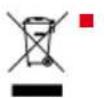
Electrical and electronic appliances do not belong in household waste, but should be collected and disposed of separately.
■ Used batteries or rechargeable batteries that are not installed permanently in the old appliance must be removed before disposal. Their disposal is regulated by the battery law.
- Owners or users of electrical and electronic appliances are obliged by law to return them after use.
■ The end user bears personal responsibility for deleting his personal data from the old appliance to be disposed of.
The symbol of the crossed-through rubbish bin means that electrical and electronic appliances may not be disposed of in the household rubbish.
Electrical and electronic appliances can be handed in at the following places at no charge:
■ Public service disposal or collection points (e.g. municipal building yards)
■ Points of sale of electrical appliances (stationary and online) provided traders are obliged to take them back or offer this voluntarily.
These statements only apply to appliances that are installed and sold in the countries of the European Union and are subject to European Directive 2012/19/EU. Different provisions may apply to the disposal of electrical and electronic appliances in countries outside the European Union.
Information on the German Battery Act (BattG)

Used batteries and rechargeable batteries do not belong in household waste, but should be collected and disposed of separately.
For safe removal of batteries or rechargeable batteries from the electrical appliance and for information on their type or chemical system, follow the further information within the operating or installation instructions.
- Owners or users of batteries and rechargeable batteries are obliged by law to return them after use. Return is limited to the handover of customary household quantities.
Used batteries can contain harmful substances or heavy metals that can cause damage to the environment and human health. Reuse of the used batteries and use of the resources contained therein contributes to the protection of these two essential commodities.
The symbol of the crossed-through rubbish bin means that batteries and rechargeable batteries may not be disposed of in household rubbish. In addition, if the symbol Hg, Cd or Pb appears under the rubbish bin, this stands for the following:
■ Hg: Battery contains more than 0.0005 % mercury
Cd: Battery contains more than 0.002 % cadmium
■ Pb: Battery contains more than 0.004 % lead Rechargeable batteries and batteries can be handed in at the following places at no charge:
■ Public service disposal or collection points (e.g. municipal building yards)
■ Points of sale of batteries and rechargeable batteries
■ Disposal points of the common take-back system for the used batteries of appliances
■ Disposal point of the manufacturer (if not a member of the common take-back system)
These statements apply only to rechargeable batteries and batteries that are sold in the countries of the European Union and that are subject to European Directive 2006/66/EU. Different provisions can apply to the disposal of rechargeable
batteries and batteries in countries outside the European Union.
KO Service Centre. These can be found on the Internet at:
www.al-ko.com/service-contacts
13 AFTER-SALES / SERVICE
In the event of questions of warranty, repair or spare parts, please contact your nearest AL-
14 GUARANTEE
We will resolve any material or manufacturing faults on the appliance during the legal warranty period for claims relating to faults, in accordance with our choice either to repair or replace. The legal warranty period is determined by the legislation of the country in which the appliance was purchased.
Our warranty promise applies only if:
■ These operating instructions are heeded
■ The appliance is handled correctly
■ Original spare parts have been used
The warranty becomes void in the case of:
■ Unauthorised repair attempts
■ Unauthorised technical modifications
Non-intended use
The guarantee excludes:
■ Paint damage that can be attributed to normal wear and tear
■ Wear parts that are marked with a frame xxxxxx (x) on the spare parts card
The guarantee period commences with purchase by the first end user. The date on the proof of purchase is decisive. In the event of a guarantee claim, please take this guarantee declaration and the original proof of purchase, and contact your dealer or the nearest authorised customer service centre. This statement does not affect the purchaser's statutory claims for defects against the vendor.
15 TRANSLATION OF THE ORIGINAL EU/EC DECLARATION OF CONFORMITY
We hereby declare, as the exclusive responsible party, that this product in its marketed form conforms to the requirements of the harmonised EU Directives, EU safety standards and the product-specific standards.
| Product | Manufacturer | Duly authorised person for technical file |
| Rechargeable battery leaf blower | AL-KO Geräte GmbH Ichenhauser Str. 14 | Andreas Hedrich Ichenhauser Str. 14 |
| Serial number | D-89359 Kötz Germany | D-89359 Kötz Germany |
| G2043022 | ||
| Type | EU directives | Harmonised standards |
| LB 4250 | 2006/42/EC | EN 60335-1:2012+A11:2014 |
| 2014/30/EU | EN 50636-2-100:2014 | |
| Sound power level | 2000/14/EC | EN 62233:2008 |
| EN ISO 3744 | 2011/65/EU | EN 55014-1:2006+A1:2009+A2 2011 |
| measured/guaranteed | ||
| 98 dB(A) / 101 dB(A) | Conformity evaluation | EN 55014-2:2015 |
| 2000/14/EC Appendix VI | EN ISO 12100:2010 |
Kötz, 19/06/2018
Dr. Wolfgang Hergeth Managing Director
VERTALING VAN DE ORIGINELE GEBRUIKERSHANDLEIDING
Inhoudsopgave
2 PRODUCTOMSCHRIJVING
Nr. Component
1 Blaaspijp
2 Basisapparaat
Nr. Component
www.al-ko.com/service-contacts
14 GARANTIE
Dr. Wolfgang Hergeth Managing Director
TRADUCTION DE LA NOTICE D'UTILISATION ORIGINALE
Table des matières
N° Pièce
www.al-ko.com/service-contacts
14 GARANTIE
N.° Componente
N. Componente
1 Tubo soffiante
2 Apparecchio base
www.al-ko.com/service-contacts
14 GARANZIA
Št. Sestavni del
1 Izpihovalna cev
2 Osnovna naprava
3 Navodila za uporabo

NAPOTEK
Akumulatorska baterija, polnilnik in sistem pasu niso vključeni v obseg dobave, zato jih je treba kupiti ločeno.
www.al-ko.com/service-contacts
14 GARANCIJA
Br. Dio
1 Cijev za puhanje
2 Osnovni uređaj
3 Upute za uporabu

NAPOMENA
Akumulator, punjač i sustav remena nisu u opsegu isporuke i stoga ih treba za-sebno kupiti.
www.al-ko.com/service-contacts
14 JAMSTVO
Možebitne greške u materijalu ili proizvodnji na uređaju uklonit ćemo tijekom zakonskoga roka zastare za jamstvo na nedostatke prema vlastitom izboru popravljanjem ili zamjenskom dostavom. Rok zastare određuje se prema pravu države u kojoj je uređaj kupljen.
Dr. Wolfgang Hergeth Managing Director
TŁUMACZENIE ORYGINALNEJ INSTRUKCJI OBSŁUGI
Spis treści
Nr elementu
Č. Součást
www.al-ko.com/service-contacts
14 ZÁRUKA
Dr. Wolfgang Hergeth Managing Director
PREKLAD ORIGINÁLNEHO NÁVODU NA POUŽITIE
Obsah
1 O tomto návode na použitie.... 146
1.1 Symboly na titulnej strane 146
1.2 Vysvetlenie symbolov a signálne slo-
vá 146
2 Popis výrobku 147
2.1 Používanie na určený účel ...... 147
2.2 Možné predvídatel'né chybné použitie147
2.3 Zvyšné nebezpečenstvo .....147
2.4 Bezpečnostné a ochranné zariadenia 147
2.5 Symboly na zariadenie.... 147
2.6 Rozsah dodávky.... 148
2.7 Prehl'ad výrobku (01).... 148
www.al-ko.com/service-contacts
14 ZÁRUKA
Dr. Wolfgang Hergeth Managing Director
AZ EREDETI KEZELÉSI ÚTMUTATÓ FORDÍTÁSA
Tartalomjegyzék
Sz. Alkatrész
1 Fúvócső
2 Alapkészülék
Sz. Alkatrész
Nr. Komponent
1 Blæserør
2 Basisapparat
3 Brugsanvisning

BEMAERK
www.al-ko.com/service-contacts
14 GARANTI
Dr. Wolfgang Hergeth Managing Director
ÖVERSÄTTNING AV ORIGINALBRUKSANVISNING
Nr. Komponent
1 Blåsrör
2 Basenhet
3 Bruksanvisning

ANMÄRKNING
Dr. Wolfgang Hergeth Managing Director
OVERSETTELSE AV DEN ORIGINALE BRUKSANVISNINGEN
Innhold
Nr. Komponent
1 Blåserør
2 Basismaskin
3 Bruksanvisning

MERK
7 ARBEIDSFREMTREDEN OG ARBEIDSTEKNIKK
8 VEDLIKEHOLD OG PLEIE
www.al-ko.com/service-contacts
14 GARANTI
Dr. Wolfgang Hergeth Managing Director
KÄÄNNÖS ALKUPERÄISESTÄ KÄYTTÖOHJEESTA
Sisällysluettelo
Nro Osa
1 Puhallusputki
2 Peruslaite
3 Käyttöohje

HUOMAUTUS
www.al-ko.com/service-contacts
14 TAKUU JA TUOTEVASTUU
www.al-ko.com/service-contacts
14 GARANTIJA
Nr. Detaja
www.al-ko.com/service-contacts
14 GARANTIJA
Dr. Wolfgang Hergeth Managing Director
Номер компонента
www.al-ko.com/service-contacts
14 ГАРАНТИЯ
Ho- мер
компонента
Dr. Wolfgang Hergeth Managing Director




- Inhaltsverzeichnis
- Nr. Bauteil
- HINWEIS
- TRANSLATION OF THE ORIGINAL INSTRUCTIONS FOR USE
- Contents
- ABOUT THESE OPERATING INSTRUCTIONS
- Symbols on the title page
- Symbol Meaning
- Legends and signal words
- DANGER!
- WARNING!
- CAUTION!
- IMPORTANT!
- NOTE
- PRODUCT DESCRIPTION
- Designated use
- Possible foreseeable misuse
- Residual dangers
- Safety and protective devices
- Risk of injury
- Symbols on the appliance
- Scope of supply
- No. Component
- Product overview (01)
- SAFETY INSTRUCTIONS
- Safety instructions for rechargeable battery-operated leaf-blowers
- Operator
- Preparation
- operation
- Maintenance and storage
- Safety in the workplace
- Safety of persons, animals and property
- Appliance safety
- Vibration load
- ■ Danger due to vibration
- Noise pollution
- Safety notes for rechargeable battery and charger
- INSTALLATION
- Mounting the blowing tube (11)
- START-UP
- Charging the rechargeable battery
- OPERATION
- Connecting the rechargeable battery belt system (02) to (05)
- Inserting the rechargeable battery (06)
- Inserting the battery
- Pull out the rechargeable battery
- Establishing the voltage supply (07, 08)
- Mounting the connecting cable
- Dismounting the connecting cable
- Operating the leaf blower (09, 10)
- Switching on the leaf blower
- Turbo mode
- Switching off the leaf blower
- WORKING BEHAVIOUR AND WORKING TECHNIQUE
- MAINTENANCE AND CARE
- HELP IN CASE OF MALFUNCTION
- TRANSPORT
- Additional notes on transport and shipment
- STORAGE
- Storing the rechargeable battery and charging unit
- DISPOSAL
- Information on the German Electrical and Electronic Equipment Act (ElectroG)
- Information on the German Battery Act (BattG)
- AFTER-SALES / SERVICE
- GUARANTEE
- TRANSLATION OF THE ORIGINAL EU/EC DECLARATION OF CONFORMITY
- VERTALING VAN DE ORIGINELE GEBRUIKERSHANDLEIDING
- Inhoudsopgave
- PRODUCTOMSCHRIJVING
- Nr. Component
- GARANTIE
- TRADUCTION DE LA NOTICE D'UTILISATION ORIGINALE
- Table des matières
- N° Pièce
- N.° Componente
- Componente
- GARANZIA
- Št. Sestavni del
- NAPOTEK
- GARANCIJA
- Br. Dio
- NAPOMENA
- JAMSTVO
- TŁUMACZENIE ORYGINALNEJ INSTRUKCJI OBSŁUGI
- Spis treści
- Nr elementu
- Č. Součást
- ZÁRUKA
- PREKLAD ORIGINÁLNEHO NÁVODU NA POUŽITIE
- Obsah
- AZ EREDETI KEZELÉSI ÚTMUTATÓ FORDÍTÁSA
- Tartalomjegyzék
- Sz. Alkatrész
- Nr. Komponent
- BEMAERK
- GARANTI
- ÖVERSÄTTNING AV ORIGINALBRUKSANVISNING
- ANMÄRKNING
- OVERSETTELSE AV DEN ORIGINALE BRUKSANVISNINGEN
- Innhold
- MERK
- ARBEIDSFREMTREDEN OG ARBEIDSTEKNIKK
- VEDLIKEHOLD OG PLEIE
- KÄÄNNÖS ALKUPERÄISESTÄ KÄYTTÖOHJEESTA
- Sisällysluettelo
- Nro Osa
- HUOMAUTUS
- TAKUU JA TUOTEVASTUU
- GARANTIJA
- Nr. Detaja
- Номер компонента
- ГАРАНТИЯ
- Ho- мер
- компонента
Brand : SOLO
Model : LB 4250
Category : Blower