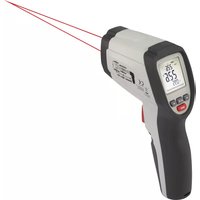
IR 2201-50D - Thermometer VOLTCRAFT - Free user manual and instructions
Find the device manual for free IR 2201-50D VOLTCRAFT in PDF.



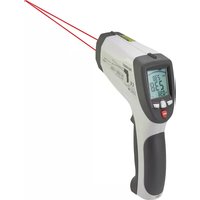
| Product Type | Infrared Thermometer |
| Brand | Voltcraft |
| Model | IR 2201-50D |
| IR Measuring Range | -50 to +2200 °C (-58 to +3992 °F) |
| IR Accuracy | ±3 °C (-50 to +20 °C), ±1 % or ±1 °C (+20 to +500 °C), ±1.5 % (+500 to +1000 °C), ±2 % (+1000 to +2200 °C) |
| Resolution | 0.1 °C |
| Optics (distance:spot) | 50:1 |
| Aiming Laser | Dual, Class 2, <1 mW, 630-670 nm |
| Emissivity | Adjustable from 0.10 to 1.00 (preset 0.95) |
| Type K Contact Probe | Included, range -50 to +250 °C (supplied probe), up to +1370 °C with other K probe |
| Memory | 100 measurement values |
| Interface | USB (mini-USB) for PC transfer |
| Functions | MAX/MIN/DIF/AVG, high/low alarm, continuous measurement (LOCK), backlight, LOG save |
| Power Supply | 9 V block battery (included) |
| Dimensions | 52 x 240 x 155 mm |
| Weight | 320 g (with battery) |
| Delivery Contents | Thermometer, 9 V battery, type K probe, tripod, USB cable, software CD, carrying case, instruction manual |
| Maintenance and Cleaning | Lens: compressed air, fine brush, special lens cloth; housing: soapy water |
| Safety | Class 2 laser – do not look directly; do not use in medical environments |
| Operating Temperature | 0 to +50 °C |
| Storage Temperature | -10 to +60 °C |
| Compatible Operating Systems | Windows Vista and higher |
Frequently Asked Questions - IR 2201-50D VOLTCRAFT
User questions about IR 2201-50D VOLTCRAFT
0 question about this device. Answer the ones you know or ask your own.
Ask a new question about this device
Download the instructions for your Thermometer in PDF format for free! Find your manual IR 2201-50D - VOLTCRAFT and take your electronic device back in hand. On this page are published all the documents necessary for the use of your device. IR 2201-50D by VOLTCRAFT.
USER MANUAL IR 2201-50D VOLTCRAFT
GB Operating Instructions
IR 2201-50D USB IR thermometer
Item No. 1599565 Page 18 - 33
F Notice d'emploi
www.business.conrad.at
- Introduction....19
- Explanation of symbols....19
- Intended use....20
- Package contents 20
- Features and functions ......21
- Safety information....21
a) General information....21
b) Laser....22
c) Battery 23
- Product overview 23
- Display elements ...... 24
- Inserting/changing the battery 24
- Operation....24
a) Function....24
b) Measuring....25
c) IR measuring spot size - Ratio measuring distance:measuring surface....25
d) Dual target laser 26
e) Backlight....26
f) Changing the temperature unit °C/°F....26
g) Data transfer USB interface....26
h) Contact temperature measurement function 27
i) Settings menu....27
j) Maximum, minimum, differential and average measurement function (MAX/MIN/DIF/AVG) 27
k) Bar graph display....28
I) Memory function LOG 28
m) Setting the emissivity (EMS)....29
n) Permanent operation (LOCK)....29
o) Alarm functions....29
p) °C/°F conversion....30
- Care and cleaning....31
a) Cleaning of the lens....31
b) Cleaning the housing....31
- Disposal 31
a) Product 31
b) Batteries 31
- Technical data....32
1. Introduction
Dear customer,
Thank you for purchasing this product.
This product complies with statutory national and European regulations.
To ensure that the product remains in this state and to guarantee safe operation, always follow the instructions in this manual.

These operating instructions are part of this product. They contain important information on setting up and using the product. Do not give this product to a third party without the operating instructions. Therefore, retain these operating instructions for reference!
For technical queries, please contact:
International: www.conrad.com/contact
United Kingdom: www.conrad-electronic.co.uk/contact
2. Explanation of symbols

The symbol with an exclamation mark in a triangle is used to highlight important information in these operating instructions. Always read this information carefully.

The arrow symbol alerts the user to the presence of important tips and notes on using the device.
3. Intended use
The infrared thermometer is a measuring device for contactless temperature measurement. It determines the temperature by infrared energy that is emitted by an object and by its emission ratio. It is especially useful for measuring the temperature of hot, difficult to access or moving objects. The device measures the surface temperature of an object. It cannot measure through transparent surfaces such as glass or plastics. The temperature measuring range is from -50 to +2200 °C (-58 to +3992 °F). A 9V block battery is required for the voltage supply. In addition, contact measurement with a conventional K-type temperature sensor is possible. The temperature data can be transferred to a computer via the integrated USB interface.
The IR thermometer itself must not come in contact with the temperature to be measured. Always maintain sufficient safety distance and observe the permitted ambient conditions.
Diagnostic application for medical purposes is not permissible.
For safety and approval purposes, you must not rebuild and/or modify this product. Using the product for purposes other than those described above may damage the components. In addition, improper use can cause injuries. Read the instructions carefully and store them in a safe place. Only make this product available to third parties together with its operating instructions.
All company and product names are trademarks of their respective owners. All rights reserved.
4. Package contents
- Infrared thermometer
- 9 V block battery
• K-type temperature sensor - Tripod
- USB cable
- Software CD
- Storage case
- Operating instructions
Up-to-date operating instructions
To download the latest operating instructions, visit www.conrad.com/downloads or scan the QR code on this page. Follow the instructions on the website.
5. Features and functions
• Dual target laser with focal point
- Integrated alarm function (optical and acoustic signal) for upper and lower alarm values
- Storage of the maximum, minimum, average and difference temperature during measurement.
• Permanent measuring function
- Adjustable emission level from 0.10 to 1.00
• Additional temperature measurement via K-type contact sensor
- Optional background illumination for the display
- Saves up to 100 measured values
- Transfer of temperature measurement values to a computer via the USB interface
6. Safety information

Read the operating instructions and safety information carefully. If you do not follow the safety information and information on proper handling in these operating instruction, we will assume no liability for any resulting personal injury or damage to property. Such cases will invalidate the warranty/guarantee.
a) General information
- The device is not a toy. Keep it out of the reach of children and pets.
- Do not leave packaging material lying around carelessly. It may become a dangerous toy for children.
- Protect the product from extreme temperatures, direct sunlight, strong jolts, high humidity, moisture, flammable gases, vapours and solvents.
- Do not place the product under any mechanical stress.
-
If it is no longer possible to operate the product safely, stop using it and prevent unauthorised use. Safe operation can no longer be guaranteed if the product:
-
is visibly damaged,
- is no longer working properly,
- has been stored for extended periods in poor ambient conditions or
- has been subjected to any serious transport-related stress.
- Always handle the product carefully. Jolts, impacts or a fall even from a low height may damage the product.

- Always observe the safety and operating instructions of any other devices which are connected to the product.
- During outdoor use, the appliance must only be operated when the weather conditions are suitable and only with the appropriate safety devices.
- Moisture, dust, fume and/or vapours can affect the optics of the thermometer and thus the measured results.
- Do not use the thermometer immediately after it has been brought from a cold environment into a warm room. The resulting condensation may destroy the interior components. In addition, the lens may become misty, which can lead to inaccurate measurements. Wait until the thermometer has reached the ambient temperature before using it.
• Always comply with the accident prevention regulations for electrical equipment when using the product in commercial facilities. - Trained personnel must supervise the use of electrical appliances in schools, training facilities and DIY workshops.
- Consult a technician if you are not sure how to use or connect the product.
- Maintenance, modifications and repairs must be done by a technician or a specialist repair centre.
- If you have questions which remain unanswered by these operating instructions, contact our technical support service or other technical personnel.
b) Laser
- When operating the laser equipment, always make sure that the laser beam is directed so that no one is in the projection area and that unintentionally reflected beams (e.g. from reflective objects) cannot be directed into areas where people are present.
- Laser radiation can be dangerous, if the laser beam or its reflection enters unprotected eyes. Before using the thermometer, familiarise yourself with the statutory regulations and instructions for operating such a laser device.
- Never look into the laser beam and never point it at people or animals. Laser radiation can seriously damage your eyes.
- If laser radiation enters your eyes, close your eyes immediately and move your head away from the beam.
- If your eyes have been irritated by laser radiation, do not continue to carry out tasks with safety implications, such as working with machines, working from great heights or close to high voltage. Do not drive any vehicles until the irritation has completely subsided.
- Do not point the laser beam at mirrors or other reflective surfaces. The uncontrolled, reflected beam may strike people or animals.
- Never open the device. Configuration or maintenance tasks must only be completed by a trained specialist who is familiar with the potential hazards. Improperly executed adjustments might result in dangerous laser radiation.

- The product is equipped with a class 2 laser. Laser signs in different languages are included in the package. If the sign on the laser is not in your local language, attach the appropriate sign to the laser.
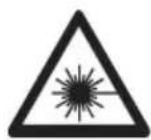
ATTENTION
LASER RADIATION
DO NOT STARE INTO THE BEAM
LASER DIODE
Wavelength: 630 - 670 nm
Max. output power: < 1 mW
CLASS 2 LASER PRODUCT
EN 60825-1:2014
- Caution: Using equipment or procedures other than those described in these instructions could lead to exposure to dangerous radiation.
c) Battery
- To prevent battery leakage, remove the battery if you do not plan to use the product for an extended period. Leaking or damaged batteries may cause acid burns when they come into contact with skin. Always use protective gloves when handling damaged batteries.
- Keep batteries out of the reach of children. Do not leave batteries lying around, as they constitute a choking hazard for children and pets.
- Batteries must not be dismantled, short-circuited or thrown into fire. Never recharge non-rechargeable batteries. Danger of explosion!
7. Product overview
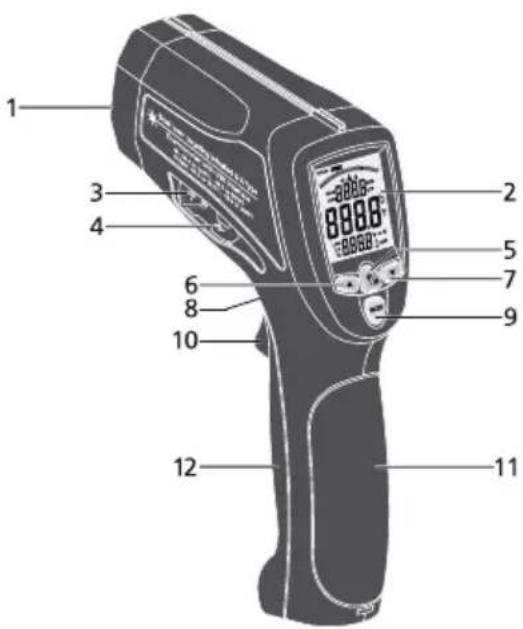
text_image
1 2 3 4 5 6 7 8 9 10 11 121 IR sensor + laser outlet
2 LCD display
3 Temperature sensor connection socket
4 USB interface
5 Backlight/laser button
6 ▲ button
7 ▼ button
8 Button to open the battery compartment
9 MODE button
10 Measuring button
11 Battery compartment
12 Handle
8. Display elements
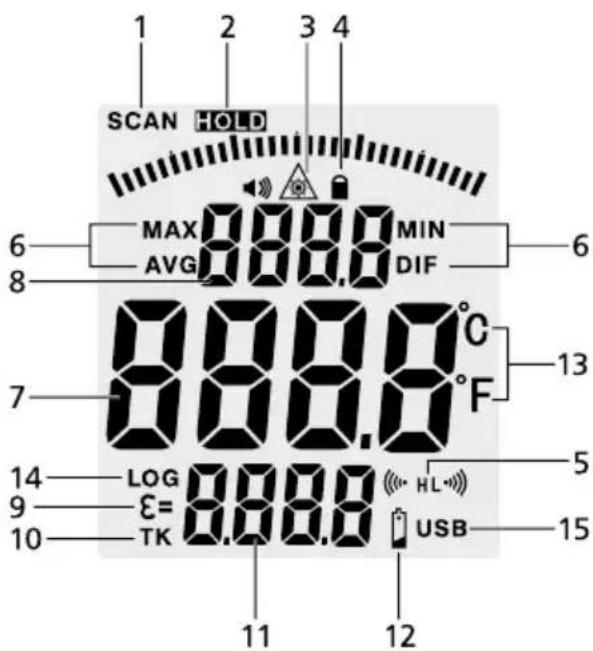
text_image
1 2 3 4 SCAN HOLD MAX 888.0 MIN AVG DIF 6 8 7 888.0 °C F 13 14 LOG HL 9 E= 888.0 USB 10 TK 11 121 Measurement indicator
2 HOLD indicator
3 Laser symbol
4 Symbol for permanent measurement
5 High/low alarm indicator
6 MAX/MIN/AVG/DIF indicators
7 Temperature display
8 MAX/MIN/AVG/DIF temperature display
9 Emission level symbol
10 K-type indicator
11 Emission level / K-type value
12 Battery symbol
13 °C/°F indicator
14 Data logger indicator
15 USB indicator
9. Inserting/changing the battery
→ Replace the battery when the battery symbol appears on the display.
- To open the battery compartment, press the button and flip open the cover.
- Remove the flat battery from the battery clip and connect a new battery of the same type with the correct polarity to the battery clip. The battery clip is constructed so the battery can be connected only with the correct polarity. Do not use force when plugging in the battery.
- Once you have inserted the battery, replace the battery compartment cover.
10. Operation
a) Function
- Infrared thermometers measure the surface temperature of an object. The sensor of the device analyses the emitted and reflected heat radiation of the object measured, and converts this information into a temperature value.
- Emissivity is used to describe the energy emission characteristics of a material. The higher the emissivity, the more radiation a material can emit. Many organic materials and surfaces have an emission level of approx. 0.95. Metallic surfaces or shiny materials have low emissivity. This results in imprecise measuring values. For this reason, the emission level can be set.
b) Measuring
- Point the measuring hole, preferably at a 90^ angle, at the object to be measured. Make sure the object to be measured is not smaller than the IR measuring spot of the device.
- Press and hold the measuring button. The measuring value is indicated on the display. The displayed measurement value corresponds to the average surface temperature of the IR measuring spot. During measurement, the SCAN indicator is shown on the display.
- After releasing the measuring button, the last measured value will be displayed for approx. 7 seconds for improved readability. The HOLD indicator also appears.
- 7 seconds after releasing the measuring button, the device turns off automatically.
• Horizontal bars appear on the display if the temperature range is exceeded.

To determine the hottest spot on the measured object you have to scan the object, with the measuring button held down, in a zigzag motion until you find the hottest spot. When the MAX temperature function is active, the highest measured temperature appears at the top of the display during measurement.
In order to obtain exact measured values, the infrared thermometer has to be adjusted to the ambient temperature. Allow the device to adjust to the ambient temperature after relocation.
Shiny surfaces affect the measured result. To compensate, the shiny part of the surface can be covered with adhesive tape or matt black paint. The device cannot measure through transparent surfaces such as e.g. glass. Instead, it measures the surface temperature of the glass.
Prolonged measurement of high temperatures at near measuring distances leads to self-heating of the measuring device and thus to inaccurate measurements. In order to obtain exact measured values, remember the following rule of thumb: The higher the temperature, the greater the measuring distance and the shorter the measuring time.
c) IR measuring spot size - Ratio measuring distance:measuring surface
- In order to obtain precise measuring results, the measured object must be larger than the IR measuring spot. The measured temperature is calculated using the average temperature of the measured area. The smaller the object, the closer it must be to the thermometer.
- The exact size of the measuring spot is shown in the following diagram. It is also indicated on the thermometer. To ensure precise measurements, the measured object should be at least twice the size of the measuring spot.

line
| Spot | Distance (mm) | Laser Intensity | InfraRed Intensity | |------|---------------|-----------------|--------------------| | 0.7 | 18 | 1.7 | 42 | | 35 | 900 | 85 | 2100 |The optimal measuring distance for this infrared thermometer is the focal point of both target lasers as this affords the greatest measuring accuracy. The size of the measuring spot at the focal point is 18 mm.
d) Dual target laser
The dual target laser can be activated and deactivated. Turn the measuring device on by pressing the measuring button. Press and hold the backlight/laser button. When the laser is activate, the laser symbol appears on the display. Press the backlight/laser button again to deactivate the target laser. The laser symbol disappears.
e) Backlight
When the device is on, press the backlight/laser button to turn the display backlight on/off.
f) Changing the temperature unit °C/°F
When the device is on, use ▲ and ▼ to switch the measuring unit from °C (degrees Celsius) to °F (degrees Fahrenheit).
g) Data transfer USB interface
The device features a USB interface to transfer and save measurement data on a computer. Proceed as follows to connect the infrared thermometer to your computer:
- Activate the USB interface in MIN, MAX, DIF or AVG mode by pressing the backlight/laser button. Press and hold the button until the display shows the USB symbol.
- Start your computer.
- With the enclosed USB cable, connect the measuring device via the lateral Mini USB socket with a free USB port on your computer.
- The computer automatically detects a new device. Insert the supplied software CD into a CD drive and follow the instructions on the screen. Let the computer search automatically for the new driver.
• After successful installation, you can start the software. - To disable the USB interface, in MAX, MIN, DIF or AVG mode press and hold the backlight/laser button until the USB symbol disappears from the display.
When the USB interface is activated, the IR and contact temperature measured values are transferred to a computer. In connection with the LOCK function and the provided software, this feature thus enables on can be a long-term logging of measured temperatures. More information can be found in the Help menu of the software.
h) Contact temperature measurement function
- In addition to the infrared measurement function, the device features a contact temperature measurement function. In addition to the included wire temperature sensor, all conventional type-K temperature sensors with a mini plug can be connected to the device.
- When you plug a type-K temperature sensor with a mini plug into the type-K temperature sensor socket, TK appears on the display in MAX, MIN, DIF or AVG mode. Press the measuring button to display the measured contact temperature at the bottom of the display.

Note that contact temperature measurement is only permitted on voltage-free objects. Note that contact temperature measurement is only permitted within the sensor's approved temperature range. The approved temperature range of the included wire sensor is -50 to +250 °C.
i) Settings menu
- The settings menu allows you to select, activate or set various device functions.
- The graphic shows a schematic of the settings menu.
- Press the MODE button to navigate within the menu. Use ▲ and ▼ to make adjustments.

flowchart
graph TD
    A["MAX MIN DIF AVG"] --> B["EMS adjustment"]
    B --> C["LOCK on/off"]
    C --> D["HAL on/off"]
    D --> E["HAL adjustment"]
    E --> F["LOW on/off"]
    F --> G["LOW adjustment"]
    G --> H["C/F"]
    H --> I["MODE"]
j) Maximum, minimum, differential and average measurement function (MAX/MIN/DIF/AVG)
- Turn the measuring device on by pressing the measuring button.
- Press the MODE button until one of the MAX/MIN/DIF/AVG/LOG symbols flashes on the display.
- MAX (the device shows the greatest measured value during the measurement in the upper area of the display.)
- MIN (the device shows the smallest measured value during the measurement in the upper area of the display.)
- DIF (the device shows the difference between the highest and the lowest temperature during the measurement in the upper area of the display.)
- AVG (the device shows the average value of the last infrared temperature measurement in the upper area of the display. AVG = Average)
- LOG (memory function)
- Use ▲ or ▼ to select the desired function.
- Press the measuring button to confirm your input or press the MODE button to proceed to the next setting.
k) Bar graph display
The bar graph display is located in the upper area of the display and provides a graphic display of the current measured value in relation to the MIN/MAX values. The left end represents the MIN value of the current measurement, the right end the MAX value.
Example:
The MIN value is 0 °C and the MAX value +100 °C . The current measurement is +50 °C . In this case the bar graph deflects to the middle of the display.
I) Memory function LOG
The product is equipped with an internal memory for up to 100 measured values.
- Turn the measuring device on by pressing the measuring button.
- Press the MODE button until one of the MIN/MAX/DIF/AVG/LOG symbols flashes on the display.
- Press ▲ or ▼ until the LOG symbol flashes on the display.
- Confirm your entry by pressing the measuring button.
- Use ▲ or ▼ to select a memory slot (001 – 100) to save an IR temperature value and press ▼ once to display the previous memory slot.
- Carry out an IR temperature measurement. After measurement, the value is shown on the display. Press the backlight/laser button to save this value on the previously selected memory slot. The temperature value is now saved on the selected memory slot.
Example: If you wish to store a value on memory slot 005, select memory slot 004. Carry out the measurement and press the backlight/laser button. The value is now saved on memory slot 005.
- Proceed as described above to save additional measurement values.
- To retrieve the saved temperature values, use ▲ or ▼ to select the memory slot you wish to read. The saved temperature values is shown at the bottom of the display.
When all memory slots are occupied, you can overwrite memory slots you no longer need.
Proceed as described below to delete all saved values at once:
- In LOG mode, press and hold the measuring button and select the memory slot 000 with ▼.
- Now press the backlight/laser button. A beep sounds and the display jumps to memory slot 001. All memory slots are now empty again.
m) Setting the emissivity (EMS)
The measuring device allows setting the emission ratio. This ensures accurate measurement of various materials and surfaces.
- Turn the measuring device on by pressing the measuring button.
- Press the MODE button until the symbol for the emission level flashes on the display.
- Use▲ and ▼ to adjust the emission level between 0.10 and 1.00 object to be measured.
- Press the measuring button to confirm your input or press the MODE button to proceed to the next setting.
- When the device is switched off, the set value is retained.
→ You can also set the emission level during measurement (while holding down the measuring button) with ▲ or ▼.
Following the technical data you will find a table with typical materials and their emission level.
Many organic materials have an emissivity of 0.95. Thus the default emission level setting is 0.95. You can also determine a surface's emission level using the device's contact measurement function. Measure the temperature of the surface with the contact temperature measurement function. Change the emission level of the infrared thermometer until the measured value matches that of the contact temperature measurement.
n) Permanent operation (LOCK)
The measuring device is equipped with a locking function for permanent measurement operation.
- Turn the measuring device on by pressing the measuring button.
- Press the MODE button until the symbol for permanent measurement flashes on the display.
- Use ▲ and ▼ to activate the permanent measurement function (display shows ON).
- As soon as you press the measuring button, the permanent measurement function is activated. The measuring device now measures permanently until the measuring button is pressed again.
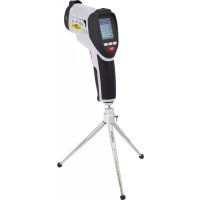
→ If necessary, use the stand for permanent measurement. The thread for the stand is located on the bottom of the handle. The legs of the stand can be extended.
o) Alarm functions
The measuring device is equipped with an alarm function on underrunning/exceeding preset temperature values. The alarm features a signal tone as well as lighting up the display red. This function makes the measuring device ideal for temperature monitoring, etc. The device has two adjustable temperature values (upper and lower alarm value). The alarm is triggered on underrunning the lower alarm value or exceeding the upper alarm value. Those values can be adjusted and activated independently. Proceed as follows to set and activate the upper alarm value (H = High):
- Turn the measuring device on by pressing the measuring button.
- To activate the upper alarm value, press the MODE button until the symbol for the upper alarm value flashes and the display shows ON or OFF (menu item HAL ON/OFF = High Alarm ON/OFF).
- Use ▲ or ▼ to activate or deactivate the upper alarm value (ON/OFF).
- Press the MODE button until the symbols for upper alarm value flash and the display shows a temperature value (menu item HAL ADJUST = set High Alarm).
- Use ▲ and ▼ to set the upper alarm value that will trigger the alarm when exceeded.
• After turning off the device the set values remain stored.
Proceed as follows to set and activate the lower alarm value (L = Low):
- Turn the measuring device on by pressing the measuring button.
- To activate the lower alarm value, press the MODE button until the symbol for the lower alarm value flashes and the display shows ON or OFF (menu item LAL ON/OFF = Low Alarm ON/OFF).
- Use ▲ and ▼ to activate or deactivate lower alarm value (ON/OFF).
- Press the MODE button until the symbols for lower alarm value flash and the display shows a temperature value (menu item LAL ADJUST = set Low Alarm).
- Use ▲ and ▼ to set the lower alarm value that will trigger the alarm when underrun.
• After turning off the device the set values remain stored.
p) °C/°F conversion
- Turn the measuring device on by pressing the measuring button.
- Press the MODE until measuring unit flashes on the display.
- Use ▲ and ▼ to select the desired measuring unit.
- Press the measuring button to confirm your input or press the MODE button to proceed to the next setting.
- When the device is switched off, the set value is retained.
→ When the HOLD function is active (measuring button not pressed), you can also set the measuring unit with ▲ or ▼.
11. Care and cleaning
a) Cleaning of the lens
- Remove loose particles with clean compressed air and wipe off remaining residues with a fine lens brush.
- Clean the surface of the lenses using a lens cloth or a soft, lint-free cloth.
- The cloth can be moistened with water or a lens cleaning solution to remove fingerprints and other residues.
- Do not use any acidic, alcoholic or other solvents or rough, linty cloth to clean the lens.
- Avoid applying too much pressure when cleaning the lens.
b) Cleaning the housing
- Use water and soap or a mild cleaning agent to clean the housing.
- Do not use abrasive agents or solvents!
12. Disposal
a) Product

Electronic devices are recyclable waste and must not be disposed of in the household waste. Always dispose of the product according to the relevant statutory regulations. Remove any inserted batteries and dispose of them separately from the product.
b) Batteries

You are required by law to return all used batteries (Battery Directive). Batteries must not be placed in household waste.
Batteries containing hazardous substances are labelled with this symbol to indicate that disposal in household waste is forbidden. The abbreviations for heavy metals in batteries are: Cd = Cadmium, Hg = Mercury, Pb = Lead (indicated on the battery, e.g. below the trash icon on the left).
Used batteries can be returned to local collection points, our stores or battery retailers.
You thus fulfil your statutory obligations and contribute to the protection of the environment.
13. Technical data
Operating voltage....9 V block battery
Response time....150 ms
Emission level....adjustable from 0.1 – 1.0
Resolution....0.1 °C
IR optics....50:1
Laser....Power: < 1 mW / Class: 2 / Wave length: 630 – 670 nm
Operating temperature ....0 to +50 °C
Operating humidity 10 – 90 %
Storage temperature....-10 to +60 °C
Storage humidity....< 80 %
System requirements......Windows® Vista™ and higher
Weight 320 g
Dimensions....52 x 240 x 155 mm
Infrared temperature measurement
| Temperature measuring range Accuracy Reproducibility | |
| -50 to +20 °C ±3 °C ±1.5 °C | |
| +20 to +500 °C ±1 % ±1 °C | ±0.5 % or ±0.5 °C |
| +500 to +1000 °C ±1.5 % | |
| +1000 to +2200 °C ±2 % ±1 % | |
K-type contact measurement
| Temperature measuring range Accuracy | |
| -50 to 0 °C ±2 °C | |
| 0 to +1370 °C ±0.5 % ±1.5 °C | |
Infrared temperature measurement
| Surface Emissivity Surface Emissivity | |||
| Asphalt 0.90 – 0.98 Varnish (matt) 0.97 | |||
| Concrete 0.94 Marble 0.94 | |||
| Chromium oxide 0.81 Human skin 0.98 | |||
| Ice 0.96 – 0.98 Mortar 0.89 – 0.91 | |||
| Ferric oxide 0.78 – 0.82 Paper 0.70 – 0.94 | |||
| Earth 0.92 – 0.96 Plastic | 0.85 – 0.95 | ||
| Hard plaster | 0.80 – 0.90 Sand | 0.90 | |
| Glass | 0.90 – 0.95 Foam | 0.75 – 0.80 | |
| Rubber (black) | 0.94 Fabric (black) | 0.98 | |
| Ceramic | 0.90 – 0.94 Textiles 0.90 | ||
| Carbon (powder) | 0.96 Water 0.92 – 0.96 | ||
| Copper oxide | 0.78 Cement | 0.96 | |
| Varnish 0.80 – 0.95 Brick | 0.93 – 0.96 | ||
The emission ratios in the above table are approximate values. Parameters such as the shape and characteristics of the material can affect the emissivity of an object.
Page
France (email): technique@conrad-france.fr
line
| Distance | Laser (in mm) | Laser (in mm) | Laser (in mm) | Laser (in mm) | Laser (in mm) | Laser (in mm) | Laser (in mm) | Laser (in mm) | Laser (in mm) | Laser (in mm) | Laser (in mm) | InfraRed (in mm) | InfraRed (in mm) | | -------- | ------------- | ------------- | ------------- | ------------- | ------------- | ------------- | ------------- | ------------- | ------------- | ------------- | ------------- | ----------------- | ----------------- | | Spot | 0.7 | 18 | 42 | - | - | - | - | - | - | - | - | - | - | | Distance | 35 | 900 | 2100 | - | - | - | - | - | - | - | - | - | - | | Distance : Spot = 50 : 1KLASSE 2 LASERPRODUCT
EN 60825-1:2014
flowchart
graph TD
    A["MAX MIN DIF AVG"] --> B["EMS adjustment"]
    B --> C["LOCK on/off"]
    C --> D["HAL on/off"]
    D --> E["HAL adjustment"]
    E --> F["LOW on/off"]
    F --> G["LOW adjustment"]
    G --> H["°C/°F"]
    H --> I["MODE"]