EasyManual
F-01 - Receiver Esoteric - Free user manual and instructions
Find the device manual for free F-01 Esoteric in PDF.



User questions about F-01 Esoteric
0 question about this device. Answer the ones you know or ask your own.
Ask a new question about this device
Download the instructions for your Receiver in PDF format for free! Find your manual F-01 - Esoteric and take your electronic device back in hand. On this page are published all the documents necessary for the use of your device. F-01 by Esoteric.
USER MANUAL F-01 Esoteric
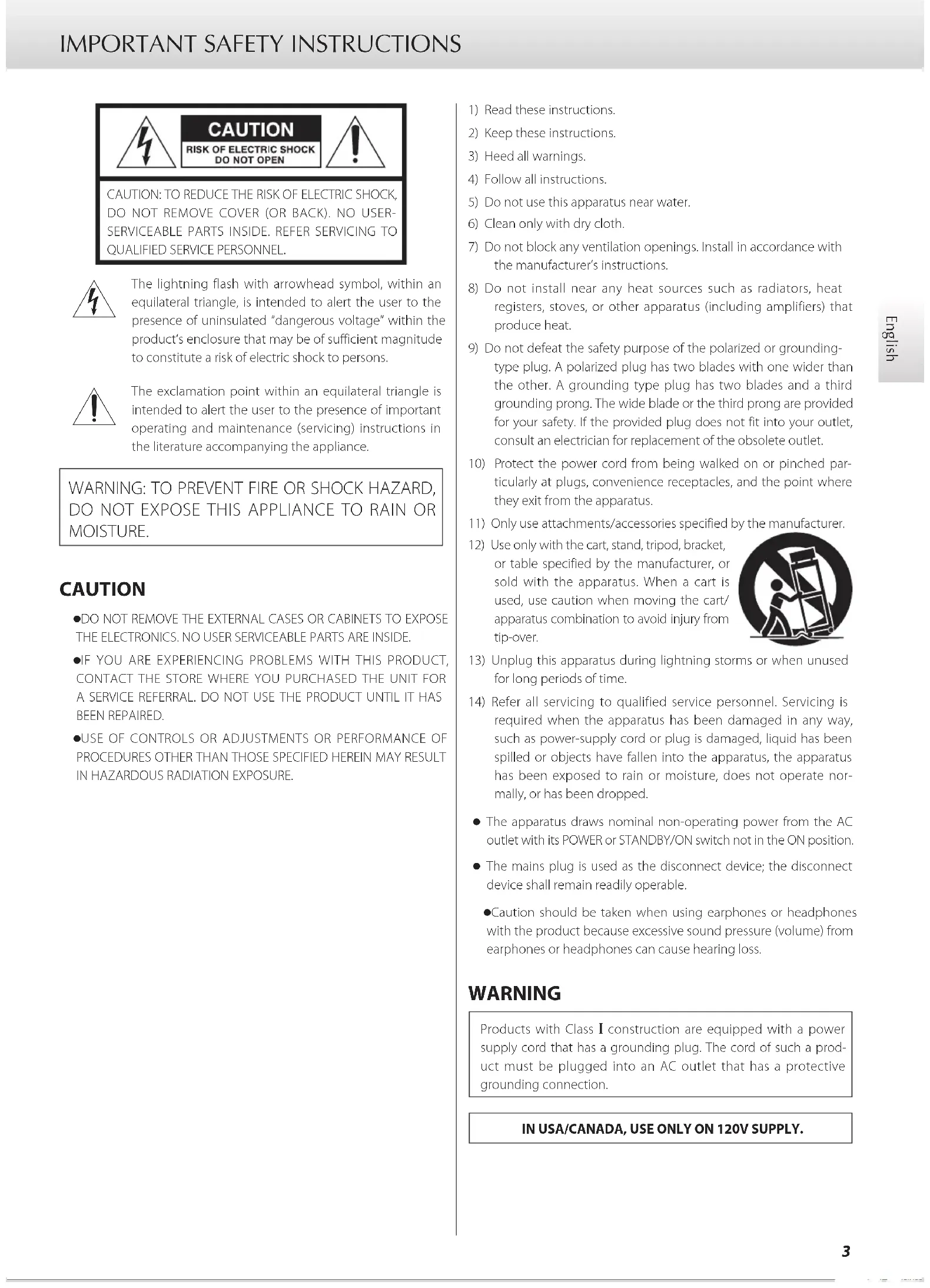
IMPORTANT SAFETY INSTRUCTIONS
CAUTION: TO REDUCE THE RISK OF ELECTRIC SHOCK, DO NOT REMOVE COVER (OR BACK). NO USER-SERVICEABLE PARTS INSIDE. REFER SERVICING TO QUALIFIED SERVICE PERSONNEL. The lightning flash with arrowhead symbol, within an equilateral triangle, is intended to alert the user to the presence of uninsulated “dangerous voltage” within the product’s enclosure that may be of sufficient magnitude to constitute a risk of electric shock to persons. The exclamation point within an equilateral triangle is intended to alert the user to the presence of important operating and maintenance (servicing) instructions in the literature accompanying the appliance.
WARNING: TO PREVENT FIRE OR SHOCK HAZARD,
DO NOT EXPOSE THIS APPLIANCE TO RAIN OR MOISTURE. CAUTION o DO NOT REMOVE THE EXTERNAL CASES OR CABINETS TO EXPOSE THE ELECTRONICS. NO USER SERVICEABLE PARTS ARE INSIDE. o IF YOU ARE EXPERIENCING PROBLEMS WITH THIS PRODUCT, CONTACT THE STORE WHERE YOU PURCHASED THE UNIT FOR A SERVICE REFERRAL. DO NOT USE THE PRODUCT UNTIL IT HAS BEEN REPAIRED. o USE OF CONTROLS OR ADJUSTMENTS OR PERFORMANCE OF PROCEDURES OTHER THAN THOSE SPECIFIED HEREIN MAY RESULT IN HAZARDOUS RADIATION EXPOSURE.1) Read these instructions.2) Keep these instructions.3) Heed all warnings.4) Follow all instructions.5) Do not use this apparatus near water.6) Clean only with dry cloth.7) Do not block any ventilation openings. Install in accordance with the manufacturer’s instructions.8) Do not install near any heat sources such as radiators, heat registers, stoves, or other apparatus (including amplifiers) that produce heat.9) Do not defeat the safety purpose of the polarized or grounding-type plug. A polarized plug has two blades with one wider than the other. A grounding type plug has two blades and a third grounding prong. The wide blade or the third prong are provided for your safety. If the provided plug does not fit into your outlet, consult an electrician for replacement of the obsolete outlet.
10) Protect the power cord from being walked on or pinched par-
ticularly at plugs, convenience receptacles, and the point where they exit from the apparatus.11) Only use attachments/accessories specified by the manufacturer.12) Use only with the cart, stand, tripod, bracket, or table specified by the manufacturer, or sold with the apparatus. When a cart is used, use caution when moving the cart/apparatus combination to avoid injury from tip-over.13) Unplug this apparatus during lightning storms or when unused for long periods of time.14) Refer all servicing to qualified service personnel. Servicing is required when the apparatus has been damaged in any way, such as power-supply cord or plug is damaged, liquid has been spilled or objects have fallen into the apparatus, the apparatus has been exposed to rain or moisture, does not operate nor-mally, or has been dropped. o The apparatus draws nominal non-operating power from the AC outlet with its POWER or STANDBY/ON switch not in the ON position. o The mains plug is used as the disconnect device; the disconnect device shall remain readily operable. o Caution should be taken when using earphones or headphones with the product because excessive sound pressure (volume) from earphones or headphones can cause hearing loss. WARNING Products with Class ! construction are equipped with a power supply cord that has a grounding plug. The cord of such a prod-uct must be plugged into an AC outlet that has a protective grounding connection.IN USA/CANADA, USE ONLY ON 120V SUPPLY.4 IMPORTANT SAFETY INSTRUCTIONS (continued) CAUTION o Do not expose this apparatus to drips or splashes. o Do not place any objects filled with liquids, such as vases, on the apparatus. o Do not install this apparatus in a confined space such as a book case or similar unit. o The apparatus should be located close enough to the AC outlet so that you can easily reach the power cord plug at any time. o If the product uses batteries (including a battery pack or installed batteries), they should not be exposed to sunshine, fire or excessive heat. o CAUTION for products that use replaceable lithium batteries: there is danger of explosion if a battery is replaced with an incorrect type of battery. Replace only with the same or equiva- lent type.
Precautions concerning batteries Misuse of batteries could cause them to rupture or leak leading to fire, injury or the staining of nearby things. Please read and observe the following precautions carefully. o Be sure to insert the batteries with correct positive (¥) and nega- tive (^) orientations. o Use batteries of the same type. Never use different types of batter- ies together. o If the remote control is not used for a long time (more than a month), remove the batteries to prevent them from leaking. o If the batteries leak, wipe away the leakage inside the battery compartment and replace the batteries with new ones. o Do not use batteries of types other than those specified. Do not mix new batteries with old ones or use different types of batteries together. o Do not heat or disassemble batteries. Never throw batteries into fire or water. o Do not carry or store batteries with other metallic objects. The bat- teries could short circuit, leak or explode. o Never recharge a battery unless it is confirmed to be a recharge- able type. o Do not expose batteries to extremely low air pressure as it could result in an explosion or leakage of flammable liquids or gases. Supplier’s Declaration of Conformity Model number: F-01 Trade name: ESOTERIC Responsible party: 11 Trading Company, LLC Address: 3502 Woodview Trace #200 Indianapolis, IN 46268 U.S.A. URL: https://11tradingcompany.com/contact-us/ This device complies with Part.15 of FCC Rules. Operation is subject to the following two conditions:
1) This device may not cause harmful interference
2) This device must accept any interference received, including
interference that may cause undesired operation. Information This equipment has been tested and found to comply with the limits for a Class B digital device, pursuant to Part 15 of the FCC Rules. These limits are designed to provide reasonable protection against harmful interference in a residential installation. This equip- ment generates, uses, and can radiate radio frequency energy and, if not installed and used in accordance with the instructions, may cause harmful interference to radio communications. However, there is no guarantee that interference will not occur in a particular installation. If this equipment does cause harmful interference to radio or television reception, which can be determined by turning the equipment off and on, the user is encouraged to try to correct the interference by one or more of the following measures:
- Reorient or relocate the equipment and/or the receiving antenna.
- Increase the separation between the equipment and receiver.
- Connect the equipment into an outlet on a circuit different from that to which the receiver is connected.
- Consult the dealer or an experienced radio/TV technician for help. CAUTION Changes or modifications not expressly approved by the party responsible for compliance could void the user’s authority to operate the equipment. Model for Canada This Class B digital apparatus complies with Canadian ICES-003. Model for Europe This product complies with the European Directives request, and the other Commission Regulations. Model for UK This product complies with the applicable UK regulations.5 English ESOTERIC is a trademark of TEAC CORPORATION, registered in the U.S. and other countries. Other company names, product names and logos in this document are the trademarks or registered trademarks of their respective owners. For European Customers Disposal of electrical and electronic equipment and batteries and/or accumulators a) All electrical/electronic equipment and waste batteries/accu- mulators should be disposed of separately from the municipal waste stream via collection facilities designated by the govern- ment or local authorities. b) By disposing of electrical/electronic equipment and waste batteries/accumulators correctly, you will help save valu- able resources and prevent any potential negative effects on human health and the environment. c) Improper disposal of waste electrical/electronic equipment and batteries/accumulators can have serious effects on the environment and human health because of the presence of hazardous substances in the equipment. d) The Waste Electrical and Electronic Equipment (WEEE) symbols, which show wheeled bins that have been crossed out, indicate that electrical/electronic equip- ment and batteries/accumulators must be collected and disposed of separately from household waste. If a battery or accumulator contains more than the specified values of lead (Pb), mercury (Hg), and/or cadmium (Cd) as defined in the Battery Directive (2006/66/EC, 2013/56/EU), then the chemical symbols for those elements will be indicated beneath the WEEE symbol. e) Return and collection systems are available to end users. For more detailed information about the disposal of old electri- cal/electronic equipment and waste batteries/accumulators, please contact your city office, waste disposal service or the shop where you purchased the equipment. Pb, Hg, Cd6 Contents Thank you for purchasing this ESOTERIC product. In order to provide you with the best audio quality for many years, we manufacture ESOTERIC products with strict quality control one unit at a time. Read this manual carefully to get the best performance from this product. After reading it, keep it in a safe place with the warranty card for future reference. Before use Included accessories Check to be sure the box includes all the supplied accessories shown below. Please contact the store where you purchased this product if any of these accessories are missing or have been damaged during transportation. Power cord × 1 Remote control (RC-1339) × 1 Batteries for remote control (AA) × 2 Felt pads × 4 Owner’s manual (this document) × 1 Warranty card × 1 Note about pinpoint feet High-precision metal pinpoint feet are attached to the bottom plate of this unit. The pinpoint feet and their stands are loose, but when the unit is placed in position, it is supported by these pinpoint feet, which effec- tively disperse vibrations. Chassis Pinpoint foot (metal) Foot-stand (metal) After placement o If there is a gap between a chassis and a pinpoint foot after place- ment, turn the pinpoint foot in the direction that tightens the screw to eliminate the gap. o Apply the included felt pads to the bottoms of the foot-stands to avoid scratching the surface where the unit is placed. o This unit is very heavy, so take care to avoid injury during installation.
For safety, disconnect the power plug from the out- let before cleaning. o Never spray liquid directly on this unit. o Do not use chemically-treated wipes, thinner or similar substances because they could damage the surface of the unit. o Avoid allowing rubber or plastic materials to touch the unit for long periods of time because they could damage the cabinet. o This equipment is very heavy, so take care to avoid injury when opening the packaging and when moving it. o Place the unit in a stable location near the stereo system that will be used with it. o Do not install this unit in a location that could become hot. This includes places that are exposed to direct sunlight or near a radia- tor, heater, stove or other heating equipment. Moreover, do not place it on top of another amplifier or equipment that generates heat. Doing so could cause discoloration or deformation. o Avoid locations that are subject to vibrations or exposed to exces- sive dust, cold or moisture. o In order to enable good heat dissipation, leave at least 20cm (8") between this unit and walls and other equipment when install- ing it. If you put it in a rack, for example, leave at least 30cm (12") open above and 20cm (8") open behind it. Failure to provide these gaps could cause heat to build up inside and result in fire. o Do not install the unit face up or on its side. o Do not place anything, not even CDs, CD-Rs, LP records or cassette tapes, on top of the unit. o Do not put cloth on top of the unit or place it on top of bedding or thick carpet. Doing so could cause it to overheat or damage it. o Do not move the unit during use. o Supply voltage to the unit that matches the voltage as printed on its back. If you are in any doubt regarding this matter, consult an electrician. o Do not open the body of the unit as this might result in damage to the circuitry or cause electric shock. If a foreign object should get into the unit, contact your dealer. o When removing the power plug from the wall outlet, always pull directly on the plug; never yank on the cord. o Since this unit includes a class A amp, there is nothing unusual about the top of the unit becoming hot, even when using head- phones or the pre-out. If the unit becomes too hot, however, the overheating protection circuit (page28) will activate, so please use care when placing the unit.8 Connections
Precautions when making connections o After completing all other connections, plug the power plug into a power outlet. o Read the owner’s manuals of all devices that will be connected, and follow their instructions. o Do not bundle connecting cables with power cords. Doing so could cause noise. XLR pin assignment
Included power cord Record player RCA cables XLR cables Audio output (AUDIO OUT, etc.) Audio output (AUDIO OUT, etc.) Super Audio CD player, tuner, etc. Super Audio CD player, etc.
Wall outlet9 English A Analog input (INPUTS) connectors Connect the analog output connectors of Super Audio CD play- ers, DVD players, cassette decks, tuners and other equipment to these connectors. Connect the R connector of a pair on this unit to the right (R) connector of an output device and the L connector of the same pair on this unit to the left (L) connector of the output device. Use commercially-available cables for connections. XLR: balanced XLR cables Insert the balanced XLR plugs until the connector levers lock. Press these levers and pull the plugs out to disconnect. RCA, PHONO: RCA cables Connect the white pin plugs to the white (L) connectors and connect the red pin plugs to the red (R) connectors. Connecting record players This unit has a built-in phono equalizer. When connecting a record player, use the PHONO connectors. o Always connect the record player’s ground to the SIGNAL GND grounding terminal on this unit. o Set the cartridge type being used with the PHONO> setting (page26). B SIGNAL GND grounding terminal Using a commercially-available sheathed wire to connect this to the grounding terminal of a Super Audio CD player, power amplifier or other device might improve the audio quality. o This is not a safety grounding terminal. C Analog output (PRE OUT) connectors These output 2 channels of analog audio. To use this unit as a preamp, see “Connections for use as a pre- amp” on page11. Connect the R connector of a pair on this unit to the right (R) connector of an input device and the L connector of the same pair on this unit to the left (L) connector of the input device. Use commercially-available cables for connections. XLR: balanced XLR cables Insert the balanced XLR plugs into the connectors until they lock. ESL-A: balanced XLR cables Use commercially-available shielded cables (page12). D Remote control input (RS-232C) connector This control connector is for use by professionals (custom installers). E TRIGGER IN/OUT connectors Use these connectors to control power from an external source. Do not connect anything to these connectors when not using them. F Optional board slot This slot is for installing optional boards that are sold separately. G DC IN connector Use this connector to connect an external power supply unit. Do not connect any equipment that has not been specified by ESOTERIC. H AC power inlet (~IN) Connect the supplied power cord to this AC inlet. After completing all other connections, plug the power plug into a power outlet.
Use only a genuine ESOTERIC power cord. Use of other power cords could result in fire or electric shock.
Disconnect the power plug from the outlet if you will not use the unit for a long time.10 Connecting speakers Notes about speaker cables o Use commercially-available speaker cables to connect the speakers. o Use the shortest speaker cables possible. The longer the cable, the greater the resistance value and the more that damping perfor- mance is reduced. Moreover, length also increases inductance and capacitance, degrading the sound quality of high frequencies. o Use left and right speaker cables that have the same length. How to connect speaker cables Use commercially-available speaker cables to connect the + terminal of the unit to the + terminal of the speaker and the − terminal of the unit to the − terminal of the speaker. o Use speakers with at least 4Ω impedance. o If the exposed tip of the core wire of a speaker cable contacts another cord or terminal, a short could occur. Never allow a speaker cable to short. o Do not connect more than one amplifier to a speaker. o Do not bundle speaker cables with power cords. Doing so could cause noise.
The power plug should always be disconnected when connecting speaker cables. Right speaker Left speaker11 English When using bare wires Loosen the cap and insert the core wire into the hole in the terminal. Then, tighten the cap. When using spade connectors Loosen the cap and insert the spade connector between the cap and base of the terminal. Then, tighten the cap. o When connecting speakers with spade connectors, they should have inside diameters of at least 8mm. When using banana plugs With the cap tightened, insert the plug into the opening in the end of the terminal. o Carefully read the instructions for the banana plugs that you are using.
Precautions when connecting speaker cables Connect the cables securely so that they do not become loose and the core wires or terminals at their ends do not become exposed and contact other metal parts or the unit. Notice about the European model In accordance with European safety regulations, connecting banana plugs to speaker terminals is not allowed on European models. The holes into which banana plugs could be inserted have been covered with black caps.Connect speakers using bare wires or spade connectors. If a black cap should become separated from its terminal, return it to its original position. Connections for use as a preamp Power amplifierConnect using a set of only one type.XLR cablesAudio inputAUDIO INES-LINK Analog input connectorsESL-A Connections Use commercially-available XLR cables to connect the analog output (PRE OUT) connectors on this unit to the analog input connectors on the power amp. Settings Press the OUTPUT button to set the output connectors to SP+PRE or PRE (page20).
Precautions when making connections After completing all other connections, plug the power plug into a power outlet.Read the owner’s manuals of all devices that will be connected, and follow their instructions.Do not bundle connecting cables with power cords. Doing so could cause noise.12 Connecting using ES-LINK Analog ES-LINK Analog overview The current transmission method utilizes the performance of HCLD buffer circuits that feature the ability to supply strong current at high speed. This suppresses the impact of impedance on signal paths, enabling pure and powerful transmission of signals. o Use connection cables that are shielded and balanced. o Ordinary balanced cables (with XLR connectors) are used for connection. These connectors can only be used with compatible devices, however, because the transmission format is unique. Connecting source devices using ES-LINK Analog Source device XLR cables Analog audio output (ESL-A) connectors ATTENTION Set the analog output setting to ESLA on the source device before connecting it. Use XLR cables to connect the analog audio output (ESL-A) con- nectors on the source device to the analog audio input (ESL-A) connectors on this unit. o Set the operation mode to ESLA for the input connectors on this unit that are connected to the source device (page26). Connecting to a power amplifier using ES-LINK Analog XLR cables ES-LINK Analog input (ESL-A) connectors Power amplifier that supports ES-LINK Analog Use XLR cables to connect the analog audio output (ESL-A) connec- tors on this unit to the ES-LINK Analog input (ESL-A) connectors on the power amplifier. o Set the power amplifier input selector to ESLA. o Press the OUTPUT button to set the output connectors to SP+PRE or PRE (page20). ATTENTION The ESL-A output connectors of this unit are female-type connectors to prevent accidental connection with XLR output connectors.13 English Connecting headphones
ATTENTION While wearing headphones, do not connect or disconnect them or turn the unit on or put it into standby. Doing so could result in a sudden loud noise that could harm your hearing. Before putting headphones on, always set the volume to mini- mum (display should show “0” when set to “STEP (0–99.9)” or “− ” when set to “dB”) (page18). Balanced headphones (BAL) Connect headphones with a 4-pin XLR plug. Press the OUTPUT button to set the output connector to Phones (BAL) (page20). PIN assignments of this unit
1: L+, 2: L− 3: R+, 4: R− Ordinary headphones (UNBAL, unbalanced drive) Connect headphones with a standard 6.3mm (1/4") stereo plug. Press the OUTPUT button to set the output connector to Phones (UNBAL) (page20).14 Main unit parts and functions A INPUT knob Turn this knob to select the active input. Select the connector that is connected to the device you want to play. o You can change the names that are shown on the display for the connectors (page23).When inputting a source name, use this to select characters.Holding this down makes it function as a power button, turning the unit on or putting it into standby. B Power indicator This lights when the unit is on. C Remote control signal receiver This receives signals from the remote control. When using the remote control, point the end of it toward this receiver panel (page15). D Display This shows the current input source name, volume, setting items, etc. E VOLUME knob Use this to adjust the volume.Turn this knob clockwise to increase the volume and counter-clockwise to decrease it.Pressing this makes it function as a mute button, enabling temporary muting of the sound. Press this again to restore the volume setting (page19).When muted, “MUTE” blinks on the screen. o The VOLUME knob will not affect input sources set to THRU> (page26). Sudden loud noises might cause hearing damage and other trouble. Always minimize the volume before starting playback, and adjust it to an appropriate level after playback begins. F Control cover G Maintenance port This is used for maintenance. Do not connect anything to this port unless instructed to do so by our service department.The control cover is open in the illustration above.15 English H Headphones jacks Connect headphones plugs (standard 6.3mm (1/4") stereo or 4-pin XLR) here (page13). I OUTPUT button Press this to switch which connector outputs analog audio (page20).Press this when in setting mode to return the display to normal. J MENU button Press this to enter setting mode. K Setting adjustment (l/;) buttons Use these to change setting values when in setting mode. L Open button Press this to open the control cover below the display. Notes about the remote control Precautions when using the remote control o When using the remote control, point it toward the remote con- trol signal receiver on the main unit from a distance of 7m (23ft) or less. Do not place obstructions between the main unit and the remote control. o The remote control might not work if the remote control signal receiver is exposed to direct sunlight or bright light. o Beware that use of this remote control could cause the unin- tentional operation of other devices that can be controlled by infrared rays. Installing batteries 1 Slide the bottom end of the remote control as shown in the illustration, and pull out the battery holder. 2 Insert two AA batteries with ¥ and ^ oriented as shown in the holder, and put the holder in again. Continued on the next page e16 Remote control parts and functions When the main unit and the remote control both have buttons with the same functions, this manual explains how to use one of the buttons. The other corresponding button can be used in the same manner. 3 Slide the bottom end of the remote control as shown in the illustration to close the battery holder. When to replace batteries If the distance required between the remote and the main unit decreases or if the unit stops responding to the remote buttons, replace both batteries with new ones.Dispose of the used batteries according to the instructions on them or requirements set by your local municipality.
Precautions concerning batteries Misuse of batteries could cause them to rupture or leak, which might result in fire, injury or the staining of nearby materials.Please read and observe the precautions on page4 carefully. Notes about the remote control (cont.)17 English h Mode selection buttons Press the SACD button to put the remote control into SACD mode, enabling use of the PLAYER buttons to control the SACD player/transport. Press the NET button to put the remote control into NET mode, enabling use of the PLAYER buttons to control the network player. After switching modes, the mode will be retained until the SACD/NET button is pressed again or the batteries are replaced. i DIMMER button Use this to adjust the brightness of the main unit’s display (page20). j PLAYER buttons Use these to control an ESOTERIC player. o This remote control can also be used for other ESOTERIC products. a ON/STANDBY buttons Use these to turn the unit on or put it into standby mode. b Input selection buttons Press these buttons to switch between input sources. Select the connector that is connected to the device you want to play. XLR Press this to cycle through the input connectors that have their operation mode set to XLR. ESL-A Press this to cycle through the input connectors that have their operation mode set to ESLA. RCA Press this to cycle through the RCA connectors. PHONO Press this when PHONO input is selected to switch the car- tridge type (MM/MC). OPTION Press this to select input connectors that have been added using the optional board slot. o When inputting source names, use the ESL-A and XLR but- tons to select characters. c Setting adjustment (l/;) buttons Use these to change setting values when in setting mode. d MENU button Press this to enter setting mode (page21). e OUTPUT button Press this to switch which connector outputs analog audio (page20). Press this when in setting mode to complete changing settings. f VOLUME (+/−) buttons Use these to adjust the volume. Press the + button to increase the volume and the − button to decrease it. o The VOLUME (+/−) buttons will not affect input sources set to THRU> (page26). g MUTE button Press this button to temporarily mute the sound. Press this again to restore the volume setting (page19). o When muted, “MUTE” blinks on the screen.18 Basic operation 4 Press the OUTPUT button to select the con- nector type used to output analog audio (page20). 5 Play the source, and then adjust the volume by turning the VOLUME knob.
Sudden loud noises might cause hearing damage and other trouble. Always minimize the volume before starting playback, and adjust it to an appropriate level after playback begins. Turning the unit on 1 Turn on the connected input source devices. 2 Press the INPUT knob until the power indicator lights to turn the unit on. o When using this unit as a preamp, turn on the power ampli- fier last. o The remote control ON button can also be used to turn on the unit. 3 Turn the INPUT knob to select an input source.19 English Muting the output Press the MUTE button to temporarily mute the sound. Press it again to restore the volume setting. o When muted, “MUTE” blinks on the screen. o You can also restore the sound by turning the VOLUME knob or by pressing the VOLUME (+/−) buttons. o The VOLUME knob on the unit can also be pressed to mute the sound. Opening the control cover Press the open button to open the control cover. Putting the unit into standby There might be noise from the speakers if the unit is turned off sud- denly. Follow the steps below to put the unit into standby. 1 If a connected device is playing back, stop playback. o When using this unit as a preamp, turn off the power ampli- fier first. 2 Press the INPUT knob on the unit until “OFF” appears on the display to activate standby mode. o The remote control STANDBY button can also be used to put the unit in standby. 3 Turn o the connected input source devices.20 Basic operation (continued) Switching the connectors used for output Press the OUTPUT button to cycle through which connector type outputs analog audio. Speakers
Phones (UNBAL) Speaker output only Speaker output + PREOUT PREOUT only Headphones (BAL) only Headphones (UNBAL) only Dimmer This can be used to adjust the brightness of the main unit’s display. DIMMER3
(off) (normal brightness) o Even when the dimmer is off, the display will light at normal brightness for a few seconds when you press a button or turn a knob. o In setting mode, the display lights at normal brightness. o Even when set to DIMMER1 or off, setting menus and error mes- sages will be shown with DIMMER2 brightness. o Pressing and holding the button will set the brightness to DIMMER2.21 English Basic operation The settings for this unit are divided into three groups: MENU1, MENU2 and MENU3.MENU1, MENU2 or MENU3 settings will be shown depending on how the MENU button is pressed. o Settings are retained even if the power plug is disconnected. 1 Open a settings menu. Opening MENU1 1. Press an input selection button to select the input source to set. The INPUT knob on the main unit can also be turned to change the setting.2. Press the MENU button to show MENU1. Opening MENU2 Press and hold the MENU button. Opening MENU3 In MENU2, select “goto MENU3” (go to MENU3) and press and hold the MENU button. o While making settings, MENU1, MENU2 or MENU3 appears at the top left of the display. 2 Press the MENU button repeatedly to select the item to change.
MENU1 MENU2 MENU3TONE>
BASS>* MID>* TRE>* Bal> Lvl> Name Edit**VolM> Gain> HPVol> Fade> MTLV> DPaOFF> APS> Light> LightLV> CPUdp> goto MENU3>XLR1> XLR2> XLR3> PHONO> THRU> RS232C> TRIG_O> TRGst> SETUP> F/W ver.* This appears only when TONE> is set to ON.** Depending on the optional board (sold separately), a setting item will be shown after “Name Edit” when it is installed.For details, see the Owner’s Manual for that optional board. 3 Use the setting adjustment (l/;) buttons to change the settings. 4 Press the OUTPUT button to end setting mode. If you do nothing for ten or more seconds, setting mode will end and ordinary display will resume. Settings22 In MENU1, you can make settings for the selected input source. You can set these independently for each of the inputs. Tone control TONE>*** Set whether to adjust audio signals with the tone circuit. o By default, the setting is BYPAS (bypass).
You can separately adjust the levels of low (BASS), medium (MID) and high (TRE) frequencies. BYPAS Audio signals do not pass through the tone circuit before amplification. Low frequency adjustment BASS>*** This is only shown when TONE> is set to ON. This can be set between −12.0dB and +12.0dB, including 0.0dB, in 0.5dB increments. o By default, the setting is 0.0dB. Mid frequency adjustment MID>*** This is only shown when TONE> is set to ON. This can be set between −12.0dB and +12.0dB, including 0.0dB, in 0.5dB increments. o By default, the setting is 0.0dB. High frequency adjustment TRE>*** This is only shown when TONE> is set to ON. This can be set between −12.0dB and +12.0dB, including 0.0dB, in 0.5dB increments. o By default, the setting is 0.0dB. Left and right balance Bal>*** Adjust the balance between the left and right output channels. This can be set from L6.0 dB to R6.0dB, including 0.0dB, in 0.1dB increments. This can also be set so that just one channel is muted. o By default, the setting is 0.0dB (no balance adjustment). Muting just one channel Press the ; button to select “Bal>R only” to output only the right channel. Likewise, press the l button to select “Bal>L only” to output only the left channel. Adjusting the output level Lvl>*** Adjust the output level for the selected input connector type. This can be set to values between −18.0dB and +18.0dB in 0.1dB increments. o By default, the setting is 0.0dB. Note about settings and sound quality The left and right balance (Bal), output level adjustment (Lvl) and amp gain (Gain, HPVol) setting items affect the volume. This unit’s microcomputer comprehensively analyzes these settings and the VOLUME setting to conduct unified control with a volume control amplifier in one place. For this reason, unlike ordinary amplifiers that pass audio signals through multiple circuits, these settings will not degrade the audio quality. MENU 123 English Input source name editing Name Edit You can change the names shown on the display for the unit’s con- nectors when you turn the INPUT knob. You can set the names as you like (up to five characters). Changing input source names
1. Select the input source to edit.
2. Press the MENU button repeatedly to show NameEdit.
3. Press and hold the MENU button.
XLR1: ***** appears when the input source is XLR1.
4. Enter the characters.
The character being input and the cursor appear alternately. Use the ESL-A/XLR input selection buttons or the main unit INPUT knob to select characters.
Use the setting adjustment (l/;) buttons to move it.
6. When finished with input, press and hold the MENU
button. o Press the OUTPUT button to cancel input. o While inputting characters, the input source cannot be changed. o Available characters English letters: A–Z, a–z Numbers: 0–9 Symbols: ! " # $ % & ' ( ) * + , − . / \ : ; < = > ? @ (blank) o Using blank spaces for all five characters will clear the input source name.24 MENU 2 In MENU2, settings can be made for the display and the unit as a whole. Volume display mode VolM>*** This sets how the volume is shown. o By default, the setting is dB. STEP This shows the volume as a value of 0.0 – 99.9.
This shows the volume in decibels. Preamp gain Gain>*** This switches the gain of the preamp section. o By default, the setting is +12dB. o This setting value is the maximum gain of the preamp section. o After this setting is changed, the output will be muted. o Depending on the speakers and headphones being used, increasing the preamp gain could cause white noise to become noticeable. Reduce the gain in such cases. 0dB The gain is 0 dB. The volume can be set to −∞dB and adjusted from −99.9dB to 0dB. +6dB The gain is +6 dB. The volume can be set to −∞dB and adjusted from −99.9dB to +6dB. +12dB The gain is +12 dB. The volume can be set to −∞dB and adjusted from −94.9dB to +12dB. +18dB The gain is +18 dB. The volume can be set to −∞dB and adjusted from −89.9dB to +18dB. Headphone amp gain HPVol>*** This sets the headphone amp gain. This can be set to values between 0dB and +18.0dB in 3dB increments. o By default, the setting is 0dB. Fade-in/out time Fade>*** The fade-in/out time used when muting and unmuting becomes longer in order from TM1 to TM3. o By default, the setting is TM2. Mute level MTLV>*** This sets the volume when it is muted. o By default, the setting is − dB. − dB The volume becomes −∞dB when muted. −20dB The volume is reduced 20dB from the set level when muted. Automatic display darkening DPaOFF>*** Use this to set the display to darken automatically. o By default, the setting is OFF.
If no operation is conducted for tenminutes, the display automati- cally turns off. DIM If no operation is conducted for ten minutes, the display will dim to DIMMER1 brightness. OFF Automatic display darkening will not occur. o We recommend setting this to “ON” because brightness irregulari- ties might occur if the same information is shown without change on the display for a long time.25 English Automatic power saving function APS>*** If there is no audio input (continuous silence) from the selected input source for the set amount of time, the unit will enter standby mode automatically. o By default, the setting is OFF. o Audio input from input sources other than the one selected has no effect on the operation of the automatic power saving function. 30m 30 minutes 60m 60 minutes 90m 90 minutes 120m 120 minutes OFF The automatic power saving function is disabled. Illumination Light>*** How the rings around the INPUT and VOLUME knobs light can be set. o By default, the setting is AUTO. AUTO When the knobs are operated, their rings light.
The rings around the knobs are always lit. OFF The rings around the knobs are always unlit. Knob illumination brightness LightV>*** The brightness of the illumination around the knobs can be set. o By default, the setting is 5. 5 (normal brightness)
1 (dim) Opening MENU3 goto MENU3 Press and hold the MENU button to open MENU3.26 Thru THRU>*** Set whether to use inputs as thru connectors. o By default, the setting is OFF. OFF Thru is not used.XLR1/ESLA1*XLR2/ESLA2*XLR3/ESLA3* RCA1 RCA2 RCA3 PHONOOnly the signals from the selected input connectors are input to the power amplifier without using the volume control functions.* One will be shown according to the operation mode setting of the input connector. If you select inputs connected to an ordinary line-level device, signals that are too strong could be output to the speakers, resulting in damage to them.“THRU” appears on the display instead of the volume level set by using the VOLUME knob/buttons.For example, if you connect the pre-out connectors (FRONT L/R) of an AV amplifier to this unit’s RCA 2 connectors, and set RCA2 to THRU, you can use the speakers connected to this unit as the front speakers of the AV amplifier. (The AV amplifier controls volume adjustment when the input source is set to “RCA2”.) o The VOLUME knob/buttons will not affect the volume of the input connectors set to THRU>. Always connect a device that has a volume control to the input connectors set to THRU. Use that device to mini-mize the volume before switching the input source, and then gradually raise the volume level. MENU 3
MENU3 includes setting items related to ampli-fication. These settings could result in damage to speakers if set incorrectly. Input connector operation mode XLR1>*** XLR2>*** XLR3>*** Set the operation mode of the input connector. o By default, the setting is XLR. XLR Select this when using normal balanced connection. ESLA Select this when using ES-LINK Analog connection. Cartridge type PHONO>*** Set the cartridge type being used by the record player connected to the PHONO connectors. o By default, the setting is MM. Select this when using an MM cartridge or an MC cartridge through a step-up transformer. Select this when using an MC cartridge.27 English Remote control input (RS-232C) connector RS232C>*** Set this to ON only when using the remote control input (RS-232C) connector. o By default, the setting is OFF. OFF The remote control input (RS-232C) connector cannot be used.
The remote control input (RS-232C) connector can be used. Trigger signal output TRIG_O>*** o By default, the setting is OFF. OFF Do not output trigger signals.
Output trigger signals. Trigger startup TRGst>*** This sets the behavior when the unit is turned on by a trigger input signal. o By default, the setting is LAST. LAST When the unit is turned on by a trigger input signal, it will start in the state it was in (including input and volume) just before it was put into standby. THRU When the unit is turned on by a trigger input signal, input signals that are set to THRU> (page26) are output directly. o If THRU> is set to OFF, it will start with the state it was in just before it was put into standby. Restoring factory settings SETUP>*** You can restore the factory default settings, erasing all changes in memory. Follow the procedures below to initialize the settings.
1. Use the setting adjustment (l/;) buttons to show CLR.
2. Press and hold the MENU button when CLR is shown.
Firmware versions F/W ver Press the ; button to show the firmware versions. I/F v**.** INP v**.** “**.**” is the version.28 Troubleshooting If you experience a problem with this product, please take a moment to review the following information before requesting service. Moreover, the problem might be caused by something other than this unit. Please also check the operation of the connected units. If this product still does not operate correctly, contact the retailer where you purchased it. The unit does not turn on. e Check that the power cord is plugged into a working power outlet. e Check that the power cord is properly connected to this unit. Standby mode starts automatically. e If the unit enters standby after “POWER OFF” appears, the auto- matic power saving function is operating to put the unit into standby. Press the INPUT knob until the power indicator lights to turn the unit on. Change the automatic power saving setting if necessary (page25). e If the unit enters standby without “POWER OFF” appearing, the DC voltage protection circuit is operating. Contact the store where you purchased the unit. Remote control does not work. e Turn the main unit on (page18). e If the batteries are exhausted, replace both of them with new ones (page16). e The remote control will not work if there is an obstruction between it and the main unit. Point the remote control toward the main unit and use it within 7m (23ft) of the front panel (page15). A television or other device is operating improperly. e The use of this unit’s remote control might cause some televi- sions and other devices with wireless remote control functions to operate incorrectly. VOLUME knob does not work. e The VOLUME knob will not affect input sources set to THRU> (page26). An error message appears. e A protection circuit is active. Put the unit into standby and eliminate the cause (page28). e A short might have occurred with the +/− speaker cables. Check the speaker cable connections (page10). The stereo sound position is irregular. e Check that neither of the speakers has a connection cable with +/− reversed. This unit uses a microprocessor, so noise and other external interference could cause it to stop functioning properly. If this occurs, put the unit into standby mode, disconnect the power cord from the outlet, and wait about one minute before restarting operation from the beginning. This unit has a DC voltage protection circuit, an overcurrent protec- tion circuit and an overheating protection circuit built-in. o If the DC voltage protection circuit is activated, the unit will imme- diately enter standby. When the overcurrent protection circuit or the overheating protec- tion circuit is operating, the power indicator blinks and one of the following error messages blinks on the display. Overload! The overcurrent protection circuit is active. If this error continues for 30 seconds or more, the unit will enter standby. Since a short could be occurring with a speaker cable + and −, put the unit into standby and check the speaker connections. Over TEMP! The overheating protection circuit is active. If this error continues for 30 seconds or more, the unit will enter standby. Since the internal temperature has become high, put the unit in standby and wait a while for the temperature to decrease. You can also change the installation conditions to improve ventilation. o The overheating protection circuit could be activated again if the power button is used while the internal temperature is still high. If a protection circuit activates again even after the cause of its activa- tion has been resolved, there could be an issue inside the unit, for example. Disconnect the power cord from the outlet and contact the store where you purchased the unit. Notes about the protection circuits29 English Specifications Speaker outputs Rated output ...................................... 30W + 30W (8Ω) 60W + 60W (4Ω) Total harmonic distortion ..................................... 0.008% (1kHz, 8Ω, 30W) Frequency response ................................. 10Hz – 100kHz (+0/−3.0dB at 1W output) S/N ratio ............................................... 104dB (IHF-A) Damping factor .................................................. 500 Minimum compatible impedance ................................ 4Ω Speaker output connectors .....................................1 pair Inputs ESL-A/XLR connectors ........................................ 3 pairs RCA connectors ...............................................3 pairs PHONO connectors .............................................1 pair (MM/MC switchable) Input impedance XLR, RCA ................................................... 10kΩ PHONO (MM) ............................................... 47kΩ PHONO (MC) ............................................... 100Ω Outputs ESL-A connectors .............................................. 1 pair XLR connectors ................................................ 1 pair Headphones jacks Standard 6.3mm (1/4") stereo jack ............................... 1 4-Pin XLR jack ................................................... 1 Maximum effective output Unbalanced ....................... 300mW + 300mW (into 32Ω) Balanced .......................... 600mW + 600mW (into 32Ω) Applicable load impedance Unbalanced ......................................... 16Ω – 600Ω Balanced ............................................ 32Ω – 600Ω Output impedance XLR. . . . . . . . . . . . . . . . . . . . . . . . . . . . . . . . . . . . . . . . . . . . . . . . . . . . . . . . . 100Ω PRE OUT S/N ratio (at 1V output) XLR, RCA input ............................................ 110dB PHONO (MM) input ......................................... 97dB PHONO (MC) input ......................................... 78dB Gain Preamplifier ......................... 18 dB maximum (selectable) (when volume settings at maximum) Power amplifier. . . . . . . . . . . . . . . . . . . . . . . . . . . . . . . . . . . . . . . . . . . . 28.5dB Tone control BASS .............................................. ±12dB (63Hz) MIDDLE .......................................... ±12dB (630Hz) TREBLE ........................................... ±12dB (14kHz) External controls RS-232C ............................................................ 1 Trigger input (TRIGGER IN) .......................................... 1 (3.5mm mono mini jack) Input level .............................................. 12V, 1mA Trigger output (TRIGGER OUT) ...................................... 1 (3.5mm mono mini jack) Output level ..................................... 12V, 50mA max General Power supply Model for Europe .................................. AC 230V, 50Hz Model for USA/Canada ............................ AC 120V, 60Hz Power consumption ........................................... 255W 230W (when no signal) In standby RS-232C setting OFF. . . . . . . . . . . . . . . . . . . . . . . . . . . . . . . . . . . . . . 0.3W RS-232C setting ON ...................................... 0.6W External dimensions (W × H × D, including protrusions) 445 × 191 × 471 mm (17 5/8" × 7 5/8" × 18 5/8") Weight ................................................ 32.2kg (71lb) Operating temperature range ......................... +5°C to +35°C Included accessories Power cord × 1 Remote control (RC-1339) × 1 Batteries for remote control (AA) × 2 Felt pads × 4 Owner’s manual (this document) × 1 Warranty card × 1 o Specifications and appearance are subject to change without notice. o Weight and dimensions are approximate. o Illustrations in this manual might differ slightly from production models.30