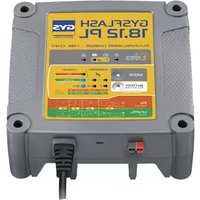
Gysflash 18.12 PL - Battery charger GYS - Free user manual and instructions
Find the device manual for free Gysflash 18.12 PL GYS in PDF.

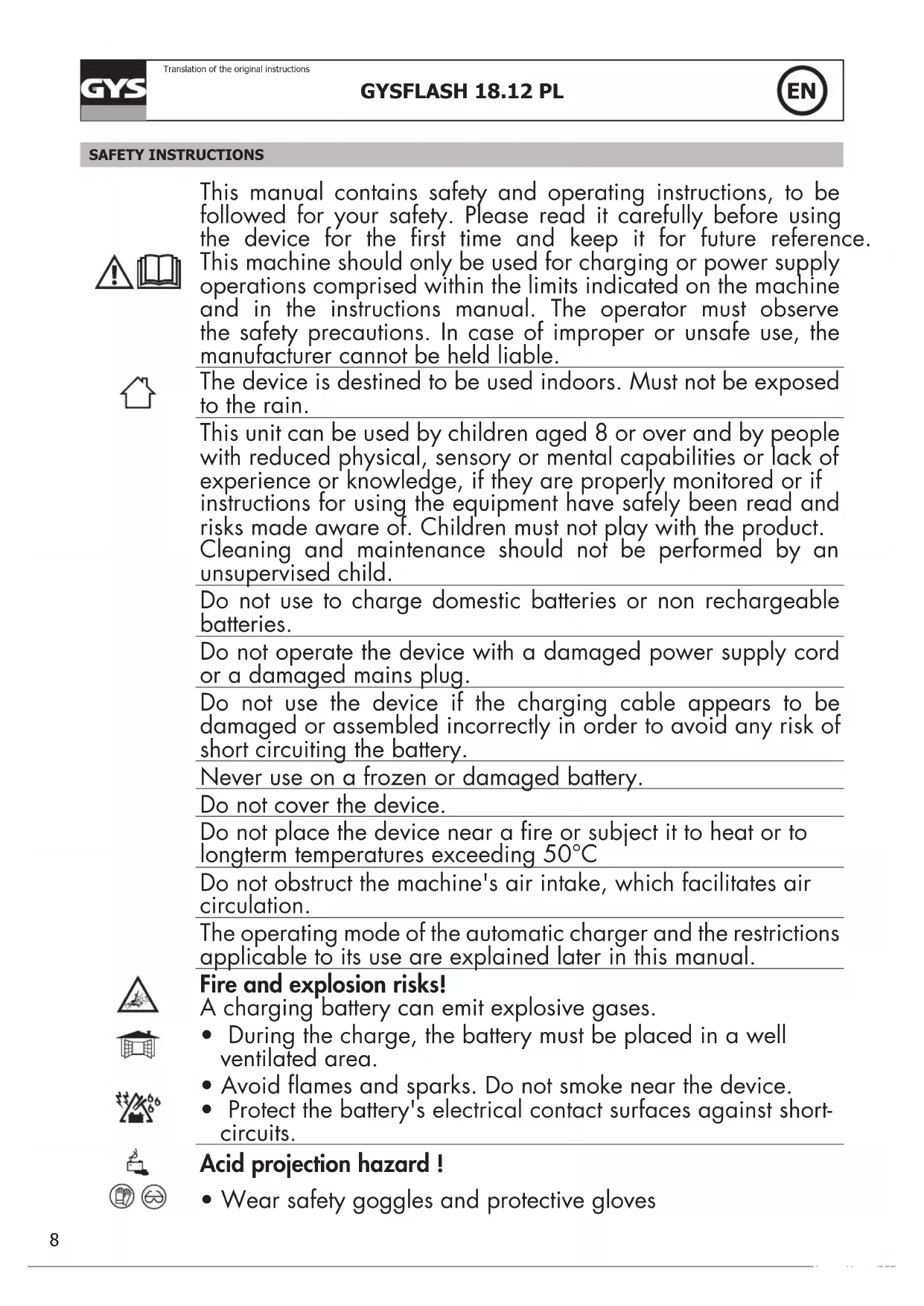


| Product type | Battery charger |
| Brand | GYS |
| Model | Gysflash 18.12 PL |
| Power supply | 220-240 V AC, 50-60 Hz, single-phase |
| Charge current | 7 A / 12 A / 18 A selectable |
| Lead charge voltage | 14.6 V (absorption), 13.6 V (maintenance) |
| Lithium (LFP) charge voltage | 14.4 V (absorption/balancing), 13.8 V (maintenance) |
| Showroom mode voltage | 13.7 V, up to 18 A |
| Compatible battery types | Lead 12 V (Gel, AGM, liquid) from 15 to 270 Ah; Lithium LFP 12 V from 7 to 270 Ah |
| Lead charge cycle | 7 steps: analysis, recovery, charge, absorption, test, desulfation, maintenance |
| Lithium charge cycle | 8 steps: analysis, recovery, charge, absorption, test, top-up, balancing, maintenance |
| Protections | Reverse polarity, short circuit, spark-free, double insulation, temperature sensor |
| Temperature sensor | Integrated, adapts charging to ambient conditions |
| Cable calibration | Required after cable change, voltage drop compensation |
| Usage | Indoor only, do not expose to rain |
| Maintenance | Clean with a dry cloth, do not use solvents |
| Cable replacement | By the manufacturer, after-sales service or qualified person |
| Warranty | 2 years (parts and labor) |
| Standards | CE, EAC, UKCA, CMIM (Morocco) |
| Weight | Not specified in the manual |
| Dimensions | Not specified in the manual |
Frequently Asked Questions - Gysflash 18.12 PL GYS
User questions about Gysflash 18.12 PL GYS
0 question about this device. Answer the ones you know or ask your own.
Ask a new question about this device
Download the instructions for your Battery charger in PDF format for free! Find your manual Gysflash 18.12 PL - GYS and take your electronic device back in hand. On this page are published all the documents necessary for the use of your device. Gysflash 18.12 PL by GYS.
USER MANUAL Gysflash 18.12 PL GYS
FR 2-7 / 44-48
GYSFLASH 18.12 PL
EN 8-13 / 44-48
DE 14-19 / 44-48
ES 20-25 / 44-48
RU 26-31 / 44-48
NL 32-37 / 44-48
IT 38-43 / 44-48
INSTRUCTIONS DE SÉCURITÉ

Option Supply (13.7 V / 18A) :
Étape 1 : Analyse
ANOMALIES, CAUSES, REMÈDES
CONDITIONS DE GARANTIE
This manual contains safety and operating instructions, to be followed for your safety. Please read it carefully before using the device for the first time and keep it for future reference.
This machine should only be used for charging or power supply operations comprised within the limits indicated on the machine and in the instructions manual. The operator must observe the safety precautions. In case of improper or unsafe use, the manufacturer cannot be held liable.

The device is destined to be used indoors. Must not be exposed to the rain.
This unit can be used by children aged 8 or over and by people with reduced physical, sensory or mental capabilities or lack of experience or knowledge, if they are properly monitored or if instructions for using the equipment have safely been read and risks made aware of. Children must not play with the product.
Cleaning and maintenance should not be performed by an unsupervised child.
Do not use to charge domestic batteries or non rechargeable batteries.
Do not operate the device with a damaged power supply cord or a damaged mains plug.
Do not use the device if the charging cable appears to be damaged or assembled incorrectly in order to avoid any risk of short circuiting the battery.
Never use on a frozen or damaged battery.
Do not cover the device.
Do not place the device near a fire or subject it to heat or to longterm temperatures exceeding 50° C
Do not obstruct the machine's air intake, which facilitates air circulation.
The operating mode of the automatic charger and the restrictions applicable to its use are explained later in this manual.

Fire and explosion risks!
A charging battery can emit explosive gases.
- During the charge, the battery must be placed in a well ventilated area.
- Avoid flames and sparks. Do not smoke near the device.
- Protect the battery's electrical contact surfaces against short-circuits.



Acid projection hazard!
- Wear safety goggles and protective gloves

- If your eyes or skin come into contact with battery acid, rinse the affected part of the body with plenty of water and seek immediate medical assistance
Connection / disconnection :
- Ensure that the charger's power supply is disconnected before connecting or disconnecting to the battery terminals.
- Always ensure the Red clamp is connected to the ""+" battery terminal first. If it is necessary to connect the black clamp to the vehicle chassis, make sure it is a safe distance from the battery and the fuel/exhaust pipe. The charger must be connected to the mains.
- After charging, disconnect the charger from the mains, then disconnect the negative clamp from the car body and then disconnect the positive clamp from the battery, in this order.

Connection :
- Class I device
- This device must be connected to an earthed power supply
- The connection to the power supply must be carried out in compliance with national standards.

Maintenance :
- If the power cable is damaged, it must be replaced by the manufacturer, its after sales or by an equally qualified person to prevent any accidents.
• Service should be performed by a qualified person - Warning! Always remove the power plug from the wall socket before carrying out any work on the device.
- Under no circumstances should solvents or other aggressive cleaning agents be used.
- Clean the device's surfaces with a soft, dry cloth.

Regulations :
• The Machine is compliant with European directives.
- The declaration of conformity is available on our website.
• EAEC Conformity marking (Eurasian Economic Community).
- Equipment in compliance with British requirements. The British Declaration of Conformity is available on our website (see home page).
• Equipment in conformity with Moroccan standards.
- The declaration C° (CMIM) of conformity is available on our website (see cover page).

Waste management:
- This product should be disposed of at an appropriate recycling facility. Do not throw away in a household bin.


GENERAL DESCRIPTION
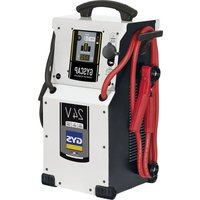
The GYSFLASH 18.12 PL is designed to charge lead-acid batteries (Gel, AGM, Liquid, ...) and lithium of the Lithium Iron Phosphate (LFP / LiFePO4).
This charger is suited for the charge of:
- Lead-acid batteries 12 V (6 elements in series) from 15 Ah to 270 Ah.
- LFP batteries 12V (4 elements in series) from 7 Ah to 270 Ah

The Gysflash 18.12 PL is equipped with a function that :
- when charging a lead-acid battery, adjusts the output voltage automatically according to the ambi-ent air temperature. This adjustment allows for a very accurate lead-acid battery charge adapted to the temperature.
- When charging a lithium battery, the charge is prevented if the ambient temperature is below 3° C.
In both cases, the adjustment can take between 1 and 10 minutes before the charge starts or stops.
CALIBRATION CABLE
Procedure for the calibration of the charging leads in order for the charger to compensate any voltage drop due to the length or condition of the cables. It is strongly recommended to perform this procedure each time the cables are modified or changed.
-
Before undertaking the procedure, make sure that the charger is disconnected from the mains socket.
-
Short-circuit the ends of the charging leads.
-
Press buttons and simultaneously.
-
Plug in the mains plug while holding down the two buttons until the indicator light OK or ⚠ lights up. Résults :
- Indicator is on: the calibration was successful.
- Indicator is on: the calibration failed, disconnect the mains plug and restart the procedure.
- Unplug the mains plug until the charger switches off.
START UP
-
Connect the charger to the battery.
-
Plug the charger to the mains (single phase 220-240Vac 50-60Hz).
-
Select the mode by pressing button MODE ▶, and the charging current by pressing button BATTERY SELECTION ▶. After roughly five seconds, the charge starts automatically. By default, the charger starts on the last mode used, except when in Supply mode.
-
During the charge, the device indicates the charge progress. When indicator OK blinks, the battery is ready to start the vehicle. Once indicator stays on, the battery is fully charged.
-
The charge can be interrupted at any time by unplugging the mains plug or pressing the button.
-
After the charge, disconnect the charger from the mains, then disconnect the charger's connections from the battery.
CHARGE MODES
- Description of charging modes and currents :
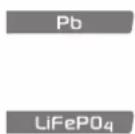
Lead-acid CHARGE mode (14.6 V/18 A max) :
Mode designed for the recharge of 12V lead-acid batteries from 15 Ah to 270 Ah. Automatic seven step charge cycle.
Lithium CHARGE mode (14.4 V/18 A max) :
Mode designed for the recharge of 12 V lithium batteries from 7 Ah to 270 Ah. Automatic eight step charge cycle.

Some Lithium batteries incorporate a UVP protection (Under Voltage Protection) which disconnect the battery in case of deep discharge. This protection prevents the charger from detecting the battery. In order for the Gysflash 18.12 PL to be able to charge the battery, it is necessary to deactivate the UVP protection. To do this, select the Lithium charging mode and press the button for 10 seconds. The charger will then deactivate the UVP protection and automatically start charging.
Charging current 7 / 12 / 18A :
● 7 ● 12 ● 18 A Selection designed to choose the most suited charging current based on the type and size of the battery (lead-acid or lithium).
| Charging current 7 A 12 A | 18 A | |||
| Battery capacity | Pb 15 | 50 Ah 50 80 Ah 80 270 Ah | ||
| LFP 7 | 12 Ah 12 20 Ah 20 270 Ah(21 66Ah EqPb*) (36 90 Ah EqPb*) | (60 840 Ah EqPb*) | ||
*Lead battery corresponding : A lithium battery has a better starting performance (CCA) than a lead battery. That's why some lithium battery manufacturers indicate the battery lead equivalent (EqPb) which corresponds to the capacity of a lead-acid battery with the same starting performance. For instance, a LFP battery of 10 Ah will have the same starting performance as a lead-acid battery of about 30 Ah.

Mode SHOWROOM (13.7 V / 18A) :
Mode designed to compensate up to 18A the current consumed on the battery of a vehicle in demonstration by delivering a stabilised voltage of 13.7 V. This mode is suited for lead-acid and lithium batteries.
Option Supply (13.7 V / 18A) :
Feature designed to turn the charger into a stabilised power source with a regulated voltage of 13.7 V and a supply of current up to 18A. This mode can be used without a battery.
To select this option, place the charger in Showroom mode and press the button until the indicator flashes.
When the indicator OK is on, the voltage is correctly regulated. If indicator ▲ flashed, this means that the current absorbed by the battery is higher than the charger maximum current (18A) and that the battery might end up being discharged.
The current supplied by the charger is indicated using the LED indicators ● 7 ● 12 ● 18 A

- Lead-acid charging curve :
The GYSflash 18.12 PL features a 7 step charging curve designed to ensure optimal charging of lead-acid batteries.
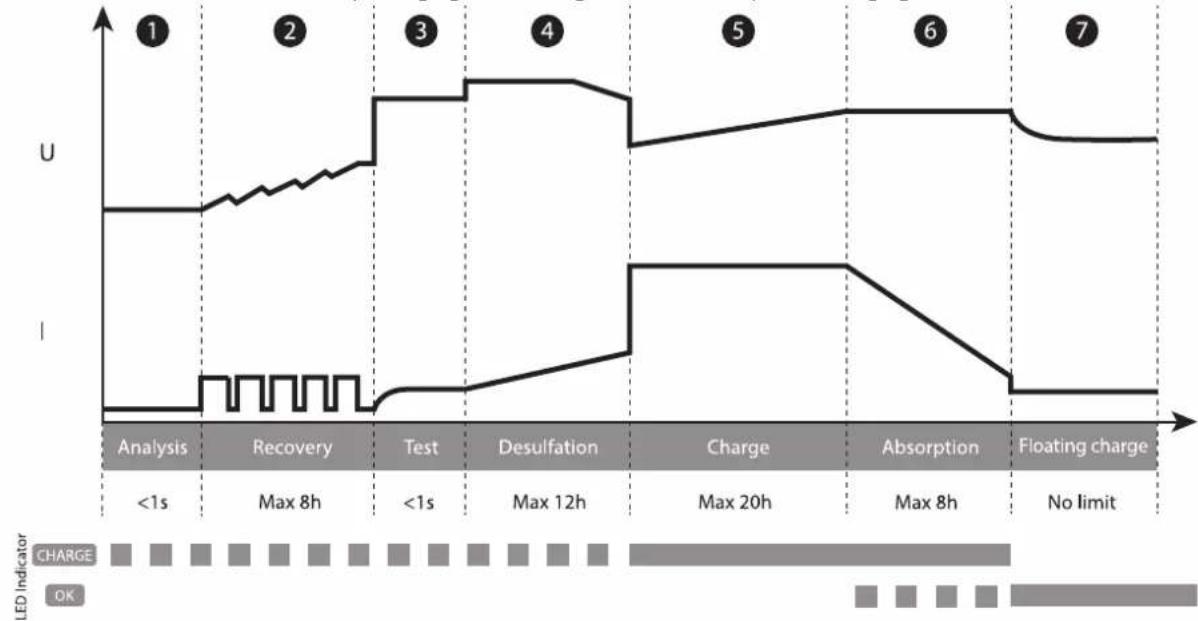
Step 1 : Analysis
Analyses the battery state (charge level, polarity inversion, wrong battery...)
Step 5 : Charge (● 7 - 7 A / ● 12 - 12 A / ● 18 A - 18 A)
Maximum current fast charge to reach 80% charge level.
Step 2 : Recovery (7 - 3 A / 12 - 4 A / 18 A - 6 A)
Recovering damaged elements due to a prolonged deep discharge.
Constant voltage charge to reach 100% charge level.
Step 3 : Test
Sulfated battery test
Step 7 : Floating charge (13.6 V)
Maintains battery charge level at its maximum.
Step 4 : Desulfation (15.8 V)
Battery desulfation algorithm.
• Lithium charging curve :
The GYSflash 18.12 PL uses a 8 steps charging curve which guarantees optimal performance for your LFP battery.
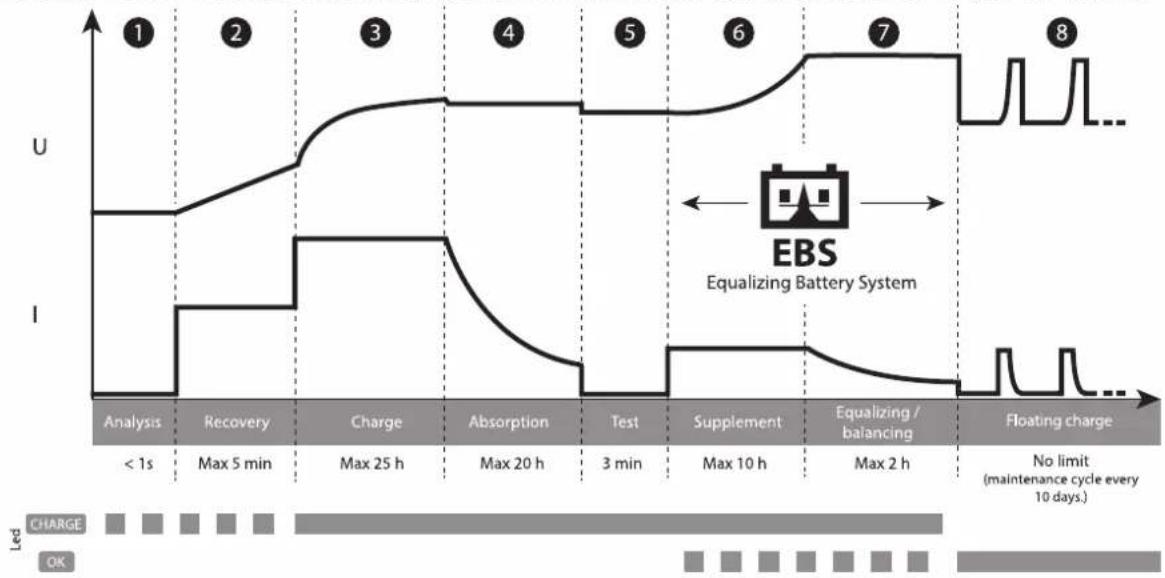
Step 1 : Analysis
Analyses the battery state (charge level, polarity inversion, wrong battery...)
Step 5 : Test
Charge conservation test.
Step 2: Recovery (7 - 1 A / 12 - 1.6 A / 18 A - 1.8 A)
Recovering damaged elements due to a prolonged deep discharge.
Step 6 : Supplement
Reduce current charge to reach 100% charge level.
Step 3 : Charge (● 7 - 7A / ● 12 - 12A / ● 18A - 18A)
Maximum current fast charge to reach 90% charge level.
Step 7 : Equalizing / balancing (14.4 V)
Balancing of battery cells.
Step 4 : Absorption (13.8 V)
Constant voltage charge to reach 98% charge level.
Step 8 : Floating charge (13.8 V)
Maintains battery charge level at its maximum and goes through charge maintenance cycle every 10 days.
• Estimated charge time :
| Charging current | Lead-acid Lithium | Ah | |||||||||||||
| 7 | 12 | 18 A | 7 | 12 | 18 A | ||||||||||
| Battery capacity 15 Ah | 50 Ah | 50 Ah | 80 Ah | 80 Ah | 130 Ah | 270 Ah | 7 Ah | 12 Ah | 12 Ah | 20 Ah | 130 Ah | 270 Ah | |||
| Charge timing0% >>> 90% | 2 h | 7 h | 4 h | 6 h | 4 h | 7 h | 14 h | 1h | 2h | 1h | 2h | 1h | 7h | 14h | |
- Protections :

The GYSFLASH 18.12 PL has comprehensive safety features to protect it against short-circuits and polarity reversals. It has an anti-spark feature which prevents sparks whilst connecting the device to the battery. This charger has double insulation and is safe to use with the battery in situ as it will protect the vehicle's on-board electronics.
The GYSFLASH 18.12 PL is fitted with an integrated temperature sensor that ensures that the charging current is adapted to the ambient temperature to prevent internal the electronics from overheating.
TROUBLESHOOTING
| Troubleshooting Causes Solutions | |||
| 1 | The indicator  | Polarity reversalBattery voltage is too highClamps in short-circuit | Check that the clamps are connected correctlyCheck that battery is 12 V |
| 2 | The indicator  | Charge failure, battery cannot be recoveredAmbient temperature is too low to charge a LFP battery | Change the battery and press to restart a charge.Charge the battery at milder temperature or press the button. |
| 3 | Indicator sta :ven after pressingMODE :ven after pressingMODE  | Thermal protection | Ambient temperature is too high (>50°C), cool the room and let the charger cool down. |
| 4 | Indicator  | Charger in sleep mode | Press button or connect a battery to the charger to exit sleep mode. |
| 5 | Indicator  | Charge interrupted by pressingMODE | Press again to restart the charge. |
WARRANTY
The warranty covers faulty workmanship for 2 years from the date of purchase (parts and labour).
The warranty does not cover:
- Transit damage.
- Normal wear of parts (eg. : cables, clamps, etc..).
- Damages due to misuse (power supply error, dropping of equipment, disassembling).
- Environment related failures (pollution, rust, dust).
In case of failure, return the unit to your distributor together with:
- The proof of purchase (receipt etc ...)
- A description of the fault reported
1 Stufe: Analyse
1 Stufe: Analyse
Этап 1 : Анализ
Stap 1 : Analyse
FR EN DE ES RU IT NL
| 1 | Veille Sleep mode Standby-Modus En espera Режим ожидания Standby Stand by | ||||||
| 2 | Charge en cours | Charge in pro-gress | Ladevorgang | En proceso de carga | Идет зарядка Carica in corso | Bezig met opla-den | |
| 3 | Charge teminée Charge complete | Abgeschlossener Ladevorgang | Carga terminada | Зарядка закончена | Carica terminata | Opladen bee-digd | |
| 4 | Défaut | Fault | Defekt | Fallo | Ошибка | Predefinito | Storing |
| 5 | Sélection des modes | Mode selection | Auswahl der Modi | Selección de modos | Выбор режимов | Selezione dei modi | Keuze modules |
| 6 | Sélection des courants de charge | Charging currents selection | Auswahl der Ladespannungen | Selección de cor-rientes de carga | Выбор токов зарядки | Selezione delle correnti di carica | Keuze laadstroom |
| 7 | Mode Showroom Option supply | Mode Showroom Option supply | Showroom-Modus Supply Option | Modo Showroom Opción Supply | Режим Showroom Опция Supply | Modo Showroom Opzione supply | Showroom module Supply Optie |
| 8 | Mode charge Plomb | Mode charge Lead-acid | Lademodus Blei-Säure | Modo Carga Plomo | Режим зарядки Свинец | Modo carica Piombo | Laadmodule Lood |
| 9 | Mode charge Lithium | Mode charge Lithium | Lademodus Lithium | Modo Carga Litio | Режим зарядки Литий | Modo carica Litio | Laadmodule Lithium |
| 10 | Courants de charge | Charging currents | Ladespannungen | Corrientes de carga | Токи зарядки | Correnti di carica Laadstroom | |
| 11 | Prise secteur | Mains plug | Netzsteckdose | Clavija de corriente | Сетевая вилка | Spina | Stopcontact |
| 12 | Pinces de charge | Charge clamps | Polklemmen | Pinzas de carga | Зажимы зарядки | Morsetti di carica | Laad-klemmen |

GYS SAS

- INSTRUCTIONS DE SÉCURITÉ
- OPTION SUPPLY (13.7 V / 18A)
- ÉTAPE 1 : ANALYSE
- CONDITIONS DE GARANTIE
- FIRE AND EXPLOSION RISKS
- ACID PROJECTION HAZARD
- CONNECTION / DISCONNECTION
- CONNECTION
- MAINTENANCE
- REGULATIONS
- WASTE MANAGEMENT
- GENERAL DESCRIPTION
- CALIBRATION CABLE
- START UP
- CHARGE MODES
- MODE SHOWROOM (13.7 V / 18A)
- LEAD-ACID CHARGING CURVE
- STEP 1 : ANALYSIS
- STEP 2 : RECOVERY (7 - 3 A / 12 - 4 A / 18 A - 6 A)
- STEP 3 : TEST
- STEP 7 : FLOATING CHARGE (13.6 V)
- STEP 4 : DESULFATION (15.8 V)
- LITHIUM CHARGING CURVE
- STEP 5 : TEST
- STEP 2: RECOVERY (7 - 1 A / 12 - 1.6 A / 18 A - 1.8 A)
- STEP 6 : SUPPLEMENT
- STEP 3 : CHARGE (● 7 - 7A / ● 12 - 12A / ● 18A - 18A)
- STEP 7 : EQUALIZING / BALANCING (14.4 V)
- STEP 4 : ABSORPTION (13.8 V)
- STEP 8 : FLOATING CHARGE (13.8 V)
- PROTECTIONS
- WARRANTY
- 1 STUFE: ANALYSE
- ЭТАП 1 : АНАЛИЗ
- STAP 1 : ANALYSE
- GYS SAS
Brand : GYS
Model : Gysflash 18.12 PL
Category : Battery charger