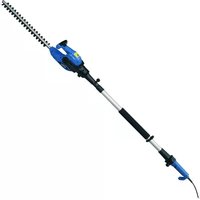
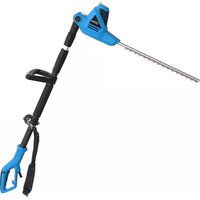
GTHS 565 - Hedge Trimmers Güde - Free user manual and instructions
Find the device manual for free GTHS 565 Güde in PDF.


| Brand | Güde |
| Model | GTHS 565 |
| Product type | Corded electric hedge trimmer |
| Supply voltage | 230 V / 50 Hz |
| Motor power | 550 W (P1) |
| Cutting length | 460 mm |
| Cutting bar length | 565 mm |
| No-load cutting speed | 1600 min⁻¹ |
| Sound pressure level (LpA) | 82 dB(A) |
| Guaranteed sound power level (LWA) | 96 dB(A) |
| Protection degree | IP20 |
| Protection class | II |
| Consumer warranty | 24 months |
| Professional use warranty | 12 months |
| Integrated safety features | Safety switch, front hand guard, blade sheath |
| Routine maintenance | Clean the body regularly, lightly oil the cutting bar, visually inspect the cable before each use |
| Repairs | Only entrust to an approved workshop, use original spare parts |
| Included accessories | Blade sheath |
Frequently Asked Questions - GTHS 565 Güde
User questions about GTHS 565 Güde
0 question about this device. Answer the ones you know or ask your own.
Ask a new question about this device
Download the instructions for your Hedge Trimmers in PDF format for free! Find your manual GTHS 565 - Güde and take your electronic device back in hand. On this page are published all the documents necessary for the use of your device. GTHS 565 by Güde.
USER MANUAL GTHS 565 Güde
ENGLISH Please read the instructions carefully before starting the machine.
GB Cleaning / Maintenance
HR Cişcenje / Održavanje
F Nettoyage/Entretien
BG YnCTeHe /IopdpbXka
knife movement 1600 min
knife Spacing. 16 mm
Cutting length. 460 mm
Beam length 565 mm
Weight 4,5 kg
Degree of protection IP 20
Protection class..
Noise and Vibration Information
Sound pressure level LPA^1) . 82 dB (A)
Measured sound power level LWA^1) 93 dB (A)
Guaranteed sound power level L_WA .96 dB (A)
Wear ear protectors!
Warning: The vibration emission level will vary because of the ways in which a power tool can be used and may increase above the level given in this information sheet. The vibration emission level may be used to compare one tool with another.
It may be used for a preliminary assessment of exposure.
An accurate estimate of the vibratory load should also take into account the times when the tool is shut down or when it is running but not actually in use. This may significantly reduce the vibratory load over the total working period.
Identify additional safety measures to protect the operator from the effects of vibration such as maintain the tool and the accessories, keep the hands warm, organisation of work patterns.


Read and understand the operating
instructions before using the appliance. Abide by all the safety measures stated in the service manual. Act responsibly toward third parties.
In case of any doubts about connection and operation refer please to our customer center
Power tool description
- Safety switch
- Front hands protection
-
Knife/cutter bar
-
Screw telescopic adjustment
- Knife/cutter bar protection
- cable strain relief
- Power supply cable
- ON/OFF switch
Specified Conditions Of Use
The hedge trimmer is designed for trimming shrubs and hedges in private hobby gardens
The device must not be used for crushing compost, as persons or damage to property konnen.The hedge trimmer is designed for trimming shrubs and hedges in private hobby gardens.
Do not use this product in any other way as stated for normal use. Not observing general regulations in force and instructions from this manual does not make the manufacturer liable for damages.
The charger may only be operated with a protective switch against stray current (RCD max. stray current 30mA ).
Requirements for operating staff
The operating staff must carefully read the Operating Instructions before using the appliance.
Qualification : Apart from the detailed instructions by a professional, no special qualification is necessary for appliance using.
Minimum age: Persons over 18 years of age can only work on the appliance. An exception includes youngsters trained in order to reach knowledge under supervision of the trainer during occupational education.
Training : Using the appliance only requires corresponding training by a professional or the Operating Instructions. No special training is necessary.
The operator is responsible for accidents or risks to third parties.
Observe to keep out of dangerous zone
Emergency procedure
Conduct a first-aid procedure adequate to the injury and summon qualified medical attendance as quickly as possible. Protect the injured person from further harm and calm them down. For the sake of eventual accident, in accordance with DIN 13164, a workplace has to be fitted with a first-aid kit. It is essential to replace any used material in the first-aid kit immediately after it has been used.
If you seek help, state the following pieces of information
- Accident site
- Accident type
- Number of injured persons
- Injury type(s)
Symbols

Caution!

Read the Operating Instructions!

Take the battery always out before any work on the appliance.

Cable pulling / transport prohibited

In case of cable damage or nock, immediately pull out plug from socket

Keep distance of persons
Observe to keep out of dangerous zone

Protect against moisture
Never expose tool to rain.

Wear eye protection!
Wear ear protectors!

Wear protective gloves!

Wear safety cut through resistant shoes with safety sole and steel toe!

Any damaged or disposed electric or electronic devices must be delivered to appropriate collection centres.

Protect against humidity

This side up
General Power Tool SafetyWarnings

Warning
Read all safety warnings and all instructions. Failure to follow the warnings and instructions may result in
electric shock, fire and/or serious injury.
Save all warnings and instructions for future reference.
The term "power tool" in the warnings refers to your mains-operated (cordepower tool or battery-operated (cordless) power tool.
1) Work area safety
a) Keep work area clean and well lit. Cluttered or dark areas invite accidents.
b) Do not operate power tools in explosive atmospheres, such as in the presence of flammable liquids, gases or dust. Power tools create sparks which may ignite the dust or fumes.
c) Keep children and bystanders away while operating a power tool. Distractions can cause you to lose control.
2) Electrical safety
a) Power tool plugs must match the outlet. Never modify the plug in any way. Do not use any adapter plugs with earthed (groundpower tools. Unmodified plugs and matching outlets will reduce risk of electric shock.
b) Avoid body contact with earthed or grounded surfaces, such as pipes, radiators, ranges and refrigerators. There is an increased risk of electric shock if your body is earthed or grounded.
c) Do not expose power tools to rain or wet conditions. Water entering a power tool will increase the risk of electric shock.
d) Do not abuse the cord. Never use the cord for carrying, pulling or unplugging the power tool. Keep cord away from heat, oil, sharp edges or moving parts. Damaged or entangled cords increase the risk of electric shock.
e) When operating a power tool outdoors, use an extension cord suitable for outdoor use. Use of a cord suitable for outdoor use reduces the risk of electric shock.
f) If operating a power tool in a damp location is unavoidable, use a residual current device (RCprotected supply. Use of an RCD reduces the risk of electric shock.
3) Personal safety
a) Stay alert, watch what you are doing and use common sense when operating a power tool. Do not use a power tool while you are tired or under the influence of drugs, alcohol or medication. A moment of inattention while operating power tools may result in serious personal injury.
b) Use personal protective equipment. Always wear eye protection. Protective equipment such as dust mask, non-skid safety shoes, hard hat, or hearing protection used for appropriate conditions will reduce personal injuries.
c) Prevent unintentional starting. Ensure the switch is in the off-position before connecting to power source and/or battery pack, picking up or carrying the tool. Carrying power tools with your finger on the switch or energising power tools that
have the switch on invites accidents.
d) Remove any adjusting key or wrench before turning the power tool on. A wrench or a key left attached to a rotating part of the power tool may result in personal injury.
e) Do not overreach. Keep proper footing and balance at all times. This enables better control of the power tool in unexpected situations.
f) Dress properly. Do not wear loose clothing or jewellery. Keep your hair, clothing and gloves away from moving parts. Loose clothes, jewellery or long hair can be caught in moving parts.
g) If devices are provided for the connection of dust extraction and collection facilities, ensure these are connected and properly used. Use of dust collection can reduce dust-related hazards.
4) Power tool use and care
a) Do not force the power tool. Use the correct power tool for your application. The correct power tool will do the job better and safer at the rate for which it was designed.
b) Do not use the power tool if the switch does not turn it on and off. Any power tool that cannot be controlled with the switch is dangerous and must be repaired.
c) Disconnect the plug from the power source and/ or the battery pack from the power tool before making any adjustments, changing accessories, or storing power tools. Such preventive safety measures reduce the risk of starting the power tool accidentally.
d) Store idle power tools out of the reach of children and do not allow persons unfamiliar with the power tool or these instructions to operate the power tool. Power tools are dangerous in the hands of untrained users.
e) Maintain power tools. Check for misalignment or binding of moving parts, breakage of parts and any other condition that may affect the power tool's operation. If damaged, have the power tool repaired before use. Many accidents are caused by poorly maintained power tools.
f) Keep cutting tools sharp and clean. Properly maintained cutting tools with sharp cutting edges are less likely to bind and are easier to control.
g) Use the power tool, accessories and tool bits etc. in accordance with these instructions, taking into account the working conditions and the work to be performed. Use of the power tool for operations different from those intended could result in a hazardous situation.
5) Service
a) Have your power tool serviced by a qualified repair person using only identical replacement parts. This will ensure that the safety of the power tool is maintained.
Additional safety instructions Hedge trimmer
- Keep parts of your body off the cutting blade. Do not remove jammed material while the blades are moving.
- When removing jammed material, make sure the appliance is off.
- Attach the knife protection for transport or storage. Before you start with the work, search the thicket for hidden objects such as wire fences, etc.
- Do not let children, other persons or pets near the cutting scissors.
- Do not use the cutting scissors if the cutting tool is not fitted properly or when it is damaged.
Before adjusting the cutting scissors, make sure the knives or blades do not touch stones or debris. - Do not cut any hard objects. This could lead to accidents and damage the cutting scissors.
- Avoid abnormal posture and do not work above shoulder height.
- Respect the system voltage!
- Do not attempt to remove shavings when the knives are moving. When removing any jammed material, make sure the cutting scissors are off and stopped. When lifting or holding the cutting scissors, do not hold the cutting knives.
CAUTION: Knives are still running for a short time after being switched off.
Putting into operation for your safety
Before carrying out any work on the machine, disconnect the plug from the socket.
Before carrying out any work on the machine, disconnect the plug from the socket.
Before using the appliance, perform a visual inspection at all times to make sure the power cord and the plug, in particular, are not damaged on the charger.
The machine must not be used under any circumstances if the machine or the safety devices are damaged.
If the device is defective, the repair has to be made exclusively by the customer service. Use only original accessories and original spare parts.
Only a regularly maintained and treated appliance can serve as a satisfactory aid. Insufficient maintenance and care can lead to unforeseen accidents and injuries.
Guarantee
Warranty period of 12 months applies to commercial use and 24 months applies to private use and commences on the day of purchase of the device.
The guarantee solely covers inadequacies caused by material defect or manufacturing defect. Original payment voucher with the sales date needs to be submitted for any claim in the guarantee period.
The guarantee does not cover any unauthorised use such as appliance overloading, use of violence, damage as a result of any unauthorised interference or caused by foreign items. Failing to follow the operating and assembly instructions and common wear are
Service
Do you have any technical questions? Any claim? Do you need any spare parts or operating instructions? We will quickly help you and without needles bureaucracy at our web pages at www.guide.com in the Servicing part. Please help us be able to help you. In order to identify your device in case of claim we need the serial No., product No. and year of production. All this data can be found on the type label. Please enter it here for future reference
Serial No.:
Art.No:
Important information for the customer
Please be sure to know that returning the product in or after the warranty period must be made in the original packaging.
Disposal
Note to the disposal arising from icons placed on
the appliance or on the package. Description of the meanings can be found in section "Marking".

Do not dispose of electrical appliances in the household waste.
According to European Directive 2002/96/EC on waste electrical and electronic equipment and transposition to the national law, worn electrical equipment must be collected separately and put to recycling.
Recycling alternative to the return requirement: As an alternative to recycling, the owner of the electrical equipment is obliged to provide assistance in professional recycling. For this purpose, an old appliance can be put to a collection centre that will dispose of it in accordance with the national circulation management and the Waste Act.
This does not apply to accessories connected to old appliances and auxiliary equipment without electrical components.
Transport packaging disposal
The packaging protects the appliance against damage during transport. Packaging materials are usually chosen according to environmental-friendliness and waste treatment aspects and can therefore be recycled. Returning the packaging to material circulation saves raw materials and reduces waste. Parts of packaging (e.g. foils, styrofoam) can be dangerous to children. Risk of suffocation! Keep the packaging out of reach of children and dispose them as quickly as possible.
Inspection and maintenance plan
| Generally Whole appliance | Plastic body Knife/cutter bar | Regularly clean the outer part Let regularly checked by authorized workshop Check for cracks and fissures Let regularly sharpen |
| Before any start-up ON/OFF switch Power supply cable | Functional test Functional test | |
| After every take out of service | Knife/cutter bar protection Use Knife/cutter bar protection | |
| storage Whole appliance To be cleaned and the knife bar slightly lubricated. | ||
| To be safely stored in a cold room. Have it checked in a specialised workshop. | ||
Failures - Causes - Removal
| Failures Causes Removal | ||
| Cutting scissors not working. | Broken cable | Consult with the customer service centre |
| Appliance is defective | Consult with the customer service centre | |
| Internal cables are defective | Consult with the customer service centre | |
| Unsteady running, strong vibrations | Appliance is defective Consult with the customer service centre | |
\section*{Caracteristiques Techniques}
Taille-haies GTHS 565
couteau Distance. 16 mm
Vibration emission value, front handle a 2) 3,0 m/s
Vibration emission value, rear handle a 2) 3,0 m/s
1) Incertitude K = 3 dB (A),2) Incertitude K = 1,5m / s^2
Risk of injury if the On/Off button is pressed unintentionally.
Entretien
HnBO Ha 3BykoMaOuHocL PA1
2 dB (A)
34
13MpeHNOHa 3ByKOBA MOIOHOCT Lw193 dB (A)
TapaHTnpaHO HnBO Ha 3ByKOb MoUHOC L.96 dB (A)
Da ce hocn npedna3Ho cpectbo 3a cnlyxa!
Vrijednost emisija vibracija, prednji rukohvat a2].....3.0 m/s2
Vrijednost emisija vibracija, stražnji rukohvat a.2) ....3,0 m/s
1) Hecunypnoct K= 3 dB (A), 2) Hecunypnoct K= 1,5 m/s
BHMMaHHe: HbBOTo Ha uyma uce ce npomeHn B
3aBNCIMMOCT OT IN3NON3BaHETo Ha eJekTPOINHCTpyMeHTa N B HAKON CNYauM MoKe Da HaDbNtAbaN OCOueHaTa B Te3N YKa3AHIA CTOnHOCT.
HNBOTO Ha Bn6paunTe MoKe Ja ce n3noI3Ba 3a B3aMHO CpaBHeHne Ha eNEKtpuuecknTe ypeN.
Iopxodn e n 3a BpeMeHHa OueHka Ha Bn6paHNOHHTO HATOBapBaHe.
3apaNToHOTO OTRaBaHe Ha HATOBaPaHETo OT Bn6paunB TeueHne Ha ONpeJeHo pa60THO Bpeme 6n Tpr6BaJIO Da Ce B3eMaT B npeBnD CbIcO BpemeHaTa, B KOnTO yPeJa e N3KJIuOe HnIpa6OTn, HO B DeINCTBnTeHNOCT He e IN3NoJ3BaH. ToBa MoKe 3HaUNTeJIHO Da HAmaII No6ema Ha HATOBaPbAHe OT Bn6paunB TeueHne Ha cJIoTO pa60THO Bpeme.
OnpedeeneTe DOnbHnTeJIHm MepKn 3a 6e3OnacHOCT 3a npedna3BaHe Ha o6CnyKbaHTo Ipei Bb3JeICTBnTa Ha Bn6paun KaTo HApnPImep TexHnuecka NOpDpBxKaHa eJNktpuuecknte INHCTpyMeHTn Uypei, NOpDlbpxKeHa Ha TemnepaTypaHa pBuTe, opraHn3aJHa pa60THne npouecn.


I3no3BaIte IomIa eEBA cIeI
KaTO BHNMaTeJIHO CTe npOeyIu pa36paJIINyTbTaHeto 3a 06CnJyKBaHe. CnA3BaIte BCnUKNHCTpyKcUN 3a 6e3ONaCHOCT NOCOeHN B yTbTaHeto.ДрЖTe ce OTROBOPHO CnpRAMO TpeTN Iua.AKO IMATE CBMHeHr OTHOCHO CBbp3BaHeto U
06CnykBaHTo Ha ypea, 06bPHeTe ce KblneHTCKn cepBn3.
Onncnne Ha ypea
1.Ппедиаенкноч
2.предна зашита на рьцete
3. Hoxkova/kocsa jeTba
4. BnHT TeJIeCKOINuHa KopeKUIna
5.3aunHaHOXOBaT/KoCsaTaJeTbA
6. Ka6eHa 3aXBaT
7. 3axpaHbau Ka6eI
8. BkIIOuBaTeI ON/OFF
I3noJ3BaHe B CbOTBeTCTBnE C npedHa3NaueHneTo
The nIeTe npEHa3NaHeHa 3a nI3p3BaHe xpaCTn I KINBII pIeTOBe B uactHn rpaDInHxO6n.
YcTpoIcTBOTHe Tp8BaJa Ce n3NoJ3BaT 3a pa3dpo6BaHe Ha KOMnOCT, KaTo IInuca NIn yBpeKdaHe Ha ImyUeCTBO xeJx konnen.The TpImep e npedHa3HaueHa 3a n3Pra3BaHe XpaCTN IN KINBn PJIeTOBe B UaCTHn rpaDInHxO6n.
To3n ypeD moKe da ce n3non3Ba no npedeHa3HaueHne camo kaKTo e nocOyeHo. Ppi Hecna3BaHe Ha pa3npope6nte ot 6oo BaIuINHte npedeNcHnru pa3npope6n ot TOBA ynbTBAhe npoun3BODHTeJe He MOKe Da ce BHN 3a Bb3HKnHaN uETn
Pa6oTaHa 3apAINDHO yCTPOIcTBOe 3peSeHa cAmO c npEpa3En n3KnIOuBaTeN euy norpeSeH ToK (RCD mAcC. rpeSeH ToK mA).
Ako ce cTnHe Do yBpeKdaHe nnn npepa3BaHe Ha Ka6ena, BeHara n3BaTe uencela O TcncelHaTa Kytn.

IinctaHnna nped xopa
06bphete BHMmaHne 3a TOBa B ONaCHATA
06nact da He ce 3aDbpjka HNKo!

PnepBna He n3naTe MaunHaTa Ha bXd.

HocTe 3aunTa 3a ouHTe! Da ce Hocn npedna3Ho cpeCTBO 3a cnlyxa!

HocTe npedna3n npkabuicn!

Hocete 6e3oNaChn 06yBKn CbC 3aunTa npOTNB npep3BaHe, rpy6a NODMeTka n CTOMaHEN Bpbx!

He n3xBbPnIte eIeKTpnuEcknTe yctpoiCTBa
Upe3 6uTOBn OTnaIbuc.
Cnopee ebponeckKaTa DnapeKtNa 2002/96/ES 3a eeneKtpnueckTe n eeneKTpoHHnTe cTapu ypeuN
BbBExJaHTo B HaUHOHaHOTo 3aKOHoTaTeCTBO
n3HOceHnTe eNeKtpnueckn ypeu Tp6Ba da ce
cb6npaT OTdEHN O da ce npedaat 3a ekOJOrnHo
peuKnipaHe.
AnTePHaTnBa Ha peuKInpaHe Ha n3nCKBaHTo 3a BpbuaHe:
B cnyaHa OTKa3 OT dBNXkMa Beu C
HamepeHne OTKa3BaHe O T npaBO Ha CO6CTBeHOCT
co6CTBeHnKa Ha eNeKtpnueckn ypeE nnbKeH,
aJItePHaTnBHO BMeCTo BpBuaHe, Da DonpInHece
3a IpOoFeCNoHaJIHTo peUKNIpaHe. 3a TOBa e
Bb3MOxHn Da OCTaBn CTapNyD nYHKT 3a cb6nP
ToBa He ce OTHacr IIO npHaIeKHOCTn, CBbp3aHn KbM CTapuTe YcTPOJcTBa N cONMaTaTeHNO 6OpydBaHe 6e3 eNEkTpueeCKN KOMNoHEHTn.
Лик biodуан Ha TpaHcnpTHaTa onaKOBka
Onakobkata npedna3Ba ypea ot nobpea no Bpeme Ha TpaHcnpTupahe. Onakobbunte MaTePnAIn 06nKHOBeHO Ce n36npat B CbOTBETCBE C ekOJIoruHn acneKTn u acneKTn Ha ynpaBHeHnTo Ha OTnabTuTE, mMorat Da ce peuKnpuT. 3aBpbUaHETo Ha onakOBbHnMaTePnAIn B 06
CbueCTbByBa pnck OT 3aDywaBae! CbXpaHraBaTe chaTn OT ONaKOBKaTa Ha HeNoctbPiHO 3a Deca MrcTo, N IINKBuDnpaTc KOlkOTO ce MoKe Hau-6bp30.
Pnah Ha nperei n nodpbxxka
CTOHOCT Ha eMNCnTa Ha Bn6paunTe, npedHa pbKoXBaTka a2 3,0 m/s²
CTOINHOCT Ha emncnTa Ha Bn6paunite, 3aHa pkoXBaTka a213,0m/s
1) NesigurantK = 3 dB (A),2) NesigurantK = 1,5 m/s²
Translation of the EC-Declaration of Conformity
We, hereby declare the conception and construction of the below mentioned appliances correspond - at the type of construction being launched - to appropriate basic safety and hygienic requirements of EC Directives.
In case of any change to the appliance not discussed with us the Declaration expires.
Notified Body Name: Adress:No:
Type Ex. Cert.-No.:
□97/68/EC
Emission No.:
2000/14/EC_2005/88/EC

- Noise and Vibration Information
- Wear ear protectors!
- Power tool description
- Specified Conditions Of Use
- Requirements for operating staff
- Emergency procedure
- Symbols
- General Power Tool SafetyWarnings
- Save all warnings and instructions for future reference.
- 1) Work area safety
- 2) Electrical safety
- 3) Personal safety
- 4) Power tool use and care
- 5) Service
- Additional safety instructions Hedge trimmer
- Putting into operation for your safety
- Guarantee
- Service
- Important information for the customer
- Disposal
- Transport packaging disposal
- Inspection and maintenance plan
- Failures - Causes - Removal
- \section*{Caracteristiques Techniques}
- Entretien
- Da ce hocn npedna3Ho cpectbo 3a cnlyxa!
- Onncnne Ha ypea
- I3noJ3BaHe B CbOTBeTCTBnE C npedHa3NaueHneTo
- Лик biodуан Ha TpaHcnpTHaTa onaKOBka
- Pnah Ha nperei n nodpbxxka
- Translation of the EC-Declaration of Conformity
Brand : Güde
Model : GTHS 565
Category : Hedge Trimmers