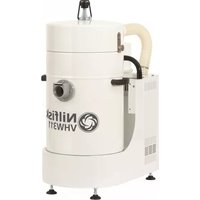
VHW311 - Industrial vacuum cleaner NILFISK - Free user manual and instructions
Find the device manual for free VHW311 NILFISK in PDF.


User questions about VHW311 NILFISK
0 question about this device. Answer the ones you know or ask your own.
Ask a new question about this device
Download the instructions for your Industrial vacuum cleaner in PDF format for free! Find your manual VHW311 - NILFISK and take your electronic device back in hand. On this page are published all the documents necessary for the use of your device. VHW311 by NILFISK.
USER MANUAL VHW311 NILFISK
CATEX IT-GB-FR-DE-ES EDITION 06/2022


IT Italian
GB English
FR French
DE Deutsch
ES Spanish
II2GD c IIBT4, T5, T6 T100°C T60°C
Translation of the original instructions
ATEX and IECEx certification
Vacuum Cleaners-Centralized Vacuum Systems-Dust Extraction Plants Manual
Operator's Additional Instructions - Use and Maintenance Manual Supplement
Key:
| Zone Atex category | Category IEC Ex | Nilfisk machine type | Vacuum unit Additional instructions | ||
| All --- A - G - I - L | |||||
| Z21 Combustible dust | II 2D | VHC compressed air - 3xP | Compressed air supply B | ||
| Z1 Flammable gases | II 2G | ||||
| Z1/21 Combustible dust and Flammable gases | II 2GD | ||||
| Z22 Combustible dust | II 3D | With side blower: TxxPLUS - T75 - Rxxx - 35xx - 37xx - 39xx - CTS - VHW series | With side blower (dust only) | C | |
| Z2 Flammable gases | II 3G | Side blower (gas and dust) | |||
| Z21 Combustible dust | II 2D | With side blower: TxxPLUS - 37xx - 39xx - CTS - VHW series | With side blower (dust only) | D | |
| Z1/21 Combustible dust and Flammable gases | II 2GD CTT Series | Motor + turbine belt drive | E | ||
| Z22 Combustible dust | II3D | Centralized Vacuum Systems and Dust Extraction Plants | With side blower, vane pump (dust only) | F | |
| Z1/21 Combustible dust and Flammable gases | - EPL Db | Gb CTT Series | Motor + turbine belt drive | H | |
The above listed models are not suitable to collect aircraft fuel (Jet Fuel) except for the VHC200 Z1 - CTT40 Z1 - VHC110 Z1 and VHC120 Z1 models.
Table of contents
A - The following prescriptions and precautions are valid for use of ATEX marked machines in areas with explosive atmosphere ....3
B - Additional prescriptions for ATEX machines with compressed air supply, Cat II2D - Cat II2G - Cat II 2GD, used in Zone 21, 1 and 1/21 ....5
C - Additional prescriptions for ATEX machines with side blowers Cat II3D - Cat II3GD used in Zone 22 or Zone 2....6
D - Additional prescriptions for ATEX machines with side blowers Cat II2D usable in Zone 21....7
E - Additional prescriptions for ATEX machines with motor belt drive Cat II2GD usable in Zones 1/21....8
F - Additional prescriptions for ATEX Cat II3D Dust Extraction Plants and Centralized Systems usable in Zone 22....9
G - Additional prescriptions for models equipped with immersion separator .....10
H - Additional prescriptions for IEC Ex machines ....12
I - Example of an identification plate marking....13
L - Maintenance and check registrations....14
A - The following prescriptions and precautions are valid for use of ATEX marked machines in areas with explosive atmosphere
These machines comply with the 2014/34/EU (ATEX) Directive except for model CTT40 Z1 IECEx.

This appliance is not suitable for direct connection to a dust generating machine.

Vacuuming combustible dust presents a risk of fire and explosion. May only be used by trained personnel.
The user must be informed about the dangers related to electric current and static electricity, and the risks deriving from the physical and chemical properties of the substances in the work area.
The user must be informed about the environmental characteristics of the area where the machine is installed and will be used.
In accordance with Directive 1999/92/EC, in the presence of combustible gases and/or flammable gases in the workplace, the Employee must classify the Area, and choose a machine in the appropriate Category (in accordance with the definitions of Directive 2014/34/EU).
The definitions of the areas where explosive atmospheres are likely to occur, are included in 99/92/EC Directive. An extract from those definitions is provided below.
Zone 2 / 22: “An area in which an explosive atmosphere is unlikely to occur in normal operation (...) and if it occurs it will exists only for a short time”
Zone 1 / 21: An area in which an explosive atmosphere is likely to occur in normal operation
A guide for identifying and classifying places where an explosive atmosphere is likely to occur can be found in Regulation EN 60079-10-1, for hazards related to flammable gases, vapours or mists, and in Regulation EN 60079-10-2, for dust-related hazards.
Prior to using:
Check that the data on the machine's identification plate correspond to the Zone classification and to the maximum allowable temperature to avoid dust ignition in the work area.
Check that the machine specifications have not been modified, otherwise the Declaration of Conformity will no longer be valid.
Machines not equipped with a protective cover for the vacuum unit are intended for use ONLY inside a housing that protects against the risk of the cooling fan blocking due to accidental falling objects. It is the user's responsibility to install the vacuum cleaner inside a housing that guarantees an adequate level of ventilation to the vacuum unit motor.
On models with this feature, ground the supplied additional yellow / green wire.
The machines that are not equipped with this feature, have antistatic wheels: check that these are used on conductive floors.
Static electricity can cause sparks, with the consequent risk of explosion! Therefore, make sure the electrical socket and plug (the ground cable supplied, on compressed air models) are correctly grounded.
Using an ohmmeter, check the electrical continuity:
- Between the inlet and end of the vacuuming accessories: the resistance detected must be less than 100M ( 10^8 )
- Between the container (if it is not installed, use the outlet for discharging the collected material) and the grounding pin (if the vacuum cleaner is equipped with a plug), or the grounding wire of the supply cable (or the grounding cable in case of compressed air models).
In this case the measured resistance must be: - less than 10 Ω if the components are made of stainless steel (the possible connection points of the electrodes are handles, inlets and wheel supports)
- Less than 10^6 Ω in case of plastic container, Safe Pack type, (the connection point of the electrodes is on the inlet)
Check the continuity of the ground and equipotential cables (green-yellow protective conductors) and make sure that they are in perfect conditions.
Check for loose electrical or mechanical connections.
The machine must be turned off before connecting it to an energy source. Connect the machine to an energy source outside the ATEX Zone (unclassified zone). If the machine has an ATEX electrical plug certified for the area it is used in, it can be connected to an ATEX certified socket in the same type of zone with the same rating, after the machine has been turned off.

On all machines supplied without an electrical plug, the user must connect the free end of the cable in a non-explosive atmosphere, in a housing or using a plug protected by a mode recognized as suitable for the area of destination.
The plug shall be installed by a qualified electrician only.
During operation:
Check that the data on the machine's identification plate correspond to the Zone classification and to the maximum allowable temperature to avoid dust ignition in the work area.
When replacing the filter, only install original Nilfisk antistatic filters.
Do not use insulating couplings or dust collection hoses.
Do not remove hoses during operation, always wait until the machine has stopped.
Do not use plastic bags for the container. Only Nilfisk original antistatic plastic bags are allowed.
If a pre-separator must be used, check that it is well grounded. Only use antistatic hoses, both for vacuuming and connecting the pre-separator. Do not use the machine to collect large objects or particles because their collision may cause sparks.
Do not rub or hit the floor with steel tools, as they can produce sparks under friction. Only use collectors and suction caps that can be replaced with original Nilfisk antistatic spare parts to clean the floor.
Check the vacuum indicator periodically. This indication is related to the filter clogging level, therefore to the flow speed in hoses. Too slow a speed can cause dangerous stagnation of material in the hose itself.
Bring the vacuum cleaner out of the ATEX classified area, then release the container and empty it, especially after vacuuming wet vegetable particles or fluids, to prevent the accumulation of fermentation gases.
To avoid changing the classification of the work area, the container must be emptied outside the zone (zone without ATEX classification). Bring the vacuum cleaner out of the ATEX classified area, then release the container and empty it. On centralized dust extraction plants, the user must observe procedures and use methods and accessories for emptying the bin that prevent any alteration of the classification in the Zone where the plant is installed. Only replace accessories supplied by the manufacturer with original spare parts.
In the case of non-observance of the above, the Declaration of Conformity is void.

CAUTION!

Any accumulation of dust on the machine could represent a potential source of ignition. Clean the surface of the machine regularly.
Specific maintenance and other precautions
Always perform the service operations and checks described in the standard instruction manual of the machine being used. Check regularly, and in particular while emptying the dust container, that the filters are in good condition (included the safety metallic filter, if equipped), so as to prevent breakage, wear, damages and/or tearing of the filter cloth, which may result in dust dispersion and exhaust emission. This may generate dangerous clouds. Check that the filter is intact before using the machine as follows: vacuum fine inert dust (e.g.: talc, chalk, scagliola...) and make sure it is not blown out of the outlet.
Periodically clean the motor cooling fan to prevent the motor from overheating.
Use antistatic suction hoses suitable for the type of material to vacuum. The hoses should not produce sparks or create electrostatic charges caused by the tube rubbing.
Only use original Nilfisk antistatic hoses and accessories.
The antistatic hoses must be grounded to prevent electrostatic charges. Using an ohmmeter, check for the correct galvanic connection (electrical continuity) between the hoses and the accessories being used. This is to prevent the operator being exposed to fire hazards and the risk of electric shocks.
All the machines that have the EXA acronym in the model description, are equipped with an inlet that allows for coupling only with Nilfisk EXA model accessories.
All EXA accessories are certified and do not have an independent function, thus are classified as components.
They can be used only with Nilfisk industrial vacuum cleaners or with other equipment from the same manufacturer, for their intended use, already equipped with Ex marking and related declaration of conformity, in compliance with the instruction indicated in their use and maintenance manual and in those of the equipment to which they are connected.
This correct coupling guarantees full compliance with the ATEX Directive without requiring further checks and/or certifications. If necessary, contact Nilfisk service centre only.

CAUTION!

Do not rub non-metal parts with clothes, rags, or fabrics of any kinds (cotton, wool, synthetic, paper, etc.) that can generate dangerous electrostatic charges.
For cleaning non metal parts, use wet clothes or rags in order to reduce the electrostatic charges.
In any case, cleaning procedures must be performed outside the area that has been classified as dangerous for risk of explosion.
Sensors, pressure gauges, solenoid valves and the other components present in the filter chamber, are suitable for use in explosive atmospheres. If replacing, make sure to use suitable components with the same markings.
B - Additional prescriptions for ATEX machines with compressed air supply, Cat II2D - Cat II2G - Cat II 2GD, used in Zone 21, 1 and 1/21
The following models are suitable for vacuuming aircraft fuel (Jet Fuel).
Nilfisk Models:
VHC series compressed air, 3xP
Standards of reference:
These machines comply with EN 1127-1 - EN ISO 80079-36 Standards

Observe the prescriptions of the above standards
Designed to be used in explosive atmospheres classified as Zone 21 and 22, in Zone 1 and 2 and in Zones Z 1/21 and Z 2/22 with the simultaneous presence of dust and gas.
Never use the vacuum cleaners in Zone 20 and/or 0.
These vacuum cleaners are designed to vacuum wet and dry particles when cleaning places and machines, especially in the foodstuffs, chemical, pharmaceutical and textile industries.
They can also be used to transport dry and wet particles in process machines, especially in the food, chemical and pharmaceutical industries.
They are not designed to be used for ST3 explosion class dust, that is to say dust with value of Kst > 300 bar m/s (ISO 6184/1 – IFA classification: http://staubex.ifa.dguv.de/?lang=e), nor dust with an ignition energy lower than 1 mJ. For these applications please refer to paragraph G - Additional prescriptions for models equipped with immersion separator.
They are not designed to collect explosives or chemically unstable substances.
They are not designed to vacuum fluids with a low flash point (Flash Point lower than 55^ C), nor for incendiary substances ( T < 200^ C).
For these models, apart from following the instructions in the use and maintenance manual of the standard vacuum cleaner, specific precautions and maintenance are also required.
Identification plate marking:
For VHC200:

II2GD c IIBT4, T5, T6 T100°C T60°C
for Zone 1 and Zone 21 present simultaneously.
Other models:

II2D Ex h IIIC T 60°C Db
for Zone 21;

II2G Ex h IIB T6 Gb
for Zone 1;

II2GD Ex h IIB T6 Gb -
Ex h IIIC T 60°C Db
for Zone 1 and Zone 21 present simultaneously.
See marking example in paragraph I.
Corrosion can be a real danger. The vacuum unit is made of aluminium. Do not vacuum gases, vapours and/or fluids that can corrode this metal.
All the above prescriptions, precautions and service operations must be observed, or the Nilfisk Warranty for proper operation of ATEX machine will become void, the Nilfisk ATEX Declaration of Conformity will no longer be valid and the User will be entirely responsible for the use of the vacuum cleaner.

CAUTION!

Any maintenance and cleaning must be done with the vacuum cleaner turned off and with the compressed air disconnected.
C - Additional prescriptions for ATEX machines with side blowers Cat II3D - Cat II3GD used in Zone 22 or Zone 2
The following models are not suitable for vacuuming aircraft fuel (Jet Fuel).
Nilfisk Models:
With side blower: TxxPLUS - T75 - Rxxx - 35xx - 37xx - 39xx - CTS - VHW series
Standards of reference:
EN 1127-1 - EN ISO 80079-36 - EN IEC 60079-0 - EN IEC 60079-31 EN 60079-14

CAUTION!

Observe the prescriptions of the above standards
They are designed to be used in areas classified as Zone 22 and Zone 2.
Never use the vacuum cleaners in Zones 20, 21 and/or Zone 0 or 1.
These vacuum cleaners are designed to vacuum occasionally dust and/or wet and dry particles in atmospheres classified as Zone 22 or Zone 2, to clean places and machines, especially in the foodstuff, chemical, pharmaceutical and textile industries.
They are not designed to be used for ST3 explosion class dust, that is to say dust with value of Kst > 300 bar m/s (ISO 6184/1 – IFA classification: http://staubex.ifa.dguv.de/?lang=e), nor dust with an ignition energy lower than 1 mJ. For these applications please refer to paragraph G - Additional prescriptions for models equipped with immersion separator.
They are not designed to collect explosives or chemically unstable substances.
They are not designed to vacuum fluids with a low flash point (Flash Point lower than 55^ C), nor for incendiary substances (T < 200 °C).
For these models, apart from following the instructions in the use and maintenance manual of the standard vacuum cleaner, specific precautions and maintenance are also required.
Identification plate marking:

II3D Ex tc IIIC T125°C Dc
for Zone 22 (dust only, IP 55);

II3G IIB T4 Gc
II3D Ex tc IIIC T125°C Dc
for Zone 2 (gas only);
for Zone 22 (dust only, IP 55);
Only vacuum cleaners with IP6X protection class are suitable to collect conductive combustible dust (e.g. metallic):

II3D Ex tc IIIC T125°C Dc IP65
Zone 22 (conductive dust: IP 65)
See marking example in paragraph I.
Check the electric panel and the grommets (Pg) for integrity, to prevent dust infiltrations.
Check that the hose clamps are correctly tightened.
In case of breakage, only use original Nilfisk spare parts. Any parts that need replacing must be replaced by trained personnel. Never perform any kind of disassembly, tampering and/or maintenance on the safety systems.
The motor and turbine ball bearings and the protective filter of the safety valve must be serviced by a Nilfisk Service Center every 10,000 working hours or every 2 years. Contact the sales network or the machine manufacturer. The operator must not dismantle, tamper with and/or service the turbines.
Vacuum unit corrosion can be a real danger. The vacuum units of these machines are made of aluminium alloy. Do not vacuum gases, vapours and/or fluids that can corrode aluminium alloys.

CAUTION!

In the case of abnormal noise, faulty bearings or faulty rotating parts, stop the machine immediately, as there is the risk of explosion!
Repairs must be done by Nilfisk Service Centers only.
Periodically clean the motor cooling fan to prevent the motor from overheating.
All the above prescriptions, precautions and service operations must be observed, or the Nilfisk Warranty for proper operation of ATEX machine will become void, the Nilfisk ATEX Declaration of Conformity will no longer be valid and the User will be entirely responsible for the use of the vacuum cleaner.

CAUTION!

All maintenance and cleaning operations must be carried out when the machine is off and disconnected from the electrical mains.
D - Additional prescriptions for ATEX machines with side blowers Cat II2D usable in Zone 21
The following models are not suitable for vacuuming aircraft fuel (Jet Fuel).
Nilfisk Models:
With side blower: TxxPLUS - CTS - VHW series
Standards of reference:
VHW machine series comply with EN 1127-1, EN 80079-36 Standards
CTS and Tplus machine series comply with EN 1127-1 - EN IEC 60079-0 - EN 60079-31 - EN ISO 80079-36:2016 - EN 60079-14 Standards

Observe the prescriptions of the above standards.
These machines have been designed to be used in explosive atmospheres classified as Zones 21 and 22 for environments with a presence of combustible dust.
They must never be used in Zone 20 and/or in Zones 0, 1, 2 in the presence of Flammable Gases.
These vacuum cleaners are designed to vacuum dry and wet particles and clean places and machines, especially in food, chemical, pharmaceutical, textile industries, and they are suitable for collective use in hotels, schools, hospitals, factories, shops, offices and residences.
They are not designed to be used for ST3 explosion class dust, that is to say dust with value of Kst > 300 bar m/s (ISO 6184/1 – IFA classification: http://staubex.ifa.dguv.de/?lang=e), nor dust with an ignition energy lower than 1 mJ. For these applications please refer to paragraph G - Additional prescriptions for models equipped with immersion separator.
They are not designed to vacuum fluids with a low flash point (Flash Point lower than 55^ C), nor for incendiary substances ( T < 200^ C).
For these models, apart from following the instructions in the use and maintenance manual of the standard vacuum cleaner, specific precautions and maintenance are also required.
Identification plate marking:
For VHW:

II2D Ex h IIIC T125°C Db
for Zone 21
For TxxPLUS and CTS:

II2D IIIC T135°C Db
for Zone 21
See marking example in paragraph I.
Check the electric panel and the grommets (Pg) for integrity, to prevent dust infiltrations.
Check that the hose clamps are correctly tightened.
In case of breakage, only use original Nilfisk spare parts. Any parts that need replacing must be replaced by trained personnel. Never perform any kind of disassembly, tampering and/or maintenance on the safety systems.
The motor and turbine ball bearings and the protective filter of the safety valve must be serviced by a Nilfisk Service Center every 10,000 working hours or every 2 years. Contact the sales network or the machine manufacturer. The operator must not dismantle, tamper with and/or service the turbines.
Vacuum unit corrosion can be a real danger. The vacuum units of these machines are made of aluminium alloy. Do not vacuum gases, vapours and/or fluids that can corrode aluminium alloys.

In the case of abnormal noise, faulty bearings or faulty rotating parts, stop the machine immediately, as there is the risk of explosion!
Repairs must be done by Nilfisk Service Centers only.
Periodically clean the motor cooling fan to prevent the motor from overheating.
All the above prescriptions, precautions and service operations must be observed, or the Nilfisk Warranty for proper operation of ATEX machine will become void, the Nilfisk ATEX Declaration of Conformity will no longer be valid and the User will be entirely responsible for the use of the vacuum cleaner.

All maintenance and cleaning operations must be carried out when the machine is off and disconnected from the electrical mains.
E - Additional prescriptions for ATEX machines with motor belt drive Cat II2GD usable in Zones 1/21
The following models are suitable for vacuuming aircraft fuel (Jet Fuel).
Nilfisk Models:
CTT series motor + turbine belt drive system
Standards of reference:
These machines comply with EN 1127-1 - EN 60079-0 - EN 60079-31 - EN ISO 80079-36 - EN 60079-14 - IEC TS 60079-46 Standards

Observe the prescriptions of the above standards.
These machines have been designed to work in areas with explosive atmosphere. These areas are classified as Zones 21 and 22 (dusty environments), Zones 1 and 2 (areas with a presence of gas) and Zones Z1/21 and Z2/22 (areas with a presence of both dust and gas).
Never use the vacuum cleaners in Zone 20 and/or 0 (areas with Flammable gases).
These vacuum cleaners are designed to vacuum dry and wet particles and clean places and machines, especially in food, chemical, pharmaceutical, textile industries, and they are suitable for collective use in hotels, schools, hospitals, factories, shops, offices and residences.
They are not designed to be used for ST3 explosion class dust, that is to say dust with value of Kst > 300 bar m/s (ISO 6184/1 – IFA classification: http://staubex.ifa.dguv.de/?lang=e), nor dust with an ignition energy lower than 1 mJ. For these applications please refer to paragraph G - Additional prescriptions for models equipped with immersion separator.
These are not intended for vacuuming incendiary substances (T < 200 °C).
For these models, apart from following the instructions in the use and maintenance manual of the standard vacuum cleaner, specific precautions and maintenance are also required.
Identification plate marking:

II2G IIB T170°C Gb - II2D IIIC T135°C Db
for Zone 1 and Zone 21 present simultaneously.
See marking example in paragraph I.
Check the electric panel and the grommets (Pg) for integrity, to prevent dust infiltrations.
Check that the hose clamps are correctly tightened.
In case of breakage, only use original Nilfisk spare parts. Any parts that need replacing must be replaced by trained personnel. Never perform any kind of disassembly, tampering and/or maintenance on the safety systems.
The motor and turbine ball bearings and the transmission belt must be serviced by a Nilfisk Service Center every 10,000 working hours or every 2 years. Contact the sales network or the machine manufacturer. The operator must not dismantle, tamper with and/or service the turbines.
This machine has an antistatic transmission belt. In case of breakage, only use original Nilfisk spare parts. Any parts that need replacing must be replaced by trained personnel. Adjust the belt tension so the belt stretches by 1% (e.g. measured on a 100 mm long belt section – see fig. 1 and 2).
Turbine corrosion can be a real danger. The turbines of these machines are made of aluminium alloy and galvanized steel. Do not vacuum gases, vapours and/or fluids that can corrode these metals.
Depending on the quantity of dust present in the area or, in any case, every six months, clean the motor plate regularly so as to remove any dust deposit. Check the transmission belt tension and wear and, if necessary, replace it with an original spare part.
In the case of abnormal noise, faulty bearings or faulty rotating parts, stop the machine immediately, as there is the risk of explosion!
Repairs must be done by Nilfisk Service Centers only.
Periodically clean the motor cooling fan to prevent the motor from overheating.
All the above prescriptions, precautions and service operations must be observed, or the Nilfisk Warranty for proper operation of ATEX machine will become void, the Nilfisk ATEX Declaration of Conformity will no longer be valid and the User will be entirely responsible for the use of the vacuum cleaner.

All maintenance and cleaning operations must be carried out when the machine is off and disconnected from the electrical mains.
F - Additional prescriptions for ATEX Cat II3D Dust Extraction Plants and Centralized Systems usable in Zone 22
The following models are not suitable for vacuuming aircraft fuel (Jet Fuel).
Nilfisk Models:
Automated vacuum units with or without wheels; with or without electrical board; with or without filter unit; with or without containment silos with manual or automated emptying; with or without emptying accessories; with or without level, flow control, product presence sensors; with or without product transfer pipes; with or without product sockets, with or without control system (sensors and/or microswitches)
Standards of reference:
These machines comply with EN 1127-1 - EN ISO 80079-36 - EN ISO 80079-37 - EN IEC 60079-0 - EN 60079-31 Standards

Observe the prescriptions of the above standards.
Automated vacuum unit
Refer to the instructions for machines with the same type of motor and designed to be used in Zone 22 for all remaining use and maintenance requirements and markings.
They are not designed to be used for ST3 explosion class dust, that is to say dust with value of Kst > 300 bar m/s (ISO 6184/1 – IFA classification: http://staubex.ifa.dguv.de/?lang=e), nor dust with an ignition energy lower than 1 mJ. For these applications please refer to paragraph G - Additional prescriptions for models equipped with immersion separator.
Other parts of the plant
To avoid altering the ATEX classification of the plant, parts should only be replaced with original Nilfisk spare parts. Make sure that the hoses are antistatic.
Proper and Improper Use:
The metallic parts of the plants (silos, hoppers, hoses and pipes) may be made of and supplied in various materials (galvanized steel, stainless steel, plastic, rubber, etc.). The type, nature and materials of construction are determined on the basis of the materials to vacuum and/or transport, as declared by the Customer in the order.
These elements are taken into consideration by Nilfisk in the ATEX risk assessment phase for the specific plant:
- Nilfisk is therefore not responsible for any risks, danger or damage caused by any other use of the plant not described and indicated in the Nilfisk Order Confirmation.
- Furthermore, Nilfisk is not responsible for the consequences of any other substances or materials being vacuumed and/or transported, which are not indicated in the Nilfisk Order Confirmation.
All the above prescriptions, precautions and service operations must be observed, or the Nilfisk Warranty for proper operation of ATEX machine will become void, the Nilfisk ATEX Declaration of Conformity will no longer be valid and the User will be entirely responsible for the use of the vacuum cleaner.

All maintenance and cleaning operations must be carried out when the machine is off and disconnected from the electrical mains.
G - Additional prescriptions for models equipped with immersion separator
The following models are not suitable for vacuuming aircraft fuel (Jet Fuel).
Nilfisk Models:
VHS110 Z22 EXA IS - VHC110 Z1 EXA IS - VHC120 Z1 EXA IS - VHC200 L100 Z1 EXA IS - T22 PLUS Z22 EXA IS - T40 PLUS Z22 EXA IS - T40W PLUS Z22 EXA IS - CTS22 Z22 EXA IS - CTS40 Z22 EXA IS
Standards of reference:
The immersion separator is designed to be used for St3 explosion class dust, that is to say dust with value of Kst > 300 bar m/s (ISO 6184/1 – IFA classification: http://staubex.ifa.dguv.de/?lang=e), and/or dust with an ignition energy lower than 1 mJ.

CAUTION!

The machine must be suitable for the collection of combustible dust.
Nilfisk recommends an EX-certified model in accordance with Standard 2014/34/EU.
The machine must be equipped with an approved inertization system for use with water or oil to prevent the formation and reactivity of combustible gases. In addition to the above and for all applications involving MIE<1mJ, in addition to the use of the immersion separator, any national restrictions may be required by local regulations. Check with the appointed authorities. In addition, specific countermeasures must be taken on the machine or in the production process to be able to safely vacuum combustible dust.
Nilfisk customer service can suggest possible measures to increase safety when operating the machine.
Use
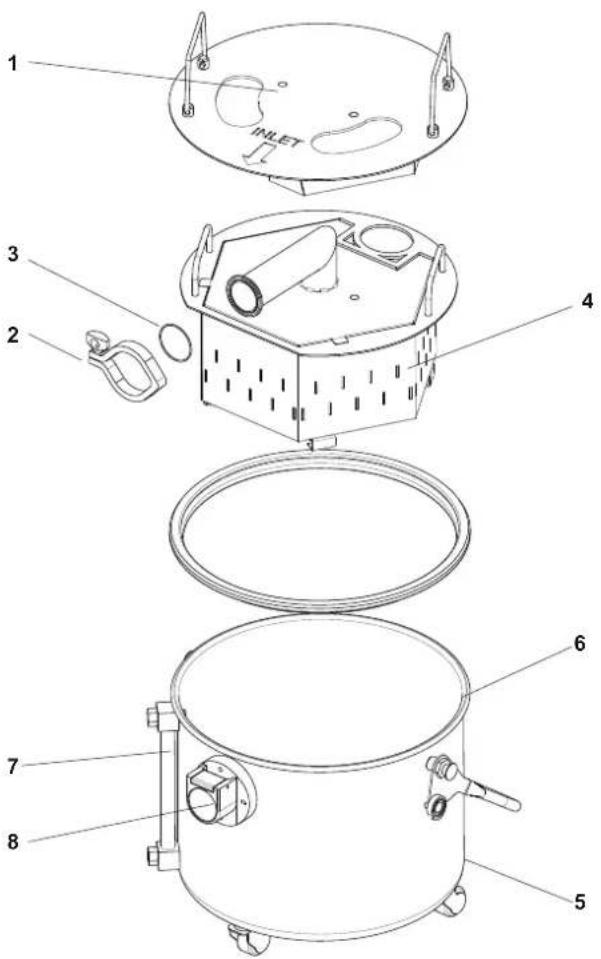
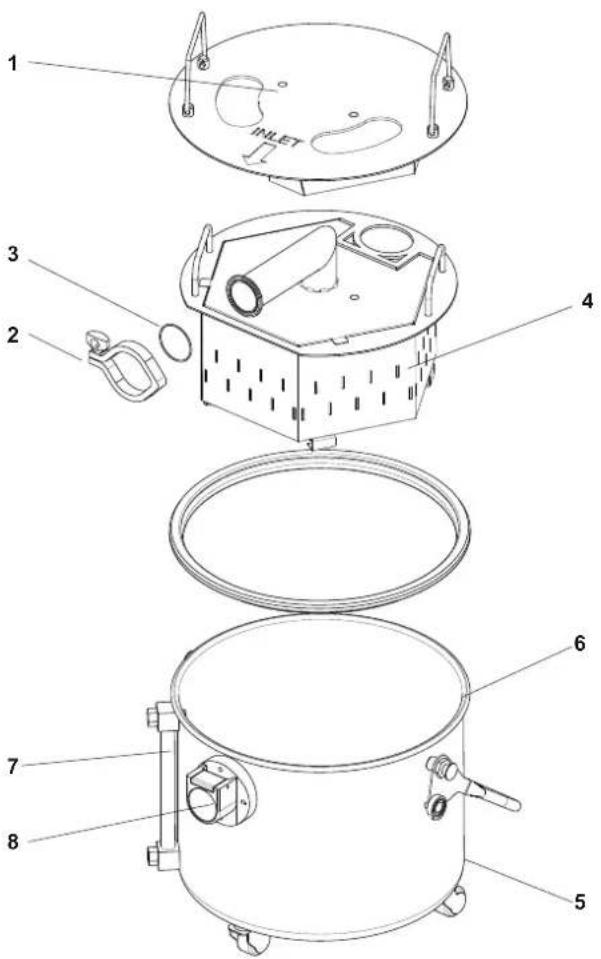
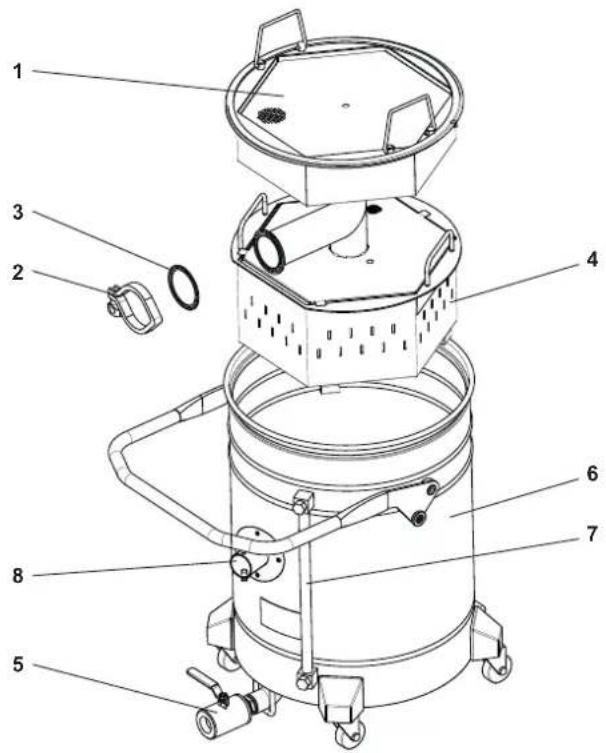
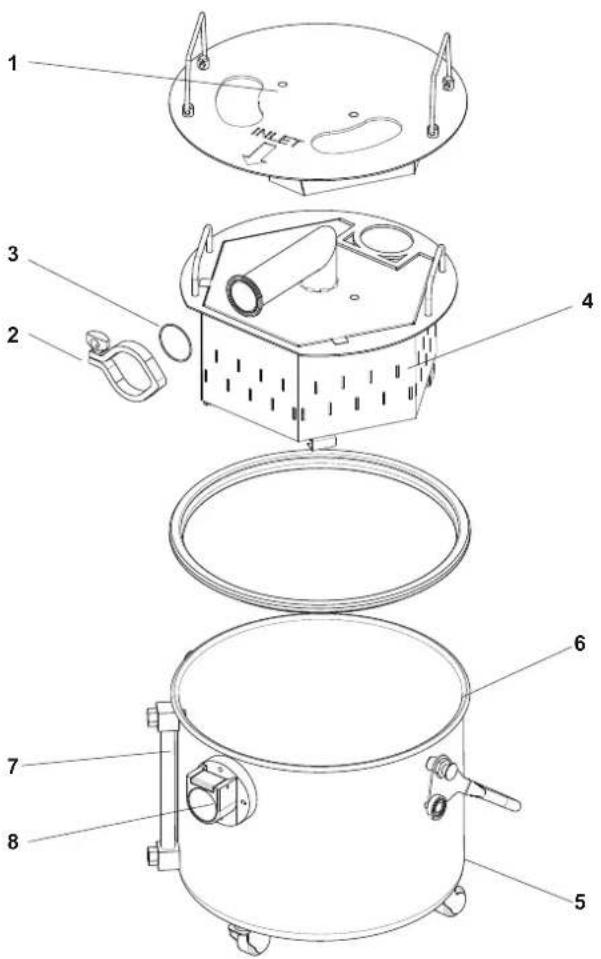
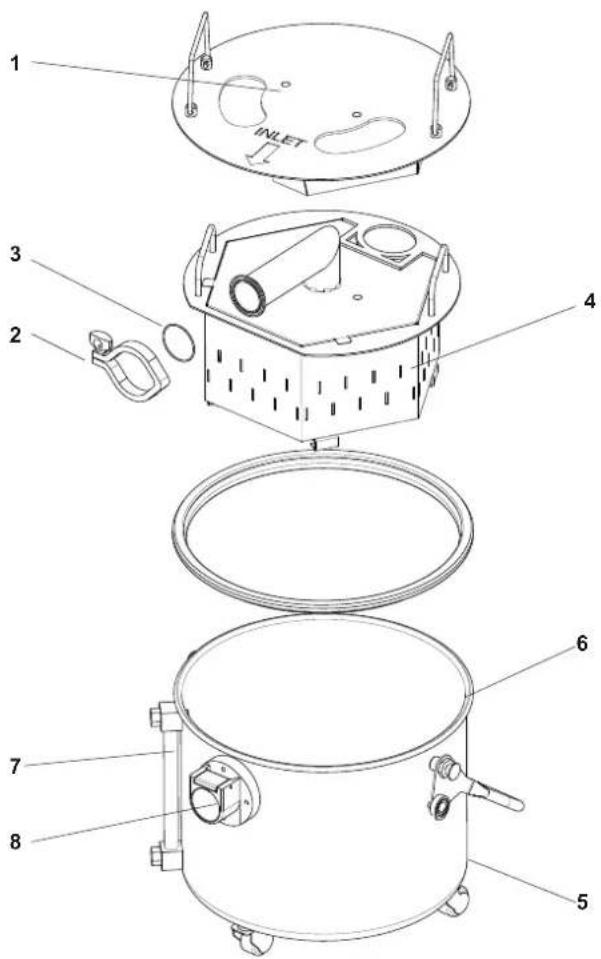
The immersion separator comprises two baskets: one on the bottom to collect the vacuumed dust, and one on the top to keep the coalescent filter in place.
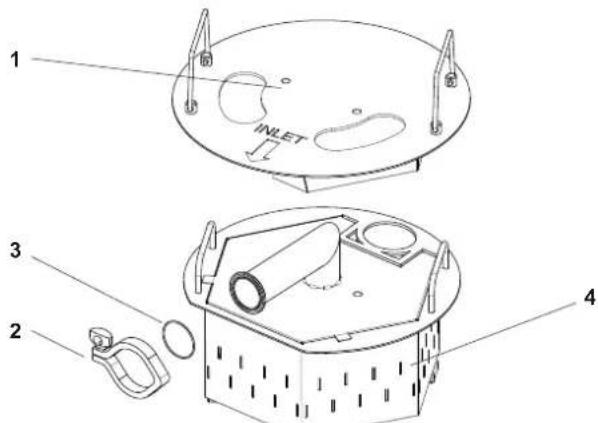
■ Remove the upper basket (1).
■ Unscrew the closing band (2), remove it and remove the clamp gasket (3).
■ Remove the collection basket (4) and make sure the exhaust valve (5) is closed.
■ Pour mineral oil (20 litres into the 460mm-diameter container or 11 litres into the 400mm-diameter container, use for example Mobil Velocite Oil no. 6) into the separator (6) and check that the level raises up to the min. mark on the level indicator (7).
■ Insert the collection basket (4) into the separator (6).
■ Restore the connection between basket (4) and separator (6), insert the clamp gasket (3) and place back the closing band (2).
■ Put the filter basket back in place onto the internal flange of the separator.
■ Insert the separator under the filter chamber.
■ Connect the vacuum hose to the inlet (8) of the separator.
■ Turn on the machine and vacuum the dust.
- Stop vacuuming dust when the oil level reaches the max. mark (about 6L of vacuumed dust with the 460mm-diameter container).
[ NOTE ]
The version equipped with a 400mm diameter collection container is equipped with an automatic stop device. Once the maximum level of collected material has been reached (approximately 4-5 L), the machine will stop vacuuming and the process must be interrupted.
Emptying the container
■ Switch off the machine and disconnect the vacuum hose.
■ Remove the separator and move the container to a suitable area for disposal/recovery of the material.
■ Place the separator on a workbench in a lifted position to allow easy emptying of the liquid.
■ Place a container near the drain valve (5).
■ Open the drain valve (5) and wait until the separator has fully emptied of the inerting liquid.
[ NOTE ]
It is advisable to interrupt the draining operation once the liquid has become muddy.
[ NOTE ]
It is advisable to install an additional filter on the container in order to further filter the inerting liquid to allow its correct disposal.
■ Remove the upper basket (1), unscrew and remove the clamp (2) and its gasket (3).
■ Using the lifting strap provided, slowly lift the material collection basket (4).
■ Wait a few seconds to allow more fluid liquid to drain through the slots at the base of the basket (4). If necessary, tilt it slightly.
■ Remove the top cover of the basket and, if necessary, the slush filter, if installed.
■ Wash all contaminated parts, taking care to rinse thoroughly with cold water to remove all traces of vacuumed material / inerting liquid.
■ Assemble the components in the reverse order of disassembly; before reassembling, thoroughly dry all the parts that were washed.
■ Restore the container and attach it to the machine before using it again.
[ NOTE ]
It is advisable to repeat this maintenance operation at regular and not too long intervals, even if small quantities of product are vacuumed and even if the maximum level of the container is not reached.
Too long intervals could create sedimentation at the base of the basket, which would require longer times for the maintenance operations described above.
![NILFISK VHW311 - [ NOTE ] - 1](/content/2026/04/639980/images/2d12155b60211ccdb030b08a206af2548c049b7812408ad297c3656371545415.jpg)
CAUTION!

The maximum quantity of sludge inside the container bin shall not exceed the maximum weight of 9 kg (20 lb). This value depends on the type of material vacuumed. When this value is reached immediately empty the container.
How to use the slush filter
The system can also be used with a proper 300 mm-slush filter, to be installed inside the container. The filter separates and collects the slimy part, thus supplying a first level filtration.
The oil residue in the container can also be filtered with another 300 or 100 mm-slush filter, in order to make it reusable.
It is suggested to use this procedure for several working cycles (3/4 cycles approximately) and to fully change the oil when it loses its fluidity (high viscosity).
Inerting liquid for immersion separator kit
The system is designed to be used with water or oil, the characteristics of the inerting liquid must be adherent to the type of material used and the user must know and consider any reactions that they may have once they have come into contact with the liquid present in the container.
To vacuum metallic powders that could have particular reactions and create dangerous vapours or gases, such as hydrogen, (following the instructions in NFPA484) inerting liquids with the following specifications are recommended:
Mineral oil
Flash point > 100°C
Viscosity at 40°C ≤10 ctS
Density > 0.80 kg/l
Oils with the same specifications (e.g. „Mobil Velocite No.6“) can be found locally.

CAUTION!

Oil is combustible and should be handled in accordance with local regulations.

CAUTION!

The level of liquid in the collection container may have different levels of evaporation during use. Be sure to use the device only when the minimum level is guaranteed.

CAUTION!

Hydrogen is a flammable gas that is generated by the contact between metallic dust and water. Vacuuming these dusts, therefore, presents a risk of fire and explosion, for this reason the intervention of qualified personnel is required.
H - Additional prescriptions for IEC Ex machines
Nilfisk Models:
Motor + turbine belt drive system
Standards of reference:
These machines comply with: IEC 60079-0 standards

CAUTION!

Observe the prescriptions of the above standards.
These machines are intended to be used in explosive atmospheres classified: Zones 21 and 22 (dusty environments), Zones 1 and 2 (areas with a presence of gas) and Zones Z1/21 and Z2/22 (areas with a presence of both dust and gas).
Never use the vacuum cleaners in Zone 20 and/or 0 (areas with Flammable gases).
These vacuum cleaners are designed to vacuum dry and wet particles and clean places and machines, especially in food, chemical, pharmaceutical, textile industries, and they are suitable for collective use in hotels, schools, hospitals, factories, shops, offices and residences.
They are not designed to be used for ST3 explosion class dust, that is to say dust with value of Kst > 300 bar m/s (ISO 6184/1 – IFA classification: http://staubex.ifa.dguv.de/?lang=e), nor dust with an ignition energy lower than 1 mJ. For these applications please refer to paragraph G - Additional prescriptions for models equipped with immersion separator.
These machines not designed for vacuuming explosive or chemically unstable materials.
They are meant for environments with presence of gas up to the IIB Group (Ethylene).
They are not designed to vacuum fluids with a low flash point (Flash Point lower than 55^ C), nor for incendiary substances ( T < 200^ C).
For these models, apart from following the instructions in the use and maintenance manual of the standard vacuum cleaner, specific precautions and maintenance are also required.
Identification plate marking:
Ex IIB T4 Gb - Ex IIIC T125°C Db (See marking example in paragraph I).
The motor and turbine ball bearings and the transmission belt must be serviced by a Nilfisk Service Center every 10,000 working hours or every 2 years. Contact the sales network or the machine manufacturer. The operator must not dismantle, tamper with and/or service the turbines.
This machine has an antistatic transmission belt. In case of breakage, only use original Nilfisk spare parts. Any parts that need replacing must be replaced by trained personnel. Follow the instructions in the basic use and maintenance manual to check the belt tension
Turbine corrosion can be a real danger. The turbines of these machines are made of aluminium alloy and galvanized steel. Do not vacuum gases, vapours and/or fluids that can corrode these metals.
Depending on the quantity of dust present in the area or, in any case, every six months, clean the motor plate regularly so as to remove any dust deposit. Check the transmission belt tension and wear and, if necessary, replace it with an original spare part.

CAUTION!

On all machines supplied without an electrical plug, the user must connect the free end of the cable in a non-explosive atmosphere, in a housing or using a plug protected by a mode recognized as suitable for the area of destination.
The plug shall be installed by a qualified electrician only.

CAUTION!

In case of bearing noise, stop the machine immediately and check the bearings. Contact the After-Sales Service Center for the above maintenance operations. Do not start the machine again, as this could cause an explosion!
All the above prescriptions, precautions and service operations must be observed, or Nilfisk Warranty for compliance with
IEC Ex requirements will become void, Nilfisk Conformity Certificate will become void and the User will be entirely responsible for the use of the vacuum cleaner.

CAUTION!

All maintenance and cleaning operations must be carried out when the machine is off and disconnected from the electrical mains.

CAUTION!

The special conditions for safe use are complemented by those described in the certificates of conformity of each equipment constitutive of the final assembly.
I - Example of an identification plate marking
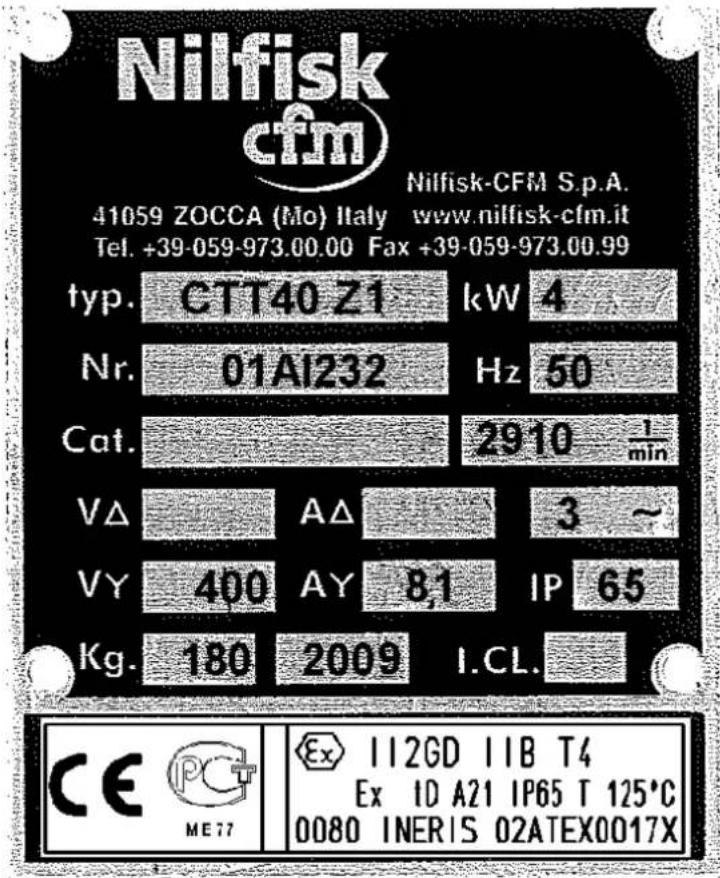
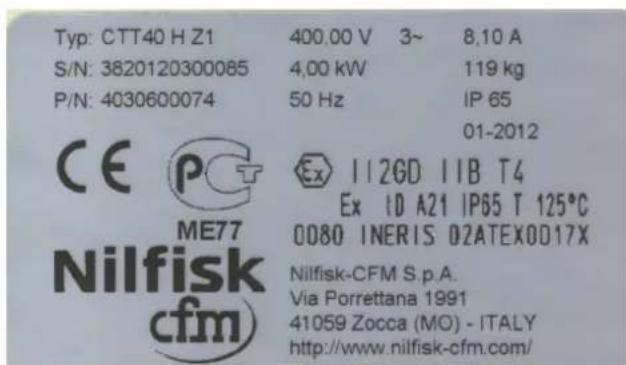
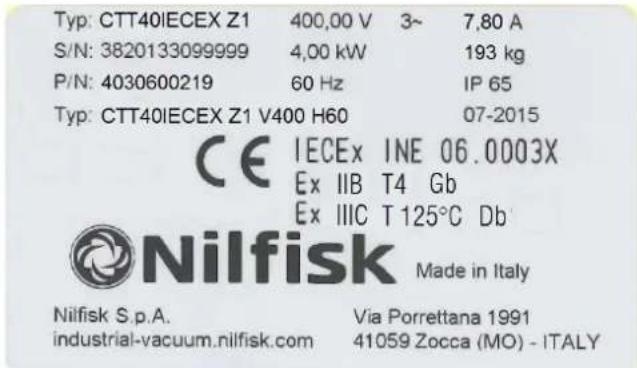
L - Maintenance and check registrations
Example of the table used to register and document the maintenance work and checks:
| Model: Purchase date: Serial number: | ||||
| Date Performed maintenance and checks Stamp/Signature | ||||
II2GD c IIBT4, T5, T6 T100°C T60°C
II2GD c IIBT4, T5, T6 T100°C T60°C
natural_image
Simple line drawing of a circular ring or loop structure (no text or symbols)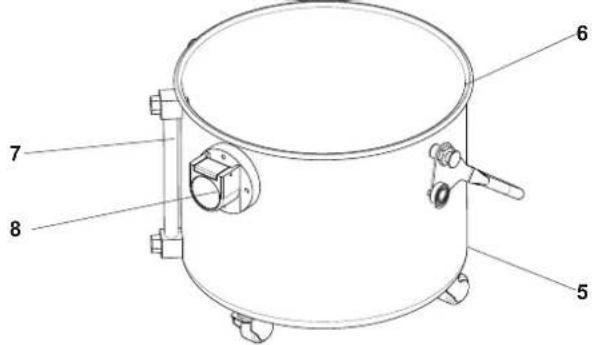
II2GD c IIBT4, T5, T6 T100°C T60°C