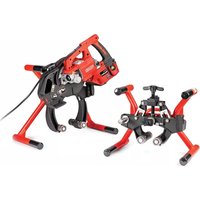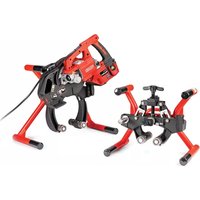
PC-612 - Saw RIDGID - Free user manual and instructions
Find the device manual for free PC-612 RIDGID in PDF.



User questions about PC-612 RIDGID
0 question about this device. Answer the ones you know or ask your own.
Ask a new question about this device
Download the instructions for your Saw in PDF format for free! Find your manual PC-612 - RIDGID and take your electronic device back in hand. On this page are published all the documents necessary for the use of your device. PC-612 by RIDGID.
USER MANUAL PC-612 RIDGID
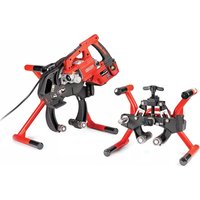
PipeSaw Transportable Pipe Saw

natural_image
Two red and black robotic quadrupedoes with visible mechanical joints and sensors, one with a white head switch (no text or symbols)Table of Contents
Recording Form For Machine Serial Number ....1
Safety Symbols....2
General Power Tool Safety Warnings
Work Area Safety 2
Electrical Safety 2
Personal Safety ....3
Power Tool Use And Care ....3
Service....3
Specific Safety Information
PipeSaw Safety 4
RIDGID® Contact Information 5
Description 6
Specifications....7
Standard Equipment 7
Pre-Operation Inspection....8
Set-Up And Operating Instructions 8
Workpiece Preparation....9
Mounting Clamp on Pipe 10
Mounting Saw on Clamp 11
Cutting Operation 11
Dismounting the PipeSaw and Clamp ....13
Transportation 14
Storage 14
Maintenance Instructions
Cleaning....14
Cleaning Saw Blade Cavity ....14
General Lubrication ....14
Gearbox Lubrication....14
Changing Saw Blade ....15
Replacing Carbon Brushes ....15
Motor Thermal Overload 16
Troubleshooting ....16
Service And Repair ....16
Optional Equipment 17
Disposal 17
FCC/ICES Statement ......60
EC Declaration....Inside Back Cover
Lifetime Warranty ....Back Cover
*Original Instructions - English
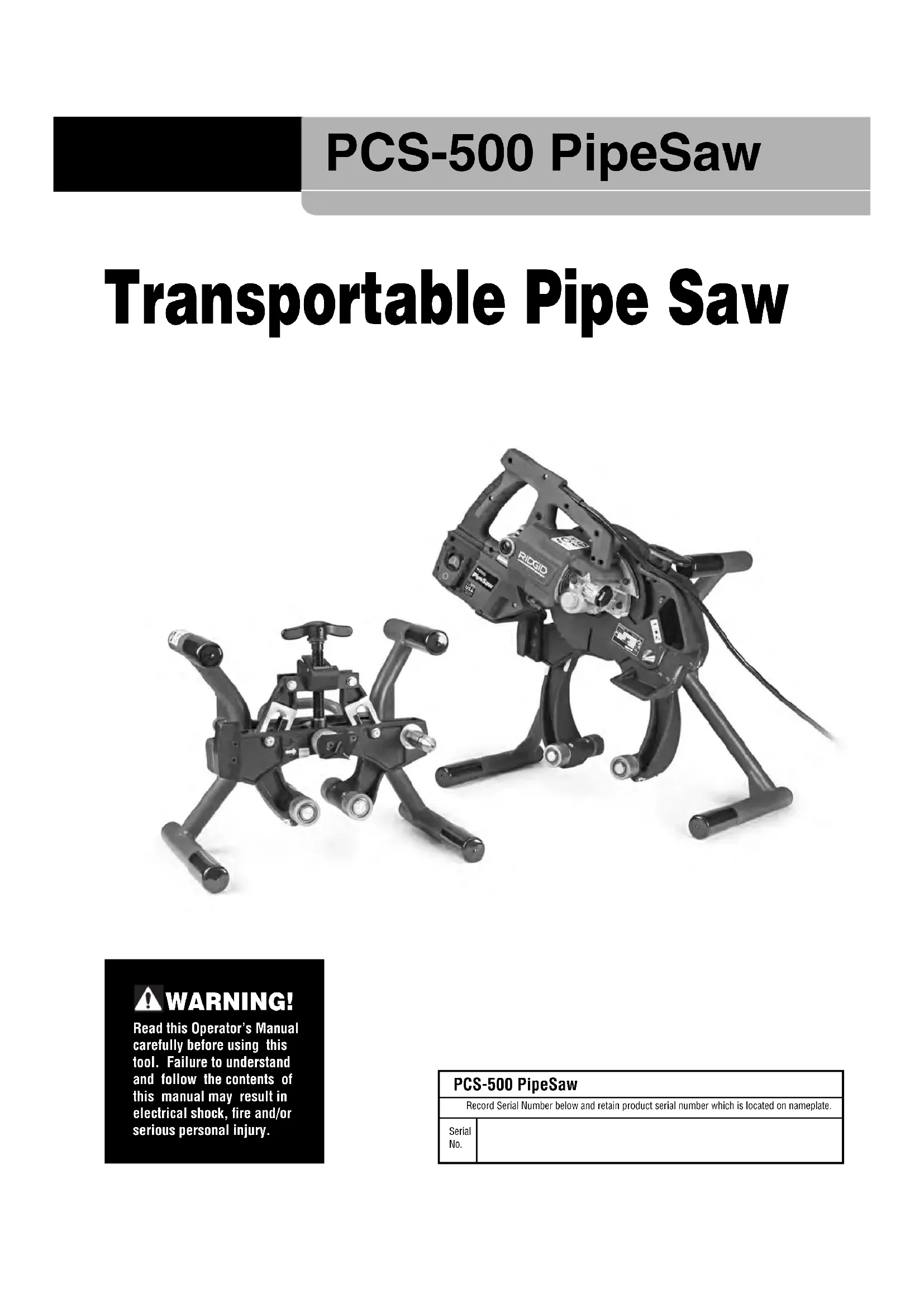
Transportable Pipe Saw

natural_image
Two black quadruped robotic devices with articulated limbs, one with a visible sensor or sensor device (no text or symbols on the device itself)
WARNING!
Read this Operator's Manual carefully before using this tool. Failure to understand and follow the contents of this manual may result in electrical shock, fire and/or serious personal injury.
| PCS-500 PipeSaw | |
| Record Serial Number below and retain product serial number which is located on nameplate. | |
| Serial No. | |
Safety Symbols
In this operator's manual and on the product, safety symbols and signal words are used to communicate important safety information. This section is provided to improve understanding of these signal words and symbols.

This is the safety alert symbol. It is used to alert you to potential personal injury hazards. Obey all safety messages that follow this symbol to avoid possible injury or death.

DANGER
DANGER indicates a hazardous situation which, if not avoided, will result in death or serious injury.

WARNING
WARNING indicates a hazardous situation which, if not avoided, could result in death or serious injury.

CAUTION
CAUTION indicates a hazardous situation which, if not avoided, could result in minor or moderate injury.
NOTICE
NOTICE indicates information that relates to the protection of property.

This symbol means read the operator's manual carefully before using the equipment. The operator's manual contains important information on the safe and proper operation of the equipment.

This symbol means always wear safety glasses with side shields or goggles and hearing protection while using this equipment to reduce the risk of injury.

This symbol indicates the risk of electrical shock.

This symbol indicates the risk of hands, fingers or other body parts being cut by the rotating saw blade.

This symbol means not to reach inside of pipe to reduce the risk of injury from rotating saw blade, moving pipe and other causes.

This symbol indicates that chips are ejected in this area. Stay clear of the chip chute to reduce the risk of injury from chips.

This symbol means do not reach into the chip chute to reduce the risk of injury from contact with the rotating saw blade.

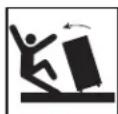
This symbol indicates the risk of equipment and material tipping, causing striking or crushing injuries.

This symbol indicates the risk of burns from hot surfaces.
General Power Tool Safety Warnings\*
WARNING
Read all safety warnings, instructions, illustrations and specifications provided with this power tool. Failure to follow all instructions listed below may result in electric shock, fire and/or serious injury.
SAVE ALL WARNINGS AND INSTRUCTIONS FOR FUTURE REFERENCE!
The term "power tool" in the warnings refers to your mains-operated (corded) power tool or battery-operated (cordless) power tool.
Work Area Safety
- Keep work area clean and well lit. Cluttered or dark areas invite accidents.
- Do not operate power tools in explosive atmospheres, such as in the presence of flam mable liquids, gases, or dust. Power tools create sparks which may ignite the dust or fumes.
- Keep children and bystanders away while operating a power tool. Distractions can cause you to lose control.
Electrical Safety
- Power tool plugs must match the outlet. Never modify the plug in any way. Do not use any adapter plugs with earthed (grounded) power tools. Un-modified plugs and matching outlets will reduce risk of electric shock.
- Avoid body contact with earthed or grounded surfaces such as pipes, radiators, ranges and refrigerators. There is an increased risk of electrical shock if your body is earthed or grounded.
- Do not expose power tools to rain or wet conditions. Water entering a power tool will increase the risk of electrical shock.
- Do not abuse the cord. Never use the cord for carrying, pulling or unplugging the power tool. Keep cord away from heat, oil, sharp edges or moving
parts. Damaged or entangled cords increase the risk of electric shock.
- When operating a power tool outdoors, use an extension cord suitable for outdoor use. Use of a cord suitable for outdoor use reduces the risk of electric shock.
- If operating a power tool in a damp location is unavoidable, use a ground fault circuit interrupter (GFCI) protected supply. Use of a GFCI reduces the risk of electric shock.
Personal Safety
- Stay alert, watch what you are doing and use common sense when operating a power tool. Do not use a power tool while you are tired or under the influence of drugs, alcohol, or medication. A moment of inattention while operating power tools may result in serious personal injury.
- Use personal protective equipment. Always wear eye protection. Protective equipment such as dust mask, non-skid safety shoes, hard hat, or hearing protection used for appropriate conditions will reduce personal injuries.
- Prevent unintentional starting. Ensure the switch is in the OFF-position before connecting to power source and/or battery pack, picking up or carrying the tool. Carrying power tools with your finger on the switch or energizing power tools that have the switch ON invites accidents.
- Remove any adjusting key or wrench before turning the power tool ON. A wrench or a key left attached to a rotating part of the power tool may result in personal injury.
- Do not overreach. Keep proper footing and balance at all times. This enables better control of the power tool in unexpected situations.
- Dress properly. Do not wear loose clothing or jewel ry. Keep your hair and clothing away from moving parts. Loose clothes, jewelry, or long hair can be caught in moving parts.
- If devices are provided for the connection of dust extraction and collection facilities, ensure these are connected and properly used. Use of dust collection can reduce dust-related hazards.
- Do not let familiarity gained from frequent use of tools allow you to become complacent and ignore tool safety principles. A careless action can cause severe injury within a fraction of a second.
Power Tool Use And Care
- Do not force the power tool. Use the correct power tool for your application. The correct power tool will do the job better and safer at the rate for which it is designed.
- Do not use the power tool if the switch does not turn it ON and OFF. Any power tool that cannot be controlled with the switch is dangerous and must be repaired.
- Disconnect the plug from the power source and/or remove the battery pack, if detachable, from the power tool before making any adjustments, changing accessories, or storing power tools. Such preventive safety measures reduce the risk of starting the power tool accidentally.
- Store idle power tools out of the reach of children and do not allow persons unfamiliar with the power tool or these instructions to operate the power tool. Power tools are dangerous in the hands of untrained users.
- Maintain power tools and accessories. Check for misalignment or binding of moving parts, breakage of parts and any other condition that may affect the power tool's operation. If damaged, have the power tool repaired before use. Many accidents are caused by poorly maintained power tools.
- Keep cutting tools sharp and clean. Properly maintained cutting tools with sharp cutting edges are less likely to bind and are easier to control.
- Use the power tool, accessories and tool bits etc. in accordance with these instructions, taking into account the working conditions and the work to be performed. Use of the power tool for operations different from those intended could result in a hazardous situation.
- Keep handles and grasping surfaces dry, clean and free from oil and grease. Slippery handles and grasping surfaces do not allow for safe handling and control of the tool in unexpected situations.
Service
- Have your power tool serviced by a qualified repair person using only identical replacement parts. This will ensure that the safety of the power tool is maintained.
Specific Safety Information
WARNING
This section contains important safety information that is specific to this tool.
Read these precautions carefully before using the PCS-500 Transportable Pipe Saw to reduce the risk of electrical shock or other serious injury.
SAVE ALL WARNINGS AND INSTRUCTIONS FOR FUTURE REFERENCE!
Keep this manual with machine for use by the operator.
PipeSaw Safety
⚠️ DANGER Keep hands away from cutting area and blade. Allow parts to come to a complete stop before handling the tool or pipe. This will reduce the risk of cutting and entanglement injuries.
- Keep your hands on saw handles and firmly control during use. This provides better control of the machine and cutting process. If both hands are holding the saw, they cannot be cut by the saw blade.
- Always wear appropriate eye protection and hearing protection. Cutting tools can break or shatter. Cutting produces chips that can be thrown or fall into eyes. Cutting produces high noise levels that over time can damage your hearing.
- Always wear appropriate personal protective equipment. Face shields, long sleeves, safety shoes, hard hat, and other equipment as appropriate will reduce the risk of injury.
- Do not wear loose clothing when operating PCS-500 Transportable Pipe Saw. Keep sleeves and jackets buttoned. Do not reach across machine. Clothing can be caught by the machine resulting in entanglement.
- Keep bystanders clear of work area. Guard or barricade minimum of 9 feet (2.7 meter) around the working area. Chips or broken saw teeth can be thrown and cause injury beyond immediate area of operation. A guard or barricade that provides a clearance around the work piece will reduce the risk of injury.
- One person must control the work process and the saw ON/OFF switch. Only the operator should be in the work area when the machine is running. This helps reduce the risk of injury.
-
Properly support work piece and PipeSaw Transportable Pipe Saw. Make sure the saw clamp is secure to the work piece. This will reduce the risk of striking and crushing injuries from tipping and falling pipe and equipment.
-
Never hold the workpiece in your hands or across your leg while cutting. Always secure the work piece in an appropriate pipe vise and properly support. It is important to support the work properly to minimize body exposure, blade binding, equipment and material falling or loss of control.
- Do not start the saw with the saw blade touching the work piece. Let the blade reach full speed before carefully feeding it into the work piece. The blade may bind, walk or kickback if the tool is started with the blade in contact with the work piece.
- Do not reach into the chip chute. Do not insert tools or other objects into the chip chute. Do not block chip chute. This will reduce the risk of cutting, entanglement and striking injuries.
- Do not reach inside the pipe. The guard cannot protect you from the blade inside the pipe.
- During set-up, always confirm the saw is locked in position on the clamp with the clamp 10 degrees from vertical. This will reduce the risk of unintended movement of the saw during use.
- Be aware that the saw gear box can be hot from use. Do not touch gearbox during or after operation to reduce the risk of burns.
- Properly route and position the cord during use to reduce the risk of cord damage and electrical shock. If the cord is cut, the saw, pipe or other objects may be electrically charged. Make sure the saw is controlled and unplug the cord from the outlet.
- Read and understand these instructions and the instructions and warnings for all equipment and materials being used before operating this tool to reduce the risk of serious personal injury.
- Do not modify PipeSaw or use for any other purpose. Other uses or modifying the saw for other applications may damage the tool, damage the attachments and/or cause personal injury.
- Only cut empty pipe. Do not cut pipe with any type of contents to reduce the risk of electrical shock and other hazards.
- Avoid breathing of dust created from pipe cutting. Some dust created may contain chemicals known to cause cancer, birth defects or other serious personal injury. Consider the pipe material and coatings when determining appropriate respiratory protection, including things such as lead based paint.
Your risk from these exposures varies, depending on how often you do this type of work and the concentration of dust. To reduce your exposure to these chem-
icals, work in a well ventilated area, and use respiratory protection selected based on appropriate regulations and standards, such as ANSI Z88.2 and OSHA.
- Do not use tool near flammable material. Do not use lubricants during cutting. Hot metal chips/sparks may cause a fire.
Blade Related Warnings
- Only use the RIDGID-recommended saw blades. Improper saw blades can increase forces and reduce control, increasing the risk of injury.
- Do not use dull or damaged saw blades. Dull or improper blades can cause excessive friction and heat, blade binding, kickback, reduce control and increase the risk of injury.
- Always use saw blades with correct size and shape (diamond versus round) of arbor holes. Blades that do not match the mounting hardware of the saw will run eccentrically, causing loss of control.
- Do not use wood cutting blades. Using blades not recommended in this manual can result in a hazardous situation.
- Only use proper blade recommended for the material to be cut. Improper blade type can damage the equipment and reduce control, increasing the risk of injury.
- Never use damaged or incorrect blade washers or bolt. The blade washers and bolt were specially designed for your saw, for optimum performance and safety of operation.
Kickback
Kickback is a sudden reaction to a pinched, jammed or misaligned saw blade, causing an uncontrolled saw to lift up and out of the workpiece. Kickback is the result of saw misuse and/or incorrect operating procedures or conditions and can be avoided by following the instructions and warnings, including those below.
- When blade is binding, or when interrupting a cut for any reason, depress the OFF switch and hold the saw motionless in the material until the blade comes to a complete stop. If saw blade is binding, it may walk up or kickback from the workpiece as the saw is restarted. Investigate and take corrective action to eliminate the cause of blade binding.
- Do not restart saw in work piece to reduce risk of kickback. With saw OFF, remove saw from pipe. Confirm proper set up and continue with a new cut.
- Properly support pipe to minimize the risk of blade pinching and kickback. Pipe can sag or shift as it is
cut. Support pipe on both sides of cut to prevent movement.
- The saw blade washers and the bolt on your saw have been designed to work as a clutch to reduce the intensity of a kickback. Understand the operation and settings of the clutch. The proper setting of the clutch, combined with firm handling of the saw will allow you to control kickback.
Guard Function
- Inspect your equipment before every use for proper assembly, maintenance and operation. Do not use if damaged. Do not use if guards do not work correctly.
- Check guards for proper closing before each use. Do not operate saw if guards do not move freely and enclose the blade instantly. Never clamp or tie the guards so that the blade is exposed. If saw is accidentally dropped, guards may be bent. Raise the guards and make sure the guards move freely and do not touch the saw blade or any other part, throughout range of motion.
- Check the operation and condition of the guard return spring. If the guard and the spring are not operating properly, they must be serviced before use. Guard may operate sluggishly due to damaged parts, gummy deposits, or a buildup of debris.
- Always observe that the guards are covering the saw blade when saw is not in use. An unprotected, coasting blade can cause injury and tool damage. Be aware of the time it takes for the blade to stop after switch is released.
- Do not run the tool when not installed on pipe. Guards may be opened by a contact with your clothing. Accidental contact with the spinning saw blade could result in serious personal injury.
- Periodically remove the saw blade, clean the upper, lower guards and the hub area. Wipe it dry, or blow it clean with compressed air. Preventive maintenance and properly operating guard will reduce the probability of an accident.
RIDGID Contact Information
If you have any question concerning this RIDG product:
- Contact your local RIDGID® distributor.
- Visit RIDGID.com to find your local Ridge Tool contact point.
- Contact Ridge Tool Technical Service Department at rttechservices@emerson.com, or in the U.S. and Canada call (800) 519-3456.
Description
The RIDGID® Model PCS-500 Transportable Pipe Saw is designed to clamp on the pipe and create a square cut. The saw can cut steel, stainless steel, plastic and cast iron pipes with the correct saw blade selection.
The clamps securely grip the work piece between clamp wheels and then the PCS-500 Transportable Pipe Saw is mounted on the clamp. The cut is formed by rotating the saw around the stationary pipe.
LED indicator lights are supplied to give feedback on proper cutting speed. LEDs are normally OFF and flash to indicate that the pipe is being cut too quickly.
The PipeSaw is lightweight and compact for ease of transport.
The saw is not designed to cut bars and plates. The pipe saw and clamp must be used together. The PipeSaw is only meant to be used with pipe on stands, and is not designed for use with in-place pipe.
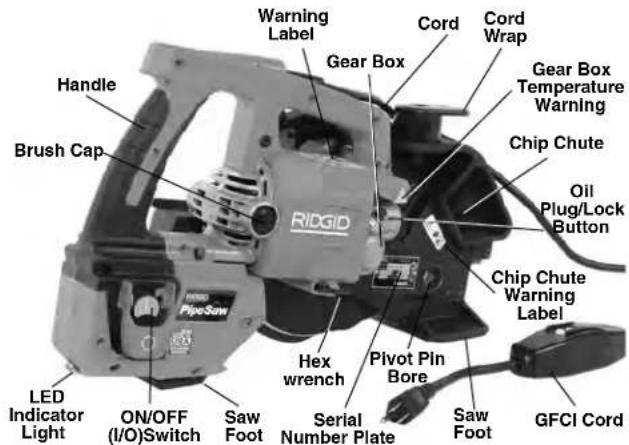
text_image
Handle Brush Cap LED Indicator Light ON/OFF (I/O)Switch Saw Foot Warning Label Gear Box Hex wrench Serial Number Plate Pivot Pin Bore Hex wrench Cord Cord Wrap Gear Box Temperature Warning Chip Chute Oil Plug/Lock Button Chip Chute Warning Label GFCI CordFigure 1 – Model PCS-500 Transportable Pipe Saw, Front Side
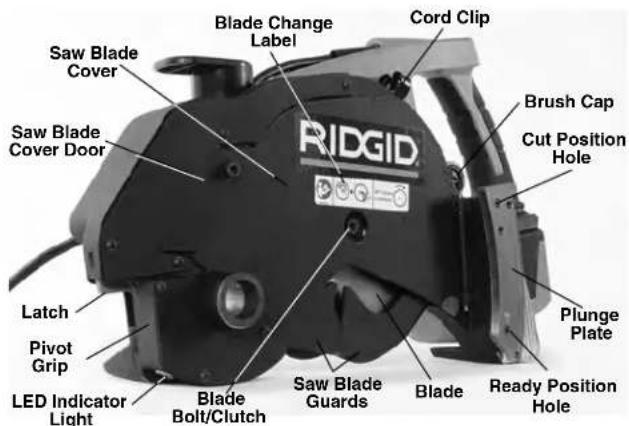
text_image
Saw Blade Cover Blade Change Label Cord Clip Brush Cap Cut Position Hole Saw Blade Cover Door RIDGID Latch Pivot Grip LED Indicator Light Blade Bolt/Clutch Blade Saw Blade Guards Blade Plunge Plate Ready Position HoleFigure 2 – Model PCS-500 Transportable Pipe Saw, Back Side

text_image
Clamp Handlebar Quick Release Lever Screw Handle Clamp Location Decal Lead Screw Pivot Pin Upper Carriage Guard Start Bracket Plunge Lock Pin Plunge Plate Guide Alignment Pad Clamp Wheels Clamp WheelsFigure 3 - RIDGID Clamp

text_image
10" (254 mm) 8" (203 mm)Figure 4A – PipeSaw Clearance on Pipe - Axial
text_image
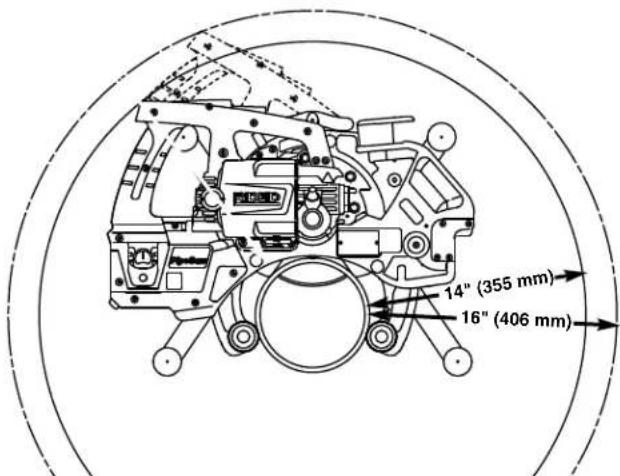
14" (355 mm) 16" (406 mm)Figure 4B - PipeSaw Clearance on Pipe - Radial
Specifications
Model ....Small Clamp Large Clamp (PC-106) (PC-612)
Nominal Pipe Cutting
Capacity.....1" to 6" (25mm to 150mm) 6" to 12" (150mm to 300mm)
Actual Pipe
Outside Diameter....1.26" to 6.625" (32mm to 168mm) 6.5" to 12.75" (165mm to 324mm)
Blade Type......Cermet-Tipped Carbide-Tipped Diamond Abrasive
Pipe Material
(With Proper Blade)......Steel, Stainless Steel Plastic and most Metal*** Cast Iron
Maximum Wall
Thickness....½" (12mm) 0.70" (18mm) ½" (12mm) For Plastic Only
Maximum Pipe Out of
Roundness** ....Less Than 1.5% of Nominal Pipe Outside Diameter
Minimum Cut-off
Length ....1" (25mm) (PipeSaw Not For Facing Pipe End)
Cut Quality (Max. Offset)...0.050" (1.27mm)
Saw Blade Type....8" Outside Diameter with 18 " Round Arbor
Motor:
Power 1800 W
Voltage 110V - 120V a.c.
Current 15 Amp
No Load Operating
Speed 3900 RPM
Controls......ON/OFF (I/O) Switch
Weight....49 lbs. (22.2 kg) w/Small Clamp 52 lbs. (23.6 kg) w/Large Clamp
Dimension (w/saw
plunged down) .....21.25" x 16" x 14.5" (540 x 406 x 368 mm) 24.5" x 20.5" x 14.5" (622 x 521 x 368 mm)
Dimension (w/saw up)....21.5" x 22" x 14.5" (540 x 559 x 368 mm) 24.5" x 26.25" x 14.5" (622 x 667 x 368 mm)
Operating temperature .....14°F to 120°F (-10°C to 49°C)
Storage Temperature .....-10°F to 120°F (-23°C to 49°C)
Sound Pressure ( I_a )*......88.12 dB(A), K=3
Sound Power ( L_AA ) ^* .....98.12 dB(A), K=3
* Sound measurements are measured in accordance with a standardized test per Standard 62841-1.
- Sound emissions may vary due to your location and specific use of these tools.
- Daily exposure levels for sound need to be evaluated for each application and appropriate safety measures taken when needed. Evaluation of exposure levels should consider the time a tool is switched off and not in use. This may significantly reduce the exposure level over the total working period.
** Pipe Out of Roundness = Maximum outside pipe diameter minus minimum outside pipe diameter (pipe diameter measured with calipers).
*** Cermet-Tipped Blade is optimized for standard mild carbon steel. Reduced blade life can be expected on other materials.
Ability to cut depends on a variety of factors, including material type, chemistry, hardness, amount of material being removed and other factors. In some cases, cuts may not be able to be made or may result in blade damage. If there are any questions about specific material to be cut, contact Ridge Tool Technical Service Department.
NOTICE Selection of appropriate materials and installation, joining and forming methods is the responsibility of the system designer and/or installer. Selection of improper materials and methods could cause system failure.
Stainless steel and other corrosion resistant materials can be contaminated during installation, joining and form-
ing. This contamination could cause corrosion and premature failure. Careful evaluation of materials and methods for the specific service conditions, including chemical and temperature, should be completed before any installation is attempted. (See NOTICE in Workpiece Preparation section.)
Standard Equipment
Refer to the RIDGID catalog for details on equipment supplied with specific machine catalog numbers.

text_image
RIDGE Tool Company, Elyria, Ohio, U.S.A. RIDGID.com Model No. PCS-500 Serial No. ECS123451120 120 V ~ 50/60 15.0 A 3900 /min Duty 5010236 Hz W IntertekFigure 5 – Machine Serial Number (Serial number plate is located on saw body near chip chute exit window. The last 4 digits indicate the month and year of manufacture.)
Pre-Operation Inspection
WARNING

Before each use, inspect your PCS-500 Transportable Pipe Saw and correct any problems to reduce the risk of serious injury from electric shock, entanglement, crushing injuries and other causes and prevent Machine damage.
Always wear safety glasses, and other appropriate protective equipment when inspecting your PCS-500 Transportable Pipe Saw.
- Make sure that the PCS-500 Transportable Pipe Saw is unplugged and press the OFF (O) button.
- Clean the machine. Clean any oil, grease, dirt, or chips from the saw, including the handles and controls. This aids inspection and helps prevent the machine or control from slipping from your grip. Clean and maintain the machine per the Maintenance Instructions.
- Inspect the PCS-500 Transportable Pipe Saw and clamp for the following:
• C ord and plug for damage or modification. - Proper assembly, maintenance and completeness.
- Any broken, worn, missing, misaligned or binding parts or other damage.
-
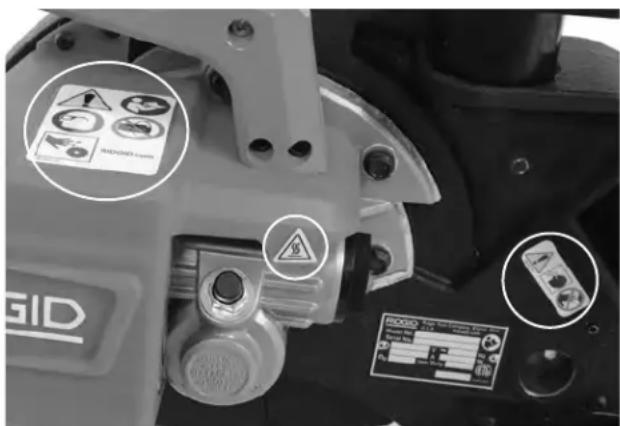
Presence and readability of the warning and instruction labels (See Figure 1, 2 and 6).
-
Saw blade guards for correct operation – if opened should close quickly under spring force. Guards should not stick. If needed, clean chips from inside the chip chute and blade cover, see Maintenance Instructions.
- Condition of the saw blade. Dull or damaged blades increase required force, produce poor results and increase the risk of injury. Chose the appropriate RIDGID recommended saw blade for the material to be cut. Confirm blade is properly secured to saw.
- Clamp wheel knurl is clean and in good condition. If needed, clean with a wire brush. Worn or dirty clamp wheel knurls can cause slippage or tracking issues in use. Dirty clamp wheels and knurls can cause ferrous contamination of stainless steel.
- Confirm chip chute is clear.
- Any other condition which may prevent safe and normal operation.
If any issues are found, do not use the tool until the issues have been repaired.
text_image
GID 10000000000000000000000000000000000000000000000000000000000000000000000000000000000000000000000000000Figure 6 – Warnings
- Inspect and maintain any other equipment being used per its instructions to make sure it is functioning properly.
Set-Up And Operating Instructions
WARNING



Always wear appropriate eye protection and hearing protection. Cutting tools can break or shatter. Cutting produces chips that can be thrown or fall into eyes. Cutting produces high noise levels that over time can damage your hearing.
Do not start the saw with the saw blade touching the work piece. Let the blade reach full speed before carefully feeding it into the work piece. The blade may bind, walk or kickback if the tool is started with the blade in contact with the work piece.
One person must control the work process and the saw ON/OFF switch. Only the operator should be in the work area when the machine is running. This helps reduce the risk of injury.
Never hold piece being cut in your hands. Always secure the work piece in an appropriate pipe vise and properly support. It is important to support the work properly to minimize body exposure, blade binding, equipment and material falling or loss of control.
Keep hands away from rotating saw blade and cutting area. Allow parts to come to a complete stop before handling the tool or pipe. This will reduce the risk of cutting and entanglement injuries.
Do not reach inside the pipe. The guard cannot protect you from the blade inside the pipe.
Keep your hands on saw handles and firmly control during use. This provides better control of the machine and cutting process. If both hands are holding the saw, they cannot be cut by the saw blade.
Inspect your equipment before every use for proper assembly, maintenance and operation. Do not use if damaged. Do not use if guards do not work correctly.
Follow operating instructions to reduce the risk of serious injury from electric shock, entanglement, crushing injuries and other causes and prevent Machine damage.
-
Check work area for:
-
Adequate lighting.
- Flammable liquids, vapors or dust that may ignite. If present, do not work in area until sources have been identified and corrected. The machine is not explosion proof and can cause sparks.
- Clear, level, stable and dry place for all equipment and operator.
-
Properly grounded electrical outlet of the correct voltage. Check the machine serial plate for required voltage. A three-prong or GFCI outlet may not be properly grounded. If in doubt, have outlet inspected by a licensed electrician.
-
Inspect the work to be done. Determine the material, type and size of the pipe. Determine the correct equipment for the job. See Specification section for tool information.
NOTICE To prevent ferrous contamination of stainless steel – use dedicated saw blades and clamp for stainless steel. Best practice is to dedicate a saw and clamp system for stainless steel.
- The operator should be the only person in the area
while the machine is operated. Keep bystanders clear of work area, set up guards or barricades to create a minimum of 9 feet (2.7 m) of clearance around the workpiece and PipeSaw. This helps to prevent bystanders from being struck by chips during use.
-
When using the PCS-500 Transportable Pipe Saw, you will generally need to use extension cords. Choose an extension cord that:
-
Is in good condition.
- Has a grounded (earthed) plug like on the PipeSaw.
• Is rated for outdoor use. - Has sufficient wire size. For extension cords up to 25' (7.6 m) long use 14 AWG (2.5 mm) or heavier. For extension cords up to 50' (15.2 m) long use 12 AWG (4.0 mm) or heavier.
-
With dry hands, plug the extension cord into the outlet. Run the extension cord along a clear path to the PCS-500 Transportable Pipe Saw. Keep all connections dry and off the ground. Leave excess cord at the base of the machine to allow for machine movement. Do not plug the PipeSaw in at this time.
-
Make sure all equipment has been properly inspected.
Workpiece Preparation
- Check that the pipe is straight and round in the area to be cut. The PipeSaw cannot be used on curved, out of round or damaged pipe. In the area that the pipe clamp will mount to the pipe, the surfaces should be clean and free from debris. If needed, mark the pipe at the desired cut point.
- Make sure that the work piece is solidly mounted and stable. Work piece and support must be able to withstand the weight of the PipeSaw and the force and torque required for cutting without moving or turning. Do not use for pipe in place – only use for horizontal pipe on stands. In place pipe may be loaded and shift or move unexpectedly during or after cutting, and could cause equipment damage or injury.
Confirm there is sufficient room for PipeSaw (See Figure 4).
When using a pipe vise, make sure that it is properly sized and secured to prevent tipping during use. For longer lengths of pipe, use appropriate pipe stands to support extra length.
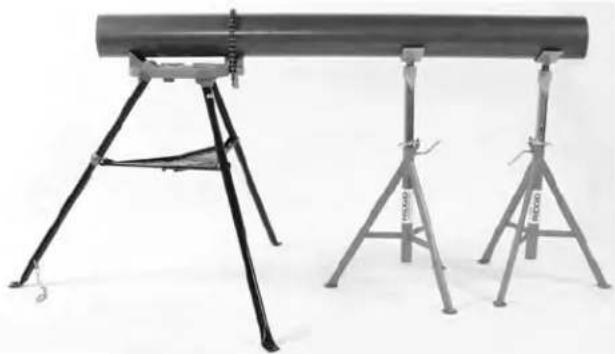
When cutting in the middle of a longer piece of pipe, each resulting section of pipe must be properly supported to prevent the pipe from moving, falling or pinching the saw blade during or after the cut. This requires at least two pipe supports on each side of the cut. Actual placement of the pipe supports will vary depending on the position of the blade and the length of pipe. See Figure 7 for an example.
- When the resulting pipe section is too short for the use of traditional pipe supports, users may need to field fabricate a support, such as tack welding a support to the end of the pipe to be cut off. The pipe must be properly supported to prevent the pipe from falling or pinching the saw blade after the cut is made. Falling pipe can cause injury or damage the power cord. Do not attempt to hold the pipe to be cut off by hand or reach into the pipe.
NOTICE Do not use the PCS-500 Transportable Pipe Saw on material that is connected to a welder. If the saw is connected to a workpiece during welding processes, it can damage the saw circuitry.
natural_image
Black-and-white photo of two metal tripod holders with long legs, one standing upright and one positioned upright (no text or symbols visible)Figure 7 – Example of Pipe Support
Mounting Clamp On Pipe
- Confirm that the workpiece has been properly set up.
NOTICE To prevent ferrous contamination of stainless steel, make sure that the clamp wheels are clean and debris free. Thoroughly clean with a stainless steel brush.
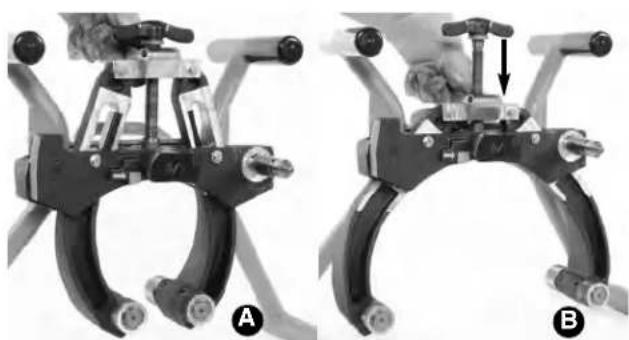
- Press the quick release lever (A) and push the upper carriage down (B) to fully open the clamp. See Figure 8.
natural_image
Mechanical clamp assembly diagrams showing two views (A and B) of a mechanical clamp with no visible text or symbolsFigure 8 – Quick Release Lever
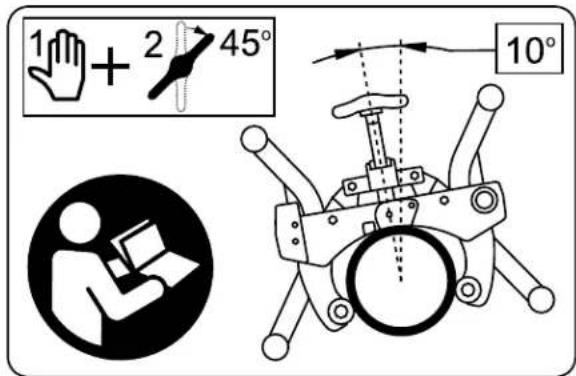
- Place clamp on the pipe with the lead screw at the 10^ from vertical position. See Figure 9. Do not place the
lead screw at 12 o'clock or greater – this can allow the clamp to rotate around the pipe under its own weight.
- Press quick release lever and lift the upper carriage until all wheels lightly contact pipe.
text_image
1 + 2 45° 10°Figure 9 – Pipe Clamp Location
- Align the Alignment pad 2" (50 mm) from the desired cut location (see Figure 10). Cut must be at least 1" (25mm) from a pipe end. This prevents the cut off piece from lodging in the guard and damaging the blade. Do not use saw to face the end of the pipe.

natural_image
Close-up of a mechanical component with a ruler measuring a white object, no visible text or symbolsFigure 10 – Aligning Cut Location
- Tighten the clamp screw handle hand tight plus an additional 1/8 turn (45°) to grip the pipe between the clamp wheels. See Figure 9. Make sure that the clamp is secure to the material.
At this point, the tracking of the clamp around the pipe can be confirmed prior to mounting the PipeSaw, if desired. Measure the distance of alignment pad from desired cut location (should be 2" (50 mm)). Slowly rotate the pipe clamp around the pipe until it reaches its original position. If the clamp becomes loose at any point during the rotation, check that the pipe is round and the clamp is properly attached and tightened. Remeasure the distance of alignment pad from desired cut location. If the before and after measure-
ments are within 0.05" (1.3 mm) of each other, tracking is within tolerance. If the measurements are greater than 0.05" (1.3 mm) of each other, see the Troubleshooting section for information.
Mounting Saw on Clamp
-
Confirm that the workpiece and clamp have been properly set up.
-
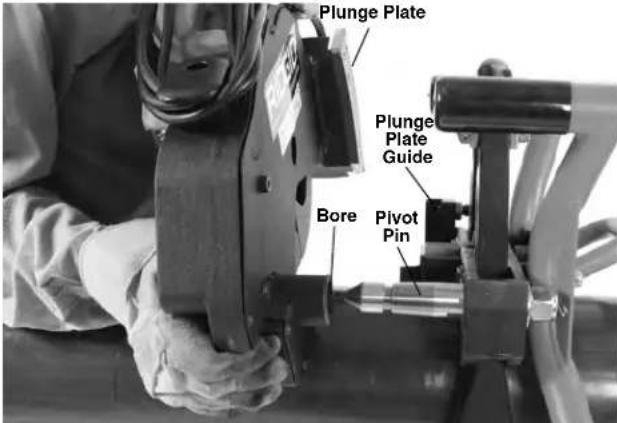
Securely grasp the PCS-500 Transportable Pipe Saw at the handle and the pivot grip. Align the pivot pin bore on the PipeSaw with pivot pin of the clamp and the plunge plate should be higher than the plunge plate guide. See Figure 11.
text_image
Plunge Plate Plunge Plate Guide Bore Pivot Pin
text_image
LatchFigure 11 – Aligning the Pivot Pin
-
Slide the PipeSaw pivot pin bore over the clamp pivot pin until the latch engages groove on clamp pivot pin.
-
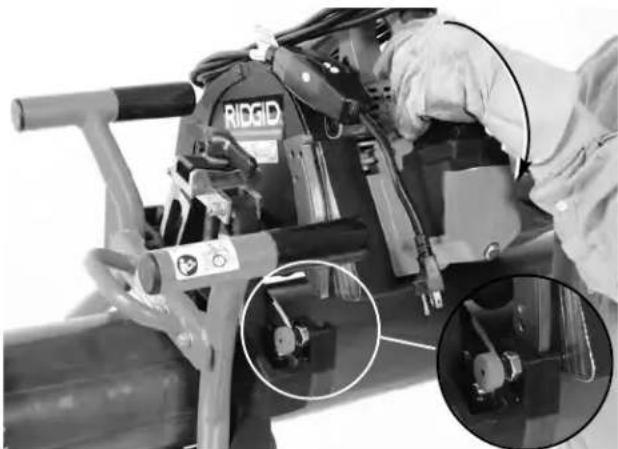
Pivot the handle end of the saw towards the pipe to engage the plunge plate in the clamp plunge plate guide. See Figure 12. The plunge lock pin will spring engage with the plunge plate ready position hole. Confirm that the PipeSaw is secure to the clamp and that the assembly is stable. The PipeSaw is locked in ready position and will not pivot until the plunge lock pin is retracted.
-
Confirm saw is unplugged to prevent unintentional starting. Grasp the saw handle with the right hand and pull the plunge lock pin with the left hand. Carefully pivot the saw towards the pipe and verify the saw blade aligns with the desired cut location.
-
Pivot the saw away from the pipe until the plunge lock pin engages with the ready position hole.
-
Adjust the clamp position if necessary. Loosen screw handle and move as necessary.
natural_image
Close-up of a person using a RIGID robotic tool, with two circular insets showing mechanical components (no visible text or symbols)Figure 12 – Engaging Plunge Plate Into Guide
-
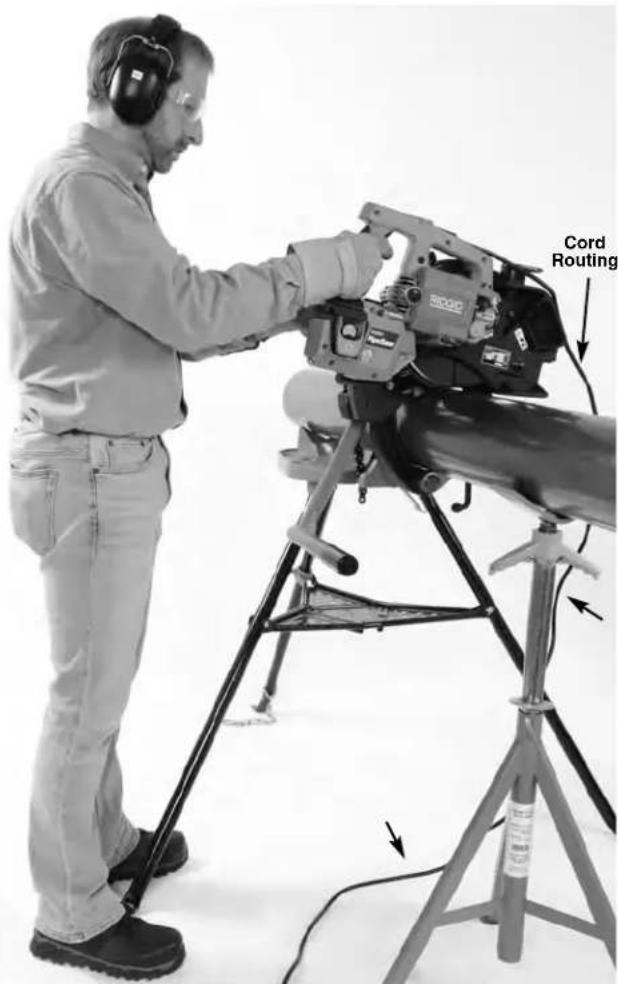
Route the cord as shown in Figure 13 to prevent tangling and obstructions during use. Ensure cord does not pass in front of the chip chute.
-
With dry hands, plug the power cord into a properly grounded outlet/extension.
Cutting Operation
- Assume a proper operating position (Figure 13).
- Stand to the side of the pipe, facing the PipeSaw handle with good access to the ON/OFF (I/O) switch. In case of emergency you must be able to turn the machine OFF.
- Be sure you have good balance and do not have to overreach.
- The operator should be the only one in the work area.
- Hold the nearest clamp handlebar with left hand.
text_image
Cord RoutingFigure 13 – Proper Operating Position
- With right hand, press the ON (I) switch to turn saw ON. The saw blade will start rotating.
- Firmly grip the saw handle with your right hand. With left hand, pull the spring-biased plunge lock pin on clamp until it disengages from the ready position hole in saw A. See Figure 14.
⚠ WARNING Do not touch pipe, do not place hands in pipe – the saw blade will be exposed in the pipe during cutting and could cause serious injury.
- Pivot the saw towards the pipe. Release the plunge lock pin and hold the clamp handlebar firmly. The guard start bracket will start to open the saw blade guards and the rotating blade will contact the pipe. Apply firm pressure to plunge the blade through the pipe wall ®. Monitor the LEDs on PipeSaw; if it begins to flash, plunge the saw slower.

natural_image
Close-up of hands operating a RIDGID industrial machine with tool handle (no visible text or symbols)Figure 14 – Plunge Lock Pin Disengagement
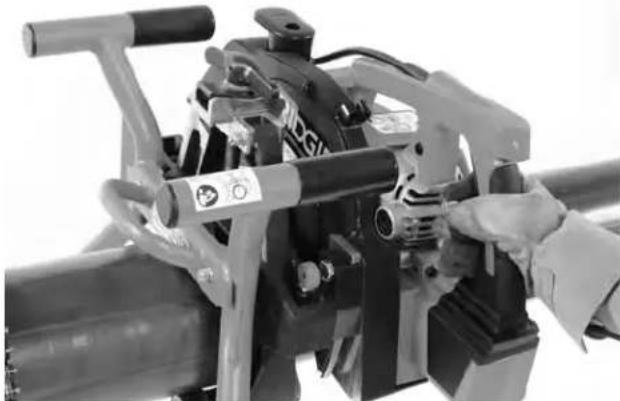
- When the saw blade is fully plunged into the pipe, the clamp plunge lock pin will engage cut position hole on saw plunge plate. Confirm that saw is locked in the cutting position. See Figure 15.
natural_image
Close-up of a hand operating a mechanical tool with visible components and a logo (no readable text or symbols)Figure 15 – PipeSaw Fully Plunged
- With one hand on the saw handle, grip the nearest clamp handlebar with other hand. Slowly rotate the PipeSaw away from you around pipe. The PipeSaw will only rotate in one direction.
Monitor the LED indicator lights on the unit (there are two LEDs – one at the handle and one near the pivot grip). If the LEDs flash, rotate the unit slower. It is important not to rotate the saw too fast to prevent saw overload, breaker tripping and saw blade damage. See Figure 16.
Always have at least one hand holding the unit. As the saw rotates around the pipe, move your hands from one clamp handlebar to the next. Monitor the pipe for movement that could indicate shifting, falling or binding pipe. Do not use cutting lubricants when cutting.
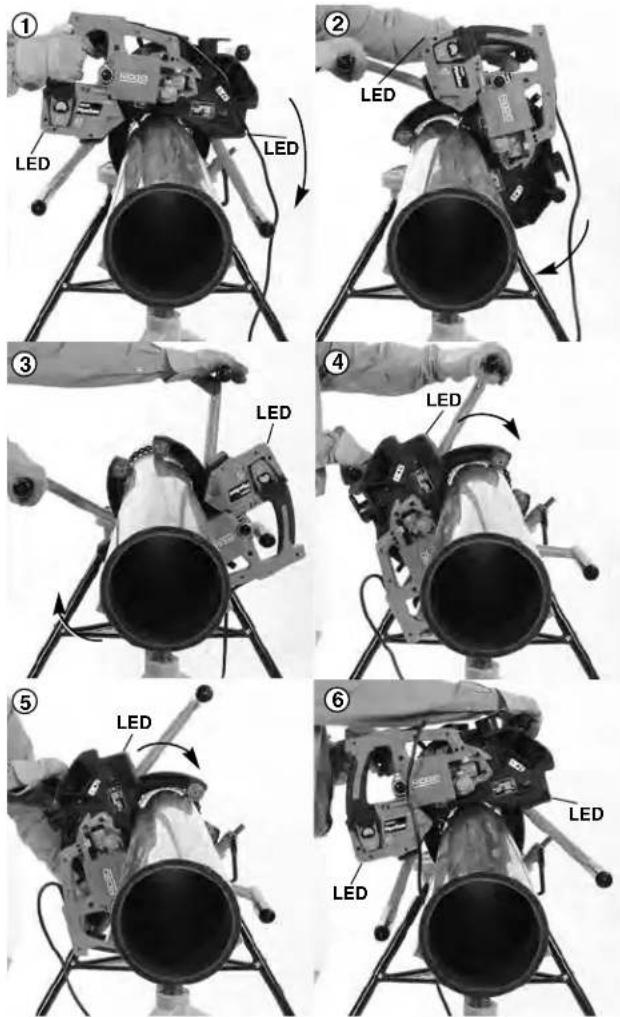
Figure 16 – Cutting Operation
⚠ WARNING Do not touch pipe, do not place hands in pipe – the saw blade will be exposed in the pipe during cutting and could cause serious injury.
Continually monitor the cord position and movement of the PipeSaw to the workpiece. Make sure the cord stays clear of moving parts. Stop rotating the unit and press the OFF (O) button If:
• The blade binds in the pipe.
• The PipeSaw unit does not track properly.
• The saw blade is not cutting properly.
• The process needs to be stopped for any reason.
If cutting is stopped before a cut is completed, unplug the saw. Hold the saw handle with right hand; with left hand, pull the plunge lock pin to disengage from cut position hole. Disengage the saw blade from pipe. Pivot the saw handle until the plunge lock pin engages ready position hole of saw plunge plate.
If the unit is stopped before the cut is complete, the cutting operation will need to be restarted. If possible, begin the cut at a new location to reduce the likelihood of possible blade damage. If repositioning at a new location is not possible, reposition the clamp on the pipe per the Mounting Clamp On Pipe instructions and align the saw blade with the prior cutting location. Then, follow the Cutting Operation instructions to plunge the blade through the existing cut and continue.
- Continue to rotate the PipeSaw around pipe until the cut is completed and the saw returns to the start position. As the cut is being completed, watch for the pipe shifting or moving. Do not touch pipe, do not place hands in pipe – the saw blade will be exposed in the pipe during cutting and could cause serious injury. Keep feet and body clear of any shifting or falling material.
- When the cut is complete, keep the saw blade running. While holding the saw handle with right hand; with left hand, pull the plunge lock pin to disengage from cut position hole.
- Raise the saw handle until the plunge lock pin engages ready position hole of saw plunge plate.
- Press the OFF (O) button. Keep hands on saw until blade stops rotating. Confirm that the saw and clamp is secure and stable.
- Unplug the PipeSaw.
- If cutting plastic pipe, clean the chips from the blade cavity after every cut. See Cleaning Saw Blade Cavity section.
Dismounting the PipeSaw and Clamp
Dismount the saw from the clamp after every cut. Leaving the saw on the clamp and moving as a unit can affect the tracking of the saw.
- Unplug the PipeSaw.
- Pull the plunge lock pin out. Pivot the saw up to disengage the plunge plate from the plunge lock pin and plunge plate guide.
- Hold the PipeSaw handle with one hand and pivot grip with other hand.
- Press the latch on PipeSaw unit to disengage the pivot pin and slide the saw off of the pivot pin. See Figure 11.
- Properly supporting the clamp on pipe, loosen the clamp lead screw about one turn.
- Press the quick release lever on the clamp and push upper carriage down to disengage the clamp from workpiece. Be careful of sharp edges on the pipe.

text_image
Cord Clip RIDGIDFigure 17 – Cord Wrapped for Transport
Transportation
- Make sure the cord is unplugged from the outlet.
- Separate the saw from the clamp, if needed, to reduce the carried weight.
- Clean the equipment.
- Coil the power cord around cord wrap as shown in Figure 17 and secure in cord clip.
Storage
WARNING The PCS-500 Transportable Pipe Saw must be kept dry and indoors or well covered if kept outdoors. Store the machine in a locked area that is out of reach of children and people unfamiliar with PipeSaw. This machine can cause serious injury in the hands of untrained users.
Maintenance Instructions
WARNING
Make sure the saw is unplugged before performing any maintenance or making any adjustments.
Dismount the PCS-500 Transportable Pipe Saw from clamp before any maintenance.
Maintain saw according to these procedures to reduce the risk of injury from electrical shock, entanglement and other causes.
Cleaning
After each use, wipe any chips off with a soft, clean, cloth or brush, especially areas of relative motion such as pivot pin, lead screw. Clean any dust and debris from the motor vents.
Clean the clamp wheel knurls with a wire brush.
Cleaning Saw Blade Cavity
Daily after use and after every plastic pipe cut, inspect and clean chips from the saw blade cavity.
- Securely position the saw with the blade cover up
- Using the supplied hex wrench, unscrew the saw blade cover door screw and swing the cover door out of the way. The screw will be retained by the cover door.
- Swing open the saw blade cover. See Figure 18.
- Clean the chips from the blade and inspect blade. Make sure the chip chute and surrounding cavity is clear. See Figure 18. Be aware that chips can be hot. To reduce risk of fire, do not allow hot chips to contact combustible material.
- Reverse steps 2-3 to close the saw blade cover. Securely tighten the screw. Never operate the PipeSaw with blade cover open.

text_image
Saw Blade Cover Door Chip Chute Saw Blade CoverFigure 18 – Saw Chip Chute and Cavity
General Lubrication
On a monthly basis (or more often if needed) lubricate all points of relative motion (such as lead screw and pivot points) with a light lubricating oil. Wipe any excess oil from exposed surfaces.
Gearbox Lubrication
Always check the gearbox oil level before using the PipeSaw. To check and add oil:
Place the saw feet on a horizontal surface. Remove oil plug/lock button assembly with hex wrench.
Check oil level, it should never be below bottom threads in the housing. Add heavy-duty worm drive saw lubricant oil as necessary, fill until oil reaches bottom threads of housing. Only use heavy-duty worm drive saw lubricant (catalog #69933) – other oils may not properly lubricate the worm gear and could damage the saw. Do not overfill. Install oil plug/lock button assembly (Figure 19).

text_image
Lock Button Oil LevelFigure 19 - Gearbox Lubrication
Changing Saw Blade
Replace the saw blade when the teeth become chipped or damaged. If cutting takes more force or longer or the LEDs start flashing more often, that indicates that the blade is dulling and needs to be changed.
- Open the saw blade cavity as per the Cleaning Saw Blade Cavity section.
- Press and hold the oil plug/lock button to lock the saw blade (see Figure 19).
- Use the supplied hex wrench to loosen the blade bolt. The blade bolt uses a left hand thread and will need to be turned clockwise (marked on the outer washer) to be removed.
- Remove the blade bolt and outer washer and retain for reuse.
- Remove the saw blade and replace with new blade, ensuring saw blade teeth are oriented correctly. Mount the blade against the inner washer (see Figure 20).
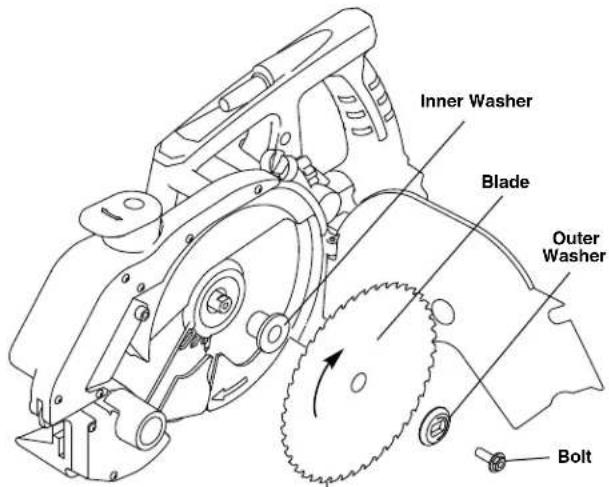
text_image
Inner Washer Blade Outer Washer BoltFigure 20 – Installing Saw Blade
- Install the outer washer and blade bolt and ensure there is no debris between the blade and inner/outer washer. Ensure proper assembly of blade and washers. See Figure 20.
- Press the oil plug/lock button and hand tighten the saw blade bolt by rotating counterclockwise, then turn an additional 45° (1/8 turn) using the supplied wrench, see Figure 21. Do not overtighten the bolt – the washers and bolt functions as a clutch to protect the tool.

text_image
1 2 45°Figure 21 - Tightening Blade Bolt
The saw blade clutching action is provided by the friction of the outer washer against the blade. It permits the blade shaft to turn when the blade encounters excessive resistance. When the blade bolt is properly tightened, the blade will slip when it encounters excessive resistance, thus reducing kickbacks or other damage.
One setting may not be sufficient for cutting all materials. If excessive blade slippage occurs, tighten the saw blade stud a fraction of a turn more (less than 1/8 turn). Overtightening the blade bolt prevents the clutch from slipping and can increase the risk of tool damage and injury.
- Reinstall the blade cover and securely tighten the lock plate screw.
Replacing Carbon Brushes
Check the motor brushes every six months and replace when worn to less than 316 " (5 mm).
- Unscrew brush caps (both sides of the PipeSaw motor).
- Remove brushes noting orientation. Inspect brushes. Replace when worn to less than 316 " (5 mm). See Figure 22. Inspect the commutator for wear. If excessively worn, have machine serviced. Clean the brush holders with a clean cloth.
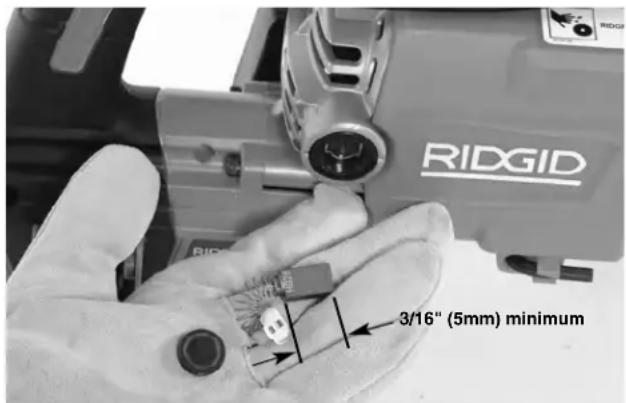
text_image
RIDGID 3/16" (5mm) minimumFigure 22 – Changing Brushes
- Re-install brushes in same orientation/install new brushes. Reassemble brush caps.
Motor Thermal Overload
If the saw overheats, the LEDs come on solid and the saw shuts down and will not run. If this happens, unplug the saw, allow the saw to cool for at least 30 minutes before operating again.
Service And Repair
WARNING
Improper service or repair can make machine unsafe to operate.
The “Maintenance Instructions” will take care of most of the service needs of this machine. Any problems not addressed by this section should only be handled by a RIDGID Authorized Independent Service Center. Only use RIDGID service parts.
For information on your nearest RIDGID Authorized Independent Service Center or any service or repair questions see Contact Information section in this manual.
Troubleshooting
| SYMPTOM POSSIBLE REASONS SOLUTION | ||
| Excessive vibration during operation. | Pipe not stable on stands. | Support pipes on stands properly. |
| Long pipes not properly supported. | Support longer pipes with additional pipe supports. See Workpiece Preparation section. | |
| Clamp not properly mounted. | Properly mount the clamp on pipe. See Mounting Clamp On Pipe section. | |
| Saw blade out of balance. | Discard saw blade and use different blade. | |
| Machine not cutting pipes properly. | Worn saw blade. | Replace worn saw blade. |
| Use on incorrect tube size or material. | Use on correct type of pipe (see Specifications). | |
| Machine stalls while cutting. | Applying excessive force rotating the saw while cutting. | Rotate saw more slowly, LED's should not be on. |
| Worn saw blade. | Replace worn saw blade. | |
| Blade binds during operation. | Properly support pipe. Rotate saw more slowly, LED's should not be ON. | |
| Clutch not set properly. | Adjust the clutch properly, see Changing Saw Blade section. | |
| Cut not square to pipe. | Damaged or dirty clamp or saw. | Inspect/clean saw. Have serviced if needed. |
| Improper Installation. | Reinstall per instructions. | |
| Saw does not run. | Saw is overheated. | See Motor Thermal Overload section. |
| Saw is damaged. | Take for service. | |
Optional Equipment
WARNING
To reduce the risk of serious injury, only use accessories specifically designed and recommended for use with the RIDGID PCS-500 Transportable Pipe Saw, such as those listed.
For a complete listing of RIDGID equipment available for these tools, see the Ridge Tool Catalog online at RIDGID.com or see Contact Information.
| CatalogNo. Description |
| 66378 PC-106 1" - 6" PipeSaw Clamp |
| 66383 PC-612 6" - 12" PipeSaw Clamp |
| 67883 PCS-500 PipeSaw Cutting Unit |
| 66388 PC-106+PCS-500 1" - 6" Clamp with PipeSaw Cutting Unit |
| 66393 PC-612+PCS-500 6" - 12" Clamp with PipeSaw Cutting Unit |
| 66398 PC-106+PC-612+PCS-500 1" - 6" Clamp, 6" -12" Clamp, and PipeSaw Cutting Unit |
| 66403 Storage Bag |
| 66413 Saw Blade for Cutting Steel and Stainless Steel Pipe |
| 69053 Saw Blade for Cutting Plastic Pipe |
| 69988 Saw Blade for Cutting Iron Pipe |
| 69933 Heavy-duty Worm Drive Saw Lubricant |
Disposal
Parts of these tools contain valuable materials and can be recycled. There are companies that specialize in recycling that may be found locally. Dispose of the components in compliance with all applicable regulations. Contact your local waste management authority for more information.

For EC Countries: Do not dispose of electrical equipment with household waste!
According to the European Guideline 2012/19/EU for Waste Electrical and Electronic Equipment and its implementation into national legislation, electrical equipment that is no longer
usable must be collected separately and disposed of in an environmentally correct manner.
natural_image
Two black quadruped robotic devices with articulated limbs, one resembling a dog's head and the other a mechanical device (no visible text or symbols)
AVERTISSEMENT !
natural_image
Black-and-white photo of two metal support structures with metal legs and a wooden beam, no visible text or symbols.Figure 7 – Exemple de porte-tubes
natural_image
Mechanical clamp assembly diagrams showing two views (A and B) of a clamp mechanism with no visible text or symbolsnatural_image
Close-up of a mechanical component with a ruler measuring a white object, no visible text or symbolsnatural_image
Close-up of a person using a RIGID robotic tool, showing mechanical components and a close-up inset (no text or symbols visible)natural_image
Close-up of hands operating a RIDGID utility tool on a metal pipe, with labeled parts A and B (no text beyond labels)natural_image
Close-up of a hand operating a mechanical power tool with visible components and no text or symbolsnatural_image
Two black quadruped robotic devices with visible mechanical joints and sensors, one larger and one smaller, against a white background (no text or symbols)
ADVERTENCIA!
natural_image
Black-and-white photo of two metal support structures with metal legs and a long cylindrical object on top, no visible text or symbols.natural_image
Two mechanical clamping mechanisms labeled A and B, showing hand positioning and assembly (no text or symbols present)natural_image
Close-up of a mechanical component with a ruler measuring a cylindrical part, showing measurement markings (no text or symbols visible)natural_image
Close-up of a person working on a utility pole with visible mechanical components and a close-up inset showing mechanical parts (no text or symbols)natural_image
Close-up of hands operating a RIGID drilling machine with tool labeled A and B (no visible text or symbols beyond labels)natural_image
Close-up of a hand operating a mechanical tool with a cylindrical component (no visible text or symbols)NOTE: This equipment has been tested and found to comply with the limits for a Class A digital device, pursuant to part 15 of the FCC Rules. These limits are designed to provide reasonable protection against harmful interference when the equipment is operated in a commercial environment. This equipment generates, uses, and can radiate radio frequency energy and, if not installed and used in accordance with the instruction manual, may cause harmful interference to radio communications. Operation of this equipment in a residential area is likely to cause harmful interference in which case the user will be required to correct the interference at his own expense.
RIDGID® PCS-500 PipeSaw Transportable Pipe Saw
RIDGE TOOL COMPANY
400 Clark Street
Elyria, Ohio 44035-6001
U.S.A.
Ridge Tool Europe NV (RIDGID)
EC DECLARATION OF CONFORMITY
We declare that the machines listed above, when used in accordance with the operator's manual, meet the relevant requirements of the Directives and Standards listed below.
DÉCLARATION DE CONFORMITÉ CE
DEKLARACJA ZGODNOŚCI WE
Conforms to UL 62841-1
Certified to CSA 22.2 #62841-1

Signature

Qualification: V.P. Engineering
Date: 10/01/2020
What is covered
RIDGID ^® tools are warranted to be free of defects in workmanship and material.
How long coverage lasts
This warranty lasts for the lifetime of the RIDGID tool. Warranty coverage ends when the product becomes unusable for reasons other than defects in workmanship or material.
How you can get service
To obtain the benefit of this warranty, deliver via prepaid transportation the complete product to RIDGE TOOL COMPANY, Elyria, Ohio, or any authorized RIDG/BUTHORIZED INDEPENDENT SERVICE CENTER. Pipe wrenches and other hand tools should be returned to the place of purchase.
What we will do to correct problems
Warranted products will be repaired or replaced, at RIDGE TOOL'S option, and returned at no charge; or, if after three attempts to repair or replace during the warranty period the product is still defective, you can elect to receive a full refund of your purchase price.
What is not covered
Failures due to misuse, abuse or normal wear and tear are not covered by this warranty. RIDGE TOOL shall not be responsible for any incidental or consequential damages.
How local law relates to the warranty
Some states do not allow the exclusion or limitation of incidental or consequential damages, so the above limitation or exclusion may not apply to you. This warranty gives you specific rights, and you may also have other rights, which vary, from state to state, province to province, or country to country.
No other express warranty applies
This FULL LIFETIME WARRANTY is the sole and exclusive warranty for RIDGID ^® products. No employee, agent, dealer, or other person is authorized to alter this warranty or make any other warranty on behalf of the RIDGE TOOL COMPANY.

text_image
RIDGID FULL LIFETIME WARRANTY Against Material Defects & WorkmanshipParts are available online at Store.RIDGID.com
Ridge Tool Company
400 Clark Street
Elyria, Ohio 44035-6001
U.S.A.