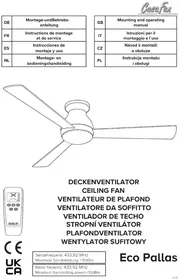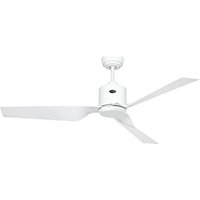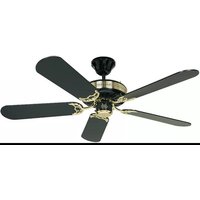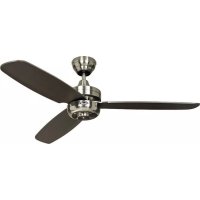
Night Flight - Fan CasaFan - Free user manual and instructions
Find the device manual for free Night Flight CasaFan in PDF.


User questions about Night Flight CasaFan
0 question about this device. Answer the ones you know or ask your own.
Ask a new question about this device
Download the instructions for your Fan in PDF format for free! Find your manual Night Flight - CasaFan and take your electronic device back in hand. On this page are published all the documents necessary for the use of your device. Night Flight by CasaFan.
USER MANUAL Night Flight CasaFan
natural_image
Line drawing of a three-blade office fan with a central hub (no text or symbols)DECKENVENTILATOR CEILING FAN VENTILATEUR DE PLAFOND VENTILATORE DA SOFFITTO
NIGHTFLIGHT
natural_image
Simple line drawing of a ceiling-mounted fixture with a central component and two base legs (no text or symbols)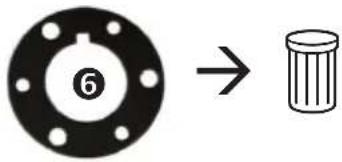
text_image
⑥ →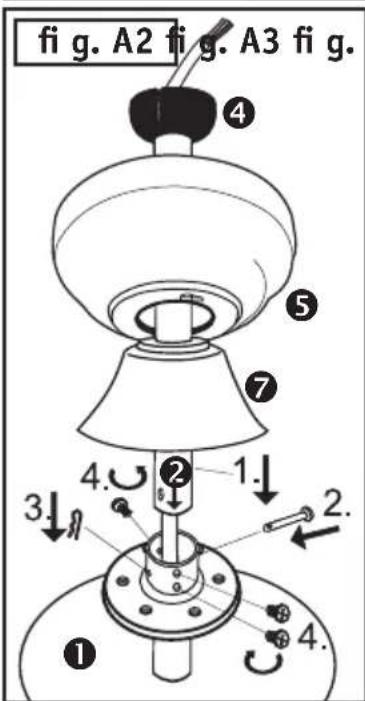
text_image
fi g. A2 fi g. A3 fi g. ① ② ③ ④ ⑤ ⑦ ② 1. 2. 3. 4. 4.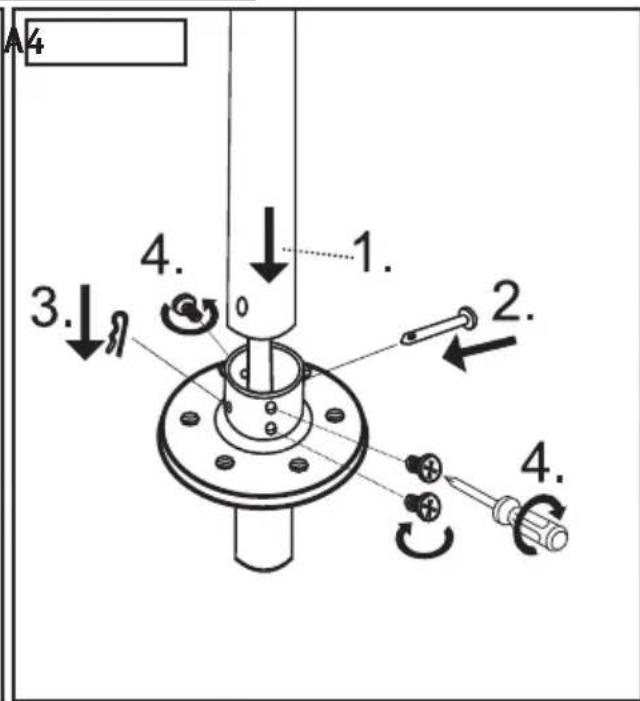
text_image
A4 1. 2. 3. 4. 4.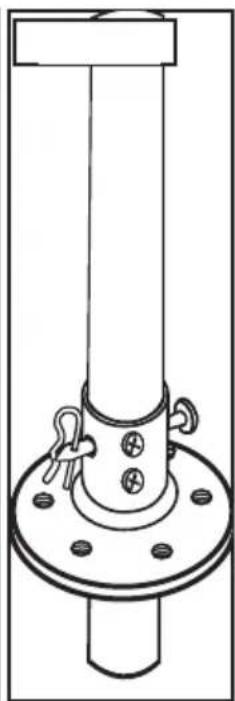
natural_image
Technical line drawing of a mechanical assembly with a flanged base and bolted mounting flange (no text or symbols)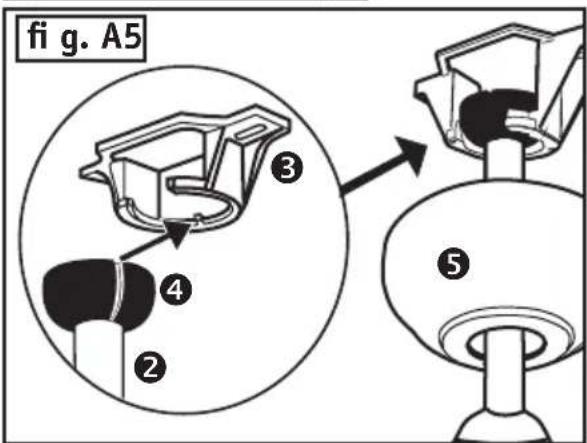
text_image
fi g. A5 ② ③ ④ ⑤natural_image
Simple line drawing of a mechanical assembly with a brick wall and a base (no text or symbols)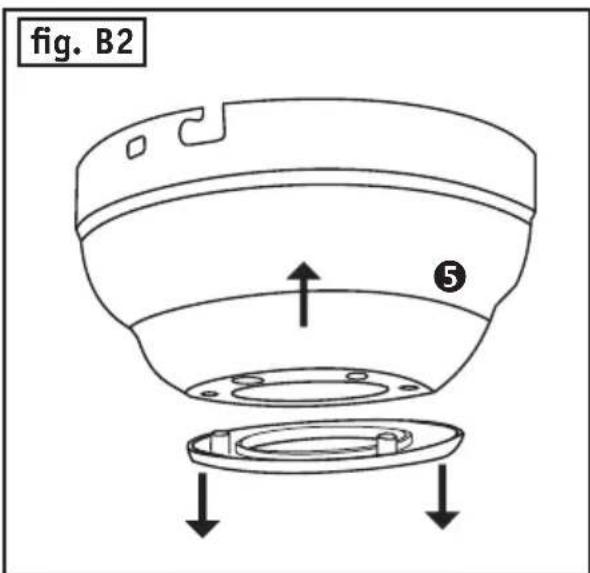
text_image
fig. B2 ⑤
text_image
fig. B3 ① ⑤ ⑥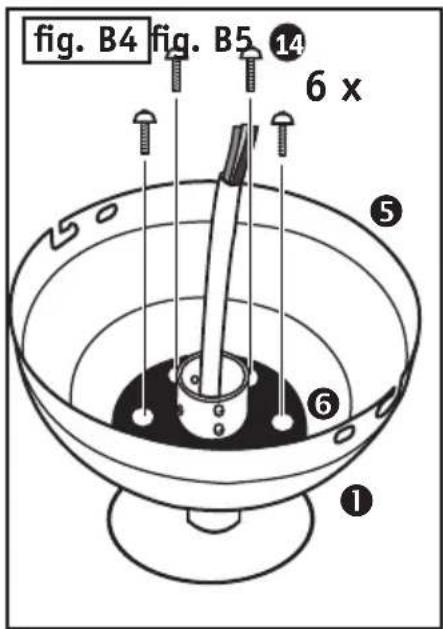
text_image
fig. B4 fig. B5 14 6 x ⑤ ⑥ ①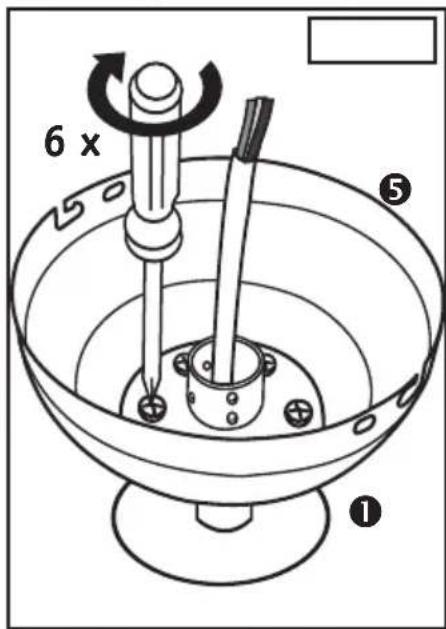
text_image
6 x ① ⑤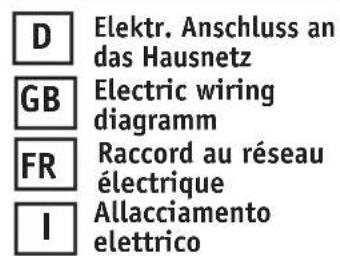
text_image
D Elektr. Anschluss an das Hausnetz GB Electric wiring diagramm FR Raccord au réseau électrique I Allacciamento elettrico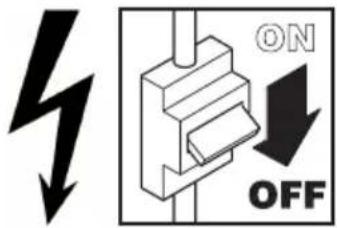
text_image
ON OFF
text_image
3. fig. B6 1. 2. 5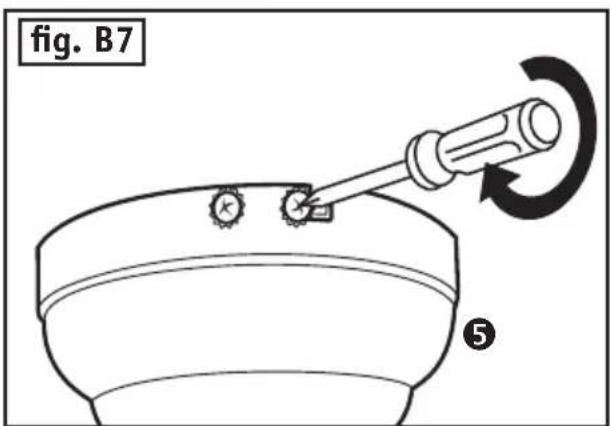
text_image
fig. B7 ⑤


About this operating instructions
Before using the CasaFan fan, read the operating instructions carefully. Keep the operating instructions within reach. Never pass the fan onto another person without the operating instructions.
| Explanation of symbols: | ||
| Dangerous electric voltage | Careful | |
| Warn the user of the dangers caused by electricity | Particular note for the user. | |
| Describing the CasaFan-VentilatorThe fan is for circulating room air. Their use in machines which are outside and unprotected, in garages, in moist or wet rooms or rooms in danger of fire or explosion, is not permitted. | ||
| Technical data: | ||
| NIGHTFLIGHT | ||
| Mains voltage: 230 V, 50 Hz | ||
| Power: 66 Watt | ||
| Protection clas: I / IP 20 | ||
| No of speeds: | 1 | |
| Dimensions ∅ x H (mm) | 1320 x 410 | |
| Weight (kg): | 8,1 | |

Caution! Only operate the unit when completely assembled!
| - Unpack the CasaFan fan, check if everything is present (see page 2) and for visible signs of damage. | ||
| 1. Motor block 6. mounting ring | 11. Anitvibration-gasket | (3x) |
| 2. Assembly rod 7. Lower cover | 13. Balancing kit | |
| 3. Mounting bracket 8. Screw | for blade (6x) 14. Screw | direct installation(6x) |
| 4. Ball assembly 9. Blade (3x) | ||
| 5. Canopy 10. Screw (2x) | ||
- Dispose of packaging taking the environment into account and keep out of the reach of children. Assembly
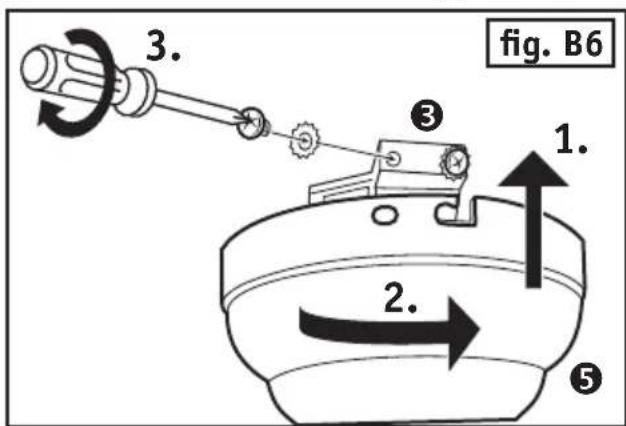
Please proceed as per figures 1 - 10 at Page 4 - 7 of these operating instructions.

When dealing with electricity, just conforming to all the safety and precautionary measures can not describe every danger situation. They do not replace sensible procedures and care, which you have to take into account when first initiating and then running your fan.
When using any electric units, several basic rules have to always followed, as detailed below:
GB
General

- The voltage details on the nameplate are to conform with the available mains voltage.
- The building mains must be earthed!
- Only operate the unit when completely assembled!
Important

- It is recommended that a specialist electrician is used for making the electrical connection to this fan.

Safety instructions
Before accessing the connection, all current carrying conductors are to be isolated.
The mains connections to which you are connected is to comply with current specifications. The fixed wire connection is to be provided with a multi-pole isolator with contact gaps of at least 3 mm. We recommend that the connection be made by a qualified electrician.

The construction of the holder and the output box is to be able to bear the weight of the fan when being moved, ie, about 15 kg minimum. Chose a secure, safe location. None of the fan blades are to be less than 2.30 m from the ground. The fan is to be correctly earthed.

Before first using the setup, all electrical connections are to be checked in order to prevent any fall, fire or electric shock.
Installing your ventilator
Ascertain that a mounting bracket is available at the intended mounting point.
If this not the case, then fix the mounting bracket directly to the ceiling using wood screws having a diameter of 6 mm and, if necessary, 8 mm diameter concrete anchors or special plugs suitable for plaster boards.

Proceed as per fig. 1 - fig. 10 shown on page 4 - 7
- Unpack the ventilator and check the contents. All the parts shown in the drawing are to be present.
- The mounting plate is separate from the fan.
Assemble the mounting plate using the screws and washers to the ceiling outlet.
In order to assure a safe operation of your fan, make sure that the mounting plate is firmly seated and is level.

-The attached part is to be vertical.
- Fix the support hook to the ceiling.
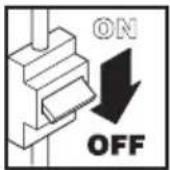
- Disconnect the electricity before working on the electrics.
- Make the electrical connection to your fan as per Figure on page 5 in fig. 8.
- Fix the blades to the motor using the bolts.
- If you are installing several fans, make sure that the various blades are not mixed up,
- The blades are grouped according to weight, in order to avoid vibration.
- After finishing assembling the fan, make sure that all connections are in order and that all nuts and bolts are tightened.

Operating your fan
Make sure that the assembly has been completely finished.
Use a stepped transformer for controlling the speed, optional extra. Never use a dimmer or a phase angle or phase inverse angle controller.
Important
Even if your fan is more that 2.30 m above the ground, care must still be taken care that the blades are free to turn and no objects can enter their radius of action.
Maintaining you fan
You increase the life of your fan by heeding the following notes:
- Check the various ceiling fixing parts and bracket twice a year.
Some of the parts on the fan components can have play. - Never use water for cleaning the motor or other electrical parts; this would lead to a short circuit.
-
Use a soft cloth for cleaning the blades and housing.
-
Greasing the bearings is not necessary, the bearings are permanently lubricated.
Do not forget to check that the earth connection lead has been correctly connected to the output terminal block and between all metal parts (connect the push-on contact to every earth symbol).
| Notes for removing faults | |
| Fault Remedy | |
| The fan does not start. | Check the fuses/trips at the main box and other connections. |
| Check the fan connection to the mains. | |
| Check that fuses/trips in the connection box are correctly inserted. | |
| The fan is noisy. Check that all bolts and screws have been tightened. | |
| Run in the fan and the bearings for 24 hours. Most noises disappear after this time. | |
| The fan vibrates too much. | All blades have been weighed and grouped according to weight. Their density can vary and therefore cause vibration even when all blades are of the same weight. The following methods can contribute to preventing most vibrations. Check the vibration before each procedure. Please note that a small amount of vibration is normal and does not pose a problem. |
| Most vibrations occur when one of the blades is not in alignment with the others. Aligning the blades is simply carried out with the aid of a flat ruler. Place the ruler vertically upwards against the ceiling and alongside the blade tip. Mark the distance between the blade side and ceiling. Turn the blades slowly by hand and carry out the same measurements with the other blades. If one of the blades is not correctly aligned, it can be remedied by lightly pressing their holders upwards or downwards in order to align them with the others. | |
| Check that the mounting plate is firmly anchored to the ceiling. | |
| Important: Opening up and repairing the unit may only be carried out by a specialist! | |
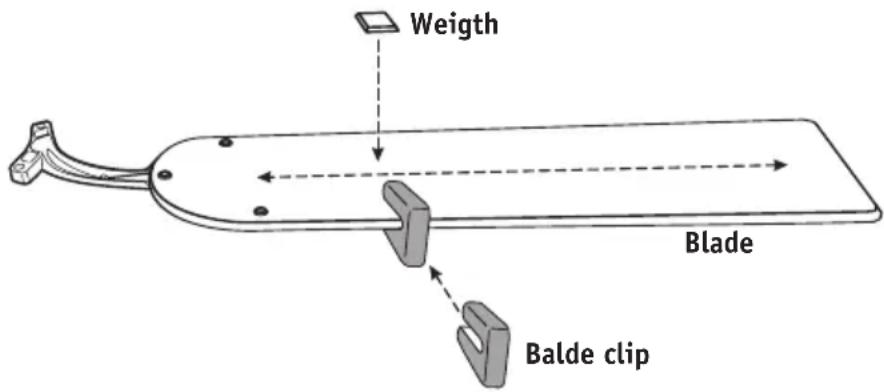
The balancing kit contains 2 weights at 5 grams each as well as a blade clip with 5 grams weight. If your ceiling fan is running after accurate and complete installation unbalanced ("wobbling"), please follow step 1 to 6:
- Switch your ceiling fan on and find out the speed setting at which the wobble is the greatest.
- Turn off your ceiling fan and allow it to come to a complete stop. Select one blade and place the balance clip on it, halfway between the bladeholder and the blade tip on the trailing edge of the blade.
- Turn the fan on and select the speed setting at which the wobble was greatest. Note whether the wobble has increased or decreased. Turn the fan off, move the clip to the next blade and retest. Repeat this procedure on all blades noting the blades on which the greatest improvement is achieved.
- Move the clip back to the blade that showed the greatest improvement. Move the clip inward and outward on this blade and operate the fan to find the position where the clip gives the greatest improvement.
- Remove the clip and glue the balancing weight on top of the blade along the centerline at the point where the clip was positioned.
- If the fan wobble problem has not been corrected finally you can improve the balancing further by repeat the procedure with additional weights. The weight can be easily devided in two parts with a cutter.
text_image
Weigth Blade Balde clipWhere does "wobbling" come from?
The blade of a ceiling fan could run at the blade tip with a speed of up to 10 m/sec. If the density or the compound varies, an imbalance towards the weightly blade occurs.
Especially wooden blades which are made from a natural material often have different densities, resulting in an imbalance.
All blades of CasaFan ceiling fans are weighted by a accurate scale and ordered by weight. A set of blades contents always 5 blades of the same weight. The atmospheric humidity changes the density of the wood. By this reason the edge and the surface of CasaFan blades are sealed against normal atmospheric humidity. For damp or wet locations we recommend acrylic blades which are non-sensitive against humidity and water.
Please consider that a fall of the packing from a low height could cause a transformation of the compound. Hence a small imbalance up to 5 mm (measured at the switch cup of the ceiling fan) is no quality defect. It can be eliminated as aforementioned with the balancing kit.
Lot d'équilibrage
This product conforms to EU Directive 2002/96/EC. This appliance bears the symbol of the barred waste bin. This indicates that, at the end of its useful life, it must not be disposed of as domestic waste, but must be taken to a collection centre for waste electrical and electronic equipment, or returned to a retailer on purchase of a replacement.

It is the user's responsibility to dispose of this appliance trough the appropriate channels at the end of its useful life. Failure to do so may incur the penalties established by laws governing waste disposal. Proper differential collection, and the subsequent recycling, processing and environmentally compatible disposal of waste equipment avoids unnecessary damage to the environment and possible related health risks, and also promotes recycling of the materials used in the appliance. For further information on waste collection and disposal, contact your local waste disposal service, or the shop from which you purchased the appliance. Manufacturers and importers fulfil their responsibilities for recycling, processing and environmentally compatible disposal either directly or by participating in collective systems.