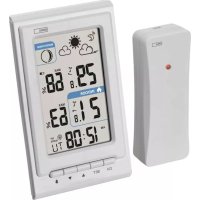
E0352 - Weather Station Emos - Free user manual and instructions
Find the device manual for free E0352 Emos in PDF.



| Product type | Wireless weather station |
| Brand | Emos |
| Model | E0352 |
| Sensor dimensions | 21 × 38 × 100 mm |
| Station power supply | 2 x 1.5 V AAA batteries (not included) |
| Sensor power supply | 2 x 1.5 V AA batteries (not included) |
| Radio signal range | Up to 30 m in open air |
| Transmission frequency | 433 MHz, 10 mW e.r.p. max. |
| Maximum number of sensors | 3 |
| Radio-controlled clock | DCF77 |
| Indoor temperature range | -10 °C to +50 °C (resolution 0.1 °C) |
| Outdoor temperature range | -40 °C to +60 °C (resolution 0.1 °C) |
| Temperature accuracy | ±1.5 °C |
| Indoor humidity range | 1% to 99% RH (resolution 1%) |
| Outdoor humidity range | 20% to 95% RH (resolution 1%) |
| Humidity accuracy | ±5% |
| Main functions | Radio-controlled clock, alarm, snooze, weather forecast, moon phases, max/min memory, temperature curves, automatic sensor rotation |
| Care and cleaning | Soft, slightly damp cloth; do not use solvent or cleaning agent |
| Safety | Do not expose to water, naked flames, extreme temperatures; do not open or repair yourself |
Frequently Asked Questions - E0352 Emos
User questions about E0352 Emos
0 question about this device. Answer the ones you know or ask your own.
Ask a new question about this device
Download the instructions for your Weather Station in PDF format for free! Find your manual E0352 - Emos and take your electronic device back in hand. On this page are published all the documents necessary for the use of your device. E0352 by Emos.
USER MANUAL E0352 Emos
text_image
Technical diagram of a device with numbered components, likely an electrical or mechanical assembly.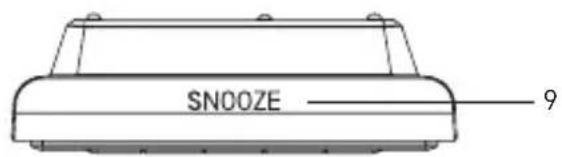
text_image
SNOOZE 91
text_image
1 2 3 4 5 6 7 8 9 10 11 12 13 14 15 16 17 29.8 °C MAX 68% C#M ENDOOR 21.8 °C MAX 63% AM 12:08 TU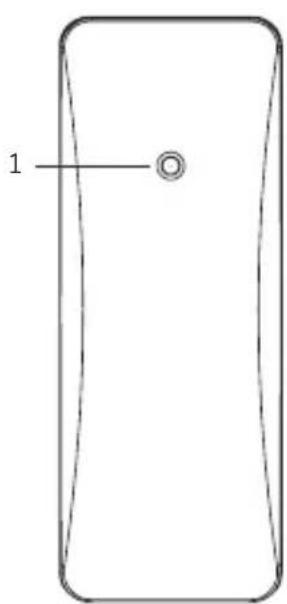
natural_image
Simple line drawing of a rectangular object with a circular hole and label '1' pointing to its top edge (no text or symbols on the object itself)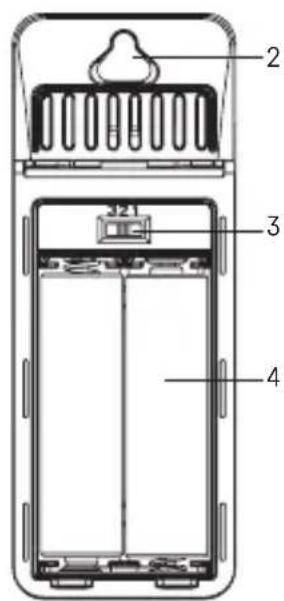
text_image
Technical diagram of a battery pack with labeled components including top, front, and internal compartments2
3
GB | Wireless Weather Station
Read this manual carefully before using the product.
Specifications
radio-controlled clock
time format: 12/24 h
indoor temperature: -10 °C to +50 °C, 0.1 °C resolution
outdoor temperature: -40 °C to +60 °C, 0.1 °C resolution
temperature measurement accuracy: ±1.5 °C
indoor humidity: 1 to 99 % RH, 1 % resolution
outdoor humidity: 20 to 95 % RH, 1 % resolution
indoor and outdoor humidity measurement accuracy: 5 %
radio signal range: up to 30 m in an open area
transmission frequency: 433 MHz, 10 mW e.r.p. max.
number of sensors: max. 3
power supply:
main station: 2× 1.5 V AAA batteries (not included)
sensor: 2× 1.5 V AA batteries (not included)
dimensions and weight without batteries:
main station: 23 × 76 × 126 mm
sensor: 21 × 38 × 100 mm
Weather Station Description (Fig. 1)
1 - CH button
6 - Battery compartment
2 - SET button
7 - Stand
3 - Up arrow button
8 - Hole for hanging
4 - Down arrow button
9 - SN00ZE touch button
5 - Alarm button
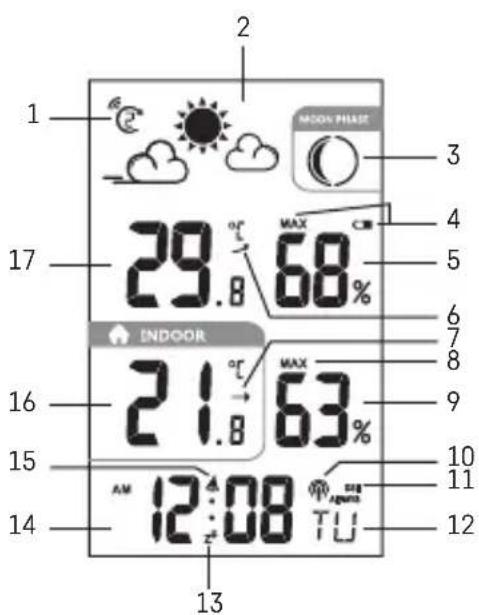
Display Description (Fig. 2)
1 - Sensor number
9 – Outdoor humidity
2 - Weather forecast
10 - DCF signal reception
3 - Moon phase
11 – Daylight saving time
4 - Low batteries in the sensor / Memory of max. and min. outdoor temperature and humidity
12 - Day of the week
5 – Outdoor humidity
13 - Alarm snooze
6 - Outdoor temperature trend
14 - Time
7 - Indoor temperature trend
15 - Alarm
8 - Memory of max. and min. indoor temperature and humidity
16 - Indoor temperature
17 - Outdoor temperature
Sensor Description (Fig. 3)
1 - LED
3 - Sensor channel number 1/2/3 setting
2 - Hole for hanging
4 - Battery compartment
Attention
Only use 1.5 V alkaline batteries of the same type; do not use rechargeable 1.2 V batteries.
Lower voltage may cause both of the units to not function.
Getting Started
-
First, insert batteries into the weather station (2× 1.5 V AAA), then into the wireless sensor (2× 1.5 V AA). Make sure the polarity is correct when inserting the batteries to avoid damaging the weather station or sensor.
-
Place the two units next to each other. After placing batteries into the station, the station automatically starts searching for DCF77 signal (hereinafter referred to as DCF); the ⚙ icon will be flashing. No other data on the display will be updated and all buttons will be disabled during the search. Long pressing the ▼ button cancels the search for DCF signal prematurely and the station automatically loads the temperature and humidity readings from the sensor. The weather station will detect the remote sensor signal within 3 minutes. If signal from the sensor is not detected, repeat the process from step 1.
- If the outdoor temperature reading disappears from the display, long press the CH button on the station. The station will start searching for the sensor signal.
- We recommend placing the sensor on the north side of the house. The range of the sensor may decrease substantially in areas with a large number of obstacles. The sensor is resistant to dripping water; however, it should not be exposed to sustained rain. Do not place the sensor on metal objects as these would reduce transmission range. Use the sensor in vertical position only. If the weather station display shows the low battery icon in the outdoor humidity field, replace the batteries in the sensor.
Note: It may take up to 30 minutes since the insertion of batteries into the units before the station begins showing the correct measured data and loads DCF time.
Changing Sensor Channel and Connecting Additional Sensors
The station can be paired with up to 3 wireless sensors.
- Choose the desired channel - 1, 2, or 3 - for the sensor by repeatedly pressing the CH button on the station.
- The number will be displayed in field no. 1 ^6 .
- Then, long press the CH button; the Ⓞ icon will start flashing.
- Remove the battery cover on the back of the sensor and move the slider to the sensor channel of choice (1, 2, 3).
- Insert batteries (2× 1.5 V AA) into the sensor. Data from the sensor will be loaded into the station within 3 minutes.
- If the sensor signal is not detected, remove the batteries and reinsert them.
Displaying Data from Multiple Sensors, Automatic Cycling through Values from Connected Sensors
Press the CH button repeatedly to display data from all connected sensors one by one. You can also activate automatic cycling through data from all connected sensors:
1. Turning on cycle mode
Repeatedly press the CH button until the display shows an arrow icon with sensor number Data from all connected sensors will be shown automatically and repeatedly on the station's display one after another.
2. Turning off cycle mode
Press the CH button; the arrow icon will disappear.
Radio-Controlled Clock (DCF77)
After placing batteries into the station, the station automatically starts searching for DCF77 signal (hereinafter referred to as DCF); the icon will be flashing.
No other data on the display will be updated and all buttons will be disabled during the search.
Long pressing the ▼ button cancels the search for DCF signal prematurely and the station automatically loads the temperature and humidity readings from the sensor.
DCF signal detected – the 📋 icon stops flashing and the current time and date will be displayed along with a 🔒 icon.
DCF signal not detected – DCF icon will not be displayed.
To repeat the search for DCF signal (3–8 minutes), long press the ▼ button; to cancel the search for DCF signal long press the ▼ button again. DCF signal will be continuously synchronised every day.
During daylight saving time, the DST ALWAYS icon will be displayed next to the DCF icon.
In normal conditions (at a safe distance from sources of interference, such as television sets or computer monitors) the detection of time signal takes several minutes.
If the weather station does not detect the signal, follow these steps:
- Move the weather station to another location and try to detect DCF signal again.
- Check the distance of the clock from the sources of interference (computer monitors or television sets). The distance should be at least 1.5 to 2 m during the reception of signal.
- When receiving DCF signal, do not put the weather station in the proximity of metal doors, window frames and other metal structures or objects (washing machines, dryers, refrigerators etc.).
- DCF signal reception is weaker in reinforced concrete structures (cellars, high-rise buildings etc.), depending on the conditions.
In extreme cases, place the weather station close to a window in the direction of a transmitter.
Reception of DCF radio signal is affected by the following factors:
- thick walls and insulation, basements and cellars,
- inadequate local geographical conditions (these are difficult to assess in advance),
• atmospheric disturbances, thunderstorms, electrical appliances with no interference elimination, television sets and computers located near the DCF receiver.
If the weather station cannot detect DCF signal, time and date must be set manually.
Note: If the weather station detects DCF signal but the current time on the display is incorrect (e.g. shifted ±1 hour), you must always set the correct time zone for the country where you are using the station, see Manual Setting of Time.
Manual Setting of Time and Date
- Long press the SET button.
- Use the ▲/▼ buttons to set the following parameters: calendar language (EN, GE, IT, FR, DU, SP, DA) – unit of temperature: °C/°F – DCF signal reception (ON/OFF) – time zone – year – month – day – time format: 12 h/24 h – hours – minutes.
Confirm each set value by pressing the SET button; holding ▲ speeds up setting changes.
If no button is pressed within 20 seconds, the unit will revert to the basic display.
Alarm Settings
Long press the button; the alarm time will start flashing.
Use the ▲ buttons to set the hour, minute and snooze time delay (5–60 minutes).
Confirm set values by pressing 🍻.
Once settings are finished, the 🔊 icon will be displayed automatically. The alarm will then activate at the set time.
If you wish to deactivate the alarm, press the button followed by . The alarm icon will not be displayed.
To reactivate the alarm, press the ▲button again.
Snooze Function
You can postpone an alarm by pressing the SNOOZE located on the top of the station.
Press the button when the alarm starts ringing. The zicon will start flashing.
To cancel SNOOZE mode, press any other button while the alarm is ringing – the zicon will stop flashing and the ▲ icon will appear on the screen.
The alarm will be re-activated the next day.
If you do not press any button while the alarm is ringing, the ringing will stop automatically after 2 minutes.
Displaying Maximum and Minimum Temperature/Humidity Readings
Press the ▲button repeatedly to gradually display the maximum and minimum readings of indoor and outdoor temperature and humidity.
The memory of measured values is automatically erased every day at 00:00.
To manually erase the memory of measured values, long press the button.
Indoor and Outdoor Temperature Trend
The icon for outdoor temperature trend is shown in field no. 6.
The icon for indoor temperature trend is shown in field no. 7.
| temperature trend indicator | |||
| falling constant rising | |||
Moon Phase
The moon phase icon is displayed in field no. 3.
The main phases are as follows:
| Full moon | Waning gibbous | Waning gibbous | Last quarter | Waning crescent | Waning crescent | New moon | Waxing crescent | Waxing crescent | First quarter | Waxing gibbous | Waxing gibbous | Full moon |
Weather Forecast
The station uses changes in atmospheric pressure to forecast weather for the next 12–24 hours for an area within the range of 15–20 km.
The accuracy of weather forecast is approximately 70%. As the weather forecast may not be 100% accurate, neither the manufacturer nor the seller can be held responsible for any loss caused by an incorrect forecast. When you first set or reset the weather station, it takes approximately 12 hours before the weather station begins forecasting correctly. The weather station displays 4 weather forecast icons.
Note: Currently displayed icon means a forecast for the next 12–24 hours. It may not reflect the current state of the weather.
 |  | 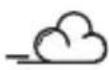  | 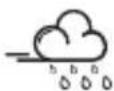  |
| Sunny Cloudy Overcast Rain | |||
Safety Instructions and Warnings
Read the user manual before using the device. Follow the safety instructions stated in the manual. The product is designed to serve reliably for many years if used properly.
- Read the manual carefully before using this product.
- Do not expose the product to direct sunlight, extreme cold and humidity, and sudden changes in temperature.
- Do not place the product in locations prone to vibration and shocks – may cause damage.
- Do not subject the product to excessive force, impacts, dust, high temperatures or humidity – doing so may cause malfunction, shorten battery life, damage batteries or deform plastic parts.
- Do not expose the product to rain or moisture if it is not designed for outdoor use.
- Do not place any open flame sources on the product, e.g. a lit candle, etc.
- Do not place the product in places with inadequate air flow.
- Do not insert any objects in the product's vents.
- Do not tamper with the internal electric circuits of the product – doing so may damage the product and will automatically void the warranty.
- To clean the product, use a slightly moistened soft cloth. Do not use solvents or cleaning agents – they could scratch the plastic parts and cause corrosion of the electric circuits.
- Do not submerse the product in water or other liquids or expose it to dripping or splashing water.
- If the product becomes damaged or defective, do not perform any repairs yourself; bring it for repair to the store where you bought it.
- This device is not intended for use by persons (including children) whose physical, sensory or mental disability or lack of experience and expertise prevents safe use, unless they are supervised or instructed in the use of the appliance by a person responsible for their safety.

Do not dispose with domestic waste. Use special collection points for sorted waste. Contact local authorities for information about collection points. If the electronic devices would be disposed in landfill, dangerous substances may reach groundwater and subsequently food where it could affect human health.
Hereby, EMOS spol. s r.o. declares that the radio equipment type E0352 is in compliance with Directive 2014/53/EU. The full text of the EU declaration of conformity is available at the following internet address: http://www.emos.eu/download.
urni format: 12/24 h
notranja temperatura: -10 °C do +50 °C z ločljivostjo 0,1 °C
4 – Gumb Strelica dolje
5 - Gumb Alarm
sensors: 21 × 38 × 100 mm
Station principale: 2× pile de 1,5 V de type AAA (pas fournies)
Station principale: 23 × 76 × 126 mm