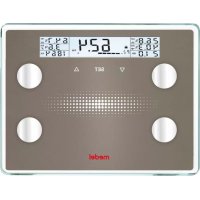
Diagnostic XXL - Scale Medel - Free user manual and instructions
Find the device manual for free Diagnostic XXL Medel in PDF.


| Product type | Body composition scale |
| Brand | Medel |
| Model | Diagnostic XXL |
| Maximum capacity | 200 kg (441 lb, 31 st) |
| Weighing accuracy | 100 g (0.2 lb, 1 st) |
| Body measurement graduation | 0.1% |
| BMI display | 0.1 |
| Calorie requirement display | 1 kcal |
| User memory | 10 slots |
| Power supply | 4 AAA batteries 1.5 V |
| Dimensions (approx.) | 32 x 32 x 2.5 cm |
| Weight (approx.) | 1.5 kg |
| Main functions | Weighing, body fat, body water, muscle mass, bone mass, BMI, calorie requirement (AMR) |
| Automatic shut-off | Yes (after about 15 seconds) |
| Low battery indicator | Yes ("L0" message) |
| Usage | Domestic use, non-medical |
| Safety precautions | Do not use with pacemaker, or during pregnancy |
| Maintenance | Clean with a damp cloth; do not use harsh products |
| Repairs | Only by Medel or authorized dealers |
| Box contents | Scale, 4 AAA batteries, user manual |
Frequently Asked Questions - Diagnostic XXL Medel
User questions about Diagnostic XXL Medel
0 question about this device. Answer the ones you know or ask your own.
Ask a new question about this device
Download the instructions for your Scale in PDF format for free! Find your manual Diagnostic XXL - Medel and take your electronic device back in hand. On this page are published all the documents necessary for the use of your device. Diagnostic XXL by Medel.
USER MANUAL Diagnostic XXL Medel
Fonte: Bulletin of the World Health Organization 2007;85:660-7; Adapted from WHO 1995, WHO 2000 and WHO 2004.
| Età bassa normale alta | ||
| 10-14<44% 44-57%>57% | ||
| 15-19<43% 43-56%>56% | ||
| 20-29<42% 42-54%>54% | ||
| 30-39<41% 41-52%>52% | ||
| 40-49<40% 40-50%>50% | ||
| 50-59<39% 39-48%>48% | ||
| 60-69<38% 38-47%>47% | ||
| 70-100<37% 37-46%>46% |
Donna
| Età bassa normale alta | ||
| 10-14 <36% 36-43%>43 % | ||
| 15-19 <35% 35-41%>41 % | ||
| 20-29 <34% 34-39%>39 % | ||
| 30-39 <33% 33-38%>38 % | ||
| 40-49 <31% 31-36%>36 % | ||
| 50-59 <29% 29-34%>34 % | ||
| 60-69 <28% 28-33%>33 % | ||
| 70-100 <27% 27-32%>32 % |
Massa ossea
Quelle: Bulletin of the World Health Organization 2007;85:660-7; Adapted from WHO 1995, WHO 2000 and WHO 2004.
| Alter wenig normal viel | |||
| 10-14 | <36% | 36-43% | >43% |
| 15-19 | <35% | 35-41% | >41% |
| 20-29 | <34% | 34-39% | >39% |
| 30-39 | <33% | 33-38% | >38% |
| 40-49 | <31% | 31-36% | >36% |
| 50-59 | <29% | 29-34% | >34% |
| 60-69 | <28% | 28-33% | >33% |
| 70-100 | <27% | 27-32% | >32% |
Knochenmasse
Thank you for choosing one of our products. Our name stands for high-quality, thoroughly tested products for the applications in the areas of heat, weight, blood pressure, body temperature, pulse.
Please read these instructions for use carefully and keep them for later use, be sure to make them accessible to other users and observe the information they contain.
Best regards,
Your Medel Team
1. Device description
- Electrodes
- Display
- "Down" key ▼
- "SET" key
- "Up" key ▲

2. Notes

Safety notes

- The scales must not be used by persons with medical implants (e.g. heart pacemakers). Otherwise their function could be impaired.
- Do not use during pregnancy.
- Caution! Do not stand on the scale with wet feet and do not step on the scale when its surface is wet – danger of slipping!
- Batteries are highly dangerous if swallowed. Keep batteries and scale out of reach of small children. If batteries are swallowed, get medical help immediately.
- Keep children away from packing materials (danger of suffocation).
- Batteries must not be charged or reactivated by other means, taken apart, thrown into a fire or short-circuited.
i General notes
- The unit is for personal use only and is not intended for medical or commercial applications.
- Please note that technically related measuring tolerances are possible, as the scale is not calibrated for professional medical applications.
- Ages 10 ... 100 years and height settings from 80 ... 220 cm (2'7"–7'2") can be preset. Load capacity: max. 200 kg (441 lb, 31 St). Result in steps of 100 g (0.2 lb, 1 lb). Measurements of body fat, body water and muscle density in steps of 0.1%.
- Calorie requirement is indicated in steps of 1 kcal. The BMI value (body mass index) is shown in increments of 0.1.
- When supplied to the customer, the scale is set to weigh and measure in "kg" and "cm". You can switch to "pounds" (lb) and "stones" (st:lb) by switching on the scale and immediately pressing the "down" button until the desired unit is shown on the display.
- Place the scale on a firm level floor; a firm floor covering is required for correct measurement.
- The scale should be cleaned occasionally with a damp cloth. Do not use abrasive detergents and never immerse the scale in water.
- Protect the scale against hard knocks, moisture, dust, chemicals, major temperature fluctuations and heat sources which are too close (stove, heating radiators).
- Repairs may only be carried out by Medel customer service or authorized dealers. Before submitting any complaint, first check the batteries and replace them if necessary.
3. Information on the diagnostic scale
The measuring principle of the diagnostic scale
This scale operates according to the B.I.A. principle (bioelectric impedance analysis). This enables physical relationships to be measured within seconds by means of an undetectable, completely harmless electric current. The body fat percentage and other physical relationships in the body can be determined by measuring the electrical resistance (impedance), and the inclusion in a calculation of constants and individual parameters (age, height, gender, degree of activity).
Muscle tissue and water have good electrical conductivity, and therefore lower resistance.
Bones and fatty tissue, on the other hand, have low conductivity, as fat cells and bones conduct hardly any current as a result of their very high resistance.
Please be aware that values obtained from the diagnostic scale represent only an approximation of actual analytical medical data. Only a specialist physician can accurately determine body fat, body water, muscle percentage and bone structure using medical procedures (e.g. computed tomography).
The BMI is calculated using the height value entered and the measured weight value.
General tips
- If possible, always weigh yourself at the same time of day (preferably in the morning), after using the toilet, on an empty stomach and unclothed, in order to achieve comparable results.
- Important for the measurement: body fat can only be measured when barefoot and with the soles of the feet slightly moist. Completely dry soles can result in unsatisfactory measurements due to inadequate conductivity.
- Stand still during the measurement.
- Wait a few hours after unaccustomed strenuous activity.
- Wait approx. 15 minutes after getting up in the morning to allow the water in the body to distribute.
Limitations
When measuring body fat and other values, deviating and implausible results may occur in:
- children under approx. 10 years,
- competitive athletes and body builders,
- pregnant women,
- persons with fever, undergoing dialysis treatment or with symptoms of edema or osteoporosis,
– persons taking cardiovascular medication,
– persons taking vascular dilating or vascular constricting medication, - persons with considerable anatomic deviations of the legs in relation to total body size (length of the legs considerably shortened or lengthened).
4. Batteries
If present, pull the battery insulating strip off the battery compartment cover or remove the battery's protective film and insert the battery according to the polarity. If the scale fails to operate, remove the battery completely and insert it again. Your scale is equipped with a "replace battery" indicator. When the scale is operated with a battery which is too weak, "L0" appears in the display field and the scale automatically switches off. The battery must be replaced in this case (4 x 1.5 V battery AAA).
5. Operation
5.1 Weight measurement
Step onto the scale. Stand still with your weight distributed equally on both feet. The scale begins to take measurements straight away. After flashing twice, the weight is established. If you step off the weighing area, the scale switches off after a few seconds.
5.2 Setting user data
To measure your body fat percentage and other physical data, you must enter your personal user parameters.
The scale includes over 10 memory spaces on which you and other members of your family can save personal settings.
Switch on the scale (tap the weighing area). Wait until the display shows "0.0".
Then press "SET". The first memory position will appear flashing on the display. Now you can enter the following settings:
| Memory position 1 to | 10 |
| Sex | male female |
| Degree of activity | 1 to 5 |
| Body size 80 to 220 cm | (2'7" -7'2") |
| Age 10 to 100 years |
You can enter the relevant settings with short or long pressure on the "up" button ▲ or "down" button ▼. Confirm the settings in each case by pressing "SET".
Then the scale is ready for measuring. If you do not carry out a measurement, the scale switches off automatically after several seconds.
Degree of activity
Selection of the degree of activity must refer to the medium and long term.
– Degree of activity 1: No physical activity.
– Degree of activity 2: Low physical activity.
A small amount of light physical effort (e.g. short walks, light garden work, gymnastic exercises).
– Degree of activity 3: Medium physical activity.
Physical effort for 30 minutes at least 2 to 4 times a week.
– Degree of activity 4: High physical activity.
Physical effort for 30 minutes at least 4 to 6 times a week.
– Degree of activity 5: Very high physical activity.
Intensive physical effort, intensive training or hard physical work for at least one hour daily.
5.3 Taking measurements
After all parameters have been entered, you can now measure your weight, body fat and the other data.
- Press "SET".
- Select the memory space where you would like to save your basic personal data by pressing the "up" ▲ or "down" ▼ button several times. These are then displayed briefly until "0.0" appears.
- Step onto the scale with bare feet and make sure that you are standing still on the electrodes.
- All values determined appear after weighing.
Important: There may be no contact between feet, legs, calves and thighs. Otherwise the measurement will not be performed correctly.
The following data are automatically displayed consecutively:
1 Body fat
2 Muscle content
3 BMI
4 Weight
5 Body water
6 Bone mass
7 Calorie consumption

The scale switches itself off automatically after approx. 15 seconds.
6. Evaluation of results
Body weight / Body mass index
The body mass index (BMI) is a number that is often called upon to evaluate body weight. The number is calculated from body weight and height, the formula is - body mass index = body weight : height ^2 . The measurement unit for BMI is [kg/m ^2 ].
Man < 20 years
| Age | Under-weight | Normal weight Over-weight |
| 10 | 12,7-14,8 | 14,9-18,4 |
| 11 | 13,0-15,2 | 15,3-19,1 |
| 12 | 13,3-15,7 | 15,8-19,8 |
| 13 | 13,7-16,3 | 16,4-20,7 |
| 14 | 14,2-16,9 | 17,0-21,7 |
| 15 | 14,6-17,5 | 17,6-22,6 |
| 16 | 15,0-18,1 | 18,2-23,4 |
| 17 | 15,3-18,7 | 18,8-24,2 |
| 18 | 15,6-19,1 | 19,2-24,8 |
| 19 | 15,8-19,5 | 19,6-25,3 |
Woman < 20 years
| Age | Under-weight | Normal weight Over-weight |
| 10 | 12,7-14,7 | 14,8-18,9 |
| 11 | 13,0-15,2 | 15,3-19,8 |
| 12 | 13,3-15,9 | 16,0-20,7 |
| 13 | 13,7-16,5 | 16,6-21,7 |
| 14 | 14,2-17,1 | 17,2-22,6 |
| 15 | 14,6-17,7 | 17,8-23,4 |
| 16 | 15,0-18,1 | 18,2-24,0 |
| 17 | 15,3-18,3 | 18,4-24,4 |
| 18 | 15,6-18,5 | 18,6-24,7 |
| 19 | 15,8-18,6 | 18,7-24,9 |
Man / Woman ≥ 20 years
| Age | Under-weight | Normal weight Over-weight |
| ≥2015 | 9-18,418,5- | 24,925,0-40,0 |
Source: Bulletin of the World Health Organization 2007;85:660-7; Adapted from WHO 1995, WHO 2000 and WHO 2004.
Note that with very muscular physiques (body builders), the BMI interpretation will show overweight. The reason for this is that no account is taken of well above average muscle mass in the BMI formula.
Body fat percentage
The following body fat percentages are for guidance (contact your physician for further information).
Man
| Age very | good good average poor | ||
| 10-14<1 | % 11-16 % 1 | 6,1-21 %>21,1 % | |
| 15-19<12 | % 12-17 % 1 | 7,1-22 %>22,1 % | |
| 20-29<13 | % 13-18 % 1 | 8,1-23 %>23,1 % | |
| 30-39<14 | % 14-19 % 1 | 9,1-24 %>24,1 % | |
| 40-49<15 | % 15-20 % | 20,1-25 %>25,1 % | |
| 50-59<16 | % 16-21 % | 21,1-26 %>26,1 % | |
| 60-69<17 | % 17-22 % | 22,1-27 %>27,1 % | |
| 70-100< | 8 % 18-23 % | 23,1-28 %>28,1 % |
Woman
| Age very | good good average poor | |||
| 10-14 | <16% | 16-21% | 21,1-26% | >26,1% |
| 15-19 | <17% | 17-22% | 22,1-27% | >27,1% |
| 20-29 | <18% | 18-23% | 23,1-28% | >28,1% |
| 30-39 | <19% | 19-24% | 24,1-29% | >29,1% |
| 40-49 | <20% | 20-25% | 25,1-30% | >30,1% |
| 50-59 | <21% | 21-26% | 26,1-31% | >31,1% |
| 60-69 | <22% | 22-27% | >32,1% | |
| 70-100 | <23% | 23-28% | 28,1-33% | >33,1% |
A lower value is often found in athletes. Depending on the type of sports, training intensity and physical constitution, values may result which are below the recommended values stated.
It should, however, be noted that there could be a danger to health in the case of extremely low values.
Body water
The body water percentage is normally within the following ranges:
Man
| Age poor | good | very | good |
| 10-100 | <50 % | 50-65 % | >65 % |
Woman
| Age poor | good | very | good |
| 10-100 | <45 % | 45-60 % | >60 % |
Body fat contains relatively little water. Therefore persons with a high body fat percentage have body water percentages below the recommended values. With endurance athletes, however, the recommended values could be exceeded due to low fat percentages and high muscle percentage.
Body water measurement with this scale is not suitable for drawing medical conclusions, for example concerning age-related water retention. If necessary ask your physician.
Basically, a high body water percentage should be the aim.
Muscle percentage
The muscle percentage is normally within the following ranges:
Man
Woman
| Age low | normal | high | |
| 10-14<44% | 44 | -57% | >57% |
| 15-19<43% | 43 | -56% | >56% |
| 20-29<42% | 42 | -54% | >54% |
| 30-39<41% | 41 | -52% | >52% |
| 40-49 | <40% | 40-50% | >50% |
| 50-59<39% | 39 | -48% | >48% |
| 60-69 | <38% | 38-47% | >47% |
| 70-100<37% | 37 | -46% | >46% |
| Age low | normal | high | |
| 10-14 | <36% | 36-43% | >43% |
| 15-19 | <35% | 35-41% | >41% |
| 20-29 | <34% | 34-39% | >39% |
| 30-39 | <33% | 33-38% | >38% |
| 40-49 | <31% | 31-36% | >36% |
| 50-59 | <29% | 29-34% | >34% |
| 60-69 | <28% | 28-33% | >33% |
| 70-100 | <27% | 27-32% | >32% |
Bone mass
Like the rest of our body, our bones are subject to the natural development, degeneration and ageing processes. Bone mass increases rapidly in childhood and reaches its maximum between 30 and 40 years of age. Bone mass reduces slightly with increasing age. You can reduce this degeneration somewhat with healthy nutrition (particularly calcium and vitamin D) and regular exercise. With appropriate muscle building, you can also strengthen your bone structure.
Note that this scale will not show you the calcium content of your bones, but will measure the weight of all bone constituents (organic substances, inorganic substances and water).
Attention: Please do not confuse bone mass with bone density. Bone density can be determined only by means of a medical examination (e.g. computer tomography, ultrasound). It is therefore not possible to draw conclusions concerning changes to the bones and bone hardness (e.g. osteoporosis) using this scale. Little influence can be exerted on bone mass, but it will vary slightly within the influencing factors (weight, height, age, gender).
AMR
The active metabolic rate (AMR) is the amount of energy required daily by the body in its active state. The energy consumption of a human being rises with increasing physical activity and is measured on the diagnostic scale in relation to the degree of activity entered (1–5).
To maintain your existing weight, the amount of energy used must be reintroduced into the body in the form of food and drink. If less energy is introduced than is used over a longer period of time, your body will obtain the difference largely from the amount of fat stored and your weight will reduce. If, on the other hand, over a longer period of time more energy is introduced than the total active metabolic rate (AMR) calculated, your body will be unable to burn off the excess energy, and the excess will be stored in the body as fat and your weight will increase.
Results in relation to time
Note that it is only the long-term trend which counts. Short period fluctuations in weight over a few days are mostly the result of a loss of fluid.
The interpretation of the results will depend on changes in your: overall weight and body fat, body water and muscle percentages, as well as on the period during which these changes take place. Rapid changes within days must be distinguished from medium term changes (over weeks) and long term changes (months).
A basic rule is that short term changes in weight almost exclusively represent changes in water content, whereas medium and long term changes may also involve the fat and muscle percentages.
- If your weight reduces over the short term, but your body fat percentage increases or remains the same, you have merely lost water – e.g. after a training session, sauna session or a diet restricted only to rapid weight loss.
- If your weight increases over the medium term and the body fat percentage falls or stays the same, then you could have built up valuable muscle mass.
If your weight and body fat percentage fall simultaneously then your diet is working – you are losing fat mass. Ideally you should support your diet with physical activity, fitness or power training. By this means, you can increase your muscle percentage over the medium term.
7. Incorrect measurement
If the scale detects an error during weighing, "Cl_or" "appears in the display.
If you step onto the scale before "0.0" appears in the display, the scale will not operate properly.
| Possible causes of error:– The maximum load-bearing capacity of 200 kg (441 lb, 31 St) was exceeded. | Remedy:– Only weigh the maximum permissible weight. |
| – The electrical resistance between the electrodes and the soles of your feed is too high (e.g. with heavily callused skin). | – Repeat weighing barefoot. Slightly moisten the soles of your feet if necessary. Remove the calluses on the soles of your feet if necessary. |
| – Your body fat lies outside the measurable range (less than 3% or greater than 55%). | – Repeat weighing barefoot.– Slightly moisten the soles of your feet if necessary. |
| – Your percentage of water lies outside the measurable range (less than 25% or greater than 75%) | – Repeat weighing barefoot.– Slightly moisten the soles of your feet if necessary. |
8. Disposal
Used, fully discharged batteries must be disposed of in a specially labeled collection container, at toxic waste collection points or through an electrical retailer. You are under legal obligation to dispose of batteries correctly.
Note: You will find these markings on batteries containing harmful substances:
Pb = battery containing lead, Cd = battery containing cadmium, Hg = battery containing mercury.
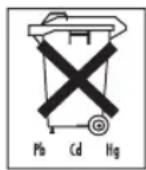
Please dispose of the device in accordance with the directive 2002/96/EC – WEEE (Waste Electrical and Electronic Equipment). If you have any queries, please refer to the local authorities responsible for waste disposal.

FRANÇAIS
Chère cliente, cher client,
Source: Bulletin of the World Health Organization 2007;85:660-7; Adapted from WHO 1995, WHO 2000 and WHO 2004.
other
| Category | Value | |---|---| | FAT | 88.8% | | FAT | 88.8% (with a small symbol) | | FAT | 88.8% (with a small symbol) | | MUS | 88.8% | | MUS | 88.8% (with a small symbol) | | MUS | 88.8% (with a small symbol) | | BMI | 88.8 | | BMI | 88.8 | | BMI | 88.8 | | age | 88.8 | | CM | 88.8 | | ft:in | 88.8 | | kg | 88.8 | | st:lb | 88.8 | | KCAL | 88.8 | | KCAL | 88.8 | | TCW | 88.8 | | TOW | 88.8 | | BON | 88.8 | | BON | 88.8 | | KCAL | 88.8 |Fuente: Bulletin of the World Health Organization 2007;85:660-7; Adapted from WHO 1995, WHO 2000 and WHO 2004.
other
| Category | Value (%) | Label | |---|---|---| | 1 | 88.8 | FAT | | 2 | 88.8 | MUS | | 3 | 88.8 | BMI | | 4 | 88:0.8"3 | 3 | | 5 | 88.8 | TBW | | 6 | 88.8 | BON | | 7 | 88.8 | KCAL |Kaynak: Bulletin of the World Health Organization 2007;85:660-7; Adapted from WHO 1995, WHO 2000 and WHO 2004.
| Yaş az | normal | çok | |
| 10-14 | <44% | 44-57%>57% | |
| 15-19 | <43% | 43-56%>56% | |
| 20-29 | <42% | 42-54% | >54% |
| 30-39 | <41% | 41-52% | >52% |
| 40-49 | <40% | 40-50% | >50% |
| 50-59 | <39% | 39-48%>48% | |
| 60-69 | <38% | 38-47% | >47% |
| 70-100<87% | 37-46% | >46% |
Kadın
| Yaş az | normal | çok | |
| 10-14 | <36% | 36-43%>43% | |
| 15-19 | <35% | 35-41%>41% | |
| 20-29 | <34% | 34-39% | >39% |
| 30-39 | <33% | 33-38% | >38% |
| 40-49 | <31% | 31-36% | >36% |
| 50-59 | <29% | 29-34% | >34% |
| 60-69 | <28% | 28-33% | >33% |
| 70-100 | <27% | 27-32% | >32% |
Kemik Kütlesi
Zródło: Bulletin of the World Health Organization 2007;85:660-7; Adapted from WHO 1995, WHO 2000 and WHO 2004.
other
| Category | Value | |---|---| | FAT | 88.8% | | MUS | 88.8% | | BMI | 88.8 | | age | - | | CM | - | | ft:in | - | | st:lb | - | | 3 | 88.8 | | 4 | 88.0 | | 5 | 88.8 | | BON | 88.8 kg | | KCAL | 88.88 |7. Capacity aux bounds
- Massa ossea
- Knochenmasse
- Device description
- Notes
- Safety notes
- i General notes
- Information on the diagnostic scale
- The measuring principle of the diagnostic scale
- General tips
- Limitations
- Batteries
- Operation
- Weight measurement
- Setting user data
- Degree of activity
- Taking measurements
- Evaluation of results
- Body weight / Body mass index
- Body fat percentage
- Body water
- Muscle percentage
- Bone mass
- AMR
- Results in relation to time
- Incorrect measurement
- Disposal
- FRANÇAIS
- Chère cliente, cher client,
- Kemik Kütlesi
- Capacity aux bounds
Brand : Medel
Model : Diagnostic XXL
Category : Scale