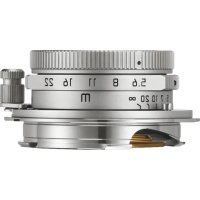
SummaronM 28mm f5.6 - Lens LEICA - Free user manual and instructions
Find the device manual for free SummaronM 28mm f5.6 LEICA in PDF.



| Product type | Hypercompact wide-angle lens |
| Brand | Leica |
| Model | Summaron-M 28mm f/5.6 |
| Focal length | 28 mm |
| Maximum aperture | f/5.6 |
| Minimum aperture | f/22 |
| Field of view (diagonal/horizontal/vertical) | 75° / 65° / 46° |
| Optical structure (lenses/groups) | 6 / 4 |
| Minimum focus | 1 m |
| Mount | Leica M bayonet with 6-bit coding |
| Filter | E34 internal thread |
| Lens hood | Slip-on (supplied) |
| Dimensions (length × diameter) | approx. 18 mm × 51 mm |
| Weight | approx. 165 g |
| Finish | Silver chrome |
| Lens identification | 6-bit identification code for digital Leica M |
| Care and cleaning | Use a fine brush or microfiber cloth for the lenses; do not use solvents on the bayonet; grease if necessary with petroleum jelly |
| Spare parts | Front cap (14 058), rear cap (14 269), lens hood (12 474) |
| Repairability | Leica Camera AG after-sales service or national representatives |
Frequently Asked Questions - SummaronM 28mm f5.6 LEICA
User questions about SummaronM 28mm f5.6 LEICA
0 question about this device. Answer the ones you know or ask your own.
Ask a new question about this device
Download the instructions for your Lens in PDF format for free! Find your manual SummaronM 28mm f5.6 - LEICA and take your electronic device back in hand. On this page are published all the documents necessary for the use of your device. SummaronM 28mm f5.6 by LEICA.
USER MANUAL SummaronM 28mm f5.6 LEICA
natural_image
Cross-sectional diagram of a mechanical gear assembly showing internal components and motion paths (no text or labels)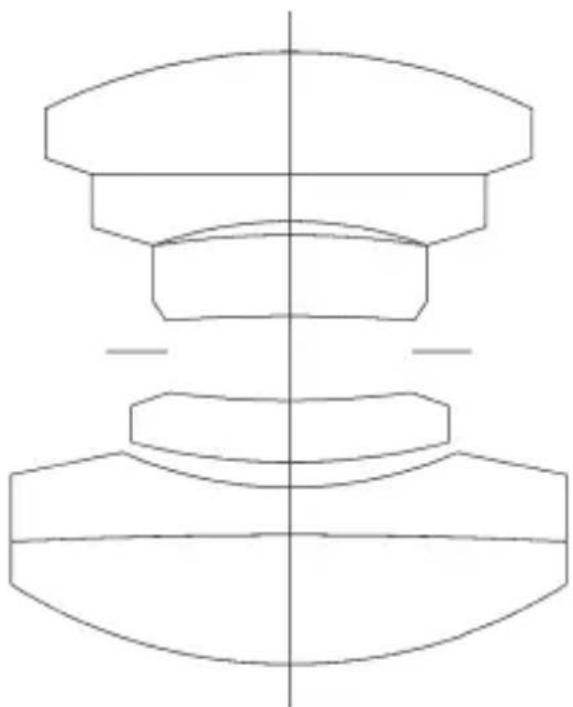
natural_image
Pure technical line drawing of a mechanical component with no text, numbers, or symbols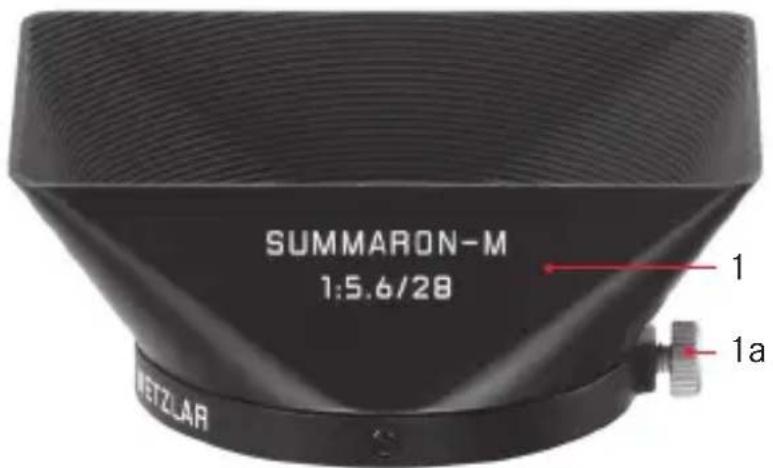
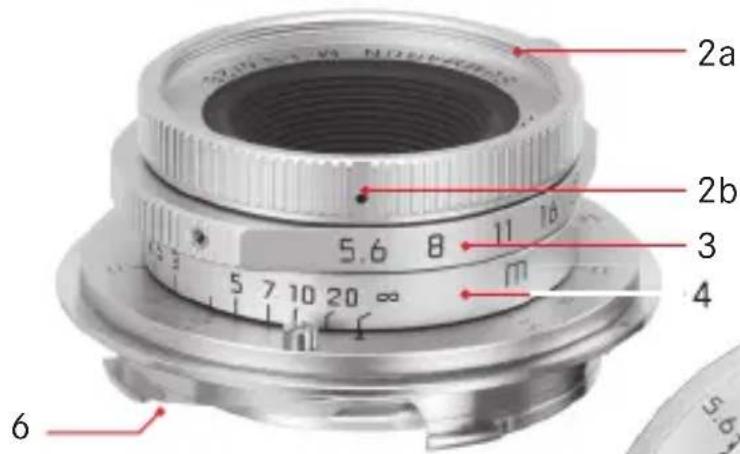
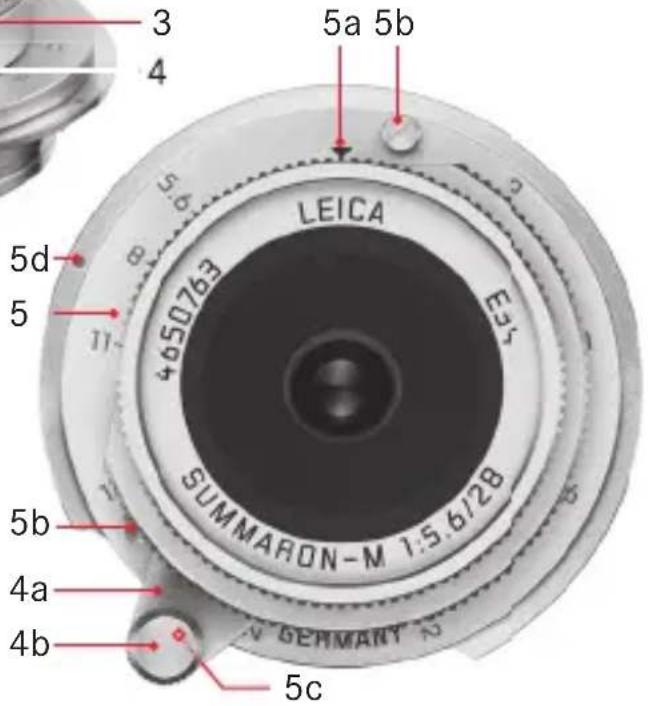
Designation of Parts
-
Lens hood with a. Clamping screw
-
Front mount with a. Filter-internal thread b. Index for aperture setting
-
Aperture setting ring
-
Focusing ring with a. Adjustment lever b. Locking button
-
Depth of field scale with a. Index for distance setting b. Stop pin c. Locking bearing d. Red index for changing lenses
-
6 bit lens identification
Product Support / Software Support
Am Leitz-Park 5
D-35578 Wetzlar
Tel.: +49(0)6441-2080-111 /-108
Fax: +49(0)6441-2080-490
info@leica-camera.com / software-support@leica-camera.com
LEICA CUSTOMER CARE
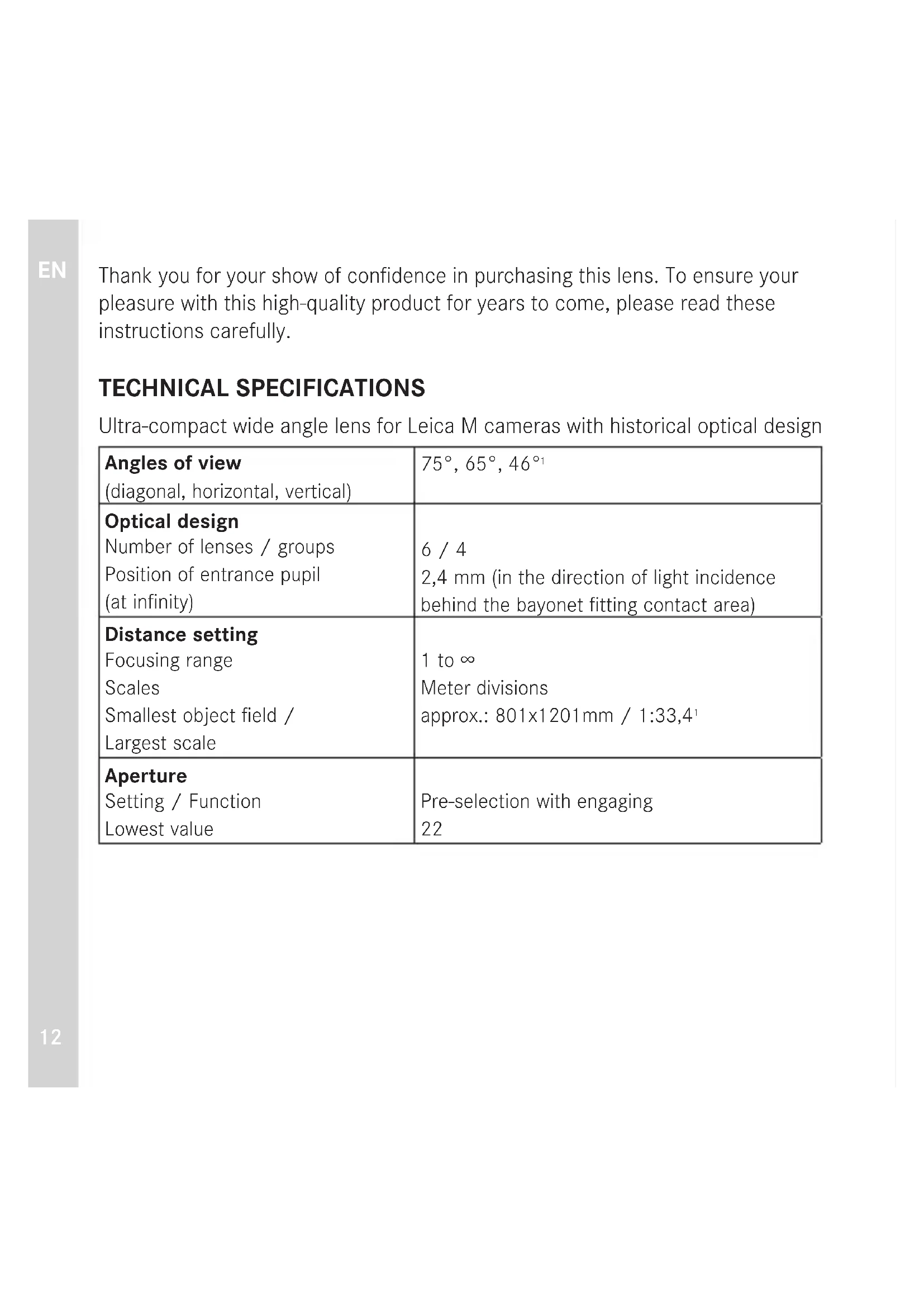
Thank you for your show of confidence in purchasing this lens. To ensure your pleasure with this high-quality product for years to come, please read these instructions carefully.
TECHNICAL SPECIFICATIONS
Ultra-compact wide angle lens for Leica M cameras with historical optical design
| Angles of view(diagonal, horizontal, vertical) | 75°, 65°, 46°1 |
| Optical designNumber of lenses / groupsPosition of entrance pupil(at infinity) | 6 / 42,4 mm (in the direction of light incidencebehind the bayonet fitting contact area) |
| Distance settingFocusing rangeScalesSmallest object field /Largest scale | 1 to∞Meter divisionsapprox.: 801x1201mm / 1:33,41 |
| ApertureSetting / FunctionLowest value | Pre-selection with engaging22 |
| Bayonet fitting | Leica M quick-change bayonet with 6 bit lens identification bar code for digital M models2 |
| Filter mount | Internal thread for screw-on filter E34, with non-rotating focusing mount |
| Lens hood | Clip-on (in delivery scope) |
| Viewfinder | Camera viewfinder3 |
| Finish | Silver chrome finish |
| Dimensions and weightLength of the bayonet fitting contact surfaceLargest diameterWeight | approx. 18mmapprox. 51mmapprox. 165g |
| Compatible cameras | All Leica M cameras4 |
^1 For 35mm (24 x 36mm):
^2 The 6 bit lens identification bar code (6) situated on the bayonet flange enables the digital Leica M models to identify the attached type of lens. This information is utilized by the cameras to optimize exposure and image data.
^3 All Leica M cameras without 28 mm frame lines, except for those with 0.85x viewfinder, the M3 and the previous MP (professional version of the M3), can be equipped with this by the Customer Care department of Leica Camera AG (Address, see p. 10, or warranty card) (then appears together with the 90 mm frame lines).
^4 Use on the Leica M8 is not recommended because the necessary UV/IR corrections filters are not available.
SPECIAL FEATURES
This Leica Summaron 1:5,6/28mm is a replica of the model originally introduced in 1955. With its 6 lens elements arranged strictly symmetrically around the aperture in 4 groups, it has the same optical design. Its extremely compact mechanical construction also corresponds to the original. Unlike this, however, the current model is equipped with the M bayonet including 6 bit code. Furthermore, various external details have been adapted to the appearance of the current M lenses, for example the shape of the focus unlock button, the diameter of the aperture ring and the knurling.
Even when fully open, the lens is characterized by high-contrast rendering in large areas of the field of view. Stopping down to 11 greatly improves the imaging performance in the corners of the picture. Although stopping down further enhances the picture corners even more, this is at the expense of the overall contrast, i.e. the imaging performance is more even overall. When the aperture is open, vignetting is max., i.e. in the image corners, appeox. 2.5 aperture stages. By stopping down to 8 vignetting can be reduced to approx. 1.8 aperture stages. Distortion is negligible.
Summary: Due to its imaging properties and its focal length, the new edition of the Leica Summaron 1:5,6/28mm is suitable for quick and discreet photography, in other words spontaneous snapshots. Its extremely small dimensions together with the camera make an extremely manageable unit that is easy to carry.
STRUCTURE OF THE LENS
The structure of the Leica Summaron-M 1:5,6/28mm is exactly the same as that of its role model, which was manufactured between 1955 and 1963. Its extremely compact structure means a slightly different arrangement for the operating elements compared to other M lenses: it has an aperture setting ring (3) and a setting ring for the distance (4) with adjustment lever (4a) and locking button (4b). A ring on the bayonet supports the index for the distance setting (5a) as well as a depth of field scale (5) and a red index for the lens change (5d). Furthermore, there are also the two stop pins for distance setting (5b) and the locking bearing (5c) for the associated button (4b).
A 6 bit lens identification bar code (7) is situated on the bayonet flange. It relays lens data to the camera body so the exposure metering system of digital Leica M models can be calibrated. The information is also used to custom-optimize image data according to the respective lens.
FOCUSING
The lens is focused by rotating the distance-setting ring. In the infinity and 1m settings, stop pins (5b) limit the adjustment track of this lever. The infinity setting is also a lockable resting position. The relevant button (4b) must be pressed, both for unlocking and locking and for leaving or adopting the resting position.
DEPTH OF FIELD SCALE
The scale (5) shows the range of the depth of field for the set distance. The ranges are indicated by the correspondingly marked sections of the lines.
LENS HOOD
A square lens hood (1) that can be clicked on and clamped on is part of the delivery scope.
When putting it on, arrange it so that one of its little screws aligns precisely with the index for the aperture setting (2b). Make sure that it is sitting straight on the lens front frame and tighten the clamping screw (1a) by turning it (clockwise). This ensures that the optical paths of the lens and the distance meter are not cut, i.e. vignetting is prevented in the imaging and shadows in the measuring field of the distance meter.
A matching metal slip cover is also supplied to protect the front lens. This cover can only be used when the lens hood is removed. For as long as the camera is being carried and used ready for photography, the lens hood should always remain fitted. It provides effective protection against contrast-reducing stray light and also against damage and soiling of the front lens, e.g. from accidental fingerprints.
FILTERS
E34 acrew-on filters can be used on the Leica Summaron-M 1:5,6/28mm. These are available from a well-stocked photographic and optical specialists.
SPARE PARTS Order No.
Lens front cover (Silver chrome finish) 14 058
Lens back cover 14 269
Lens hood....12 474
TIPS ON LENS CARE
Dust on the outside of the lens should be removed carefully with a soft-haired brush or a soft, clean, dry cloth. We recommend micro-fiber cloths (available from photographic and optical specialists) that are stored in a protective container and can be washed at temperatures of up to 40^ C (without fabric softener, never iron!). If stains and fingerprints have to be removed, use such a cloth and clean with a circular movement starting at the center of the lens. Do not use the type of cloths used especially for cleaning eyeglasses since these are impregnated with chemicals which can damage the glass used for high performance lenses.
In order to ensure fast and smooth lens changes, the bayonet has been coated with a thin layer of grease in the factory. Normally, this lubricating film will remain on the lens for years, even if the lens is wiped from time to time. In the event that a grease solvent is used when cleaning, a fresh layer of grease should be applied. To do this, apply a small amount of vaseline to the bayonet with your finger and spread it with a clean cloth.
Important: Make sure not to apply too much vaseline to the bayonet, especially to omit the lens identification bar code (6), because residual grease could otherwise remain in the recess and lead to further grime accumulating. This could even cause the code to become illegible and thus interfere with some camera functions in digital M-models. In addition to the designation by type, each lens has an individual serial number. Please note this number in your documents as a safety measure.
LEICA PRODUCT SUPPORT
The Leica Product Support department can provide you with an answer to any technical application questions relating to the Leica range either in writing, on the telephone or by e-mail.
Leica Camera AG
Product Support / Software Support
Am Leitz-Park 5
35578 Wetzlar
Germany
Tel.: +49(0)6441-2080-111 /-108
Fax: +49(0)6441-2080-490
info@leica-camera.com / software-support@leica-camera.com
LEICA CUSTOMER SERVICE
For service of your Leica equipment and in case of necessary repairs please contact the Customer Care department of Leica Camera AG or of any national Leica agency (see Warranty Card for address list).
Leica Camera AG
Customer Care
Am Leitz-Park 5
35578 Wetzlar
Germany
Tel.: +49(0)6441-2080-189
Fax: +49(0)6441-2080-339
customer.care@leica-camera.com
Product Support / Software Support
Am Leitz-Park 5
35578 Wetzlar, Germany
Tél. : +49(0)6441-2080-111 /-108
Fax: +49(0)6441-2080-490
info@leica-camera.com/software-support@leica-camera.com
SERVICE APRÈS-VENTE LEICA
35578 Wetzlar, Germany
Tél. : +49(0)6441-2080-189
Fax: +49(0)6441-2080-339
customer.care@leica-camera.com
SCHERPTEDIEPTESCHAAL
Productsupport / softwaresupport
Am Leitz-Park 5
35578 Wetzlar, Germany
Telefoon: +49(0) 6441-2080-111 /-108
Fax: +49(0) 6441-2080-490
info@leica-camera.com / software-support@leica-camera.com
LEICA KLANTENSERVICE
35578 Wetzlar, Germany
Telefoon: +49(0) 6441-2080-189
Fax: +49(0) 6441-2080-339
customer.care@leica-camera.com
Product Support / Software Support
Am Leitz-Park 5
35578 Wetzlar, Germany
Telefono: +49(0)6441-2080-111 /-108
Fax: +49(0)6441-2080-490
info@leica-camera.com / software-support@leica-camera.com
SERVIZIO ASSISTENZA CLIENTI LEICA
35578 Wetzlar, Germany
Telefono:+49(0)6441-2080-189
Fax: +49(0)6441-2080-339
customer.care@leica-camera.com
Product Support / Software Support
Am Leitz-Park 5
35578 Wetzlar, Germany
35578 Wetzlar, Germany

- Designation of Parts
- LEICA CUSTOMER CARE
- TECHNICAL SPECIFICATIONS
- SPECIAL FEATURES
- STRUCTURE OF THE LENS
- FOCUSING
- DEPTH OF FIELD SCALE
- LENS HOOD
- FILTERS
- SPARE PARTS Order No.
- TIPS ON LENS CARE
- LEICA PRODUCT SUPPORT
- LEICA CUSTOMER SERVICE
- SERVICE APRÈS-VENTE LEICA
- SCHERPTEDIEPTESCHAAL
- LEICA KLANTENSERVICE
- SERVIZIO ASSISTENZA CLIENTI LEICA
Brand : LEICA
Model : SummaronM 28mm f5.6
Category : Lens