Z 07475 - Washing machine EasyMaxx - Free user manual and instructions
Find the device manual for free Z 07475 EasyMaxx in PDF.


| Product type | Mini washing machine |
| Model | Z 07475 / XTB30-8 |
| Brand | EasyMaxx |
| Supply voltage | 220 – 240 V ~ 50 Hz |
| Power | 260 W |
| Protection class | IPX4 |
| Washing capacity | max. 3 kg of laundry |
| Spin capacity | max. 1.5 kg of laundry |
| Max. water volume | 10 litres |
| Max. water temperature | 60 °C |
| Timer | up to 15 minutes |
| Functions | Washing, Rinsing, Spinning |
| Drum type | Removable washing drum and spin drum |
| Water connection | Supply hose or manual filling |
| Drainage | Drain hose with suspension hook |
| Tub material | Plastic |
| Cleaning | Soft, damp cloth; regular descaling |
| Safety | Do not immerse; unplug before cleaning; do not open during operation |
| After-sales service | DS Produkte GmbH, Am Heisterbusch 1, 19258 Gallin, Germany |
Frequently Asked Questions - Z 07475 EasyMaxx
User questions about Z 07475 EasyMaxx
0 question about this device. Answer the ones you know or ask your own.
Ask a new question about this device
Download the instructions for your Washing machine in PDF format for free! Find your manual Z 07475 - EasyMaxx and take your electronic device back in hand. On this page are published all the documents necessary for the use of your device. Z 07475 by EasyMaxx.
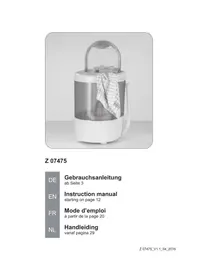
USER MANUAL Z 07475 EasyMaxx
natural_image
White portable water heater with open lid and cloth, no visible text or symbolsZ 07475
DE
Gebrauchsanleitung
ab Seite 3
EN
Instruction manual
starting on page 12
FR
Mode d'emploi
www.service-shopping.de
natural_image
Person washing a stainless steel kitchen sink with a piping bag (no visible text or symbols)natural_image
Close-up of a black and white plastic water tap wrench with a handle (no text or symbols visible)Zufl ussschlauch
natural_image
Hand holding a flexible hose connecting a stainless steel faucet into a water-filled sink (no text or symbols visible)
natural_image
Top-down view of a plastic basket filled with small dark objects, no text or symbols visiblenatural_image
Close-up of a washing machine interior with visible fan and wheel (no text or symbols)Safety Instructions 13
Items Supplied and Device Overview 15
Before Initial Use 15
Use 16
Cleaning and Care 18
Troubleshooting 18
Technical Data 19
Disposal 19
Explanation of Symbols

Safety instructions:
Please read these carefully and comply with them in order to prevent personal injury and damage to property.

Supplementary information


Read operating instructions before use!
Dear Customer,
We are delighted that you have chosen this mini washing machine.
Before using the device for the first time, please read the instructions through carefully and keep them for future reference. If the device is given to someone else, these instructions should also be handed over with it.
The manufacturer and importer do not accept any liability if the information in these instructions is not complied with.
If you have any questions about the device and about spare parts/accessories, contact the customer service department via our website:
www.service-shopping.de
Intended Use
• The device is suitable for washing light textiles at a temperature of no more than 60^ C.
- The device is not suitable for washing large and heavy textiles, such as wool blankets, bedding or winter jackets.
- The device is not suitable for washing laundry that needs to be boiled.
- The device is not suitable for bleaching or dyeing textiles.
- The device is for personal use only and is not intended for commercial applications.
- Use the device only as described in the instructions. Any other use is deemed to be improper.
- The following are excluded from the warranty: all defects caused by improper handling, damage or unauthorised attempts at repair. This also applies to normal wear and tear.
Safety Instructions
This device is not designed to be used by individuals (including children) with limited physical, sensory or mental abilities or those without sufficient experience and/or knowledge, unless they are supervised by someone responsible for their safety or have received instructions from them on how to use the device.
■ Children must be supervised to ensure that they do not play with the device.
- The device must always be disconnected from the mains power when it is left unattended and before assembling, disassembling or cleaning the device.
- Never exceed the maximum fill level (note MAX marking!). If the washing machine is overfilled, water could escape from the discharge hose during the wash cycle.
- Do not make any changes to the device. Also do not replace the mains cable yourself. If the device, the connecting cable or the plug of the device is damaged, it must be replaced by the manufacturer or customer service department or a similarly qualified person (e.g. specialist workshop) in order to avoid any hazards.

Dangers of Injury
- Keep the device and packaging material away from children and animals. There is a risk of injury and suffocation!
■ Never reach into the spinning drum before it has come to a complete stop.
If the device is not being supervised, make sure that it contains no water. - Lay the cable in such a way that it does not present a trip hazard.
- Set up the device so that it cannot be pulled down by the cable or become caught on it.

Danger of Electric Shock and Fire
The device should only be connected to a properly installed plug socket with safety contacts. The plug socket must also be readily accessible after connection so that the connection to the mains can quickly be isolated. The mains voltage must match the technical data of the device. Only use suitable extension cables whose technical data is the same as that of the device.
- Never immerse the device, mains cable or plug in water or other liquids and ensure that they cannot fall into water or become wet.
- Should the device fall into water, switch off the power supply immediately. Do not attempt to pull it out of the water while it is still connected to the mains power!
- Do not use the device if it has malfunctioned or been dropped in water. Have it checked in a specialist workshop before using it again.
- Never touch the mains cable or plug with wet hands when these components are connected to the mains power.
- Switch off the device and pull the mains plug out of the plug socket if an error occurs during operation or before a thunderstorm.
■ Always pull the plug and never the mains cable.
■ Use the device only in closed rooms. - Do not use the device in rooms containing easily ignitable dust or poisonous and explosive fumes.
- Never place clothing into the device which has recently been in contact with solvents such as benzine.
- Do not operate the device in a very damp environment or in the vicinity of combustible material.
■ Always check the device for damage before putting it into operation. Only use it if the device, mains cable and plug have no signs of damage!
Avoiding Damage to Material, Property and the Device
■ Always place the device on a dry, level, firm and moisture-resistant surface.
■ Make sure that the discharge hose, the feed hose and the mains cable are not squashed, bent or laid over sharp edges and do not come into contact with hot surfaces.
■ Use only accessories that are also supplied with the device or are recommended by the original manufacturer.
- Maintain a sufficient distance from heat sources such as hobs or ovens in order not to damage the device. Do not place any naked flames, e.g. burning candles, in the immediate vicinity of the device, cable or plug.
- Do not place any heavy or hot objects on the device.
- Do not drop the device or allow it to be knocked violently.
- Do not expose the device to extreme temperatures, wide temperature variations, wet conditions or direct sunlight.
Water that is hotter than 60^ C must not be used as otherwise the plastic trough could be deformed.
■ Remove all objects such as keys, small change, etc. from pockets or other places to prevent any damage to the textiles and the device.
- Do not use any caustic or abrasive cleaning agents to clean the device. These can damage the surface.
Notes on Hygiene
There may still be some production residues on the device. To avoid harmful effects to your health, clean the device before you first use it (see the "Cleaning and Care" chapter).
- Keep the device clean.
Items Supplied and Device Overview

text_image
Labeled diagram of a portable washing machine with numbered parts for identification1 Timer control dial
2 Suspension device for the discharge hose
3 Discharge hose
4 Wash drum
5 Motor unit
6 Spin drum incl. cover
7 Lid
8 Connecting socket for the feed hose
9 Waschen - Schleudern - Aus (wash - spin - off) control dial
Not shown:
- Feed hose
- Mains cable with plug
- Tap adapter
Before Initial Use

CAUTION!
■ The device may contain production residues. Clean it thoroughly before you first use it.
■ Make sure that during the wash cycle the discharge hose is always secured vertically on the suspension device.
■ Danger of suffocation! Keep children and animals away from the packaging material.
- Unpack all parts and check the items supplied for completeness (see the "Items Supplied and Device Overview" chapter) and transport damage. If you find any damage to the components, do not use them (!); instead, contact our customer service department.
- Remove any films or stickers that may be present from the device.
- Clean the device with a damp, soft cloth.
- Place the device on a dry, water-resistant and flat surface a sufficient distance away from flammable objects. Please make sure that the device is not accessible to children!
- Attach the discharge hose (3) using the hook to the suspension device (2).
- Fill the washing drum (4) up to the MAX marking (approx. 10 litres) with clear water at a temperature of no more than 60^ C (see the "Use" chapter, "Set-Up, Filling and Connection" section).
- Close the lid (7).
-
Insert the mains plug into a properly installed 220 - 240 V plug socket.
-
Move the control dial (9) to Waschen (wash) and set the timer (1) to 15 minutes. Allow the wash cycle to run through once.

natural_image
Person washing a stainless steel sink with a piping bag (no text or symbols visible)- Drain the water via the discharge hose (3) into a sink or similar outlet and repeat this process one more time. The washing machine is now ready to be operated!
Use

CAUTION!
- Never reach into the spinning drum before it has come to a complete stop.
■ Remove all objects such as keys, small change, etc. from pockets or other places to prevent any damage to the textiles and the device. - Never place clothing into the device which has recently been in contact with solvents such as benzine.
Water that is hotter than 60^ C must not be used as otherwise the plastic trough could be deformed.
■ Make sure that during the wash cycle the discharge hose is always secured vertically on the suspension device. - Do not open the lid of the device during operation.
■ Always remove the mains plug from the plug socket when the device is not in use!

- Always read the washing instructions on the textiles that you want to wash.
- Fine textiles such as wool or silk should be washed in a wash bag or something similar in order to preserve the fabrics.
- Zip fasteners should always be closed in order to prevent damage to the material.
- Coarse dirt such as sand, glue, etc. should be brushed off beforehand so that the discharge flow of the device does not become clogged up.
Set-Up, Filling and Connection
- Place the device on a dry, water-resistant and flat surface a sufficient distance away from flammable objects. Please make sure that the device is not accessible to children!
- Attach the discharge hose (3) using the hook to the suspension device (2).
- Open the lid (7) and fill the wash drum (4) with no more than 3 kg of textiles.
- To fill the device with water, you can use either the feed hose or a bucket of water:
Bucket
- Fill the bucket with clear water at a temperature of no more than 60^ .
- Pour the water into the wash drum (4). Make sure that you do not exceed the MAX marking.

natural_image
Close-up of a black and white mechanical valve with a metallic handle (no text or symbols visible)
natural_image
Hand washing a faucet with a white hose in a stainless steel kitchen sink (no text or symbols visible)Feed Hose
- Connect the feed hose to the socket (8) on the device.
-Plug the feed hose onto the tap adapter so that it cannot slip off.
-Connect the feed hose to a tap using the adapter and tighten the clip.

If the adapter does not fit on your tap, you can also simply hold the feed hose under the tap.
- Fill the wash drum (4) up to the MAX marking with clear water at a temperature of no more than 60°C.
- Pour detergent that is suitable for the textiles into the wash drum (4). Please note that you require less detergent than in a conventional washing machine.
- Close the lid (7).
- Insert the mains plug into a properly installed 220 - 240 V plug socket.
Washing
- Move the control dial (9) to Waschen (wash) and set the timer (1) to the time you want (max. 15 minutes).
- The device will start the wash cycle.
- When the washing time is up, the device switches off automatically.
- Allow the water to drain via the discharge hose (3) into a sink or similar outlet.
Rinsing
- Fill the wash drum (4) again with clear water that is cold or lukewarm but do not add any detergent to it.
- Move the control dial (9) to Waschen (wash) and set the timer (1) to the time you want (max. 15 minutes).
- The device will start the rinse cycle.
- When the rinsing time is up, the device switches off automatically.
- Allow the water to drain via the discharge hose (3) into a sink or similar outlet.
Spinning
- Open the lid (7) and take the wet laundry out of the wash drum (4).

natural_image
Top-down view of a plastic basket filled with small circular indentations (no text or symbols visible)- Place the wet laundry, divided up if necessary (max. 1.5 kg) into the spin drum (6) and then insert the cover again.

natural_image
Close-up of a white plastic washing machine with visible internal components and a labeled section 'A' (no text or symbols on the main subject)-
Place the spin drum (6) into the wash drum (4). Make sure that it is seated correctly on the hub (A). To ensure that the spin drum does not jump off the hub (A) while it is spinning, the recesses in the bottom of the spin drum (6) must be seated correctly on the mating parts on the hub (A).
-
Close the lid (7).
- Make sure that the discharge hose (3) leads into a sink or similar outlet so that the water can drain away during spinning.
- Move the control dial (9) to Schleudern (spin) and set the timer (1) to the time you want (max. 15 minutes).
- The device will start the spin cycle.
- When the spinning time is up, the device switches off automatically.
- Open the lid (7).
- Allow the spin drum (6) to come to a complete stop before you remove it from the wash drum (4).
- Remove your laundry from the spin drum and hang it up in the usual way. If the laundry is still too wet, repeat the spin cycle.
- Move the control dial (9) to Aus (off) and remove the mains plug from the plug socket!
Cleaning and Care

CAUTION!
■ Never immerse the device, mains cable or plug in water or other liquids.
- Do not use any aggressive, abrasive or toxic cleaning agents for cleaning. These can damage the surface.
■ Remove the mains plug from the plug socket before cleaning the device!
- Wipe the outside of the device and the lid with a clean, damp cloth.
- Wipe the inside of the device with a clean, damp and soft cloth and mild cleaning agent. Then allow a rinse cycle to run through with clear water (see the "Use" chapter, "Set-Up, Filling and Connection" and "Rinsing" sections).
- Allow the device and all accessories to dry completely before you store them away.
- Store the device in a dry place that is protected from sunlight and is not accessible to children and animals.

Keep the device ready for operation. You should regularly remove water limescale deposits with a descaling agent in accordance with the water quality in your area and how often the device is used. Follow the instructions provided with the descaling agent to descale the washing machine.
Troubleshooting
If the device stops working properly, first check whether you are able to correct the problem yourself.

Do not attempt to repair a defective electrical device yourself!
| Problem Possible cause / solution | |
| The device cannot be switched on. | Is the control dial (9) in the Waschen (wash) or Schleudern (spin) position?Is the mains plug correctly inserted in the plug socket?Is the socket defective? Try another socket.Check the fuse of your mains connection. |
| The device does not switch off. | • Is the timer blocked? |
| During use, an unpleasant smell is detected. | • Is the device being used for the first time? A smell often develops when new devices are fi rst used. The smell should disappear after you have used the device several times.• Have you previously descaled the device? Rinse it with clear water. |
| The laundry does not get clean. | • Is the device dirty? Clean it (see the "Cleaning and Care" chapter).• Is the discharge or the hub heavily contaminated or clogged up? Remove the contamination / blockage (see the “Removing Heavy Contamination / Blockages” section). |
Removing Heavy Contamination / Blockages
If the discharge or the hub is heavily contaminated or clogged up, clean it as follows:
–Make sure that the device is disconnected from the mains power.
- Undo the screws using a standard commercial screwdriver.
—Take the discharge cover and the hub out of the wash drum.
- Remove any contamination in the wash drum and on the discharge cover or the hub.
- Insert the discharge cover and the hub back into the wash drum. Make sure that it fi ts correctly.
–Tighten the screws again using the screwdriver.
Technical Data
Article no.: Z 07475
Model: XTB30-8
Voltage supply: 220 – 240 V \~ 50 Hz
Power: 260 W
Protection class: I
Type of protection: IPX4
Capacity:
- Wash drum: max. 3 kg of laundry
max. 10 litres of water
- Spin drum: max. 1.5 kg of laundry
Customer Service / Importer:
DS Produkte GmbH
Am Heisterbusch 1
19258 Gallin
Germany
Tel.: +49 38851 314650
(Calls subject to a charge. The cost varies depending on the service provider.)
CE
Disposal

The packaging material is recyclable. Please dispose of it in an environmentally friendly manner and take it to a recycling centre.

Dispose of the article in an environmentally friendly manner. It should not be disposed of in the normal household waste. Please dispose of it at a recycling centre for used electrical and electronic devices. You can obtain more information from your local authorities.
Contenu
www.service-shopping.de
natural_image
Person washing a stainless steel kitchen sink with a hand holding a hose (no visible text or symbols)natural_image
Close-up of a black and white plastic pipe fitting with a metallic handle (no text or symbols visible)natural_image
Hand washing a stainless steel kitchen sink with a hand holding a flexible hose (no text or symbols visible)
natural_image
Top-down view of a plastic basket filled with small circular indentations (no text or symbols visible)natural_image
Close-up of a white washing machine interior with visible fan and wheel (no text or symbols)www.service-shopping.de
Doelmatig gebruik
natural_image
Person washing a stainless steel kitchen sink with a piping bag (no text or symbols visible)natural_image
Close-up of a black and white plastic water tap wrench with a handle (no text or symbols visible)Toevoerslang
natural_image
Hand washing a stainless steel kitchen sink with a hand holding a hose (no text or symbols visible)
natural_image
Top-down view of a plastic basket filled with small circular indentations (no text or symbols visible)natural_image
Close-up of a white plastic appliance with a circular component and labeled point A (no text or symbols on the object itself)-Wastrommel: max. 3 kg was
max. 10 liter water
– Centrifugetrommel: max. 1,5 kg was