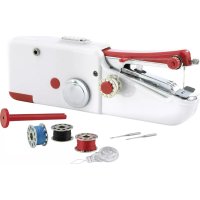
2927 - Sewing machine EasyMaxx - Free user manual and instructions
Find the device manual for free 2927 EasyMaxx in PDF.



| Brand | EasyMaxx |
| Model | 2927 (MS-101) |
| Product type | Manual straight stitch sewing machine |
| Power supply | 4 AA 1.5 V batteries or 6 V DC, 600 mA mains adapter (not included) |
| Protection class | II |
| Sewing functions | Straight stitch only |
| Package contents | 1 sewing machine, 4 bobbins, 2 spare needles, 1 spring, 1 needle threader, 1 instruction manual |
| Required accessories not included | Mains adapter or AA batteries |
| Intended use | Sewing fabric for private, non-professional use |
| Target audience | Adults and children aged 8 and above under supervision |
| Safety instructions | Do not immerse, keep away from children under 8 years, risk of electric shock, do not repair yourself |
| Continuous operation time | Maximum 10 seconds, then 5-second pause |
| Needle type | Standard sewing machine needles, sizes suitable for fabric |
| Thread tension adjustment | Manual tension dial |
| Maintenance | Remove fibers with a fine brush, clean the housing with a soft dry cloth |
| Storage | In original packaging, clean and dry, out of reach of children and animals |
| Repairability | Do not repair yourself, contact after-sales service |
| Spare parts available | Needles, bobbins, spring, needle threader (via customer service) |
| Disposal | Follow the WEEE directive, remove batteries before disposal |
Frequently Asked Questions - 2927 EasyMaxx
User questions about 2927 EasyMaxx
0 question about this device. Answer the ones you know or ask your own.
Ask a new question about this device
Download the instructions for your Sewing machine in PDF format for free! Find your manual 2927 - EasyMaxx and take your electronic device back in hand. On this page are published all the documents necessary for the use of your device. 2927 by EasyMaxx.
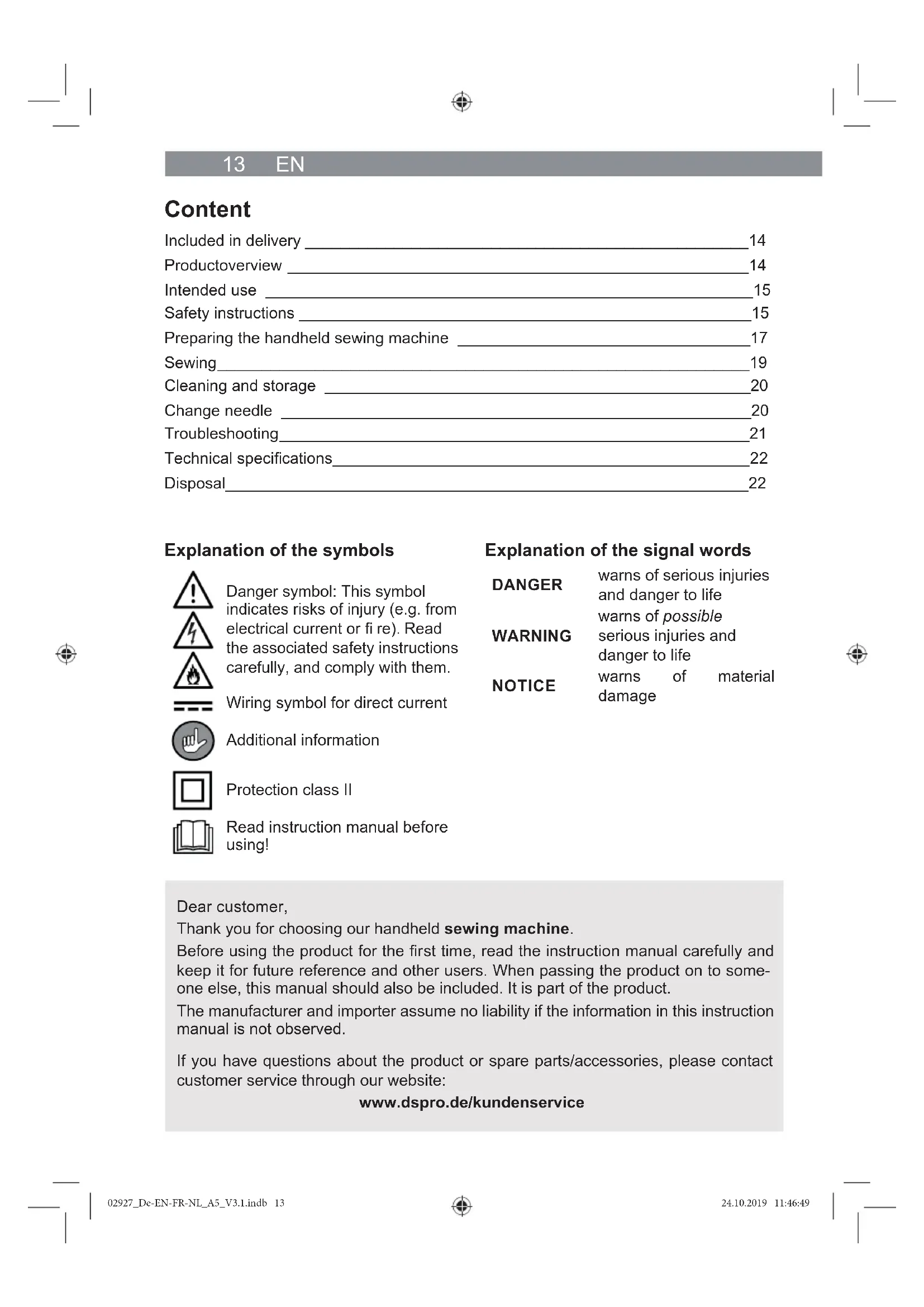
USER MANUAL 2927 EasyMaxx
Included in delivery 14
Productoverview 14
Intended use 15
Safety instructions 15
Preparing the handheld sewing machine 17
Sewing 19
Cleaning and storage 20
Change needle 20
Troubleshooting 21
Technical specifications 22
Disposal 22
Explanation of the symbols

Danger symbol: This symbol indicates risks of injury (e.g. from electrical current or fire). Read the associated safety instructions carefully, and comply with them.

Wiring symbol for direct current


Additional information
Protection class II
Read instruction manual before using!
Explanation of the signal words
DANGER
warns of serious injuries and danger to life warns of possible
WARNING
serious injuries and danger to life
NOTICE
warns of material damage
Dear customer,
Thank you for choosing our handheld sewing machine.
Before using the product for the first time, read the instruction manual carefully and keep it for future reference and other users. When passing the product on to someone else, this manual should also be included. It is part of the product.
The manufacturer and importer assume no liability if the information in this instruction manual is not observed.
If you have questions about the product or spare parts/accessories, please contact customer service through our website:
Included in delivery
Check the product for transport damage. If it is damaged, do not (!) use. Instead, contact customer service. Remove any existing transport protection.
• 1 x handheld sewing machine
- 4 x bobbins with yarn
- 2 x spare needles
- 1 x spring (thread-reel/coil holder)
- 1 x threader
- 1 x instruction manual

An additional 6 V AC adapter or 4 x 1.5 V AA batteries are required for use. Power adapters and batteries are not included!
Productoverview
Legend
(See front fold-out page for illustration)
1 Yarn tensioner (adjusts the tension of the thread)
2 Arm
3 Thread guide 1
4 On/off switch
5 Connection socket adapter cable
6 Battery compartment
7 Hand wheel (turn the wheel to raise and lower the needle.)
8 Coil holder with bobbin
9 Thread-reelholder for larger thread reels
10 Threader
11 Throat plate with carrier
12 Cloth clamp
13 Thread guide2
14 Needle
15 Needle clamp screw
15 EN
Intended use
• This product is intended for sewing fabrics together.
- The product is intended for privatenon-commercial use.
- Use the product only for the specified purpose and only as described in the instruction manual. Any other use is regarded as improper use.
- The guarantee does not cover any defects caused by improper use, damage, or attempted repairs. This also applies to normal wear and tear.
Safety instructions
This product may be used by children from 8 years of age, or by persons with reduced physical, sensory or mental capabilities, or lack of experience and/or knowledge, if they have been supervised or instructed regarding the safe use of the device and have understood the dangers arising from it.
■ Children are not allowed to play with the product.
- Cleaning and user maintenance must not be carried out by children unless they are over 8 years old and supervised.
■ Children younger than 8 years old and animals must be kept away from the product and the connecting cable.
■ Use and store the product out of reach of children and animals. Improper operation may result in injury and electric shocks.
- The product must always be switched off and, if necessary, disconnected from the mains if supervision is not available and before assembly, disassembly or cleaning.
- Do not make any changes to the product. If the product, accessories, or connecting cable show visible damage, do not use the product. Never try to repair the product or accessory yourself. Have repairs carried out by a specialist workshop only! In the case of damage, contact customer service immediately.

DANGER – shock hazard
■ Only use and store the product in enclosed rooms. Do not operate in areas with high humidity.
- Never immerse product and the connecting cable in water or other liquids, and ensure that they do not fall into water or become wet.
- Should the product fall into water, immediately disconnect the power supply. Do not try to pull the product out of the water while it is connected to the mains!
- Never touch the product or connecting cable with wet hands if these components are connected to the mains.
EN 16
- Do not use the product if it has malfunctioned or if it has fallen into water. Have it checked by a specialist workshop before using it again.
The product must be switched off when connected to the power supply or when disconnected from the power supply.

WARNING – risk of injury
Risk of suffocation! Keep children and animals away from packaging materials.
Risk of strangulation! Make sure that the connecting cable is always out of reach of small children and animals.
- Danger of chemical burn from battery acid! Batteries can be life-threatening if swallowed. Keep batteries and product out of reach of children and animals. If a battery has been swallowed, seek medical help immediately.
- Danger of chemical burn from battery acid! If a battery leaks, never allow skin, eyes, or mucous membranes to come into contact with the battery acid. Should this occur, rinse the affected areas immediately with plenty of clean water and seek medical attention immediately.
- Keep fingers away from all moving parts. Special caution should be taken around the sewing needle.
- Do not sew clothes that are on your or someone else's body. Remove clothes before sewing.
- Risk of falling! Make sure that the connected connecting cable is not a tripping hazard.

WARNING – fi re hazard
- Do not use the product in rooms containing easily flammable or explosive substances.
- Do not use the product under a cover or the like, to avoid overheating.
■ Unwrap the connecting cable fully before connecting it to the mains.
NOTICE – risk of material and property damage
If a mains adapter is used, only connect it to a properly installed socket. The socket must also be easily accessible after connection. The mains voltage must match the technical specifications of the mains adapter.
- Ensure that the connecting cable is not crushed, kinked or laid over sharp edges, and that it does not come into contact with hot surfaces.
- Do not place any heavy objects on the product or the connecting cable.
- Protect the product from: jostling, fire, heat, direct sunlight, low temperatures, long-lasting humidity and moisture.
- Only use original accessories from the manufacturer so as not to impair the functioning of the device and to prevent possible damage.
In case of damage/malfunction, switch off the product immediately. Do not use the product if it is damaged.
- Do not make any changes to the product and do not try to repair it. In case of damage contact customer service.
- Do not insert anything into the openings on the product and ensure that these are not plugged up.
17 EN
NOTICE – risk of material and property damage from batteries
■ Remove batteries from the product if they are used or if the product will not be used for a while. This helps prevent damage from leaks.
■ Remove leaking batteries from the battery compartment immediately and clean the contacts.
■ Remove batteries from the product if they are used or if the product will not be used for a while. This helps prevent damage from leaks.
Preparing the handheld sewing machine
The handheld sewing machine can be powered by both electricity and batteries. The batteries must be inserted first for battery operation. A mains adapter must be connected for mains operation.
Battery operation
NOTICE!
- Only use the battery type specified in the “technical data.”
■ Remove the batteries from the product when changing a needle to prevent accidental start-up.
■ Always replace all batteries. Do not use different battery types or brands, or batteries with different capacities.
Before inserting the batteries, check whether the contacts in the item and on the batteries are clean, and clean them if needed.
- Push the on/off switch (4) away from the arm of the sewing machine (2) to deactivate the product (Image A).
- On the underside of the product is the battery compartment lid. Push the lid away from the housing to open the battery compartment (6) (Image B).
- Insert four 1.5 V AA batteries. Ensure correct polarity (+/-) (Image C).
- Close the battery compartment cover, press down and push it back into the lock until you hear it click into place.
If the handheld sewing machine's performance deteriorates, the batteries should be replaced.
Mains operation
- Connect the adapter's power cable to the handheld sewing machine's connection socket (5).
- Plug the adapter's power plug into an easily accessible socket that meets technical specifications.
- To disconnect the product from the mains, first disconnect the power plug from the socket and then pull out the power cable from the socket on the product.
EN 18
Threading

If the sewing machine has already been delivered with the thread inserted, carefully examine the thread guide before changing the thread.
When choosing the yarn, make sure that it is suitable for sewing machines. An unsuitable yarn can quickly tear when sewing.
- When using a bobbin, take the short coil holder (8). For a conventional thread reel, use the thread reel holder (9).
- If necessary, pull out the coil holder from the product and remove the spring. Place a coil or thread reel on the holder so that it rotates counter-clockwise when pulling on the thread (Image D).
- Insert the spring onto the holder and firmly insert it (with the spring) into the appropriate opening in the handheld sewing machine.
- Turn the handwheel (7) until the arm (2) and needle (14) are on top.
- Insert the thread end through thread guide 1 (3) (from bottom to top).
- Put the thread between the two discs of the thread tensioner (1) from above.
- Pass the thread through thread guide 2 (13) (Image E).
- Insert the thread end from back to front (to the product tip) through the needle eye, if necessary use the threader (Image F):
- Thread the wire loop of the threader through the needle eye from front to back.
-Thread the thread through the wire loop.
-Pull the wire loop with the thread through the needle eye.
-Now the thread is threaded. Remove the wire loop.
Adjusting the thread tension
It is best to test the stitch type with a piece of cloth that must be processed later. Check the thread tension.
- Heavy fabric requires less thread tension. If the stitches are too tight, the thread tension is set too high. Turn the thread tensioner (1) counter-clockwise to loosen the tension.
- For light fabrics, a higher thread tension is required. If the stitches are too loose, the thread tension is set too low. Turn the thread tensioner clockwise to increase the tension.
19 EN
Sewing
Sewing start

PLEASE NOTE!
■ Make sure that the thread is threaded correctly! Incorrect thread guidance may cause the yarn to tear, stitches to be missed, or the fabric to curl along the seam. It could possibly damage the product.
- Do not leave the product on for more than 10 seconds without interruption. Take a break of about 5 seconds before turning it back on.
With the handheld sewing machine, fabrics can be sewn with the straight stitch.
- Make sure that the on/off switch (4) is in the "off" position (Image A).
- Turn the handwheel (7) to raise the needle to the highest position (Image G).
- Lift the cloth clamp (12), place the fabric to be processed between the cloth clamp and throat plate (11) and lower the cloth clamp. PLEASE NOTE THE FOLLOWING: The fabric is moved to the left when sewing. Therefore it must be placed at the left end in the sewing machine (Image H).
- Pull out the threaded yarn (see chapter "Preparing the Handheld Sewing Machine" - "Threading") approx. 5 cm.
- Turn the handwheel until the needle pierces the fabric. Hold the fabric with one hand.

The thread and fabric must be correctly inserted in the sewing machine before the on/off switch (4) is activated. After pressing the on/off switch, the handheld sewing machine starts to sew immediately.
-
Hold the handheld sewing machine in one hand and push the on/off switch to the "on" position with your thumb.
-
The fabric is sewn and moved to the left. Carefully guide the fabric with the other hand so that the seam becomes straight (Image I). To lengthen the stitches, pull on the fabric lightly and evenly. But don't pull too hard!
Change sewing direction
- Stop the sewing machine where the sewing direction must be changed and so the needle is in the fabric. If necessary, turn the handwheel until the needle pierces the fabric.
- Lift the cloth clamp and turn the fabric in the new direction using the needle as the pivot point.
- Lower the cloth clamp and continue sewing in the new direction.
Sewing
- Stop the sewing machine.
- Turn the needle to the highest position by turning the handwheel.
- Use a pair of scissors to pull some more thread out of the sewing machine (Image J).
- Cut the thread about 15 cm away from the fabric so that enough thread is left over to secure the seam by hand.
- Lift the cloth clamp and carefully pull out the fabric (Image K).
EN 20
Cleaning and storage

PLEASE NOTE!
- Do not disassemble the housing of the sewing machine.
■ Never use corrosive or abrasive cleaners for cleaning. These can damage the surface.
- Remove any gathered fabric fibres and thread remnants with a fine brush.
- Dust the housing with a soft, dry cloth. Heavy soiling can be wiped with a damp cloth.
- Put a piece of fabric under the cloth clamp as protection.
- Store the product and accessories in their original packaging and keep them in a clean, dry place out of reach of children and animals.
Change needle
Sewing machine needles are available in different sizes. Small needles are suitable for fine/delicate fabrics and large needles for heavy fabrics. The needles supplied are suitable for average fabric thicknesses. If a particularly firm or fine fabric is to be sewn, we recommend buying and using a suitable sewing machine needle.
A needle must always be straight and sharp for trouble-free sewing. Replace a needle if it is bent, dull or broken.
- Move the needle to the highest position with the handwheel.
- Hold the needle and loosen the needle clamp screw (15) counter-clockwise. Now the needle can be removed (Image L).
- Insert the new needle into the needle clamp. The flat side of the needle must be aligned with the needle clamp screw.
- Hold the needle and tighten the needle clamp screw.
PLEASE NOTE THE FOLLOWING: After replacing the needle, first check only by manual operation with the handwheel to see if the machine is sewing neat stitches. Do not press the on/off switch until the needle is in the correct position and sewing neat stitches.
21 EN
Troubleshooting
If the device does not function properly, first check whether the problem can be solved by yourself. If these steps do not solve the problem, contact customer service.

Do not try to repair an electrical device yourself!
| Problem Possible cause/solution | |
| The machine does not start. | Battery operation: The batteries have been inserted incorrectly or are empty. Insert new batteries.Mains operation: The mains adapter is not plugged correctly into the socket or the cable is not properly connected to the product.The socket is defective. Try another socket.Check the fuse of the mains connection. |
| The thread breaks. | The thread is not threaded properly.The thread is tangled.Thread tension is too high.The thread reel or coil was not placed correctly.The needle is bent or dull.The combination of needle size/thread size/fabric is not correct. |
| Stitches are omitted. | The needle was inserted incorrectly.A bad needle is used.The combination of needle size/thread size/fabric is not correct.There are fi bres or lint on the throat plate.The thread guide is not correct. |
| The fabric curls. | Thread tension is too high.The thread guide is not correct.The wrong needle is used.The combination of needle size/thread size/fabric is not correct. |
| The fabric was moved incorrectly. | The combination of needle size/thread size/fabric is not correct.A bad needle is used.The thread is tangled. |
| The needle breaks. | The needle was not inserted correctly.A bad needle was used.The combination needle size/thread size/fabric is not correct.The fabric is pulled too much. Let the carrier push the fabric further, not pull on the fabric. |
EN 22
Technical specifications
Model number: MS-101
Product number: 02927
Functions:
Straight
stitch
Power supply
Mains adapter: 6 V DC, 600 mA (3.5 mm jack)
Batteries: 4 x 1.5 V batteries, type AA
Protection class: II
ID, operating instructions: Z 02927 M DS V3.1 1019

Disposal

Dispose of packaging materials in an environmentally sound way and take recyclables to collection facilities.

Remove batteries before disposing of the product and deliver them separately from the product.
This product is subject to European Directive 2012/19/EU on Waste Electrical and Electronic Equipment (WEEE). Do not dispose of this product as normal household waste, but through an officially approved disposal business according to environmental regulations.
23 FR
Contenu
WAARSCHUWING – Letselgevaar
WAARSCHUWING – Brandgevaar
- Explanation of the symbols
- Explanation of the signal words
- DANGER
- WARNING
- NOTICE
- Included in delivery
- Productoverview
- Legend
- EN
- Intended use
- Safety instructions
- DANGER – shock hazard
- EN 16
- WARNING – risk of injury
- WARNING – fi re hazard
- NOTICE – risk of material and property damage
- EN
- NOTICE – risk of material and property damage from batteries
- Preparing the handheld sewing machine
- Battery operation
- NOTICE!
- Mains operation
- EN 18
- Threading
- Adjusting the thread tension
- EN
- Sewing
- Sewing start
- PLEASE NOTE!
- Change sewing direction
- EN 20
- Cleaning and storage
- Change needle
- EN
- Troubleshooting
- EN 22
- Technical specifications
- Disposal
- FR
- Contenu
- WAARSCHUWING – Letselgevaar
- WAARSCHUWING – Brandgevaar
Brand : EasyMaxx
Model : 2927
Category : Sewing machine