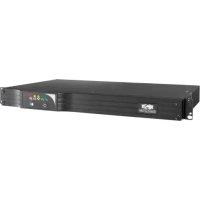
SMX500RT1U - Inverter Tripp Lite - Free user manual and instructions
Find the device manual for free SMX500RT1U Tripp Lite in PDF.


| Product Type | Line-Interactive Intelligent UPS |
| Model | SMX500RT1U (AG-03AD Series) |
| Brand | Tripp Lite |
| Form Factor | 1U Rackmount (19" rack) |
| Nominal Input Voltage | 230 V~ (range 187-265 V~) |
| Nominal Input Frequency | 50/60 Hz (±5 Hz) |
| Nominal Output Voltage (Line Mode) | 230 V~ sine wave |
| Output Voltage (Battery Mode) | 230 V~ quasi-sine wave (PWM) |
| Nominal Output Frequency | 50/60 Hz (±0.5 Hz) |
| Rated Output Power (W/VA) | 300 W / 500 VA |
| Maximum Output Current | 2.17 A |
| Efficiency at Rated Load | 97 % |
| Runtime at Full Load | 3 minutes |
| Battery Recharge Time | 12 hours |
| Transfer Time | 2 ms typical (4 ms max.) |
| Output Receptacles | 5 C13 outlets with battery backup, regulation and surge; 1 C13 outlet surge-only |
| Maximum Input Current | 7 A |
| Maximum Operating Altitude | 2,000 m |
| Battery | Sealed lead-acid, hot-swappable |
| Communication Ports | USB and RS-232 (DB9) with cables included |
| Emergency Power Off (EPO) Port | Yes (RJ11 connector) |
| Accessory Slot | Yes (for SNMP network management option) |
| Input Circuit Breaker | Yes, resettable |
| Safety Instructions | Install indoors away from moisture and excessive heat; do not plug surge protectors or extension cords into output; batteries are recyclable |
Frequently Asked Questions - SMX500RT1U Tripp Lite
User questions about SMX500RT1U Tripp Lite
0 question about this device. Answer the ones you know or ask your own.
Ask a new question about this device
Download the instructions for your Inverter in PDF format for free! Find your manual SMX500RT1U - Tripp Lite and take your electronic device back in hand. On this page are published all the documents necessary for the use of your device. SMX500RT1U by Tripp Lite.
USER MANUAL SMX500RT1U Tripp Lite
Intelligent, Line-Interactive UPS Systems
SMX500RT1U
Series: AG-03AD
SMART500RT1U
Series: AG-03AA
Important Safety Instructions 2
Mounting 3
Quick Installation 4
Optional Installation 6
Basic Operation 7
Storage and Service 10
Battery Replacement 11
Specifications 12
Product Registration 13
Español 14
Français 27
Русский 40
Deutsch 53
WARRANTY REGISTRATION
Register your product today and be automatically entered to win an ISOBAR ^® surge protector in our monthly drawing!
tripplite.com/warranty
text_image
QR code image containing encoded data, no visible human-readable text
text_image
TRIPP·LITE
Manufacturing Excellence.
1111 W. 35th Street, Chicago, IL 60609 USA • tripplite.com/support
Copyright ©2021 Tripp Lite. All rights reserved. SmartPro ^® is a registered trademark of Tripp Lite.
Important Safety Instructions

SAVE THESE INSTRUCTIONS
This manual contains important instructions that should be followed during the installation, operation and storage of all Tripp Lite UPS Systems. Failure to heed these warnings will void your warranty.
UPS Location Warnings
- Use caution when lifting your UPS. Because of the considerable weight of all rack-mount UPS systems, at least two people should assist in lifting and installing them.
• Install your UPS indoors, away from excess moisture or heat, dust or direct sunlight. - For best performance, the ambient temperature near your UPS should be between 0^ and 40^ (between 32^ and 104^ ).
- Leave adequate space around all sides of the UPS for proper ventilation. Do not obstruct its vents or fan openings.
UPS Connection Warnings
- The UPS contains its own energy source (battery). The output terminals may be live even when the UPS is not connected to an AC supply.
- Connect your UPS to a properly grounded AC power outlet. Do not modify the UPS's plug in a way that would eliminate the UPS's connection to ground. Do not use adapters that eliminate the UPS's connection to ground.
- Do not plug your UPS into itself; this will damage the UPS and void your warranty.
- If you are connecting your UPS to a motor-powered AC generator, the generator must provide filtered, frequency-regulated, computer-grade output.
Equipment Connection Warnings
- Use of this equipment in life support applications where failure of this equipment can reasonably be expected to cause the failure of the life support equipment or to significantly affect its safety or effectiveness is not recommended.
- Do not connect surge suppressors or extension cords to the output of your UPS. This might overload the UPS and will void the surge suppressor and UPS warranties.
Battery Warnings
- Batteries can present a risk of electrical shock and burn from high short-circuit current. Observe proper precautions. Do not dispose of the batteries in a fire. Do not open the UPS or batteries. Do not short or bridge the battery terminals with any object. Unplug and turn off the UPS before performing battery replacement. Use tools with insulated handles. There are no user-serviceable parts inside the UPS. Battery replacement should be performed only by authorized service personnel using the same number and type of batteries (sealed Lead-Acid). The batteries are recyclable. Refer to your local codes for disposal requirements or in the USA only call 1-800-SAV-LEAD or 1-800-8-BATTERY (1-800-8-228-8379) or visit www.call2recycle.org for recycling information. Tripp Lite offers a complete line of UPS System Replacement Battery Cartridges (R.B.C.). Visit Tripp Lite on the Web at tripplite.com to locate the specific replacement battery for your UPS.
- During hot-swap battery replacement, the UPS will not provide backup power in the event of a blackout or other power interruptions.
- Do not operate UPS without batteries.
- When adding external battery packs to select models with external battery pack connectors, connect only Tripp Lite-recommended battery packs of the correct voltage and type. Do not connect or disconnect battery packs when the UPS is operating on battery power.
Mounting
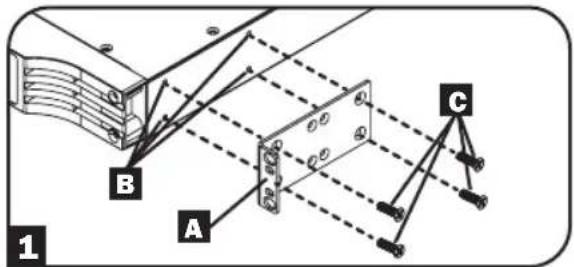
Mount your equipment in either a 4-post or 2-post rack or rack enclosure. The user must determine the fitness of hardware and procedures before mounting. If hardware and procedures are not suitable for your application, contact the manufacturer of your rack or rack enclosure. The procedures described in this manual are for common rack and rack enclosure types and may not be appropriate for all applications.
4-Post Rack Mounting
UPS models include hardware required to mount in a 4-post rack.
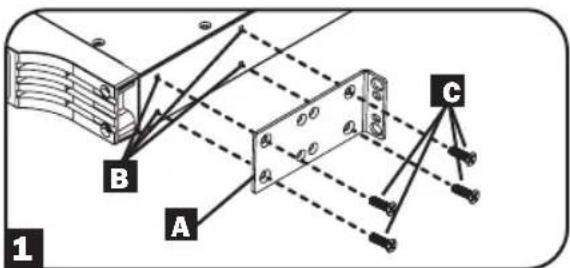
1 Attach mounting ears A to the front mounting holes of your equipment B using the screws provided C. The ears should face forward.
2 Using an assistant if necessary, lift your equipment and mount it to the rack. Attach it by screwing the appropriate hardware D through its mounting ears and into the rack rails.
text_image
B A C 1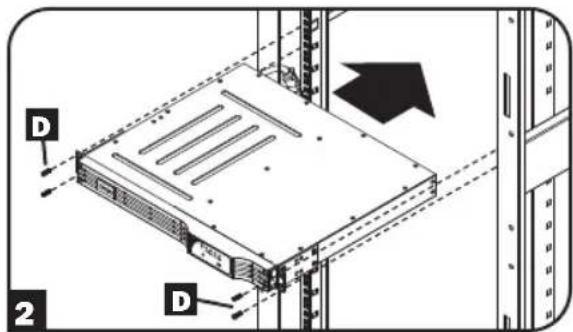
text_image
D 2 D2-Post (Telecom) Rack Mounting
Following the procedures below, mount the 1U UPS model in 2-post racks with the included hardware.
1 Attach mounting ears A to the front mounting holes of your UPS B using the screws provided C. The ears should face backward.
2 Using an assistant if necessary, lift your UPS and attach it to the rack by passing the screws, nuts and washers provided D through its mounting ears and into the rack rails.
text_image
1 A B C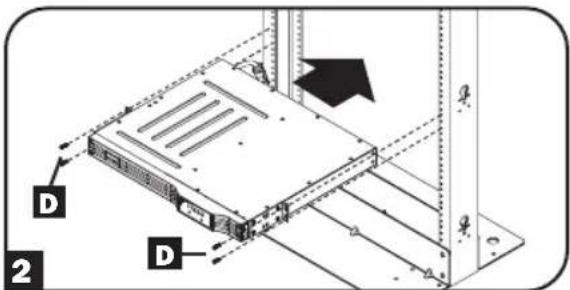
text_image
D D 2Mounting
Tower Mounting
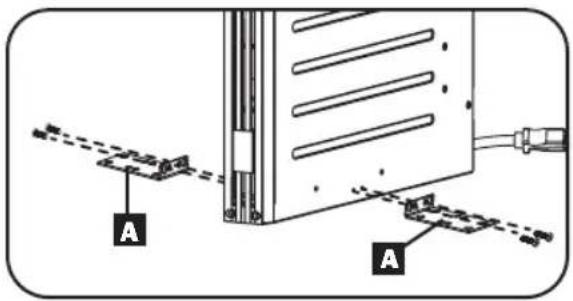
Mount UPS models in an upright tower position using included hardware. The user must determine the fitness of hardware and procedures before mounting.
Stand your UPS on its side with the LED/Control panel at the top. Attach one rack mounting ear A to each side of the UPS using included screws.
text_image
A AQuick Installation
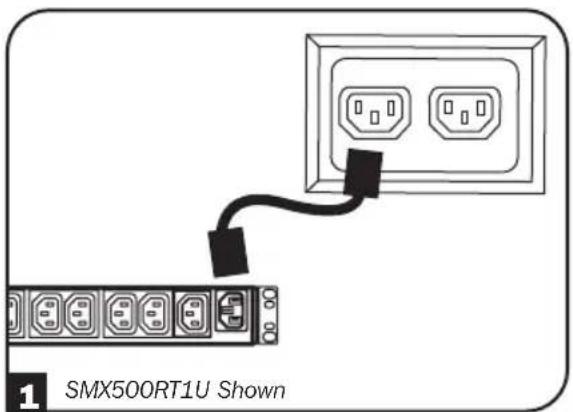
1 Plug the UPS into an outlet on a dedicated circuit.\*
- Connect the SMX500RT1U AC input to the outlet using one of the two included 1.8 m C13 to C14 power cords, or connect with a user-supplied cord.
• SMART500RT1U has an attached cable.
NOTE! after plugging the UPS into a live AC outlet, the UPS (in "Standby" mode) will automatically charge its batteries**, but will not supply power to its outlets until it is turned ON (see Step 3 below).
Note: UPS system will function properly upon initial startup. However, maximum runtime for the unit's battery will only be accessible after it has been charged for 24 hours.
* See Specifications for circuit amperage requirements.
** The BATTERY CHARGE LED will be the only LED illuminated.
text_image
SMX500RT1U Shown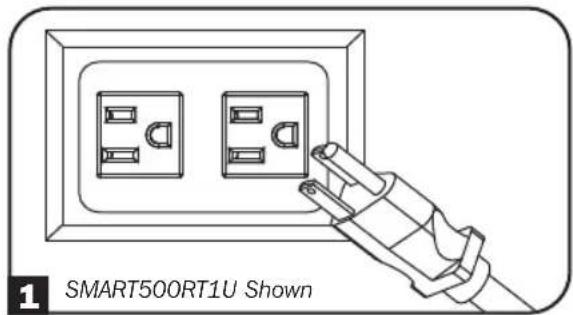
natural_image
Line drawing of a Smart500RT1U socket with a plug inserted, no text or symbols presentQuick Installation
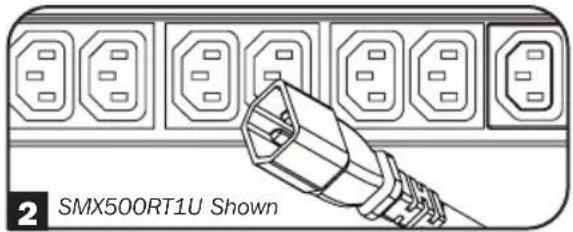
2 Plug your equipment into the UPS.\*
- For SMX500RT1U, use the second of the two included 1.8 m C13 to C14 power cords to connect equipment to the UPS, or connect with a user-supplied cord.
• Additional power cords are available from Tripp Lite. Visit tripplite.com.
* Your UPS is designed to support only electronic equipment. You will overload the UPS if the total VA ratings for all the equipment you connect exceeds the UPS's Output Capacity (see Specifications). To find your equipment's VA ratings, look on their nameplates. If the equipment is listed in amps, multiply the number of amps by your UPS's voltage to determine VA.
For example: for SMART500RT1U,
1 amp x 120 V = 120 VA; for SMX500RT1U,
1 amp × 230 V = 230 VA. If you are unsure if
you have overloaded the UPS's outlets, see
"OUTPUT LOAD LEVEL" LED description.
3 Turn the UPS ON.
Press and hold the "ON/OFF/STANDBY" button for one second. The alarm will beep once briefly after one second has passed. Release the button.
text_image
SMX500RT1U Shown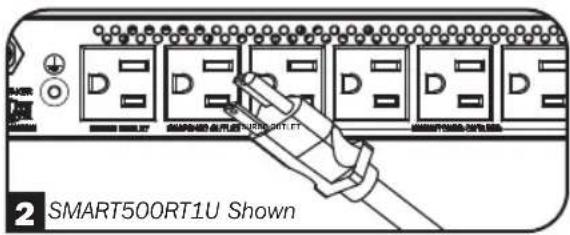
text_image
2 SMART500RT1U Shown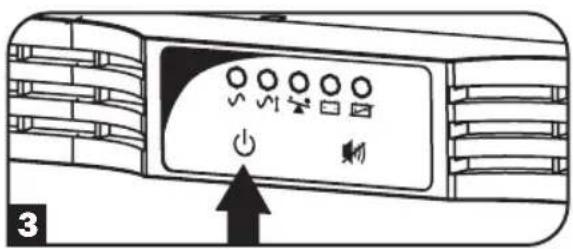
text_image
Diagram of an air conditioner control panel with labeled buttons and a power indicator arrowOptional Installation
These connections are optional. Your UPS will function properly without these connections.
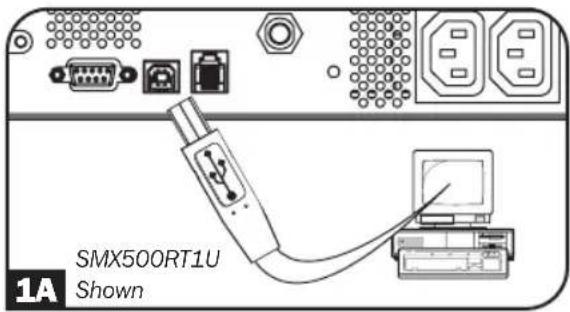
1 USB and RS-232 Serial Communications
Use the included USB cable (see 1A) and/or DB9 serial cable (see 1B) to connect the communication port on your computer to the communication port of your UPS. Install on your computer the Tripp Lite PowerAlert software appropriate to your computer's operating system. Your UPS may feature additional communications ports. These ports may also be connected to additional computers which have PowerAlert® software installed. Consult your PowerAlert manual for more information.
text_image
SMX500RT1U Shown 1A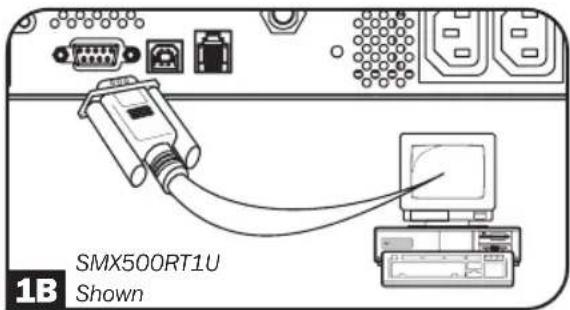
text_image
SMX500RT1U Shown2 EPO Port Connection
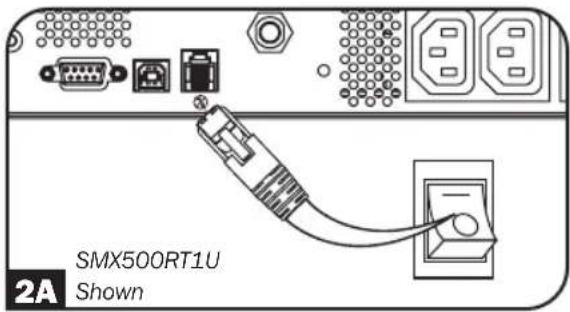
This optional feature is only for those applications which require connection to a facility's Emergency Power Off (EPO) circuit. When the UPS is connected to this circuit, it enables emergency shutdown of the UPS's inverter.
Using the cable provided, connect the EPO port of your UPS (see 2A) to a user-supplied normally closed or normally open switch according to the circuit diagram (see 2B).
Note: The EPO port is not a phone line surge suppressor; do not connect a phone line to this port.
text_image
SMX500RT1U 2A Shown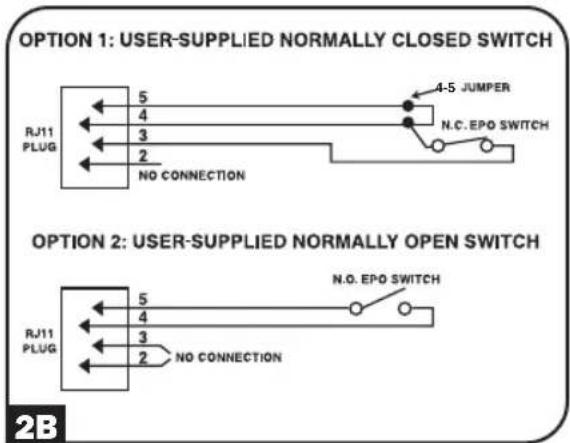
flowchart
graph TD
    subgraph OPTION 1: USER-SUPPLIED NORMALLY CLOSED SWITCH
        A["RJ11 PLUG"] -->|5| B["4-5 JUMPER"]
        A -->|3| C["N.C. EPO SWITCH"]
        A -->|2| D["NO CONNECTION"]
    end
    subgraph OPTION 2: USER-SUPPLIED NORMALLY OPEN SWITCH
        E["RJ11 PLUG"] -->|5| F["N.O. EPO SWITCH"]
        E -->|4| G["NO CONNECTION"]
        E -->|3| H["NO CONNECTION"]
    end
Basic Operation
LED Interface
text_image
Diagram showing various electrical symbols and power indicators, including power, switch, and speaker.Buttons (Front Panel)
"ON/OFF/STANDBY" Button
- To turn the UPS ON: With the UPS plugged into a live AC wall outlet*, press and hold the "ON/OFF/STANDBY" button for one second.** Release the button. If utility power is absent, you can "cold-start" the UPS (i.e.: turn it ON and supply power for a limited time from its batteries*** ) by pressing and holding the "ON/OFF/STANDBY" button for one second.**
- To turn the UPS OFF: With the UPS ON and receiving utility power, press and hold the "ON/OFF/STANDBY" button for one second.** Then unplug the UPS from the wall outlet. The UPS will be completely OFF.
* After you plug the UPS into a live AC outlet, the UPS (in "Standby" mode) will automatically charge its batteries, but will not supply power to its outlets until it is turned ON. ** The alarm will beep once briefly after the indicated interval has passed. *** If fully charged.
"MUTE/TEST" Button
To Silence (or "Mute") UPS Alarms: Briefly press and release the "MUTE/TEST" button.
To Run a Self-Test: With your UPS plugged in and turned ON, press and hold the "MUTE/TEST" button for two seconds.* Continue holding the button until the alarm beeps several times and the UPS performs a self-test. See "Results of a Self-Test" below.
Note: You can leave connected equipment on during a self-test. Your UPS, however, will not perform a self-test if the UPS is not turned on (see "ON/OFF/STANDBY" Button description).
CAUTION! Do not unplug your UPS to test its batteries. This will remove safe electrical grounding and may introduce a damaging surge into your network connections.
* The alarm will beep once briefly after the indicated interval has passed.
Results of a Self-Test: the test will last approximately 10 seconds as the UPS switches to battery to test its load capacity and battery charge.
- If the "OUTPUT LOAD LEVEL" LED remains lit red and the alarm continues to sound after the test, the UPS's outlets are overloaded. To clear the overload, unplug some of your equipment and run the self-test repeatedly until the "OUTPUT LOAD LEVEL" LED is no longer lit red and the alarm is no longer sounding.
CAUTION! Any overload that is not corrected by the user immediately following a self-test may cause the UPS to shut down and cease supplying output power in the event of a blackout or brownout.
- If the "BATTERY WARNING" LED remains lit and the alarm continues to sound after the test, the UPS batteries need to be recharged or replaced. Allow the UPS to recharge continuously for 12 hours, and repeat the self-test. If the LED remains lit, contact Tripp Lite for service. If your UPS requires battery replacement, visit tripplite.com to locate the specific Tripp Lite replacement battery for your UPS.
Basic Operation
Indicator Lights (Front Panel)
All Indicator Light descriptions apply when the UPS is plugged into a wall outlet and turned ON.
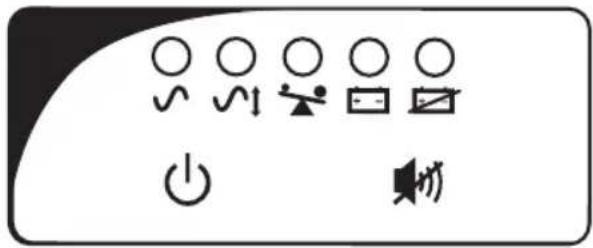
"POWER" LED: This green LED lights continuously when the UPS is ON and supplying connected equipment with AC power from a utility source. The LED flashes and an alarm sounds (4 short beeps followed by a pause) to indicate the UPS is operating from its internal batteries during a blackout or severe brownout. If the blackout or severe brownout is prolonged, you should save files and shut down your equipment, since internal battery power will eventually be depleted. See "BATTERY CHARGE" LED description below.
"VOLTAGE CORRECTION" LED: This green LED lights continuously whenever the UPS is automatically correcting high or low AC voltage on the utility line without the assistance of battery power. The UPS will also emit a slight clicking noise. These are normal, automatic operations of the UPS; no action is required on your part.
"OUTPUT LOAD LEVEL" LED: This multicolored LED indicates the approximate electrical load of equipment connected to the UPS's AC outlets. It will turn from green (light load) to yellow (medium load) to red (overload). If the LED is red (either illuminated continuously or flashing), clear the overload immediately by unplugging some of your equipment from the outlets until the LED changes from red to yellow (or green). CAUTION! Any overload that is not corrected by the user immediately may cause the UPS to shut down and cease supplying output power in the event of a blackout or brownout.
"BATTERY CHARGE" LED: When the UPS is operating from utility power, this LED indicates the approximate charge state of the UPS's internal batteries: red indicates the batteries are beginning to charge, yellow indicates the batteries are roughly midway through charging, and green indicates the batteries are fully charged. When the UPS is operating from battery power during a blackout or severe brownout, this LED indicates the approximate amount of energy (ultimately affecting runtime) which the UPS's batteries will provide: red indicates a low level of energy, yellow indicates a medium level of energy, and green indicates a high level of energy. Since the runtime performance of all UPS batteries will gradually deplete over time, it is recommended that you periodically perform a self-test (see "MUTE/TEST" Button description) to determine the energy level of your UPS batteries BEFORE a blackout or severe brownout occurs. During a prolonged blackout or severe brownout, you should save files and shut down your equipment, since battery power will eventually be depleted. When the LED turns red and an alarm sounds continuously, it indicates the UPS's batteries are nearly out of power and UPS shut down is imminent.
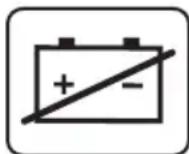
"BATTERY WARNING" LED: This LED lights red and an alarm sounds intermittently after you complete a self-test (See "MUTE/TEST" Button description) to indicate the UPS batteries need to be recharged or replaced. Allow the UPS to recharge continuously for 12 hours, and repeat the self-test. If the LED continues to light, contact Tripp Lite for service. If your UPS requires battery replacement, visit triplite.com to locate the specific Tripp Lite replacement battery for your UPS.
Basic Operation
Other UPS Features (Rear Panel)
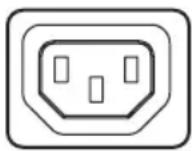
C13
AC Receptacles: Your UPS features C13 outlets (SMX500RT1U) or NEMA 5-15R outlets (SMART500RT1U). These outlets provide your connected equipment with AC line power during normal operation and battery power during blackouts and brownouts. The UPS protects equipment connected to these receptacles against damaging surges and line noise. If you have a serial or USB connection to your UPS, you can remotely reboot connected equipment by turning receptacles OFF and ON using Tripp Lite's PowerAlert software. Models also feature outlets labeled "UNSWITCHED" which may not be remotely turned off.
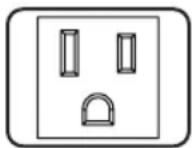
NEMA 5-15R
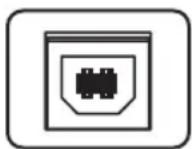
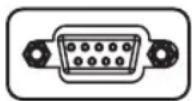
Communications Ports (USB or RS-232): These ports connect your UPS to any workstation or server. Use with Tripp Lite's PowerAlert software and included cables to enable your computer to automatically save open files and shut down equipment during a blackout. Also use PowerAlert to monitor a wide variety of AC line power and UPS operating conditions. Consult your PowerAlert manual or contact Tripp Lite Customer Support for more information. See “USB and RS-232 Serial Communications” in the “Optional Installation” section for installation instructions.
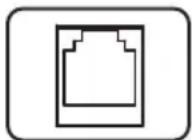
EPO (Emergency Power Off) Port: Your UPS features an EPO port that may be used to connect the UPS to a contact closure switch to enable emergency inverter shutdown. See “Optional Installation” section.
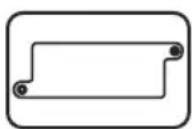
Accessory Slot: Remove the small cover panel from this slot to install optional accessories to remotely monitor and control your UPS. Refer to your accessory's manual for installation instructions. Contact Tripp Lite at tripplite.com/support for more information, including a list of available SNMP, network management and connectivity products.

Input Breaker(s): Protect an electrical circuit from overcurrent draw from the UPS load. If one or more breakers trip, remove some of the load, then reset them by pressing the breaker(s) in.
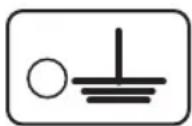
Ground Screw: Use this to connect any equipment that requires a chassis ground.
Storage and Service
Storage
Before storing your UPS, turn it completely OFF: With the UPS ON and receiving utility power, press and hold the "ON/OFF/STANDBY" button for one second (an alarm will beep once briefly after the interval has passed), then unplug the UPS from the wall outlet. If you store your UPS for an extended period of time, recharge the UPS batteries once every three months: plug the UPS into a wall outlet, allow it to charge for 12 hours, and then unplug it and place it back in storage. Note: after you plug the UPS in, it will automatically begin charging its batteries. However, it will not supply power to its outlets (see Quick Installation section). If you leave your UPS batteries discharged for an extended period of time, they will suffer a permanent loss of capacity.
Service
Before returning your UPS for service, follow these steps:
- Review the installation and operation instructions in this manual to ensure that the service problem does not originate from a misreading of the instructions. Also, check that the UPS System's circuit breaker(s) are not tripped. This is the most common cause of service inquiries, which can be easily remedied by following the resetting instructions in this manual.
- If the problem continues, do not contact or return the UPS to the dealer. Instead, contact Tripp Lite at triplite.com/support. A service technician will ask for the UPS's model number, serial number and purchase date.
- If the problem requires service, the technician will issue you a Returned Material Authorization (RMA) number, which is required for service. If you require packaging, the technician can arrange to send you proper packaging. Securely pack the UPS to avoid damage during shipping. Do not use Styrofoam beads for packaging. Any damages (direct, indirect, special, incidental or consequential) to the UPS incurred during shipment to Tripp Lite or an authorized Tripp Lite service center is not covered under warranty. UPS Systems shipped to Tripp Lite or an authorized Tripp Lite service center must have transportation charges prepaid. Mark the RMA number on the outside of the package. If the UPS System is within the 2-year warranty period, enclose a copy of your sales receipt. Return the UPS for service using an insured carrier to the address given to you by the Tripp Lite service technician.
Battery Replacement
Under normal conditions, the original batteries in your UPS will last many years. See “Safety” section before replacing batteries. The batteries are designed for hot-swap replacement (i.e. leaving the UPS in ON mode), but qualified service personnel may wish to put the UPS in the OFF mode before proceeding.
Procedure
1 Remove Front Panel
2 DisconnectBatteries
3 Remove/Dispose of Batteries
4 Add Batteries
5 ConnectBatteries
Attach connectors: black-to-black and red-to-red.
6 Replace Front Panel
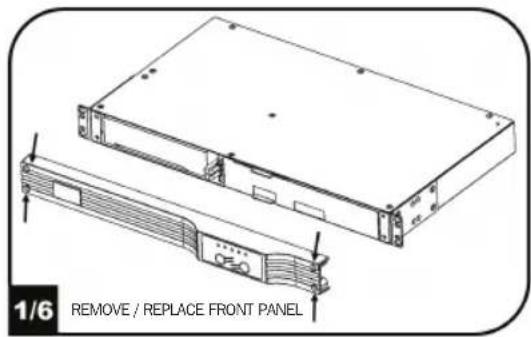
text_image
1/6 REMOVE / REPLACE FRONT PANEL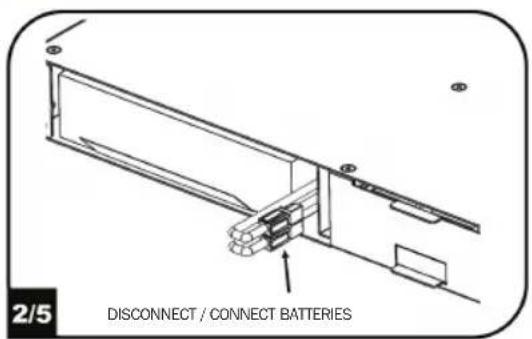
text_image
DISCONNECT / CONNECT BATTERIES 2/5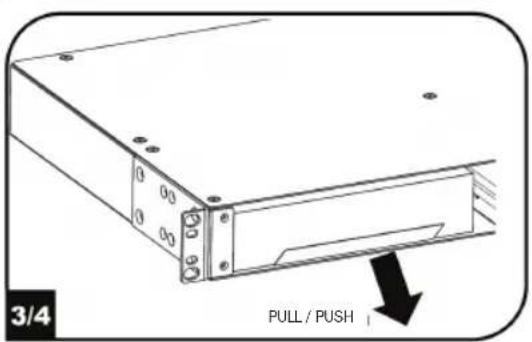
text_image
3/4 PULL / PUSHSpecifications
| Model SMX500RT1U SMART500RT1U | ||
| Nominal input voltage(s) and range | 230V~, 187-265V~ 120V~, 90-1 | 39V~ |
| Nominal input frequency and tolerance | 50/60 Hz (+/- 5 Hz) 60 Hz (+/- 5 Hz) | Hz) |
| Nominal output voltage 230V~ sinusoidal in line mode and 230V~ PWM in battery mode | 120V~ sinusoidal in line mode and 120V~ PWM in battery mode | |
| Nominal output frequency | 50/60 Hz (+/-0.5 Hz) 60 Hz (+/-0.5 Hz) | 0.5 Hz) |
| Output voltage regulation in line-mode | 230 V~ (+15% / - 8%) 120 V~ (+16% / - 14%) | |
| Output voltage regulation in battery mode | 230V~ (+/-5%) 120V~ (+/-5%) | |
| Nominal output power in W / VA: | 300W / 500VA 300W / 500VA | |
| Output voltage waveform | Sinusoidal in line mode and quasi-sine (PWM) in battery mode | Sinusoidal in line mode and quasi-sine (PWM) in battery mode |
| Maximum output current @ P.F. | 2.17A @ 230V~ 4.2A @ 120V~ | |
| P.F. = 0.6 P.F. = 0.6 | ||
| Efficiency with nominal load | 97% 97% | |
| Maximum operating altitude at 100% of nominal power | 6561 ft. (2000 m) above sea level | 6561 ft. (2000 m) above sea level |
| Online overload capability | 120% @ 5 minutes 120% @ 5 minutes | |
| Overload capacity in battery mode | 120% @ 5 minutes | 120% @ 5 minutes |
| Current limitation | Input 7A | Input 10A |
| Autonomy time at full load | 3 minutes @ 300W | 3 minutes @ 300W |
| Battery recharge time | 12 hours | 12 hours |
| Transfer time 2 milliseconds | ds typical(4 milliseconds max) | 6 milliseconds typical(10 milliseconds max) |
| Outlets | 5x C13 outlets with battery backup, regulation and surge;1x C13 outlets only for surges | 5x 5-15R outlets with battery backup, regulation and surge;1x 5-15R outlets only for surges |
| Maximum input current 7A | 10A | |
Product Registration
Visit tripplite.com/warranty today to register your new Tripp Lite product. You'll be automatically entered into a drawing for a chance to win a FREE Tripp Lite product!*
* No purchase necessary. Void where prohibited. Some restrictions apply. See Web site for details.
FCC RADIO/TV INTERFERENCE NOTICE: (FOR CLASS A MODELS)
Note: This equipment has been tested and found to comply with the limits for a Class A digital device, pursuant to Part 15 of the FCC Rules. These limits are designed to provide reasonable protection against harmful interference when operated in a commercial environment. This equipment generates, uses and can radiate radio frequency energy, and if not installed and used in accordance with the instruction manual, may cause interference to radio communications. Operation of this equipment is likely to cause harmful interference in which case the user will be required to correct the interference at his own expense. The user must use shielded cables and connectors with this product. Any changes or modifications to this product not expressly approved by the party responsible for compliance could void the user's authority to operate the equipment.
FCC RADIO/TV INTERFERENCE NOTICE: (FOR CLASS B MODELS)
Note: This equipment has been tested and found to comply with the limits for a Class B digital device, pursuant to Part 15 of the FCC Rules. These limits are designed to provide reasonable protection against harmful interference in a residential installation. This equipment generates, uses and can radiate radio frequency energy, and if not installed and used in accordance with the instruction manual, may cause interference to radio communications. However, there is no guarantee that interference will not occur in a particular installation. If this equipment does cause harmful interference to radio or television reception, which can be determined by turning the equipment off and on, the user is encouraged to try to correct the interference using one or more of the following measures: reorient or relocate the receiving antenna; increase the separation between the equipment and the receiver; connect the equipment into an outlet on a circuit different from that which the receiver is connected; consult the dealer or an experienced radio/television technician for help. The user must use shielded cables and connectors with this product. Any changes or modifications to this product not expressly approved by the party responsible for compliance could void the user's authority to operate the equipment. This device complies with part 15 of the FCC rules. Operation is subject to the following 2 conditions: (1) This device may not cause harmful interference, and (2) This device must accept any interference received, including interference that may cause undesired operation.
Regulatory Compliance Identification Numbers
For the purpose of regulatory compliance certifications and identification, your Tripp Lite product has been assigned a unique series number. The series number can be found on the product nameplate label, along with all required approval markings and information. When requesting compliance information for this product, always refer to the series number. The series number should not be confused with the marketing name or model number of the product.
Tripp Lite has a policy of continuous improvement. Product specifications are subject to change without notice. Photos and illustrations may differ slightly from actual products.
Note on Labeling
Two symbols are used on the label.
V\~ : AC Voltage
V÷DC Voltage

text_image
TRIPP·LITE
Manufacturing Excellence.
1111 W. 35th Street, Chicago, IL 60609 USA • tripplite.com/support
21-10-019 933903_RevC
text_image
Diagram of a remote control panel with labeled buttons and an arrow pointing to the power buttontext_image
Diagram showing six basic electrical symbols: power, switch, battery, lamp, resistor, and meter.Botones (Panel Frontal)
text_image
2/5 DESCONECTE / CONECTE LAS BATERÍAS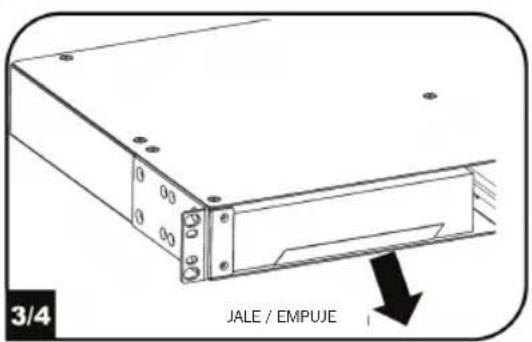
text_image
3/4 JALE / EMPUJEEspecificaciones
1111 W. 35th Street, Chicago, IL 60609 USA • tripplite.com/support
text_image
Technical diagram of a server rack with labeled components and directional arrows indicating movement or assembly.Montage
Montage en tour
natural_image
Illustration of a Smart500RT1U power plug inserted into an electrical socket (no text or symbols on the diagram itself)Installation rapide
text_image
Diagram of a device control panel with icons and an arrow indicating power input or statustext_image
Diagram showing various electrical symbols and power connections, including power source, switch, lamp, and speaker.Boutons (panneau avant)
1111 W. 35th Street, Chicago, IL 60609 USA • tripplite.com/support
21-10-019 933903_RevC
1111 W. 35th Street, Chicago, IL 60609 USA • tripplite.com/support
text_image
Diagram of a remote control panel with labeled buttons and an upward arrow indicating actiontext_image
Diagram showing six basic electrical symbols with Chinese labels: power, switch, lamp, diode, and speaker.1111 W. 35th Street, Chicago, IL 60609 USA • tripplite.com/support
21-10-019 933903_RevC
Benutzerhandbuch
Manufacturing Excellence.
1111 W. 35th Street, Chicago, IL 60609 USA • tripplite.com/support
text_image
Diagram of a remote control panel with labeled buttons and an arrow pointing to the power buttonOptionale Installation
text_image
Diagram showing various electrical symbols and icons, including power, switch, and speakerTasten (Frontplatte)
„EIN/AUS/STANDBY“ Taste
Manufacturing Excellence.
1111 W. 35th Street, Chicago, IL 60609 USA • tripplite.com/support
21-05-183 933903_RevC