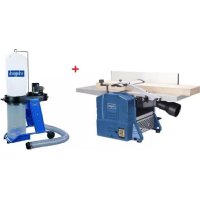
HMS860 - Plane SCHEPPACH - Free user manual and instructions
Find the device manual for free HMS860 SCHEPPACH in PDF.

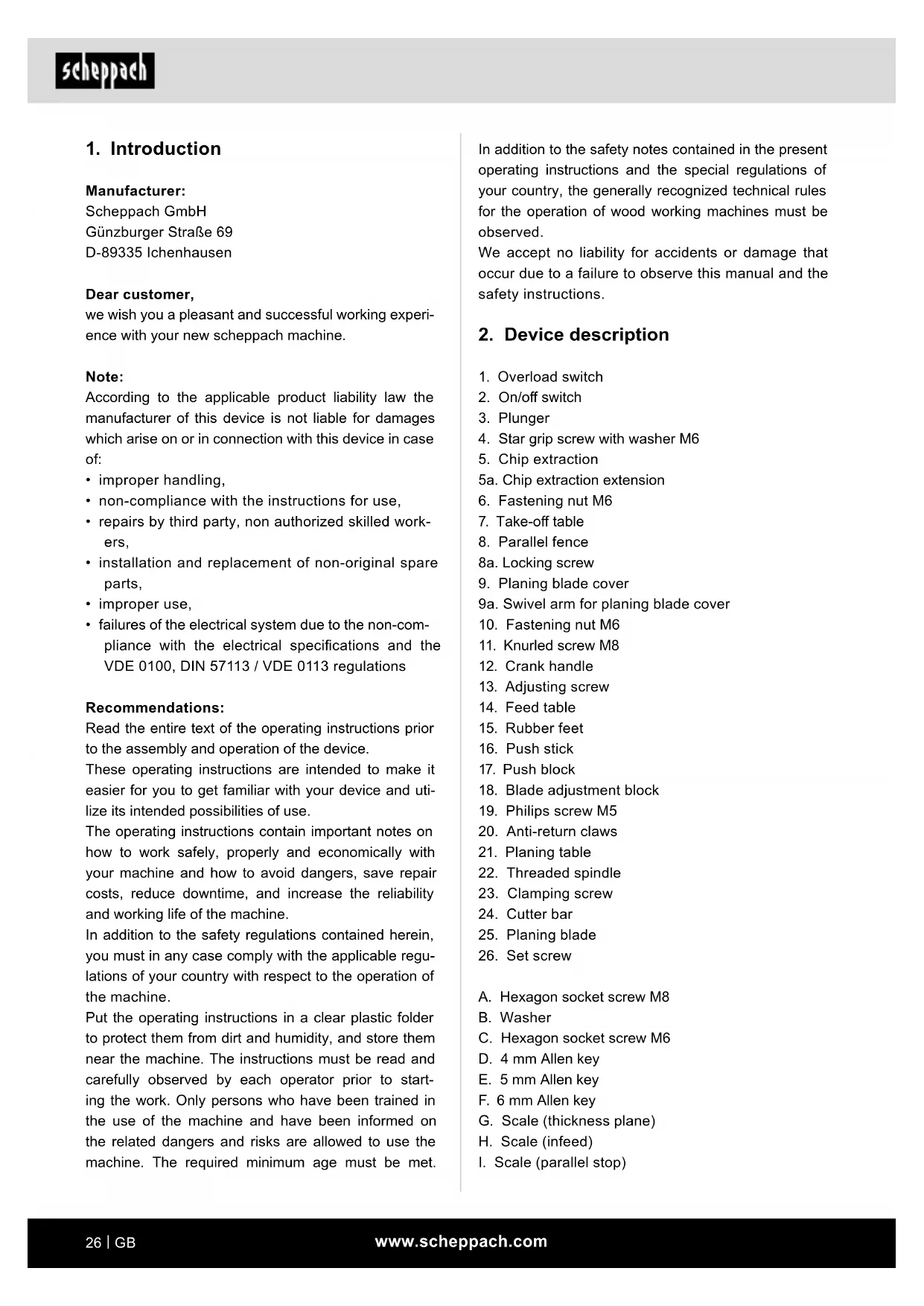


| Product type | Planer / Jointer-Planer |
| Brand | Scheppach |
| Model | HMS860 |
| Dimensions (L x W x H) | 770 x 450 x 483 mm |
| Weight | 24 kg |
| Power supply | 230-240 V ~ 50 Hz |
| Power consumption (P1) | 1500 W |
| Cutter head speed | 9000 min⁻¹ |
| Number of blades | 2 |
| Max. working width (jointing) | 204 mm |
| Max. depth of cut (jointing) | 2.5 mm |
| Fence dimensions | 540 x 105 mm |
| Fence tilt range | 90° - 135° |
| Jointer table dimensions | 740 x 213 mm |
| Max. working width (planing) | 204 mm |
| Max. planing height | 120 mm |
| Max. depth of cut (planing) | 2 mm |
| Planer table dimensions | 250 x 270 mm |
| Sound pressure level LpA | 92 dB(A) |
| Sound power level LWA | 105 dB(A) |
| Functions | Jointing, planing, parallel stop, chip extraction, anti-kickback protection |
| Maintenance and cleaning | Regular cleaning of tables and ejector, monthly oiling of moving parts, lubrication of threaded rods with dry lubricant, replacement of blades if worn |
| Safety | Overload switch, safety keys (ejector), planer guard, anti-kickback fingers, emergency stop, motor brake |
| Spare parts and repairability | Planer blades (consumables), timing belt, carbon brushes. Repairs by a qualified electrician |
| General information | Legal warranty, wear parts not covered. Intended use for planing and jointing solid wood only |
Frequently Asked Questions - HMS860 SCHEPPACH
User questions about HMS860 SCHEPPACH
0 question about this device. Answer the ones you know or ask your own.
Ask a new question about this device
Download the instructions for your Plane in PDF format for free! Find your manual HMS860 - SCHEPPACH and take your electronic device back in hand. On this page are published all the documents necessary for the use of your device. HMS860 by SCHEPPACH.
USER MANUAL HMS860 SCHEPPACH
Günzburger Straße 69
D-89335 Ichenhausen
Verehrter Kunde
Homepage: https://www.scheppach.com/de/service
Explanation of the symbols on the device
Symbols are used in this manual to draw your attention to potential hazards. The safety symbols and the accompanying explanations must be fully understood. The warnings themselves will not rectify a hazard and cannot replace proper accident prevention measures.
| Read and observe the instructions manual and safety regulations before starting the machine! | |
| Wear ear-muffs! | |
| Wear a breathing mask. Dust which is injurious to health can be generated when working on wood and other materials. Never use the tool to work on any materials containing asbestos! | |
| WARNING! Wear safety goggles. Sparks generated during working or splinters, chips and dust emitted by the device can cause loss of sight! | |
| WARNING! Risk of injury! Never reach into the planing knife during operation. | |
| OFF ON | Overload switch |
| Feed direction |
Table of contents: Page:
- Introduction 26
- Device description 26
- Scope of delivery 27
- Intended use 27
- Safety information 27
- Technical data 30
- Unpacking 30
- Assembly 31
- Installation 31
- Electrical connection 33
- Cleaning 34
- Storage 34
- Maintenance 34
- Disposal and recycling 35
- Troubleshooting 36
- Declaration of conformity 115
1. Introduction
Manufacturer:
Scheppach GmbH
Günzburger Straße 69
D-89335 Ichenhausen
Dear customer,
we wish you a pleasant and successful working experience with your new scheppach machine.
Note:
According to the applicable product liability law the manufacturer of this device is not liable for damages which arise on or in connection with this device in case of:
- improper handling,
- non-compliance with the instructions for use,
- repairs by third party, non authorized skilled workers.
- installation and replacement of non-original spare parts,
improper use, - failures of the electrical system due to the non-compliance with the electrical specifications and the VDE 0100, DIN 57113 / VDE 0113 regulations
Recommendations:
Read the entire text of the operating instructions prior to the assembly and operation of the device.
These operating instructions are intended to make it easier for you to get familiar with your device and utilize its intended possibilities of use.
The operating instructions contain important notes on how to work safely, properly and economically with your machine and how to avoid dangers, save repair costs, reduce downtime, and increase the reliability and working life of the machine.
In addition to the safety regulations contained herein, you must in any case comply with the applicable regulations of your country with respect to the operation of the machine.
Put the operating instructions in a clear plastic folder to protect them from dirt and humidity, and store them near the machine. The instructions must be read and carefully observed by each operator prior to starting the work. Only persons who have been trained in the use of the machine and have been informed on the related dangers and risks are allowed to use the machine. The required minimum age must be met.
In addition to the safety notes contained in the present operating instructions and the special regulations of your country, the generally recognized technical rules for the operation of wood working machines must be observed.
We accept no liability for accidents or damage that occur due to a failure to observe this manual and the safety instructions.
2. Device description
- Overload switch
- On/off switch
- Plunger
- Star grip screw with washer M6
- Chip extraction
5a. Chip extraction extension - Fastening nut M6
- Take-off table
- Parallel fence
8a. Locking screw - Planing blade cover
9a. Swivel arm for planing blade cover - Fastening nut M6
- Knurled screw M8
- Crank handle
- Adjusting screw
- Feed table
- Rubber feet
- Push stick
- Push block
- Blade adjustment block
- Philips screw M5
- Anti-return claws
- Planing table
- Threaded spindle
- Clamping screw
- Cutter bar
- Planing blade
- Set screw
A. Hexagon socket screw M8
B. Washer
C. Hexagon socket screw M6
D. 4 ~mm Allen key
E. 5 mm Allen key
F. 6 mm Allen key
G. Scale (thickness plane)
H. Scale (infeed)
I. Scale (parallel stop)
3. Scope of delivery
- Operating manual
- Hexagon socket screw M8 4x
- Washer 4x
- Hexagon socket screw 2x
Allen key 4mm
Allen key 5mm
Allen key 6mm - Push stick
- Push block 2x
- Blade adjustment block
Chip extraction
Chip extraction extension - Parallel fence
- Planing blade cover
- Swivel arm for planing blade cover
Star grip screw with washer M6
Crank handle
Rubber feet 4x
4. Intended use
The surfacing and thickening plane is designed for the surfacing and thickening of all types of whole pieces of square, rectangular or chamfered converted timber.
The machine is to be used only for its prescribed purpose.
WARNING!
The following work must not be carried out:
- Insert work (in other words any work which does not extend over the full length of the workpiece)
- Recesses, tenons or cut-outs
- Planing highly warped timber in which there is inadequate contact with the feed bench.
The protective equipment on the appliance is strictly prohibited to be disassembled, changed, used in conflict with the designation and it is prohibited to attach any protective equipment of other manufacturers.
The bridge guard must not be removed during machining. The unused part of the blade shaft must be covered.
Requirements for operating staff
The appliance may only be operated and maintained by persons familiarised with it and informed about possible risks.
Never let children work with the appliance. Never let adults work with the appliance unless they have been properly trained.
The operating staff must carefully read the Operating Instructions before using the appliance.
Qualification: Apart from the detailed instructions by a professional, no special qualification is necessary for appliance using.
Minimum age: Persons over 18 years of age can only work on the appliance. An exception includes youngsters trained in order to reach knowledge under supervision of the trainer during occupational education.
Local regulations may stipulate the minimum age of the user.
Training: Using the appliance only requires corresponding training by a professional or the Operating Instructions. No special training is necessary.
The equipment is to be used only for its prescribed purpose. Any other use is deemed to be a case of misuse. The user / operator and not the manufacturer will be liable for any damage or injuries of any kind caused as a result of this.
Please note that our equipment has not been designed for use in commercial, trade or industrial applications. Our warranty will be voided if the machine is used in commercial, trade or industrial businesses or for equivalent purposes.
5. Safety information
General Safety Instructions
WARNING! When using electric tools basic safety precautions should always be followed to reduce the risk of fire, electric shock and personal injury including the following.
Read all these instructions before attempting to operate this product and save these instructions.
Safe operation
- Keep work area clear
- Cluttered areas and benches invite injuries.
- Consider work area environment
- Do not expose tools to rain.
- Do not use tools in damp or wet locations.
-
Keep work area well lit.
-
Do not use tools in the presence of flammable liquids or gases.
-
Guard against electric shock
-
Avoid body contact with earthed or ground- ed surfaces (e.g. pipes, radiators, ranges, refrigerators).
-
Keep other persons away
-
Do not let persons, especially children, not involved in the work touch the tool or the extension cord and keep them away from the work area.
-
Store idle tools
-
When not in use, tools should be stored in a dry locked-up place, out of reach of children.
-
Do not force the tool
-
It will do the job better and safer at the rate for which it was intended.
-
Use the right tool
-
Do not force small tools to do the job of a heavy duty tool.
-
Do not use tools for purposes not intended; or example do not use circular saws to cut tree limbs or logs.
-
Dress properly
-
Do not wear loose clothing or jewellery, they can be caught in moving parts.
-Non-skid footwear is recommended when working outdoors.
-
Wear protective hair covering to contain long hair.
-
Use protective equipment
-
Use safety glasses.
-
Use face or dust mask if working operations create dust.
-
Connect dust extraction equipment
-
If the tool is provided for the connection of dust extraction and collecting equipment, ensure these are connected and properly used.
-
Do not abuse the cord
-
Never yank the cord to disconnect it from the socket. Keep the cord away from heat, oil and sharp edges.
-
Secure work
-
Where possible use clamps or a vice to hold the work. It is safer than using your hand.
-
Do not overreach
-
Keep proper footing and balance at all times.
-
Maintain tools with care
-
Keep cutting tools sharp and clean for better and safer performance.
-
Follow instruction for lubricating and changing accessories.
-
Inspect tool cords periodically and if damaged have them repaired by an authorized service facility.
-
Inspect extension cords periodically and replace if damaged.
-
Keep handles dry, clean and free from oil and grease.
-
Disconnect tools
-
When not in use, before servicing and when changing accessories such as blades, bits and cutters, disconnect tools from the power supply. If the planer shaft blocked when working by excessive feed force or clamping the work piece, turn off the device and disconnect it from the mains plug. Remove the workpiece and make sure that the planer shaft runs freely. Turn the power on, and run the operation again with reduced feed force.
-
Remove adjusting keys and wrenches
-
Form the habit of checking to see that keys and adjusting wrenches are removed from the tool before turning it on.
-
Avoid unintentional starting
-
Ensure switch is in "off" position when plugging in.
-
Use outdoor extension leads
-
When the tool is used outdoors, use only extension cords intended for outdoor use and so marked.
-
Stay alert
-
Watch what you are doing, use common sense and do not operate the tool when you are tired.
-
Check damaged parts
-
Before further use of tool, it should be carefully checked to determine that it will operate properly and perform its intended function.
-
Check for alignment of moving parts, binding of moving parts, breakage of parts, mounting and any other conditions that may affect its operation.
-
A guard or other part that is damaged should be properly repaired or replaced by an authorized service centre unless otherwise indicated in this instruction manual.
-
Have defective switches replaced by an authorized service centre.
-
Do not use the tool if the switch does not turn it on and off.
21. WARNING!
-
The use of any accessory or attachment other than one recommended in this instruction manual may present a risk of personal injury
-
Have your tool repaired by a qualified person
-
This electric tool complies with the relevant safety rules. Repairs should only be carried out by qualified persons using original spare parts, otherwise this may result in considerable danger to the user.
This appliance is not intended for use by persons (including children) with reduced physical, sensory or mental capabilities, or lack of experience and knowledge, unless they have been given supervision or instruction concerning use of the appliance by a person responsible for their safety.
Children should be supervised to ensure that they do not play with the appliance.
Warning! This electric tool generates an electromagnetic field during operation. This field can impair active or passive medical implants under certain conditions. In order to prevent the risk of serious or deadly injuries, we recommend that persons with medical implants consult with their physician and the manufacturer of the medical implant prior to operating the electric tool.
Special safety instructions
- Do not use blunt knives. Risk of kick-back.
- The cutter block must be fully covered.
- Use a push stick to plane any short workpieces.
- Take additional safety precautions if you are planing any narrow workpieces. It may be necessary to use lateral pressure equipment and springloaded covers to ensure that you can work in safety.
- The machine is not suitable for cutting rebates.
- The anti-kick safeguard and the infeed roller must be inspected at regular intervals.
- Machines fitted with a sawdust extractor and extractor hoods must be connected to the devices concerned. The type of material used can have a negative influence on the dust generated.
- The machine is designed exclusively for the cutting of wood and similar materials.
- The knife must be replaced immediately once it becomes worn down by 5% .
-
If a push stick is not used there may be a risk of serious danger. The push stick should always be kept at the machine when not used.
-
There is a greater risk of danger when small workpieces are fed in by hand. Always observe the manufacturer's instructions on the use of the push stick.
- If the safety covers, infeed table or mesh are incorrectly aligned they could lead to uncontrollable situations.
- Damaged or soiled workpieces may cause a risk of danger. Never use metal parts in the machine or any materials which can fracture or shatter. Risk of injury!
- To cut long workpieces, always place them on a mobile table or similar type of supporting equipment. Otherwise there is a risk that you may lose control over the workpiece.
- The machine is only suitable for planing and thicknessing.
-
Wear suitable protective clothing when working with the machine:
-
ear protection to prevent damage to your ears,
- a breathing mask to avoid the risk of inhaling hazardous particles of dust,
- safety gloves to avoid injuries from sharp edges or knives,
-
safety goggles to avoid eye injuries from flying parts.
-
It is imperative that the following situations are avoided at all times: Premature interruption of the cutting operation (planing cuts which do not complete the entire length of the workpiece; planing of uneven pieces of wood which do not lie flat on the infeed table).
- Important! If the primary mains connection is in a poor condition there is a risk of short-circuits when the machine is switched on. This may also affect other functions (e.g. the lighting up of indicator lamps). Should there be any faults in the primary mains connection, please contact your local electricity supplier to advice and information.
Residual risks
The machine has been built according to the state of the art and the recognised technical safety requirements. However, individual residual risks can arise during operation.
- Health hazard due to electrical power, with the use of improper electrical connection cables.
- Furthermore, despite all precautions having been met, some non-obvious residual risks may still remain.
-
Residual risks can be minimised if the "safety instructions" and the "Proper use" are observed along with the whole of the operating instructions.
-
Do not load the machine unnecessarily: excessive pressure when sawing will quickly damage the saw blade, which results in reduced output of the machine in the processing and in cut precision
- Use the tool that is recommended in this manual. In doing so, your machine provides optimal performance.
- Hands may never enter the processing zone when the machine is in operation.
- Release the handle button and switch off the machine prior to any operations.
- Danger of injury! of fingers and hands by contact with the blade shaft at uncovered areas when changing tools. These can also be crushed by opening the guard.
- Eye injuries
-on the infeed and discharge opening by dangerous recoil
- Danger from current if the electric cables have not been connected correctly.
- harmful wood duct may be generated if operated without an extractor or chip bag.
- by catapulted parts
- Metal parts in the workpiece can blunt or destroy the blades.
- Lung damage if no suitable protective dust mask is used.
6. Technical data
Number of knives 2 pieces
| Cutter block 9000 RPM | |
| Dimensions 770 x 450 483 mm | |
| Weight | 24 kg |
| Technical data – Surfacing | |
| Max planing width | 204 mm |
| Max chip removal | 2,5 mm |
| Ripping fence I x h | 540 x 105 mm |
| Ripping fence tilting angle | 90°–135° |
| Surfacing table size | 740 x 213 mm |
| Technical data – Thicknessing | |
| Max planing width | 204 mm |
| Max planing thickness | 120 mm |
| Max chip removal | 2 mm |
| Thicknessing table size | 250 x 270 mm |
| Drive | |
| Motor | 230-240V~ / 50 Hz |
Consumption power P1 1500 W
Subject to technical changes!
Noise
Total noise values determined in accordance with EN 61029.
| Sound pressure level LpA | 92 dB |
| Uncertainty KpA | 3 dB |
| Sound power level LWA | 105 dB |
| Uncertainty KWA | 3 dB |
Wear hearing protection.
The effects of noise can cause a loss of hearing
The above-mentioned noise emission values were measured in accordance with a standardised test procedure and can be used to compare one power tool with another.
The above-mentioned noise emission values can also be used for the preliminary assessment of exposure.
Warning:
- The noise emissions during the actual use of the power tool may differ from the above-mentioned values depending on the power tool being used, in particular on the type of workpiece being processed.
- Try to keep emissions as low as possible, for example by limiting your working time. In this regard, all the operational cycle phases must be taken into consideration (such as the times when the tool is switched off or running idle).
7. Unpacking
- Open the packaging and remove the device carefully.
- Remove the packaging material as well as the packaging and transport bracing (if available).
- Check that the delivery is complete.
- Check the device and accessory parts for transport damage. Inform the transport agent immediately of any faults. Later complaints cannot be considered.
- If possible, store the packaging until the warranty period has expired.
-
Familiarize yourself with the machine with the help of the operating instructions manual before using it.
-
Use only original parts for accessories as well as consumables and spare parts. Spare parts can be obtained from your scheppach retailer.
- Please quote our article numbers as well as type and production year in all your orders.
ATTENTION
The device and packaging materials are not toys! Children must not be allowed to play with plastic bags, film and small parts! There is a risk of swallowing and suffocation!
8. Assembly
IMPORTANT!
You must fully assemble the appliance before using it for the first time!
8.1 Rubber feet (fig. 2)
Secure the four rubber feet (15) to the bottom side of the equipment using the Allen screws (A) and washers (B) supplied.
8.2 Planing blade cover (fig. 3-5)
- First remove the Phillips screw (19) and the fastening nut (10) on the planer blade cover (9) and the fastening nut (6) on the swivel arm for planing blade cover (9a).
- Push the planing blade cover (9) and the swivel arm (9a) together.
- Retighten fastening nut (10) and Phillips screw (19).
- Fasten the assembly to the holes shown in Fig. 4/ Fig.5 using the fastening nut (6) and the star grip screw (4)
8.3 Parallel stop (fig. 6 + 7)
- Now attach the parallel stop (8) to the machine housing and fasten it using the Allen screws (C).
8.4 Crank handle for thickness planer chip depth (fig. 8)
- The crank handle (12) will be only plugged on the spindle.
8.5 Chip extraction (fig. 10)
- To mount the extension of the chip extraction (5a), open the Phillips screw on the extension. Fit both parts (5, 5a) together and retighten the Phillips screw.
8.6 Chip extractor - surface planing (fig. 11 + 12)
- Set the planing knife cover cpl. (9) in the upperst position.
- Use the crank handle (12) to place the thicknessing table (21) in the lowest position.
Take the chip extractor (5) and hold the switching pins (3) beside. Place the chip extractor (5) at a slightly slanting angle on the machine and push it backwards. For this you need to hold the switching pins (3) outwards. - Now lock the chip extractor (5) with the switching pins in the table. Attention! The machine won't start if the switching pins are incorrectly plugged in.
- Now you can fold the planing knife cover cpl. (9) down again.
8.7 Chip extractor - thickness planing (fig. 13 + 14)
- The parallel stop (8) needs to be removed for thickness planing. Follow point 8.3 in reverse order.
- Hold the switching pins (3) outside and set the chip extractor (5) on top of the machine.
- Now lock the chip extractor (5) with the switching pins in the table. Attention! The machine won't start if the switching pins (3) are incorrectly plugged in.
9. Installation
IMPORTANT!
You must fully assemble the appliance before using it for the first time!
Before each use, check the following:
- Proper function of the on and off button, incl. the emergency switch (if available).
- Locked disconnected protective equipment (fig. 1a - pos. 3)
by gradual opening of every separating protective equipment to be able to turn the machine off and checking that the machine cannot be turned on whenever the protective equipment is open
- Brake
Switch on the machine at the start of work and allow the machine to reach speed. Now switch the machine off again. The engine must come to a standstill within 10 seconds. Otherwise, there is a defect.
- Anti-kick claws (fig. 9 - pos. 20)
at least once per shift by a visual inspection to establish that they are in good working order, for example, that the contact surface has not been damaged by impacts and that the anti-kick claws (20) fall back without hindrance due to their own weight;
- Planing blades (fig. 17 - pos. 25)
for signs of damage and to ensure they are positioned correctly.
The machine may only be used if all these conditions are satisfied.
Use only well sharpened and maintained blades. Use only blades that are designed for the machine.
Use pusher wood or sticks which are in perfect condition for machining short workpieces.
Connect the machine to a dust and chip extractor.
Check that the stop is secure before starting the machining work.
Ensure that you can maintain your balance at all times. Stand to the side of the machine.
Whilst the machine is running keep your hands at a safe distance from the cutting block and from the point at which the chips are discharged.
Do not start the planing work until the cutting block has reached the required speed.
Also ensure that the workpiece does not contain any cables, wires, cords or the like. Do not machine any wood which has lots of knots or knot holes.
Secure long workpieces to prevent them tipping over at the end of the planing process. Use roller stands, for example, or similar devices for this purpose.
Removing sawdust and chippings from the machine when running is strictly prohibited.
Switch off the machine immediately it is jams. Pull out the mains plug and remove the jammed workpiece.
Set the smallest cutting size after use to prevent the risk of injury.
CAUTION!
The machine must be secured to the floor / countertop using suitable screws / screw clamps since otherwise there is a risk that it will tip over.
- Before you connect the equipment to the mains supply make sure that the data on the rating plate are identical to the mains data.
WARNING! Before cleaning\~, adjustment\~ maintenance\~ or repair work, disconnect the power cord from the main power supply! - Check at regular intervals that the knife (25) is firmly attached in the knife block.
- The knives (25) must not project more than a maximum of 1.1mm out of the knife block.
Make sure that the anti-kick claws (24) work correctly.
Always wear eye protection. - Never cut concavities, tenons or shapes.
- All covers and safety devices have to be properly fitted before the machine is switched on.
- It must be possible for the planing knife to run freely.
IMPORTANT!: The surfacing and thickening plane has been specially designed for planing solid wood. High alloy knives (25) are used for this purpose. The contact surface of the workpiece must be flat for thickening. If you want to work on large or heavy workpieces, the machine must be secured in place (e.g. using the thread in the machine base).
- The ON/OFF switch (2) is on the left-hand side of the machine. Press the green key "1" to switch on the machine. Press the red key "0" to switch off the machine.
- The machine is fitted with an overload switch (1) to protect the motor. In the event of an overload, the machine will cut out automatically. After a short time, the overload switch (1) can be reset again.
- To work on long workpieces, use roller tables or a similar supporting arrangement. Such optional units are available from your local DIY stores. They must be placed at the entry and exit ends of the plane. Their height must be adjusted such that the workpiece is horizontal when it is fed into and out of the machine.
9.1 Surfacing
IMPORTANT! Pull out the power plug before performing any maintenance, cleaning and adjusting work.
9.1.1 Adjustment (fig. 7 + 15)
- Turn the adjustment knob for cutting depth (13) to set the height of the feed table. The set cutting depth can be read off the scale (H).
- Loosen the parallel stop (8) with the clamping crew (8a). Adjust the desired angle. The adjusted angle can be read off the scale (I). Fix the parallel stop (8) with the clamping screw (8a) after adjustment.
9.1.2 Surface planing mode (Fig. 20/21)
Attention! Watch out the right mounting of the chip extractor (point 8.5)
(Narrow workpieces see fig. 21) Open the knurled srcew (10) and slide the planer blade cover (9) as far as the width of the workpiece requires. Then tighten the knurled srcew (10) again.
- (Width, flat workpieces see fig. 20) Open the star knob nut (4) and set the planer blade cover completely. (9) is just as high as the workpiece is thick. The planer blade cover (9) covers the entire blade roller! Tighten the star knob nut (4) again.
Plug in the machines power cord (Press the green button "I" to start the plane (1).
- Place the workpiece you wish to plane on the feed table (14). Slide the workpiece as far as possible with the push stick (16) forwards towards the planing table (7) over the knives (25).
- When you have finished work, switch off the machine. To do this, press the red button "0". Then disconnect the machine from the mains supply.
- Remove the chips and dust from the feed table (14), planing table (7) and knife block after the machine has reached a complete standstill.
- Move the planing knife cover (9) back into position and cover the entire length of the planing knife.
9.2 Thicknessing
IMPORTANT! Pull out the power plug before performing any maintenance, cleaning and adjusting work.
9.2.1 Adjustment (fig. 22)
- Place the crank handle (12) on the spindle and turn it to adjust the thicknessing table (21) to the required height. The set angle can be read off the scale (G).
It is important to adjust the height of the planing table (21) from bottom to top, i.e. crank the table further down (approx. 5mm ) than the desired height. Then crank the table (21) upwards to the desired height.
9.2.2 Thicknessing mode (fig. 22 + 9)
Attention! Watch out the right mounting of the chip extractor (point 8.7)
- Plug in the machines power cord. Press the green button "l" to start the plane (2).
- Place a workpiece on the thicknessing table (21).
Guide the workpiece towards the feed table (14). - When you have finished work, switch off the machine. To do this, press the red button "0". Then disconnect the machine from the mains supply.
- Remove the chips and dust from the thicknessing table (21) and knife block after the machine has reached a complete standstill.
10. Electrical connection
The electrical motor installed is connected and ready for operation. The connection complies with the applicable VDE and DIN provisions.
The customer's mains connection as well as the extension cable used must also comply with these regulations.
Important information
In the event of an overloading the motor will switch itself off. After a cool-down period (time varies) the motor can be switched back on again.
Damaged electrical connection cable.
The insulation on electrical connection cables is often damaged.
This may have the following causes:
Passage points, where connection cables are passed through windows or doors.
- Kinks where the connection cable has been improperly fastened or routed.
- Places where the connection cables have been cut due to being driven over.
Insulation damage due to being ripped out of the wall outlet.
- Cracks due to the insulation ageing.
Such damaged electrical connection cables must not be used and are life-threatening due to the insulation damage. Check the electrical connection cables for damage regularly. Make sure that the connection cable does not hang on the power network during the inspection.
Electrical connection cables must comply with the applicable VDE and DIN provisions. Only use connection cables with the marking "H05VV-F".
The printing of the type designation on the connection cable is mandatory.
AC motor:
The mains voltage must be 230 - 240V
- Extension cables up to 25m long must have a cross-section of 1.5mm^2
Connections and repairs of electrical equipment may only be carried out by an electrician.
Please provide the following information in the event of any enquiries:
Type of current for the motor
Machine data - type plate
11. Cleaning
Warning! Prior to any adjustment, maintenance or service work disconnect the mains power plug!
General maintenance measures
Wipe chips and dust off the machine from time to time using a cloth. In order to extend the service life of the tool, oil the rotary parts once monthly. Do not oil the motor.
When cleaning the plastic do not use corrosive products.
The threaded spindle for height-adjustment of the thicknessing table may only be treated with a dry lubricant agent.
The table surfaces as well as the infeed and output rollers must always be kept free from resin.
Regularly clean infeed and output rollers.
In order to avoid overheating of the motor, regularly check the air openings for any dust sticking on.
After a longer period of use, it is recommended to have the machine checked by an authorized dealer service
Tool care:
Cutter block, clamping devices, knife supports and knives must be regularly cleaned from resin, as a clean tool improves the planing quality. To this purpose, clamping devices, knife supports and knives can be put in a common resin remover for 24 hours.
Resin from aluminium tools may only be removed with cleaning liquids not being aggressive to this type of metal.
12. Storage
Store the device and its accessories in a dark, dry and frost-proof place that is inaccessible to children. The optimum storage temperature is between 5 and 30^ . Store the electrical tool in its original packaging. Cover the electrical tool in order to protect it from dust and moisture. Store the operating manual with the electrical tool.
13. Maintenance
Warning!
Prior to any adjustment, maintenance or service work disconnect the mains power plug!
Changing the knives (Fig 17-19)
- Important! Always pull the mains plug before changing the knives.
- Pull the planing knife cover (9) forwards as far as possible so that the entire knife block is exposed.
- Loosen and remove the four clamping screws (23).
- Lift the knives (25) and knife block (24) from the cutter block.
- Remove the chips and any resin from the cutter block and knife support.
- Place new knives (25) into the cutter block and fix them with the rectangle slots in both screw heads. (With these two screws, height-adjustment of the knife is done.)
- Place the knife block (24) onto the knife.
- Slightly tighten the four clamping bolts (23).
- Repeat these actions for the second knife.
- Place the blade adjustment block (18), as shown in Figure 18, on the knife block. Make sure that the knife (25) touches both sides of the blade adjustment block (18).
- By the two set screws (26), the knife can be adjusted for height.
After a successful knife setting, all clamping screws must be tightened
Please mind:
- Sharp planer/thicknesser knives guarantee a clean planing surface and put less stress on the motor.
After three grinding actions, a maximum material removal of 3 × 0.05 ~mm may not be exceeded. - The planer/thicknesser blades used on this machine are not suitable for rebating and dovetailing.
- Finally lower the cutter block guard again onto the table. Cover the cutter block and block it with the star grip screw.
IMPORTANT!
Only use knives which are recommended by the manufacturer for this equipment. If you use other knives there is a risk of injuries due to lack of control.
Avoid over-tightening and the possibility of the thread becoming detached. If the latch (22) or the screws have worn out threads they must be immediately replaced.
Connections and repairs
Connections and repairs of electrical equipment may only be carried out by an electrician.
Service information
Please note that the following parts of this product are subject to normal or natural wear and that the following parts are therefore also required for use as consumables.
Wear parts*: Planer blades, motor drive belt, carbon brushes
- Not necessarily included in the scope of delivery!
Spare parts and accessories can be obtained from our service centre. To do this, scan the QR code on the cover page.
14. Disposal and recycling
Notes for packaging


The packaging materials are recyclable. Please dispose of packaging in an environmentally friendly manner.
Notes on the electrical and electronic equipment act [ElektroG]
![SCHEPPACH HMS860 - Notes on the electrical and electronic equipment act [ElektroG] - 1](/content/2026/03/577329/images/5d62e20a86c9dea9f941f7f2ebc21b4d9a6a9b881165dd3e1795b1fac83b2815.jpg)
Waste electrical and electronic equipment does not belong in household waste, but must be collected and disposed of separately!
-
Used batteries or rechargeable batteries that are not installed permanently in the old appliance must be removed non-destructively before disposal. Their disposal is regulated by the battery law.
-
Owners or users of electrical and electronic devices are legally obliged to return them after use.
-
The end user is responsible for deleting their personal data from the old device being disposed of!
-
The symbol of the crossed-out dustbin means that waste electrical and electronic equipment must not be disposed of with household waste.
-
Waste electrical and electronic equipment can be handed in free of charge at the following places:
-
Public disposal or collection points (e.g. municipal works yards)
-
Points of sale of electrical appliances (stationary and online), provided that dealers are obliged to take them back or offer to do so voluntarily.
-
Up to three waste electrical devices per type of device, with an edge length of no more than 25 centimetres, can be returned free of charge to the manufacturer without prior purchase of a new device from the manufacturer or taken to another authorised collection point in your vicinity.
Further supplementary take-back conditions of the manufacturers and distributors can be obtained from the respective customer service.
-
If the manufacturer delivers a new electrical appliance to a private household, the manufacturer can arrange for the free collection of the old electrical appliance upon request from the end user. Please contact the manufacturer's customer service for this.
-
These statements only apply to devices installed and sold in the countries of the European Union and which are subject to the European Directive 2012/19/EU. In countries outside the European Union, different regulations may apply to the disposal of waste electrical and electronic equipment.
15. Troubleshooting
The table below contains a list of fault symptoms and explains what you can do to remedy the problem if your equipment fails to work properly. If the problem still persists after working through the list, please contact your nearest service workshop.
| Problem Possible Cause Remedy | ||
| Machine cannot be switched on. | No power supply. Carbon brush worn. Chip extractor not mounted | Check power supply. Take machine to your service point. Fit chip extraction system. |
| Machine does not work or stops suddenly | Power cut Motor or switch defective Check microswitch | Check fuse, check overload switch on machine. Have the motor or switch checked by an electrician. Fit the chip extractor hood so that the microswitch is pressed. Check fuses. Due to the integrated lowvoltage protection, the machine does not restart automatically. Upon return of the voltage, the machine must be switched on again. |
| Machine stops during planing. | Plating blade blunt/worn Overload switch has tripped Check microswitch Too much chip removal Too fast feed | Replace or sharpen blade Switch on the motor again once it has cooled Fit the chip extractor hood or bench lock so that the microswitch is pressed. Reduce chip removal. Reduce infeed speed. |
| Workpiece jams during thick-nessing | Cutting depth too great Reduce cutting depth and machine the work-piece in several passes | |
| Speed decreases when planing | Too much chip removal Too fast feed Blunt knives. | Reduce chip removal. Reduce infeed speed. Replace knives. |
| Unsatisfactory surface finish Plan | Plating blade blunt/worn Planing blade filled with chips Uneven feed | Replace or sharpen blade Remove chips Feed the workpiece with constant pressure and at reduced speed |
| Machined surface too rough Workpiece | piece contains too much moisture | Dry workpiece |
| Machined surface cracked Workpiece | piece was machined against the grain Too much material planed at one pass | Machine the workpiece from the opposite direction Machine the workpiece in several passes |
| Workpiece speed too low during thickening | Workpiece was machined against the grain Too much material planed at one pass | Clean bench top and apply a thin coating of lubricant wax Repair transport rollers |
| When thickening, chip eject- tion obstructed (without dust extractor). | Too much chip removal Blunt knives. Wood too humid. | Reduce chip removal. Replace knives Dry workpiece |
| When surface planing, chip ejection obstructed (without dust extractor) | Too much chip removal Too fast feed Blunt knives. Wood too humid. | Reduce chip removal. Reduce infeed speed. Replace knives. Dry workpiece |
| With surface planing and thick-nessing, chip ejection obstructed (with dust extractor). | Suction performance too weak. | Use a dust extractor unit having an airflow rate at the suction connection of at least 20 m/s. |
Günzburger Straße 69
D-89335 Ichenhausen
Chers clients,
Günzburger Straße 69
D-89335 Ichenhausen
Egregio cliente,
Günzburger Straße 69
D-89335 Ichenhausen
Geachte klant,
Günzburger Straße 69
EC Declaration of Conformity
| x 2006/42/EG | |
| x | Annex IV Notified Body: SGS Fimko Ltd Notified Body No.: 0598 Certificate No.: MD-433 Issue 1 |
| 2000/14/EG_2005/88/EG | |
| Annex V | |
| Noise: measured LwA = xx dB(A); guaranteed LwA = xx dB(A) P = xx KW; L/∅ = cm Notified Body: Notified Body No.: | |
| 2016/1628/EU | |
| Emission. No: |
Standard references:
EN 61029-1:2009+A11:2010, EN 61029-2-3:2011, EN IEC 55014-1:2021, EN IEC 55014-2:2021
EN IEC 61000-3-2:2019+A1:2021, EN 61000-3-3:2013+A1:2019+A2:2021
This declaration of conformity is issued under the sole responsibility of the manufacturer.
The object of the declaration described above fulfils the regulations of the directive 2011/65/EU of the European Parliament and Council from 8th June 2011, on the restriction of the use of certain hazardous substances in electrical and electronic equipment.
Subject to change without notice
Documents registrar: Dawid Hudzik
Günzburger Str. 69, D-89335 Ichenhausen
Garantie DE
Apparent defects must be notified within 8 days from the receipt of the goods. Otherwise, the buyer's rights of claim due to such defects are invalidated. We guarantee for our machines in case of proper treatment for the time of the statutory warranty period from delivery in such a way that we replace any machine part free of charge which provably becomes unusable due to faulty material or defects of fabrication within such period of time. With respect to parts not manufactured by us we only warrant insofar as we are entitled to warranty claims against the upstream suppliers. The costs for the installation of the new parts shall be borne by the buyer. The cancellation of sale or the reduction of purchase price as well as any other claims for damages shall be excluded.
Garantie FR


- Verehrter Kunde
- Explanation of the symbols on the device
- Table of contents: Page:
- Introduction
- Manufacturer:
- Dear customer,
- Note:
- Recommendations:
- Device description
- Scope of delivery
- Intended use
- The machine is to be used only for its prescribed purpose.
- WARNING!
- Requirements for operating staff
- Safety information
- General Safety Instructions
- Safe operation
- WARNING!
- Special safety instructions
- Residual risks
- Technical data
- Noise
- Wear hearing protection.
- Warning:
- Unpacking
- ATTENTION
- Assembly
- IMPORTANT!
- Rubber feet (fig. 2)
- Planing blade cover (fig. 3-5)
- Parallel stop (fig. 6 + 7)
- Crank handle for thickness planer chip depth (fig. 8)
- Chip extraction (fig. 10)
- Chip extractor - surface planing (fig. 11 + 12)
- Chip extractor - thickness planing (fig. 13 + 14)
- Installation
- IMPORTANT!
- Before each use, check the following:
- - Locked disconnected protective equipment (fig. 1a - pos. 3)
- - Brake
- - Anti-kick claws (fig. 9 - pos. 20)
- The machine may only be used if all these conditions are satisfied.
- CAUTION!
- Surfacing
- Adjustment (fig. 7 + 15)
- Surface planing mode (Fig. 20/21)
- Attention! Watch out the right mounting of the chip extractor (point 8.5)
- Thicknessing
- Adjustment (fig. 22)
- Thicknessing mode (fig. 22 + 9)
- Electrical connection
- Important information
- Damaged electrical connection cable.
- AC motor:
- Cleaning
- General maintenance measures
- Tool care:
- Storage
- Maintenance
- Changing the knives (Fig 17-19)
- Please mind:
- Connections and repairs
- Service information
- Disposal and recycling
- Notes for packaging
- Notes on the electrical and electronic equipment act [ElektroG]
- Troubleshooting
- Chers clients,
- Egregio cliente,
- Geachte klant,
- EC Declaration of Conformity
- Standard references:
- Garantie DE
- Garantie FR
Brand : SCHEPPACH
Model : HMS860
Category : Plane