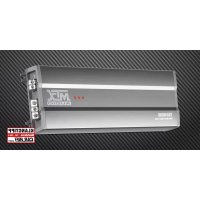
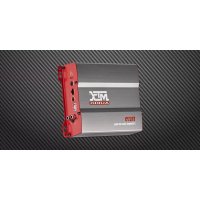
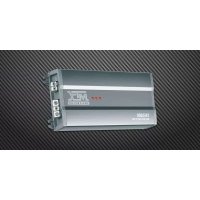
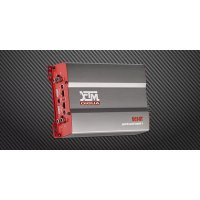
USER MANUAL TX81000D MTX Audio
TX480D TX6500D TX81000D
Owner's Manual
Designed by MTX in Phoenix, AZ - USA

Specifications :
TX81000D Specifications :
- Mono block class-D amplifier
- CEA2006 certified Power Output :
- 1x 1000 Watts RMS @ 2Ω and THD+N ≤1%
- 1x 600 Watts RMS @ 4Ω and THD+N ≤1%
• Crossover :
- Low pass 24dB/oct variable from 40Hz to 150Hz
- Subsonic filter 24dB/oct at 30Hz
• Signal-to-Noise Ratio (1 Watt) : > 75dB
- THD+Noise (Distortion) (1 Watt) : ≤ 0,1%
• Frequency Response (±0,5dB): 10Hz-150Hz
• Maximum Input Signal : 6V
• Maximum Sensitivity : 100mV
• EBC remote control
• Bridged mode with gain management
• Thermoregulated fan connector for an external fan(s)
• Dimensions : 366mm x 133mm x 54mm
TX6500D Specifications :
- Mono block class-D amplifier
- CEA2006 certified Power Output :
- 1x 500 Watts RMS @ 2Ω and THD+N ≤1%
- 1x 300 Watts RMS @ 4Ω and THD+N ≤1%
• Crossover :
- Low pass 24dB/oct variable from 40Hz to 150Hz
- Subsonic filter 24dB/oct at 30Hz
• Signal-to-Noise Ratio (1 Watt) : > 75dB
- THD+Noise (Distortion) (1 Watt): ≤ 0,1%
• Frequency Response (±0,5dB): 10Hz-150Hz
• Maximum Input Signal : 6V
• Maximum Sensitivity : 100mV
- EBC remote control
• Bridged mode with gain management
• Thermoregulated fan connector for an external fan(s)
• Dimensions : 266mm x 133mm x 54mm
TX480D Specifications :
• 4-Channel Class-D wide range amplifier
- CEA2006 certified Power Output :
- 4x 140 Watts RMS @ 2Ω and THD+N ≤1%
- 4x 80 Watts RMS @ 4Ω and THD+N ≤1%
- 2x 280 Watts RMS bridged at 4Ω and THD+N ≤1%
• Crossover :
- High pass 12dB/oct variable from 40Hz to 400Hz
- Low pass 12dB/oct variable from 40Hz to 400Hz
• Signal-to-Noise Ratio (1 Watt) : > 85dB
- THD+Noise (Distortion) (1 Watt): ≤ 0,05%
• Frequency Response (±1dB): 10Hz-40000Hz
• Maximum Input Signal : 6V
• Maximum Sensitivity : 200mV
• Thermoregulated fan connector for an external fan
• Dimensions : 216mm x 133mm x 54mm

Settings, Power and Speaker connections :
TX81000D TX6500D
TX480D
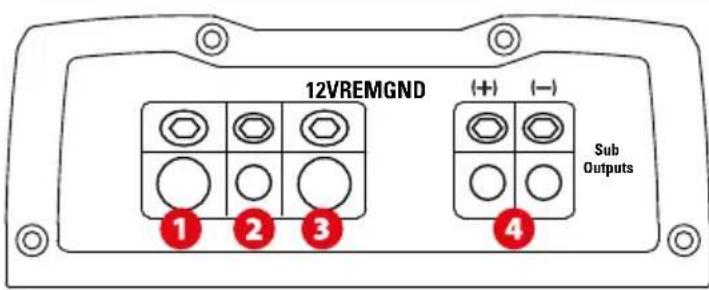
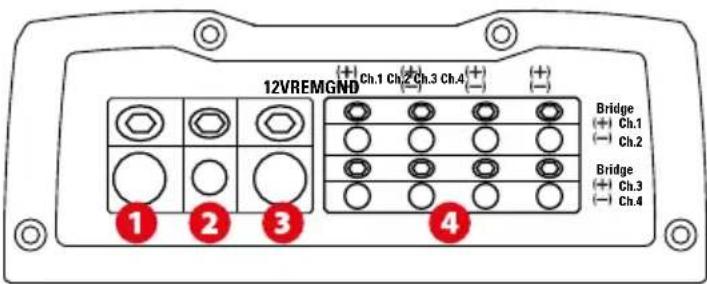
1 Ground Terminal (GND) - A proper ground is required for your amplifier to operate at peak performance. A short ground cable the same diameter as the power cable should be used to attach the ground terminal directly to the chassis of the vehicle. Always remove paint, dirt or debris to expose bare metal where the ground cable will be attached.
2 Remote Terminal (REM) - The amplifier can be turned on by applying 12 volts to this terminal. Typically this voltage is supplied by a wire from the source unit marked "remote" or "power antenna".
3 +12V Power Terminal (12V) - This is the main power input for the amplifier and must be connected directly to the positive terminal of the vehicles battery for proper operation. Use caution when installing (+12) power cable in the vehicle. Avoid running this cable parallel with RCA cables, antennas, or other sensitive equipment due to massive currents that can induce noise into the audio system. It is also very important to have a tight, secure connection for maximum performance. MTX recommends using 50mm² power wire with the MTX RFL4001D amplifier.
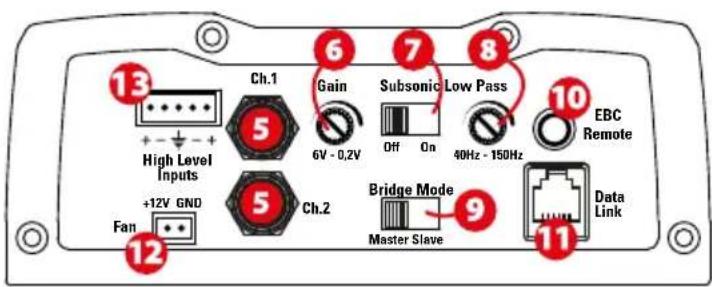
4 Speaker Terminals TX81000D TX6500D (Sub outputs) : Connect your subwoofer(s) to these terminals. If using two subwoofers or a dual voice coil subwoofer, respect the phase (+) together, (-) together...
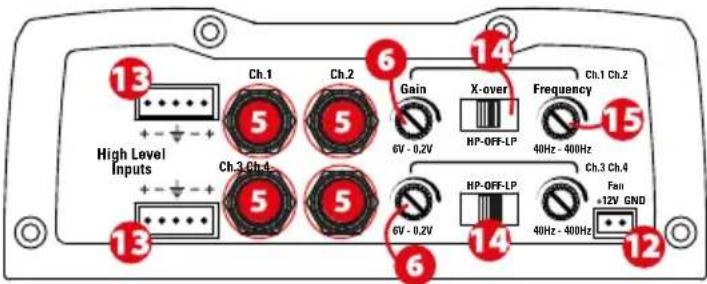
Speaker Terminals TX480D : Connect the speakers to these terminals. Observe speaker polarity throughout the system. Improper phase can result in loss of bass response and/or poor overall sound quality.
Bridge Mode :
When bridging the amplifier, use the Ch1 positive terminal and the Ch2 negative terminal only.
When bridging the amplifier, use the Ch3 positive terminal and the Ch4 negative terminal only.
Warning : do not bridge the amplifier with an impedance lower than 4Ω.
5 RCA Inputs (Ch.1 Ch.2 Ch.3 Ch.4) - These RCA inputs are used with head units that have RCA or Line level outputs (head units need a minimum level of 200mV output for proper operation of the amplifier). MTX recommends only high quality RCA cables to decrease the possibility of radiated noise entering the system.
6 Gain Control (Gain) - The gain control matches the input sensitivity of the amplifier to the head unit being used. The operating range varies from 0,2 to 6V.
Adjusting the gain
- Turn the gain control on the amplifier all the way down (counter clockwise).
- Turn up the volume control on the head unit to approximately 3/4 of maximum.
- Adjust the gain control on the amplifier until audible distortion occurs.
- Adjust the gain control down until audible distortion disappears.
- The amplifier is now calibrated to the output of the head unit.
7 Subsonic Switch (Subsonic) - Used to switch the subsonic filter on or off. The subsonic filter frequency is set to 20Hz. The subsonic filter protects subwoofer(s) against low frequencies that can cause damage. Very useful with vented enclosures.
8 Low Pass X-Over Frequency Control - Used to select the desired low-pass (LP) x-over frequency. The frequency is adjustable from 40Hz to 150Hz.
9 Bridge mode Switch - Used to put the amp in Master mode or Slave mode when bridging two RFL4001D's. For more details, see Master/Slave Mode section.
10 EBC Port (External Bass Control) - The Remote Subwoofer Level Control (EBC) plugs directly into this port, while the EBC itself can be placed anywhere in the vehicle for on demand bass adjustments. EBC is included.
11 Data link Port (Data Link) : Used to connect two TX81000D or two TX6500D in bridge mode and used in Master/Slave mode. The RJ15 cable is included. For more detail see Master/Slave mode section.
12V thermoregulated fan connector for one or two 12V external cooling fans (Attention : 0,5A max - two fans max). The harness is included.
13 High level inputs (HLI): This input will allow the amplifier to operate from source units with speaker-level outputs. Output speaker leads from the source unit should be tied directly to the wire harness provided with the amplifier. Please respect the polarity to get the maximum sound quality.
Note : When speaker level inputs are used, a remote turn on wire must be used to switch the amplifier on and off.
14 X-Over Switch (X-Over) :
In "LP" position, the active low pass (LP) x-over is turned on. Use this position for subwoofer application.
In "HP" position, the active high pass (HP) x-over is turned on. Use this position for speaker application.
In "Off" position, the x-over is turned off. The amp is in wide range mode.
15 X-Over Frequency Control (Frequency): Used to select the desired x-over frequency. The frequency is adjustable from 0Hz to 400Hz.
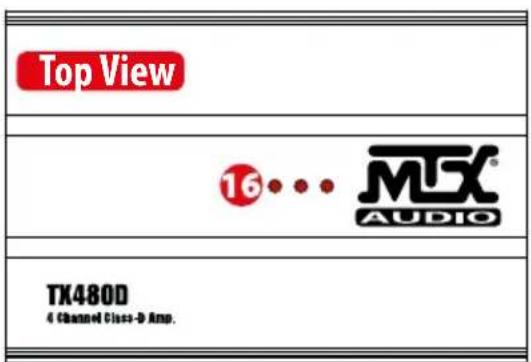
16 PowerOn/Protection LED :
- The LED illuminates red when the amp is switched on.
- The LED is flashing red when the outputs are in short circuit, when the impedance is too low (2Ω minimum), when the amp is in thermal protection.
Master Slave mode (Bridge mode):
For MAXIMUM output power, two TX81000D amps can be bridged together (You can do the same with two TX6500D).
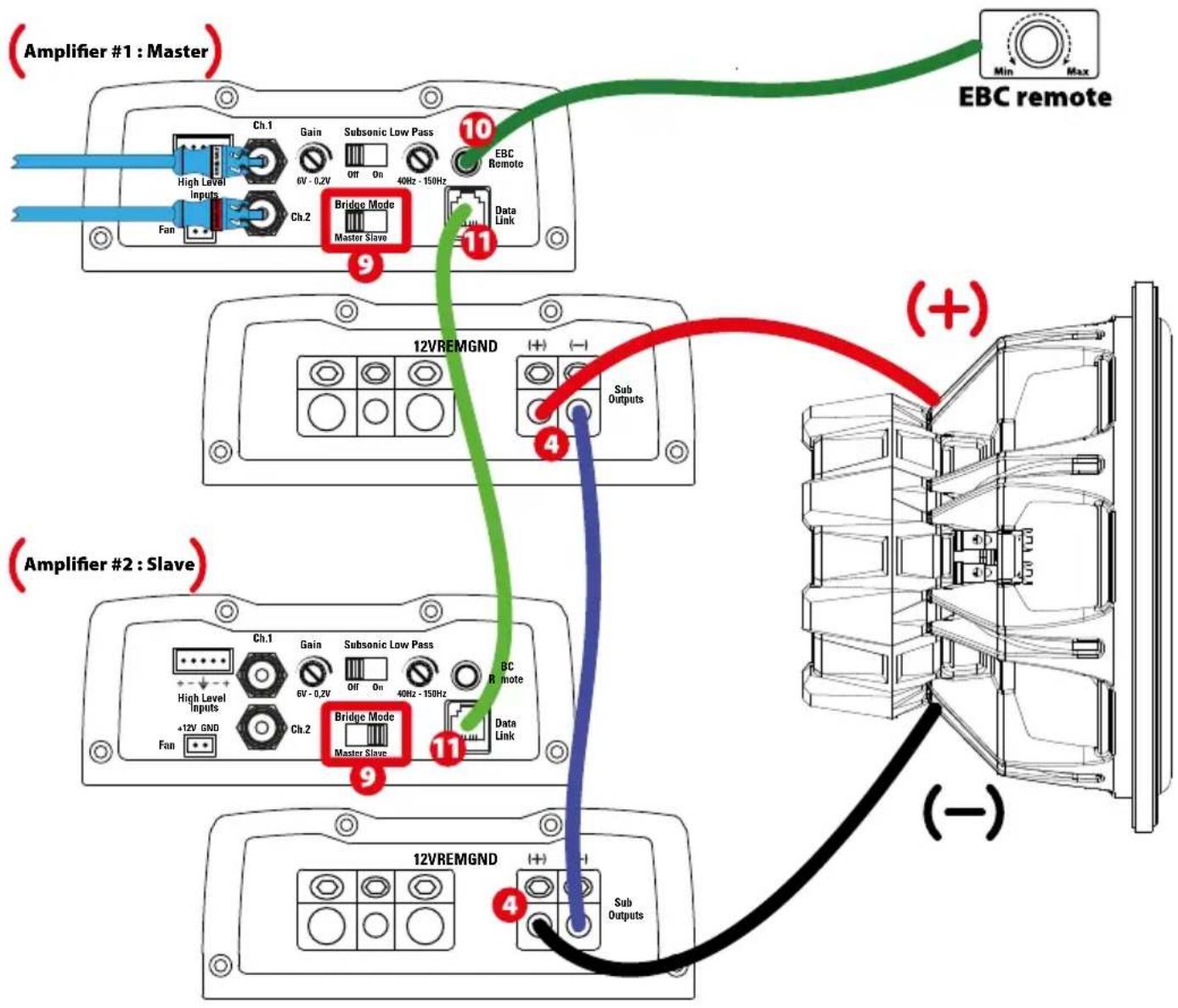
- Decide which TX81000D is the "Master" amp. The other one will be the "Slave" amp. Set the "Bridge Mode" switch (9) to "Master" on the master amp. Set the slave amp to "Slave" (9).
- Connect the input signal from the head unit to the RCA inputs of the "Master" amp. The "Slave" amp does not need RCA connections. It will take the signal from the "Master" amp through the RJ15 cable.
- Connect both "Data link" (11) ports together with one of the RJ15 included cable.
- Adjust the gain, the x-over frequency and the subsonic filter on the master amp. All the "Slave" amp controls are disconnected through "Slave" mode. The "Master" amp fully manages the "Slave" amp.
- Your (+) speaker output is the (+) speaker output from the master amp (4).
- Your (-) speaker output is the (+) speaker output from the slave amp (4).
- Connect both (-) speaker outputs together with the same cable as the one used for the subwoofer.
Note: The EBC remote works fine in master/slave mode. It only needs to be connected to the master amp (10).
flowchart
graph TD
    A["Amplifier #1: Master"] --> B["Ch.1 Gain 6V - 0.2V Subsonic Low Pass Off On 40Hz - 150Hz"]
    B --> C["Ch.2 Bridge Mode Master Slave"]
    C --> D["Sub Output 11"]
    D --> E["Max EBC Remote Min Max"]
    F["Amplifier #2: Slave"] --> G["Ch.1 Gain 6V - 0.2V Subsonic Low Pass Off On 40Hz - 150Hz"]
    G --> H["Ch.2 Bridge Mode Master Slave"]
    H --> I["Sub Output 11"]
    I --> J["Max EBC Remote Min Max"]
    K["Sub Output 4"] --> L["Max EBC Remote Max"]
    M["Sub Output 4"] --> N["Max EBC Remote Max"]
    O["Sub Output 4"] --> P["Max EBC Remote Max"]
Installation & Mounting :
MTX recommends your new amplifier be installed by an Authorized MTX retailer. Any deviation from specified installation instructions can cause serious damage to the amplifier, speakers and/or vehicle's electrical system. Damage caused from improper installation is NOT covered under warranty. Please verify all connections prior to system turn on!
- Disconnect the vehicle's negative battery cable.
- Determine the mounting place for your MTX amplifier. Keep in mind there should be sufficient air flow for proper cooling. Mark the mounting holes from the amplifier to be drilled. Before drilling make sure all vehicle wires, gas lines, brake lines and gas tank are clear and will not interfere with installation. Drill the desired holes and mount the MTX amplifier.
Installation & Mounting :
- Install a positive (+) power cable from the vehicle's battery through the firewall using a grommet or firewall bushing to avoid cable damage from sharp edges of the firewall. Run the cable through the interior of the vehicle and connect it to the amplifier's (12V) terminal. Do Not connect to the battery at this time.
Note : Use only proper gauge wire for both positive and negative connections.
- Install a circuit breaker or fuse within 20cm of the battery. This effectively lowers the risk of severe damage to you or your vehicle in case of a short circuit or accident. Make sure the circuit breaker is switched off or the fuse is taken out of the fuse holder until all connections are made. Now connect your positive power cable to the positive battery terminal of the battery.
- Grounding - Locate a proper ground point on the vehicle's chassis and remove all paint, dirt or debris to reveal a bare metal surface. Attach the ground wire to that contact point. Connect the opposite end of the ground wire to the (GND) terminal on the MTX amplifier.
- Connect a Remote Turn-on wire from the head unit to the MTX amplifier's Remote terminal. If the head unit does not have a dedicated Remote Turn-on lead, you may connect to the head unit's Power Antenna lead.
- Connect RCA cables from the head unit to the MTX amplifier's RCA inputs. Run all signal cables away from vehicle wiring, computers and power cables. If cables must be crossed do so at a 90° angle. Use only high quality RCA cables to decrease radiated noise from entering the system.
- Connect your speakers to the MTX amplifier's speaker terminals using proper gauge wire.
- Double check all previous installation steps, in particular, wiring and component connections. Once verified, reconnect the vehicle's negative battery cable, turn the circuit breaker on or place the fuse in the fuse holder.
Note : Gain Levels on the amplifier should be turned all the way down (counter clockwise) before proceeding with adjustments.
Troubleshooting :
Problem
Cause
Solution
3 LEDs are off No +12V at remote connection Supply +12V to terminal No +12V at Power connection Supply +12V to terminal Insufficient ground connection Verify ground connection Blown power fuse Replace fuse and try to understand why Blown amp Return for service
3 LEDs are flashing red. Speaker load is too low. Remove the speaker(s). The amp is in thermal protection. Wait for the amp to cool down. Input tension is too high or too low. Check your battery and your alternator
3 LEDs are solid red, Volume on head unit off Increase volume on head unit
but no output Speaker connections not made Make speaker connections
Gain control on amplifier set to minimum Turn up gain
Signal processing units off Apply power to signal processor
All speakers blown Replace speakers
Output distorted
Amplifier gain set too high
Head unit volume set too high Lower head unit volume Lower amplifier gain
Balance reversed
RCA inputs reversed
Speakers wired reversed
Reverse RCA input
Wire speakers with correct orientation
Bass is weak
Not using MTX woofers
Speakers wired out of phase
Buy MTX woofers
Wire speakers with correct phase
Blowing fuses
Amplifier defective
Excessive output levels
Return for service
Lower the volume
How To Stay Tuned :

https://www.facebook.com/MTXEurope

https://twitter.com/MTXEurope

http://www.mtxaudio.eu

Caractéristiques :
TX81000D
Caractéristiques :
- 4 x 140 Watts RMS @ 2Ω et THD+N ≤1%
- 4 x 80 Watts RMS @ 4Ω et THD+N ≤1%
- 2 x 280 Watts RMS ponté @ 4Ωet THD+N ≤1%
• Filtre actif :
https://www.facebook.com/MTXEurope

https://twitter.com/MTXEurope

http://www.mtxaudio.eu

Technische Daten :
https://www.facebook.com/MTXEurope

https://twitter.com/MTXEurope

http://www.mtxaudio.eu
Caratteristiche :
https://www.facebook.com/MTXEurope

https://twitter.com/MTXEurope

http://www.mtxaudio.eu

Especificações :
Inverta as saídas RCA
Fusíveis queimados
https://www.facebook.com/MTXEurope

https://twitter.com/MTXEurope

http://www.mtxaudio.eu
- 1x 1000 Bt RMS @ 20M n THD + N ≤ 1%
- 1x 600 Bt RMS @ 40M n THD + N ≤1%
• Кроссовер:
- 1x 500 Bt RMS @ 20M n THD + N ≤1%
- 1x 300 Bt RMS @ 40M n THD + N ≤1%
• Кроссовер:
https://www.facebook.com/MTXEurope

https://twitter.com/MTXEurope

http://www.mtxaudio.eu

Specificatii :
TX81000D Specificatii :
- Clasa-D amplifier Monoblock
• CEA 2006 certificat Putere de ieşire :
- 1x 1000 wati RMS @ 2Ω si THD + N ≤ 1%
- 1x 600W RMS @ 4Ω si THD + N ≤ 1%
• Crossover :
- Low Pass 24dB / oct variabilă de la 40Hz la 150Hz
- Filtru subsonic 24dB / oct la 30Hz
• Raportul semnal-zgomot (1 Watt) : >75dB
• THD + zgomot (distorsiuni) (1 Watt) : ≤ 0,1%
• Răspuns în frecvență (± 0,5dB) : 10Hz-150Hz
- Semnal de intrare maximă : 6V
• Sensibilitate maxima : 100mV
• Control de la distanță EBC
- Modul punte
- Reglat termic Conector ventilator pentru un ventilator extern (s)
• Dimensiuni: 366mm x 133mm x 54mm
TX6500D Specificatii :
- Clasa-D amplifier Monoblock
• CEA 2006 certificat Putere de ieşire :
- 1x 500W RMS @ 2Ω si THD + N ≤ 1%
- 1x 300 wati RMS @ 4Ω si THD + N ≤ 1%
• Crossover :
- Low Pass 24dB / oct variabilă de la 40Hz la 150Hz
- Filtru subsonic 24dB / oct la 30Hz
• Raportul semnal-zgomot (1 Watt):> 75dB
- THD + zgomot (distorsiuni) (1 Watt): ≤ 0,1%
• Răspuns în frecvență (± 0,5dB): 10Hz-150Hz
- Semnal de intrare maximă: 6V
• Sensibilitate maxima: 100mV
- Control de la distanță EBC
- Modul punte
- Reglat termic Conector ventilator pentru un ventilator extern (s)
• Dimensiuni: 266mm x 133mm x 54mm
TX480D Specificatii :
https://www.facebook.com/MTXEurope

https://twitter.com/MTXEurope

http://www.mtxaudio.eu
MEX®
AUDIO
MTX is proud to be an
American Audio Company since 1971.

MTX is a proud member of Mitek Corp high quality consumer audio product lines.

MiTek
Corporation
Designed and Engineered by Mitek
in Phoenix - AZ, USA - Assembled in Korea. © 2016 Mitek. All rights reserved.
MTX is a registered trademarks of Mitek. Due to continual product development, all specifications are subject to change without notice.
Mitek - MTX - 4545 East Baseline Rd. Phoenix, AZ 85042, USA

mtxaudio.eu facebook.com/MTXEuropetwitter.com/MTXEurope