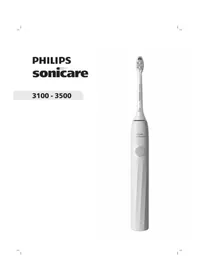
Sonicare 2100 Series HX4021 - Electric toothbrush PHILIPS - Free user manual and instructions
Find the device manual for free Sonicare 2100 Series HX4021 PHILIPS in PDF.

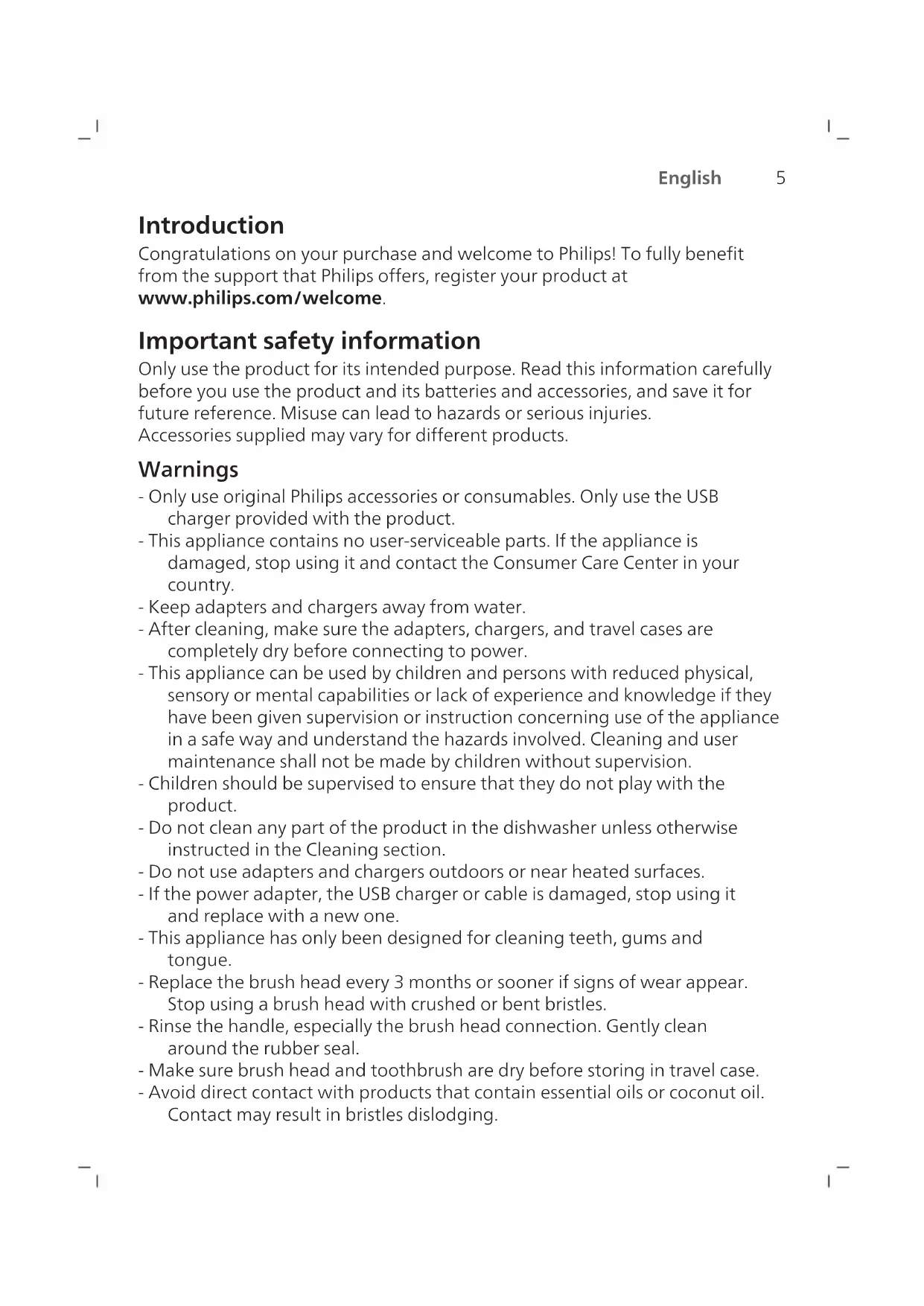


| Product Type | Sonic electric toothbrush |
| Brand | Philips |
| Model | Sonicare 2100 Series HX4021 |
| Dimensions (approx.) | 25 cm (length) x 3 cm (diameter) |
| Weight (approx.) | 130 g (handle only) |
| Power supply | USB charger (5 V DC, 2.5 W) with Philips WAA1001/WAA2001 mains adapter (100‑240 V~, 50/60 Hz) |
| Battery type | Built-in rechargeable lithium-ion (non-user-replaceable) |
| Battery life | Approximately 28 brushing sessions of 2 minutes (i.e., 14 days with twice-daily use) |
| Charging time | Up to 24 hours for a full charge |
| Main functions | SmartTimer (2-minute timer), QuadPacer (pause every 30 seconds), EasyStart (gradual power increase over 14 brushings), two intensity levels (high/low) |
| Intensity levels | 2 (high and low) |
| Charging indicator | LED: flashing green when charging, solid green 30 s after full charge; flashing orange if battery low |
| Compatible brush heads | Philips Sonicare replacement brush heads (replacement recommended every 3 months) |
| Included accessories | 1 handle, 1 brush head, 1 USB charger, 1 travel case (depending on version) |
| Care and cleaning | Rinse brush head after each use; clean handle with a damp cloth; do not put in dishwasher |
| Safety | Waterproof (rubber seal), safe for orthodontic appliances and dental restorations, do not share the brush |
| Operating temperature | 0 °C to 40 °C; storage from -20 °C to 60 °C |
| Recommended brushing cycles | 2 minutes twice a day |
| Warranty | 2 years (parts and labor); brush heads not covered |
| Country of manufacture | China (stated in manual) |
| Repairability | No user-serviceable parts; battery removable only by a professional at end of life |
| Model number | HX4021 (engraved under handle) |
| Support website | www.philips.com/support |
Frequently Asked Questions - Sonicare 2100 Series HX4021 PHILIPS
User questions about Sonicare 2100 Series HX4021 PHILIPS
0 question about this device. Answer the ones you know or ask your own.
Ask a new question about this device
Download the instructions for your Electric toothbrush in PDF format for free! Find your manual Sonicare 2100 Series HX4021 - PHILIPS and take your electronic device back in hand. On this page are published all the documents necessary for the use of your device. Sonicare 2100 Series HX4021 by PHILIPS.
USER MANUAL Sonicare 2100 Series HX4021 PHILIPS
Congratulations on your purchase and welcome to Philips! To fully benefit from the support that Philips offers, register your product at www.philips.com/welcome.
Important safety information
Only use the product for its intended purpose. Read this information carefully before you use the product and its batteries and accessories, and save it for future reference. Misuse can lead to hazards or serious injuries.
Accessories supplied may vary for different products.
Warnings
-
Only use original Philips accessories or consumables. Only use the USB charger provided with the product.
-
This appliance contains no user-serviceable parts. If the appliance is damaged, stop using it and contact the Consumer Care Center in your country.
-
Keep adapters and chargers away from water.
-
After cleaning, make sure the adapters, chargers, and travel cases are completely dry before connecting to power.
-
This appliance can be used by children and persons with reduced physical, sensory or mental capabilities or lack of experience and knowledge if they have been given supervision or instruction concerning use of the appliance in a safe way and understand the hazards involved. Cleaning and user maintenance shall not be made by children without supervision.
-
Children should be supervised to ensure that they do not play with the product.
-
Do not clean any part of the product in the dishwasher unless otherwise instructed in the Cleaning section.
-
Do not use adapters and chargers outdoors or near heated surfaces.
-
If the power adapter, the USB charger or cable is damaged, stop using it and replace with a new one.
-
This appliance has only been designed for cleaning teeth, gums and tongue.
-
Replace the brush head every 3 months or sooner if signs of wear appear. Stop using a brush head with crushed or bent bristles.
-
Rinse the handle, especially the brush head connection. Gently clean around the rubber seal.
-
Make sure brush head and toothbrush are dry before storing in travel case.
-
Avoid direct contact with products that contain essential oils or coconut oil. Contact may result in bristles dislodging.
English
- The maximum altitude of use is 4500 meters.
Medical warnings
- Stop using the appliance and consult your dentist/doctor if excessive or prolonged bleeding occurs after use, or if you experience discomfort or pain during use.
- If you have a pacemaker or other implanted device, contact your doctor or the manufacturer of the implanted device prior to use.
- This appliance is a personal care device and is not intended to be shared by multiple users.
Battery safety instructions
- This appliance contains batteries that are only removable by skilled persons.
- Keep product and batteries away from fire and do not expose them to direct sunlight or high temperatures.
- If the product becomes abnormally hot or smelly, changes color or if charging takes longer than usual, stop using and charging the product and contact Philips.
- Do not place products and their batteries in microwave ovens or on induction cookers.
- Do not open, modify, pierce, damage or dismantle the product or battery to prevent batteries from heating up or releasing toxic or hazardous substances. Do not short-circuit, overcharge or reverse charge batteries.
- This appliance contains batteries that are non-replaceable. When the battery is at end of life, the appliance shall be properly disposed of, see section on Disposal.
- Charge only with Philips WAA1001, WAA2001, safety approved IPX4 adapters with input ratings (100-240 V~; 50/60 Hz; 3.5 W) and output ratings (5 V dc; 2.5 W). For the list of adapters, please see www.philips.com/support.
- Charge and use the product at a temperature between 0^ and 40^ (32°F and 104°F).
Storage and transportation conditions
Temperature -20^ to +60^ (-4^ to 140^)
Electromagnetic fields (EMF)
This Philips appliance complies with all applicable standards and regulations regarding exposure to electromagnetic fields.
SAVE THESE INSTRUCTIONS
LIST OF SYMBOLS USED
The following symbols may appear on the product:

This symbol means read the instructions for use, before using the appliance.
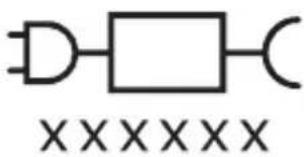
This symbol means to use the indicated power supply.
Intended use
This Sonicare power toothbrush is intended to remove adherent plaque and food debris from the teeth to reduce tooth decay and improve and maintain oral health. This Sonicare power toothbrush is intended for consumer home use. Use by children should be with adult supervision.
Your Philips Sonicare (Fig 1.)
1 Brush head cap
2 Brush head(s)
3 Handle
4 Power on/off button
5 Battery indicator
6 USB charger (wall adapter not included)
7 Travel case
Note: Accessories included may vary based on the model purchased.
Getting started
Attaching the brush head
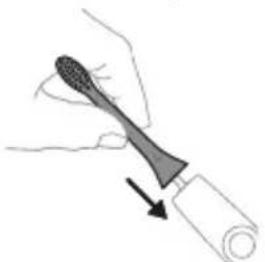
1 Align the brush head so the bristles point in the same direction as the front of the handle.
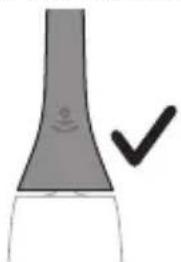
2 Firmly press the brush head down onto the metal shaft until it will not go any further.
Note: It is normal to see a slight gap between the brush head and the handle.
Using your Philips Sonicare toothbrush
If you are using your Sonicare toothbrush for the first time, it is normal to feel more vibration than when using a non-electric toothbrush. It is common for first time users to apply too much pressure. Only apply gentle pressure and let the toothbrush do the brushing for you. Please follow brushing instructions below for the best experience.
To help you transition to your new Sonicare power toothbrush, it comes with the EasyStart feature activated. This feature gradually increases the power over the first 14 brushing sessions to help you adapt to brushing with your Sonicare toothbrush.
Brushing instructions
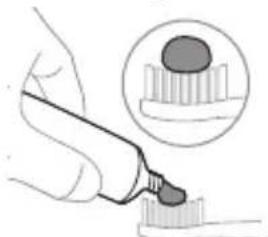
1 Wet the bristles and apply a small amount of toothpaste.
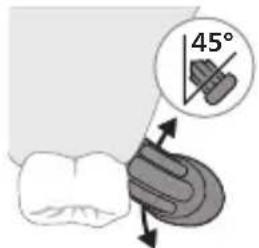
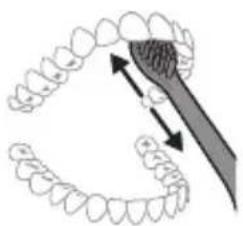
2 Place the toothbrush bristles against the teeth at a slight angle (45 degrees), pressing gently to make the bristles reach the gumline or slightly beneath the gumline.
Note: Keep the center of the brush in contact with the teeth at all times.
3 Press the power on/off button to turn on the Philips Sonicare.
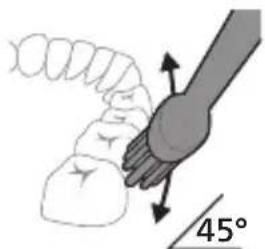
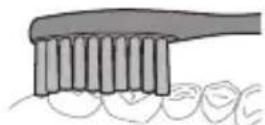
4 Gently keep the bristles placed on the teeth and in the gumline. Brush your teeth with small back and forth motion so the bristles reach between the teeth. Continue this motion throughout your brushing cycle.
Note: The bristles should slightly flare. It is not recommended to scrub as you would with a manual toothbrush.
English
5 To clean the inside surfaces of the front teeth, tilt the brush handle semi-upright and make several vertical overlapping brushing strokes on each tooth.
Note: To make sure you brush evenly throughout the mouth, divide your mouth into 4 sections using the QuadPacer feature (see chapter 'Features').
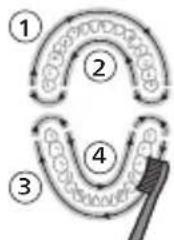
6 Begin brushing in section 1 (outside upper teeth) and brush for 30 seconds before you move to section 2 (inside upper teeth). Continue brushing in section 3 (outside lower teeth) and brush for 30 seconds before you move to section 4 (inside lower teeth).
7 After you have completed the brushing cycle, you can spend additional time brushing the chewing surfaces of your teeth and areas where staining occurs. You can also brush your tongue, with the toothbrush turned on or off, as you prefer.
Your Philips Sonicare toothbrush should be safe to use on braces (brush heads wear out sooner when used on braces) and dental restorations (fillings, crowns, veneers) if they are properly adhered and not compromised. If a problem occurs, please follow up with a dental professional.
Note: When using the Philips Sonicare toothbrush in clinical studies, operate it at high intensity setting with the handle fully charged and the EasyStart feature deactivated.
Intensities
Intensity settings
Your power toothbrush comes with 2 different intensites:
High intensity
- Low intensity
Note: We recommend high intensity for best results.
To manually select your desired intensity, press the power button within 2 seconds of starting or resuming the brushing when the toothbrush is on, to toggle between the options.
Features
- SmarTimer
- QuadPacer
- EasyStart
SmarTimer
The SmarTimer indicates that your brushing cycle is complete by automatically switching off the toothbrush at the end of the brushing cycle. Dental professionals recommend brushing no less than 2 minutes twice a day.
Note: If you press the power on/off button after you started the brushing cycle, the toothbrush pauses. If you press the on/off button within 30 seconds, the timer resumes to allow you to finish your brushing cycle. After a pause of 30 seconds, the SmarTimer resets.
QuadPacer
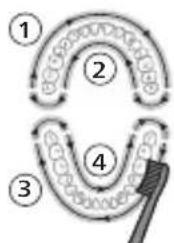
The QuadPacer is an interval timer that has a short beep and pause to remind you to brush the 4 sections of your mouth evenly and thoroughly. This Philips Sonicare toothbrush comes with the QuadPacer feature activated.
EasyStart
This Philips Sonicare model comes with the EasyStart feature activated. The EasyStart feature gently increases the power over the first 14 brushing sessions to help you get used to brushing with the Philips Sonicare.
To activate or deactivate EasyStart, follow the instructions below:
1 Place the handle on the plugged-in charger.
2 Press and hold the power on/off button while the handle remains on the charger.
12 English
3 Keep the power on/off button pressed until you hear three short beeps (after 3 seconds).
4 Release the power on/off button.
- Triple tone of low-med-high means the EasyStart feature has been activated. The battery level indicator light will also blink green 2 times to confirm activation.
- Triple tone of high-med-low means the EasyStart feature has been deactivated. The battery level indicator light will blink amber 1 time to confirm deactivation.
Charging and battery status
This Philips Sonicare toothbrush is designed to provide on average 28 brushing sessions, each session lasting 2 minutes (14 days if used twice per day) on a fully charged battery. The battery indicator shows the battery status when you complete the 2-minute brushing session, when you pause the toothbrush, or while it is charging.
Note: It can take up to 24 hours to fully charge the battery before first use, but you can use the Philips Sonicare toothbrush before it is fully charged.
Charging
1 Attach the USB charging cord to a wall adapter, plug the wall adapter into an electrical wall outlet.
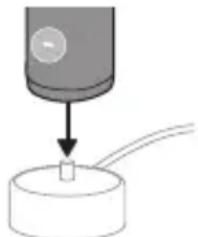
2 Place the handle on the charger.
3 Two short beeps are emitted to confirm that the handle is placed properly.
4 The flashing green light of the battery indicator shows that the toothbrush is charging.
5 Once the battery is fully charged, the green light remains solid for 30 seconds and then turns off.
Battery status (when handle is on plugged-in charger)
When the handle is plugged into the charger, the battery indicator at the bottom of the handle shows the battery level.
Battery status
LED color
Low Flashing green
Partially full Flashing green
Full Solid green for 30 seconds and then switches off
Battery status (when handle is not on plugged-in charger)
When the toothbrush is awake, the battery indicator at the bottom of the handle shows the battery level.
Battery status LED color
Full Solid green
Partially full Solid green
Medium low Flashing green
Low Flashing amber and 3 beeps after brushing
Empty Flashing amber and 2 sets of 5 beeps
Note: To save energy, the battery indicator will switch off when no longer charging.
Note: When the battery is completely empty, the toothbrush switches off. Plug the toothbrush into the charger to charge it.
Note: To keep the battery fully charged at all times, you may keep your toothbrush plugged into the charger when not in use.
Cleaning
Toothbrush handle
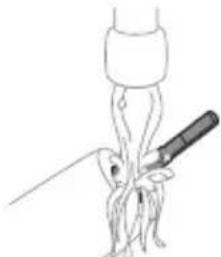
1 Remove the brush head and rinse the metal shaft area with warm water. Make sure you remove any residual toothpaste on the handle and around the buttons at least once a week, but preferably after each use.
Caution: Do not push on the rubber seal on the metal shaft or around the buttons with sharp objects, as this may cause damage.
2 Wipe the entire surface of the handle with a damp cloth.
Caution: Do not tap the handle on the sink or counter to remove excess water.
3 Dry the handle with a soft cloth or towel.
Brush head
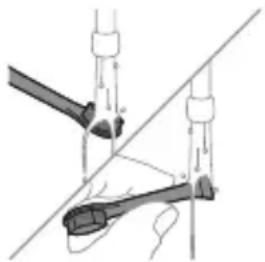
1 Rinse the brush head and bristles after each use and allow to air dry.
2 Remove the brush head from the handle and rinse the brush head connection with warm water at least once a week.
Charger
1 Unplug the charger before you clean it.
2 Wipe the surface of the charger with a damp cloth.
3 Dry the charger with a soft cloth or towel.
Travel case
Rinse with warm water and use a damp cloth to clean the travel case and allow to air dry.
Storage
If you are not going to use the product for an extended period of time, unplug it from the electrical outlet, clean it and store it in a cool and dry place away from direct sunlight.
Replacement
Replace Philips Sonicare brush heads every 3 months to achieve optimal results. Use only Philips Sonicare replacement brush heads.
Locating the model number
Look on the bottom of the Philips Sonicare toothbrush handle for the model number (e.g.HX123A).
Troubleshooting
This chapter summarizes the most common problems you could encounter with the appliance. If you are unable to solve the problem with the information below, visit www.philips.com/support and insert your model number for a list of frequently asked questions or contact the Consumer Care Center in your country.
Problem Possible Cause Solution
| I cannot fully attach the brush head. There is a gap between the brush head and handle. | This gap is normal and is needed for the brush head to vibrate appropriately. The brush head must be able to move to create the right amount of vibrations. | |
| My Philips Sonicare toothbrush vibration is less powerful than before. | The brush head is too close to the body of the toothbrush or the toothbrush needs to be charged. | Remove the brush head from the handle and reset it on the metal shaft leaving a small gap. (1-2mm). When charging, make sure the charger is plugged into a power supply and placed on a flat surface before placing the toothbrush on the charger. Allow the toothbrush to charge for 24 hours. |
| I charged my toothbrush, but it only works for a short time. | The base of the toothbrush is not placed flat on the charger when attempting to charge. | Make sure the charger is plugged into a power supply and placed on a flat surface before placing the toothbrush on the charger. Allow the toothbrush to charge for 24 hours. |
Warranty and support
Philips warrants its products for two years after the date of purchase. Defects due to faulty materials and workmanship will be repaired or replaced at
Philips' expense provided that convincing proof of purchase in the qualifying period is provided.
Philips recommends use of genuine Sonicare brush heads for optimal performance. Use of other brush heads may damage your Sonicare toothbrush and limit your warranty protection.
Contact our Consumer Care Center at 1-888-744-5477 (North America), outside North America contact your local Philips Consumer Care Center.
Internet information: www.philips.com/support.
WARRANTY EXCLUSIONS
What is not covered under warranty:
- In mouth attachments including brush heads and nozzles.
- Damage caused by use of unauthorized replacement parts or unauthorized brush heads.
- Damage caused by misuse, abuse, neglect, alterations or unauthorized repair.
- Normal wear and tear, including chips, scratches, abrasions, discoloration or fading.
IMPLIED WARRANTY
ANY IMPLIED WARRANTYES, INCLUDING IMPLIED WARRANTYES OF MERCHANTABILITY AND FITNESS FOR A PARTICULAR PURPOSE, SHALL BE LIMITED TO THE DURATION OF THE EXPRESS WARRANTYES SET FORTH ABOVE. IN SOME STATES LIMITATIONS ON DURATION OF IMPLIED WARRANTYES DO NOT APPLY.
LIMITATION OF REMEDIES
IN NO EVENT SHALL PHILIPS OR ANY OF ITS AFFILIATED OR SUBSIDIARY COMPANIES BE LIABLE FOR ANY SPECIAL, INCIDENTAL OR CONSEQUENTIAL DAMAGES BASED UPON BREACH OF WARRANTY, BREACH OF CONTRACT, NEGLIGENCE, TORT, OR ANY OTHER LEGAL THEORY. SUCH DAMAGES INCLUDE, WITHOUT LIMITATION, LOSS OF SAVINGS OR REVENUE; LOSS OF PROFIT; LOSS OF USE; THE CLAIMS OF THIRD PARTIES INCLUDING, WITHOUT LIMITATION, DENTISTS AND DENTAL HYGIENISTS; AND COST OF ANY SUBSTITUTE EQUIPMENT OR SERVICES. SOME STATES DO NOT ALLOW THE EXCLUSION OR LIMITATION OF INCIDENTAL OR CONSEQUENTIAL DAMAGES.
Disposal
CONTAINS LITHIUM-ION RECHARGEABLE CELL. MUST BE RECYCLED OR DISPOSED OF PROPERLY.

-
Contact your local town or city officials for electronics recycling and battery disposal information. You can also call 1-800-822-8837 or visit www.call2recycle.org for drop-off locations.
-
For assistance, visit our website www.philips.com/support or call 1-888-744-5477 toll free.
-
Your product is designed and manufactured with high quality materials and components, which can be recycled and reused. For recycling information, please contact your local waste management facilities or visit: www/recycle.philips.com.
-
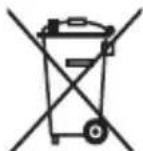
This symbol means that electrical products and batteries shall not be disposed of with normal household waste.
-
Follow your country's rules for the separate collection of electrical products and batteries.
-
The built-in rechargeable battery must be removed by a qualified professional when the product is discarded. Instructions for removal of built-in rechargeable batteries can be found on www.philips.com/support. Use the Philips support home search bar to enter the toothbrush model number and find your product. The model number begins with "HX" (e.g. HX123A) and can be found on the bottom of your toothbrush. The battery removal instructions are in the Troubleshooting and Repair section of the product's support page.
-
If batteries are damaged or leaking, avoid contact with the skin or eyes. If this occurs, immediately rinse well with water and seek medical care.
-
When you handle batteries, make sure that your hands, the product and the batteries are dry.
English
- To avoid accidental short-circuiting of batteries after removal, do not let battery terminals come into contact with metal objects (e.g. coins, hairpins, rings). Do not wrap batteries in aluminum foil. Tape battery terminals or put batteries in a plastic bag before you discard them.
Introduccion
EXCLUSIONS DE GARANTIE
www.philips.com/Sonicare
www.philips.ca/sonicare
© 2025 Koninklijke Philips N.V. (KPNV). All rights reserved.
Philips and the Philips shield are trademarks of KPNV.
Sonicare and the Sonicare logo are trademarks
of Philips Oral Healthcare, LLC and/or KPNV.
Philips Oral Healthcare, LLC.
22100 Bothell Everett Highway
Bothell, WA 98021
300015139701 (06/08/2025)