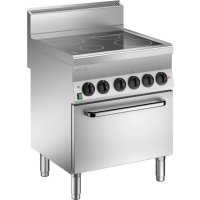
115059 - Electric oven BARTSCHER - Free user manual and instructions
Find the device manual for free 115059 BARTSCHER in PDF.



| Brand | Bartscher |
| Model | 115059 |
| Product type | Electric oven |
| Usage | Professional |
| Exterior material | Polished stainless steel |
| Control type | Rotary knobs (mode selector and thermostat) |
| Cooking modes | Top (grill), bottom, top+bottom, convection (fan oven model) |
| Temperature range | 110°C to 280°C |
| Power supply | Voltage and frequency according to rating plate; omnipolar circuit breaker required |
| Safety - Temperature limiter | Yes, on radiant elements |
| Safety - Safety thermostat | Yes, manual reset |
| Operating indicator light | Yellow light on when heating elements are active |
| Included accessories | Cooking grids |
| Daily cleaning | Soft cloth, water, non-abrasive products; do not use scouring pads |
| Periodic maintenance | At least twice a year by an authorized technician; internal cleaning and parts inspection |
| Repairability | Original spare parts available; replacement by authorized technician |
| Main replaceable parts | Heating elements, fan (fan oven model), safety thermostat, door seal |
Frequently Asked Questions - 115059 BARTSCHER
User questions about 115059 BARTSCHER
0 question about this device. Answer the ones you know or ask your own.
Ask a new question about this device
Download the instructions for your Electric oven in PDF format for free! Find your manual 115059 - BARTSCHER and take your electronic device back in hand. On this page are published all the documents necessary for the use of your device. 115059 by BARTSCHER.
USER MANUAL 115059 BARTSCHER
Read the general informations immediately!
GENERAL INFORMATION....17
1 APPLIANCE SPECIFICATIONS 17
2 GENERAL PRESCRIPTIONS....17
REMINDERS FOR THE INSTALLER....17
REMINDERS FOR THE USER 17
REMINDERS FOR THE MAINTENANCE TECHNICIAN 17
REMINDERS FOR CLEANING....17
3 SAFETY AND CONTROL DEVICES....17
3.1 ELECTRIC OVEN 17
4 DISPOSAL OF PACKING AND THE APPLIANCE....17
INSTRUCTIONS FOR INSTALLATION....18
REMINDERS FOR THE INSTALLER....18
5 REFERENCE STANDARDS AND LAWS....18
6 UNPACKING....18
7 POSITIONING....18
8 CONNECTIONS....18
9 COMMISSIONING 18
INSTRUCTIONS FOR USE....18
REMINDERS FOR THE USER 18
10 USING THE GLASS CERAMIC HOB 19
12 PROLONGED DISUSE....19
INSTRUCTIONS FOR CLEANING....20
REMINDERS FOR CLEANING 20
INSTRUCTIONS FOR MAINTENANCE....20
REMINDERS FOR THE MAINTENANCE TECHNICIAN 20
13 CONVERSION TO A DIFFERENT TYPE OF GAS....20
14 COMMISSIONING 20
15 TROUBLESHOOTING 20
15.1 GLASS CERAMIC HOB....20
15.2 ELECTRIC OVEN 20
16 REPLACING COMPONENTS....20
REMINDERS FOR REPLACING COMPONENTS....20
16.1 GLASS CERAMIC HOB....20
16.2 ELECTRIC OVEN 21
17 CLEANING THE INTERIOR 21
18 MAIN COMPONENTS 21
18.1 GLASS CERAMIC HOB....21
18.2 ELECTRIC OVEN 21
GENERAL INFORMATION
This chapter contains general information which all users of the manual must be familiar with. Specific information for individual users of the manual is provided in subsequent chapters ("INSTRUCTIONS FOR ....").
1 APPLIANCE SPECIFICATIONS
• The appliance data plate is located inside the control panel.
- The appliance model and serial number are also detailed on decals under the brand logo and on the packing.
2 GENERAL PRESCRIPTIONS
The manufacturer will not be liable for any damage or injury resulting from failure to observe the following rules
REMINDERS FOR THE INSTALLER
- Read this manual carefully. It provides important information for safe installation, use and maintenance of the appliance.
- Installation, conversion to a different type of gas and appliance maintenance must be carried out by qualified technicians authorized by the manufacturer, in compliance with current safety standards and the instructions in this manual.
- Identify the specific appliance model. The model number is detailed on the packing and on the appliance data plate.
• The appliance must be installed in a well-ventilated room. - Do not obstruct any air vents or drains present on the appliance.
- Do not tamper with appliance components.
REMINDERS FOR THE USER
- Read this manual carefully. It provides important information for safe installation, use and maintenance of the appliance.
- Keep this manual in a safe place known to all users so that it can be consulted throughout the working life of the appliance.
- Installation, conversion to a different type of gas and appliance maintenance must be carried out by qualified technicians authorized by the manufacturer, in compliance with current safety standards and the instructions in this manual.
- For after-sales service, contact technical assistance centers authorized by the manufacturer and demand the use of original spare parts.
- Have the appliance serviced at least twice a year. The manufacturer recommends taking out a service contract.
- The appliance is designed for professional use and must be operated by trained personnel.
- The appliance is to be used for cooking food as specified in the reminders for use. Any other use must be considered improper
- Do not allow the appliance to operate empty for prolonged periods. Only pre-heat the oven just before use.
- Do not leave the appliance unattended while in operation.
- In the event of an appliance fault or malfunction, shut the gas shut-off valve and/or switch the appliance off at the main switch installed upline.
- Clean the appliance following the instructions given in Chapter "INSTRUCTIONS FOR CLEANING".
- Do not store fl ammable materials in close proximity to the appliance. FIRE HAZARD.
• Children should be supervised to ensure that they do not play with the appliance.
- This appliance is not intended for use by persons (including children) with reduced physical, sensory or mental capabilities, or lack of experience and knowledge, unless they have been given supervision or instruction concerning use of the appliance by a person responsible for their safety.
- Do not obstruct any air vents or drains present on the appliance.
- Do not tamper with appliance components.
REMINDERS FOR THE MAINTENANCE TECHNICIAN
- Read this manual carefully. It provides important information for safe installation, use and maintenance of the appliance.
- Installation, conversion to a different type of gas and appliance maintenance must be carried out by qualified technicians authorized by the manufacturer, in compliance with current safety standards and the instructions in this manual.
- Identify the specific appliance model. The model number is detailed on the packing and on the appliance data plate.
• The appliance must be installed in a well-ventilated room.
- Do not obstruct any air vents or drains present on the appliance.
- Do not tamper with appliance components.
REMINDERS FOR CLEANING
- Clean the satin finish stainless steel exterior surfaces, the cooking wells and the surface of the hotplates every day.
- At least twice a year, have an authorized technician clean the internal parts of the appliance.
- Do not use direct or high pressure water jets to clean the appliance.
- Do not use corrosive products to clean the floor beneath the appliance.
3 SAFETY AND CONTROL DEVICES
- The heating units are equipped with a tempera-ture regulator which cuts off the electric mainsupply to the heating elements when the tempe-rature exceeds the maximum limit.
3.1 ELECTRIC OVEN
SAFETY THERMOSTAT
The manufacturer will not be liable for any damage or injury resulting from failure to observe the following rules
- The appliance is equipped with a manual reset safety thermostat that interrupts heating when the operating temperature exceeds the maximum permitted value.
- To restore appliance operation press the thermostat reset button. This procedure must only be carried out by a qualified, authorized technician.
4 DISPOSAL OF PACKING AND THE APPLIANCE
4.1 PACKING
The packing is made using environmentally friendly materials. The plastic recyclable components are:
- the transparent cover, the bags containing the instructions manual and nozzles (made of Polyethylene - PE).
• the straps (in Polypropylene - PP).
4.2 APPLIANCE
The appliance is manufactured 90% from recyclable metals (stainless steel, aluminium sheet, copper....).
The appliance must be scrapped in compliance with current regulations governing such disposal.
• It must be disposed of properly.
• Make the appliance unusable before scrapping.
INSTRUCTIONS FOR INSTALLATION
REMINDERS FOR THE INSTALLER
The manufacturer will not be liable for any damage or injury resulting from failure to observe the following rules
- Read this manual carefully. It provides important information for safe installation, use and maintenance of the appliance.
- Installation, conversion to a different type of gas and appliance maintenance must be carried out by qualified technicians authorized by the manufacturer, in compliance with current safety standards and the instructions in this manual.
- Identify the specific appliance model. The model number is detailed on the packing and on the appliance data plate.
• The appliance must be installed in a well-ventilated room. - Do not obstruct any air vents or drains present on the appliance.
- Do not tamper with appliance components.
Appliances in the DROP-IN series
- The appliance must be installed in strict compliance with the directions given in the attached drawings.
- Appliances should only be installed on units made of metal (and not wood and/or other fl ammable materials).
- Take particular care with the power lead: the channelways must be perfectly smooth with no sharp corners and/or edges. The lead must not, at any point, be subjected to temperatures of more than 50°C above normal room temperature.
5 REFERENCE STANDARDS AND LAWS
Install the appliance in compliance with current safety standards.
Install the appliance in compliance with the prescriptions of EN1717 and the water pollution regulations in force in your country.
6 UNPACKING
Check the state of the packing and in the event of damage, ask the delivery person to inspect the goods.
- Remove the packing
- Remove the protective film from the external panels. Use a suitable solvent to remove any residual adhesive from the panels
7 POSITIONING
- The overall dimensions of the appliance and the position of connections are given on the installation diagram at the start of this manual.
- The appliance can be installed singly or in combination with other appliances in the same product range.
- The appliance is not suitable for integrated installation.
- Position the appliance at least 10 cm from adjacent walls. This distance can be reduced in the presence of non-combustible walls or heat-insulated walls.
7.1 APPLIANCE ASSEMBLY WITH BASE
Follow the instructions provided with the type of support utilized.
7.2 JOINING APPLIANCES TOGETHER IN LINE
- Place the appliances side by side and adjust the tops to the same height.
- Unite the appliances using the special unionjoint-coverings supplied upon request
8 CONNECTIONS
The position and dimensions of connections are given in the installation diagram at the start of this manual.
8.1 ELECTRICAL CONNECTIONS
Check that the appliance is designed to operate at the voltage and frequency of the power supply present on site. Check the details given on the appliance data plate.
- At an easily accessible point upline of the appliance, fit an all-pole disconnect switch of suitable capacity with a contact breaking distance of at least 3 mm, and a highly sensitive differential protection device. The maximum permitted leakage current is 1 mA/kW.
- A flexible rubber cable with insulation specifications not lower than type H05 RN-F must be used for connection.
- Connect the power supply cable to the terminal board as shown in the wiring diagram supplied with the appliance.
- Secure the power supply cable with the cable clamp.
- Protect the power supply cable on the outside of the appliance with a rigid plastic or metal pipe.
8.2 PROTECTIVE EARTH AND EARTH BONDING CONNECTIONS
Connect the appliance to an efficient ground circuit. Connect the earth conductor to the terminal with the symbol 1/2 located next to the main terminal board.
Connect the metal structure of the appliance to the equipotential node. Connect the conductor to the terminal with the symbol 🌐 on the outside part of the bottom.
8.3 CONNECTION TO THE WATER SUPPLY
The appliance must be connected to a potable water supply. The water inlet pressure must be between 150 kPa and 300 kPa. Use a pressure reducer if the inlet pressure is above the maximum permitted level.
• Install a mechanical filter and a shut-off valve upstream of the appliance in an easily accessible point.
- Make sure the water circuit is free from ferrous particles before connecting the filter and the appliance.
- Seal any unused connectors with a plug.
- Once the appliance has been installed, check for gas leaks at the connection points.
8.4 CONNECTION TO THE WATER DRAIN
The water drainage system must be provided using materials resistant to temperatures of 100\ °C . The bottom of the appliance must not be subjected to steam produced by drainage of hot water.
9 COMMISSIONING
See Chapter "INSTRUCTIONS FOR MAINTENANCE"
INSTRUCTIONS FOR USE
REMINDERS FOR THE USER
The manufacturer will not be liable for any damage or injury resulting from failure to observe the following rules
- Read this manual carefully. It provides important information for safe installation, use and maintenance of the appliance.
-
Keep this manual in a safe place known to all users so that it can be consulted throughout the working life of the appliance.
-
Installation, conversion to a different type of gas and appliance maintenance must be carried out by qualified technicians authorized by the manufacturer, in compliance with current safety standards and the instructions in this manual.
- For after-sales service, contact technical assistance centers authorized by the manufacturer and demand the use of original spare parts.
- Have the appliance serviced at least twice a year. The manufacturer recommends taking out a service contract.
- The appliance is designed for professional use and must be operated by trained personnel.
- The appliance is to be used for cooking food as specified in the reminders for use. Any other use must be considered improper
- Do not allow the appliance to operate empty for prolonged periods. Only pre-heat the oven just before use.
- Do not leave the appliance unattended while in operation.
- In the event of an appliance fault or malfunction, shut the gas shut-off valve and/or switch the appliance off at the main switch installed upline.
- Clean the appliance following the instructions given in Chapter "INSTRUCTIONS FOR CLEANING".
- Do not store fl ammable materials in close proximity to the appliance. FIRE HAZARD.
• Children should be supervised to ensure that they do not play with the appliance. - This appliance is not intended for use by persons (including children) with reduced physical, sensory or mental capabilities, or lack of experience and knowledge, unless they have been given supervision or instruction concerning use of the appliance by a person responsible for their safety.
- Do not obstruct any air vents or drains present on the appliance.
- Do not tamper with appliance components.
10 USING THE GLASS CERAMIC HOB
Important: Use flat-bottomed pots and pans having a diameter that is suitable for the cooking zone. The bottom of pots and pans must be clean, smooth and dry in order to avoid scratching the surface of the glass ceramic hob. Do not place aluminium foil or plastic containers on the hot surface of the glass ceramic hob.
In any case, the glass ceramic hob must not be used as rest surface.
SWITCHING ON AND OFF
The radiant hotplate control knob has the following positions :
0 Off
1 Minimum temperature
2...5 Intermediate temperatures
6 Maximum temperature
Switching on
- Turn the knob for the corresponding cooking zone to the desired setting. Important: The indicator light underneath the cooking hob turns on when the temperature of the cooking zone is above 50°C.
Switching off
• Turn the knob to position "0".
11 USING THE ELECTRIC OVEN
REMINDERS FOR USE
- The appliance is designed for cooking foods placed on the grilles provided.
- Do not leave the door even partially open during use.
- The appliance is equipped with a manual reset safety thermostat that interrupts heating when the operating temperature exceeds the maximum permitted value.
- Fan in cooking chamber which allows defrosting with air at ambient temperature, as well as forced convection cooking (hot air); (mod. ventilated oven).
SWITCHING ON AND OFF
The electric oven is controlled by two knobs (for selecting the type of heating and the cooking temperature). A yellow indicator light indicates operation of the heating elements.
The control knob has the following positions:
0 Off
Top element (grill) on
Bottom element on
Top element + bottom element on
The thermostat control knob has the following positions:
0 Off
110 Minimum temperature
280 Maximum temperature
Switching on
• Turn the control knob to the chosen position.
- Turn the thermostat knob to the chosen temperature setting for cooking.
• The yellow indicator light switches on.
- The yellow indicator light switches off when the oven reaches the set temperature.
Switching off
• Turn the thermostat knob to position "0".
• Turn the knob to position "0".
Ventilation start ( mod. ventilated oven)
The switch has the following positions:
1 ON
0 OFF
Switching on
- Press the switch to 1.
- The switch lights up.
Switching off
- Press the switch to 0.
- The switch lights off.
12 PROLONGED DISUSE
Before any prolonged disuse of the appliance, proceed as follows:
• Clean the appliance thoroughly.
- Rub stainless steel surfaces with a cloth soaked in Vaseline oil to create a protective film.
- Leave lids open.
- Shut off taps and main switches upline of appliances. Following prolonged disuse, proceed as follows:
- Inspect the appliance thoroughly before using it again.
- Allow electric appliances to operate at the lowest temperature for at least 60 minutes.
INSTRUCTIONS FOR CLEANING
REMINDERS FOR CLEANING
The manufacturer will not be liable for any damage or injury resulting from failure to observe the following rules
- Disconnect the appliance electric supply, if present, before carrying out any operation.
- Clean the satin finish stainless steel exterior surfaces, the cooking wells and the surface of the hotplates every day.
- At least twice a year, have an authorized technician clean the internal parts of the appliance.
- Do not use direct or high pressure water jets to clean the appliance.
- Do not use corrosive products to clean the floor beneath the appliance.
SATIN FINISH STAINLESS STEEL SURFACES
- Clean the surfaces with a cloth or sponge using water and proprietary non-abrasive detergents. Follow the direction of the satin fi nish lines. Rinse repeatedly and dry thoroughly.
- Do not use pan scourers or other iron items.
- Do not use chemical products containing chlorine.
- Do not use sharp objects which might scratch and damage the surfaces.
Cleaning fan (mod.ventilated oven)
The ofan should be cleaned regularly. Excessive grease deposited on the blades may cause themotor to overheat, thereby preventing correct distribution of heat and uniform cooking.
INSTRUCTIONS FOR MAINTENANCE
REMINDERS FOR THE MAINTENANCE TECHNICIAN
The manufacturer will not be liable for any damage or injury resulting from failure to observe the following rules
- Read this manual carefully. It provides important information for safe installation, use and maintenance of the appliance.
- Installation, conversion to a different type of gas and appliance maintenance must be carried out by qualified technicians authorized by the manufacturer, in compliance with current safety standards and the instructions in this manual.
- Identify the specific appliance model. The model number is detailed on the packing and on the appliance data plate.
• The appliance must be installed in a well-ventilated room. - Do not obstruct any air vents or drains present on the appliance.
- Do not tamper with appliance components.
13 CONVERSION TO A DIFFERENT TYPE OF GAS
See Chapter "Instructions for installation"
14 COMMISSIONING
Following installation, conversion to a different type of gas or any maintenance operations, check appliance operation. In the event of any malfunction, consult the next Paragraph "Troubleshooting".
Switch on the appliance as directed in the instructions and reminders for use given in Chapter "INSTRUCTIONS FOR USE" and check:
• the current values of each phase.
- the correct operation of the heating elements.
15 TROUBLESHOOTING
15.1 GLASS CERAMIC HOB
The radiant hotplate does not heat
Possible causes:
- Check the fuses
• Power supply main switch disconnected - Insufficient voltage or incorrect electric connection of the appliance
• Defective energy regulator - Element defective or not properly connected (burnt internal heating element).
Heating cannot be adjusted
Possible causes:
• Temperature thermostat defective.
15.2 ELECTRIC OVEN
The appliance does not heat.
Possible causes:
• Temperature thermostat defective.
• Heating elements defective.
• Safety thermostat tripped.
• Defective fan. (mod. ventilated oven).
Heating cannot be adjusted
Possible causes:
• Temperature thermostat defective.
16 REPLACING COMPONENTS
REMINDERS FOR REPLACING COMPONENTS.
- Disconnect the appliance electric supply, if present, before carrying out any operation.
• After replacing a gas system component, check for gas leaks at connection points. - After replacing an electrical system component, check it is correctly wired.
- When replacing the radiant hotplates, handle and re-assemble parts with the utmost care.
16.1 GLASS CERAMIC HOB
Replacing the radiant hotplates
- Remove the bottom of the appliance.
- Replace the faulty component.
Replacing the energy regulator
- Remove the bottom of the appliance.
- Replace the faulty component.
Glass ceramic hob
- In the event the glass ceramic hob is broken, contact our company to have it replaced.
16.2 ELECTRIC OVEN
Replacing the heating element
- Working inside the oven chamber and from behind of the appliance, disconnect the heating element and remove the screw from the flanges.
- Remove and replace the component.
- Re-assemble all parts. For assembly, proceed in reverse order.
Replacing the fan (mod.ventilated oven)
- Remove racks, rack-holders and fan protection from inside the cooking chamber.
- Remove and replace the component.
- Re-assemble all parts. For assembly, proceed in reverse order.
Replacing the fan motor (mod.ventilated oven)
- Remove the fan protection from inside the cooking chamber.
- Remove the posterior panel.
- Remove and replace the component.
- Re-assemble all parts. For assembly, proceed in reverse order.
Replacing the temperature thermostat, the control knob, the indicator lamp and the safety thermostat
- Remove the control knob.
- Remove the front panel
- Disconnect the component from the wiring.
- Remove the bulb from the support bracket on the inside of the oven chamber (thermostat).
Replacing the door seal.
- Remove the seals ( fitted in place around the edges ).
- Remove and replace the component.
- Re-assemble all parts. For assembly, proceed in reverse order.
17 CLEANING THE INTERIOR
- Check the condition of the inside of the appliance.
- Remove any built-up dirt.
- Check and clean the fumes exhaust system.
18 MAIN COMPONENTS
18.1 GLASS CERAMIC HOB
• GLASS CERAMIC HOB
- Indicator light
- Radiant hotplates
• Energy regulator
18.2 ELECTRIC OVEN
- Control knob
• Working thermostat - Safety thermostat
- Heating element
- Indicator light
• Fan motor (mod.ventilated oven) - Door seal
INFORMATIONS GÉNÉRALES 23
1 DONNÉES DE L'APPAREIL 23
2 AVERTISSEMENTS GÉNÉRAUX 23
AVERTISSEMENTS POUR L'INSTALLATEUR....23
AVERTISSEMENTS POUR L'UTILISATEUR....23
AVERTISSEMENTS POUR LE TECHNICIEN PRÉPOSÉ À L'ENTRETIEN 23
AVERTISSEMENTS POUR LE NETTOYAGE 23
3 DISPOSITIFS DE SÉCURITÉ ET DE CONTRÔLE 23
3.1 FOUR ÉLECTRIQUE 23
4 ÉLIMINATION DE L'EMBALLAGE ET DE L'APPAREIL 24
INSTRUCTIONS POUR L'INSTALLATION 24
AVERTISSEMENTS POUR L'INSTALLATEUR....24
5 NORMES ET TEXTES DE LOI DE RÉFÉRENCE....24
6 DÉBALLAGE....24
7 MISE EN PLACE....24
8 RACCORDEMENTS....24
9 MISE EN SERVICE....25
INSTRUCTIONS POUR L'UTILISATION....25
AVERTISSEMENTS POUR L'UTILISATEUR....25
10 UTILISATION DE LA TABLE DE CUISSON VITROCÉRAMIQUE 25
12 PÉRIODES D'INACTIVITÉ 26
INSTRUCTIONS POUR LE NETTOYAGE....26
AVERTISSEMENTS POUR LE NETTOYAGE 26
INSTRUCTIONS POUR L'ENTRETIEN 26
15 RÉSOLUTION DES DYSFONCTIONNEMENTS....26
15.1 TABLE DE CUISSON VITROCÉRAMIQUE....26
15.2 FOUR ÉLECTRIQUE 27
16 REMPLACEMENT DE PIÈCES....27
AVERTISSEMENTS POUR LE REMPLACEMENT DE PIÈCES....27
16.1 TABLE DE CUISSON VITROCÉRAMIQUE....27
16.2 FOUR ÉLECTRIQUE 27
17 NETTOYAGE DES PIÈCES INTERNES 27
18 PIÈCES PRINCIPALES 27
18.1 TABLE DE CUISSON VITROCÉRAMIQUE....27
18.2 FOUR ÉLECTRIQUE 27
INFORMATIONS GÉNÉRALES
4 AFVOER VAN DE VERPAKKING EN HET APPARAAT ALS AFVAL 36
INSTRUCTIES VOOR DE INSTALLATIE 36
VEILIGHEIDSTHERMOSTAAT
4 AFVOER VAN DE VERPAKKING EN HET APPARAAT ALS AFVAL
4.1 VERPAKKING
8.4 VERBINDING MET DE WATERAFVOERPUNTEN
- GENERAL INFORMATION
- 1 APPLIANCE SPECIFICATIONS
- 2 GENERAL PRESCRIPTIONS
- REMINDERS FOR THE INSTALLER
- REMINDERS FOR THE USER
- REMINDERS FOR THE MAINTENANCE TECHNICIAN
- REMINDERS FOR CLEANING
- 3 SAFETY AND CONTROL DEVICES
- 3.1 ELECTRIC OVEN
- SAFETY THERMOSTAT
- 4 DISPOSAL OF PACKING AND THE APPLIANCE
- 4.1 PACKING
- 4.2 APPLIANCE
- INSTRUCTIONS FOR INSTALLATION
- APPLIANCES IN THE DROP-IN SERIES
- 5 REFERENCE STANDARDS AND LAWS
- 6 UNPACKING
- 7 POSITIONING
- 7.1 APPLIANCE ASSEMBLY WITH BASE
- 7.2 JOINING APPLIANCES TOGETHER IN LINE
- 8 CONNECTIONS
- 8.1 ELECTRICAL CONNECTIONS
- 8.2 PROTECTIVE EARTH AND EARTH BONDING CONNECTIONS
- 8.3 CONNECTION TO THE WATER SUPPLY
- 8.4 CONNECTION TO THE WATER DRAIN
- 9 COMMISSIONING
- INSTRUCTIONS FOR USE
- 10 USING THE GLASS CERAMIC HOB
- SWITCHING ON AND OFF
- SWITCHING ON
- SWITCHING OFF
- 11 USING THE ELECTRIC OVEN
- REMINDERS FOR USE
- VENTILATION START ( MOD. VENTILATED OVEN)
- 12 PROLONGED DISUSE
- INSTRUCTIONS FOR CLEANING
- SATIN FINISH STAINLESS STEEL SURFACES
- CLEANING FAN (MOD.VENTILATED OVEN)
- INSTRUCTIONS FOR MAINTENANCE
- 13 CONVERSION TO A DIFFERENT TYPE OF GAS
- 14 COMMISSIONING
- 15 TROUBLESHOOTING
- 15.1 GLASS CERAMIC HOB
- THE RADIANT HOTPLATE DOES NOT HEAT
- HEATING CANNOT BE ADJUSTED
- 15.2 ELECTRIC OVEN
- THE APPLIANCE DOES NOT HEAT
- 16 REPLACING COMPONENTS
- REMINDERS FOR REPLACING COMPONENTS
- 16.1 GLASS CERAMIC HOB
- REPLACING THE RADIANT HOTPLATES
- REPLACING THE ENERGY REGULATOR
- GLASS CERAMIC HOB
- 16.2 ELECTRIC OVEN
- REPLACING THE HEATING ELEMENT
- REPLACING THE FAN (MOD.VENTILATED OVEN)
- REPLACING THE FAN MOTOR (MOD.VENTILATED OVEN)
- REPLACING THE TEMPERATURE THERMOSTAT, THE CONTROL KNOB, THE INDICATOR LAMP AND THE SAFETY THERMOSTAT
- REPLACING THE DOOR SEAL
- 17 CLEANING THE INTERIOR
- 18 MAIN COMPONENTS
- 18.1 GLASS CERAMIC HOB
- 18.2 ELECTRIC OVEN
- INFORMATIONS GÉNÉRALES
- VEILIGHEIDSTHERMOSTAAT
- 4 AFVOER VAN DE VERPAKKING EN HET APPARAAT ALS AFVAL
- 4.1 VERPAKKING
- 8.4 VERBINDING MET DE WATERAFVOERPUNTEN
Brand : BARTSCHER
Model : 115059
Category : Electric oven