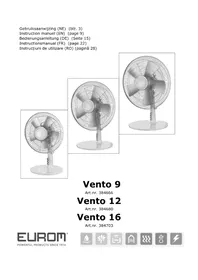
Vento 12 - Fan Eurom - Free user manual and instructions
Find the device manual for free Vento 12 Eurom in PDF.

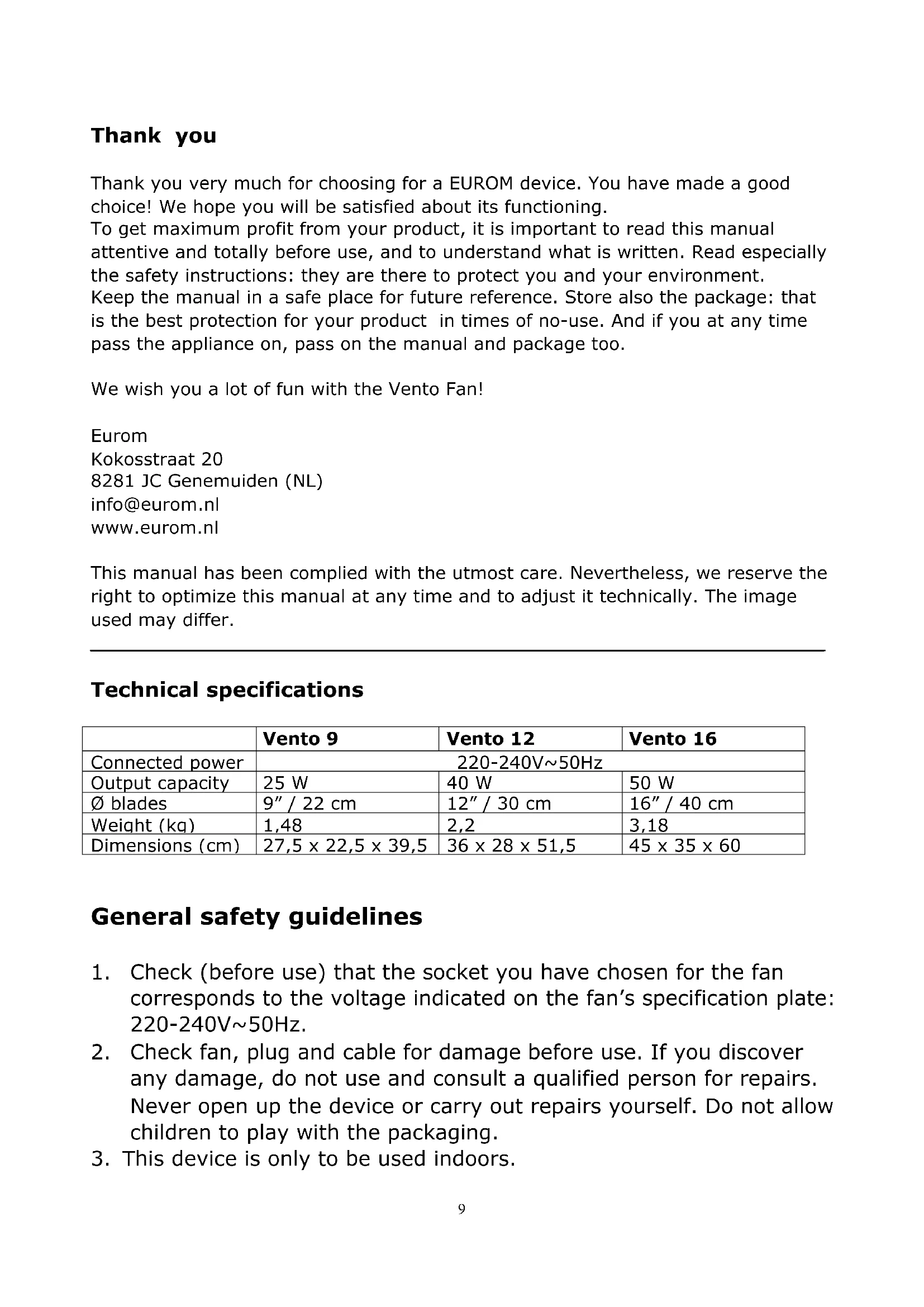


| Product type | Pedestal fan |
| Brand | Eurom |
| Model | Vento 12 |
| Supply voltage | 220-240 V ~ 50 Hz |
| Power consumption | 40 W |
| Fan diameter | 30 cm (12 inches) |
| Weight | 2.2 kg |
| Dimensions (H x W x D) | 51.5 x 28 x 36 cm |
| Number of speeds | 3 (standard, strong, extra strong) |
| Oscillation angle | 75° |
| Tilt adjustment | Yes, manual tilt |
| Housing material | Plastic |
| Usage | Indoors only |
| Protection | Metal protection grille |
| Protection rating | IPX0 (not waterproof) |
| Power cord | Length not specified |
| Maintenance | Regular dusting, cleaning with a slightly damp cloth |
| Repairability | Spare parts available, repair by a professional |
| Included accessories | User manual, original packaging |
Frequently Asked Questions - Vento 12 Eurom
User questions about Vento 12 Eurom
0 question about this device. Answer the ones you know or ask your own.
Ask a new question about this device
Download the instructions for your Fan in PDF format for free! Find your manual Vento 12 - Eurom and take your electronic device back in hand. On this page are published all the documents necessary for the use of your device. Vento 12 by Eurom.
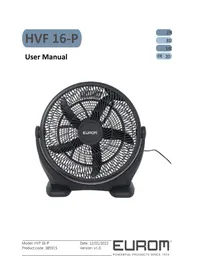
USER MANUAL Vento 12 Eurom
natural_image
Front view of a standard office air conditioner with visible blades and cooling fan (no text or symbols)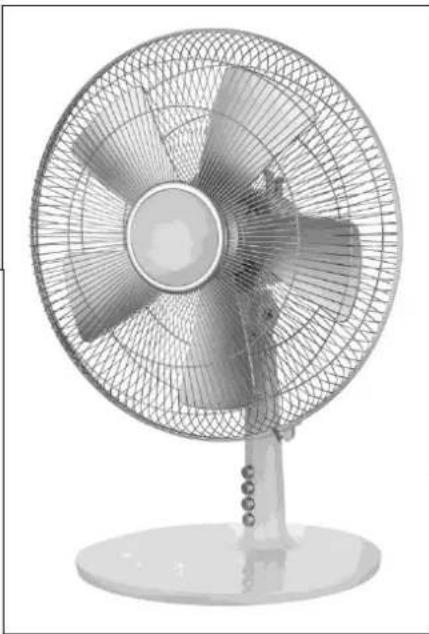
natural_image
Front view of a standard electric fan with visible blades and mounting base (no text or symbols)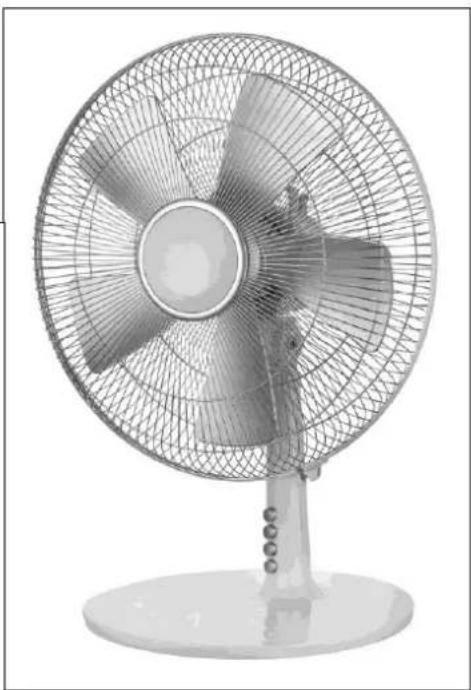
natural_image
Black-and-white photo of a standard office fan with visible blades and a stand (no text or symbols)Vento 9
Art.nr. 384666
Vento 12
Art.nr. 384680
Vento 16
Art.nr. 384703
Dank
Samenstelling
natural_image
Symbol of a trash bin with crossed lines indicating no waste or discharge, and a solid black rectangle below (no text or labels)Thank you very much for choosing for a EUROM device. You have made a good choice! We hope you will be satisfied about its functioning.
To get maximum profit from your product, it is important to read this manual attentive and totally before use, and to understand what is written. Read especially the safety instructions: they are there to protect you and your environment.
Keep the manual in a safe place for future reference. Store also the package: that is the best protection for your product in times of no-use. And if you at any time pass the appliance on, pass on the manual and package too.
We wish you a lot of fun with the Vento Fan!
Eurom
Kokosstraat 20
8281 JC Genemuiden (NL)
info@eurom.nl
www.eurom.nl
This manual has been complied with the utmost care. Nevertheless, we reserve the right to optimize this manual at any time and to adjust it technically. The image used may differ.
Technical specifications
| Vento 9 | Vento 12 | Vento 16 | |
| Connected power | 220-240V~50Hz | ||
| Output capacity | 25 W | 40 W | 50 W |
| ∅ blades | 9" / 22 cm | 12" / 30 cm | 16" / 40 cm |
| Weight (kq) | 1,48 | 2,2 | 3,18 |
| Dimensions (cm) | 27,5 x 22,5 x 39,5 | 36 x 28 x 51,5 | 45 x 35 x 60 |
General safety guidelines
-
Check (before use) that the socket you have chosen for the fan corresponds to the voltage indicated on the fan's specification plate: 220-240V\~50Hz.
-
Check fan, plug and cable for damage before use. If you discover any damage, do not use and consult a qualified person for repairs. Never open up the device or carry out repairs yourself. Do not allow children to play with the packaging.
-
This device is only to be used indoors.
-
First, assemble the fan fully before use. Before you assemble or disassemble the fan first unplug it from the wall socket.
-
Ensure that the unit is always placed on a sturdy, flat and horizontal surface during use
-
Always turn the fan off and always remove the plug from the socket before moving the fan, cleaning it or carrying out maintenance.
-
Never pull on the cord or roll and/or wind it too tightly.
-
Never touch the device with wet hands!
-
If the electrical cable or plug is damaged then it must be replaced by a qualified person. To avoid accidents, never make repairs yourself.
-
Never hang anything over the fan and do not use near curtains or other materials that could jam the motor. This could lead to overheating.
-
Never insert a finger, pen, stick or any other object through the protective grille when the fan is in use! This could cause injury and damage!
-
Prevent the fan from blowing continuously on small children, patients or people that have difficulty moving.
-
Never spray products (anti-insect, cleaning spray etc) on or into the fan; this could lead to physical illnesses (particularly in children) or damage parts.
-
Never connect the fan to a timer or dimmer.
-
Do not use the fan in excessive temperatures (above 40^ ), in the vicinity of heating units, in areas with high air humidity (bathrooms etc) or in dusty rooms.
-
Do not use the device in the vicinity of baths, showers, basins or other receptacles that may contain water/liquids. Never immerse the device, cable or plug in liquid!
-
Do not use the fan in areas where acids, alkalis or oil are stored. These materials could cause the unit to deform or erode and lead to it functioning incorrectly.
-
Never use the fan in spaces where flammable, explosive or gaseous substances are stored. A single spark from the switch/engine could ignite the substances!
-
This device is not suitable to be used by persons (including children) with a physical, sensual or mental disability or those who lack experience and knowledge, irrespective of whether they are being supervised or there is a responsible person present. Keep these persons and household pets out of the vicinity of the fan.
-
This appliance can be used by children aged from 8 years and above and persons with reduced physical, sensory or mental capabilities or lack of experience and knowledge if they have been given supervision or instruction concerning use of the appliance in a safe way and understand the hazards involved. Children shall not play with the appliance. Cleaning and user maintenance shall not be made by children without supervision.
Diagram of components
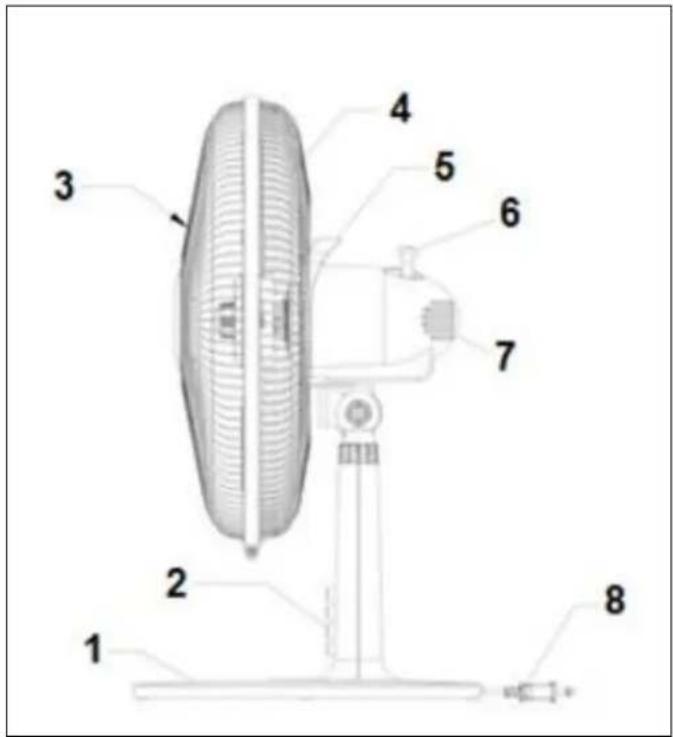
- foot
- operating buttons
- front grid
- rear grid
- handle
- oscillating button
- motor housing
- electrical cable with plug
Assembly
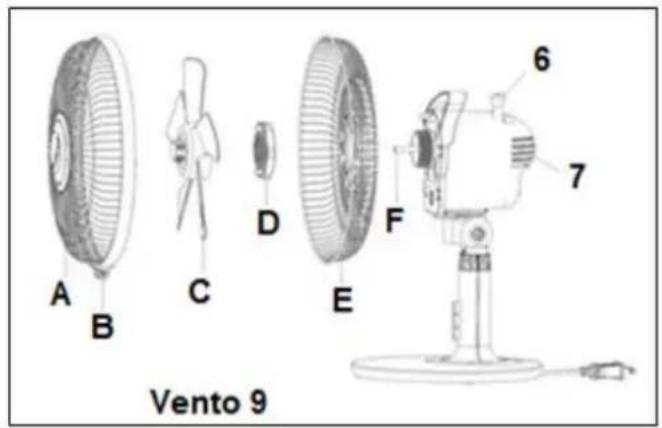
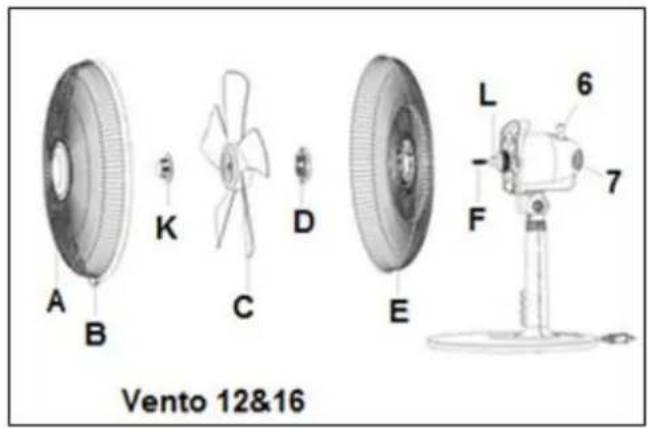
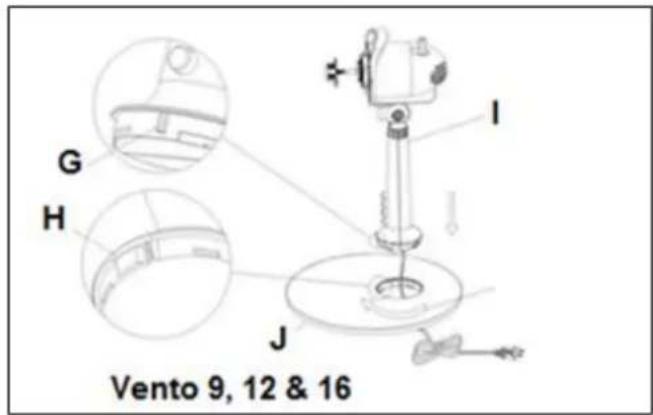
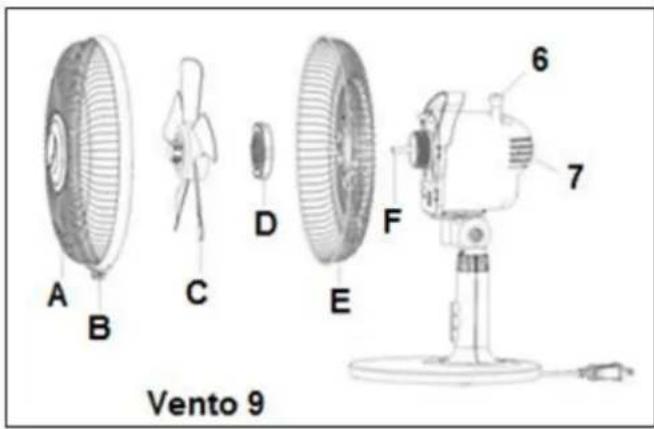
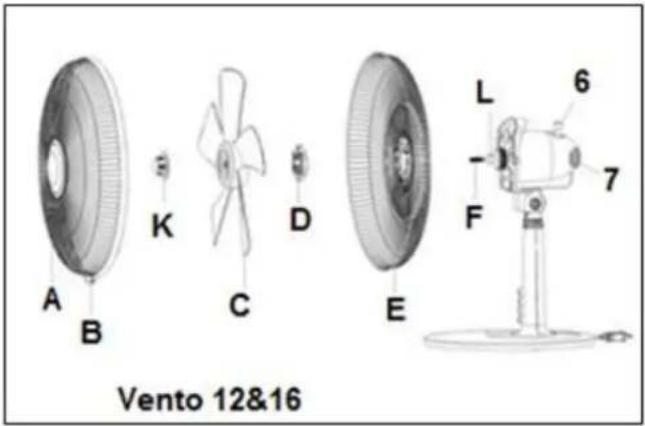
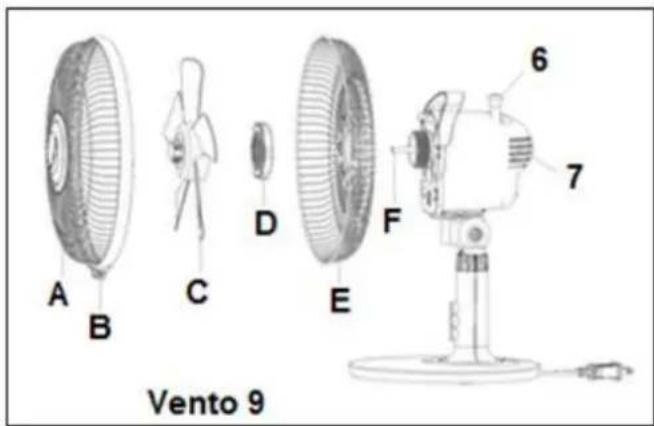
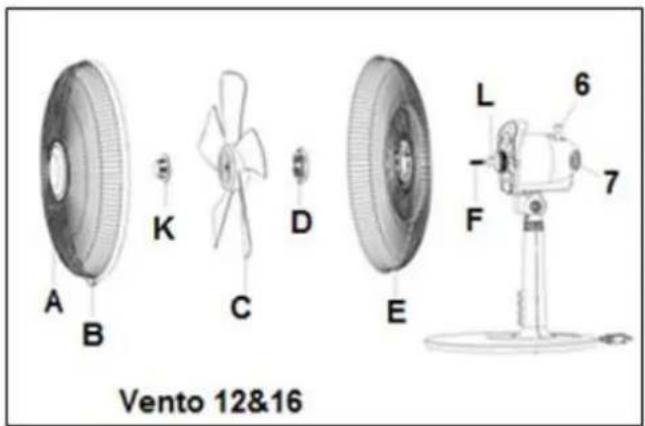
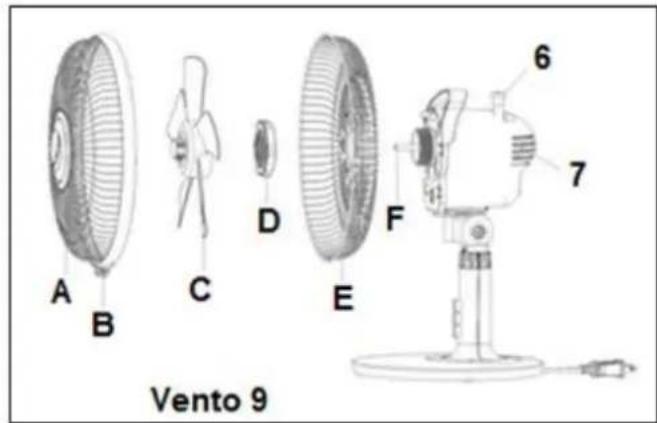
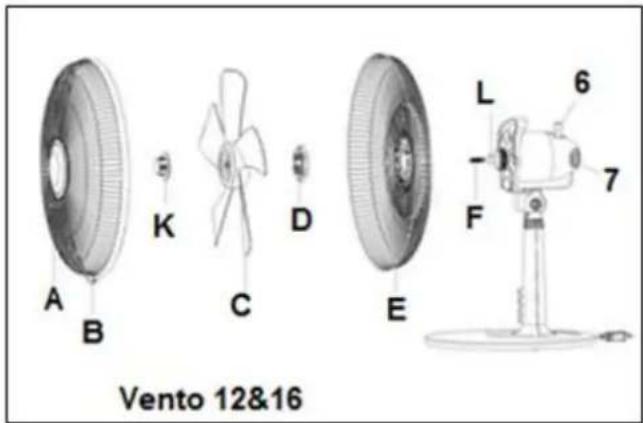
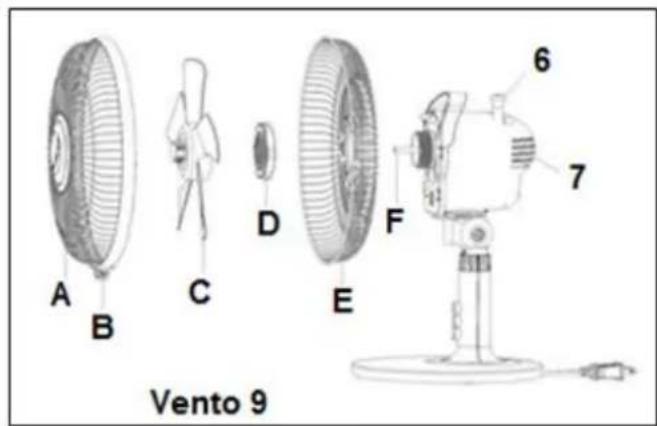
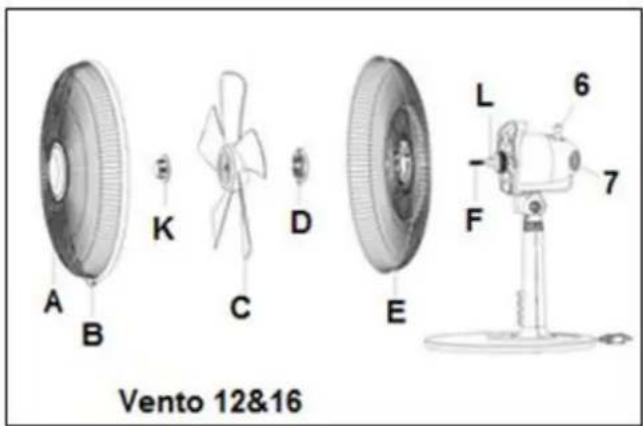
A. front grid
B. grid locking ring
C. fan
D. grid mount
E. rear grid
F. motor shaft
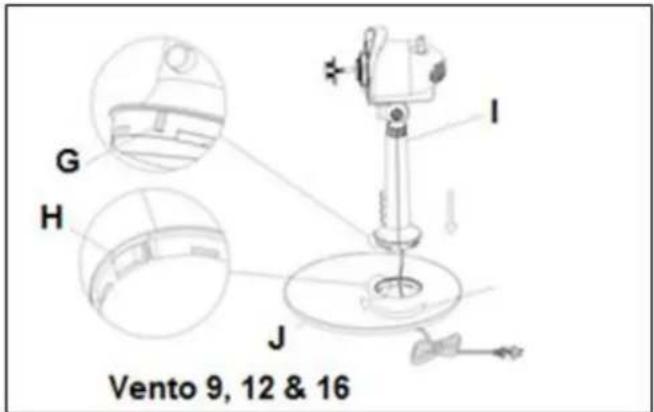
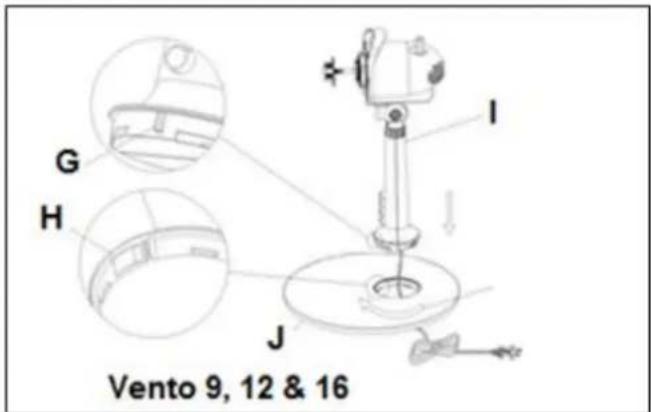
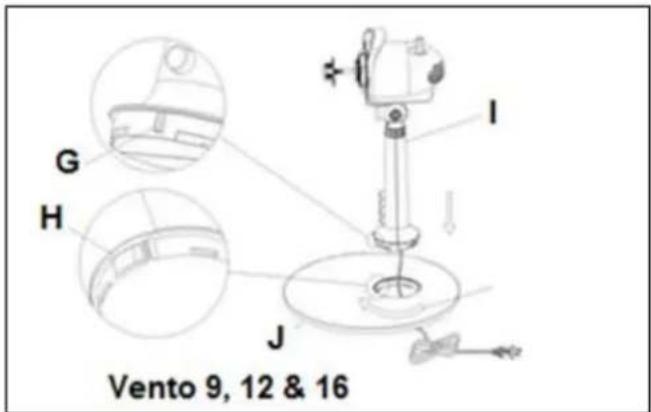
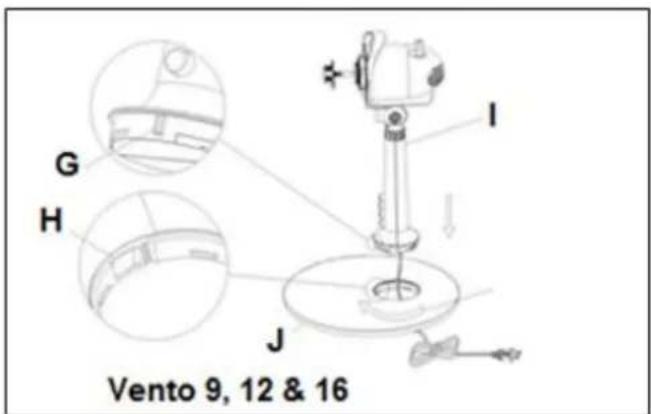
G. stand protrusion
H. foot cutaway
I. pedestal
J. foot
K. fan mounting knob
L. shaft pin
Unplug from the wall socket!
- Remove the fan mounting knob (only Vento 12&16) and the grid mount from the motor shaft.
- Position the rear grid on the appropriate pins. Screw it tight with the grid mount.
- Push the fan as far as possible onto the motor shaft. Vento 12 and 16: ensure that the pins enter the grooves and tighten the fan with the fan mounting knob by tightening it anti-clockwise.
- Check that the fan rotates freely if you turn it by hand.
- Open the grid locking ring a little by loosening the screw a bit. Place the front grid on the rear grid so that the grid locking ring correctly encloses the edges of the grids; the grids firmly against each other! Then tighten the grid locking ring firmly with the screw. Check that everything is properly lined up.
- Run the electric cable through the hole in the foot. Mount the pedestal on the foot, so that the protrusions on the pedestal enter the cut always in the foot. Now screw the pedestal to the foot; the electrical cable will now run through its guides.
Important
Do not use the fan in a bathroom or wet area. Find a stable, horizontal place for the fan in the vicinity of a wall socket. Ensure that the fan is not within the reach of children. Never stick objects through the grid. Always unplug the fan from the wall socket before you move it or carry out maintenance on it!
Operation
The fans can be set to different speeds: The Vento 9 has two settings; the Vento 12 & Vento 16 have three settings. All types of fan are equipped with an oscillation function (75°).
If you would like to angle the fan upwards or downwards, the motor block can be angled further up or down in relation to the foot. Before doing so, however, turn off the fan and remove the plug from the socket!
If - the fan has been fully assembled
- all connections have been properly secured
- all safety guidelines have been taken into account
you can use the fan.
I - Insert the plug into the socket.
II - Select setting: 0=off, 1=standard, 2=strong (Vento 12&16: 3=extra strong).
The output buttons on the (T) models are located on the base; they can be found on the button unit on the (S) models.
The fan will now begin to work.
III – If required, you may now depress the oscillation button on top of the motor: the fan will now begin to oscillate through an angle of 75^ . Depressing and releasing this button will turn the oscillation function off. Make sure that hair, clothes, curtains etc. cannot be sucked into the spinning fan!
Press the 0 button to switch the fan off. If you wish to turn the device off for longer than just a few minutes, you must also remove the plug from the socket.
Cleaning and maintenance
Switch the fan off and remove the plug from the socket if you wish to clean the device or perform maintenance. The fan only needs general, exterior maintenance. Dust it regularly with a soft cloth or duster or use a vacuum cleaner with a soft brush to clean. If it is very dirty, open the grille and clean grilles and blades using a soft, damp cloth and a mild household cleaning agent. Dry everything thoroughly and allow the fan to dry properly before reassembling and using again. Ensure that water does not come into contact with anything other than the grille and blades.
Never rinse or spray the fan! In order to prevent material discolouration or deformities, never use aggressive or corrosive (cleaning) products. Rub a little oil on the motor shaft at the end of the season to prevent rust. If the fan is to be stored at the end of the season, repack in its original packaging: this offers the best protection. Store it in a safe and dry place that is not subject to extremes of heat or cold.
Problems and solutions
The fan blades do not rotate even though the device is switched on
- Is the plug in the socket?
- Is there power to the socket?
- Is the blade blocked, e.g. by damage, a deformity on the grille or a foreign object?
There is strange noise when starting
- Check to ensure the blades are placed as far over the motor axle as possible.
- Check whether the blades have become deformed and are touching the protective grille.
Warning: Repairs must be carried out by qualified engineers. This also applies to replacing or repairing the electrical cable and plug. Please request original parts if the device needs to be repaired. If the device is subjected to modifications or repairs are carried out by unqualified persons, the guarantees from the supplier, importer and manufacturer will become null and void.
Removal
natural_image
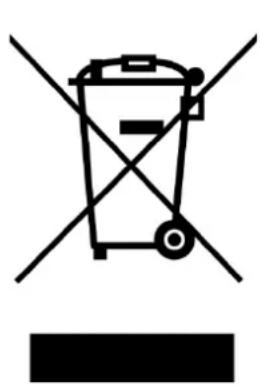
Symbol of a trash bin crossed with no text or numbers, representing environmental restriction (no text present)In the EU this symbol indicates that this product may not be disposed of as ordinary household waste. Old equipment contains valuable materials, suitable for recycling. These materials should be made suitable for reuse in order to prevent any adverse effects to health and the environment caused by unregulated waste collection. Therefore, please make sure that you bring old equipment to a designated collection point. Alternatively, contact the original supplier, who can make sure that as many of the components as possible can be recycled.
CE-declaration
See page 34.
Dank
Montage
natural_image
Symbol of a trash bin crossed with two diagonal lines, no text or labels presentMontage
natural_image
Symbol of a trash bin with crossed lines indicating no waste or discharge, and a solid black rectangle below (no text or labels)Compoziție
natural_image
Symbol of a trash bin with crossed lines indicating no waste or discharge, and a solid black rectangle below (no text or labels)declares the following device in sole responsibility:
Product: Fan
Brand name: EUROM
Model: Vento 9 / Vento 12 / Vento 16
Item number: 384666 / 384680 / 384703
Complies with the following harmonization rules:
Low Voltage Directive: LVD 2014/35/EU
Electromagnetic compatibility Directive: EMC 2014/30/EU
Restriction of Hazardous Substances RoHS Directive:2011/65/EU&(EU)2015/863
Applied harmonized standards:
EN 60335-2-80:2003;A1:2004+A2:2009
EN 60335-1:2012:A11:2014+A14:2017+A1:2019+A14:2019
EN 62233:2008
EN 55014-1:2017
EN 55014-2:2015
EN 61000-3-2:2014
EN 61000-3-3:2013
Genemuiden, 09-11-2020
W.J. Bakker, alg. Dir.
EUROM
Kokosstraat 20
8281 JC Genemuiden
The Netherlands
info@eurom.nl
www.eurom.nl
091120
Brand : Eurom
Model : Vento 12
Category : Fan