
KM4682 - Coffee machine KRUPS - Free user manual and instructions
Find the device manual for free KM4682 KRUPS in PDF.
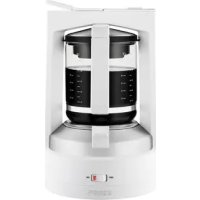



| Product type | Drip coffee maker |
| Brand | Krups |
| Model | KM4682 |
| Capacity | 1 liter (approx. 8 cups) |
| Reservoir material | Stainless steel |
| Filter type | Reusable permanent filter |
| Recommended coffee type | Ground coffee (medium grind) |
| Auto shut-off function | Yes, after 20 minutes |
| Safety system | Safety button and locking lever |
| Power supply | Mains, cord with winder |
| Maintenance | Hand wash removable parts; periodic descaling |
| Recommended descaling | Every 20 to 60 cycles or depending on water hardness |
| Included accessories | Glass carafe, permanent filter, spoon |
| Available spare parts | Carafe, seals, permanent filter |
| Cord storage | Under the appliance, integrated winder |
Frequently Asked Questions - KM4682 KRUPS
User questions about KM4682 KRUPS
0 question about this device. Answer the ones you know or ask your own.
Ask a new question about this device
Download the instructions for your Coffee machine in PDF format for free! Find your manual KM4682 - KRUPS and take your electronic device back in hand. On this page are published all the documents necessary for the use of your device. KM4682 by KRUPS.
USER MANUAL KM4682 KRUPS
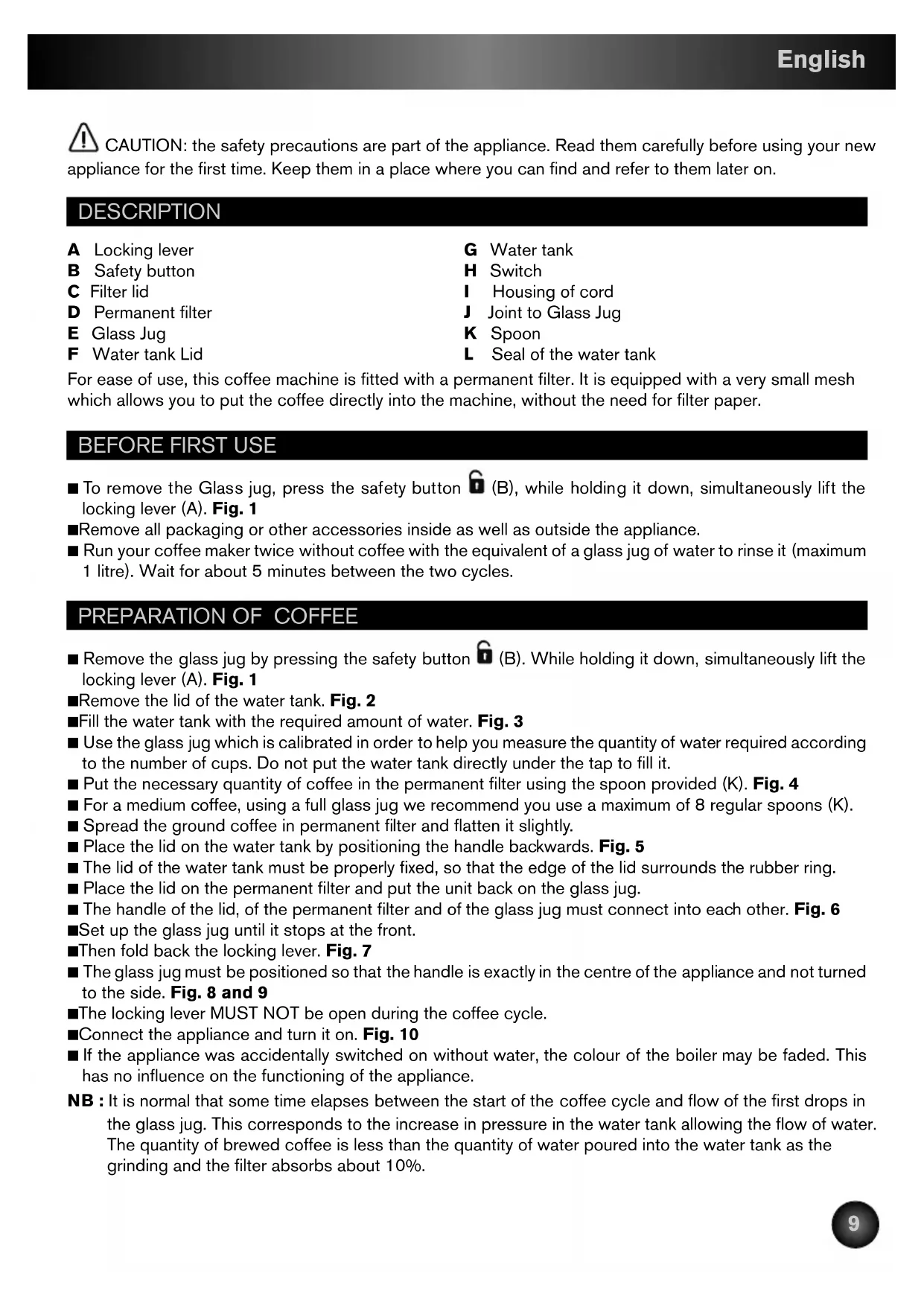
CAUTION: the safety precautions are part of the appliance. Read them carefully before using your new appliance for the first time. Keep them in a place where you can find and refer to them later on.
DESCRIPTION
A Locking lever B Safety button C Filter lid D Permanent filter E Glass Jug F Water tank Lid
G Water tank H Switch
Housing of cord Joint to Glass Jug K Spoon L Seal of the water tank
For ease of use, this coffee machine is fitted with a permanent filter. It is equipped with a very small mesh which allows you to put the coffee directly into the machine, without the need for filter paper.
BEFORE FIRST USE
To remove the Glass jug, press the safety button (B), while holding it down, simultaneously lift the locking lever (A). Fig. 1 ■Remove all packaging or other accessories inside as well as outside the appliance. ■ Run your coffee maker twice without coffee with the equivalent of a glass jug of water to rinse it (maximum 1 litre). Wait for about 5 minutes between the two cycles.
PREPARATION OF COFFEE
Remove the glass jug by pressing the safety button (B). While holding it down, simultaneously lift the locking lever (A). Fig. 1 ■Remove the lid of the water tank. Fig. 2 ■Fill the water tank with the required amount of water. Fig. 3 Use the glass jug which is calibrated in order to help you measure the quantity of water required according to the number of cups. Do not put the water tank directly under the tap to fill it. Put the necessary quantity of coffee in the permanent filter using the spoon provided (K). Fig. 4 ■ For a medium coffee, using a full glass jug we recommend you use a maximum of 8 regular spoons (K). - Spread the ground coffee in permanent filter and flatten it slightly. Place the lid on the water tank by positioning the handle backwards. Fig. 5 The lid of the water tank must be properly fixed, so that the edge of the lid surrounds the rubber ring. Place the lid on the permanent filter and put the unit back on the glass jug. The handle of the lid, of the permanent filter and of the glass jug must connect into each other. Fig. 6 ■Set up the glass jug until it stops at the front. Then fold back the locking lever. Fig. 7 The glass jug must be positioned so that the handle is exactly in the centre of the appliance and not turned to the side. Fig. 8 and 9 The locking lever MUST NOT be open during the coffee cycle. Connect the appliance and turn it on. Fig. 10 If the appliance was accidentally switched on without water, the colour of the boiler may be faded. This has no influence on the functioning of the appliance.
NB: It is normal that some time elapses between the start of the coffee cycle and flow of the first drops in the glass jug. This corresponds to the increase in pressure in the water tank allowing the flow of water. The quantity of brewed coffee is less than the quantity of water poured into the water tank as the grinding and the filter absorbs about 10%.
The increase in pressure is constantly renewed; the coffee will flow by alternation. The flow of coffee is finished when coffee no longer drips from the permanent filter for about ten seconds. ■ When the cycle is finished, press the safety button and simultaneously raise the locking lever GENTLY to release any residual pressure. Fig. 11 Remove the glass jug.
Attention: Do not touch the stainless steel machine parts: the water tank (G) and the lid of the filter (C). You are likely to burn yourself especially when pouring the coffee.
Sometimes there can be a cloudy appearance to the coffee due to the water quality, the type of grounds used or its degree of fineness. We recommend that you stir the coffee in the glass jug. Serve it. If the coffee cycle takes significantly more time than usual, please carry out the descaling of the machine. (see paragraph DESCALING).
AUTOMATIC STOP
■ Your device will automatically turn off approximately 20 min after the start of the cycle.
STORING THE POWER CORD
This coffee maker is equipped with a practical system of winding the cord underneath the unit. Fig. 12
CLEANING
■ Never immerse the body of the appliance in water. Always unplug and allow the appliance to cool before cleaning. The water tank and heater are made of stainless steel and therefore it is easy to clean. Clean the water tank with a soft cloth or damp sponge. Do not clean the appliance when it is still hot. - Do not attempt to remove incrustation with abrasive objects or materials; they can be lodged in the pipe and the plug (see the paragraph "descaling"). ■ Wash the glass jug, lids and filter holder in hot water and washing-up liquid then rinse thoroughly and carefully. Occasionally, loosen the knob on the bottom of the lid of the filter and clean the interior part of the lid. Fig. 13 et 14
REPLACEMENT OF THE GASKET
■ After a certain period of use, the lid of the water tank, the filter holder or hot water pipe may no longer close properly. This is due to the deterioration of the gasket. To replace them, contact The Customer Relations Department, see Contact list
DESCALING
Why descale
The scale is naturally deposited in your coffee maker. Descaling preserves the coffee maker and ensures it a longer life. Descaling ensures a consistent quality of coffee in time. The scale may permanently deteriorate the performance of the machine. The malfunctions related to the scaling will not be under guarantee if you return the product.
■How to descale
By using the descaling kit or white vinegar.
When to descale
The frequency of descaling depends on the water hardness and the number of coffee cycles. When the following signs are encountered: cycle time lengthened, high evaporation, high level of noise at the end of cycle, stop during the cycle, it signifies that your machine is calcified.
The descaling of the coffee maker must be between 20 and 60 cycles or once a month depending on the water hardness.
How to descale your KRUPS coffee maker
Use the KRUPS® descaling solution diluted in 0.5l of water or 250 ml of commercially available white vinegar in half-litre of water.
Pour the solution into the water tank (without coffee).
Start the cycle (without coffee). After 4 min, manually stop the cycle. Leave it still for an hour. Restart the coffee to complete the cycle.
To rinse the machine, run 2 cycles with water but no coffee.
Repeat the operation if necessary.
The guarantee does not cover appliances which become faulty because the descaling operations have not been carried out regularly.
ACCESSORIES
For spare parts and accessories please contact the Customer Relations Department, see contact list
Glass jug
POSSIBLE BREAKDOWNS AND SOLUTIONS
| PROBLEM SOLUTION | |
| The coffee does not flow or the ap- pliance does not turn on. | ■ Make sure that the appliance is properly plugged in a working outlet and it is in "ON" position. ■ The water tank is empty. ■ There was a power outage. ■ The automatic stop function to switch off the appliance. Turn the power off and then on again. For more information, see "Preparation of coffee" section. |
| Theapplianceseemstoleak. | ■ Make sure that the water tank was not filled beyond the maximum limit. at the lid of the glass jug : ■ ensure that the glass jug is positioned correctly: stop the machine and wait 5 minutes. Unlock the lever, remove the glass jug, put it back and lock the lever. ■ensure that the joint (J) is positioned correctly at the lid of the water tank: ■Remove it and put it back: the lid of the water tank must be properly fixed, so that the edge of the lid surrounds the ring of rubber. |
| The flow of coffee takes more time. | ■Descale the appliance. ■Several minerals can accumulate in the circuit of coffee maker. It is recommended to descale the machine regularly. It may need to do it more frequently depending on the hardness of your water. For more information, see the "Descaling" section. ■It is normal that some time elapses between the start of the coffee cycle and the flow of the first drops in the carafe. This corresponds to the increase in pressure in the water tank allowing the flow of water. NOTE: Do not disassemble the appliance. |
| The filter holder (D) overflows or coffee flows too slowly. | ■ The coffee maker needs to be cleaned. ■ There is too much coffee. We recommend that you use the spoon (K) or a tablespoon of ground coffee for a large cup. ■ The ground is too fine (the ground for espresso is not suitable for a coffee maker with percolation). |
| The coffee tastes bad. | ■ The coffee outlet must be cleaned. ■ The ground is not suitable for your coffee. ■ The proportion of coffee and water is inadequate. Adjust it according to your taste. ■ The quality and freshness of the coffee are not optimal. ■ The water is of poor quality. Use the filtered water in jug or bottled water. |
| Coffee does not flow. | ■ Make sure the glass jug is positioned correctly: stop the machine and wait 5 minutes. Unlock the lever, remove the glass jug, put back and lock the lever. ■ Make sure the gasket is positioned correctly ■ The coffee flow system is perhaps blocked. You can wash it by simply rinsing it with water. |
| The coffee is cold | ■ This coffee machine is not equipped with a self-warming function. At the end of the cycle, drink the coffee before it gets cold. |
DISPOSAL OF MATERIALS

The packaging consists solely of environmentally friendly materials that can be disposed of according to your local recycling facilities.
To find out how to dispose of the appliance itself, contact the relevant department of your local administrative body.
ENVIRONMENTAL PROTECTION
Think of the environment!
Your appliance contains valuable materials which can be recovered or recycled. Leave it at a local civic waste collection point.
If you have any further problems or queries, please call our Customer Relations Team first for expert help and advice:
Helpline:
0845 330 6460 - UK
016774003-ROI
Or consult our web site: www.krups.co.uk
DESCRIPTION
POSSIBLE FAULTS AND SOLUTIONS



- DESCRIPTION
- BEFORE FIRST USE
- PREPARATION OF COFFEE
- ATTENTION: DO NOT TOUCH THE STAINLESS STEEL MACHINE PARTS: THE WATER TANK (G) AND THE LID OF THE FILTER (C). YOU ARE LIKELY TO BURN YOURSELF ESPECIALLY WHEN POURING THE COFFEE
- AUTOMATIC STOP
- STORING THE POWER CORD
- CLEANING
- REPLACEMENT OF THE GASKET
- DESCALING
- WHY DESCALE
- HOW TO DESCALE
- WHEN TO DESCALE
- HOW TO DESCALE YOUR KRUPS COFFEE MAKER
- ACCESSORIES
- DISPOSAL OF MATERIALS
- ENVIRONMENTAL PROTECTION
- THINK OF THE ENVIRONMENT
Brand : KRUPS
Model : KM4682
Category : Coffee machine