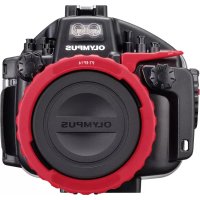
PTEP14 - Camera OLYMPUS - Free user manual and instructions
Find the device manual for free PTEP14 OLYMPUS in PDF.



User questions about PTEP14 OLYMPUS
0 question about this device. Answer the ones you know or ask your own.
Ask a new question about this device
Download the instructions for your Camera in PDF format for free! Find your manual PTEP14 - OLYMPUS and take your electronic device back in hand. On this page are published all the documents necessary for the use of your device. PTEP14 by OLYMPUS.
USER MANUAL PTEP14 OLYMPUS
date of issue 2016.07
OLYMPUS
©2016 OLYMPUS CORPORATION
Printed in China
WD193301
OLYMPUS
PT-EP14
| JP | 取収説明書 | 2 |
| EN | Instruction Manual | 26 |
| FR | Mode d'emploi | 50 |
| DE | Bedienungsanleitung | 74 |
| ES | Manual de instructcciones | 98 |
| CHT | 使用說明書 | 122 |
| KR | 사용품명서 | 146 |
FLRJHJFJFJFJFJFJFJFJFJFJFJFJFJFJFJFJFJFJFJFJFJFJFJFJFJFJFJFJFJFJFJFJFJFJFJFJFJFJFJF
Thank you for purchasing our product.
Please read this instruction manual carefully and use the product safely and correctly. Please keep this instruction manual for reference after reading it.
- Wrong usage may cause damage to the camera inside the Case due to water leakage, and repair may not be possible.
Before use, perform an advance check as described in this manual.
Introduction
- Unauthorized copying of this manual in part or in full, except for private use, is prohibited. Unauthorized reproduction is strictly prohibited.
- OLYMPUS CORPORATION shall not be responsible in any way for lost profits or any claims by third parties in case of any damage occurring from improper use of this product.
Please read the following items before use
- This Case is a precision device designed for use at a water depth within 60m . Please handle it with sufficient care. Depending on the lens port used, the allowable water depth can be different. Please check in advance.
- Please use the Case correctly after sufficient understanding of the contents of this manual in regard to handling of the Case, checks before use, maintenance, and storage after use.
- OLYMPUS CORPORATION shall in no way be responsible for accidents involving immersion of a digital camera in water. In addition, expenses incurred for damage of internal materials or loss of recorded contents due to water entering the camera will not be compensated.
Please address these possible damages by insuring your camera at your own discretion before use.
- OLYMPUS CORPORATION shall not pay any compensation for accidents (injuries or material damage) at the time of use.
For safe use
This instruction manual uses various pictographs for correct use of the product and to prevent danger to the user and other person, as well as property damage. These pictographs and their meanings are shown below.
| WARNING | This shows the content regarding assumption of possibility of human death or severe injury in case of handling with disregard of this indication. |
| CAUTION | This shows the contents regarding assumption of possibility of injury or damage to property in case of handling with disregard of this indication. |

WARNING
① Keep this product out of the reach of babies, infants, and children. There is the possibility of occurrence of the following types of accidents.
- Injury by dropping onto the body from heights.
- Injury from parts of the body getting caught in parts which open and close.
- Swallowing of small parts, O-ring, silicone grease and silica gel. Please consult a physician immediately if any parts have been swallowed.
② Do not store digital camera with batteries inserted in this product.
Storage with a battery inserted may lead to leakage of the battery liquid and fire hazard.
③ If leakage of water should occur with a camera installed in this product, quickly remove the battery from the camera. There is the possibility of ignition and explosion from generation of hydrogen gas.
This product is made of resin. There is the possibility that injuries may be caused when it becomes broken due to strong impact with a rock or other hard objects. Please handle it with sufficient care.

CAUTION
① Do not disassemble or modify this product. This may cause water leakage or defect. In case of the loss of image data caused by disassembly, repair or modification etc. by any party other than those appointed by OLYMPUS CORPORATION, we shall bear no responsibility for damage.
② Use or storage of the product at the following locations may cause defective operation, defects, damage, fire, internal fogging, or water leakage. This should be avoided.
- Locations reaching high temperatures such as those under direct sunlight, in an automobile, etc.
- Locations close to fire
A water depth in excess of 60m - Locations subject to vibrations
- Locations with high temperature and humidity or with extreme temperature changes
- Locations with volatile substances
③ Opening and closing at locations with much sand, dust, or dirt may impair the waterproof characteristic and cause water leakage. This should be avoided.
This product is not a case to soften impacts to the camera inside the product. When this product with a digital camera inside is subjected to impacts or heavy objects are placed onto it, the digital camera may be damaged. Please handle it with sufficient care.
⑤ Do not use the following chemicals for cleaning, corrosion prevention, prevention of fogging, repair or other purposes. When these are used for the Case directly or indirectly (with the chemicals in vaporized state), they may cause cracking under high pressure or other problems.
| Chemicals which cannot be used | Explanation |
| Volatile organic solvents, chemical detergents | Do not clean the Case with alcohol, gasoline, thinner or other volatile organic solvents or with chemical detergents etc. Pure water or lukewarm water is sufficient for cleaning. |
| Anticorrosion agent | Do not use anticorrosion agents. Pure water is sufficient when washing the metal parts as stainless steel and brass are used. |
| Commercial defogging agents | Do not use commercial defogging agents. Always use the specified desiccant silica gel. |
| Grease other than specified silicone grease | Use only the specified silicone grease for the O-ring, as otherwise the O-ring surface may deteriorate and water leakage may occur. |
| Adhesive | Do not use adhesive for repairs or other purposes. When repair is required, please contact your local service station or dealer. |
⑥ Jumping into the water with the Case in your hand, throwing the Case from a boat or ship into the water, and other rough handling may cause water leakage. Please handle with sufficient care, when handing it over from hand to hand etc.
If the Case interior or the camera should become wet because of water leakage, etc., immediately wipe off all moisture and contact your local service station or dealer.
Do not apply excessive force to the projection parts, such as the dial or tripod seat.
⑨ Please remove the O-ring when traveling by air. Otherwise air pressure may make it impossible to open the Case.
For safe use of the digital camera in this product, please read the "Instruction Manual" for the digital camera carefully.
When sealing this product, take sufficient care that no foreign matter gets caught at the O-ring and the contact surface. It is caused for water leakage.
Contents
Introduction 26
Please read the following items before use 26
For safe use 26
1.Preparations 31
Check the contents of the package 31
Names of the parts 32
Using the supplied accessories. 33
33
Removing and mounting the body cap 33
Installing the lens port (optional) 34
Installation and removal of the lens port 34
For port adapter (PAD-EP08) 34
Installation of the diffuser (optional) 35
Using the diffuser 35
Removing diffuser (with port adapter) from the lens port. 35
Prepare the digital camera 36
2. Advance check of the Case 37
Advance check before use 37
Remove the O-ring 37
Remove any sand, dirt, etc. 37
How to apply grease to the O-ring 38
Install the O-ring 38
3.Installing the digital camera 39
Open the Case 39
Attach the flash to the camera 39
Load the digital camera 40
Make sure the camera is loaded properly 40
Seal the Case 41
Check the operation of the loaded camera 41
Waterproofness test 42
4 Connecting the underwater flash 43
5.Taking Pictures Under Water 44
How to select the shooting modes 44
Underwater shooting modes 44
6. Handling After Shooting 45
Wash the Case with pure water 45
Wipe off any waterdrops 45
Unload the digital camera 45
Dry the Case 45
7.Maintaining the Waterproof Function 46
Remove the O-ring 46
Remove any sand, dirt, etc. 46
How to apply grease to the O-ring 46
Install the O-ring 46
Replace consumable products 46
8.Appendix 47
Specifications 47
Accessories 47
Usable main lenses and lens ports. 48
1. Preparations
Check the contents of the package
Check that all accessories are in the box.
Contact your dealer if accessories are missing or damaged.
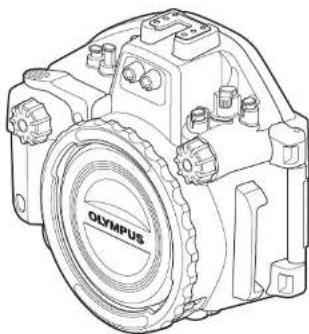
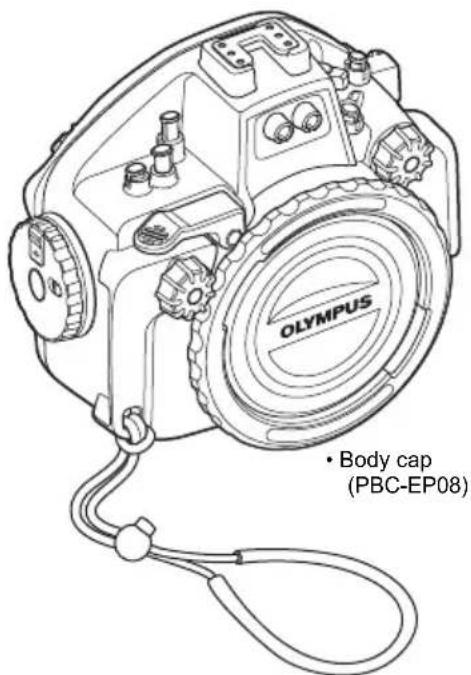
Case body (PT-EP14)
(Check that the O-ring is installed.)
- Hand strap
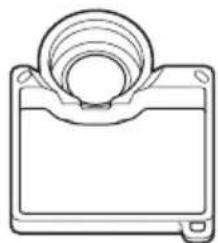
Monitor hood (PFUD-EP14)
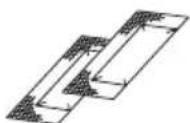
Silica gel (1 g) (SILCA-5S)
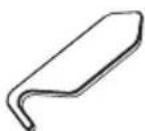
- O-ring remover
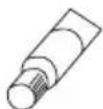
Silicone grease (PSOLG-2)

Optical fiber cable insertion slot cap (2)
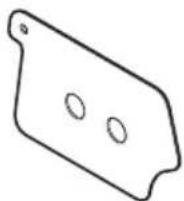
- Flash window cover (PFC-EP12)
-
Instruction manual (this manual)
-
After purchase, be sure to do maintenance even in brand-new condition. Neglecting the maintenance may become the cause of water leakage.
For how to maintenance the case, refer to P.46.
Names of the parts
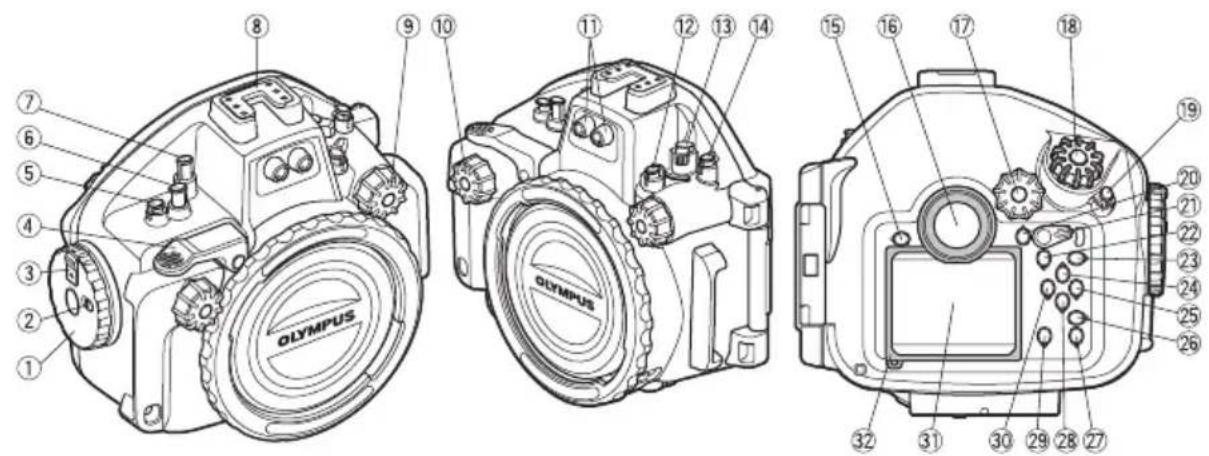
① Open/close dial
②Lock knob
③Slide lock
*④Shutter lever
^* ⑤ (Movie) button
*6Fn2 button
*⑦Mode dial lock
⑧Accessory mount
⑨Zoom dial
*⑩Front dial
- Optical fiber cable insertion slots
⑫HDR button
⑬ON/OFF lever
*AF button
*15 LV button
⑥Finder window
*⑦Mode dial
18Rear dial
*9Fn1 button
*20 AEL/AFL button
*2Fn lever
*2INFO (Info display) button
*23OK button
*24Cross-cursor button
^*25 Cross-cursor button
*26 MENU button
*⑦ Play) button
*Cross-cursor button
*Erase) button
*Cross-cursor button
Monitor window
Monitor hood
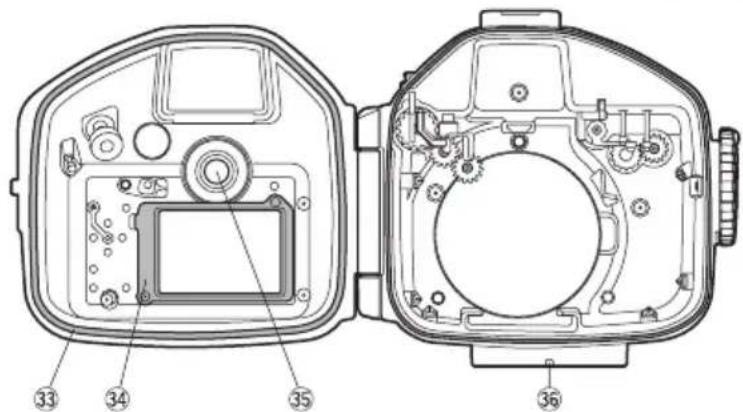
③ 3 O-ring
Monitor inner hood
35 Pickup finder
36 Tripod seat
Note:
Case operation parts marked by * correspond to the operation parts of the digital camera. When the operation parts of the Case are operated, the corresponding functions of the digital camera will operate. For details of the functions, refer to the instruction manual for the digital camera.
Using the supplied accessories
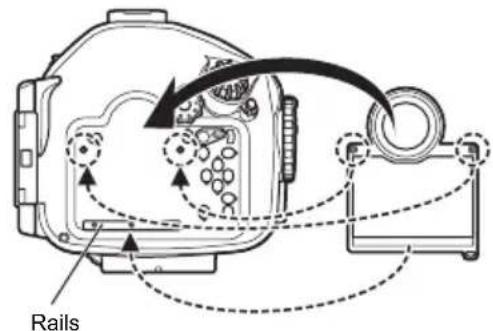
Installing and removing of the monitor hood
Installation
Fit the holes of monitor hood into the left and right pins at the top of the monitor window.
Fit the monitor hood into the finder window.
Fit the bottom frame of monitor hood into the rail at the bottom of the monitor window.
Removal
Remove the monitor hood from the rails at the bottom of the monitor window by extending it outward.
Remove the monitor hood from the left and right pins at the top of the monitor window.
Remove the monitor hood from the finder window.
Removing and mounting the body cap
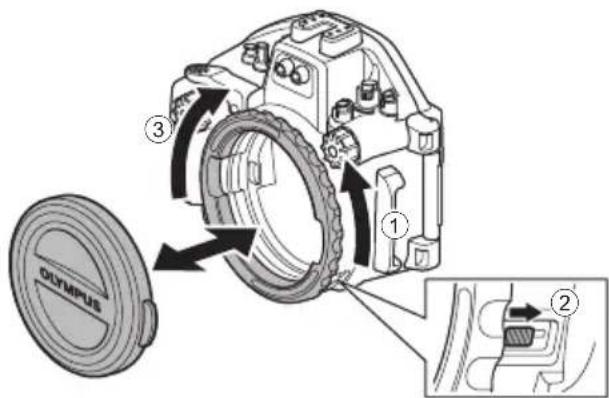
Removal
Turn the port ring (1) while sliding the slide lock (2) of the port ring.
Remove the body cap.
Installation
Fit the right and left protrusions of the body cap to the concave parts of the port ring.
Turn the port ring (③) to lock.
Installing the lens port (optional)
In order to use this product, you need the optional lens port, zoom gear and anti-reflection ring sold separately. Make sure the combination is compatible with your lens (P.48).
Installation and removal of the lens port
To begin with preparations, follow the lens port's instruction manual.
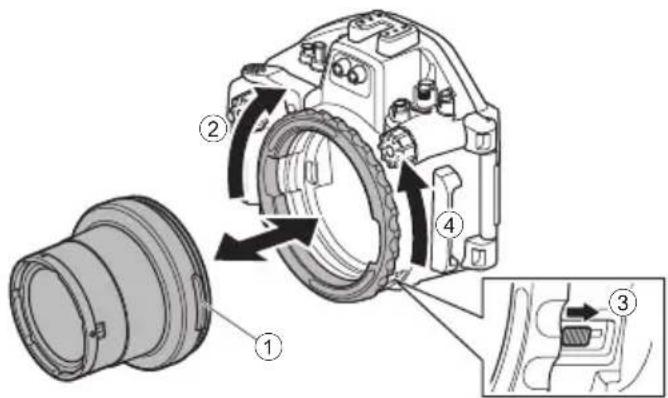
For lens port PPO-EPXXX
Installation
Fit the lens port in the Case.
Then, turn the port ring (②) to lock.
Make sure that the port ring is locked.
Removal
Turn the port ring (4) while sliding the slide lock of the port ring (3).
Then, remove the lens port.
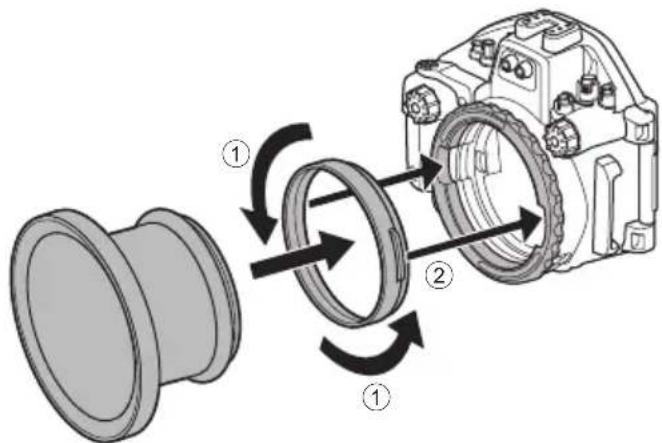
For port adapter (PAD-EP08)
Installation
Gently screw the port adapter in a counter clockwise direction into the lens port (①).
Fit the left and right protrusions of the port adapter into the concave parts of the port ring (2).
Screw well the port adapter on the lens port.
Turn the port ring to lock.
Make sure that the port ring is locked.
Removal
Turn the port ring while sliding the slide lock of the port ring.
Remove the lens port and the port adapter.
Turn the port adapter to remove from the lens port.
If the port adapter is difficult to remove, turn the lens port to loosen it while it is mounted on the Case.

Installation of the diffuser (optional)
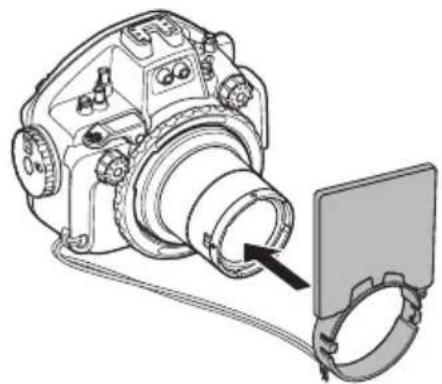
Using the diffuser
When using the flash supplied with the camera, attach the diffuser. Use a diffuser compatible with the lens port.
① Attach the diffuser to the port adapter.
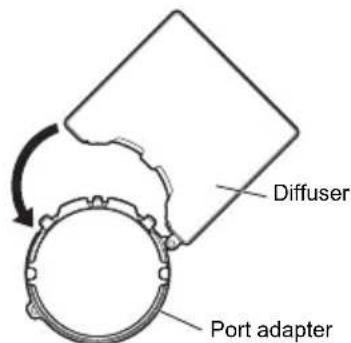
② Install the strap of the lens port to the Case body.

③Install the diffuser on the lens port.
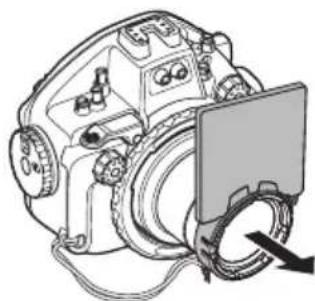
Removing diffuser (with port adapter) from the lens port To remove the diffuser, pull the port adapter from the lens port.
EN
Prepare the digital camera
Prepare the digital camera before loading it in the Case.
1. Battery Confirmation
It is impossible to change the batteries when using the Case. Make sure that you have sufficient remaining battery capacity before use.
2. Check the remaining number of pictures
Check that the image storage medium has enough room for the number of pictures you want to take.
3. Remove the strap, lens cap, filter and eye-cup from the camera.
If the digital camera is loaded without removing these, the Case cannot be sealed properly and may leak.
4. Prepare the lens.
Fix the zoom gear or focus gear.
Fix the anti-reflection ring.
The mounting or installation order can differ according to the lens (P.48).
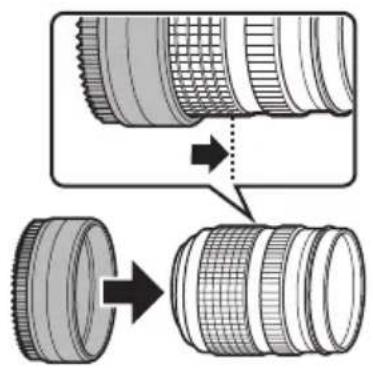
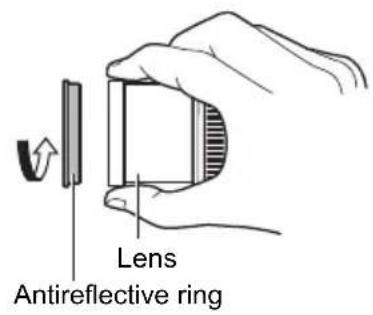
For details of the combination of the zoom gear and the antireflective ring, refer to P.48.
5. Turn the "Built-in EVF Auto Switch" setting off.
Press the button to switch the display between the finder and monitor.
If this setting is on, the eye sensor may activate and appear in the finder display.
2. Advance check of the Case
Advance check before use
Depending on the carrying and storage conditions, the maintenance status, etc., the waterproof function may be damaged.
Before using, always perform the following advance checks.
If the advance test should show water leakage with normal handling, stop using the Case and contact your dealer or an Olympus service station.
Remove the O-ring
Open the Case and remove the O-ring.
Procedure
① Insert the O-ring remover into the gap between the O-ring and O-ring groove wall.
② Bring the tip of the inserted O-ring remover below the O-ring. (Be careful not to damage the groove with the tip of the O-ring remover.)
③ Lift the O-ring, pinch it with your fingertips and pull it out of the Case.
Remove any sand, dirt, etc.
After visually checking that dirt has been removed from the O-ring, check for attached sand and other foreign matter, as well as for damage and cracks by squeezing the entire circumference of the O-ring lightly with your fingertips.
Remove attached foreign matter from the O-ring groove with a lint-free clean cloth or a cotton swab. Also remove any sand or dirt attached to any part of the Case that comes into contact with the O-ring.
- When a sharp object is used to remove the O-ring or to clean the inside of the O-ring groove, the Case and the O-ring may be damaged and water leakage may be caused.
- When the O-ring is checked with the fingertips, take care not to stretch the O-ring.
- Never use alcohol, thinner, benzene or similar solvents or chemicals detergents to clean the O-ring. When such chemicals are used, it is likely that the O-ring will be damaged or that its deterioration will be accelerated.
How to apply grease to the O-ring
| ①Apply only Olympus exclusive lubricant to each O-ring. | Make sure that your fingers and the O-ring are free of dirt, then squeeze the appropriate amount of exclusive lubricant onto a finger to spread onto the entire circumference of the O-ring (approx. 15 mm is adequate). | |
| ②Spread the lubricant onto the entire circumference of the O-ring. | Spread the grease onto the entire circumference of the O-ring using 3 fingers. Be careful not to use excessive force as this may stretch the O-ring. | |
| ③Check that the O-ring is free of scratches or unevenness. | After spreading the lubricant, check visually and by touch that the O-ring is not scratched and that its surface is flat. If it is damaged in any way, replace it with a brand-new O-ring. |
- Always perform maintenance of the waterproof function even when the Case has been opened every shooting. Neglecting this maintenance may become the cause of water leakage.
- When the Case is not to be used for a long time, remove the O-ring from the groove to prevent deformation of the O-ring, apply a thin coat of silicone grease, and store it in a clean plastic bag or the like.
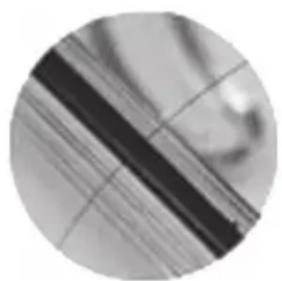
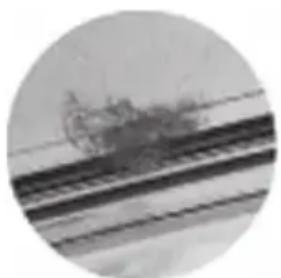
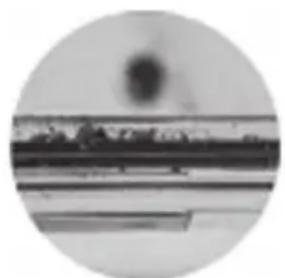
Examples of foreign matter sticking to the O-ring
Hair Fibers Grains of sand
Install the O-ring
Confirm that no foreign matter is in the gap and then fit the O-ring. At this time, confirm that the O-ring does not stick out from the groove.
When sealing this product, make sure that no hairs, fibers, sand particles or other foreign matter stick not only to the O-ring, but also to the contact surface (front cover). Even a single hair or a single grain of sand may cause water leakage. Please check with special care.
3. Installing the digital camera
Open the Case
① Slide the lock knob towards the arrow direction (1 of figure below).
② Slide and hold the slide lock towards the arrow direction (2 of figure below) and turn the open/close dial clockwise (3 of figure below).
③Turn the open/close dial to the position where it cannot be turned further.
④ Open the rear lid of the Case gently.
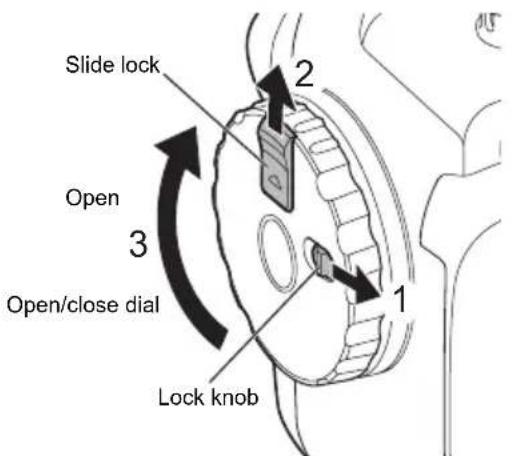
- Do not exert too much force while turning the open/close dial. Doing so may damage the dial.
Attach the flash to the camera
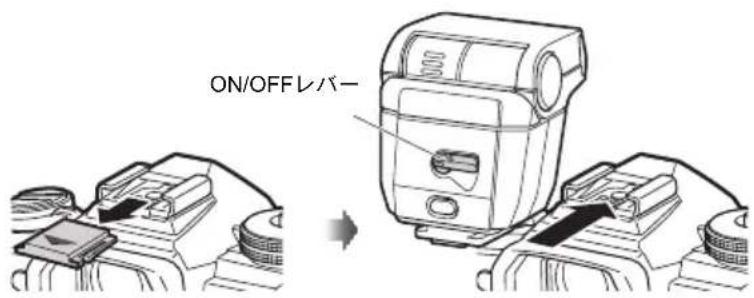
① Attach the flash supplied with the camera.
Make sure to set the light emitting part facing to front.
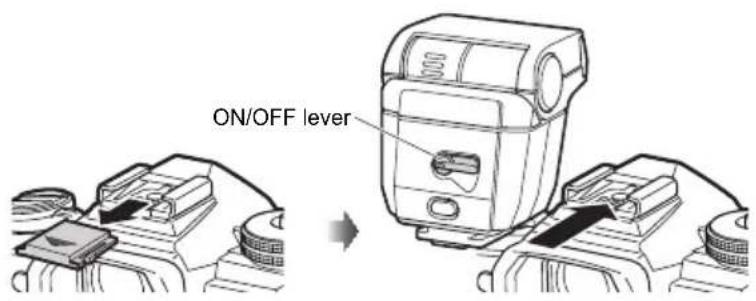
② Raise the ON/OFF lever to turn the power ON.
When using the flash supplied with the camera, light distribution unevenness may occur. If the distribution unevenness occurs, use an external flash.
Load the digital camera
① Confirm that the digital camera is OFF.
② Put the monitor in closed position (do not pull out).
③ Raise the ON/OFF lever (1 of figure below), then set to the "OFF" position.
④ Set the digital camera lever on "1" and adjust the position of the lever of the Case (2 of figure below) to "1" also.
Gently load the digital camera into the Case.
⑥ Insert a silica gel bag (1 g) between the bottom of the digital camera and the Case. The silica gel bag provided for prevention of fogging.
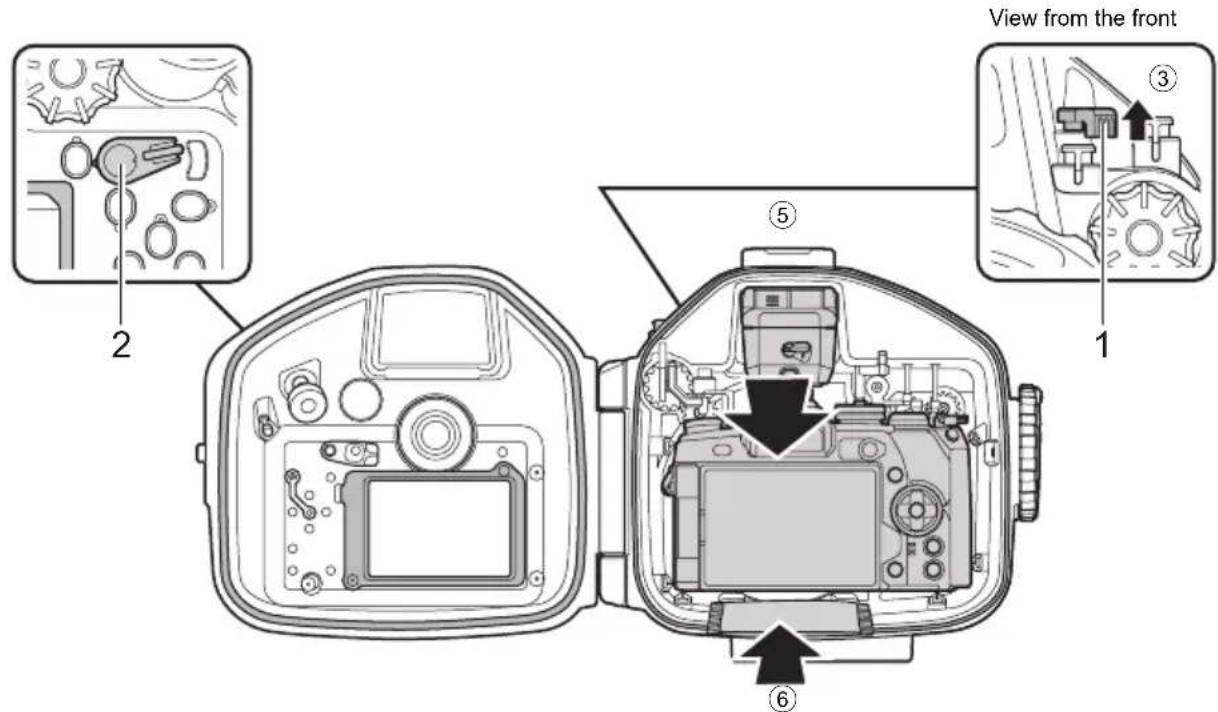
- If the silica gel bag is caught when the Case is sealed, water leakage will occur.
- Once silica gel has been used, the moisture absorption performance will be impaired. Always replace the silica gel when the Case is opened and closed.
- Clean the surface of the dials of the Case and the camera. The dials may slip if there is grease or foreign matter on them.
Make sure the camera is loaded properly
Check the following points before sealing the Case.
- Is the digital camera loaded properly?
- Is silica gel inserted all the way at the specified location?
Is the grease applied to O-ring? - Is the O-ring attached properly to the opening on the Case?
- Is there any dirt or foreign matter on the O-ring or the O-ring contact surface on the front lid?
Seal the Case
① Close the Case gently while aligning the mounting projection of the rear lid and groove.
② Turn the open/close dial counter clockwise (1 of figure below) until you hear a "click" sound and lock the Case.
The Case is sealed.
③ Slide the lock knob towards the LOCK side (2 of figure below).
Lower the ON/OFF lever.
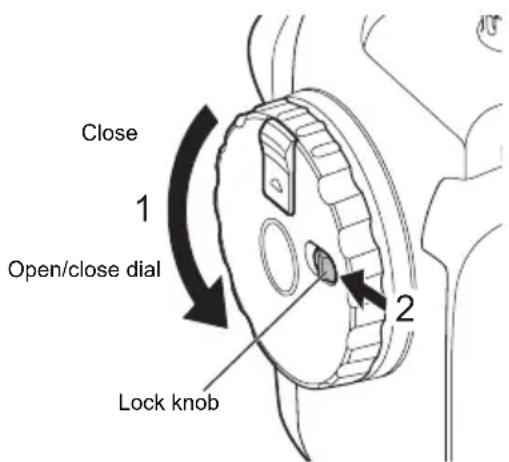
- If the open/close dial is not fully turned, the Case will not be sealed. This will cause water leakage.
- Close the rear lid of the Case so that the lens cap, silica gel or monitor hood strap doesn't catch. If it catches, water leaks may result.
Check the operation of the loaded camera
After sealing the Case, check that the camera operations normally.
- Operate the ON/OFF lever on the Case and confirm that the camera turns ON/OFF.
- Turn the mode dial on the Case and confirm that the camera mode switches properly.
- Operate the lever and confirm that the camera lever position switches properly.
- Press the shutter lever on the Case and confirm that the camera shutter releases.
- Operate other control buttons/levers on the Case and confirm that the camera functions properly as intended.
Waterproofness test
The final test for waterproofness after loading the camera is explained below. Always perform this test. It can be performed easily in a water tank or a bathtub. Confirm the operation of the different buttons. The required time is about 5 minutes.
- At first, immerse the Case for only 3 seconds and check that no water enters the Case.
- Next, immerse the Case for 30 seconds and check that no water enters the Case.
-
Then, immerse the Case for 3 minutes, operate all buttons and levers, and check the following:
-
check that no water has entered the Case.
- check that the Case is not fogged internally.
-
check that no water drops have entered the Case.
-
If the inside of the Case becomes fogged or there are water drops in the Case, repeat the maintenance of the O-ring (P.37) and perform the waterproofness test again.

4. Connecting the underwater flash
To connect the underwater flash (optional) to the Case using an underwater optical fiber cable (optional: PTCB-E02), follow the procedures below. Fix the flash window cover strap to the optical fiber cable in advance.
Connecting the underwater optical fiber cable
① Put the underwater optical fiber cable plug into the optical fiber cable insertion slot. Insert firmly until it stops next to the flash window cover.
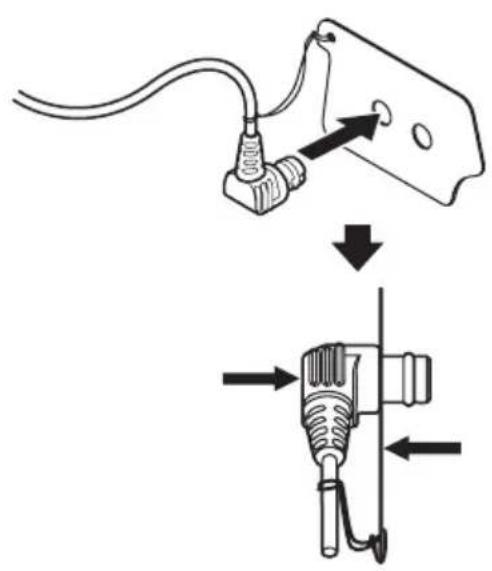
② Put the cap to the optical fiber cable insertion slot when not in use.
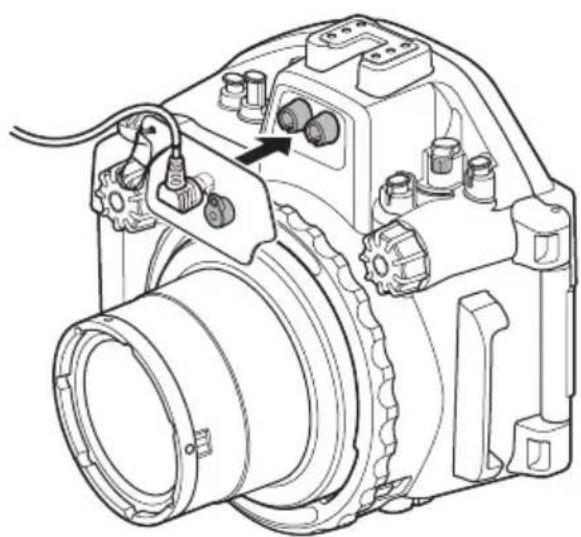
EN
Setting of the digital camera
When using the underwater flash supporting wireless RC flash, set the RC mode of the camera to ON and set the underwater flash to RC mode. For details, refer to the instruction manuals of the camera and the flash.
In case of UFL-1, plug the optical fiber cable in the same way. Set the RC mode of the camera to OFF.
5. Taking Pictures Under Water
For details, see the instruction manual of the digital camera.
How to select the shooting modes
You can easily set the underwater mode by assigning (Underwater Wide-Angle)/ (Underwater Macro) to Fn button of the digital camera.
Select [Fn1 Button Function]-[Fn1 Button Function] or [Fn2 Button Function], then press OK button.
Memo:
- Press the Fn button to switch between Underwater Wide-Angle and Underwater Macro modes.
- When using the lens with electric zoom function, the wide-angle end and the telephoto end of the zoom is automatically set in conjunction with the switching to (Underwater Wide-Angle) or (Underwater Macro).
- Turn the mode dial knob to temporarily exit the underwater mode. Press again the button you set for (Underwater Wide-Angle)/ (Underwater Macro) to return to the underwater mode.
- Press and hold down the button you set for (Underwater Wide-Angle)/ (Underwater Macro) to return to the original shooting mode.
- In iAUTO and movie modes, pressing the Fn button will not set the camera in underwater mode.
- In the (Underwater Wide-Angle)/ (Underwater Macro) mode, (Underwater White Balance)is automatically set.
Underwater shooting modes
Underwater Wide-Angle
Suitable for shooting a scene that extends across a wide range such as a school of fish swimming through the water. Background blues are vividly reproduced.
Underwater Macro
Suitable for close-up shooting of small fish and other underwater creatures. Natural colors of the underwater are accurately reproduced.
Operation sound of camera may be recorded when recording the movies.
Memo:
- When using the P, A, S, M modes, the (under water white balance)/ (under water picture mode) can be selected in each mode.
- When operating the electric zoom, assign electric zoom to the or the buttons on the camera to operate by pressing the , and buttons.
Select [Electric Zoom] in [Button Function]-[Button Function] or [button], then press the OK button.
6. Handling After Shooting
Wash the Case with pure water
① After use, clean the protector thoroughly with pure water as soon as possible.
After use in sea water, soak it in pure water for a fixed time (30 minutes to an hour) to remove any salt.
② Operate the shutter lever and various buttons of the product in pure water to clean and remove the salt attached to the shaft.
③ Take it out of the water and rinse with pure water.
- Never disassemble the Case for cleaning.
- The functions may be impaired when the Case is dried with the salt still adhered to it. Make sure to wash away the salt after use.
Wipe off any waterdrops
Remove any drops of water from the Case. Use pressurized air or a soft, lint-free cloth to carefully wipe away any moisture from the hinge between the front and rear lids, the shutter release lever and the open/ close dial.
Water left between the front and rear lids can get inside the case once it is opened. Please dry these areas carefully.
Unload the digital camera
Raise the ON/OFF lever and open the Case carefully and then take the digital camera out.
- When opening the case, make sure no water from outside (e.g. drops from your hair or the diving suit) gets inside the case and/or on the camera!
- Before opening the case, ensure that your hands or gloves are completely clean (free of sand, loose fibers, etc.).
- Never open the Case in areas where water could splash or spray or where sand or dust could be blown in the air. When this cannot be avoided, for example if the battery or memory card needs to be changed, the Case and camera should be protected from the wind or spray with a plastic sheet or similar object.
- Never touch the digital camera and/or battery when your hands are wet with sea water.
Dry the Case
After washing with pure water, use a lint-free soft cloth without any salt on it to wipe off any waterdrops and dry the Case completely at a well ventilated location in the shade.
Do not use hot air from a hair drier or the like for drying and do not expose the Case to direct sunlight, as this may accelerate deterioration and deformation of the Case and deterioration of the O-ring, leading to leakage of water.
When wiping the Case, take care not to cause scratches.
7. Maintaining the Waterproof Function
The O-ring is a consumable product. Before each use, perform proper maintenance. Always be sure to perform the O-ring maintenance operation as described below. Neglecting this maintenance may become the cause of water leakage.
Perform at the location without sand or dust, after washing and drying your hands.
Remove the O-ring
Refer to P.37.
Remove any sand, dirt, etc.
Refer to P.37.
How to apply grease to the O-ring
Refer to P.38.
Install the O-ring
Refer to P.38.
Replace consumable products
- The O-ring is a consumable product. Independent of the number of times the Case is used, it is recommended that the O-ring should be replaced by a new piece after a year has passed.
-
Deterioration of the O-ring is accelerated by the usage conditions and the storage conditions. Replace the O-ring even before a year has passed if it shows signs of damage, cracking or loss of elasticity.
-
Please use genuine Olympus silicone grease, silica gel and O-ring.
- Do not try to replace the O-ring by yourself.
- We recommend to perform the check periodically.
8. Appendix
Specifications
Underwater Case PT-EP14
| Available models Olympus Digital Camera E-M1 Mark II | |
| Pressure resistance Depth of down to 60 m (197 feet) | |
| Main materials Main body: Polycarbonate O-rings: Silicone rubber | |
| Dimensions Width 197 mm x Height 185 mm x Depth 126 mm | |
| Weight Approx. 1,390 g (not including camera and accessories) | |
| Weight under water | Approx. 290 g (in the fresh water) (including lens port PPO-EP02, camera (including flash), lens ED 8mm f1.8 Fisheye PRO, focus gear, shade ring, battery, media card) |
| Approx. 160 g (in the fresh water) (including lens port PPO-EP03, camera (including flash), lens ED 60mm f2.8 Macro, focus gear, battery, media card) | |
- We reserve the right to change the external appearance and the specifications without notice.
Accessories
O-ring: POL-EP14
Silicone grease: PSOLG-3
Bracket:PTBK-E01/PTBK-E02
Underwater flash: UFL-3
Underwater optical fiber cable:PTCB-E02
Short arm: PTSA-02/PTSA-03
Balance weight: PWT-1BA/PWT-1AD
Underwater macro conversion lens: PTMC-01
Macro lens adapter: PMLA-EP01
(designed for PPO-EP01)
Diffuser: PPODP-EP03
- When use combining PTBK-E01 and the Case, the dedicated washers are necessary in the screw part. If you have PTBK-E01 to which dedicated washers are not bundled, please contact to customer support center.
Usable main lenses and lens ports
| Usable lens Waterproof | lens port | Waterproof lens port adaptor | Focus gear/ zoom gear | Anti-reflection ring |
| M.ZUIKO DIGITAL ED 7-14mm f2.8 PRO | PPO-E04 PAD | D-EP08 PER-E01 | PPZR-EP06 - | |
| M.ZUIKO DIGITAL ED 8mm f1.8 Fisheye PRO | PPO-EP02 - | PPZR-EP05 POSR-EP10 | ||
| M.ZUIKO DIGITAL ED 12mm f2.0 | PPO-EP02 - | POSR-EP08 | ||
| M.ZUIKO DIGITAL ED 9-18mm f4.0-5.6 | PPO-EP01/ PPO-EP02 | - PPZR-EP02 POSR-EP02 | ||
| M.ZUIKO DIGITAL ED 12-50mm f3.5-6.3 EZ | PPO-EP01 - - | |||
| M.ZUIKO DIGITAL ED 30mm f3.5 Macro | PPO-EP01/ PPO-EP03 | - PPZR-EP07 POSR-EP11 | ||
| M.ZUIKO DIGITAL ED 60mm f2.8 Macro | PPO-EP01/ PPO-EP03 | - PPZR-EP03 - |
- Zoom gear, focus gear, anti-reflection ring or shade ring are needed in addition to the lens port. Check our homepage for assembly method and latest information.
OLYMPUS AMERICA INC.
3500 Corporate Parkway, P.O. Box 610, Center Valley, PA 18034-0610, U.S.A. Tel. 484-896-5000
Technical Support (U.S.A. / Canada)
Our phone customer support is available from
24/7 online automated help:
9 am to 9 pm (Monday to Friday) ET
http://www.olympusamerica.com/support
http://olympusamerica.com/contactus
Phone customer support:
Olympus software updates can be obtained at:
Tel. 1-800-260-1625 (Toll-free)
http://www.olympusamerica.com/digital
OLYMPUS EUROPA SE & CO.KG
Premises: Consumer Product Division
Wendenstrasse 14-18, 20097
Hamburg, Germany
Tel: +49 40-23 77 3-0 / Fax: +49 40-23 07 61
Goods delivery: Modul H, Willi-Bleicher Str. 36,
52353 Duren, Germany
Letters: Postfach 10 49 08, 20034 Hamburg,
Germany
European Technical Customer Support:
Please visit our homepage http://www.olympus-europa.com or call our TOLL FREE NUMBER*: 00800 - 67 10 83 00
for Austria, Belgium, Denmark, Finland, France, Germany, Luxembourg, Netherlands, Norway, Poland, Portugal, Spain, Sweden, Switzerland, United Kingdom.
- Please note some (mobile) phone services / provider do not permit access or request an additional prefix to +800 numbers.
For all not listed European Countries and in case that you can't get connected to the above mentioned number, please make use of the following CHARGED NUMBERS +49 40 - 237 73 899
Bras court: PTSA-02/PTSA-03
Contrepoids : PWT-1BA/PWT-1AD
Sopporté: PTBK-E01/PTBK-E02
Flash submarine:UFL-3
Cable de fibra optica submarino: PTCB-E02
Adaptador brazo corte: PTSA-02/PTSA-03
③ 03, 喜Iina nJnJiJiJiJiJiJiJiJiJiJiJiJiJiJiJiJiJiJiJiJiJiJiJiJiJiJiJiJiJiJiJiJiJiJiJiJiJiJiJiJiJiJiJiJiJiJiJiJiJiJiJ1
④ 原本的重奏是重奏内部的重奏,如重奏的内容必须是重奏内容。
⑤ 朝·本·社·社-告之的目式以云的中乐,如
賊贈原部藻藻藻藻藻藻藻藻藻藻藻藻藻藻藻藻藻藻藻藻藻藻藻藻藻藻藻藻藻藻藻藻藻藻藻藻藻藻藻藻藻藻藻藻藻藻藻藻藻藻藻藻藻藻藻藻藻藻藻藻藻藻藻
MONITe Hua TaH
■
MOnuTc Ht 100000000000000000000000000000000000000000000000000000000000000000000
■本报讯
I 0-1000000000000000000000000000000000000000000000000000000000000000000000000000000000
3.다지일 키에라 썸奮想办法
Kai
水中增增增增增增增增增增增增增增增增增增增增增增增增增增增增增增增增增
矣:PTSA-02/PTSA-03
[BertLs W]eIeT: PWT-1BA/PWT-1AD
次中默克隆成商范简:PTMC-01
Мэдго Рени Stуten: PMLA-EP01
(PPO-EP01號製)
華山:PPODP-EP03