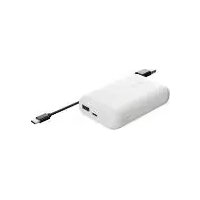
TPB 10000 A1 - Power bank TRONIC - Free user manual and instructions
Find the device manual for free TPB 10000 A1 TRONIC in PDF.



| Product type | External battery PowerBank |
| Brand | Tronic |
| Model | TPB 10000 A1 |
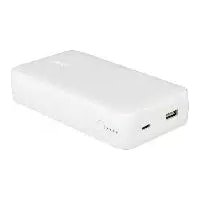
| Battery capacity | 10 000 mAh (3.7 V, 37 Wh), Lithium polymer |
| Dimensions (L x W x H) | approx. 132 x 68 x 16 mm |
| Weight | approx. 216 g |
| USB-C (PD) input voltage/current | 5 V ⎓ 3 A / 9 V ⎓ 2 A / 12 V ⎓ 1.5 A |
| USB-C (PD) output voltage/current | 5 V ⎓ 3 A / 9 V ⎓ 2 A / 12 V ⎓ 1.5 A |
| USB-A (QC 3.0) output voltage/current | 5 V ⎓ 3 A / 9 V ⎓ 2 A / 12 V ⎓ 1.5 A |
| Maximum output power | 15 W |
| Maximum output current | 3 A |
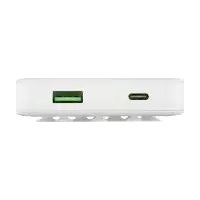
| Number of output ports | 2 (1 USB-C PD, 1 USB-A QC 3.0) |
| Fast charging technologies | Power Delivery (PD) and Qualcomm Quick Charge 3.0 |
| Battery indicator | 4 capacity LEDs |
| Minimum output current | approx. 60 mA |
| Operating temperature | 5 °C to 35 °C |
| Storage temperature | 0 °C to 45 °C |
| Humidity (non-condensing) | 10 % to 70 % |
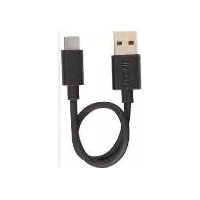
| Package contents | PowerBank, USB-A to USB-C cable, instruction manual |
| Warranty | 3 years |
| Safety features | Overcurrent protection, automatic shut-off after 30 s, overheat protection |
| Care and cleaning | Soft, slightly damp cloth, no abrasive products |
| Disposal | Do not dispose of with household waste, recycle via collection centers |
Frequently Asked Questions - TPB 10000 A1 TRONIC
User questions about TPB 10000 A1 TRONIC
0 question about this device. Answer the ones you know or ask your own.
Ask a new question about this device
Download the instructions for your Power bank in PDF format for free! Find your manual TPB 10000 A1 - TRONIC and take your electronic device back in hand. On this page are published all the documents necessary for the use of your device. TPB 10000 A1 by TRONIC.
USER MANUAL TPB 10000 A1 TRONIC
Operation and Safety Notes
FR BE
BATTERIE EXTERNE
POWERBANK
PD enabled power supply and USB Type C to Type C cable not included.
natural_image
Line drawing of a rectangular electronic device with three pins (no text or symbols)
natural_image
Simple line drawing of a U-shaped connector or cable (no text or symbols)B
QC3.0 enabled or conventional power supply not included.
Alimentation compatible QC3.0 ou conventionnelle non incluse.
natural_image
Line drawing of a plug-in socket with two pins (no text or symbols)
text_image
TRONIC 4Warnings and symbols used ...... Page 24
Introduction Page 26
Intended use...... Page 27
Trademarknotice...... Page 27
Scope of delivery.... Page 27
Parts description...... Page 28
Technical specifications ...... Page 28
Safety notices Page 29
Before use Page 31
Operation and use...... Page 31
Charging the power bank ...... Page 31
Checking the battery status...... Page 33
Charging mobile devices with the power bank.. Page 33
Troubleshooting...... Page 35
Cleaning and care ...... Page 36
Storage during non-use...... Page 36
Disposal Page 37
Warranty and service Page 38
Warranty Page 38
Warranty claim procedure...... Page 39
Service...... Page 39
| Warnings and symbols usedThese instructions for use contain the following warnings: | |
 | DANGER! This symbol with the signal word “DANGER” indicates a hazard with a high level of risk which, if not avoided, will result in serious injury or death. |
 | WARNING! This symbol with the signal word “WARNING” indicates a hazard with a medium level of risk which, if not avoided, could result in serious injury or death. |
 | CAUTION! This symbol with the signal word “CAUTION” indicates a hazard with a low level of risk which, if not avoided, could result in minor or moderate injury. |
 | ATTENTION! This symbol with the signal word “ATTENTION” indicates a possible property damage. |
 | NOTE: This symbol with the signal word “NOTE” provides additional useful information. |
 | WARNING! EXPLOSION HAZARD!A warning with this symbol and word"WARNING! EXPLOSION HAZARD"indicates the potential threat of explosion.Failure to observe this warning may result in serious or fatal injuries and potential property damage. Follow the instructions in this warning to prevent serious injuries, a danger to life or property damage! |
 | This symbol means that the operating instructions must be observed before using the product. |
 | Direct current / voltage |
 | Technology to optimize charging time. |
 | Qualcomm quick charge 3.0The equipment complies Quick Charge 3.0 specifications and agreements issued by Qualcomm Technologies, Inc. |
| PD | PD: Power Delivery (PD), introduced by the USB Implementers Forum, Inc., is a specification for handling higher power and allows a range of devices to charge quickly over a USB connection. It operates by facilitating a conversation between two devices so they can determine how much power can be pulled from the charger. |
| CE | CE mark indicates conformity with relevant EU directives applicable for this product. |
POWER BANK
●Introduction
We congratulate you on the purchase of your new product. You have chosen a high quality product. The instructions for use are part of the product. They contain important information concerning safety, use and disposal. Before using the product, please familiarise yourself with all of the safety information and instructions for use. Only use the product as described and for the specified applications. If you pass the product on to anyone else, please ensure that you also pass on all the documentation with it.
Intendeduse
This POWER BANK (hereinafter referred to as “product”) is an Information Technology device which is solely intended to be used to charge mobile devices which are normally charged through a USB port.
This product is not intended for commercial use. Manufacturer is not liable for damages, which result from non-intended use.
•Trademarknotice
- USB is a registered trademark of USB Implementers Forum, Inc.
- The TRONIC trademark and trade name is the property of their respective owners.
- The Smart Fast Charge trademark and trade name is the property of their respective owners.
- Any other names and products may be trademarks or registered trademarks of their respective owners.
- Qualcomm is a trademark of Qualcomm Incorporated, registered in the United States and other countries.
Qualcomm Quick Charge is a trademark of Qualcomm Incorporated. All Qualcomm Incorporated trademarks are used under license.
- Scope of delivery
1 Power bank
1 USB type A to USB type C cable
1 Instructions for use
Partsdescription
Please refer to the fold out page.
1 USB type C (PD) input and output port
2 USB type A (QC3.0) output port
3 Power bank
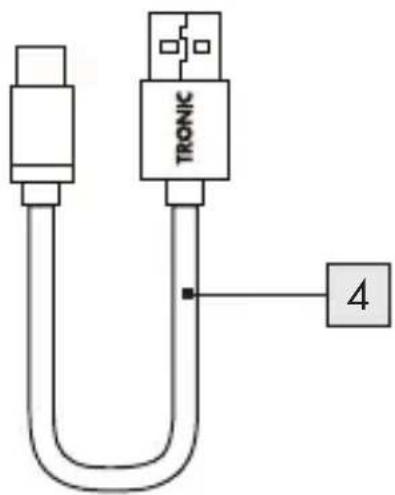
4 USB cable (USB type A to Type C)
5 Instructions for use
6 ON / OFF button
7 LED indicator for battery capacity
●Technicalspecifications
| Built-in rechargeable battery: | 3.7 V ---, 10,000 mAh, 37 Wh (Lithium polymer) |
| USB type C input voltage / current (PD): | 5 V ---, 3 A/9 V ---, 2 A/12 V ---, 1.5 A |
| USB type C output voltage / current (PD): | 5 V ---, 3 A/9 V ---, 2 A/12 V ---, 1.5 A |
| USB type A output voltage / current (QC3.0): | 5 V ---, 3 A/9 V ---, 2 A/12 V ---, 1.5 A |
| Maximum output power: 15 W* | |
| Maximum output current: 3 A* | |
| Minimum output current: approx. 60 mA | |
Operating temperature: 5 - 35 °C
Storage temperature: 0 - 45 °C
Humidity (no condensation): 10 -70 %
Dimensions: approx.
132 × 68 × 16 mm
Weight: approx. 216 g
* If All USB output ports are used at the same time, the total output current will only have 3A (5V --- 3A, 15W).
⚠️Safetynotices
Please familiarise yourself with all instructions for use and safety notices before using the product for the first time. When passing this product on to third parties, please be sure to include all documentation.
- Check the product for visible external damage before use. Do not use the product if damaged or dropped.
This product may be used by children age 8 years and up, as well as by persons with physical, sensory or mental impairments or lacking experience and/or knowledge, provided they are supervised or instructed in the safe use of the product and understand the associated risks. Do not allow children to play with the product. Never allow children to clean or maintain this product unsupervised.
DANGER! Packaging materials are not toys. Keep all packaging materials out of the reach of children. Suffocation hazard!
■ Always use the product on flat and smooth surface. The product could be damaged if it falls. - Do not expose the product to direct sunlight or high
temperatures. It may otherwise overheat and be damaged beyond repair.
- Do not operate the product near heat sources such as radiators or other devices producing heat.
- Do not operate the product near open flames.
The product is not designed for use in rooms with high temperatures or humidity (i.e bathrooms) or those in which a great amount of dust is generated. - Do not expose the product to extremely high temperatures. This applies in particular if you are thinking about storing the product in your car. Over a prolonged period of time, the car and the glove compartment could become extremely hot. Remove electric and electronic devices from the car.
- Do not use the product immediately after it has brought from a cold room to a warm room. Allow the product to acclimatise before you switch it on.
WARNING! Never open the product casing. This product has no internal parts requiring maintenance. - Do not independently convert or modify the product.
■ Repairs to the product must be performed by authorised specialised companies or customer service. Improper repairs may place the user in considerable danger. They will also void the warranty. - Do not expose the product to dripping water or splashing water and do not place containers filled with liquids such as vases or open drinks on top of or beside the product.
- Immediately switch the product off and remove the charging cable from the product if you smell burning or see smoke. Have the product examined by a qualified technician before using it again.
If you use a USB power supply, the socket used must always be easily accessible so that the USB power supply can be quickly removed from the socket in the case of emergency. Please also refer to the manufacturer's instruction manual.
WARNING! EXPLOSION HAZARD! Improper handling of lithium polymer batteries can result in fire, explosions, hazardous substances leaking, or other dangerous situations! Do not throw the product into the fire, as this could lead to the built-in battery exploding.
- Observe the usage restrictions and prohibitions of use for battery-operated products in situations which may be hazardous such as at petrol stations, airports, hospitals, etc.
WARNING! During charging process, please be noticed that the product must not be covered. Otherwise the product can be heated.
The product should never be charged at a PC or notebook, because due to the high power consumption, the PC or notebook could be damaged.
●Beforeuse
NOTE: Remove all packaging materials from the product.
☐ Please also check the content of delivery inside the packaging to see if there are any damages. If you notice any damage or missing parts, please contact the dealer who sold this product.
●Operation and use
- Charging the power bank
The built-in rechargeable battery must be fully charged before using the product.
☐ To charge the power bank 3 only use power supplies with an output voltage and current matching the rated input voltage and current as stated in “Technical specifications” of this user manual.
☐ ATTENTION! The power bank should not be charged from a PC or notebook.
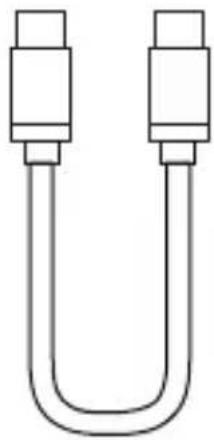
☐ In order to get the fastest charging speed, charge the powerbank 3 via the PD port 1 using a USB Type C to Type C cable (not included) and a USB Power Delivery (PD) enabled power charger (not included). Connect the USB Type C plugs of your Type C to Type C cable (not included) to the PD port 1 of the powerbank 3 and the PD port of your USB PD enable power charger (not included) (see fig. A).
Alternatively, you could charge the powerbank 3 via USB Type C port 1 using the included USB Type-A to Type C cable 4 with a conventional USB charger but the charging time will be longer. Connect the USB Type C plug of the USB cable 4 with the PD port 1 and connect the USB Type A plug of the USB cable 4 to the USB power supply (not included) (see fig. B).
☐ The LED indicator for battery capacity 7 shows you the approximate charge level of the internal battery via 4 LED lights as described below:
| LED indicator 7 status | Power bank capacity level |
| 1 LED flash 0 - 25 % | |
| 1 LED light up, 1 LED flash | 25 - 50 % |
| 2 LED light up, 1 LED flash | 50 - 75 % |
| 3 LED light up, 1 LED flash | 75 - 100 % |
| 4 LED light up 100% |
* This is approx percentage of power bank capacity but not actual measurement.
NOTE: The 4th LED light will turn green when the power bank is charged via PD input port 1 using a PD-enabled USB charger. If a conventional USB charger is used for charging, the 4th LED will still be the original colour of the battery status indicator.
⚠ WARNING! Do not connect any device to be charged to power bank as long as the power bank is charging. Remove the charging cable from the power bank when it is fully charged.
- Checking the battery status
You can check the battery status via the LED indicator 7 of the power bank 3 at anytime.
□ Briefly press the ON / OFF button 6. The LED indicator 7 shows the approximate charge status of the internal battery capacity level for approx. 30 seconds.
- Charging mobile devices with the power bank
You can charge up to two devices at the same time using the power bank 3. If all outputs are used at the same time, the sum of the output current may not exceed 3 A.
☐ To charge your QuickCharge 3.0 enabled device, connect the USB Type A plug of USB cable 4 or the original USB Type A to USB Type C charging cable of the device to be charged to the USB type A output 2 which supports QuickCharge 3.0. Then connect the USB Type C plug of the USB cable 4 to the USB Type C input port of the device to be charged. The charging process will start automatically.
NOTE: You could also charge your conventional USB devices from the USB Type A output port 2 of the power bank using the included USB cable 4 or a USB Type A to micro USB cable (not included).
☐ To charge your USB Power Delivery (PD) enabled device, connect the USB Type C plugs of your USB Type C to Type C cable (not included) to the PD port 1 of the power bank and the PD port of the device to be charged. The charging process will start automatically.
In case if the charging process does not begin immediately, press the ON / OFF button 6 briefly to begin the charging process. The current battery status of the power bank 3 is displayed during the charging process by the LED indicator for battery capacity 7.
☐ To end the charging process, disconnect the USB charging cable from the mobile device and the power bank 3. The power bank will switch OFF after approx. 30 seconds.
Or simply double click with ON / OFF button 6. The power bank and the LED indicator for battery capacity 7 will switch off.
i NOTE:
-
If you use all the USB ports, a voltage of 5 V will output at the outputs. The maximum output current must not exceed 3.0 A for all outputs. If all USB outputs are used, fast charge is not possible.
-
If USB type A output 2 or PD port 1 is in quick charge or PD mode, and another USB port is connected to another device for charging, the quick charge mode or PD mode will be terminated and switched to normal charge mode. All devices will now be charged at 5 ~V each.
●Troubleshooting
● = Problem
= Cause
= Solution
The power bank 3 is not being charged.
It may be that the power bank is not connected properly.
○ Check that it is connected.
In order to charge the power bank, use a power supply with an output voltage and current matching the rated input voltage and current as stated in „Technical specifications“ of this user manual.
A connected device is not being charged.
The battery is drained.
○ Charge the battery.
The device is not connected.
The device is not connected. Check that it is connected. Briefly press the ON / OFF button 6 to begin the charging process.
The current consumption of the connected device might be too low.
☐ Check with your connected device manual and see if your connected device current consumption comply with this product. The minimal output current of the power bank is approx. 60 mA.
The power bank ^3 does not react when the button is pressed or when a device is connected, even though the battery is charged.
The power consumption of the connected devices is too high. Therefore, the internal overcurrent protection device was activated.
○ Reduce the number of devices connected and press the ON / OFF button 6.
●Cleaning and care
This product has no internal parts requiring maintenance. Moisture entering the product may result in damage.
☐ Ensure no moisture enters the product during cleaning to prevent damaging the product beyond repair.
☐ Do not use abrasive, solvent-based or aggressive cleaners. These can damage the surface of the product.
☐ Only clean the product with a slightly damp cloth and mild washing-up liquid.
●Storage during non-use
Store the product in a dry dust-free location, protected from direct sunlight.
☐ If the product is not used for a long time, the built-in battery should be fully charged to prolong its operating life. Regularly charge the built-in battery if you do not use the product for a long period of time. This is necessary to preserve the battery.
●Disposal
Packaging:
The packaging is made of environmentally friendly materials, which may be disposed of through your local recycling facilities.
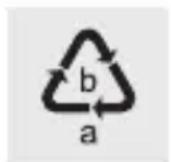
Observe the marking of the packaging materials for waste separation, which are marked with abbreviations (a) and numbers (b) with following meaning: 1–7: plastics / 20–22: paper and fibreboard / 80–98: composite materials.
Product:

Contact your municipality for information on how to dispose of your worn-out product.
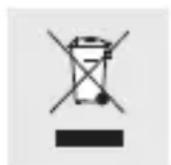
The adjacent symbol of a crossed out dustbin on wheels indicates this product is subject to Directive 2012/19/EU. This directive states at the end of the life this product must not be disposed of through regular household refuse but must be returned to special collection sites, recycling depots or waste management companies.
This disposal is free of charge to you.
Protect the environment and dispose of properly.

The product is recyclable, subject to extended manufacturer responsibility, and collected separately. an be obtained from your local authority.
The built-in rechargeable battery cannot be removed for disposal. Return the product completely to a collection site for used electronics.
●Warranty and service
Warranty
The product has been manufactured to strict quality guidelines and meticulously examined before delivery. In the event of product defects you have legal rights against the retailer of this product. Your legal rights are not limited in any way by our warranty detailed below.
The warranty for this product is 3 years from the date of purchase. The warranty period begins on the date of purchase. Please keep the original sales receipt in a safe location. This document is required as your proof of purchase.
Should this product show any fault in materials or manufacture within 3 years from the date of purchase, we will repair or replace it – at our choice – free of charge to you. This warranty becomes void if the product has been damaged, or used or maintained improperly.
The warranty applies to defects in material or manufacture. This warranty does not cover product parts subject to normal wear, thus possibly considered consumables (e.g. batteries) or for damage to fragile parts, e.g. switches, rechargeable batteries or glass parts.
●Warranty claim procedure
To ensure quick processing of your case, please observe the following instructions:
Please have the till receipt and the item number (IAN 378647_2101) available as proof of purchase.
You will find the item number on the rating plate, an engraving, on the front page of the instructions for use (bottom left), or as a sticker on the rear or bottom of the product.
If functional or other defects occur, please contact the service department listed either by telephone or by e-mail.
You can return a defective product to us free of charge to the service address that will be provided to you. Ensure that you enclose the proof of purchase (till receipt) and information about what the defect is and when it occurred.
Service
GB Service Great Britain
Tel.: 08000569216
E-Mail: owim@lidl.co.uk
IE Service Ireland
Tel.: 1800 200736
E-Mail: owim@lidl.ie