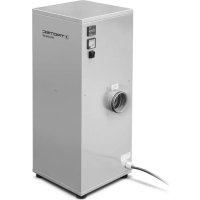
TTR 250 HP - Humidifier TROTEC - Free user manual and instructions
Find the device manual for free TTR 250 HP TROTEC in PDF.



| Product type | Adsorption air dehumidifier |
| Brand | Trotec |
| Model | TTR 250 HP |
| Power supply | 230 V, 50 Hz |
| Operating principle | Adsorption on silica gel rotor with regeneration by electric heating |
| Process air volume | Approximately 2 to 3 times the regeneration air volume |
| Dry air temperature | 25 - 40 °C (normal operation) |
| Wet air temperature | 30 - 50 °C (normal operation) |
| Housing material | Stainless steel |
| Rotor type | Patented silica gel rotor (flat and corrugated non-woven layers) |
| Filter | Standardized filter non-woven mat |
| Regeneration heater | Positive temperature coefficient (PTC) thermistor |
| Rotor motor | Electric motor with toothed belt drive |
| Fan | Fan driven directly by electric motor |
| Recommended maintenance | Check and replace filters every 6 months; clean rotor and components if necessary |
| Rotor cleaning | Wash with water and mild acid detergent or toluene, rinse and dry with low-pressure compressed air |
Frequently Asked Questions - TTR 250 HP TROTEC
User questions about TTR 250 HP TROTEC
0 question about this device. Answer the ones you know or ask your own.
Ask a new question about this device
Download the instructions for your Humidifier in PDF format for free! Find your manual TTR 250 HP - TROTEC and take your electronic device back in hand. On this page are published all the documents necessary for the use of your device. TTR 250 HP by TROTEC.
USER MANUAL TTR 250 HP TROTEC
- Safety instructions B-1
- General Description B-3
-Utilisation . B - 3
-Design B-3
-Operating principle. B-3
- Design B-4
-Casing B-4
- Rotor. B - 4
-Filter. B - 4
-Fan. B-4
- Regeneration Heating. B - 5
04.Start-up B-5
-Starting. B-5
05.Maintenance B-5
-Filter Replacement B-5
- General Maintenance B-6
-Rotor Cleaning B-6
06.Troubleshooting B-6
07. Technical Appendix
01. SAFety InStructOnS
Observe the notes in the Operating Instructions.
- The basic condition for the safe handling and trouble-free operation of this air dehumidifier is to know the basic indications and regulations applicable to safety.
- The present Operating Instructions include the most important indications required for the safe operation of the air dehumidifier.
- These Operating Instructions and especially the indications on safety must be observed by all persons working on the air dehumidifier.
- The rules and regulations for the prevention of accidents applicable on site must be observed in addition to this.
Obligations of the Operator
The operator has the obligation to allow work on the air dehumidifier only for persons who:
- Are well acquainted with the basic regulations on occupational safety and on the prevention of accidents, who have been familiarised with how to operate the air dehumidifier; and who:
- Have read the Section on Safety and the warning notices included in these Operating Instructions, confirming by their signatures that they have understood these notes.
The operator must check the observance of the safety regulations by the personnel on a regular basis.
Obligations of the Personnel
All persons who are charged with performing work on the air dehumidifier must assume the following obligations before taking up work:
- Observe the basic regulations on occupational safety and accident prevention.
- Read the Section on Safety and the warning notices included in these Operating Instructions, confirming by their signatures that they have understood these notes.
Hazards during the Operation of the Air Dehumidifier
The air dehumidifier has been manufactured according to the state of the art and the generally accepted rules of safety engineering. Use the air dehumidifier only:
- For the intended purpose; and when it is
In a perfectly safe condition.
Faults which may affect safety must be eliminated immediately.
Intended Use
The air dehumidifier is designed only for dehumidifying atmospheric air. Any other use or any use in addition to this shall be deemed not intended. TROTEC GmbH & Co. KG will not assume any liability for damages resulting from such unintended use. The intended use does also include:
- The observance of all indications given in the Operating Instructions; and
The due performance of inspection and maintenance activities.
Warranty and Liability
Our "General Conditions of Sale and Delivery" will be applied in principle. These Conditions will be made available to the operator by the latest when concluding the contract. Claims under a warranty or under a liability for injury to persons or damage to property will be ruled out if such claims are due to one or more of the following causes:
- Misuse of the air dehumidifier;
- Inappropriate mounting, start-up, operation and maintenance of the air dehumidifier.
- Operation with defective safety appliances, or with safety and protective devices which are not mounted adequately and orderly, or not operative;
- Non-compliance with the indications given in the Operating Instructions on the transportation, storage, mounting, start-up, operation and maintenance of the air dehumidifier;
- Unauthorised structural alterations;
- Unauthorised alteration to the technical design;
Defective monitoring of components subject to wear and tear;
Inexpert performance of repairs; or - Catastrophes caused by foreign objects or force majeure.
Organisational Measures
- The operator must provide the required personal protection equipment.
- All existing safety appliances must be checked on a regular basis.
Safety Guards
- All protective devices must be installed as appropriate and be in an operative condition before starting the air dehumidifier.
-
Protective devices may only be removed when: a) The air dehumidifier is not operated; and when b) It is protected against restarting.
-
The operator must install the protective devices himself in accordance with regulations if the device is supplied in individual parts.
Informal Safety Measures
- The Operating Instructions must always be kept at the place where the air dehumidifier is operated.
- General and local regulations for accident prevention and environmental protection must be provided and observed in addition to the Operating Instructions.
- All notes on safety and hazards on the air dehumidifier must be kept in a legible condition.
Training of Personnel
- Only trained and instructed personnel may work on the air dehumidifier.
- The responsibilities of the personnel must be defined clearly with regard to mounting, start-up, operation, maintenance and repair.
Air Dehumidifier Control
- Only instructed personnel may operate the controls.
Hazards Caused by Electrical Energy
- Work on the power supply may only be carried out by professional electricians.
- Check the air dehumidifier's electrical equipment on a regular basis. Eliminate any loose connections and damaged cables immediately.
- The switch room must always be locked. Access to this room is only allowed to authorised personnel using a tool.
- If work on voltage-carrying parts is required, a second person must be present to cut power supply if necessary in an emergency.
Maintenance, Upkeep and Troubleshooting
- Perform prescribed setting, maintenance and inspection activities when due.
- Inform the operating personnel before starting any maintenance and upkeep work.
- Protect all installation parts and operating fluids such vapour connected upstream and downstream of the air dehumidifier against unintentional restarting or reclosure.
- Disconnect power on the air dehumidifier and protect the main switch against unintentional reclosure before starting any maintenance, inspection or repair activity.
- Place a danger sign to prevent re-closure.
- Check loosened screw connections for solid fit.
- Check the function of safety appliances at the end of the maintenance activities.
Structural Alterations to the Air Dehumidifier
- No alteration, addition or remodelling of the air dehumidifier is allowed without authorisation by the manufacturer. This also applies to welding on supporting members.
- All remodelling measures require the written confirmation of TROTEC GmbH & Co. KG.
- All machine parts which are not in a perfect condition must be replaced immediately.
- Use only original spare and wearing parts.
- Third-party components do not provide any guarantee for being designed and manufactured according to the required stresses and strains while observing safety specifications.
Air Dehumidifier Cleaning and Waste Disposal
- All substances and materials used must be handled and disposed off adequately. This applies especially to a) Work on the lubrication system and to b) Cleaning with solvents.
Copyright
The copyrights for the present Operating Instructions are held by TROTEC GmbH & Co. KG. These Operating Instructions shall only be used by the operator and his or her personnel.
It includes notes and regulations which must not be
-duplicated
-distributed or
- disclosed in another way without the authorisation of TROTEC GmbH & Co. KG.
Contraventions will be prosecuted under criminal law.
02. generAL DeScriptlOn
Utilisation
Air dehumidifiers working according to the principle of adsorption are used to solve drying problems in process engineering, air conditioning and for air dehumidification in production and storage rooms containing products and facilities which require a particularly low air humidity.
Air dehumidifiers equipped with electric heating may only be operated in rooms exposed to explosion hazards after having consulted the manufacturer.
Adsorption technology allows lower dew points and operationally reliable dehumidification at lower air temperatures. At these points, cold dehumidifiers cannot reach this performance for physical reasons any longer. In addition, air dehumidifiers work by far more efficiently under these operating conditions.
Design
The air dehumidifier is equipped completely with rotor, fan, driving motor, heater for regeneration and electrical system. Air humidity is adsorbed using the silica gel rotor.
Operating Principle
The air dehumidifier works continuously using two air flows (between 2:1 and 3:1, approximately). The larger process airflow is dehumidified in the rotor which turns
slowly (= adsorption) , while the smaller regeneration airflow is heated and thus expels the water adsorbed from the silica gel again (= desorption) .
03. DeSign
Casing
The air dehumidifier has a casing made of stainless steel which contains all necessary equipment.
Rotor
The air dehumidifier is equipped with a patented silica gel rotor.
This rotor is made of flat and corrugated non-woven layers consisting of chemically bonded silica gel and metal silicate. This creates a large number of air channels running in axial direction and having both a large surface and a direct connection to the internal pore structure of the silica gel. This allows a good transition of water vapour and it also makes for the extraordinarily high adsorption capacity of the silica gel rotor.
The particular manufacturing process of the rotor material makes certain that the silica gel is not destroyed by saturated air. This makes it possible to operate the air dehumidifier with pre-cooling. No damage will be caused even when the heating or the regeneration airflow fails.
The permanent link between the silica gel and the base material prevents the sorption material from being carried away by the airflow.
No super-saturation will occur even when the rotor is not operating, thus not requiring any particular safety measures.
The rotor has a high mechanical resistance and it is non-flammable. The rotor is driven by an electric motor with a toothed belt transmission.
Filter
The filter mat is made of standard non-woven fabric.
Fan
The fan is driven directly by an electric motor.

The dehumidifier is a continuously working device with integrated heat recovery, and it can reach very low dew points. By turning, the rotor carries the thermal energy from the hot regeneration zone to the rinsing zone, the rotor cools down while heating the entering regeneration air. As a result, process air is less hot and the dew point is lower.
Regeneration Heating
The PTC regeneration heating used has the following advantages:
- Power consumption is varied easily by the air volume flow.
- There is no overheating; the heating flow goes down to zero when there is no airflow.
This is made possible by the PTC thermistor, i.e., by a temperature-dependent semiconductor resistor. Its resistance value increases very strongly when the temperature rises, starting at a defined temperature (Curie point). This positive temperature coefficient is the very origin of the PTC thermistor's name. In practice, this characteristic resistance curve makes for a temperature which remains almost constant over a wide range. Variations in room temperature, voltage or in the airflow will only have a small influence on thermistor temperature.
The regeneration airflow may be reduced correspondingly if the maximum dehumidifier capacity is not required. Heating will react immediately by a higher resistance, while maintaining the surface temperature.
Thus, a smaller regeneration airflow means a lower heating capacity while maintaining the regeneration air at an almost constant temperature.
04. START-UP
Starting
- Check whether the reducing dampers (if any) are widely open and whether the air ducts are free.
- Are the filters mounted correctly?
- Is the preliminary safety device selected correctly according to the technical data?
- Start the air dehumidifier by setting the ON/OFF switch to "ON". The control light in the switch shows that the device is operating.
- Use the reducing dampers installed on the building side to adjust the air volumes.
Process and humid air volumes must always be tuned in proportion to one another. The rotor will become too hot and the capacity for dehumidification will not be used efficiently if the humid air volume is too big.
The humid air volume should also be adjusted by reduction at the outlet when the dry air volume has been adjusted. A temperature of less than 50^ should be used as a reference value at the humid air outlet.
The smaller the humid air value, the lower is the humid air temperature.
The humid air volume may be reduced if the capacity for dehumidification is not needed.

CAUTION: Clogged filters reduce the air volume.
05. MAINTENANCE
TROTEC air dehumidifiers are designed for long operating times without needing a great effort in terms of maintenance. Please observe the following notes:
Disconnect the air dehumidifier from the mains before dismounting the air dehumidifier. If it has been in operation before this, let the air dehumidifier cool down for about 15 minutes before dismounting.
A. Filter Replacement
Filters should be checked and replaced if necessary on a regular basis. The intervals between each filter replacement depend on the application of the device in the corresponding individual case. A filter life of approximately 6 months may be assumed under normal conditions.
Clogged filters affect filter capacity.
Never operate the dehumidifier without having installed the filters correctly!
B. General Maintenance
We recommend to check all installed components every 6 months or more frequently if required by utilisation, and to clean the following parts using a vacuum cleaner or compressed air under low pressure:
- Gear motor and toothed belt
- Fan
- Switch room
- Regeneration heater
- Maintenance openings, sealings
C. Rotor Cleaning
Although it is described below, the washing process should not be performed during normal maintenance. We recommend to have this work done by the TRO-TEC Service, or, at least, to call an TROTEC Service Centre before washing.
- Operate the air dehumidifier without regeneration for 15 minutes.
- Disconnect the power supply (unplug the mains connector) to prevent the device from being switched on unintentionally. Injuries which are dangerous to life may occur otherwise.
- Dismount the rotor carefully and make certain that the surfaces are not damaged in this process.
- Place the rotor in a bath for approximately 30 minutes, adding a weakly acid detergent or toluol.
- Flush the rotor using fresh water under low pressure.
- Drain the liquid from the rotor and blow the structure of the rotor free using compressed air under low pressure.
- Mount rotor and toothed belt carefully.
- Make certain that all sealings are correctly in place.
- Start the dehumidifier without including it in the process and measure its capacity after approximately 30 minutes.
Never use strongly alkaline detergents as they may lead to the complete deterioration of the rotor.
06. TROUBLESHOOTING
It is easy to check the dehumidifier function by taking the temperature at the uninsulated air tubes.
Under normal conditions:
- the dry air outlet is warm (25 - 40^) and
- the humid air outlet is warm or hot (30 - 50^)
You can proceed as follows if the capacity for dehumidification is not satisfactory:
A. Dry and humid air outlets are warm
B. Both air outlets are cold.
C. The dry air outlet is cold and the humid air outlet is very hot
A1. Check entering humidity and compare with data sheet. The capacity of the device may be too low to cope with existing conditions.
A2. Check air flows, filters and reducing damper adjustment.
A3. Check rotor sealings.
B1. Is the device switched on?
B2. Has it broken down because of a fault?
B3. Check the regeneration heater.
B4. Check the fan.
B5. Check whether the reducing damper in the regeneration channel is not closed.
B6. Check the air filter.
C1. Check whether the rotor is turning.
C2. Check whether the reducing damper in the process channel is not closed.
TABLE DeS MATIÈRE S
05. SERVICE OG VEDLIKEHOLD
07. tecHnIscHer AnHAng / tecHnIcAL AppendDIX / AnneXe tecHnIQue /
tecHnIscHe BljLAge / teklnSk veDLegg / teklnk ek
Declaration of Conformity
TROTEC
GmbH & Co. KG
Grebbener Straße 7 D-52525 Heinsberg
hereby declares that due to their construction and design the following dehumidifiers, including those products introduced into the market by us, comply with the EU guidelines and directives as stated below.
Important information:
This declaration is no longer legally valid if the unit is not used, installed or maintained as intended or when any unauthorised changes are made to the unit.
Type of unit: Dehumidifier
Series/Model: TTR 160, 250, 250 HP, 300, 700
Applicable regulations:
89/392/EWG 73/23/EWG
Machine guideline Low voltage guideline
Applied norms:
Heinsberg, 21. February 2009

PMProduct Management

- SAFety InStructOnS
- Observe the notes in the Operating Instructions.
- Obligations of the Operator
- Obligations of the Personnel
- Hazards during the Operation of the Air Dehumidifier
- Intended Use
- Warranty and Liability
- Organisational Measures
- Safety Guards
- Informal Safety Measures
- Training of Personnel
- Air Dehumidifier Control
- Hazards Caused by Electrical Energy
- Maintenance, Upkeep and Troubleshooting
- Structural Alterations to the Air Dehumidifier
- Air Dehumidifier Cleaning and Waste Disposal
- Copyright
- generAL DeScriptlOn
- Utilisation
- Design
- Operating Principle
- DeSign
- Casing
- Rotor
- Filter
- Fan
- Regeneration Heating
- START-UP
- Starting
- MAINTENANCE
- Filter Replacement
- General Maintenance
- TROUBLESHOOTING
- Dry and humid air outlets are warm
- Both air outlets are cold.
- The dry air outlet is cold and the humid air outlet is very hot
- TABLE DeS MATIÈRE S
- SERVICE OG VEDLIKEHOLD
- tecHnIscHer AnHAng / tecHnIcAL AppendDIX / AnneXe tecHnIQue /
- tecHnIscHe BljLAge / teklnSk veDLegg / teklnk ek
- Declaration of Conformity
- TROTEC
- Important information:
Brand : TROTEC
Model : TTR 250 HP
Category : Humidifier