
HTA FKTSA 40Li A1 - Electric chainsaw FLORABEST - Free user manual and instructions
Find the device manual for free HTA FKTSA 40Li A1 FLORABEST in PDF.



| Product type | Cordless chainsaw |
| Brand | Florabest |
| Model | HTA FKTSA 40-Li A1 |
| Rated battery voltage | 36 V (40 V max) |
| Battery capacity | 2.5 Ah (90 Wh) |
| Battery type | Lithium-ion |
| Guide bar length | 305 mm |
| Cutting length | 283 mm |
| Chain pitch | 10 mm |
| Groove width | 1.2 mm |
| Chain speed | 1 m/s |
| Number of sprocket teeth | 6 |
| Oil tank capacity | 180 ml |
| Sound pressure level (LpA) | 86.8 dB(A) |
| Measured sound power level (LWA) | 96.5 dB(A) |
| Guaranteed sound power level | 100 dB(A) |
| Vibration (front handle) | 3.37 m/s² |
| Vibration (rear handle) | 3.32 m/s² |
| Charger input voltage | 100-240 V~, 50/60 Hz |
| Charger output voltage | 36 V |
| Charge current | 3.0 A |
| Charging time | Approx. 60 min |
| Charger protection class | II (double insulation) |
| Delivery contents | Chainsaw, chain, guide bar, battery FAP 40 A1, charger FLG 40 A1, scabbard, oil (180 ml), instruction manual |
Frequently Asked Questions - HTA FKTSA 40Li A1 FLORABEST
User questions about HTA FKTSA 40Li A1 FLORABEST
0 question about this device. Answer the ones you know or ask your own.
Ask a new question about this device
Download the instructions for your Electric chainsaw in PDF format for free! Find your manual HTA FKTSA 40Li A1 - FLORABEST and take your electronic device back in hand. On this page are published all the documents necessary for the use of your device. HTA FKTSA 40Li A1 by FLORABEST.
USER MANUAL HTA FKTSA 40Li A1 FLORABEST
List of pictograms used
Introduction
Intended use
Parts description.. Page 28
Scope of delivery.. Page 29
Technical data.. 29
Safety warnings
General power tool safety warnings.. Page 30
Chainsaw warnings.. Page 31
Vibration and noise reduction. Page 32
Behaviour in emergency situations.. Page 33
Residual risks.. Page 33
Battery charger safety warnings..
Initial use.
Unpacking Page 34
Accessories.. Page 34
Before use
Attaching / removing the battery pack.. Page 34
Charging the battery pack.. Page 34
Checking the battery level. Page 35
Safety functions.. Page 35
Assembly. Page 36
Operation Page 38
Chain brake.. Page 38
Switching on and off.. Page 38
Cutting techniques.. Page 38
After use.. Page 40
Cleaning and care
Cleaning . Page 40
Maintenance.. Page 41
Repair
Storage.
Transportation
Troubleshooting
Disposal
Service
Warranty
Translation of original
declarution of conformity.
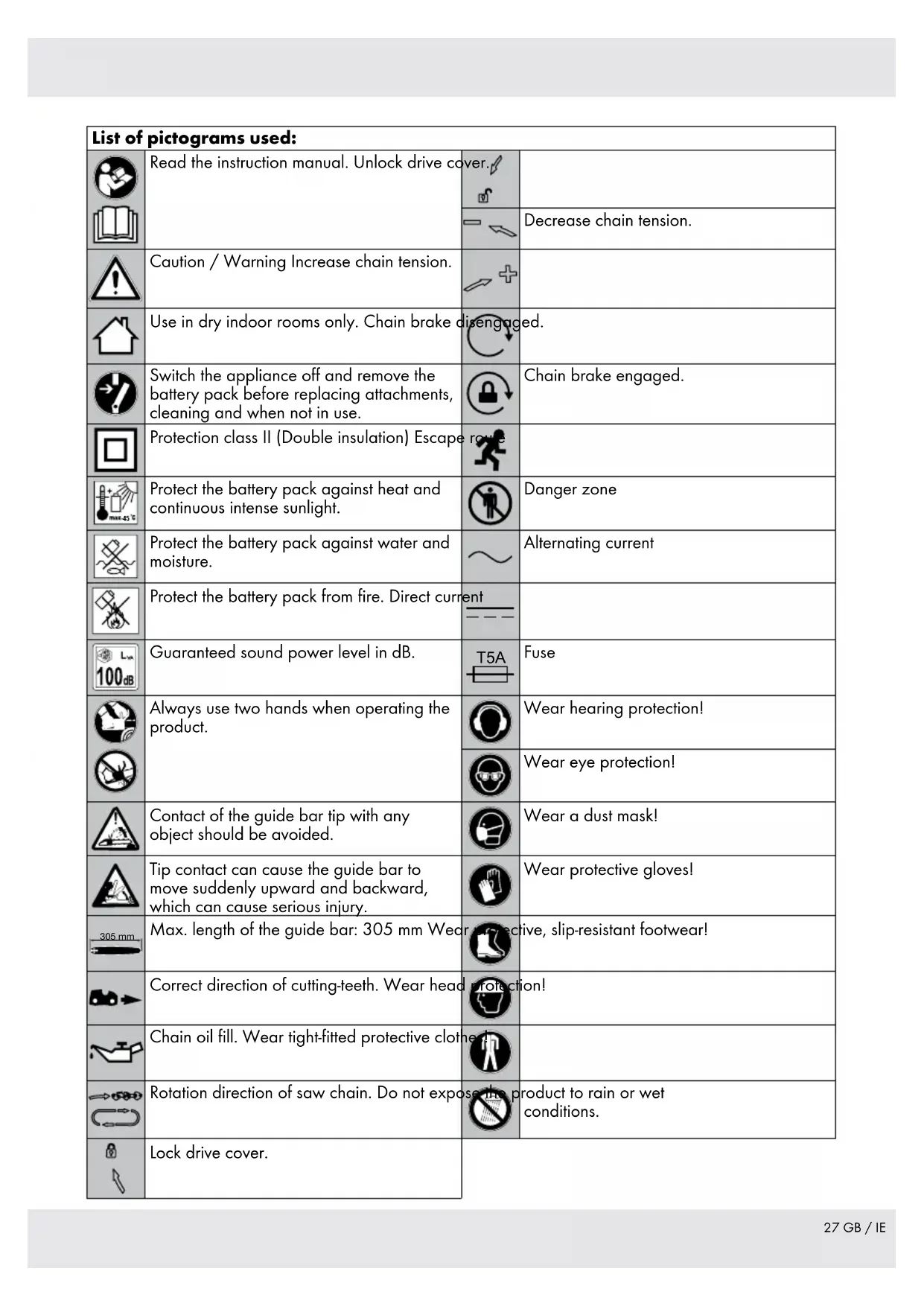
| List of pictograms used: | ||
| Read the instruction manual. Unlock drive cover. | ||
| Decrease chain tension. | ||
| Caution / Warning Increase chain tension. | ||
| Use in dry indoor rooms only. Chain brake disengaged. | ||
| Switch the appliance off and remove the battery pack before replacing attachments, cleaning and when not in use. | Chain brake engaged. | |
| Protection class II (Double insulation) Escape rope | ||
| Protect the battery pack against heat and continuous intense sunlight. | Danger zone | |
| Protect the battery pack against water and moisture. | Alternating current | |
| Protect the battery pack from fire. Direct current | ||
| Guaranteed sound power level in dB. | Fuse | |
| Always use two hands when operating the product. | Wear hearing protection! | |
| Wear eye protection! | ||
| Contact of the guide bar tip with any object should be avoided. | Wear a dust mask! | |
| Tip contact can cause the guide bar to move suddenly upward and backward, which can cause serious injury. | Wear protective gloves! | |
| 305 mm | Max. length of the guide bar: 305 mm Wear active, slip-resistant footwear! | |
| Correct direction of cutting-teeth. Wear head protection! | ||
| Chain oil fill. Wear tight-fitted protective clothes | ||
| Rotation direction of saw chain. Do not expose the product to rain or wet conditions. | ||
| Lock drive cover. | ||
CORDLESS CHAINSAW 40 V HTA FKTSA 40-Li A1
Introduction
We congratulate you on the purchase of your new product. You have chosen a high quality product. The instructions for use are part of the product. They contain important information concerning safety, use and disposal. Before using the product, please familiarise yourself with all of the safety information and instructions for use. Only use the product as described and for the specified applications. If you pass the product on to anyone else, please ensure that you also pass on all the documentation with it.
Intended use
This cordless chainsaw 40V (hereinafter "product" or "power tool") is designed for cutting wood only. The product is not designed for any other types of application (e.g. cutting of brickwork, plastic or food).
The product is to be used by adults. Children under the age of 16 may not use the tool except under supervision.
Any other use or modification of the product are considered improper use and can result in hazards such as death, life-threatening injuries and damage. The manufacturer is not liable for any damages caused by improper use. The product is not intended for commercial use or for any other use.
Do not use and store the power tool in rain or wet conditions.
Observe all applicable local safety regulations, standards and ordinances. The use of noise emitting power tools may be restricted to certain times by national or local regulations.
Cutting length of wood: 283mm
Parts description
Figure A:
1 Rear handle
2 Oil tank cap
3 Front guard / chain brake
4 Guide bar
5 Saw chain
6 Lock knob
Drive cover
8 Chain tension knob
9 Rear guard
10 Spiked bumper
11 Front handle
12 Motor housing
13 On/off switch
14 Lock-off button
15 Oil level indicator
16 Guide bar cover
Figure B:
17 Battery pack
18 Battery charging level button
19 Release button
20 Battery level indication light
Figure C:
21 Rapid charger
22 Charger status LED - Green
23 Charger status LED - Red
Figure F:
24 Guide bar bolt
25 Chain tension pin
26 Sprocket
Scope of delivery
1 Cordless chainsaw 40 V HTA FKTSA 40-Li A1
1 Saw chain
1 Guide bar
1 Battery pack FAP 40 A1
1 Rapid battery charger FLG 40 A1
1 Guide bar cover
1 Oil bottle with 180ml chain oil
1 Operating instructions
Technical data
Cordless chainsaw:HTA FKTSA 40-Li A1
Rated voltage: 40 V
No load speed n_0 : 5800 min
Saw chain type: Oregon 91P045X, low-kickback
Guide bar type: Oregon 12" 120SDEA041
Guide bar length: 305mm
Cutting length: 283 mm
Chain pitch: 10mm
Chain gauge: 1.2 ~mm
Chain speed v_0 : 1.1 m/s
Drive sprocket: 6 teeth
Oil tank volume: approx. 180 ml
Battery pack: FAP 40 A1
Type: Lithium ion
Rated voltage: 36 V
40V---max.
Capacity: 2.5 Ah (90 Wh)
Number of cells: 10
Rapid battery FLG 40 A1 charger:
INPUT:
Rated voltage: 100 - 240 V \~, 50/60 Hz
Power consumption: 160 W
OUTPUT:
Rated voltage: 36 V
Charging current: 3.0 A
Charging time: approx. 60 min
Protection class: II/
Noise emission value:
Noise measurement value determined in accordance with EN 60745. The A-rated noise level of the power tool is typically as follows:
Sound pressure level L_PA .. 86.8 dB(A)
Uncertainty K_pA : 3 dB
Sound power level L_WA : 96.5 dB(A)
Uncertainty K_WA 3 dB
Guaranteed sound power level L_WA 100 dB(A)
(according to 2000/14/EC amended by 2005/88/EC)
WARNING!

Wear ear protection!
Vibration emission value:
(front handle)
Hand/arm vibration a_n : 3.37 m/s²
(rear handle)
Hand/arm vibration q_h : 3.32 m/s²
Uncertainty K: 1.5m / s^2
WARNING!
The vibration level varies in accordance with the use of the power tool and may be higher than the value specified in these instructions in some cases. There is a risk of underestimation of the vibration load if the power tool is used regularly in this manner. Try to keep the vibration loads as low as possible. Measures to reduce the vibration load are, e.g. wearing gloves and limiting the working time. Wherein all states of operation must be included (e.g. times when the power tool is switched off and times where the power tool is switched on but running without load).
NOTE
The vibration level specified in these instructions has been measured in accordance with a standardised measuring procedure specified in EN 60745 and can be used to make equipment comparisons. The specified vibration emission value can also be used to make an initial exposure estimate.

Safety warnings
- General power tool safety warnings

WARNING!
Read all safety warnings and all instructions. Failure to follow the warnings and instructions may result in electric shock, fire and/or serious injury.
Save all warnings and instructions for future reference.
The term "power tool" in the warnings refers to your mains-operated (corded) power tool or battery-operated (cordless) power tool.
Work area safety
- Keep work area clean and well lit. Cluttered or dark areas invite accidents.
- Do not operate power tools in explosive atmospheres, such as in the presence of flammable liquids, gases or dust. Power tools create sparks which may ignite the dust or fumes.
- Keep children and bystanders away while operating a power tool. Distractions can cause you to lose control.
Electrical safety
- Power tool plugs must match the outlet. Never modify the plug in any way. Do not use any adapter plugs with earthed (grounded) power tools. Unmodified plugs and matching outlets will reduce risk of electric shock.
- Avoid body contact with earthed or grounded surfaces, such as pipes, radiators, ranges and refrigerators. There is an increased risk of electric shock if your body is earthed or grounded.
- Do not expose power tools to rain or wet conditions. Water entering a power tool will increase the risk of electric shock.
-
Do not abuse the cord. Never use the cord for carrying, pulling or unplugging the power tool. Keep cord away from heat, oil, sharp edges or moving parts. Damaged or entangled cords increase the risk of electric shock.
-
When operating a power tool outdoors, use an extension cord suitable for outdoor use. Use of a cord suitable for outdoor use reduces the risk of electric shock.
- If operating a power tool in a damp location is unavoidable, use a residual current device (RCD) protected supply. Use of an RCD reduces the risk of electric shock.
Personal safety
- Stay alert, watch what you are doing and use common sense when operating a power tool. Do not use a power tool while you are tired or under the influence of drugs, alcohol or medication. A moment of inattention while operating power tools may result in serious personal injury.
- Use personal protective equipment. Always wear eye protection. Protective equipment such as dust mask, non-skid safety shoes, hard hat, or hearing protection used for appropriate conditions will reduce personal injuries.
- Prevent unintentional starting. Ensure the switch is in the off-position before connecting to power source and/or battery pack, picking up or carrying the tool. Carrying power tools with your finger on the switch or energising power tools that have the switch on invites accidents.
- Remove any adjusting key or wrench before turning the power tool on. A wrench or a key left attached to a rotating part of the power tool may result in personal injury.
- Do not overreach. Keep proper footing and balance at all times. This enables better control of the power tool in unexpected situations.
- Dress properly. Do not wear loose clothing or jewellery. Keep your hair, clothing and gloves away from moving parts. Loose clothes, jewellery or long hair can be caught in moving parts.
- If devices are provided for the connection of dust extraction and collection facilities, ensure these are connected and properly used. Use of dust collection can reduce dust-related hazards.
Power tool use and care
- Do not force the power tool. Use the correct power tool for your application. The correct power tool will do the job better and safer at the rate for which it was designed.
- Do not use the power tool if the switch does not turn it on and off. Any power tool that cannot be controlled with the switch is dangerous and must be repaired.
- Disconnect the plug from the power source and/or the battery pack from the power tool before making any adjustments, changing accessories, or storing power tools. Such preventive safety measures reduce the risk of starting the power tool accidentally.
- Store idle power tools out of the reach of children and do not allow persons unfamiliar with the power tool or these instructions to operate the power tool. Power tools are dangerous in the hands of untrained users.
- Maintain power tools. Check for misalignment or binding of moving parts, breakage of parts and any other condition that may affect the power tool's operation. If damaged, have the power tool repaired before use. Many accidents are caused by poorly maintained power tools.
- Keep cutting tools sharp and clean. Properly maintained cutting tools with sharp cutting edges are less likely to bind and are easier to control.
- Use the power tool, accessories and tool bits etc. in accordance with these instructions, taking into account the working conditions and the work to be performed. Use of the power tool for operations different from those intended could result in a hazardous situation.
Battery tool use and care
- Recharge only with the charger specified by the manufacturer. A charger that is suitable for one type of battery pack may create a risk of fire when used with another battery pack.
-
Use power tools only with specifically designated battery packs. Use of any other battery packs may create a risk of injury and fire.
-
When battery pack is not in use, keep it away from other metal objects, like paper clips, coins, keys, nails, screws or other small metal objects, that can make a connection from one terminal to another.
Shorting the battery terminals together may cause burns or a fire. - Under abusive conditions, liquid may be ejected from the battery; avoid contact. If contact accidentally occurs, flush with water. If liquid contacts eyes, additionally seek medical help. Liquid ejected from the battery may cause irritation or burns.
Service
- Have your power tool serviced by a qualified repair person using only identical replacement parts. This will ensure that the safety of the power tool is maintained.
- Chainsaw warnings
- Keep all parts of the body away from the saw chain when the chain saw is operating. Before you start the chain saw, make sure the saw chain is not contacting anything. A moment of inattention while operating chain saws may cause entanglement of your clothing or body with the saw chain.
- Always hold the chain saw with your right hand on the rear handle and your left hand on the front handle. Holding the chain saw with a reversed hand configuration increases the risk of personal injury and should never be done.
- Hold the power tool by insulated gripping surfaces only, because the saw chain may contact hidden wiring. Saw chains contacting a "live" wire may make exposed metal parts of the power tool "live" and could give the operator an electric shock.
-
Wear safety glasses and hearing protection. Further protective equipment for head, hands, legs and feet is recommended. Adequate protective clothing will reduce personal injury by flying debris or accidental contact with the saw chain.
-
Do not operate a chain saw in a tree. Operation of a chain saw while up in a tree may result in personal injury.
- Always keep proper footing and operate the chain saw only when standing on fixed, secure and level surface. Slippery or unstable surfaces such as ladders may cause a loss of balance or control of the chain saw.
- When cutting a limb that is under tension be alert for spring back. When the tension in the wood fibres is released the spring loaded limb may strike the operator and/or throw the chain saw out of control.
- Use extreme caution when cutting brush and saplings. The slender material may catch the saw chain and be whipped toward you or pull you off balance.
- Carry the chain saw by the front handle with the chain saw switched off and away from your body. When transporting or storing the chain saw always fit the guide bar cover. Proper handling of the chain saw will reduce the likelihood of accidental contact with the moving saw chain.
- Follow instructions for lubricating, chain tensioning and changing accessories. Improperly tensioned or lubricated chain may either break or increase the chance for kickback.
- Keep handles dry, clean, and free from oil and grease. Greasy, oily handles are slippery causing loss of control.
- Cut wood only. Do not use chain saw for purposes not intended. For example: do not use chain saw for cutting plastic, masonry or nonwood building materials. Use of the chain saw for operations different than intended could result in a hazardous situation.
Causes and operator prevention of kickback
Kickback may occur when the nose or tip of the guide bar touches an object, or when the wood closes in and pinches the saw chain in the cut. Tip contact in some cases may cause a sudden reverse reaction, kicking the guide bar up and back towards the operator.
Pinching the saw chain along the top of the guide bar may push the guide bar rapidly back towards the operator.
Either of these reactions may cause you to lose control of the saw which could result in serious personal injury. Do not rely exclusively upon the safety devices built into your saw. As a chain saw user, you should take several steps to keep your cutting jobs free from accident or injury.
Kickback is the result of tool misuse and/or incorrect operating procedures or conditions and can be avoided by taking proper precautions as given below:
- Maintain a firm grip, with thumbs and fingers encircling the chain saw handles, with both hands on the saw and position your body and arm to allow you to resist kickback forces. Kickback forces can be controlled by the operator, if proper precautions are taken. Do not let go of the chain saw.
- Do not overreach and do not cut above shoulder height. This helps prevent unintended tip contact and enables better control of the chain saw in unexpected situations.
- Only use replacement bars and chains specified by the manufacturer. Incorrect replacement bars and chains may cause chain breakage and/or kickback.
- Follow the manufacturer's sharpening and maintenance instructions for the saw chain. Decreasing the depth gauge height can lead to increased kickback.
Vibration and noise reduction
To reduce the impact of noise and vibration emission, limit the time of operation, use low-vibration and low-noise operating modes as well as wear personal protective equipment.
Take the following points into account to minimise the vibration and noise exposure risks:
Only use the product as intended by its design and these instructions.
Ensure that the product is in good condition and well maintained.
Use correct attachments for the product and ensure they are in good condition.
Keep tight grip on the handles/grip surface.
- Maintain this product in accordance with these instructions and keep it well lubricated (where appropriate).
Plan your work schedule to spread any high vibration tool use across a longer period of time.
Behaviour in emergency situations
Familiarise yourself with the use of this product by means of this instruction manual. Memorise the safety warnings and follow them exactly. This will help to prevent risks and hazards.
Always be alert when using this product, so that you can recognise and handle risks early. Fast intervention can prevent serious injury and damage to property.
Switch the product off and remove the battery pack if there are malfunctions. Have the product checked by a qualified professional and repaired, if necessary, before you operate it again.
Residual risks
Even if you are operating this product in accordance with all the safety requirements, potential risks of injury and damage remain. The following dangers can arise in connection with the structure and design of this product:
Health defects resulting from vibration emission if the product is being used over long periods of time or not adequately managed and properly maintained.
Injuries and damage to property due to broken cutting attachments or the sudden impact of hidden objects during use.
Danger of injury and property damage caused by flying objects.
WARNING!
This product produces an electromagnetic field during operation! This field may under some circumstances interfere with active or passive medical implants! To reduce the risk of serious or fatal injury, we recommend persons with medical implants to consult their doctor and the medical implant manufacturer before operating this product!
- Battery charger safety warnings
This product can be used by children aged from 8 years and above and persons with reduced physical, sensory or mental capabilities or lack of experience and knowledge if they have been given supervision or instruction concerning use of the product in a safe way and understand the hazards involved.
Children shall not play with the product.
- Cleaning and user maintenance shall not be made by children without supervision.
- Do not charge non-rechargeable batteries. Disregarding this instruction is hazardous.
If the supply cord is damaged, it must be replaced by the manufacturer, its service agent or similarly qualified persons in order to avoid a hazard.
- Protect the electrical parts against moisture. Do not immerse such parts in water or other liquids to avoid electrical shock. Never hold the product under running water. Pay attention to the instructions provided for cleaning, maintenance and repair.
This charger is only designed for charging the battery pack type: FAP 40 A1.

CAUTION! RISK OF EXPLOSION

Never charge non-rechargeable batteries! Protect the battery pack against heat, e. g., against continuous intense sunlight, fire, water and moisture. Danger of explosion.


Initial use

Unpacking

WARNING!
The product and the packaging are not children's toys! Children must not play with plastic bags, sheets and small parts! There is a danger of choking and suffocation!
- Unpack all parts and lay them on a flat, stable surface.
- Remove all packing materials and shipping devices if applicable.
- Make sure the delivery contents are complete and free of any damage. If you find that parts are missing or show damage do not use the product but contact your dealer. Do not use the product unless missing parts have been delivered in addition or defective parts have been replaced. Using an incomplete or damaged product represents a hazard to people and property.
- Ensure that you have all the accessories and tools needed for assembly and operation. This also includes suitable personal protective equipment.

Accessories
To operate this product safely and correctly, the following accessories, i.e. tools and attachments, are necessary:
Suitable personal protective equipment
Oil suction gun with pinpoint tip
Sharpening set (chain file)
Ensure that you have the accessories and tools needed for commissioning and operation available.
This also includes suitable personal protective equipment.
Accessories and tools are available through your authorised dealer. When buying always consider the technical requirements of this product (see "Technical data").
If you are not certain, ask a qualified specialist and get advice from your trusted dealer.
NOTE
This instruction manual contains information and suggestions for several attachments and their uses. The attachments depicted are not necessarily included in the shipment, but are meant to indicate additional possibilities for using this product.

Before use

Attaching / removing the artery pack
Attaching the battery pack:
- Align the battery pack 17 to the battery pack bay and slide it into it. Ensure it clicks noticeably in place.
Removing the battery pack:
- Press the release button 19 and remove the battery pack 17.

Charging the battery pack
NOTE
The battery pack comes partly charged. Charge the battery pack 17 prior to first use, ideally at least 60 minutes.
Always pull out the plug of the charger from the mains before removing or connecting the battery pack 17 to the charger.
Never charge the battery pot when the ambient temperature is below 10^ or above 40^ .
Never recharge a battery pack again immediately after rapid charging. This could overcharge the battery pack [17], thus reducing the lifespan of the battery pack [17] and charger [21].
Rest the charger for at least 15 minutes between successive charging sessions.
If no battery pack is inserted into the charger 21 and the charger is connected to mains, the charging status LED 22 flashes green.
- Connect the battery pack 17 to the battery charger 21.
- Insert the mains plug into the socket. The charging status LED 23 lights up red, at the same time the green charging status LED 22 will extinguish. Once the battery pack 17 is completely charged, the green charging status LED 22 is lit continuously, indicating that the charging process is complete. At the same time the red charging status LED 23 will extinguish.
- Disconnect the charger 21 from the mains and remove the battery pack 17 from the charger.
- Attach the battery pack 17 back to the product.
Charging status LEDs
| Green LED flashing | Charger ready |
| Red LED continuously lit | Battery pack charging |
| Green LED continuously lit | Battery pack fully charged |
| Red and green LEDs flashing | Battery pack defect |
| Red and green LEDs continuously lit | Battery pack too cold or warm |
- Checking the battery level
Press the battery charging level button to check the charging level of the battery pack [17]. The status / remaining charge will be shown on the battery charging level indication light [20]
| 4 Green LEDs continuously lit | Battery pack fully charged |
| 3 Green LEDs continuously lit | Battery pack 75% charged |
| 2 Green LEDs continuously lit | Battery pack 50% charged |
| 1 Green LED continuously lit | Battery pack 25% charged |
| 1 Green LED flashing | Low battery charging level |
- Charge the battery pack before operation when it is at medium or low battery charging level.
Safety functions
A Rear handle with rear guard 9 Apart from protecting your hand if the saw chain 5 jumps or snaps, the rear guard 9 stops branches and twigs from interfering with your grip on the rear handle 1.
3 Front guard / chain brake
The chain brake 3 is a control system, which stops the saw chain 5 immediately in case of a spring-back; chain brake can also be activated manually; protects the left hand of the operator if it slides from the front handle 11.
5 Saw chain with low kickback
Helps to catch kickbacks with specially developed control systems.
10 Spiked bumper
Spiked bumper 10 was pre-installed on the power tool. Installation is not required. Do not disassemble or make adjustment on the spiked bumper 10 . The chain must be running at full speed before the spiked bumper 10 contacts with the wood. Use the spiked bumper 10 to support the chain saw on the wood. Use the spiked bumper 10 as a leverage point while cutting.
13 On / off switch with safety chain brake
On releasing the on/off switch 13, the product immediately switches off.
14 Lock-off button
The lock-off button 14 must be pressed for switching on the product.
Assembly

WARNING!

Always switch the product off and remove the battery pack before performing inspections, installing accessories, making adjustments, refilling fluids or lubricating!

WARNING!
The product must be fully assembled before operation! Do not use a product that is only partly assembled or assembled with damaged parts!
Follow the assembly instructions step-by-step and use the pictures provided as a visual guide to easily assemble the product!

CAUTION! RISK OF EXPLOSION

The cutting edges of the saw chain are sharp! Always wear protective gloves when handling chain!
Guide bar and saw chain

WARNING!
Always use a saw chain designed as "low-kickback" or a saw chain which meets the low-kickback requirements! A standard saw chain (a chain which does not have the kickback reducing guard links) should only be used by an experienced professional operator!
Nevertheless, a low-kickback saw chain does not completely eliminate kickback! A low-kickback or "safety" chain should never be regarded as complete protection against injury! Therefore always use a low-kickback saw chain in conjunction with other kickback protection devices such as the front guard / chain brake!

CAUTION! RISK OF INJURY
Never attach a new saw chain to a worn sprocket or place onto a damaged or worn guide bar. The chain could spring back or break, potentially leading to serious injury.
Assemble the guide bar 4 and saw chain 5 before operation. Use only a guide bar 4 and saw chain 5 according to the technical data of the product (see "Technical data").
- Place the product on a suitable flat surface.
- Loosen the lock knob 6 anticlockwise and remove together with the drive cover 7
- Fit the chain links into the groove around the guide bar 4 . Make sure the cutters of the saw chain 5 are facing away from the product along the top edge of the guide bar 4 .
- Fit the chain links around the sprocket 26. Place the slotted end of the guide bar 4 over the guide bar bolt 24 . Accommodate the guide bar 4 so the chain tension pin 25 inserts into the lower hole in the guide bar 4 Adjusting the position of chain tension pin 25 is necessary if the chain tension pin 25 could not be fitted into the lower hole in the guide bar 4 .Tension the chain by adjusting the tension knob 8 so the saw chain 5 does not slip off the sprocket 26
- Place the drive cover 7 and tighten the lock knob 6 so that the cover is snug, but not tight. Tension the saw chain 5 (see "Tensioning the saw chain").
Tensioning the saw chain

CAUTION! RISK OF INJURY
Always maintain proper chain tension! A loose chain will increase the risk of kickback! A loose chain may jump out of the guide bar groove! This may injure operator and damage the chain! A loose chain will cause rapid wear to chain, guide bar and sprocket!
Tensioning the chain too tightly will overload the motor and cause damage; insufficient tension can provoke chain derailing, whereas a correctly tightened chain provides the best cutting characteristics and prolonged work life! The chain life depends mainly upon sufficient lubrication and correct tensioning!
NOTE
Regularly tightening the saw chain provides safety for the user and reduces and / or prevents wear and chain damages. Before the start of work and in approx. 10 minute intervals, we recommend to examine the chain tension and correct it, if necessary. The chain warms up when working with the saw and thus expands slightly. These "expansions" can be expected especially from newer chains.
Do not re-tighten or change the chain when it is hot because it shrinks slightly once it has cooled down. In case of non-observation, this can lead to damages on the guide rail or the motor because now the chain is too taut. Chain tension and chain lubrication have a significant impact on the service life of the chain.
The chain is correctly tensioned if it does not sag at the guide bar underside and can be rotated completely around with the gloved hand. When the saw chain is tensioned with 9N (approx. 1kg ), the gap between the saw chain and the guide rail may not be more than 2mm .
In the case of a new chain, the tensioning force decreases after some time. Re-tension the chain after the first 5 cuts and no later than after 10 minutes' working time.

- Place the product on a suitable flat surface.
- Loosen the lock knob 6 slightly.
- Turn chain tension knob 8 clockwise to increase chain tension and anticlockwise to decrease tension.
- Tighten the lock knob 6
- Check the saw chain tension again. If needed, repeat the adjusting steps to achieve the correct tension.
Chain lubrication

WARNING!
The product is not filled with chain oil! It is essential to fill with oil before using! Never operate the product without chain oil or an empty oil tank, as this will result in extensive damage to the product!
Never run the guide bar and saw chain without lubrication oil! Running the product dry or with too little oil will decrease cutting efficiency, shorten product life, and cause rapid wear to the chain and guide bar from overheating! Insufficient oil is evidenced by smoke or guide bar discoloration! Adequate lubrication of the saw chain during cutting operations is essential to minimise friction with the guide bar!
This product is equipped with an automatic oiling system. The oiling system automatically delivers the proper amount of oil to the guide bar 4 and saw chain 5.
Check the oil level indicator15 regularly and top-up the oil if the minimum mark MIN is reached on the oil level indicator. The oil tank holds about 180ml of oil.
If you have no bio-oil available, use chain lubrication oil with low adhesive additive content.
Empty the oil tank before longer periods (6 - 8 weeks) of non-use.
- Place the product on a suitable flat surface.
- Unscrew the oil tank cap 2 and fill up with chain oil.
- Wipe off any spilled oil and close the oil tank cap 2 again.
- Test the chain lubrication (see "Switching on and off").
Operation

CAUTION! RISK OF INJURY!
- Keep your hands away from the saw chain when the product is in operation!
Chain brake
The chain brake is a safety mechanism activated by the front guard 3. When kickback occurs, the chain brake aids to stopping the saw chain 5 very quickly.
Testing the chain brake

WARNING!
Always check that the chain brake is in perfect working condition, before operating this product! Do not use the product if the chain brake is not working properly.
The product must be checked after every kickback or drop.
The following function check should be carried out before each use. The purpose of the chain brake testing is to reduce the possibility of injury due to kickback.
- Place the product on a suitable flat surface. Make sure the saw chain 5 is not touching the surface or other objects.
- Make sure the chain brake is disengaged. Pull the front guard 3 back towards the front handle 11
- Hold the product with left hand on the front handle 11 and right hand on the rear handle 1
- Press the lock-off button 14 and squeeze the on/off switch 13 to switch the product on (see "Switching on and off").
- While the motor is running, activate the chain brake by moving your left hand forward against the front guard 3 . Saw chain 5 and motor should stop immediately.
NOTE
The motor will not start if the chain brake is in the engaged position.
The chain brake should not be used for starting and stopping the product during normal operation!
- Switching on and off
Testing chain lubrication
NOTE
Check the chain lubrication before each use.
- Switch on the chainsaw (see "Switching on and off") and hold it above a bright background. The product must not touch the ground. If an oil trace can be seen, the product is working trouble-free.
- If no oil trace can be seen clean the oil passages of the guide bar 4, in order to guarantee a trouble-free, automatic oiling of the saw chain 5 during operation. Use a brush or a cloth to help remove residues from the oil passage.
Switching on:
- Disengage the chain brake (see "Chain brake").
- Hold the product with left hand on the front handle [11] and right hand on the rear handle [1].
- Press the lock-off button 14 and hold it in position.
- Squeeze the on/off switch 13 to switch the product on. Release the lock-off button 14 afterward.
Switching off:
- Release the on/off switch 13 to switch the product off.
Cutting techniques
General

WARNING!
Do not attempt to pull out the product using force when the saw chain jams. Switch off the product, remove the battery pack and use a lever or wedge to free the saw chain.
You have better control when you work with the bottom side of the guide bar 4 (with pulling saw chain 5) and not to with the top side of the guide bar (with pushing saw chain).
The saw chain must not contact either the ground or another object during cutting through or after cutting completion.
Make sure that the saw chain 5 does not become jammed in the wood. Do not let the tree trunk break or split off.
Consider also the precautions against kickback (see "Safety warnings").
Felling trees

WARNING!
A lot of experience is necessary in felling trees. Cut down trees only when you can safely handle the product. In no case should you use the product if you feel unsure about anything.
Do not fell any trees when a strong or changing wind is blowing, if the danger of property damage exists or if the tree could fall on electric wires.
Never step in front of a tree which is notched.
As soon as the tree begins to fall, pull out the product from the section, switch off, place the product down and leave the workplace using the escape route.
Immediately after termination of the sawing procedure, remove the ear protection so that you can hear hooter and alarm signals.
NOTE
For safety reasons, we advise inexperienced users not to fell any logs with a guide rail length which is smaller than the trunk diameter.
Ensure that no people or animals are in the field of action. The safety distance between the tree to be felled and the nearest located workplace must be 212 tree lengths.
Note the felling direction: You must be able to move safely near the felled tree, to saw off the tree easily and remove branches. It is to be avoided that the felled tree snags itself on another tree. Note the natural felling direction, which is dependent on the slope and curvature characteristic of the tree, wind direction and the number of branches.
Stand above the tree to be felled, in the case of sloping ground.
- Small trees, with a diameter of 15 - 18cm , can usually be cut off with one cut.
In case of trees with a larger diameter, a notched cut and a back cut must be implemented (see Fig. M).

1. Removal of branches:
Remove hanging branches by positioning the cut from above the branch. With removal of branches, never work higher than shoulder level.

2. Escape area:
Remove the undergrowth around the tree to ensure an easy escape. The escape area should be around 45^ either side behind the planned felling direction.

3. Cutting notch:
Make a felling notch in the direction in which you wish the tree to fall. Start with the bottom, horizontal cut. The cut depth should be around 1/3 of the trunk diameter. Now make a slanted saw cut from above at an angle of roughly 45^ to meet exactly.
4. Felling back cut:
Make the back cut from the other side of the log, where you stand to the right of the log and cut with the saw chain pulling (lower edge of the guide bar 4). The back cut must run horizontally 5cm above the horizontal notched cut. The back cut should be so deep that the separation distance between the back cut and the notch cutting line is at least 1 / 10 of the trunk diameter. The part of the log not cut through is designated as a break dimension. Insert a felling wedge or a crowbar into the back cut, as soon as the depth of cut permits this, in order to prevent a jamming of the guide bar 4. If the trunk diameter is larger than the length of the guide bar 4, make two cuts. After carrying out of the back cut, the tree falls by itself or with the aid of the felling wedge or crowbar.
Limbing

WARNING!
Many accidents occur during the removal of branches. Never cut tree limbs when you are standing on the log. Keep the spring-back area in mind if branches are under tension.
Limbing is the designation for the cutting off of branches and boughs from a fallen tree.
Do not remove support branches until after the cutting off.
Branches under tension must be cut from below to above, in order to prevent jamming of the saw chain 5.
- When working on thicker branches, use the same technique as when you are cutting up a felled trunk. Work to the left of the log and as near as possible to the product. As far as possible, the weight of the product should rest on the log.
- Change position to cut off branches on the other side of the trunk.
Branches sticking out are cut off separately.
Bucking
This refers to cutting up a fallen tree trunk into smaller sections.
Ensure that the saw chain does not come in contact with the ground during cutting.
Make sure you have a secure stance and, in the case of sloping ground, stand above the log.

1. Log is lying on the ground:
Cut through the log completely from above and ensure at the end of the cut not to contact the ground.
If you can turn the tree trunk, cut two-thirds of the way through it. Then turn the trunk around and cut the rest of the way through from above.

2. Log is supported at one end:
Start cutting from the bottom and work your way up (with the upper edge of the guide bar 4) a third of the way into the diameter of the trunk to prevent splitting. Then cut from the top downwards (with the lower edge of the guide bar 4) towards the first cut to prevent the guide bar from becoming jammed in the wood.

3. Log is supported at both ends:
Start from the top and work down (with the lower edge of the guide bar 4) to a third of the diameter of the trunk. Then cut from underneath (with the upper edge of the guide bar 4) until the two cuts meet.
4. Sawing on a sawhorse:
First-time user should, as a minimum practice, cut logs on a sawhorse. Hold the product steady with both hands, keeping it in front of you while cutting. Once the guide bar 4 is through the wood, guide the product passed you on the right. Hold your left arm as straight as you can. Watch out for the falling trunk. Position yourself to prevent any danger from the separated trunk. Watch your feet. The trunk may cause injuries when falling. Keep your balance.
After use
- Switch the product off, remove the battery pack [17] and let it cool down.
- Check, clean and store the product as described below.
- Cleaning and care

WARNING!

Always switch the product off, remove the battery pack and let the product cool down before performing inspection, maintenance and cleaning work!
- Cleaning
The product must always be kept clean, dry and free from oil or grease. Remove debris from it after each use and before storage.
Regular and proper cleaning will help ensure safe use and prolong the life of the product.
Inspect the product before each use for worn and damaged parts. Do not operate it if you find broken and worn parts.
Never allow fluids to get into the product.
Clean the product with a dry cloth. Use a brush for areas that are hard to reach.
In particular clean the air vents after every use with a cloth and brush.
Remove the drive cover and clean the surrounding area.
Clean the guide bar4 and pay special attention to the oil passages and the teeth of the rail.
Remove stubborn dirt with high pressure air (max. 3 bar).
NOTE
Do not use chemical, alkaline, abrasive or other aggressive detergents or disinfectants to clean this product as they might be harmful to its surfaces.
Maintenance
Before and after each use, check the product and accessories (or attachments) for wear and damage. If required, exchange them for new ones as described in this instruction manual. Observe the technical requirements (see "Technical data"). Regularly carry out the maintenance operations listed in the following table. The life of the product is extended by regular maintenance. Furthermore, you get optimum cutting performance and avoid accidents.
| Part Action | Before every use | After every use | |
| Front guard / chain brake 3 | Check, replace if required | ✓ | |
| Sprocket 26 | Check, replace if required | ✓ | |
| Saw chain 5 | Check lubrication, regrind or replace if required | ✓ | |
| Saw chain 5 | Clean and lubricate | ✓ | |
| Guide bar 4 | Check, clean and lubricate | ✓ | ✓ |
| Lubrication system | Check and, where appropriate, clean the oil passages | ✓ | |
Lubricating the saw chain
Lubricate the saw chain 5 after cleaning, after 10 hours of use or at least once weekly, depending on which comes first.
Before lubricating, the guide bar must be cleaned thoroughly, in particular the teeth of the rail (see "Cleaning").
Lubricate the individual chain links with the aid of an oil suction gun with pinpoint tip. Place individual oil drops onto the articulated links and onto the tooth tips of the individual chain links.
Guide bar inspection
Regularly inspect the guide bar4 for wear.
Remove burrs and straighten the guide surface with a flat file.
Clean the oil passages (see "Cleaning").
Sharpening the Saw Chain
Have your chain sharpened professionally or sharpen it yourself with a sharpening kit suitable for the chain recommended for your chainsaw. Observe the sharpening instructions provided with the sharpening kit.
Repair
This product does not contain any parts that can be repaired by the user. Contact an authorised service centre or a similarly qualified person to have it checked and repaired.
Storage
- Switch the product off and remove the battery pack [17].
Clean the product as described above.
Empty the oil tank and dispose of the oil according to local regulations, if the product is not to be used for longer periods.
□ Always attach the guide bar cover16.
Store the product and its accessories in a dark, dry, frost-free, well-ventilated place.
Always store the product in a place that is inaccessible to children. The ideal storage temperature is between 10^ and 30^ .
We recommend using the original package for storage or covering the product with a suitable cloth or enclosure to protect it against dust.
Regularly check the charge level of the battery pack, if it is to be stored for an extended period. Optimum storage conditions are cool and dry.
- Transportation
- Switch the product off and remove the battery pack [17].
- Attach transportation guards, if applicable.
Always carry the product by its handles. - Protect the product from any heavy impact or strong vibrations which may occur during transportation in vehicles.
- Secure the product to prevent it from slipping on falling over.
Troubleshooting

WARNING!
Only perform the steps described within these instructions! All further inspection, maintenance and repair work must be performed by an authorised service centre or a similarly qualified specialist if you cannot solve the problem yourself!
Suspected malfunctions are often due to causes that the users can fix themselves. Therefore check the product using this section. In most cases the problem can be solved quickly.
| Problem Possible cause Solution | ||
| Product does not start | Battery pack not properly attached | Attach properly |
| Battery pack discharged | Remove and charge the battery pack | |
| Battery pack damaged | Check by a specialist electrician | |
| Other electrical defect to the product | Check by a specialist electrician | |
| Product does not reach full power | Battery pack capacity too low | Remove and charge the battery pack |
| Air vents are blocked | Clean the air vents | |
| Unsatisfactory result | Accessory is worn | Replace with a new one |
| Accessory not suitable for intended operation | Use suitable accessory | |
| Product suddenly stops | Product overloaded | Remove the product from the workpiece and switch it on again |
| Battery pack discharged | Remove and charge the battery pack | |
| Battery pack too hot | Remove the battery pack and let it cool down | |
| Excessive vibration or noise | Accessory is dull / damaged | Replace with a new one |
| Bolts/nuts are loose | Tighten bolts/nuts | |
Disposal
The packaging is made entirely of recyclable materials, which you may dispose of at local recycling facilities.

Observe the marking of the packaging materials for waste separation, which are marked with abbreviations (a) and numbers (b) with following meaning: 1 - 7: plastics / 20 - 22: paper and fibreboard / 80 - 98: composite materials

The product and packaging materials are recyclable, dispose of it separately for better waste treatment. The Triman logo is valid in France only.

Contact your local refuse disposal authority for more details of how to dispose of your worn-out product.

To help protect the environment, please dispose of the product properly when it has reached the end of its useful life and not in the household waste. Information on collection points and their opening hours can be obtained from your local authority.
Faulty or used batteries / rechargeable batteries must be recycled in accordance with Directive 2006/66/EC and its amendments. Please return the batteries / rechargeable batteries and / or the product to the available collection points.

Environmental damage through incorrect disposal of the batteries / rechargeable batteries!
Remove the batteries / battery pack from the product before disposal. Batteries / rechargeable batteries may not be disposed of with the usual domestic waste. They may contain toxic heavy metals and are subject to hazardous waste treatment rules and regulations. The chemical symbols for heavy metals are as follows:
Cd = cadmium, Hg = mercury, Pb = lead. That is why you should dispose of used batteries / rechargeable batteries at a local collection point.
Service
WARNING!
Have your product repaired at the service centre or an electrician, using only original manufacturer parts. This will maintain the safety of this product.
Always have a plug or power cord replaced by the product manufacturer or its service centre. This will maintain the safety of this product.
Warranty
The product has been manufactured to strict quality guidelines and meticulously examined before delivery. In the event of product defects you have legal rights against the retailer of this product. Your legal rights are not limited in any way by our warranty detailed below. The warranty for this product is 3 years from the date of purchase. Should this product show any fault in materials or manufacture within 3 years from the date of purchase, we will repair or replace it - at our choice - free of charge to you. The warranty period begins on the date of purchase. Please keep the original sales receipt in a safe location. This document is required as your proof of purchase. This warranty becomes void if the product has been damaged, or used or maintained improperly.
The warranty applies to defects in material or manufacture. This warranty does not cover product parts subject to normal wear, thus possibly considered consumables (e.g. batteries) or for damage to fragile parts, e.g. switches, rechargeable batteries or glass parts. The warranty for this rechargeable battery pack is 1 year from the date of purchase.
Warranty claim procedure
To ensure quick processing of your case, please observe the following instructions:
Please have the till receipt and the item number (e.g. IAN 123456) available as proof of purchase. You will find the item number on the type plate, an engraving on the front page of the instructions (bottom left), or as a sticker on the rear or bottom of the product.
If functional or other defects occur, please contact the service department listed either by telephone or by e-mail.
You can return a defective product to us free of charge to the service address that will be provided to you. Ensure that you enclose the proof of purchase (till receipt) and information about what the defect is and when it occurred.
GB Service Great Britain
Tel.: 0871 5000 720 (£ 0.10/Min.)
E-Mail: owim@lidl.co.uk
IE Service Ireland
Tel.: 1890 930 034
(0,08 EUR/Min., (peak))
(0,06 EUR/Min., (off peak))
E-Mail: owim@lidl.ie
IAN 292275
Translation of original declaration of conformity
We, OWIM GmbH & Co. KG, Stiftsbergstraße 1, DE-74167 Neckarsulm, GERMANY, hereby declare under our sole responsibility that the product: cordless chainsaw 40 V HTA FKTSA 40-Li A1, Model No.: HG03225, Version: 11/2017, to which this declaration refers, complies with the standards / normative documents of 2006/42/EC, 2000/14/EC, 2014/30/EU, 2011/65/EU.
Applied harmonised standards:
EN 60745-1/A11:2010
EN 60745-2-13:2009/A1:2010
EN 55014-1:2006/A2:2011
EN 55014-2:2015
EN 61000-3-2:2014
EN 61000-3-3:2013
EN 60335-1:2012/A11:2014
EN 60335-2-29:2004/A2:2010
EN 62233:2008
EN 50581:2012
We additionally confirm the following in accordance with the 2000/14/EC emissions guideline:
Sound power level
guaranteed: 100 dB(A)
measured: 96.5 dB(A)
Compliance evaluation process carried out in accordance with Appendix V, 2000/14/EC
Division Manager / Responsible for documentation
The declaration of conformity can also be viewed at: www.owim.com.

The object of the declaration described above satisfies the provisions of Directive 2011/65/EU of the European Parliament and the Council of 8 June 2011 on limiting the use of certain harmful substances in electrical and electronic appliances.
Sommaire
Power consumption: 160 W
SORTIE:
Type zaagketting: Oregon 91P045X,
low-kickback
Type geleidingsrail: Oregon 12" 120SDEA041
Lengte van de
geleidingsrail: 305mm
Snijlengte: 283 mm
Kettingverdeling: 10mm
Nabijeci proud: 3,0 A
Doba nabijeni: approx. 60 min
Trida ochrany: II/
Emise hluku:

- List of pictograms used
- Introduction
- Safety warnings
- Initial use.
- Before use
- Operation Page 38
- Cleaning and care
- Troubleshooting
- Disposal
- Service
- Warranty
- Translation of original
- declarution of conformity.
- CORDLESS CHAINSAW 40 V HTA FKTSA 40-Li A1
- Intended use
- Parts description
- Figure A:
- Figure B:
- Figure C:
- Figure F:
- Scope of delivery
- Technical data
- Cordless chainsaw:HTA FKTSA 40-Li A1
- Battery pack: FAP 40 A1
- Rapid battery FLG 40 A1 charger:
- Noise emission value:
- WARNING!
- Vibration emission value:
- NOTE
- Save all warnings and instructions for future reference.
- Work area safety
- Electrical safety
- Personal safety
- Power tool use and care
- Battery tool use and care
- - Chainsaw warnings
- Causes and operator prevention of kickback
- Vibration and noise reduction
- Behaviour in emergency situations
- Residual risks
- - Battery charger safety warnings
- CAUTION! RISK OF EXPLOSION
- Initial use
- Unpacking
- Accessories
- Attaching / removing the artery pack
- Attaching the battery pack:
- Removing the battery pack:
- Charging the battery pack
- Charging status LEDs
- - Checking the battery level
- Safety functions
- Assembly
- Guide bar and saw chain
- CAUTION! RISK OF INJURY
- Tensioning the saw chain
- Chain lubrication
- Operation
- CAUTION! RISK OF INJURY!
- Chain brake
- Testing the chain brake
- - Switching on and off
- Testing chain lubrication
- Switching on:
- Switching off:
- Cutting techniques
- General
- Felling trees
- Removal of branches:
- Escape area:
- Cutting notch:
- Felling back cut:
- Limbing
- Bucking
- Log is lying on the ground:
- Log is supported at one end:
- Log is supported at both ends:
- Sawing on a sawhorse:
- After use
- - Cleaning and care
- - Cleaning
- Maintenance
- Lubricating the saw chain
- Guide bar inspection
- Sharpening the Saw Chain
- Repair
- Storage
- - Transportation
- Environmental damage through incorrect disposal of the batteries / rechargeable batteries!
- Warranty claim procedure
- GB Service Great Britain
- IE Service Ireland
- IAN 292275
- Translation of original declaration of conformity
- Applied harmonised standards:
- Sommaire
- Emise hluku:
Brand : FLORABEST
Model : HTA FKTSA 40Li A1
Category : Electric chainsaw