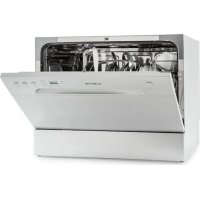
Havasia UV 6 - Dishwasher Klarstein - Free user manual and instructions
Find the device manual for free Havasia UV 6 Klarstein in PDF.



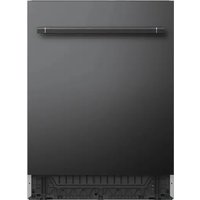
| Product type | Dishwasher |
| Brand | Klarstein |
| Model | Havasia UV 6 |
| Capacity | 6 place settings |
| Dimensions (H x W x D) | 45 x 55 x 52 cm |
| Power supply | 220-240 V / 50 Hz |
| Energy consumption (eco program) | 0.460 kWh per cycle |
| Water consumption (eco program) | 6.5 L per cycle |
| Eco program duration | 3 h 35 min |
| Noise level | 49 dB(A) |
| Energy efficiency class | D |
| Wash programs | Intensive, Universal, Eco, Glass, Party, 90 minutes |
| Functions | Delayed start up to 24 h, UV light |
| Required water pressure | 0.04 to 1 MPa |
| Minimum drain diameter | 4 cm |
| Maintenance | Washable filters, door seal to clean |
| Spare parts availability | Until 12/31/2028 |
| Warranty | 24 months |
Frequently Asked Questions - Havasia UV 6 Klarstein
User questions about Havasia UV 6 Klarstein
0 question about this device. Answer the ones you know or ask your own.
Ask a new question about this device
Download the instructions for your Dishwasher in PDF format for free! Find your manual Havasia UV 6 - Klarstein and take your electronic device back in hand. On this page are published all the documents necessary for the use of your device. Havasia UV 6 by Klarstein.
USER MANUAL Havasia UV 6 Klarstein
Berlin Brands Group UK Ltd
PO Box 1145
Oxford, OX1 9UW
United Kingdom
Dear customer,
Congratulations on the purchase of your device. Please read the following instructions carefully and follow them to prevent potential damage. We accept no liability for damage caused by disregarding the instructions and improper use. Please scan the QR code to access the latest operating instructions and further information about the product.

CONTENTS
Safety Instructions 41
Installation in kitchen units 43
Installation 49
Quick start 51
Display and button functions 52
Before first use 53
Filling the rinsing salt dispenser 54
Filling the rinse aid dispenser 56
Filling the detergent dispenser 57
Loading the dishwasher correctly 59
Rinsing programmes (EN 60436) 61
Energy saving recommendations 62
Setup and operation 62
Cleaning and Care 64
Troubleshooting 66
Product data sheet 70
Disposal Considerations 71
Manufacturer & Importer (UK) 71
SAFETY INSTRUCTIONS
WARNING
Risk of explosion! Under certain conditions, hydrogen gas can form in a hot water system that has not been used for more than two weeks. HYDROGEN GAS IS HIGHLY EXPLOSIVE! If you have not used the dishwasher for a long time, open all hot water taps and let the water flow for a few minutes before using the dishwasher. This causes the accumulated hydrogen gas to escape from the system. As the gas can ignite, avoid open flames and do not
smoke during this time.
- Do not pull on the door. Do not sit or stand on the door and the dish rack.
- Do not touch the heating rod of the dishwasher during or shortly after operation.
- Do not start the dishwasher until the door is firmly closed.
- Open the door very carefully during operation and take care that no water splashes in your direction.
- Do not place anything heavy on the open door, this could cause the machine to tip forward.
- Make sure that plastic objects do not come into contact with the heating element during operation.
- Make sure that the detergent compartment is empty after the washing cycle.
- Only wash plastic objects that are dishwasher safe and marked accordingly.
- Only use detergents and rinse aids that are suitable for dishwashers. Do not use soap, detergent or hand wash.
- The building's power supply must include a main switch with a contact gap of at least 3mm between each pole to allow the circuit to be broken in the event of a malfunction.
- Keep children away from the detergent and rinse aid and make sure they do not steal any detergent from the open door.
- Make sure that children do not play with the device.
- Children, physically and physically impaired persons should only use the appliance if they have been familiarised in detail with the functions and safety precautions by a supervisor.
-
Dishwashing detergents are strongly alkaline. If they are swallowed, poisoning can occur. Avoid any skin or eye contact and keep children away from the dishwasher when the door is open.
-
To make sure no one can trip over it, do not leave the door permanently open.
- If the mains cable is damaged, it must be replaced by the manufacturer or a qualified specialist.
- Please dispose of the packaging material properly.
- During installation, make sure that the mains cable is neither severely kinked nor squeezed.
- Do not play with the controls.
- When connecting the machine, use new hoses and discard the old ones.
- Make sure that no carpet is blocking the openings underneath.
- Use the dishwasher only for the purpose for which it was designed.
- Use the dishwasher indoors only.
- The dishwasher is not intended for commercial use, but only for use in households and similar environments.

CAUTION
Risk of injury! When loading the machine, take special care that sharp items are placed in the machine so that they do not damage the door seal. Sharp knives must be placed in the cutlery basket with the handle facing upwards. Knives and other objects with sharp points must be placed in the cutlery basket with the point facing downwards or placed horizontally.

WARNING
Risk of suffocation! Children could injure themselves on the packaging materials and old appliances. When disposing of the old appliance, make sure that you cut off the power cable and render the door lock unusable.
INSTALLATION IN KITCHEN UNITS
Power connection
Do not use an extension cord or adapter. Make sure that the socket is earthed and complies with local regulations. Only connect the appliance to sockets that correspond to the specified voltage of the appliance. If the plug does not fit the socket, have it replaced by a professional.
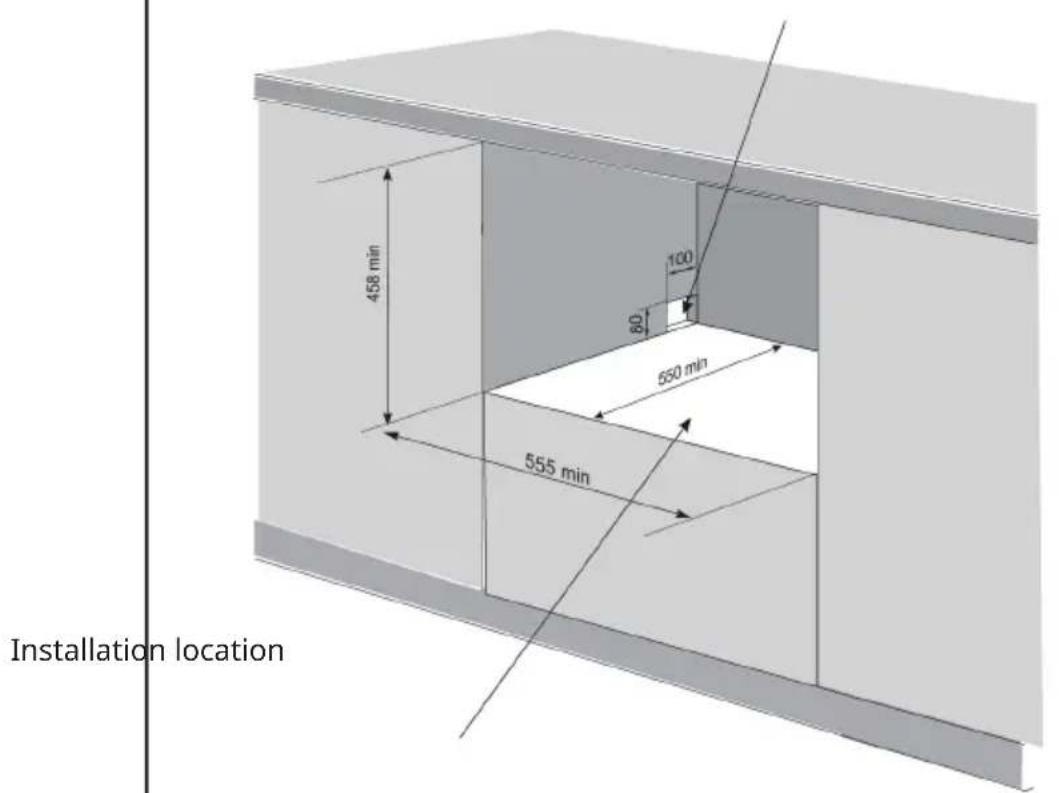
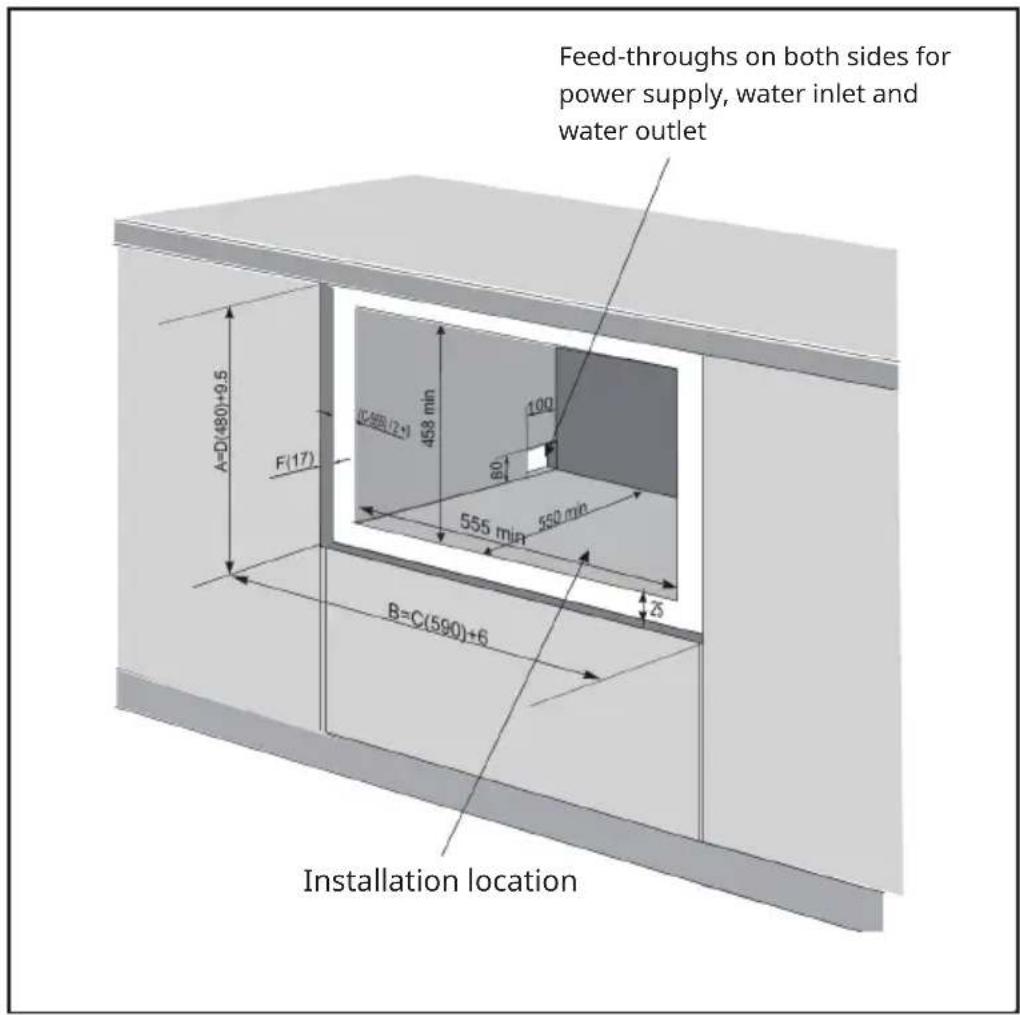
Assembly without door panel
Feed-throughs on both sides for
power supply, water inlet and water outlet
Door panel
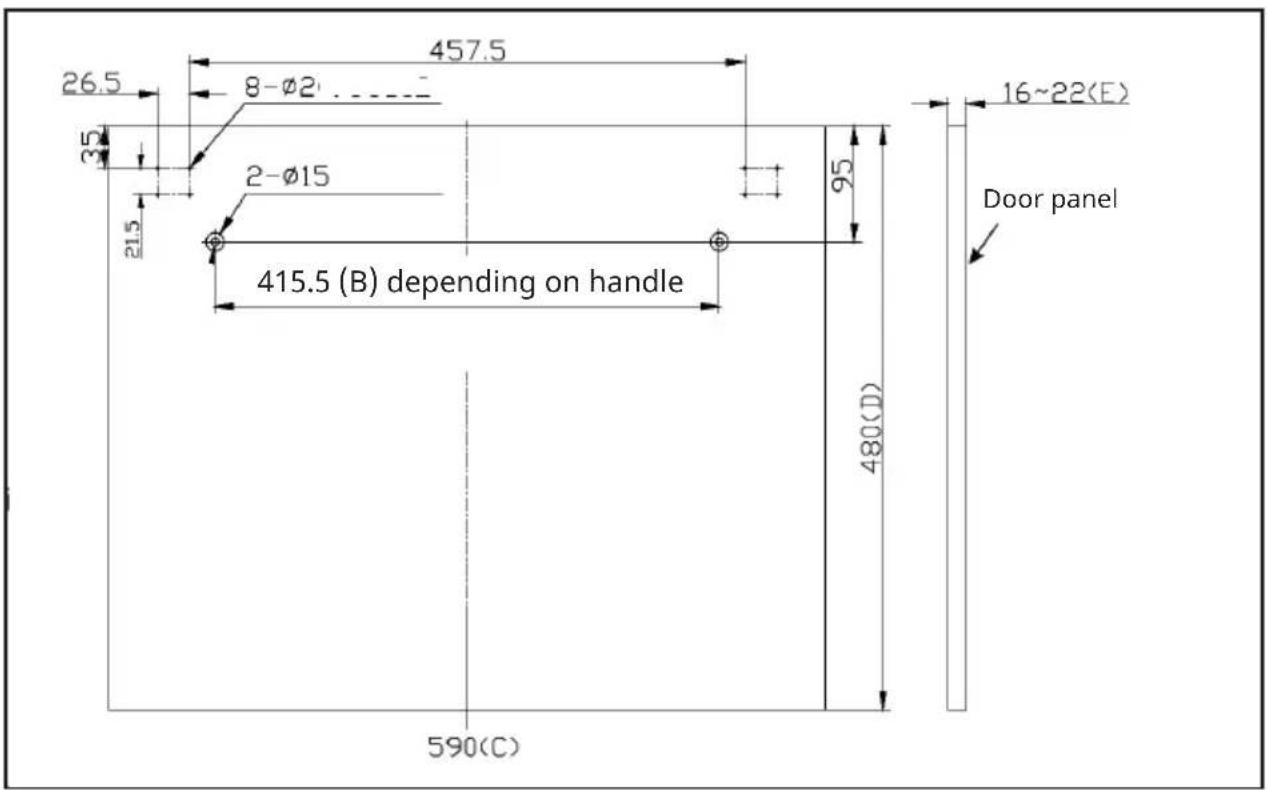
- The weight of the door panel should be at least 3kg and at most 4kg .
- Dimensions A and B depend on the handle.
- Dimensions C, D and E depend on the environment.
The range for dimension E is 16 - 22mm
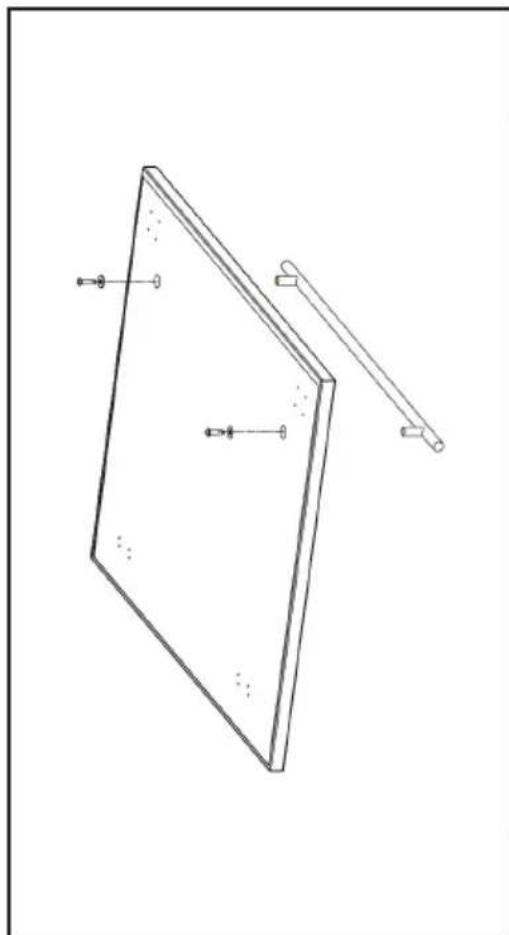
Fitting the door panel (if necessary)
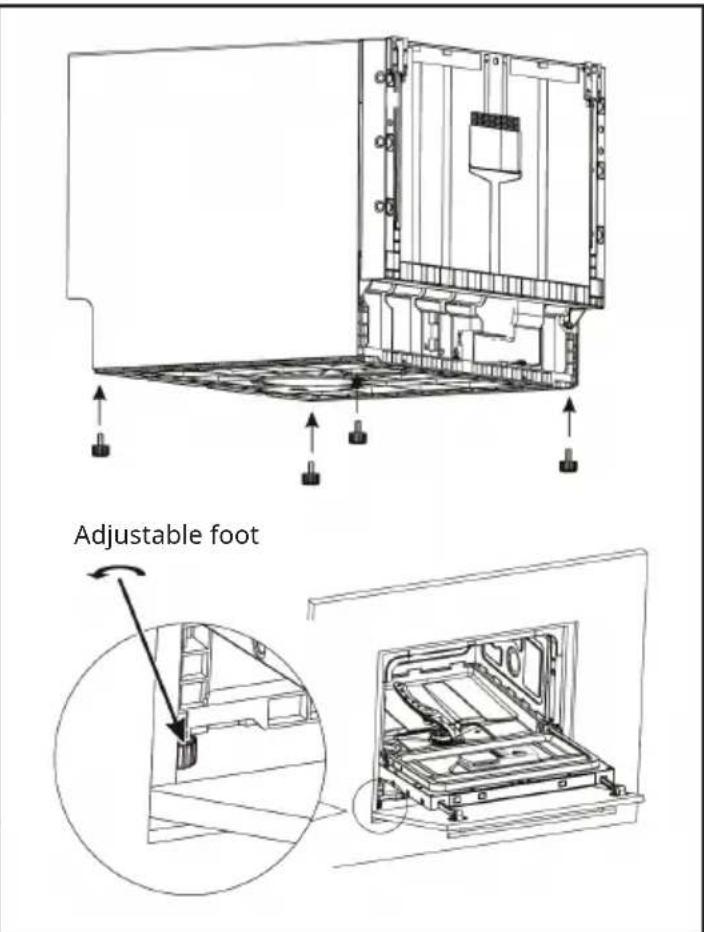
Place the dishwasher in the opening, but not completely. First align the feet with the support surface and then place the unit completely inside.
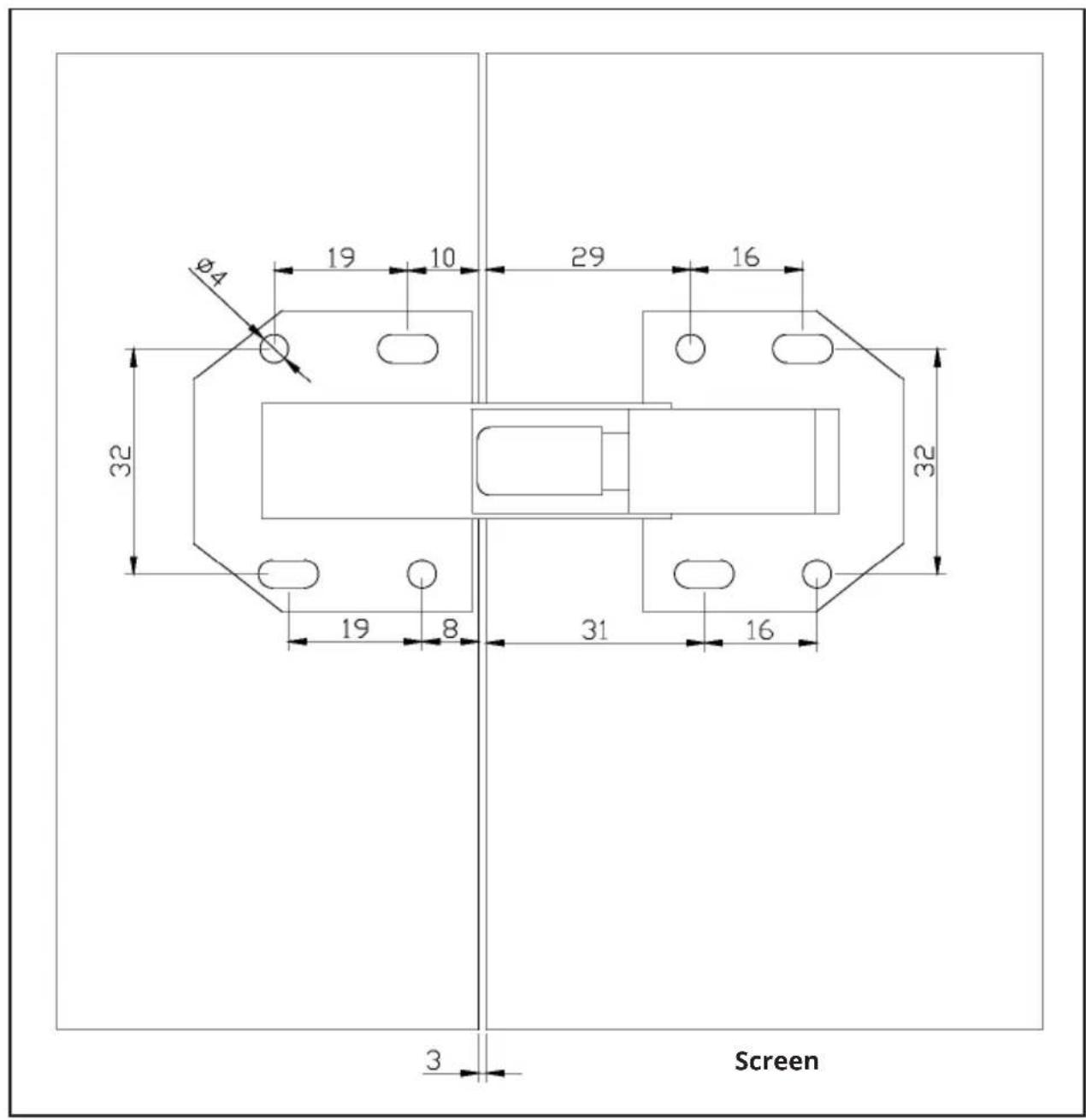
Proceed as in the picture below. First fit the hinges between the cupboard support and the door panel with a total of 16 screws.
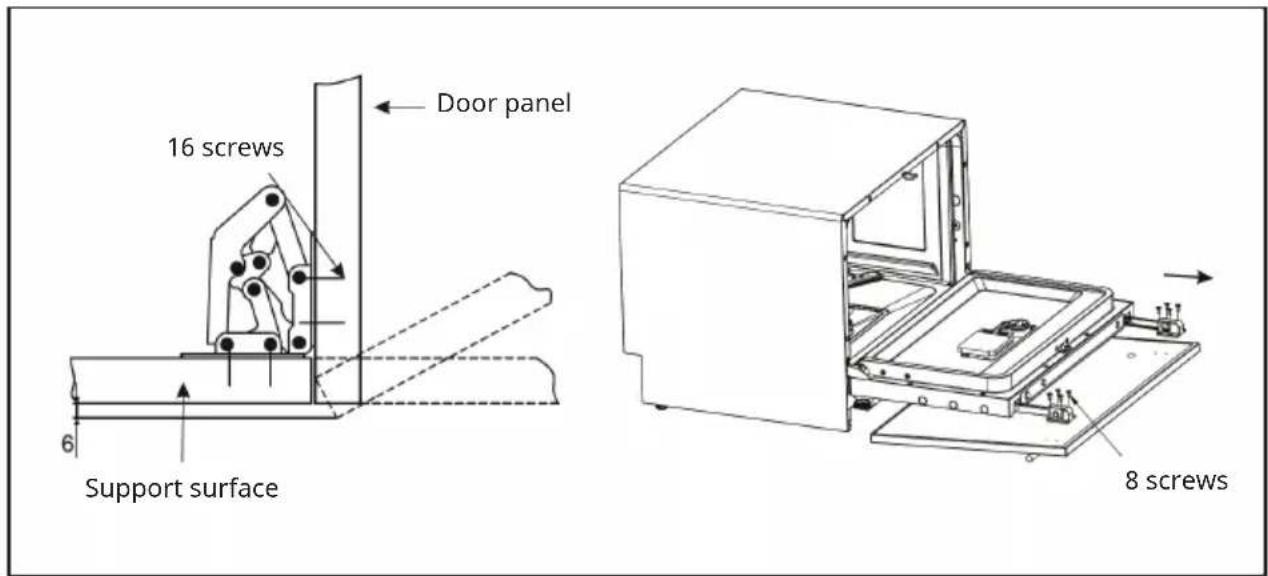
INSTALLATION
Preparation
- Place the appliance near a water inlet or drain and a power socket.
- Make sure that the hoses and the plug are accessible at all times.
Setting up the unit
Place the unit in the preferred location. The back should face the wall, the sides towards the built-in cupboard or a wall. The dishwasher is equipped with a water drain that can be directed to the right or the left to facilitate installation.
Power connection
Do not use an extension cord or adapter. Make sure that the socket is earthed and complies with local regulations. Only connect the appliance to sockets that correspond to the specified voltage of the appliance. If the plug does not fit the socket, have it replaced by a professional.
Attach and remove the water inlet
Use new hoses for the connection. Do not use old hoses. The water pressure must be between 0.04-1 MPa. If the pressure is lower than this, ask a specialist company for advice.
- Attach the inlet hose: Completely unwind the safety inlet hose from the bracket on the back of the appliance. Attach the screw to a 3/4 inch water tap. Turn on the water supply fully before use.
- Remove the supply hose: Close the water supply. Unscrew the inlet hose from the water tap.
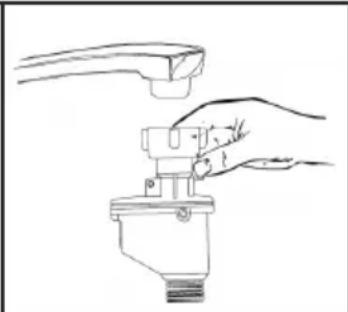
Note: Make sure the screw is tight on the tap. If you have never used the connection before or have not used it for a long time, drain some water beforehand until clear water comes out of the tap. This precaution ensures that the inlet valve is not clogged or damaged by particles in the water.
Attaching the water drain
Insert the water drain hose into a water drain pipe with a minimum diameter of 4 cm or leave it hanging in the drain. Make sure that the hose is not bent or curved.
Use the supplied hose clamp for fastening. To prevent backflow, the water drain pipe (A) must not be higher than 75~cm and the drain hose (B) must not be immersed in water.

Note: Secure the drain hose firmly to the drain with the supplied hose clamp to prevent it from moving and leaking waste water.
Collecting waste water
If your drain is more than 1 metre below the appliance, you cannot direct the water directly into the drain. In this case, you must collect the waste water in an appropriate collection container, which must be located lower than the water outlet.
Extension hose
If you need an extension hose, use a similar type and make sure it is not longer than 4 metres. Longer hoses can have a negative effect on the cleaning performance of the dishwasher.
QUICK START
| 1 | |
| Install the dishwasher (see chapter INSTALLATION) | |
| 2 | 3 |
| Inside→Outside | |
| Remove larger residues from the dishes to avoid pre-rinsing. | Load the baskets. |
| 4 | 5 |
| Fill the dispenser with detergent and rinse aid. | Select a suitable programme and start the dishwasher. |
DISPLAY AND BUTTON FUNCTIONS
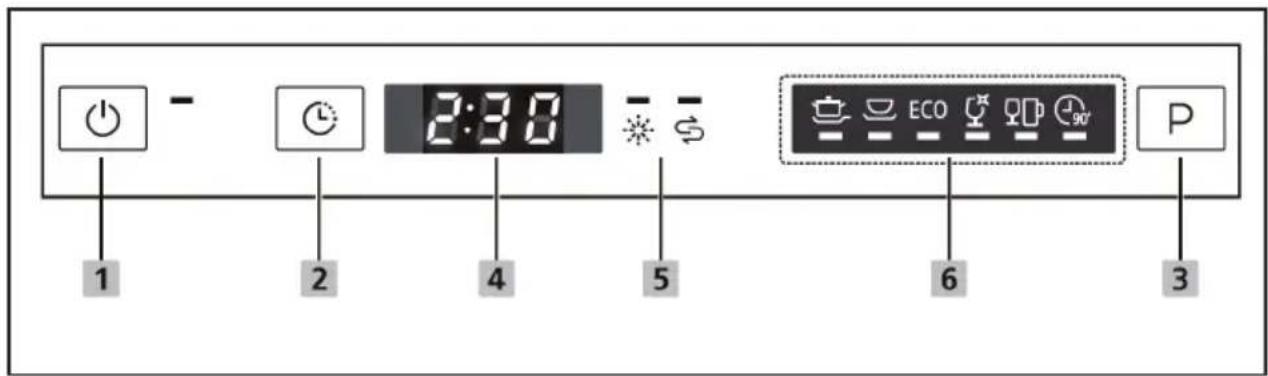
| 1 | On/off (power) | Press this button to switch on the dishwasher. | |
| 2 | Delay | Press the delay button to increase the start delay time. Delay the start of the dishwasher by up to 24 hours in 1-hour increments. After you have set the start delay time, close the door. | |
| 3 | Programme | Press this button to select the corresponding washing programme. The indicator for the selected programme lights up. | |
| 4 | Display | Displays the remaining time, delay time, error codes and other information. | |
| 5 | Warning light | ※ | Rinse aid: When the corresponding symbol is displayed on the screen, it means that the rinse aid is almost empty and needs to be refilled. |
| ◎ | Rinse salt: When the corresponding symbol lights up on the screen, it means that the dishwasher salt needs to be refilled. | ||
| 6 | Programmes | Intensive: For heavily soiled pots and pans and for dishes with dried-on food residues. | |
| Universal: For normally soiled loads, such as pots, plates, glasses and lightly soiled pans. | |||
| ECO | Eco: Standard programme for cleaning dishes with a normal degree of soiling. Environmentally friendly programme, as it is very energy- and water-saving. | ||
| Glass: For light soiling and glasses. | |||
| Party tableware: For freshly soiled coffee cups or glasses. | |||
| 90 minutes: For dishes with a normal degree of soiling that need to be cleaned quickly. | |||
BEFORE FIRST USE
Dishwashing salt
- If your model does not have a salt container, you can skip this section. Always use salt suitable for dishwashers. The salt container is located below the lower dish compartment and should be filled as follows:
- Only use salt that is specifically designed for use in dishwashers. Any other type of salt, especially table salt, will damage the container. Damage caused by the use of unsuitable salt is not covered by the manufacturer's warranty.
- Only fill the appliance into the container before starting the dishwasher. This prevents salt or salt water, which may have been spilled, from remaining on the bottom of the dishwasher for a long period of time and causing wear and tear.
FILLING THE RINSING SALT DISPENSER
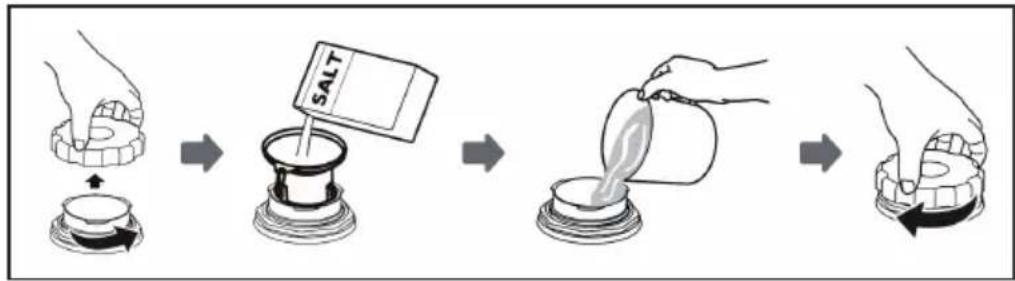
- Remove the dish insert and unscrew the cover of the container.
- Insert the bottom of the funnel (included) into the hole and pour in about 1kg of dishwashing salt.
- Fill the salt container to the top with water before using the appliance for the first time. It is normal for a small amount of water to leak out of the salt container.
- After filling, screw the cover firmly back onto the container.
- After the salt container has been filled with salt, the warning light goes off.
- A cleaning programme should be started immediately after the container has been filled with salt. (We recommend using a short programme.) Otherwise, the filter system, the pump or other appliance components may be damaged by the salty water. In such cases, the warranty claim becomes invalid.
Please note:
- The salt only needs to be topped up when the salt warning light comes on. Depending on how well the salt dissolves, the salt warning light may remain on for some time after the salt container has been filled. If your appliance does not have such a warning light (on some models), you can estimate the moment when you need to refill the salt depending on the frequency of use of the dishwasher.
- If salt has spilled, run a quick programme to remove it.
Setting the salt quantity
The dishwasher is designed so that the amount of salt can be adjusted according to the hardness of the water being used. This is to optimise and individually adjust salt consumption. To adjust the salt consumption, please proceed as follows.
-
Close the door and switch on the appliance.
-
Within 60 seconds after switching on the appliance, press and hold the programme button for more than 5 seconds to start the water softener setting mode.
-
Press the programme button again to select the correct setting according to local conditions; the setting changes in the following order: H1 > H2 > H3 > H4 > H5 > H6.
-
If you do not press any button within five seconds or if you press the power button to exit the setting mode, the setting will be saved by the programme.
| Water hardness | Hardness level 5 | Regeneration 6(takes place after every Xth programme sequence) | Salt consumption (gram/cycle) | |||
| °dH 1) | °fH3 | °Clear3 | mmol/l4 | |||
| 0 - 5 0 - 9 | 0 - 6 0 - 0.94 | H1 no regeneration 0 | ||||
| 6 - 11 10 | 20 7 - 14 1.0 | - 2.0 H2 10 9 | ||||
| 12 - 17 21 | - 30 15 - 21 2 | 1 - 3.0 H3 5 | 12 | |||
| 18 - 22 31 | - 40 22 - 28 3 | 1 - 4.0 H4 3 | 20 | |||
| 23 - 34 41 | - 60 29 - 42 4 | 1 - 6.0 H5 2 | 30 | |||
| 35 - 55 61 | - 98 43 - 69 6 | 1 - 9.8 H6 1 | 60 | |||
1 German hardness level
2 French hardness level
3 British hardness level
4 International hardness level
5 Default factory setting is hardness level H4
Each cycle with a regeneration process consumes an additional 2.0 litres of water, the energy consumption increases by 0.02kWh and the programme duration is extended by 4 minutes.
FILLING THE RINSE AID DISPENSER
The rinse aid is released during the last rinse cycle and prevents the water from forming drops on the dishes, which can leave stains and streaks. It also improves drying by making the water roll off the dishes. This dishwasher is designed for the use of liquid rinse aids.
Note: Only use branded rinse aid for dishwashers. Never fill the rinse aid dispenser with other substances such as dishwasher detergent or liquid detergent. This would damage the device.
Refilling the rinse aid dispenser
If the rinse aid warning light (on the control panel is not lit, you can estimate the amount by looking at the colour of the visual level indicator next to the lid. When the rinse aid tank is full, the display is completely dark. The size of the dark spot decreases as the amount of rinse aid decreases. The rinse aid level should never be less than 1/4.
When the amount of rinse aid decreases, the size of the black dot on the rinse aid level indicator changes as shown below.

To top up the rinse aid
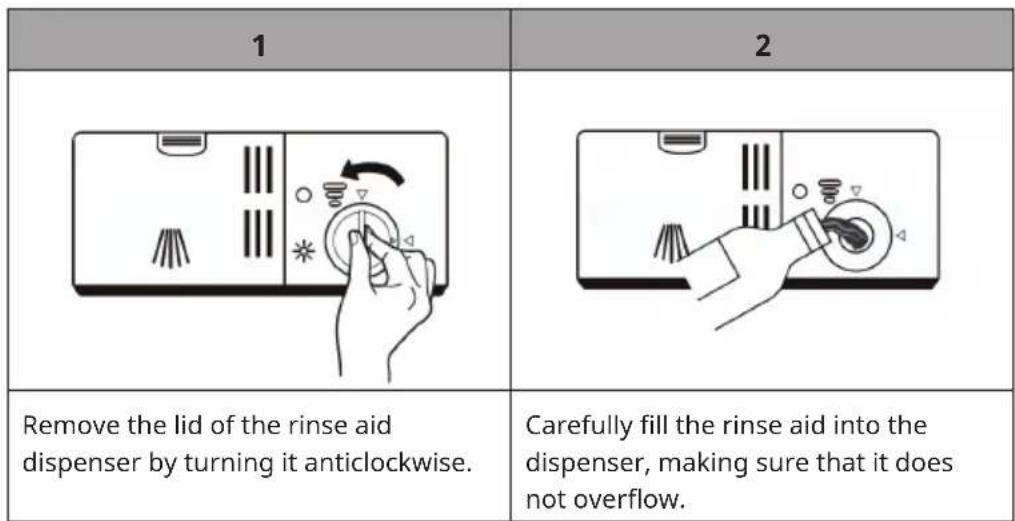
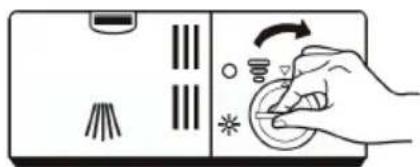
3
Close the rinse aid dispenser lid by turning it clockwise.
Note:
Wipe up spilled rinse aid with an absorbent cloth to avoid excessive foaming during the next wash cycle.
Setting the correct amount of rinse aid
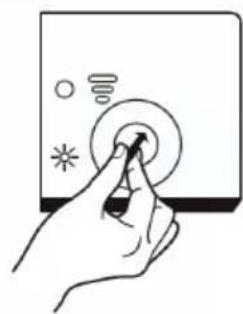
Remove the lid of the rinse aid dispenser. Turn the rinse aid indicator to a number. The higher the number, the more rinse aid the dishwasher uses. If the dishes do not dry properly or are stained, turn the knob to the next higher number until your dishes are stain-free. Decrease the value if there are whitish stains on the dishes. Then close the lid of the rinse aid dispenser again.
FILLING THE DETERGENT DISPENSER
The chemical components of the detergent are necessary to remove the dirt, break it down and remove all the dirt from the dishwasher. Most commercially available dishwashing detergents are suitable for this purpose.
Important notes on the use of dishwashing detergent
Only use detergents that are specifically suitable for dishwashers. Keep your detergent fresh and dry. Only fill the detergent into the dispenser when you are ready to start the dishwasher.

WARNING
Dishwashing detergent is corrosive. Keep dishwashing detergent out of the reach of children.
To refill detergent
| 1 | 2 |
| Press the release button on the dispenser to open the lid. | Fill the detergent into the larger cavity (A) for the main wash. For more heavily soiled dishes, also add some detergent to the smaller cavity (B) to release it during the prewash. |
| Close the lid and press it until it clicks into place. | Note: Please follow the manufacturer's recommendations on the detergent packaging. |
LOADING THE DISHWASHER CORRECTLY
Unsuitable crockery and cutlery
| Unsuitable crockery/cutlery Conditional | suitable crockery and cutlery |
| • Cutlery with wooden, horn or mother-of-pearl handles • Heat-resistant plastic tableware • Older cutlery with glued parts that are not heat resistant. • Coated cutlery or crockery. • Things made of tin and copper. • Crystal glass • Things made of non-stainless steel • Wooden dishes • Plastic crockery and cutlery | Certain types of glass, as they can become cloudy over time. Silver and aluminium parts, as they can change colour over time. Glazed crockery, as the glaze disappears over time the more often you wash it. |
What you should bear in mind when loading
Remove larger food scraps. Soak burnt-on residues in pans beforehand. It is not necessary to rinse the dishes until clear beforehand. Place the items in the dishwasher as follows:
- Place cups, glasses, pots and pans in the dishwasher with the inside facing down.
- You should load curved objects standing up so that the water can run off.
- Load the objects inside the device in such a way that they cannot fall over.
- Make sure that the spray arms can rotate freely and are not obstructed by dishes or protruding objects.
- Do not wash small items in the dishwasher as they could easily fall out of the basket.
- Make sure that dishes and cutlery do not overlap or cover each other.
- To avoid glass breakage, glasses must not touch each other.
- Load large items that are difficult to clean into the basket.
- Long and sharp objects must be placed horizontally in the basket to avoid injury.
- For best results, do not overload the dishwasher.
Notes on the end of the programme

CAUTION
Risk of burns! The parts are very hot after rinsing! To avoid damage, do not remove glasses and cutlery from the dishwasher until about 15 minutes after the programme has ended.
Loading the baskets
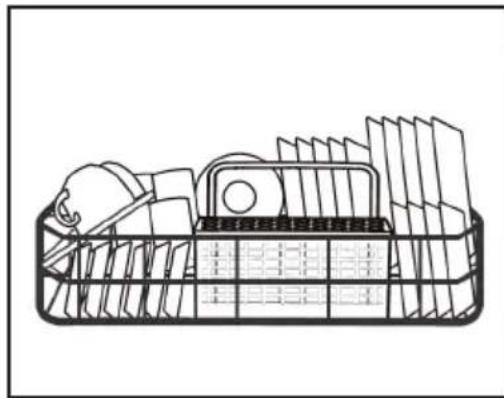
To improve the cleaning surface and the rinsing performance, it is recommended to place the dirty side towards the spray arm. To ensure that the movement of the spray arm is not blocked, do not let the dishes protrude from the bottom of the basket. The recommended maximum diameter for is 19cm so as not to obstruct the opening of the dispenser.
Loading the cutlery basket
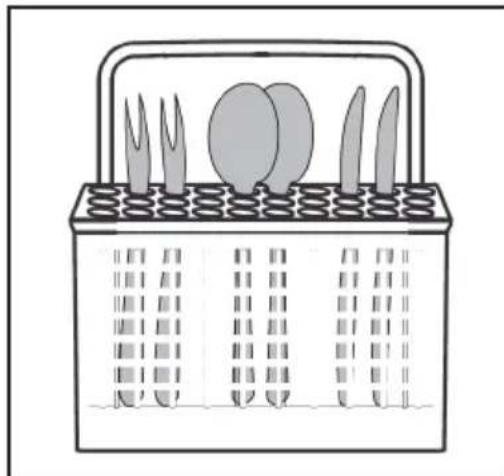
Put the cutlery in the basket and make sure it is not touching.
The utensils must not get caught in each other.
The cutlery is inserted with the handles facing downwards.
- Knives and other potentially dangerous utensils are inserted with the handle facing upwards.

Do not allow any objects to protrude through the floor. Always load sharp objects with the sharp tip pointing downwards!
RINSING PROGRAMMES (EN 60436)
The table below shows which programmes are most suitable depending on the amount of food residues and how much detergent is needed. It also contains various information about the programmes. The consumption values and programme duration are only guide values, except for the ECO programme.
| Programme | Rinsing cycle | Rinse aid front/main | Time (min) | Energy (KWh) | Water (L) | Rinse aid |
| Intensive | Prewash (50°C) Wash (70°C) Rinsing Rinsing Rinse (60 °C) Drying | 4/10 g or 1 tab | 135 0.79 | 90 9.6 | yes | |
| Universal | Prewash Wash (60°C) Rinsing Rinse (60 °C) Drying | 4/10 g or 1 tab | 110 0.58 | 80 7.7 | yes | |
| ECO (*EN 60436) | Prewash Wash (45°C) Rinse (50 °C) Drying | 4/10 g or 1 tab | 215 0.55 | 53 6.5 | yes | |
| Glass | Wash (45°C) Rinsing Rinse (50 °C) Drying | 14 g or 1 tab | 70 0.40 | 0 5.8 | yes | |
| Party | Wash (45°C) Rinsing Rinsing | 14 g or 1 tab | 20 0.30 | 8 7.0 | no | |
| 90° 90 min. | Wash (65°C) Rinsing Rinsing Rinse (60 °C) Drying | 12 g or 1 tab | 90 0.59 | 90 6.6 | yes | |
| *EN 60436: The ECO programme was used for the test run in accordance with EN 60436. The ECO programme is suitable for cleaning normally soiled dishes and is the most efficient programme for this purpose in terms of energy and water consumption. | ||||||
ENERGY SAVING RECOMMENDATIONS
- The eco programme is suitable to clean normally soiled tableware, that for this use, it is the most efficient programme in terms of its combined energy and water consumption, and that it is used to assess compliance with the EU ecodesign legislation.
- Loading the household dishwasher up to the capacity indicated by the manufacturer will contribute to energy and water.
- Incorrect loading can have these consequences:
- a deteriorated cleaning result
- damage to property due to the blocking of the spraying arms.
- Manual pre-rinsing of tableware items leads to increased water and energy consumption and is not recommended.
- Washing tableware in a household dishwasher usually consumes less energy and water in the use phase than hand dishwashing when the household dishwasher is used according to the manufacturer's instructions.
- The values given for programmes other than the eco programme are indicative only.
SETUP AND OPERATION
Starting the washing process
- Pull out the lower and upper baskets, load the dishes and push the basket back in. It is recommended to load the lower basket first and then the upper basket.
- Fill in the detergent.
- Plug the power plug into the mains socket.
- Make sure that the water supply is set to full pressure.
- Open the door and press the power button.
- Select a programme, the indicator light lights up. Close the door and the dishwasher will start its programme.
Changing the programme
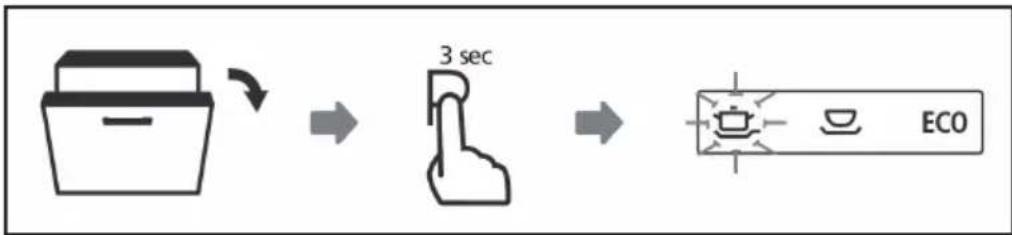
A programme can only be changed if the appliance has only been running for a short time. Otherwise, the dishwasher detergent may have already been released and the dishwasher may already be full of water. If this is the case, the machine will need to be reset and the dispenser will need to be refilled with detergent. To reset the dishwasher, proceed as follows:
- Open the door a little to stop the dishwasher. After the spray arm has stopped working, you can open the door completely.
- Press the programme button for more than three seconds to enter the programme selection mode.
- You can change the programme to the desired cycle setting.
Adding dishes later
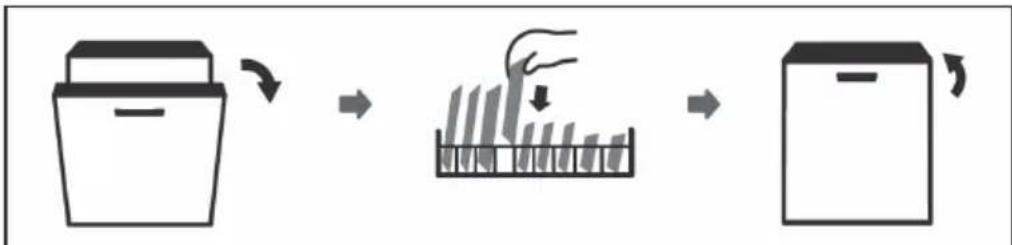
Forgotten dishes can be placed in the dishwasher before the dishwasher detergent dispenser opens. If this is the case, follow these steps:
- Open the door a little to stop the washing process.
- After the spray arms have stopped working, you can open the door completely.
- Add the forgotten dishes.
- Close the door.
- The dishwasher starts running again.

Note on automatic opening of the door
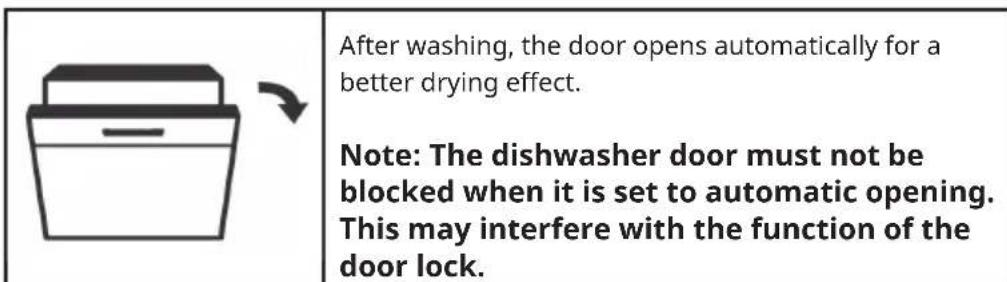
Note on UV light
- During the drying time of a cycle, the UV lamp switches on automatically.
- If the drying time of a cycle is interrupted, the UV lamp goes off.
- When the door is opened, the UV lamp switches off automatically.
CLEANING AND CARE
Door and door seal
Clean the door seals regularly with a damp cloth to remove food residues. When filling the dishwasher, food residues may stick to the sides of the dishwasher door. These surfaces are on the outside and cannot be reached by the spray arms. Always remove this residue before closing the door.
Control panel
- Wipe the control panel only with a soft, damp cloth.
- Do not use any spray cleaners to prevent water from getting behind the door seal or into the electrical appliance components.
- Do not use aggressive cleaners or scouring pads on the outer surfaces of the appliance as this could scratch the coating. Note that some paper towels may also scratch or leave marks on the surface.
Removal of foreign objects
- Check the sieves and the tub after each use of the dishwasher. Foreign objects (e.g. broken glass, plastic particles, bones or toothpicks, etc.) reduce the cleaning performance and can cause damage to the drain pump. Remove the sieve system as described in this chapter. Remove foreign objects by hand.
- Caution. If you cannot remove the objects, contact an authorised service centre. Reinstall the filter system as described in this chapter.
Filter system
The filter system is located at the bottom of the dishwasher. Residues from the wash cycle remain in the filter. The accumulation of residues can lead to clogging of the filters. The filters should therefore be checked regularly and, if necessary, cleaned under running water. Follow the steps below to clean the filters:
| 1 | 2 |
| Hold the coarse filter and turn it anticlockwise to unlock it. Pull the filter out upwards. | Lift the fine filter from the main filter. |
| 3 | 4 |
| Larger food residues can be removed by holding the filter under running water. For a more thorough cleaning, it is recommended to use a soft toothbrush. | Reassemble the filters in reverse order and put them back in the dishwasher. Now turn the filters clockwise to fix them. |
Note: The illustrations are for orientation only and may differ from your model.
- Do not screw the filters in too tightly. Replace the filters in order, otherwise residue from the coarse filter could get into the other two filters and cause a blockage.
- Never use the dishwasher without filters. Replacing the filter incorrectly can affect the overall performance of the dishwasher and damage dishes and accessories.
Note on aggressive solvents or cleaning agents
Do not use aggressive solutions or cleaning agents to clean the outside and rubber components of the unit. Use only a clean cloth with warm soapy water. To remove stains or dirt from the surface of the inside, use a damp cloth with a little vinegar or a detergent specially designed for dishwashers.
If the unit will not be used for a long period of time
It is recommended to run the empty dishwasher through once and then disconnect the mains plug from the socket, turn off the water supply and leave the dishwasher door slightly open. This preserves the door seals for longer and prevents odours from forming inside the dishwasher.
TROUBLESHOOTING
| Problem Potential cause | Use Solution | |
| The dishwasher does not start. | The fuse is out or blown. Replace the fuse or flip the switch again. Remove all other devices that are connected to the circuit themselves. | |
| No power. Make sure that the appliance is switched on, the door is firmly closed and the mains cable is firmly plugged into the socket. | ||
| The door is not closed properly. | When closing, make sure that the door lock engages. | |
| No water is pumped out of the dishwasher. | The drain hose is kinked. Check the hose. | |
| The filter is clogged. Check the coarse filter. | ||
| The drain is blocked. Check your drain and clean it if necessary. If you still have problems. Contact a specialist company. | ||
| Rust stains on the cutlery. | The cutlery is not stainless. | Only wash stainless cutlery. |
| No programme was started after the rinsing salt was refilled. | After filling, start the quick programme with an empty dishwasher. | |
| The lid to the rinsing salt container is loose. | Make sure that the lid is firmly closed. | |
| Coloured stains in the tub. | Coloured detergent. Only use detergent without colour. | |
| White film on the inner surfaces. | Mineral residues from hard water. | Clean the inside surfaces with a damp cloth and some dishwasher detergent. Use gloves when doing this and do not use any other detergent. |
| Knocking noises in the interior. | The spray arm hits an object in the basket. | Pause the programme and place the dishes in a way that the spray arm is not obstructed. |
| Rattling noises in the interior. | The dishes are not standing securely. | Pause programme and place dishes so that they are secure. |
| Knocking noise in the water pipe. | Can be caused by crossing the water pipes. | Does not affect the performance of the dishwasher. If you are not sure, contact a specialist company. |
| Foam in the tub. Unsuitable | dishwashing detergent. | Only use detergent that is suitable for dishwashers. If there is still foam in the tub, open the door and allow the foam to evaporate. Pour some cold water into the tub and close the door. Run any washing programme to remove the residue. |
| Rinse aid overflow. Wipe up | any rinse aid that has spilled over immediately. | |
| The dishes are not clean. | The dishes were not loaded properly. | Follow the instructions for loading the dishwasher. |
| The programme was not powerful enough. | Use the intensive programme. | |
| Too little detergent. Use m | ore detergent or use a different detergent. | |
| Objects block the spray arms. | Place the dishes in the appliance in a way that the spray arms are not obstructed. | |
| The filter system is dirty or incorrectly used. | Clean the filters or insert them correctly. Clean the spray arms. | |
| The dishes do not dry. Incorrect loading. Follow the instructions for loading the dishwasher. | ||
| Too little rinse aid. Increase | the rinse aid quantity. | |
| The dishes were taken out too early. | Leave the dishes in the dishwasher for about 15 minutes after cleaning. Open the door so that the humid air can escape. | |
| Incorrect programme. In short programmes, the washing and drying temperature is lower. Use a programme with a higher runtime. | ||
| Cutlery with inferior coating. | Such dishes and cutlery are not suitable for the dishwasher. | |
| The glass is fogged up. Co | Combination of soft water and too much detergent. | Use less detergent and use the shortest programme to wash and clean the glass. |
| Black or grey stripes on dishes | Aluminium parts have rubbed against the dishes. | Use a mild abrasive cleaner. |
| Detergent residues in the chamber. | The dishes are obstructing the dissolution of the detergent. | Load the dishes carefully into the dishwasher. |
Error codes
For some faults, the display shows an error code to warn you: In the event of some faults, the display shows an error code to warn you. In these cases, call in specialist personnel.

WARNING
Risk of electric shock or other personal injury!
Do not repair the appliance yourself. The dishwasher may only be repaired by qualified personnel. The repair must be carried out professionally.
| Code | Meaning Potential cause | |
| E1 | Water supply disrupted. The tap is not open, the water supply is interrupted or the water pressure is too low. | The heating element is broken. Contact a specialist company. |
| E3 | The water temperature is not reached. | |
| E4 | Water leak. Part of the dishwasher is leaking. Turn off the main tap and call a professional. If there is still water in the tub after the end of the programme, remove it before restarting the dishwasher. | |
| Ed | Fault in communication between main circuit board and display circuit board | Open circuit or interrupted wiring for communication. Contact a specialist company. |
- If there is water in the base pan due to overfilling or a small leak, remove it before restarting the dishwasher.
- In case of repair, please contact a qualified repair service in your area Spare parts for the item are available until 31.12.2028.
PRODUCT DATA SHEET
Information according to Regulation (EU) No 2019/2017
| Manufacturer's name or trade mark: Klarstein | ||||
| Manufacturer's address: Wallstraße 16, 10179 Berlin, Germany. | ||||
| Article number : 10046456 | ||||
| General product parameters: | ||||
| Parameter Value Parameter Value | ||||
| Standard place settings 6 | Dimensions in mm | Height 45 | ||
| Width 55 | ||||
| Depth 52 | ||||
| EEI 49.9 Energy efficiency class D | ||||
| Cleaning performance index | 1,125 | Drying performance index | 1,065 | |
| Energy consumption in kWh [per cycle], based on the eco programme with cold water filling. The actual energy consumption depends on how the unit is used. | 0.460 | Water consumption in litres [per cycle], based on the Eco programme. The actual water consumption depends on the use of the appliance and the water hardness. | 6.5 | |
| Programme duration (h:min) | 3:35 Construction type: Freestanding | |||
| Airborne sound emissions (dB(A) re 1 pW) | 49 Acoustic emission class C | |||
| Off mode (W) 0.49 Standby mode (W) N/A | ||||
| Start delay (W) (if applicable) | 1.00 | Networked on-call service (W) (if applicable) | N/A | |
| Minimum term of the warranty offered by the manufacturer: 24 months | ||||
| Further information: | ||||
| Web link to the website of the supplier where the information according to Annex II point of Commission Regulation (EU) 2019/2022 can be found: www.klarstein.de | ||||
DISPOSAL CONSIDERATIONS
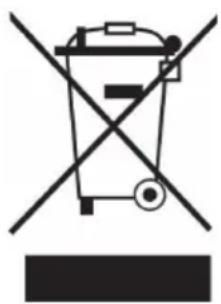
If there is a legal regulation in your country regarding the disposal of electrical and electronic equipment, this symbol on the product or on the packaging indicates that this product must not be disposed of with household waste. Instead, it must be taken to a collection point for the recycling of electrical and electronic equipment. By disposing of this product in accordance with the regulations, you protect the environment and the health of those around you from negative consequences. For information on recycling and disposal of this product, contact your local government or household waste disposal service.
MANUFACTURER & IMPORTER (UK)
Manufacturer:
Chal-Tec GmbH, Wallstrasse 16, 10179 Berlin, Germany.
Importer for Great Britain:
Berlin Brands Group UK Ltd
PO Box 1145
Oxford,OX1 9UW
United Kingdom
Cher client, chere clientele,
FICHE DE DONNÉES PRODUIT
Berlin Brands Group UK Ltd
PO Box 1145
Oxford, OX1 9UW
United Kingdom
Gentile clientele,
Piano 3/4 piano 1/2 piano 1/4 piano Vuoto

PRODUTTORE IMPORTATORE (UK)
Produtlore:
Chal-Tec GmbH, Wallstraße 16, 10179 Berlin, Germania.
Berlin Brands Group UK Ltd
PO Box 1145
Oxford, OX1 9UW
United Kingdom
Estimado cliente:
Berlin Brands Group UK Ltd
PO Box 1145
Oxford, OX1 9UW
Reino Unido


KLARSTEIN

- Dear customer,
- CONTENTS
- SAFETY INSTRUCTIONS
- WARNING
- CAUTION
- INSTALLATION IN KITCHEN UNITS
- Power connection
- Assembly without door panel
- Door panel
- Fitting the door panel (if necessary)
- INSTALLATION
- Preparation
- Setting up the unit
- Attach and remove the water inlet
- Attaching the water drain
- Collecting waste water
- Extension hose
- QUICK START
- DISPLAY AND BUTTON FUNCTIONS
- BEFORE FIRST USE
- Dishwashing salt
- FILLING THE RINSING SALT DISPENSER
- Please note:
- Setting the salt quantity
- FILLING THE RINSE AID DISPENSER
- Refilling the rinse aid dispenser
- To top up the rinse aid
- Note:
- Setting the correct amount of rinse aid
- FILLING THE DETERGENT DISPENSER
- Important notes on the use of dishwashing detergent
- To refill detergent
- LOADING THE DISHWASHER CORRECTLY
- Unsuitable crockery and cutlery
- What you should bear in mind when loading
- Notes on the end of the programme
- Loading the baskets
- Loading the cutlery basket
- RINSING PROGRAMMES (EN 60436)
- ENERGY SAVING RECOMMENDATIONS
- SETUP AND OPERATION
- Starting the washing process
- Changing the programme
- Adding dishes later
- Note on automatic opening of the door
- Note on UV light
- CLEANING AND CARE
- Door and door seal
- Control panel
- Removal of foreign objects
- Filter system
- Note on aggressive solvents or cleaning agents
- If the unit will not be used for a long period of time
- TROUBLESHOOTING
- Error codes
- Risk of electric shock or other personal injury!
- PRODUCT DATA SHEET
- DISPOSAL CONSIDERATIONS
- MANUFACTURER & IMPORTER (UK)
- Manufacturer:
- Importer for Great Britain:
- FICHE DE DONNÉES PRODUIT
- Gentile clientele,
- PRODUTTORE IMPORTATORE (UK)
- Produtlore:
- Estimado cliente:
Brand : Klarstein
Model : Havasia UV 6
Category : Dishwasher