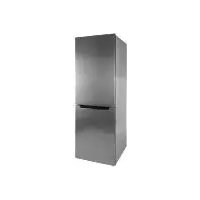
SKGK 323 A1 - Refrigerator-freezer SILVERCREST - Free user manual and instructions
Find the device manual for free SKGK 323 A1 SILVERCREST in PDF.



| Product type | Combined refrigerator-freezer, freestanding |
| Dimensions (H × W × D) | 1840 × 600 × 660 mm |
| Weight | 65.5 kg |
| Power supply | 220-240 V ~, 50 Hz |
| Rated current | 0.90 A |
| Refrigerant | R-600a, 52 g |
| Energy efficiency class | E |
| Annual energy consumption | 249 kWh/year |
| Total capacity | 323 L |
| Refrigerator capacity | 219 L |
| Freezer capacity | 104 L (4 stars) |
| Autonomy in case of power cut | 10.5 hours |
| Freezing capacity | 6.4 kg/24h |
| Climate class | SN, N, ST (10 °C to 38 °C) |
| Noise emissions | 40 dB(A), class C |
| Defrost | Automatic (No-Frost) |
| Interior lighting | LED, class G |
| Refrigerator temperature (adjustable) | 2 °C to 8 °C or OFF |
| Freezer temperature (adjustable) | -14 °C to -22 °C |
| Special functions | ECO mode, Super-freeze, Door alarm |
| Included accessories | 2 glass shelves, 1 vegetable drawer with cover, 1 Fresh Converter bin, 3 door bins, 3 freezer drawers, ice cube tray, egg holder |
| Door reversibility | Yes, installation on right or left |
| Warranty | 3 years |
| Maintenance and cleaning | Cleaning with water and mild detergent; automatic defrost; do not use sharp objects |
| Safety | Child lock (8 years+), flammable refrigerant R-600a, emergency stop by unplugging |
Frequently Asked Questions - SKGK 323 A1 SILVERCREST
User questions about SKGK 323 A1 SILVERCREST
0 question about this device. Answer the ones you know or ask your own.
Ask a new question about this device
Download the instructions for your Refrigerator-freezer in PDF format for free! Find your manual SKGK 323 A1 - SILVERCREST and take your electronic device back in hand. On this page are published all the documents necessary for the use of your device. SKGK 323 A1 by SILVERCREST.
USER MANUAL SKGK 323 A1 SILVERCREST
natural_image
Exterior view of a modern stainless steel refrigerator (no visible text or symbols)
KÜHL-/GEFRIERKOMBINATION / FRIDGE FREEZER / RÉFRIGÉRATEUR-CONGÉLATEUR SKGK 323 A1
DE AT CH
KÜHL-/GEFRIERKOMBINATION
Bedienungsanleitung
FR BE
RÉFRIGÉRATEUR-CONGÉLATEUR
Mode d'emploi
CZ
CHLADNIČKA S MRAZNIČKOU
Návod k obsluze
SK
CHLADNIČKA A MRAZNIČKA
Návod na obsluhu
DK
K∅LE-FRYSEKOMBINATION
Operating instructions
NL BE
KOEL-VRIESCOMBINATIE
Gebruiksaanwijzing
PL
CHŁODZIARKO-ZAMRAŻARKA
Instrukcja obstugi
ES
FRIGORÍFICO COMBI
Before reading, unfold the page containing the illustrations and familiarise yourself with all functions of the device.
FR BE
GB/IE Operating Instruction Page 35
natural_image
Technical drawings of mechanical parts including a bracket, a tray with circular holes, and a housing (no text or symbols)D
flowchart
graph LR
    A["Step 1: Initial assembled part"] --> B["Step 2: ↑↑"]
    B --> C["Step 3: Processed assembly"]
    C --> D["Step 4: Final assembled part"]
natural_image
Line drawing of a hand holding a shelf with a wooden plank, no text or symbols present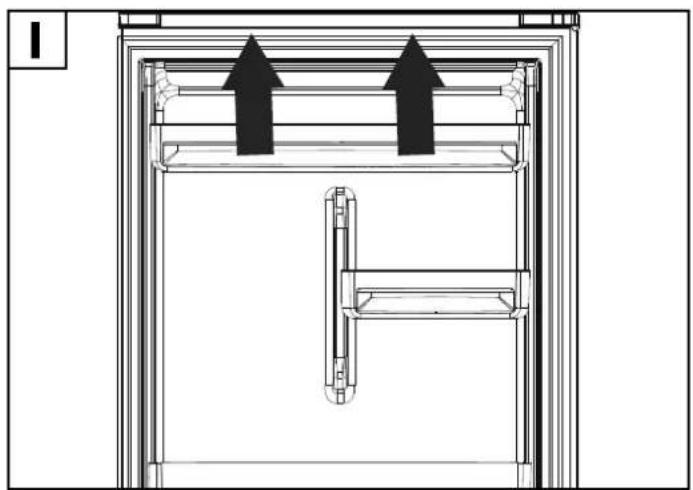
natural_image
Technical line drawing of a door frame with two upward arrows indicating movement or force (no text or symbols)Inhaltsverzeichnis
1. Einführung 7
natural_image
Technical line drawing showing two mechanical assembly steps: one with a screwdriver inserted into a bracket, the other with a clamp securing a bracket (no text or symbols present)Abb. 1 Abb. 2
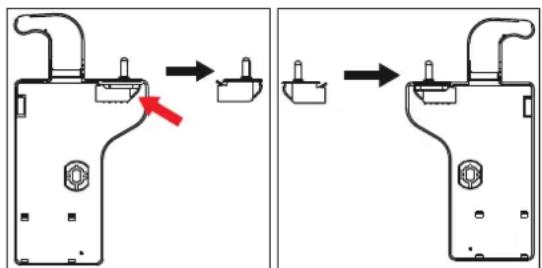
Abb. 3 Abb. 4
natural_image
Simple line drawing of a mechanical assembly with a screwdriver and base mount (no text or symbols)Abb. 5
natural_image
Line drawing of a mechanical assembly with a screw and base mount (no text or symbols)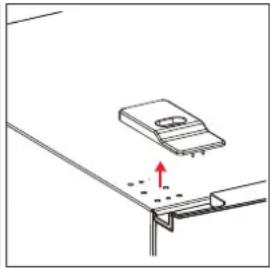
natural_image
Simple line drawing of a mechanical component with a red arrow indicating upward motion (no text or symbols)Abb. 6 Abb. 7
natural_image
Pure technical line drawing of a mechanical frame or enclosure without any text, numbers, or symbolsAbb. 9
natural_image
Mechanical assembly diagram showing a lever mechanism with red arrows indicating motion or force direction (no text or symbols)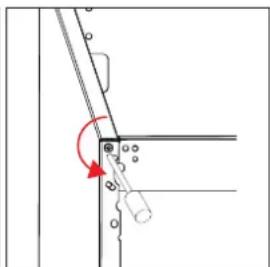
natural_image
Pure mechanical diagram showing a bracket with a red arrow indicating rotation, no text or symbols presentAbb. 10 Abb. 11
SILVER CREST®
natural_image
Mechanical assembly diagram showing four sequential steps of a bracket mechanism with no text or symbolsAbb. 12
natural_image
Mechanical assembly diagram showing four stages of a mechanical component with no visible text or symbolsAbb. 13
natural_image
Technical line drawing of a mechanical bracket or clamp assembly (no text or symbols)Abb. 14
natural_image
Technical line drawing showing two mechanical assembly configurations: one with a screwdriver and the other with a bracket (no text or symbols)Abb. 15 Abb. 16
natural_image
Simple line drawing of a screwdriver inserted into a clamp or bracket (no text or symbols)Abb. 17

1.1. Information about this user manual 37
1.2. Explanation of symbols....37
2. Proper use 38
3. Safety instructions 39
3.1. General safety instructions....39
3.2. Transport....40
3.3. Installation and electrical connection....40
3.4. Cleaning and maintenance....42
3.5. Faults 43
3.6. Disposal 43
4. Package contents 44
5. Description of components 44
6. Recommended food storage 45
7. Technical specifications....45
7.1. Product data sheet 46
8. EU declaration of conformity 47
9. Spare parts......47
10. Information on the appliance 47
10.1. Information regarding refrigerant R-600a....48
11. Before operation 48
11.1. Changing the door hinge 48
11.2. Setting up the appliance 51
11.3. Inserting/removing accessories 51
12. Operating the appliance 52
12.1. Setting the temperature....52
12.2. Switching off the appliance....54
13. Door alarm 54
14. Optimising energy consumption....54
15. Deep-freezing food....54
15.1. Using ice cube trays....55
15.2. Defrosting food....55
16. Storing food in the refrigerator compartment 55
17. Cleaning and defrosting 56
17.1. Defrosting....57
17.2. Cleaning the appliance....57
18. Replacing the interior light 57
19. Faults....57
20. Measures in case of power failure....57
21. Troubleshooting....58
22. Longer periods without use....58
23. Transport....59
24. Disposal....59
25. Legal notice 60
25.1. Information on trademarks....60
SILVER CREST®
26. MLAP GmbH Warranty 60
26.1. Conditions of warranty 60
26.2. Warranty period and legal claims for defects....60
26.3. Scope of warranty 60
26.4. Processing of warranty claims....61
27. Service....61
27.1. Supplier/Producer/Importer 61
28. Privacy statement 62
1. Introduction
1.1. Information about this user manual

Congratulations on purchasing your new appliance. You have chosen a high-quality product. The user manual is an integral part of this product. It contains important safety information and instructions for use and disposal. Before using the product, please familiarise yourself with all operating and safety instructions. Only use the product as described and for the specified applications. Keep this user manual in a safe place. If you give this product to someone else, ensure that you also hand over all the documents.
1.2. Explanation of symbols

DANGER!
Warning: risk of fatal injury!
■ Follow the instructions to avoid situations that will lead to fatal or serious injuries.
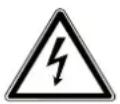
DANGER!
Warning: risk of electric shock!
■ Follow the instructions to avoid situations that will lead to fatal or serious injuries.

WARNING!
Warning: risk of possible fatal injury and/or serious irreversible injuries!
■ Follow the instructions to avoid situations that may lead to fatal or serious injuries.
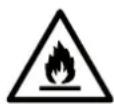
Warning: danger due to combustible and/or highly flammable substances!
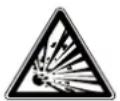
Warning: risk of explosive materials!

NOTICE!
Follow these instructions to prevent damage to the appliance!
▶ Follow the instructions to avoid situations that may damage the appliance.

Observe the notes regarding assembly or operation!

Follow the instructions in the user manual!

AC (alternating current)
■ Instruction to be followed to prevent hazards
- Bullet point/information on steps during operation
▶ Instruction to be carried out

Products that feature this symbol meet the requirements of the EU directives (see section entitled "EU declaration of conformity").
SILVERCREST®

Tested safety: Products that feature this symbol meet the requirements of the German Product Safety Act.

Packaging material label regarding waste separation
Label includes abbreviations (a) and numbers (b) with the following meaning: 1–7: plastics/20–22: paper and cardboard/80–98: composite materials.

Dispose of packaging in compliance with environmental regulations (see section "Disposal").

Dispose of packaging in compliance with environmental regulations (see section "Disposal").

The "Triman" symbol tells the consumer that the product can be recycled, is covered by an extended system of manufacturer's responsibility and must be sorted by material type, in France.
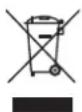
Dispose of the appliance in compliance with environmental regulations (see section "Disposal").

Indicates the correct upright position of the transport packaging.
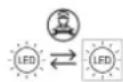
The replacement of the LED interior light is the responsibility of the manufacturer, its customer service or a similarly qualified person.
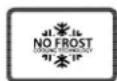
The symbol indicates that the appliance is a refrigerating appliance with automatic defrost (no frost).
2. Proper use
This appliance is intended to be used for cooling and freezing food. This appliance is designed for use in private households and similar household applications, such as:
- Staff kitchens in shops, offices and other workplaces
- In agriculture and by guests in hotels, motels and other types of accommodation
- Bed-and-breakfast establishments
- Catering establishments and wholesale use
The manufacturer accepts no liability for damages if the appliance is used for commercial purposes or for any purpose other than cooling and freezing food.
Please note that we shall not be liable in cases of improper use:
- Do not modify the appliance without our consent and do not use any auxiliary equipment that we have not approved or supplied.
- Only use replacement parts or accessories that we have supplied or approved.
- Comply with all the information in this user manual, especially the safety instructions. Any other use is considered improper and can cause personal injury or property damage.
3. Safety instructions
IMPORTANT SAFETY INSTRUCTIONS – READ CAREFULLY AND KEEP FOR FUTURE REFERENCE!
This appliance can be used by children over the age of 8 and by persons with reduced physical, sensory or mental abilities or by those with limited experience and/or knowledge, provided that they are supervised or have been instructed in how to use the appliance safely, and have understood the associated risks.
■ Children must not be allowed to play with the appliance.
■ Children between the ages of 3 and 8 are allowed to load and remove items from refrigerating appliances.
■ Cleaning and user maintenance must not be carried out by children unless they are supervised.

DANGER!
Risk of choking and suffocation!
There is a risk of choking and suffocation due to swallowing or inhaling small parts or plastic wrap.
- Keep all packaging materials used (bag, pieces of polystyrene etc.) out of reach of children.
■ Do not allow children to play with the packaging material. - Keep children away from the appliance inner. If the door is closed, there is a risk of suffocation!
3.1. General safety instructions

WARNING!
Risk of injury!
The appliance's refrigeration system contains R-600a refrigerant. If the refrigerant escapes, there is a risk of injuries.
■ WARNING! Do not damage the refrigerant circuit.
If the refrigeration system has nevertheless become damaged, ventilate the room. Avoid naked flames and ignition sources. Have the appliance repaired by a qualified technician before using it again.
If refrigerant comes into contact with the skin or eyes, this can lead to injuries. If necessary, rinse the eyes with clean water and consult a doctor.
■ WARNING! Do not operate electrical appliances inside the cooling chamber that do not conform to the design recommended by the manufacturer.
■ Do not use any other electrical appliances (such as ice machines) inside the refrigerating appliance unless they are approved for this purpose by the manufacturer.
■ Tampering with the refrigerant circuit is prohibited and invalidates the warranty.
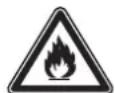
WARNING!
Risk of fire!
There are flammable liquids in the coolant circuit and the compressor.
■ Note the "Fire hazard" warning signs on the back of the appliance or the compressor.
- Avoid naked flames and ignition sources when using, maintaining and disposing of the appliance.
SILVER CREST®
3.2. Transport

CAUTION!
Risk of injury!
The appliance is heavy. There is a risk of injury from the strain of lifting the appliance.
- Seek the assistance of at least one other person in order to move the appliance. Do not transport the appliance alone.

NOTICE!
Possible material damage!
Risk of damage to the appliance if transported incorrectly
■ Make sure that the packaging is not damaged.
■ Carefully remove the packaging material and check the appliance for transport damage.
■ Never connect a damaged appliance. In the event of damage, contact the Service Centre.
■ Always transport the fridge freezer in its packaging and with the transport lock.
■ Ensure that no part of the refrigerant circuit is damaged when transporting and installing the appliance.
■ Where possible, always transport the appliance upright. If tilted to an angle of more than 40^ during transport, wait 4 hours before connecting it to the mains and switching it on to enable the refrigerant circuit to return to normal after transport.
■ Do not place the appliance on its side or back, as this can cause oil from the compressor to enter and block the refrigerant circuit.
■ Do not expose the appliance to rain or spray water.
3.3. Installation and electrical connection
3.3.1. Location

NOTICE!
Possible material damage!
Risk of damage to the appliance due to improper handling
■ Install the refrigerating appliance in a dry and ventilated room. The room should be approx. 4 m^2 to ensure that sufficient air volume is available if the refrigeration system becomes damaged.
■ Take the space requirements into consideration when setting up the appliance (see "11.2. Setting up the appliance" on page 51).
■ The appliance is suitable for climate classes ST, SN and N (see the type plate). The cooling performance of the appliance is guaranteed at ambient temperatures from 10^ C to 38^ C. If temperatures deviate from this range, the appliance performance may be reduced.
■ Do not use the appliance outdoors.
■ Do not expose the appliance to extreme conditions. Avoid:
– high humidity or wet conditions
- extremely high or low temperatures
- direct sunlight
- naked flames.

WARNING!
Risk of fire!
Insufficient air circulation can lead to heat accumulation.
■ WARNING! Make sure that the ventilation openings in the housing, around the appliance and in the installation niche are not blocked.
■ The appliance is not designed to be an integrated appliance.
■ To ensure adequate ventilation, a minimum clearance of 5 cm to the top, 5 cm to the sides and 5 cm to the back must be observed.
- Do not install near heat sources such as hobs, radiators, underfloor heating etc. If installation near a heat source cannot be avoided, use an appropriate insulation panel or maintain the following minimum clearances to the heat source:
- from electric or gas ovens or similar: approx. 5 cm
- from oil or coal-fired ovens: approx. 30 cm
- If installed next to another refrigerating appliance, a minimum distance of 5cm from the side is required.
3.3.2. Before connection
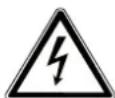
WARNING!
Risk of electric shock!
There is a risk of electric shock due to live parts.
■ After installing the appliance, check that the mains cable is not squashed or damaged.
■ Do not operate the appliance if it has been visibly damaged or the mains cable or plug is defective.
In the event of damage, contact the Service Centre.
3.3.3. Mains connection
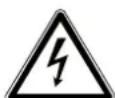
WARNING!
Risk of electric shock!
There is a risk of electric shock due to live parts.
■ Only connect the appliance to a properly installed and easily accessible earthed mains socket that is close to where you are using the appliance. The local mains voltage must match the voltage stated in the technical specifications for the appliance.
■ The power socket must be easily accessible so that you can unplug the appliance from the mains quickly if necessary.
■ WARNING! Ensure the mains cable is out of harm's way and will not trip people up. Do not use an extension cable.
■ WARNING! Do not allow the mains cable to become trapped or damaged during installation.
■ WARNING! Do not connect portable multiple sockets or power supplies to the back of the appliance.
In order to disconnect the appliance completely from the electrical circuit, pull the mains plug out of the socket.
SILVER CREST®
3.3.4. Use of the appliance
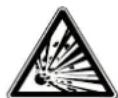
WARNING!
Risk of explosion!
Flammable gases and liquids can cause explosions if stored in the appliance.
■ Do not store any explosive materials, e.g. aerosol containers containing propellant gas, in the appliance.
- Do not freeze any carbonated beverages. Expanding liquid can break the container.

WARNING!
Risk of injury/risk to health!
Improper handling of the appliance can lead to injuries.
■ Do not misuse the plinth, drawer compartments, doors etc. as a step or for support.
The appliance may not work properly (temperature increase) if the appliance is exposed to temperatures that fall below the specified intended temperature range for a prolonged period of time (below 10^ C).
In case of power failure or a switched off appliance, stored foodstuffs may spoil. There is a risk of food poisoning.
If there has been a power failure, check that the food which is stored in the appliance still looks and smells safe to eat.
■ Do not store medicines, laboratory specimens or other temperature-sensitive products that are subject to the Medical Devices Directive 2007/47/EC inside the fridge freezer.
■ Ensure cleanliness and correct storage of food.
■ If the door is left open for a long time, this can cause the temperature inside the appliance zones to increase significantly.
■ Store raw meat and fish in appropriate containers in the appliance to ensure that they do not come into contact with or drip onto other food.
■ Store food on plates or in appropriate containers.
If the appliance is not going to be used for a longer period of time, pull the mains plug out of the mains socket, defrost and clean the appliance, leaving the door open to avoid unpleasant odours and to prevent mould from forming.
3.4. Cleaning and maintenance
■ Regularly clean surfaces that may come into contact with food and accessible drain systems.
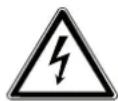
WARNING!
Risk of electric shock!
There is a risk of electric shock due to live parts.
■ Before starting any cleaning or maintenance work, pull the mains plug out of the socket (pull on the plug, not the mains cable). If the plug is not accessible, the corresponding fuse for the mains electricity supply to the house needs to be switched off.
■ Never touch the mains plug with wet or damp hands.

DANGER!
Risk of explosion and fire!
An accumulation of gas can lead to explosions.
■ Do not use any flammable liquids to clean the appliance or appliance parts.

NOTICE!
Possible material damage!
Damage to the appliance caused by improper handling
■ Do not operate any electrical appliances for cleaning inside the fridge freezer. Both appliances may be damaged irreparably.
- Do not use any abrasive or harsh cleaning agents on the inside, door or housing of the appliance as these could damage the surfaces.
■ Do not allow oil and grease to come into contact with the plastic parts and the door seal as the door seal can become porous and brittle.
■ Do not use any other mechanical equipment or synthetic agents to accelerate the defrosting process, e.g. electric heaters, hot air blowers or hair-dryers or pointed or hard objects. The heat insulation and appliance interior are sensitive to scratches and heat and can melt.
3.5. Faults
WARNING!
Risk of electric shock!
There is a risk of electric shock due to live parts.
■ Never try to open and/or repair an appliance component yourself.
If there is damage to the mains connection cable on this appliance, it must be replaced by the manufacturer, its customer service department, or another suitably qualified person. This is necessary to avoid hazards.
In the event of a fault, contact the Service Centre or another suitable professional repair workshop.
■ The replacement of the LED interior light is the responsibility of the manufacturer, its customer service or a similarly qualified person.
3.6. Disposal

DANGER!
Risk of choking and suffocation! Risk of injury!
To avoid risks to children, proceed as follows before disposing of the appliance:
■ Remove fridge and freezer doors and the seals or tape the fridge and freezer doors closed.
■ Leave the drawers/shelves in the appliance so that no-one, for example children, can climb into the appliance.
SILVER CREST®
4. Package contents

DANGER!
Risk of choking and suffocation!
There is a risk of choking and suffocation due to swallowing or inhaling small parts or plastic wrap.
- Keep the packaging material and small parts out of the reach of children.
Please check your purchase to ensure that all items are included and in perfect condition. If anything is missing or damaged, please contact us within 14 days of purchase.
The following items are supplied with your product:
- Fridge freezer, including:
- 2 glass shelves
- 1 transparent vegetable drawer with glass cover
- 1 transparent crisper drawer with glass cover
- 3 transparent door shelves
- 3 transparent freezer drawers
- 1 hinge cover
- 1 ice cube tray
- 1 egg tray
5. Description of components
See Fig. A
1) Hinge cover
2) Refrigerator door
3) Door compartments
4) Door compartment, small
5) Bottle compartment
6) Middle hinge
7) Freezer door
8) Lower hinge
9) Appliance feet,
Transport rollers (not shown, on the back)
10) Freezer drawers
11) Crisper drawer with glass cover (Fresh Converter), marked with
12) Vegetable drawer with glass cover
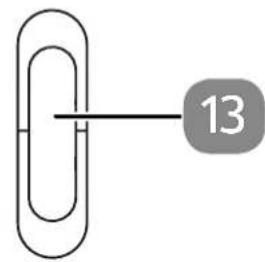
13) Slider for setting the temperature in the vegetable/crisper drawer (Fresh Converter)
14) Glass shelves
15) LED interior light
16) Controls
See Fig. B
17) Operating mode button: Select between ECO, SUPER or custom
18) ECO operating light
19) SUPER operating light
20) Temperature display
21) Fridge/freezer zone indicator: FRIDGE compartment or FREEZER compartment
22) TEMP button: Set temperature level
23) FG&FZ button: Select fridge or freezer zone
See Fig. C
The type plate is located in the refrigerator compartment.
6. Recommended food storage
▶ Store food in the correct fridge/freezer zone according to its type and sensitivity, see Fig. A.
Fridge/freezer compartment recommended for:
A) Cheese, pastry
B) Beverages (stored horizontally), sausages
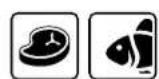
C) Fish, meat and poultry (store in suitable containers)
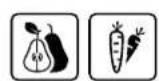
D) Fruit and vegetables
E) Fruit and vegetables / fish and meat (store in suitable containers)
F) Ice cream, frozen fruit, frozen foods, baked goods
G) Frozen vegetables, chips
H) Fresh meat, poultry, fish, ice cubes
I) Eggs
J) Jam, tins, glass containers
K) Butter
L) Milk, beverages

The ✕*** freezer compartment is suitable for storing the following foods:
Seafood (fish, prawns, shellfish), freshwater fish and meat products (recommended for 3 months, the longer the storage time, the more likely it is that the taste and nutritional value will deteriorate in quality), suitable for frozen fresh foods. Store the food in suitable containers (see also "15.
Deep-freezing food").
7. Technical specifications
Rated voltage: 220-240 V\~
Rated frequency: 50 Hz
Rated current: 0.90 A
Defrosting capacity: 160 W
Refrigerant: R-600a
Refrigerant quantity: 52 g
Insulation gas: Cyclopentane
Weight: Approx. 65.5 kg
Protection class:
Storage time in case of fault: 10.5 hours

SILVER CREST®
7.1. Product data sheet
| Supplier's name or trademark: SilverCrest® | |||
| Supplier's address: MLAP GmbHMeitnerstr. 970563 StuttgartGERMANY | |||
| Model identifier: SKGK 323 A1 | |||
| Type of refrigerating appliance: | |||
| Low-noise appliance: | No Design type: Free-standing | ||
| Wine cooler: No Other refrigerating | appliance: | Yes | |
| General product parameters: | ||||
| Parameter Value Parameter Value | ||||
| Overall dimensions (in mm) | Height 18 | 40 Total volume (in dm or l) ^3 | or l) | 323 |
| Width | 600 | |||
| Depth | 660 | |||
| EEI | 100 | Energy efficiency class | E | |
| Airborne noise emissions (in dB(A) re 1 pW) | 40 | Airborne noise emission class | C | |
| Annual energy consumption (in kWh/a)* | 249 | Climate class: | SN, N, ST | |
| Minimum ambient temperature (in °C) for which the refrigerating appliance is suitable | 10 | Maximum ambient temperature (in °C) for which the refrigerating appliance is suitable | 38 | |
| Winter mode | No | |||
* kWh/year energy consumption calculated on the basis of conformity testing results over 24 hours. The actual consumption will depend on the use and location of the appliance.
| Compartment parameters: | |||||
| Compartment type | Compartment parameters and values | ||||
| Compartment volume (in dm3 or l) | Recommended temperature settings for optimal food storage (in °C). | Freezing capacity (in kg/24h) | Defrost type A/M** | ||
| Compartment for fresh food | Yes | 219.0 | +4 | — | A |
| 4-star freezer compartment | Yes | 104.0 | -18 | 6.4 | A |
** Automatic defrost = A, manual defrost = M
| 4-star freezer compartment | |
| Fast freeze facility Yes | |
| Light source parameters: | |
| Type of light source LED | |
| Energy efficiency class G | |
| Minimum duration of the warranty offered by the manufacturer: | 36 months from date of purchase |
| Additional information: | Scan the QR code shown on the energy label to download the complete product data sheet. |
8. EU declaration of conformity


MLAP GmbH hereby declares that the product conforms to the following requirements of the European Union:
• EMC Directive 2014/30/EU
• Low Voltage Directive 2014/35/EU
• Ecodesign Directive 2009/125/EC
• RoHS Directive 2011/65/EU.
9. Spare parts
If you would like to order spare parts, please contact us using the contact form at www.mlap.info/contact.
10. Information on the appliance
- The appliance uses refrigerant R-600a (HCFC- and CFC-free) in the refrigerant circuit.
- The refrigerant circuit has been checked for leaks. This complies with the relevant safety regulations for electrical appliances.
• Energy efficiency class E
• Climate class SN, N, ST
The different climate classes are explained in the following table.
| Climate class Meaning | Ambient temperature | |
| SN | Appliances for subnormal climate | +10°C to +32°C |
| N | Appliances for normal climate | +16°C to +32°C |
| ST Appliances for subtropical climate | +16°C to +38°C | |
| T | Appliances for tropical climate | +16°C to +43°C |
SILVER CREST®
10.1. Information regarding refrigerant R-600a
R-600a and cyclopentane are used as 100% HCFC-free refrigerant and insulating materials in this appliance. This helps to protect the ozone layer and reduces the so-called greenhouse effect.
These appliances can be identified by the "Refrigerant R-600a" notice on the type plate.
Ensure that the refrigerant circuit is not damaged, as small quantities of R-600a can contribute to the greenhouse effect if released.
This applies both when transporting the appliance and throughout its service life. Also ensure that you dispose of this appliance correctly according to local regulations.
11. Before operation
Remove the packaging material and all protective film.
11.1. Changing the door hinge
The fridge freezer is supplied with the doors hinged on the right-hand side. If you would like to change the opening direction of the fridge freezer doors, proceed as follows.
To change the door hinge, you will need:
• Phillips screwdriver
- Slotted screwdriver
- 6 mm wrench
- 8 mm wrench
- 10 mm wrench
In addition, you require the hinge cover (27) for the door with left-hand door hinge from the accessories. The mains plug has been unplugged.
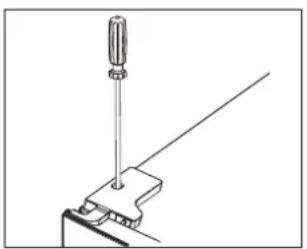
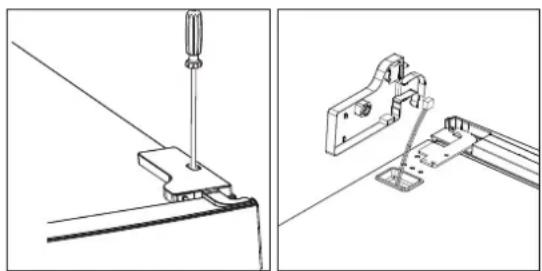
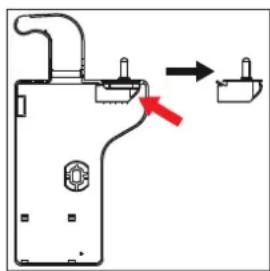
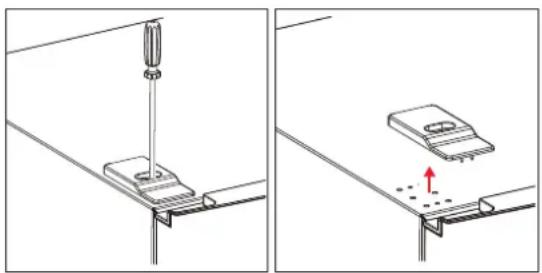
▶ Use a Phillips screwdriver to unscrew the retaining screw on the hinge cover (1) (Fig. 1) and gently remove the cover (Fig. 2).
Then press the release on the cable connector and simultaneously pull it out of the socket on the hinge cover (1).
▶ Remove the hinge cover (1) completely.
natural_image
Technical line drawing showing two mechanical assembly steps: one with a screwdriver inserted into a bracket, the other with a clamp securing a bracket (no text or symbols present)Fig. 1 Fig. 2
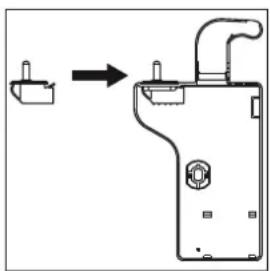
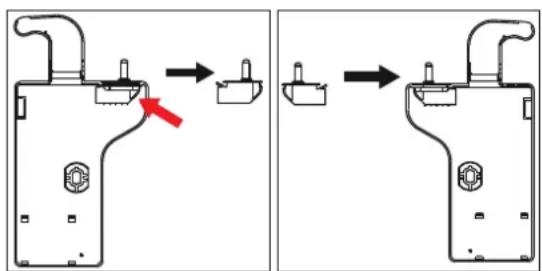
▶ Press down the marked tab on the door contact to enable the door contact to be removed from the hinge cover (1) (Fig. 3).
Mount the door contact in the hinge cover (27) from the accessories by clipping in the door contact (Fig, 4). Place the hinge cover safely to one side for use later.
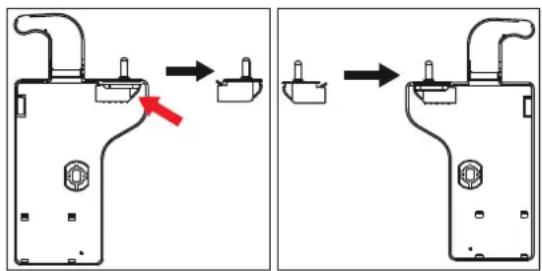
Fig. 3 Fig. 4
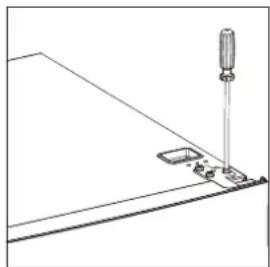
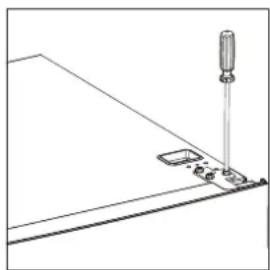
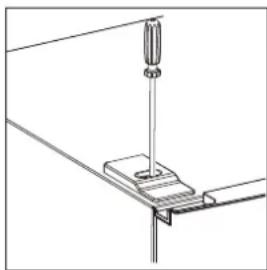
▶ Unscrew the three retaining screws on the perforated hinge plate and remove the hinge from the refrigerator door (2) (Fig. 5). Remove the washer as well and place them safely to one side for use later.
▶ Lift the refrigerator door (2) off the middle hinge and place it to one side on a soft surface to avoid scratches and secure it against falling over.
natural_image
Simple line drawing of a mechanical setup with a screwdriver and a base component (no text or symbols)Fig. 5
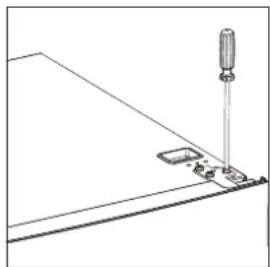
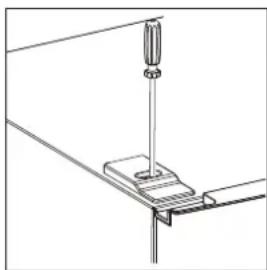
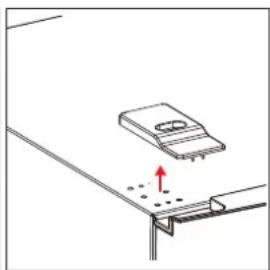
▶ Use a Phillips screwdriver to remove the retaining screw on the screw cover (Fig. 6).
▶ Lift up the screw cover (Fig. 7) and reposition it onto the holes on the opposite side that are now free. Make sure that both screw cover lugs are at the front and are seated securely in the front holes.
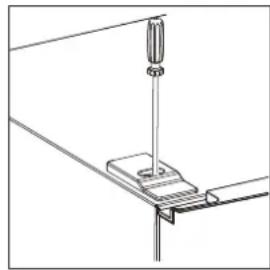
natural_image
Technical line drawing of a mechanical assembly with a screwdriver inserted into a bracket (no text or symbols)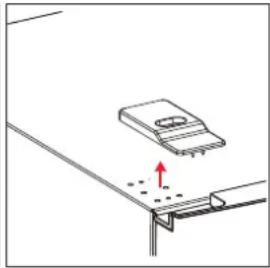
natural_image
Simple line drawing of a mechanical component with a red arrow indicating upward motion (no text or symbols)Fig. 6 Fig. 7
▶ Pierce the right hole in the screw cover using a pointed object such as a Phillips screwdriver. Then screw down the screw cover in the right hole.
Remove the middle hinge (6) by loosening the retaining screws (Fig. 8). Remove the washers as well and place them safely to one side for use later.
▶ Lift the freezer door (7) off the bottom hinge and place it to one side on a soft surface to avoid scratches and secure it against falling over.
Remove the blind plug from the hinge bushing on the left-hand side of the freezer compartment door (7) by prying it out using a slotted screwdriver. Re-insert the blind plug into the hinge bushing on the right-hand side.
Pry out the blind plugs between the refrigerator and freezer compartment on the left-hand side using a slotted screwdriver and reposition into the holes on the right-hand side that are now free.
▶ Seek the assistance of a second person to tip the appliance backwards slightly so that you can access the underside of the appliance.
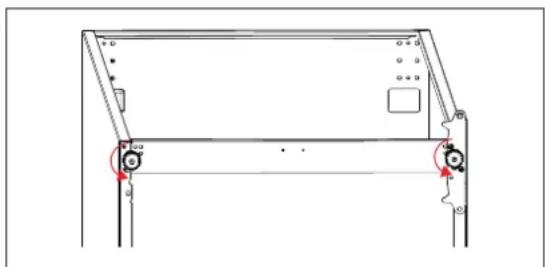
Remove the appliance feet (9) by turning anti-clockwise (Fig. 9).
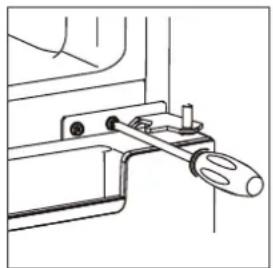
natural_image
Technical line drawing of a mechanical clamp or bracket assembly (no text or symbols)Fig. 8
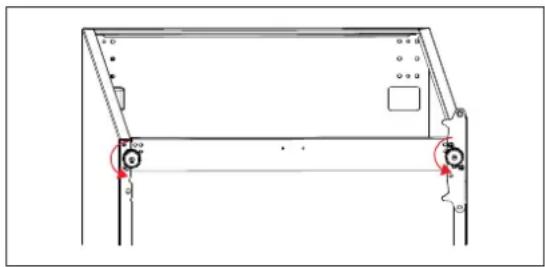
natural_image
Pure technical line drawing of a mechanical component with no text, numbers, or symbolsFig. 9
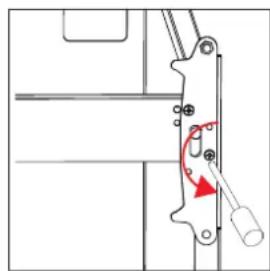
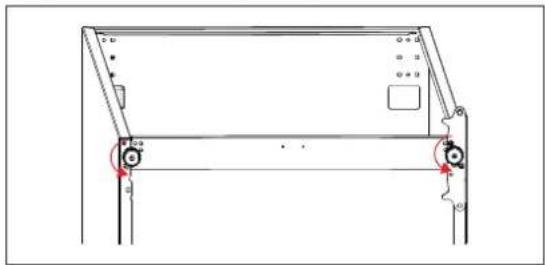
▶ Unscrew the two retaining screws on the perforated hinge plate and remove the hinge from the freezer door (7) (Fig. 10).
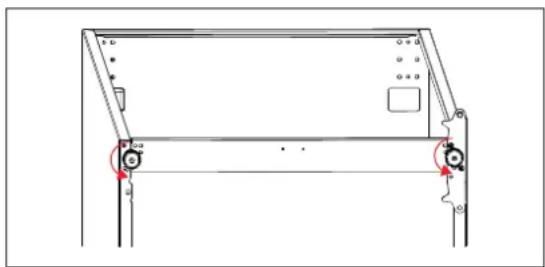
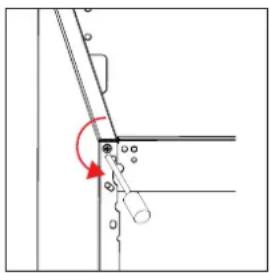
▶ Loosen the screw on the left side of the housing using a Phillips screwdriver and reposition it on the right side of the housing (Fig. 11).
natural_image
Mechanical assembly diagram showing a lever mechanism with red arrows indicating motion or force (no text or symbols present)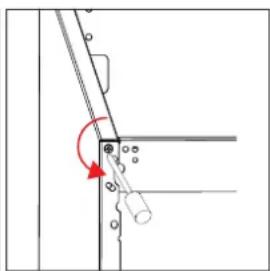
natural_image
Pure mechanical diagram showing a lever mechanism with a red arrow indicating rotational motion (no text or symbols)Fig. 10 Fig. 11
SILVER CREST®
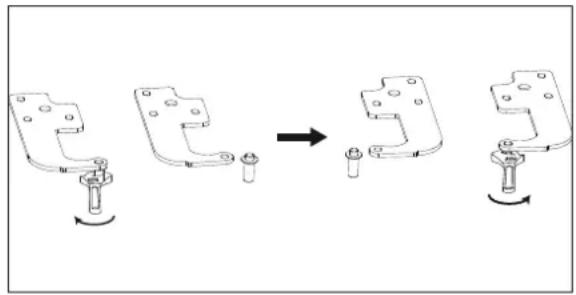
▶ Use a 6 mm wrench to remove the upper hinge pin (Fig. 12) and screw the pin back into the hole on the opposite side.
natural_image
Mechanical assembly diagram showing four sequential steps of a bracket clamp mechanism (no text or labels)Fig. 12
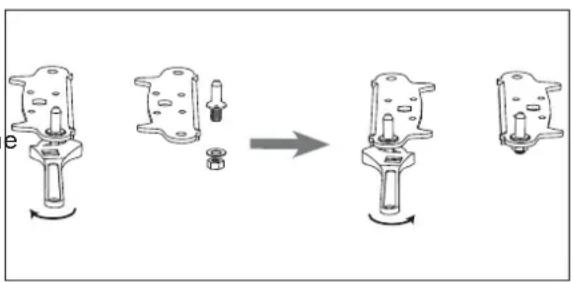
▶ Use a 10 mm wrench to remove the lower hinge pin (Fig. 13) and screw the pin back into the hole on the opposite side.
▶ Turn the perforated plate of the lower hinge so that the holes in the perforated plate match the holes in the appliance on the opposite side.
natural_image
Mechanical assembly diagram showing four stages of a mechanical component with no visible text or symbolsFig. 13
▶ Screw on the lower hinge (8) using the four retaining screws.
▶ Screw in the appliance feet (9).
▶ Stand the appliance upright again. Next, level the appliance by screwing the appliance feet (9) in or out as required.
Now place the freezer compartment door (7) on the lower hinge (8) by positioning the recess at the bottom of the freezer compartment door (7) onto the pin.
▶ Keep the freezer door (7) closed.
▶ Position the middle hinge (6) on the left-hand side.
Place two washers on the pin of the middle hinge and place the pin in the freezer compartment door (7).
- Secure the middle hinge (6) using the two screws and a Phillips screwdriver (Fig. 14).

natural_image
Technical line drawing of a mechanical bracket or clamp assembly (no text or symbols)Fig. 14
Do not tighten the screws completely yet so that you can still align the freezer door (7). Tighten the screws firmly only when it is possible to close the freezer door (7) evenly.
Place a washer onto the hinge pin of the middle hinge and place the refrigerator door (2) onto the hinge pin.
Now place the refrigerator compartment door (2) on the middle hinge (6) by positioning the recess at the bottom of the refrigerator compartment door (2) onto the hinge pin.
▶ Turn the perforated plate of the upper hinge so that the holes in the perforated plate match the holes in the appliance on the opposite side.
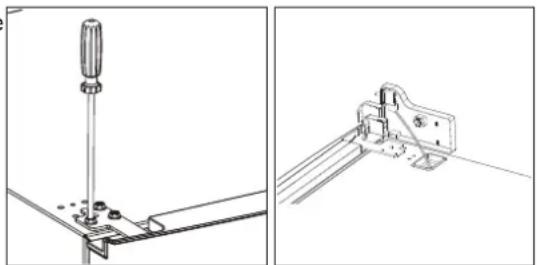
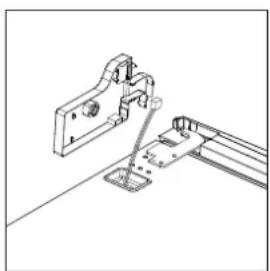
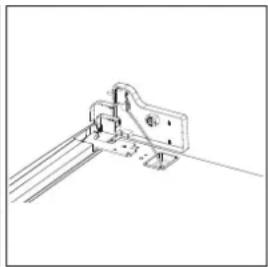
▶ Secure the upper hinge using the retaining screws as well (Fig. 15).
Do not tighten the screws completely yet so that you can still align the door. Tighten the screws firmly only when it is possible to close the door evenly.
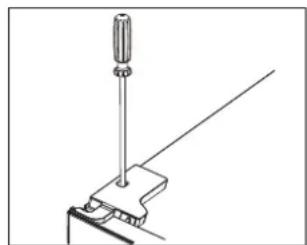
▶ Insert the cable connector into the bushing on the hinge cover (27) from the accessories (Fig. 16).
natural_image
Technical line drawing showing two views of a mechanical bracket assembly (no text or symbols)Fig. 15 Fig. 16
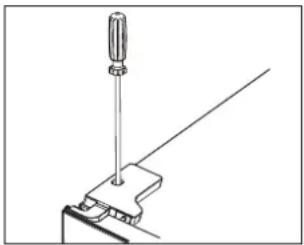
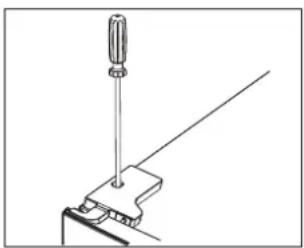
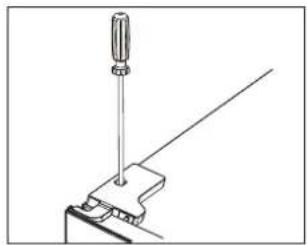
Place the hinge cover (27) onto the hinge with the door contact mounted and tighten the hinge cover (27) (Fig. 17).
natural_image
Simple line drawing of a screwdriver inserted into a clamp (no text or symbols)Fig. 17

The door seal adapts to the new door hinge after a few hours.
11.2. Setting up the appliance
Before switching on the appliance for the first time, clean all parts of the appliance (see section "17. Cleaning and defrosting" on page 56).
Dry the appliance thoroughly after cleaning and before switching it on for the first time.
Place the appliance in an appropriate location (see also section "3.3.1. Location" on page 40).
▶ Ensure that the appliance is level. Compensate for any unevenness in the floor by screwing the appliance feet (9) in or out.
▶ Level the fridge freezer with a spirit level.
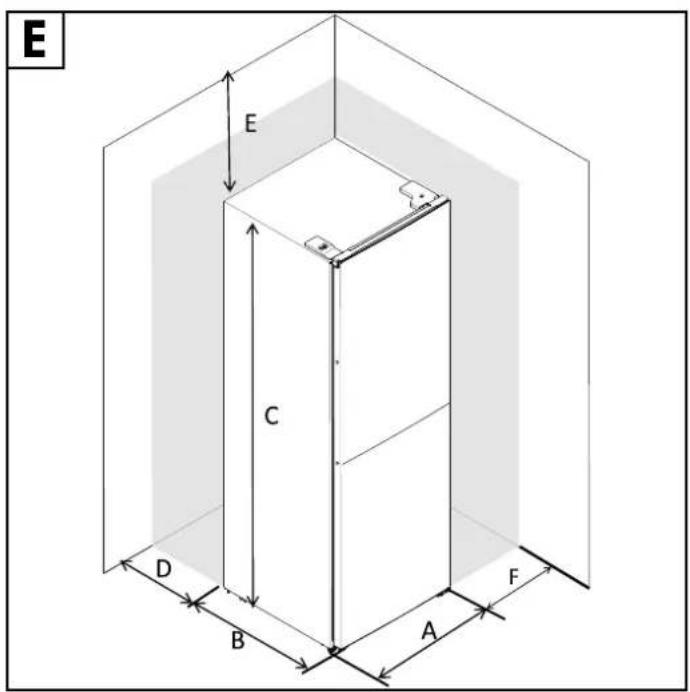
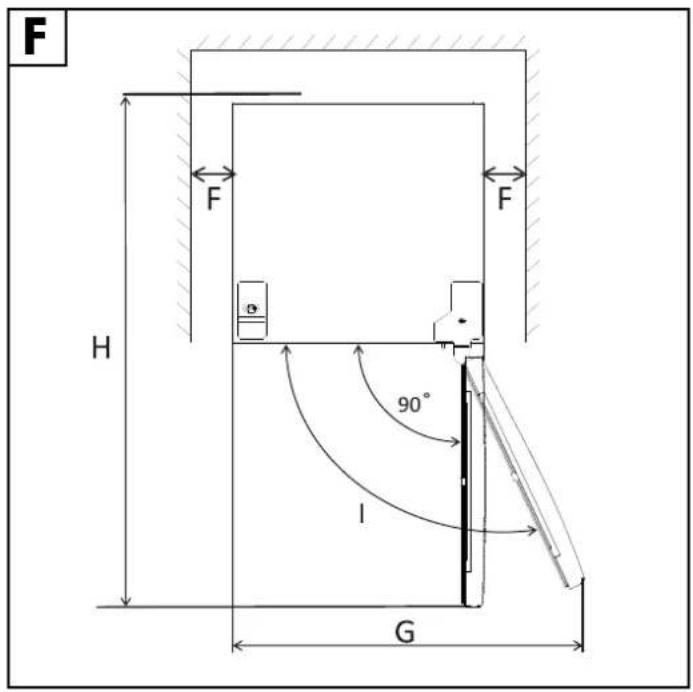
To fully open the appliance doors, the room dimensions stated below must be available (see also Fig. E and Fig. F):
| Room dimensions (Fig. E/F) | |
| A 600 mm | |
| B 660 mm | |
| C 1840 mm | |
| D min. 50 mm | |
| E min. 50 mm | |
| F min. 50 mm | |
| G | 1200 mm |
| H | 1285 mm |
| I | 135° |
11.3. Inserting/removing accessories
11.3.1. Inserting/removing freezer drawers/vegetable drawer/crisper drawer
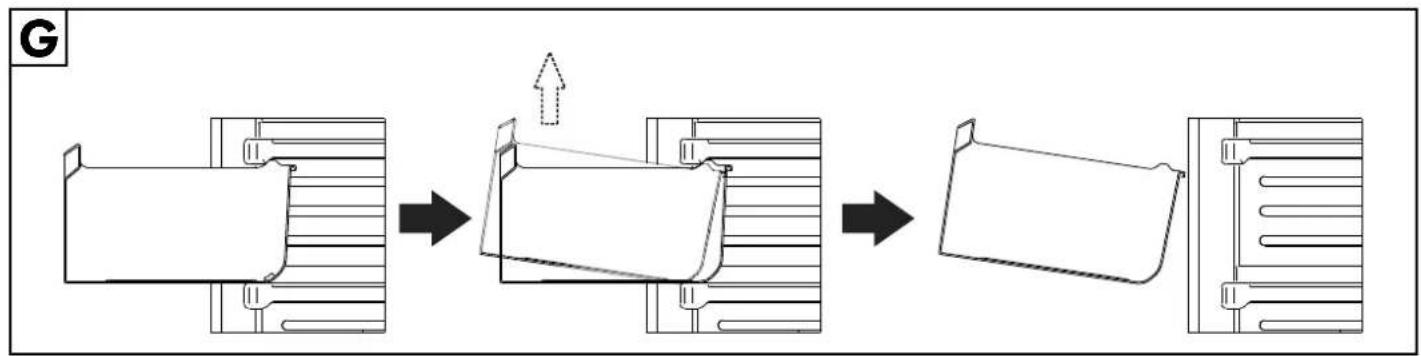
▶ To remove a freezer drawer (10) / crisper drawer (11) / vegetable drawer (12), open the door fully.
▶ Pull out the freezer drawer (10) / crisper drawer (11) / vegetable drawer (12) with both hands and remove the freezer drawer (10) / crisper drawer (11) / vegetable drawer (12) from the freezer compartment / refrigerator compartment at a slight angle (Fig. G).

For easy removal of the crisper drawer (11), remove the corresponding glass cover (11) beforehand (see below).
To insert the freezer drawer (10) / crisper drawer (11) / vegetable drawer (12), slide them into the appliance at a slight angle.
SILVER CREST®
11.3.2. Removing glass shelves / glass covers
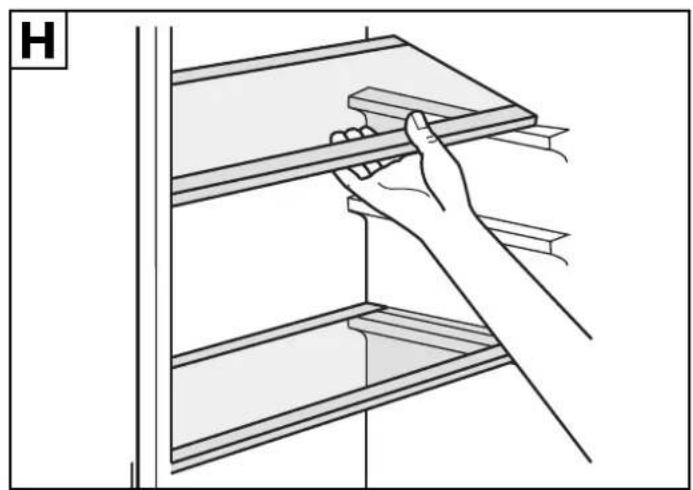
▶ Open the door fully to remove the glass shelves (14) / glass covers (11/12) (Fig. H).
▶ Lift the shelf (14) / glass cover (11/12) with both hands and pull the shelf / glass cover out of the refrigerator compartment.
When removing the glass covers, pull out the crisper drawer (11) or the vegetable drawer (12) slightly first so that the glass covers can be removed easily.
11.3.3. Inserting glass shelves / glass covers
Insert the glass shelves (14) / glass covers (11/12) from the front into the recesses in the refrigerator wall.
11.3.4. Removing/inserting door compartments
▶ Lift the door compartment (3–5) (Fig. I) to remove it.
To fit a door compartment, slide the door compartment from top to bottom onto the door compartment guide until it is firmly in place.
The small door compartment (4) can be inserted on the right or left of the centre guide.
11.3.5. Egg tray
Place the egg tray (25) in the upper door compartment (3).
12. Operating the appliance
Connect the appliance to an earthed mains socket. The local mains voltage must match the voltage stated in the technical specifications for the appliance.
The appliance settings are carried out using the control panel and the slider (13) in the refrigerator compartment.
- Store food in the correct cooling zones according to its type and sensitivity (see "6. Recommended food storage" on page 45).

Audible noises such as cracking, humming or gurgling are caused by the expansion and shrinkage of the components as a result of the temperature changes or by the compressor working and do not indicate a malfunction.
12.1. Setting the temperature
The temperature of the fridge and freezer compartments is controlled independently of each other.
The appliance operates perfectly at an ambient temperature between 10^ C and 38^ C.
Refrigerator compartment:
▶ Press the button to set the refrigerator compartment. The FRIDGE cooling zone indicator (21) lights up as soon as the refrigerator compartment has been selected.
Press the TEMP button (22) once or several times to set a temperature ( 2^ C, 3^ C, 4^ C, 5^ C, 6^ C, 7^ C, 8^ C or OFF).
The OFF setting switches off the cooling in the refrigerator compartment, but not in the freezer compartment. The set temperature initially flashes in the digital temperature display (20) for 5 seconds before it is accepted and permanently displayed.

Effects of storage on food
When set to 5^ C, the optimal storage time of food in the refrigerator compartment is no longer than 3 days.
Other settings can shorten the optimal storage time. The optimal storage time varies depending on the food. Pay attention to the storage times recommended by the food manufacturers.
Crisper drawer:
Use the slider (13) in the refrigerator compartment to set the temperature and humidity control for the crisper drawer (11) (marked with 📄, 🐃, 🌈, 🍼).
▶ Move the slider (13) up to reduce the temperature in the crisper drawer (11). This setting is particularly suitable for short-term storage (approx. 3 days) of fresh meat, poultry or fish; the refrigerator compartment temperature should also be set to <4^ .
▶ Move the slider (13) down to increase the temperature in the crisper drawer (11). This setting is particularly suitable for storing vegetables and fruit due to an ideal temperature and humidity setting.
Freezer compartment:
▶ Press the Ⓗ button to set the freezer compartment. The FREEZER cooling zone indicator (21) lights up as soon as the freezer compartment has been selected.
Press the TEMP button (22) once or several times to set a temperature (-14°C, -15°C, -16°C, -17°C, -18°C, -19°C, -20°C, -21°C or -22°C).
The set temperature initially flashes in the digital temperature display for 5 seconds before it is accepted and permanently displayed.

Effects of storage on food
When set to -18^ , the optimal storage time of food in the freezer compartment is no longer than 3 months.
Other settings can shorten the optimal storage time. The optimal storage time varies depending on the food. Pay attention to the storage times recommended by the food manufacturers.

The internal temperatures can be influenced by factors such as the installation location, ambient temperature and the number of times the door is opened. Take these factors into account when setting the temperature.

Do not load the fridge freezer compartments before the appliance has reached the appropriate refrigeration and freezing temperature.

If frost forms on the back, set the temperature lower.
▶ Check the temperatures in the fridge and freezer compartment with a thermometer. Once the set temperatures have been reached, you can load it with food.
12.1.1. ECO mode
In ECO mode, the temperature is automatically regulated to a temperature of 5^ C in the refrigerator compartment and -18^ C in the freezer compartment.
This function is for energy-efficient operation.
Press the button (17) once or several times to set ECO mode. The ECO operating light (18) initially flashes for 5 seconds as soon as ECO mode has been selected. The ECO operating light (18) lights up continuously as soon as the ECO mode has been activated.
12.1.2. Super freezing mode
In super freezing mode, the temperature is automatically regulated to approx. -25^ in the freezer compartment and manually set in the refrigerator compartment. The super freezing mode ends after 50 hours at the latest.
This function is used to freeze food quickly without losing the nutrients, vitamins, flavours or appearance.
▶ Activate the super freezing mode 24 hours before loading fresh food to be frozen and when loading the appliance for the first time.
SILVER CREST®
Press the 📄 button (17) once or several times to set the super freezing mode. The SUPER operating light (19) initially flashes for 5 seconds as soon as super freezing mode has been selected. The SUPER operating light (19) lights up continuously as soon as the super freezing mode has been activated.
When super freezing mode is activated, the temperature in the freezer compartment cannot be adjusted.
▶ Press the button again until the SUPER operating light (19) goes out. The super freezing mode is now switched off.
12.1.3. Custom operation
This function is used for setting the temperature of the refrigerator and freezer compartments individually.
Press the button (17) once or several times to set custom operation. The ECO (18) and SUPER operating lights (19) are switched off as soon as custom operation has been selected.
▶ Set the temperature for the refrigerator and freezer compartment manually as described above.
12.2. Switching off the appliance
▶ Unplug the appliance from the power socket to de-energise the appliance completely.
13. Door alarm
If the refrigerator compartment door (2) is left open for more than 60 seconds, an alarm signal sounds.
▶ Close the refrigerator compartment door (2) immediately. The alarm signal stops once the refrigerator compartment door (2) is closed.
14. Optimising energy consumption
In order to achieve the best possible cooling performance with low energy consumption, observe the following:
Do not position the appliance near a heat source (radiator or cooker etc.).
The location should be not too warm, dry, dust-free and well ventilated.
▶ Ensure that air can circulate freely around the refrigerating appliance.
The energy consumption will be lowest if all shelves and drawers are left inside the appliance when it is in use.
If the door is left open for a long time, this can cause the temperature inside the appliance zones to increase significantly. Only open the door briefly when loading and removing foodstuffs. Less cold can escape if the door is left open for only a short time and therefore the appliance requires less energy.
▶ Select the temperature setting according to how full the appliance is.
▶ Ensure that the door seals are undamaged and that the door closes properly.
If the appliance is left empty for an extended period of time, switch it off. Defrost and clean the appliance and allow it to dry. Leave the door open to prevent mould from forming in the appliance.
15. Deep-freezing food
Almost all types of food are suitable for freezing, except vegetables which are eaten raw, e.g. lettuce. Only high-quality food is suitable to be frozen. Freeze food in portions for single use and do not refreeze any products that have defrosted.
▶ Food to be frozen must not come into contact with food that has already been frozen. It may be necessary to reduce the quantity of food to be frozen if you intend to freeze food each day.
Do not exceed the storage times recommended by the food manufacturers.
Place the food in odourless, airtight, moisture-free, greaseproof and leach-resistant packaging.
– Polythene bags and aluminium foil are the most suitable materials.
- The food must be closely wrapped in airtight packaging.
- Do not use glass packaging as the glass may break.
▶ Set the temperature control to Super freezing mode 24 hours before putting fresh food in the freezer. After loading with fresh food to be frozen, set the temperature control to -18^ C.
▶ Take care not to overload the freezer compartment as otherwise optimal performance cannot be guaranteed and energy consumption will increase.
- Signs of moisture or swelling of deep-freeze packaging indicates that the food has not been stored/transported correctly and may be spoiled. Check the condition of the food before eating.
Fruit can be frozen in the freezer compartment and ice cubes can be made.
15.1. Using ice cube trays
▶ Clean the ice cube tray (24) thoroughly with water and a little washing-up liquid before using for the first time.
▶ Fill the ice cube tray (24) with drinking water.
Place the ice cube tray (24) upright in the bottom freezer drawer (10).
As soon as the ice cubes are frozen, remove the ice cube tray (24) from the freezer drawer (10) and press the ice cubes out of the mould.
15.2. Defrosting food
Depending on the type and use, food can be defrosted in a refrigerator, in a container filled with lukewarm water, in a microwave, at room temperature or in the oven. Fruit and vegetables which are going to be cooked do not need to be defrosted.
Once defrosted, food is preferably to be eaten on the same day or stored in the refrigerator until the next day at the latest. Food must not be refrozen, even if it has not fully defrosted.
16. Storing food in the refrigerator compartment

NOTICE!
Possible material damage!
Possible risk of damage to the door seal
■ Sensitive surfaces: Do not allow oil and grease to come into contact with the plastic parts and the door seal as the surface can become porous and brittle.
To avoid food from becoming contaminated (spoiled), please observe the following instructions:
If the door is left open for a long time, this can cause the temperature inside the appliance zones to increase significantly.
▶ Regularly clean surfaces that may come into contact with food and accessible drain systems.
▶ Store raw meat and fish in appropriate containers in the appliance to ensure that they do not come into contact with or drip onto other food.
▶ Store food on plates or in appropriate containers.
▶ Distribute the food evenly throughout the appliance. Please note that food must not touch the rear wall of the refrigerator compartment, as this could cause frost and condensation to form.
Do not put hot food or food that is still warm in the refrigerator compartment. Allow the food/dishes to cool completely so as not to increase energy consumption and to avoid damage to the appliance.
▶ Ensure that foods that take on other smells easily, such as butter, milk and quark, are well packaged. i.e. in tightly sealed containers.
▶ Store food in the correct cooling zone according to its type and sensitivity.
▶ Storing vegetables with a high water content causes condensation to form on the vegetable containers. This does not impair the proper function of the refrigerator compartment.
Dry vegetables thoroughly before placing them in the refrigerator compartment. The storage time is reduced for vegetables with a high water content (e.g. leaf vegetables, cucumbers).
SILVER CREST®
17. Cleaning and defrosting
▶ Regularly clean surfaces that come into contact with food and the drainage system.
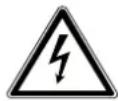
WARNING!
Risk of electric shock!
There is a risk of electric shock from electrified parts.
■ Before starting any cleaning work, pull the mains plug out of the socket (pull on the plug, not the cable). If the plug is not accessible, the corresponding fuse for the mains electricity supply to the house needs to be switched off.
■ Do not touch the mains plug with wet or damp hands.
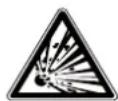
DANGER!
RISK OF EXPLOSION AND FIRE!
An accumulation of gas can lead to explosions.
■ Do not use any flammable liquids to clean the appliance or appliance parts.
■ Do not use de-icer sprays. They may produce explosive gases.

WARNING!
Risk to health!
Improperly handling foods can lead to food poisoning.
Cooling is no longer sufficient if you switch off the appliance or in case of power failure.
Frozen food can thaw or defrost completely.
A rise in temperature of the frozen food during manual defrosting, maintenance or cleaning can shorten the storage life of the frozen products.
■ Remove the frozen food from the appliance, wrap in several layers of newspaper and store in a sufficiently cool room or refrigerator.

WARNING!
Risk of injury!
Risk of burns resulting from the low temperatures.
- Do not touch the freezer compartment's frozen inner walls or frozen foodstuffs with your hands. Use a dry cloth, for example, to hold the frozen products.

NOTICE!
Possible material damage!
Damage to the appliance due to improper handling of the sensitive surfaces of the appliance
■ Sensitive surfaces: Do not allow oil and grease to come into contact with the plastic parts and the door seal as the door seal can become porous and brittle.
■ Never use acidic, abrasive or granular, acetic-acid-, soda- or solvent-based cleaning agents. These may damage the surfaces of your appliance.
- Do not use any other mechanical equipment or synthetic agents to accelerate the defrosting process, e.g. electric heaters, hot air blowers or hair-dryers or pointed or hard objects. The heat insulation and appliance interior are sensitive to scratches and heat and can melt.
■ Do not operate any electrical appliances inside the fridge freezer. Both appliances may be damaged irreparably.
17.1. Defrosting
Your appliance has a No-Frost function that prevents frost from forming on the inner walls and on food when the appliance is in use. The continuously circulating cold air prevents frost from forming. This means that it is not necessary to manually defrost the appliance, instead defrosting takes place automatically.
The temperature increase when defrosting complies with ISO requirements. If you would like to prevent the temperature of frozen foods from increasing too much when defrosting the appliance, store the frozen food packed in several layers of newspaper.
17.2. Cleaning the appliance

A rise in temperature of the frozen food during manual defrosting, maintenance or cleaning can shorten the storage life of the frozen products.
▶ Unplug the mains plug.
Remove the drawers and the shelves from the refrigerator and freezer compartment.
Wipe the refrigerator and freezer compartment with water and a mild detergent (e.g. washing-up liquid) and leave to dry completely.

To prevent mould, vinegar (cleaning vinegar, household vinegar or vinegar essence) can be added to the water for cleaning. Cleaning agents containing sand, soda and acid are not suitable.
Carefully rinse all fittings with water and a little washing-up liquid and leave to dry (vegetable drawer (12), crisper drawer (11), freezer drawer (10), glass shelf (14), egg tray (25), ice cube tray (24)).
▶ Clean the appliance surfaces, except the door seal, with a mild cleaning agent.
▶ Clean the door seal with clean water, wipe it off and allow to dry.
▶ Plug the mains plug back into the socket.
As soon as the freezer compartment has reached a temperature of -18^ , you can put the food back into the appliance.
18. Replacing the interior light

CAUTION! Risk of injury/damage to the appliance!
The replacement of the LED interior light is the responsibility of the manufacturer, its customer service or a similarly qualified person.
■ If the interior light does not work, contact customer service.
19. Faults
WARNING! Risk of electric shock!
There is a risk of electric shock due to live parts.
■ Never try to open and/or repair an appliance component yourself.
In the event of a fault, contact the Service Centre or another suitable professional repair workshop.
20. Measures in case of power failure
Food must not be refrozen, even if it has not fully defrosted.
In case of a power failure, check the condition of food before eating (see also "3.3.4. Use of the appliance").
SILVER CREST®
21. Troubleshooting
Faults may occur during operation. Please use the following table to check whether you can resolve the problem yourself. All other repairs are prohibited and invalidate the warranty. Therefore, in the event of a fault, contact our Service Centre or another suitable professional repair workshop.
| Fault Cause Solution | ||
| The appliance is not working. | Power supply interrupted | ▸ Check whether the mains plug is plugged in.▸ Check whether the mains socket is live by plugging in another electrical appliance (e.g. a bedside lamp). Have the mains socket repaired, if necessary.▸ Check that the mains cable is not damaged. Contact customer services if necessary. |
| The interior lighting is not working. | LED interior lighting is defective | ▸ Contact customer services (see “18. Replacing the interior light” on page 57) |
| The temperature is not low enough. | The door does not seal properly or is opened too often. | ▸ Arrange food so that it does not prevent the door from closing properly.▸ Open the door for less time. |
| The ambient temperature is less than 10°C/higher than +38°C. | ▸ The appliance is designed to work in a temperature range from +10°C to +38°C. | |
| Air circulation behind the appliance is impeded. | ▸ Move the appliance away from the wall. | |
| The appliance has been set up in a location exposed to direct sunlight or next to a heat source. | ▸ Place the appliance in a different position. | |
| Water collects on the bottom of the refrigerator compartment. | Food is touching the rear wall of the refrigerator compartment. | ▸ Move food and containers away from the rear wall. |
| The appliance makes too much noise. | The appliance has not been set up properly. | ▸ Level the appliance by screwing the appliance feet (9) in or out. |
22. Longer periods without use
If the appliance is not going to be used for a longer period of time, proceed as follows to safely store and protect the appliance.
▶ Pull the mains plug out of the mains socket.
▶ Clear out the appliance.
▶ Wipe out the inside of the freezer and refrigerator compartments and allow to dry.
▶ Carefully clean and dry all fittings.
Leave the refrigerator and freezer compartment door open to avoid unpleasant odours and to prevent mould from forming.
23. Transport

CAUTION! Risk of injury!
The appliance is heavy. There is a risk of injury from the strain of lifting the appliance.
- Seek the assistance of at least one other person in order to move the appliance. Do not transport the appliance alone.
▶ Disconnect the appliance plug from the mains socket.
Remove all food, shelves and glass shelves from the refrigerator compartment.
▶ Fully screw in the adjustable appliance feet (9).
▶ Tape the refrigerator and freezer compartment door shut.
▶ To avoid damage during transport, we recommend that you use the original packaging.
24. Disposal

DANGER!
Risk of choking and suffocation! Risk of injury!
To avoid risks to children, proceed as follows before disposing of the appliance:
■ Remove fridge and freezer doors and the seals or tape the fridge and freezer doors closed.
■ Leave the drawers/shelves in the appliance so that no-one, for example children, can climb into the appliance.

Packaging
Your appliance has been packaged to protect it from damage in transit. Packaging materials are raw materials and can therefore be reused or recycled.
Appliance
Do not dispose of old appliances in normal household waste.
In accordance with Directive 2012/19/EU, these appliances must be disposed of correctly at the end of their service life.
This involves separating the materials in the appliances for the purpose of recycling and minimising the environmental impact.
Take old appliances to a collection point for electrical scrap or a recycling centre.
Contact your local waste disposal company or your local authority for more information on this subject.
During disposal, please note that the appliance/insulation contains cyclopentane (a flammable expanded gas for insulation).
The appliance/insulation must be disposed of correctly.
SILVER CREST®
25. Legal notice
Copyright © 2021
All rights reserved.
This user manual is protected by copyright.
Mechanical, electronic and any other forms of reproduction are prohibited without the written permission of the manufacturer.
Copyright is owned by the company:
MLAP GmbH
Meitnerstr. 9
70563 Stuttgart
GERMANY
25.1. Information on trademarks
SilverCrest® is a registered trademark of Lidl Stiftung & Co. KG, 74167 Neckarsulm, Germany.
All other names and products are trademarks or registered trademarks of their respective owners.
26. MLAP GmbH Warranty
Dear customer,
The warranty on this product is 3 years from the date of purchase. In the event of defects in this product, you have legal rights against the product vendor. These legal rights are in no way limited by the warranty described below.
26.1. Conditions of warranty
The warranty period begins on the date of purchase. Please take care to keep the original purchase receipt. This document will serve as a proof of purchase.
If, within three years of the date of purchase of this product, any defect in material or manufacture should become evident, the product will – as we choose – be repaired free of charge or replaced. This warranty is subject to presentation, within the three-year term, of the defective product and the proof of purchase (receipt) and a brief, written description of what constitutes the defect and when it became evident.
If the defect is covered by our warranty, you will receive back the repaired product or a new replacement. Repair or exchange of the product does not lead to a renewed warranty period.
26.2. Warranty period and legal claims for defects
The warranty period is not prolonged by the above fulfilment. This also applies for replaced and repaired parts. Any damage or defects present at the time of purchase must be notified immediately after unpacking. Repairs that are carried out after the expiration of the warranty period are subject to a charge.
26.3. Scope of warranty
The product is manufactured in accordance with strict quality guidelines and thoroughly tested before dispatch.
The warranty applies for defects in materials or manufacture. This warranty does not extend to product parts that are subject to normal wear and can therefore be regarded as wearing parts or to damage to fragile parts, e.g. switches, batteries or parts made of glass.
This warranty is void if the product has been damaged or not properly used or serviced. For proper use of the product, exact compliance with all instructions listed in the user manual is required. It is essential to avoid procedures and use for purposes against which the user manual advises or warns.
The product is intended for private use only and not for industrial/commercial use. Improper handling and usage not in accordance with the intended purpose, use of force and any interventions that are not carried out by our authorised service centre will render the warranty null and void.
26.4. Processing of warranty claims
For speedy processing of your request, please observe the following instructions:
- For all enquiries, please keep the receipt and the article number IAN 376245_2104 to hand as proof of purchase.
- The article number is to be found on the type plate, an engraving, on the title page of your instructions (bottom left) or on an adhesive label on the rear or underside.
- If functional or other defects occur, first contact the service department named below by telephone or via our contact form.
27. Service
You can download this user manual and many other manuals, product videos and installation software from www.lidl-service.com.
Scan this QR code to be directed straight to the Lidl Service website (www.lidl-service.com) where you can open your user manual by entering the article number IAN 376245_2104.
IE Service Ireland
Hotline
① +353 1 6533859
Mon - Fri: 09:00 - 17:00
Please use the contact form at www.mlap.info/contact
NI Service North Ireland
Hotline
① +44 28 95922074
Mon - Fri: 09:00 - 17:00
Please use the contact form at www.mlap.info/contact
IAN 376245_2104
27.1. Supplier/Producer/Importer
Please note that you cannot use the address below for returns. Please contact the Service Centre mentioned above.
MLAP GmbH
Meitnerstr. 9
70563 Stuttgart
GERMANY
SILVERCREST®
28. Privacy statement
Dear Customer,
We wish to inform you that we, MLAP GmbH, Meitnerstr. 9, 70563 Stuttgart, Germany, process your personal data as a data controller.
For matters regarding data protection, we are supported by our company data protection officer who can be contacted at MLAP GmbH, Datenschutz, Meitnerstr. 9, 70563 Stuttgart, Germany, datenschutz@mlap.info. We process your data for the purpose of warranty processing and associated processes (e.g. repairs) and therefore rely on processing your data for the sales contract concluded with us. Your data will be provided to repair service providers contracted by us for the purpose of warranty processing and associated processes (e.g. repairs). We generally store your personal data for a period of three years in order to fulfil your legal warranty rights.
You have the right to be informed of the personal data concerned as well as the right to rectification, deletion, restriction of processing, the right to object to processing and the right to data portability.
In case of access and cancellation rights, restrictions apply according to paragraphs 34 and 35 of the BDSG (Federal Data Protection Act) (Art. 23 GDPR). In addition, there is a right of appeal to a competent data protection supervisory authority (Article 77 GDPR in conjunction with paragraph 19 BDSG). For MLAP, this is the Landesbeauftragte für Datenschutz und Informationsfreiheit Baden-Württemberg, Postfach 10 29 32, 70025 Stuttgart, Germany, www.baden-wuerttemberg.datenschutz.de.
The processing of your data is necessary for warranty processing: it is not possible to process the warranty without the provision of the required data.
SILVER CREST®
Sommaire
1. Introduction......65
natural_image
Technical line drawing of a mechanical clamp or bracket assembly with a screwdriver inserted (no text or symbols)Fig. 1
natural_image
Technical line drawing of a mechanical assembly with mounting bracket and railings (no text or symbols)Fig. 2
natural_image
Pure mechanical component diagram without any text, numbers, or symbolsFig. 3
natural_image
Diagram showing a mechanical device with a handle and lever mechanism, no text or symbols presentFig. 4
SILVERCREST®
natural_image
Simple line drawing of a sewing machine needle and base mount (no text or symbols)Fig. 5
natural_image
Technical line drawing of a screwdriver inserted into a bracket (no text or symbols)Fig. 6
natural_image
Simple line drawing of a mechanical component with a red arrow indicating direction (no text or symbols)Fig. 7
natural_image
Technical line drawing of a mechanical clamp or bracket assembly (no text or symbols)Fig. 8
natural_image
Technical line drawing of a mechanical frame with mounting holes and adjustment knobs (no text or symbols)Fig. 9
SILVER CREST®
natural_image
Mechanical assembly diagram showing a lever mechanism with a red arrow indicating rotational motion (no text or symbols)Fig. 10
natural_image
Pure mechanical diagram showing a bracket with a red arrow indicating rotation, no text or symbols presentFig. 11
natural_image
Mechanical assembly diagram showing four sequential steps of a bracket mechanism (no text or labels)Fig. 12
natural_image
Mechanical assembly diagram showing four stages of a mechanical component with no visible text or symbolsFig. 13
natural_image
Technical line drawing of a mechanical bracket or clamp assembly (no text or symbols)Fig. 14
natural_image
Technical line drawing of a screwdriver mounted on a bracket (no text or symbols)Fig. 15
natural_image
Technical line drawing of a mechanical bracket assembly (no text or symbols)Fig. 16
natural_image
Simple line drawing of a screwdriver inserted into a clamp or clip (no text or symbols)Fig. 17

natural_image
Technical line drawing showing two mechanical assembly steps: one with a screwdriver inserted into a bracket, the other with a clamp securing a bracket (no text or symbols present)Afb. 1 Afb. 2
Afb. 3 Afb. 4
natural_image
Simple line drawing of a screwdriver inserted into a flat surface with a small object nearby (no text or symbols)Afb. 5
natural_image
Technical illustration showing two mechanical assembly steps: one with a screwdriver inserted into a bracket, the other with a close-up of a component mounted on a base (no text or symbols)Afb. 6 Afb. 7
natural_image
Technical line drawing of a mechanical clamp or bracket assembly (no text or symbols)Afb. 8
natural_image
Technical line drawing of a mechanical frame or enclosure with two circular features and mounting holes (no text or symbols)Afb. 9
natural_image
Technical diagram showing mechanical assembly with red arrows indicating motion or force direction (no text or symbols)Afb. 10 Afb. 11
SILVER CREST®
natural_image
Mechanical assembly diagram showing four sequential steps of a bracket mechanism with mounting holes and rotating joints (no text or labels)Afb. 12
natural_image
Mechanical assembly diagram showing four stages of a mechanical component with no visible text or symbolsAfb. 13
▶ Schroef de pootjes (9) in.
natural_image
Technical line drawing of a mechanical bracket or bracket assembly (no text or symbols)Afb. 14
natural_image
Technical line drawing showing two views of a mechanical bracket assembly (no text or symbols)Afb. 15 Afb. 16
natural_image
Simple line drawing of a screwdriver inserted into a clamp (no text or symbols)Afb. 17

natural_image
Technical line drawing showing two mechanical assembly steps: one with a screwdriver inserted into a bracket, the other with a clamp securing a workpiece (no text or symbols present)Obr. 1 Obr. 2
Obr. 3 Obr. 4
natural_image
Simple line drawing of a screwdriver inserted into a component on a flat surface (no text or symbols)Obr. 5
natural_image
Technical line drawing showing two mechanical assembly steps: one with a screwdriver inserted, the other with a flat base and a red arrow indicating force direction (no text or symbols)Obr. 6 Obr. 7
SILVERCREST®
natural_image
Technical line drawing of a mechanical clamp or bracket assembly (no text or symbols)Obr. 8
natural_image
Technical line drawing of a mechanical frame with two circular components and mounting holes (no text or symbols)Obr. 9
natural_image
Technical diagram showing mechanical assembly with two views (top and side), no visible text or symbolsObr. 10 Obr. 11
natural_image
Mechanical assembly diagram showing four sequential steps of a bracket mechanism with mounting holes and a central shaft (no text or labels)Obr. 12
natural_image
Mechanical assembly diagram showing four stages of a mechanical component with no visible text or symbolsObr. 13
SILVERCREST®
natural_image
Technical line drawing of a mechanical bracket assembly (no text or symbols)Obr. 14
natural_image
Technical line drawing showing two mechanical assembly configurations: one with a screwdriver and the other with a bracket (no text or symbols)Obr. 15 Obr. 16
natural_image
Simple line drawing of a screwdriver on a clamp (no text or symbols)Obr. 17

natural_image
Technical line drawing showing two mechanical assembly steps: one with a screwdriver inserted into a bracket, the other with a clamp securing a workpiece (no text or symbols present)Rys. 1 Rys. 2
Rys. 3 Rys. 4
natural_image
Simple line drawing of a screwdriver inserted into a flat surface with a small object nearby (no text or symbols)Rys. 5
natural_image
Technical line drawing showing two mechanical assembly steps: one with a screwdriver inserted into a bracket, the other with a component mounted on a base (no text or symbols)Rys. 6 Rys. 7
natural_image
Technical line drawing of a mechanical clamp or bracket assembly (no text or symbols)Rys. 8
SILVERCREST®
natural_image
Technical line drawing of a mechanical frame with two circular components and mounting holes (no text or symbols)Rys. 9
natural_image
Technical diagram showing mechanical assembly with red arrows indicating motion or force direction (no text or symbols)Rys. 10 Rys. 11
natural_image
Mechanical assembly diagram showing four sequential steps of a bracket mechanism (no text or labels)Rys. 12
natural_image
Mechanical assembly diagram showing a valve mechanism with four stages of assembly (no text or labels)Rys. 13
natural_image
Technical line drawing of a mechanical bracket or clamp assembly (no text or symbols)Rys. 14
natural_image
Technical line drawing showing two mechanical assembly configurations: one with a screwdriver and the other with a bracket (no text or symbols)Rys. 15 Rys. 16
natural_image
Simple line drawing of a screwdriver inserted into a clamp (no text or symbols)Rys. 17

natural_image
Technical line drawing showing two mechanical assembly steps: one with a screwdriver inserted into a bracket, the other with a clamp securing a bracket (no text or symbols present)Obr. 1 obr. 2
Zatlačte označenú lamelu na kontakte dverí, aby ste mohli odstránit kontakt dverí z krytu závesu (1) (obr. 3).
▶ Namontujte kontakt dverí do krytu závesu (27) z príslušenstva, pričom zachytíte kontakt dverí (obr. 4). Odložte kryt závesu na neskoršie použitie bezpečne na stranu.
Vykrúfte tri pridržiavacie skrutky dierkovanej dosky závesu a odstráňte záves dvierok chladiaceho priestoru (2) (obr. 5). Rovnako odstráňte podložku a odložte ich pre neskoršie použitie na stranu.
Nadvihnite dvierka chladiaceho priestoru (2) zo stre-dového závesu a odložte ich na mäkkú podložku, aby nedošlo k prevrhnutiu a aby ste zabránili poškriaba-niu.
Obr. 3 obr. 4
natural_image
Simple line drawing of a screwdriver inserted into a flat surface with a small object nearby (no text or symbols)Obr. 5
natural_image
Technical line drawing showing two mechanical assembly steps: one with a screwdriver inserted into a bracket, the other with a component mounted on a base (no text or symbols)Obr. 6 obr. 7
natural_image
Technical line drawing of a mechanical clamp or bracket assembly (no text or symbols)Obr. 8
natural_image
Technical line drawing of a mechanical frame with mounting holes and adjustment knobs (no text or symbols)Obr. 9
natural_image
Technical diagram showing mechanical assembly with red arrows indicating rotation or movement (no text or symbols)Obr. 10 obr. 11
SILVER CREST®
natural_image
Mechanical assembly diagram showing four sequential steps of a bracket clamp mechanism (no text or labels)Obr. 12
natural_image
Mechanical assembly diagram showing four stages of a mechanical component with no visible text or symbolsObr. 13
natural_image
Technical line drawing of a mechanical bracket or clamp assembly (no text or symbols)Obr. 14
Neutahujte skrutky ešte úplne pevne, aby ste ešte mohli vyrovnat' dvere mraziaceho priestoru (7). Až ked' je možné rovnomerné zatvorenie dverí mraziaceho priestoru (7), pevne utiahnite skrutky.
Zasuňte podložku na čap stredového závesu a nasuňte dvierka chladiaceho priestoru (2) na čap závesu.
Teraz nasad'te dvierka chladiaceho priestoru (2) na stredový záves (6), pričom výrez dole na dvierkach chladiaceho priestoru (2) umiestnite na čap závesu.
natural_image
Technical line drawing showing two mechanical assembly steps: one with a screwdriver inserted into a bracket, the other with a bracket mounted on a flat surface (no text or symbols)Obr. 15 obr. 16
natural_image
Simple line drawing of a screwdriver inserted into a clamp (no text or symbols)Obr. 17

natural_image
Technical line drawing showing two mechanical assembly steps: one with a screwdriver inserted into a bracket, the other with a bracket mounted on a frame (no text or symbols present)Fig. 1 Fig. 2
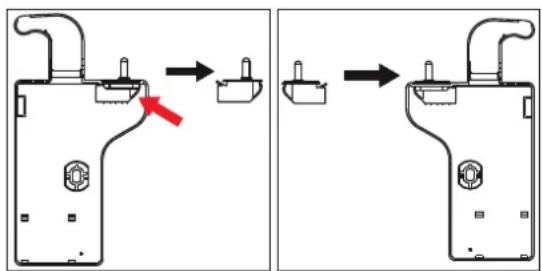
Fig. 3 Fig. 4
natural_image
Simple line drawing of a mechanical setup with a lever and base (no text or symbols)Fig. 5
natural_image
Technical line drawing of a screwdriver inserted into a bracket (no text or symbols)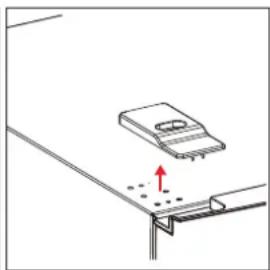
natural_image
Simple line drawing of a device with a red arrow pointing to a component, no text or symbols presentFig. 6 Fig. 7
natural_image
Technical line drawing of a mechanical clamp or bracket assembly (no text or symbols)Fig. 8
natural_image
Technical line drawing of a mechanical frame with two circular components and mounting holes (no text or symbols)Fig. 9
SILVER CREST®
natural_image
Technical diagram showing mechanical assembly with red arrows indicating motion or force direction (no text or symbols)Fig. 10 Fig. 11
natural_image
Mechanical assembly diagram showing four sequential steps of a bracket mechanism (no text or labels)Fig. 12
natural_image
Mechanical assembly diagram showing a valve mechanism with four stages of assembly (no text or labels)Fig. 13
natural_image
Technical line drawing of a mechanical bracket or clamp assembly (no text or symbols)Fig. 14
natural_image
Technical line drawing showing a screwdriver mounted on a bracket and a separate mechanical bracket assembly (no text or symbols)Fig. 15 Fig. 16
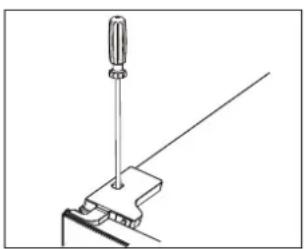
natural_image
Simple line drawing of a screwdriver inserted into a clamp or bracket (no text or symbols)Fig. 17

ADVARSEL! Brandfare!
natural_image
Simple line drawing of a tool or bracket with a screwdriver inserted, no text or symbols presentFig. 1
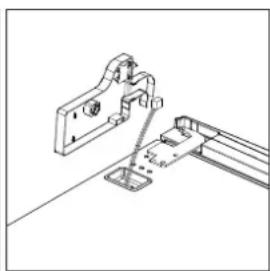
natural_image
Technical line drawing of a mechanical bracket assembly with mounting holes and a base plate (no text or symbols)Fig. 2
SILVER CREST®
natural_image
Pure mechanical component diagram without any text, numbers, or symbols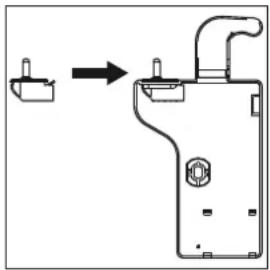
natural_image
Diagram showing a mechanical device with a lever and two ports, no text or symbols presentFig. 3 Fig. 4
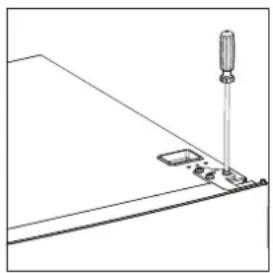
natural_image
Pure technical line drawing of a mechanical assembly with a screwdriver and base component (no text or symbols)Fig. 5
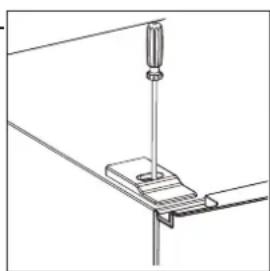
natural_image
Technical line drawing of a mechanical clamp or bracket assembly (no text or symbols)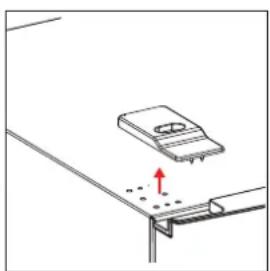
natural_image
Simple line drawing of a device on a table with a red arrow indicating motion (no text or symbols)Fig. 6 Fig. 7
natural_image
Technical line drawing of a mechanical clamp or bracket assembly (no text or symbols)Fig. 8
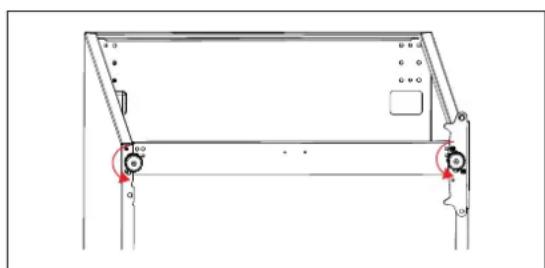
natural_image
Technical line drawing of a mechanical frame with two circular components and mounting holes (no text or symbols)Fig. 9
natural_image
Technical diagram showing mechanical assembly with red arrows indicating rotation or movement (no text or symbols)Fig. 10 Fig. 11
natural_image
Mechanical assembly diagram showing four sequential steps of a bracket mechanism with mounting holes and adjustment arrows (no text or labels)Fig. 12
natural_image
Mechanical assembly diagram showing four stages of a mechanical component with no visible text or symbolsFig. 13
natural_image
Technical line drawing of a mechanical bracket assembly (no text or symbols)Fig. 14
natural_image
Technical line drawing showing a screwdriver inserted into a bracket with mounting holes, alongside a close-up of the bracket detail (no text or symbols)Fig. 15 Fig. 16
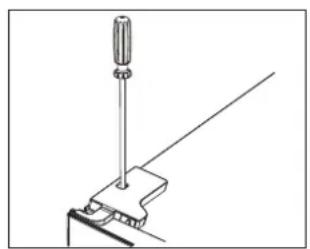
natural_image
Simple line drawing of a screwdriver holding a tool, with no text or symbols present.Fig. 17

- KÜHL-/GEFRIERKOMBINATION / FRIDGE FREEZER / RÉFRIGÉRATEUR-CONGÉLATEUR SKGK 323 A1
- FR BE
- Inhaltsverzeichnis
- Einführung 7
- SILVER CREST®
- Proper use 38
- Safety instructions 39
- Package contents 44
- Description of components 44
- Recommended food storage 45
- Technical specifications....45
- EU declaration of conformity 47
- Spare parts......47
- Information on the appliance 47
- Before operation 48
- Operating the appliance 52
- Door alarm 54
- Optimising energy consumption....54
- Deep-freezing food....54
- Storing food in the refrigerator compartment 55
- Cleaning and defrosting 56
- Replacing the interior light 57
- Faults....57
- Measures in case of power failure....57
- Troubleshooting....58
- Longer periods without use....58
- Transport....59
- Disposal....59
- Legal notice 60
- Information on trademarks....60
- MLAP GmbH Warranty 60
- Service....61
- Privacy statement 62
- Introduction
- Information about this user manual
- Explanation of symbols
- DANGER!
- WARNING!
- NOTICE!
- SILVERCREST®
- Packaging material label regarding waste separation
- Proper use
- Safety instructions
- Risk of choking and suffocation!
- General safety instructions
- Risk of injury!
- Risk of fire!
- Transport
- CAUTION!
- Possible material damage!
- Installation and electrical connection
- Location
- Before connection
- Risk of electric shock!
- Mains connection
- Use of the appliance
- Risk of explosion!
- Risk of injury/risk to health!
- Cleaning and maintenance
- Risk of explosion and fire!
- Faults
- Disposal
- Risk of choking and suffocation! Risk of injury!
- Package contents
- Description of components
- See Fig. A
- See Fig. B
- See Fig. C
- Recommended food storage
- Technical specifications
- Product data sheet
- EU declaration of conformity
- Spare parts
- Information on the appliance
- Information regarding refrigerant R-600a
- Before operation
- Changing the door hinge
- Setting up the appliance
- Inserting/removing accessories
- Inserting/removing freezer drawers/vegetable drawer/crisper drawer
- Removing glass shelves / glass covers
- Inserting glass shelves / glass covers
- Removing/inserting door compartments
- Egg tray
- Operating the appliance
- Setting the temperature
- Refrigerator compartment:
- Effects of storage on food
- Crisper drawer:
- Freezer compartment:
- ECO mode
- Super freezing mode
- Custom operation
- Switching off the appliance
- Door alarm
- Optimising energy consumption
- Deep-freezing food
- Using ice cube trays
- Defrosting food
- Storing food in the refrigerator compartment
- Cleaning and defrosting
- Risk to health!
- Defrosting
- Cleaning the appliance
- Replacing the interior light
- CAUTION! Risk of injury/damage to the appliance!
- Faults
- WARNING! Risk of electric shock!
- Measures in case of power failure
- Troubleshooting
- Longer periods without use
- Transport
- CAUTION! Risk of injury!
- Disposal
- Packaging
- Appliance
- Legal notice
- Information on trademarks
- MLAP GmbH Warranty
- Conditions of warranty
- Warranty period and legal claims for defects
- Scope of warranty
- Processing of warranty claims
- Service
- IE Service Ireland
- NI Service North Ireland
- Supplier/Producer/Importer
- Privacy statement
- Sommaire
- Introduction......65
- ADVARSEL! Brandfare!
Brand : SILVERCREST
Model : SKGK 323 A1
Category : Refrigerator-freezer