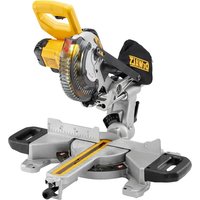
DW870 - Saw DEWALT - Free user manual and instructions
Find the device manual for free DW870 DEWALT in PDF.


User questions about DW870 DEWALT
0 question about this device. Answer the ones you know or ask your own.
Ask a new question about this device
Download the instructions for your Saw in PDF format for free! Find your manual DW870 - DEWALT and take your electronic device back in hand. On this page are published all the documents necessary for the use of your device. DW870 by DEWALT.
USER MANUAL DW870 DEWALT
383823-01/DW870 5/3/02 1:33 PM Page 1



383823-01/DW870 5/3/02 1:33 PM Page 2
DeWALT Industrial Tool Co., 701 East Joppa Road, Baltimore, MD 21286
Printed in China (MAY00-1) Form No. 383823-01
DW870 Copyright © 2000
The following are trademarks for one or more DeWALT power tools: the yellow and black color scheme; the "D" shaped air intake grill; the array of pyramids on the handgrip; the kit box configuration; and the array of lozenge-shaped humps on the surface of the tool.
Questions? See us on the World Wide Web at www.dewalt.com
INSTRUCTION MANUAL GUIDE D'UTILISATIONMANUAL DE INSTRUCCIONES
INSTRUCTIVO DE OPERACION, CENTROS DE SERVICIO Y POLIZA DE GARANTIA. ADVERTENCIA: LEASE ESTE INSTRUCTIVO ANTES DE USAR EL PRODUCTO.

DW870
14" (355 mm) Heavy Duty Chop Saw
Scie fendeuse de 355 mm (14 po) et de service intensif
Cortadora de metales de 355 mm (14")
IF YOU HAVE ANY QUESTIONS OR COMMENTS ABOUT THIS OR ANY DEWALT TOOL, CALL US TOLL FREE AT: 1-800-4-DewALT (1-800-433-9258)
WARNING: FOR YOUR OWN SAFETY READ INSTRUCTION MANUAL BEFORE OPERATING CHOP SAW.
Important Safety Instructions
WARNING! Read and understand all instructions. Failure to follow all instructions listed below may result in electric shock, fire and/or serious personal injury.
SAVE THESE INSTRUCTIONS
- KEEP GUARDS IN PLACE and in working order.
- REMOVE ADJUSTING KEYS AND WRENCHES. Form habit of checking to see that keys and adjusting wrenches are removed from tool before turning it on.
- KEEP WORK AREA CLEAN. Cluttered areas and benches invite injuries.
- DON'T USE IN DANGEROUS ENVIRONMENT. Don't use power tools in damp or wet locations, or expose them to rain. Keep work area well lighted.
- KEEP CHILDREN AWAY. All visitors should be kept at a safe distance from work area.
- MAKE WORKSHOP KID PROOF with padlocks, master switches, or by removing starter keys.
- DON'T FORCE TOOL. It will do the job better and safer at the rate for which it was designed.
USE RIGHT TOOL. Don't force tool or attachment to do a job for which it was not designed. - USE PROPER EXTENSION CORD. Make sure your extension cord is in good condition. When using and extension cord, be sure to use one heavy enough to carry the current your product will draw. An undersized cord will cause a drop in line voltage resulting in loss of power and overheating. The following table shows the correct size to use depending on cord length and nameplate ampere rating. If in doubt, use the next heavier gage. The smaller the gage number, the heavier the cord.
Minimum Gage for Cord Sets
Volts Total Length of Cord in Feet
120V 0-25 26-50 51-100 101-150
240V 0-50 51-100 101-200 201-300
Ampere Rating
More Not more American Wire Gage
Than Than
| 0 | - | 6 | 1 | 8 | 1 | 6 | 1 | 6 | 1 | 4 |
| 6 | - | 10 | 18 | 16 | 14 | 12 | ||||
| 10 | - | 12 | 16 | 16 | 14 | 12 | ||||
| 12 | - | 16 | 14 | 12 | Not Recommended | |||||
- WEAR PROPER APPAREL. Do not wear loose clothing, neckties, rings, bracelets, or other jewelry which may get caught in moving parts. Nonslip footwear is recommended. Wear protective hair covering to contain long hair. Air vents often cover moving parts and should also be avoided.
- ALWAYS USE SAFETY GLASSES. Also use face or dust mask if cutting operation is dusty. Everyday eyeglasses only have impact resistant lenses, they are not safety glasses.
- SECURE WORK. Use clamps or a visse to hold work when practical. It's safer than using your hand and it frees both hands to operate tool.
DON'T OVERREACH. Keep proper footing and balance at all times. - MAINTAIN TOOLS WITH CARE. Keep tools sharp and clean for best and safest performance. Follow instructions for lubricating and changing accessories.
- CONNECT TOOLS before servicing; when changing accessories, such as blades, bits, cutters, and the like.
- REDUCE THE RISK OF UNINTENTIONAL STARTING. Make sure switch is in off position before plugging in.
- USE RECOMMENDED ACCESSORIES. Consult the instruction manual for recommended accessories. The use of improper accessories may cause risk of injury to persons.
- NEVER STAND ON TOOL. Serious injury could occur if the tool is
tipped or if the cutting tool is unintentionally contacted.
- CHECK DAMAGED PARTS. Before further use of the tool, a guard or other part that is damaged should be carefully checked to determine that it will operate properly and perform its intended function — check for alignment of moving parts, binding of moving parts, breakage of parts, mounting, and any other conditions that may affect its operation. A guard or other part that is damaged should be properly repaired or replaced.
- DIRECTION OF FEED. Feed work into a blade or cutter against the direction of rotation of the blade or cutter only.
- NEVER LEAVE TOOL RUNNING UNATTENDED, TURN POWER OFF. Don't leave tool until it comes to a complete stop.
- REPLACEMENT PARTS. When servicing use only identical replacement parts.
- TO REDUCE THE RISK OF ELECTRIC SHOCK, this equipment may have a polarized plug (one blade is wider than the other.) This plug will fit in a polarized outlet only one way. If the plug does not fit, contact a qualified electrician to install the proper outlet. DO NOT CHANGE THE PLUG IN ANY WAY.
- The tool may be equipped with a 3-prong grounding type plug. This plug is to be used in a grounded outlet only. If the plug does not fit, contact a qualified electrician to install the proper outlet. DO NOT CHANGE THE PLUG IN ANY WAY.
Additional Safety Rules for Chop Saw
Always wear safety goggles or other eye protection when using this tool.
Before using, inspect each cutting wheel for cracks or flaws. If a crack or flaw is evident— discard the wheel! The wheel should also be inspected whenever you think the tool may have been dropped.
- When starting the tool (with a new or replacement wheel installed) place the tool in a well protected area. If the wheel has an undetected crack or flaw, it should burst in less than one minute. Never start the tool with a person in line with the wheel. This includes the operator.
- In operation, avoid bouncing the wheel or giving it rough treatment. If this occurs, stop the tool and inspect the wheel.
English
- Clean your chop saw periodically following the procedure in this manual.
- Do not remove wheel guard.
- ALWAYS USE THE VISE OR SPECIAL FIXTURE TO CLAMP WORK SECURELY. Other aids such as the, spring, bar, or C-clamps may be appropriate for certain sizes and shapes of workpiece. Use care in selecting and placing these clamps and make a dry run before making a cut.
- Use only 14" type 1 wheels rated at 4100 rpm or higher.
- Allow cut off parts to cool before handling.
- Do not attempt to cut wood or plastic with this tool.
NEVER CUT MAGNESIUM WITH THIS TOOL. - Use chop saw in a well-ventilated area.
- Turn chop saw off before removing any pieces from the base.
- DO NOT CUT ELECTRICALLY LIVE MATERIAL.
- NEVER USE A CIRCULAR SAW BLADE IN THIS CHOP SAW do not use toothed blades.
DO NOT OPERATE THIS TOOL NEAR FLAMMABLE LIQUIDS, GASES OR DUST. Sparks or hot chips from cutting or arcing motor brushes may ignite combustible materials. - Do not use the side of the abrasive wheel as a deburning grinder. This will substantially weaken the wheel creating an unsafe condition. The wheel may come apart.
A. CAUTION: Wear appropriate hearing protection during use. Under some conditions and duration of use, noise from this product may contribute to hearing loss.
WARNING: Some dust created by power sanding, sawing, grinding, drilling, and other construction activities contains chemicals known to cause cancer, birth defects or other reproductive harm. Some examples of these chemicals are:
- lead from lead-based paints,
crystalline silica from bricks and cement and other masonry products, and - arsenic and chromium from chemically-treated lumber (CCA).
Your risk from these exposures varies, depending on how often you do
this type of work. To reduce your exposure to these chemicals: work in a well ventilated area, and work with approved safety equipment, such as those dust masks that are specially designed to filter out microscopic particles.
- Avoid prolonged contact with dust from power sanding, sawing, grinding, drilling, and other construction activities. Wear protective clothing and wash exposed areas with soap and water. Allowing dust to get into your mouth, eyes, or lay on the skin may promote absorption of harmful chemicals.
Power Supply
Be sure your power supply agrees with the nameplate marking. 120 volts, "60 Hz" means alternating current (normal 120 volt, 60 Hz house current).
A voltage decrease of more than 10% will cause a loss of power and overheating.
Cutting Capacity
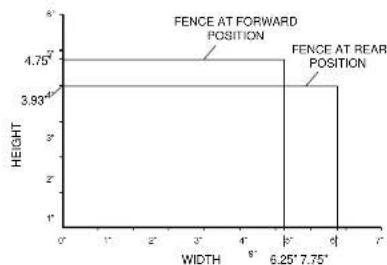
The wide vise opening and high pivot point provide cutting capacity for many large pieces. Use the cutting capacity chart to determine total maximum size of cuts that can be made with a new wheel.
CAUTION: CERTAIN LARGE, CIRCULAR OR IRREGULARLY SHAPED OBJECTS MAY REQUIRE ADDITIONAL HOLDING MEANS IF THEY CANNOT BE HELD SECURELY IN VISE. CAUTION: DO NOT CUT MAGNESIUM WITH THIS TOOL.
Maximum Cutting Capacity
NOTE: CAPACITY SHOWN ON CHART ASSUMES NO WHEEL WEAR AND OPTIMUM FENCE POSITION.
Standard Equipment
1 14" Metal Cutting Abrasive Wheel. Use only high strength Type 1 organic bonded wheels rated 4,100 rpm or higher.(Aluminum Oxide)
1 Wheel Wrench
383823-01/DW870 5/3/02 1:33 PM Page 7
To Carry
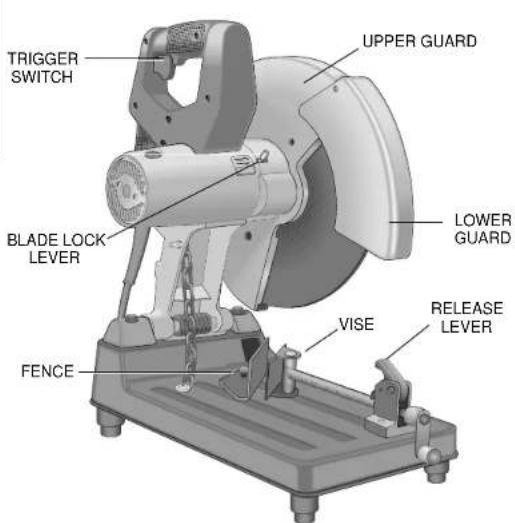
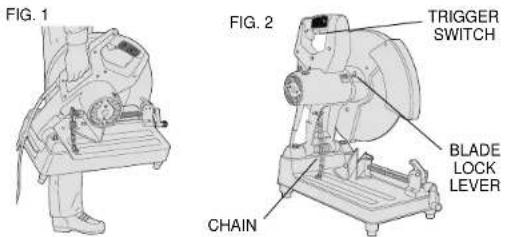
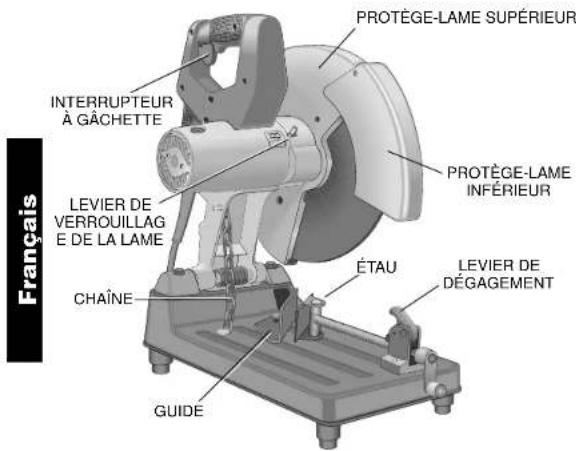
Fold down unit to position where you can attach chain to pin on tool arm (Fig. 1).
UnlockING
To unlock tool and raise head, depress motor arm slightly and remove chain. Motor arm will then pivot upward (see Figure 2).
Material Clamping and Supporting
- Angles are best clamped and cut with both legs resting against base
- A spacer block slightly narrower than the work space can be used to increase wheel utilization.
- Long workpieces must be supported by a block so it will be level with top of base. The cut off end should be free to fall downward to avoid wheel binding.
Vise Operation
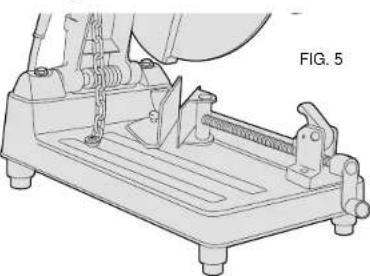
Vise has a quick travel feature. To release the vise when it is clamped tightly, turn the crank counterclockwise one or two times to remove clamping pressure. Lift vise lever up. Pull crank assembly out as far as desired. Vise may be shoved into work without cranking. Lower vise lever then tighten vise on work by using crank (see Figure 5).
4

To Adjust Vise Stop
CUTTING ANGLE
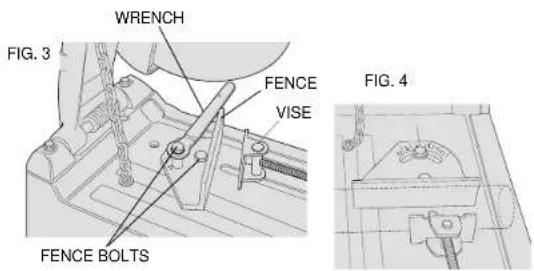
Use the wrench to loosen the two hex bolts (Fig. 3). (Do not remove the bolts). The fence can be rotated in either direction. Securely tighten both the bolts before use.
Switch
To start the tool.
depress the trigger switch shown in Figure 2. To turn the tool off, release the trigger switch. Keep hands and material from wheel until it has coasted to a stop.
Removal and Installation of Wheels
- Be sure tool is disconnected from power supply.
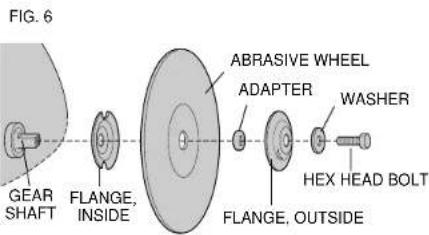
- Push in wheel lock lever (Figure 6) and rotate wheel by hand until wheel lock lever engages slot in inside flange to lock wheel. Loosen the bolt counterclockwise in the center of the abrasive wheel with the 8mm hex wrench found in the holder in the base. Bolt has right hand thread.
- Remove the bolt, washer, outside flange, adapter and old wheel (Fig. 10).
- Install the new abrasive wheel by reversing the above steps. Make sure the adapter is on the shaft and centered on the wheel.
- Do not over tighten bolt.
DO NOT MAKE ANY ADJUSTMENT WHILE THE WHEEL IS IN MOTION.
DO NOT MAKE ANY ADJUSTMENT WHILE CHOP SAW IS PLUGGED INTO POWER SUPPLY.
WARNING: CHECK THE WORK SURFACE THAT THE CHOP SAW RESTS ON WHEN REPLACING WITH A NEW ABRASIVE WHEEL. IT IS POSSIBLE THAT THE WHEEL MAY CONTACT ANY ITEMS OR STRUCTURE THAT EXTENDS ABOVE WORK SURFACE (UNDER THE BASE) WHEN THE ARM IS FULLLY LOWERED.
Procedure For Permanent Mounting
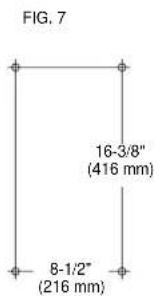
- Drill four holes, 5 / 16^ diameter minimum, through the work surface (Fig. 7).
- Remove screws from feet.
- Insert 1/4-20 screws through underside of work surface, through feet, into holes in tool base. The proper screw length is equal to the thickness of the work surface plus 1 inch (25 mm).
CRADLE MOUNTING
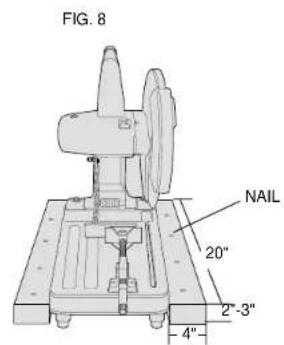
- Cut two boards approximately 20" long x 2" high x 4" wide.
- Place chop saw at desired work location.
- Place boards tightly along side, and nail to work surface, (Figure 8).
Motor Brush Inspection and Replacement
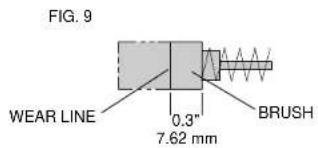
Be sure tool is unplugged before inspecting brushes. Brushes should be regularly inspected for wear. To inspect brushes, unscrew the two end cap screws and remove end cap. To remove each brush, first unplug the shunt wire terminal connection. Then carefully back the brush spring out of the brush box and remove brush. Brushes should slide freely in brush box. If brushes are worn down to 3^ they should be replaced (see Figure 9). To reinstall each brush carefully back the spring out of the brush box, insert the brush and return the spring making sure it is pressing on the brush and not touching the brush box. Then replace the end cap and two screws.
Operation Tips for More Accurate Cuts
- Allow the wheel to do the cutting. Excessive force will cause the wheel to glaze reducing cutting efficiency and/or to deflect causing inaccurate cuts.
- Adjust fence angle. (Figure 3)
Make sure material is laying flat across base. - Properly clamp material to avoid movement and vibration.
Cleaning
Blowing dust and grit out of the main housing by means of an air hose is recommended and may be done as often as dirt is seen collecting in and around the air vents.
Accessories
Recommended accessories for use with your tool are available at extra cost from your local dealer or authorized service center. If you need assistance in locating any accessory for your tool, contact: DrWALT Industrial Tool Co., 701 East Joppa Road, Baltimore, MD 21286
CAUTION: The use of any other accessory not recommended for use with this tool could be hazardous.
Important
To assure product SAFETY and RELIABILITY, repairs, maintenance and adjustment should be performed by authorized service centers or other qualified service organizations, always using identical

replacement parts. ALWAYS WEAR SAFETY GLASSES, ALWAYS SECURE WORK IN VISE. DISCONNECT TOOL FROM POWER SUPPLY BEFORE CHANGING WHEEL.
Lubrication
Closed-type, grease-sealed ball bearings are used throughout. These bearings have sufficient lubrication packed in them at the factory to last the life of the chop saw.
Gears should be relubricated every 60 to 90 days, depending upon use. This lubrication should only be attempted by experienced power tool repair persons like the mechanics at D'WALT service centers. The gear case should be wiped clean and 1/2 oz. (16 grams) of D'WALT Lubricant Part No. 790206 (6 oz. tube) placed in the gear case.
Full Warranty
DeWALT heavy duty industrial tools are warranted for one year from date of purchase. We will repair, without charge, any defects due to faulty materials or workmanship. For warranty repair information, call 1-800-4-DeWALT. This warranty does not apply to accessories or damage caused where repairs have been made or attempted by others. This warranty gives you specific legal rights and you may have other rights which vary in certain states or provinces.
In addition to the warranty, DeWALT tools are covered by our: 30 DAY NO RISK SATISFACTION GUARANTEE
If you are not completely satisfied with the performance of your DeWALT heavy duty industrial tool, simply return it to the participating seller within 30 days for a full refund. Please return the complete unit, transportation prepaid. Proof of purchase may be required.
FREE WARNING LABEL REPLACEMENT: If your warning labels become illegible or are missing, call 1-800-4-DEWALT for a free replacement.


Trouble Shooting Guide
TROUBLE! TOOL WILL NOT START
WHAT'S WRONG? WHAT TO DO...
- Tool not plugged in. 1.Plug in saw.
- Fuse blown or circuit breaker tripped. 2.Replace fuse or reset circuit breaker.
- Cord damaged. 3. Have cord replaced by authorized service center 4. Brushes worn out. 4. Have brushes replaced by qualified service p
TROUBLE! TOOL MAKES UNSATISFACTORY CUTS
WHAT'S WRONG? WHAT TO DO.
1. Glazed wheel, 1. Dress the wheel or replace with a new one.
2. Workpiece incorrectly placed or clamped. 2.Firmly clamp and support workpiece.
TROUBLE! BLADE DOES NOT COME UP TO SPEED
WHAT'S WRONG? WHAT TO DO...
1. Extension cord too light or too long. 1.Replace with adequate size cord. See chart on page 2.
2. Low voltage. 2.Contact your electric company
3. Low generator voltage. 3. Check generator output voltage. Reduce number of tools powered by the generator.
TROUBLE! TOOL VIBRATES EXCESSIVELY DURING CUT
WHAT'S WRONG? WHAT TO DO...
1. Tool not mounted securely to stand or work bench.
2. Damaged wheel. 2.Replace wheel
3. Workpiece not clamped properly.
TROUBLE! DOES NOT MAKE ACCURATE CUTS
WHAT'S WRONG? WHAT TO DO.
1. Fence not adjusted correctly.
2.Wheel is not square to fence.
3. Excessive force used to make cut.
4. Work piece moving.
TROUBLECANNOTMOVEABM
WHAT'S WRONG? WHAT TO DO?
1. Auto-retracting wheel guard will not move
2. Chain is engaged. 2.Push down slightly on the arm, remove chain from pin. Raise arm.
TROUBLEMATERIAL MOVES DURING CUT
WHAT'S WRONG? WHAT TO DO...
- Fence slipping or workpiece incorrectly placed or clamped.
- Vise too loose
- Excessive cutting force.
1.Tighten all mounting hardware. See page 5, Procedures for Permanent Mounting.
3.Refer to Material Clamping and Supporting page 4.
- Check and adjust. See Fence Operation on page 5.
- Check and adjust.
- Reduce cutting force, let the wheel do the work.
- Clamp workpiece securely. See Material Clamping and Supporting page 4. Make sure material is laying flat against the base.
SI VOUS AVEZ DES QUESTIONS OU VOULEZ NOUS FAIRE PART DE VOS COMMENTAIES CONCERNANT CET OUTIL OUT TOUT AUTRE OUTIL DEWALT, COMPOSEZ SANS FRAIS LE : 1800 433-9258.
AVERTSEMENT :POUR ASSURER VOTRE PROTECTION, LIRE LE MANUEL D'UTILISATION AVANT DE FAIRE FONCTIONNER L'OUTIL
PROBLÉME:L'OUTIL NE DEMARRE PAS
QUE SE PASSE-T-IL? QUOI FAIRE...
PROBÉME: L'OUTIL NE COUPE PAS AVEC PRECISION
OUESE PASSE-T-IL2OUOLEAIRE